
by Legalnaija | Aug 22, 2021 | Uncategorized

On Monday 16th August, 2021, President Mohammadu Buhari signed the Petroleum Industry Bill (PIB) 2021 into law thereby replacing the Petroleum Industry Bill 2020. The oil and gas industry is a highly important part of the nation’s economy as it contributes about 60% of the total income of the nation. Therefore, it is only pertinent that national matters or anything pertaining to this industry be taken very seriously. What does the assenting of this new law signify? The dawn of a new era in the way oil and gas business is run in Nigeria.
The PIB is a combination of various Nigerian laws on petroleum i.e. the monetization and protection of the nation’s oil and gas resources and it has gone through several changes since its creation in 2008. One of the benefits of a new Petroleum Industry Bill include increased investment opportunities as the industry will be more regulated and thus attractive due to these changes. Another major benefit of the enactment of a new PIB is to ensure that every official and institution in the industry fully understands their responsibilities and are able to fulfill their roles in such a way that the NNPC becomes a highly lucrative commercial endeavor. The creation of a new set of petroleum laws an imperative action that is long overdue because the old laws were no longer environmentally compliant and most of them were not globally competitive.
The move towards enacting this new law is a laudable one even though there is really no provision on transitioning from the current usage of fossil fuel to clean renewable energy as seems to be the global trend.
Below are some of the key changes that have been made to the Petroleum Industry Bill 2021:
- Establishment of a fund for the exploration of unassigned frontier basins across the country such as Chad Basin, Sokoto Basin and Benue Trough. This fund is 30% of Profit from oil and gas sale made by NNPC Limited.
- Creation of the National Petroleum Corporation Limited to be incorporated under the Companies and Allied Matters Act within six months of the bill coming into effect. The institution now has to work like any other organization aimed at making money with the exception that ownership of shares is held by the Ministries of Finance and Petroleum on behalf of the vested owner, the government. NNPC automatically becomes NNPC Limited with all the interests, assets and liabilities transferred to the new company and all its employees consequently becoming its workers too.
- Creation of a Host Communities Development Trust Fund to be registered under the Companies and Allied Matters Act after 12 months of the commencement of the bill.
- Regulation of the Oil and Gas industry by The Nigerian Upstream Regulatory Comission (“The Commission”) and The Nigerian Midstream and Downstream Petroleum Regulatory Authority (“The Authority”).
- Management of Environmental and Gas Flare depending on the size of operation and the risk involved.
- Creation of New Licenses which are the Petroleum Prospecting Licence, Petroleum Mining Lease and Petroleum Exploration Licence.
- Voluntary agreement between buyers and sellers on gas prices even though regulation is still a function of The Authority.
- The Commission and The Authority are both to be run by a Governing Board who will handle general administration and other policy-related matters.
- Permission of companies with refining license as well as international credibility for trading in petroleum products to import any product shortfall that goes unmet by local refineries.
- Limitation of the discretionary powers of the Minister of Petroleum to grant and revoke licenses. This power is now subject to the recommendations of The Commission.
- Creation of other funds such as Environmental Remediation Fund based on size of operations, Decommissioning/Abandonment Fund based on periodic appraisals and Midstream and Downstream Gas Infrastructure Fund which is slated at 0.5% of wholesale price of petroleum and natural gas products sold in Nigeria.
- Calculation of Royalty based on price and production even though Nigerian refineries have preferential royalty rates.
In conclusion, it is obvious that the changes that have been made to the Petroleum Industry Bill are much needed in keeping with the times and current world practices. The provisions contained in the new Bill as drafted by the National Assembly are quite commendable but like all newly enacted laws, we cannot begin to guage how effective the laws will be if we have not implemented or enacted them. Other than that, the motives behind the creation of the bill and the enactment itself promise a very exciting development in the oil and gas industry.
References
Ajayi Adewale (2021) Petroleum Industry Bill (PIB) 2021 – A Game Changer? KPMG Nigeria. Available at https://www.mondaq.com/nigeria/oil-gas-electricity/1093178/petroleum-industry-bill-pib-2021–a-game-changer-update
Thomas David (2021). What you need to know about Nigeria’s Petroleum Industry Bill. African Business Blog. Available at https://african.business/2021/07/energy -resources/what-you-need-to-know-about-nigerias-petroleum-industry-bill/
Bakare Majeed (2021) What you need to know about proposed law to regulate Nigeria’s oil industry. Premium Times blog. Available at https://www.premiumtimesng.com/news/headlines/472172-pib-what-you-need-to-know-about-proposed-law-to-regulate-nigerias-oil-industry.hyml
Olajumoke Ogunfowora
@AOCSolicitors
www.aocsolicitors.com.ng

by Legalnaija | Aug 22, 2021 | Uncategorized
Repatriation: To send back to one’s own country.
Repatriation has been defined as the act of making amends for a wrong. According to Black’s law dictionary, 9th edition 1325. It is a compensation for an injury or wrong especially for wartime damages for a breach of international obligation. It seeks to mitigate harm caused because of a loss of opportunity and compensate the claimant for the loss caused.
Restitution, on the other hand is quite similar to repatriation as they both involve the idea of restoration but it is more concerned with recovery as opposed to compensation for the loss suffered. The relief granted to the original owner of the property is usually measured in view of the loss suffered by the owner and not the unjust enrichment of the other party.
Nigeria has recently been involved in negotiations for the return of its cultural items/artworks acquired during the colonial era through force of arms and deception. In 2014, the Boston Globe reported an arrangement by the Museum of Fine Arts to return eight (8) Nigerian artifacts that were illegally taken to the United States some decades ago.
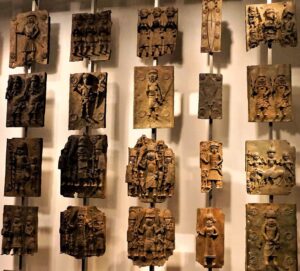
The Benin bronzes which were carted away by the British Government in their punitive expedition of on Benin City in 1897 are on the verge of being repatriated back to Nigeria from Germany. Germany has the second-largest collection of Benin bronzes in the world and has agreed to return over two thousand bronzes back to the country to be housed in a new museum in Benin City, Nigeria by 2022.
With respect to cultural heritage, repatriation is a key concept that must be practiced when unjust enrichment occurs to or loss is suffered by one party.
Cultural heritage as defined by the United Nations is the mirror of a country’s history, thus lying within the very core of its existence, since it represents not only specific values and traditions, but also a unique way a people perceives the world.
Cultural heritage is incredibly vital in any community or nation in that it is not just ornamentally significant but also economically relevant in the global antiquities market. Therefore, the current move by the German government to restore the Benin Bronzes to the rightful owners seems to be a highly commendable one and to be emulated by other nations with respect to illegal possession of another country’s cultural heritage.
A few laws and international conventions have been enacted which seek to prevent prohibit and prosecute illegal importation of cultural artifacts. These include the 1970 UNESCO Convention (on the Means of Prohibiting and Preventing the Illicit Import, Export and Transfer of Ownership of Cultural Property); The 1954 Convention on the Protection of Cultural Property also known as the Hague Convention; The 1995 UNIDROIT Convention on Stolen or Illicitly Exported Cultural Objects. The only thing that seems to be an issue is the fact that the laws are not retroactive and do not therefore ratify any transaction make before the enactment of the conventions. Other sources of international law with respect to cultural heritage are the Resolutions of the United Nations General Assembly and agreements between nations or regions.
There are however some arguments in existence that seek to validate the lack of repatriation of lost artworks to their original homes. The first is the idea that cultural heritage belongs to all mankind because each group of persons makes cultural contributions to the culture of the world, therefore, it does not matter the current location of the property as long as it is preserved and put on a platform that the whole world can see it. This belief is called cultural internationalism and is predicated on the poverty or ignorance of the owner nations to properly preserve or treat the fragile art works from the effects of natural decay and damage. The result is usually that the nation in possession of the property is usually unjustly enriched from the property at the expense of the rightful owners and that it would be highly difficult for the people who own the cultural artifact to have access to it compared to the country that has taken it.
The second argument is based on cost, specifically litigation cost. Depending on how valuable the cultural property, it is argued that it would cost a lot of money and resources for the source nation (especially if it’s a developing nation) to see to it that the artifacts are brought back. With respect to litigation, it would be relatively expensive to fund and almost impossible to get witnesses to prove what goods were stolen or where exactly they were stolen from seeing as the expatriation occurred somewhere around the 19th century.
As it stands now, there is an ongoing controversy in Nigeria as to where the received Bronze artifacts are to be returned. The Oba of Benin, the Edo state government and the Federal Government of Nigeria have all laid claims to the Benin Bronzes. Key lessons can be taken from the case of Peru v. Johnson, the government of Peru claimed that it was the legal owner of the artifacts seized by the United States Customs Service. The court held that there was no direct evidence that the items came from what is now modern day Peru because the Peruvian culture as at the time of the seizure spanned not only Peru as it is now but also some of the territory that is now Bolivia and Ecuador.
In conclusion, the move to repatriate African art is a highly commendable one by the German government but it should be noted that the exact location for the artifacts to be returned to is crucial to the entire repatriation process as seen in the aforementioned case otherwise the repatriation would end up being forfeited due to the disputing claims from various parties.
References:
- Klesmith, Elizabeth A. (2014) “Nigeria and Mali: The Case for Repatriation and Protection of Cultural Heritage in Post-Colonial Africa, “Notre Dame Journal of International Cooperative law”. Vol 4. Iss. 1, Article 1.
Available at http://scholarship.law.nd.edu/ndjicl/vol4/iss/1
- Larry Mayor Alton Jones, Repatriations, Restitution & Transitional Justice
Available at: http://issi-media.stanford.edu/evnts/6421/85-repatrations,-restitution,-andtransitional-justice.pdf
- Black’s Law Dictionary, 9th edition 1325
- Government of Peru v. Johnson, 720 F. Supp. 810 (C.D. Cal. 1989)
- Chitty on Contract, London Street & Maxwell, 1632 (2004)
@AOCSolicitors
info@aocsolicitors.com.ng
www.aocsolicitors.com.ng

by Legalnaija | Aug 13, 2021 | Uncategorized
What is an Affidavit?
An affidavit is a sworn written statement voluntarily made by a person called a deponent affirming something to be true and which is administered by a person legally authorized to do so. It is an official statement that contains a verification made under oath or affirmation with the understanding that if the statement is found to be untrue or misleading, the deponent could be on penalty of perjury. Affidavits are typically used in courts as evidence or proof. Affidavits are typically used in courts as evidence or proof. The general contents of an affidavit are contained in Section 90 of the Evidence Act.
What is an Affidavit of Change of Name?
An affidavit of change of name is a sworn written document declaring that a person has changed their name from and has discarded the old name. This could be a modification in spelling of a name, an addition of a new name or change of surname which is especially particular to newly married women. Essentially, anybody can change their name as long as they are up to 18 years of age which is the legal age in Nigeria. Note that a change of name would be invalid if it with the intention to commit a crime or to escape a financial obligation or for any other illegal reasons.
How to Use an of Affidavit of Changeof Name
This affidavit is mostly used in the event of a marriage or a divorce. Once an affidavit is sworn to and notarized, the next step for anyone intending to change their name is to make a public declaration in a national newspaper in order to give general notice to anyone concerned. The next step is to inform the relevant authorities and to effect the changes immediately. These relevant authorities include bank officials and other relevant bodies specifically but notlimited to the ones that involve personal identification e.g. passports, national identity cards, driver’s license, etc.
As a newly-wed woman or a recent divorcee who has changed their name to a new one, you need to formally inform the court of this development and to do that, you would need an affidavit. Do not bother yourself with the rigorous details of creating an affidavit from scratch,you can simply download a customizable template on www.legalnaija.com.

by Legalnaija | Aug 13, 2021 | Uncategorized
What is an Affidavit?
An affidavit is a sworn written statement voluntarily made by a person called a deponent affirming something to be true and which is administered by a person legally authorized to do so. It is an official statement that contains a verification made under oath or affirmation with the understanding that if the statement is found to be untrue or misleading, the deponent could be on penalty of perjury. Affidavits are typically used in courts as evidence or proof. Affidavits are typically used in courts as evidence or proof. The general contents of an affidavit are contained in Section 90 of the Evidence Act.
What is an Affidavit of Loss?
An affidavit of loss is a legal statement declaring that a security or certificate or license or any original document has been lost, destroyed, mutilated or stolen.
How to Use an Affidavit of Loss
This document can be used in situations when you lose an important document such as a certificate of stocks and bonds, or more commonly your identity card to a fire, theft, flood or any other situation. Immediately you notice that any of the aforementioned items or your original documents has been misplaced or damaged, it is expedient that you file an affidavit of loss.
Filing an affidavit of loss is necessary in order to prevent someone else in possession of the original document i.e certificate of the stocks and bonds to lay claims to it as the original owner. You must present an affidavit of loss if you are going to be indemnified or have your certificate replaced by the security issuer.
The affidavit of loss should describe the security that has been lost with one or more documents evincing your ownership of the said security. It must give a detailed explanation of the circumstances that led to the loss as well as verify your identity as the owner.
You also need to file a police report in addition to the affidavit as supporting documentation. In order to make it legally binding, the affidavit must be sworn at a court before a commissioner for Oaths or be notarized by a notary public.
If ever any of your personal items or documents gets lost or stolen, you can save yourself the stress of finding where to procure an affidavit of loss by simply downloading a customizable template on Legalnaija.com

by Legalnaija | Aug 13, 2021 | Uncategorized
Contemporary society’s concept of procreation, parental rights as well as child rights have proven to be an evolving continuum with the introduction of Surrogacy as one of the artificial reproductive techniques gaining acceptance in the absence of any legal framework regulating its existence and efficacy among contracting parties in Nigeria. This is another typical allusion where legal and ethical issues lag behind human innovation.
With surrogacy contracts, an infertile couple can rely on an alternative means to adoption, a method which has proven to be more effective than the cumbersome procedure associated with the latter in this part of the world.
Surrogacy contracts involves a tripartite contractual relationship with commissioning parents, the surrogate and a surrogate agency, acting as middleman for the former to secure a surrogate mother who agrees through artificial insemination to conceive, deliver and hand over the baby to the commissioning parents at birth.
The first popular judicial pronouncement on the subject matter of Surrogacy came to light in New Jersey (USA) in the case of Baby M in 1987.
In this case the surrogate mother refused to relinquish parental rights to the commissioning couple after delivery in 1986. Consequently, the commissioning parents contested the parental rights of the surrogate which was already waived by contract. The Supreme Court of New Jersey gave recognition to the surrogate arrangement between the parties, awarding legal custody to the commissioning parents on the rationale that the best interest of the baby was being considered among other things.
The concept of surrogacy has been an intrinsic human reality going back to the story of Abraham, Sarah who secured Hagar’s assistance in the procreation process, albeit biologically, today our legal jurisprudence in some part of the world recognises this medical intervention through, traditional surrogacy; a practice where the surrogate mother contributes genetically to the conception of the baby by a fertilisation of her own eggs via In-Vitro Fertilisation (IVF) (i.e. artificial insemination of the surrogate’s egg with the commissioning father’s semen)[i] and gestational or host surrogacy also known as rent a uterus: a practice where the surrogate mother does not contribute genetically to the conception of the baby. Here, the surrogate is strictly the carrier of the pregnancy. This means that a prior fertilised egg (embryo) is implanted into the uterus of the surrogate and the surrogate carries the pregnancy to full term.
No doubt this emerging trend is fraught with challenges from the perspective of the commercialisation of reproduction, social tussle over a child where the surrogate eventually withdraws from the original arrangement or breaches same all together, which more often, the commissioning parents usually have a stronger bargaining power over the surrogate in accessing judicial intervention or negotiating monetary settlement to possess the child in question, whilst keeping the surrogate at bay[ii].
Some countries like the United Kingdom, France, Bulgaria, Portugal, Italy, Germany, outrightly prohibit surrogacy. While countries like the USA, Canada or Australia, depending on the jurisdiction, allow it, providing for residency or citizenship for the commissioning parents and/or surrogate.
Notwithstanding, legal aspects[iii] of surrogacy hinge on a few central questions:
- Are surrogacy agreements enforceable, void, or prohibited? Does it make a difference whether the surrogate mother is paid (commercial) or simply reimbursed for expenses (altruistic)?
- What, if any, difference does it make whether the surrogacy is traditional or gestational surrogacy?
- Is there an alternative to post-birth adoptionfor the recognition of the intended parents as the legal parents, either before or after the birth?
In a society like Nigeria, where this practice is rarely overt, the surrogate is likely to be isolated once the news spreads in the community since it is in contradistinction with our cultural beliefs to approach procreational intervention through a third party, when a man has the option of being polygamous, in addition to the fact that the surrogate’s medical/obstetrics history is disclosed to the commissioning parents, infringing on the physician – patient confidentiality
With surrogate agencies[iv] emerging in Nigeria as registered companies or business entities, it is important to cover this human phenomenon through judicial pronouncements as well as legislations in consideration of enforceability of such contracts, ethical consideration on non-disclosure, whether it should be an option to legal abortion, import the concept of closed or open adoption to surrogacy, while policy makers should frame regulations sufficiently required to guide the practice of surrogacy in terms of addressing social mores, human rights, parental rights, child rights and intestacy rights (since the child is not the full blood of both parents) in Nigeria.
If ever you choose to resort to surrogacy, endeavour to engage the service of a family lawyer who has expert knowledge on this area of law, to draft a surrogate contract for you or review the contract emanating from the surrogate’s attorney or a surrogate agency, in order to adequately protect your interest and advice on the safety or otherwise of carrying it out in Nigeria or in a jurisdiction where it is recognised. I look forward to hearing from you (my contact details are in my Linkedin profile).
[i] http://www.ajmhs.org/article.asp?issn=2384-5589;year=2014;volume=13;issue=2;spage=105;epage=109;aulast=Umeora
[ii] The surrogate often times is a woman with weak economic means
[iii]en.wikipedia.org
[iv] Meet Surrogate Mothers Agency Limited is a popular example

Adeola Osifeko is a corporate-commercial lawyer with keen interest in Intellectual Property Law, Company Secretaryship and Emerging Practice Areas. She provides legal, business advisory and compliance services to startup companies, firms and non-profit organisations.
Adeola is also a writer and author, as a past time she facilitates for governmental and non-profit organisations.

by Legalnaija | Aug 12, 2021 | Uncategorized
The judicial powers of the Federal Republic of Nigeria are vested in the courts established by Section 6 of the Constitution of the Federal Republic of Nigeria 1999 (as amended). The courts are established for the primary purpose of resolving disputes amongst litigants who approach it for the determination of their civil rights and obligations.
There are three traditional arms of government, viz- the legislature, the executive and the judiciary. The legislature is that arm which is concerned with law making whilst the executive arm of government is concerned with the enforcement of laws and policies. The judiciary interprets laws and resolves disputes. Under the governmental doctrine of separation of powers, each arm of government is not expected to encroach into the activities of the other arms of government.
In the exercise of its constitutional role of dispute resolution, the courts resort to interpretation of existing laws and regulations which are applicable to that dispute. The courts interpret the laws made by the legislature and make pronouncements on the rights of the parties before it. In performing this duty of interpreting the law, the courts are expected to take particular care to ensure that it pronounces on the rights of only the parties before it. This is an inveterate doctrine that has taken root in our jurisprudence and the Supreme Court has emphasized in a plethora of cases that a court is not expected to make a pronouncement in favour of a person who is not before the court as a party/litigant or who was not given the opportunity of being heard.[1]
How Does the Supreme Court Make/Shape Policy?
It is necessary to emphasize as a preliminary point that the Supreme Court of Nigeria is the highest court in Nigeria and its decisions are binding on every person and authorities breathing the air in Nigeria.[2] Under our principle of stare decisis, or judicial precedence, the decisions of the Supreme Court of Nigeria are followed and obeyed by all subordinate courts in Nigeria.[3] Therefore, the pronouncements of the Supreme Court are not only meant for the benefit of the litigants who approach that court, but are also meant for the benefit of all Nigerians including the unborn generations whose rights may be likely affected by the reasoning and logic of the Apex Court. Therefore, although most of the points raised hereunder apply to almost all superior courts of record, the peculiar position of the Supreme Court as the highest court of the land (with nationwide territorial jurisdiction) places its decisions in a position to influence the policy of the entire nation over and above the decisions of the other subordinate courts.
- By Interpreting the Law
Under the principle of separation of powers in our jurisprudence, judges are expected to refrain from “making the law” in the process of adjudication of disputes as this is the exclusive preserve of the legislative arm of government. The Court of Appeal explained this duty with clarity in the case of Action Congress of Nigeria v. Rivers State Independent Electoral Commission & Ors (2013) LPELR-21169(CA) where the Learned Lord Jonah Adah JCA stated the law thus:
“It is trite that Courts do not make laws. They interpret laws. Courts cannot amend the constitution or any part thereof. There is no doubt that under our constitution, the three arms of government in both the Federation and the States are distinct and separate, and each has its functions and powers clearly set out. The judicial powers of the Federation and the States are vested in the Courts established for the Federation and the States respectively. Although the traditional function of the Courts is to interpret, uphold and pronounce what the law is and not what it ought to be, very often judges make useful comments in the course of interpreting a law which later turn out to influence an amendment to that law. See the cases of Global Trans. Oceanica S.A. v. Free Ent. (Nig) Ltd (2001) 5 NWLR (Pt.706) 426; and Asari Dokubo v. F.R.N. (2007) 12 NWLR (Pt. 1048) 320.”
As a corollary to the above, the Supreme Court makes and shapes policy when it is called upon to interpret certain provisions of the Constitution. This is because the route which a court takes when interpreting the provisions of our sacred and organic constitution is different from the route it takes when it is interpreting a mere statute. The Supreme Court explained this role in the case of Marwa v Nyako (2012) 6 NWLR (Part 1296) 199 when it held thus:
“When interpreting the Constitution, the court must bear in mind that it is dealing with an instrument which controls and regulates the powers and functions of government, controls the rights and obligations of the citizen and controls the peace and order of the society upon which the Constitution is supposed to operate. While in an ordinary statute the normal rule is that the terms used must be given the meaning they bore at the passing of the statute, a constitution is intended to be permanent and must be interpreted by looking at the past and according to present conditions in order to fulfil the object and true intent of the Constitution. A Constitution must therefore be interpreted and applied liberally. A Constitution must always be considered in such a way that it protects what it sets out to protect or guides what it set out to guide. By its very nature and by necessity, a constitutional document must be interpreted broadly in order not to defeat the clear intention of its framers.”
Therefore, it is clear that the court has a mandate to ensure that it interprets the provisions of the constitution in such a way that the fundamental rubrics of the society are protected. Although the administration of the country is the near-exclusive preserve of the executive arm of government, this country will also be governed by the pronouncements of the Supreme Court as the rights of every Nigerian would be affected by the interpretation which the Apex Court gives to various provisions of the Constitution; whether liberal or restrictive.
In interpreting the laws of the land and the Constitution, the courts employ several canons of interpretation. Ordinarily, courts are enjoined to make use of the literal rule of interpretation when construing statutes. This is the ground rule. A court of law is meant to give statutes their literal and unambiguous meaning where same is clear.
However, there are times when the intentions of the draftsperson of a law (including the Constitution) is obfuscated and the courts may have to jettison the literal rule of interpretation and adopt other modes of interpretation. It is in the exercise of these constructive modes of interpretation that the policy-making role of the Supreme Court is emphasized. One of the canons of interpretation which accentuates the policy-making role of the Apex Court is the purposive rule of interpretation wherein the courts embark on a jurisprudential odyssey to unveil the unclear purpose for which a legislation was enacted. In doing so, the courts shape (judicial) policy by the application of this liberal rule which would be followed by the lower courts through the inveterate doctrine of stare decisis and also binding on all persons and authorities in Nigeria.
One of the popular instances in which the Supreme Court made use of the purposive rule of interpretation to shape judicial (and labour) policy in Nigeria is in the celebrated case of Skye Bank v Iwu (2017) 16 NWLR (Part 1590) 24 wherein the Apex Court applied this rule of interpretation in unravelling the hitherto ambiguous intention of the framers of the Constitution of the Federal Republic of Nigeria, (Third Alteration) Act (Act No 3), 2010. Prior to this decision of the Apex Court, Nigerians were unclear and confused as to whether there was an existing right of appeal to the Court of Appeal against certain decisions of the National Industrial Court which did not involve questions of fundamental human rights. The Constitution was unclear on whether such right of appeal existed and how it was to be exercised. Litigants who were aggrieved by certain decisions of the National Industrial Court were at loss on how to appeal against these decisions, and the Judges of the said National Industrial Court sometimes saw themselves as overlords of a final court whose decisions are not appealable in certain cases.
To further confuscate the problem, there were conflicting decisions of the Court of Appeal on this issue and there was a need for the Apex Court to step into the arena to clear the ambiguity for the benefit of our labour laws. The Court of Appeal then stated the case of Skye Bank v Iwu to the Apex Court for it to resolve this jurisdictional dilemma.[4] In resolving the forensic issues case stated to it, the Supreme Court refused to share its primacy with the National Industrial Court and held that all decisions of the National Industrial Court of Nigeria are appealable to the Court of Appeal; as of right in matters involving complaints of fundamental rights, and with the leave of court in all other matters. The decision of the Supreme Court in this case of Skye Bank v Iwu helped shaped both labour and judicial policy in the Country. The Learned Justices of the Apex Court who delivered this judgment were mindful of the fact that the National Industrial Court was established to cater for the labour and industrial needs of the Country. Hence, the Apex Court did a fine job in balancing the need for speedy dispensation of justice in labour related disputes and also the need to protect the rights of access to court and fair hearing of litigants who approach the National Industrial Court.
- By Enthroning Substantial Justice
The Supreme Court being the Apex Court in the land is clothed with jurisdiction to determine cases which are of general public interest and capable of shaping the policy of the country or of making policy for the country. The Justices of the Supreme Court wield a special power that enable them to give decisions/judgments that is capable of determining the rights of other Nigerians who are not even before the Court as litigants. For example, in the locus classicus case of Savannah Bank v Ajiloh (1989) 1 NWLR (Pt 97) 305, despite the fact that the forensic dispute at the Supreme Court was between Savannah Bank of Nigeria and David Oni-Orisan on the one hand and Ammel O. Ajilo and Ammels Photo Industries Ltd on the other hand, the Supreme Court essentially determined the rights of millions of Nigerians who hitherto owned statutory interests in land in Nigeria and also shaped the land registration policy which governed the rights of millions of Nigerians who would acquire interest in land in Nigeria after that decision was given.
Consequently, as a result of the far-reaching effect of the decisions of the Supreme Court, the Justices of the Apex Court have always been advised to ensure that they give effect to the enthronement of substantial justice at all times. In the case of Engineering Enterprises Contractor Company of Nigeria v Attorney General of Kaduna State (1987) 2 NWLR (Pt. 57) 381, the Noble Lord Kayode-Eso JSC observed as follows:
“One stream that permeates through all these decisions, and I hold the view that this is a good sign for the administration of justice in this country, is the clear, unadulterated water filed with great concern for the justice of the case. The signs are now clear that the time has arrived that the concern for justice must be the overriding force, and action of the court. I am not saying that ex debito justiciae, by itself is a cause of action, it is to be the basis for the operation of the court, whether in the interpretative jurisdiction or the basic attitude towards the examination of a case.”
The Nigerian Apex Court has adopted with commendable approval, the opinion of the erudite English Jurist, Lord Denning MR, in his book, Family Story, where he postulated at page 174 as follows:
“My root belief is that the proper role of a judge is to do justice between the parties before him. If there is any rule of law which impairs the doing of justice, then it is in the province of the judge to do all he legitimately can to avoid that rule – or even to change it – so as to do justice in the instant case before him. He need not wait for the legislature to intervene because that can never be of help in the instant case. I would emphasize however, the word ‘legitimately’ the judge himself subject to the law and must abide by it.”
Hence, there are instances where the Apex Court can choose to ignore a purported rule of law which would hinder the enthronement of substantial justice, and in doing so, they compel the legislature to make drastic amendments to the law which would favour the polity. A classic example is the decision of the Apex Court in the case of Amaechi v INEC (2008) 5 NWLR (Pt. 1080) 227 which prompted the National Assembly to introduce drastic reforms to the Electoral Act vide an amendment.
- Judicial Review
Similarly, the judiciary is imbued with the power of judicial review. The courts have the inherent power to strike down the provisions of any legislation or custom that is not in conformity with the constitution in the exercise of its interpretive jurisdiction. This exercise of judicial review is tantamount to policy making, as the decisions of the courts shape the lives of millions of Nigeria. For example, in the case of Mojekwu v Mojekwu (1997) 7 NWLR (Part 512) 283, the Court of Appeal struck down a rampant customary law in Eastern Nigeria which hitherto prevented females from inheriting the estate of their deceased fathers. In that case, the Noble Lord Niki Tobi JCA (as he then was) shaped the customary law policy of Nigeria when he held as follows:
“A court of law, being a court of equity as well, cannot invoke a customary law which is repugnant to natural justice, equity and good conscience. The “Oli-ekpe” custom is one of such customs as it permits the son of the brother of a deceased person to inherit the property of the deceased to the exclusion of the deceased’s female child.” (P. 305 @ paras. D-E)
This decision of the Court of Appeal was upheld and affirmed by the Supreme Court in the latter case of Mojekwu v Iwuchukwu (2004) 11 NWLR (Part 883) 196 thereby effectively outlawing this customary practice.
In addition, the Apex Court also exercises its power of judicial review over certain actions of the executive arm of government and shapes policy in doing so. For example, the Supreme Court was notorious for striking down certain ouster clauses in military decrees during the tumultuous decades of military administration in Nigeria, which has now formed the bedrock for the protection of the fundamental right of access to court which is now available to every Nigerian.
- Political Doctrine/Political Tendencies
It is trite that the Judiciary is constitutionally empowered to checkmate the overzealous excesses of the other arms of government. The level of seriousness at which the judiciary would perform this checkmating function can be directly traced to the attitude which the Apex Court approaches such issues. For instance, the Apex Court made it clear by its decision in the cases of Inakoju v Adeleke (2007) 4 NWLR (Pt. 1025) 423 and Governor of Ekiti State & Ors v Prince Sanmi Olubunmo & Ors (2017) 3 NWLR Part 1551 Page 1 that the judiciary would no longer sit by and watch while some rogue elements in the legislature and executive respectively attempt to turn the law on its head or hijack a lacuna in the law to achieve an illegal or immoral purpose.
Prior to the decision in Inakoju v Adeleke (Supra), the courts were shy to dabble into matters dealing with the removal of a governor or deputy governor from office due to the ouster clause in Section 188 (10) of the Constitution and the earlier decisions of the Court of Appeal on this issue. This gave the members of some states Houses of Assembly the imprimatur to resort to all sorts of political trickery and gimmicks in order to remove a sitting Governor from office because they knew such activities would be unchecked by the judiciary. However, the Supreme Court in Inakoju v Adeleke refused to have any of this and laid down the principle that any legislative exercise which purports to impeach a sitting governor or deputy governor from office must be done in strict accordance with the law else the Courts will intervene and set same aside notwithstanding the ouster clause in Section 188 (10) of the Constitution. This decision had a tremendous effect on governance as it has shaped legislative policy against any arbitrary exercise of the powers of checks and balances under Section 188 of the Constitution. The Noble Lord Niki Tobi JSC remarked, quite commendably, in his leading judgment as follows:
“The Legislature is the custodian of a country’s Constitution in the same way that the Executive is the custodian of the policy of Government and its execution, and also in the same way that the Judiciary is the custodian of the construction or interpretation of the Constitution. One major role of a custodian is to keep under lock and key the property under him so that it is not desecrated or abused. The Legislature is expected to pet the provisions of the Constitution like the way the mother pets her day-old baby. The Legislature is expected to abide by the provisions of the Constitution like the way the clergyman abides by the Bible and the Iman abides by the Koran. And so, when the Legislature, the custodian, is responsible for the desecration and abuse of the provisions of the Constitution in terms of patent violation and breach, society and its people are the victims and the sufferers? and in this particular context, the Oyo State society and the respondents, particularly the third respondent. Fortunately, society and its people are not totally helpless as the Judiciary, in the performance of its judicial functions under section 6 of the Constitution, is alive to check acts of violation, breach and indiscretions on the part of the Legislature. That is what I have done in this judgment. I do hope that this judgment will remove the apparent wolf in the appellants as members of the House of Assembly of Oyo State.”
Similarly, in Governor of Ekiti State & Ors v Olubunmo & Ors (Supra), the Apex Court descended heavily on the executive arm of government when the Ekiti State Governor had purported to sack all constitutionally created Local Government Councils in Ekiti State replaced them with caretaker committee whilst relying on Sections 23B(i) and (ii) of the Ekiti State Local Government Administration (Amendment) Law, 2001 as the justification for his action. The Supreme Court in condemning this affront on the Constitution vouchsafed the inviolability of the provisions of Section 7(1) of the Constitution which provides for democratically elected local government councils. Therefore, by virtue of this decision of the Apex Court, no governor can purport to sack any democratically elected local government council in his state for any reason whatsoever without drawing the ire of the judiciary.
The attitude of the Apex Court in descending heavily on the other arms of government in cases like Inakoju and Olubunmo has set down a policy which guides these other arms of government that every exercise of their powers to checkmate the excesses of one another must be done with utmost fealty to the spirit and intendment of the Constitution.
Some Justices of the Apex Court have also unsuccessfully tried to shape (electoral) policy by their dissenting decisions. The recent Imo State and Zamfara State Supreme Court review cases wherein the Applicants in those cases had approached the Supreme Court to review its earlier decision on appeals emanating from the elections conducted in those states are classical examples. The decisions of the Supreme Court have always been immutable since time immemorial and the Apex Court has always been reluctant to review or set aside its own decision which it has earlier given, no matter the extenuating circumstances. However, the Noble Lord Chima Nweze JSC had dissented in both cases, and held on to the view that the Supreme Court should be able to review its earlier decision where it made an apparent error. The dissenting opinions of the Noble Lord Nweze JSC although unpopular at this time, may form the bedrock for a future change in electoral policy in Nigeria. The purpose of such dissenting opinions is to strengthen our law and the administration of justice.
Conclusion
The Justices of the Apex Court must ensure to always be guided by judicial restraint when exercising their policy making roles in the discharge of their duties. Many jurists are of the opinion that the democratic process and legislative enactments which represent the will of the people should direct changes in policy and not judicial activism. Justices of the Supreme Court (and other courts) are appointed and not elected. Hence they do not possess the sovereign will of the people unlike their counterparts in executive and legislative arm of government. However, the judges of the Court have a fundamental duty to right societal wrongs through their interpretation of the law.
This writer ultimately submits that the Justices of the Apex Court should be guided by the fundamental prescription that the Constitution being an organic document should be interpreted in the context of modern life and modern problems.
 Nonso Anyasi is a Lagos-based Legal Practitoner and can be reached via nonsoanyasi@nigerianbar.ng
References
[1] Please see the cases of Alhaji Mudashiru Kokoro-Owo & Ors v. Lagos State Govt & Ors (2001) LPELR- 1699 (SC) and Comrade Mike Alioke v. Dr. Victor Ike Oye & Ors (2018) LPELR-45153(SC).
[2] See Section 281 (7) of the Constitution of the Federal Republic of Nigeria 1999 (as amended).
[3] Aghedo v Adenomo (2018) 13 NWLR (Pt. 1636) 264.
[4] Ordinarily, there is no right of appeal to the Supreme Court over cases emanating from the National Industrial Court, hence, the need to state case this matter to the Apex Court for an effective final determination of the constitutional issue involved.

by Legalnaija | Aug 10, 2021 | Uncategorized

To grow your law practice, you have to be everywhere a potential client may look for you, including online directories, and our Lawyer Directory can be extremely effective. Our legal directory focuses on listing lawyers for the purpose of making it easy for potential clients to search and find a lawyer through their location, area of practice and gender.
The benefits of subscribing to the Directory includes;
- Online visibility for your law practice
- Helps with your Search Engine Optimization
- Helps build trust with clients
- Helps clients find you
- Helps other lawyers who need referrals or collaborations in your jurisdiction.
To take advantage of these benefits, you can subscribe to the Legalnaija Directory by following these simple steps;
- Log on to https://app.legalnaija.com/signup
- Create an account
- Fill in your details, attach any relevant documents and submit for verification (Note that you will not be listed if you do not complete your profile and submit the requested documents for verification).
- You will be notified of your approval and listing via email.
More exciting is that you get a 30 day free trial when you sign up. Note that subscription is 1,000 Naira only monthly, and you have the opportunity to upgrade and become top listed in your location as well. If you have signed up and are also yet to complete your profile and get verified, you should do so now.
Hurry clients are waiting to find you right now!!!
For more information, contact support at hello@legalnaija.com or via @Legalnaija across your social media platforms.
www.legalnaija.com
WhatsApp – 09029755663

by Legalnaija | Aug 8, 2021 | Uncategorized
To grow your law practice, you have to be everywhere a potential client may look for you, including online directories, and our Lawyer Directory can be extremely effective. Our legal directory focuses on listing lawyers for the purpose of making it easy for potential clients to search and find a lawyer through their location, area of practice and gender.
The benefits of subscribing to the Directory includes;
- Online visibility for your law practice
- Helps with your Search Engine Optimization
- Helps build trust with clients
- Helps clients find you
- Helps other lawyers who need referrals or collaborations in your jurisdiction find you
To take advantage of these benefits, simply subscribe to our Lawyers Directory by following these simple steps;
- Log on to https://app.legalnaija.com/signup
- Create an account
- Fill in your details, attach any relevant documents and submit for verification (Note that you will not be listed if you do not complete your profile and submit the requested documents for verification).
- You will be notified of your approval and listing via email.
Note that subscription is 1000 Naira only monthly, and you have the opportunity to upgrade and become top listed in your location as well. More exciting is that you get a 30 day free trial when you sign up.
If you have signed up and are also yet to complete your profile and get verified, you should do so now.
Hurry clients are waiting to find you right now!!!
For more information, contact support at hello@legalnaija.com or via @Legalnaija across your social media platforms.
@Legalnaija
www.legalnaija.com
WhatsApp – 09029755663

by Legalnaija | Jul 30, 2021 | Uncategorized

Famsville Solicitors is delighted to bring to you the Residency and Citizenship Series. This is a series which is aimed at giving you a leverage and insights into how you can, not only ‘japa’ to your desired country, but also to become a citizen of that country.
The maiden edition of this series is coming up on Monday, 2nd of August, 2021.
The topic is: ‘Securing Turkish Citizenship through Citizenship by Investment’.
Turkey is ranked as one of the best countries to live and work in the world. It has a good work-life balance, high standard of living, amongst other benefits.
Register and join us for this event to learn how to become a Turkish citizen through Citizenship by Investment and secure your future.
Registration link is: https://bit.ly/2VxBOLL
Meeting ID: 827 0711 6674
Password: 888882
See you!
#legalnaija #calltobar2021 #nigerianlawyers #immigrationlawyer #japa #naija #relocating #relocation #nigerianyouths #famsville

by Legalnaija | Jul 28, 2021 | Uncategorized

INTRODUCTION.
A Court decides a case on only admissible evidence tendered and admitted before it. When parties and their Counsel prepare for trial, they make a checklist of the documents they intend to rely on and examine the admissibility of these documents. Some of these documents are public documents. A Public document is a vital document in discharging an evidential burden in litigation, hence proof of the contents of a public document is important. Section 102 of the Evidence Act, 2011 provides what a public document is, and proof of such public documents is done by either by producing the document itself, that is the original copy (primary evidence, see section 86 of the Evidence Act, 2011) or by producing a certified true copy of the public document (secondary evidence, see Sections 87(a), 89(e) and 90(1)(c) of the Evidence Act, 2011).
When the original copy of the public document is in the possession of the party, there is no problem, however, when it is not, parties encounter difficulty in getting a certified true copy. Some of these difficulties range from the expense in certifying the documents, the delay in getting the document certified from the government institution which delays the trial of the case, and in worse case scenarios refusal to certify the document by the government institution. These creates some legal problems for parties and their Counsel. In finding a solution to the problem of getting a certified true copy, trial lawyers tender a photocopy of a certified true copy or subpoena the government official, and in cases of a trial by affidavit evidence or interlocutory applications, canvassed the argument that the document forms part of the affidavit so doesn’t need to be certified. These legal ingenuities have sometimes been rejected by the Court.
ANALYSIS OF THE DECISIONS OF THE COURT.
In the case of a photocopy of a certified true copy, there are conflicting authorities on whether such is admissible. The two leading authorities on this issue are the Supreme Court’s decision in Minister of Lands, Western Nigeria v. Dr Azikiwe (1969) ALL NLR 49 at 59 and Magaji v. Nigerian Army (2008) 8 NWLR (Pt 1089) 338 S.C. While the former stated that a photocopy of a certified true copy is not admissible in evidence, the latter stated that it is admissible. The ratio in Minister of Lands v. Azikiwe is that by the combined interpretation of the provisions of Sections 96(1)(e), (2)(c), 108 of the Evidence Act, 1945 now Sections 89(e) (f), 90(1)(c) and 102 of the Evidence Act, 2011 respectively, only a duly certified true copy of a public document is admissible in evidence and none other. While the ratio in Magaji v. Nigerian Army is that on the authority of Daily Times v. F.R.A Williams (1986) 4 NWLR (Pt 36) 536 and Iheonu v. Obiukwu (1994) 1 NWLR (Pt 332) 594 once a photocopy of a certified true copy has on the face of the document, all the requirements needed in Section 104 of the Evidence Act, 2011 (i.e., the name, seal, signature & title of the officer that certified the document and proof of payment of legal fees) the document ought to be taking judicial notice of pursuant to section 122(1), (2)(e) and (j) hence admissible in evidence.
Until this issue is revisited and confirmed by the Supreme Court, it would be risky for a Counsel to tender a photocopy of a certified true copy in evidence as the trial Court may rule either way. Counsel may also pray to the Court to return the document for recertification in the interest of justice if the Court is of the opinion that a photocopy of a certified true copy is not admissible in evidence. The Court in carrying out its duty to do substantial justice can order the documents to be recertified, see Tablik Investment Limited v. GTB (2011) 17 NWLR (Pt 1276) 240.
The other mode where the government official in possession of the document is subpoenaed has also hit a brick wall, which is the narrow interpretation of section 90(1)(c) of the Evidence Act, 2011 by the Supreme Court in Araka v. Egbue (2003) 17 NWLR (Pt 848) 1. The facts of the case were that the Appellant’s witness testified that he was representing the Principal Secretary to the Executive Governor of Enugu State who was subpoenaed to tender documents in the court. After laying the necessary foundation that the original of the public document is lost, went on to tender the evidence wherein an objection was raised because it was not certified. The trial Court overruled the objection and admitted it into the evidence. The Court of Appeal set aside the ruling, holding that only a certified true copy is admissible notwithstanding that the original public document is lost so there is no way it could be certified.
On further appeal to the Supreme Court, the Appellant argued that section 97(2)(c) [now section 90(1)(c)] should be interpreted to accommodate a situation where the original of a public document is lost and cannot be found or destroyed and is no longer in existence. The apex Court rejected the argument and stated that the phrase ‘no other secondary evidence is admissible’ in section 97(2)(c) means that it is only under that section that a secondary evidence of a public document can be admissible in evidence and no other section of the Evidence Act.
This narrow interpretation will cause a lot of problems. In view of current realities, an example is the vandalization and arson on the Lagos division of the High Court of Lagos State and the Lagos Magisterial District of the Magistrate Court of Lagos State. A lot of vital documents were burnt making it difficult if not impossible to obtain the certified true copy of those public documents. In another scenario, what if the public institution who has custody of such a document is also the adverse party whom the evidence is intended to be proved against. The public institution can simply state that the document is lost or cannot be found. What this means is that it cannot be admissible under Section 89(a) (i) &(ii) of the Evidence Act, 2011. That is injustice! It does not accord with the duty of the Court to do substantial justice. Where the literal interpretation of a statute will lead to injustice, the Court is meant to explore other rules of interpretation of statutes. See Ugwu v. Ararume (2007) 12 NWLR (Pt. 1048) 365. It is impermissible to construe sections in isolation. See Marwa and Ors v. Nyako (2012) 6 NWLR (Pt 1296) 199 (SC), Elelu-Habeeb v. A-G, Federation (2012) 12 NWLR (Pt 1318) 423; I.N.E.C. v. Musa [2003] 3 NWLR (Pt. 806) 72, 102; A.T. Ltd. v. A.D.H. Ltd [2007] 15 NWLR (Pt. 1056) 118, 166-167. The phrase ‘no other secondary evidence is admissible’ should not be interpreted in isolation. A holistic interpretation should be resorted to in order to arrive at the intention of its framers. Marwa and Ors v. Nyako (supra).
The proper interpretation of section 90(1)(c) is that it does not exclude other events where the document can be admissible. A case where such an interpretation was given is in Anagbado v. Faruk (2019) 1 NWLR (Pt 1653) 292 S.C where the Supreme Court held a document that was meant to be in law a public document as a private document on the fact that it was tendered and admitted without objection by the opposing party. Contrast against Onwuzuruike v. Ezodiem (2016) 6 NWLR (Pt 1508) 215 S.C where it was held as a public document.
The rigid and narrow interpretation by the Court in Araka v. Egbue may not stand the test of time and ought to be revisited by the Supreme Court.
In cases of a trial by affidavit evidence or interlocutory applications, the usual argument canvassed is that the document forms part of the affidavit so doesn’t need to be certified. This has received judicial validation in the cases of B.A.T Nig. Ltd v. Int Tobacco Co. Plc (2013) 2 NWLR (Pt 1339) 493 C.A and Ilorin East Local Govt. v. Alasinrin & Anor. (2012) LPELR-800. However, this is not a blanket authority to circumvent the need to certify a public document. The Supreme Court’s decision in Fawehinmi v. I.G.P (2000) 7 NWLR (Pt 665) S.C 525 is that under section 97 of the old Evidence Act (now section 90) there is no distinction in proceedings instituted by other processes other than writ of summons and those instituted by writ of summons, hence only a certified true copy of the public document attached to the affidavit will be admissible if the document seeks to prove the truth of a particular deposition in the affidavit. While in Jukok International Limited v. Diamond Bank Plc (2016) 6 NWLR (Pt 1507) 106-107 it was held that if the public document is not in dispute it need not be certified.
CONCLUSION.
The rationale for only a certified true copy of a public document being admissible as a secondary evidence is to verify the authenticity of such documents. However, each case should be treated on its own peculiar fact, so the general rule in section 90(1)(c) should accommodate some exceptions under other sections of the Evidence Act. If the facts of the case are not peculiar, then the general rule should be applied.

Adewale Sontan is a legal practitioner and has a keen interest in dispute resolution. He is a Counsel in various litigation proceedings involving corporate institutions, individuals and government agencies. He can be contacted via sontanadewale@gmail.com