
by Legalnaija | Jul 28, 2021 | Uncategorized

INTRODUCTION.
A Court decides a case on only admissible evidence tendered and admitted before it. When parties and their Counsel prepare for trial, they make a checklist of the documents they intend to rely on and examine the admissibility of these documents. Some of these documents are public documents. A Public document is a vital document in discharging an evidential burden in litigation, hence proof of the contents of a public document is important. Section 102 of the Evidence Act, 2011 provides what a public document is, and proof of such public documents is done by either by producing the document itself, that is the original copy (primary evidence, see section 86 of the Evidence Act, 2011) or by producing a certified true copy of the public document (secondary evidence, see Sections 87(a), 89(e) and 90(1)(c) of the Evidence Act, 2011).
When the original copy of the public document is in the possession of the party, there is no problem, however, when it is not, parties encounter difficulty in getting a certified true copy. Some of these difficulties range from the expense in certifying the documents, the delay in getting the document certified from the government institution which delays the trial of the case, and in worse case scenarios refusal to certify the document by the government institution. These creates some legal problems for parties and their Counsel. In finding a solution to the problem of getting a certified true copy, trial lawyers tender a photocopy of a certified true copy or subpoena the government official, and in cases of a trial by affidavit evidence or interlocutory applications, canvassed the argument that the document forms part of the affidavit so doesn’t need to be certified. These legal ingenuities have sometimes been rejected by the Court.
ANALYSIS OF THE DECISIONS OF THE COURT.
In the case of a photocopy of a certified true copy, there are conflicting authorities on whether such is admissible. The two leading authorities on this issue are the Supreme Court’s decision in Minister of Lands, Western Nigeria v. Dr Azikiwe (1969) ALL NLR 49 at 59 and Magaji v. Nigerian Army (2008) 8 NWLR (Pt 1089) 338 S.C. While the former stated that a photocopy of a certified true copy is not admissible in evidence, the latter stated that it is admissible. The ratio in Minister of Lands v. Azikiwe is that by the combined interpretation of the provisions of Sections 96(1)(e), (2)(c), 108 of the Evidence Act, 1945 now Sections 89(e) (f), 90(1)(c) and 102 of the Evidence Act, 2011 respectively, only a duly certified true copy of a public document is admissible in evidence and none other. While the ratio in Magaji v. Nigerian Army is that on the authority of Daily Times v. F.R.A Williams (1986) 4 NWLR (Pt 36) 536 and Iheonu v. Obiukwu (1994) 1 NWLR (Pt 332) 594 once a photocopy of a certified true copy has on the face of the document, all the requirements needed in Section 104 of the Evidence Act, 2011 (i.e., the name, seal, signature & title of the officer that certified the document and proof of payment of legal fees) the document ought to be taking judicial notice of pursuant to section 122(1), (2)(e) and (j) hence admissible in evidence.
Until this issue is revisited and confirmed by the Supreme Court, it would be risky for a Counsel to tender a photocopy of a certified true copy in evidence as the trial Court may rule either way. Counsel may also pray to the Court to return the document for recertification in the interest of justice if the Court is of the opinion that a photocopy of a certified true copy is not admissible in evidence. The Court in carrying out its duty to do substantial justice can order the documents to be recertified, see Tablik Investment Limited v. GTB (2011) 17 NWLR (Pt 1276) 240.
The other mode where the government official in possession of the document is subpoenaed has also hit a brick wall, which is the narrow interpretation of section 90(1)(c) of the Evidence Act, 2011 by the Supreme Court in Araka v. Egbue (2003) 17 NWLR (Pt 848) 1. The facts of the case were that the Appellant’s witness testified that he was representing the Principal Secretary to the Executive Governor of Enugu State who was subpoenaed to tender documents in the court. After laying the necessary foundation that the original of the public document is lost, went on to tender the evidence wherein an objection was raised because it was not certified. The trial Court overruled the objection and admitted it into the evidence. The Court of Appeal set aside the ruling, holding that only a certified true copy is admissible notwithstanding that the original public document is lost so there is no way it could be certified.
On further appeal to the Supreme Court, the Appellant argued that section 97(2)(c) [now section 90(1)(c)] should be interpreted to accommodate a situation where the original of a public document is lost and cannot be found or destroyed and is no longer in existence. The apex Court rejected the argument and stated that the phrase ‘no other secondary evidence is admissible’ in section 97(2)(c) means that it is only under that section that a secondary evidence of a public document can be admissible in evidence and no other section of the Evidence Act.
This narrow interpretation will cause a lot of problems. In view of current realities, an example is the vandalization and arson on the Lagos division of the High Court of Lagos State and the Lagos Magisterial District of the Magistrate Court of Lagos State. A lot of vital documents were burnt making it difficult if not impossible to obtain the certified true copy of those public documents. In another scenario, what if the public institution who has custody of such a document is also the adverse party whom the evidence is intended to be proved against. The public institution can simply state that the document is lost or cannot be found. What this means is that it cannot be admissible under Section 89(a) (i) &(ii) of the Evidence Act, 2011. That is injustice! It does not accord with the duty of the Court to do substantial justice. Where the literal interpretation of a statute will lead to injustice, the Court is meant to explore other rules of interpretation of statutes. See Ugwu v. Ararume (2007) 12 NWLR (Pt. 1048) 365. It is impermissible to construe sections in isolation. See Marwa and Ors v. Nyako (2012) 6 NWLR (Pt 1296) 199 (SC), Elelu-Habeeb v. A-G, Federation (2012) 12 NWLR (Pt 1318) 423; I.N.E.C. v. Musa [2003] 3 NWLR (Pt. 806) 72, 102; A.T. Ltd. v. A.D.H. Ltd [2007] 15 NWLR (Pt. 1056) 118, 166-167. The phrase ‘no other secondary evidence is admissible’ should not be interpreted in isolation. A holistic interpretation should be resorted to in order to arrive at the intention of its framers. Marwa and Ors v. Nyako (supra).
The proper interpretation of section 90(1)(c) is that it does not exclude other events where the document can be admissible. A case where such an interpretation was given is in Anagbado v. Faruk (2019) 1 NWLR (Pt 1653) 292 S.C where the Supreme Court held a document that was meant to be in law a public document as a private document on the fact that it was tendered and admitted without objection by the opposing party. Contrast against Onwuzuruike v. Ezodiem (2016) 6 NWLR (Pt 1508) 215 S.C where it was held as a public document.
The rigid and narrow interpretation by the Court in Araka v. Egbue may not stand the test of time and ought to be revisited by the Supreme Court.
In cases of a trial by affidavit evidence or interlocutory applications, the usual argument canvassed is that the document forms part of the affidavit so doesn’t need to be certified. This has received judicial validation in the cases of B.A.T Nig. Ltd v. Int Tobacco Co. Plc (2013) 2 NWLR (Pt 1339) 493 C.A and Ilorin East Local Govt. v. Alasinrin & Anor. (2012) LPELR-800. However, this is not a blanket authority to circumvent the need to certify a public document. The Supreme Court’s decision in Fawehinmi v. I.G.P (2000) 7 NWLR (Pt 665) S.C 525 is that under section 97 of the old Evidence Act (now section 90) there is no distinction in proceedings instituted by other processes other than writ of summons and those instituted by writ of summons, hence only a certified true copy of the public document attached to the affidavit will be admissible if the document seeks to prove the truth of a particular deposition in the affidavit. While in Jukok International Limited v. Diamond Bank Plc (2016) 6 NWLR (Pt 1507) 106-107 it was held that if the public document is not in dispute it need not be certified.
CONCLUSION.
The rationale for only a certified true copy of a public document being admissible as a secondary evidence is to verify the authenticity of such documents. However, each case should be treated on its own peculiar fact, so the general rule in section 90(1)(c) should accommodate some exceptions under other sections of the Evidence Act. If the facts of the case are not peculiar, then the general rule should be applied.

Adewale Sontan is a legal practitioner and has a keen interest in dispute resolution. He is a Counsel in various litigation proceedings involving corporate institutions, individuals and government agencies. He can be contacted via sontanadewale@gmail.com

by Legalnaija | Jul 27, 2021 | Uncategorized
Famsville Solicitors is pleased to specially invite you to her maiden edition of the Regulatory Innovators and Business (RIB) Leaders’ Series. The RIB Leaders’ Series is a platform that brings together regulators, innovators, business leaders and professionals across various disciplines to discuss salient issues impacting on the Nigerian economy.
The maiden edition of this series is scheduled to hold on Thursday, 29 July, 2021 between 1 pm and 2:30 pm via zoom.
The Zoom meeting link is: https://us02web.zoom.us/j/85121330618?pwd=RDFDYTdqUWY0TDJ4aVRITEduQmlhZz09
The discussion will centre on “the Securities and Exchange Commission Rules on Crowd Funding: Opportunities and Challenges.”

Panelists are:
Mr. Emomotimi Agama,
Head, Registration, Exchanges, Market, Infrastructure and innovation, Securities and Exchange Commission
Seun Onayiga – Head, West Africa, Renaissance Capital
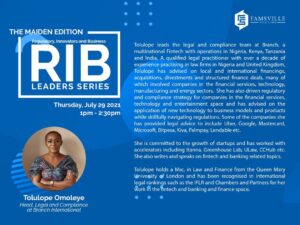
Tolulope Omoleye – Head, Legal and Compliance, Branch International
Azizah Abiola – Head, Legal Department, Cardinal Stone

by Legalnaija | Jul 25, 2021 | Uncategorized

Not even at the height of the myth of Pegasus was Pegasus more devastating than it is now – not even in the battle that killed the monster Chimera. Pegasus may be merely regarded as a Greek myth but in present day, however, it is the most sophisticated spyware built to keep surveillance on its target in a manner hardly detectable or preventable by the safest of systems.
Built on the so called ‘Zero-click technology’, Pegasus poses the most significant challenge yet to cyber security experts and systems, making a mockery of the iOS and Android Operating Systems, regarded and indeed which pride themselves as the best and most secure privacy-ensuring Operating Systems.
Cyber Attacks and the Myth of Cyber Security
Cyber security refers to the practice of defending computers, servers, mobile devices, electronic systems, networks, and data from cyber-attacks. It entails the application of technologies, processes and controls to protect systems, networks, programs, devices and data from cyber-attacks with the aim of at least, reducing the risk and exposure of a device to cyber-attacks whilst protecting against the unauthorised exploitation of systems, networks and technologies.
On its part, a cyber-attack is regarded as any attempt to steal, alter, expose, destroy, or gain any information from a person/organisation through unauthorized access and by the use of one or more computers against a single or multiple computers or networks. It is the gaining or an attempt to gain illegal access to electronic data stored on a device or a network. Cyber-attacks are on the rise and there are several types of them which a system can be subjected to.[1]
Amongst cyber security experts, there is unanimity in the knowledge that the implementation of cyber security does not guarantee full protection from cyber-attacks. However, the implementation provides reasonable safeguards, some of which are regarded as more or less impenetrable.
Certain Operating Systems are built on this and are claimed to be the safest and incapable of penetration by cyber attackers. For instance, Apple claims that its iPhones are the safest and most secure mobile device in the market due to its tried and trusted iOS which undergoes constant upgrade. Google’s Android OS is not far off either. These systems are designed to ensure that people feel safe and are guaranteed of their privacy and security from spying or surveillance when using their mobile devices. Indeed, that is the aim of cyber security and data protection laws, the world over.
Enter, Pegasus…
The narrative would begin to change in 2016 after a failed attempt to install the Pegasus spyware on an iPhone belonging to a human rights activist leading to an investigation. Between 2016 and 2021, Pegasus spyware has attained unprecedented sophistication and can now be installed on any device – primarily mobile devices – without any interaction with the owner of the device thanks to the ‘Zero-click technology’.[2] Common vectors of the Pegasus spyware are SMS, WhatsApp, iMessage, Calls, etc. and once installed on a device, it gathers data from the affected device and communicates same to the attacker.
To put things in perspective, once installed, Pegasus can have access to all SMS, Emails, call logs, photos, videos, location, contacts and chats of the victim as well as activate the victim’s microphone and camera such that it records the audio and visual communication of the victim for transmission to the attacker – all these undetectable by the device’s owner.
Pegasus attack targets a device’s “zero day” vulnerabilities[3] obtaining the device’s ‘root privileges’ or ‘administrative privileges’ in the process. It is also said that once a device has been infected, Pegasus has more control over it than the owner of the device.[4] The effect of an attack on a device’s zero day vulnerability is that even where the manufacturer is able to identify and remedy those flaws; the attacker is able to exploit new flaws. This has led to the assertion that the manufacturers only try to get better while the attackers get worse.
Besides the foregoing, there are others attributes of Pegasus that make it the world’s most feared spyware: Pegasus is effective across all Operating Systems, self-destructs when it is unable to connect to the server after sixty days of installation or when installed on a wrong device and at present, almost impossible to prevent or detect.[5]
Pegasus and Cyber Security
While cyber security is broad and meanders around infinity, there are certain minimum cyber security tips owners of devices are expected to keep in order to keep their devices reasonably safe from cyber-attacks. Some of the tips are regular update of devices when updates are available, use of password managers to avoid password attacks, use two-factor authentication, giving serious thoughts and consideration before downloading Apps or clicking a link and using a VPN App especially when using a public WiFi. These safety tips are designed to protect devices from common types of cyber-attacks.
Rather unfortunately, Pegasus spyware, whilst being a form of malware attack is not a common attack and is unpreventable by any of the above tips. Its ‘zero click’ feature chides these tips which are rather more effective against password and social engineering attacks. Several assessments have shown Pegasus by-pass the iOS 14.0 and other updated versions of the iOS.[6] It would appear that at present, cyber security is helpless in the face of Pegasus’ advance. Asked how to prevent a Pegasus attack, Claudio Guarnieri of Amnesty International’s Security Lab retorted that: “the real honest answer is nothing”.
Pegasus and Data Protection Laws
Data Protection entails cyber security. It is the end product of cyber security as data cannot be protected in this digital age without cyber security. As a concept, data protection seeks to provide minimum regulatory and/or organizational standards for the protection of the personal data of natural persons.
In Nigeria, the Nigerian Data Protection Regulation, 2019 (“the NDPR) caters for this. The EU General Data Protection Regulation (“the GDPR”) bulwarks against data breach in the EU and is seen as the standard. Both the NDPR and the GDPR define personal data in such terms as to include the location data, footage, names, email addresses, phone numbers and indeed anything capable of identifying a natural person (data subject).[7] These personal data indicators are essentially what Pegasus targets when it infects a device. It thus goes without saying that a successful Pegasus attack is a breach of both the NDPR and the GDPR. What is more, processing of personal data using Pegasus cannot be fitted into any of the lawful basis for processing under both the NDPR and the GDPR.
A question may arise as to whether the NDPR, nay the GDPR applies in situations of Pegasus attack given that the processing of personal data of the victims of the attack is itself unlawful since consent was not obtained. Prima facie, the processing is unlawful and criminal. However, it is to prevent such attacks that the NDPR and GDPR was formulated, underlying the application of the NDPR.[8]
A caveat to the foregoing, however, is when Pegasus is used to attack a corporate organization. Certain remedies may lie to such organizations and the attack may well constitute a crime under relevant cyber-crime laws. However, it does seem that such an attack cannot constitute a breach of the NDPR or the GDPR as organizations are not data subject under these regulations.
Perhaps, the point should be made that the Pegasus spyware is developed by an Israeli tech company, the NSO Group to help nations combat terrorism. At present, the spyware is sold for hundreds of millions of United States Dollars only to countries, meaning that it is not in the possession of individuals.[9] However, Pegasus has been shown to be used by state actors for espionage and political surveillance. According to a Washington Post, three serving Presidents, seven former Prime Ministers (some of whom were serving at the time of the attack) and one King have been targeted with Pegasus.[10] This is a particularly dangerous act of espionage given the capabilities of Pegasus and ultimately offends data localization principle.
National Security and use of Pegasus
Under the NDPR, personal data can be processed for public interest without the need for consent. By Article 2.5 of the Guidelines for the Implementation of the NDPR in Public Institutions, processing of personal data for national security is an exemption to the requirement for consent. It seems that the aggregate of the NDPR and the Guidelines is that processing can be done even without the consent of the data subject where it is necessitated by public interest and national security.
However, the NDPR does not contemplate the surveillance of data subjects. Rather, the NDPR only allows for the processing of personal data irrespective of the consent of the data subject in cases where this exception applies. Consequently, provision is not made for the criminal gathering of personal data by surveillance, spyware or phishing. In fact, use of Pegasus to obtain personal data of individuals will constitute a crime under Section 32 of the Cyber Crimes (Prohibition) Act, 2015 which criminalizes acts of phishing and spamming.
However, in a country where the government is actively in pursuit of perceived criminals, one would not be surprised to learn of the deployment of the Pegasus spyware on journalists, agitators and political opponents alike.
To conclude, the Pegasus spyware poses the most significant threat to cyber security in modern day. Somewhat sadly, it seems it will take some time for experts to lay a grip on it while for its users, it will only mean attacking other vulnerabilities. The die is cast and cyber security appears to finally be realizing that it is not the king after all.
 Abraham is an Associate at the Firm of Solola & Akpana. He is a member of the Firm’s Data Protection Compliance and Dispute Resolution Practice Groups. He is also a member of the Firm’s Corporate/Commercial Practice Group providing a wide range of legal representation and advice to a broad spectrum of clients in the Oil and Gas, Banking/Finance, Fintech and private sectors on various transactions and regulatory compliance.
He has several articles on data protection/privacy law, international law and Intellectual Property Law published in his name and has routinely audited and filed data audit reports on behalf of several multinational and national companies in Nigeria, to NITDA.
He obtained his LL.B from Ambrose Alli University, Ekpoma and was called to the Nigerian Bar in 2019. He also holds a certification in Data Protection.
Abraham particularly has data protection, intellectual property, sports/entertainment law and fintech as his niche whilst also excelling in dispute resolution.
Reach Abraham at abrahamaigba@gmail.com; 08131993172
[1] Common cyber-attacks are malware attacks, phishing attacks, denial of service attacks, man in the middle attack, social engineering attack, password attack, etc.
[2] What this implies is that without as much as the owner of the device clicking a link, downloading an App or answering a call, Pegasus can be installed on the device
[3] Zero day vulnerabilities refers to an Operating System’s flaws either not yet known to the manufacturer or which the manufacturer is yet unable to rectify
[4] https://amp.theguardian.com/news/2021/jul/18/what-is-Pegasus-spyware-and-how-does-it-hack-phones (last accessed on July 21, 2021)
[5] To detect whether a phone has been infected with Pegasus or not, the phone is sent for digital forensic cyber security lab analysis, which of course is a luxury in Nigeria
[6] https://www.washingtonpost.com/technology/2021/07/19/apple-iphone-nso/ (last accessed July 22, 2021)
[7] See Articles 1.3 and 4.1 of the NDPR and GDPR respectively
[8] It would be rather naive to imagine that the attackers will present for compliance with the NDPR/GDPR. But as the attackers, at present at least, are governments/government institutions or at least government-linked, compliance with the NDPR may well be an issue particularly when the information/data is declassified.
[9] True as this may be, sight should not be lost on the fact that these countries are represented by individuals. What has been with Pegasus is that rather than being used against terrorists, it has been used to attack journalists, human rights activists and opposition figures by heads of countries. Its deployment has been more in misuse than in use. More so, it cannot be claimed that Pegasus has only been sold to governments; certain individuals have been able to lay hold of the spyware.
[10] https://www.washingtonpost.com/world/2021/07/20/heads-of-state-pegasus-spyware/ (last accessed July 22, 2021)

by Legalnaija | Jul 21, 2021 | Law
ADMISSIBILITY OF AN UNREGISTERED LAND INSTRUMENT: DISSECTING BENJAMIN -V- KALIO (2018) 15 NWLR (Pt 1641) 38, ANAGBADO -V- FARUK (2019) 1 NWLR (Pt 1653) 292 AND ABDULLAHI & ORS -V- ADETUTU (2020) 3 NWLR (Pt 1711) 338,
INTRODUCTION
A land instrument is a vital document in proving legal title and equitable interest in land. This paper examines the current position of the law on the admissibility of an unregistered land instrument by dissecting the three Supreme Court cases of Benjamin -V- Kalio (2018) 15 NWLR (Pt 1641) 38, Anagbado -V- Faruk (2019) 1 NWLR (Pt 1653) 292 and Abdullahi & ors -V- Adetutu (2020) 3 NWLR (Pt 1711) 338.
THE POSITION OF THE LAW BEFORE 2017
The law on admissibility of an unregistered land instrument was governed by the various land instrument registration law of the states. The position was that an unregistered land instrument is not admissible to proof title to land, however, such unregistered instrument is admissible to prove payment of money, possession, or an equitable interest in land. See the cases of Ojugbele v. Olasoji (1982) 4 SC 31, Akintola & Anor. v. Solano (1986) 2 NWLR (Pt 24) 589, Ogbimi v. Niger Construction Ltd (2006) 9 NWLR (Pt. 986) 474) and Anyabunsi v. Ugwunze (1995) 6 NWLR (Pt.401) 255.
THE SUPREME COURT’S DECISION AFTER 2017.
On 15 December 2017, a full panel of the Supreme Court sitting, delivered a landmark decision in Benjamin v. Kalio (2018) 15 NWLR (Pt 1641) 38 changing the position of the law. In that case the apex Court declared unconstitutional, null and void section 20 of the Land Instruments (Preparation and Registration) Law, Cap. 74, Laws of Rivers State, 1999 and by extension similar provisions of the Land Instruments Law of the various states. The previous position of the law was based on the premise that evidence was not on the exclusive legislative list under the 1963 Constitution. It was under the constitutional scenario that the federal legislature and the regional (State) legislatures re-enacted the Evidence Ordinance of 1945 as Evidence Act and Evidence Laws respectively. However, in 1979, the situation changed. Under the 1979 Constitution, evidence was brought into the exclusive legislative list as item 23. It has remained so since then. It is currently item 23 of the exclusive legislative list in Part 1 in the Second Schedule to the extant Constitution of the Federal Republic of Nigeria, 1999 (as amended, 2011). A piece of evidence pleaded and admissible in evidence under the Evidence Act cannot be rendered unpleaded and inadmissible in evidence by a Law enacted by the House of Assembly of a State under the prevailing constitutional dispensation.
This newly informed position was followed by the Supreme Court in Anagbado v. Faruk (2019) 1 NWLR (Pt 1653) 292, where it was held as follows:
‘’The Law Cap. 85 of Kaduna State (section 15 thereof), in so far as it purports to render inadmissible any material and relevant piece of evidence that is admissible in evidence under the Evidence Act, 2011, is to that extent inconsistent with the Evidence Act, enacted by the National Assembly pursuant to the powers vested in it by section 4(2) of the Constitution and Item 23 of the Exclusive Legislative List set out in Part I of the Second Schedule to the Constitution. Evidence is Item 23 in the Exclusive Legislative List. I am of the firm view that, in view of section 4(5) of the Constitution read with section 4(2) and Item 23 of the Exclusive Legislative List set out in Part I of the Second Schedule to the Constitution, in the event of section 15 of the Law, Cap.85 of Kaduna State being in conflict or inconsistent with any provisions of the Evidence Act, the provisions of the Evidence Act shall prevail. The sum total of all I am saying, on this issue, is that section 15 of the Kaduna State Law, Cap. 85 cannot render inadmissible exhibitP2 which evidence is material, relevant and admissible in evidence under the Evidence Act, 2011. A piece of evidence admissible in evidence under the Evidence Act cannot be rendered inadmissible in evidence by any law enacted by the House of Assembly of any State.’’
In 2019, the Supreme Court in Abdullahi & Ors v. Adetutu (2020) 3 NWLR (Pt 1711) 338 did not follow the new position of the law it laid down but applied the old principle of law that an unregistered land instrument is not admissible to proof title to land but admissible to prove payment of money, possession, or an equitable interest in land. This has led litigants to believe that the Supreme Court has overruled the earlier decision in Benjamin v. Kalio and Abdullahi v. Adetutu and that the old position of law is still valid. The principle of law that where there are two conflicting decisions of the Supreme Court, the latter in time should be followed supports this impression. see Cardoso v. Daniel (1986) 2 NWLR (Pt 20) 1, Isaac v. Obiuweubi v. CBN (2011) 3 SCNJ 166.
A closer analysis of these three cases and other principle of laws reveals that the decision in Abdulahi v. Adetutu did not overrule the decisions in Benjamin v. Kalio and Abdullahi v. Adetutu. The reasons are as follows:
First, the cases of Benjamin v. Kalio and Anagbado v. Farouk on one hand and Abdullahi & ors v. Adetutu on the other hand have one major factor that distinguishes them, which is the interpretation of the Constitution in relation to the validity of the Land Instrument law of the state. In Abdullahi & ors v. Adetutu, the Supreme Court did not determine the validity of the law. In the earlier two cases the Supreme Court effectively determined the law to be null and void while in the latter case the apex Court decided the case based on the issues and argument before the court viz: a document is admissible based on what it is pleaded for. Benjamin v. Kalio was decided by a full panel of the Supreme Court sitting which interpreted the Constitution and effectively overruled the previous position of the law. Abdullahi & Ors v. Adetutu was not decided by a full panel of the Supreme Court. If the Supreme Court intends to overrule its previous position of the law, it sits as a full Court. see Paul Odi & anor v. Gbaniyi Osafile & anor (1985) 1 NWLR (Pt 1) 17 S.C. Effiom v. State (1995) 1 NWLR (Pt 373) 565-566 S.C. A principle or rule used in arriving at a decision in a case is an important factor in deciding where the ratio of the Court lies. See N.A.B v. Barrie N.G (1995) 8 NWLR (Pt 413) 257 Sifax Nig ltd v. Migfo Nig Ltd & anor (2018) 1-2 S.C 1, Fawehinmi v. NBA (No. 2) (1989) 2 NWLR (Pt 105). The constitutional principle used in deciding the two earlier cases is an important factor in distinguishing these cases.
Secondly, in our hierarchy of law, the Constitution is supreme, see Section 1 of the Constitution of the Federal Republic of Nigeria, 1999; judicial precedent is lower in hierarchy. A judicial precedent cannot overrule the provisions of the constitution, except the judicial precedent is on interpretation of the Constitution (i.e., where there are conflicting interpretations of a provision of the Constitution).
Lastly, Abdullahi & Ors v. Adetutu is an anomaly. A case law that goes against an avalanche of other case law authorities must pale into significance and cannot be followed or relied upon. See Onuoha v. State (1989) 1 NSCC 411 at 421 where Oputa J.S.C stated as follows:
‘’a just decision of the case will be a decision in accord with the many many authorities and previous decisions of our Courts as well as English decisions which our Courts have followed and adopted. A decision that throws all our existing authorities to the wind, will no doubt be an alarming decision, but hardly a just decision. With respect, it was thus foolhardy for the lower Court to have followed and relied on the decision of the Court of Appeal in Otiki v. Bajehson when there are many other authorities of the Supreme Court and the Court of Appeal to the contrary. It is incumbent on, and essential for, all the players in the administration of justice system to take pains and acquaint themselves with developments in the law.’’
The statement of Oputa J.S.C has been followed in Afelumo & Ors v. Ojo & Ors (2013) LPELR-19976 C.A, and Olukosi v. Nigerian College of Aviation Technology, Zaria & anor (2014) LPELR-24009 C.A.
CONCLUSION
Abdullahi & Ors v. Adetutu is not authority that an unregistered land instrument is not admissible to proof title to land, it is good authority for the position of law that a document is admissible only for what it is pleaded and tendered for. The correct position of the law is that an unregistered instrument affecting land is admissible in evidence to prove title because an evidence rendered admissible under the Evidence Act cannot be rendered inadmissible by a state law as laid down in Benjamin v. Kalio (2018) 15 NWLR (Pt 1641) 38 and Anagbado v. Faruk (2019) 1 NWLR (Pt 1653) 292.
Adewale Sontan is a legal practitioner and has a keen interest in dispute resolution. He is a Counsel in various litigation proceedings involving corporate institutions, individuals and government agencies. He can be contacted via sontanadewale@gmail.com

by Legalnaija | Jul 18, 2021 | Uncategorized
Weeks after the passing of the Petroleum Industry Bill (the Bill) by the National Assembly, discussions remain rampant on the provisions of this Bill and how suited it is in realizing the core objectives centered on fostering sustainable prosperity in the Host Communities, enhancing peaceful and harmonious co-existence between licensees or leases and Host Communities as well as supporting the development of the Host Communities in particular, and the country in general.
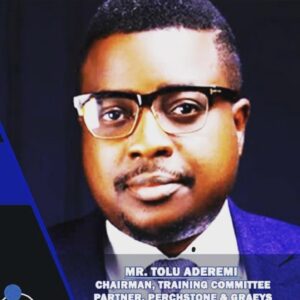
Speaking on the “Conversation with Oluwakayode” a Radio Programme on Lagos Talks 91.3fm on Saturday, July 17 2021, Mr. Tolu Aderemi, an Oil and Gas Expert and a Partner at Perchstone and Graeys LP, one of the leading commercial Law Firms in the country, shared his expert opinion on the harmonization process of the Bill, its expected outcome and the impact on the Host Community.
The journey to what we now have as the Bill could be traced back to the Oil and Gas Reform Committee (OGRC) constituted during the General Olusegun Obasanjo administration. However, in 2008 Late General Umaru Yar’dua took the bold step by introducing the Bill to the National Assembly. It is quite alarming that after 13 (Thirteen) years, 3 (Three) Presidents and 4 (Four) Assembly, this Bill remains a subject of tactical negotiation and strategizing as the Host Communities remain unsatisfied.
Commenting on whether the Bill can be rightly described as a game changer, Mr. Tolu Aderemi, stated that the Bill is an ambitious one that has attempted to compress 16 legislations into one document. He further stated that not only is this ambitious, but also has the tendencies to be counterproductive because a careful consideration of the Industry challenges and issues that have arisen from the several legislations have not been addressed.
Some of these legislations he referred to are the Petroleum Profit Tax Act (PPTA) on the issue of taxation and The Deep Offshore and Inland Basin Production Sharing Contract Act 2019 as amended on the Investment Tax Credit (ITC) which has been a subject of several arbitration cases.
On the question of how the Bill has been able to manage the different industry issues arising from the harmonized legislations, Mr. Tolu Aderemi stated that the Bill has not done bad at all because looking at where we are coming from and where we are now as a country, there has been a great improvement in the light of the provisions on Governance and the Host Communities.
He stated that part of the problems we have had as a country in this sector is the absence of regulatory clarity as on one hand, players in the industry do not know who the regulators are and on the other hand, they know that it is the Department of Petroleum Resources (DPR), but it is generally conceived and rightly so that the DPR is saddled with many responsibilities that needed to be broken down into different parts. This issue, he pointed out has been addressed by the Bill, more so excellently by breaking down our regulatory infrastructure into the Upstream Regulatory Commission and an Authority, regulating the midstream and downstream sector.
According to him, we cannot categorically say that these are without their challenges but to a greater extent these challenges are surmountable, as the Bill has now made the issue of issuance of licenses and taxation clearer. It has also reduced the bottleneck.
Speaking on the administration of the Bill, Mr. Tolu Aderemi stated that the Bill has introduced a new structure for the Nigerian National Petroleum Corporation (NNPC) – the big Elephant in the room by transitioning into an entirely commercial entity to be known as NNPC Limited. This entity, according to him will run like Chevron, Shell, and Exxon Mobil of today. It is going to compete favorably in the local and international market and to show the confidence that Government intends this to be a full commercial entity, it is going to have shares that will be held by the Ministry of Finance and how they are to be transferred will be under stringent condition.
He further stated that the question of what becomes of the Assets and Liabilities of NNPC has also been addressed in that, those that are not inimical will be moved to the new entity while the ones that are inimical will become the liability of the Federal Government. However, he pointed out that one of the shortcomings is the absence of an Asset Management Company just like we have in the Power Sector with the introduction of the Nigerian Electricity Liability Management LTD/GTE, an entity capitalized by government that warehouses liabilities.
Furthermore, Mr. Tolu Aderemi stated that NNPC has subsidiaries that cut across the entire value chain. We have NPDC (Nigerian Petroleum Development Company Ltd), the Petroleum Development arm of the Corporation that addresses exploration, exploitation and production; Nigerian Engineering and Technical Company going together with Integrated Data Services that deals with the seismic part of the business; PPMC (Pipeline and Product Marketing Company); Refineries including the Kaduna, Port Harcourt and Warri Refineries and also a company called Duke Oil which also cats as a player within a player in the market.
According to Mr. Tolu Aderemi, NNPC Ltd will be a full-blown company that will operate as the existing International Oil Companies (IOCs), capable of going abroad to borrow funds and can bid and be regulated like every other company.
He stated that NNPC Limited will also sell crude oil on behalf of the federal government for a fee and even though acting on behalf of the federal government, it is not unusual as the provisions of the current Petroleum Act and the Deep Offshore Act allow private companies to conduct petroleum operations on behalf of government.
He also stated that there would be a limited ministerial influence on the NNPC limited. Thus, the current structure of the NNPC limited positions it to be commercially oriented and we do not expect anything less in terms of commercial efficiency and effectiveness.
Commenting on what the Bill has introduced towards ameliorating the development in the South-South, Mr. Tolu Aderemi pointed out that the question of ownership of oil has always been rested as by virtue of Section 1 of the Petroleum Act, the entire ownership of oil is vested in the Federal Government of Nigeria who holds it on behalf of the people of Nigeria. According to him, this ownership structure is distinct from the structure in America that embraces individual ownership structure with the incidence of tax payment to the American Government.
He further stated that the importance of the Host Communities come from the consequence of the operations of the IOCs in terms of the environmental impact. Thus, our question and major concern as far as these Host Communities’ issues are concerned is a question of how these environmental hazards and hardship meted out to the Host Communities can be mitigated.
Furthermore, he succinctly stated that the Government in 1960 set up what was known as the Niger Delta Development Board for the purpose of dealing with environmental concerns. Similarly, UNPADEC and Niger Delta Development Commission (NDDC) were set up in 1992 and 2000 respectively. There was also the introduction of the 13% derivation percentage. Thus, according to him, the question remains one of accountability, as the Bill cannot resolve these environmental challenges overnight because reactively, success can only be achieved as we move on with the implementation of the Bill.
Mr. Tolu Aderemi also stated that there is a progressive departure from what used to be 5% of interest in the asset, a policy introduced during the President Goodluck Ebele Jonathan’s regime that was capable of driving away business in this country because, despite the fact that the Host Communities will own 10% equity (a combination of assets and liabilities) and will be entitled to 10% in the event of profit share, the problem arises when a cash call is made, a call which requires the Host Communities to pay 10% to the companies. The question now is where and how the host Communities can get this money when there has been no adequate accountability and transparency.
Joining him in the conversation was Mr. Malachi Ugonmadu, a Lawyer and former president of the Committee of the Defence of Human Rights. Mr. Malachi in addressing the question of whether the 3% is enough for the Host Communities and whether the Bill should have done better, stated from the socio political angle that, if our law as it stands today vests ownership of petroleum in the state as against the American system of government that embraces individual ownership, more so as we emulated the federal government system from America, then Nigeria has a dysfunctional federalism and this further fortifies the call for restructuring.
Conclusively, Mr. Tolu Aderemi stated that the Bill made up of 5 (Five) Chapters, 319 (Three Hundred and Nineteen) Sections and 8 (Eight) Schedules is a purposeful one. Thus, commenting on his part, he stated that 0% of 100 is not the same as 1% of 100. And looking at the books of an Oil Company and their operating expense that runs into billions of dollars, the 3% we are talking about is almost the budget of a state in Nigeria and so our focus should be centered more on the administration, management, accountability and transparency of these resources.

by Legalnaija | Jul 17, 2021 | Uncategorized

Law books are the life line for lawyers, law firms, law researchers and law students. The importance of law books cannot be overemphasized, and on the Legalnaija online book store, we have a list of books that would boost your law practice and help build your law library, all of which are readily available on our online store.
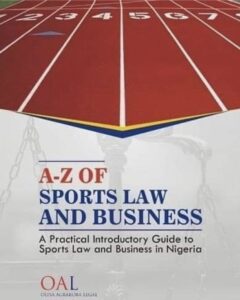
A – Z Of Sports Law
 ₦2500
₦2500
The A to Z of Sports Law and Business is a comprehensive and bite-sized industry guide book for lawyers and non-lawyers to all the major hot topics you need to know in the sports industry.
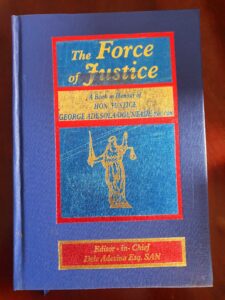
A Force of Justice (A book in honour of Hon. Justice Oguntade)
₦25000
This book was published in honour of Hon. Justice Oguntade JSC (RTD) in 2010. It focuses on some of the landmark cases where Justice Oguntade either delivered the leading judgment or a dissenting judgment subjecting them to critical review and comprehensive assessment in well articulated and researched essays by the contributors.
Contributors include over 24 Senior Advocates and other distinguished Legal Practitioners and Professors, including; Professor Yemi Osibajo SAN, Professor Taiwo Osipitan SAN, Chief Wole Olanipekun SAN, Kola Awodein SAN, Professor Oyelowo Oyewo SAN, Dr. Alex Iziyon SAN, Chief Bolaji Ayorinde SAN, Kemi Pinheiro SAN, Tayo Oyetibo SAN, Dr. Babatunde Ajibade SAN, Professor Ayo Atsenuwa, Dr Olisa Agbakoba SAN. Etc
Babalola’s Law Dictionary (2nd Edition)
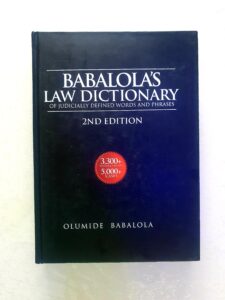
₦5000
Babalola’s Law Dictionary Of Judicially Defined Words And Phrases (2nd Edition) lists over 3300 definitions and cites over 5000 cases. The Dictionary remains a must have for every lawyer, law firm and law student.
Casebook On Data Protection
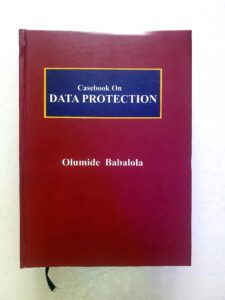
₦20000
The book is divided into fourteen chapters. After an introduction that traces the brief history of data protection in Nigeria, separate chapters are devoted to Definitions, Relationship with other rights; Principles of Data Protection; Exceptions and Derogation; Employment Data; Sensitive Data; Transfer of Data to a Foreign Country; Liability of Data Controllers; Data Subject’s Rights; Data Breach; Remedies; Data Property Rights; Supervisory Authority and Appendices that feature the Nigeria Data Protection Regulation and the NDPR Implementation Framework.
Casebook On Human Rights Litigation In Nigeria
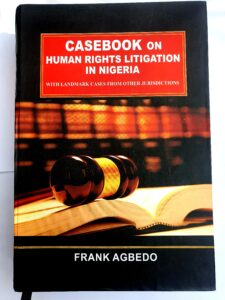
₦20000
Human rights litigation in Nigeria is the latest book on Human rights by Frank Agbedo, author of the popular law books, Rights of Suspects and Accused Persons and Human Rights Litigation in Nigeria.
This book focuses on a compilation of leading cases on all salient legal principles and issues affecting fundamental rights enforcement in Nigeria.
This book painstakingly addresses the predicament of lawyers and judges in accessing relevant cases of interest, by providing and updating the practitioners with a comprehensive collection of (both current and locus classicus) reported cases mainly from decisions of the Supreme Court and Court of Appeal, on all notable issues of law and procedure relating to human rights litigation in Nigeria.
Every chapter presents you with a gamut of leading cases on fundamental issues and principles on enforcement of fundamental rights of citizens under our laws, etc, namely;
- The meaning, definition, and classification of fundamental rights.
- Limitations to enforcement of fundamental rights.
- Commencement of Action for enforcement of fundamental rights.
3( i) Who may sue for enforcement of fundamental rights.
3(ii) Whetter the Constitutional right to life of a deceased can be enforced by his/ her dependents.
3(iii) Whetter an Application can be filed by more than one person for the enforcement of fundamental rights.
- The liability of a Public Officer who allows himself to be used by a citizen to commit illegality such as debt recovery or settlement of civil claims.
- Whether every citizen is duty-bound to report the commission of an offence to the Police and the corresponding duty of the Police to investigate it.
6.Whether both the High Court and Federal High Court have concurrent jurisdiction to entertain and determine Fundamental Rights Application.
7.Condition Precedent to the exercise of the Court’s jurisdiction in an Action for enforcement of fundamental rights.
8.The right of an Applicant to Compensation and Damages in an action for the infringement of his fundamental rights.
9.Whether the Socio-economic rights provided in Chapter II of the constitution are totally nonjusticiable in Nigerian Courts.
- Landmark cases from other jurisdictions.
Dark Hearts (Hard Cover)

₦4500
Dark Hearts is a collection of gripping short stories based on actual court cases that will get you thinking, gaping, puzzled and wondering about the realities of the dark side of life. This compilation provides rare insights into the criminal mind.
Human Rights Litigation In Nigeria: Law, Practice And Procedure
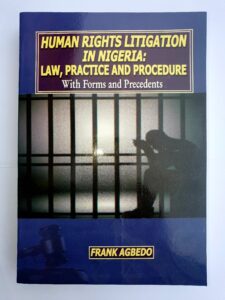
₦8000
This book is written by Mr. Frank Agbedo, one of Nigeria’s leading authors in human rights literature and jurisprudence.
Principal features of the book include but are not limited to the ABC of human rights litigation, an in depth analysis of the new FREP Rules 2009, A review of judicial attitude to enforcement of Fundamental Rights Cases, Prosecuting Appeals in Fundamental Rights Cases, The status of public interest litigation in Nigerian Courts, The Role of Amici Curae in human rights litigation, the justiciability or judicialisation of socio-economic rights in Nigerian Courts and the future of human rights litigation. The book also features a comprehensive package of practice forms and precedents relating to practical applications for enforcement of fundamental rights, as well as a comprehensive index of cases and relevant statutes.
Practice forms and precedents
The book is almost a ready answer to all issues and matters relating to preparation, initiation, filing and prosecution of fundamental right cases in Nigerian Courts. The book is comprehensive enough to the cover of the field of human right law, practice and procedure and which could be better described as a One-Stop-Shop in human rights litigation.
International Arbitration Law And Practice: The Practitioners Perspective
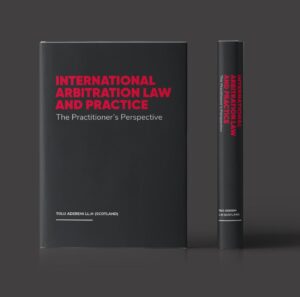
₦10000
Edited by: Tolu Aderemi
The Practitioners Perspective” is one book every arbitration practitioner or student should have.
The Book is a compendium of scholarly papers that focus on contemporary topics which will deepen the practice of arbitration; whether at a junior or mid-Senior level. This book is a valuable resource tool for Arbitration Practitioners and is a welcome contribution to the body of knowledge on the topic in Nigeria.
The book which is edited by Tolu Aderemi, Partner, Perchstone & Grays, is also a compilation of articles by seasoned international arbitration practitioners from both within and outside the Nigerian legal jurisdiction including very eminently qualified and senior Arbitration practitioners such as Kamal Shah (UK), Funke Adekoya SAN, Dr. Babatunde Ajibade, SAN, Adedoyin Rhodes-Vivour SAN, Hon. Justice Nnamdi Dimgba, Tunde Fagbohunlu SAN, Osaro Eghobamien SAN, BOLAJI AYORINDE SAN, FCArb., O.F.R., Bode Olanipekun, SAN, Tunde Busari, SAN, FCIS, FCIArb, @Ikponwosa Omigie (Company Secretary, NAPIMS), Prof Alero Akeredolu, Funmi Roberts and Prof Olawuyi.
This book is a valuable resource tool for Arbitration Practitioners and is a welcome contribution to the body of knowledge on the topic in Nigeria.
Journal Of Current Law And Arbitration Practice (Vol 1, No.2)
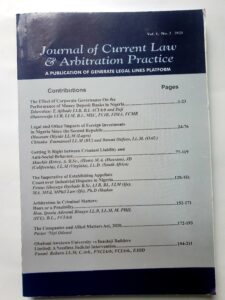
₦5000
Articles in this Volume include:
- The Effect of Governance On The Performance Of Money Deposit Banks In Nigeria.
- Legal And Other Impacts Of Foreign Investments In Nigeria Since The Second Republic
- Getting it Right Between Criminal Liability And Anti – Social Behaviour
- The Imperative Of Establishing Appellate Courts Over Industrial Disputes In Nigeria
- Arbitration In Criminal Matters: Hoax Or Possibility
- CAMA 2020
- OAU vs. Onaolaji Builders Limited: A Needless Judicial Intervention
50 in stock
LAW FOR THE LAYMAN
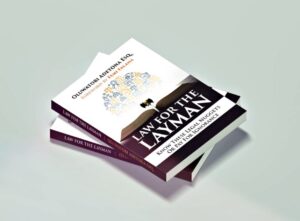
₦3000
Law for the Layman is a book aimed at promoting legal literacy in Nigeria by bridging the gap between YOU and the LAW using the simplest language easy for comprehension in an entertaining style coupled with interesting cases and first-hand experiences from the lens of a legal practitioner.
Legal Rights And Obligations Under Nigerian Laws (Ebook)
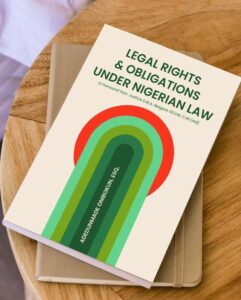
₦2500
This book educates the average Nigerian and visitor on Nigerian laws. It contains explainers on over 80 Nigerian laws for the benefit of the reader. The Hard Cover copy of this book is sold for N3,000 (Three Thousand Naira).
Metamorphosis; Tales By A Lawyer Girl

₦2800
A fascinating and entertaining book, one that exposes the challenges of young professionals, in this case a young lawyer and her drive for success.
New Developments In Law And Practice In Nigeria
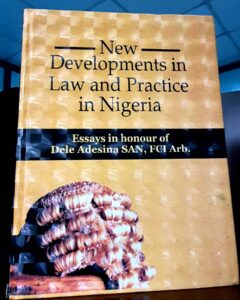
₦20000
This book examines a wide array of topical and contemporary areas of law and Practice, which include the following subjects: The Constitution; Administration of Justice; Practice and Procedure; Corporate Law including tax; Shipping Investment, arbitration, money laundering, insolvency issues; Intellectual property, media, and the Legal profession, among others.
RIGHTS OF SUSPECTS AND ACCUSED PERSONS UNDER NIGERIAN CRIMINAL LAW

₦6000
The book in a painstaking manner dwells on the fundamental rights of citizens, with particular reference to the rights of suspects and defendants as guaranteed by the Constitution of Nigeria, the Penal Code and some International Charters and Instruments which have been ratified by Nigeria. Major highlights include (a) The rights of a Suspect before and after Arrest by security agents, (b) Rights of a Suspect/Defendant during trial before a Court of Law, ( c) The Duties of the State/Prosecution in Criminal trials, (d) Defences available to an Accused person/Defendant during trial, (e) Rights of suspects/ Convict after trial, (f) Rights of Suspects in Prison Custody, (g) Legal remedies against rights violations, (h)Obstacles to effective Criminal Justice Administration in Nigeria, (i) Criminal Justice reforms, (j) Domestication of International Covenants on Human rights, (k) Appendixes of relevant laws. etc, etc.
Social Media For Lawyers

₦2500
This book helps lawyers, and law firms can harness social media resources to boost clientele, establish their reputations in niche practice areas and advance their legal careers.
Author- Adedunmade Onibokun
The Employment Law Handbook
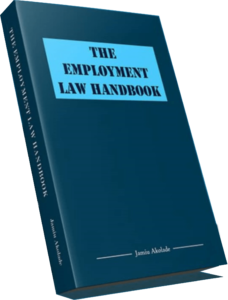
₦15000
The Employment Law Handbook is written to fill a gap identified in the nature of texts on Employment and Labour Law in Nigeria. While there are many well-researched books on the general principles of Labour and Employment Law, there is a dearth of quick reference materials for Human Resource Managers and Legal Practitioners who have to grapple with taking decisions and advising on workplace related issues on a daily basis. This need is accentuated by the rapid changes in this area of the Law in recent years.
This book provides answers to most of the frequently asked questions on Employment and Labour Law, contains a synopsis of all Employment and Labour Law related legislations as well as selection of precedents.
The Nigerian Electricity Market; Understanding The Transactional, Legal & Policy Issues

₦35000
The books aims at giving industry participants all the necessary negotiating tools as they engage in the complexities within the power sector in Nigeria. The books discusses licenses, agreements, and regulations that operate within the power industry space.
Understanding Petroleum (Oil & Gas) Transactions and the Nigerian Market

₦50000
There have been several policies in the Petroleum industry such as those related to local content and domestic gas supply obligations. This book provides a clear Insight about executing transactions, obtaining licenses and other complex issues industry participants encounter.
Visit the law shop now on www.legalnaija.com/shop
Or social media @Legalnaija
Or via Whatsapp/Text/Call on 09029755663

by Legalnaija | Jul 13, 2021 | Uncategorized
Over 80 corporate sponsors, including Oando Plc, Zenith Bank, Total E & P, among others, have thrown their weight behind the 15th Annual Business Law Conference of the Nigerian Bar Association Section on Business Law (NBA-SBL).
The conference, which begins with a preconference cocktail on Tuesday, July 13, 2021, will run through July 14 and 15 with a total of eight plenary sessions and three breakout sessions.
The sponsorships cover most of the programmes at the two-day conference, including the pre-conference cocktail, plenary sessions, tea breaks, lunch breaks, the SBL Innovation Hub App Challenge, among others.
The 15th annual NBA-SBL Conference holding July 14-15, 2021, with the theme “Re-tooling Business for Change: Leveraging the Tech Explosion”, focuses on how businesses, including the legal profession, can continue to keep pace with and take advantage of technological developments and disruptions in a fast-changing world.
According to a full sponsors list made available by the conference organisers, the sponsors are grouped into Headline Sponsors, Platinum Sponsors, Gold Sponsors, Silver Sponsors, Bronze Sponsors, and Supporters.
The Headline Sponsors are Duale, Ovia and Alex-Adedipe, Africa Law Practice, Omaplex Law firm, Banwo and Ighodalo, Zenith Bank Plc, Babalakin & Co, Flutterwave, Jackson, Etti & Edu, Templars, and the Lagos State government.
On the Platinum Sponsors list are Udo Udoma & Belo-Osagie, The Law Crest LLP, Odujinrin & Adefulu, IHS Towers, Wigwe & Partners, AELEX, Mikano Group (Geely Motors), MRS Holdings Limited, BTO Partners, Detail Commercial Solicitors, George Etomi & Partners, Africa Finance Corporation, and Aluko and Oyebode.
CLP Legal, Giwa-Osagie & Co, Piggyvest Technology Limited, White & Case, South Atlantic Petroleum Limited, Lekki Port Enterprise Limited, Tolaram Group, Oak Legal Compliance, Bloomfield, WalterSmith, and SAPETRO are Gold Sponsors.
The Silver Sponsors include Aarndale Solicitors, NG Clearing Limited, Pavestones Legal, Total E & P, Alliance Law Firm, Paul Usoro & Co, J.K Gadzama, Simonscooper Partners, British American Tobacco, Streamsowers and Kohn, Famsville Solicitors, and Advocaat Law Practice.
Others on the Silver Sponsors list are Nigerian Content Development & Monitoring Board, Union Bank of Nigeria PLC, Foundation Chambers, Unilever PLC, Victoria Chambers, Lagos State Internal Revenue Services, Corporate Affairs Commission, Primera Africa Legal, Austin Peters, Oguntoye & Oguntoye, Coopley, Oando, A02Law, Guinness, and Tokunbo Orimobi LLP.
Twelve Legal, Broderick Bozimo & Co, Akindelano LP, Gbenga Biobaku & Co, Cadbury Nigeria Plc, Nigerian Communications Commission and Sterling Bank are Bronze Sponsors, while SPA Ajibade & Co, The Law House, Babs Animashaun Chambers, Kenna Partners, Chris Uche, SAN & Co, Patreli Partners, Lexavier Partners, ACAS-Law, Everlaw LSP, AB-Legal-Practitioners, Lexavier Partners, and Uchelaw are listed as Supporters.
The conference aims to take participants on an exploration of the topics revolving around the fast-developing relationship between frontier technologies across the world and the business law space, said Ayuli Jemide, chairman, NBA-SBL and lead partner, Detail Commercial Solicitors.
“These conversations are stirred up in hopes of improving the efficiency of legal practice and the competencies of participants,” he said in a preconference note.

by Legalnaija | Jul 12, 2021 | Uncategorized

We know how important your legal career is to you and we have 2 (Two) Tools that can help you advance your legal career.
- The Legalnaija Lawyers Directory
The Directory enables Lawyers complete a professional profile in order to enhance visibility on the Internet. By subscribing to the Directory, a Lawyer increases access to prospective clients and strengthens professional reputation among peers and within the legal community. People who are looking to hire a Lawyer can also visit your profile and contact you via email, or phone call, if you have an active subscription on the Directory. Lawyers who subscribe also benefit directly from the high volume of visitors to the Legalnaija website.
To subscribe, follow these 4 simple steps –
- Log on to https://app.legalnaija.com/signup
- Create and verify your account
- Fill in your details, attach all (Call To Bar certificate, Current payment of professional fees) relevant documents and submit for verification.
- You will be notified of your approval and listing via email.
Failure to attach relevant documents will result in a disqualification. If however your application is suspended, ensure your profile is updated, your credentials are uploaded and resubmit. Subscription fee is 1,000 Naira only monthly. Hurry, you get a 30 day free trial when you sign up.
- The Legalnaija online law bookstore
Law books are the lifeline for lawyers, law firms, law researchers and law students. The importance of law books cannot be overemphasized, and on the Legalnaija online bookstore, we have books that would boost your law practice and help build your law library, all of which are readily available for immediate purchase and nationwide delivery.
Some of the books include;
- THE NIGERIAN ELECTRICITY MARKET; UNDERSTANDING THE TRANSACTIONAL, LEGAL & POLICY ISSUESby Dr. Ayodele Oni
- UNDERSTANDING PETROLEUM (OIL & GAS) TRANSACTIONS AND THE NIGERIAN MARKETby Dr. Ayodele Oni
- BABALOLA’S LAW DICTIONARY OF JUDICIALLY DEFINED WORDS AND PHRASES (2ND EDITION)by Olumide Babalola
- INTERNATIONAL ARBITRATION LAW AND PRACTICE: THE PRACTITIONERS PERSPECTIVEby Tolu Aderemi
- CASEBOOK ON DATA PROTECTION By Olumide Babalola
- SOCIAL MEDIA FOR LAWYERSby Adedunmade Onibokun
- A – Z of Sports Law and Business by Olisa Agabakoba Legal
- A Force of Justice (A book in honour of Hon. Justice Oguntade)
- Casebook on Human Rights Litigation in Nigeria by Frank Agbedo
- Human Rights Litigation In Nigeria: Law Practice And Procedure)
- Journal of Current Law And Arbitration Practice (Vol 1 & 2)
- The Employment Law Handbook by Jamiu Akolade
You can order any of the books above via the Legalnaija Store at www.legalnaija.com/shop.
For more info, contact support at hello@legalnaija.com, via @Legalnaija across your social media platforms or on Whatapp via 09029755663.

by Legalnaija | Jul 12, 2021 | Uncategorized

How businesses can leverage technology to drive transformation will be the focus of the 15th annual conference of the Nigerian Bar Association Section on Business Law (NBA-SBL) holding July 14-15, 2021.
The conference, themed “Retooling Business for Change: Leveraging the Tech Explosion”, will feature an array of carefully selected speakers and panellists sourced from the ICT sector, governments, corporate bodies, law firms and law societies.
The annual NBA-SBL conference is a platform for business lawyers within and outside Nigeria to network and engage on issues relevant to their fields as well as to establish a thriving relationship between the business community and government institutions.
According to the organisers, there will be a total of five plenary sessions on Day 1 of the two-day conference.
The first session, with the topic “Tech Innovation and E- Governance”, will be moderated by Ifueko Omoigui-Okauru, Managing Partner at Compliance Professionals Plc, and Coordinated by Temidayo Ajayi-Bello of DETAIL Commercial Solicitors. The panellists include Governor Godwin Obaseki of Edo State, Gabriel Okeowo, Principal Lead/CEO, BudgIT Nigeria, Honourable Justice Kashim Zannah, Chief Judge of Borno State, Yewande Sadiku, Executive Secretary/CEO, NIPC.
Panellists including Mitchell Elegbe, MD/CEO of Interswitch, Olugbenga Agboola, Co-Founder and CEO of Flutterwave, Gisele Nwepu, CEO of Okapi Financial Services, Olaoluwa Awojoodu, CEO of E-Settlement Group, and Babatunde Ogundeyi, Co-Founder/CEO of Kuda Bank, will discuss the topic “The Future of Digital Financial Services & Financial Inclusion” in the second panel session. The session will be moderated by Dayo Ademola, Managing Director, Branch.co., will moderate the session, while Tiwalola Osazuwa of Aelex will be the coordinator.
“Outliers – From Law to There” will be the crux of the discussion at the third panel session with Funke Bucknor-Obruthe, Founder, Zapphaire Events, Audu Maikori, Founder, Chocolate City, Emem Ema, Founder, One Management, and Nnamdi Patrick-Onuh, Founder, Alistair Englebert Preston Photography, as panellists.
Other topics to be tackled on the Day 1 of the conference are “Internet and Broadband Connectivity – Good or Bad?” (Plenary 4) and “We All Have a Story” (Plenary 5).
Dr. Omobola Johnson, Senior Partner, TLcom Capital, will moderate the fourth session which has panellists that include Charles Anudu, CEO of Swift 4G, Prof. U. G. Danbatta, Executive Vice Chairman of Nigeria Communications Commission, Gerald Ilukwe, Pioneer MD, Galaxy Backbone, and Kazeem Oladepo, VP, IHS Towers. The session will be coordinated by Aderonke Alex-Adedipe of Pavestone Solicitors.
Gbenga Oyebode, Founding Partner and Of Counsel, Aluko & Oyebode, Asue Ighodalo, Founding Partner, Banwo & Ighodalo, and Myma Belo-Osagie, Of Counsel, Udo Udoma Belo-Osagie, will be the discussants at the fifth panel, with Ayuli Jemide, Chairman, NBA SBL and Lead Partner, DETAIL Commercial Solicitors, as well as Tobenna Erojikwe, Chairman Board of Governors, Institute of Continuing Legal Education and Partner, The Law Crest LLP, as moderators.
There will also be a Question and Answer session with Oyeyemi Aderibigbe, Senior Associate, Templars, while Dr. Adeoye Adefulu, Vice Chair, NBA-SBL and Partner, Odujinrin & Adefulu, will give the closing remarks.
The panel sessions will be preceded by remarks by the Chairman of the Conference Planning Committee, Adeleke Alex-Adedipe, Managing Partner, Duale, Ovia & Alex-Adedipe (DOA), Conference Framer, Ayuli Jemide, Chairman, NBA-SBL and Lead Partner, DETAIL Commercial Solicitors, and welcome remarks by Olumide Akpata, President of the Nigerian Bar Association (NBA).
Meanwhile, the organisers have confirmed that Lagos State Governor, Babajide Sanwo-Olu, will deliver the opening address, Dr. Wendy Okolo, Intelligence Research Engineer, National Aeronautics and Space Administration (NASA), will give the keynote speech, while Engr. Simbi Wabote, Executive Secretary of the Nigerian Content Development and Monitoring Board (NCDMB), will deliver the goodwill message.
by Legalnaija | Jul 8, 2021 | Directory, Uncategorized

Marketing a law firm online can sometimes like a daunting task, but it doesn’t have to be so if you know what to do. What is most important is that you finally take control of your law firm’s marketing strategy?
In the book, Social Media For Lawyers, Adedunmade Onibokun sets out a concise for lawyers and law firms looking to harness social media resources to grow visibility online. If your goal is to get more clients, or become a thought leader in your area of practice, Social Media For Lawyers is a good place to start, and it’s available on the Legalnaija online bookstore.
One way to market your law practice or law firm is also through subscribing to a Lawyers Directory, and a great directory for Nigerian Lawyers is the Legalnaija online lawyers directory. The Legalnaija Lawyers Directory enables Lawyers complete a professional profile in order to enhance visibility on the Internet. By subscribing to the Directory, a Lawyer increases access to prospective clients and strengthens professional reputation among peers and within the legal community. People who are looking to hire a Lawyer are more likely to visit your profile and contact you via email, or phone call, if you have an active subscription on the Directory. Lawyers who subscribe benefit directly from the high volume of visitors to the Legalnaija website, and Lawyers can also list office location(s), phone numbers and email addresses so that potential clients can make contact right away.
To subscribe, follow these 5 simple steps –
- Log on to https://app.legalnaija.com/signup
- Create an account
- Fill in your details, attach any relevant documents and submit for verification.
- You will be notified of your approval and listing via email.
If however your application is suspended, ensure your profile is filled and your credentials are uploaded and resubmit. Subscription fee is 1,000 Naira monthly only. Hurry, you get a 30 day free trial when you sign up. For more info, contact support at hello@legalnaija.com or via @Legalnaija across your social media platforms.
@Legalnaija
www.legalnaija.com