
Maritime Cabotage In Nigeria – The Need To Empower Domestic Shipowners | Bisi Akodu
The world is often been referred
to as “a global village’. Countries are interdependent on each other in the
area of trade and commerce. More than 80 percent of global trade measured in
volume is carried by sea to ports worldwide. Shipping or maritime transport is
an economic enabler and fosters trade competiveness even in landlocked
countries that do not have the advantage of coastal states. Seaborne trade
reached over 9 billion tons in 2013 a record high due to the opening up of
markets in China and increased trade with Asian countries.
to as “a global village’. Countries are interdependent on each other in the
area of trade and commerce. More than 80 percent of global trade measured in
volume is carried by sea to ports worldwide. Shipping or maritime transport is
an economic enabler and fosters trade competiveness even in landlocked
countries that do not have the advantage of coastal states. Seaborne trade
reached over 9 billion tons in 2013 a record high due to the opening up of
markets in China and increased trade with Asian countries.
As maritime transportation
has increased many countries have seen the need to safeguard their economies by
enforcing strict cabotage regimes to build local or indigenous capacity in
shipping and derive revenues from inland and coastal shipping transportation.
Cabotage traditionally refers to shipping along coastal routes, port to port.
Cabotage policies are intended to protect the domestic shipping industry from
foreign competition, preserve domestically owned shipping infrastructure for
national security purposes, and ensure safety in congested territorial waters.
has increased many countries have seen the need to safeguard their economies by
enforcing strict cabotage regimes to build local or indigenous capacity in
shipping and derive revenues from inland and coastal shipping transportation.
Cabotage traditionally refers to shipping along coastal routes, port to port.
Cabotage policies are intended to protect the domestic shipping industry from
foreign competition, preserve domestically owned shipping infrastructure for
national security purposes, and ensure safety in congested territorial waters.
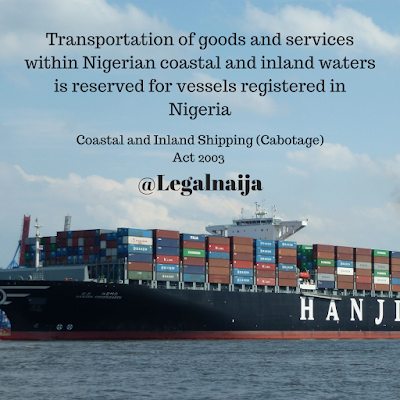
The Coastal and Inland Shipping
(Cabotage) Act was passed in 2003 and its objective was to reserve commercial
transportation of goods and services within Nigerian coastal and inland waters
to vessels registered in Nigeria and
owned by Nigerians. The Act primarily sought to encourage indigenous ship
ownership and restrict foreign vessels from trading in Nigeria’s inland waters.
Alas, twelve years after the Cabotage Act we have seen a decline in shipping
activities by our indigenous shipowners who have been excluded from the
lucrative oil sector for lack of sea-worthy vessels. Most of our shipowners
have been impoverished and frustrated by the lack of commitment by government
to heed their call for reforms in the cabotage regime.
(Cabotage) Act was passed in 2003 and its objective was to reserve commercial
transportation of goods and services within Nigerian coastal and inland waters
to vessels registered in Nigeria and
owned by Nigerians. The Act primarily sought to encourage indigenous ship
ownership and restrict foreign vessels from trading in Nigeria’s inland waters.
Alas, twelve years after the Cabotage Act we have seen a decline in shipping
activities by our indigenous shipowners who have been excluded from the
lucrative oil sector for lack of sea-worthy vessels. Most of our shipowners
have been impoverished and frustrated by the lack of commitment by government
to heed their call for reforms in the cabotage regime.
The Nigerian Maritime
Administration and Safety Agency Act, 2007 established the Nigerian Maritime
Administration and Safety Agency (NIMASA) to promote and develop indigenous
commercial shipping in international and coastal trade and regulate and promote
maritime safety, security, marine pollution and maritime labour. At the
commencement of the Act, all assets, liabilities, rights and obligations of the
Nigerian Maritime Authority (NMA) and the Joint Maritime Labour Industrial
Council (JOMALIC) were transferred to NIMASA. It is under NIMASA that Cabotage
is to be enforced.
Administration and Safety Agency Act, 2007 established the Nigerian Maritime
Administration and Safety Agency (NIMASA) to promote and develop indigenous
commercial shipping in international and coastal trade and regulate and promote
maritime safety, security, marine pollution and maritime labour. At the
commencement of the Act, all assets, liabilities, rights and obligations of the
Nigerian Maritime Authority (NMA) and the Joint Maritime Labour Industrial
Council (JOMALIC) were transferred to NIMASA. It is under NIMASA that Cabotage
is to be enforced.
A keen look at the Cabotage
Act highlights salient provisions for the growth of a vibrant shipping sector.
Carriage of petroleum products between oilrigs, platforms and installations
whether off shore or on shore or within any ports or points in Nigerian waters
has been restricted to Nigerian citizens. In fact, the Act is far reaching and
must have caused some excitement by those who promoted its enactment. In the
United States of America, the Merchant Marine Act, 1920 also known as the Jones
Act did a lot to restrict the operation of foreign vessels in American coastal
waters. By Section 27 of the Jones Act all goods transported by water between
U.S. ports are to be carried on U.S. flag
ships, constructed in the United States, owned by U.S. citizens, and crewed by
U.S. citizens and U.S. permanent residents. Although the Jones Act has been
amended on several occasions, it still provides for a strict cabotage regime
worthy of emulation.
Act highlights salient provisions for the growth of a vibrant shipping sector.
Carriage of petroleum products between oilrigs, platforms and installations
whether off shore or on shore or within any ports or points in Nigerian waters
has been restricted to Nigerian citizens. In fact, the Act is far reaching and
must have caused some excitement by those who promoted its enactment. In the
United States of America, the Merchant Marine Act, 1920 also known as the Jones
Act did a lot to restrict the operation of foreign vessels in American coastal
waters. By Section 27 of the Jones Act all goods transported by water between
U.S. ports are to be carried on U.S. flag
ships, constructed in the United States, owned by U.S. citizens, and crewed by
U.S. citizens and U.S. permanent residents. Although the Jones Act has been
amended on several occasions, it still provides for a strict cabotage regime
worthy of emulation.
The
intention of the American Congress to ensure a vibrant maritime industry is
clearly stated in the most recent revision of the United States Code, a
consolidation and codification of American laws. The objectives of cabotage are
stated to be necessary for the national defense and the development of domestic
and foreign commerce of the United States, to ensure that the United States has
a merchant marine that is sufficient to carry the waterborne domestic commerce
and a substantial part of the waterborne export and import foreign commerce of
the United States. In addition it is to provide shipping service essential for
maintaining the flow of waterborne domestic and foreign commerce at all times
that will be capable of serving as a naval and military auxiliary in time of
war or national emergency. It is mandatory that these vessels are operated by
citizens of the United States and composed of the best-equipped, safest, and
most suitable types of vessels constructed in the United States and manned with
a trained and efficient citizen personnel; and supplemented by efficient facilities for
building and repairing vessels. It was stated that the policy of the United
States is to encourage and aid the development and maintenance of a merchant
marine satisfying the objectives described in this Code.
intention of the American Congress to ensure a vibrant maritime industry is
clearly stated in the most recent revision of the United States Code, a
consolidation and codification of American laws. The objectives of cabotage are
stated to be necessary for the national defense and the development of domestic
and foreign commerce of the United States, to ensure that the United States has
a merchant marine that is sufficient to carry the waterborne domestic commerce
and a substantial part of the waterborne export and import foreign commerce of
the United States. In addition it is to provide shipping service essential for
maintaining the flow of waterborne domestic and foreign commerce at all times
that will be capable of serving as a naval and military auxiliary in time of
war or national emergency. It is mandatory that these vessels are operated by
citizens of the United States and composed of the best-equipped, safest, and
most suitable types of vessels constructed in the United States and manned with
a trained and efficient citizen personnel; and supplemented by efficient facilities for
building and repairing vessels. It was stated that the policy of the United
States is to encourage and aid the development and maintenance of a merchant
marine satisfying the objectives described in this Code.
Though
we cannot compare our development in this area with that of the United States
of America we can aim to be serious by implementing policies and strengthening
institutions in Nigeria’s maritime industry that will impact positively on revenue
generation and economic growth. Nigeria’s potential for growth and poverty
reduction are yet to be realized and will never be realized if Government
policies are not fully implemented. Like the United States of America we should
constantly review policy relating to cabotage to ensure that our institutional
and legal framework is updated to suit modern trends.
we cannot compare our development in this area with that of the United States
of America we can aim to be serious by implementing policies and strengthening
institutions in Nigeria’s maritime industry that will impact positively on revenue
generation and economic growth. Nigeria’s potential for growth and poverty
reduction are yet to be realized and will never be realized if Government
policies are not fully implemented. Like the United States of America we should
constantly review policy relating to cabotage to ensure that our institutional
and legal framework is updated to suit modern trends.
Malaysia’s
cabotage policy dates back to January 1, 1980. Like the Nigerian Maritime
Administration and Safety Agency, Malaysia set up the Domestic Shipping and
Licensing Board to implement its cabotage policy. It should be noted that all
Malaysia’s oil and gas fields are located offshore.
cabotage policy dates back to January 1, 1980. Like the Nigerian Maritime
Administration and Safety Agency, Malaysia set up the Domestic Shipping and
Licensing Board to implement its cabotage policy. It should be noted that all
Malaysia’s oil and gas fields are located offshore.
Section
65A of Part 11B of Malaysia’s Merchant Shipping Ordinance of 1952 defines “domestic
shipping” as the use of a ship to provide services in the territorial waters of
Malaysia and the exclusive economic zone for the shipment of goods or the
carriage of passengers from any port of place in Malaysia to any port or place
in Malaysia or the exclusive economic zone. A vessel that services the
Malaysian oil and gas fields must be registered as a Malaysian ship and must
hold a domestic shipping license, unless exempted under the Ordinance or by the
Minister of Transport.
65A of Part 11B of Malaysia’s Merchant Shipping Ordinance of 1952 defines “domestic
shipping” as the use of a ship to provide services in the territorial waters of
Malaysia and the exclusive economic zone for the shipment of goods or the
carriage of passengers from any port of place in Malaysia to any port or place
in Malaysia or the exclusive economic zone. A vessel that services the
Malaysian oil and gas fields must be registered as a Malaysian ship and must
hold a domestic shipping license, unless exempted under the Ordinance or by the
Minister of Transport.
Malaysian
cabotage laws are similar to those in Nigeria and it is evident that the
Malaysian indigenous shipping sector has been supported by the Government’s
will to turn this sector into a multi-billion dollar revenue generator for
Malaysia. Likewise in China the China Shipping Group owns over 500 ships with a
capacity of 30m dwt.
cabotage laws are similar to those in Nigeria and it is evident that the
Malaysian indigenous shipping sector has been supported by the Government’s
will to turn this sector into a multi-billion dollar revenue generator for
Malaysia. Likewise in China the China Shipping Group owns over 500 ships with a
capacity of 30m dwt.
A
big loophole in the Cabotage Act, 2003 is the provision of waivers for foreign
owned vessels which some may say has been responsible for the failure of
cabotage in Nigeria. Section 9 of the Act provides that the Minister for
Transport may grant a waiver to a registered vessel, to be wholly owned by
Nigerian citizens, where he is satisfied that there is no wholly Nigerian owned
vessel that is suitable and available to provide the services or perform the
activities described in the application. This provision has been a big cog in
the wheel for Nigerian shipowners. The reason being that they have been excluded
largely from participating in transporting oil in coastal and inland waters.
This trade is exclusively foreign and has given rise to the flight of foreign
exchange, the non-development of local capacity in the sector and the loss of
trillions in revenue terms.
big loophole in the Cabotage Act, 2003 is the provision of waivers for foreign
owned vessels which some may say has been responsible for the failure of
cabotage in Nigeria. Section 9 of the Act provides that the Minister for
Transport may grant a waiver to a registered vessel, to be wholly owned by
Nigerian citizens, where he is satisfied that there is no wholly Nigerian owned
vessel that is suitable and available to provide the services or perform the
activities described in the application. This provision has been a big cog in
the wheel for Nigerian shipowners. The reason being that they have been excluded
largely from participating in transporting oil in coastal and inland waters.
This trade is exclusively foreign and has given rise to the flight of foreign
exchange, the non-development of local capacity in the sector and the loss of
trillions in revenue terms.
It
is also apparent that applications for waivers have been made in respect of
foreign tanker ships and anchor handlers both of which our local ship owners
are able to provide. Most of the foreign vessels are involved in the
transportation of oil without obtaining waivers. This has placed our indigenous
shipowners among some of the poorest in the world. In
fact this critical state of affairs has necessitated the drafting of new waiver
guideline for foreign vessels wishing to participate in coastal shipping. The
new guidelines when implemented will require that foreign vessels submit a Cabotage
Waiver Form 60 days before the arrival of the vessel in Nigerian waters.
is also apparent that applications for waivers have been made in respect of
foreign tanker ships and anchor handlers both of which our local ship owners
are able to provide. Most of the foreign vessels are involved in the
transportation of oil without obtaining waivers. This has placed our indigenous
shipowners among some of the poorest in the world. In
fact this critical state of affairs has necessitated the drafting of new waiver
guideline for foreign vessels wishing to participate in coastal shipping. The
new guidelines when implemented will require that foreign vessels submit a Cabotage
Waiver Form 60 days before the arrival of the vessel in Nigerian waters.
In the United States, the United States Maritime Administration reviews waiver
requests on a case-by-case basis. Waivers have been granted in cases of
national emergencies or in cases of strategic interest. In the wake of Hurricane Katrina, Homeland Security Secretary Michael Chertoff temporarily waived
the coastwise laws for foreign vessels carrying oil and natural gas from
September 1 to 19, 2005. Similarly the Department of Homeland Security issued a
temporary blanket waiver of the Jones Act for the shipment of petroleum
products following widespread fuel shortages caused by Hurricane Sandy.
requests on a case-by-case basis. Waivers have been granted in cases of
national emergencies or in cases of strategic interest. In the wake of Hurricane Katrina, Homeland Security Secretary Michael Chertoff temporarily waived
the coastwise laws for foreign vessels carrying oil and natural gas from
September 1 to 19, 2005. Similarly the Department of Homeland Security issued a
temporary blanket waiver of the Jones Act for the shipment of petroleum
products following widespread fuel shortages caused by Hurricane Sandy.
The Cabotage Act has done little to
build indigenous capacity in shipping. Our shipowners are largely indebted to
banks in a bid to stay in business. The Cabotage Vessel Finance Fund (CVFF)
designated as a special fund to develop local shipping has about N5o billion
still waiting to be disbursed to Nigerian shipowners. One reason advocated by
industry analysts for this has been brought about by policy inconsistency. It
should be noted that NIMASA has been riddled with controversy by the frequent
appointments of several director- generals over the years. NIMASA is one of the
richest government agencies that is overburdened with a plethora of functions
including, cabotage enforcement, safety and security of inland and coastal
waters, administration of the CVFF, licensing etc. The time has come to
unbundle NIMASA such as was done with the National Electric Power Authority for
better administration and function.
build indigenous capacity in shipping. Our shipowners are largely indebted to
banks in a bid to stay in business. The Cabotage Vessel Finance Fund (CVFF)
designated as a special fund to develop local shipping has about N5o billion
still waiting to be disbursed to Nigerian shipowners. One reason advocated by
industry analysts for this has been brought about by policy inconsistency. It
should be noted that NIMASA has been riddled with controversy by the frequent
appointments of several director- generals over the years. NIMASA is one of the
richest government agencies that is overburdened with a plethora of functions
including, cabotage enforcement, safety and security of inland and coastal
waters, administration of the CVFF, licensing etc. The time has come to
unbundle NIMASA such as was done with the National Electric Power Authority for
better administration and function.
Though there have been several attempts
by the Indigenous Shipowners’ Association (ISAN) to enforce cabotage Nigerian shipowners
have, to coin a phrase, ‘been left up the creek without a paddle’. There are
two landmark cases that exemplify the resolve of the Indigenous Shipowners’
Association (ISAN) to take the bull by the horn as interested parties to
enforce cabotage. In the case of Indigenous Shipowners’ Association (ISAN) &
Another vs. Lovell Sea & 3 Others the
plaintiffs, ISAN, challenged the propriety of the use of the 1st defendant, a
foreign vessel by the 2nd – 4th defendants to carry out cabotage trade within
the cabotage jurisdiction of Nigeria. It was the plaintiffs’ contention that
the 1st defendant not being registered as a cabotage vessel or granted a waiver
or restricted license to operate within the cabotage jurisdiction had infracted
on their guaranteed rights under the Cabotage Act, 2003. The Federal High Court
judge in this case held that the defendants were in deed in violation of
cabotage and gave judgment to ISAN for the loss suffered by it.
by the Indigenous Shipowners’ Association (ISAN) to enforce cabotage Nigerian shipowners
have, to coin a phrase, ‘been left up the creek without a paddle’. There are
two landmark cases that exemplify the resolve of the Indigenous Shipowners’
Association (ISAN) to take the bull by the horn as interested parties to
enforce cabotage. In the case of Indigenous Shipowners’ Association (ISAN) &
Another vs. Lovell Sea & 3 Others the
plaintiffs, ISAN, challenged the propriety of the use of the 1st defendant, a
foreign vessel by the 2nd – 4th defendants to carry out cabotage trade within
the cabotage jurisdiction of Nigeria. It was the plaintiffs’ contention that
the 1st defendant not being registered as a cabotage vessel or granted a waiver
or restricted license to operate within the cabotage jurisdiction had infracted
on their guaranteed rights under the Cabotage Act, 2003. The Federal High Court
judge in this case held that the defendants were in deed in violation of
cabotage and gave judgment to ISAN for the loss suffered by it.
However, in
the case of the Indigenous Shipowners’ Association (ISAN) vs. M.T Makhambet,
ISAN commenced an
action at the Federal High Court Lagos and sought inter alia an order of injunction restraining the Defendants from
further carrying on cabotage trade within the Nigerian Exclusive Economic Zone
prior to or without their complying with the Cabotage Act. The defendants
challenged ISAN’s locus (right) to institute the action. The Federal High Court
held that the plaintiff did not prove that the defendants contravened the
provisions of the Cabotage Act and struck out the case of the plaintiffs.
Though this case went on appeal to determine two fundamental issues relating to
the right of the plaintiffs to reliefs not sought by them, this case still
represents the position taken by our indigenous shipowners and against all odds
their determination to enforce cabotage in Nigerian waters.
the case of the Indigenous Shipowners’ Association (ISAN) vs. M.T Makhambet,
ISAN commenced an
action at the Federal High Court Lagos and sought inter alia an order of injunction restraining the Defendants from
further carrying on cabotage trade within the Nigerian Exclusive Economic Zone
prior to or without their complying with the Cabotage Act. The defendants
challenged ISAN’s locus (right) to institute the action. The Federal High Court
held that the plaintiff did not prove that the defendants contravened the
provisions of the Cabotage Act and struck out the case of the plaintiffs.
Though this case went on appeal to determine two fundamental issues relating to
the right of the plaintiffs to reliefs not sought by them, this case still
represents the position taken by our indigenous shipowners and against all odds
their determination to enforce cabotage in Nigerian waters.
These two cases show the effort made by
the Indigenous Shipowners’ Association to safeguard their business by enforcing
cabotage. As the regulatory body NIMASA has an inherent duty to enforce
cabotage, unfortunately this duty has been ignored in the face of the huge sums
of money that NIMASA realizes annually from waiver levies.
the Indigenous Shipowners’ Association to safeguard their business by enforcing
cabotage. As the regulatory body NIMASA has an inherent duty to enforce
cabotage, unfortunately this duty has been ignored in the face of the huge sums
of money that NIMASA realizes annually from waiver levies.
In conclusion, we see that cabotage has
failed woefully to build indigenous capacity in shipping which has resulted in
the loss of trillions of Naira in revenue for the government. To turn things
around will require a cabotage enforcement action plan which will involve a
review of the Cabotage Act especially Sections 2, 3, 5, 9, 10, 11,
12, 15, 22, 23, 29, 33 and 39. The maritime industry needs a total overhaul of
legal and regulatory framework. It is crucial that stakeholders come together
to seriously discuss the industry and lay down an ACTION PLAN that will be
presented to government for immediate implementation. Cabotage presently is not
working and will not work until certain parameters are reviewed, revised and
restructured.
failed woefully to build indigenous capacity in shipping which has resulted in
the loss of trillions of Naira in revenue for the government. To turn things
around will require a cabotage enforcement action plan which will involve a
review of the Cabotage Act especially Sections 2, 3, 5, 9, 10, 11,
12, 15, 22, 23, 29, 33 and 39. The maritime industry needs a total overhaul of
legal and regulatory framework. It is crucial that stakeholders come together
to seriously discuss the industry and lay down an ACTION PLAN that will be
presented to government for immediate implementation. Cabotage presently is not
working and will not work until certain parameters are reviewed, revised and
restructured.
There is no rocket science required to understand the
fundamentals of having a vibrant and robust shipping sector. Job opportunities
such as Seafaring, Stevedoring, Operators, Managers, Brokers, Dockers, Ship-builders,
Charterers, Freighters, Cargo handlers, Insurers, legal services etc the list
goes on and on, will eventually be created and contribute to the Nation’sGDP . There is a dire need to transform
infrastructure in the sector for better cabotage effectiveness. Our ports
system will have to be re-evaluated which may necessitate the quick passage of
the Ports and Harbour Bill by the National Assembly. The Bill will give legal
backing to the privatization of the ports and will encourage foreign and
domestic investment when passed into law. A wind of change is blowing through
the maritime industry and it is crucial that all stakeholders are emboldened to
collaborate in order to revamp the sector.
fundamentals of having a vibrant and robust shipping sector. Job opportunities
such as Seafaring, Stevedoring, Operators, Managers, Brokers, Dockers, Ship-builders,
Charterers, Freighters, Cargo handlers, Insurers, legal services etc the list
goes on and on, will eventually be created and contribute to the Nation’s
infrastructure in the sector for better cabotage effectiveness. Our ports
system will have to be re-evaluated which may necessitate the quick passage of
the Ports and Harbour Bill by the National Assembly. The Bill will give legal
backing to the privatization of the ports and will encourage foreign and
domestic investment when passed into law. A wind of change is blowing through
the maritime industry and it is crucial that all stakeholders are emboldened to
collaborate in order to revamp the sector.
BISI
AKODU IS A PARTNER AT OLISA AGBAKOBA LEGAL AND HEADS THE CORPORATE/COMMERCIAL
GROUP AT OAL
AKODU IS A PARTNER AT OLISA AGBAKOBA LEGAL AND HEADS THE CORPORATE/COMMERCIAL
GROUP AT OAL