Legal Titan Aare Afe Babalola, SAN endorses Paul Usoro for NBA Presidency

Legal Titan Aare Afe Babalola, SAN endorses Paul Usoro for NBA Presidency

The
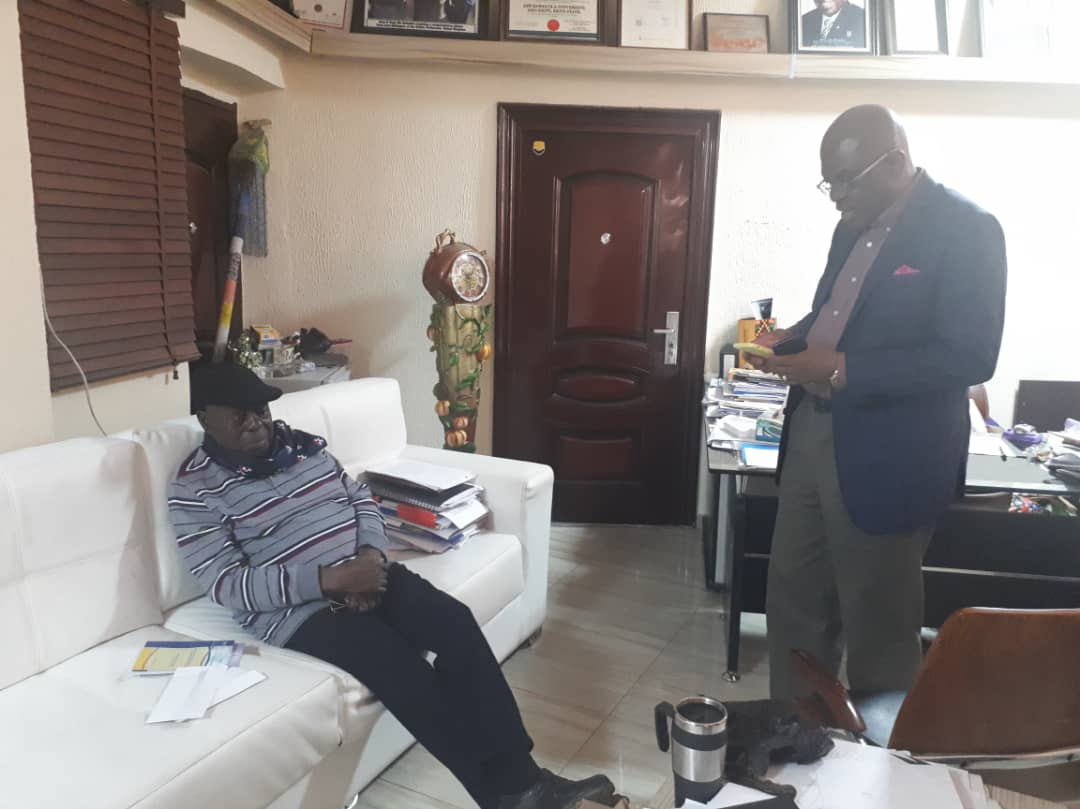
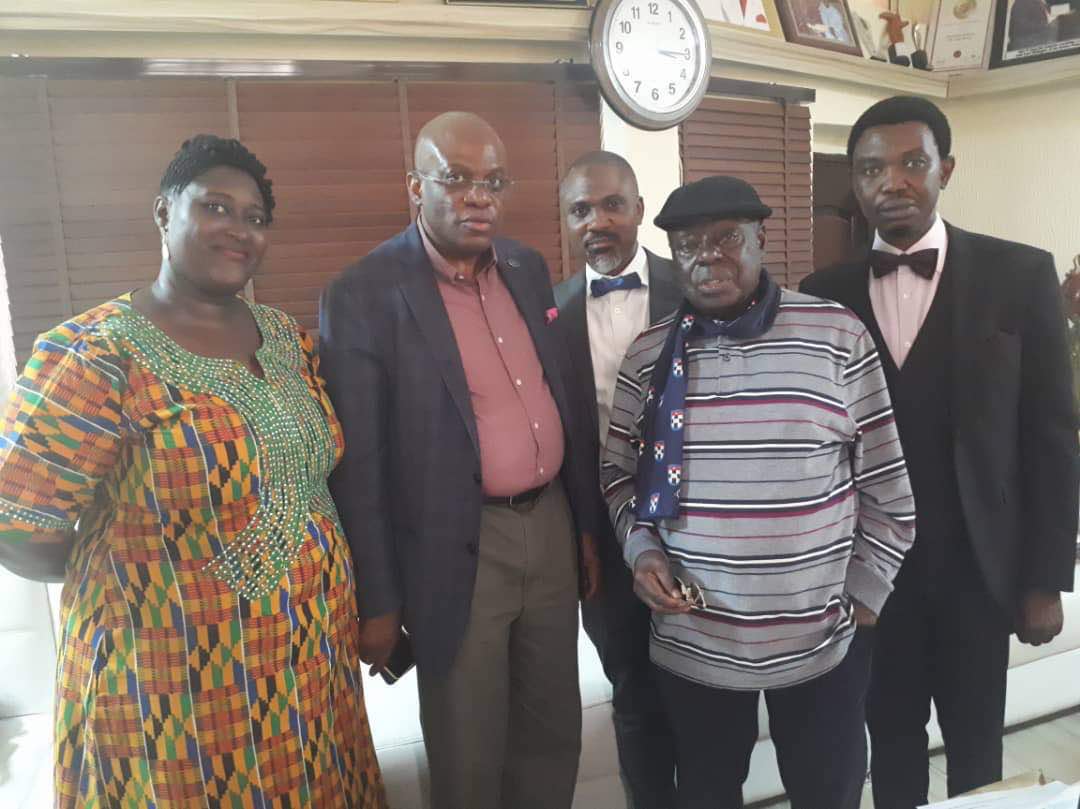
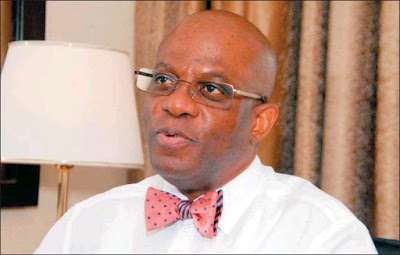
Prince of Telecommunication Law, Paul Usoro SAN who is currently in Ado Ekiti,
paid a courtesy visit to his role model Chief Afe Babalola, SAN at his office
at the Afe Babalola University, Ado Ekiti, earlier today, 25th May 2018.

During
the visit, Paul Usoro, who is one of the NBA Presidential candidates for the
forthcoming election, informed the colossus that the purpose of his visit to
the Elder Statesman is to notify him of his aspiration to lead the Bar,
considering that Chief Afe Babalola is one of the great lawyers used by God to
elevate him to the rank of a Senior Advocate of Nigeria (SAN). He also noted
that the elder statesman has been very contributive to who he is today.

Chief
Afe Babalola was very elated to receive Mr. Usoro, SAN and his team in his
office. He stated that Mr. Usoro, SAN is his son and it will be good for him to
be the NBA President. He further stated that Mr. Usoro represents what he as a
person stands for – “Industry, Discipline and Integrity”. He then concluded by
praying for Paul Usoro and declaring his support for him.

The
Learned Silk arrived Ekiti yesterday  for the NBA Ado Ekiti Branch’s
Annual Bar Dinner and was well received by prominent members of the Bar and
Bench during the commissioning of the Ultra-Modern High Court Complex, Ado
Ekiti.
IP ABC: – Can I Copyright My Book Title | Infusion Lawyers

IP ABC: – Can I Copyright My Book Title | Infusion Lawyers


I’m a
Nigerian author. Presently, I am writing my second book. The book is titled, Buhari:
100 Days in London and Other Stories
. But there is a problem. I discovered
3 other writers who have written articles that are similar to the title of my
book. In fact, when I contacted one of the writers about this, he emphatically
told me that he was about to finish a book with a similar title. And just as I
tried to think it through, a Nigerian movie also with almost identical title
popped up in a TV advert. I badly want to use this title. For protection, can I
copyright the title of my book?

Answer 

The
answer is NO.

Copyright
law does not protect titles of books or titles of other literary works. Also,
titles of both artistic and musical works are not copyrightable. (This may
partly explain why so many books out there have the same titles and no one is
getting into any legal troubles.)

The reason is that copyright protects only eligible works.

Eligible works are not only required to be artistic works (paintings),
broadcasts (radio programs), cinematographic works (films), literary works
(books), musical works (songs), or sound recordings (soundtracks, excluding
films) but also required to meet 2 vital conditions.

These 2 conditions are as follows:

1.     Sufficient effort has been expended on making the work
to give it an original character
;
and

2.     The work has been fixed in any definite medium of
expression now known or later to be developed, from which it can be perceived,
reproduced or otherwise communicated either directly or with the aid of any
machine or device.

The
two conditions above are prescribed in section 1(2) of the Nigerian Copyright
Act.


Therefore, titles do not meet the first statutory condition above: sufficient
effort expended on making the work to give it an original character
.

In
some other parts of the word, this is similarly described as a
significant amount of original expression. 
Expressions as short as
book titles do not qualify as sufficient effort. This is why you can
neither stop the writers using identical or similar titles with yours nor
protect your title under copyright. Copyright law says you need to do better
than that!

But this doesn’t give you or any person the right to title artistic,
literary, or musical works just about any existing title.

For instance, your book cannot be titled Buhari: 100 Days in London and
Other Stories
if that title is another person’s trademark. In other words,
if the producers of the film 100 Days in London have trademarked the
film title, you are prohibited from using any identical or similar titles for
your book. (Yes, some titles qualify for trademark protection, either because
those titles are to be used in connection with business or have become so well
– known they are distinctively connected to a particular author or
publisher. This is more so with series and popular titles. Think the
series Harry Potter or the popular book Chicken Soup for
the Soul
. Chinua Achebe’s Things Fall Apart—though with a title
which is not original to the author—may qualify for trademark protection
considering how well known the book has become globally. (Even Google honoured the author with a doodle recently.)

So the point is this:

Once
a book becomes a bestseller or becomes so successful it is recognized as a
distinctive brand, the author or publisher may trademark the title.
And once trademarked, the title is out of bounds to any person.


Consider this.

If
you can come up with a title that is not already in use—particularly in
the genre your book falls into—you may consider that title instead. As an
author, you need to keep your publications away from avoidable controversies.
You also don’t want to confuse your audience.

You wish to consider your options closely? For competent guidance, you may consult
an IP lawyer or law firm for professional advice and assistance.

IP
ABC
Source – Infusion Lawyers 

LCA_YAN Symposium & International Moot Competition

LCA_YAN Symposium & International Moot Competition

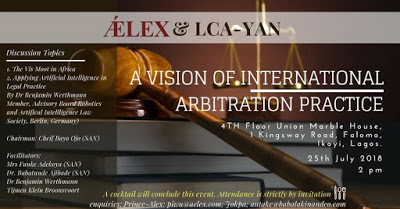
As a prelude to the 2018 Lagos Court
of Arbitration, Young Arbitrators Network (LCA_YAN)  International Moot Competition , there would be
a symposium on the theme “A Vision of International Arbitration Practice” on
the 25th of July 2018. This would mark the start of a 3-day event with the
semi-finals and finals of the moot on following days.  See Flier for
more details. 

Excerpts from Mr. Paul Usoro, SAN’s Speech at the meeting held with members of the NBA, Okitipupa Branch today

Excerpts from Mr. Paul Usoro, SAN’s Speech at the meeting held with members of the NBA, Okitipupa Branch today

“The office of
the NBA President calls for service and not enrichment of oneself.

When I decided to
contest for NBA Presidency, I was actually looking at building and working with
an inclusive bar. A bar that takes care of every lawyer, whether from a
cosmopolitan place or the hinterland.

The kind of bar that
I envision is the type of bar that will be professional in outlook. A bar that
protects the interest of lawyers and also builds a practice for them. 

My life has been
built around 3 critical things – God’s favour, building and maintaining
relationships, and keeping promises. These 3 things are very key and have made
me, by the grace of God, who I am today. As the President of NBA, I will keep
to my promises”. 

University Dons Laud Paul Usoro SAN

University Dons Laud Paul Usoro SAN


A University Don, Professor Momodu Kasim-Momodu, Law Dean at Crescent University, Abeokuta recently lauded the eminent lawyer, Mr. Paul Usoro, SAN for his giant strides in the industry. The Professor made this known at a breakfast meeting in honour of Paul Usoro organised by the Young Lawyers Forum (YLF) of Kano, Ungogo and Dutse branches.


Speaking at the meeting, he hailed Paul Usoro for his exceptional and excellent skills over the years having one of the finest law firms, Paul Usoro & Co., that is known to hire young lawyers taking them through thorough pupillage and mentorship.
In review of the exploit of the learned silk, the University Don called on fellow academia and other lawyers in the country to choose Usoro as their candidate for the next President of the Nigerian Bar Association. “I have had faith in him from the first day I heard about his ambition to lead the NBA. I had never met him but I went online to read about his works and they are simply exceptional. Paul is a bar man that has the potentials to give us an Association that will put you and your dreams first”.
“A vote for Paul Usoro is a vote for yourself – if you vote for Paul Usoro, you are voting for your interest as a lawyer and you are also voting for the overall interest of the legal profession”, he enthused.
Notable personalities at the breakfast meeting include Alh. Tajudeen Oladoja (Life Bencher), Ibrahim Shehu, (YLF Chairman, Dutse branch), Abdullahi Musa Karaye, (YLF Chairman, Ungogo branch), Mukhtar Bello Shehu (YLF Chairman, Kano Branch), Ahmed Khali (YLF Chairman, Yobe Branch) among others.
In the same vein, as part of his agenda to have an inclusive bar, Usoro recently paid a courtesy visit to the law teachers of the Rivers State University of Science and Technology, Port Harcourt during the 2018 conference of the Section on Legal Practice of the Nigerian Bar Association (SLP NBA) held in Port Harcourt.
Addressing the law teachers, Paul Usoro said, “My coming here is to reinforce the belief that the bar under my leadership will work together with the academics to provide solutions to the myriads of problems facing legal practice in Nigeria. The academics are well placed to research into those problems and proffer solutions”.
In the euphoria created by the visit of the bar man, the Dean, Faculty of Law, Rivers State University of Science and Technology, Port Harcourt, Professor Nlerum Okogbule expressed the support of the academia to vote Usoro as the next NBA President. “We commend your foresight in the industry and we are impressed to have you speak to us at this conference. We would support you because we need innovations in the NBA. The bar needs somebody like you to lead the Association and you can be rest assured of our support”.
Paul Usoro is a visionary leader with the right temperament to unify all. He is a truly detribalised Nigerian with strong connections to all the geographical zones. Born in the East – South East, educated in the West, practiced in the North, now headquartered in Lagos with branch offices in Abuja and Uyo. He is a consummate professional and leader you can trust.
Paul Usoro, a responsible citizen – LIRS

Paul Usoro, a responsible citizen – LIRS

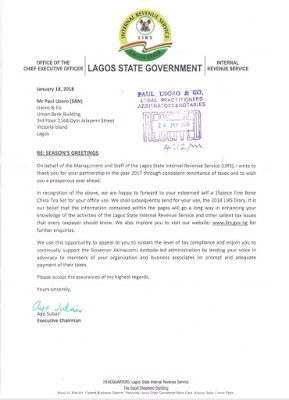
The Executive Chairman of the Lagos State
Government Internal Revenue Service, LIRS, Ayo Subair, has lauded the
consistent commitment to responsibly remit taxes exhibited by Paul Usoro, SAN.

In an official letter sent to the learned
silk, the LIRS Chairman hailed Mr Usoro’s actions and appreciated his continued
support and ongoing partnership with the Lagos State Government. Subair further
revealed that such actions were exemplary and held him up as a model for all
Nigerian taxpayers to follow.

The Chairman appealed to Mr Usoro, imploring
him to sustain the level of tax compliance while enjoining him to continually
support the Akinwunmi Akinbode-led administration by lending a voice in
advocacy to members of his firm, Paul Usoro & Company, PUC, as well as
business associates on the utmost importance of prompt and adequate payment of
their taxes.

The LIRS Chairman concluded by assuring Mr
Usoro of his highest regards while felicitating with him ahead of the rest of
the year.

The Repeal And Re-Enactment Of The Companies And Allied Matters Act 1990 (Cap C20, Lfn 2004); What to expect? | Oyewole Gboyega

The Repeal And Re-Enactment Of The Companies And Allied Matters Act 1990 (Cap C20, Lfn 2004); What to expect? | Oyewole Gboyega


The Premise – After
28 long and hard years of its existence, the Companies and Allied Matters Act
of 1990 is finally going to be overhauled in favour of a new Act which would be
cited similarly. The repeal and re-enactment planned by the National Assembly by
virtue of the Bill for An Act to Repeal the Companies and Allied Matters Act
1990 (Cap C20, LFN 2004) is long overdue considering the fact that the Act had
been severely left behind by the times and had become a hindrance to modern and
efficient corporate governance practices as well as general economic
development.

The Expectation – There
is an expectation that the re-enacted law would address several issues which
have been problematic for companies and for the Corporate Affairs Commission in
the past and this has prompted many to look carefully at the Bill that has been
pass by the National Assembly.

Bottom-line – A few
notable changes and additions to the law are as follows:

The Governing Board
of the Commission
– the issue of the leadership of the Corporate
Affairs Commission has been properly defined in the bill; expressly referring
to the leaders of the Commission as the “Governing Board” and not as “Members”
as was the case before. Furthermore, in the appointment of a representative of
the accountancy profession to the leadership of the Commission, the Institute
of Chartered Accountants would no longer be the sole organisation whose members
would be considered as other professional bodies in the accounting profession
would have a shot at a seat at the table.

A representative of
the Institute of Chartered Secretaries would now form part of the leadership as
well as a representative from the Federal Ministry of Industry Trade and
Investment. These additions are key corporate governance practices which ensure
the diversity of any Board to aid creative problem solving and well rounded
decision and policy making. The functions of the “Governing Board” are also
clearly spelled out in the Bill and the chief of these is policy making for the
Commission. This most definitely would ensure that the Commission has a clear
focus and goal at all times.

Requirement for Pre-action Notice – this is a crucial change as it would drastically alter the procedure
for filing lawsuits against the Corporate Affairs Commission.
The Bill requires
that before a suit can be commenced against the Commission, a pre-action notice
must be issued and served on it. This protection has been afforded several
other federal government agencies and it is good to see that said protection
has been expanded to the Commission.

The Right to Form a CompanyAnother key
change is the fact that 1 person may now incorporate a private company so long
as the provisions of the Act in respect of same are complied with as opposed to
the previous position where there had to be at least two persons. This would
make for ease of commencement of a business.

Company Limited by Guaranteethe
requirement for the consent of the Attorney General to the incorporation of a
company limited by guarantee has been dispensed with under the Bill. This is a
very welcome development as the cumbersome nature of obtaining the Attorney
general’s consent has always been a massive stumbling block to the
incorporation of companies limited by guarantee which are essential to social
development.

Disclosure of
Capacity by Shareholder
– the issue of shareholder transparency
which has long been a concern has been dealt with by the Bill. Every
shareholder would be required to disclose to the company within 7 days of
becoming a member, the capacity in which he holds the shares and if he holds
them as a beneficial owner. There is also obligation placed on the company to
disclose this information to the Commission.

Place of Meeting – a very
progressive change to the law is that private companies are now free to hold
general meetings electronically provided that such meetings are conducted in
accordance with regulations to be made by the Commission from time to time.


Oyewole Gboyega
Source – www.septemberpost.com 

Building A Culture Of Arbitration And The Need For A National Policy On Arbitration | Dr. Olisa Agbakoba OON, SAN, FCIArb  & Ridwan ‘Tola Bello, LLM, MCIArb.

Building A Culture Of Arbitration And The Need For A National Policy On Arbitration | Dr. Olisa Agbakoba OON, SAN, FCIArb & Ridwan ‘Tola Bello, LLM, MCIArb.


The judicial system has proven extremely
inadequate at processing cases or enforcing decisions. Courts are slow and
generally considered inefficient for reasons that include funding, poor
physical facilities, staff shortages, congestions, and inadequate training etc.
The average duration for the resolution of cases in Nigerian courts is between
10 – 20 years spanning the entire tiers of the judicial system. This is
evidently unmanageable in any economy.

The enforcement of commercial
contracts or settlement of disputes continues to be a primary concern for
entrepreneurs and investors. Economic reforms and investment growth are hardly
achieved and barely successful in face of dispute resolution constraints. The
reason is that Litigation has become such a major bottleneck to business that
it is no longer seen as an effective mechanism for timely resolution of
commercial dispute. Reliable alternative methods of resolving commercial
disputes became imperative hence the introduction and wide acceptance of
Alternative Dispute Resolution (ADR) processes or mechanisms.

Arbitration has become the established method
of determining international commercial disputes. All over the world, states
have modernized their laws of arbitration to take account of this fact. In a
recent survey conducted by White and Case, in collaboration with Queen Mary
University, School of International Arbitration on the Improvements and
Innovations in International Arbitration, 90% of the respondents to that survey
confirmed that international arbitration is their preferred dispute resolution
mechanism.

New arbitral centers are being established
and there is rapid development of law and practice of arbitration. International
treaties such as the New York Convention of 1958 on the Recognition and
Enforcement of Foreign Awards as well a body like UNCITRAL[1]
is essential to the effectiveness of Arbitration internationally.

The attraction is that international
arbitration is conducted in different countries and against different legal, cultural
backgrounds with a striking lack of formality but upon certain and acceptable
international standards, norms and ethics. 
Records support the establishment and effectiveness of arbitration
institutions. International institutions driving arbitration includes the ICC
in Paris, SIAC in Singapore, LCIA in London, HKIAC in Hong Kong. In addition to
arbitration services provided by these institutions, they set rules and other
procedural requirements which attract users universally.

Nigeria generates a significant volume of
commercial transactions (both domestic and international with about 80 percent
of these transactions originating or terminating in Lagos). Unfortunately,
dispute arising from these transactions are ultimately arbitrated in foreign
countries. This situation has been attributed to the inadequacy and efficacy of
Nigeria’s legal and institutional framework for Arbitration. The “flight” of
“domestic” (i.e. purely Nigerian) arbitration cases to arbitral venues outside
Nigeria is unhelpful to Nigeria’s economic empowerment and development strategy
programme (NEEDS). It also means loss of revenue for majority of lawyers and other
ADR practitioners. Various efforts and proposals have been made at the national
level and some states too. The Repeal and Re-enactment Bill of the Arbitration
and Conciliation Act 1988 currently before the legislature makes an attempt at
addressing this issue. What is required is a commitment and affirmative steps
for actualization of the proposals.

In line with promoting policies which
encourage the development of arbitration in this region, there is currently a bill
before the National Assembly for the amendment of the Arbitration and
Conciliation Act (ACA) 1988.
Under the present 30
years old framework, lengthy and expensive are words that are often used to
describe arbitration proceedings in Nigeria. These are words which should not
be associated with arbitration as a means of dispute resolution. The reform will
help the argument for making Nigeria a preferred seat of arbitration and thus
increasing Nigeria’s share of arbitration.

The Olisa Agbakoba Legal Mediation and Arbitration Center submitted a
proposal to the House Committee in charge of the repeal and the re-enactment of
the Arbitration and Conciliation Act. Our proposal seeks to introduce in the
Bill an opt-in provision for fixing the seat of arbitration in Nigeria.
We propose that where
parties have failed to determine Seat and Place of the Arbitration, the
Arbitration tribunal should revert
to Nigeria as the forum or seat for the Arbitration.
This would invariably promote the growth of the industry and also encourage
investment, drive economic development and improve Arbitration practice and
culture amongst Arbitrators and relevant professionals.

Another example of policies that drive the
growth and culture of arbitration is the Lagos Arbitration Law 2009. Lagos
remains the commercial hub of the nation with the potential of becoming an
international financial and investment center in Africa. However, it requires an
efficient commercial dispute resolution environment founded on enabling legal
and institutional frameworks. In United Kingdom, the London Court of
International Court of International Arbitration (LCIA) in London derives
tremendous support from the London City Corporation with the London Chamber of
Commerce as one of the core drivers. In view of foregoing, affirmative action
could be taken by a state like Lagos. During my tenure as the NBA President,
precisely in 2008, I made a proposal to the Lagos State Government on the need
for establishment of a Domestic Arbitration Center in Lagos as a pilot
initiative. The state then started the process by introducing ‘a Bill for a Law to provide for the
establishment, management and operation of a Center which would act as a Court
for Commercial Arbitration as other Dispute Resolution (ADR) Mechanisms in
Lagos State and for connected purposes therewith’
. This resulted in the
establishment of the Lagos Court of Arbitration in Lekki, Lagos.

In Nigeria, business managers (or their legal
advisers) who have to decide on the advantages of choosing Nigeria as an arbitration
forum will be interested to see that the appropriate frameworks are in place. What
prevails at Ad Hoc Arbitration and ADR bodies applying different kind of rules;
favourably and unfavourably to the parties. Nigeria has commercial centers like
Lagos, Abuja, Port Harcourt and Kano with the potential of becoming
international financial and investment centers in Africa. A national culture of
Arbitration is imperative as a framework and symbol of institutional
arbitration.

In fact, a national culture or policy on
arbitration will galvanize the improvement of domestic arbitration and provide
the platform for development and standardization of Ad hoc Arbitration process.
As an international organization, the Regional Center for International Arbitration
(RCIA) Lagos is constrained to drive the kind of national support required for
development and practice of Arbitration. The fact is that Nigeria can emulate
the practice in successful jurisdictions like Singapore or Malaysia, which have
strategically positioned themselves in their regions as arbitration hubs,
generating enough dispute resolutions to act as a catalyst in the development
of their respective economies. They achieved this by a national policy and
culture of arbitration. Another country that has seen significant development
by adopting a national policy in arbitration recently is Rwanda with the
establishment of the LCIA-backed Kigali International Arbitration Center. Mauritius
and Egypt have shown themselves to be sound choices for African arbitral seats,
and their use in intra-African arbitrations should be promoted.

It is worthy of note that not one African
arbitration centre has attained its full potential. This could be attributed to
the fact that there are simply too many of them. Limited resources should be
channeled efficiently for the development of three or four regional centres,
which are fully equipped with state-of-the-art facilities and information
technology. If establishing a regional centre faces too much red-tape, then governments
should consider simply promoting those African institutions which have
successfully established themselves (such as the LCA, CRCICA, Mauritius
International Arbitration Centre and the KIAC which have all struck the right
balance between being supported by their respective governments, without
control or interference from them), and making them the default choice in their
contracts. This removes an item from public expenditure, and may have benefits
in terms of the political leverage to be gained from encouraging the use of one
or more of these centres.

Next Steps –
Under the tenure of the former Attorney
General of the Federation, Prince Bola Ajibola, the Nigerian policy of
Arbitration was at its height. It was under this tenure that the Regional Center
of Arbitration was setup. The Government needs to promote its arbitration
policy by fully backing a center of arbitration. The Lagos Court of Arbitration
(LCA) undoubtedly, has potential to become a powerhouse in international
arbitration in West Africa. Its strong institutional rules and the recent
development in arbitration legislation in Nigeria demonstrates that it can gain
the trust and acceptance of the region, and this should be a good springboard
from which to build an international arbitration centre and a regional
arbitration hub.
If this centre was promoted in intra-African
arbitrations, then it would build a track record of international arbitrations
(albeit from other African countries), and gain enough credence to administer
non-African arbitrations.

Stakeholders such as banks, maritime
operators, government agencies need to propel the development of arbitration by
keying into the sector. Contracts in these sectors need to contain arbitration
clauses. Disputes resulting from such contract should be arbitrated in Nigeria.
There should be no reason for a purely Nigerian dispute between Nigerian
parties to be arbitrated in London. There is a need to grow the Nigerian
arbitration jurisprudence and expertise.

Stakeholders also need to engage Presidential
Enabling Business Environment Council (PEBEC) on the ease of doing business.
The council must understand that for there to be growth or development in
Arbitration, an arbitration policy is crucial. Investors need to be assured
that in the event of any dispute, there is an efficient legislative framework
on arbitration to resolve such commercial dispute.

Conclusion – Telling the World

Nigeria must be cognizant of its bargaining
power. In the scramble for resources, investors will be forced to accept local
or regional arbitral systems and/or African seats, or risk losing deals.
Indeed, in a survey conducted by Simmons & Simmons in 2015, 72% of
respondents said that they would consider using local or regional arbitral
systems, and 58% said they would use an African seat.

In order to develop arbitration in this
region and prop Nigeria as a regional hub in West Africa, it is incumbent on us
to take active steps to increase awareness. We must build up the capacity of
our arbitration centres, then market them aggressively. We must make
legislative reforms an agenda priority, then publicise them widely. Stakeholders
need to develop more seasoned Nigerian Arbitrators by encouraging partnerships
between international law firms and locally-based firms. This will enable the
transfer of knowledge and skills, and the opportunity to gain from the wealth
of experience which international law firms have to offer, in order to build
local capacity.

In all these efforts, it is important to act
quickly and capitalize on the current interest in the continent and Nigeria, as
this will eventually wane. If we are successful, perhaps what might emerge is a
more mature Nigerian arbitration jurisprudence, and evolution of an
African-centric style of arbitration, or at the very least, one in which Nigeria
has had an influence.

The culture and policy of arbitration in
Nigeria is still at its infancy.


[1] United Nation Commission
on International Trade Laws

Promoting Arbitration As A Tool For Encouraging Investment | Ridwan Bello

Promoting Arbitration As A Tool For Encouraging Investment | Ridwan Bello

It is no secret that the world today is
a global village, interdependent on itself to ensure the continuity of a
thriving commercial community and the survival of each and every nation. Cross
border transactions are the norm in today’s world
and cannot be avoided.  Daily, international business
contracts are signed as well as Bilateral Investment Treaties
(BIT)   to protect international commerce, cross border
transactions and investments.

Human nature dictates that conflicts will
arise in the execution of these transactions. Conflicts are part and parcel of
contracts, particularly cross border contracts. For this reason, dispute
resolution mechanisms are agreed, setting out the parameters for the resolution
of potential disputes before they occur. In a recent survey conducted by White
and Case, in collaboration with Queen Mary University, School of International
Arbitration on the Improvements and Innovations in International Arbitration,
90% of the respondents to that survey confirmed that international arbitration
is their preferred dispute resolution mechanism.

On this premise, the question on the
ease and mechanics of arbitration and its competence in the resolution of
conflicts in the execution of cross border contracts and transactions comes to
fore. How can arbitration be a successful tool for the promotion of investment?

Due diligence must be carried out on the
future stability, predictability, and protection of foreign investment prior to
a potential foreign investor making an investment commitment. Arbitration
, as noted, is the preferred dispute
adjudication method in protecting foreign investment.

Undoubtedly, there is
a nexus between the existence of a stable legal environment which is
pro-arbitration, and the level of investment which an economy can attract. For
instance, Bilateral Investment Treaties (BITs) play a role in promoting Foreign
Direct Investment in countries. BITs are treaties between countries which
protect foreign investors and their investments in a host country. This is
essentially by means of the dispute resolution clause in the BIT. More often
than not, this is an arbitration clause prescribing arbitration at the International
Center for Settlement of Investment Disputes (ICSID).

With the existence of
a BIT, potential investors and their investments enjoy some amount of security.
ICSID, being an institution of the World Bank, enjoys some level of compliance and
unreserved enforcement of its arbitral awards; the ICSID Convention being
widely assented to by countries who would rather be on the good side of the
World Bank.

Countries such as
Singapore, Hong Kong or Rwanda are premium investment hubs for potential
investors. These states each have a thriving pro-arbitration stance to dispute
resolution. In simple terms, arbitration friendly jurisdictions are the preferred
destination for potential investors. One could argue that arbitration not being
subject to any particular jurisdiction essentially wears a “transnational hat”
which strategically makes it independent of the national legal system of the
host nation. This advantage goes a long way in the minds of investors as the
idea of national bias or mistrust of the national legal system of a host state
is removed.

Also, arbitration
enjoys the clout of the Convention on the Recognition and Enforcement of
Foreign Arbitral Awards (the New York Convention 1958). This Convention ensures
the enforcement and recognition of foreign Arbitral awards in all states which
are signatories to the convention. Currently, the convention has 156 members,
thus easing the enforcement of Arbitral awards. These features amongst others encourage
investments and increase Foreign Direct Investment. Nigeria stands to
meaningfully benefit if the investment climate is conducive and receptive to
investors. The Nigerian economy, if it must develop, is in dire need of
investors who offer expertise, capital and industrial revolution.

Nigeria has made
definite progress in ADR over the years and with the recent marked growth in
foreign direct investment, arbitration would most certainly have a role to play
in the protection and sustenance of foreign investment which is fundamental to the
growth and development of our economy.

By – Ridwan Bello

       Associate, Olisa Agbakoba Legal

Ease Of Doing Business – Consolidating On Improved Ranking For Nigeria | OAL

Ease Of Doing Business – Consolidating On Improved Ranking For Nigeria | OAL

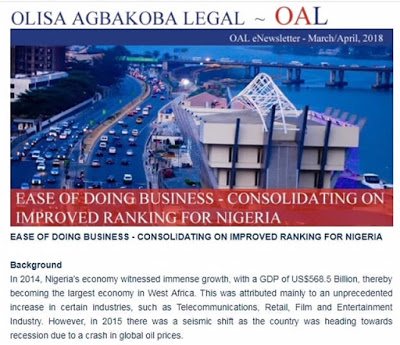
Background

In
2014, Nigeria’s economy witnessed immense growth, with a GDP of US$568.5
Billion, thereby becoming the largest economy in West Africa. This was
attributed mainly to an unprecedented increase in certain industries, such as
Telecommunications, Retail, Film and Entertainment Industry. However, in 2015 there
was a seismic shift as the country was heading towards recession due to a crash
in global oil prices.

The
state of the economy led the newly inaugurated Buhari administration to take
certain far-reaching measures to revive the economy, as a crucial part of the
government’s economic transformation policy in 2016, the Presidential Enabling
Business Environment Council (PEBEC) was established to remove bureaucratic
constraints to doing business in Nigeria and create a favourable environment
for growing business; specifically the council has as part of its mandate the
task of improving Nigeria’s ranking in the ease of doing business. On February
21, 2017, the council approved a 60-Day National Action Plan detailing actions
to be performed by certain Ministries, Departments and MDAs.

Certain
reforms have been introduced by the council in key areas such as-

Starting
a business- company name searches on the CAC portal has been introduced, a single
incorporation form has also been adopted by the CAC to save time and reduce
costs; documents can also be uploaded for submission on the CAC website, FIRS
e-payment solution has been integrated into the CAC portal.

 Dealing with Construction Permits- there is an
operational e-planning platform which allows tracking of applications, payment
of fees and uploading of architectural designs.

Getting
electricity-there has been a reduction in the number of procedures and time
lines at the Nigerian Electricity Regulatory Commission (NERC).

Getting
credit-online searches have been introduced at the National Collateral Registry

Registering
a property- sworn affidavits are no longer required at the registry and there
is an on-going streamlining of the registration process.

Trading
across borders- the palletisation of imports has become mandatory to enable
physical inspection of goods at the import, vessels importing into Nigeria are
now required to provide an advance cargo manifest for risk assessment and cargo
placement, the Nigerian Custom Service is required to coordinate physical
examination of goods, certain agencies such as the Central Bank of Nigeria, Nigerian
Customs Service (NCS) and commercial banks are now mandated to accelerate pre-export
documentation procedures and there is a reduction in container placement notice
time.

Entry
and Exit of people- The process for obtaining visa on arrival has been
simplified including the submission process. There are new immigration
regulations; arrival and departure forms have been consolidated, there is also 48-hours
visa processing time, and other infrastructural improvements at the Abuja
Airport.
The
National Assembly aligning with the objective of improving the ease of doing business
launched its own initiative in 2016 called the National Assembly Business
Environment Roundtable which is a partnership between the National Assembly and
private individuals seeking to introduce legal and constitutional reforms in
order to facilitate the ease of doing business in Nigeria. In its
“Comprehensive Review Of The Institutional, Regulatory, Legislative &
Associated Instruments Affecting Businesses In Nigeria”, it recommended the
review of several Bills such as the Federal Competition and Consumer Protection
Bill, 2015,  Federal Roads Authority
Bill, 2015, National Inland Waterways Authority Bill, 2015, National Roads
Funds Bill, 2015, National Transport Commission Bill, 2015 and the Nigerian
Ports & Harbours Authority Bill, 2015, Nigerian Postal Commission Bill,
2015 and establishment of a Federal Legislative Clearing House for cohesion and
consistency.

Fortunately,
the Federal Competition and Consumer Protection Bill 2016 has been passed by
the government, its main objective is to promote a competitive market and
protect consumer rights

Executive
Orders

In
July 2016, the President signed the first executive order on doing business in
Nigeria. The main objective of the order was to promote transparency and
efficiency in the Business Environment. Certain key changes were introduced,
and they are as follows:

Transparency-MDAs
were directed to make information on the procedure for obtaining licences,
permits and approvals including fees and timelines immediately available to the
public in their premises and on their websites. 

Default
Approvals- MDAs were directed to ensure that approvals are communicated in a
timely manner to members of the public, failure to do so will result in the
application being deemed granted.

One
Government- this was introduced to facilitate cooperation between MDAs in the
event that a customer requires input requirements and documentation from
another MDA.

Entry
Experience of Visitors and travellers- Ordinary visas and tourist visas are to
be issued or rejected within 48 hours. A list of visa requirements should be
provided, regarding port operations- all agencies represented at the ports have
been advised to streamline their operations into a single interface and Apapa
port should be operating for 24 hours. Importantly, each Port in Nigeria has
been directed to designate an existing export terminal for the exportation of
agriculture produce.

Other
Executive orders aim to address the following pertinent issues namely, timely
submission of annual budgetary estimates by all statutory and non-statutory
agencies, including companies owned by the Federal Government, support for
local content in public procurement by the Federal Government and  improve local content in public procurement
with science, engineering and technology components.

Ease
of Doing Business

Undoubtedly,
the reforms introduced by the government led to an improvement in Nigeria’s
ranking in the Ease of Doing Business. On November 8th 2017, the World Bank
Country Director, Rachid Benmessaoud, presented the Report on the Ease of Doing
Business to Vice-President Yemi Osinbajo, according to that report; Nigeria
moved up by 24 points from the 169th position on the 2017 ranking to 145th
and was included in the 10 most reformed economies.

Graph
Depicting Nigeria’s Progress in the Ease of Doing Business


Source:
Invest Advocate available at
https://investadvocate.com.ng/2018/03/02/improving-nigerias-business-operating-environment-enhance-economic-growth/

What
is the Ease of doing business?

The
Ease of Doing Business is an index published by the World Bank which measures
by way of performance indicators the extent to which a particular country’s
processes encourage foreign investment in comparison with other countries. Specifically
it “provides objective measures of
business regulations and their enforcement across 190 economies and selected
cities at the subnational and regional level.

We
will now examine some key findings of the Ease of Doing Business report below:

Starting
a business:

The report
using Lagos and Kano as case studies states that it would take approximately 15
days to register a company in Nigeria. Specifically, for a private company it
would cost N5000 for every 1Million share capital. Additional costs include: N
500 for incorporation forms, N 3,000 for certified true copy of Memorandum and
Articles of Association, N 2,000 for certified true copy of form CAC 1.1. On
average lawyers would charge N60,000.00 for incorporation depending on the size
of the firm. Companies are also required to register at the Federal Inland
Revenue Service; this can be completed in one day according to the report.

Building
and Construction Permits: In Lagos, obtaining the relevant licenses for a new
building according to the report would take approximately 116 days and cost
approximately N6.4 Million to complete. In Kano however it would take about 91
days and cost about N377,566.

Getting
Electricity: To calculate the cost of obtaining electricity in Nigeria, the
report uses a warehouse as a case study. The process would be completed in at
least 166days and cost approximately N336000. In contrast, in Kano it takes
about 94 days and costs about N328000.

Registering
Property:  According to the Ease of Doing
business report registering a property in Lagos takes 76 days and cost
approximately N2,723,874 Million but in Kano it takes about 45days with a
charge of N3,182,347 Million.

Getting
Credit: This indicator measures the effectiveness of the credit reporting
systems and collateral/bankruptcy laws in Nigeria. Concerning legal rights
Lagos scored 10 out of 12 while on the depth of information about credit, it
scored 8 out of 8.

Paying
Taxes: The Ease of Doing Business report considers the taxes a small or medium
sized company would need to pay annually. The findings are that in Lagos about
59 payments need to be made yearly requiring a total of 366 hours.

Trading
across borders: The report considers the time and cost implications of
exporting and importing goods. The procedures examined in detail include
documentary compliance, border compliance and domestic transport. Additional
parameters include the availability and status of implementation of Electronic
Data Interchange (EDI) and Single Window (SW) systems. According to the study
it will take at least 135 hours to export and cost approximately $786.

Enforcing
Contracts: The amount of time spent resolving a commercial dispute from the
court of first instance and the quality of the judicial process is another
indicator examined in detail in the report. It concluded that in Lagos a claim
with a value of  N1,010,472.00 instituted
at the Magistrate Court would be resolved in about 447 days and cost at least
N424,398.

Conclusion

Irrespective
of the fact that significant strides have been made in the ease of doing
business in Nigeria, a lot of work still needs to be done by various government
institutions and agencies. First and foremost infrastructural deficits need to
be addressed for example the Apapa Gridlock caused by bad roads and unruly
behavior of tanker drivers has had an adverse impact on the import and export
industry. In spite of the executive order on the decongestion of the ports
there is still a long way to go. Port congestions and delays have made it
difficult for parties to meet their contractual obligations and foster
corruption at the ports.

 Importantly, to ensure the sustainability of
the ease of doing business reforms, the National Assembly should quickly pass
the Omnibus Bill which consolidates all the ease of doing business reforms by providing
a robust legal framework.

 In addition, Government should mitigate the
cost of doing business. For example in Lagos there are issues of multiple
regulation and taxation specifically, the new Land use Charge Law seems to be
worsening the situation. Going forward a uniform fiscal policy that is investor
friendly should be applied to all states.

Finally,
there needs to be a drastic change in the area of settling disputes. To this
end, government should design and implement proper case management procedures
in the various courts; furthermore modern infrastructure is urgently required
at all levels. Concerning arbitration, there should be a limit to the challenge
of arbitral award in the courts this can be done by conducting an enlightenment
campaign for judges on international arbitration.

Olisa
Agbakoba Legal