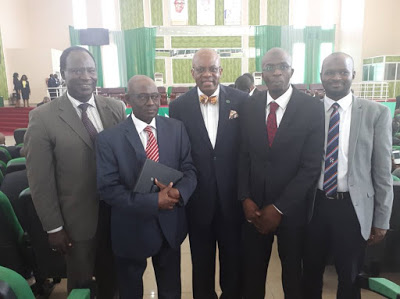
Learned Silk and Egusi | Lotanna Attoh Esq.

Learned Silk and Egusi | Lotanna Attoh Esq.


Introduction

There once was a silk

Who lived and still lives

Educated and learned

Refined and polished

All who knew him

Said he was wise

If not, they asked:

“Why was his hair white?”

The snowest of white

Like a baby lamb

Even Soyinka wondered whether he dyed

No, this was a sage, a god amongst men

A man of learning

A man who read

Letters and words, his butter and bread

In the courtroom he was, respected and feared

To go against him, men would dread

Defeat was sure, for those who dared

Alas, like all men, a weakness he had

That is Egusi, his love of which

Has given him now, a dishonourable badge.

Egusi, egusi, egusi

Who doesn’t love egusi?

Tell me, who doesn’t love egusi?

The sight of her

The aroma and taste of her

Egusi, fine fine egusi

Ah egusi, the tribeless one

The sweetest one

The one who has men licking their lips and fingers

And always asking for more

Ah egusi, the dangerous mistress

The one who satisfies but leaves men blotted and
cursing…

Courtship and Consummation

Silk always knew egusi

Always admired her

Coveted and chased her

Adored and worshipped her

But silk knew she was bad

She was bad for him

For she had a reputation of soiling great men

A reputation of dirtying the cleanest of men

A reputation of staining great reputations

Once she leaves her mark on you

It is seen

And no amount of omo can wipe it clean

Yet silk pursued her like a madman in heat

For the taste of her overpowered his wit

He forgot his brief and all his ethics

And forged ahead

For deadly meat

Like a warrior in the battlefield

He fought and killed

All in the bid for sweet egusi’s lips

Silk conquered and got his wish

Egusi was his, fait accompli

After the deed, silk was soiled

So he changed his robes into another of course

But egusi’s stain was like a hole

You can fix it

But it will always show that it was once a hole

So Silk went about dressed in his new robes

Confident his egusi tale will never be told

Till the Eagle came with its probes

And learned silk needed a silk to hold

Questions were asked, fingers were pointed

Defences crumbled, evidences amounted

Judgement was given, and it went like this:

Egusi is sweet, it is sweet indeed; but you
silk, are now a convict, case dismissed.

Condemnation

Pity?

No!

I have no pity for silk

For silk was aware when he made his choice

For silk was under no duress

Of body nor of mind

For silk was seized of his actions

Just like his brief

The consequences

Just like a thief

No, silk deserves no pity

Only scorn and reproach

Leave pity aside

His actions, we can’t condone

Silk made his bed

On it he shall lie

Silk soiled himself

In it he shall lie.

I remain a Minister in the Temple of Justice.

L. Attoh Esq.

© 2018 Lotanna Attoh. All Rights Reserved. Photo:
www.dobbyssignature.com

NBA Elections: Supporters of Paul Usoro SAN Ride On Merit For A Worthy Successor

NBA Elections: Supporters of Paul Usoro SAN Ride On Merit For A Worthy Successor

At the Nigerian Bar Association National Executive Council (NBA NEC) meeting, the supporters of the Learned Silk, Mr. Paul Usoro, SAN have continued to rally support for him citing merit as a key to choosing the next president for the association.
In his speech at the just concluded NEC meeting, the NBA President Mr. A. B. Mahmoud, SAN declared that he has no preferred candidate to succeed him.

 This statement came at the time rumours are flying that Paul Usoro who joined the race for the No 1 position of the NBA most recently is viewed as the anointed candidate. But with this, the camp of Paul Usoro’s is excited as this stands to exonerate them from the   propaganda.
“Our support for Paul is based on his landmark achievements in the practice which include the reforms he has carried out as well as his immense contributions to the NBA. Looking at the reforms the NBA President has initiated, we are confident that Usoro is one man that has the credentials to build on the existing reforms and even initiate more desired reforms for the advancement of the Bar”.
Supporters of Paul Usoro are highly spirited that the Bar Titan has built a successful practice that cuts across corporate experience which is what the NBA needs at the time to get to the acme of perfection.
A teaming number of supporters were particularly excited to have met the legal luminary for the first time at the NEC meeting. They expressed that before now, his works and achievements, which is in the public domain is enough pull factor to attract unbiased support.
While supporters of other candidates for the race are riding on the heels of being the anointed ones, Usoro’s supporters are riding on the pedigree, successes and experience of the Learned Silk in corporate governance, leadership and advicacy which has made him to be a most sort after personality who sits on the boards of blue chip companies.
It’s on record that Paul Usoro has not enjoyed any appointment by the NBA President to put him forward for visibility and prominence unlike two other presidential aspirants that have enjoyed that privilege.  
Considerations: Third Party Litigation And Arbitration Funding In Nigeria | Franklin Okeke

Considerations: Third Party Litigation And Arbitration Funding In Nigeria | Franklin Okeke

Introduction

Third Party Funding
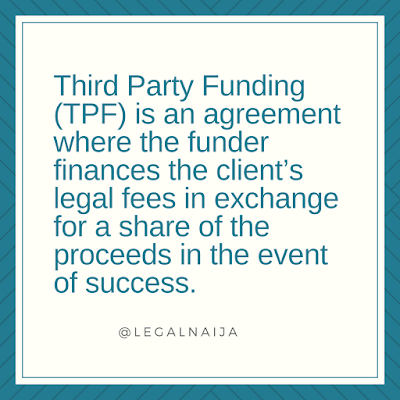
(TPF) refers to an agreement or arrangement between a funding company/individual
and a client (the claimant) whereby the funder agrees to finance some or all of
the client’s legal fees in exchange for a share of the proceeds in the event of
success. Under this model, outside investors — typically a hedge fund or
special purpose litigation fund — seek out commercial litigants who have
meritorious and substantial claims, but who may be unable or unwilling to make
the financial investment required to litigate those claims.

In Nigeria, TPF is
frowned at by the courts based on the common law principles of champerty and
maintenance which: (i) prohibit a third party from funding litigation between
disputants (in which the funder has no legitimate interest); and (ii) render an
agreement to provide such funds illegal and void, on the ground of public
policy. The latin maxim, “interest
reipublicase ut sit finis litium”
(it is in the interest of the State that
there be an end to litigation) underpins public policy and permitting
litigation funders could result in significant spikes in litigation, and
potentially more of the otherwise unmeritorious claims.  Presumptively most litigation funders could
view the suits as an investment, thereby incentivizing a more than passing
interest in the outcomes of claims they funded, and all attendant implications
flowing therefrom. Being common law principles, until contrary statutory
provisions are enacted, the principles of champerty and maintenance are
applicable in Nigeria.

In Oloko
v. Ube[1]
Edozie JCA held thus: “at common law, champerty is a form of
maintenance that occurs when the person maintaining another stipulates for a
share of the proceeds of the action or suit or other contentious proceedings
where property is in dispute. An agreement by a solicitor to provide funds for
litigation in consideration of a share of the proceeds is champertous.”

More recently, in Kessington
Egbor v. Ogbebor,[2]

the Court held that where a person elects to maintain and bear the costs of
action for another in order to share the proceeds of the action of the suit,
such an action is champertous.

In R
(Factortame Limited & Ors) v. Secretary of State for Transport, Local
Government and the Regions
,[3] Lord Phillips of Worth Maltravers MR
approved the following two definitions of champerty and maintenance respectively:
‘‘a person is guilty of maintenance if he
supports litigation in which he has no legitimate concern without just cause or
excuse. Champerty occurs when the person maintaining another stipulates for a
share of the proceeds of the action or suit.’’


REGULATORY
OVERVIEW

Rules of Professional
Conduct (RPC) 2007

The RPC, which
regulates the conduct of legal practitioners, only provides for contingency fee
and not TPF. The term “contingency fee” is defined by the RPC as: “the fee paid or agreed to be paid for the
lawyer’s legal services under an arrangement whereby compensation, contingent
in whole or in part upon the successful accomplishment or deposition of the
subject matter of the agreement, is to be of an amount which is either fixed or
is to be determined under a formula.”

Rule 50(1) & (2)
RPC

provides as follows: “(1) A lawyer may
enter into a contract with his client for a contingent fee in respect of a
civil matter undertaken or to be undertaken for a client whether contentious or
non-contentious: provided that: -a. The contract is reasonable in all the
circumstances of the case including the risk and uncertainty of the
compensation; b. The contract is not i. Vitiated by fraud, mistake or undue
influence, or ii. Contrary to public policy; and c. If the employment involved
litigation, it is reasonably obvious that there is a bona fide cause of action.
(2) A lawyer shall not enter into an arrangement to charge or collect a
contingent fee for representing a defendant to a criminal case.”

It is instructive to
note that under Rule 50(4) RPC, a lawyer shall not enter into a contingent fee
arrangement without first informing the client of the potential effects.

From the foregoing
provisions, a contingency fee arrangement is only permissible in the following
circumstances, where: (i) it is a civil matter, whether contentious or
non-contentious; (ii) the contract is reasonable in the circumstances of the
case including risk and uncertainty of compensation; (iii) the contract is not
vitiated by either fraud, mistake, or undue influence; (iv) the contract is not
contrary to public policy; and (v) the employment involves litigation, there is
a reasonable and bona fide cause of action.

It is expressly
stated in Rule 50(2) that a
lawyer cannot collect contingent fees in criminal matters. It is clear from the
above that the RPC does not expressly prohibit TPF in light of its approval of
contingent fee arrangement (for civil matters).

Legal Aid Council
(LAC)

The Legal Aid Council
(the Council) was established by the Legal Aid Act[4]
(LAA)
to ensure the grant of legal aid, advice and access to justice to
otherwise disadvantaged citizenry. By section 8 LAA the foregoing shall be
provided by the Council in three broad areas: (a) Criminal Defence Service, (b)
Advice and Assistance in Civil Matters, including legal representation in court
and (c) Community Legal Services subject to merits and indigence tests for the
parties. The LAA seeks to make provision for the establishment and operation
of a scheme for the granting in proper cases, legal aid and legal advice, to
people with low income, who could not otherwise afford to procure them for the
enforcement or vindication of a legitimate right or for obtaining a just
relief. As laudable as the actions of the LAC are, we must understand that not
every category of litigant can be covered by the legal aid scheme (LAS).

Section 10 LAA provides:
“(1) Legal aid shall only be granted to a
person whose income does not exceed the national minimum wage; (2)
Notwithstanding the provision of subsection (1), the Board may, in exceptional
circumstance, grant legal aid service to a person whose earning exceeds the
national minimum wage; (3) Notwithstanding the provisions of subsection (1) of
this section, the Governing Board may approve the giving of legal aid on a
contributory basis to a person whose income exceeds ten times of the national
minimum wage.”


It is clear from the
foregoing that some prospective litigants
with rightful claims are still outside the coverage of the legal aid scheme.

Section
8(3) LAA
provides that “the
Council shall establish and maintain a service to be known as the Civil
Litigation Service for the purpose of assisting indigent persons to access such advice, assistance, and
representation in court where the interest of justice demands, to secure, defend,
enforce, protect or otherwise exercise any right, obligation, duty, privilege
interest or service to which that person is ordinarily entitled under the
Nigerian legal system.”

The purpose of the
LAS is to address fundamental rights cases for persons at the lower end of the
economic pyramid whose fundamental human rights have been allegedly violated. Section
11(1) LAA
provides that in ascertaining the means of any person for the
purposes of LAA, that person’s income and his personal and real property
shall be taken into account.

Arbitration and
Conciliation Act[5]
(ACA)

It is a fact that
arbitration is increasingly becoming the preferred mode for the resolution of
commercial disputes.  However, the costs
of arbitration have been a major concern to users and proponents of
arbitration. One way of reducing the cost of arbitration, thereby making it
even more attractive, is through TPF.

In the UK case of Essar
Oilfields Services Limited v. Norscot Rig Management PVT Limited,[6]

an application was made under section 68, Arbitration Act 1996 to
set aside a partial award. The Award was concerned only with the question of
interest and costs.  The costs included
litigation funding.   The litigation
funder, Woodsford Litigation Funding,
had made an agreement with Norscot in 2011, whereby it advanced to it about
£647,000 for the arbitration. That agreement entitled it, in the event of
Norscot’s success, to a fee of 300% of the funding or 35% of the recovery. In
that regard, Norscot sought from Essar a sum just over £1.94 million, being the
sum Norscot owed to Woodsford for the funding. The arbitrator held that he was
entitled to make order at his discretion, because such litigation funding costs
were “other costs” for the purpose of section 59(1)(c) Arbitration
Act
, which refers to “legal or
other costs of the parties”
.   The
Court held that as a matter of language, context and logic, it seemed that “other costs” could include the costs of
obtaining litigation funding.

In Nigeria’s ACA,
section 49
defines “costs of
arbitration” but does not include “other costs” as in the UK.  Furthermore, section 49 is restrictive
in its definition of what costs entail and does not give much room for
arbitrators’ discretion.

In light of the
above, we must critically consider whether the time is ripe to revisit
applicability of the doctrine of champerty and maintenance. A significant
proportion of litigation has always been funded by third parties in the form of
insurers, trade unions or other interested bodies. However, the funding of
litigation by commercial funders who seek to make a profit from their funding
of litigation is a more recent development. TPF would potentially facilitate filing
of meritorious claims that would have been otherwise not litigated. It may help
the economically weaker party to get closer to a level playing field against a well-funded
opponent. For instance, where a person has a claim for medical negligence
against a well-established hospital, TPF can grant such a prospective litigant
access to resources to successfully proceed with his action.

COMPARATIVE
ANALYSIS – OTHER JURISDICTIONS

Legislative Approach:
Hong Kong and Singapore

In June 2017, the
Hong Kong legislature passed the Arbitration and Mediation (Third Party
Funding) (Amendment) Bill
into law. This new legislation expressly
permits TPF agreements and authorizes a body to issue a code of practice for TPFers.
The legislation requires parties to disclose to the arbitration body (which
includes the arbitral tribunal) and opposing parties if a TPF agreement is in
effect, along with the name of the TPFer, either before arbitration commences
or within fifteen days of the TPF agreement’s adoption, whichever is earlier.

Like Hong Kong,
Singapore passed a Civil Law (Amendment) Bill in January 2017 to permit TPF
agreements for arbitration. Singapore considered that opening up TPF to arbitration
was necessary in order to remain a competitive international arbitration hub.
The Singaporean government also introduced the Civil Law (Third Party Funding)
Regulations
to set out eligibility requirements for TPFers, including a
requirement in Rule 4 of the said Regulations that TPFers must have “paid up share capital of not less than US$5
million.”
The Singapore International Arbitration Centre (SIAC) also issued
its revised Investment Arbitration Rules in January 2017, which permit
arbitral tribunals to order disclosure of the existence of TPF agreements and
names of TPFers.

Under the Singapore
model, a typical funding agreement will include provisions for calculating the
maximum amount of money the funder will contribute to the legal representation,
the portion of the return that the funder will expect to receive upon success,
and the maximum adverse costs award that the funder would pay, if any, in the
event that the client loses the case.

Ad Hoc/Juridical
Approach: England and Wales

In England and Wales,
statutory amendments in the late 1960s abolished the torts and crimes of champerty
and maintenance. Common law prohibitions on champerty and maintenance do still
remain and such arrangements would be contrary to public policy and
unenforceable as a result. The courts have, however, played a significant role
in relaxing (and thereby developing) the rules on champerty and maintenance,
particularly in respect of TPF.

In England and Wales,
a TPF arrangement will generally only amount to maintenance or champerty where there is an element of impropriety
such as disproportionate profit or excessive control of the proceedings
by
the TPFer. The English courts have gone further by highlighting the important role
TPF can play in providing access to justice and downplaying historic concerns
over such funding. Historic concerns included the risk of justice being
corrupted and/or inappropriate third party meddling in proceedings.

South Africa

South Africa (SA)
does not prohibit TPF. SA courts first tackled the topic as far back as 1894,
when in Hugo & Moller N.O v. Transvaal Loan, Finance and Mortgage Co,[7]
it was ruled that agreements to share proceeds of lawsuits – or pactum de quota litis – are not
necessarily illegal, and could be upheld or otherwise at the discretion of the
courts, based on the structure of the agreement and the peculiarity of the
situation. In 1997, the enactment of the Contingency Fees Act, “no win, no
fee” agreements became legally enforceable. 
Accordingly, there are companies such as Litigation Funding SA, South
African Litigation Funding Company Limited engaged in litigation funding as
their primary business.

CONCLUSION

It is instructive to
note some of the factors that are the main driving forces in the demand for TPF
– the maxim ubi jus ubi remedium is a
cardinal principle underlying our jurisprudence and by extension the very
justification of the legal profession. 
What happens if there is a wrong and the victim has no resources to sue?
Should citizens be denied access to justice because of the source of their
funds for litigating the suit? 


In a country like ours
with endemic poverty and where many parties simply cannot afford the disproportional
cost of access to justice and consequent inability to ventilate the grievances,
should we continue wholesale application of champerty and maintenance?  Truly, “there
should be an end to litigation
”, but not at the cost of injustice that
would result from lack of financial capacity to prosecute meritorious claims.

In the absence of any
legislation, it is my opinion that Nigerian courts should consider every matter
on a case by case basis. The claim that TPF would lead to a hoard of
unwarranted litigation has no merit as no investor would readily invest in a
suit which does not have the likelihood of success especially considering the
expensive nature of arbitration/litigation. It is time for TPF to be embraced
in Nigeria’s judicial system firstly for the purpose of expanding access to
justice as well as opening an untapped business avenue.

Franklin
Okeke is a commercial lawyer and practices with Messrs LeLaw Barristers &
Solicitors


[1] [2001] 13 NWLR (Pt.729)
Pg. 161 at 181
[2] (2015) LPELR-24902
[3] (No.8) [2002] 3 WLR 1104
at para 32.
[4] No. 17 2011
[5] CAP A18 LFN 2004
[6] [2016] EWHC 2361
[7] [1894] 1 OR 339 at 340

British Nigeria Law Forum (BNLF) Upcoming Events

British Nigeria Law Forum (BNLF) Upcoming Events

  • London Legal Walk on 21 May 2018

Join the BNLF London Legal Walk
team as we raise funds to support free legal advice charities in London and the
South East.  50% of any funds raised by the BNLF team will be donated to
our selected charity AFRUCA (Africans Unite Against Child Abuse). Contact chair@bnlf.org.uk to join the BNLF team
sponsored walkers.

For further information or to make a donation see: https://uk.virginmoneygiving.com/fundraiser-display/showROFundraiserPage?userUrl=BritishNigeriaLawForum18&pageUrl=1
 

  • AGM & Elections on 5 June 2018

All BNLF members who are paid up
are eligible to vote at the election on 5 June 2018. We have introduced
electronic voting to enable wider participation in the elections. Paid up
members will receive details of how to vote, please make sure that we have your
current email address.

To be eligible to stand for election you must be a current member (paid up for
2018).If you are interested in standing for an Executive Officer position you
must be a current member, paid up for the last 3 consecutive years and also be
a Barrister/ Solicitor with at least 3 years post qualification experience.
Contact admin@bnlf.org.uk
to receive a nomination form.

For further information and to attend the AGM at Bryan Cave Leighton Paisner LLP see:
https://www.eventbrite.co.uk/e/british-nigeria-law-forum-annual-general-meeting-election-5-june-2018-tickets-45887134655?aff=es2

  • To join BNLF

Go to the website and see the
categories of membership. Complete the membership form and make payment via
PayPal or through the BNLF bank account See:
 

  • 27 – 29 June 2018

To be part of the delegation of
BNLF members attending the Nigerian Bar Association’s 12 Annual Business Law
Conference 27 – 29 June 2018 at the Transcorp Hilton Hotel, Abuja, Nigeria
contact businessnetwork@bnlf.org.uk

http://www.bnlf.org.uk/event/bnlf-delegates-attending-the-nba-section-of-business-law-conference/
 

  • Launch of BNLF Junior Lawyers Division
    (further details to be provided soon).


  • 25 – 30 August 2018

A delegation of BNLF members will
be attending the Annual General Conference of the Nigerian Bar Association,
Abuja, Nigeria (further details to be provided soon).
 

  • 11 September 2018

Family Law Conference at Bircham
Dyson Bell. This event is organised by the BNLF Family Law Network (further
details to be provided soon).
 

  • 30 November 2018

BNLF
Annual Dinner, London (further details to be provided soon). For enquiries
about sponsorship/advertising at this event contact: chair@bnlf.org.uk

Thank you for your interest
Email: info@bnlf.org.uk
Website: http://bnlf.org.uk


Experts at DOA Business Series Call For Investments in TMT Sector

Experts at DOA Business Series Call For Investments in TMT Sector

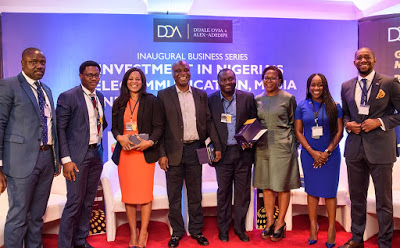
Leke Alex Adedipe, Partner, DOA; Lloyd
Onanighon, Head TMT, Stanbic; Ijeoma Obatoyinbo, MD, FBN Quest Funds; Eghosa
Omoigui, Echo VC; Idris Saliu, Co-Founder, Vanso; Mrs. David West, Director,
Lagos Business School; Soibi Ovia, Partner, DOA; Niyi Duale, Managing Partner,
DOA

Legal,
TMT and Finance experts have called for more investment in the
telecommunication, Media and Technology, (TMT) sector in a bid to grow the
country’s GDP and create employment opportunities. 

This call
is coming at a time when the country’s economy is currently propelled by crude
oil and the country is in dire need of more investments outside of this
resource. 

Speaking
during the inaugural business series organised by Duale, Ovia & Alex-Adedipe,
(DOA) a fast-growing full-service commercial law firm providing expert legal
services in corporate commercial law and dispute resolution, Adeniyi Duale,
managing partner of the firm said Nigeria must collectively address the
inhibiting factors to attracting investment into the telecommunication,
FinTech, E-commerce and all other sectors of the economy that can help Nigeria
realise it’s full potential and not continually depend on oil as mainstay of
the economy. 

According
to him, in the last 10 years there have been increase in the number of
companies who have gotten funding from investors. 

Duale
said “As at 2008, there were about four companies who had received funding
but today they are about 20 and we are grateful that your are panelist. We are
passionate about this industry and we are keen on supporting TMT companies from
inception through various stages of their growth and cycle (which range from
raising seed capital financing, early stage investments, growth capital as well
as exits).”

He
disclosed that DOA also assists investors in identifying and carrying out
proper legal diligence on targeted vehicles or companies in the sector as well
as providing structuring advice and documentation to give effect to
transactions. 

He noted
that the breakfast session which focuses on investments in Nigeria’s TMT market
is apt as it seeks to address development in Nigeria and Africa as a
whole. 

Duale
added that the inaugural edition of the DOA Business Breakfast Series seek to
stimulate discussions and resolutions that can generate possible roadmaps for
an industry that is itself disruptive and can assist the government’s growth
and recovery plan. 

During
the panel session, Akintoye Akindele, Co-Founder, Synergy Capital Managers,
advised tech entrepreneurs to ensure investor engagements are very memorable
and have a proper business preposition. 

“You
must have a good business model and must be able to explain your business. You
must be sure of the capital you need to drive your business model. You must
also get the right people that will provide a legal framework around your
business idea,” Akindele added.

Obinna Ekezie,
managing director, Wakanow, who also spoke during the panel session said Wakanow
saw an opportunity and decided to create value to customers. 

“We
identified lack of transparency, inability to make payment online and buy
tickets as fast as possible. So, we used technology to create solution. This
led to huge uptake for customers who needed these services,” Ekezie said.

Administration Of Estate: Effect Of An Intestate Property | Esse Palmer

Administration Of Estate: Effect Of An Intestate Property | Esse Palmer


The issue of administration
of an estate is usually post-mortem. That is why many property owners with
dependents and all adults in general are encouraged to write a Will while they
are still alive. However, despite the push for more Will drafting, many still
hold reservations to the act.

The factors responsible for
this skepticism may include:

1.     Religious
doctrine

2.     Procrastination

3.     Ignorance

4.     Morbid
fear

It must be appreciated that
when a person leaves a will, he or she makes it easier for the beneficiaries to
receive, with zero stress, the intended gift of the testator. Also, the court
house is spared from all the battles on who has the most legitimate claim to
the property. The benefits of writing a Will are undoubtedly considerable, as
opposed to not writing.

But what then is the effect
of leaving a property without a will? In such cases there may be frequent
visits to the court house, abuse of property by family members, unfair
dominance of certain persons over others, bad blood between family members,
unnecessary interference by outsiders over private family affairs, and the list
goes on.

Fortunately, many states in
Nigeria have promulgated or adopted modern laws on the Administration of
estates which enables the court to interpret the stance of the law on how the
estates should be administered in the absence of a will.

The Lagos Administration of
Estate Law would be relied on for the purpose of this article.

The Administration of Estate
Law of Lagos State 2004 in section 2 defines an intestate person as one who
dies without making a will and this includes a person who dies intestate as to
some beneficial interest in his real or personal estate not contained in the
will. In other words, an estate or property not included in a will, whether by
omission or intentionally, would deem the deceased owner intestate as it
concerns that particular property. 

When a person dies testate,
personal representatives of the deceased are easily identifiable; this is a
direct contrast with a case of intestacy where the personal representatives are
appointed by the court in accordance with the law. Those who consider
themselves to be personal representatives of the deceased are mandated to apply
for Letters of Administration.

Who is can be a personal
representative in the case of intestacy?

Under Section 49 AEL persons
who are entitled to grant of letters of administration in order of priority
include:

1.    
Surviving Spouse

2.    
Children of the Deceased or the issues of the
children of the deceased (who died before the deceased)

3.    
Parents of the deceased

4.    
Brothers and sisters of the deceased of full
blood and their surviving children

5.    
Brothers and Sisters of the deceased of
half-blood and their surviving children that are sui juris

6.    
Grandparents of the deceased

7.    
Uncles and Aunties of whole blood or their
surviving children

8.    
Creditors of the intestate estate

Any of these persons
approved by the government shall be deemed “Administrator of Estate”

It is important to note that
under Section 49 AEL, every application for letters of administration is
usually published in a gazette, to enable any other person interested enter the
appropriate caveat. Consequently, letter of administration shall not be granted
until a specified period of time (usually determined by relevant law or rules
of court in the state of application) has elapsed and where there is a caveat,
shall not be granted during the period of such caveat unless the caveator
refuses or neglects to respond to citation.

Essay Palmer

Legal Practitioner

Adedunmade Onibokun &
Co.

Artist Performance Contracts And The Accolades Nigerian Artists Deserve | Joshua Olorunmaiye

Artist Performance Contracts And The Accolades Nigerian Artists Deserve | Joshua Olorunmaiye


If you caught up with my previous
article related to this subject matter; MUSIC
CONTRACTS AND THE ACCOLADES NIGERIAN ARTISTS DESERVE,
you would remember
the point noted that there is no perfect music contract that caters, once and
for all, for every single situation. This is so because there are several types
of contracts an artist may make during the long haul of a music career. What is
crucial therefore, is that you understand the content within each specific
music contract; the rights and obligations that they create between parties.

On this article, I am using an Artist
Performance Contract as a template for some of the insights to what you should
arm yourself with as an artist. As you may know, an Artist Performance Contract
is the contract which contains agreements regarding your performance at a gig.

In the meantime, do budding artists in
Nigeria ever sign these contracts or they just receive a call to perform at a
venue and turn up ready to blow out the mics?

Let’s go:

1.    
BASICS: Your contract should clearly define
the location, date, time, amount of compensation for your performance and have
a signature from you and your host.

2.    
PERFORMANCE: Precisely define the expectations of
the performance. What does your host expect and what do you expect? How many
breaks? How long should the minimum performance be?

3.    
PAYMENT: How will you be paid? Is it a fixed
amount, or a percentage of ticket/merchandise sales? When will the you be paid?
What is the method of payment? Would it be in lump sum or in instalments?

4.     RIGHTS: Who has the commercial rights to the recording,
reproduction, transmission and photography of your performance?

5.     COST: If the gig is out of town, you need to be certain of who
will cover the cost of incidentals such as meals, transportation and lodging.

6.     PRODUCTION: How and who handles issues such as
DJs, sound engineering, instrumentals, needs to be stated. Does your host
handle them or leave you to provide them?

7.     FRUSTRATION:
Acts
of God’ are often mentioned to protect everyone involved. This includes weather
and/or illnesses. Acts of God is a legal term for occurrences that are beyond
the control of man and which would effectively cause the performance to be
impossible or delayed.

8.     TERMINATION: How will a cancellation of the
performance be handled? Will there be a penalty and to what extent?
Cancellation policies need to be clearly defined in your contract.

9.     COPYRIGHTS: You may consider adding a clause on
royalties and licenses to your performance contract especially if the work is
copyrighted. This would bring you economic gains as any part of your
performance is monetized.

10. RESTRICTIONS: Some specific requirements or restrictions
due to religion or social norms within the location regarding dressing,
language, smoking, drinking etc., would need to be inexplicably stated to avoid
running legal problems.

11. AGENTS: If there is an agent involved, their
terms need to be included as well in relation to the kind of compensation they
would receive or any obligations that they would have.

12. INSURANCE: Terms relating to insurance and
security should be provided to cater for possible injuries or mishaps that may
occur in relation to your performance.

In all, as an artist, it behoves on
you, upon your invitation to a gig, to request that a formal contract be signed
between you and your host. This goes a long way in ensuring that both parties
are saved from unnecessary anger in the event that things go wrong.

Finally, make sure to have your lawyer
review all documents in relation to your art before you sign same.

I hope you enjoyed this. Kindly share
to others. Cheers!

*Joshua
Olorunmaiye Esq is a legal practitioner based in Lagos. He is on Twitter as
@joshomaiye. You may contact him via email joshomaiye@gmail.com

Issue For Determination | Kema Ufelle-Smith

Issue For Determination | Kema Ufelle-Smith

Good morning Mr. Tobi, kindly accept my most
sincere apologies for being unable to secure the eventual satisfaction of your
creditor’s pecuniary liabilities towards you. It was indeed a jostle for which intricate
and extensive-cum-holistic research was expended, and for which no small degree
of persuasive legal gymnastics and histrionics were employed towards assuaging
the heart of His Lordship in your favour.

You know my problem with you, Barrister Segun? You try to
make your points with an unnecessary wide choice of words, and at the end of
the day, I never understand what you are saying. I always require the help of
an interpreter whenever you draft an agreement for me, and in this case, I
still don’t know if you are telling me that you won or lost my case.

Oh well, Mr. Tobi, your inability to
comprehend these rudimentary elucidations, is no fault of mine. Your worrisome
lack of comprehension, despite my spirited attempts at descending to your
level, is a matter to be settled between you and your English teachers. On my
part, it would be tantamount to being sucked into the vortex of incompetence to
cascade to such depths as to communicate on a banal and pedestrian level. Such asinine
communication is reserved for peasants, and must never be heard among the ranks
of the learned. Do you not know that the hallmark of an educated mind is its
ability to unearth the hidden meanings and nuances in an obscure speech?

Sometimes I wonder if you actually mean some of the
things you say. Since when has communication turned into a fine art, which will
require deeper interpretations? Isn’t communication simply for the purpose of
conveying a simple message to another person anymore? You insult me and call me
pedestrian because I use simple words, but what you don’t know is that it takes
an intelligent mind to speak with simplicity. Not only is your intelligence
revealed in your simplicity of language, but so also is your wisdom. This is
because it takes a wise man to use words that will be understood by the greater
number of people. Of what use will it be to speak without being understood? It
is like taking a bath without the intention of being clean, or telling a joke
without planning to be funny.

Again, I will pardon your ignorance on issues
of this stripe. Your brazen disregard for the elevated art of fine conversation
is self-evident, and I wish to continue this conversation no further.

No way, Barrister Segun! You cannot start a fire and then
run away. I have ignored you all this while, but we must get to the root of
this thing today. Just last week, I asked you to draft an agreement for me. It
was a simple agreement I reached with my business partner, but we wanted to make
it binding. When we asked you to put it into writing, we couldn’t even tell
what it was that we were signing anymore – we just had to rely on the trust we
had for you. Why will you write something for my own benefit, and then I cannot
understand its content? I mean, it only makes sense that I understand the
agreement that I am signing, doesn’t it?

You seem to have a lot of time on your hands
today, Mr. Tobi. Unfortunately, I have higher-ranking ordeals and herculean
tasks that require my timeous intervention. However, whilst I resist the
temptation to ignore your retorts, which, by the way, are strikingly similar to
those of an intellectually-vacuous man, I will make it poignantly clear that a
learned and lettered man is of a rare ilk. His is an elevated vocation, and his
frock is sewn by a different fabric. He has a solemn obligation to the law, and
nowhere in such an obligation is he bound to ensure the comprehension of his
clients. His sworn duty is to protect the law, and in what better way can the law
be preserved but in its strict, obscurantist and non-pedestrian form? If you
seek a conversation for the sake of leisure, there is an abundance of
motor-park simpletons waiting to indulge you, but my time, Mr. Tobi, is valuable.

You seem to throw insults quite freely, Barrister Segun.
All I wanted was a fair explanation on why your words are always so complex,
and not an afternoon shower of abuses. It seems that when you are backed into a
corner, you resort to verbal attacks. You say your duty is to protect the law,
but I am the one paying for the service. If it is the law you are serving, then
why isn’t the law paying you to draft the agreement? The service culture is
obviously lacking in your trade, and the earlier you treat me like I matter,
the better for your continued survival. When you defend me, I reserve the right
to understand in an intelligible form, how I am being defended, and I wonder
why this is so hard for you to understand.

You speak as though you have never been at the
mercy of a doctor. When he pens down his prescriptions, do you understand his
handwriting? No. Yet I am the hapless victim of your ill-considered
vituperations. I have had enough of this conversation. And if this was done in
a bid to avoid paying me my legal fees, then you must be joking. Do you not
know that a legal practitioner unwittingly subscribes to an unwritten vow to
preserve the mystique and inherent legalese of legal communication?

Perhaps this is true.
However, Barr. Segun, have you considered that the use of simple language may
actually promote efficiency and speed in legal drafting?

(Raucous
laughter
) Efficiency and speed, you say? What would an intellectual
Lilliputian like yourself know about legal drafting? Ordinarily, I would not
have dignified such puerile rantings with a response, but I consider it my duty
to educate simpletons such as yourself. Do you not know that the law is a
complex linguistic leviathan which requires arduous study to master? Surely,
even you must know that many words and phrases employed in legislations and
agreements have judicially-defined meanings, which would be lost in the miasma
of simplistic transliterations? For instance, do you know what it means to
‘execute’ a thing in law?

Of course! It means to
kill it.

There you go! A first-rate simpleton you are,
my dear friend. To execute simply means to sign a document. I have had enough
of this insipid and inane conversation. Off I go to attend to more pressing
engagements. You will do well to remit my fees into the bank account I have
already furnished as soon as is practicable and without undue delay.

My dear reader, please judge between Barrister Segun and I.
Do you think lawyers should tone down on their complex use of language, or should
it be retained for the preservation of the customs of the profession?

Kema
is a business lawyer, Founding Partner of Capitalfield Attorneys, and member of
the World Economic Forum.

Kema.ufellesmith@gmail.com

Paul Usoro SAN delivers a powerful lecture at the Kano State NBA Branch 2018 Law Week

Paul Usoro SAN delivers a powerful lecture at the Kano State NBA Branch 2018 Law Week

The Learned Silk is in the city of Kano for the NBA Law week, where he delivered a lecture on the topic “Good Governance, Corruption and Economic Development: Nigeria’s Experience and the Journey So Far”.
The law week promises to be exciting with key insights to be delivered from the 5th – 9th of May, 2018.
Excerpts of Paul Usoro’s lecture can be viewed below:

“Traditionally, the Bar Law Week gives us opportunity to examine topical issues as far as Nigeria is concerned, and it is quite interesting that this time, the Kano Bar decided to pick a very interesting topic – Good Governance, Corruption and Economic Development: Nigeria’s Experience and the Journey so Far.
 It is also interesting that the theme of this Law Week is actually geared “Towards Improving the Quality of Justice Delivery in Nigeria.
One of the significant ingredients for good governance is quality justice delivery. Without quality justice delivery, it is impossible for us to talk about good governance.
Essentially, good governance relates to political and institutional processes, and outcomes that are deemed necessary to achieve the goals of development.
The true test of good governance is the degree to which it delivers on the promise of human, civil, cultural, economic, political and social rights.
Good Governance, according to the United Nations Commission on Human Rights is the process by which public institutions conduct public affairs, manage public resources and guarantee the realization of human rights in a manner essentially free of abuse and corruption, and with due regard to the rule of law.
This definition indeed, incorporates justice delivery and the rule of law as features of good governance.
There are four (4) pillars that determine good governance according to the International Development Association. These four pillars are:
Accountability
Transparency
Rule of Law
Participation of the Citizenry
Transparency of decision making, particularly in budget, regulatory and procurement processes, is critical to effectiveness of resource use and the reduction of corruption and waste.
There must be a fair, predictable and stable legal framework which helps businesses and individuals to assess economic opportunities and act on them without fear of arbitrary interference or expropriation.
Good governance requires that civil society has the opportunity to participate during the formulation of development strategies.
Good leadership sets the tone for the standard of good governance. Without having good leadership, it will be difficult for us to have good governance.
When there is transparency in government, the private sector which is acknowledged as the engine room for economic development will have confidence in the economy and will want to invest.
Investment can only go to a place where there is good governance. Good governance is a precondition for economic development, which essentially means that the wellbeing and quality of life of the citizenry is dependent on good governance.
Good governance creates a viable economy with a knock-on result being economic development. The indexes for determining this economic development in a country are:
Ease of doing business and predictability of economic policies – If you have good governance, the ease of doing business will be enhanced.
Increased local investments as well as FDIs
Job creation and opportunities;
Assured security of lives and properties;
A satisfied, patriotic and tax compliant citizenry.
Corruption is a bane to economic development. Monetary corruption is very bad, but corruption goes beyond financial corruption, which includes embezzlement, bribery etc. Corruption is common in all countries, irrespective of their stages of development.
The Black’s Law Dictionary, 8th Edition, defines corruption in two aspects:
Depravity, perversion, or taint; an impairment of integrity, virtue, or moral principle; especially, the impairment of a public official’s duties by bribery.
The act of doing something with an intent to give some advantage inconsistent with official duty and the rights of others; a fiduciary’s or official’s use of a station or office to procure some benefit either personally or for someone else, contrary to the rights of others.
Other forms of corruption that affect economic development occur when:
Law-making processes are subverted and there is no transparency.
Marks and grades are given in exchange for sex or some other forms of inducements or extortions or they are simply awarded on grounds other than merit
Employment, appointments and contract awards and procurements are made, not on merit but based on some other opaque and corrupt considerations
Approvals are given based on corrupt considerations
Independence of the judiciary and independence of judges is tampered with and taken away by overbearing executive interference
Electoral processes are tempered with
*A corrupt system produces a weak institution.
*As lawyers, we must be able to speak against corruption even when there is executive intimidation, interference and harassment. We must ensure that the bench is not corrupt.
Government must consciously acknowledge that good leadership is critical to good governance, and must ensure that good leadership is entrenched in Nigeria. It must also make relentless efforts to curb corruption.
Our Leaders must lead by example by respecting the basic principles of good governance – accountability, transparency, rule of law, citizenry participation in policies of government, restoration of due process and respect for laid down rules. It is important that the institutions that fight corruption must be strengthened. Fighting corruption in a way that erodes the rule of law is also corruption on its own. It is difficult to fight corruption with corruption. There must be a proper system to fight corruption”