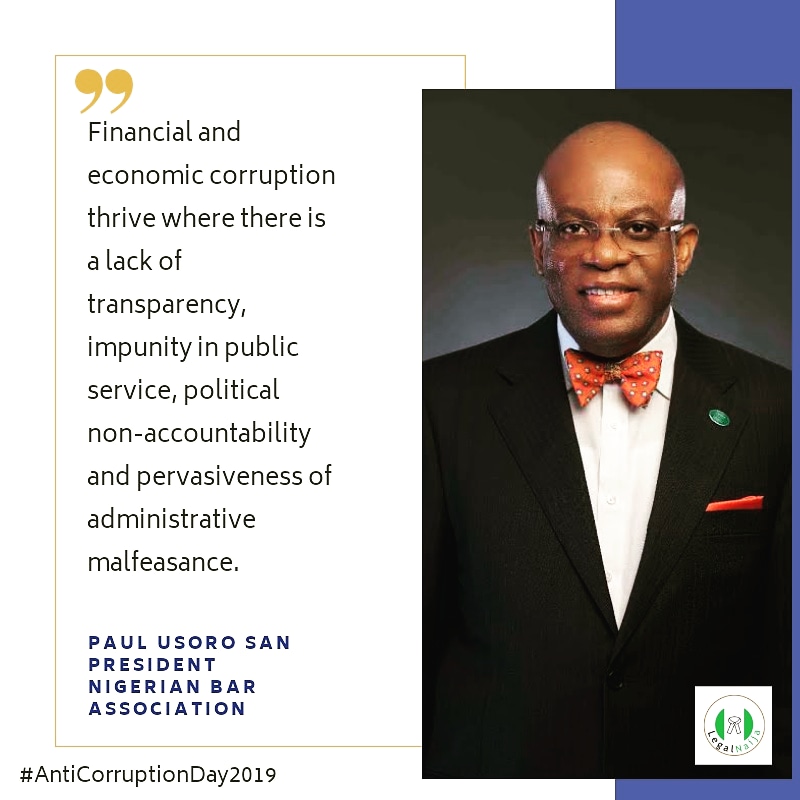
Anti – Corruption Day 2019

Anti – Corruption Day 2019

When I was a child, for a public/civil servant to be caught in corrupt practices, that individual will be a pariah. He will be a complete reject of the society; he/she could not raise his or her voice to speak in the public. So what happened between that time and now? That time when a public officer, prison or customs officer caught in corruption hides his face in shame amongst his peers, he just couldn’t come out publicly. Today, when they come back, they get chieftaincy titles, they are received in grand style, cows are killed, they ride on white horses. 

– Wole Soyinka 
#anticorruptionday2019
#anticorruption
#legalnaija
#nigerianlawyers
#SayNoToCorruption
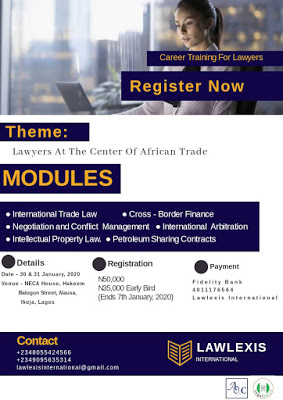
Cross – Border Financing: A Module At The Career Training For Lawyers

Cross – Border Financing: A Module At The Career Training For Lawyers

Commercial activity that occurs among several jurisdictions or countries is called a cross-border transaction. Therefore with the introduction of the African Continental Free Trade Agreement (AfCFTA), lawyers must be knowledgeable in the complexities of cross-border financing contracts. 

At the Career Training For Lawyers holding in January, 2020, one of the modules lawyers will participate in is Cross – Border Financing and it promises to equip participants with the necessary skills and tools to meet the legal demands of clients and businesses. 
Details of the Training include –
· Theme:  “Lawyers at the center of African Trade”
· Modules:  
– Negotiation & Conflict Management 
– International Arbitration 
– Cross Border Finance 
– International Trade Law
–  Petroleum Sharing Contracts
– Intellectual Property Law
· Date: 30th and 31st of January, 2020 
·Time: 9am – 5pm daily
·Venue: Neca House, Hakeem Balogun Street, Alausa, Ikeja, Lagos.
·Audience: Lawyers
· Aims & Objectives: To train lawyers on how they may take advantage of the opportunities presented by the African Continental Free Trade Agreement.
Registration Details
Fee per delegate     – N50,000                                                           
Early Bird (Ends January 7, 2020) – N35,000 
For registration andsponsorship details, Please contact the undersigned on 09095635314; 08055424566.  Or send a mail to lawlexisinternational@gmail.com. 
Piracy And Armed Robbery In The Gulf Of Guinea And The Suppression Of Piracy And Other Maritime Offences Act (Supmoa) 2019 | CAROLINE TOKULAH-OSHOMA (MRS)

Piracy And Armed Robbery In The Gulf Of Guinea And The Suppression Of Piracy And Other Maritime Offences Act (Supmoa) 2019 | CAROLINE TOKULAH-OSHOMA (MRS)

 I.         INTRODUCTION

The increasing rise in piracy in the Gulf of Guinea has
become alarming. Until recently, the concern about piracy has been the Gulf of
Eden operated by Somalia pirates; however, piracy has witnessed a drastic shift
to the Gulf of Guinea. Armed robbery against ships and cargo theft have also risen
uncontrollably within Nigerian territorial and internal waters. These
activities pose a serious threat to national, regional and global security and
economy. 

Earlier
this year, the Director General of the Nigerian Maritime Administration and
Safety Agency (NIMASA), Dr. Dakuku Peterside attended a major maritime security
conference at the International Maritime Organization (IMO) Headquarters in
London. The conference discussed the increasing high risk of piracy in the Gulf
of Guinea with emphasis on piracy off the coast of Nigeria. The Head of
Security for BIMCO, Jakob Larsen, noted that Nigeria holds the key to resolving
maritime offences within the coast of Nigeria and this requires Nigeria to work
with international navy. On the part of Nigeria, Dr Dakuku Peterside
acknowledged that there is a high security risk of piracy in the Gulf of Guinea
but stated that NIMASA and the Nigerian Navy are
doing their best to help curb the problem

As part of curbing the problem of piracy, armed robbery
against ships and other Maritime offences, the President assented to the piracy
bill, sponsored by NIMASA titled; T
he Suppression of Piracy and Other Maritime Offences Act (SUPMOA) 2019. The Act gives effect to the United Nations Convention on the
Law of the Sea (UNCLOS) 1982, the Convention for the Suppression of Unlawful
Acts against the Safety of Maritime Navigation (SUA) 1988 and its Protocols.

This article discusses the SUPMOA 2019, notes some of the pitfalls
and offers some recommendations.

II.        PIRACY,
ARMED ROBBERY AND CARGO THEFT IN THE GULF OF GUINEA VIS-À-VIS NIGERIA’S
TERRITORIAL WATERS

According to the International Maritime Bureau (IMB)
2019 Q3 report on piracy and armed robbery against ships covering January 1 – September 30, 2019, the

Gulf of Guinea was reported to be the world’s most dangerous trade route and
piracy hotspot in the world. The report noted
that 119 incidents of piracy and armed robbery against ships occurred worldwide,
with 95 ships boarded, 10 ships fired upon, 10 attempted attacks, and 4 ships
hijacked. The Gulf of Guinea accounted for 43 of the actual attack and 10
attempted attacks, 86% of crew taken hostage and 82% of crew kidnappings
worldwide.
The report further revealed that of the 9 ships fired upon
worldwide, 8 were off the coast of
Nigeria.

Undisputedly,
these statistics reflect that Nigeria is currently at the epicenter of piracy
attacks in the Gulf of Guinea. This position is reinforced by the IMB Q3 report
which shows that the Lagos seaport appears to
have the highest number of incidents in the world so far in 2019, with 11 of
the incidents reported occurring within Lagos port.
Interestingly, the
IMB Q3 report reveals that there was not a single incident of piracy in Somalia
and in the Gulf of Eden from January 1 – September 30 2019. This clearly shows
that the tide of piracy has indeed shifted to the Gulf of Guinea in general and
Nigeria in particular.

Apart from
piracy and armed robbery against ships, one other prevalent attack against
ships within Nigerian waters is the theft of crude oil and other essential cargoes and properties.  The IMB Q3 report revealed several incidents
of actual and attempted cargo theft within Nigeria waters. For instance; on
March 24, 2019, two armed robbers boarded an anchored tanker at Lagos secured
anchorage area and stole oil cargo using hose pipes. Prior to this, on January
7, 2019, two armed robbers boarded an anchored tanker during STS operations in
Lagos, the hoses were connected to the ullage ports of the forward cargo tanks
to steal cargo, but an alarm was raised and the robbers escaped but on the July
25, 2019, ten armed robbers boarded a berthed ship during cargo operations and
stole the ship’s stores from the paint locker. On August 14, 2019, two robbers
boarded a berthed Offshore Supply Vessel at Onne Port and stole the ship’s
properties from the pump room.
Some of the key driving factors behind
armed robbery against ships and cargo theft within Nigeria waters include weak
law enforcement, corruption, poverty and an unregulated oil market. Due to the
high risk associated with Nigerian territorial waters, insurance providers now
require ships coming to Nigeria to obtain extra cover / security.
Unfortunately, this is an added significant primary cost to ship owners and
charterers which makes Nigerian ports expensive and unattractive.

III.       THE SUPPRESSION OF PIRACY AND OTHER
MARITIME OFFICES ACT (SUPMOA) 2019

The Suppression of Piracy and Other
Maritime Offices Act (SUPMOA) 2019 was enacted at a time when the coast of
Nigeria is being described as the new haven for piracy in the world, the
“Somalia” of the present day by the international maritime community.
The Act is timeous, innovative and far-reaching.  

Purpose
of the Act

The SUPMOA 2019 seeks to prevent and suppress piracy, armed
robbery and other unlawful act against a ship, aircraft and other maritime
craft, howsoever propelled, including fixed or floating platform.

Application of the Act

The act applies to any
person on board a ship or aircraft navigating in, on or above the territorial
and internal waters of Nigeria or on above international waters; or fixed or
floating platform in, on or above the territorial and internal waters of
Nigeria or on or above international waters.

It also includes
circumstances where the offender or alleged offender is found outside Nigeria
but is in the territory of a State who is a party to other International
Maritime Conventions.

Piracy Defined

Section
3 of the SUPMOA 2019 provides the definition of piracy and practically adopted
the definition provided under Article 101 of United Nations Convention on the Law
of the Sea (UNCLOS) 1982.
 It provides that piracy consists of
any; 

(a)    Illegal
act of violence, act of detention, or any act of depredation, committed for
private ends by the crew or the passengers of a private ship or a private
aircraft, and directed:

    
(i) In International Waters against another ship or aircraft, or against
a person or property on board such ship or aircraft;

 
(ii)  Against a ship, aircraft, persons or property in a place
outside the jurisdiction of any State;

(b)  Act of voluntary
participation in the operation of a ship or of an aircraft with knowledge of
facts making it a pirate ship or aircraft; and

(c)  Act of inciting or of
intentionally facilitating an act described in subparagraph (a) or (b)

Flowing
from the definition of piracy, it is evident that any acts of violence committed
against a ship within the territorial or internal waters of Nigeria will not be
considered piracy. It is pertinent to distinguish between piracy from armed
robbery against ships. A
rmed
robbery against ships is often misinterpreted and misconstrued as piracy, these
two criminal concepts are categorized differently. While the crime of piracy
takes place on the High seas (international waters) and must fulfill some
essential elements, the crime of armed robbery against ships on the other hand takes
place within the territorial and internal waters of a Coastal State i.e
Nigeria. The offence of piracy is provided under Section 3 of SUPMOA, while the
offence of armed robbery against ships is covered under section 4.

Section
4 provides that a maritime offence includes armed robbery at sea and any other
act, other than piracy which is committed by any person or group of persons
where that person or group of persons or their sponsors unlawfully within the
Nigerian Maritime Zone or jurisdiction commit the following acts or offences
such as: Hijacking of a ship, destruction of a ship, theft of cargoes on a
ship, demanding ransom, receiving proceeds from the offences of piracy,
permitting pollution of water from the ship, threat to life whether or not to
solicit for ransom, providing false claim of a piracy and other maritime
offences under the Act.

Prosecution

One aspect of the act that is commendable is the fact that
it empowered NIMASA to prosecute offences under SUPMOA albeit with the consent
of the Attorney General. Section 5 (1) provides that the Attorney General; any
law officer so designated by the Attorney General; or the Nigerian Maritime
Administration and Safety Agency (NIMASA) with the Attorney General’s consent
are empowered to prosecute offences under SUPMOA.

Jurisdiction

As with
other Maritime related offences, Section 5(2) of the Act gives exclusive
jurisdiction to the Federal High Court to hear and determine any matter under
the Act irrespective of other elements of crime that may appear to be
non-maritime related contained in the offence.

Punishment

Section 12 provides that any person who commits an
act of piracy, armed robbery at sea or any other unlawful act under SUPMOA,
whether or not the person was armed with a firearm or other weapon during the
commission of the offence shall be liable on conviction to life imprisonment
and payment of
N50, 000,000.00 (Fifty Million Naira) and in addition to restitution to the owner.

IV.       SUPMOA 2019 PITFALLS

v  The Piracy and Other Maritime
Offences Fund

Section 19 of
the Act provides that a fund known as the Piracy and Other Maritime Offences
Fund (POMO Fund) shall be created
by the Nigerian Maritime
and Safety Agency (NIMASA). The POMO fund is to be used for the implementation
of the Act and the Fund shall be credited from money approved by the Federal
Government for the implementation of the Act; gifts, financial contributions by
beneficiaries of the services of the maritime enforcement agencies; 35% of the
proceeds of sales of any property seized and anything forfeited under the Act
including instruments used in the commission of crimes and criminal activity
under the Act; the contribution from the maritime fund under NIMASA Act; and
contribution from the Cabotage Vessel Financing Fund (CVFF) under the Cabotage
Act 2003. Furthermore, the POMO fund is
to be managed by NIMASA.

It is hoped that
the POMO fund will not suffer the same fate as the undisbursed Cabotage Vessel
Financing Fund (CVFF) created under the Cabotage Act. Suffice to say that the
POMO fund is to be disbursed judiciously for the successful implementation of
the SUPMOA 2019.

Piracy
Definition

With
the full adaptation of the definition of piracy under Article 101 of UNCLOS, the
challenges associated with that definition were also adopted.  For instance, section 4 of SUPMOA provides that
for piracy to be established, the act must be committed for private ends or for
personal gain. However, any acts that are politically motivated do not fall
within the definition of piracy. This principle is flawed because in Nigerian
political climate, political rivals could go as far as committing criminal act
of violence against a ship or crewmen, unfortunately, it will not amount to
piracy.

v  Failure to define a Ship

Another pitfall observed, is the failure
of the Act to expressly define a ship or what constitute a ship. Similar lacuna
was also created in the Cabotage Act 2003. The failure of the Cabotage Act to
expressly describe an oil rig as a ship has been used by foreign shipowners as
an avenue for contesting the statutory powers of NIMASA to levy its statutory
fees on oil rigs employed by these shipowners in their drilling operations
until the Court finally interpreted the act to include oil rigs that are
propelled.  The issue of what constitute
a ship could have easily been averted if the definition given by the Act was
all encompassing and sufficient to cover all ships like the Jones Act 1929 did.
It is hoped that this lacuna will not affect the effective prosecution of
offences under the Act.

v  Receiving proceeds from the crime
under the Act

Section
4(g) of the SUPMOA 2019 provides that it is an offense to receive proceeds from
the crime of piracy, armed robbery against ships and other maritime offences at
sea. The Act expressly lumped individuals receiving proceeds from the crimes
under the Act and Corporate entities such as banks and other financial
institution.  There is need to revisit
this section because proceeds of crimes including maritime crimes usually find
its way to banks and other financial institutions without the banks knowing the
actual source of the funds.  With the
enactment of this Act, banks and other financial institutions are advised to
upgrade their KYC tools and procedure.

v  Punishment

The Act under section 12 (1) provides that any person who commits an act of
piracy, armed robbery at sea or any other unlawful act under the Act, whether
or not the person was armed with a firearm or other weapon during the
commission of the offence shall be liable on conviction to life imprisonment
and a fine of N50, 000,000.00 (Fifty Million Naira) and restitution. However,
section 12 (2) also provide that if during the commission of armed robbery at
sea, the offender was in possession of or had under his control any firearm,
explosive or BRCN weapon, the offender will be liable on conviction to at least
15 years imprisonment.  There is need to
revisit the punishment section because of the disparity and ambiguity.

V.        RECOMMENDATION

The
aim of SUPMOA 2019 is to prevent and suppress
piracy, armed robbery and other unlawful act against ships, aircraft and other
maritime craft. But
these maybe difficult to achieve if the necessary
tools are not put in place for the effective implementation of the Act. The
following tools are recommended;

1.     
Establishment
of a National Coast Guard

NIMASA has been empowered under the Act to enforce the
SUPMOA 2019. However, NIMASA being a civil entity is not fully equipped to
effectively carry out the enforcement of SUPMOA 2019. For this revolutionary
Act to be effective and cure the menace of sea crimes, it therefore calls for
establishment of a national Coast Guard empowered by law according to
international maritime best practices. The role of the national Coast Guard is
to safeguard the territorial and internal waters of a Coastal State while the
Navy patrols the High Seas and protect the Costal State against external
aggression. The time to establish a national Coast guard is now.

2.     
Funding

The Nigerian navy needs to be fully supported and
funded and there should be a collaboration between the Nigerian navy and
international navy in safeguarding the high seas around the coast of Nigeria
and the Gulf of Guinea.

3.     
Creating
Maritime Division Court

Maritime matters are of specialized
knowledge as such, there is an urgent need to create a specialized divisional
court to handle maritime matters presided over by trained maritime judges for
the speedy dispensation of offenses under the Act.
With NIMASA’s powers to prosecute
albeit with the consent of the Attorney General, offences under the Act will be
prosecuted swiftly, hence the need to have a maritime court readily available
to dispense justice.

VI.       CONCLUSION

The
Suppression of Piracy and Other Maritime Offences Acts (SUPMOA) 2019 is a
much-needed intervention in the Nigerian maritime sector and for the security
of Nigerian territorial and internal waters. With the Act criminalizing the
offences of piracy, armed robbery against ships, cargo theft and other related
maritime offences, Nigeria will be taken seriously in the international
maritime community. Nigeria has taking the necessary steps not only to improve
security within her territorial waters, this Act will also help to curb the
menace at seas internationally.

WRITTEN
BY;

CAROLINE
TOKULAH-OSHOMA (MRS)

Associate – Olisa
Agbakoba Legal (OAL)

Email:
ctokulah@hotmail.com
         

The Potential Of Sports In Developing Nigeria | Oluwabukunmi Adeniran

The Potential Of Sports In Developing Nigeria | Oluwabukunmi Adeniran

ABSTRACT

In the
words of Beverly Agbakoba-Onyejianya; “There has been an explosion in
the Entertainment industry. It is time for the sporting industry to begin to
add value. We are a populous country, we have a young population, so there is
no reason why sports should not be bigger than it is now”.[1]The
introduction of sports law as a field has gained a lot of prominence around the
world, especially in Europe. In Nigeria however, it is yet to spread its wings,
owing to certain factors, most of which are based on the structure of the
sporting associations in the country. Also, It is yet to be realized that
sports has gone beyond mere recreational activity and is now a highly lucrative
business and a means of making money across the board,  for clubs, sponsors, footballers, agents, and
even lawyers.[2]This
Article highlights the current issues in the Sports sector and provides an
insight to the profitability and potential of sports law in Nigeria and its
possible effect on the Nigerian economy if duly exploited.

1.0 
INTRODUCTION

Sports has the capacity to be one of
the most lucrative areas for the Nigerian economy if properly explored. The
constant neglect and manipulation in that space has however limited its
potential. According to Sport for Development and Peace International
Working Group
, sport has the potential to promote social integration,
gender equality, and social capital development amongst others.[3]
Sports Law touches on a variety of matters, including contract, tort, agency,
constitutional, labor, trademark, copyright, discrimination based on sex,
criminal, and tax issues.[4]
These laws vary, depending on the status of the athlete, the kind of sport, and
some laws vary for other reasons.

Sports has always been an important
part of human social existence. They have been used as forms of exercise,
sometimes just for leisure, or as a hobby. They are so ingrained in our lives
and have thus become an exciting part of our daily lives. However, in recent
time sports has transcended from pure entertainment or leisure and has now
gained commercial and economic significance, especially in the United States,
the United Kingdom and all through the European Union. Through marketing,
promotion, franchising, merchandising and brand building of professional sports
teams, teams in these countries have become more economically significant,
viable and have assumed the influences associated only with multi- national
companies. Sportsmen and women have also become more commercially important
surpassing previously existing notions with respect to their financial worth,[5]
thereby bringing value to their respective localities or countries, thus
inviting investors. There has been an evolution of the most popular sports,
such as football, tennis, basketball, cricket, car- racing, and so on into mega
international events. They have also evolved into profitable domestic sports
events like; Major League Soccer (MLS), the English Premier League (EPL) and
the Spanish La Liga. The organizers of these sporting events on the
international level have been able to reap immense financial rewards by inter
alia
exploiting and leveraging on aggressive marketing campaign, taking
advantage of the marketable potential resident in these sports.[6]

According to PricewaterhouseCoopers,
the North American sports industry generated $60.5 billion in 2014, and is
expected to reach $73.5 billion by 2019. Sources of revenue include
merchandizing, sponsorship, media rights and gate receipts, which is the
biggest source of revenue. But revenue derived from media rights deals is
projected to surpass gate revenues. The industry also provides employment in
different areas ranging from the athletes to coaches, scouts, umpires,
referees, commentators, amongst others.[7]

In Europe, the data is even
more compelling. The sports industry’s contribution to the European economy is
enormous. The industry contributes more to the European economy than
agriculture, forestry and fisheries combined. If other sectors that benefit
from sports are included, the share of the continent’s sports GVA jumps to
2.98% or 300 billion Euros. 

In terms of jobs, the sports
labour market accounts for 2.12% of the total employment in Europe, equivalent
to about 4.5 million sports-related jobs. The largest number of sports-related
jobs is in Germany, estimated at 1.5 million jobs. Sports and sport-related
activities are estimated to supply over 400,000 full-time jobs in England, or
2.3% of the country’s jobs market.[8]
Nigeria should really tap into the huge prospects of the sports sector.

2.0   LIMITING FACTORS TO THE POTENTIAL OF SPORTS IN
NIGERIA

2.1                         
Lack of Sporting and Recreational Facilities

Poor management of facilities and
lack of adequate ones are said to be largely responsible for the poor
performance of the nation’s sports men and women in both continental and world
championships, making it difficult to develop and inject fresh blood into Team
Nigeria’s contingent. It has made a country like Nigeria, with a population of
over 167million people, to keep recycling athletes for major international
competitions.[9]

2.2                         
Lack of Medical Care and Insurance

The unavailability of adequate
medical care and insurance packages for athletes on national and club
assignments has negatively affected sports in Nigeria. At the Namibian 2014
African Women’s Cup of Nations, Gloria Ofoegbu, a Nigerian player, suffered a
career-threatening injury, as reported by the Punch Newspaper, which ruled her
out of the game for two years. The player’s club could not afford the cost of
the surgery required to ensure she returned to football and Ofoegbu was left on
the sidelines for two years until a “Good Samaritan” paid for the surgery in
2016.

2.3                         
Poor Remuneration

Most football clubs take on players
from academies without the proper contractual agreements between the clubs and
the players, thus meaning that the clubs do not own the players and can
therefore lay no claim to the profits whenever a player is being sold. By
virtue of section 9(4) of the Nigeria Labour Act: “No contract shall
provide for the payment of wages at intervals exceeding one month unless the
written consent of the State Authority has been previously obtained
.”

Also following is the issue of
professional footballers being owed months/years of salaries without being able
to enforce payment of their salaries, as agreed initially. One of the reasons
would be their inability to acquire the services of a lawyer, who would be able
to secure a favorable contract on their behalf, with Nigerian football clubs.

Similarly, the reluctance of clubs to
pay off players whose contracts have been terminated is also a bug wonder.  The Labour Act provides in section
11(7)
that: “All wages payable in money shall be paid on or before the
expiry of any period of notice
”. However, in Nigeria, most players are
rarely paid their wages after being offloaded by their clubs and that is due to
their inability to make sure they signed enforceable contracts. This has become
a major problem for Nigerian players, who are thus unable to make ends meet.[10]

2.4                         
Recycling of Old Athletes

It is not a surprise that the
country’s habit of recycling old and past athletes contributes to the lack of
improvement and growth in the Sports sector. This recycling results from the
lack of recreational and sporting facilities in primary and  secondary schools which stifles talent
discovery. It can also be as a result of the poor remuneration thereby
discouraging the youths from the consideration of participating in sports
within the country. Hence, the reason we see natives of the country playing for
other countries is attributable to the fact that it is more secure and
profitable for them. The Government should show interest and encourage the
youths by providing the necessary training facilities and opportunities and
select new athletes or players, thereby refreshing the sporting  community and expelling the aged among them
so as to enhance quality performance and create a more competitive team.

2.5                         
Insufficient Policy Regulations

The National Sports Commission
(NSC)
, established in 2007,[11]
is the apex Federal Government Agency charged with the responsibility of
implementing the policy and programs of the Federal Government with respect to
sports administration, management and 
facilities development, with a vision statement; “To Develop Sports
Sector to a World Class Level”
.

As a commission, it has its primary
objectives enshrined in the National Sports Policy of 1989, but the
sports management structure suffered some setbacks as a result of poor or
non-implementation of the 1989 policies. Since 2007, an Executive Bill has been
put to the National Assembly for an Act in respect of the establishment of the
N.S.C. Up to this moment, this Bill has not been passed into law. The impact of
the non-passage of this Bill into law is weighty and ramifying and does not
make the NSC to be as strong as it would have been with its enabling law is in
place.[12]
It has been argued that the Nigerian National Sports Policy is a richly crafted
document which, if followed to the letter, could catapult the country into
being a sports giant. Some of the key aspects of the policy include the
co-ordination of sports development programs at all levels of government. For
instance, the Federal Government, through the National Sports Commission, is
expected to initiate programs aimed at identifying, nurturing and developing
talents through a national elite development program. This is to be done
through state sports festivals, the national sports festival, national youth
games, etc. 

2.6                         
Poor Funding/ Corruption:

Poor funding
is one of the problems inhibiting the growth of Nigerian sports.

And most
times, when funds are even made available, officials siphon the

money, leaving the athletes underfed,
underpaid and under motivated.[13]

3.0 
RECOMMENDATIONS; THE WAY FORWARD.

Fairly speaking, Sports has had an
appreciable impact on national development in Nigeria.[14]
However, there is no denying the fact that there is still more to be done in
terms of administration and providing the enabling environment for sports to
thrive. As the saying goes; Rome was not built in a day.

From the investment in sporting
facilities in the wake of the oil boom to the African Nations Cup successes in
1980 and 1994, Olympic gold medals in 1996, sport has frequently been regarded
as perhaps the most potent unifying factor in the multi-ethnic country.[15]
With the recent failures in sports competitions, there have been calls for a
revamp of sports administration.

As of 2017, the Nigerian population
was estimated to be 190.9 million.[16]
For both males and females, the median age of the country is 18.4 years of age.[17]
Agreeably, a high percentage of the population is of sport-able age.
Considering that Nigeria is ranked 7th most populous country in the
world, it is clear that with provision and maintenance of more sporting and
recreational facilities, with improved technical competence and a clear cut and
enforceable government policy on sports development as well as government
policies encouraging parents , the sporting sector will flourish.

It becomes imperative that
professional sports clubs and sports events organizers within Nigeria not only
join this highly profitable global bandwagon but also take into consideration
the various areas of Law that have a nexus with Sports. The role of skilled
lawyers in the media, sports and entertainment sector in Nigeria cannot be
overemphasized. The most eminent legal scholars have always unanimously held
that law is necessary to keep the world running. Without law, there would be a
state of chaos. In the same vein, Sports without the governance of a body of
laws can be comparable to a football match without a referee; havoc.[18]

It would be important for
professional players, as well as clubs in Nigeria, to acquire the services of
lawyers, in order to make the footballing environment comfortable for  clubs and players as well.[19]

The National Assembly should revisit
the National Sports Commission Act, giving it the necessary organizational
empowerment to exercise discretion on matters concerning it, allowing it
exercise creativity and initiative as sports operations demand without any
unnecessary encumbrance. It is however important to note that Sports law does
not control the rules within games, this is left to the internal governing
bodies to make rules for enforcement. For example, FIFA(  stands for Federation Internationale de
Football Association, in French…put this in the footnote….use the full
English name) makes the majority of rules and regulations for football.[20]

It is argued that Nigeria would be
better served by the introduction of a sui generis intellectual
property law that will solely protect aspects of intellectual property in
Nigerian sports. This Law would be in the shape of a unique sports proprietary
rights to protect innovation and creativity in Nigerian sports. This would
ensure that Nigerian sports associations, sports events organizers, as well as
sports professionals would have a one-stop-shop for the protection of their
intellectual property rights and innovations rather than having to rely on
piecemeal protection.[21]

4.0  CONCLUSION

Nelson Mandela’s speech in 2000, that “Sport has the power to
change the world … to inspire … to unite people … create hope … is more
powerful than governments …
[22]
is reflective of the immense potential of sport in the modern day.

From a football club making profit
from commercial partnerships, sale of match day tickets, players, and other
sources of club revenue, to the kit and sporting goods manufacturers making
profit from the sale of replica kits, down to the match day steward who earns
income with his back to the game, it can be seen that the economic benefits of
commercialization of sport reach beyond the athlete and the sports club only.[23]


[1]
B. Agbakoba-Onyejianya, “Why I am Passionate About Sports Law” (2019)
Available at: https://thenationonlineng.net/why-im-passionate-about-sports-law/
(Accessed 5th December, 2019)
[2]
O. A. Eribake, “What Students And Aspiring Sports Lawyers Need To Know About
Sports Law In Nigeria”  (2019) Available
at:
https://www.lawyard.ng/what-students-and-aspiring-sports-lawyers-need-to-know-about-sports-law-in-nigeria-by-eribake-ayomide-oloruntoba/
(Accessed 5th December, 2019)
[3]
H. O. Oloko, “Sports Law in Nigeria and its Prospects”
[4]
 https://legal-dictionary.thefreedictionary.com/sports+law(Accessed
5th December, 2019)
[5]
U.J. Amadi, “Intellectual Property Rights In Sports: A Trick Or Two
Nigeria Can Learn From The Global Game” (201…)  LLM [Leeds Beckett University]

[6] P.
Kandiah, “Sports and Intellectual Property”, (201…) Available at:
http://EzineArticles.com/5202279 (Acessed on 4th December, 2019)

[7] Olajide
Olutuyi, Sports should be part of Nigeria’s economic diversification.
(Published on  15 June, 2017).

[8]
Olajide Olutuyi, Sports should be part of Nigeria’s economic diversification.
(Published on  15 June, 2017).

[9]
Salifu Usman, Mike Ubani and Phillips Adefioye, Nigeria: State of Sports
Facilities in Nigeria (2012). Available at:
https://allafrica.com/stories/201209230339.html (Accessed 4th December, 2019)
[10]Eribake
Ayomide Oloruntoba,  “Sports Law in
Nigeria; The Need for Enforceable Contracts For Footballers” (201…)
Available at: (insert website) (Accessed 5th December, 2019)
https://www.lawyard.ng/sports-law-in-nigeria-the-need-for-enforceable-contracts-for-footballers/
(Accessed 5th December, 2019)

[11]
https://en.wikipedia.org/wiki/National_Sports_Commission

[12]
Has sports development suffered setback in the National Assembly? By Professor
Emmanuel Ojeme

[13]
U. Jeremiah, “Nigeria sport:Falling standards, result of leadership
vacuum” (2017l Available at: (insert website link) (Accessed 5th December,
2019)
[14]
K.C. Omuojine, “The Legal Framework For Sports Development In
Nigeria” (201..) Available at (insert website link) (Accessed 5th
December, 2019)

[15]
Ibid.

[16]
Sources include: World Bank, United States Census Bureau.
[17]
World Population Review, “Nigeria Population 2019 (Demographics, Maps,
Graphs)” (201…) Available at:
http://worldpopulationreview.com/countries/nigeria-population/ (Accessed 5th
December, 2019)
[18]
Worldwide: Global Overview Of The Sports 
by George SK and Smriti Ganotra. Last updated: 21 March 2018.
[19]
Ayomide ‘Toba Eribake, Sports Law in Nigeria; The Need for Enforceable
Contracts For Footballers.
[20]
Sports Law by Richard Ubah, May 19, 2015
[21]
African Sports Law and Business Bulletin. Issue 3/2017
[22]
Nelson Mandela, “Speech by Nelson Mandela at the Inaugural Laureus Lifetime
Achievement Award, Monaco 2000”, World Laureus Sports Awards Limited, 25 May
2000, viewed on 07 November 2018,
https://db.nelsonmandela.org/speeches/pub_view.asp?pg=item&ItemID=NMS1148.
[23]
Why Africa urgently needs to commercialize its sports sector. Published 29
November 2018 By: Kelvin C. Omuojine

Olumide Akpata receives an award at the annual dinner of the Warri Branch of the NBA

Olumide Akpata receives an award at the annual dinner of the Warri Branch of the NBA

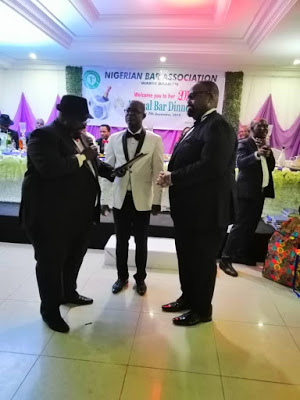
The Warri Branch of the Nigerian Bar Association (NBA) hosted its annual dinner for 2019 yesterday, 7th December. 

Distinguished members of the bar and bench as well as other distinguished guests attended the dinner, including Templars’ Senior Partner and immediate past chairman of the NBA Section on Business Law (SBL), Mr. Olumide Akpata. 
Mr  Akpata, who co-chaired the Technical Committee on Conference Planning that organised the 2019 Annual General Conference (AGC) of the NBA, commended the Warri Branch for hosting a successful dinner. He used the opportunity to highlight the sterling role of the Warri Branch under the leadership of Mike Asugo Esq. in securing the huge successes recorded by the TCCP in the 2019 AGC. 
In his reaction, Mike Asugo Esq, Chairman of the Branch, referred to Mr. Akpata as a Warri-bred lawyer who will always be a part of the Warri Branch. 
The Branch also seized the opportunity to present an award to Mr Akpata, in recognition of his stewardship and long-standing contributions to the Branch. The award was presented by G.O.K. Ebowe Esq, former Chairman of the Branch, on behalf of the leadership and membership of the Branch.
Paul Usoro SAN Presents NBA Quarterly Score Card At NEC Meeting

Paul Usoro SAN Presents NBA Quarterly Score Card At NEC Meeting

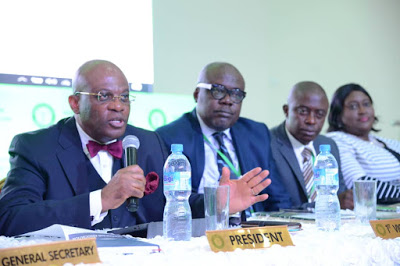
The President of the Nigerian
Bar Association, Paul Usoro SAN has presented the Quarterly score card for the Nigerian
Bar Association at its 2019 Quarter 4 NEC Meeting curren at its 2019 Quarter 4
NEC Meeting currently holding at the NBA Secretariat in Abuja today 5th
December, 2019. 

In his speech, the President
covered some of the many victories the NBA has achieved since its last NEC
Meeting including the Annual General Conference which had a record registration
of over 12,000 delegates and the Annual General Meeting, during which the NBA Constitution
was amended to incorporate sustainable governance processes which in the
President’s words if faithfully implemented, would, amongst others, entrench
accountability and transparency in the management of the Association’s
finances. Other achievements include regularizing the Association’s Annual
Returns which had been unattended at the CAC and filing the particulars of the new
Trustees.

Furthermore, the NBA has
been able to revive the Life Assurance Policy for Lawyers, commissioned a fast
speed internet service for the NBA Secretariat and instituted both the NBA
Women’s Forum and the Young Lawyers Forum. 


Mention must also be made of
the successful Election Monitoring teams who earned a well deserving reputation
for the routinely published election monitoring reports which are now used as
reference materials by researchers, scholars, election petitioners, social
activists and the general public. 

More good news is the role
being played by the NBA in the AfCFTA Trade Negotiations being spearheaded by
the Nigerian Office for Trade Negotiations (NOTN) which set up a Nigerian Coalition
of Services Industry for the negotiation of Trade Services, same of which is Co
– Chaired by Mr. Seni Adio SAN and Irene Robinson – Ayanwale, two outstanding
legal professionals. Most certainly the inclusion of Mrs. Mfon Usoro as the
Trade Expert in those negotiations is also worthy of mention as Mfon USoro has
always carried the flag high for the NBA in the past years. 
Most certainly, the NBA is
going in the right direction with the Honorable President, Paul Usoro SAN.

@Legalnaija

Olumide Akpata Highlights Important Role Of Lawyers In Nation Building And Donates 1 Million Naira To NBA (Akure Branch). 

Olumide Akpata Highlights Important Role Of Lawyers In Nation Building And Donates 1 Million Naira To NBA (Akure Branch). 

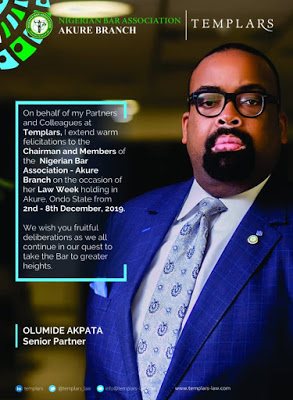
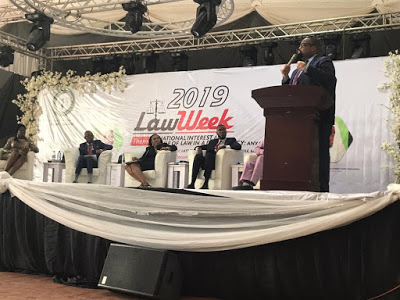
The Akure Branch of the Nigerian Bar Association has been holding its Annual Law Week in Akure, Ondo State. The week long event which began on the 2nd of December and will run to the 8th of December, 2019 has this year’s theme as “National Interest and the Rule of Law”.

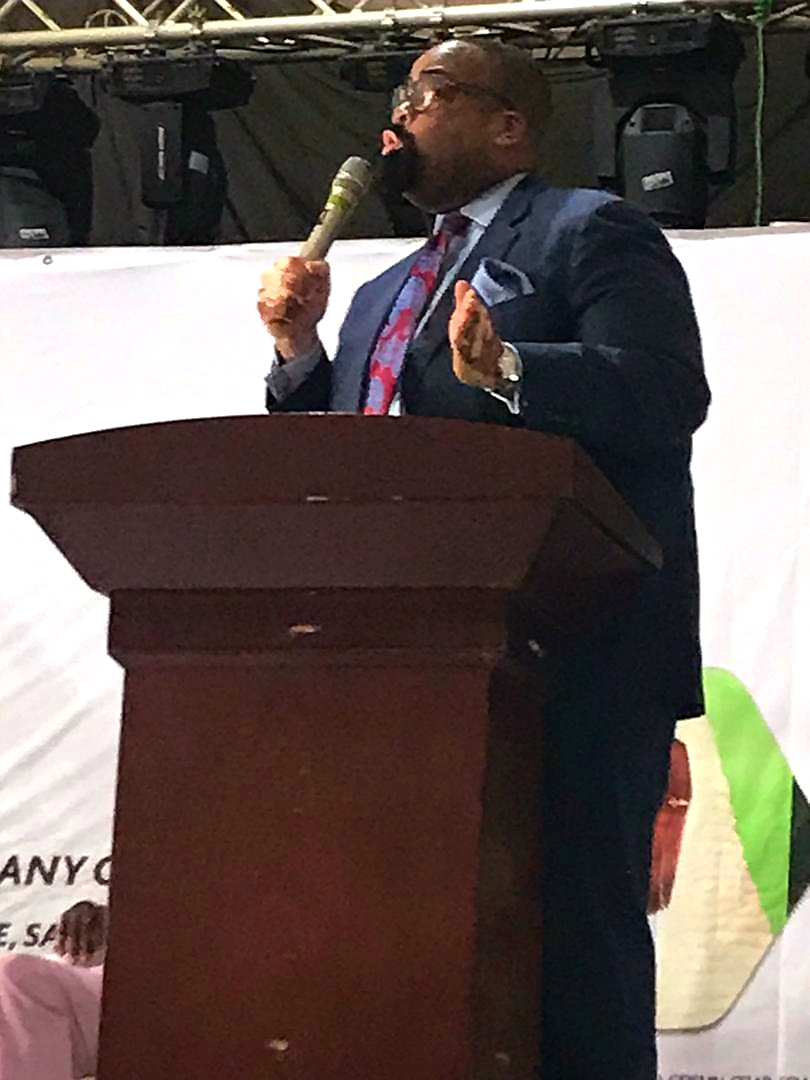
Earlier today, 4th December, 2019 and as part of the week long festivities, the NBA Akure Branch hosted a lecture that was attended by both members of the Akure Branch and other distinguished lawyers from across the country, including Mr Olumide Akpata (former Chairman of the NBA Section on Business Law).
Mr Akpata felicitated with the Akure Branch for curating the hugely successful event and emphasised the role of the NBA in strengthening the rule of law as the bedrock of the country’s constitutional democracy. 
Mr. Akpata also highlighted the responsibility of lawyers in nation building, especially in defending the constitutional rights of the masses and providing guidance on issues of national discourse. 
Mr. Akpata visited the Law Centre of the NBA Akure Branch which is currently under construction and donated 1 Million Naira towards completion of the building. When it is completed, the Law Centre will serve as a resource centre for both members of the Akure Branch of the NBA and the general populace at large. 
The Branch was thankful for Mr Akpata’s gesture and commended him for his consistent commitment and contributions to the development of the NBA.
@Legalnaija 
What You Should Know – Legalization Of Nigerian Documents For Use Abroad | Busayo Adedeji

What You Should Know – Legalization Of Nigerian Documents For Use Abroad | Busayo Adedeji

Nigeria is not a party to the Apostille Convention which specifies the modalities through which a document issued in one of the signatory countries (to the Apostille Convention) can be certified for legal purposes in all the other signatory states.

Hence attestation of Nigerian issued documents usually follow a particular process, depending on the type of document and the country such document is sought to be used. Regardless of the process or type of document however, the attestation process is called legalization.

We have highlighted below what a typical document legalization exercise will entail for use abroad:
Notarization: notarization is the official fraud-deterrent process that assures the parties of a transaction that a document is authentic, and can be trusted. It is a three-part process, performed by a Notary Public, that includes vetting, certifying and record-keeping of the document. Some embassies require that the document sought to legalized be first notarized by a notary public in Nigeria. It is pertinent to state that certain embassies have a list of certified notaries public that must be used.
Translation: some countries will also require that the relevant document be translated to the official language of the country in which the document is sought to be used before approaching the embassy for legalization. It is also noteworthy that certain embassies have their list of certified translators that must be used as well.
Authentication by Ministry of Foreign Affairs (MOFA): the final step of certifying the authenticity of Nigerian issued document before approaching the embassy of the foreign country is certification by MOFA. MOFA will upon payment of the prescribed fees and verification of the document, engrave its seal on the document, thereby certifying the authenticity of the relevant document.
Authentication by Ministry of Education (MoE): In addition to authentication by MOFA, education certificates are required to be authenticated by the MoE. The MoE requirement for education document is required to be done before the MOFA authentication above. The process at the MoE is similar to that at MOFA.
Legalization at the embassy: this is usually the final stage in the legalization cycle and it entails the embassy ensuring all the previous attestation the document has gone through are genuine. This is done by trained inhouse personnel of the embassy or by consulting external investigators. Once the embassy is satisfied of the authenticity of the document and the prescribed fees are paid, the embassy will legalize the document, thereby certifying it appropriate for use abroad.
Conclusion
As straight forward as attesting/legalizing a document may seem, it is always best to employ the services of trained practitioners who are familiar with the process in other to avoid potential pitfalls. 
Important notes:
Different countries have different requirements for legalization. Some countries may require some or all of the steps highlighted above. Others may even have additional requirements;
Legalization fees at the embassy may be subject to foreign exchange rates; and
Certain documents have a timeline within which they must be legalized once issued.
For questions and clarifications, please do not hesitate to contact Busayo Adedeji at:
Busayo.adedeji@newedege-consultants.com and +2348034476429.
How Courts Disrespect Litigants and Lawyers

How Courts Disrespect Litigants and Lawyers

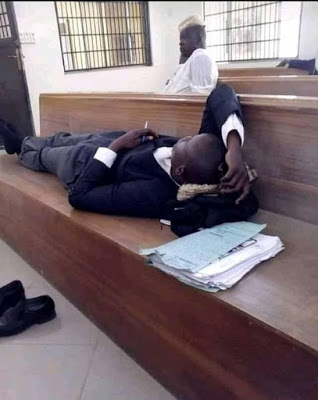
I left my house 5.30am this morning and arrived High Court premises at Igbosere at about 7.30am. It is is my regular practice to arrive court at least an hour before 9am. I have asked my client to arrive court before 8.30am which he, like me, had to wade through this terrible Lagos traffic to make it to court at the appointed time.

Registrar finally arrives after 9am and announces *”the court is not sitting, please listen for your matters for date”.* 
To leave home at 5.30am I had to wake up 4am. Between 5.30 and 7.30/7.50am I am in Lagos traffic burning fuel with stress building up as to why I must be made to go through this stress. The same goes for the litigant who must leave early and wade through traffic to make it to court.
Had the court considered the challenge and wasted manhours and resources it takes to be on Lagos roads, it would have done the simple task of sending messages to parties if it will not sit for any reason. 
While counsel are required to put their functional email address and phone number, on each processes to be file, this requirement is for a reason but it appears that the court that made it a requirement is not keen at making it an important tool for effective dispensation of justice.
Last week I had a matter at Federal High Court Lagos Division and we had to wait for Registrar till after 9 for a court that normally sits 9 on the dot. On arrival the Registrar announced that the court will not be sitting. On enquiry as to why no message was sent like the last time the Registrar responded that the last messages sent were sent from his pocket and that when they made a proposal to the CR for funds for such messages it was turned down, hence he can’t continue funding it from his pocket.
Just last Thursday a had a matter for trial before a judge in TBS Annex. Arriving court, when it was 9am Registrar started giving dates that the court is not sitting. When counsel present demanded for explanation as to why message was not and the Registrar responded that counsel and litigants should always call a day before the court day to find out if court will be sitting or not.
Can the Bar take this up with the Bench and insist that courtesy be accorded lawyers and litigants in this regards so the court can be taken seriously.
This practice is not rocket science, at least National Industrial Court carries it out effortlessly, why not the State High Courts and Federal High Courts?
 *#JUSTMINDINGMYBUSINESS* 
– copied