Reflating The Economy Through MSME Support – NASME Business Luncheon on 13/7/2017

Reflating The Economy Through MSME Support – NASME Business Luncheon on 13/7/2017


The Nigerian Association of Small & Medium Enterprises (NASME) charged with
the co-ordination, promotion and development of the MSME sector of the Nigerian
economy hereby invites the general public to its Business Round Table tagged
“REFLATING THE ECONOMY THROUGH MSME SUPPORT”. 


NASME is the only Nigerian private sector -led BMO affiliated to the World
Association of Small & Medium Enterprises (WASME) enjoying consultative
status with the United Nations. NASME is equally being assisted through
strategic collaborations with UNIDO, UNDP, IFC, Federal Ministries, several
embassies and bilateral Chambers of Commerce on its various projects. 
NASME was also jointly conceived by
promoters of MSMEs in the private sector and agencies of the federal government
of Nigeria including the Bank of Industry, to serve as the apex organization
that will coordinate MSME activities and interact with local and foreign
organizations whose services are vital to the development of MSMEs.

The Association is committed to further advancing the NASME brand by providing
high-quality and responsive services and building and strengthening partnerships
nationwide in order to better serve her members. The Association also advocates
for a conducive operating environment while partnering with MSME promoters to
ensure the emergence of Large pool of viable and technologically empowered
MSMEs.

With Employment Rates in Nigeria being averaged at 89.79 percent from 2014
until 2016, reaching an all-time high of 93.60 percent in the fourth quarter of
2014 and a record low of 86.40 percent in the second quarter of 2016; the high
exchange rate of the Dollar to the Naira. The promotion and empowerment of
Nigeria’s MSMEs as a means of achieving sustainable employment generation,
economics growth development in the country cannot be over-emphasized. 

 Today’s small business sector creates many of the new ideas and innovations.
Small businesses are vital to the success of the economy. They look inwards and
identify or develop prospective products for domestic consumption and export
market as a means of earning foreign exchange for

the state. 

That’s why we are delighted to invite you to this round table discussion on
your small business and other MSMEs in Nigeria shall be championing the drive
towards the restoration of our economy. 
Keynote Speaker for the day is Prof.
Olusegun Ajibola Ph.D, FCIB, President & Chairman of Council, Chartered
Institute of Bankers in Nigeria.

Date is 13th July, 2017
Venue – NECA Event Centre, A2 Hakeem Balogun
Street, Central Business District, Alausa, Ikeja, Lagos.
Time – 10am
Regisreteration
fee

– N5000 (Members) / N10,000 (Non Members) 

For adverts and sponsor bookings, Pls
call 08082982810 or 08138333998


Let us expose your business to local and
foreign markets; help you identify and source appropriate technologies and
relevant raw materials that can enhance the efficiency of your business and
show you how you can play a more active role in policy advocacy on issues
affecting MSMEs through legislative and executive lobbying as well as ensuring
proper representative and participation in state and federal government special
committees. 

Rights Of Igbo To Self Determination And A Call For The Restructuring Of The Current Nigerian Political System

Rights Of Igbo To Self Determination And A Call For The Restructuring Of The Current Nigerian Political System

 Abstract
The recent heightened clamour for self-determination in various quarters
of southeastern Nigeria – a geographical location largely made up of the Igbo
people, has awakened the keen interest of many people around the world. Various
secessionist leaders calling for the recognition of the sovereign state of
Biafra have been incarcerated by the Nigerian Federal Government on many
occasions while a few others are standing criminal trial for offences like
sedition, treason and other treasonable felonies. It is therefore imperative
for one to look into this agitation for self-determination and decipher if
indeed such right exist in favour of the secessionists, whether this right is
recognized by international law and if there are conditions precedent to the
enjoyment of this right. This paper focuses on the international law framework
guaranteeing the right to self-determination vis-a-vis the Igbo nation of
Biafra; and also proffers probable solutions/recommendations for continued
co-existence.

1.                
INTRODUCTION
The Right to
self-determination is a right that inures to every group/people as their innate
human right and does not come through negotiations. Just as there is no
condition precedent for the enjoyment of any human right across the world,
except the fact that a person is ‘Human’, same is the case with the Right of a
People to Self-determination. A proper understanding of the right to
self-determination under International Law will afford every nation seeking to
secede, without any doubt, a guide in achieving state status in a manner
acceptable to the international community.
The discussions in
this paper will be divided into four parts. Part One is the Introduction. Part
Two will provide a historical background of the struggle for self-determination
by the Biafra nation. Part Three will attempt to summarize all the relevant
international laws bothering on self-determination citing examples of some
states that actualized an independent sovereign state status in recent times.
This paper concludes with Part Four wherein the writers reemphasize the right
of every people including the Igbo race to self-determination under
International Law, and also spells out certain pragmatic recommendations for
continued co-existence.
2.                
HISTORICAL BACKGROUND OF THE STRUGGLE TO
SELF-DETERMINATION BY THE BIAFRAN NATION.
The Oxford Dictionary
of Law defines “self-determination” as: 
“the right of a people living within a
non-self-governing territory to choose for themselves the political and legal
status of that territory. They may choose independence and the formation of a
separate state, integration into another state, or association with an
independent state, with autonomy in internal affairs”.[1]
Various reasons can
account for the desire by an indigenous people to crave for autonomy and an
independent state status. Some of these reasons include perceived religious
bias by an extant government, ethnic domination, patent cultural differences,
injustice and marginalization, among other reasons.
The struggle for
self-determination by the Igbo race can be traced as far back as 1914 when the
then British government forcefully merged the Northern and Southern
Protectorates of Nigeria. This merger was to facilitate a functional political
and economic control over the Nigerian people.
The systems of
government that existed in the two protectorates differed significantly, more
so, the cultures and religions of those regions were extremely dissimilar. The
incongruity of the two regions immediately began to manifest in religious
clashes, election riots, persecution of Igbo traders in Northern Nigeria among
other injustices all culminating in the Nigerian Civil War, alternatively
referred to as the Biafran War, which lasted from July 6, 1967 to January 15,
1970.
Today, many years
after the civil war has ended, evidence of marginalization of south-eastern
Nigeria still exists in the form of bad road networks across the region, the
dilapidated River Niger Bridge at Onitsha, Anambra State, outrageous ethnic
inequality in the employment of persons to the federal civil service, general
exclusion in federal projects among other social, economic and political
inequalities.
The aforementioned
social, economic and political inequalities have resulted in the formation of
many indigenous organizations aimed at voicing out the grievances of the Igbo
nation. Most notable among these organizations include the Movement for the
Actualization of the Sovereign State of Biafra (MASSOB) and the Indigenous
People of Biafra (IPOB). There have also been reports of various groups of
people protesting against these perceived injustices in various ways including
organized marches, comments and write-ups on the social media, tyre burnings, stoning
of Federal Government officials, destruction of Federal Government buildings
and bombing of oil pipelines in south-eastern Nigeria.
3.                
THE
INTERNATIONAL LAW RIGHT TO SELF-DETERMINATION
The United Nations
(UN) charter states that the purposes of the UN is:
“To develop friendly relations among nations based on
respect for the principle of equal rights and self-determination of
people, and to take other appropriate measures to strengthen universal peace.”[2](emphasis
mine)
The United Nation
Organization which is the primary body of UN countries in the international
community clearly recognizes this right to self-determination in its Charter.[3] As
such, no group of persons ought to be compelled by any constituted authority to
remain in a country they have no love, regard and respect for.
Furthermore, the twin
1966 Covenants i.e. the International Covenant on Civil and Political Right
(ICCPR) and the International Covenant on Economic, Social and Cultural Rights
(ICESCR) which, unlike the UDHR, are binding covenants on all member states
(Nigeria inclusive). These Covenants enshrined a people’s inalienable Right to
self-determination in the following Clear and repetitive terms.
They both provide:
 “all people have the right to
self-determination by virtue of that right they freely determine their
political status and freely pursue their economic, social and cultural
development”. [4]
It is instructive to
note that the right of self-determination is considered so elementary that it
is a rule of customary international law, at least in its application to
colonial territories.[5]
The United Nations
Declaration on the Right of Indigenous People (UNDRIP) was adopted by the
United Nations General Assembly on 13th September, 2007. [6]
Inasmuch as a
Declaration is not binding in International Law, the UNDRIP goes a long way in
expressing the status of the international community vis-à-vis the right to
self-determination.
South Sudan gained
independence from Sudan in 2011, Pakistan seceded from the British Indian
Empire, Kosovo declared independence on February 17, 2008 among numerous other
active separationist movements in the world i.e. the various secessions from
Old Soviet Union, the separation of the old State Union of Serbia and
Montenegro, the division and fusion of Germany (West and East Germany), old
Czechoslovakia, the Austro-Hungarian Empire etc.
4.                
CONCLUSION
It is indubitable that
International Law recognizes the right to self-determination. The clamour by
the Igbo race of south-eastern Nigeria for an independent state status is
therefore one in consonance with the provisions of International Law. The right
to self-determination is at the core of International Human Rights Law because
it is a pre-condition for the enjoyment of other human rights, and no other
human right can be enjoyed without it. The Right to self-determination should
therefore not be disregarded by an extant government or cowered by threats of
aggression, but the various grievances should be addressed and possibly a referendum
conducted like in the popular and recent Catalonia’s case which has been
scheduled for the 1st of October, 2017, this latter date was even
after a failed referendum on “Self-Determination” in 2014.
RECOMMENDATIONS
In recent times,
asides the people of Biafra, there have been various clamours for
self-determination by various secessionist groups across Nigeria i.e. RONDEL[7] in
the Niger/Delta, Arewa youths in the North, the Oduduwa people in the South
West, the people of the Middle-Belt etc.

Although it has been
established and emphasized herein that no unwilling group can be compelled to
remain in a union they do not want to be a part of. However, if these groups
are willing to remain together as a whole, then the situation calls for a
gathering of all of them or their representatives to discuss their existence.
The best option to sustain the existence of Nigeria is Confederalism,
wherein every geo-political zone will be totally independent, uniting under an
umbrella called Nigeria. i.e. the European Union.
However, where a
Confederal system of government fails, a very palatable option to sustain the
existence of Nigeria and to alleviate these clamours for self-determination by
the various constituent nations will be the recent call for the restructuring
of the current political system, which has of late been at the forefront of
every National discourse in the country. Simply put, a call mainly for Resource
Control and autonomy.
It is not a fact to be
ashamed of, that we are different people, with different religions and cultural
complexities. In fact, admitting these very intrinsic differences go a long way
in solving our biggest and recurring problems as a country. Our strength lies
in our Diversity, and it is in our best interest to be united than divided.
According to our Former President Goodluck Jonathan, we will be more recognized
in the International Sphere as a whole than in parts. We are called the Giant
of Africa and derive a lot of benefits from same, not only because of our
wealth, but majorly because we consist of One-Quarter of the entire black
population.
The recent call for
restructuring of the current political system is a call for true federalism
along the lines of all the geo-political zones in Nigeria, wherein these
geo-political zones will be the federating states (entirely controlling their
resources), since they are largely made up people with similar cultures,
religion and identity.
The current Nigerian
purported federal structure is not a federal system of government in a real
sense, but rather a Unitary System of Government disguised as a federal system
of Government. The entire resources are forced out of the Niger-Delta and
shared amongst all the states, without the receiving states having any
contribution to the commonwealth. This is a very inequitable structure which
can never bring about our development, but will only encourage the harbouring
of spite and anarchy, like every other unjust system. A typical example of a
true Federal structure is what is obtainable in the United States of America.
Other countries which have devolved powers from the centre i.e. China, Japan,
India etc., have also experienced rapid growth.
Our National problems
are largely structural rather than peripheral. The current system and its
national-cake syndrome has inspired a spate of unpatriotism and apathy towards
nationhood, and can be linked to every challenge that the Country is now
facing. It has also succeeded in breeding strong men rather than strong
institutions. This explains why we have corruption problems that cannot be
checked or controlled, unending inter-tribal and communal conflicts, unending
issues of insurgency and militancy, different/divergent counterproductive
governance systems i.e. unitary, federal, sharia, customary etc. It only took
the fall in oil prices for us to discover that we were actually living/sitting
on a ticking time-bomb.
THE NEED TO
RESTRUCTURE OF OUR CURRENT POLITICAL SYSTEM – A CALL FOR TRUE FEDERALISM
·       
The need for every people to grow at their pace without suffering
limitations from the other.
A true federal system
will allow each of the federating states to grow at their pace and choose their
individual political systems/form of internal governance or government to
achieve such growth and still remain a part of the same country. i.e. there is
no reason why a Sharia System should be imposed on all Nigerians whereas
arguably over half of the entire population consists of Christians (every
region should be allowed to choose what works for it). Although the centre may
still retain certain powers i.e. Defence and currency etc, virtually most of
the exclusive powers of the Centre ought to be devolved to the federating
states i.e. structuring of political and legal systems, aviation, creation of
Local Government to suit needs etc. With all these measures, the issue of
power/energy generation that has been a perpetual problem of Nigeria will be a
thing of the past i.e. there is no sense in a person in Lagos State for
example, generating electricity to be channelled to the National grid to be
transmitted to all Nigerians without considering the power needs of people in
Lagos. It is a very unaccountable and repressive system. There is an old Igbo
saying that ‘a dog that is owned by everyone is often killed by hunger”. That is
simply the situation of our Power Sector. A person in Lagos should be allowed
to Generate as much electricity to suit his needs.
·                   
Issue of Corruption and Accountability
Allowing these
federating states to develop, control and explore their resources for their own
development will give them a sense of entitlement to the workings of their
government and will bring the government closer to the people. i.e. someone in
the Niger/Delta will not need to travel all the way to Abuja in order to
regulate activities of oil companies mining its resources. Virtually all
clamour for good governance and accountability will be at the Regional level,
since all the region control its resources. When this is the case,
accountability sets in, corruption will become a thing of the past, more
credible candidates start contesting elections etc. this will also help
unburden the centre in order to channel its attention to face real national
issues. A 70-30% sharing formula between the Federating States and the Centre
respectively is very fair.
Also, a true federal
system is the best way to make the centre accountable. This is because every
public official at the centre will have the duty of explaining to each of the
regions what our commonwealth is being used for. Since all the regions will now
generate their resources and contribute a percentage to the centre, issues of
embezzlement of large chunks of money at the centre will not go unexplained and
unpunished. This is because a person involved in such act will have the
invidious task of explaining to every Nigerian, and not only the Niger-Deltans,
as to why he should go unpunished; it becomes truly a crime against the Federal
Republic of Nigeria.
Healthy Competition
Amongst Federating States And Issue Of Security
The current political
structure encourages laziness. If true federalism is practised in Nigeria,
virtually half of the present states in Nigeria have a capability of even being
more developed (all-round) than the centre. Since states will develop at their
pace, developing/progressive states will serve as an example to others. Every
state for example would love its territory to be a destination for investors.
Issues concerned with ignorant leaders, insurgency, indiscriminate killings and
other odious issues which have the capability of isolating a people from the
comity of nations will be a thing of the past. The over-dependence on oil is
very over-rated, every state in Nigeria has the resources to sustain it. Texas
is the oil-producing hub of the United States and yet it is not the richest
state in the US.
Not to mention that
every state in Nigeria is gifted with at least one natural resource, which can
at least sustain it before it can find other ways to increase its Internally
Generated Revenue (IGR).
Issue Of Diversifying
Our Economy And Unemployment
The current clamour by
the present administration to diversify the economy will never come to fruition
under the current structure, and any success at diversifying the economy will
be at best minimal. We run a system where our Governors sit every month
expecting allocations and security votes from the Centre without any
proportionate reciprocal contribution. Bearing in mind how selfish most of our
politicians are, once they get these funds, they can care less about the people.
If true Federalism is practised, states will be forced to generate their own
resources for their sustenance. Since their existence will now lie in their
hands, diversifying the economy, unemployment issues, failure to pay salaries
will be the least of our worries.

Osinachi Obi-Njoku and Henry Chibuike Ugwu

Photo Credit – www.pointblanknews.com

[1] Elizabeth A. Martin, et al., Oxford Dictionary of Law, 6th
ed. (New York: Oxford University Press Inc., 2006) p.486.
[2] Article 1(2), United Nations Charter, 1945.
[3] Ibid., Article 73.
[4] Article 1(1) of
the I.C.C.P.R 1966 and Article 1(1) of the I.C.E.S.C.R 1966.
[5] B.B.O. Enabulele,
International Law (Lagos: AMBIK
PRESS, 2006) p.211.
[6] Worthy of note is that Nigeria among 10 other
states abstained from the voting to adopt the UNDRIP. See also Articles 3 – 5,
UNDRIP.
[7]
Region of Niger Delta
5 takeaways from our poll on whether Evans the kidnapper should be released on compassionate grounds

5 takeaways from our poll on whether Evans the kidnapper should be released on compassionate grounds

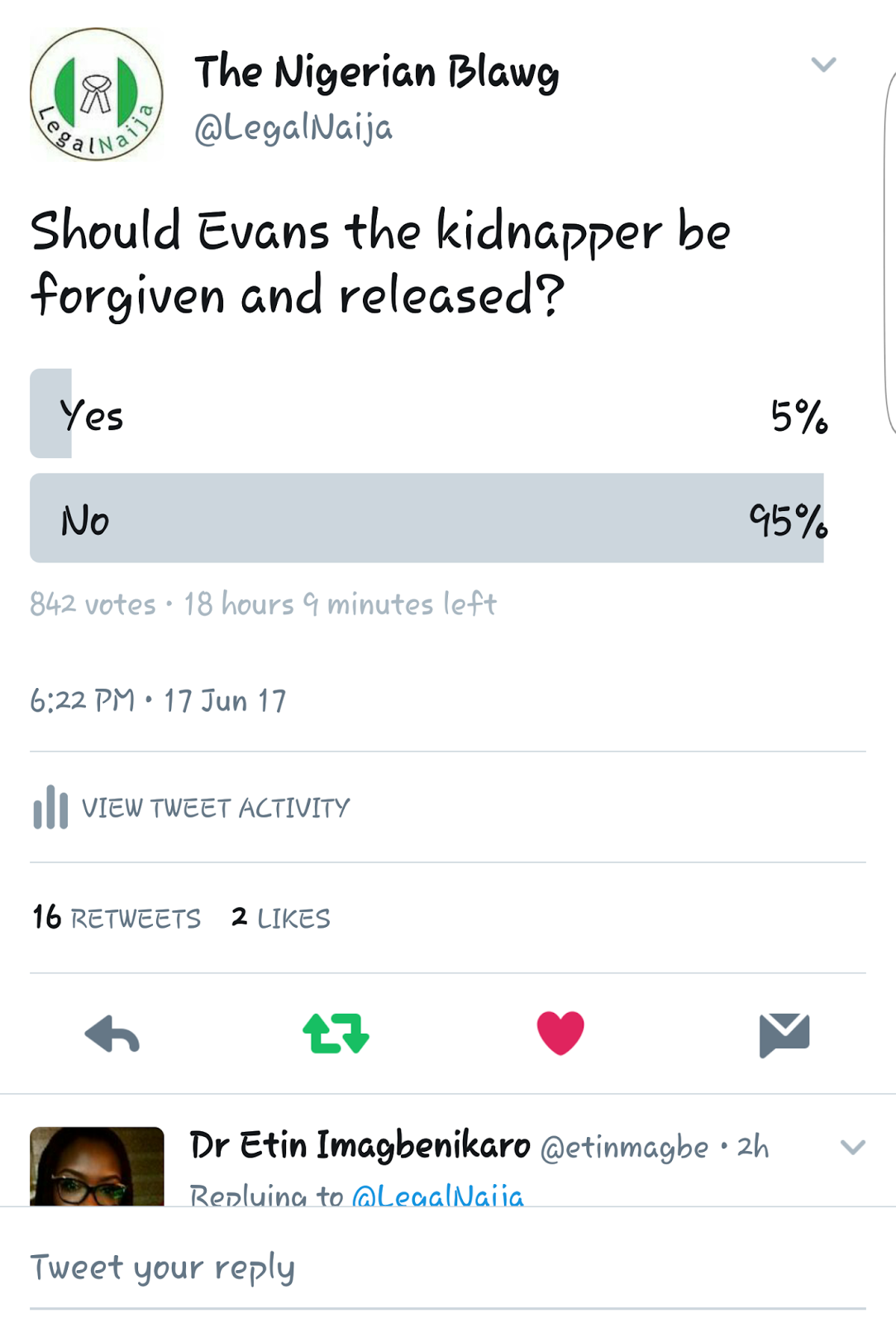
The news of the successful arrest of kidnap kingpin, Evans Onwuamadik, in Magodo, on the 10th of June, 2017, has trailed several news outlets and social media in Nigeria for the past week. Evans had led his gang of kidnappers on several successful operations which had earned him millions of naira in cash and properties including several houses scattered all over the country. While also leaving behind the emotional torture and pain inflicted  on his victims and their families. 

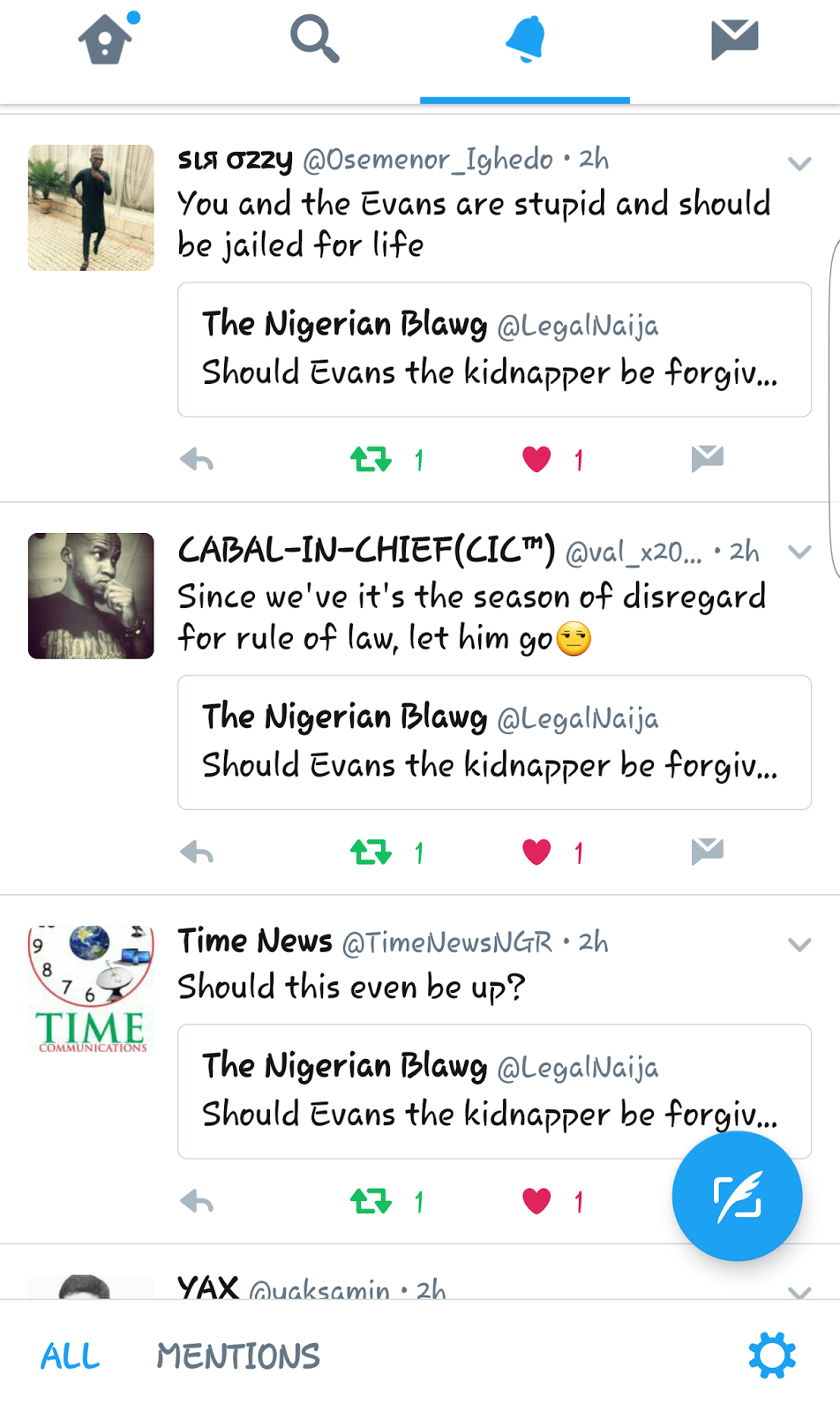
More surprising, was the call from his wife for the release of her hubby and father of her children on compassionate grounds. No doubt, majority of Nigerians found everything wrong this plea and this caused a debate on twitter and other social media outlets on why such a person should enjoy the benefits of a second chance. Hence, our poll to ascertain public opinion on the issues,here are the lessons from our poll and twitter engagement. 

1. The Criminal Code needs urgent reform –

While states such as Lagos, Edo and Delta have passed stricter laws such as the death penalty and life imprisonment on kidnapping, the Criminal Code Act still provides for a lesser penalty. Section 364 of the Act states a penalty of 10 years imprisonment for anyone who unlawfully imprisons another. This clearly shows that the Criminal Code Act is far behind on the current reality of crime in Nigeria and urgently needs to be adequately reformed, hopefully the 8th National Assembly takes a critical look at the Criminal Code Act to bring it in line with current realities. 


2. Revisiting the Death Penalty –

While Nigerian laws still recognise the death 
Penalty for offences such as murder, it is to be considered whether the death penalty should be introduced nationally to other grievous crimes such as corruption and kidnapping. Though executions have rarely happened in the past few years, introducing capital punishment for these crimes may help considerably stem down the high rise of these offences in the country. 
3. Opinion could easily become an infringement on the rights of others – 
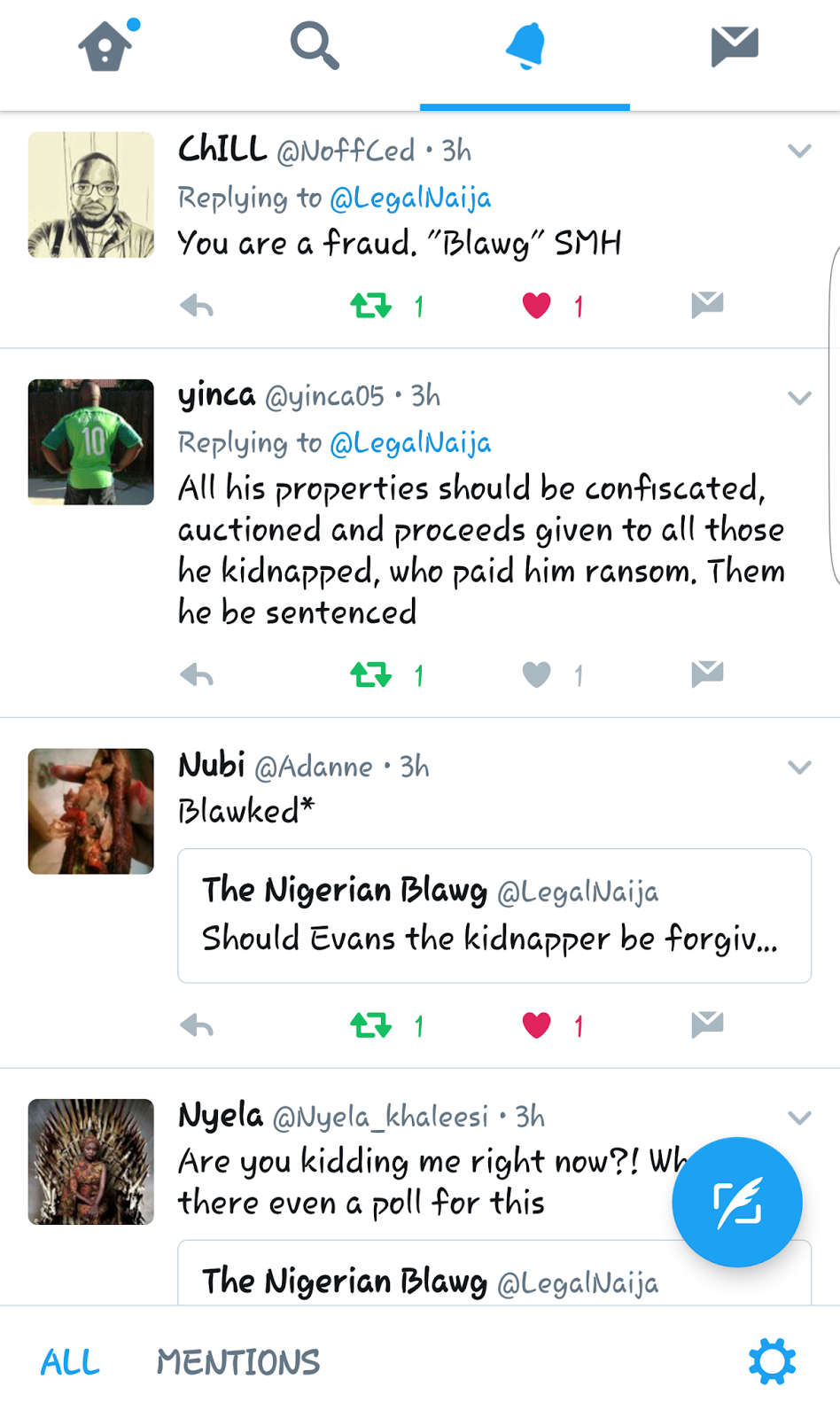
While the constituion guarantees the rights of freedom of thought and expression, many Nigerians don’t understand that these rights are in no way absolute. Where the rights of one person stops,the rights of others begin. Though we have a legal right to ask a poll to ascertain public opinion on any subject, the responses we received from fellow twitter users were quite epic. For instance, a twitter user @noffced wrote that Legalnaija was a fraudulent blawg, a clear statement made without proof of any fraudulent act committed by Legalnaija but made to disparage the public identity of the blog. A statement which could be argued as defamatory. It should be noted that a defamatory matter according to section 373 of the Criminal Code is one likely to expose a person to hatred, ridicule or contempt. While it is okay to say whatever we want,its wrong to say things that are untrue and could cause damage to the reputation of others,this may find the maker of such statement liable for the act of defamation and also to damages. 
4. Kidnapping is a national emergency and must be treated as such – 
The public outcry from our poll is evident of the devastation the act of kidnapping has caused on the lives of many Nigerians. Victims have included wealthy persons, government officials and also students. This is an urgent call for the overview of the national security apparatus in safeguarding the lives of Nigerians as they go about their daily activities. 
5. Nigerian Twitter takes no prisoners – 
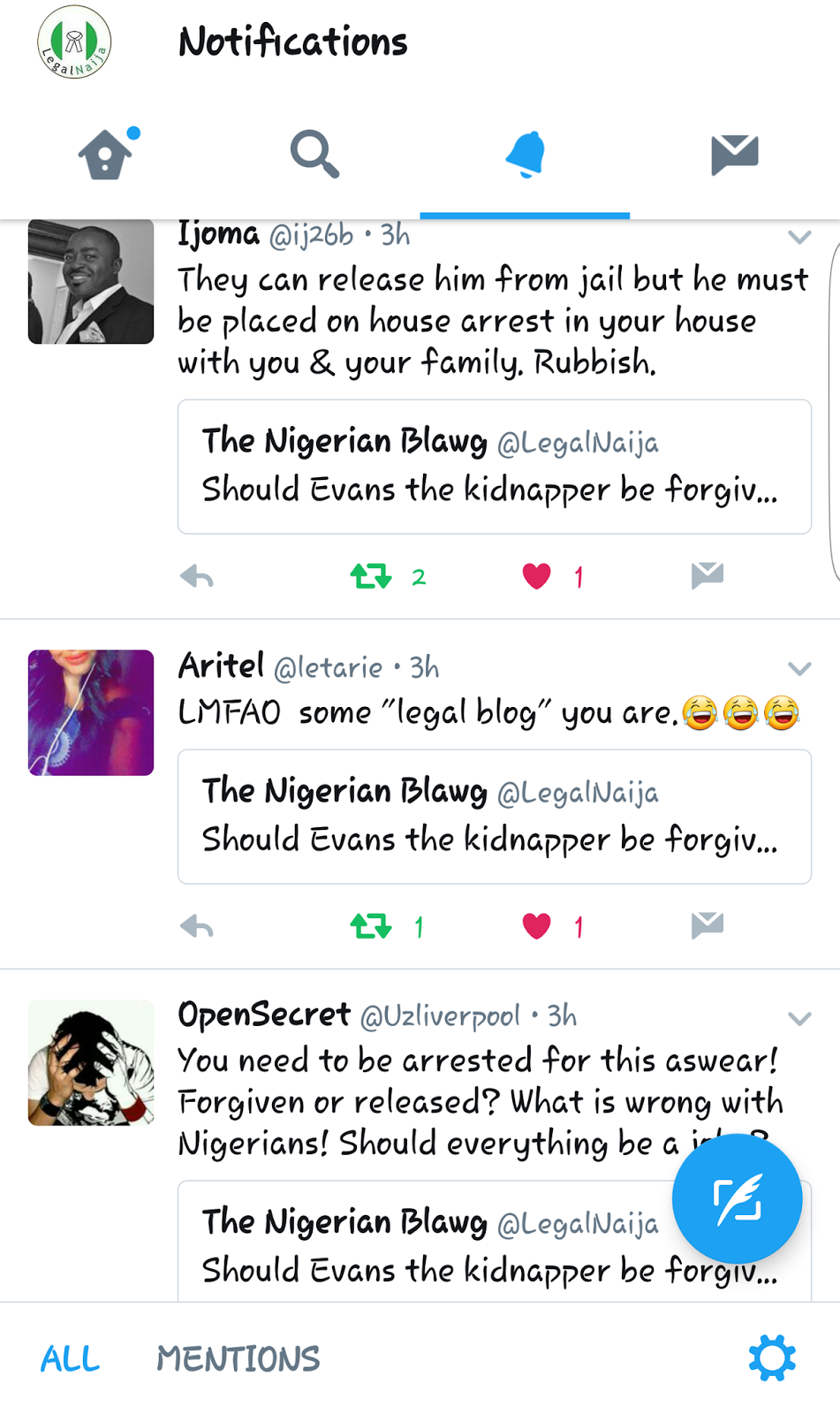
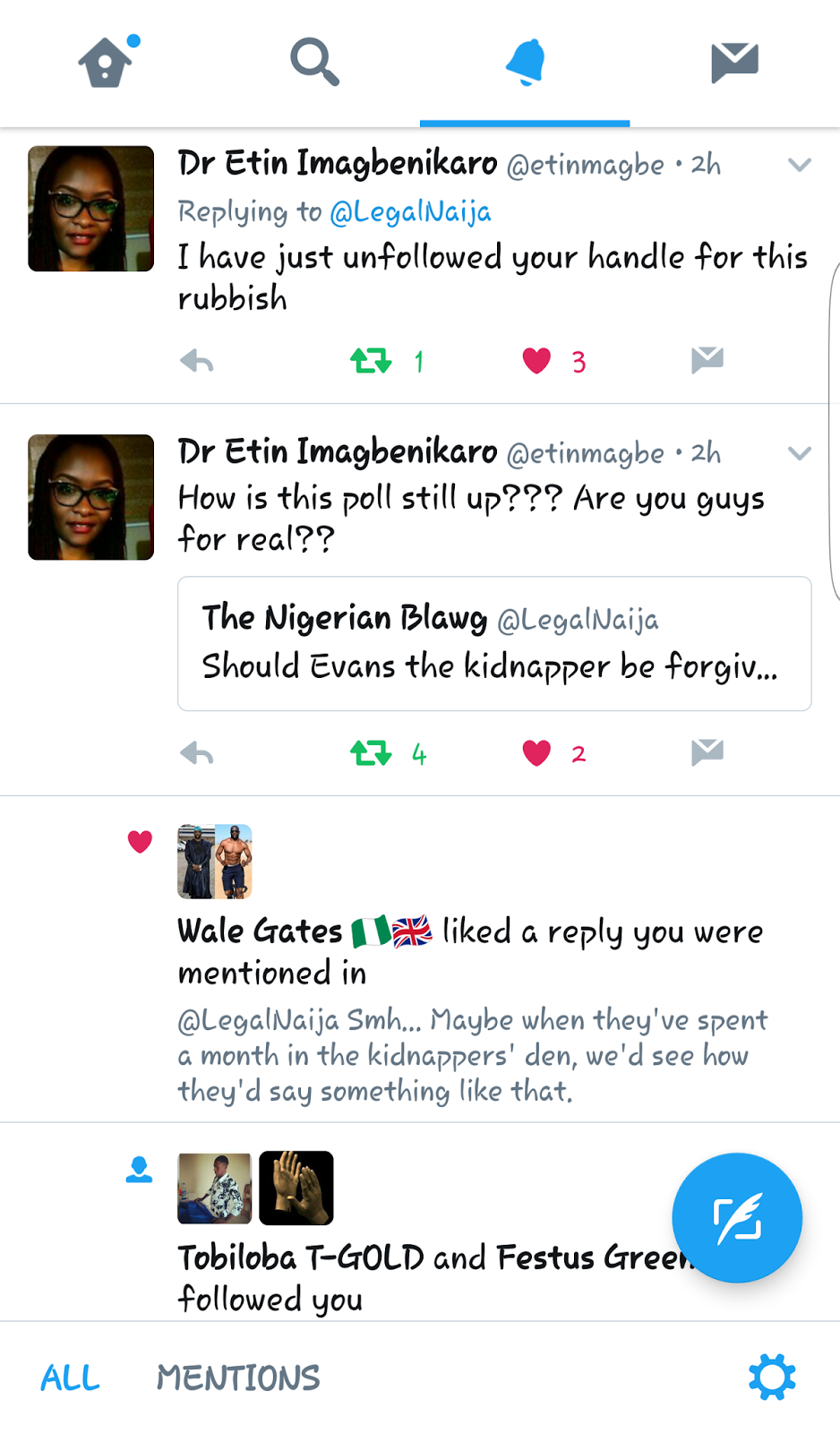
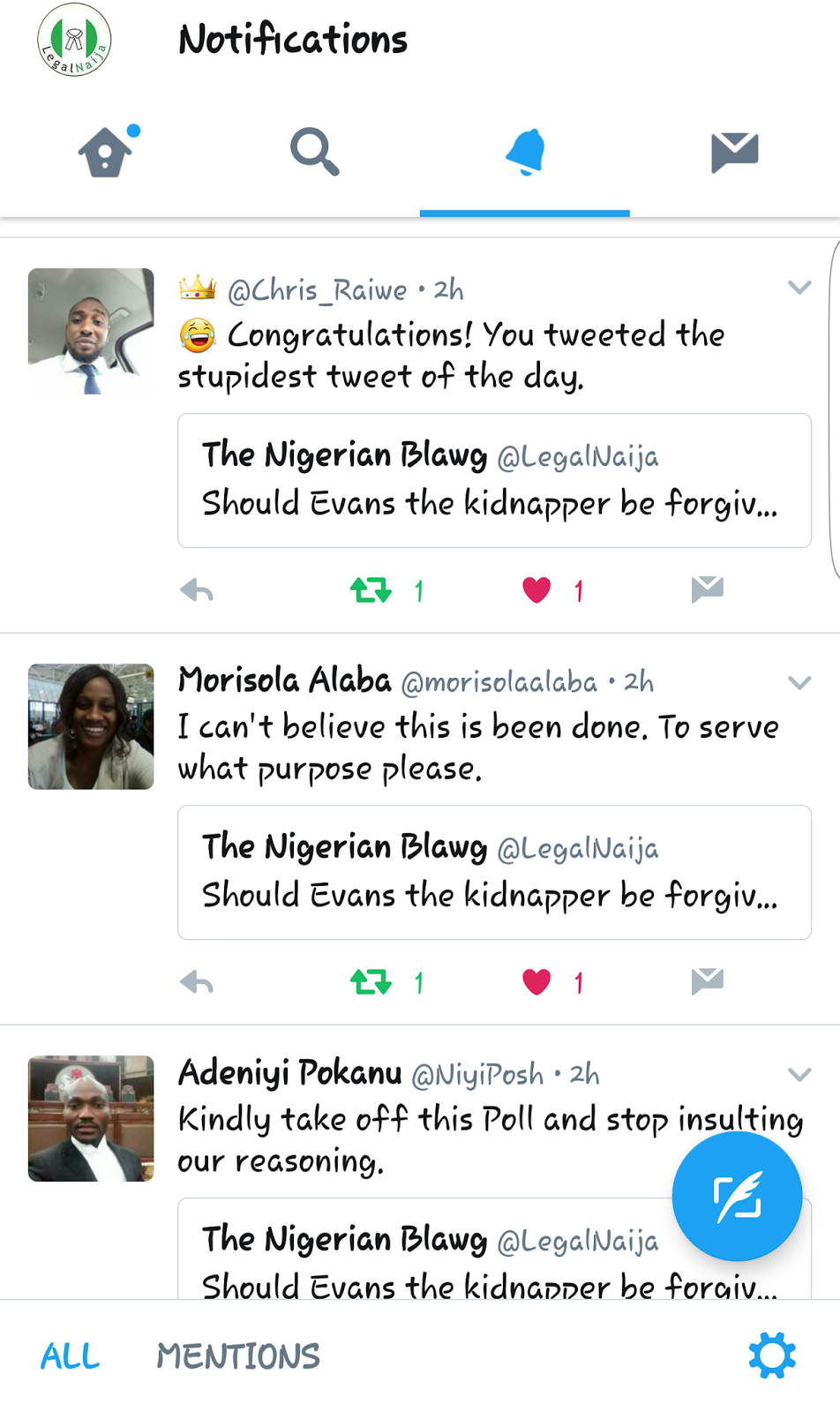
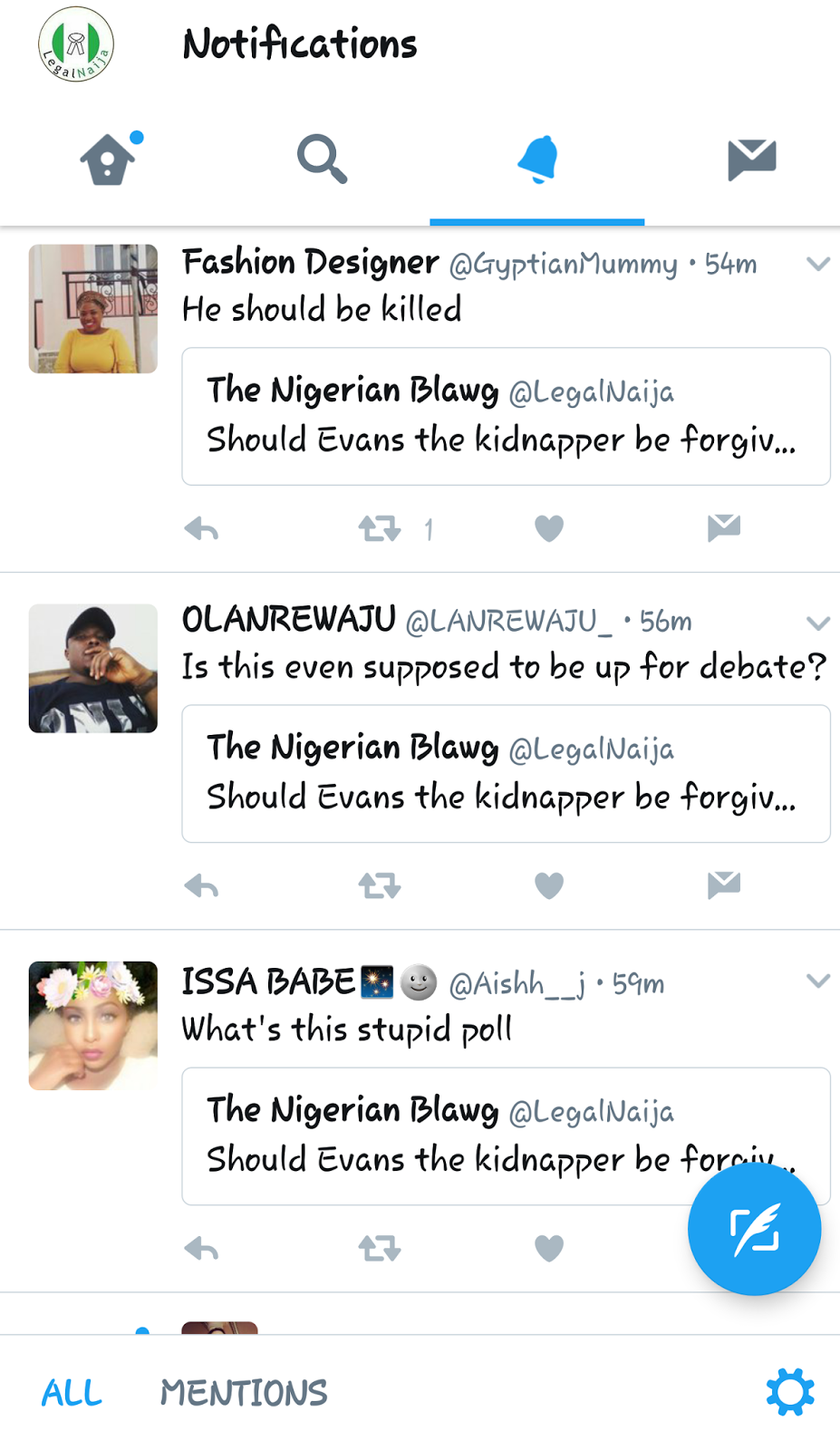
Nigerian twitter is very vocal and anyone who has been on its bad side would attest that tweeps can be merciless with their comments. From our poll, we got responses asking about our mental state, asking us to delete our account, accusing us of being bribed by the family of Evans, referring us to the police, unfollowing us and even lawyers denouncing our blog. 
It’s however quite important to note that the poll was for ascertaining public opinion and in no way supports or condones kidnapping or any other crime whatsoever. 
A Brief Analysis Of Constructive Dismissal | Busayo Adedeji

A Brief Analysis Of Constructive Dismissal | Busayo Adedeji

Simply put constructive dismissal is the
changing of an employee’s job or working conditions with the aim of forcing
their resignation. It is resignation because of the employer creating a hostile
work environment. Since the resignation was not truly voluntary, it is in fact,
a termination. An example of constructive dismissal might be a situation where
an employer forces a senior officer to take instructions from his juniors
(where the senior officer is clearly more experienced and competent) or any
such other related actions in an attempt to frustrate the employee to the point
of resignation.

Employers might wish to know that the
concept of constructive dismissal, though not often heard of in Nigerian labour
and employment issues is no longer alien to this clime. This is especially as
the third alteration to the 1999 constitution empowers the National Industrial
Court of Nigeria (“NICN”) to apply international best practices in labour in
arriving at its decision. Also, noteworthy in this regard is the provision of
section 19(d) of the NICN Act (2006) which provides that:
“The court may in all other cases and where
appropriate make any other including; an award of compensation or damages in
any circumstance contemplated by this Act or any other Act of the National
Assembly dealing with any matter that the court has jurisdiction to hear”.
In Miss Ebere Ukoji v. Standard
Alliance Life Assurance Co. Ltd 
[2014] 47 NLLR (Pt. 154) 531 NIC
,
the court held that to attempt to have the employee resign, rather than
outright firing the employee means that the employer is trying to create a
constructive discharge.[ii]
Generally, an employee bringing a claim of
constructive dismissal must (1) show that his employer created a hostile work
environment in a bid to get him to resign; and (2) that the hostile work
environment led to his resignation.
[ii] The Changing Face of Nigerian Labour Law
Jurisprudence and What Employers Need to Know. By Hon. Justice Benedict Bakwaph
KANYIP, PhD
Regulatory Compliance & Commercial law
advisor

Ed’s note – This article was first published here 
Legal protection from workplace sexual harassment | Michael Dugeri

Legal protection from workplace sexual harassment | Michael Dugeri


There is legal protection from workplace
sexual harassment. Workplace sexual harassment is commonly defined as
unwelcome sexual advances, requests for sexual favours, and other verbal or
physical conduct of a sexual nature when:

·                 
Submission
to such conduct is made either explicitly or implicitly, a term or condition of
an individual’s employment, or
·                 
Submission
to or rejection of such conduct by an individual is used as a basis for
employment decisions affecting such individual, or
·                 
Such
conduct has the purpose or effect of unreasonably interfering with an
individual’s work performance or creating an intimidating, hostile, or
offensive working environment.
Workplace sexual harassment can include a
one-off incident or a series of incidents. Both male and female colleagues can
either be the victim or offender. It is particularly serious when behaviour of
this kind is initiated by any official who is in a position to influence the
career or employment conditions (including hiring, assignment, contract
renewal, performance evaluation, working conditions, or promotion) of the
victim. Sexual harassment may also occur outside the workplace and/or outside
working hours.
The Nigerian Labour Act and the many HR
policies that workers in Nigeria are commonly bound by are silent on the issue
of workplace sexual harassment. This has left many victims of this problem in
doubt as to their legal options. Workplace sexual harassment results in
violation of the fundamental rights of a worker which include dignity of the
human person and personal liberty guaranteed under the 1999 Constitution.
A person’s right to protection against
sexual harassment and the right to work with dignity are universally recognised
human rights by international conventions and instruments. Hence every person
has the right to practice any profession or to carry on any lawful occupation,
trade or business which includes a right to a safe environment free from sexual
harassment.
The National Industrial Court (NIC) amended
its civil procedure rules recently to provide the procedure for claims against
workplace sexual harassment. Order 14 of the National Industrial
Court of Nigeria (Civil Procedure) Rules, 2017
provides that an action
in which a worker alleges sexual harassment at the workplace should spell out
whether the sexual harassment is any of the following:
a.      Physical conduct of
a sexual nature: such as unwanted physical contact, ranging from touching to
sexual assault and rape, strip search by or in the presence of the opposite
sex, gesture that constitutes the alleged sexual harassment ; and/or
b.     A verbal form of
sexual harassment: such as unwelcome innuendoes, suggestions and hints, sexual
advances, comments with sexual overtones, sex related jokes or insults, or
unwelcome graphic comments about a person’s body, unwelcome and inappropriate
enquiries about a person’s sex life and unwelcome whistling at a person or
group of persons, any document, material or exhibit in further support of the
claim ; and/or
c.      A non-verbal form
of sexual harassment which includes unwelcome gestures, indecent exposures, and
unwelcome display of sexually explicit pictures and objects ; and/or
d.       Quid
pro quo harassment where an owner, employer, supervisor, member of management
or co-employee undertakes or attempts to influence or influences the process of
employment, promotion, training, discipline, dismissal, salary increments or
other benefits of an employee or job applicant in exchange for sexual favours.
To be clear, the said Order 14 of the NIC
Rules is not necessarily a codification of the law on workplace sexual
harassment; as this workplace vice has always been actionable before the
courts. However, the new NIC provision is helpful in at least three major ways.
Firstly, it defines what amounts to workplace sexual harassment. Secondly, it
explicitly makes it an actionable claim. Thirdly, it provides a guide on how to
prove it before the court.
For instance, it is common to assume that
only behaviour under paragraph (d) above amounts to workplace sexual
harassment, when in fact there is a lot more to it than that. From Order 14 of
the new NIC Rules therefore, we are now clear that any of the following
qualifies as workplace sexual harassment:
·                 
asking
for sex in exchange for a benefit or a favour
·                 
repeatedly
asking for dates, and not taking “no” for an answer
·                 
strip
search by or in the presence of the opposite sex
·                 
making
unnecessary physical contact, including unwanted touching
·                 
using
rude or insulting language or making comments towards women
·       
(or
men, depending on the circumstances)
·       
calling
people sex-specific derogatory names
·       
making
sex-related comments about a person’s physical characteristics or actions
·       
posting
or sharing pornography, sexual pictures or cartoons, sexually
·       
explicit
graffiti, or other sexual images (including online)
·       
making
sexual jokes
A worker who suffers from any of the above
can institute an action at the National Industrial Court for reliefs, which
include monetary compensation, damages and injunction. 
Protesting against sexual harassment is
extremely difficult because it most often results in a hostile work
environment, delay in promotion or even loss of job. The daily humiliation is
compounded by the forced repeated encounters with the offender who is often a
person in power in the office. Harm caused by sexual harassment is often
extreme, including humiliation, loss of dignity, psychological (and sometimes
physical) injury, damage to professional reputation and career. Inevitably, the
victims face a choice between their work and their self-esteem. Sometimes, they
face a choice between their jobs and their own safety. While these effects are
not seen instantly, they linger on in the mind of the victim long after the
abuse has taken place. Employees who become less confident overtime are
sometimes the victims of sexual harassment.
While the person who sexually harasses
someone else is liable for their behaviour, employers can also be held
vicariously liable for acts of sexual harassment by their employees or
agents. This would be more so where there is proof that the employer was aware
of the sexual harassment but failed to protect the victim or punish the
offender. In fact, employers that do not take steps to prevent sexual
harassment can face major costs in decreased productivity, low morale,
increased absenteeism, health care costs and potential legal expenses.
Some types of sexual harassment may also be
offences under criminal law and should be reported to the police. These include
behaviours like indecent exposure, stalking, sexual assault and obscene or
threatening communications. 
Companies that want to manage their risk
prudently must act before the problem occurs. Employers should adopt a clear
sexual harassment policy, by devoting a section in their employee policy
handbook to sexual harassment that outlines the following:
a.     define
sexual harassment;
b.     state
in clear terms that it will not be tolerated;
c.      set
out a clear procedure for filing sexual   harassment complaints;
d.         
state
that retaliation against anyone who
e.          
complains
about sexual harassment would not be tolerated; and
e.      continually
monitor the work place for signs of sexual harassment.
It is better to be safe than sorry. 
Michael Dugeri
Corporate Commercial Lawyer at
Austen-Peters & Co.

Ed’s Note – This article was first published here 
The Right of the Employer to Reject a Resignation | Michael Dugeri

The Right of the Employer to Reject a Resignation | Michael Dugeri


An employer has no right to reject the
resignation of its employee, for whatever reason. The law is that a notice of
resignation of an appointment becomes effective and valid the moment it is
received by the person or authority to whom it is addressed. This is because
there is absolute power to resign and no discretion to refuse to accept; and it
is not necessary for the person to whom the notice of resignation is addressed
to reply that the resignation is accepted.

In the cases of Taduggoronno v.
Gotom
 [2002] 4 NWLR (Pt. 757) 453 andYesufu v. Gov. Edo
State
 [2001] 13 NWLR (Pt. 731) 517, the courts held that it is not
open to the employer for whatsoever reason to refuse to accept the resignation
of the employee, for the employee has an absolute power to resign and the
employer has no discretion to refuse to accept the resignation. See also the
case of Adefemi v. Abegunde [2004] 15 NWLR (Pt. 895) 1.
It is not uncommon for Employee Handbooks
to contain a clause that confers on the employer the right not to accept the
resignation of an employee on grounds such as ‘on-going investigation’ and where
the employee seeking to resign is under a contractual bond, the terms of which
he is yet to finish serving. The courts have held such provisions to be
unlawful and unenforceable. An employee has the right to resign with immediate
effect, and to reject his rejection is tantamount to forced labour, and also
against the time-honour labour law principle that an employer cannot force
himself on an unwilling employee.
It is also common to find in the
termination clause of some employment contracts that only the employer may make
a payment in lieu of notice, while the employee is mandatorily required to give
notice. The remedy available to the employer, where the employee, in such a
case, resigns without notice would likely be damages and certainly not specific
performance. In other words, such resignation would be treated as wrongful but
not null and void.    
In WAEC v. Oshionebo [2006]
12 NWLR (Pt. 994) 258, it was held that a notice of resignation is effective
not from the date of the letter, or from the date of any purported acceptance,
but from the date on which the letter was received by the employer or his
agent; and that tendering of a letter of resignation by an employee carries
with it the right to leave the service automatically without any benefit subject
to the employee paying any of his indebtedness to his employer.
Thus, once an employee tenders his
resignation, he ceases henceforth to be an employee, regardless of a rejection
of the resignation by the employer. The employee’s resignation would have
immediate effect even where he continues to come to work after his resignation
is tendered.
Rejection of retirement
The distinction is however, made in cases
of retirement. A letter of retirement does not necessarily take effect from the
date that it is received by the employer. The case ofWAEC v. Oshionebo [2006]
12 NWLR (Pt. 994) 258  made a distinction between “resignation” and
“retirement” with different legal consequences. Resignation carries with it the
right to leave service immediately and automatically without any benefit
subject to the employee paying any of indebtedness to his employer. Retirement,
on the other hand does not confer such a right to leave service immediately and
automatically. A further legal consequence of retirement is provided for in OSHC
v. Shittu
 [1994] 1 NWLR (Pt. 321) 476, the court held that where
an employee gives notice of his voluntary retirement to his employer, and the
employer refuses to accept the notice, the position is that the employee is
still in the employer’s service. However, it is only the employee who can rely
on that notice in his favour and not the employer who rejected the notice. This
would be particularly relevant for the computation of terminal benefits. This
is because it has to be adjudged not only a deviation from “natural equity” but
also contrary to law for an employer who is guilty of the irregularity of
refusing a notice of voluntary retirement to turn around and benefit from that
irregularity.

See also Osu v. PAN Ltd [2001]
13 NWLR (Pt. 731) 627, where the court held that the notice of retirement will
appropriately expire at the stipulated periods regardless of directives from
the employer that the employee should stop work before the date stipulated; as
such an employee remains a staff of the employer up to and including the last
day when the notice would have properly expired.

Michael Dugeri 
Corporate Commercial Lawyer at Austen-Peters & Co.

Ed’s Note – This article was first published here.
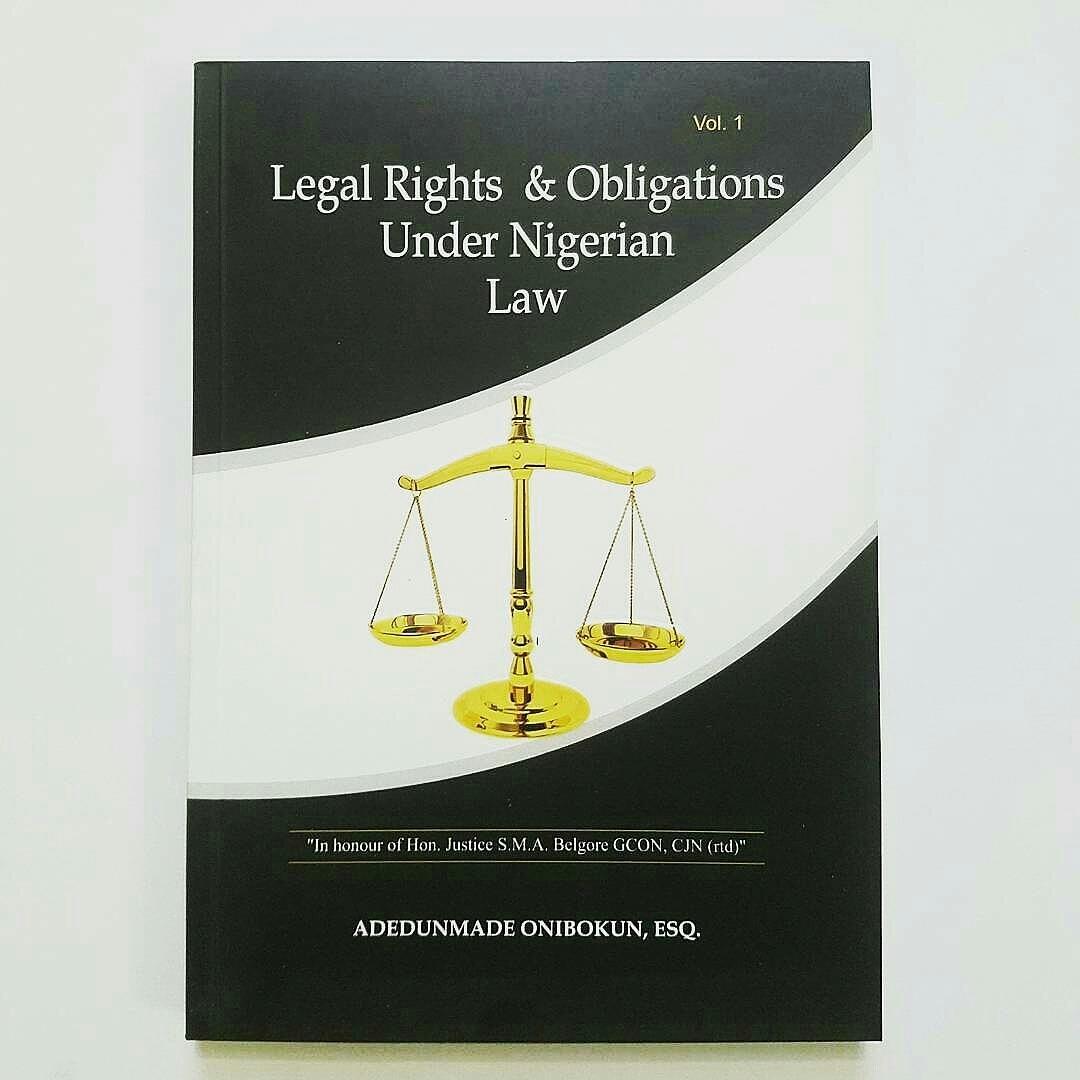
ORDER BOOK – Legal Rights and Obligations Under Nigerian Law

ORDER BOOK – Legal Rights and Obligations Under Nigerian Law

This Book is designed
to educate its reader on various provisions of Nigerian laws and how each
person may protect and enforce their legal rights and obligations. It is a
collection of rich legal topics on recondite varied areas of law such as;
Business Law, Government and Administrative Law,  Courts and Justice System, Criminal Law,
Corruption and Fraud, Electoral Law, Family Law, Law Enforcement Laws, Armed
Forces Law,  and Property Law.
The book is one of a
kind and will in no small way close the gap of legal literacy in Nigeria and
equip the citizenry with legal information and education.
To order your copy, contact Lawlexis on
08055424566
Price is N5000
(Five Thousand Naira). 

Please note that there is a One Thousand Naira charge for delivery anywhere within Lagos. 
Consumer Rights Protection And The Nigerian State | Ahmed Adetola-Kazeem

Consumer Rights Protection And The Nigerian State | Ahmed Adetola-Kazeem


Being the text of a paper delivered by Ahmed
Adetola-Kazeem, MCIArb (UK) at a
lecture organized by the Nigeria
Association of Muslim Law Students (NAMLAS) Olabisi Onabanjo University chapter
in honour of Hon. Justice M. O Abimbola, Chief Judge of Oyo State.
INTRODUCTION
The recent Judgment of Hon. Justice Adedayo
Oyebanji in suit no. LD/13/2008- Adebo Holdings Ltd
&Anor v. Nigerian Bottling CompanyPlc&Anor
has brought to
the fore Nigeria’s lackadaisical attitude towards the protection of consumers
just as it is in other facet of its national life.


The black’s law dictionary 9th edition
defines a consumer as a person who buys goods or services for personal, family
or household use, with no intention of resale; a natural person who uses
product for personal rather than business purposes. A consumer has been defined
by the Consumer Protection Council Act, CAP C25 Laws of the Federation, 2004 as
an individual who purchases, uses, maintains or disposes of products or
services.

ADEBO HOLDINGS LTD &ANOR V.
NIGERIAN BOTTLING COMPANYPLC&ANOR REVISITED

The court held in Adebo Holdings
Ltd & Anor v. Nigerian Bottling Company Plc & Anor
 that
high levels of benzoic acid and sunset additives in the coca-cola products
could pose a health risk to consumers when mixed with ascorbic acid, commonly
known as vitamin C.

Justice Adedayo Oyebanji ordered the
Nigerian Bottling Company (NBC) to place written warnings on Fanta and Sprite
bottles against drinking them with vitamin C, and awarded costs of two million
naira ($6,350) against the National Agency For Food and Drug Administration and
Control (NAFDAC) for failing to ensure health standards.

The court said “It is manifest that
NAFDAC has been grossly irresponsible in its regulatory duties to the consumers
of Fanta and Sprite manufactured by Nigeria Bottling Company, NAFDAC has failed
the citizens of this great nation by its certification as satisfactory for
human consumption products which become poisonous in the presence of ascorbic
acid.”

A background to what transpired leading to
the filing of the action against NBC and NAFDAC was given by Dr. Fijabi Adebo
in an interview granted to Punch Newspaper on the 26th of March 2017[1]. He said,

“When the Coca Cola European Union alleged
that the products our trading company, EFAD Limited brought into the UK were
fake and unsafe for human consumption which made the UK Customs and Excise to
act by destroying the products, we had to query the NAFDAC which plays
supervisory roles in safeguarding public health as an agency of the Federal
Government. We had to ask what it was doing when products unfit for human
consumption were being manufactured in the country. That was why we joined them
in the suit. In fact, our initial prayer was to stop the production of Fanta
with sunset yellow because it really alarmed us and according to the UK
findings, it could cause injury to children and others. Justice Taiwo in 2009
ruled that NAFDAC should go to the premises of NBC and make it reduce the
content of sunset yellow in Fanta. They obeyed the order and reduced the
content considerably. Before then, you would notice that whenever children
drank Fanta, their tongue would be yellowish. If they knew that it was not
injurious to consumers’ health, why did they reduce the sunset yellow? After
that, we got another ruling against NAFDAC compelling it to henceforth do
things right after being negligent by allowing manufacturers do things their
way. It was after we concluded those ones that we faced Coca Cola. Our lawyers
wrote them and they were so arrogant. They were not interested in our loss as a
customer who bought products from them. Their response to our lawyers was a
little less insulting. We then thought that if we had been so badly treated in
England on issue that was a fault of a manufacturer in Nigeria, I would not
come to my country and be so treated. I therefore swore to pursue the case
until justice was served.”

“My main aim was to save Nigerians. I later
got rulings compelling the NBC to reduce the sunset yellow in Fanta and make
NAFDAC responsible in discharging its responsibilities. I also got an order for
the continuous monitoring of the content of Coca Cola products. The rulings
were satisfying to me. At the time we got the rulings, one would have
expected them to act in a normal, serious and corporate manner. But all we got
was that we did not tell them we were taking the products to the UK. What law
says I should tell them where I was taking the products to? By law, I have a
right to export to anywhere in the world? Through the Nigerian company law, I
have a limited liability company and also a licensed company in the UK. I
brought a shipping company to their premises to load the drinks including
customs to check the products. What else do they want me to do?”
Lawyers for the NBC argued that the
products were not intended for export on the grounds that the UK standards
limit benzoic acid in soft drinks to a maximum of 150 mg/kg. Both Fanta and
Sprite have benzoic levels of 200 mg/kg which is lower than the Nigerian
regulatory limit of 250 mg/kg, but Justice Adedayo Oyebanji rejected this
defense.

The Honourable Judge said, “Soft
drinks manufactured by Nigeria Bottling Company ought to be fit for human
consumption irrespective of color or creed.”

NAFDAC and NBC have appealed the decision
of the Lagos High Court, it remains to be seen which side of the divide the
appellate court will tilt.

In view of the High Court Judgment in
Adebo’s case and other worrisome cases, how has Nigeria faired in protecting
its consumers from the claws of manufacturers, business men and service providers
whose main aim is to make profit at the expense of unsuspecting Nigerians?

It will be wrong to suggest that there are
no adequate laws that govern consumer protection in Nigeria. The problem is not
the non-availability of laws but ignorance of the laws by consumers and the
unwillingness of those in authority to implement the laws.  Nigeria’s
situation was best described by a former MD of Nestle Plc, when he said
“Nigeria is over-legislated but under-governed.

CONSTITUTIONAL RIGHTS OF CONSUMERS
Chapter IV of the Constitution of the
Federal Republic of Nigeria, 1999(as amended) contains the fundamental rights
of all citizens and persons in Nigeria. These are the rights to life; dignity
of human person; personal liberty; fair hearing; private and family life;
freedom of thought, conscience and religion; freedom of expression and the
press; peaceful assembly and association; freedom of movement; freedom from
discrimination; and the right to acquire and own immovable property anywhere in
Nigeria.

These rights can be said to have some
affinities with consumer protection. Some actually have direct bearing on
consumer Protection. For instance the right to fair hearingaddresses
the principle of access to justice which
is a cardinal principle of consumer protection. [2]Section 36(1) of the Constitution provides:

“In the determination of his civil
rights and obligations, including any question or determination by or against
any government or authority, a person shall be entitled to a fair hearing
within a reasonable time by a court or other tribunal established by law and
constituted in such manner as to secure its independence and impartiality.”

In addition, on the strength of the
Constitution, Any citizen whose rights has been violated under any law
including consumer protection laws can approach the court or any other
appropriate body for redress, under section 46. The Fundamental rights are so
important that failure to observe them in any case vitiates the proceedings. They
cannot be derogated from except to the extent allowed by law. Describing
the primacy of a fundamental right, Eso,J.S.C, In Ransome Kuti v.
Attorney General of the Federation
 (1985) 2 NWLR (Pt.6) 211
 said:

“It is a right which stands above
the ordinary laws of the land and which in fact is antecedent to the political
society itself. It is a primary condition to a civilized existence and what has
been done by our Constitution, since independence … is to have these rights
enshrined in the Constitution so that the rights could be “immutable” to the
extent of “non immutability.”
CONSUMER PROTECTION COUNCIL
The Consumer Protection Council is the body
saddled with the responsibility of the protection of the rights of consumers in
Nigeria. Other agencies saddled with the duties of consumer protection in
various specific sectors are:
1.     National
Drug Law Enforcement Agency (NDLEA)
2.     Nigeria
Electricity Regulation Commission(NERC)
3.     Nigerian
Communications Commission (NCC)
4.     National
Agency for Food and Drug Administration and Control (NAFDAC)
5.     Central
Bank of Nigeria (CBN)
6.     Nigeria
Deposit Insurance Corporation (NDIC)etc.
Whilst the agencies listed above
individually deals with specific sectors, the Consumer Protection Council has a
wider coverage and has the power to deal with any consumer complaints against
any manufacturer or service provider.
FUNCTIONS OF CONSUMER PROTECTION
COUNCIL
Some of the functions of the Council as
provided in section 2 of the Consumer Protection Council Act are as follows:
a)    Providing speedy
redress to consumers complaints through negotiation, mediation and
conciliation; 
b)    Seeking ways and
means of removing from the markets hazardous products and causing offenders to
replace such products with safer and more appropriate alternatives;
c)     Publishing
from time to time list of products whose consumption and sale have been banned,
withdrawn, severally restricted or not approved by the Federal Government;
d)    Causing an offending
company, firm, trade association or individual to protect, compensate, provide
relief and safeguards to injured consumers or communities from adverse effects
of technologies that are inherently harmful, injurious, violent or highly
hazardous;
e)    Organising and
undertaking campaigns and other forms of activities that will lead to increased
public consumer awareness;
f)      Encouraging
trade, industry and professional associations to develop and enforce in their
various fields, quality standards designed to safeguard the interest of
consumers;
g)    Issuing
guidelines to manufacturers, importers, dealers and wholesalers in relation to
their obligation under the CPC enabling law;
h)    Encouraging the
formation of voluntary consumer groups or associations for consumers’ well
being;
i)      Ensuring
that consumers’ interest receive due consideration at appropriate fora and
providing redress to obnoxious practices or the unscrupulous exploitation of
consumers by companies, firms, trade associations or individuals;
j)      Registering
and monitoring products, services and sales promotions in the market place.
Section 3 of the CPC act gives additional
powers to the Council to do the following:
(a) Apply to court to prevent the
circulation of any product which constitutes an imminent public hazard;
(b) Compel a manufacturer to certify that
all safety standards are met in their   products;
(c) Cause as it deems necessary, quality
tests to be conducted on a consumer product;
(d) Demand production of label showing date
and place of manufacture of a commodity as well as certification of compliance;
(e)Compel a manufacturer, dealer and
service company where appropriate, to give public notice of any health hazards
inherent in their products;
(f) Ban the sale, distribution,
advertisement of products which do not comply with safety or health regulation.

RIGHTS OF CONSUMERS
 The Consumer Protection Council
Website[3] lists some rights
which consumers are entitled to and must insist on as follows:
·        
The Right to Satisfaction of Basic Needs Access to
basic goods and services necessary for survival, such as food, water, energy,
clothung, shelter, health-care, education and sanitation. Goods and services
must meet the standard of quality promised such that there is value for money
in the purchase.
·        
The Right to Safety Protection from hazardous
products, production processes and services.
·        
The Right to Information Provision of
information enabling informed consumer choice as well as protection from
misleading or inaccurate advertising and labeling.
·        
The Right to Choose Access to variety of quality
products and services at competitive prices.
·        
The Right to Redress Compensation for
misrepresentation, shoddy goods and unsatisfactory public and private services,
including the right to adequate legal representation
·        
The Right to Consumer Education Acquisition
of the skills required to be an informed consumer throughout life
·        
The Right to Consumer Representation Advocacy of
consumers’ interest and the ability to take part in the formulation of economic
and other policies affecting consumers i.e. the right to be heard
·        
The Right to a Healthy Environment Habitation is
a place that is safe for present and future generations and which will enhance
the quality of their lives.

RECENT STRIDES OF THE CONSUMER
PROTECTION COUNCIL
It is interesting to note that the Council
has made giant strides towards the protection of consumers’ rights in Nigeria.
In 2015, the Council issued Volkswagen Nigeria a 7 days ultimatum to provide
information on the status of its vehicles as regards the emissions of cheating
software which is reported to have affected 11 million cars worldwide. The
Council went on a nationwide sensitization campaign to checkmate smuggled
poultry products in the Country. Upon numerous complaints of subscribers to Digital
Satellite Television (“DSTV“), in July 2015 the Council
commenced investigative sittings into the operations of Multichoice Nigeria,
the franchise owners of DSTV. [4] The
Council later announced that it had “substantiated” allegations of abuses of
consumer rights brought before the council against MultiChoice Nigeria, the
owner of DSTV. In August 2015, the Council waded into a complaint of Bauchi
State Goverment of excess bank charges by First City Monument Bank, the Council
upon conclusion of investigation ordered the bank to refund N1.543 Billion
Naira unlawful deductions. The Council also investigated the activities of
VIP Express Tourism Limited, a Nigerian hospitality company upon receipt of complaints
that the operations of the company is against the rights of their subscribers,
the company was ordered to refund N25 Million Naira to aggrieved consumers.

It is also interesting to note that the
Council has commenced independent investigation into safety of additives in
Nigerian Bottling Company’s Fanta and Sprite. The Director of CPC in a
recent statement said, “Indeed the judgment only serves as the subject of
bringing this information to CPC’s attention, the Council would conduct its own
independent investigation. The reason for CPC’s interest is not far-fetched.
For years, Fanta, Sprite and Coca Cola have arguably and consistently been the
most widely consumed beverages in Nigeria. The spectrum of consumption is also
perhaps the widest, with consumption starting as early as age four and far into
adult years.”

“In addition, Vitamin C is one of the most
consumed medications for both children and adults, both as a matter of
prescription/ over the counter and, or as dietary supplement. Essentially, both
the NBC products and Vitamin C are routinely consumed in Nigeria with
absolutely no restrictions to access and availability” she added.
FAILINGS OF THE CONSUMER PROTECTION
COUNCIL
In spite of these achievements, there is
still a lot of work to be done. The Nigerian market is flooded with substandard
products and products which are not registered with the Council. Many Nigerian
consumers are not aware of their  rights or how to enforce them. It is
difficult for the Council to suspend the business activities of big
multi-nationals such as DSTV or MTN in proven cases of abuse of consumer’s
rights. It is also difficult for the Council to enforce consumer rights against
Federal Government agencies which are mandated to provide essential services to
the citizenry.

RECOMMENDATION AND CONCLUSION
It is important for the Council to devise
creative means of ensuring that its orders are obeyed, particularly by
multinationals and government agencies. The Council’s taskforce should
intensify its efforts by carrying out regular monitoring of factories, markets
and shops to ensure that products sold to Nigerian consumers are not
substandard and are duly registered with the Council. The Nigerian Customs
service and other security agencies must ensure the security of our borders and
ports through which many substandard products enter the country.

More sensitization campaign should be
carried out in schools, churches, mosques, print media, electronic media and
social media to create awareness on the rights of consumers and how to get
redress when such rights are infringed upon. The Council must be attentive to
complaints against the products of foreign or local companies, big and small
enterprises, private establishments and government agencies if it is to
adequately achieve its statutory mandate.
[2] Ebun
Adegboruwa, “Challenges of Consumer Rights Protection in Nigeria”. A
paper delivererd at the NBA Conference 2015.
[3] http://www.cpc.gov.ng/index.php/consumers (accessed
on 23rd May 2017)
[4] Nigeria:
An Appraisal Of The Role Of The Consumer Protection Council In Protecting
Consumers’ Rights In Nigeria
http://www.mondaq.com/Nigeria/x/459154/Consumer+Law/An+Appraisal+Of+The+Role+Of+The+Consumer+Protection+Council+In+Protecting+Consumers+Rights+In+Nigeria (accessed
on 23rd May 2017)

Ahmed Adetola-Kazeem
AHMED ADETOLA-KAZEEM,
MCIArb(UK) is a counsel at Gani Adetola-Kaseem (SAN) LP and ExecutiveDirector
of Prisoners’ Rights Advocacy Initiative (PRAI).
.
Ed’s Note – Article was first published here
Northern Groups October 1 Deadline to Igbos; A Constitutional Breach | Adedunmade Onibokun

Northern Groups October 1 Deadline to Igbos; A Constitutional Breach | Adedunmade Onibokun


According to news
reports
, on Tuesday, the 6th of June, 2017, 16, Northern groups including
the Arewa Citizens Action for Change, Arewa Youth Consultative Forum, Arewa
Youth Development Foundation, Arewa Students Forum and Northern Emancipation
Network on the Igbo Persistence for Secession, among others directed all Igbos
residing in their States to vacate the northern region before the 1st
of October, 2017.


This comes closely behind
the Indigenous People of Biafra (IPOB) and the Movement for the Sovereign State
of Biafra (MASSOB)’s May 30 shut down of commercial and social activities in
major towns in the East over Biafra agitations. The deadline which is worrisome
and could lead to a volcanic rise in ethnic tensions or probably another civil
war is condemnable in the highest words and not in the spirit of national unity
or have we as a country crossed the rubicon 
and now heading towards self- implosion?  

The Constitutional and
fundamental rights of every Nigerian with an Igbo descent is now on the line and
the a subsequent breach of same will likely result to violence, senseless loss
of lives and regional tensions as seen during the Nigerian civil war.   According
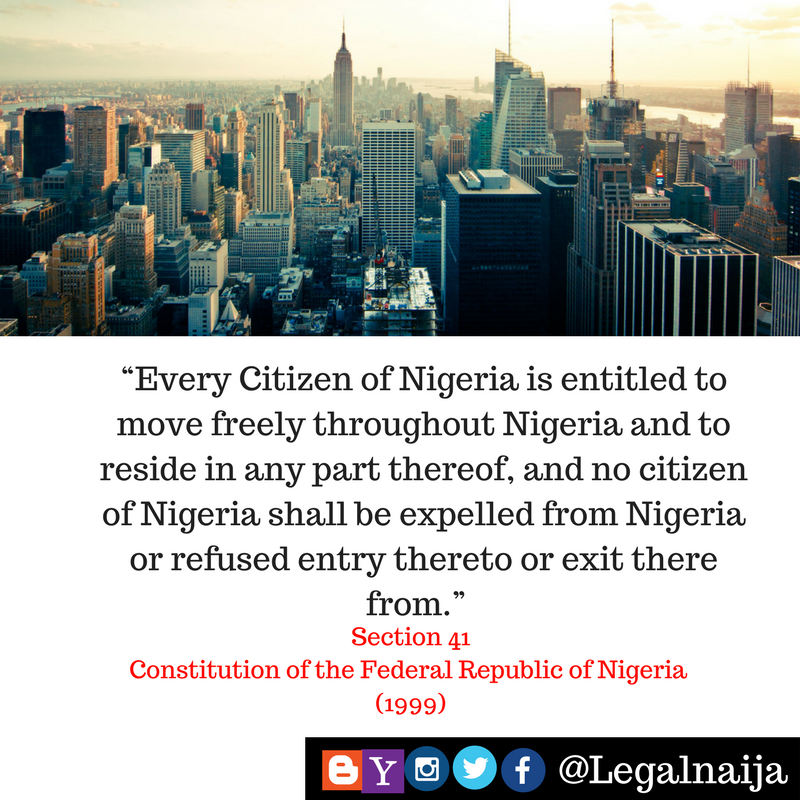
to Nigerian Constitution, Section 41 guarantees the right of every Nigerian to
freedom of movement. It provides in subsection 1 that-
“Every
Citizen of Nigeria is entitled to move freely throughout Nigeria and to reside
in any part thereof, and no citizen of Nigeria shall be expelled from Nigeria
or refused entry thereto or exit there from.”  
Section 43, further
provides for the right to acquire and own immovable property anywhere in Nigeria.
For ease of reference, it provides that;
“Subject
to the provisions of this Constitution, every citizen of Nigeria shall have the
right to acquire and own immovable property anywhere in Nigeria”.
The above provisions of
the Nigerian Constitution clearly shows that the deadline given to Igbos is a
clear breach of our constitutional provisions and thus should be met the full
force of the law and expertise of national security agencies to prevent the
grave mishap that looms in our front yard. The only legal exceptions provided
for the above constitutional provisions is also clearly outlined in Section 45
of the said Constitution which provides that only laws passed in a democratic
society and in the interest of defence, public safely, public order public morality
or public health; or for the purpose of protecting the rights and freedom of
other persons. Can the deadline be described as a law in line with the
provisions of Section 45, the answer is No.

Moreover, the said
deadline is seditious in itself and a breach of Section 51 of the Criminal Code
Act. Sedition has been defined by the Criminal Code in Section 50(2) to mean; any
act that excites the citizens or other inhabitants of Nigeria to attempt to
procure the alteration, otherwise than by lawful means, of any other matter in
Nigeria as by law established; or  to
raise discontent or disaffection amongst the citizens or other inhabitants of
Nigeria; or to promote feelings of ill-will and hostility between different
classes of the population of Nigeria. Could the deadline given by these
Northern groups be said to fall in line with the definition of a seditious act
under the criminal code, the answer is Yes. What the n is the penalty?

Section 51 of the Criminal
Code provides that;
“any
person who-
(a)
does or attempts to do, or makes any preparation to do, or conspires with any
person to do, any act with a seditious intention;
(b)
utters any seditious words;
(c)
prints, publishes, sells, offers for sale, distributes or reproduces any
seditious publication;  
(d)
imports any seditious publication, unless he has no reason to believe that it
is seditious;
 shall be guilty of an offence and liable on
conviction for a first offence to imprisonment for two years”.
The Penal Code also recognizes
the offence of sedition where it provides in Section 417 that “Whoever, seeks
to excite hatred or contempt against any class of persons in such a way as to
endanger the public peace, shall be punished with imprisonment for a term which
may extend to three years or with fine or with both”.

Clearly the deadline given
by the Northern groups to Igbo-Nigerians is a clear seditious, constitutional
and fundamental breach of Nigerian laws which clearly should attract prosecution.

Dunmade
Onibokun Esq.
Adedunmade
Onibokun & Co.

How to register a patent in Nigeria | Adedunmade Onibokun

How to register a patent in Nigeria | Adedunmade Onibokun


A Patent is an official
right to be the only person to make, use or sell a product or an invention. The
essence of a patent is to protect inventors by ensuring they get due
recognition and compensation for their efforts in inventing. A patent usually
covers new and ground breaking inventions which could be in any industry and
not necessarily in the sciences alone.


A patent confers upon the
patentee the right to preclude any other person from doing any of the following
acts-

 a)     where
the patent has been granted in respect of a product, the act of making,
importing, selling or using the product, or stocking it for the purpose of sale
or use; and
b)
     where the patent has been granted in
respect of a process, the act of applying the process or doing, in respect of a
product obtained directly by means of the process, any other acts mentioned
above.

That’s why various
governments have made it a point of duty to support and protect the rights of
inventors through patents. In Nigeria, a patent is registerable at the Ministry
of Trade and Investment located in Abuja.

The application for patent
registration begins with a search to ascertain whether such innovation or
invention had been created by another person in the past. This is then followed
by an application for registration. The Applicant must include other vital
information such as; the applicant’s full name and address; a specification,
including a claim or claims in duplicate; plans and drawings, if any, in
duplicate; where appropriate, a declaration signed by the true inventor
requesting that he be mentioned as such in the patent and giving his name and
address; a signed power of attorney or authorization of agent if the
application is made by an agent; an address for service in Nigeria if the
applicant’s address is outside Nigeria; and The prescribed fee.

It is important to note
that a patent shall stay valid for 20 years, after which other manufacturers
may have access to the creation or be legally able to create another version in
itself.  An inventor who has registered a
patent in another country can also re-register the patent in Nigeria. Such
inventor will be requested to append to his application a written declaration
showing the date and number of the earlier application, the country in which
the earlier application was made, and the name of the applicant who made the
earlier application. The applicant will be expected to furnish the Registrar,
not more than three months after the making of the application in the initial country
with a copy of the earlier application certified correct by the Industrial
Property Office (or its equivalent) in the country where the earlier
application was made.

A patent shall also lapse
if the prescribed annual fees are not duly paid in respect of it, provided that
a grace period of six (6) months shall be allowed for the payment of the fees;
and if the fees and the prescribed surcharge are paid within that period, the
patent shall continue as if the fees had been duly paid.

Many inventors have not
had the benefit of registering their inventions. This may result in a loss of
ownership by these inventors or a situation where the invention is registered
by someone else who is not the rightful creator of that invention.

If you have any enquires about
registering a patent or trademark in Nigeria. You may contact the undersigned
via
info@adedunmadeonibokun.com
or via
www.adedunmadeonibokun.com

Adedunmade Onibokun & Co.
Solicitors & Advocates

+2348055424566 

Photo Credit – www.insidecounsel.com