
Can A Director Be Sued Personally for an Alleged libelous letter written by Him? |Rosemond Phil-Othihiwa

Can A Director Be Sued Personally for an Alleged libelous letter written by Him? |Rosemond Phil-Othihiwa


It is worthy of note that upon
incorporation a company assumes a separate legal entity different from the
promoters, shareholders, directors, secretaries, auditors and other members of
the company. Section 37 CAMA. This provision enacts the
fundamental principle of corporate personality. This concept was laid down
under the common law in the celebrated case of Salomon Vs Salomon and
Co Ltd
(1897) AC 22 where the House of Lords per Lord McNaughten
stated the position as follows;


“I cannot understand how a body corporate
such as this made capable by statute can lose individuality by issuing the bulk
of its capital to one person, whether he be a subscriber to the memorandum or
not. The Company is at law a different person altogether from the subscriber…
Nor are the members (subscribers) liable…”
The meaning of directors is defined under section
244(1) of the Companies and Allied Matters Act, Cap C20, LFN 2004 
as
persons duly appointed by the company to direct and manage the business of the
company.
However, it is merely an artificial person.
Therefore it can only act under the instrumentality of human beings, operating
as its agents, either as members in a general meeting, directors or officers.
The law generally will attribute the conducts of such individuals to the
company and this is the basis of the company’s liability in tort, contract and
even crime.
In Bolton (Engineering) Co. Ltd
v. Graham & Sons (1957) 1 Q. B 159, 
Lord Denning stated that:
“A company may in many ways be
likened to a human body. It has a brain and nerve centre which controls what it
does. It also had hands which hold the tools and act in accordance with
directions from the centre. Some of the people in the company are mere servants
and agents who are nothing more than hands to do the work and cannot be said to
represent the mind or will. Others are directors and managers who represent the
directing mind and will of the company, and control what it does…”
This ratio is on all fours with the
decision earlier considered in Lee v Lee Air Farming Ltd (1960)
3 ALL E.R 420
  where the court held that Lee is a mere agent of
the Company. In Okolo v Union Bank of Nigeria , 2004) 3 NWLR (PT 859)SC
87 
, the Supreme court held that a director of the company is in the
eye of the law and agent of the company, such that when a Director enters into
a contract for a company, the principal which is liable on it not the
directors. However, a person will be personally liable for a Contract made in his
own name without disclosing either the name of or the existence of a principal
to the other Contracting party even though he may in fact be acting on a
principal’s behalf. Directors and officers are nevertheless the agents of the
company and, under the principles of agency law, are jointly and severally
liable with a company for torts committed.
There is no legal reason therefore why a
claimant should not sue the directors if they also have assets (which may
include a Directors and Officers insurance policy). However, in the light of
the House of Lords’ decision in Williams v Natural Life Foods
Limited 
[1998]2 All ER 577
 a director is only likely to be
found liable if there has been a voluntary assumption of responsibility towards
a third party. It is only in exceptional circumstances that directors can face
personal liability to third parties, such as in the case of fraud and the well-known
doctrine of ‘lifting the veil.’ In the House of Lords case of Standard
Chartered
 Bank v Pakistan National Shipping Corporation (No
2)
 [2002] 1 All ER 173
 a director knowingly and deliberately
made a false statement in order to obtain payment on a letter of credit. The
House of Lords held that a director cannot escape liability for deceit on the
ground that he acted on behalf of and for the benefit of the company. case of Nathaniel
Adeniji v State
 (1992) 4 NWLR (PT 248) 1 the court held
that any business which appears to have been handled recklessly or with intent
to defraud, the court may declare that any person who were knowingly parties to
the carrying on of the business in the manner aforesaid shall be personally
liable for all or any of the debts or other liabilities of the Company. It is
submitted that the work of the Court have been made easier by Section 506(1) of
the CAMA which provides that if in the course of winding up of a company, the
act has been carried on in a reckless manner or with intent to defraud, the
creditors of the Company or creditors of any person for any other purpose, the
receiver or liquidator or contributory of the company may, if it thinks proper
to do so, declare that any person who were knowingly parties to the aforesaid
be made personally liable.

The court went further in Yesufu v
Kupper International N.V53
 (1996) 5 NWLR (PT 248) 1 that
where a director is in the eyes of the law, an agent of the Company, for which
he acts, the general principle of agency will apply. The Supreme Court held
that where a director enters into a contract in the name of or purporting to
bind the company, it is the Company, the principal, which is liable on it, not
the director. The director is not personally liable unless it appears that he
undertook personal liability. For instance, a Company’s director cannot be held
liable for the loan granted to the Company in good faith.
The fact that a corporation is liable for a
tortuous act is not necessarily a bar to concurrent liability of the company’s
directors or officers. However, for a claim to proceed against a director or
officer, the claim will have to include allegations of their personal tortuous
conduct.
Recent case law suggests that the
specificity of the pleading is the most crucial factor in determining whether a
claim can be made out against a director or officer.
In the case of MR. EMMANUEL
AGBANELO V. UNION BANK OF NIGERIA LTD (2000)4iLAW/SC.20/1997 
This
action was brought by the plaintiff/appellant, against the defendant/respondent
in the Warri High Court, claiming general and special damages for dishonoured
cheque and damages for libel. The salient aspects of the facts which resulted
in plaintiff bringing this action are not really in dispute. Plaintiff, a
businessman, and a sole distributor of a biscuit manufacturing Company (i.e.
Temitope Bakeries and Catering Services Ltd.) was a Customer of the defendant
bank. Defendant bank was at all times material to the facts of this case,
carrying on the business of banking. They had branches at No.8 Warri/Sapele
Road. Warri, where plaintiff opened and operated a current account in his trade
name of EPACO (Nigeria) Marketing Company. Plaintiff applied to the defendant
sometime in April, 1986 for the issuance of a Bank Draft in favour of the
Biscuit Manufacturing Company, payable at the defendants branch in Surulere.
The defendant bank in compliance with plaintiff’s instructions issued the bank
draft to Temitope Bakeries and Catering Services Ltd. Upon presentation by
Temitope Bakeries and Catering Services Ltd. for payment, the bank draft was
returned to the Company with the endorsement “1st signature irregular.”
The defendant bank did not honour payment of the draft. Plaintiff thereupon has
brought this action claiming damages that the words endorsed on the draft were
defamatory of him and that the draft was negligently issued by the defendant.
In the High Court, the trial judge dismissed the claims in their entirety
because, he held the claim for libel and for negligence were not proved.
It is important to observe that the Learned
trial judge did not give reasons for dismissing the claim for libel. With
respect to the claim for negligence his reasoning was concisely that-
The defendant was the Union
Bank of Nigeria Limited, (Warri Branch)and not Warri Bank Nigeria Limited
(Surulere Branch) nor the Union Bank Nigeria Limited
.”
The matter went to the supreme court the
court held… “and here is no doubt that on the basis of this theory, so in the
instant case. The act of a branch is the act of the company. Hence the act of
the employee of the company, done in the course of his employment renders the
company vicariously liable irrespective of the branch from which the action
emanated. The error of the Learned trial Judge and the Court below arose from
the reasoning that the branch of the Defendant Bank was different and a
separate entity from the parent body. This is a fu0ndamental error which
permeated the entire reasoning and faulted it.” The court further stated, In
establishing liability in an action for defamation, it is the established
principle of law that the question whether a statement is defamatory or not is
to consider what the meaning of the words would convey to the ordinary person.Okolo
v. Mid-West News paper Corporarion. (1977)NSCC 11 and Dumbo v. Idugboe (1983) 1
SCNLR 29.
With the above case law the correct
position where a director writes an allegedly defamatory content on behalf of
his company ,the libeled party’s right of action will lie against the company
,owing to the fact that that they are not personally liable since their act is
the corporate act. This is because of the concept of a corporate act, not
because of limited liability which applies to shareholders, not directors.
Their act is the act of the corporation.

Associate Counsel at
OLATUNDE ADEJUYIGBE & CO. SAN


Ed’s Note – This article was first published here.
Photo Credit –  tab.ie

Emotional Wellbeing Of An Accused Person |Tunrayo Mutairu

Emotional Wellbeing Of An Accused Person |Tunrayo Mutairu

I watched an episode of a
legal series on TV called “the good wife”. On this particular episode, an
accused person is charged with the offence of murder and was looking at a life
imprisonment sentence. He had the option of taking a plea deal of 8 years but
refused because he affirmed he was innocent and was willing to take his chances
with the jury. While the matter was ongoing in court, counsel on the
prosecution and defense side were conferring with the judge on whether a
witness should be allowed to testify in the matter. In the usual rapport of
lawyers and judges, they argued and eventually turned this into a joke and were
seen laughing heartily while the accused person looked on, confused as to what
could be really funny while his life hangs in the balance. 


He looked at the
jury and members of the gallery with tears in his eyes, no one looked at him
more than a criminal charged for killing a person. I guess it was at this point
he decided there was no way the case was going to go his way. He looked around
and saw the gun of the officer in court exposed. He managed to get it and ended
up shooting a number of people in the court room, his lawyer and tried killing
himself but he was out of bullet. Suffice to say this is a sad outcome but not
totally shocking given the psychological state of mind of an accused person
especially an innocent one.
My job as a first-year
state counsel at the department of public prosecution exposes me to a lot of
criminal prosecution. I get to see accused robbers, murderers, child-molesters
and the likes of them in the prosecution of offenders in pursuit of the
administration of criminal justice. I observe that the usual countenance of the
officers of the state, the police, the warders that keep these accused persons
in custody is usually one of guilt and indifference; and this is before they
have been convicted by the court.
I have observed lawyers in
court converse with their colleagues, Judges, Investigating Police Officers
(IPO), families of the accused person in a way that is very indifferent to the
course of the accused while the latter looks on sadly often times physically
and emotionally drained from his place at the dock. For some reasons, his
lawyer after arguing sternly about the unfairness of not responding to an application
by the opposing party leading to a further delay in his incarceration and
count-down to his acquittal still manages to share a hearty laugh with his
colleague just shortly after been upset. I would often look at the dock to see
how they feel. Does this person feel like his lawyer or the judge doesn’t care
enough for his situation to find humour in his very saddening situation?
I know that as lawyers we
are taught in school and in the course of early practice to learn to distance
our personal feelings from our jobs. I think however that we need to do more.
We need to care more. A person living in a deplorable state in incarceration
while his life hangs in the balance doesn’t understand that you do this every
day and it is usual to see criminals now and then hence your immunity. If we
are to even consider a state where opposing party doesn’t care whether an
accused person is innocent or guilty I think it is the duty of his own lawyer
to do more. It is absolutely unfair and cruel to laugh at silly things in court
while your client is unsure of his future survival.
The job of a lawyer is not
only to ensure exoneration of his client, he also owes him a duty of care; a
humane feeling towards his plight when the latter is going through the process.
This I believe will to a large extent reduce depression and suicidal thoughts
from the state of mind of an accused person.


Ed’s Note – This article
was originally posted here

Photo Credit – websitetemplate.info 
Resolving Artist-Record Label Disputes: Why Arbitration Is Quite Desirable | Adejorin D. Abiona

Resolving Artist-Record Label Disputes: Why Arbitration Is Quite Desirable | Adejorin D. Abiona

The entertainment
industry encompasses diverse relationships. With the adoption of ever-changing
developing technology, novel problems are emerging which require creative
solutions. For example, the abundance of contractual relationships creates the
likelihood of disputes. This article will look into the contracts between
record labels and artists with a focus on the peculiarities in the relationship
with creatives that has made arbitration desirable for dispute resolution.

In the
entertainment industry, timeliness of decisions and transactions, limited
resources for protracted litigation, and the need to secure relationships are
key considerations. Disputing parties are increasingly intolerant of the cost,
delays and risks of litigation, paucity of jurisprudence and industry expertise
of judges, possibility of appeal, loss of privacy and confidentiality, and the
emotional toll which characterize litigation as a method of resolving disputes[1]. Thus, Arbitration is gradually
gaining ground as a better option for parties to employ in resolving their
disputes.
WHAT IS ARBITRATION?
Arbitration is an
Alternative Dispute Resolution mechanism where parties appoint independent
arbitrator(s) to resolve their disputes by granting an award which is legally
binding on the parties and final. The parties may in their contract commit to
arbitration in the event of a future dispute by inserting an arbitration clause
in the contract.
A typical example
of an arbitration clause is modeled in this manner:
In the event of any dispute or difference arising between the parties
to this agreement from or in connection with this agreement or its performance,
construction or interpretation, such dispute shall be referred to arbitration
by a single arbitrator in accordance with the provisions of the Arbitration and
Conciliation Act CAP 18 Laws of the Federation of Nigeria 2004 or any
amendments thereto, whose decision in relation to any such dispute or
difference shall be final and binding on all parties hereto.”
[2]
DISPUTES ARISING
FROM ARTIST-RECORD LABEL CONTRACTS
There are many
sources of disputes in artist-label relationships. Many disputes arise out of
artist complaints focusing on several concerns, including inequitable recording
contracts, poor royalty schemes, injurious accounting policies and
content-ownership issues.[3]
Some other
disputes arise from the breach of the contract by an act or omission of any of
the parties. Also, there might be some form of ambiguity in the terms of the
contract which might give rise to dispute between the parties and thus, such
terms should be properly interpreted.
Another area of
the artist-label relationship in which disputes arise frequently is
infringement and ownership issues after the determination of the artist -record
label contract.
THE NEED TO INSERT AN ARBITRATION
CLAUSE IN AN ARTIST-RECORD LABEL CONTRACT
The artist-record
label contractual relationship in entertainment industry is a very peculiar one
with characteristics which has made arbitration very desirable as a method of
resolving disputes arising from this relationship. The need to always insert an
arbitration clause in the artist-record label contract cannot be
over-emphasized as disputes must always be envisaged while drafting a contract
and the means to resolve such when it arises must be properly provided for.
WHY IS ARBITRATION DESIRABLE?
Due to the nature
of the Artist–Record label contracts, arbitration is well suited as the method
for resolving disputes arising thereof for the following reasons:
Expense/cost
The financial
implication of every action is always very important in business. The
Record labels and the artists are in the music industry for business and as
such, should naturally go for a less expensive but effective option of
resolving disputes when they arise. It is also common for an artist or even a
record label to lack the financial strength needed to carry through with a lengthy
lawsuit.
Arbitration costs
generally are significantly low and predictable if compared with that of
litigation. Trial-related matters which consume time and money such as
extensive evidentiary issues, proposed findings of fact, endless authentication
of documents, qualification of experts, cumulative witnesses are more limited
in arbitration than in litigation. Hence, Attorneys’ fees and other expenses
are minimized in arbitration.
Technical
expertise
Entertainment
matters often involve complex legal issues and technical industry concepts,
which may be difficult for a Judge to understand. Arbitration provides the
parties with the option to select ADR professionals with substantial experience
in entertainment and intellectual property matters.
By selecting
neutrals with unique practice area-specific experience, the parties can save
time by not having to educate Judges and jurors with little to no knowledge of
the industry and the law[4].
Confidentiality
and Public Perception
Publicity of
ongoing disputes between labels and artists may contribute negatively to the
public’s perception of the music industry. The consumers may have less respect
for record companies or the artists.
Confidentiality
is usually maintained during arbitration proceedings and the award is always
being delivered only to the parties, counsel and any applicable organization.
Arbitration guarantees the privacy of the disputes which in turn prevents any
form of negative publicity that may be generated if such were publicized.
Preserving
the Relationship
Since so many of
the disputes between artist and their record labels arise during the actual
contractual relationship, it is important to have an effective means of
resolving those disputes, while still maintaining a good relationship[5].
Properly
conducted arbitration provides a means to work out any issue while still
permitting the parties to preserve, build or re-establish good working and
personal relationship.
Time
In the music
industry, there are always deadlines and public expectations to meet. Hence,
time is always of essence and also very critical. Whenever a dispute arises
from the contractual relationship between an artist and a record label, a less
time consuming method of resolution should be employed as time is always very
crucial.
Arbitration
offers a quick process of resolving disputes. Several reasons explain the
saving of time associated with arbitration: it is always governed by few and
less stringent rules of evidence; the parties have greater control over the
speed and length of the proceedings; it is less susceptible to multiple
proceedings; and an arbitral award is generally not subject to subsequent
judicial review. In a nutshell, Arbitration provides a fast method of obtaining
a final and binding resolution of a dispute.
CONCLUSION
It is worthy of
note that arbitration’s objective is to provide a fair, faster, lower-cost,
party-structured method for the full and final disposition of disputes by a commercially
experienced neutral person, in a private and more relaxed atmosphere, with
confidentiality of the process and the award, which may preserve or enhance the
parties’ relationship despite the dispute[6].
Hence,
Arbitration preserves the artist-label good working relationship, improves the
music business and subsequently, the quality of music produced. This is
beneficial for record labels, artists as well as the consuming public and as
such, arbitration is well-suited to resolve artist-label disputes and
therefore, quite desirable.
REFERENCES
2 Sander H.
Gibson C.ARB, MCI ARB (2015): Advantages and Disadvantages of
Commercial Arbitration: Arbitration In The Canadian Film & Tv Industry
retrieved
from http//www.sanderhgibson.com/englishsite/arbitrator assessed on 29th June,
2017.
3 Bello Adesina
Temitayo (2014): Why Arbitration Triumphs Litigation: Pros Of Arbitration;
Singaporean Journal Of Business Economics, And Management Studies Vol.3, No.2,
2014
[3] Kaleena Scamman (2008):
ADR In The Music Industry: Tailoring Dispute Resolution To The Different Stages
Of The Artist-Label Relationship; Cardozo Journal of Conflict Resolution, 10
(fall) 269-304 retrieved from http://cardozojcr.com/vol10no1 assessed on 29th June,
2017
[4] Jeffrey Grubman (2013):
Taking advantage of ADR in the entertainment industry: IP cases in the
entertainment industry are great candidates for mediation and arbitration;
INSIDECOUNSEL.COM: Business Insights For Law Department Leaders (April 16,
2013)
[5] Kaleena Scamman (2008):
ADR In The Music Industry: Tailoring Dispute Resolution To The Different Stages
Of The Artist-Label Relationship; Cardozo Journal of Conflict Resolution, 10
(fall) 269-304 retrieved from http://cardozojcr.com/vol10no1 assessed on 29th June,
2017
[6] Sander H. Gibson C.ARB,
MCI ARB (2015): Advantages and Disadvantages of Commercial Arbitration:
Arbitration In The Canadian Film & Tv Industry
retrieved from http//www.sanderhgibson.com/englishsite/arbitrator assessed
on 29th June, 2017

Adejorin D. Abiona

Associate Attorney |
Writer | Public Speaker 


Ed’s Note – This article was first published here


Photo Credit – www.musiclawupdates.com  
Senator Ashafa Decries Jungle Justice While Commending Ikorodu Residents For Resisting Badoo Cult Group

Senator Ashafa Decries Jungle Justice While Commending Ikorodu Residents For Resisting Badoo Cult Group

The Senator representing Lagos East in the
Senate, Senator Gbenga Ashafa has through a press statement he released via his
social media feeds decried the rising incidents of jungle justice in the
Ikorodu area of Lagos East Senatorial District.

News of reported incidents of lynching and
in some cases outright killing of suspected members of the Badoo Cult group,
terrorizing the community hit the airwaves in the past few days. With some of
the victims identified as innocent law abiding members of the society.
In the statement, Senator Gbenga Ashafa
commended the people of Ikorodu for saying no to the existence of the group
within their community. In his words, “I must I commend the resilience of the
Ikorodu people who have unequivocally said NO to the presence of such a
nefarious group within the Ikorodu community. Also, I commend the efforts of
the Government of Lagos State ably led by Governor Akinwunmi Ambode, in
conjunction with Commissioner of Police, Lagos State, various vigilante groups
including the Oodua Peoples Congress and the Onyabo who have mobilized with the
police to flush out, neutralize and prosecute as many of such criminals as
exist within the Ikorodu environment.”
Ashafa however condemned the incidents of
jungle justice, stating that, “Unfortunately, I have also received the news
that in the process of resisting the members of the Badoo Cult group, the
residents of Ikorodu have taken the laws into their hands and resorted to
jungle justice. In some instances as reported, people have been arrested and
lynched to the extent of being burnt to death. This is absolutely unacceptable;
it is against the tenets of humanity and justce.”
He concluded by urging the people of
tIkorodu and its environs to remain law abiding wile staying vigilant and alert
in the face of rising insecurity, stating that “As the people of Lagos East, we
must continue to be civil and law abiding in all we do. While our disposition
in the face of rising insecurity must be that of vigilance and alertness, I
strongly believe that we must channel all our suspicions through the
appropriate channels for arrest, rather than taking the laws into our hands.”
“Lagos East boasts of the most noble,
enlightened, industrious, intellectually advanced and law abiding people. We
cannot in 2017 allow ourselves to be returned to the primitive days of jungle
justice because most often than not mob actions result in wrongful punishment
for innocent citizens like you and I.

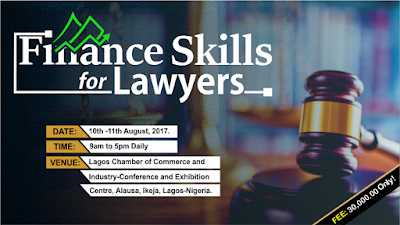
TRAINING – Finance Skills For Lawyers via @oaco_accounting

TRAINING – Finance Skills For Lawyers via @oaco_accounting


Lawyers play a very important role in the
financial world, but often have little or no knowledge in finance. This
training aims to fulfill this knowledge gap by providing people with legal
background with adequate knowledge to further understand the financial decision
making of their clients and foster an effective communication with integrated
team of lawyers, accountants and investment advisers.

KEY BENEFITS:
By attending this program, you will
·        
Understand
the key concept in finance and investment.
·        
Able
to scale up by add more value to your client when negotiating with the other
party, as you will be able to estimate the financial implication of specific
changes in the deal.
·        
Be
able to ask the right questions from your client, and from other financial
advisors – accountant and investment advisors etc…
·        
Improve
your understanding of current financial market development and trends.
COURSE OUTLINE
Financial Basics
·        
Financial
Accounts
·        
Balance
Sheet, classification and ratios
·        
Profit
and loss Account, classification and ratios
·        
Statement
of Cash Flow
·        
Working
Capital
Understanding Cash flow
·        
Introduction
to cash flow
·        
Computation
of ratios
Valuation and Cost of Capital
·        
Introduction
to valuation methods
·        
Discounted
Cash Flow valuation
·        
Cost
of Capital
Time Value of Money
·        
Time
value of money and implication in the corporate world
·        
Discounting
and Compounding
·        
Annuities
TRAINING
INFORMATION
DATE: 10th -11th August,
2017.
TIME: 9am to 5pm Daily
DURATION:  2 Days
VENUE:  Lagos Chamber of
Commerce and Industry-Conference and Exhibition Centre, Alausa, Ikeja,
Lagos-Nigeria.
FEE:    30,000.00
Only!
NOTE:   Registration
closes July 30, 2017. Registration before July 13, 2017 attracts 10% discount.
REGISTRATION
PROCESS:
·        
Make Payment or Transfer into OACO PROFESSIONAL
SERVICES: ZENITH BankAccount Number: 1012953067
·        
Complete the registration form below.
·        
Acknowledgement email would be sent to your email
address as confirmation of registration
To Register, Click Here

Contact OACO Porfessional Services Via info@oacoprofessionals.com or +234
908 621 1184 or Via Twitter @ OACO_Accounting
or Rear Suite, 14 Samuel Awoniyi
Street, Off Salvation Road, Opebi, Ikeja, Lagos.
How to prove that the termination of your employment was wrongful |Michael Dugeri

How to prove that the termination of your employment was wrongful |Michael Dugeri

When is termination/dismissal said to be wrongful? 
You may sue and demand to enforce your rights if your employment
contract is wrongfully terminated. Wrongful termination is when any of the
following occurs:
      
i.       
Your former
employer did not follow the terms of the contract in terminating it or
dismissing you. For instance, if the contract specified that either party can
only terminate by giving the other 30 days’ notice or one month’s salary in
lieu of notice, it would be wrongful to terminate the contract forthwith and
not pay you anything in lieu. Also, if your employment contract provides for a
disciplinary procedure to be followed before you can be dismissed (say for
gross misconduct) and the procedure was not followed or your act/omission was
wrongly categorized, your dismissal would be wrongful.

   
ii.                       
Your appointment
was terminated ‘in accordance’ with the terms of contract but the reason for
the termination is unlawful or unjustifiable. For instance, where termination
is based on discrimination or sexual harassment, it will qualify as wrongful
termination. It does not matter that your employer (like most companies in
Nigeria) does not have a policy against workplace discrimination or sexual
harassment. These are matters of law and public policy that are implied into
every employment contract.
 iii.                       
You actually did
resign ‘voluntarily’ but under conditions that left you with no other choice.
For instance, your former employer frustrated you and deliberately made it
practically impossible for you to continue with the job. The technical term for
this is “constructive dismissal”, and it also qualifies as wrongful
termination. 
 iv.                       
Your position
had been rendered redundant but your former employer played smart and clothed
it as simple termination (like merely said your ‘services no longer required’)
in order to save itself the cost of paying you redundancy or other
benefits.     
While it is true that no employer should feel compelled to retain an
employee whose services are no longer required or who is no longer fit to remain
in the job, if your appointment must be terminated, it should be with the
dignity and respect deserving of your person as an employee, and all your
entitlements fully paid.
When to sue
If you are aggrieved about the manner that your appointment has been
terminated, you need to move fast in getting a redress. Sue as soon as it is
reasonably clear to you that your grievance cannot be amicably resolved. By
law, you must sue within 6 years of the termination otherwise your claim will
become stale and unenforceable. The courts are strict with this timeframe and
would hardly entertain any excuse for delay in suing; not even where the delay
was because you were trying to settle amicably with your former employer.
If you were working in the civil or public service, the need to act fast
is even more urgent. This is because the timeframe allowed to sue public
officers/offices is just 3 months! Although, there are legal arguments (and
authorities) that this principle does not apply to breaches of contract, or
claims for work and labour done, why delay and get your case entangled in any such
legal haggles!     
Where to sue
The National Industrial Court is your go-to court for labour disputes. The
court only handles labour disputes hence the Judges are more able to quickly
settle the cases before them. Let me quickly add that you should always first
consider settling your case amicably (out of court) before suing. At any rate, Alternative
Dispute Resolution (ADR) options are preferred to litigation in the resolution
of disputes such as employment disputes. ADR options include arbitration,
mediation, conciliation, etc. These options better protect confidences, they
are cheaper (well, arguably) and faster too.
What facts to establish
It is not enough
to say your employment is wrongly terminated. You have to explain how you came
about that conclusion. It is helpful if you tell your story in a logical and
compelling manner. You will therefore want to capture the following facts:
i.                  
That you were employed
by the defendant (your former employer) – state date and the designation in
which you were employed; 
ii.               
The terms and
conditions of the appointment including duration and termination – emphasize
the procedure for termination;
iii.            
State who had
the power, under your employment contract, to terminate or dismiss you;
iv.            
State any
special circumstances that are needed to prove your case – for instance, if you
are basing your claim for wrongful termination on workplace sexual harassment,
discrimination or redundancy, state clearly the circumstances that led you to
believe the facts;
v.               
State the circumstances
under which your appointment was in fact terminated – for instance, that you
had not been given any notice (or payment in lieu), fair hearing etc
vi.            
State the pain
and trouble that you have suffered on account of the wrongful termination – while
this is not very necessary sometimes such sentiments prove helpful to your
cause.
vii.         
Itemize your
demands in an orderly manner and with explanations where necessary.
Help the court
to help you; explain yourself!


What documents to rely on
More often than
not, your employment ‘contract’ is not just the ‘Offer Letter’. Other terms of
the contract are contained in documents like the ‘Staff Handbook’, collective
agreements (common in unionized industries like Maritime or Aviation), etc. It’s
important to place before the court all documents necessary to paint the full
picture. These include the following:
i.                  
Letter of Offer/Contract
of Employment
ii.               
Letters of
promotion
iii.            
Letters of
commendation or awards
iv.            
Employee
Handbook/Expatriate Policy,
v.               
The letter of termination
or dismissal,
vi.            
relevant
Collective Agreements,
vii.         
Circulars, internal
memos, notices, and
viii.      
other workplace
documents, like official e-mails, etc that are necessary to establish your case.
These documents, together with your oral testimony (and that of any
other witness) are what the court will use in deciding your fate.
What to ask for
This is the interesting part. Nearly all claims in court about wrongful
termination are about money! You are most likely simply asking that you should
be paid some money as terminal benefits. Two quick clarifications:
a.     payment of terminal benefits is not automatic and
the payment (trust me) is not a windfall. What you will be paid will depend,
largely, on what was previously agreed upon between you and your employer.
Sometimes, Lawyers get overzealous and make bold baseless assurances to clients
on what they can obtain in court. But the court is not Santa Claus and would
not award you damages just for asking. You will have to earn it. Admitted,
sometimes you would rather err on the side of caution and ask for more rather
than less, but why pad your claims and end up appearing like a gold digger
before the Judge? It is best to be clear-headed about your claims and save
everybody’s time. 
In some cases, (like terminations based on workplace
discrimination, sexual harassment, redundancy, etc) the Judge would likely award
heavy penalty against your former employer as a deterrent to other employers
and as compensation deserving of the manner of your termination. What is “heavy
penalty” (Lawyers call it “punitive damages”) will ultimately depend on the
facts of each case, but our Judges here are rather conservative on these
things, so don’t get your hopes too high.
b.    Suing for wrongful termination is not (and should
not) always be about money. There are cases (like a dismissal) in which it is
more important for the aggrieved employee to ‘clear his name’ and set the
records straight (or just to prove a point). Even where you are really pressed
for the money, you should not overlook this aspect of your case. Interestingly,
until you convince the Judge that indeed your dismissal/termination was
wrongful, you are likely not getting paid any damages. Don’t allow money get in
the way.       
How do you determine your rightful entitlements?  Look at your contract and see for yourself
what it says you will be paid in case you are asked to leave. For instance, are
there provisions in the contract that you will be paid a salary in lieu of
notice? Also check the Staff Handbook which may contain provisions on payment
of gratuity, redundancy, etc. In summary, your list of claims could run like
this:
i.                  
payment in lieu
of notice
ii.               
outstanding
salaries (if you were owed any prior to the termination)
iii.            
gratuity
iv.            
redundancy (if
your case is deserving of it)
v.               
other accrued
benefits (like leave allowances, etc) that are outstanding.
It is important to be sure that you are entitled to these benefits
before you make your claim for them. Don’t get greedy and start making up
claims from the blues. Also ensure that what you are claiming is actually
outstanding. Do not embarrass your Lawyer by making him/her claim for money
that is already paid to you. Finally, check to ensure that your pension, tax,
NSITF, etc. deductions are also fully remitted or paid. Your lawyer will help
you in computing the claims if your termination is based on special
circumstances and you would like punitive damages awarded in your favour
against your former employer.
What not to ask for
Keep your case tidy. Don’t spoil it with spurious demands. Some demands
are not to be made because they are simply not practicable. Let’s briefly
highlight some:
      
i.           
Don’t ask for
money for ‘injured feelings and loss of reputation’. Don’t get your claim for
wrongful termination mixed up with claims about defamation. You can actually claim
for both but not in one breathe (and also not in the same court).
  
   
ii.           
Don’t ask to be
reinstated – unless your employer is a government agency, nobody has legal
powers to foist you on your unwilling employer. Termination of ordinary
employment contracts is never “null and void, unlawful or unconstitutional”.
The termination, at best, can only be wrongful but not invalid. Either party is
free to terminate at any time and for any or no reason. All that is required is
fairness – that the terms of the contract are followed and within the bounds of
the law.
 iii.           
Don’t ask for
pre-judgment interest on the monies that you are claiming – unless it had
already been agreed upon between you and your former employer. Interest, if
any, on any award that the court will grant you, will start to run from the
date of the judgment, and not from the date that the money became due.    

PS: The
language of this article is deliberately simple and devoid of legal niceties
because it is intended for non-lawyers. It is however, not intended to be a
substitute for legal advice. You will certainly need a Lawyer to, among other
things, plead your case in court. Finally, going to court should be a last
option. Employment disputes are best resolved amicably; unless of course you
are left with no other option than to sue.   

Michael Dugeri
Corporate Commercial Lawyer at
Austen-Peters & Co.

Photo Credit – www.miza.org.za

The Supreme Jurisdiction Of The National Industrial Court Of Nigeria | Vincent Oniga

The Supreme Jurisdiction Of The National Industrial Court Of Nigeria | Vincent Oniga

The constitutional right
of appeal and the well-entrenched principle of fair hearing are the foundation
of modern legal systems across the globe. The principles as guaranteed under
The Constitution of the Federal Republic of Nigeria (1999) as amended (“The
Constitution”) ensure that in the conduct of judicial proceedings to determine
the civil rights and/or obligations of the parties brought before any Court,
the twin pillars of natural justice shall be adhered to and applied by the
courts. 


The basic attributes of the twin principles of fair hearing and right
of appeal includes: that a court shall hear both parties to a case fairly and
without bias as is humanly possible, that a court gives or provide equal
opportunity, treatment and consideration to the parties in presenting the
issues relevant to their side of the case, the proceedings are held in public
and all the parties shall be informed or notified of the upcoming proceedings,
dates and have free access to the venue of the hearing, that a party aggrieved
by the decision of a lower court is afforded the unfettered opportunity to
challenge such a decision in a higher court, that the proceedings are conducted
in accordance with all the legal rules formulated to ensure that justice is not
only done, but manifestly seen to have been done to the parties in the case.

The National Industrial
Court of Nigeria (NIC) was established in 1976 by the Trade Disputes Act, Cap
432, Laws of the Federation of Nigeria, 1990 and was in 2010 elevated to a
superior court of record and of coordinate jurisdiction with the Federal High
Court, the various State High Courts and other Courts of coordinate
jurisdiction with a well-defined jurisdiction and powers as contained in The
Constitution. 

This paper attempts a brief but critical appraisal of the
seemingly unbridled jurisdiction vested in the Court vis-a-vis the litigant’s
right of appeal and fair hearing. Section 254 (C) (1 – 4) of The Constitution,
also known as the Third Alteration Act generally confers on the NIC the jurisdiction
to the exclusion of other courts of coordinate jurisdiction to adjudicate over
civil and criminal causes and matters relating to labour, industrial trade
union and industrial relations and environment and conditions of work, health,
safety and welfare of labor and matters related and incidental thereto amongst
others. Section 243 (2) & (3) of The Constitution provides for the right
and procedure for appeal decisions arising from the NIC. The said section was
recently given judicial interpretation in the Case of Lagos Sheraton Hotel and
Towers Vs. Hotels and Personal Services Senior Staff (2014) LPELR 23340 (CA)
and affirmed by a full panel of the Court of Appeal in Coca-Cola (Nig) Ltd
& 2 Ors Vs. Akisanya (2013) 1 ACELR 28. In both Cases, the Court of Appeal
held that section 243 (2) & (3) only recognizes the right to criminal
appeals and appeals on questions of fundamental human rights and that all other
rights of appeal are subject to an Act of the National Assembly. The Court held
further that since such Act does not exist, then the decision of the NIC is
final on the issue. The effect of the above decisions is that an aggrieved
litigant who intends to appeal on issues other than issues bordering on
criminal appeals and appeals on questions of fundamental human rights have no
constitutional right of appeal. 

The writer, with due respect, is of the view
that the decision is contrary to the principle of fair hearing and amounts to
an aberration of the notion of modern justice. This writer submits that it does
not serve the cause of justice to allow a single Judge of the NIC to take
matters to finality, thereby making the NIC a Court of first instance as well
as a Supreme Court to itself at the same time. The proper approach to the
interpretation of the constitution is that of liberalism. This implies not only
that words of the constitution should be given their broad meanings, it also
means that where alternative constructions are equally open, the court should
prefer a broader construction which will bring about an effective result and is
consistent with the intention of the legislature. This writer is of the opinion
that Their Lordships ought to have given liberal interpretation to sections 240
and 254 (c) (5) & (6) of the same Constitution which vests in the Court of
Appeal the general powers to hear and determine appeals from lower courts and
resolve whatever perceived inconsistency and lacuna that may have resulted from
Section 243 (2) & (3).

Furthermore, the Court of
Appeal should have considered and applied the principle as expounded by the
Supreme Court in Bamgboye vs University of Ilorin (1999) 10 NWLR, PT 622 @ 290
that “the right of a person to fair hearing is so fundamental to our concept of
justice that it could not be waived nor taken away by a statute, whether
expressly or by implication”. There is no court of first instance in Nigeria,
save the Supreme Court of Nigeria when exercising its original jurisdiction
under Section 232 of the Constitution, whose decision is final and not
appealable; not even a court martial or other tribunals, or election tribunals
(see Section 240 of the Constitution). 

This is after due consideration of the
fact that the composition of the panel of the Supreme Court allows for a
majority decision to prevail, whether the panel is composed of five (5)
Justices or Seven (7) Justices as the case may arise under Section 234 of the
Constitution. In concluding this discourse, the writer suggests that it is most
imperative for the National Assembly to undertake a consideration of the
provisions of Section 240 and other relevant sections of the Constitution and
guarantee expressly therein, the right to appeal all decisions of the NIC at
the Court of Appeal and finally at the Supreme Court. When a single Judge is
allowed to possibly make a judicial error which is not subject to scrutiny or
capable of reversal by a higher authority, it portends imminent danger for the
actors in administration of Justice.

Undoubtedly, labour and
industrial related disputes are serious issues in any nation. Labour disputes
have had and will continue to have staggering effects on both the social and
economy spheres of a country. Any form of neglect or the absence of checks and
balances could result in low productivity, unemployment, wastage of human resources
and many other problems, all of which can be avoided to a large extent by
positive judicial activism.


Vincent Oniga
Associate at Odujinrin&Adefulu
Ed’s note – This article was first
published here
Photo Credit – www.pmnewsnigeria.com 

Lawyer Profile – Alex A. Izinyon, LL.B (Hons), LL.M, PhD, SAN

Lawyer Profile – Alex A. Izinyon, LL.B (Hons), LL.M, PhD, SAN

Dr. ALEX A. IZINYON, SAN is the principal
partner and the head of chambers of Alex A. Izinyon SAN and Company,
established on August 5, 1987. He has vast experience, which covers all aspect
of law ranging from simple contractual documentation to the most intricate and
complex legal matters. His vast knowledge and skill has led to his engagement
as legal adviser to several organizations, parastatals, banks, commercial
institutions, and various State Governments in the Federal Republic of Nigeria.


Dr. Alex A. Izinyon, SAN obtained his PhD
in arbitration in 2004 from the University of Uyo, Akwa Ibom State, Nigeria. He
had his LL.M from the prestigious University of Ife (now Obafemi Awolowo
University) in 1991.

He was called to the Nigerian Bar after he
received his B.L from the Nigeria Law School at Lagos and LL.B from University
of Ibadan in 1985 and 1986 respectively. As a result of his vast experience and
outstanding contributions to legal development in Nigeria, he was conferred
with the rank of Senior Advocate of Nigeria in 1999. He was the very first
Senior Advocate in Nigeria among practicing legal practitioners to be so
appointed in the Federal Capital Territory, Abuja, Nigeria. He is also a Notary
Public of the Supreme Court of Nigeria.

He has been engaged in giving expert
opinion on several bills in the process of law making in the National Assembly
of the Federal Republic of Nigeria. The Senate of the National Assembly of the
Federal Republic of Nigeria approached him to draft the ELECTORAL BILL 2006.

He was appointed Legal Adviser to the
liquidator by the Bureau of Public Enterprise (BPE) for the winding up process
of the multi-billion Dollar National Fertilizer Company of Nigeria (NAFCON).

He led the legal team that defended SIEMENS
LIMITED before the Commission of Inquiry investigating Nigeria Airways (the
National Carrier of Nigeria). He was also involved in the proceedings of the
Commission of Inquiry investigating NITEL/M-TEL; Commission of Inquiry
investigation Nigeria Airways.

His experience is also immense in Nigerian
Immigration Law and Practice and has procured expatriate quota for some
Companies and Foundations in Nigeria.

He represented the firm as external
solicitor to Liberty Bank Plc., Broad Bank, Bank of the North Ltd., Union Bank
Plc., FSB International Bank Plc., and Savannah Bank of Nigeria Plc.

He engaged in various arbitration
proceedings both in Nigeria and the United Kingdom.

He is a renowned publisher of legal books
and literature. He was a lecturer at the University of Abuja between 1994–2000.

He is a member of various professional
bodies: member, Chartered Institute of Arbitration, UK (MCIArb); member, the
London Court of International Arbitration; member, Commonwealth Lawyers
Association; and member, International Bar Association.

He has conducted several cases at the High
Court, Court of Appeal and Supreme Court of Nigeria. The cases are reported in
the Nigerian Law Reports.

He is a versatile Constitutional lawyer and
consultant. He has conducted several celebrated, intractable, and landmark
cases in Nigeria. He was one of the lead Counsel that defended the then Vice
President of Nigeria Alhaji Atiku Abubakar, when he was sacked by the
President, Olusegun Obasanjo at the Court of Appeal and Supreme Court. He was
the coordinator and one of the leading Counsels to President Umar Yar-Adua in
the fall out of presidential election at the Court of Appeal and the Supreme
Court.
He has conducted several election petition
matters for several State Governors, Senators, and Honourable Members of
Representative at the tribunals and appellate levels.

He has been involved in several celebrated
criminal matters as defence counsel and sometimes prosecution counsel. Recall
the celebrated ex-convict saga case against His Excellency James Onanefe Ibori
former Governor of Delta State, Nigeria, which case he won from High Court to
the Court of Appeal and at the Supreme Court, the Senator Wabara, bribery scam
where he defended one Senator and Hon. Member, the ex-CEO of NSTIF, the
Ex-minister of Health, etc.

He has several books, articles, and
publications to his credit. He is the Chairman of some companies and Chairman
of the Law Publication Company, Acavi Publishing Company devoted to legal
research and publication of law report etc. He is married to Grace with
children.

Culled from www.alexiziyon.com  

Overview Of Wills And The Necesssary Requirements Under Nigerian Law  | Motunrayo Olaleye

Overview Of Wills And The Necesssary Requirements Under Nigerian Law | Motunrayo Olaleye

INTRODUCTION
The aim of this Article is to give a basic,
brief and easy to read explanation of the fundamental requirements that are
must know for every person with respect to Wills. This Article also intends to
correct the notion that Wills are unnecessary or trivial and gives a clear
suggestion on the significance of writing and keeping a Will.

DEFINITION OF A WILL
A Will is defined as “a document by which a
person (called the testator) appoints executors to administer his estate (his
assets and properties) after his death, and directs the manner in which it is
to be distributed to the beneficiaries (the people who are to benefit from the
Will, such as family and friends).
DEFINITION OF AN EXECUTOR
An executor is the person appointed or
nominated by the maker of a Will to administer or manage his Estate after his
death. He is responsible for ensuring that any debts and creditors that the
deceased have are paid off and that any remaining money or property is
distributed according to the wishes of the deceased.
CHARACTERISTICS OF A WILL
Every Will must have certain
characteristics for it to be valid. If a Will is not valid, it will not be
legally binding after the death of the maker of the Will (Testator). The
following are some of the characteristics of a Will:
It must be made voluntarily
The testator must be of  sound mind
It must name the beneficiary or
beneficiaries
It must be in the presence of witnesses
It must identify the property.
TYPES OF WILL
There are different types of Will, such as:
Oral Will: This is a Will made orally
before two or more credible witness.
Mutual Will – This is where two or more
persons execute the same Will, conferring mutual benefit or reciprocal benefits
on each other. It is common between husband and wife. In this, none of the
testators can revoke or amend without the consent of the other.
Prenuptial Will – This is a Will made by
any of the spouses before marriage
Conditional Will – This is a Will that is
executed by a testator and made subject to a condition.
ADVANTAGES OF MAKING A WILL
There are many advantages of making a Will.
It is important and a smart choice to make a Will so that the maker of the Will
can protect his family, relatives, friends and any other person he may wish to
inherit his assets.
In our society, some people get upset when
their spouses ask if they have a Will. However, there is nothing to get upset
about and it does not mean your spouse is trying to kill you. In fact, it is a
way to protect your wife and children from suffering if the unexpected happens.
 It
is merely superstitious and unnecessary to think that making a Will means you
will die soon. That is not true. Many people have Wills and still live very
long.  
Some other advantages of making a Will are:
·       
The
testator will be able to order his affairs before his death
·       
The
testator will be able to share his assets and properties amongst his family and
friends in the way he desires
·       
The
testator’s property will not be shared under customary law since he has already
decided how he wants it to be shared
·       
The
testator has the benefit of appointing people he trusts as his executors, and
they have the duty to carry out his wish.
·       
Trusted
persons can be appointed as guardians of testator’s infants (young children).
·       
It
gives the testator the opportunity of showing generosity to other people
e.g.  donation for charitable purposes
·       
The
testator is given the opportunity to give his funeral directives.
WHO CAN MAKE A WILL
Every person of requisite statutory age
(above the age of 18), with a sound disposing mind and memory can make a Will
notwithstanding his tribe, religion, or physical status. Thus, a blind or disabled
person can also make a Will.
TESTAMENTARY CAPACITY OF A TESTATOR
It has been stated above that every person
can make a Will, however such a person must have testamentary capacity.
Testamentary capacity means legal capacity to make a Will. The law requires
that a testator must have a sound disposing mind both at the time of giving
instructions and execution of the Will. The purport of this is to ensure that
the Will was made voluntarily and without undue influence. The criteria for
deciding that a testator has testamentary capacity are as follows:
·       
The
testator must understand the nature of the act that he is making his will and
its effect.
·       
He
must understand and recollect the extent of the property of which he is
disposing.
·       
He
must understand and appreciate the nature and extent of the claims upon him by
both of those whom he is including from his Will.
·       
The
manner in which the property is distributed must be rational that no disorder
of the mind has poisoned his affection or perverted the exercise of his will.
VALIDITY OF A WILL
For a Will to be valid, it must be duly
executed. Therefore, the following conditions must be met:
·       
It
must be in writing;
·       
It
must be signed by the testator or his representative, and dated;
·       
The
signature of the testator must be witnessed by at least two witnesses;
·       
The
witnesses must attest and subscribe the Will in the presence of the testator
·       
 
AMENDMENT OF A WILL
Can you rewrite your Will? The answer is
yes.  A will can  be revoked or amended by the maker during his
life time as many times as he wishes. Thus, the last Will and Testament is the
one that is made by the Testator before his death and the last will revokes all
previous wills. Where the Testator just intends to add some things, correct a
clerical error or replace or appoint new executors he might just prepare an
addendum. This is called a codicil.
WHO CAN BE A WITNESS
Anybody can be a witness to a Will.
However, it is advisable that beneficiary of a Will is not a witness to the
Will. This is because a witness who benefits under a Will loses any property or
benefit that he is given by the maker of the Will, and this is irrespective of
if the Testator is your spouse.
However, in cases where there are at least
three (3) witnesses to the Will, the beneficiary can still keep his gift if the
Court discountenances the attestation of the beneficiary so that there will be
at least two (2) witnesses to validate the Will.
HOW TO WRITE A WILL
A Will can be written by the Testator
himself. It is however good to consult a lawyer who is skillful in the art of
writing a Will so that it conforms with the requirements of a valid Will.
DIGITAL ASSETS
Digital assets can be defined as digitally
stored content or an online account owned by an individual. (www.thedigitalbeyond.com) It can
also be referred to as something that has value and can be owned but has no
physical presence. Digital assets include but are not limited to documents,
websites, books, media, designs, digital currency, data and art.
(simplicable.com)
It is needless to say that we are at a time
where many people have turned small businesses to global businesses with the
help of the Internet, mobile marketing, telecommuting, smart phones and social
media.
It is therefore apt  for a Testator to consider how these tools
may be managed in the event of his demise. 
WHERE IS A WILL KEPT?
After a Will has been written, it can be
kept in the custody of the lawyer, in the house of the testator, bank vault or
probate registry.
The best option is for it to be kept at a
probate registry which is located in every state’s High Court premises. It is
the safest place for the Will and makes it easier to prove. After the death of
the testator, the family members can approach the probate registry after 7 days
with a copy of the death certificate.
Subsequently, the probate registrar
contacts all beneficiaries and sets a date for the reading of the Will. On that
day, the probate registrar breaks the seal of the Will and reads out its
contents.
WHAT IS PROBATE?
Probate is the legal process whereby a will
is proved in a Court and accepted as a valid document that is the last true
testament of the deceased. (en.m.wikipedia.org).
The process of obtaining probate is the
first step in the adminstration of the estate of a deceased and can be done by
the Exceutors of the Estate. It is however usually a cumbersome and tasking
prodedure for persons who are unfamiliar with the process and it is advisable
to employ the services of a Legal Practitioner.
CONCLUSION
It is imperative that people embrace the
idea of writing a Will once adulthood is attained. Furthermore, it is also
pertinent to modify the Will when more assets are attained to avoid excluding
the additional assets from the Will.
If you put your house in order, your
dependants will not be left to suffer if the inevitable happens.
  

 By- Motunrayo Olaleye
 Legal Counsel at B. Ayorinde & Co.


Photo Credit – www.davidfreedman.ca
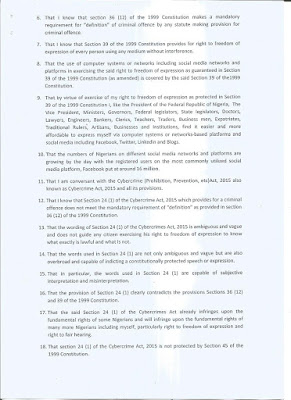
Lawyer Sues Govt on Section 24, Cybercrimes Act 2015

Lawyer Sues Govt on Section 24, Cybercrimes Act 2015


Barr. Solomon Okedara 

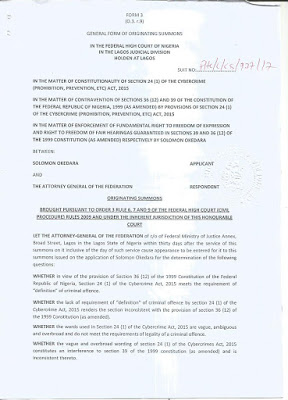
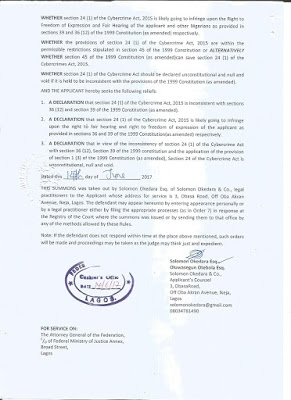
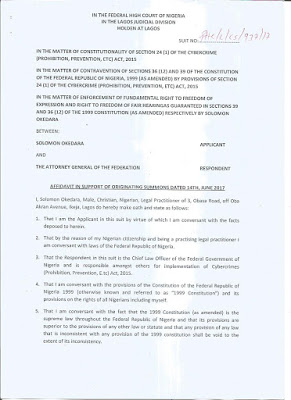
Cybercrime Act 2015: Solomon Okedara V. Attorney General Of The Federation: FHC/L/CS/937/17

The last two years have
been marked with cases of arrests, detentions and prosecutions of Nigerians in
connection with speeches and expressions made on social media platforms ranging
from Facebook posts to Tweets and to blogs. Some of the persons arrested,
detained or being prosecuted have only acted within the purview of exercise of
their Freedom of Expression as guaranteed in the 1999 Constitution (as
amended).


Section 24 of the
Cybercrime Act, 2015 is the law under which Nigerians have been and are being
booked in this regard. The law, in very vague, overbroad and impermissible
terms restrict and criminalizes expressions and speeches made via computer
systems or networks including social media. Section 24 of the Cybercrime Act,
2015 provides that:

“Any
person who, knowingly or intentionally sends a message or other matter by means
of computer systems or network that
(a)      Is grossly offensive, pornographic or of
an indecent, obscene or menacing character or causes any such message or matter
to be so sent; or
(b)     He knows to be false, for the purpose of causing
annoyance, inconvenience danger, obstruction, insult, injury, criminal
intimidation, enmity, hatred, ill will or needless anxiety to another or causes
such a message to be sent: commits an offence under this Act and shall be
liable on conviction to a fine of not more than N7,000, 000.00 or imprisonment
for a term of not more than 3 years or to both such fine and imprisonment”

Realizing that the
statutory provision is cancerous to Freedom of Expression and the need to
engender unbridled Freedom of Expression, the applicant –Nigerian Lawyer and
Global Research Fellow, International Center for Not for profit Law (ICNL),
Washington DC, recently instituted a legal action challenging the
constitutionality of Section 24 (1) of the Cybercrime Act, 2015 asking the
court to declare the section unconstitutional, null and void.


This is one suit that would
excite journalists, bloggers, lawyers, human rights activists, civil society
actors as its victory would mean victory not just for over 190 million
Nigerians but also for all lovers of democracy the world over.