
by Legalnaija | Mar 2, 2022 | Uncategorized
Lawyers working within the “tech space” these days are quick to exclusively introduce themselves as “Tech Lawyers.” As catchy and interesting as the title appears, its multi-faceted dimension is often ignored or confused for the creation of a new practice area or a specie of new breed of lawyers.
Surprisingly, this often-bandied contemporary appellation has not enjoyed sufficient analytical (and even academic) attention in spite of its dynamic and robust ramifications. Consequently, when ‘tech law’ is discussed, there is an undue usual fixation on legal services provided on issues concerning robotics, machines and AI at the expense of other areas of the law. This is rather contrary to meaning of technology itself which simply connotes ‘an easier way of achieving certain tasks’.
What is Tech Law?
An inquisition into what Tech Lawyers do must logically commence with an understanding of what ‘tech law’ is. Whether one refers to it as ‘tech law’ or ‘technology law’, its catchment areas are unimaginable wider than its connotative use especially among a certain generation of creative lawyers.
The word ‘technology’ itself is derived from “Techre” – a Greek word which means “art.” Professor A. Zvorikine of the U.S.S.R Academy of Sciences Institute of Philosophy notes that, technology has been defined as the ‘aggregate of techniques diverted towards the attainment of some purpose; specifically, the aggregate of techniques diverted against the forces of nature and towards the modification of materials’ (See A. Zvorikine, ‘Ideas of Technology. Technology and Culture, 443-458).
The erudite professor however observed that the definition as offered by other scholars does not properly capture the material and organic aspect of technology, hence he defines it as “the means of work, the means of human activity developing within a system of social production and social life.”
From the foregoing definitions of technology, then tech law can be simply defined as the body of laws that regulates the deployment of technology. In other words, tech law is the branch of law that regulated the means with which human activities develop within a system. This practice area governs both private and public deployment of technology for certain objectives.
Technology law is (in)explicably wide and complex as it accommodates several other areas of the law to wit; privacy and data protection, information communication technology (ICT), cybercrime, cyber law, artificial intelligence (AI), consumer protection, cyber security, intellectual property, digital rights, digital law, information technology law, fintech, private equity, venture capital, private equity, real estate contracts, contractual transactions, commercial transactions, entertainment, digital assets, cryptocurrency, patent, software licensing, mergers and acquisition, etc the list is open-ended.
What do Tech Lawyers do?
Since we already have an idea of the ambit of tech law, a simplistic and direct answer to what tech lawyers do, would be that: tech lawyers provide legal support/services to technology-related transactions or disputes.
Because of the complex nature of tech law, most commentators are understandably fixated on information technology divide of tech law, hence various commentators on what tech lawyers do have approached the issue from a rather narrow perspective. For example, Angus Finnegan (a partner who heads the International Technology and Telecom group in Reed Smith LLP- a global Law Firm head quartered in United States), argue that tech lawyers assist clients with solving ‘complex technology matters such as software licensing arguments and telecoms contracts? (See ‘Technology law: area of practice’ accessible at <https://targetjobs.co.uk/careers-advice/law/technology-law-area-practice>)
However, Katherine Bishop (another American lawyer) agrees that, from the definition of tech law, tech lawyers function across the broad range of practice area covered by technology law. She argues that a tech lawyer could even function in a financial company advising in regulatory compliance or externally revising the regulatory or contractual implications of technology solutions. Ultimately, she concludes that any lawyer who has advised a client on privacy policy/notice, intellectual property, fintech, even employment contracts is a tech lawyers. Bishop’s position quite rightly captures the organic nature of technology as the means of human productivity within a system. (See ‘What does a tech lawyer do?’ accessible at < https://attorneyatlawmagazine.com/what-does-a-tech-lawyer-do#:~:text=A%20tech%20lawyer%20can%20help,clients%20on%20employee%20classification%20issues.>)
In another rather restrictive article titled ‘The role of a technology lawyer’, Nicholas A. Kees notes that, any lawyer who provides services in relation to protection of ideas, productive and marketing of same, qualifies as a tech lawyer. He recognizes the ‘major’ areas of tech law as intellectual property, competition law, communications and privacy. (accessible at < https://www.gklaw.com/Resources/Documents/KeesEdit3AInsidetheMindsChapterforAspatoreBooks.pdf?)
Interestingly, in June 2021 Bloomberg conducted a survey on ‘Who are tech lawyers? (accessible at < https://news.bloomberglaw.com/bloomberg-law-analysis/analysis-who-are-tech-lawyers-we-asked-them-directly>). The survey did not only reveal that tech law spans almost if not all the law practice areas there is, but that majority of lawyers who have drafted or reviewed (technology-related) contracts would ascribe that appellation to themselves. The survey further revealed that, the regular technology-related matters are privacy, intellectual property, mergers and acquisition, manufacturing and supply agreements, litigation and settlement, employment matters, corporate law matters etc.
Conclusion
From the all-encompassing definition of technology law to the versatility of tech lawyers, it appears all lawyers would have, at one point or another, acted as tech lawyers for their clients. Hence, in my opinion, any lawyer who has drafted or reviewed a contract at any time for his/her career qualifies as a tech lawyer irrespective of the subject matter provided is simplifies the client’s task. Litigation lawyers on the other hand also qualify as tech lawyers since litigation is a pot pouri of many practice areas.
It must be understood at all times that, technology law begins with contracts, hence every lawyer who drafts or reviews a contractual document plays the role of a tech lawyer. Kevin Davis (Professor of Business Law, New York University, school of Law) succinctly put it that:
“If technology means ‘useful knowledge about how to produce things at low cost’, then contracts should qualify. Just as mechanical technologies are embodied in blueprints, technologies of contracting are embodied in contractual documents that serve as blueprint for collaborations.’ (See Kevin E. Davis, ‘Contracts as technology’ (2013) 88(83) New York University Law Review, 83)
Conclusively, if tech law is not exclusive to any practice area, then the description of tech lawyer is not necessarily a separate garment worn by any lawyer acting within the precincts of some limited practice areas erroneously contemplated as constituting technology law. The definition of tech law is too wide and flexible for the exclusive preserve of a sect of lawyers who provide professional services in a hand-picked practice areas.

by Legalnaija | Feb 25, 2022 | Uncategorized
Nigeria has 21 million legal problems each year.
According to the 2018 Justice Needs and Satisfaction report, Nigerians encounter over 57,000 legal problems daily.
Everyday, at Legalnaija we help Nigerians resolve some of these problems by connecting them with expert lawyers or by providing them with information. By doing this, we are solving the problem of access to justice in Nigeria because we believe that a society grounded on the Rule of Law will definitely thrive and succeed.
If you are a lawyer, we will like you to join us in reviving our legal system by assisting citizens in protecting their rights, while also advancing your legal career and attracting new clients to your business. Excitingly, our Directory allows users filter their search for a lawyer via the Lawyer’s location, area of practice and gender.
If interested in this amazing opportunity for personal and national development, kindly ensure you are registered and have a valid subscription on the Lawyers Directory. Subscription is 1,000 Naira for 30 days; 5000 Naira for 6 months, and 10,000 Naira for 1 year.
Kindly note that if you do not have a valid subscription, we shall not be able to refer any briefs to you and clients won’t be able to find you.
If you are having any problem with your registration or subscription or if you want us to activate your subscription, thereby saving you the time, please text the word “Register” or “Subscribe” to 09029755663, or send a mail to hello@legalnaija.com
Remember, we are rooting for you.
Legalnaija Team

by Legalnaija | Feb 25, 2022 | Uncategorized

A lot of business is conducted during unofficial hours and weekends. While enjoying TGIF with friends and partners or having a chat, lots of deals worth billions are being struck over handshakes and champagne toasts.
The problem however is that you always agree to finalise the paper work later on which sometimes can pull the brakes on your business idea and slow things down a lot.
What if you could change that?
What if you could get your contracts and agreements customized to your specifics before you even finish the toast?
On www.legalnaija.com, you can get your legal agreements for a whole lot cheaper, and in less than 5 minutes. Thereby saving you money and keeping the business momentum on full speed. Some of the available Templates include customizable;
1. Contract of Employment
2. Power of Attorney
3. Sales Agreement
4. Licensing Agreement
5. Non – Disclosure Agreements
6. Loan Guaranty Agreement
7. Loan Agreement
8. Uber Commercial Transport Agreement
9. Tenancy Agreement
10. Affidavits and lots more
To customize an Agreement, simply;
1. Visit www.legalnaija.com
2. Select “Draft An Agreement” from the menu list.
3. Choose the Agreement template you need.
4. Answer few questions about your document.
5. Make payment and receive the Agreement in your email immediately.
Our smart contract templates is revolutionizing the way individuals and businesses engage with legal, and this powerful tool is now in your hands.
Are you going to empower yourself and your business?
Legalnaija Team
www.legalnaija.com

by Legalnaija | Feb 24, 2022 | Uncategorized

Do you drive a Uber or Bolt (Taxify) or do you own the car being used for a Uber or Bolt service, If yes, do you have a Commercial Driver Agreement?
According to statistics, Uber Nigeria, currently has 9,000 active driver-partners and no fewer than 267,000 monthly rider. This means there a lot of people in the business, and you may already be a party or thinking of getting into the business yourself.
If you are going into the business, especially if you are going in as a Driver of the Vehicle Owner, it is important have an agreement. Such an agreement will help protect both interests of the driver and car owner.
A number of clauses that should be provided for in your agreement include –
- Properly identifying the Vehicle
- Stating the duration of the agreement
- Responsibility for the maintenance and repairs of the vehicle.
- Insurance
- Storage of the vehicle
- Obligations of the parties
- Payment schedules
- Driver Guarantor
- Breach & Termination of the agreement
How To Get An Agreement
If you want to get an agreement between a Driver and Vehicle Owner, you can get one in less than 5 minutes on Legalnaija.
Instructions on how to get an Agreement on Legalnaija
- Log on to Legalnaija
- Select the Uber Commercial Vehicle Agreement from the lists of Templates
- Answer the questionnaire
- Make payment
- Receive your Agreement in your Email.
- Print and sign
- Go on and do business.
Please note that this information is provided for general informational purposes only and is not intended to be legal advice. No lawyer-client relationship is formed nor should any such relationship be implied. It is not intended to substitute for the advice of a qualified lawyer. If you require legal advice, please consult with a qualified lawyer.
@Legalnaija
www.legalnaija.com
hello@legalnaija.com

by Legalnaija | Feb 24, 2022 | Uncategorized

A Tenancy Agreement is the agreement between a Landlord and Tenant for the use of a premises for a period of time and for a certain fixed sum. In other words, a Tenancy Agreement is a contract between a Landlord and the Tenant which sets out the rights and obligations of both the Landlord and the Tenant when renting property.
The tenancy agreement lists out all the terms of use agreed to by the parties, and is usually prepared by the Landlord or the Landlord’s lawyer. The type of clauses found in a Tenancy Agreement, usually include;
- The date the tenancy begins.
- The names and addresses of the Landlord and the Tenant
- Address where the property is situated
- The duration of the tenancy
- The cost of rent
- The obligations of the Landlord and Tenant
- Outline of Bills, the Tenant and Landlord are responsible for during the tenancy period.
- Mode of termination
- Service charge and security deposits if applicable
- Legal fees, and agency fees,
The above list is not exhaustive and in fact there are more terms that are frequently included in well-drafted Tenancy Agreements. It is quite important that Landlords provide Tenancy Agreements for their Tenants, and for Tenants to ensure they study the Tenancy Agreements given to them by the Landlord before signing same.
If you need a Tenancy Agreement, you can customize and download one within minutes on our website, simply login to Legalnaija.
Instructions on how to get an Agreement on Legalnaija
- Log on to Legalnaija
- Select the Tenancy Agreement from the lists of Templates
- Answer the questtionaire
- Make payment
- Receive your Tenancy Agreement in your Email.
- Print and sign
Please note that this information is provided for general informational purposes only and is not intended to be legal advice. No lawyer-client relationship is formed nor should any such relationship be implied. It is not intended to substitute for the advice of a qualified lawyer. If you require legal advice, please consult with a qualified lawyer.

by Legalnaija | Feb 17, 2022 | Uncategorized

A contract of employment is a contract between an employer and employee in which the terms and conditions of employment are stated. The term “employee” denotes anyone who is employed under a contract of employment for remuneration and an employer is such person who employs an employee.
An employment contract is an agreement which carries with it an obligation to pay wages in return for service and a corresponding right of control on the part of the employer. Before an employer/employee can make claims under the contract of employment, such party must prove that the existence of a contractual relationship. A contract of employment can be oral, written, or partly oral and written; it may even be inferred or implied from the conduct of the parties, though most contracts of employment are either oral or written.
Usually a contract of employment contains the following clauses;
- Name of parties
- Address of parties
- Date of commencement
- Salary and emoluments
- Work hours
- Non – Compete clauses
- Ownership of intellectual property
- Vacation and Annual Leaves
- Termination of Employment, and much more.
On Legalnaija, you can create and download your own Employment Contracts and Agreement in less than 5 minutes and for a small fee. All you need do is;
- Visit https://app.legalnaija.com/shop/templates
- Select Tenancy Agreement
- Answer the questions
- Make payment
- Download your agreement
Through this innovation, we have made getting Tenancy Agreements, easier, cheaper and faster. Most especially all our Templates are drafted by expert lawyers.
@Legalnaija
www.legalnaija.com

by Legalnaija | Feb 16, 2022 | Uncategorized
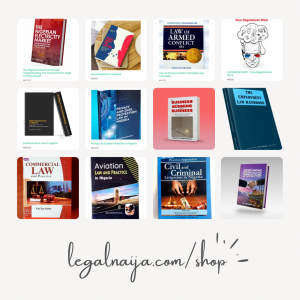
If you want to impress your clients and get the briefs pouring in this year, there are 12 books all Nigerian lawyers must have in their library, and the Legalnaija online bookstore has curated these books for you. See the list below;
- LISTENEVERYHOW – How Negotiations Work (₦9,800)
- Privacy And Data Protection In Nigeria (₦10,000)
- The Employment Law Handbook (₦15,000)
- The Nigerian Electricity Market; Understanding The Transactional, Legal & Policy Issues (₦35,000)
- Understanding Petroleum (Oil & Gas) Transactions and the Nigerian Market (₦50,000
- Social Media For Lawyers (2500)
- Aviation Law And Practice In Nigeria (₦14,000)
- Civil And Criminal Litigation In Nigeria (₦9,500)
- Commercial Law And Practice (₦10,000)
- Entertainment Law In Nigeria (₦25,000)
- Law of Armed Conflict: Principles and Concepts (₦5,000)
- The Business of Running Your Business (₦5,000)
You can order any of these books from the convenience of your device and get it delivered to your doorstep easily. All purchases in Lagos are delivered next day, while those outside Lagos are delivered within 1 – 3 working days.
To make your purchase, visit www.legalnaija.com/shop and to chat with a customer care agent, you can call, text or Whatsapp on 09029755663.
Remember, we are rooting for you.
by Legalnaija | Feb 13, 2022 | Uncategorized
As we celebrate the 30th anniversary of Sierra Leone’s 1991 national Constitution, here are ten (10) interesting facts about the constitution:
- No one can be taken to court for any offence for which he has previously been convicted for by the court. Similarly, if he has been acquitted (freed) by the court from that offence he cannot be taken to court again for the same offence. Section 23(9)
- The constitution gives every Sierra Leonean the right to bring a court action before the Supreme Court to seek redress if any of their fundamental rights have been infringed upon by any person or institution. Section 28
- The President of the Republic of Sierra Leone can pardon any person for a crime he/she may have committed if the person has been tried for that crime by the court and found guilty of the said crime. The power is under the prerogative of mercy. Section 40 (4)(e)
- The constitution states that no person shall hold office as President for more than two terms of five years each, whether or not the terms are consecutive. Section 46(1)
- The Vice President is the Chairman of the Police Council in Sierra Leone. The Police Council advises the President on all matters relating to the Police, internal security and the appointment of the Inspector General of Police. Section 156 (1)
- No one can bring a civil or criminal court action against a Member of Parliament because of what the Member of Parliament said during Parliamentary proceedings. Section 99(1)
- No one can bring an action against a Judge for any matter or anything he does whilst performing his judicial functions. Section 120 (9)
- The 1991 constitution states that every court must give judgments or rulings not later than three months after the close of the case and submission of arguments and the court must provide copies of any judgment or ruling delivered to the parties involved. Section 120 (16)
- The Supreme Court is the only court which can depart from its previous decisions when it appears right to do so and all other courts are bound to follow its decision. This means a future Supreme Court can disagree with what the present Supreme Court has held to be the law. Section 122(2)
- A Judge shall not while he continues in office as a judge, hold any other office where he will make profit or earn emolument, whether by way of allowances or otherwise, whether private or public, and either directly or indirectly. Section 138(4).
 Babatunde Johnson is a law graduate from the University of Sierra Leone, Fourah Bay College and he is currently awaiting admission to the Sierra Leone Law School. He is also a legal content creator and Co- Founder at Salone Law Centre.

by Legalnaija | Feb 2, 2022 | Uncategorized
Every lawyer before the appellate court craves for a consensus from the judges in the panel, this is the norm and dissent is a departure from what is conceived to be the norm. Dissent is not a concept unique only to the legal system, it is part of our daily lives which is why the famous writer Mark Twain said:
“Whenever you find yourself on the side of the majority, it is time to pause and reflect.”
I have on few occasions witnessed the delivery of dissenting judgments and though I am not in agreement with all of them yet I admire the courage to dissent even in the face of probably offending colleagues and those who expect a consensus judgment.
This topic of dissent has always been an enigma to me and as I set on this journey to research on how far and how much our appellate courts have embraced it, I shall first endeavor to address the views of distinguished authors on dissenting judgments.
Former Chief Justice of the United States of America Harlan F. Stone in a letter to the Columbia University in 1928 described dissent in the following manner:
“A dissent in a court of last resort is an appeal to the brooding spirit of the law, to the intelligence of a future day, when a later decision may possibly correct the error in which the dissenting judge believes the court to have been betrayed
Judges are not there simply to decide cases, but to decide them as they think they should be decided, and while it may be regrettable that they cannot always agree, it is better that their independence should be maintained and recognised than that unanimity should be secured through its sacrifice.[2]”[Emphasis Mine]
I agree with the Learned Chief Justice and as I have seen in cases with dissenting judgment, the dissent points out to the losing party that the judgment may be an error and may be worth another try in a higher court and if not possible, hope that the law will change in the future to reflect the dissent as held by the dissenting judge. A consensus does not give that hope.
Louis Blom-Cooper and Gavin Drewry in their 1972 article Final Appeal – ‘A study of the House of Lords in its judicial capacity’[3] described dissent of a final appeal as:
“the most apparently poignant judicial tragedy in a legal system founded upon the dramatic conventions of certainty and unanimity”.
A strong condemnation indeed, certainly from advocates of unanimity but I do not agree with the view that a dissent signals a judicial tragedy. Their views may seem to my mind to be nothing short of an endorsement of the herd mentality.
Justice White in the American Supreme Court case of Pollocks v Farmers Loan and Trust Co. (1895)[4] said:
“[the] only purpose which an elaborate dissent can accomplish, if any, is to weaken the effect of the opinion of the majority, and thus engender want of confidence in the conclusion of courts of last resort”.
In the case of Liversidge v Anderson and another [1942][5], the majority of the Law Lords gave a judgment by applying a subjective interpretation to the Defence (General) Regulations 1939 thus allowing the Secretary of State to exercise broad powers by detaining anyone he reasonably believes to be a threat to national security.
Lord Aitkin disagreed and he gave us what we now have as the most popular dissenting judgment in the commonwealth legal system in the following words:
“I view with apprehension the attitude of judges who, on a mere question of construction, when face to face with claims involving the liberty of the subject, show themselves more executive-minded than the executive. Their function is to give words their natural meaning, not, perhaps, in war time, leaning towards liberty…’ in a case in which the liberty of the subject is concerned, we ‘cannot go beyond the natural construction of the Statute.
In this country amidst the clash of arms the laws are not silent. They may be changed, but they speak the same language in war as in peace. It has always been one of the pillars of freedom, one of the principles of liberty for which on recent authority we are now fighting, that the judges are no respecters of persons and stand between the subject and any attempted encroachments on his liberty by the executive, alert to see that any coercive action is justified in law. In this case I have listened to arguments which might have been addressed acceptably to the Court of Kings Bench in the time of Charles I.
I protest, even if I do it alone, against a strained construction put upon words with the effect of giving an uncontrolled power of imprisonment to the Minister. To recapitulate. The words have only one meaning: they are used with that meaning in statements of the common law and in statutes; they have never been used in the sense now imputed to them: they are used in the defence regulations in the natural meaning: and when it is intended to express the meaning now imputed to them, different and apt words are used in the defence regulations generally and in this regulation in particular.” {Emphasis Mine]
Not swayed by popular opinion or by the persuasion of those who have read his draft[6] and armed with the breastplate of independence, he delivered a dissenting judgment believing he was doing the right thing.
He was justified 38 years later, confirming the words of Chief Justice Stone with regards to the hope that someday in the future a later decision may correct the error of the law as the dissenting judge may have opined.
Lord Diplock delivering the judgment in Inland Revenue Commission v Rossminister & Others (1980)[7] said:
“For my part I think the time has come to acknowledge openly that the majority of this House in Liversidge v. Anderson were expediently and, at that time, perhaps, excusably, wrong and the dissenting speech of Lord Atkin was right.” [Emphasis added]
For some practitioners, there is no need to bother with dissenting judgments but I believe a better approach is to read the judgments as a whole and to form your views on the opinion of the Learned Justices. Every Practitioner will understand the beauty of this advice when faced with the dilemma in the case of The Estate of Khalilu Jabbie v Skye Bank (SL) Ltd MIsc. App 45/2014 SLCA (unreported)[8].
I am sure many will agree with me that our present legal system is in desperate need of dissenting judgments. Has that been the case? Have we had enough such dissents to qualify the system to be reflective of judicial independence, freedom of expression and a transparent decision-making process? These are all the questions I might provide answers to in the succeeding parts of this article for we must all agree that the right to disagree is a right that brooks no dissent.
In the words of Justice Ginsburg of the US Supreme Court who is known to have written few dissents in a 2009 speech said:
“My experience teaches that there is nothing better than an impressive dissent to lead the author of the majority opinion to refine and clarify her initial circulation.”
Bernard Eldred Jones Esq is a Barrister and Solicitor in Sierra Leone. He holds a Master of Laws in Banking and Finance Law (UOL), Post Graduate Diploma In Commercial and Corporate Law, Bachelor of Social Sciences specializing in Economics from Fourah Bay College University of Sierra Leone and Bachelor of Laws (LLB) Hons (London)
He was called to the Sierra Leone Bar in 2009. He is a private practitioner.
by Legalnaija | Jan 20, 2022 | Uncategorized
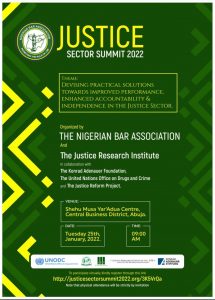
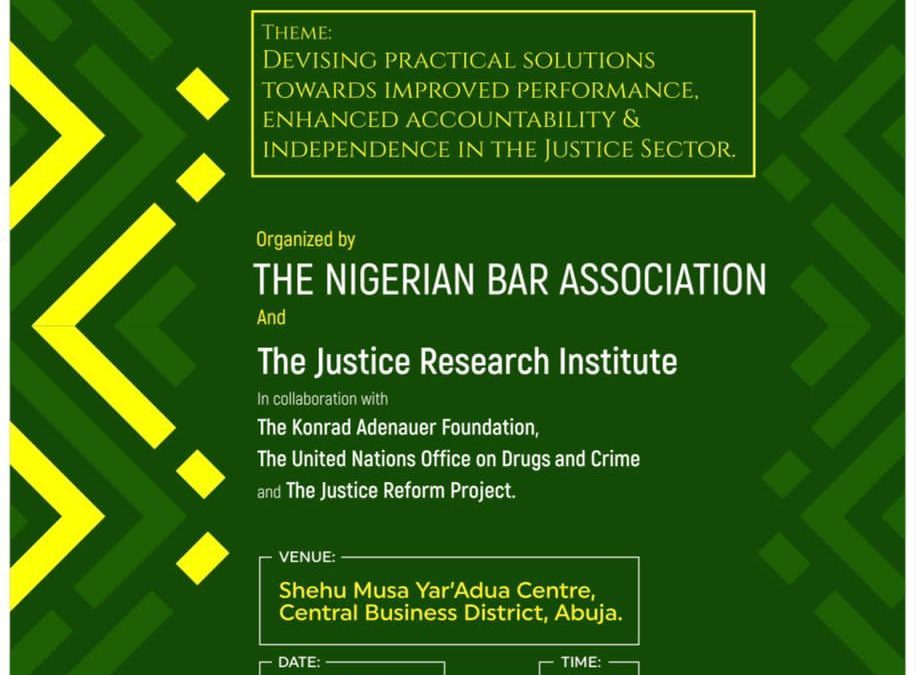
The Justice Sector Summit 2022 themed – “Devising practical solutions towards improved performance, enhanced accountability and independence in the justice sector” is scheduled to hold on Tuesday 25th January 2022.
The Summit is organised by the Nigerian Bar Association and the Justice Research Institute; in collaboration with the Konrad Adenauer Foundation, the United Nations Office on Drugs and Crime and the Justice Reform Project. It is expected that the Summit will proffer practical and actionable solutions that will be implemented by all stakeholders, leading to significant and tangible improvements in the efficiency of the justice sector.
Registration to attend the Summit virtually is now open to Judicial Officers and Lawyers and will close on Friday, 21st January 2022. The organising committee will email the event link and other relevant information to all registered participants on or before Monday, 24th January 2022. If you have any questions, you can reach the organising committee via email at akinyemiaremu@gmail.com or via telephone on 08057765897
Registration here https://docs.google.com/forms/d/e/1FAIpQLSfyK6oroc0hkbYUHqKy3eO5j67kT0pFmsElTCP_TKpP0QV_Xg/viewform
#justicesummit #nbajusticesummit #legalnaija