by Legalnaija | May 4, 2026 | Blawg
In my usual juridical survey, I stumbled upon the case of *Gomez v. C. & S.S (2009) 10 NWLR (Pt. 1149) 223 (SC),* wherein a question that has troubled courts for years was put to rest. Though it prima facie looks simple, but is quite tricky in application.
When a court decides on jurisdiction, is that decision final or merely interlocutory? And more importantly, when must an appeal be filed? At first glance, you might think, “Ah, this one is straightforward”, but far from it.
This issue did not start with us. It came all the way from England, the same England that conceived, gestated, birthed, and weaned our Nigerian legal system.
Two cases. Two principles. Two completely different directions. We have *Bozson v. Altrincham Urban District Council (1903) 1 KB 547. On the other hand, Salaman v. Warner (1891) 1 QB 734.*
Now, here is where the confusion began.
Under *Bozson,* the court, *per Lord Alverstone, C.J.,* looks at the effect of the decision. So, if a court is faced with an application, usually a motion on notice; challenging its jurisdiction, and upon considering the application with the reply made thereof says: “I do not have jurisdiction; I therefore strike out the matter,”
that is the end of the case in that court. Nothing remains, and that decision is FINAL.
But if the court says: “I have jurisdiction and I shall proceed to hear the matter on the merit,”
that decision is interlocutory, because the real issues are still alive.
There is also *Salaman v. Warner.* Under Salaman, the focus is not on the effect of the decision, but on the nature of the application. *Per Fry, L.J.* opined that: whether the court says it has jurisdiction or it does not, both are interlocutory. Put differently, the order is to be classified as interlocutory in either case because it was made upon an interlocutory application.
You see the problem now?
One says look at the result.
The other says look at the process. And that was how both decisions continued their legal argy-bargy, dancing back and forth like a pendulum that refuses to settle.
Now the question is, what did Nigeria do?
Did we join the dance?
The answer is No!
Nigerian courts, in their usual wisdom, refused to entertain confusion. They picked one test and settled with it.
That test is the *Bozson test.*
This position was firmly reaffirmed in the said case of *Gomez v. C. & S.S (2009) 10 NWLR (Pt. 1149) 223 (SC),* where the Supreme Court, constituted of five panel of justices and presided over by the Law *Lord Niki Tobi, JSC, with Oguntade, JSC (of blessed memory)* delivering the lead judgment, made it clear that Nigeria prefers certainty. No room for the English style of “let’s see how it goes.” Therefore, a decision that the court has jurisdiction is interlocutory. Conversely a decision that the court does not have jurisdiction is final because there is nothing for the court to decide after holding that it does not have jurisdiction.
The court stated further that even earlier, in *Akinsanya v. U.B.A. Ltd. (1986) 4 NWLR (Pt. 35) 273, Eso, JSC* had already warned that allowing both tests to operate would only create confusion. According to him, the law should be workable and certain, not something that sends lawyers rummaging through books in search of answers.
So, yes, Nigeria chose clarity over chaos.
One may, however, ask, “But that was since 2009; what if the Court has made a U-turn?” Good question, indeed. This writer took further effort to confirm the most recent position.
In *Heritage Banking Co. Ltd. v. N.U.C. (2017) 5 NWLR (Pt. 1557) 104 (SC) and C.G.G. (Nig.) Ltd. v. Eronini (2019) 14 NWLR (Pt. 1692) 219 (SC),* the Supreme Court remained consistent on the said position.
Then came the more recent authority, according to my research: *Igoin v. Ajoko (2021) 17 NWLR (Pt. 1804) 90 (SC),* and the Supreme Court did not mince words and provided ipsissima verba as follows: “An order of court striking out or dismissing a case… for want of jurisdiction determines the rights of the parties… there is nothing left… the decision is final… It is not an interlocutory decision.”
At this point, the law is no longer shaking. It is standing firmly like the Aso Rock; let me borrow the words of my brother R.K. Rasheed, the decision stands firm:“like Kano State June/July rain fall.”
In light of the above, it can be said that the extant position of the law is this:
Where the court says: “I have no jurisdiction” and strikes out or dismisses the case, that decision is FINAL, and pursuant to section 25 of the Court of Appeal Act, the appeal must be made within 3 months (in civil cases) or 90 days (in criminal cases), as the case may be.
However, where the court says: “I have jurisdiction and I shall, in view of that, proceed with the merit of the case,” that decision is INTERLOCUTORY, and the aggrieved party must appeal within 14 days pursuant to the same section of the Act.
It can therefore be said that a decision on the issue of jurisdiction is treated as an exception to the general rule that an order that does not settle the matter in contention is interlocutory, while one that settles it is final. This is because, considering the pride of place that the issue of jurisdiction occupies in adjudication by a court, even though a decision that a court has no jurisdiction to entertain a case is not a decision on the merit with respect to the rights of the parties in the claim, it is a final decision. This is because the court is, by virtue of that fact, ipso facto devoid of the authority to further entertain the suit and cannot proceed to determine same on the merit.
While the order that says “I have jurisdiction” is interlocutory, any party aggrieved shall appeal within the 14 days.
At this point, you may want to start overthinking it:don’t. Whether it sits well with your logic or not, the court has spoken. It’s an adage in the Hausa language that: “Shari’a saɓanin hankali”: meaning; the law often runs contrary to reasoning or common sense.
As for whether England is still dancing their argy-bargy dance on this issue and refused to settle for one position like Nigeria, I honestly do not care to confirm, because I am not really a friend of foreign cases. After all, they are merely persuasive in our courts.
In sum, the extant position is that where a court declines jurisdiction and strikes out or dismisses a case, the decision is final and appeal lies within the prescribed time for final decisions. However, where the court assumes jurisdiction and proceeds to hear the matter, the ruling is interlocutory and appeal must be filed within 14 days.
In light of the above, I say no more, hoping I have made the point clear.
Thank you, for following through, my dear readers!
________________________________________________________________
Isah Bala Garba is a Level 400 student of Common and Islamic Law and a Senior Advocate of Bayero University, Kano,(SABUK).He has authored numerous legal articles and analyzed many cases in clear, plain language. He can be reached for comments or corrections via: Email: isahbalagarba05@gmail.com | Tel: 08100129131

by Legalnaija | May 4, 2026 | Blawg
Advancing Child Justice Administration in Nigeria: What to Expect at the Child and Family Law Conference 2026
Date: August 12th-13th, 2026
Time: 10:00am daily.
Venue: Hybrid (Port Harcourt and Zoom).
NBA-ICLE: 2 CPD Points
Nigeria stands at an important moment in the development of child justice. Children make up a significant proportion of Nigeria’s population, yet the justice system still often struggles to respond to their realities in a way that is accessible, child-friendly, protective, and effective..
It is against this backdrop that Sceptre and Prima is convening the Child and Family Law Conference 2026, a high-level forum dedicated to advancing informed, practical, and rights-based approaches to child justice administration in Nigeria.
Held under the theme “Advancing Child Justice Administration in Nigeria: Law and Practice,” the conference will bring together judicial officers, legal practitioners, academics, policymakers, child protection professionals, social welfare actors, development partners, parents, and children themselves for two days of reflection, dialogue, learning, and reform-oriented engagement.
The conference programme has been carefully designed to combine thought leadership, practical insight, and lasting sector impact.
Highlights include:
– Keynote Address
– Panel Sessions on on the principles of child justice administration, the digital environment, detention reform, and adoption;
– Paper Presentations
– Launch of Books on Child Justice
– Launch of Children’s Rights and Family Law Journal
– Launch of Child Law Online Research Database
– Interactive Q and A Sessions
– Address by a Child on Access to Justice for Children
Opportunities to Participate
Register: https://sceptreandprima.com/conference/
The Child and Family Law Conference 2026 is also opening multiple pathways for participation and collaboration.
Call for Papers:
The **Journal of Children’s Rights and Family Law (CRFLJ)** invites well-researched papers for publication in its maiden edition. Scholars, practitioners, researchers, policymakers, and students are encouraged to contribute original work in child rights and family law.
Call for Authors and Book Vendors:
Authors, publishers, and booksellers with publications in child law, family law, children’s rights, and related areas are invited to showcase their books at the conference bookstore for purchase.
Call for Partners
Organisations and institutions interested in partnering with the conference are also welcome to connect with the organisers.
To learn more, register, or explore participation opportunities, visit the conference page: https://sceptreandprima.com/conference/
Certificates and 2 CPD points of the NBA-ICLE will be awarded on completion.
Email:admin@sceptreandprima.com
Phone number: 08075595575
by Legalnaija | Apr 30, 2026 | Blawg
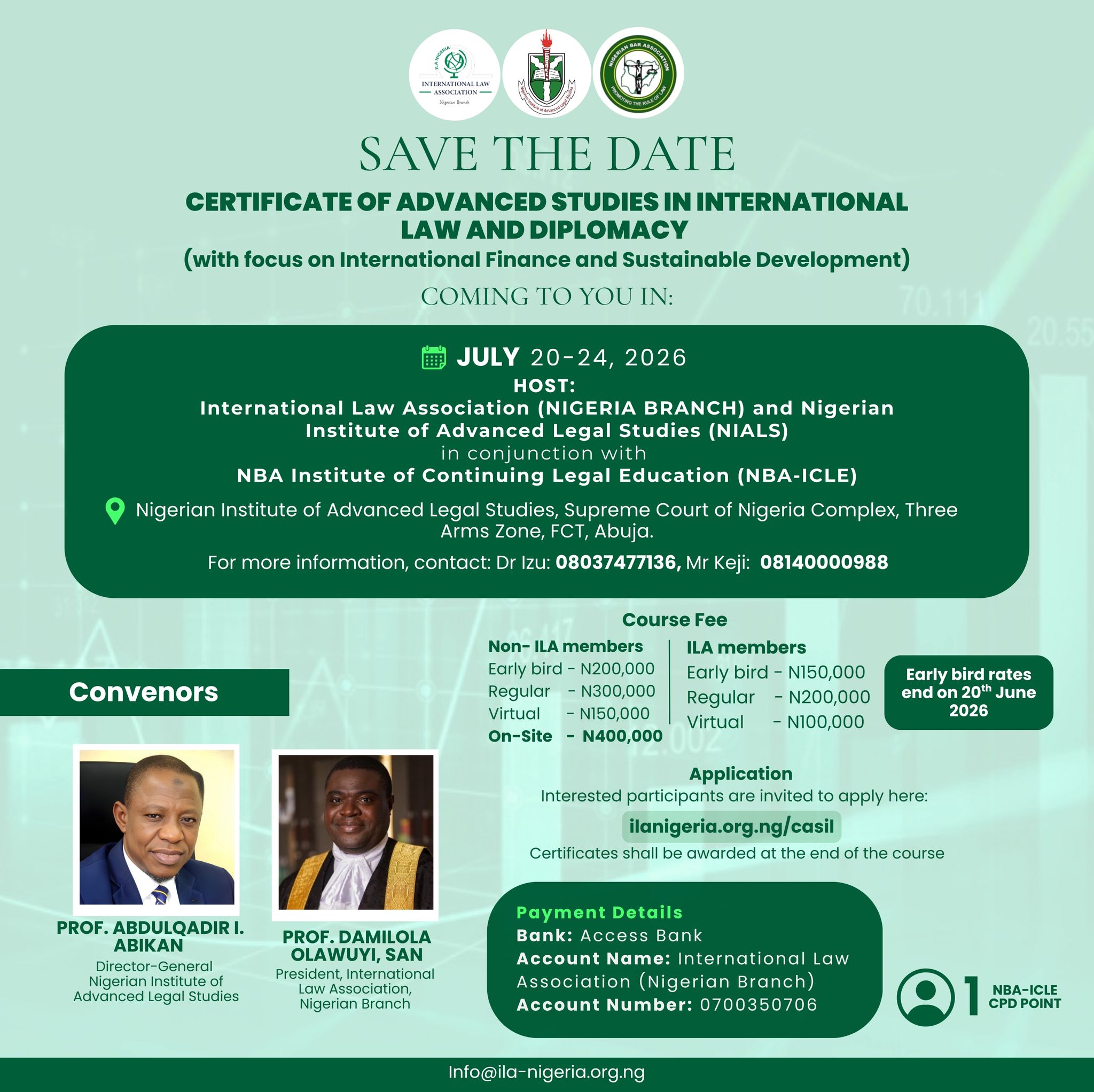
Good news! The Early Bird registration deadline for the 4th Edition of the Certificate of Advanced Studies in International Law and Diplomacy course has been extended to 20 June 2026.
If you missed the initial deadline, this is another opportunity to secure your place at a 20% discounted rate for what promises to be another landmark opportunity to elevate your career in international law and diplomacy.
From 20-24 July 2026 in Abuja, the course will bring together leading practitioners, diplomats, in-house counsel, policymakers, and industry experts from across Africa and beyond to engage on the issues shaping the practice and future of international law and diplomacy.
Now in its fourth edition, this course is organized by @Nigeria_ILA in partnership with @nialsorg. This year’s edition focuses on International Finance and Sustainable Development.
Date: July 20-24, 2026
Time: 9:00 am Daily.
Venue: Nigerian Institute of Advanced Legal Studies (NIALS), Supreme Court of Nigeria Complex, Three Arms Zone, FCT, Abuja.
Kindly register via this link: ilanigeria.org.ng/casil
Certificates and 1 CPD point of the NBA-ICLE will be awarded on completion.
Opportunities like this don’t come often—and this extension won’t last long.

by Legalnaija | Apr 30, 2026 | Blawg
Dr. Tolu Aderemi has strongly condemned the reported killing of a young Delta State indigene by a police officer, describing the incident as a grave violation of justice and human dignity, and calling for urgent institutional accountability.
The legal practitioner, who currently serves as Chairman of the NBA Lagos Branch Law Reform and Monitoring Committee and is a Partner at Perchstone & Graeys, expressed deep concern over the gruesome event said to have occurred in Effurun, Delta State. The incident, which has circulated widely in a disturbing video, allegedly involved the fatal shooting of 28-year-old Mr. Mene Ogidi under circumstances that appear both unjustifiable and contrary to established standards governing police conduct.
Dr. Aderemi noted that the deceased, by all indications, posed no immediate threat and had reportedly offered to cooperate with law enforcement by providing relevant information. He described the act as not only excessive but suggestive of conduct inconsistent with the ethical and professional obligations of police officers.
Emphasizing the need for justice, Dr. Aderemi urged the leadership of the Nigerian Bar Association (NBA) to take proactive steps in safeguarding public interest. He called for the NBA Public Interest Committee to closely monitor the disciplinary process and any ensuing prosecution of the officers involved.
He further advocated for the assignment of counsel to hold a watching brief on behalf of the Association, ensuring that the case is pursued diligently and without compromise.
According to him, such intervention is critical to reinforcing public confidence in the justice system and demonstrating the NBA’s commitment to the rule of law and protection of fundamental rights.
Dr. Aderemi concluded by stressing that incidents of this nature must not be allowed to recur, and that accountability must remain central to policing in a democratic society.
by Legalnaija | Apr 27, 2026 | Blawg
The Tolu Aderemi Initiative has successfully concluded its 12-week Alternative Dispute Resolution (ADR) Online Masterclass, capping an intensive programme designed to equip emerging professionals with practical skills and a global perspective on dispute resolution.
The Masterclass featured a distinguished lineup of facilitators who delivered sessions across negotiation, mediation, arbitration, emotional intelligence, and the growing role of technology in ADR. The closing ceremony celebrated participants’ achievements and reflected on the evolving demands of the profession.
The programme opened with Dr. Kolawole Mayomi, an accomplished arbitrator, who challenged traditional notions of negotiation by framing it as a value-driven skill applicable beyond disputes. He emphasized preparation, strategic thinking, and emotional discipline as essential tools for effective engagement.
Subsequent sessions built on this foundation. Fola Alade introduced participants to mediation and mediation advocacy, advocating for a structured approach through the Negotiation–Mediation–Arbitration–Litigation (NMAL) framework and stressing the importance of long-term career planning and a global outlook in ADR practice.
International perspectives were further explored by Aaron Ogletree, a US/Canadian attorney and expert in arbitration, who provided insights into international arbitration’s efficiency, confidentiality, and flexibility. Laura Alakija complemented this with a session on investment arbitration, offering an African perspective on investor–state disputes and the need to balance investor protections with states’ regulatory powers.
A recurring theme throughout the Masterclass was the human element in dispute resolution. In a dedicated session on emotional intelligence, Fola Alade underscored the importance of self-awareness, communication, and empathy, noting that many disputes are rooted in perception rather than purely legal issues.
The Masterclass also addressed emerging trends. Rotimi Ogunyemi, an astute tech-lawyer, led discussions on Online Dispute Resolution (ODR) and the integration of artificial intelligence, highlighting both its transformative potential and the ethical considerations of its use. He stressed that AI should serve as an assistive tool with human oversight.
Workplace dynamics and professional sustainability were examined during a panel featuring Bonyameen Babajide Lawal, Fola Alade, and Dr. Tolu Aderemi. The panel addressed conflict management in law firms, generational expectations, and the importance of fostering healthy professional environments.
Further reinforcing the programme’s practical focus, Professor Bankole Sodipo, SAN, a professor of law and Senior Advocate of Nigeria, delivered a session on ADR advocacy and career development. He encouraged participants to adopt a solution-oriented mindset, build professional visibility, and commit to continuous learning.
In the final sessions, Dr. Tolu Aderemi, the convener, highlighted the strategic importance of preliminary meetings in arbitration, describing them as critical to shaping direction and efficiency in proceedings.
Speaking at the closing ceremony, Dr. Tolu Aderemi reiterated the Initiative’s commitment to developing a new generation of ADR practitioners who are technically sound, adaptable, ethically grounded, and globally competitive.
With this cohort graduating better positioned to navigate the complexities of modern dispute resolution, especially in an era shaped by technology, cross-border transactions, and evolving professional expectations.
The Tolu Aderemi Initiative has announced TAI 2.0. The next phase will be more specialized and will have deeper intersections with AI and legal tech.
TAI continues to strengthen its role as a platform for building capacity and advancing excellence in ADR practice. For more information or sponsorship, please visit @tolu.aderemi.initiative or call Kelvin on +234703669793.
by Legalnaija | Apr 17, 2026 | Blawg, Book
The question of jurisdiction is one of the most fundamental issues in legal practice. It determines not just where a case is heard, but whether it can be heard at all. Yet, despite its importance, misconceptions around jurisdiction have persisted in Nigerian legal discourse for decades.
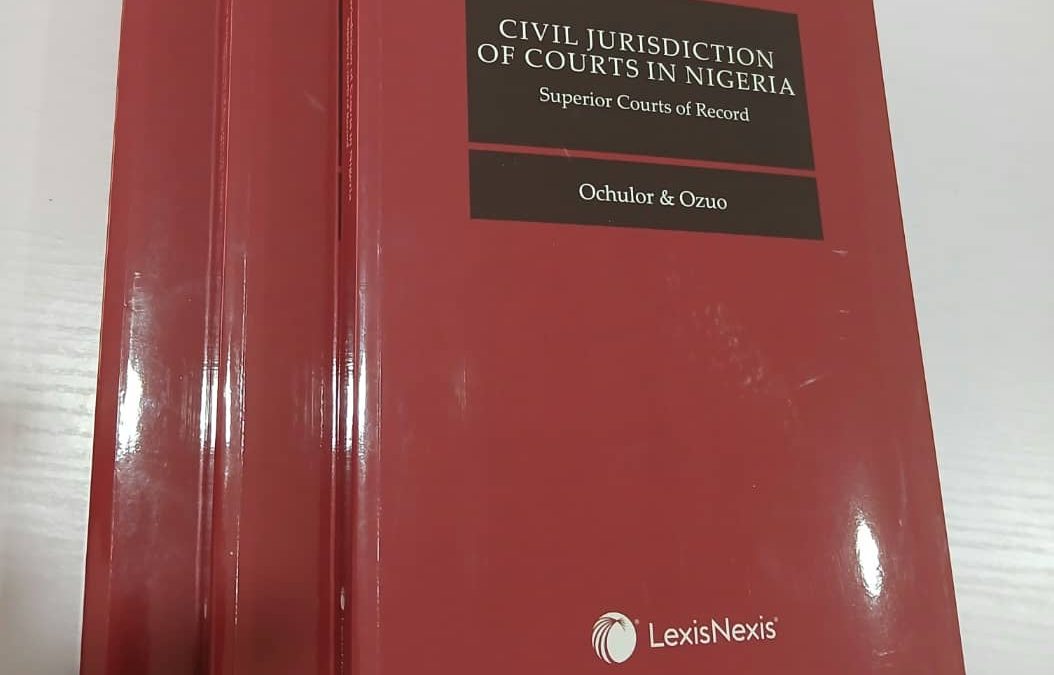
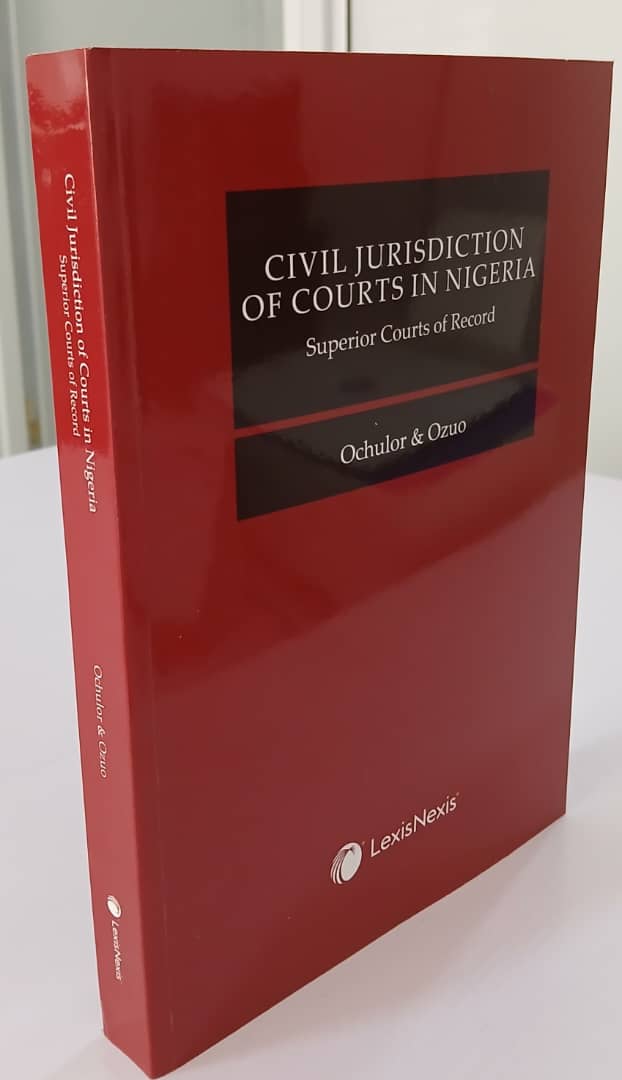
A new book, Civil Jurisdiction of Courts in Nigeria by Lawrence Ochulor and Isdore Ozuo, offers a bold and deeply researched re-examination of this critical area of law.
At the heart of the book is a provocative but carefully argued position: that Madukolu v Nkemdilim, long treated as the leading authority on jurisdiction, may not in fact be an authority on jurisdiction in the way it is commonly understood. This assertion alone makes the book a significant contribution to ongoing legal conversations in Nigeria.
Drawing from extensive research, the authors methodically challenge entrenched assumptions and provide fresh clarity on what jurisdiction truly entails. They make important conceptual distinctions—particularly between competence and jurisdiction, and between jurisdiction itself and the exercise of jurisdiction. These distinctions are not merely academic; they have practical implications for litigation strategy, judicial reasoning, and the administration of justice.
Beyond theory, the book serves as a comprehensive guide to the civil jurisdiction of all superior courts of record in Nigeria. It walks readers through the structure and scope of these courts, while also engaging with contentious flashpoints that frequently arise in practice.
Whether you are a judge, legal practitioner, academic, or law student, this book is an essential resource. It equips readers with the tools to properly analyze, challenge, and defend issues of jurisdiction—an area where precision can make or break a case.
Published by LexisNexis, this work stands as a valuable addition to Nigeria’s legal literature and a necessary read for anyone serious about mastering civil procedure.
Now available on the Legalnaija Bookstore.

by Legalnaija | Apr 9, 2026 | Blawg

Nigeria’s development conversation often centres around infrastructure, oil revenues, policy reforms, and technology. While these are critical, there is a less visible but equally powerful factor that continues to shape the nation’s growth trajectory—access to justice.
A country cannot truly develop if its citizens do not understand their rights, cannot resolve disputes efficiently, or feel excluded from the legal system. In such an environment, rights exist only in theory, businesses operate with uncertainty, and trust in institutions gradually erodes.
This is where the role of access to justice becomes central to national development.
Access to justice goes beyond the courtroom. It includes the ability of individuals and businesses to understand legal principles, navigate processes, and enforce their rights without unnecessary complexity or cost. When this access is limited, the consequences are far-reaching: unresolved disputes, stalled commercial activity, weakened investor confidence, and social instability.
In Nigeria, everyday legal challenges—ranging from land disputes to employment issues and commercial disagreements—often go unresolved, not because solutions do not exist, but because the law is perceived as complex, distant, or inaccessible.
Bridging this gap is essential for sustainable development.
This is where Legalnaija plays a significant role. Through its digital platform, Legalnaija is steadily transforming how Nigerians interact with the law by making legal knowledge simple, practical, and accessible.
By providing simplified legal articles, practical guides on everyday legal issues, and insightful case analyses, the platform empowers both lawyers and non-lawyers to better understand the legal landscape. It removes the intimidation often associated with legal processes and replaces it with clarity and usability.
The impact of this is profound.
When citizens are informed, they are better equipped to make decisions. When businesses understand their legal environment, they operate with greater confidence. When disputes can be approached with knowledge, resolution becomes more efficient. These outcomes collectively strengthen economic activity, improve social order, and enhance institutional trust.
In essence, Legalnaija is contributing to Nigeria’s development—one article, one resource, and one informed citizen at a time.
National development is not driven solely by large-scale government interventions. It is also built through everyday interactions with systems that work. A justice system that is accessible and understandable enables individuals to participate more fully in the economy and society.
For a country like Nigeria, where inclusive growth remains a priority, democratizing access to legal knowledge is not just beneficial—it is necessary.
The future of national development will not only be shaped in policy rooms or corporate boardrooms. It will also be shaped by platforms and tools that empower citizens with knowledge and enable them to use the law effectively.
Because ultimately, a nation develops best when its people can understand and use the law.
Visit our website www.legalnaija.com
@Legalnaija

by Legalnaija | Apr 6, 2026 | Blawg, Book
Published by Legalnaija Bookstore | www.legalnaija.com/store
The fight against financial crimes in Nigeria — money laundering, terrorism financing, proliferation financing, and corruption — has intensified significantly over the past decade. With Nigeria’s ongoing engagement with the FATF process and the increased enforcement activity by the EFCC, NFIU, and other agencies, lawyers practising in this space must be exceptionally well-resourced.
Whether you are in prosecution, defence, compliance advisory, or asset recovery, the Legalnaija bookstore has essential texts to support your work.
Books We Recommend
As financial crime enforcement in Nigeria becomes more sophisticated — with increased international cooperation, electronic evidence, and complex asset tracing — only the most prepared lawyers will be able to deliver results for their clients. These books are your starting point.
🛒 Browse and order at: www.legalnaija.com/store

by Legalnaija | Apr 6, 2026 | Blawg, Book
Published by Legalnaija Bookstore | www.legalnaija.com/store
Alternative Dispute Resolution (ADR) — particularly arbitration and mediation — is growing rapidly as a preferred mechanism for resolving commercial disputes in Nigeria. With the Arbitration and Mediation Act 2023 bringing Nigerian arbitration law into alignment with international standards, this is an exciting time to be practising in this space.
Whether you are a Lagos lawyer appearing before an ICAMA panel, an in-house counsel drafting dispute resolution clauses, or a mediator facilitating settlement, these books will sharpen your understanding and practice.
Books We Recommend
As Nigerian courts continue to encourage parties toward settlement and as international commercial arbitration out of Nigeria grows, building expertise in ADR is one of the smartest investments any commercial lawyer can make.
🛒 Browse and order at: www.legalnaija.com/store

by Legalnaija | Apr 6, 2026 | Blawg, Book
Published by Legalnaija Bookstore | www.legalnaija.com/store
Tax law in Nigeria is a dynamic and demanding practice area. With ongoing reforms to the tax system — including the Tax Reform Acts of 2024 — practitioners need resources that are both comprehensive and current. Whether you are advising on income tax, VAT, transfer pricing, or enforcement, a strong library is your most reliable tool.
Legalnaija stocks key texts for Nigerian tax lawyers and advisers, covering case law, statutes, and enforcement mechanisms.
Books We Recommend
Tax disputes are on the rise in Nigeria as the Federal Inland Revenue Service (FIRS) and state tax authorities intensify enforcement activity. Understanding the case law, the applicable statutes, and the enforcement tools available to tax authorities is essential for any lawyer advising businesses or individuals on Nigerian tax matters.
🛒 Browse and order at: www.legalnaija.com/store