
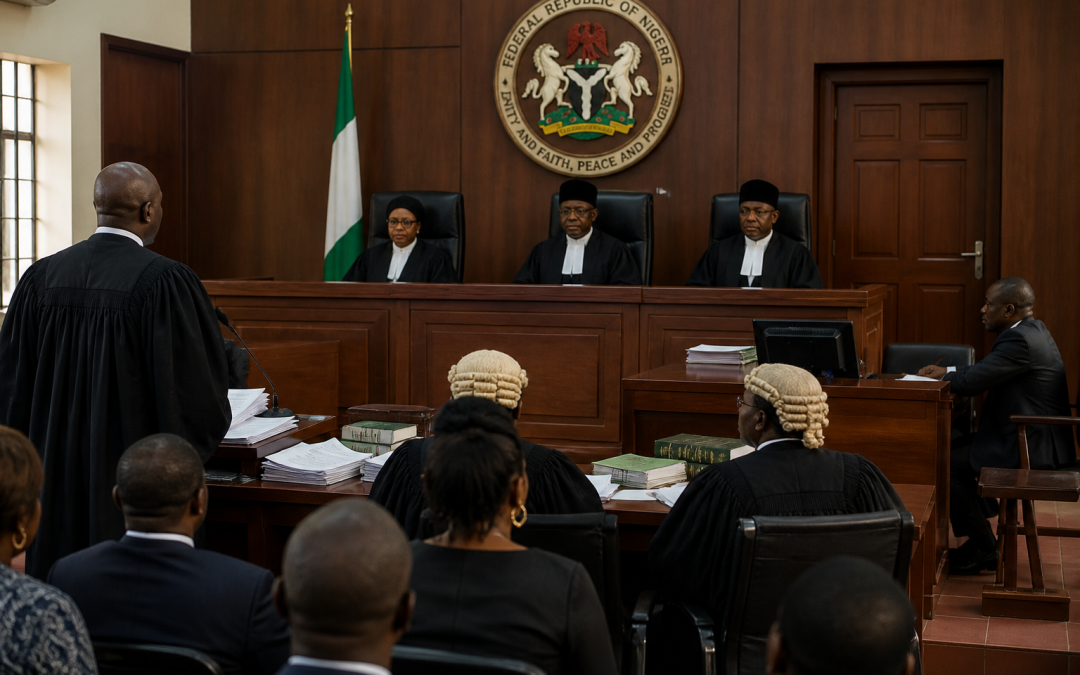
In my usual juridical survey, I stumbled upon the case of *Gomez v. C. & S.S (2009) 10 NWLR (Pt. 1149) 223 (SC),* wherein a question that has troubled courts for years was put to rest. Though it prima facie looks simple, but is quite tricky in application.
When a court decides on jurisdiction, is that decision final or merely interlocutory? And more importantly, when must an appeal be filed? At first glance, you might think, “Ah, this one is straightforward”, but far from it.
This issue did not start with us. It came all the way from England, the same England that conceived, gestated, birthed, and weaned our Nigerian legal system.
Two cases. Two principles. Two completely different directions. We have *Bozson v. Altrincham Urban District Council (1903) 1 KB 547. On the other hand, Salaman v. Warner (1891) 1 QB 734.*
Now, here is where the confusion began.
Under *Bozson,* the court, *per Lord Alverstone, C.J.,* looks at the effect of the decision. So, if a court is faced with an application, usually a motion on notice; challenging its jurisdiction, and upon considering the application with the reply made thereof says: “I do not have jurisdiction; I therefore strike out the matter,”
that is the end of the case in that court. Nothing remains, and that decision is FINAL.
But if the court says: “I have jurisdiction and I shall proceed to hear the matter on the merit,”
that decision is interlocutory, because the real issues are still alive.
There is also *Salaman v. Warner.* Under Salaman, the focus is not on the effect of the decision, but on the nature of the application. *Per Fry, L.J.* opined that: whether the court says it has jurisdiction or it does not, both are interlocutory. Put differently, the order is to be classified as interlocutory in either case because it was made upon an interlocutory application.
You see the problem now?
One says look at the result.
The other says look at the process. And that was how both decisions continued their legal argy-bargy, dancing back and forth like a pendulum that refuses to settle.
Now the question is, what did Nigeria do?
Did we join the dance?
The answer is No!
Nigerian courts, in their usual wisdom, refused to entertain confusion. They picked one test and settled with it.
That test is the *Bozson test.*
This position was firmly reaffirmed in the said case of *Gomez v. C. & S.S (2009) 10 NWLR (Pt. 1149) 223 (SC),* where the Supreme Court, constituted of five panel of justices and presided over by the Law *Lord Niki Tobi, JSC, with Oguntade, JSC (of blessed memory)* delivering the lead judgment, made it clear that Nigeria prefers certainty. No room for the English style of “let’s see how it goes.” Therefore, a decision that the court has jurisdiction is interlocutory. Conversely a decision that the court does not have jurisdiction is final because there is nothing for the court to decide after holding that it does not have jurisdiction.
The court stated further that even earlier, in *Akinsanya v. U.B.A. Ltd. (1986) 4 NWLR (Pt. 35) 273, Eso, JSC* had already warned that allowing both tests to operate would only create confusion. According to him, the law should be workable and certain, not something that sends lawyers rummaging through books in search of answers.
So, yes, Nigeria chose clarity over chaos.
One may, however, ask, “But that was since 2009; what if the Court has made a U-turn?” Good question, indeed. This writer took further effort to confirm the most recent position.
In *Heritage Banking Co. Ltd. v. N.U.C. (2017) 5 NWLR (Pt. 1557) 104 (SC) and C.G.G. (Nig.) Ltd. v. Eronini (2019) 14 NWLR (Pt. 1692) 219 (SC),* the Supreme Court remained consistent on the said position.
Then came the more recent authority, according to my research: *Igoin v. Ajoko (2021) 17 NWLR (Pt. 1804) 90 (SC),* and the Supreme Court did not mince words and provided ipsissima verba as follows: “An order of court striking out or dismissing a case… for want of jurisdiction determines the rights of the parties… there is nothing left… the decision is final… It is not an interlocutory decision.”
At this point, the law is no longer shaking. It is standing firmly like the Aso Rock; let me borrow the words of my brother R.K. Rasheed, the decision stands firm:“like Kano State June/July rain fall.”
In light of the above, it can be said that the extant position of the law is this:
Where the court says: “I have no jurisdiction” and strikes out or dismisses the case, that decision is FINAL, and pursuant to section 25 of the Court of Appeal Act, the appeal must be made within 3 months (in civil cases) or 90 days (in criminal cases), as the case may be.
However, where the court says: “I have jurisdiction and I shall, in view of that, proceed with the merit of the case,” that decision is INTERLOCUTORY, and the aggrieved party must appeal within 14 days pursuant to the same section of the Act.
It can therefore be said that a decision on the issue of jurisdiction is treated as an exception to the general rule that an order that does not settle the matter in contention is interlocutory, while one that settles it is final. This is because, considering the pride of place that the issue of jurisdiction occupies in adjudication by a court, even though a decision that a court has no jurisdiction to entertain a case is not a decision on the merit with respect to the rights of the parties in the claim, it is a final decision. This is because the court is, by virtue of that fact, ipso facto devoid of the authority to further entertain the suit and cannot proceed to determine same on the merit.
While the order that says “I have jurisdiction” is interlocutory, any party aggrieved shall appeal within the 14 days.
At this point, you may want to start overthinking it:don’t. Whether it sits well with your logic or not, the court has spoken. It’s an adage in the Hausa language that: “Shari’a saɓanin hankali”: meaning; the law often runs contrary to reasoning or common sense.
As for whether England is still dancing their argy-bargy dance on this issue and refused to settle for one position like Nigeria, I honestly do not care to confirm, because I am not really a friend of foreign cases. After all, they are merely persuasive in our courts.
In sum, the extant position is that where a court declines jurisdiction and strikes out or dismisses a case, the decision is final and appeal lies within the prescribed time for final decisions. However, where the court assumes jurisdiction and proceeds to hear the matter, the ruling is interlocutory and appeal must be filed within 14 days.
In light of the above, I say no more, hoping I have made the point clear.
Thank you, for following through, my dear readers!
________________________________________________________________
Isah Bala Garba is a Level 400 student of Common and Islamic Law and a Senior Advocate of Bayero University, Kano,(SABUK).He has authored numerous legal articles and analyzed many cases in clear, plain language. He can be reached for comments or corrections via: Email: isahbalagarba05@gmail.com | Tel: 08100129131