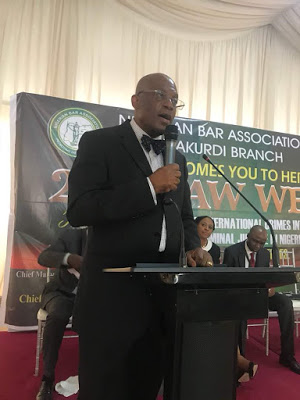
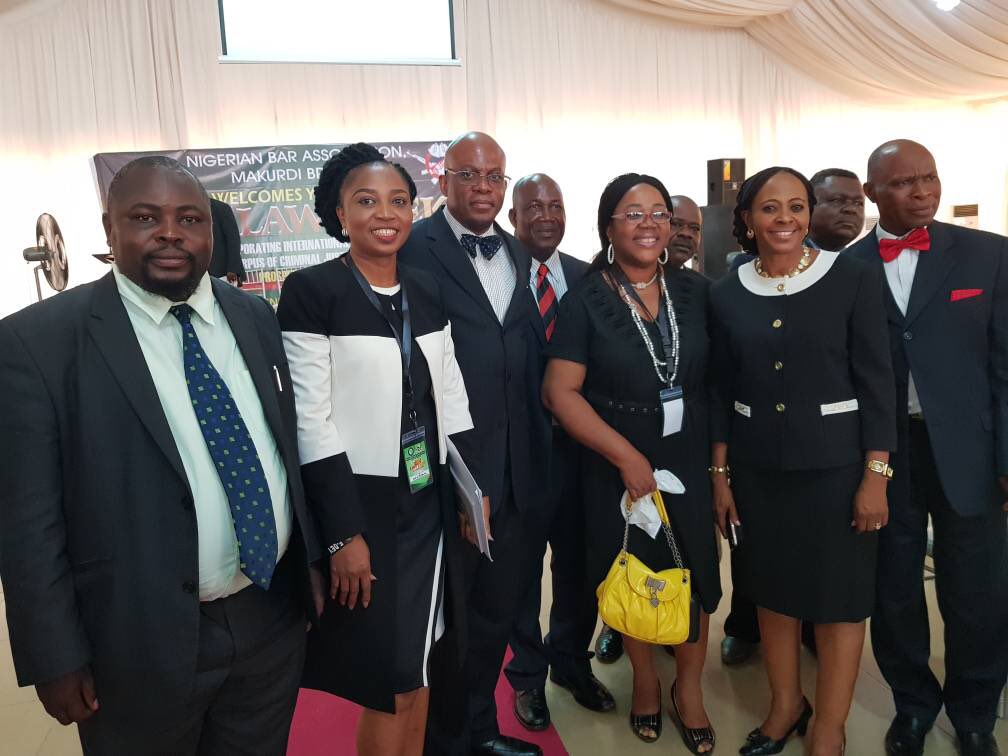
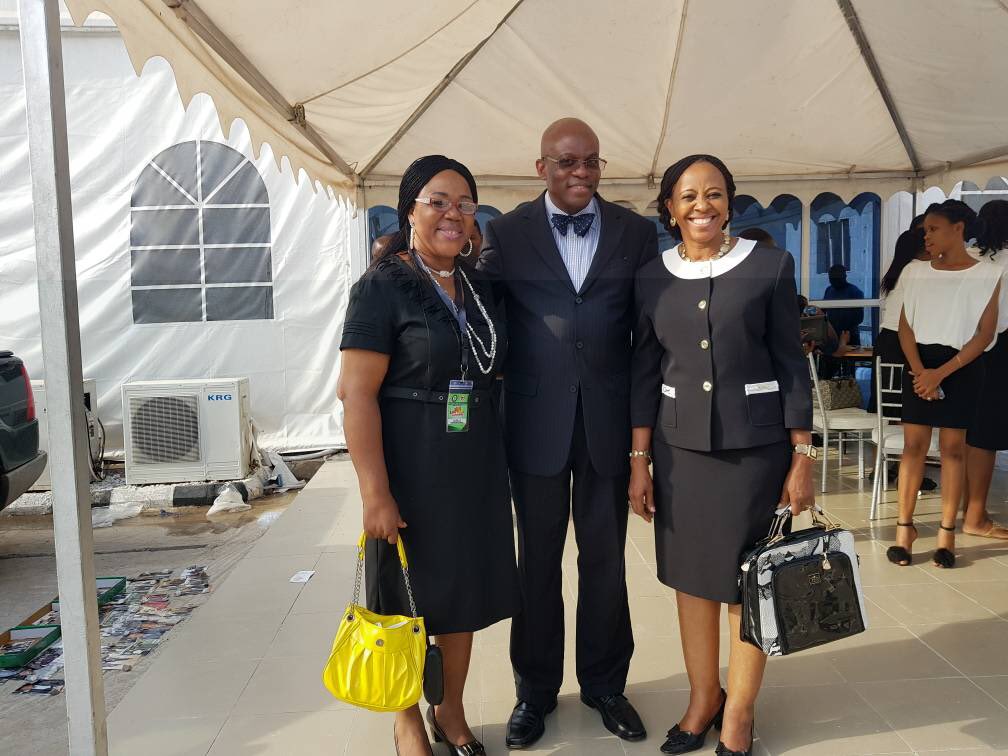
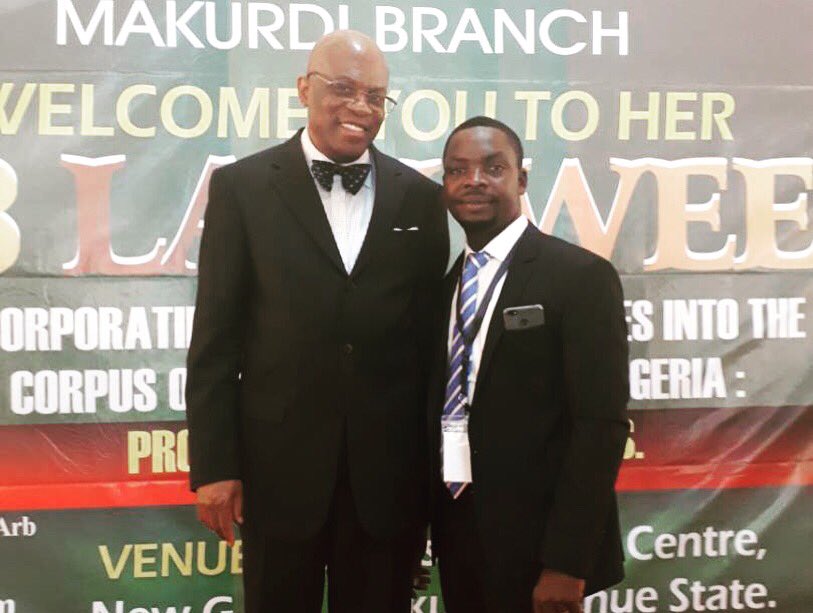
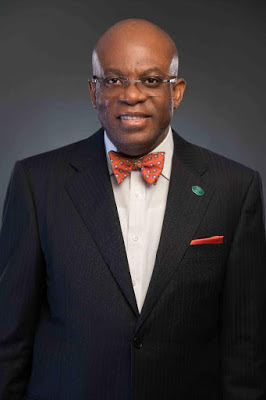
The Place of Pupillage and Mentorship in the Future of Legal Practice in Nigeria | Paul Usoro SAN

The Place of Pupillage and Mentorship in the Future of Legal Practice in Nigeria | Paul Usoro SAN


“The
topic ” The Place of Pupillage and Mentorship in the Future of Legal
Practice in Nigeria” is very hot because the standard appears to be
falling and most people equates pupillage  with housemanship.

Pupillage is not exactly the same
as Mentorship. Pupillage simply means understudying a person in order to better
your knowledge and understanding of legal practice. Mentorship on the other
hand is a platform for junior lawyers  to look up  to the senior lawyers
to guide them. Mentorship is not formal like pupillage. A mentor shows you the
pothole to avoid and the things to know so as to have a successful practice.

Pupillage is a mandatory
programme for the training  of barristers in the UK. In Nigeria we have a
fused practice. Our pupillage must be able to accommodate the transaction and
litigation aspect of our legal practice. Mentorship is voluntary and does not
form part of the qualifying process. It has no formal arrangement like
Pupillage.

The essence of both Pupillage and
Mentorship is to improve the standard and quality of lawyers in legal practice.

If our Pupillage programme is
going to be part of the qualifying process, then it should be regulated by the
Council of Legal Education.

The firms that the young lawyers
will be attached must be firms with a certain standard. Standard must be set
and maintained for our firms.

The issue of minimum wage during
pupillage is an issue that must be factored elaborately.
I support mentorship as
well as pupillage because it helps you to build a successful and sustainable
practice as mine. I served here in Makurdi at the Law Firm of George Uloko
& Co. I was not paid big money but the foundation of what I am today
was built here in Makurdi.

The basis of our profession is
seniority/respect. Our Juniors must learn how to respect the senior lawyers and
should not see all of them as unworthy of emulation. The bar we should build
must be an inclusive bar that has a place for the junior lawyers to grow with
respect for the senior lawyers “

2018 Career Training For Lawyers – 3 Days To Go

2018 Career Training For Lawyers – 3 Days To Go

The Creative Industry in Nigeria is one of our greatest exports to the world. The Arts, Entertainment & Recreation Sector contributed 2.3% (NGN239biliion) to Nigeria’s Gross Domestic Product (GDP) in 2016.
According to ‘PWC’, the North American sports industry is expected to reach $73.5 billion by 2019 and the Nigerian Sports Industry also has enormous potential as well.

These industries require more lawyers with the requisite competence to service its legal framework and players. Participate in the Career Training For Lawyers and give your legal career the boost it deserves while improving your competence in the Entertainment, Sports and Creative Industry.
Modules include Entertainment Law, Sports Law, Mediation, Forensic Document Examination, Intellectual Property Law and Finance for Lawyers. 
The details of the training include – 
Date – 26th and 27th April, 2018
Venue – LCCI Conference & Exhibition Centre, Nurudeen Olowopopo Drive, Alausa, Ikeja 
Time – 9am – 5pm daily 
REGISTRATION
Fee per delegate: N30,000 
ACCOUNT DETAILS–
Lawlexis International Limited
Fidelity Bank
4011176564
Note that all Payment confirmation and Delegate Information should be sent to lawlexisinternational@gmail.com or call 08055424566.

#RegisterNow #LegalCareer #LegalTraining
Sexual Assault by Penetration

Sexual Assault by Penetration


Section 259 of the Criminal
Law of Lagos State, provides that;

“Any person who penetrates
sexually the anus, vagina, mouth or any other opening in the body of another
person with a part of his body or anything else, without the consent of the
person is guilty of a felony and liable to imprisonment for life.”

This offence is known as
sexual assault by penetration and it means that the following acts are
punishable, under that section;

1.      A
man (or woman) forcibly penetrating the body of his/her spouse, sexually. This
is referred to in some countries as spousal rape.

2.      Forcible
sexual penetration of a member of the same gender.

3.      The
sexual assault need not involve the genitals, to violate the provisions of this
section as penetration with objects, (so long as it done in a sexual manner) is
now clearly included.

4.      This
offence also covers an unwelcome sexual penetration of the anus, mouth or any
other opening in the body of the victim. Anal rape for instance, is now be
punishable under this section, in Lagos State.

Please note that this
offence is punishable with life imprisonment; same as rape.

It is important to note that
as of today, as far as this writer knows, this provision has only been enacted
in Lagos State (there is a similar provision in Section 1 of the Violence
Against Persons (Prohibition) Act, 2015, (VAPPA) which defines rape to include
all acts included in Section 259 of the Lagos law. But this law is applicable
only in Abuja).

In other states, the
Criminal Code/Penal Code, provides for rape and defines it to mean the unlawful
penile penetration of the vagina, without the real consent of the victim. These
laws do not recognise for instance, spousal rape, anal rape or even same gender
sexual violence. All these fall under indecent assault which is punishable with
three years imprisonment (in the case of a male victim) and two years
imprisonment, in the case of a female victim. The punishment for these, in this
writer’s opinion, is not enough to serve as punishment or a deterrent, for the
commission of these offences. This is so because, penile-vagina rape is
punishable with life imprisonment, under the Criminal and Penal Codes. It is
therefore inexplicable, that other forms of sexual violence, subject of this
discourse, and in which the victim is supposedly in a similar or even worse
situation than the victim of penile-vagina rape, carry such a negligible term
of years, as punishment.  

One of the applaudable
innovations of the VAPPA, is that Section 1(4) thereof provides that a register
for convicted sexual offenders shall be maintained and made accessible to the
public. This will not only serve to deter the commission of sexual offences,
but will also help to protect any prospective victim from falling prey, since
background checks can now be done on persons. It will be very beneficial, if this
provision can be enacted and implemented by all states of the Federation.

In conclusion, since sexual
offences come in different forms, our laws must recognize this and be dynamic,
to ensure that justice is served, at every material point in time. It is the
writer’s wish that other States begin to amend/alienate their criminal laws, so
as to ensure adequate protection for victims of sexual assaults, that adequate
punishment is meted out to offenders and to ensure ultimately, the safety of
lives and dignity of all, living within their jurisdictions.

 Zeniath Abiri 

Abiri & Mustafa 
Source – LinkedIn 

Dissolution Of Marriage Contracted Under Islamic Law | Zeniath Abiri

Dissolution Of Marriage Contracted Under Islamic Law | Zeniath Abiri


There
are two major ways through which a marriage contracted in line with Sharia or
Islamic principles, can be dissolved, which are;

1.     Talaq
and

2.     Khul’u.

In
view of the fact that the second method of dissolution of marriage is less
discussed and consequently, less known in this part of the world when compared
to Talaq, focus shall be on Khul’u in a bid to shed more light on the subject..

The Khul’u System of
Dissolution of Marriage.

Khul’u
means the dissolution of a marriage, usually on the giving of  something
of value, by the wife, to the husband. It is initiated at the instance of the
wife, against her husband, where she is so unhappy in her marriage, or the
relationship between her and her husband, is so strained, that a harmonious
relationship between them, as spouses, is impracticable. Certain scholars take
the position that for Khul’u to be effective, the dissatisfied wife may, as
consideration for the divorce, surrender the dowry and other material gifts,
where necessary, to her husband, to compensate him for his material losses. The
husband on the other hand, may, if he likes, waive his right to compensation,
and simply agree to divorce her. Once Khul’u occurs, it is an irrevocable form
of divorce. This system of divorce is sometimes referred to as ‘Khula’.

The
most well-known story that references khul’u and serves as the basis for legal
interpretations, is the story of Jamilah, the wife of Thabit ibn Qays:

1.     Narrated Ibn ‘Abbas: The wife of Thabit bin Qais
came to the Prophet (PBUH) and said, “O Allah’s Apostle! I do not blame
Thabit for defects in his character or his religion, but I, being a Muslim,
dislike to behave in un-Islamic manner if I remain with him.” On that
Allah’s Apostle (PBUH) said to her, “Will you give back the garden which
your husband has given you as Mahr (dowry)?” She said, “Yes.”
Then the Prophet (PBUH) ordered to Thabit, “O Thabit! Accept your garden
and divorce her once.” See  http://www.searchtruth.com/book_display.php?book=63&translator=1&start=0&number=197

There
are two principal ways for a wife to achieve divorce through Khul’u;

(i)                 She
informs her husband that she no longer wishes to remain in marriage with him;
and requests that he divorce  her.

(ii)               If
her husband is not willing to grant her a divorce, the wife is well within her
rights in Shariah, to approach a Sharia Court and present her divorce case to the
Kadi (Shariah Court Judge) The Judge would then summon the husband and ask him
to declare a divorce upon his wife and free her from the marriage. If the
husband for any reason refuses, the Sharia Judge,
irrespectively, may declare a divorce between the husband and the wife of the
marriage, if he is satisfied that peaceful coexistence in matrimony, cannot be
achieved by the parties.

Once
the wife expresses her desire to exercise her right under Khul’u, two
circumstances may arise,

1.     Both
the husband and wife mutually decide to divorce or the wife wants it, and
certain conditions are agreed upon, between the couple. In this case, the
couple need not have recourse to law, as it is enough to meet these conditions,
and then for the couple to pronounce that they are now divorced from each
other.

2.     A
wife wants it, but the husband is reluctant, and insists on the subsistence of
the marriage, despite the wife’s resentment to it. In this latter case, the
wife may proceed to the Sharia Court, and have her petition for the grant of
khul’u, heard. The following questions must be resolved;

–         Can
anything be done at all, to salvage the marriage?

–         Is
the wife entitled to such separation? If so, under what circumstances?

–         Can
the Khadi (a judge of the Sharia Court) dissolve the marriage, despite the
husband’s insistence on its continuance?

·        Because
the laws of khul
ʿu in particular cannot be found in the Qur’an
directly, a Sharia court
judge must discern from Hadith and Islamic jurisprudence historical cases what
they believe to be valid reasons for this system of divorce. See Macfarlane,
Julie Islamic Divorce in North America: A Shari’a Path in a Secular
Society
 Oxford: Oxford
University Press
, 2012, p. 168-9.

In
Usman v Usman (2003) 8 NWLR (Pt. 208) 253 CA @ pp 129 – 130 paragraphs H – D,
the wife requested a divorce due to cruel conduct by the husband. The
husband refused to agree to the divorce and the Kadi dissolved the marriage and
ordered the wife to refund the estimated amount of the bridal gift and marriage
expenses. The Court of Appeal affirmed the divorce.

 It
must be noted that a kadi cannot compel a wife seeking divorce through khul’u,
to explain her reasons. Though it is desired that she does, it is enough for
her to state that she is discontented with her marriage and is no longer
interested in continuing with the marriage relationship. The kadi will
grant divorce, if he is satisfied that harmonious co-existence between the
couple is no longer feasible or the continuance of the union is strongly
resented by the wife, and/or that the couple would transgress the bounds of
Allah, if the divorce is not granted.

Issues that are Usually
Considered, Upon a Petition for Khul’u.

Compensation:

While
many scholars agree that the man is not entitled to more than the initial
amount of dowry (mahr/dower), given to the wife at the time of celebration of
the marriage, others do not think he is entitled to any compensation at all
while a few think he is entitled to more, especially where the wife has
attained a certain higher social status or is in a better financial standing,
by reason of the marriage. But what has been applicable in Nigeria, is that the
woman returns the dowry along with other wedding gifts, given to her, by her
husband. A considerable number  of scholars have said the principle of
compensation is to apply, only when the husband is not at fault. They base this
idea on the fact, that Islamic law does not help the transgressor or wrong
doer, and that the law leans in favour of the party who is less at fault. I
tend to agree more with this group of scholars.

Another
scenario that occurs under this head, is where the unwilling husband to
divorce, requests an unreasonable financial compensation, as in the case of Usman
v Usman (supra),
where the husband was requesting for half a million Naira
as compensation.

Custody:

·        Usually,
the issue of custody of the children of the marriage, is resolved in favour of
the woman. The man is still expected to provide child care and support, unless
the woman declines this and can afford to care for the children, without their
father’s help. Once a child is old enough, he is given the choice of
determining who has custody. See Welchman, Lynn (1998). Women and
Muslim Family Laws in Arab States: A Comparative Overview of Textual
Development and Advocacy.
 Amsterdam: Amsterdam
University Press
p. 121.

Iddah:

When
a woman is granted a divorce through khul’u, she is required to enter a waiting
period, known as iddah. The waiting period (usually three months), is observed
before she can remarry, to ascertain whether she is pregnant and where she is
found to be pregnant, avoid controversy as to the paternity. If the wife who
has successfully exercised her rights under the khul’u system, finds that she
is pregnant, she must be delivered of the baby before she can be totally free
to remarry. See Tucker, Judith E. (2008). Women, Family, and Gender in
Islamic Law
. Cambridge: Cambridge
University Press
, p. 100-101.

Another
way through which a woman may divorce her husband, in islam, is known as tafwid.
It is a less common system in Nigeria and involves the husband handing over the
power of divorce, to his wife. He may use words like, “I permit you to divorce
yourself from me” or “I hand over to you, the power of divorce”. The wife,
where she accepts it, is expected to say immediately (or a short time
thereafter, but no longer than the next day), “I divorce myself from you”. This
option is usually exercised by the husband, where he does not want the society
to look down on him, for divorcing his wife. It may also be exercised by him,
when the wife requests for it. In the latter case, it becomes a form of khul’u.

In
conclusion, though many may not know this, the khul’u system of divorce is the
most common form of divorce in areas where the Sharia Law is applicable, in
Northern Nigeria. See Nasir, Jamal J (2009). The
Status of Women Under Islamic Law and Modern Islamic Legislation
.
Brill. p. 130 ISBN9789004172739.

Zeniath Abiri
Abiri & Mustafa LP
Source – LinkedIn
Photo Credit – www.muslimvillage.com 
7 Times Mfon Usoro Lawyers Female Table Tennis Champion Shares Her Experience, Says Paul Usoro Is A Pathfinder NBA Needs

7 Times Mfon Usoro Lawyers Female Table Tennis Champion Shares Her Experience, Says Paul Usoro Is A Pathfinder NBA Needs


I have heard people speak about
Paul Usoro SAN as regards his passion to develop the legal profession through
sponsorship of different capacity programmes, some of which challenge the legal
mind, and others are sporting activities which not only challenge the mind and
body, but create relaxation and promote friendship amongst lawyers. I am well positioned to
speak on his involvement in the area of sports, having won the females’ gold
medal and trophy at the MFOM USORO LAWYERS’ TABLE TENNIS CHAMPIONSHIP (An annual
lawyers table tennis competition sponsored by Paul Usoro SAN since 2009) for
seven consecutive times.

Table tennis is a passion I nurtured from childhood. I attempted
to develop it to a competitive level then. I needed to go to school but
couldn’t put sports and schooling together. ”Hey, you can’t eat your cake and
have it”, i was told. So I dropped table tennis for school.

While in UNIBEN in 1995, during the West Africa Universities
Games (WAUG) hosted by the school that year, I won a bronze medal in the
females’ doubles in the game and thought that was about the closest I could
come to expressing myself in this area I love so much.

You can then imagine my delight when in 2009, Paul Usoro put
smiles on my face (and that of many other colleagues) by creating a platform
for lawyers to interact in this manner. I have always known that this was
necessary since sports is life, but I never thought anyone could conceive, let
alone birth such an idea in this our otherwise conservative ”fit and proper”
professional environment. I would ordinarily jump at any opportunity for a game
of table tennis without incentives.

Paul Usoro however tied mouth-watering prizes ranging from Law
Reports, Sports Kits, Cash Prizes and Return Ticket to International Bar
Association (IBA) Conferences to it. So, I have everything to play for and
nothing to lose. Thank you Paul Usoro, for giving me the opportunity to eat my
cake and still have it.

Apart from the sponsorship, what amazes me year in and out is
the personality of Paul Usoro and his wife, so much humility and courteousness.
We get treated each time like kings and Queens that sometimes, i get confused
as to who is doing who a favour.

The NBA today is in need of a president that is sensitive to the
welfare of its members. A president that would go to the core to ignite, re
establish and redefine the essence of the association to center around the
lawyer.

NBA is in need of a pathfinder, one who would think outside the
box to open up new frontiers of opportunities to the lawyer (like he did in his
specialized area of practice) and protect existing ones from incursion. A
president who sincerely loves the profession and has demonstrated his sincerity
and commitment to its progress even when political office was not contemplated.
Need I say more?

TITILAYO OMOBOLANLE OSAGIE ESQ.
7 TIMES FEMALE CHAMPION (2010 – 2016)
MFON USORO LAWYERS TABLE TENNIS CHAMPIONSHIP
Source – www.thenigerianlawyer.com 

Paul Usoro, SAN: A Commitment to the Welfare and Empowerment of Young Lawyers

Paul Usoro, SAN: A Commitment to the Welfare and Empowerment of Young Lawyers

Everyone that works is deemed worthy of his pay. This is pretty much an accepted fact in various circles; religious; professional and even in the most informal of settings. This much is apparent to young lawyers who seek to make a name for themselves in the legal profession. This is an issue close to the heart of Paul Usoro, SAN.

As a matter of practice and personal conviction, Paul believes in and is committed to youth empowerment, diversity and inclusion. A few life examples:

  • New hires in PUC being post NYSC enjoy six figures start salaries (minimum of N150,000.00) and are encouraged to tap into the sustainable growth scheme of the firm.
  • Young Lawyers benefit from the Firm’s annual Profit Sharing and Bonus schemes.
  • Of the 5 Partners in PUC, we will mention 2 partners to demonstrate Paul’s investment in the mentorship and growth of young lawyers:
    • Mr Muniru Liadi, a Litigation Partner progressed from entry level post youth service to the position of a Partner.
    • Mrs Adetola Bucknor Taiwo, a Transaction Partner joined PUC 2 years post call and made partner after 6 years in the firm.
  • Youth Corpers posted to the Firm take home a minimum of N50,000.00 monthly and Law School interns have a N20,000 farewell allowance.
  • For nine (9) years and counting, PUC sponsors the Lawyers’ Table Tennis Open (Mfon Usoro Cup), nicknamed the largest sporting event among lawyers. LTTO is a Table Tennis tournament open to lawyers from within and outside Lagos. Travel and accommodation cost for out-of-town lawyers are underwritten by PUC. Prizes include fully paid return flight ticket to the International Bar Association (“IBA”) Conferences and other attractive prizes for 2nd and 3rd positions.
MALE CATEGORY FEMALE CATEGORY
RANK NAME BAR BRANCH RANK   BAR BRANCH
2017
1st TUNJI ABDULHAMEED LAGOS 1ST YETUNDE MARTINS IKEJA
2nd RAPHAEL IPINYOMI IBADAN 2ND TITILAYO OSAGIE IKEJA
3rd KABIR ADELEKE LAGOS 3RD SISAN EZEIKPE LAGOS
2016
1st KABIR ADELEKE LAGOS 1ST TITILAYO OSAGIE IKEJA
2nd TUNJI ABDULHAMEED LAGOS 2ND YETUNDE MARTINS IKEJA
3rd ADEYINKA ADEREMI   3RD TAOFIKAT ODUNUGA  
2015
1ST TUNJI ABDULHAMEED LAGOS 1ST TITILAYO OSAGIE IKEJA
2ND KABIR ADELEKE LAGOS 2ND YETUNDE MARTINS IKEJA
3RD OLUSEGUN FABUNMI IKEJA 3RD ZAINAB OLABODE-SHODUNKE LAGOS
2014
1ST TUNJI ABDULHAMEED LAGOS 1ST TITILAYO OSAGIE IKEJA
2ND OLUSEGUN FABUNMI IKEJA 2ND SUSAN EZEIKPE  
3RD KABIR ADELEKE LAGOS 3RD ANNE AIMUA  
2013
1ST TUNJI ABDULHAMEED LAGOS 1ST TITILAYO OSAGIE IKEJA
2ND ADEYINKA ADEYEMI   2ND YETUNDE MARTINS IKEJA
3RD KABIR ADELEKE LAGOS 3RD GANIAT ALLIU  
2012
1ST ADEYINKA ADEYEMI   1ST TITILAYO OSAGIE IKEJA
2ND TUNJI ABDULHAMEED LAGOS 2ND SUSAN EZEIKPE  
3RD WOLE ODUWOLE 3RD 3RD YETUNDE MARTINS IKEJA
2011
1ST ODUWOLE OLAWALE LAGOS 1ST TITILAYO OSAGIE IKEJA
2ND MOSHOOD ABDULLAHI   2ND YETUNDE MARTINS IKEJA
3RD TUNJI ABDULHAMEED LAGOS 3RD SUSAN EZEIKPE  
2010
1ST OLUSEGUN FABUNMI IKEJA 1ST TITILAYO OSAGIE IKEJA
2ND ADEDAYO OSHODI   2ND SUSAN EZEIKPE  
3RD ONYEKA ANIONWU        
2009
1ST LEKAN IJELU IKORODU      
2ND DAYO OSHODI        
3RD LOOKMAN AGBOOLA        
1ST LEKAN IJELU IKORODU      


Consistency in Supporting NBA and Nigerian Lawyers
It is notable that all the activities highlighted in this write-up predate Paul’s decision to contest for the presidency of the Nigerian Bar Association. His life and actions demonstrate consistency, propelled by genuine altruism. A visionary leader with the right temperament to unify all.

Source – www.barfirst360.com 

COMMUNIQUE OF THE ANNUAL GENERAL MEETING OF THE YOUNG LAWYERS FORUM HELD ON THE 20TH OF APRIL, 2018

COMMUNIQUE OF THE ANNUAL GENERAL MEETING OF THE YOUNG LAWYERS FORUM HELD ON THE 20TH OF APRIL, 2018


COMMUNIQUE OF THE ANNUAL GENERAL MEETING OF THE YOUNG LAWYERS FORUM HELD ON THE 20TH OF APRIL, 2018 AT THE NIGERIAN LAW SCHOOL AUDITORIUM, LAGOS STATE 

Preamble:
At the Annual General Meeting of the Young Lawyers’ Forum summoned by the Wada Ahmed Wada led governing council of the Young Lawyers’ Forum slated for 3pm the members of the Young Lawyers’ Forum gathered at the venue and waited for about 2hours. There was no communication from the Executives or any of the members of the Governing Council as to the position of the AGM.
At about 5pm it became obvious that the Chairman, Wada A. Wada and his team had deliberately boycotted the meeting and the 13 Branch Chairmen present moved that the meeting be called to order.
Consequently, Mr. Richarmond O. Natha-Alade, the Branch Chairman of the Young Lawyers’ Forum, Ibadan Branch, drew the attention of the members to Article 17 of the Nigeria Bar Association Uniform Bye Law which empowers the AGM to appoint a member to act in the absence of the Chairman or the Secretary or any member of the Governing Council of the YLF.
Pursuant to the above provision and in strict compliance with the NBA Constitution, Mr. Bolaji Adeoye, the Branch Secretary of YLF, Ibadan Branch, thereafter moved a motion that Mr. Charles Ajiboye of the Ikeja Branch be appointed to preside as the Chairman at themeeting. Mr. Ageherario Emamanuel of Warri Branch seconded the motion moved by Mr. Bolaji Adeoyefollowing which the AGM resolved and appointed the said Charles Ajiboye as the Chairman while Mr. Oghenevwarhe Ohwonohwo, Chairman Efurun Branch was equally appointed as the secretary for the purpose of the meeting
It was proposed and resolved by a motion moved by Joseph Asawa of Port-harcourt and supported by Mr. Paul, the Chairman of Katsina Branch YLF, that the meeting proceeded as the Annual General Meeting of the Young Lawyers Forum. However, Mr. Okon of EpeBranch moved a counter motion that the meeting should proceed as a mere meeting of members rather than as AGM which was supported by Ezekiel Olugbenga
To reach a resolution, a vote was taken in which 64 persons voted in support that the meeting be constituted as the AGM of the Young Lawyers Forum while only 2 persons voted in support of the counter motion that it be a mere meeting.
Accordingly, the meeting commenced as the AGM of the YLF following which Mr. Chairman proposed the Agenda for the AGM for adoption as follows:
1. Opening Prayer
2. Constitutional Review Committee
3. Succession Plan of Executives
4. AOB
5. Adjournment
6. Closing Prayer.
Mr. Jude Tejiri of Oleh Branch moved for the adoption of the Agenda and was seconded by Anderson Djegbada of Warri Branch. The Agenda was thereafter adopted.
Constitutional Review Committee:
Following an informal meeting of Chairmen of branches the day before with the National Executives of YLF wherein it was agreed that the YLF makes representation to the Constitution review committee, the house deliberated on several areas of concern.
Mr. Chairman then called for nomination of members to constitute a committee that will be charged with the responsibility of drawing up a memorandum to be sent to the NBA Constitution Review Committee headed by Mallam Yusuf Ali, SAN, to address issues bothering on the welfare of young lawyers and other areas of concern in the NBA constitution under review.
The following persons were nominated and adopted by the AGM as the members of the committee and charged with the responsibilities of drawing up a memorandum and a proposal to be sent to the NBA constitutional review committee within 14days from the day of their appointment. The said appointed members are:
1. Eigbe Alright – Ibadan Branch
2. Djegbada Anderson – Warri Branch
3. Lucky Nwosu – Jos Branch
4. John Afolabi Ogedengbe– Ilorin Branch as chairman of the committee
5. Wakili Gambo – Gombe Branch
6. Dogbajale Memunah – Lagos Branch as secretary of the committee
7. Benjamin Nwosu
Succession Plan of the Executives:
At the deliberations of the above agenda, Mr. KanuStephen of the Ibadan Branch drew the attention of the AGM to the fact that the tenure of the current leadership of the YLF would lapse at the end of July, 2018 and the need to make provisions for succession in order not to have a vacuum could not be under estimated. The house discussed the need to put the Forum in order and implement the NBA constitutional provision for the election of its leaders. 
In his contribution, Mr. Richarmond O. Natha-Alade, of the Ibadan Branch pointed out that the AGM, pursuant to Article 17(d) can take far reaching decisions including but not limited to the elections of its principal officers and urged the AGM to proceed immediately with the elections of its principal officers in accordance with the law. 
The house considered the various reactions and thereafter a motion was formally moved and seconded by Mr. KanuStephen of the Ibadan branch and it was thereafter resolved as follows:
1. That a Vote of No Confidence be passed on the current national leadership of the Young Lawyers Forum led by Wada Ahmed Wada for act of gross misconduct for their deliberate refusal to participate in the AGM which formed part of the Annual Young Lawyers Summit held in Lagos – an AGM they called for. 
2. That an Electoral Committee be constituted by the AGM to fashion out modalities for election into National Executive Offices of the Young Lawyers Forum.;
3. That a communiqué be issued to the public and a letter to the Executives of NBA regarding the outcome of the AGM.
Vote of No Confidence:
In line with the resolution to pass a Vote of No Confidence, several comments were taken on the embarrassment and disregard by the Chairman, Wada Ahmed Wada and his executives. Actual votes were then taken to formalize the motion wherein an overwhelming majority voted in support of the Vote of No Confidence while only 1 person against it. Having taken the votes, Mr. Kanu Stephen moved a formal motion for the Vote of No Confidence and seconded by Binta Salam of Lagos Branch and a vote of no confidence was thereafter passed. The vote was to the effect that they be sanctioned by the National Executives of the NBA for their irresponsible actions.
Electoral Committee:
Pursuant to a prior resolution that an Electoral Committee be set up, the presiding Chairman then called for nominations of persons to be constituted as members of the Electoral Committee, following which the following persons were nominated and thereafter appointed as members of the Electoral Committee of the Young Lawyers’ Forum by the AGM:
1. Akintunji Akinyemi – Ikeja Branch as chairman of the committee
2. Chisom Chude – Okah Branch as the Secretary of the Committee
3. Agherario Emmanuel – Warri Branch
4. Samuel Okon – Epe Branch 
5. Ggbande Terve Paul – Katsina Branch
The terms of reference include; to specifically come up with clear guidelines for the elections as well as to ensure that the elections are conducted at an Annual General Meeting to be held during the 2018 Annual General Conference of the NBA before the NBA AGM.
Adjournment:
After fruitful deliberations, Mr. Samuel Okon of EpeBranch moved for the adjournment of the AGM to the Annual General Conference of the NBA but before the AGM of the NBA Annual General Conference which was seconded by Kanu Stephen.
Closing Prayer:
The closing prayer was said by Deliverance Falaye of Ikeja Branch at about 8pm.
Mr. Charles AjiboyeMr. Oghenevwarhe Ohwonohwo
Presiding ChairmanPresiding Secretary

Advertisements: An Offer Or An Invitation To Treat? | Eseoghene Palmer

Advertisements: An Offer Or An Invitation To Treat? | Eseoghene Palmer


“A communication by which a party is invited to make an offer is commonly
called an invitation to treat. It is distinguishable from an offer,
primarily on the ground that it is not made with the intention that it
shall become binding as soon as the person to whom it is addressed simply
communicates (his or her) assent to its terms. A statement is clearly not an
offer if it expressly provided that the person who makes it is not to be bound
merely by the other party’s notification of assent but only when he himself has
signed the document in which the document is contained”- per Oduyemi JCA[1]
(emphasis mine)

A few weeks ago, in an interview with a client it was
revealed that he (my client) was a past winner of one beauty pageantry; he had
been dubbed the King of some item or theme of the competition, and had a
co-winner, a counterpart who had won the Queen category of the competition. His
major grouse, amongst others, was that having fulfilled all obligations set by
the organizers, including selling tickets and paying the levies, the promise of
a cash price as stated in the advertisement along with other benefits and
packages was yet to be fulfilled, and if the organizers still had the mind to
live up to the promise, it would be coming almost a year late. Of course there
was no signed agreement nor was there a handshake as evidence of acquiescence.
So the question is, was there a contract?

The truth is, this story is just one of the many realities
confronting many winners of show biz competitions. In court the usual defense
for such glaring breach of contract is usually the term “invitation to treat”.

The case of CBN V. S.A.P.N which ruling is stated at the
beginning of this article has given a strict answer to the fundamental question
on “what is an “invitation to treat” and how can it be differentiated from an “Offer”? It must be understood,
however, that not all contracts, particularly, the one in this story, are made
in writing.

There are several classes of contract. It must be noted that
the formation of a contract involves: Offer, Acceptance and Consideration.
Under Simple contracts, we may involve contracts that are merely written on
paper and devoid of complexities or contracts that are merely expressed by word
of mouth between two parties, that is parole contract (oral contract). In
ascertaining whether a person was directly offered something or simply invited
to negotiate between offers, it is pertinent to bear in mind that not all
contracts are clear cut. Much like the above story, a contract agreement can be
inferred by conduct in lieu of signature.

 In Trade Bank PLC v. Dele Morenikeji & Anor[2],
here the answer to the question on whether
an agreement can be oral or inferred from conduct of parties
was
reiterated. A brief summary of the case is thus: the Respondents agreed with
the Appellant Bank for a loan for the exportation of cocoa produce, this was
agreed in writing and executed; the respondent similarly introduced another
contract to import caustic soda with the proceeds of the Cocoa export.
Although, there was no signed agreement in relation to the latter venture, the
bank availed the respondents the money from the proceeds of the cocoa exports.
However, the bank summarily decided to recover all debt due from the respondent
and placed a lien over the caustic soda already imported. The bank went ahead
to sell the caustic soda without informing the respondents. The court had this
to say:

“An agreement can be oral or can be implied from conduct of the parties
thereto. In the instant case, although the initial agreement between the
parties was written, the conduct of the parties shows that there was an extension
of agreement to cover the transaction relating to the importation of caustic
soda, though not in writing.”

In application of this ruling to the
modeling agency story earlier painted, it must be appreciated therefore that for
an agreement to take place between parties there must be a consensus ad idem or a meeting of minds between them, hence, the
terms Offer and Acceptance.

So, at this junction, was the advert,
acted upon by my client, an offer? The locus classicus case of Carlil v.
Carbolic Smokeball Company[3]
readily comes to mind. In that case the defendant company advertised on
newspapers to the effect that it would pay 100 pounds to any person who used a
smoke ball manufactured by it for a minimum of two weeks, and nevertheless
succumbed to influenza. The plaintiff bought one smokeball and used it as specified
and still caught influenza. The company was held liable to the plaintiff for
the 100 pounds. The court held that by the terms of the contract, there was no
need to notify the defendant company of the fact of acceptance. This had
apparently been waived by the company and acceptance took a form of performance.
According to Bowen LJ

“An advertisement is an offer made to all the world: and why should not
an offer be made to all the world which is to ripen into a contract with
anybody who comes forward and performs the condition? It is an offer to become
liable to anyone who, before it is retracted performs the condition…”

Summarily, the answer is simple and
straight. An offer is simply a promise or an undertaking to do something if
certain terms are followed. Whether this is stated orally or in writing, on a bill
board or on the telephone, It becomes a contract when it Is accepted as
evidenced by the conduct or the signature of the other party.

Do not forget that at the very core a
contract is simply: OFFER, ACCEPTANCE and CONSIDERATION.


Eseoghene Palmer

Legal Practitioner

Adedunmade Onibokun & Co.


[1]CBN
V. S.A.P.N LTD  (2004) 37 WRN P. 103
[2](2005)
6 NWLR (PT. 921) P. 309
[3]
(1893) 1 QB 246

Paul Usoro sends goodwill message to Young Lawyers Forum (YLF)

Paul Usoro sends goodwill message to Young Lawyers Forum (YLF)

We must
embrace IT and the innovations it engenders in the practice- Paul Usoro sends
goodwill message to Young Lawyers Forum (YLF)


The learned silk who has pledged
his commitment to the young lawyers’ forum today has sent out his well wishes
to the forum and it has been captured below:

It is with immense delight that I
felicitate with the National Chairman, the Governing Council and the entire
members of the Nigerian Bar Association (NBA) Young Lawyers Forum (YLF) on this
auspicious occasion of its summit, which is scheduled to hold from today,
Wednesday 18 April, 2018 to Friday, 20 April 2018 in Lagos.
Undoubtedly, the theme of this year’s
summit; “Transforming Legal Practice for Young Lawyers: The option of
information and communication Technology”, clearly resonates with the desire of
every progressive lawyer, particularly as it relates to the development of
legal practice in the area of Information and Communication Technology (ICT).
Indeed, legal practice globally, has become IT based, and we will be stagnating
the legal practice in Nigeria if we do not embrace IT and the innovations it
engenders in the practice.

The future of legal practice in
our dear country, Nigeria, rest in the hands of the young lawyers, and as
seniors at the bar, whether individually or collectively, we have a
responsibility to make legal practice more enthralling, formidable and
lucrative for the young Lawyers, in line with global trends. Moreso, the
Nigerian government obviously has a critical role to play in making the
internet access seamless and affordable. The NBA leadership must, therefore, be
able to prevail on government to live up to this expectation. It is only by
this means that we can be certain of a bright future of the legal practice in
Nigeria.


I congratulate and thank members
of the YLF immensely on/for this giant stride and wish you all a propitious
summit.

Long Live the NBA Young Lawyers
Forum!

Long Live the Nigerian Bar
Association!

Long Live the Federal Republic of
Nigeria!

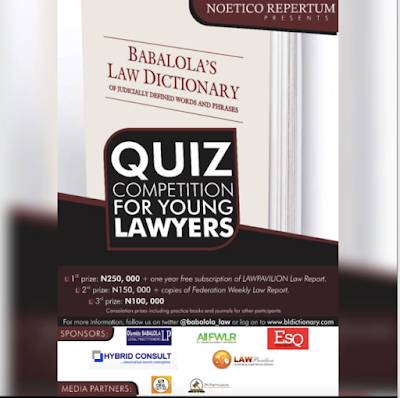
40 young lawyers shortlisted for 2018 Babalola’s Law Dictionary Quiz competition

40 young lawyers shortlisted for 2018 Babalola’s Law Dictionary Quiz competition

In a bid to further deepen the
culture of reading and mastery of legal terminologies, about 40 young lawyers
practicing nationwide have been shortlisted for this year’s edition of the
Babalola’s Law Quiz Competition for young lawyers between 0 and 7 years’ post
call. The competition which would hold at the Onikan Youth Centre, Lagos on Friday,
the 1st day of June 2018
 promises to be keenly contested as the
shortlisted young lawyers are drawn from all the states of the federation
including the FCT.


The prizes to be won are:


1st Prize = N250, 000 and one
year free subscription of law pavilion electronic law report.


2nd prize = N150, 000 and FWLR
report


3rd prize = N100, 000


And other consolation prizes.


The names of the shortlisted
contestants are as follows:


1.    
Nathaniel
Ojobo      (Portharcourt)

2.     Temidayo
Adewoye (Lagos)

3.     Uche
Amahalu (

4.     Evelyn
Aniete James

5.     Abdulateef
Abdul

6.     Henrietta
Ogunbor

7.     Emmanuel
Ejim

8.     Anthony
Sidi

9.     Promise
Ajumebor
10. Samuel
Jacob

11. Yvonne
Nweke

12. Omowunmi
Akinmuleya

13. Wesley
Tamara Kemefa

14. Fisayo
Okuboyejo

15. Morisola
Alaba

16. Afurmchi
Ottah

17. Ahmed
Danfulani

18. Emmanuel
Okpara

19. Adam
Ndakudu

20. Olajide
Abiodun

21. Chidebere
Samuel

22. Adavize
Alao

23. Emmanuel
Ogazi

24. Eniola
Ojo

25. Olabisi
Ahmed

26. Ogbudike
Christabel

27. Sheriff
Tijani

28. Esohe
Omoruyi

29. Emmanuel
Ejim

30. Mojisola
George

31. Chizorom
Nweke

32. Chisom
Akabogu

33. David
Oyero

34. Maryanne
Nwokolo

35. Benedict
Onyeodi

36. Francis
Afolabi

37. Aderinboye
Clement

38. John
Chikaelo

39. Henry
Ikwunemere

40. Binta
Salam


Entry is still open till 30th
April 2018
. To enter the competition, log on to  www.bld.com