
Implementing The Child Rights Act In Nigeria: Alternative Strategies  | Fifehan Ogunde

Implementing The Child Rights Act In Nigeria: Alternative Strategies | Fifehan Ogunde

On 30th November 2019, it will be 30 years since the Convention on the Rights of the Child (CRC) was adopted by the United Nations General Assembly. Nigeria became a party to the CRC in 1991, just two years after. In order to incorporate the provisions of the CRC into Nigerian law, a Child Rights Bill was proposed in 1993 but was opposed by conservative religious groups and traditional rulers on grounds of incompatibility with religion and culture.

The Nigerian Child Rights Act (CRA) was eventually enacted in 2003 further to the recommendation by the UN Committee on the Rights of the Child in 1996 to enact legislation in this respect. Nearly 16 years after however, it is yet to be universally implemented in Nigeria. About 24 states have implemented the Child Rights Act with 12 states refusing to implement the Act. Of the 12 states, nine are in the North-East region of Nigeria which has the lowest literacy rates and highest number of child-brides . Many of these states oppose the CRA on grounds of the incompatibility of its provisions with Islamic law.

Numerous calls have been made for these states to incorporate the CRA into domestic law. Unfortunately, the peculiar constitutional arrangement of the Nigerian federation purportedly implies that unless these states incorporate the CRA into domestic law, it remains inapplicable in these states. Legislative competence under the constitution is divided between the federal and state governments. The federal legislature is competent to legislate on matters under the exclusive list and the concurrent list. The state legislature is competent to legislate on matters under the concurrent list. For matters not contained in either list, any federal legislation is only applicable in states to the extent of incorporation under state law. Child rights is a matter under the residual list and as a result, its provisions are only applicable in states to the extent that they are incorporated into the laws of the state. 
 It does not appear as though any of these states are not willing to change their stance with respect to the implementation of the CRA and in any case, as asserted by Ogunniran, trying to reconcile the CRA with Sharia Law is an exercise in futility. This does not however suggest that with respect to child rights protection, the federal government is helpless. Where there is a conflict between validly made federal and state law, federal legislation prevails and such state legislation is void to the extent of its inconsistency. Being federal legislation, the CRA should therefore prevail over any state law that is incompatible with its provisions. Surprisingly, this position is hardly advanced in mainstream arguments relating to child rights protection with emphasis being laid instead on encouraging Northern states to domesticate the provisions. This may be due to the fact that without a corresponding political will on the part of states, substantive implementation of the CRA will not be guaranteed even if its supremacy under the constitution is asserted to void incompatible provisions of Sharia Law for example.
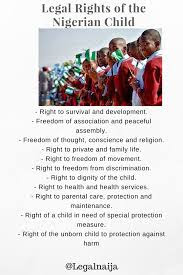
Are there any alternatives? Perhaps focus need to shift towards reforming existing law for the purpose of implementing the provisions of the CRA. In the first instance, fundamental rights under the constitution are deemed applicable to ‘every person’ in Nigeria. According to Section 3 of the CRA, those provisions apply ‘as if they were stated in the Act’. It is in my view not far-fetched to argue that this implies that as far as it relates to children, the CRA should represent the authoritative interpretation of fundamental rights provisions under the constitution.
 Another option is to consider the CRA as being the universally applicable law in matters that relate to children under the exclusive legislative list. For instance, the National Assembly is empowered under the exclusive legislative list to make laws relating to the health, safety and welfare of employees. In this area, the CRA may apply in setting the conditions under which children may engage in labour even in states that have not implemented the CRA. The regulation of ‘prisons’ is also a matter under the exclusive list. The provisions of the CRA prohibiting life imprisonment for juveniles can on this basis be regarded as universally applicable on. Post-primary Education is also under the concurrent list, meaning that in cases where the provisions of the CRA conflicts with state law on post-primary education, federal law prevails. Emphasis may be laid on such constitutional guarantees in order to ensure that CRA provisions in this area is universally applicable. 
The United Nations Committee on the Rights of the Child has particularly suggested reforming existing law to ensure compatibility with the CRC. It is however noted that majority of the subjects of particular relevance to children including offences under the Criminal and Penal Codes applicable to Southern and Northern Nigeria respectively are not covered under either the exclusive or concurrent legislative list. Consequently, legislation enacted for the purpose of reforming existing law will still face the problem of limited applicability.  This has been the problem with enforcing subsequent child-rights friendly legislation such as the Violence Against Persons Prohibition (VAPP) Act 2015 which prohibits, among other things, Female Genital Mutilation (FGM) but is only applicable in the Federal Capital Territory. Another option might be broadly interpreting Item 61 of the exclusive legislative list under Schedule 2 of the Constitution to include certain matters that are covered under the existing Criminal and Penal Codes relating to children.
As evidenced above, there are different ways by which the substantive provisions of the CRA can be universally applicable even without domestic incorporation. Moving away from the incorporation of the CRA into domestic law, there is a stark reality that needs to be confronted one way or another with regards children in Nigeria. The numbers may conflict but current statistics show that Nigeria has the highest number of out-of-school children in the world . A significant number of Nigerian children are suffering from violation of their fundamental rights, even in states that have purportedly implemented the provisions of the CRA. In a legal context, the CRA is hardly used as a tool for child rights litigation and has only been referred to or relied upon in a handful of cases. A significant tool in enhancing child rights protection is the development of caselaw to that effect and the CRA needs to serve as a primary frame of reference in all decisions involving children, even in cases where the parties are adults. 
In all of this, it does not appear as though there is any form of political will either at state or federal level to specifically give effect to the provisions of the CRA. With respect to states that have implemented the CRA, greater effort must be made to ensure that its provisions are implemented. Cases involving children should be dealt with under the CRA in order to establish a significant body of case-law relating to child rights protection. Establishing a body of jurisprudence, no matter how significant, does not however replace the need to ensure that greater awareness is created among civil society of the status and relevance of the CRA. UNICEF Nigeria seems to be taking steps in this regard in ensuring that a copy of the CRC is made available to children in local languages . Reports have also emerged of a child-led petition to the Federal government of Nigeria to amend the constitution for the eradication of child marriage. Whether such awareness-creating steps will generate the necessary political and civil society support remains to be seen. One would Otherwise building an effective child rights protection framework may remain a mere pipe dream.
Fifehan Ogunde

Oluwafifehan Ogunde is an research specialist and consultant with research interests in human rights law, criminal law and constitutional law. He has a Master’s degree in Human Rights Law from the University of Nottingham and a Bachelor’s degree from the University of Sheffield. He is also a barrister and solicitor of the Federal Republic of Nigeria, having been called to the Nigerian Bar in February 2012.

Protecting Electricity Consumers In Nigeria | Jafar Atiku Muhammad

Protecting Electricity Consumers In Nigeria | Jafar Atiku Muhammad

If Nigerians can access safe, reliable and affordable power supply, livelihood would be meaningful, households would be lively, firms would operate competitively and businesses would flourish. This means more jobs for Nigerians and less forex outflows for the importation of foreign products. With a growing economy, a promising population and a GDP of 510 billion USD, Nigeria is acclaimed the largest economy in Africa and its highest FDI attractor.

Unfortunately, Nigeria’s power supply is mirage, and this means that the attainment of its vision 20:2020 depends intricately on its ability to leverage on its energy potentials and accelerate growth in its power sector.
The significance of power to Nigeria’s economy led to the ineluctable need to reform. The dawn of 2005 was greeted by the enactment of the Electric Power Sector Reform Act No. 6, 2005 (the Act), which saw to the unbundling of the electricity infrastructure and opened up the sector to participation of the private sector. Prior to the reform, the entire electricity value chain was fused into a vertically-integrated state-owned monopoly – the Nigerian Electricity Power Authority (NEPA), and consumer rights were basically nonexistent. 
The power sector privatisation and reform programme implied a liberalisation of the Nigerian Electricity Supply Industry (NESI) and privatisation of electricity utilities. This development was followed by surging demands for electricity and the need for a robust framework that will comprehensively protect consumers from the juggernauts of the privatised market, because exploring electric competition calls for intricate questions on how the new industry will be structured, how it should operate and how consumers will be affected.

Credit – www.cfr.org
Consumer protection issues are crucial to the Electric Power Sector Reform, as the purpose of the reform will be largely defeated if the new market also means augmented fraud, endless complaints, customer confusion, and other forms of consumer exploitation.
With a utility as crucial as electricity in private hands, a great percentage of electricity consumers in Nigeria are potentially exploited and are facing daunting challenges in the protection of their rights.
While the exploitation of consumers manifests across all sectors of the economy, especially the deregulated sectors of Nigeria’s economy like banking, telecommunications, etc., the menace is at a greater proportion and poses more significant threats in the power sector. 
Basis of Consumer Protection
Recognising that consumption is the essence of production of goods and services, the Act tasks the Nigerian Electricity Regulation Commission (the Commission) with an important mandate under its Consumer Protection Framework. 
Monye  portrays a picture of the consumer thus: 
There is high incidence of fake and substandard products. The problem cuts across various fields including the supply of services. Most often, consumers find themselves saddled with shoddy services, or even non-performance …the supply of shoddy products and services constitutes a big problem to the consumer.
In light of the above, there is a conscious legal policy by the government inspired by the recognition of the vulnerable position which the consumer occupies in the market place. 
The growth of the energy sector and the consequent expansion of its consumer base have been followed by intense consumer complaints cutting across issues of metering, billing, tariff, poor services, and so on. Hence, the law recognises that consumption is the essence of production, and thus puts in place legal and institutional frameworks for the protection of consumers in the NESI.
credit- energymixreport.com
Consumer protection, no doubt, is one of such instances where state intervention is necessary. An ordinary consumer has the right to a sense of security about the products and services purchased in the marketplace. In the circumstance, a consumer is entitled to enjoy the right to protection against poor quality, right to stop unethical practices and right to see that Consumer justice is done. 
The government has sought to ensure the protection of consumers by assigning specific functions to some governmental agencies.  In the power sector, the state saw the need for administrative intervention institutionalising appropriate legal framework for consumer protection, hence the creation of agencies vested with authority to supervise, monitor and regulate the activities of operators and providers of services.
It follows that consumer protections laws and policies span directly from the fundamental rights enshrined in the Constitution. The right to fair hearing, for example, addresses issues of access to justice and consumer redress as a cardinal principle of consumer protection.
From a rule of law approach, the Nigerian Constitution is extant on the extent of deregulation in key sectors of the national economy vis-a-vis consumer protection. The fundamental objectives and directive principles of state policy under Chapter II of the Constitution, particularly section 16 of the Constitution sets out the economic objectives that should guide regulation, deregulation and reregulation, to the effect that the constitution requires an economy that is efficient but also secures “the maximum welfare, freedom and happiness of every citizen on the basis of social justice and equality of status and opportunity”. Although the legal status of these directive principles is that they are not justiciable at the instant of a person who alleges that his rights have been infringed by the acts of government or another citizen,  this does not mean that they are divested of legal effect as they sought to guide executive actions in Nigeria. Every branch of government ought to reflect these directives in their policies and programmes, and where they fail to incorporate them, or act contrary to their requirement, such actions can be held as unconstitutional. 
Similarly, most of these consumer protections principles replicate the African Charter on Human and Peoples’ Rights, and the Charter, as held in Abacha v. Fawehinmi,  the provisions of the Charter are enforceable in Nigeria as any other law.
Credit – www.pscsolaruk.com 
The Legal Framework
The power sector reform saw to the enactment of the Electric Power Sector Reform Act 2005, which creates a foundation for the protection of electricity consumers in Nigeria. This law is the industry-specific legislation for the protection of electricity consumers and electricity governance generally.
In a quest to reinforce the legal regime for the protection of consumers of goods and services across all sectors of the economy, the Federal Competition and Consumer Protection Act 2019 was enacted to provide a comprehensive legal framework for business competition and consumer protection across all sectors.
The relevant consumer rights’ surveillance and consumer protection institutions are the Federal Competition and Consumer Protection Commission and the Nigeria Electricity Regulatory Commission. While the former is the general consumer protection agency across all sectors enforcing the Federal Competition and Consumer Protection Commission, the later is the sector-specific regulator with mandate of protecting electricity consumers, operating within the purview of the Electric Power Sector Reform Act.
The objects of the Nigerian Electricity Regulatory Commission includes, among others, to ensure that an adequate supply of electricity is available to consumers, to ensure that the prices charged by licensees are fair to consumers and to ensure the safety, security, reliability, and quality of service in the production and delivery of electricity to consumers.  In carrying out the objects, one of the Commission’s functions is to establish appropriate consumer rights and obligations regarding the provision and use of electric services. 
Rights of Electricity Consumers
Prior to the power sector liberalisation and privatisation, consumer rights were left to the whims of the officials of the erstwhile NEPA. One of the innovations of the reform is the establishment of a set of consumer rights. In furtherance of its objects under section 32 or the Act, the Commission is mandated to establish appropriate consumer rights and obligations regarding the provision and use of electric services. In fact, the Commission is mandated by law to issue written reasons for and of its decisions affection the existing rights and obligations of any person(s). Some of the rights of electricity consumers today include:
1. Right to electricity supply in a safe and reliable manner.
2. Right to a properly installed and functional meter.
3. All new electricity connections must be done strictly based on metering before connection.
4. Right to be properly informed and educated on electricity services.
5. Right to transparent electricity billing.
6. All un-metered customers should be issued with electricity bills strictly based on the Commission’s estimated billing methodology.
7. Rright to be notified in writing ahead of electricity service by the DisCo serving the customer in line with the Commission’s guidelines.
8. Right to refund when overbilled.
9. Right to file complaints and to the prompt investigation of their complaints.
10. Any un-metered customer who is disputing his/ her estimated bill has a right not to pay the disputed bill, but to pay only the last undisputed bill as the contested bills goes through dispute resolution by the Commission.
11. It is not the responsibility of any electricity customer or community to buy, replace or repair electricity transformers, poles and related equipments used in the supply of electricity.
Conclusion
On a final note, it is the writer’s conclusion that the designation of the FCCPC as a co-regulator with the NERC in relation to consumer protection and the proliferation of the legal framework for the protection of electricity consumers in Nigeria breed inconsistencies and confusion. The provisions of the Federal Competition and Consumer Protection Act replicates the NERC’s mandate on the FCCPC and dictates its superiority in the event of any conflict with other existing laws, including the Electric Power Sector Reform Act.
This legal regime may be contestable and impracticable, particularly with respect to highly regulated industries, such as the power sector, having specialized skills and industry-specific legislation.
Recommendation
The consumer protection framework of the NESI should be vested exclusively in the NERC, because the dynamics of the power sector requires a certain level of expertise in energy law, electricity consumer protection and electricity governance. This calls for a thorough review and amendment of the Federal Competition and Consumer Protection Act to expunge its relevant provisions that replicate the Electric Power Sector Reform Act and hijacks the mandate of the NERC. These powers need to be clearly defined to ensure that conflicting and a multiplicity of regulatory compliance obligations are not created by the FCCPA. The EPSRA should also be amended and reinforced with more consumer protection principles to reflect the constitutional imperative for consumer protection in the NESI.
Jafar Atiku Muhammad 
The author can be reached onamjafar01@gmail.com 
Reviewing Nigeria’s Constitutional Arrangement: A Few Considerations (2) | Fifehan Ogunde

Reviewing Nigeria’s Constitutional Arrangement: A Few Considerations (2) | Fifehan Ogunde

LEGISLATIVE HOUSE MEMBERSHIP
Further to the constitution, the Senate house consists of 3 representatives from each state. The House of Representatives is comprised of 360 legislators. The basis for this number is not easily ascertained and one would suggest that there is no need for more than one representative from each state.

This will greatly cut expenditure in this regard and increase the availability of funds for relevant sectors of the economy. It is worth noting that members of the Senate and House of Representatives are the highest paid legislators in the world bearing in mind their salaries and allowances. There is little evidence to show that the current number is necessary to effectively exercise the law-making function of the legislative House.

Qualification for membership of the house is on these grounds: minimum age of 35 years (30 years for house of representatives), education up to School Certificate Level and membership of a political party. There is very little stated with respect to the professional experience of the individual with respect to the sensitive function of law-making. It is understandable that as an elected representative of the people, membership qualification with respect to the Senate and House of Representatives should be as diverse and all-encompassing as possible. There is very little in the constitution to guide an assessment of the suitability of law-makers for the position. This itself is in need of review. Furthermore, there is no limit to the number of terms for serving as a member of the Senate and the House of Representatives. It may be necessary to introduce some form of limitation in this regard. This could be in a manner similar to the two-term limit imposed on the office of President or state Governor.
ELECTION TO THE OFFICE OF PRESIDENT 
Since 1999 when Nigeria returned to democratic rule following the death of the military dictator, General Sani Abacha, 2 out of the last 4 democratic presidents have been former military administrators. Major-General Olusegun Obasanjo was President and commander in chief of the armed forces between 1999 and 2007 (1999-2003,2003-2007) in addition to occupying office as a military administrator between 1976-1979. The current president, Muhammadu Buhari is also a former military administrator of the Federal Republic of Nigeria (1983-1985). Under the constitution, an individual is allowed to run for president unless he has been previously elected to the office of President at two previous elections. It should however in my view be amended to also exclude individuals who have occupied the post of President and Commander-in-Chief of the Armed offices under the military dispensation which at the moment is not the case. At the very least, a period of government under the military dispensation should be regarded as one term for the purpose of electing an individual to the office of President. It should also apply to those who have occupied the position of Vice-President under previous administrations. 
IMMUNITY
Under the constitution, there is some level of immunity from criminal prosecution for the President and Vice-President of Nigeria as well as the Governor or Deputy Governor of a State. This may be necessary in order to allow these elected individuals perform the functions of office without any unnecessary distractions. However, it is also important to remember that they are individuals elected by a people to whom they are held accountable. The office of President/Vice President should not serve as a form of sanctuary for individuals who may be acting contrary to the interests of the nation in engaging in illegal activities. If the elected officials have engaged in criminal acts while in office, there is little need waiting for their terms to expire before they can be prosecuted. The interests of the nation is sovereign and they are also bound by the laws of the land. Breaching the laws of the land while in office should also be dealt with by the rule of law as is the case for any other individual. They may be absolved from certain requirements associated with prosecution (such as attendance of particular court proceedings) in order to enable them perform their functions pending the decision of the court. Nevertheless there is a need to reconsider the current constitutional position on immunity for elected officials.
LEGISLATIVE LISTS 
Schedule II divides matters of legislative competence between the National and State Houses of Assembly. There are some problematic aspects of these lists. Item 61 of the Exclusive legislative list for instance regards as a matter of exclusive legislative competence ‘the formation, annulment and dissolution of marriages other than Islamic and Customary marriages’. The reasons for this may be understandable (protecting religious and cultural diversity). Nevertheless, such a position makes it difficult to ensure uniformity in the law pertaining to these areas. Bearing in mind the rise in the relevance of respect and protection of fundamental rights even in relation to personal matters such as marriage, one will consider it more beneficial for all forms of marriages to be included in this list. This also helps to dispel any notions of the supremacy of one religion over another. 
In conclusion, the constitution of the Federal Republic of Nigeria is highly complex and intricate. It seeks to balance several competing interests and to a large extent, the attempt to do so is highly commendable. Nevertheless, there are different aspects of the constitution that by nature serve as a hindrance to the implementation of progressive laws in the Nigerian system. The 1999 constitution is largely a reproduction of the constitution enacted in 1979 (almost 30 years ago). A number of significant changes have emerged nationally and globally since then. These changes need to be reflected in our Constitution. 
Fifehan Ogunde

Oluwafifehan Ogunde is an research specialist and consultant with research interests in human rights law, criminal law and constitutional law. He has a Master’s degree in Human Rights Law from the University of Nottingham and a Bachelor’s degree from the University of Sheffield. He is also a barrister and solicitor of the Federal Republic of Nigeria, having been called to the Nigerian Bar in February 2012.

Kidnap of Honourable Justice Chioma Iheme – Nwosu, Ph.D, Justice of the Court of Appeal and Murder of His Lordship’s Orderly

Kidnap of Honourable Justice Chioma Iheme – Nwosu, Ph.D, Justice of the Court of Appeal and Murder of His Lordship’s Orderly

1. The utterly reprehensible kidnap of Honorable Justice Chioma Iheme-Nwosu, PhD, Justice of the Court of Appeal, and the gruesome murder of His Lordship’s orderly should not only unnerve and agitate all of us but must also jolt our collective conscience. Iheme-Nwosu JCA’s car was intercepted and disabled, Rambo-style, by dare-devil criminals who executed her orderly with the proficiency of marksmen right in the heart of Benin City and then abducted His Lordship, all in broad daylight at about 11.30am. As we write, His Lordship’s whereabout and safety remain unknown and of grave concern to all well-meaning persons.
2. This kidnap incident is one too many and utterly condemnable by everyone for and from multiple fronts. First, it truly should be a taboo for criminals to breach and tamper with the safety of judges generally. We made this point in the Nigerian Bar Association’s (“NBA”) Release following the recent kidnap of Honorable Justice Abdu Dogo of the Federal High Court. Given the sensitive nature of judges’ assignments, it behooves on us to make criminal attacks on them most unprofitable for the criminals lest justice becomes imperiled and shackled. This point assumes greater importance in this season when Justices of the Court of Appeal are crisscrossing the Nigerian nation to sit on and dispense justice in election petition matters.
3. The Court of Appeal as most would know is the court of last resort for all House of Assembly and National Assembly election matters and we have plenty of these at this time. Given the sensitive nature of those petitions, these Court of Appeal panels are mostly constituted and made up of Justices who are deployed outside of their normal duty stations. Some of the venues for these Court of Appeal Tribunals are in cities that are inaccessible by air or not easily accessible by air which means our Justices are left with no option but to travel to these locations by road. And, in that process, Their Lordships are exposed to great harm and danger in the hands of underworld men and women.
Couple that with the fact that Iheme-Nwosu JCA was criminally assaulted and kidnapped right in the city where she works and in broad daylight and the conclusion and prospects become inescapable, to wit, that justice and indeed, our democracy is potentially shackled and totally imperiled by the criminal men and women in our midst.
4. Beyond the safety of judges generally, we cannot but wonder what type of bestial and evil people would descend on a woman and a Justice, with such violence and inhumanness, as was meted out to Iheme-Nwosu JCA? 
Have we become so completely immoral and gone so low in our cultural esteem that criminals have no respect whatsoever and howsoever for womanhood? In every culture in our Nigerian society, womanhood is held as sacred and not to be despoiled or attacked. That is why violence against women and rape – which used to be primarily targeted at women – were and are still considered so very reprehensible and low. That is why, even in war situations, the safety of women and children are always considered paramount. It cuts us to the marrow that the criminals in our midst have not only desecrated the temple of justice continually but have now defiled womanhood – the very symbol and nurturers of life, the hands that rock the cradle – with the abduction of Iheme-Nwosu, JCA.
5. The NBA not only condemns in the strongest terms the horrifying and criminal abduction of Honorable Justice Chioma Iheme-Nwosu, PhD, Justice of the Court of Appeal, but calls more importantly for her immediate release and safe return to all of us. The law enforcement agencies owe their assassinated colleague, Iheme-Nwosu, JCA’s orderly the debt and responsibility of fishing out and meting justice to the criminals who so brutally and heinously murdered him and abducted His Lordship. This crime must not end up as part of our crime statistics. We owe ourselves the responsibility of stopping these criminals now. They must not go unpunished. We must start our redemption by ensuring the safe return of Iheme-Nwosu, JCA. Nothing must happen to His Lordship and her abductors must not escape justice.
Paul Usoro, SAN 
NBA President
NBA WOMEN’S FORUM HOLDS INAUGURAL MEETING IN ABUJA.

NBA WOMEN’S FORUM HOLDS INAUGURAL MEETING IN ABUJA.

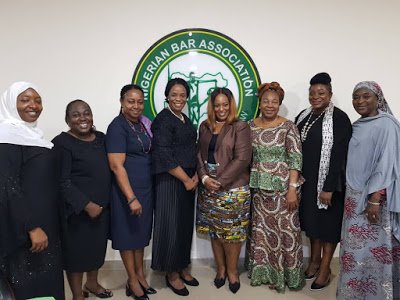
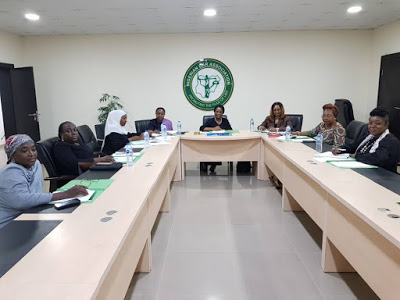
The NBA Women’s Forum held its inaugural General Council meeting today, Wednesday the 30th October 2019, at the NBA National Secretariat Abuja. It will be recalled that the Executive Council of the Women Forum was recently inaugurated by the President of the Nigerian Bar Association, Paul Usoro SAN on the 17th day of September 2019.
In attendance were
Prof. Oluyemisi Bamgbose SAN, Chairperson of the Forum; Mrs Chinyere Okorocha, Vice Chair; Mrs. Nsidibe Aideyan, Secretary and Safiya Iweyi Balarabe, Treasurer. Other members of Council in attendance were H.E Anna Ishaku; Mrs. Florence Fiberesima; Ayotola Jagun and Hadiza D. S. Magaji.
The NBA Women Forum will be an influential voice in the society as well as globally, whilst taking the lead in addressing matters of interest to female lawyers in particular and the well being of women (including the girl child) n general.
 Kunle Edun
 National Publicity Secretary, NBA.
About Outsourcing and Offshoring your Legal Services ! Kelechi Achinonu

About Outsourcing and Offshoring your Legal Services ! Kelechi Achinonu


A bit of curiosity got me thinking
and trying to understand the difference between Legal Process Outsourcing and
Legal Service Offshoring. I did a bit of research and then thought to share my
now better grasp of both concepts.


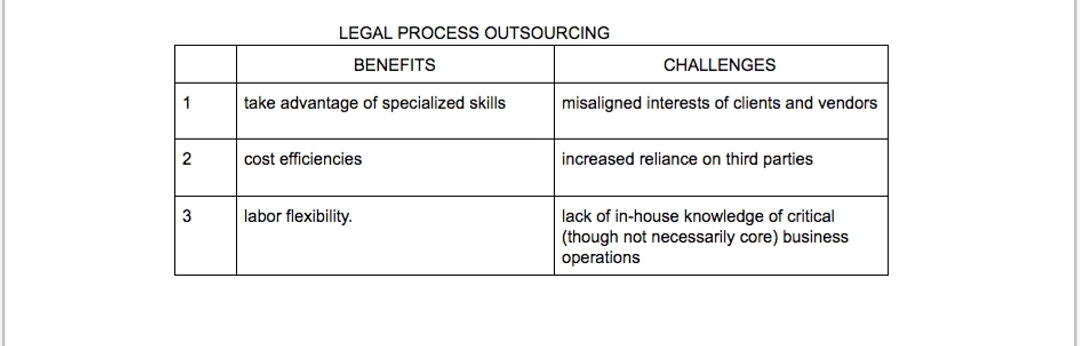
 Legal Process Outsourcing refers to assigning
law-related tasks to an external firm (locally or globally) that is able to
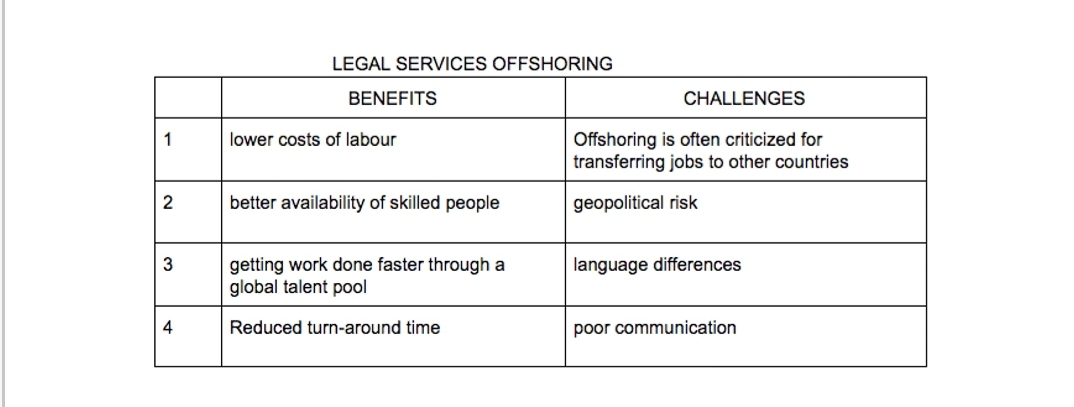
handle those tasks efficiently. Legal Services Offshoring refers to getting
your legal work done in a different country, usually to leverage cost
advantages.
I know they really seem alike, but
one differentiating element turns out to be LOCATION.
For example, let’s assume a tech
company in Nigeria decides to contract a law firm in Nigeria to carry out all
law-ish activities, now that’s outsourcing. But in the case where the same tech
company contracts a law firm in India to carry out the law-related tasks,
that’s offshoring.
Yea, I know it still sounds
somehow….
Okay,
let’s look at some of the benefits and challenges for both concepts. 


This
is what I think. Whether you decide to outsource or offshore your legal tasks,
you should really consider the following:
1.     Competence and
efficiency of the contracting firm
2.     The flexibility of
communication between both parties (to what extent would technology be
leveraged to enhance communication)
3.     The flexibility of
availability for both parties (for instance, in the case of emergency sit-down
talks)
4.     Confidentiality and
Information security ( your data should be really important to you)
5.     Laws and regulations
that would guide such contractual relationship
6.     Your own peace of mind.
Thanks
for reading!
Founder Techlawyered | Technology
Lawyer | LegalTech Advocate | Software Developer
NIGERIA—THE LARGEST ECONOMY IN AFRICA: WHERE DO THE LAWYERS FIT IN? | OLUMIDE AKPATA

NIGERIA—THE LARGEST ECONOMY IN AFRICA: WHERE DO THE LAWYERS FIT IN? | OLUMIDE AKPATA

Introduction
I must thank you for inviting me to this very important community within the NBA, to share my thoughts on a very important and timely issue. In an organization as big as the NBA, it is often easy for members to feel disconnected from the organization. The core value to be derived from meetings like this was captured by the celebrated Chinua Achebe when he said:

‘When we sit under the moonlight with our kinsmen, it is not because we want to see the moonlight – everyone can see it from his own compound. When we come together to feast, it is not because we are hungry- everyone has food in his house. It is because we are one, and it is right for us to do so.’
That is why branch meetings like this are very important and I must commend the leaders of this branch for organizing this meeting. Meetings like this sustain us as a community of lawyers, foster comradeship, and enable us to discuss very topical issues like the one we are here to discuss.
The Place of Lawyers within Nigeria’s Economy
As at October 2019, the IMF assessed Nigeria’s GDP to be slightly above US$ 446.5 Billion. Although this figure indicates a 21.4% drop from what our GDP was in 2014, it still earns Nigeria the title of the largest economy in Africa in terms of nominal GDP. It is often easy to take a myopic view of Nigeria’s position in Africa by looking solely at the nominal GDP and the aggregated performance of all sectors within the economy. Taking that view is quite restrictive and would prevent us from adequately identifying all of the areas requiring the services and finesse that only lawyers can provide. In conversations like this, many people tend to forget that Nigeria is also the largest in Africa in terms of actual human resources. Nigeria has a population of approximately 200.96 million people according the IMF’s most recent estimates. This represents a workforce, a market, and a pool of potential clients for our colleagues who operate outside the core corporate and commercial sphere.
In simple terms, lawyers are the backbone of the economy. Our legal system is founded on received English law, the bulk of which is common law. Common law is a system of laws designed to maximize the wealth of society – the economy. As lawyers, therefore, everything we do has a direct impact on the economy. For example, our colleagues specializing in general contract and property law are performing key functions in the economy as they are concerned with creating and defining property rights or rights to the shared or exclusive use of valuable property, and facilitating the voluntary transfer of property rights into the hands of those who value them the most. In the same vein, our colleagues specializing in general torts law are also serving the economy by protecting personal and property rights. 
Our colleagues specializing in criminal law are also extremely important for the preservation and development of our economy. When battery becomes grievous harm or murder; or when assault becomes sexual assault and rape; or when passing-off becomes criminal deceit or fraudulent misrepresentation; or when trespass to chattel, conversion or detinue becomes extreme and takes on the character of corruption, robbery, theft, or stealing – or as the economist would describe it “the pure coercive transfer of wealth or utility from the victim to the wrong doer” – then criminal law kicks in. Therefore, accentuating the importance of our colleagues carrying on in the critical function of criminal prosecution and criminal defence. Thus, from an economic perspective, criminal law is essentially a more punitive backup to tort law.
Our colleagues specializing in constitutional and administrative law may also feel that their roles within the legal system are tangentially related to wealth maximization and the development of the economy. That is also the wrong view. The law and politics of revenue allocation, election cycles, court system, national budgeting, fundamental rights and the basic principles that should undergird state policy (to mention a few) are largely regulated by the Constitution. These are issues that impact directly on our economic wellbeing as a country. 
The public service and all regulatory offices fall within the purview of our colleagues practicing administrative law, whether as legal officers in government departments or in the private sector. Virtually all businesses done in Nigeria and all taxes paid are conducted and paid through regulatory offices. It is therefore easy to articulate the crucial roles our colleagues in that realm should play or should be playing.
As a developing economy, Nigeria is very reliant on international private capital in the form of foreign direct investment. The capital flows into Nigeria encourage investment in and expansion of our manufacturing (including extractive industries), financial services, communications, technology, power, entertainment, real estate and hospitality sectors. This provides an array of opportunities for lawyers with different skill sets and has triggered an increase in the demand for commercially aware and business savvy lawyers. Business structures and practices within Nigeria are becoming much more complex, nuanced and are evolving rapidly. Regulators, on the other hand, are evolving at a significantly slower rate and this generates regulatory risks and inefficiencies for the businesses operating in Nigeria. In addition to this, when new laws or regulations are enacted, old businesses have to adjust, and the new ones have to comply. This creates a special and unavoidable need for lawyers with a sound understanding of the legal needs of these businesses, their commercial objectives, and the regulatory environment. In fact, industry professionals and business leaders know that they need to maintain a strong relationship with us in order to avoid regulatory landmines, accelerate growth, and maximize returns.
Although, the legal system appears to sit within the economy, a deeper squint would reveal that the economy and finance are actually legally constructed and do not operate outside the law. Financial assets are contracts, the value of which depends largely on their legal vindication. Whether a financial asset will or will not be vindicated is a function of legal rules and their interpretation by courts and regulators. The same holds true for the economy and every sector within it since the economy is essentially the aggregation of the financial and other assets within the country. This means that our duty to serve and protect the legal system imposes an obligation on us to serve and protect the economy. The key roles we play in facilitating knowledge exchange, the interpretation of laws, and law reform also helps in reducing the regulatory risks associated with doing business in Nigeria and encourages the international flow of investment capital to Nigeria.
Above all else, our colleagues in the academia play the most important role because besides the fact that their research facilitates law reform, they dedicate themselves to the training of those who would perform these key functions and serve the economy tomorrow and in the future. 
Having gone through all of the above, the answer to the question of where lawyers fit in becomes significantly simple. Quite literally, lawyers fit in everywhere. We fit nicely into every cell in every sector of Nigeria’s economy; and in those cells, we are the mitochondrion. For those of us who may not remember our elementary biology, we are the powerhouse since we advise on what is legally permissible or not, facilitate the making and interpretation of laws, facilitate the enforcement of rights and the resolution of disputes, provide commercially sound legal advice to the businesses feeding the economy, and most importantly, we train those who would perform these functions tomorrow and in the future. We are the crucial link that bridge the gap between the legislative intention, the judicial interpretation, and the market reality.
To my mind, therefore, the more appropriate question is: do we all have the nuanced skills required to sufficiently perform our roles in servicing the economy?
Nigeria has been a mono-product economy for a very long time, and this has had implications on the structure of legal practice, the required skill set and training needs (pre and post Call). However; in the past two decades, successive governments have made concerted efforts to diversify the productive base of our economy. The progress has been very slow but their efforts have led to significant improvements in telecommunications, power, financial services, agriculture, oil and gas (hydrocarbons generally), media and entertainment, technology, and increasingly, sports. These are all sectors that require nuanced legal services both on the transactional side and on the dispute resolution side. 
Sadly; we, who are supposed to be servicing the economy and all sectors of it, still rely very heavily on the structure of legal practice, the skills set, and training methodologies established under and designed for the slowly fading mono-product structure of our economy. The economy is changing, and with it, the market for legal services is also changing. The problem is that existing and future lawyers have failed to change with the market. We are not dynamic. We are largely still stuck in the 90s. Most lawyers today are not fit for purpose and the more worrisome issue is that even those who are undergoing training to become lawyers may not also be fit for purpose if nothing is done to correct the trend.
For example: Nigeria has been producing hydrocarbons for decades. How many lawyers understand what hydrocarbons are and can comfortably advice a hydrocarbon business on the legal and commercial issues related to the establishment, management, financing, restructuring and dissolution of such a business? We regularly hear of feuds between record labels and artists in the entertainment industry and of feuds between football club owners and their players. How many lawyers understand what contracts and disputes in those sectors entail? The same goes for technology and even general dispute resolution. Dispute in court is the end game in today’s world. It should not typically not get to court if lawyers have done their work well in the contracting stage and at the stages of alternative dispute resolution. Leaving titles and suffixes aside, how many lawyers are actually skilled in alternative dispute resolution? 
Nigeria depends, a lot, on international private capital in the form of foreign direct investment. The providers of this capital do not trust Nigerian lawyers. Typically, they engage English lawyers and only use Nigerian lawyers on specific questions on Nigerian law. Increasingly, we see that many indigenous investors are also losing faith in Nigerian lawyers. They engage foreign lawyers to advise on the technical parts of their transactions and only resort to Nigerian lawyers on specific questions of Nigerian law. Truth be told, the fact that most of us are still able to practice law and earn a living is due largely to the protectionist provisions in the LPA and the RPC. Foreign lawyers are taking away business from us, to the extent they can, and when the AfCFTA goes live, many Nigerian lawyers may be relegated to the sidelines.
Ideally, when the government pursues a policy that encourages development in a specific sector of the economy, that policy should also include modalities for the training of lawyers to service the legal needs of that sector. For instance, a policy designed to encourage the development of the agricultural sector should also include strategies for teaching agriculture in schools, for teaching food and agriculture law to law students, and for providing continuing legal education on food and agriculture law to interested lawyers. But overtime, the government has failed to designed such all-encompassing policies. That does not mean that the NBA must fail too.
The NBA is an extremely influential organization and it must rise to the occasion. It must ensure that the economy is serviced by lawyers who are reasonably fit for purpose. If the government fails to drive the policy on nuanced legal education, the NBA must design and drive that policy. The NBA must ensure that the training methodologies at the universities and the law school are designed to produce lawyers who understand the nuances of the current and emerging market for legal services. The NBA must ensure that there are credible continuing legal education programmes for existing lawyers to support the development of the skills required to provide nuanced legal services.
Conclusion
The productive base of our economy is expanding, and with it, the market for legal services is also expanding. We must ensure that the legal skills we have are fit for purpose and are able to adequately serve the economy. The NBA has a major role to play in designing and driving the policies that will support the development of the nuanced skills set required to service that economy. We must all be committed to ensure that it plays that role to the best extent possible.
Thank you very much for listening. 
Top finance law firm to host 4th AICIF in Lagos

Top finance law firm to host 4th AICIF in Lagos

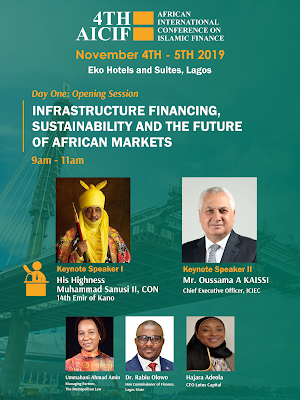
The Met Skills Limited in collaboration with the Metropolitan law firm is set to host the 4th African International Conference on Islamic Finance (AICIF), in Lagos from Monday November 4th 2019 to Tuesday the 5th.
The event, which will take place at Eko Hotels & Suites, Victoria Island, Lagos, will bring together experts in finance, law, infrastructure and various other sectors and segments of the economy.
The two-day conference themed “Infrastructure Financing, Sustainability and the Future of African Markets” will feature the Emir of Kano, his Highness, Muhammad Sanusi II, CON as the first keynote speaker, while Oussama Kaissi, Chief Executive Officer of the Islamic corporation for the Insurance of Investment and Export Credit (ICIEC) of the Islamic Development Bank Group, will give the second keynote.
Speaking about the forthcoming event, the conference chair and Managing Partner of Metropolitan Law Firm, Ummahani Amin disclosed that one of the fundamental goals of the conference was to establish a community of Practice that will serve as a credible resource/support for Islamic Finance deal structuring and create a platform for financial institutions and other key eco-system players to demonstrate their commitment and support for the development of Islamic Finance in Africa.
“With focus on Islamic Microfinance as a tool for financial inclusion, poverty alleviation and promoting economic growth, the AICIF conference hopes to motivate financial institutions to push for more defined regulations on Islamic finance,” she said.
Unveiling some of the speakers at the 4th AICIF, Amin revealed that the line-up included, thought leaders and experts from different jurisdictions where Islamic Finance has progressed. Among these are, Mallam Nasir El-Rufai, governor of Kaduna State; Muhammed Dabai Suleyman, Director, FSS2020; Ahmad Usman Kollere, Assistant Director (Head, Financial Inclusion) NAICOM Abuja; Toyin. F Sanni, Group CEO, Emerging Africa Capital; Gbenga Oyebode, Chairman, Aluko & Oyebode; and Dr Konstantinos Tsanis of FinTech Association of Nigeria – who is currently leading the innovation and transformation arm of Alat, created by WEMA Bank.
Others are, Abdulkader Thomas, Chairman, Shariah Board, Sterling Bank; Norfadelizan Abdulrahman, MD, TAJ Consortium Limited; 
The Chair of the conference stated that with the line-up above, there would be an enormous wealth of experience to be shared at the conference, which according to her has the potential to lead to exponential growth & development in the country.
The Metropolitan law firm is a multi-specialist law firm established in 2006 with profound understanding of the investment environment of the capital Market and business Laws in Nigeria.  It has distinguished itself in the financial services sector and continues to provide seamless services to its diverse clientele, which include high net-worth individuals, public and privately held commercial Businesses and Financial institutions.
Does the Supreme Court still have the Power to Hear Appeal on Grounds of Mixed Law and Facts? By O.G. Ogbom, esq.

Does the Supreme Court still have the Power to Hear Appeal on Grounds of Mixed Law and Facts? By O.G. Ogbom, esq.

The Supreme Court, just like every other courts in the land, is a creation of the constitution. It is vested with both original and appellate jurisdictions. It is the only court clothed with authority and jurisdiction to entertain appeals from the Court of Appeal. This is provided for in section 233(1) of the Constitution which confers exclusive jurisdiction on the Supreme Court to hear and determine appeals from the Court of Appeal.
It has been notoriously settled that jurisdiction is the life of every form of adjudication, and without it, no court or tribunal can proceed to competently determine a suit or matter brought before it. It is a threshold issue that can be raised by any party, or even the court at any stage of the proceedings, even for the first time on appeal. That is what the Supreme Court said in Elabanjo & Anor v Dawodu [2006] 15 NWLR (PT 1001) 76; (2006) LPELR – 1106 (SC) where MOHAMMED, JSC held:
“Jurisdiction is the very basis on which any tribunal tries a case. A trial without jurisdiction is a nullity …the importance of jurisdiction is the reason why it can be raised at any stage of a case, be it at the trial, on appeal to the Court of Appeal or to this court; afortiori the court can suo motu raise it. It is desirable that preliminary objection be raised early on issue of jurisdiction; but once it is apparent to any party that the court may not have jurisdiction, it can be raised even viva voce as in this case. It is always in the interest of justice to raise issue of jurisdiction so as to save
time and costs and to avoid a trial in nullity”
It is also settled law that any proceedings conducted without jurisdiction no matter how well conducted and no matter how sound the decision or orders made therein is a nullity. See the case of –MADUKOLU V. NKEDILIM (1962) 2 SCNLR 341.
It is important to mention that before the enactment of the 3rd Alteration Act of 2010, section 233 (2) of the Constitution of the Federal Republic of Nigeria, (as Amended) 1999, provided for instances where appeals from the decisions of the Court of Appeal would lie to the Supreme Court as of right, whilst section 233 (3) and (4), particularly (3) provided for instances wherein appeals would lie from the decisions of the Court of Appeal to the Supreme Court with the leave of the Court of Appeal or the Supreme Court. 
Flowing from the above stated provisions, where an appeal is lodged against the finding of facts by the lower court (the Court of Appeal, in view) such appeal is said to be based on grounds of fact. Where the question to be determined by the appellate court is a question as to what the law is, it will certainly amount to a ground of law. It might seem difficult or impossible to determine or misapprehend. This is usually so when the questions to be determined by the Appellate court are a mixture of facts and law. In essence, it is called a ground (s) of mixed fact and law.
This has always been the position of law as regards appeals to the Supreme Court before the decision in Shittu vs P.A.N Ltd (2018)15 NWLR (Pt. 1642) 195; made pursuant to the third Alterations to the Constitution of the Federal Republic of Nigeria 1999. By this case, It appears that there can be no appeals to the Supreme Court with leave of court, in other words, appeals to the Supreme Court could only be as of right. This presupposes that appeals with leave of court to the Supreme court has deeply changed or obliterated.
Under the said Third Alteration Act, whilst sections 233 (1) and (2) (relating to appeals to the Supreme Court generally and on grounds of law respectively) are retained, sections 233 (3) (4) and (5) (all of which relate to appeals with leave to the Supreme Court), are not retained, and as such, are no longer in existence. Importantly, the absence of section 233 (3) in particular, connotes the absence of any constitutional basis upon which appeals that are not on grounds of law, as provided for in section 233 (2) (a), or are not provided for in section 233 (2) (b)-(f), may be brought to the Supreme Court. By Shittu’s case (supra) it appears that, the Constitution of the Federal Republic of Nigeria (as amended) does not recognise appeals with leave to the Supreme Court.
For the clarity and ease of reference, section 233 (2) (a) – (f) provides as follows:
1. where the grounds of appeal against the decision of the Court of Appeal involves questions of law alone, such appeals shall lie as of right to the Supreme Court;
2. appeals to the Supreme Court against decisions of the Court of Appeal as to the interpretation or application of the constitution will lie as of right;
3.appeals to the Supreme Court against decisions of the Court of Appeal on contraventions of any of the provisions of Chapter IV of this Constitution (Fundamental Rights), shall be as of right;
4. decisions in which any person has been sentenced to death by the Court of Appeal or in which the Court of Appeal has affirmed a sentence of death imposed by any other court, shall be appealable as of right to the Supreme Court;
5.decisions of the Court of Appeal bordering questions of the validity of the election of a person as President, Vice-President, Governor, Deputy-Governor or whether the tenure of any such persons has ceased will be appealable to the Supreme Court as of right; and
6. an appeal from a decision of the Court of Appeal may lie as if right by virtue of the provisions of an Act of the National Assembly.
And such other cases as may be prescribed by an Act of the National Assembly.
From the above, it is clear that by the third alteration of the 1999 Constitution of the Federal Republic of Nigeria, the leeway, by virtue of Section 233(3) to an aggrieved party whose grounds of appeal involve facts or mixed law and facts, is closed.
In upholding the preliminary objection of learned Respondent counsel (O. Tolani Esq.,) to the competence of the appeal in Shittu vs P.A.N Ltd (2018)15 NWLR (Pt. 1642) 195, at pages 209-210 of the report : Honorable Justice Bode Rhodes- Vivour stated as follows:
“I must observe that there is now in existence the 1999 Constitution of the Federal Republic of Nigeria, as altered by the First, Second and Third Alterations Act , 2010. By the Alterations there is no longer section 233(3) of the Constitution. That is to say, the Supreme Court now can only hear appeals where the ground of appeal involves questions of law . See section. 233(1) & (2) of the Constitution. The Supreme Court no longer has jurisdiction to hear appeals where the ground of appeal involves questions of mixed law and facts. Appeals on grounds of mixed law and facts ends at the Court of Appeal .” 
Again, it continued:
…I must observe that there is now in existence the 1999 Constitution of the Federal Republic of Nigeria, as altered by the First, Second and Third Alterations Act, 2010. By the alterations, there is no longer section 233(3) of 1999 Constitution which allowed leave to appeal to the Supreme Court. That is to say, by virtue of section 233(1) and (2) of the Constitution of the Federal Republic of Nigeria, 1999 (as altered), the Supreme Court can only hear appeal where the grounds involves questions of law. The apex Court no longer has jurisdiction to hear appeal where grounds of appeal involve questions of mixed law and facts. Appeals on grounds of mixed law and facts ends in Court of Appeal.’’
Flowing from the above quoted position of the Supreme court, can one safely say that what was made was just a mere observation as indicated? Can it be said that it was made only in passing as an aside that was not necessary for the determination of the real issue the court was called to address and decide? Can it be referred to as an obiter dictum? 
The Shitu’s case has been used to repeatedly represent or qualify for the proposition that right of appeal to the Supreme Court on grounds of facts, mixed law and facts or challenging exercise of discretion of the courts below no longer exists even with leave. This is so, even though the Supreme court has not been called upon as it where, to decisively interpret section 233 cfrn, of the Third Alteration Act, by empaneling a full court of 7 Justices with an invitation to amicus to assist their lordships if need be. It is dangerous to continue to leave the Shittu’s case with different interpretations as currently being witnessed. The intendment of section 233 must not be allowed for argument or doubt. There is also need not to arm-twist the spirit and intention of the Constitution. By excluding section 233 (3) of the constitution by the draft man, the conclusion that leaves no one in doubt, is that the Supreme is stripped the powers to hear appeals on grounds of facts, mixed law and facts. 
O.G. Ogbom, Esq., LL.B,(Hons) BL, LL.M., is a Port Harcourt based legal practitioner.
Public Documents Attached to an Affidavit or Counter Affidavit need no Certification |  O.G. Ogbom, Esq.

Public Documents Attached to an Affidavit or Counter Affidavit need no Certification | O.G. Ogbom, Esq.

Sections 88, 89 and 90 of the Evidence Act, 2011, communally regulate admission and proof of documents. Under Section 88 of the Evidence Act, documents shall be proved by primary evidence except in the cases mentioned in the Act.
Primary evidence has been defined by Section 86(1) of the Evidence Act to mean the document itself produced for inspection of the Court. The Evidence Act grants dispensation with primary evidence in Sections 89 and 90 of the Act to the effect that secondary evidencemay be given of the existence, condition or contents of primary evidence when inhibited by circumstances as spelt out in Section
89 thereof. Hence, the nature of the secondary evidence admissible under Section 89 are provided for by Section 90 of theEvidence Act. Section 90(1)(c) of Evidence Act, 2011, also provides for admissibility of the photocopy of a public document to be a certified copy of the document, but no other photocopy.
Again, sections 102 and 103 of the Evidence Act, have clearly distinguished what private and public documents are. The Evidence Act, section 102, and the Stroud’s Judicial Dictionary, both define a public document to be a document made for the purpose of the public making use of it and one to which the public has access or original documents executed or made by public officers or public agency while carrying out official act. For the avoidance of doubt, the said section 102 states as follows:
(a) documents forming the official acts or records of the official acts of—
(i) the sovereign authority,
(ii) official bodies and tribunals, or
(iii) public, officers, legislative, judicial and executive,
whether of Nigeria or elsewhere: and
(b) public records kept in Nigeria of private documents.
While section 103 of the Evidence Act defines a private document as one which is meant for personal use and consumption. 
Section 111 of the Evidence Act, provides for the certification of public documents. … Such certificate must be dated and subscribed by a public officer in custody of the document with his name and his official title with a seal if the officer is entitled in law to make use of a seal.
In Udom vs. Umana (No. 1) (2016) 12 NWLR Pt. 1526, pg. 179 at 234 -235, the Apex Court per, the noble Rhodes-Vivour, JSC., in his contribution instructed thus:
…. Before a public document can be tendered and accepted by the Court, it must be certified. A public document is certified if:
1. It was paid for;
2. there is an endorsement/certificate that it is a true copy of the document in question;
3. the endorsement/certificate must be dated and signed by the officer responsible for certification, with his name and official
title. Payment of the prescribed fees is indeed part of the conditions that must be fulfilled before a public document can be
validly certified to be the true copy of its original.
The case of Udom vs. Umana(supra) and sections 88, 89, 90 and 102 of the Evidence Act, 2011, would ordinarily come into play when questions of tendering of
documentary evidence and admissibility of same arise and wherein the totality of the dispute is initiated by way of Writ of Summons. In that stance, a witness would need to enter the witness box to lead evidence that will convert the pleaded documents into evidence. On the converse and in cases where proceedings are initiated by Originating Summons or Motion, there is no room for leading evidence in chief and tendering of documents from the witness box. All the evidence needed therein would be incorporated in the affidavit and counter affidavit sworn on oath either in support or against the Originating Summons or Motion. All that is left for the Court in this regard, is to read and interpret the documents and analyze the affidavit and counter affidavit facts as they are before it. This is to say that the parties are left with no room for vive voce evidence.
This position is in consonance with the decision of the Court of Appeal, per Mbaba, JCA., in British American
Tobacco Nig. Ltd. vs. International Tobacco Co. Plc. (2013) 2 NWLR Pt. 1339, Pg. 493 at 520 – 521 where he found that:…public documents exhibited as secondary copies in affidavit evidence cannot necessarily be certified true copies and that document exhibited to an affidavit is already an exhibit before the Court, being part of the affidavit evidence which a Court is entitled to look at, and use…..See Adejumo V Governor of Lagos State (1970) All NLR 187. Where the same position was taken by the Supreme Court. See also Nwosu v. Imo State Environmental Sanitation Authority (1990) 2 NWLR (Pt. 135) 608, 735 and Jukok International Ltd v. Diamond Bank Plc (2016) 6 NWLR (Pt. 1507) 55. The second point is that an exhibited copy of a document attached to an affidavit evidence must necessarily be a photocopy or secondary copy … It is therefore not the position of law to expect the exhibited photocopy to be certified by the adverse party before the Court can attach probative value to it” Per EKANEM, J.C.A. (Pp. 14-16, Paras. D-F). See BOKO v. NUNGWA & ORS (2018) LPELR-45890(CA).
This position is a departure from the case of Governor of Kwara State v. Lawal (2007) 13 N.W.L.R (Pt. 1051) @pp 360-361, where the Court of Appeal held that:
“Where a public document as opposed to a private document is produced in an attempt to prove facts in issue before a court of law, before it can be considered admissible in evidence, it must be duly certified as required by law, irrespective of whether such a document is being used in an interlocutory application or at the hearing of a substantive suit. In other words, only a certified true copy of a public document must be tendered.” 
And also the case of Fawehinmi v. IGP (2000) 7 N.W.L.R. (Pt. 665) @p. 525, which was upheld by the Supreme Court. But the S.C in Jukok International Ltd v. Diamond Bank Plc (2016) 6 NWLR (Pt. 1507) 55 departed from the cases of Governor of Kwara State v. Lawal (2007) 13 N.W.L.R (Pt. 1051) @pp 360-361, and Fawehinmi v. IGP (2000) 7 N.W.L.R. (Pt. 665) @p. 525 and then set the ball rolling for the decision in British American. Tobacco Nig. Ltd. vs. International Tobacco Co. Plc. (2013) 2 NWLR Pt. 1339, Pg. 493 at 520 – 521.
A document attached to or exhibited with affidavit forms part of the evidence adduced by the deponent and is deemed to be proper before the Court to be used, once the Court is satisfied and it is credible, being already an evidence before the Court (on oath), the formality of certification for admissibility, (if it required certification) had been dispensed with. Of course, the reason for this is easy to deduce, the first being that affidavit evidence is already an admitted evidence before the Court, unlike pleading, which must be converted to evidence at the trial, at which time issues of admissibility of an exhibit is decided. Again, as mentioned earlier,  document attached to an affidavit evidence must necessarily be a photocopy or secondary copy (except where the document was executed in several parts or counter parts and the deponent has many of the parts to exhibit in original forms). See British American Tobacco Nig. Ltd. vs. International Tobacco Co. Plc. (2013) 2 NWLR Pt. 1339, Pg. 493 at 520 – 521. 
It is therefore not the position of the law as it is today, to expect the exhibited photocopy of public documents to be certified by the adverse party before the Court can attach probative value to it. Originating Summons and Motions are fought on the platform of affidavit and counter affidavit evidence, documents annexed thereto have equally become evidence before the Court thereby dispensing with the question of their admissibility or non-admissibility. In this regard, secondary evidence or photocopies of the original documents are without
contest and suffices. 
O.G. Ogbom, Esq., LL.B,(Hons) BL, LL.M., is a Port Harcourt based legal practitioner.