by Legalnaija | Feb 3, 2023 | Uncategorized

Fifa’s Football Agent Regulations 2022 – AN APPRAISAL | Oluwajoba Odefemi[1]
On December 16, 2022, one day before Croatia played Morocco in the third-place playoffs at the 2022 FIFA World Cup in Qatar, and two days before Argentina beat France in that epic final to win the competition, the Fédération Internationale de Football Association (FIFA) Council at its meeting in Doha ratified a new regulation regime to govern the activities of football agents, called the FIFA Football Agent Regulations (“FFAR/the Regulations”)
On January 9, 2023, the Regulations – which FIFA says will guarantee minimum professional and ethical standards for the occupation of football agent, including a mandatory licensing system – came into force. The new regime replaced the erstwhile FIFA Regulations on Working with Intermediaries (“the Intermediary Regulations”), which came into force on 1 April 2015, and which had previously de-centralised the regulation of such intermediaries.
While the FFAR may not be all good news for some of the existing persons who serve as football agents given some of the restrictions it has introduced, it is one of the more anticipated developments by football stakeholders in the last few years in view of its potential to bring more professionalism to football agency, as well as ensure organisation in an otherwise chaotic sector of the football world.
Among the core objectives of FIFA’s introduction of the new football agency regime are to ensure the quality of the service provided by football agents to clientsare fair and reasonable, limiting conflicts of interest,protecting players who lack experience or information relating to thefootball transfer system and preventing exploitative and excessive practices.[2]
The Regulations govern the occupation of football agents involved in theinternational transfer system, and particularly apply to representation agreements with an international dimension or connected to an international transfer or transaction.[3]Thus, for example, where there is a transfer of football players between a football club in Nigeria’s Professional Football League (first tier) and another football club in Nigeria’s Nationwide League One (third tier), the football agents involved in that transaction will not be governed by the Regulations. Each member association is required to implement and enforce its own national football agentregulations (which must be consistent with the FFAR) by 30 September 2023, which will govern the occupation of footballagents within their respective territory.[4]

A – Z of Sports Law & Business
Under the new regulations, to engage in the business of football agent services, prospective football agents will need a football agent licence issued by FIFA.To be issued a football agent licence, an applicant mustsuccessfully pass the exam conducted by FIFA, comply with the eligibility requirements and pay an annual licence fee to FIFA.[5]
It is worthy to note that a football agent licence can only be issued to a natural person, is strictly personal and non-transferable and authorizes agents to provide services to football players, coaches and clubs on a worldwide basis.[6] Licensed football agents are required to comply with continuing professional development requirements on an annual basis.[7]
Given the above, football players who are currently represented by family members (think Lionel Messi, Neymar, et al) who have no special qualifications to operate as FIFA licensed agents will be required to comply with the provisions of the FFAR.
Furthermore, a football agent may only perform football agent services for a client after entering into a written Representation Agreement with that client, and the maximum term for any such agreement with an individual is two (2) years[8].
However, Representation Agreements between football players/clubs and agents in existence prior to December 16, 2022, although not compliant with the requirements of the FFAR, will remain valid until their natural expiration date as is currently contained in the contract.
Also, agents registered before 2015 (under FIFA’s oldlicensing regimesof 1991, 1995, 2001 or 2008) will not have to take the new exam as they qualified under the old rules.[9]
Multiple representation by a single agent to different parties in a single transaction has been limited. This ensures that conflict of interest is avoided. Thus, under the new football agent regime, a football agent can no longer perform football agent services for all parties within the same transaction, both a releasing entity and individual in a transaction, or both a releasing entity (selling club) and engaging entity (buying club)in a transaction. The only permitted exception for dual representation is represent both an individual and an engaging entity in the same transaction, and this is subject to prior explicit writtenconsent being given by both clients.[10]
Another innovation of the FFAR is the enforcement of a cap on the amount chargeable by agents as service fee. Under the Intermediary Regulations, the cap was merely a recommendation. [11]Agents representing individuals or an engaging entity can now charge a maximum of 3% of the individual’s remuneration where the individual’s annual remuneration is above USD200,000 (Two Hundred Thousand United States Dollars).
Where an agent represents both an individual and the engaging entity in a single transaction (as apermitted dual representation), the maximum service fee chargeable is 6% of the individual’s remuneration where the individual’s annual remuneration is above USD200,000 (Two Hundred Thousand United States Dollars).However, where an agent represents the releasing entity, the maximum service fee chargeable on an annual remuneration above USD200,000 (Two Hundred Thousand United States Dollars) is 10% of the remuneration.[12]It is worthy to note that if an individual’s remuneration is above USD200,000, the 3% and 6% limits only apply to the amount in excess of USD200,000.
The aim of the cap on agent fees seems to be to arrest the excesses of a few agentswho are wont to exploiting their clients’ moves from club to club to maximize their gains (Man United fans will be familiar with the reported earnings of late football agent Mini Raiola on transactions involving Paul Pogba). The question remains whether such blanket cap is not unfair and limiting on the freedom of service professionals to charge in line with their level of expertise.
Agents are also barred from approaching clients in solicitation where such client is bound by an exclusive RepresentationAgreement with another football agent, except in the final two monthsof that exclusive Representation Agreement, and may not enter into a RepresentationAgreement with such client except in the final two months of that exclusive RepresentationAgreement.[13]
Finally, the Regulations aim to protect minors by stipulating that football agents may not approach minors or their legal guardians earlier than six months before they become eligible to sign their first professional contract, and any approach made within the six months window must be made only afterwritten consent has been obtained from the minor’s legal guardian.[14] For example, in territories where football players are allowed to sign their first professional contract at 17, no approach must be made or Representation Agreement signed before a football player is 16 ½ years, while for territories where the qualifying age is 18, such approach must not come before a player is 17 ½ years.
The FFAR came into force on Monday, 9 January 2023, although there is provision for a transition period ahead of the obligation to only use licensed football agents and the cap on agent fees, which begins on 1 October 2023.
FIFA aims to ensure compliance with the requirement of the FFAR by requiring that all relevant transfer or employment agreement in a transaction contain the football agent’s name, their client, their FIFA licence number and theirsignature. Nonetheless, transactions may still be negotiated and concluded without the services of an agent at all, in which case, this is to be explicitly stated in the relevanttransfer or employment agreement.[15]
All in all, the new regime should bring greater control to the activities of football agents and ensure that rogue agents find it difficult to exploit clients, particularly football players who have little leverage in negotiations.
[1]Oluwajoba is a Legal Practitioner based in Lagos,with specialization in Corporate Commercial Law, Regulations and Compliance. He is also a licensed Football Referee and Sports Law enthusiast.
[2]Article 1 (2), FFAR
[3]Article 2 (1), FFAR
[4]Article 3 (1), FFAR
[5]Article 4 and 5, FFAR
[6]Article 8, FFAR
[7]Article 9, FFAR
[8]Article 12 (3), FFAR
[9]Article 23, FFAR
[10]Article 12 (8& 9), FFAR
[11]Article 7 (3), Intermediary Regulations
[12]Article 15, FFAR
[13]Article 16 (1), FFAR
[14]Article 13, FFAR
[15]Article 12 (11 & 12), FFAR

by Legalnaija | Jan 24, 2023 | Uncategorized
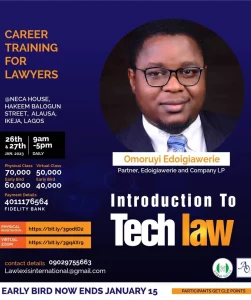
OMORUYI OSAGIE EDOIGIAWERIE
@uyilaw is the Founder and Lead Partner of the Firm. He also leads the Corporate Commercial, Tech and specialised team at the Firm. He specializes and has in-depth experience in Startup Law, Corporate Commercial Legal Practice, Statutory Compliance and Entrepreneurship and other corporate commercial practice areas.
He also has expert knowledge of Matrimonial Causes and Entertainment Law and expertly provides legal advisory and capacity building support to a broad spectrum of clients locally and internationally. Omoruyi has advised on several landmark and strategic transactions both locally and internationally. So far, he has helped build and grow over 1000 companies most of who remain gainfully in business and still rely on him for expert legal advice.
He is a member of the Nigeria Bar Association and the American Bar Association. In addition, he is a Startup Mentor at the Tony Elumelu Foundation. In the Nigerian Bar Association, he was appointed a member of Mentoring Committee of the Nigeria Bar Association, Secretary of the Steering Committee of the Young Members Group of the Chartered Institute of Arbitrators (UK) Nigerian Branch and member of the policy and drafting team at the Nigerian Startup Act Project. Omoruyi is a Harvard trained Leadership Expert, Yale Certified Business Negotiator and Business Compliance Specialist. He also holds a specialization in Legal Entrepreneurship from the University of Maryland, USA and a compliance and data protection certification from the University of Pensylvania. A prolific writer, Omoruyi is the author of the best-selling masterpiece for entrepreneurs, The Business Of Running Your Business To Building A Successful Business; A Practical Guide the book is a product of his in-depth experience in Corporate and Commercial Legal Practice, Statutory Compliance Matters, and Entrepreneurship Development.

He is also recognized as one of the leading Entrepreneurship and Startup lawyers in Nigeria. Omoruyi regularly contributes to nation building through regular speaking engagements across the Country on contemporary issues that relate to law, and nation building.

by Legalnaija | Jan 23, 2023 | Uncategorized
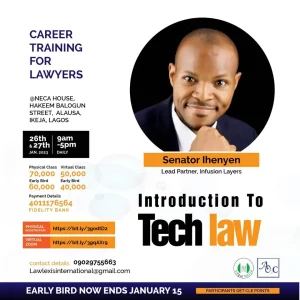
Senator Ihenyen is the Lead Partner at Infusion Lawyers where he heads the FinTech, Blockchain & Virtual Assets Practice of the law firm. He has advised both local and global companies, including FinTech companies on various areas of law, policy, and regulations, which includes FinTech, blockchain, data protection & privacy, and related areas of information technology.
A tech lawyer with interest in policy and regulations, Senator is former President of Stakeholders in Blockchain Technology Association of Nigeria (SiBAN) where he is now a member of the Advisory Council. He served as Vice Chairman, Policy & Regulations. Senator is also the current General Secretary of the Blockchain Industry Coordinating Committee of Nigeria (BICCoN), the coordinating body in Nigeria’s emerging blockchain industry. He is also the current General Secretary of the FinTech Alliance Coordinating Team (FACT), comprising the Fintech Association of Nigeria (FinTechNGR), Blockchain Nigeria User Group (BNUG), Cryptography Development Initiative of Nigeria (CDIN), Innovation Support Network Hubs (ISN Hubs), and Financial Services Innovators (FSI).
Senator is the exclusive contributor (Nigeria chapter) to the International Guide to Blockchain 2020 and Lead Trainer, Blockchain for Lawyers 101. A contributor (Nigeria Chapter) to the International Comparative Legal Guide to Data Protection 2019, Senator also advises on data protection and privacy. He has been the author of the Data Protection Overview for Nigeria on DataGuidance by OneTrust since 2016.
Senator has been a resource person and speaker on FinTech, blockchain, and innovation at various fora, including the Committee of Chief Information Security Officers of Nigerian Financial Institutions (CCISONFI) Conference, May 2021; Blockchain Nigeria User Group Conference, May 2018; Blockchain & Cryptocurrency Forensics for the Economic and Financial Crimes (EFCC), September 2021; Blockchain & Fintech 101, Nigerian Bar Association (NBA), Asaba Branch Law Week, December 2021; Legal Business Conference on ‘Regulating Blockchain, FinTech, and Innovations’, 17 May 2022; TechPoint Africa Blockchain Summit (TABS), 20 May 2022; and ‘Evolving Relationship between FinTech, Regulators, and Financial Institutions’, Central Bank of Nigeria (CBN), June 2022.
Senator is currently the 1st Vice Chairman, Intellectual Property Committee and member of the Information Technology Committee of the Nigeria Bar Association Section on Business Law (NBA-SBL).
by Legalnaija | Jan 18, 2023 | Uncategorized
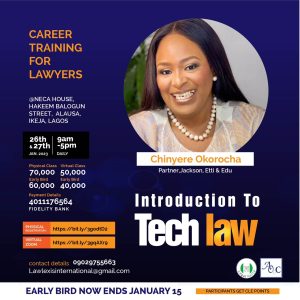
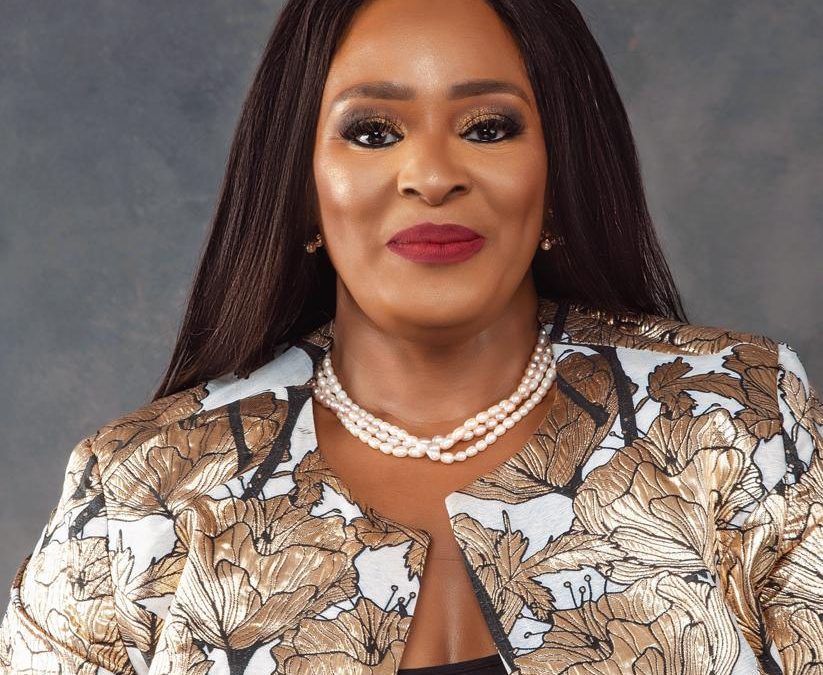
Chinyere is a Partner in Firm of Jackson, Etti & Edu, Lagos–Nigeria and has over 32 year’s practical legal experience in Intellectual Property law, where she is internationally recognised as an expert. She also advises varied government agencies on IP related issues, particularly Law reform. Chinyere is also a medico-legal practitioner and heads the firms Health & Pharmaceutical Practice group, offering tailor made solutions to clients sector specific needs.
She is highly respected by peers and clients alike, with some notable industry appointments & professional recognitions, which include appointment as current Chairperson, Nigerian Bar Association(NBA) Women Forum, Past Council Member & Treasurer-NBA, Section on Business Law (SBL), Inaugural Chairperson, IP Committee NBA-SBL, Patron of the Law Society, Faculty of Law, University of Lagos; Member – Dispute Resolution Panel, Nigerian Copyright Commission. Chinyere was nominated as one of 20 most influential women in Business Law in Nigeria in 2020/21, by Business Day Newspaper, was nominated as one of Managing Intellectual Property’s (MIP’s) Top 250 Women in IP, worldwide 2021/22, and one of the 50 most influential women in the Legal Profession in Nigeria (Business Day Newspaper, April 2011). She is Ranked in Chambers Global, as a Leading Individual in IP in Nigeria, as well as is recognised as an expert in Who Is Who Legal Nigeria, to mention a few.
Chinyere has acquired first hand experience about the challenges associated with building a successful career, as a female professional, attaining a work life balance and embracing the necessary diverse role changes along the way. With a passion for assisting young people reach their full potential in the work place, she founded the Heels & Ladders Career Mentorship Club, where she provides inspiring & motivational guidance and tips for career success for female professionals seeking career growth.
She is on the Advisory Board of a number of NGOs and speaks regularly at workshops, seminars and conferences (locally and internationally) on varied topics of interest.
Registration Details;
Physical Session:
Fee: 70,000 Naira
Early Bird: 60,000 Naira (ends 10th January, 2023)
Venue: NECA House, Alausa, Ikeja, Lagos
Reg Link: https://bit.ly/3haXvfy
Virtual Session (ZOOM)
Fee: 50,000
Early Bird: 40,000 (ends 10th January, 2023)
Registration Link: https://bit.ly/3fIJvcq
by Legalnaija | Jan 18, 2023 | Book
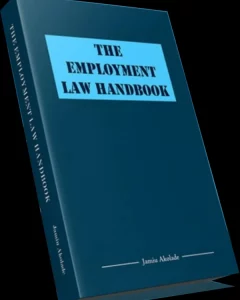
While there are many well-researched books on the general principles of Labour and Employment Law, there is a dearth of quick reference materials for Human Resource Managers and Legal Practitioners who have to grapple with taking decisions and advising on workplace related issues on a daily basis.
The Employment Law Handbook is written to fill a gap identified in the nature of texts on Employment and Labour Law in Nigeria.
This book provides answers to most of the frequently asked questions on Employment and Labour Law, contains a synopsis of all Employment and Labour Law related legislations as well as selection of precedents.
In the words of a former Attorney General of the Federation and Minister of Justice, Mr. Bayo Ojo, SAN, ‘This insightful book coming from someone who demonstrates a commendable solid knowledge of the subject, is lucidly written, free of the usual technical jargons and presented in an easy to read language. It is a great, lively, vigorous, engaging and stimulating book, that is recommended for reading by all class of people including experts, and the general public who seeks a handy reference material and a rudimentary understanding of the elementary of labour laws’.
The Author, Jamiu Akolade is currently a Legal Counsel within the Global Litigation team of the Shell Petroleum Development Company (SPDC). Before joining SPDC, he was a dispute resolution Counsel in Adepetun Caxton-Martins Agbor & Segun, a top-tier commercial law firm where he was part of the employment litigation team.
In his years of practice, Jamiu has advised extensively on employee wrongful termination claims, redundancies, executive compensation,
compensation for workplace injuries and has also represented high net worth clients in State and Federal Courts.

by Legalnaija | Jan 16, 2023 | Law, Training
DAVIDSON OTURU
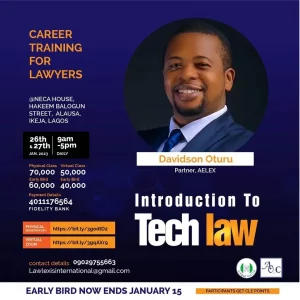
Davidson is a Partner at Aelex in the firm’s IP/TMT, Corporate/Commercial and Dispute Resolution Practice Groups. He advises clients on trans-border issues relating to Intellectual Property Law, Information and Communication Technology Law, Financial Technology (FinTech) Law Cybersecurity, Telecommunications, Data Protection and Privacy.
His clients are in a variety of industries, including banking, information technology, private equity, financial services, pharmaceuticals and capital markets.
He has significant experience in representing and advising clients on trans-border issues relating to financial technology (fintech), project finance, digital assets, blockchain technology data protection and cyber security breaches, white collar crimes and data privacy. He assists clients with remediating high-stakes multi-jurisdictional cybersecurity breaches, negotiating complex technology transactions, franchising and intellectual property licensing.
He provides practical and strategic advice to leading telecommunications service providers, mobile network operators, infrastructure owners and investors, technology suppliers and equipment manufacturers and financial institutions.
His unique IP practice focuses on contentious and general IP work as he works closely with clients across various industries to manage, protect and advance their portfolio of IP rights, including trademarks, patents and design covering multiple jurisdictions. He represents clients in enforcement proceedings involving unfair competition, copyright infringement, passing off and trademark infringement.
Davidson regularly advises companies on compliance with corporate, statutory and regulatory matters. He advises on business start-up, labour & employment, corporate due diligence and corporate restructuring. He advises foreign investors seeking to establish entities in Free Trade Zones and also advises various multinationals on the framework for foreign direct/portfolio investments in Nigeria.
His regulatory advisory work also includes the provision of legal support to technical advisory groups funded by the USAID and DFID that are aimed at providing high-level support to Federal and State Government agencies on their Public Private Partnership (PPP) programmes.
In recognition of his thought leadership and continuous contributions to the fintech ecosystem, he was ranked as a leading lawyer by Chambers and Partners in its 2022 Fintech Guide.
To register use the links below;
Physical Session:
Fee: 70,000 Naira
Venue: NECA House, Alausa, Ikeja, Lagos
Reg Link: https://bit.ly/3godtD2
Virtual Session (ZOOM) Fee: 50,000
Registration Link: https://bit.ly/3gqAXr9
Persons who should attend include lawyers, founders, tech compliance officers and stake holders in the Tech Industry at all levels. For enquiries, please contact: Lawlexis – lawlexisinternational@gmail.com or 09029755663.

by Legalnaija | Jan 12, 2023 | Uncategorized
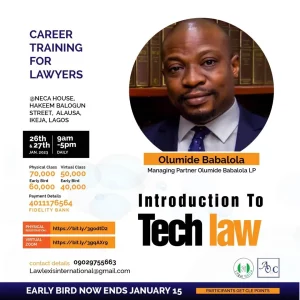
Olumide Babalola Esq is a prolific and consummate digital rights, consumer rights, privacy and data protection lawyer. His rich and diverse digital rights litigation experience spans across all superior courts of records in Nigeria and regional courts in Africa including ECOWAS Community Court of Justice.
He has specifically litigated on Digital Privacy, Cybercrime, Hate Speech, Freedom of Information, Online Freedom of Expression, passage of laws protecting digital rights among others. Olumide is a seasoned Conference speaker at local and international fora. In 2018, he was selected alongside 6 other digital rights lawyers from West Africa to attend the Internet Governance Forum (IGF) in Paris a multi-stakeholder engagement forum and in June 2019, he spoke at the RightsCon (The 8th Annual Summit on Human Rights in the Digital Age) held in Tunis.
Olumide has four published books to his credit: the first is a historical piece on the office of the attorney general of the federation and its occupants in Nigeria; the second being a casebook on Labour and employment law – which work was propelled by the volume of legal opinions (on Nigerian Labour regime especially the decisions of the courts on the peculiar issues) he had to write for his multi-national company on regular basis while the third is another casebook on corporate law and practice. His latest publication – Babalola’s Law Dictionary, is reputed as Nigeria’s first law dictionary (strictly so called).
Olumide is the managing partner of Olumide Babalola, LP – his flagship full service law office with particular bias for digital rights, consumer rights litigation, class actions, employment and corporate commercial litigation et al. As a testament to the cutting-edge practice of his law firm, the law firm was in 2016 presented with the prestigious award of “Quality Summit Award” in the city of New York.
The awardee of the “Nigerian Rising Star Award” is a member of the Nigerian Bar Association, Secretary of NBA Lagos Human Rights Committee, British Nigeria Law Forum, Internet Society, Internet Governance Forum Support Association (IGFSA), Chartered Institute of Arbitrators, World Litigation Forum, International Bar Association and International Association of Privacy Practitioners.
To register, please follow any of the appropriate links;
• Physical Session:
Fee: 70,000 Naira
Early Bird: 60,000 Naira (ends 15th January, 2023)
Venue: NECA House, Alausa, Ikeja, Lagos
Reg Link: https://bit.ly/3godtD2
Virtual Session (ZOOM)
Fee: 50,000
Early Bird: 40,000 (ends 15th January, 2023)
Registration Link: https://bit.ly/3gqAXr9

by Legalnaija | Jan 10, 2023 | Uncategorized

Meet The Faculty At The Introduction To Tech Law Training
Chukwudi “Chudi” Ofili @chudyofili is a licensed attorney in the State of New York and in Nigeria. He is primarily involved in active project pipeline management and deal closing as Renew Capital scales up across the region.
Prior to joining Renew Capital, he was a partner at a commercial law firm in Nigeria and advised high-growth companies and startups on the full spectrum of their legal issues, as well as the private equity and venture capital companies that finance them. He has also advised on international finance and project development deals within Africa.
Chudi has been named a Rising Star Partner and National Leader in Nigeria by the legal directories International Financial Law Review (IFLR) and Who’s Who Legal. His international experience includes stints as a visiting lawyer at Trinity International LLP in London, United Kingdom and as an extern at the Coca-Cola Company in Atlanta, Georgia, United States.
He holds a bachelor of laws from Babcock University in Ilishan-Remo, Ogun State, Nigeria and a master of laws with a concentration in business and finance from the University of Georgia School of Law in Athens, Georgia, United States. He also has a fintech certificate from the INSEAD Business School in Fontainebleau, France.
Looking to advance their skills in Tech Law? Join Chudi and other Members of Faculty at the career training for lawyers on Tech Law.
To register see information below;
Physical Session: 70,000 Naira
Early Bird: 60,000 Naira
Reg Link: bit.ly/3godtD2
Virtual Session: 50,000
Early Bird: 40,000
Reg Link: bit.ly/3gqAXr9
#lawlexis #careertrainingforlawyers #techlaw #nigerianbarassociation

by Legalnaija | Dec 30, 2022 | Uncategorized
The year 2022 has come and gone, and yes it was an exciting year with its own fair share of highs and lows. One beautiful thing about the new year is the hope and excitement it comes with. As a lawyer, I am sure you have lots of plans for your career in the year 2023, and here are a few tips to help you achieve your goals only if you practice them.
- Write More
Writing and publishing articles or short legal tips for public consumption has helped a lot of lawyers attract clients. Writing articles establishes you as an authority and thought leader in your area of practice, thereby earning you the trust and confidence of your clients.On the Legalnaija Blawg, we publish law articles free and if you will like us to share your articles with our community, you can simply share them via email along with a short bio and portrait to hello@legalnaija.com
- Use the internet
The internet is an invaluable resource for individuals and businesses. Potential clients use the internet as one of their first points of call when searching for legal information, and it is important that they find you in their search. Some of the many ways you can take advantage of the internet include using social media to share content, and host community discussions; signing up to a Lawyers Directory, and building a brand.
- Attend professional trainings
Professional trainings are an incredible way to improve your skills as a lawyer. It not only updates you with current trends in your area of practice but also provides an opportunity to engage with experts in your area of practice, engagements which can easily lead to mentorships. An example of a good professional training program is the Introduction To Tech Law training for lawyers scheduled to hold in January, 2023.

Career Training For Lawyers
- Perfect your skill
Professional development is mandatory for lawyers, and improving your skills makes you more valuable to your firm, and clients. Reading books in your area of practice and building a good law library is a very important to becoming a successful lawyer. A good place to get law books at affordable prices is the Lawyers online bookstore.
- Collaborate More
Collaboration is the new competition, and if you want to go far in 2023, you should be thinking about collaborating with communities within and outside the legal profession. It could be your school association, religious group, social clubs or NGOs, but which ever you choose, you certainly cannot go wrong.
If you find the tips and tools in this article useful, don’t hesitate to share them with your friends and colleagues by using the share button.
@legalnaija
by Legalnaija | Dec 13, 2022 | Uncategorized
Monday, the 13th of June, 2022 saw the National Information Technology Development Agency release a preview copy of the Code of Practice for Interactive Computer Service Platforms/Internet Intermediaries. According to them, the Draft was created in conjunction with the Nigerian Broadcasting Corporation and the Nigerian Communications Commission. With this draft, they intend to give the general Nigerian populace an opportunity to review and contribute despite the copious absence of a channel for feedback until the 17th of July.
In a recently booming tech ecosystem like Nigeria’s, one which has driven serial international investors and created multiple employment thereby dousing the unemployment inferno to a very large extent, an average citizen is left wondering what the agenda behind this policy could be. This work of the draftsman that could determine their employment status and infringe on their indivisible, inalienable rights simultaneously.
As expected, several knowledgeable and experienced policy experts have publicly expressed their dissatisfaction with this guiding policy document with most pointing out now visibly infamous paragraphs and sections contained therein. This work can be said to be motivated by a huddle call with other colleagues who equally advise these companies and the Nigerian populace who keep themselves happy with content posted on these platforms. Both very worried at the far-reaching legal implications of this draft Code of Practice.
Whilst this article will examine the advantageous parts of this draft, it will not only make a case for the infractions but expose an aspect which goes to the deep root of this intended policy document.
Whither Revenge Porn and Nudity?
Under Part II(2), all Platforms are mandated to inform their users through terms of service not to share content harmful to a child; encourages money laundering, exploiting a child, infringes the subsisting intellectual property of another or promotes terrorism. This seems fair enough in light of the misuse of social media by others who though exercising their fundamental human rights, overreach into the rights of others.
This seems to draw a thick line between where an individual rights stop and where another’s begin. It indeed, is a welcome development.
Platforms were mandated under part IV to delete within 24 hours prohibited materials objectionable on grounds of morality and public interest. This leads us to the age old jurisprudential debate of the line between morality and the law. The Nigerian state as it stands today follows codified law and under no condition shall a person suffer for not written. Nulla poema (crimen) sine lege, the Latin legal maxim which guides the law shows the spirit and nature of the law. In light of the fact that human beings are diverse and the world is dynamic, it is expected that the question of what is moral will be relative.
Are the Platforms expected to gauge what is moral or immoral on behalf of lawmakers and law interpreters?
Can a Platform be held responsible for a crime not known to law?
What exactly is objectionable on grounds of immorality?
In an interview, the Agency’s Legal Services and Board Matters Unit had contended that the inclusion of ‘morality’ is to ensure that whatever goes out is in line with Nigerian local laws. This is rather obscure in nature and evasive.
It is believed that the draft Code of Practice will do better.
Is National Security Greater than Fundamental Human Rights?
The movement for Fundamental Human Rights need no introduction as enough has been said and is continuously being said in order to ensure that the inalienable, indivisible rights of every human being is not taken away from them under any pretext. The Nigerian Constitution, in line with international best practices have adopted fundamental human rights for its citizens and this is seen in Sections 33 through 42 under Chapter IV of the laws of the land.
In Section 37, the Constitution expressly states that the privacy of citizens, their homes, correspondence, telephone conversations, telegraphic communications is protected. Sections 38 through 40 then reiterate that every person shall be entitled to their fundamental rights to freedom of thoughts, conscience and religion; freedom of expression and freedom of association.
All four rights and freedoms are very fundamental to Nigerian Citizens’ usage of these Platforms. There are cases where in exercise of their rights, they also advocate for the continuous protection of those rights. .
In October 2020, Twitter was agog with the EndSars protest which was an advocacy for the protection of the fundamental right to life of every citizen who are prone to police brutality merely by breathing the air in Nigeria. This movement marked a reawakening of conscience and a realization that leaders had to do better. It also put them under a spyglass of scrutiny which they have not been able to avoid till date.
Section 45(1)(a) and (b) however states that where a law reasonably justifiable in a democratic society is enacted in the interest of defense or the public; or for the purpose of protecting the rights and freedoms of other persons, Sections 37 through to Section 41 shall not invalidate such law.
REGISTER NOW
Omnibus Terms: Who is Who? and What is What?
In some paragraphs of this draft Code of Practice, the use of ambiguous words is observed to the extent that upon first instance, one is left wondering whether it is deliberate or a mere oversight on the part of the Draftsman.
The word ‘Child’ in the Definition part is said to be subject to definition by Nigerian Law however it i submitted that Nigerian Law as of today is at variance expressly and by inference as it relates to who a child is. Though the Child Rights Act had been enacted in 2003 by the Federal arm, states like Kano have done a total overhaul with the inputs of Ulamas Islamic Scholars and Society Organizations in order to fit into the Sharia Law acceptable to their state which strictly speaking, they can do in a federal system of government.
The Corporate and Allied Matters Act of 2020 by inference defines a child as any person under 18 by virtue of Section 106. This is also the position of Section 29(4) of the Constitution of the Federal Republic of Nigeria 1999 (as amended). The Definition part should have stated expressly what Nigerian Law will define the age of majority even as some may argue that the Constitution remains the grundnomm, it looks like an area prone to judicial intervention when litigation arises.
Still on ambiguity, Part IV places the liability of removal of ‘prohibited materials’ from Platforms within 24 hours of notice from the government on these Interactive Computer Service Platforms.
The definition of ‘prohibited materials’ is then heavily placed on all applicable Nigerian Laws including but not limited to the eleven stated in the draft namely:
- Nigerian Communications Act;
- National Broadcasting Commission Act;
- Nigeria Broadcasting Code;
- Cybercrimes (Prohibition, Prevention, etc.) 2015;
- Advance Fee Fraud and other Fraud Related Offences Act 2006;
- Nigeria Data Protection Regulation 2019;
- Advertising Practitioners Act 2004;
- Sales Promotions of Nigerian Code of Advertising Practice Sales Promotion and other Right/Restrictions on practice Act 2004.
- Terrorism Prevention Amendment Act 2022 10. NCC Consumer Code of Practice Regulations 2017
- Federal Competition and Consumer Protection Act (FCCPA) 2018.
The effect of which is not only a repetition of these laws but a ticking bomb as a misnomer or misinterpretation of any of these laws may lead to content deletion or even prosecution as it stands. This could also mean that any of these laws may be reviewed from time to time in order to accommodate more ‘prohibited materials’ which is a danger to the constitutionally exhibited right to freedom of speech and right to freedom of thoughts, conscience and religion of every citizen of the country as it were.
What netizens should be thankful for, however, is that it is a draft and it is subject to review. So we are told.
Exercise of Regulatory Powers over Platforms: A threat to Corporate Governance
The nature of these Interactive Computer Service Platforms is quite unique and rather unlike an average company regulated by a regulatory agency or legal frameworks peculiar to its objects. Unlike a construction company or a renewable energy company, these platforms do not stricto sensu, need the license or express permission of any agency in Nigeria to operate as sanctions cannot be used against them effectively. This shall be explained in the next paragraph.
In an instance where a Fintech company is a payment platform, they require a Payment Service Platform license from the Securities and Exchange Commission in order to operate, the default of which will see the Commission see to the closure of such company’s registered address until the needful is done subject to the intervention of the Investment and Securities Tribunal or even the Federal High Court as the case may be.
This shows a degree of control and demonstrable sanctions in a regulatory relationship of suzerainty. This is not the case with Interactive Computer Service Platforms because they do not have bank accounts in the country upon which a lien can be placed or access restricted as in the earlier instance, some do not even have offices in continent while a vast majority of them, if not all, are not incorporated in the country. The nature of Facebook, Twitter, Tiktok, Instagram etcetera is very unique because they are free-to-air.
The draft under part II mandates these multinational Platforms operating globally to carry our risk assessment of every content to determine whether such content is harmful. The practicability of this on a large service platform is quite interesting.
As it stands, even the veil of these companies cannot be lifted in Nigeria to uncover fraud or illegal purposes because they have not made themselves subject to Nigerian Corporate Law and they may choose not to without bearing any sanctions, an example of which is the now infamous Twitter ban which even though was ongoing, Netizens found their way back to enjoy the microblogging platform.
The Corporate and Allied Matters Act of 2020 remains the foremost regulatory framework for the administration of companies in Nigeria as of today alongside Codes of Corporate Governance. This law recognizes and respect that directors, members, persons with significant control should control and administer the company going by the guidelines of regulatory bodies peculiar to their field. It is submitted that regulatory bodies are not supposed to meddle with the day-to-day administration of the company or the object of the company as it goes against corporate governance to have a regulatory agency butt in from time to time on the basis of an ambiguous Code of Practice.
It seems to me that despite claims of the National Information Technology Development Agency that it sought the input of these Platforms, the latter should have, through their policy experts been more involved in the drafting process in order to create an all-inclusive, mutually beneficial and widely accepted policy especially with little degree of control the Agency at present realistically has over them.
An Academic Adventure: The Case for a Punitive Code of Practice
Part VI of this draft Code of Practice explains that non compliance with the Code will be deemed a breach of the National Information Technology Development Agency Act of 2007.
The combined understanding of Section 17 and Section 18 of the Act is to the effect that any person or corporate body who acts at variance with the act commits an offence punishable by fine and imprisonment which does not preclude the payment of levy to the Federal Internal Revenue Service. Asides from the fact that the Act itself does not state where the matter will be heard in the case of a company in default in compliance with the fundamental right to fair hearing entrenched in Section 36 of the Constitution, the nature of Codes generally is that of guidance. Its force in law, I humbly submit, is that which is persuasive in nature.

Click To Order
Codes are not meant to be protocols to an Act of the National Assembly neither are they meant to be punitive by resting on an already existing Act to derive its force of law. That is the difference between an Act and a Code.
In the instance of the Corporate and Allied Matters Act, the Banks and other Financial institutions Act, the Investments and Securities Act and the Central Bank of Nigeria Act ; all acts that regulate Public Companies, you find that such Codes released by by some of the agencies created by these acts are not in nature.
The Code of Corporate Governance for Public Companies released by the Securities and Exchange Commission in 1.3 for instance, states that it is not meant to be a rigid set of rules but to facilitate sound corporate practices.
The Code of Corporate Governance for Banks and Discount Houses in the preamble circular signed by the then Director of Financial Policy and Regulations Department states that it aims to align the Nigerian ecosystem with international best practices.
It seems as though the National Information Technology Development Agency knows that it cannot frontload the provisions of the proposed National Information Technology Development Agency Bill of 2022 through the Code of Practice. Even if that would happen, the new Act should lay the foundation for the new Code and not the other way around. It raises a serious question of law.
Under the 2007 act, the Agency does not have that much power however the fresh bill increase their functions to 24 from 14 thereby overlapping and arrogating other regulatory agencies operating within the same space such as the Computer Professionals Registration Council of Nigeria, Galaxy Backbone, Office of the National Security Adviser, National Universities Commission and so on.
Sections 6, 13, 20, 21 and 22 of the Bill will enable the Agency fix classes of licenses, impose administrative sanctions and enter premises in order to detain persons or companies that contravene the Act.
The classes of lines are: Product License, Service Provider License and Platform Provider License. With the analysis of the proposed Bill, one can easily see that the Code of Practice is intended to announce the appearance as forerunner in anticipation of a more heavily worded and bullish Act.
It is therefore a stellar innovation by the Agency to release a draft Code punitive in nature, ambiguous in wording and that which criminalizes acts not known to law.
 Mosopefoluwa Fayeun is a corporate/commercial lawyer and management consultant with Albert and Abraham LLP where she regularly advises with regards strategy and corporate governance.