
by Legalnaija | Oct 23, 2023 | Uncategorized
Legal drafting is one of the most time-consuming and tedious tasks for lawyers. It involves creating and modifying various legal documents, such as contracts, agreements, pleadings, and more. Legal drafting requires a high level of accuracy, consistency, and attention to detail. However, it also involves a lot of repetition and manual work, which can lead to errors, inefficiencies, and frustration.
That’s why Legalnaija, a leading online platform for Nigerian lawyers, has introduced a document automation feature that helps lawyers save time and improve their productivity. Document automation is the process of using software to generate customized legal documents from predefined templates. Document automation can reduce the time spent on legal drafting by up to 80%, according to some studies.
How does document automation work?
Document automation works by using existing legal documents as templates and filling in the variable information based on the user’s input. For example, if a lawyer needs to draft a contract for a client, they can use a document automation tool to select a contract template that suits their needs. Then, they can answer a series of questions about the client’s details, such as name, address, terms of agreement, etc. The document automation tool will then generate a new contract that is customized for the client.
How does Legalnaija help lawyers with document automation?
Legalnaija is a platform that connects Nigerian lawyers with clients, colleagues, and resources. It offers various features and services for lawyers, such as online marketing, legal research, and more. One of its features is document automation.
Legalnaija’s document automation feature allows lawyers to create and access legal templates for different practice areas. Legalnaija’s document automation feature helps lawyers save time on legal drafting by:
- Providing them with ready-made templates that are relevant and compliant with Nigerian laws and regulations.
- Enabling them to customize their templates according to their preferences and needs.
- Allowing them to generate new documents in minutes by answering simple questions or filling out online forms.
- Reducing the risk of errors and inconsistencies by automating data entry and formatting tasks.
- Enhancing their client service and satisfaction by delivering high-quality and professional documents faster.

www.legalnaija.com/shop
What are the benefits of document automation for lawyers?
Document automation can provide many benefits for lawyers, such as:
- Saving time: Document automation can significantly reduce the time spent on legal drafting by automating repetitive and manual tasks. This can free up more time for lawyers to focus on other aspects of their practice, such as client communication, strategy development, research, etc.
- Improving quality: Document automation can improve the quality and accuracy of legal documents by minimizing human errors and ensuring consistency. This can enhance the reputation and credibility of lawyers and reduce the risk of disputes and litigation.
- Increasing efficiency: Document automation can increase the efficiency and productivity of lawyers by streamlining their workflow and reducing their workload. This can enable them to handle more cases and clients without compromising their quality of service.
- Boosting profitability: Document automation can boost the profitability of lawyers by lowering their costs and increasing their revenue. By saving time on legal drafting, lawyers can reduce their overhead expenses and increase their billable hours. They can also offer fixed-fee services or alternative fee arrangements to attract more clients who value speed and transparency.
How can lawyers get started with document automation?
If you are a lawyer who wants to save time on legal drafting and improve your practice with document automation, here are some steps you can take:
- Sign up for Legalnaija
- Explore the templates
- Try it out
- Give feedback
Some of the document templates on Legalnaija include a Non – Disclosure Agreement, Affidavits, Memorandum of Agreement, Loan Agreement, Guarantors Forms, Tenancy Agreement, Power of Attorney, Licensing Agreement and more. Document automation is a powerful tool that can help lawyers save time on legal drafting and improve their practice. Legalnaija is a platform that makes document automation easy and accessible for Nigerian lawyers. If you want to learn more about document automation and how Legalnaija can help you, visit our website here.
Note: Subscribing to the Legalnaija Lawyers Directory gives any lawyer or law firm free access to the Agreement Templates on the website. For inquiries, please contact hello@legalnaija.com; or 09029755663.

by Legalnaija | Oct 18, 2023 | Book
Litigation is the legal process of resolving disputes through the court system governs the way things are done in practice, the court be it Civil or Criminal cases. If you desire to perfect your skill in litigation (be it Civil or Criminal),these books are essential resources for litigation lawyers, helping them navigate the complex legal landscape and effectively represent their clients in court. Here are 10 books available on Legalnaija you should add to your law library.
- Criminal Evidence in Nigeria by Jide Bodede: The book contains twelve chapters. Chapter one on the admissibility of evidence deals with the nature of evidence which can prove the existence or non-existence of facts including hearsay and improperly obtained evidence. Chapter two on the burden of proof deals with the responsibility to produce evidence to prove facts. Chapter three on witnesses and chapter four on the corroboration of witnesses both deal with the persons who can present evidence, the restrictions on the presentation of evidence. Chapter five, deals with the trial rights of defendants and the defence alternatives. Chapter six, deals with the exclusion of confessions on the grounds of oppression or unreliablity. Chapter seven is about the admissibility of evidence of visual identification and identification parades. See the book here https://legalnaija.com/product/criminal-evidence-in-nigeria/

- Trial within Trial in Criminal Proceedings by Ekemini UdimTrial within trial is a mini trial within the context of the main trial. It is a procedure in criminal law wherein the confessional statement of an accused person is subjected to trial scrutiny so as to determine whether the statement was freely and voluntarily made by the accused person to the police. In the words of Honourable Justice Centus Nweze of the Supreme Court of Nigeria, the raison d’être of the evolution of the mini trial procedure is to arm the trial court with a procedural mechanism for sifting the chaff of involuntary and inadmissible evidence from the wheat of admissible evidence. See the book here https://legalnaija.com/product/trial-within-trial-in-criminal-proceedings/
- Practical Approach to Cross Examination by Ekemini Udim:The Book demystifies cross- examination and places in the hands of every trail advocate the basis but necessary tools for attainment of effective cross examination. See the book here https://legalnaija.com/product/practical-approach-to-effective-cross-examination/
- A Hand Book Of Criminal Law And Procedure Through Cases: This handbook which is in its 2nd edition covers a wide range of important issues in criminal law, including approaches, methods and models, general principles, specific offenses. This edition captures recent developments in the law as evidenced by decisions of the Superior Courts, particularly the Apex court. The subject areas have also been expanded, while their classification now makes for easier reading and quicker reference as occasion demands. A very easy to use subject matter index forms an important component of the book making referencing a lot easier. Have a look at the book here; https://legalnaija.com/product/a-hand-book-of-criminal-law-and-procedure-through-cases-hard-cover/
- A Force of Justice (A book in honour of Hon. Justice Oguntade):This book was published in honour of Hon. Justice Oguntade JSC (RTD) in 2010. It focuses on some of the landmark cases where Justice Oguntade either delivered the leading judgment or a dissenting judgment subjecting them to critical review and comprehensive assessment in well-articulated and researched essays by the contributors. Contributors include over 24 Senior Advocates and other distinguished Legal Practitioners and Professors, including; Professor Yemi Osibajo SAN, Professor Taiwo Osipitan SAN, Chief Wole Olanipekun SAN, Kola Awodein SAN, Professor Oyelowo Oyewo SAN, Dr. Alex Iziyon SAN, Chief Bolaji Ayorinde SAN, Kemi Pinheiro SAN, Tayo Oyetibo SAN, Dr. Babatunde Ajibade SAN, Professor Ayo Atsenuwa, Dr Olisa Agbakoba SAN. Etc. See the book here https://legalnaija.com/product/a-force-of-justice-a-book-in-honour-of-hon-justice-oguntade/
- Casebook On Evidence Law :Casebook on Evidence Law by Olusegun Yerokun. See the book here https://legalnaija.com/product/casebook-on-evidence-law/

- Human Rights Litigation In Nigeria: Law, Practice And Procedure: This book is written by Mr. Frank Agbedo, one of Nigeria’s leading authors in human rights literature and jurisprudence.
Principal features of the book include but are not limited to the ABC of human rights litigation, an in depth analysis of the new FREP Rules 2009, A review of judicial attitude to enforcement of Fundamental Rights Cases, Prosecuting Appeals in Fundamental Rights Cases, The status of public interest litigation in Nigerian Courts, The Role of Amici Curae in human rights litigation, the justiciability or judicialisation of socio-economic rights in Nigerian Courts and the future of human rights litigation. The book also features a comprehensive package of practice forms and precedents relating to practical applications for enforcement of fundamental rights, as well as a comprehensive index of cases and relevant statutes.Practice forms and precedents. The book is almost a ready answer to all issues and matters relating to preparation, initiation, filing and prosecution of fundamental right cases in Nigerian Courts. The book is comprehensive enough to the cover of the field of human right law, practice and procedure and which could be better described as a One-Stop-Shop in human rights litigation. See the book here https://legalnaija.com/product/human-rights-litigation-in-nigeria-law-practice-and-procedure/
- Civil And Criminal Litigation In Nigeria:A Practical guide for Civil and Criminal Litigation Lawyers. See the book here https://legalnaija.com/product/civil-and-criminal-litigation-in-nigeria/
- Civil Litigation in Nigeria:This is the 3rd Edition of the book “Civil Litigation in Nigeria”, published in 2020, and co-written by M.M Stanley – Idum (Mrs) and J. A Agaba PH.D. See the book here https://legalnaija.com/product/civil-litigation-in-nigeria/
- Law of Evidence in Nigeria: This book is expansive in scope, covering a wide range of issues relevant for a proper understanding of the law relating to the Law of Evidence in Nigeria. It evinces the author’s industry, hard work and diligence. It also advertises his redoubtable scholarship. It is fascinating both for its insightful acuity and fecundity of his writing style. His prose is arresting just as the breadth and diversity of the issues on the Law of Evidence is breath taking. See the book here https://legalnaija.com/product/the-law-of-evidence-in-nigeria/

by Legalnaija | Oct 16, 2023 | Blawg
PRIVCON PRIVACY AWARDS: CALL FOR NOMINATION
The conveners of PrivCon Nigeria – an annual privacy and data protection conference in Nigeria – are delighted to announce the call for nominations into varying categories of their inaugural PrivCon Privacy Awards 2024. These awards have been established to identify and celebrate outstanding contributions to the growth and development of privacy and data protection in Nigeria.
Nominations are now open into the following categories:
- Privacy Leading Light (Legal) for lawyers in private practice or in-house counsel.
- Privacy Leading Light (Tech)– Privacy professionals in tech (non-lawyers)
- Privacy Leading Light (Academics): University lecturers teaching law, cybersecurity, ICT and other related courses.
- Privacy Leading Light (Research): Researchers with published works in the area of privacy, data protection, cybersecurity or related subjects.
- Privacy Leading Light (Women category): Women in tech, female lawyers
- Privacy Leading Light (Advocacy): Non-governmental organisations leading privacy/data protection advocacy in Nigeria.
- Privacy Team of the Year (Private sector): Private and public companies with formidable privacy departments.
- Privacy Team of the Year (Public sector): Government agencies with formidable privacy departments.
- Best Privacy Culture Development: Nigerian Organisations with the best privacy culture
- Best Privacy Product/Programme: Nigerian Companies with privacy-enhancing products or programmes
- DPO of the Year (private sector): DPOs in private or public companies.
- DPO of the Year (public sector): DPOs in government departments
- DPCO of the Year: licenced DPCOs in Nigeria
- Rising star (Legal): young lawyers (1 -5 years post-call)
- Rising star (Tech): young privacy professionals (1-5years experience)
- Rising star (Undergraduate): University students (including postgraduate and law school)
Nominations are invited from individuals, organizations, and entities who have made significant strides in promoting the privacy and data protection industry in Nigeria. Please consider submitting nominations for deserving candidates in these categories.
HOW TO NOMINATE:
Head over to PrivCon Privacy Awards website at www.privconprivacyawards.ng. Fill out the nomination form with the required information. Include a detailed description of the nominee’s contributions and why they deserve recognition in the selected category.
NOMINATIONS TIMELINE:
Call for Nominations Opens:16th October 2023
Nominations Deadline: 30th November 2023
Shortlisted Nominees Announced: 7th December 2023
Voting starts: 8th December 2023
Voting closes: 8th January 2024
Final Nominees Announced: 31st January 2024
Panel of Judge Announced: 1st February 2024
Awards Ceremony: April 2024
For any inquiries or require assistance, please contact host@privconnigeria.ng
Join us in celebrating those who have made significant strides in advancing privacy and data protection in Nigeria.

by Legalnaija | Oct 14, 2023 | Blawg
Criminal Instinct; Inborn Or Socially Imbibed[1]
CRIME FACTORS
- CONSTITUTIONAL/ENVIRONMENTAL FACTORS
Research had been carried out and it is deduced that to ascertain the causes of crime, the researcher must start somewhere, which necessitates some assumptions. The most popular presumption is that criminal behavior results from constitutional, environmental, and psychological factors operating either alone or in concert with one another on the offender. The presence of these forces must be dealt with as best as we can while keeping in mind the significant degree of overlap between them, even though their intensity and size are not now subject to precise measurement.
I allude to the physical traits that predispose the offender to act in the manner he does when I talk about constitutional variables in crime causation. These physical traits may be long-lasting or fleeting. Drunkenness is an example of a temporary criminogenic factor, although a physical condition like dwarfism may be a lifelong criminogenic predisposing factor. Studies on heredity, twins, hormones, and physical appearance all provide support for the constitutional tendency to criminal behavior at this time.
Early phrenologists, or men who sought to establish a link between the skull, the brain, and social behavior, are credited with starting the scientific study of these topics. Franz Joseph Gall[2] believed that the physical makeup of the skull and the structure of the brain was connected to a person’s propensities for particular types of behavior, including criminal behavior. But Lombroso was the one who popularized this anthropological theory of criminal behavior. The study that disproved the accuracy of anthropological beliefs was conducted by Dr. Charles B. Goring, an English jail doctor. In his book The English Convict,[3] Goring summarizes his research, which he conducted using control groups and statistical methods Pearson developed at University College, London.
2. HEREDITY
Numerous observers have remarked how frequently criminal behavior in children matches criminal behavior in parents or siblings, and some have concluded that a propensity for criminal behavior is an inheritable trait. Studies of ‘criminal families’ such as Richard Dugdale’s The Jukes,[4] Estabrook’s and Davenport’s The Nam Family,[5] and Henry Goodard’s The Kallikaks[6] have been used in support of this conclusion.
In Nigel Walker’s words, most delinquent children have lived with their delinquent parents or siblings long enough to acquire ways of life by imitation or some other non-genetic process of transmission.[7] Nevertheless, Cyril Burt came to the opinion that constitutional considerations are important in determining juvenile delinquency, but it would be erroneous to assume that every criminal is a helpless victim of his predisposition to crime.[8]
3. TWINS
The age-old and crucial question in criminology is “nature vs. nurture.” The studies of twins that examined the degree of concordance or discordance in the criminal behavior of monozygotic (identical) and dizygotic (non-identical) twins have proven to be the most effective means of addressing it. Monozygotic twins are produced when a single ovum is fertilized and separated into two separate embryos, each of which has an identical set of genes. These monozygotic twins are always identical in terms of sex, blood type, and appearance. On the other hand, the simultaneous fertilization of two ova by two spermatozoa leads to the development of dizygotic twins. These twins, which could be made up of one male and one female, two males, or two females, do not have genetically identical sets. Both of them may or may not share the same blood type, and they may or may not look alike.
When it comes to behavior, twins who display the same behavior are considered to be concordant in that regard. When it comes to the behavior aspect, twins that display divergent behavior are considered to be discordant. In this sense, two twins with the same genetic complexion are said to be concordant. This trait may be the result of genetic transmission if monozygotic twins exhibit a much higher rate of concordance with the trait of criminal behavior than dizygotic twins. Medical research has shown that at least one type of abnormal behavior, the symptom caused by Huntington’s chorea,[9] is genetically transmitted. Monozygotic twin pairs have also been reported to have high concordance rates for alcoholism, idiopathic epilepsy, and schizophrenia.[10]
According to Walker,[11] incorrect categorization will most frequently result in dizygotic being labeled as monozygotic, which will if anything, lower the concordance rate. One can only presume that the investigator was aware of the issue of prejudice and took appropriate action in response to the second criticism. The use of monozygotic twins who were raised in different circumstances is the only way to address the last complaint, which is of course the most serious. Studies in this vein have proved ‘that there are a marked genetic factor underlying measurable traits of personality, such as extraversion and neuroticism, and of course intelligence.’[12]
There is strong but not conclusive evidence based on unseparated twins for a partial determination of ‘criminality, by genetic inheritance; and fairly conclusive evidence, based on separated and unseparated twins, for a similar determination of at least two personality traits. The onus of proof, therefore, seems to lie on those who wish to explain away the higher concordance rates for delinquency in monozygotic.[13]
4. ENDOCRINOLOGY
Some have hypothesized that endocrine disorders in the individual are a contributing factor in criminality generally and particularly in the case of sexual offenses. In their book The New Criminology,[14] Schlapp and Smith made an effort to explain why there was a high rate of crime among immigrant parents’ first-born children in America by claiming that the mother’s glandular disorders were caused by the stress of immigration. The authors postulated that their offspring received this glandular imbalance from them. Children that were born later were not affected once the mother’s problems calmed. Hormonal therapy and castration of sexual offenders, both essentially presume an endocrine foundation for the proscribed behavior, have neither had outstanding outcomes nor been free of debate.[15]
5. PHYSIQUE
Ernst Kretschmer, a well-known German psychiatrist, contributed significantly to the field of serious investigation on the relationship between body composition and personality. He was able to prove beyond a shadow of a doubt that different body types are associated with particular types of mental diseases. For instance, he found a link between schizophrenia and an athletic body type. The work of Sheldon and the Gluecks in America may be credited to Kretschmer for having first connected bodily kinds (somatypes) to criminality. Kretschmer continued to make this connection. Sheldon defined four body kinds, or somatypes, based on his system of categorizing body types, which is predicated on the idea that a particular type of tissue will predominate in every individual.
- The endomorph in which fatty tissue predominates. This type is given to food, drink, comfort, company, and sleep.
- The ectomorph in which skin and the nervous system predominate. This type is given privacy, is sensitive to pain, needs sleep, and is youthful in appearance.
- The mesomorph is in which bone, muscle, and sinew predominate. He is insensitive to pain and is given to movement and aggression.
The balanced type or that body build in which equal amounts of the features of the preceding types are found.
6. MENTAL FACTOR
Mental disease, as opposed to mental sub-normality, is always characterized by the affected person’s persistent inability to live up to the expectations of the reality in which he or she is immersed. Because it is famously difficult to distinguish between periodic and constant failure, the literature frequently uses varying language and lacks accuracy. As a result, the interested person has a lot of latitude in how he constructs his thinking on the matter. The ideas of intellect, emotional maturity, and persistence have all been utilized in attempts to isolate, stabilize, and quantify components of mental existence. Intelligence is the ability to successfully adapt behavior to changing circumstances and to learn from experience. When it comes to pursuing action that is motivated by intelligence, emotion, or both, persistence is the opposite of emotional adjustment, which is the ability to reconcile one’s thoughts about things.
It is obtained that the mother is the primary caregiver for a child’s emotional needs from birth to age four, and this is crucial for healthy growth. The child starts to develop long-lasting relationships with others between the ages of four and seven, and father-child relationships become significant. The child’s intelligence is gradually growing at the same time that this emotional pattern is taking shape. The child’s ability to develop mentally depends on how well his emotional and intellectual growth keeps up with one another. His intelligence is known to rise throughout infancy, peaking between the ages of fourteen and sixteen, and then remain constant at that level until the second half of his life when it starts to fall.
For an informal discussion, mental diseases are frequently separated into two major categories: organic and functional. Organic mental illness is dependent on a specific physical illness, such as advanced syphilitic infection or drug use. Functional mental diseases are those that ‘have not yet been shown to have a clear physiological cause.’[16] They are recognized psychologically as opposed to physically. Examples of mental disorders with a functional origin include anxiety and hysteria.
7. PSYCHOSES
The general paralysis of the insane (dementia paralytica) caused by syphilitic infection, traumatic psychoses brought on by accidents, encephalitis lethargica, senile dementia, puerperal insanity, epilepsy, intoxication, psychoses, paranoia, paraphrenia, mania, and schizophrenia are the psychoses that are of interest from a criminological perspective.
- General paralysis of the Insane due to Syphilitic Infection
An overall decline in the quality of the person’s entire personality is a symptom of this psychosis. Antisocial behavior, such as theft, fraud, forgery, and violence performed without any attempt at covertness, sometimes precedes the onset of clinical symptoms. In the lack of clinical signs, these people may be mistakenly held responsible for their actions.
- Traumatic Psychoses Caused by Accidents
There have been cases when brain injuries were followed by pronounced personality changes, including an excess of sensitivity to the effects of alcohol, excitability, and a propensity for violent crimes. The punch-drunk boxer’s antisocial behavior is a hallmark of this type of psychosis.
- Encephalitis Lethargica (Sleeping Sickness)
An inflammation of the brain is caused by psychotic fever, which is ‘typically followed by serious and long-lasting aftereffects and changes in physique, intelligence, and character.’[17] The post-encephalitic stage is characterized by ‘committing thefts, assaults, acts of cruelty, or sexual misdemeanors’ by the patients. Only placing them in specialized hospitals is something that can be done.[18]
The organic psychosis known as epilepsy is commonly linked to criminal activity. Unconsciousness, convulsions, and uncontrollable body movement may result from the brain’s normal electrical activity being incredibly erratic and violent. A typical epileptic seizure follows. This disturbance, nevertheless, can be less severe and the epileptic features hardly noticeable. Although these epileptic seizures can sometimes be created intentionally, in the case of the actual epileptic, they are brought on by relatively unidentified internal impulses. In some epileptics, the focal point of the severe electrical activity surges has been seen to be damaged areas of the brain. It is well-recognized that some illnesses and poisonings can cause epilepsy.
It is often said intoxication leads to psychosis,[19] when it does we may be treated to the situation found in R. v. Hartridge[20], where Hartridge shot his wife to death while he was in a highly intoxicated state. Hartridge didn’t try to hide what he had done, and there wasn’t a clear reason for the shooting. In actuality, the rifle’s report, per his testimony, was the occasion that brought the reality of the situation to the forefront of his thoughts. He was unable to recall any of the activities leading up to the shooting. The Saskatchewan Court of Appeal rejected his arguments in a thorough ruling issued by Culliton, C.J.S. He had defended automation and the psychosis that it implies.
The source of the psychosis, in the Court’s opinion, was of utmost importance. This opinion was undoubtedly informed by the criminal law’s well-known unwillingness to absolve culpability in situations where intoxication was the offender’s state[21]. Criminological intoxication has four facets;[22]
- To what extent is intoxication per se a crime?
- What influence does intoxication have on the commission of a crime?
- What is the psychiatric significance of intoxication?
- What is the reaction of the criminal law to offenses committed under the influence of alcohol?
- Manic-Depressive Psychosis
Intervals of enthusiasm and depression alternate with sporadic intervals of rationality in this type of mental disease, which swings back and forth. Reactive depression is defined as depression brought on by an external force, such as the flu or the usage of sulphonamides. It might be endogenous and have no known external origin. Suicidal behavior[23] frequently follows depression, regardless of the reason. A severe depression mood might result in a parent killing his children and himself or a couple making a suicide pact.[24] On the other end of the spectrum, mania will show itself as intense, uncontrollable enthusiasm, which can occasionally result in violence like homicide, which is a reflection of an exaggerated urge to kill. Most often, medication or electroconvulsive therapy is used to treat depression and manic episodes.
- NEUROSES
The psychotic’s reality is so controlled by his imagination that he is no longer subject to natural laws. Reality has vanished. The neurotic, on the other hand, can see the world for what it is, but he is significantly less able to handle its demands. Hallucinations or delusions are not a part of neurotic symptoms, and their onset is never abrupt. Although medication may occasionally be used, psychotherapeutic techniques of treatment are typically used.
Hysteria is a condition in which the person has lost control over some aspect of his behavior,’ according to one definition. This may cause the person to make utterly unconscious movements or verbalizations. A powerful example is how the film ‘For King and Country’ tackled the battle exhaustion of one particular soldier. The physical changes that may accompany hysteria are entirely reversible, and its underlying causes are solely emotional. Hysteria always has the same underlying cause: a never totally conscious and usually wholly unconscious attempt on the part of the victim to use the portrayal of disease symptoms for their benefit. These physical symptoms are just as valid as those with only physiological explanations. The alleviation of unresolvable mental conflict is advantageous to the patient. Treatment must take this into account since, if it eliminates the main channel of release without offering a suitable substitute, severe harm may follow.
- Anxiety Neurosis and Phobias
One of the neuroses that affect people the most frequently is this one. It is defined by the person experiencing extreme and ongoing anxiety over circumstances that would not trigger such a response in a non-sufferer. The typical level of anxiety response prevalent in all of these people reaches such a high pitch that it significantly impairs the sufferer’s capacity to deal with the demands of his surroundings. When a student asks to postpone taking a test after having fully prepared himself for it from an objective standpoint, that behavior is an example of anxiety neurosis. It is typically referred to as a phobia when this extreme worry is caused by a wholly irrational view of an object or circumstance.
8. THE ‘USUAL’ OFFENDER
A ‘normal’ criminal does not exist, which is an absurdity. The crime itself is an indication of abnormality. If psychosis, neurosis, psychopathy, or mental deficiency are supposed to be absent from normality, the ‘normal’ offender is the one whose personality does not include any of these. Any examination of the ‘normal’ offender must start with the premise that offenders and non-offenders have distinct psychological makeups. However, the study has been unable to identify any particular personality traits of the offender group. The study, in Wooton’s opinion, shows that ‘personality traits are distributed in the criminal population in about the same way as in the general population.’[25] Although it has been documented to cause suicide in extreme situations, anxiety neurosis has no direct criminological significance. Occasionally, hospitalization may be required.
9. PSYCHOPATHY
It is necessary to take into account a group whose mental instability is more readily seen in their conduct than in their mental processes through the study of abnormal mental life. From a criminologist’s perspective, this group reflects criminals whose behavior is characterized by frequent run-ins with the law that seem to be the result of a pronounced inability to draw on prior experience. Repeated offenses and penalties have little effect on the pattern of their behavior, and they just make them more hopeless and resentful. The psychopath’s career usually starts in youth, lasts his entire life, and seems to be influenced by both physical and emotional aspects.
The unusual electroencephalographic pattern of electrical activity in the brain and the immature capillary loop formation in the nail bed are two physical traits associated with psychopaths. A disproportionately large number of psychopaths’ recorded electrical patterns reveal brain processes that are similar to those often found in young infants.
10. MENTAL DEFICIENCY
In a New York survey of 10,000 consecutive criminals, 2.6% were classified as having mental impairments. Since Alfred Binet’s studies in France in the eighteenth century, there has been debate over whether intelligence and delinquency are related. The early idea that crime was a logical choice of behavior gave rise to the belief that people with mental defects shared no legal liability for their actions with newborns and the crazy. Early in the nineteenth century, mental incapacity was distinguished from insanity, but it wasn’t until the latter part of the century that scientific standards for gradations of mental ability were developed. It is important to keep in mind that the same elements contributing to an individual’s resulting IQ score may also contribute to criminality when examining the association between intelligence and delinquency. If comparisons of the IQ of delinquents and non-delinquents are to be relevant, they must only take into account delinquency. Walker[26] contests the idea that people chosen by society for the delinquent group are increasingly characterized by an inferior mentality.
About 10% of all cases of severe mental abnormalities can be attributed to grossly distorted newborn rearing. For many years, early-life psychological trauma has been studied as a potential cause of mental illness. However, because severe mental deficiency is typically linked to apparent organic disease, this idea has been ignored in severe mental deficiency. Emotionally adverse environments likely have a substantial role in mental disability.[27]
Congenital intellectual impairment refers to people who exhibit signs of a lower level of intellectual capability or ability from birth. This intellectual disability is described as a condition of limited potential for, or arrest of, cerebral development, as a result of which the affected person is unable, at maturity, to adapt himself to his environment or the needs of the community to maintain an existence independent of external support.[28] Intellectual disability may result from environmental or inherited causes, intrauterine developmental abnormalities, or early childhood infections or traumas that cause damage to the neurological system.
It is critical to keep in mind that, in addition to the subject’s intrinsic intellect, other factors may have an impact on the test’s outcomes. When the mental age score from the Binet test is divided by the chronological age result, the result is the I.Q. These are the categories of intelligence;
- the moron with an IQ of less than 50,
- the imbecile with a score of 25 to 50,
- the idiot with a score of 50 to 70,
- the moron with a score of 50 to 80, the dull normal 80 to 90,
- the average 90 to 110,
- the superior 110 to 120,
- the very superior, over 120,
- and the genius or close to genius with a score of 140 and above.
Any determination of a person’s intellectual capacity should be supported by both clinical judgment and psychological testing.
11. SOCIAL FACTORS
- FAMILY
Just like Vin Diesel said in most parts of Fast and Furious, family is all that matters. The first set of persons an individual is introduced to, learns from, and grows with is the family, every member of the family, all their activities, words, actions, and inactions. Because they have an impact on a child’s development, the family environment and parenting style are significant risks or protective factors for involvement in crime. The likelihood that a youngster will become a criminal adult is significantly shaped by parental behavior. A child’s likelihood of experiencing conduct issues and subsequent criminal involvement appears to be significantly elevated when their parents are criminals. Due to the numerous methods (common environmental influences, genetic risk factors, biological risk factors, and parental negative role modeling) that may transmit a parent’s risk of criminal participation to their child, the influence of parental criminality is complicated.
Significant generational consequences on a person’s risk of committing a crime are caused by family violence and child abuse. According to some studies, childhood abuse doubles a person’s likelihood of committing many different types of crimes.
The impact of family influences seems to be greatest during a child’s formative years and diminishes as they age, though inadequate parental supervision and a lack of affection between parents and their teenage children have also been identified as risk factors for future offenses.
2. COMMUNITY AND PEERS
Another institution we are quickly introduced to after the family which also has a great influence in our lives whether good or bad is the community we are born and grow into and also the field we keep. Although it can be challenging to quantify, community and neighborhood effects on criminality do seem to have an impact on both crime and antisocial behavior. As a youngster gets older, the influences of the neighborhood become more significant.
Numerous studies have indicated that violent behavior and the emergence of antisocial peer groups are closely related. Most of the people involved in crime and nabbed have been asked what motivated them into committing the crime and they have confessed to being brainwashed and influenced by those they call friends. Some have even said when they rejected their offer, they were bullied and cheated they later conceded.[29]
3. EDUCATION
On countless times the video of teachers maltreating the pupils kept under their care trended on the internet. With the cruel treatment, the individual is exposed to help to train their minds and perception about things which in turn makes them brutal and heartless. A risk factor for subsequent delinquency and criminal conduct is not participating in school-level education. When compared to lawful work, education alters the relative opportunities provided by crime, particularly property crime. Greater profits from employment are ensured by higher levels of education, making it more desirable than crime.
For children under the age of 13, having parents with poor levels of education (i.e., parents without college degrees) has also been linked to an increased risk of future crime. Success in education lessens the financial rewards of crime and, hence, the motivations for criminal behavior.
- LEVEL OF ECONOMY
Unemployment, relative wealth (disparity), and poverty (deprivation) are all economic elements that affect criminal behavior. A link between disparity and violent crime is suggested by the weight of the evidence. Although there is disagreement over the strength of this association, worldwide data reveals that a relationship remains even after adjusting for other characteristics.
According to evidence, certain types of criminal behavior are linked to deprivation. Even after adjusting for parental, individual, school, and peer characteristics, the Christchurch Health and Development Study’s[30] analysis contends that socioeconomic disadvantage is linked to both self-reported crimes and officially documented convictions.
4. SOCIAL MEDIA
Since the advent of smartphones and the internet, we have always spent most of our time on the phone chatting with friends, playing games, surfing the internet, and having access to unsolicited websites. On some of these websites, are training, groups and organizations educating some of their audiences on how to carry out some criminal activities.
Also, some movies and symposiums are basically for mind training and supporting individuals to join their criminal course and they will be paid for it and some other benefits.
CONCLUSION
We live in a world filled with a lot of criminal activities. Truth be told, everyone is capable of carrying out different criminal acts. However, some people are so determined that no matter what, even if Jupiter will fall, they will never be involved in any criminal activity. Those that are now involved in criminal activities, if truth be told are not acting with their right senses. They are either brainwashed, manipulated, or coerced as discussed earlier.
It is however pertinent that each government of the states of the world set up a Wellbeing Institution. What will this Institution be responsible for? This institution will be responsible for identifying individuals that have this criminal psychology, accommodating and not arresting them with the option that they are free to go back into society of their freewill if they do not like being in the institution but if they are found exhibiting the criminal psychology traits they exhibited that got them into the institution, they will now be arrested and prosecuted. Those that decide to stay back at the institution should be educated, fed, medically treat, train in different entrepreneurial skills, empowered, and released back into society to start life afresh as a different person. However, the individuals released back into the and closely monitored to see that all they have been taught in the institution is dully put into practice.
Why did I recommend this method? I believe that if most of these persons with criminal psychology have the right and appropriate person(s) to be connected with, they will surely and quickly snap out of their mystery.
REFERENCES
- S. Hornby. (1974) Oxford Advanced Learner’s Dictionary Oxford: Oxford University Press. 800.
Abacha v. State 2002 100 LRCN 1588.
Anthropological Criminology. Retrieved from https://en.m.wikipedia.org/wiki/Anthropological_criminology
Armstrong and Turner. (1965). Special Problem Groups in McGrath (Ed.). Crime and Its Treatment in Canada. 462.
Arthur H. Estabrook and Charles Davenport. The Nam Family: A Study in Cacogenics. Retrieved from https://core.ac.uk/download/pdf/46955637.pdf
Barbara Wooton. (1959). Social Science and Social Pathology.
Bryan A Garner. (2007). Black’s Law Dictionary (8ed.) St Paul: West Group. 10.
C.M.V. Clarkson. (2001). Understanding Criminal Law (3ed.) London: Sweet & Maxwell. 9.
Criminal Code of Canada, Supra, n. 36, s. 213. A successful suicide is an example of Dr. William’s ‘unenforceable crime.’
Driver v. Hinnant (1966) 356F.2d761 (4th Cir.)
Easter v. District of Columbia (1966) 361 F. 2d 50 (D.C. Cir.).
Franz Joseph. Gall and Phrenology. Retrieved from https://study.com/academy/lesson/franz-joseph-gall-phrenology-theory-definition-lesson-quiz.html
Genesis 4: 1-7. See also https://www.biblegateway.com/passage/?search=Genesis%204&version=NLV
Government Liquor Act, R.S.B.C. 1960, c. 166, s. 68
Guttmacher and Weihofen. (1952). Psychiatry and the Law, 172. New York.
- Bourne. (1965). Protophrenia: A Study of Perverted Recruing and Mental Dwarfism. 11.
H.M.S.O. London (1913).
Halsbury’s Laws of England. Retrieved from https://www.google.com/search?client=firefox-bd&q=Halsbury%E2%80%99s+Laws+of+England+definition+of+crime
Henry H. Goddard. The Kallikak Family. Retrieved from https://embryo.asu.edu/pages/kallikak-family-study-heredity-feeble-mindedness-1912-henry-herbert-goddard
Hutchinson T. & Duncan. (2012). Defining and Describing What We Do; Doctrinal Legal Research. New Jersey. Deakin Law Review. Vol. 17 No. 1.
Ignorantia juris non excusat.
Ikomi v. State 1986 3 NCR, ALR 341
Imran A. K. Nyazee. (2002) General Principles of Criminal Law (2ed.) Rawalpindi, F L H, 2002. 15-16;
Isaiah 14:13-14
How, why, and when did Satan fall from heaven? Retrieved from https://www.gotquestions.org/Satan-fall.html
- B. Curzon. (1997). Criminal Law (2ed.) Plymouth: M & E Handbooks. 7.
Nigel Walker. (1965). Crime and Punishment in Britain. 47.
Okoli v. State 1992 6 NWLR Pt. 247 381
- v. Hartridge (1967), 1 C.C.C. 346 (Sask. C.A.).
- v. Hilborn [1946) O.R. 552; 2 C.R. 129; 86 C.C.C. 406 (Ont. C.A.)
Richard Dougdale. The Jukes: A Study of Crime, Pauperism, Disease, and Heredity. Retrieved from https://readingroom.law.gsu.edu/buckvbell/1/
Robinson v. California (1962) 370 U.S. 660, 666
Romans 3:23; for all have sinned, and come short of the glory of God Retrieved from https://www.bible.com/bible/1/ROM.3.23.KJV; See also 1 John 1:19; If we confess our sins, he is faithful and just to forgive us our sins, and to cleanse us from all unrighteousness Retrieved from https://www.kingjamesbibleonline.org/1-John-1-9/
Romans 6:23; See also ‘For the wages of sin is death, but the gift of God is eternal life in Christ Jesus our Lord.’ Retrieved from https://biblehub.com/romans/6-23.htm
Schlapp and Smith. The New Criminology. Retrieved from https://books.google.com.ng/books/about/The_New_Criminology.html?id=37w1AAAAIAAJ&redir_esc=y
Section 2 Criminal Code of Nigeria
See the movie Monster produced by Tonya Lewis Lee, Nikki Silver, Aaron L. Gilbert, Mike Jackson, and Edward Tyler Nahem 2018
Sellin, (1964). The MeasuTement of Delinquency. 7-8.
Stafford-Clark. (1963). Psychiatry Today (2nd Ed.).
The Liquor Act, R.S.S. 1965, c. 382, s. 105 (1)
The Liquor Control Act, 1958, R.S.A. 1958, c. 37. s. 87
The Liquor Control Act, R.S.M. 1956, c. 40, s. 169 (3).
University of Otago, Christchurch. Christchurch Health and Development Study. Retrieved from https://www.otago.ac.nz/christchurch/research/healthdevelopment/
Vec Milos (September 2007). The mind on the stage of justice: the formation of criminal psychology in the 19th century and its interdisciplinary research. Retrieved from https://pubmed.ncbi.nlm.nih.gov/18173066/
Vernon Fox (1976). Introduction to Criminology. New Jersey: Prentice-Hall Inc. 27.
Vernon Fox. (1976). Introduction to Criminology. New Jersey: Prentice-Hall Inc., 8-9.
[1]. A. V. Adeleye Puzzle Law Firm, Durban Street, Off Ademola Adetokunbo Crescent, Wuse 2, Abuja. adeleyebola93@gmail.com 08108173996
[2] Franz Joseph. Gall and Phrenology. Retrieved from https://study.com/academy/lesson/franz-joseph-gall-phrenology-theory-definition-lesson-quiz.html
[3] H.M.S.O. London (1913).
[4] Richard Dougdale. The Jukes: A Study of Crime, Pauperism, Disease, and Heredity. Retrieved from https://readingroom.law.gsu.edu/buckvbell/1/
[5] Arthur H. Estabrook and Charles Davenport. The Nam Family: A Study in Cacogenics. Retrieved from https://core.ac.uk/download/pdf/46955637.pdf
[6] Henry H. Goddard. The Kallikak Family. Retrieved from https://embryo.asu.edu/pages/kallikak-family-study-heredity-feeble-mindedness-1912-henry-herbert-goddard
[7] Nigel Walker. (1965). Crime and Punishment in Britain. 47.
[8] Op. cit. Supra n 5, at 230.
[9] Op. cit. Supra n. 20, at 48. Also, see infra, n. 92.
[10] Id., at 48-49.
[11] Id., at 50.
[12] Id., at 50-51.
[13] Id., at 51.
[14] Schlapp and Smith. The New Criminology. Retrieved from https://books.google.com.ng/books/about/The_New_Criminology.html?id=37w1AAAAIAAJ&redir_esc=y
[15] Armstrong and Turner. (1965). Special Problem Groups in McGrath (Ed.). Crime and Its Treatment in Canada. 462.
[16] Stafford-Clark. (1963). Psychiatry Today (2nd Ed.).
[17] Op, cit. Supra, n. 20, at 63
[18] Id., at 62.
[19] Id., at 246
[20] (1967), 1 C.C.C. 346 (Sask. C.A.).
[21] Robinson v. California (1962) 370 U.S. 660, 666; Driver v. Hinnant (1966) 356F.2d761 (4th Cir.); Easter v. District of Columbia (1966) 361 F. 2d 50 (D.C. Cir.).
[22] Government Liquor Act, R.S.B.C. 1960, c. 166, s. 68: The Liquor Control Act, 1958, R.S.A. 1958, c. 37. s. 87: The Liquor Act, R.S.S. 1965, c. 382, s. 105 (1): The Liquor Control Act, R.S.M. 1956, c. 40, s. 169 (3).
[23] Criminal Code of Canada, Supra, n. 36, s. 213. A successful suicide is an example of Dr. William’s ‘unenforceable crime.’
[24] R. v. Hilborn [1946) O.R. 552; 2 C.R. 129; 86 C.C.C. 406 (Ont. C.A.)
[25] Barbara Wooton. (1959). Social Science and Social Pathology.
[26] Op. cit. Supra, n. 20, at 59
[27] H. Bourne. (1965). Protophrenia: A Study of Perverted Recruing and Mental Dwarfism. 11.
[28] Guttmacher and Weihofen. (1952). Psychiatry and the Law, 172. New York.
[29] See the movie Monster produced by Tonya Lewis Lee, Nikki Silver, Aaron L. Gilbert, Mike Jackson, and Edward Tyler Nahem 2018.
[30] University of Otago, Christchurch. Christchurch Health and Development Study. Retrieved from https://www.otago.ac.nz/christchurch/research/healthdevelopment/
by Legalnaija | Oct 14, 2023 | Uncategorized
ABSTRACT
Different criminal activities keep eating into the fabric of society in every corner of the world and everything and method put into action to curb these crime rates keeps proving abortive. Both the government and the security operatives are viewed as incompetent and carrying out their first duty which is the safety of the lives and property of every member of the state. This article views criminal behavior as a deliberate action from the mind and not a thing of mistake as every criminal action is planned and calculated. The history of criminal psychology and the different factors influencing criminal psychology are itemized and provide the possible way out of the menace.
KEYWORDS: Criminal, Psychology, Psychoses, Social media, Brainwash.
INTRODUCTION
Just recently, there was a trend of a video of a young boy, I think from the South American continent of around eight (8) to twelve (12) years old being asked what he wants to be when he grows up. He said he wants to be a killer with a happy expression. The Interviewer went further to ask him why he wants to be a killer and he said it feels good. He went further to say he is going to kill anybody he could come along his way. The Interviewer asks that will he kill his Mom and siblings too, and he made an exception for them. The Interviewer asks if he is going to kill her too and he also makes an exception for her.
One question that comes to mind is where did this young boy get the mindset to be a killer? Was anyone in his family once involved in the killing that the boy witnessed? What intrigued the inhuman thoughts in the people found in different criminal activities, was learned as they grow from friends social media, and movies or they were born with it and they had it in them all through their growth
This study tends to conduct in-depth research into the psychology of crime and what motivates criminals to do what they did.
The Research work will be adopting both a normative analysis and a critical analysis approach. In order to assess the coherence and validity of normative data, such as the legal principles, provisions of some textbooks, journals, discussions on the subject matter, and other pertinent laws, it is necessary to examine the doctrinal data first. One illustration is deciding if criminalizing behaviour committed by an individual is normatively coherent, but ignoring what may have ignited the thought and behaviour.[1] A critical analysis, on the other hand, examines electoral and democratic principles in existing literature and policy in order to assess and apply these concepts to justify the modification of election laws. Case laws and some textbooks will also be consulted through the research of this topic.
HISTORY OF CRIME PSYCHOLOGY
Right from the creation of the world, maybe we decide to go by the Biblical way, the scientific story of man, or the one told by different customs and traditions across the world, crime has been in existence for a long time. Most people often think that the first crime in the Bible started with Cain killing Abel[2] but no, the first crime in the Biblical story is the conspiracy Lucifer and some angel had against God,[3] it is no need to state here that conspiracy is a crime. This conspiracy which played out in both Lucifer’s and Cain’s issues is an issue of the mind. The idea of rebelling against God his master and killing his brother started and was perfectly played out in their minds. This is to let you know that crime has been in existence for a very long time and it lives with us, we are born in it and we grow in it. However, it is left to an individual whether to develop and go into crime or just live a normal life devoid of crime.
The study of criminal psychology began in the late 17th century seeing the great crime rate increasing side every day around the world. Both frightening and interesting, the thinking of a known criminal. The usefulness of a quantitative record of criminal activity was highlighted by Sir William Petty and Bentham campaigned for the courts to maintain a statistical record of criminal convictions in 1778.[4]
The development of human behavior began with the establishment of tiny towns and villages in agricultural regions, and the application of the intellect to satisfy the needs of the body and its associated systems. Who began communal living first is still unclear. It is certain, however, that it began close to water sources where there was both vegetation and meat to be had. The supernatural, mysticism, and magic were also used in early attempts to comprehend human behavior. Long before Freud, people believed that dreams had meaning, and we continue to learn about ‘mental dynamics.’
‘Extrasensory perception (ESP) is an old idea that is enjoying much current study. It is based on the ‘psychic power’ enabling people to communicate with unseen and unheard people and other sources and that ‘The witch doctor or medicine man or shaman became the interpreters of ‘law’ or conforming behavior.’[5]
The separation of the ‘mind’ and ‘body’ in early philosophies led to paradoxes in our understanding of how people behave.
Behaviorism in modern experimental psychology holds that anything that cannot be defined, observed, and measured is ‘mentalistic’ and subjective. Subjective data pertains to personal experience bound by past and present awareness and interpretation. Objective data or ‘veridical domain’ refers to data that can be observed and are available to everybody. Experimental psychologists and many social scientists are concerned only with objective data, while many clinicians, including clinical psychologists, psychiatrists, and psychiatric social workers, are concerned with personal awareness and perception, experience, and the perspective of the patient.[6]
In contrast to scientists, religious philosophers place more emphasis on the latter. To determine whether intentions were good or evil and the behaviors that resulted from those intentions from realistic viewpoints, the debate’s goal was to examine the relationship between the mind and body. It has helped us to comprehend human behavior, especially criminal activity that is motivated by retaliation (also known as Actus Reus or Mens Rea) and related to purpose. A significant component of the interactions between Mens Rea and Actus Reus remained unexplored due to disagreements over criminal behavior and its causes.
Understanding criminal behavior and recommending corrective actions through the criminal justice system are based on criminality. The focus is on the types of crimes that are committed and how they are categorized per local law and social norms, with any imposed restrictions. The two primary aspects of the crimes, the Public Wrong and the Moral Wrong are mostly used to categorize and decide upon them. Mala in prohibita and Mala in se are two additional ways to distinguish between criminal offenses. The purpose of this example is to demonstrate how criminal behavior is consistent among those involved in comparable crimes and when criminal conduct is regarded to be a crime.
It should however be noted that any background can be used as justification for committing a crime, but in this section, it will be highlighted as to who commits what crimes and under what conditions. The fundamental notion regarding the commission of crimes is to comprehend the operation of a sense of capability. Human behavior is unique to each individual, and there may be many more causes than those covered in this article. It is important to emphasize that although man prefers easy, he must work hard to obtain relaxation.
Quarreling is defined as a physical altercation, a heated argument, or the exchange of insults, taunts, threats, or accusations between two people. These crimes are perpetrated by people who are aggressive and violent by temperament, but not to the point where they would hurt their adversaries physically. Most often, they are the ones that try to force others to follow the rules and procedures, whether they agree with them or not. They intimidate or abuse one another when they argue at a distance, yet they argue with one another face-to-face without being physical. However, their “Sense of Capability” prevents them from resorting to actual violence while they are blaming or arguing. The other type of abuse involves wrongly using someone, with or without their consent, by using their environment and circumstances to force them to participate in the abuse. Legally abusing is ‘deviating from legal or reasonable use of words or force in dealing with a person or thing. Injury to the mind, emotions, body, or sexual organs can come from physical or mental abuse.’[7] Because they lack the confidence to endure more than verbal abuse or to confront any retaliatory force, the perpetrators of these crimes choose weaker individuals as their targets, such as children, women, elderly or young people, and any type of subordinates.
Offenders of violent crimes physically damage others, whether or not there is a motive or animosity between them. Most often, people with anxiety or high blood pressure would commit these kinds of actions, which are both crimes and offenses, to fulfill their unfulfilled aspirations and desires. They would have unfinished wills that date back to their childhood, adolescence, or young. These individuals lack patience, thus they respond quickly to any unfavorable circumstance by hurting an adversary or creating property harm. Some people carry out these crimes to extort money under duress, while others do so out of passion or to fulfill their nasty fantasies. In every one of these situations, their “sense of capability” allowed them to act improperly regardless of the damage that resulted. The violence primarily manifests as an individual or group act. In cases of personal violence, the goal is to lessen or hinder the opponents’ capacity for competition by inflicting harm that results in a loss or some kind of temporary or permanent disability. Collective violence typically disrupts or harms the daily activities of the public, causing losses for the country.
Philosophy, medicine, law, and biology were the four main pillars of the creation of criminal psychology. Before there was criminal psychology, there was a debate in criminal law between medical specialists and court judges over how to proceed in the majority of instances, which prompted the formation of a specialized field for individualized investigations and assessments of suspects. Criminal anthropology[8], which focuses more on systemic characteristics of crime than specific suspects and court cases, is considered to be a subfield of the larger discipline of criminology, which is often regarded as having criminal psychology as a forerunner.[9]
CRIME AND OTHER TERMINOLOGIES
Offenses are felonies, unlawful deeds, omissions, or circumstances that usually result in court-ordered criminal prosecutions. In every society, the State establishes some crimes as offenses by codification, and when these crimes are committed, police or investigation agencies are triggered to take action, bring the criminals to justice, and punish them.
An act or omission which renders the person doing the act or making the omission liable to punishment under this Code, or any Act, or law, is called an offense.[10]
However, C. M. V. Clarkson defines it as;
Criminal law sets standards that largely reflect community values of what is wrong and harmful. By setting these standards and punishing those who do not conform to them, lawmakers hope to strengthen respect for the standards and encourage people to comply with them. It is not enough simply to lay down these standards. They must be communicated to the public and potential wrongdoers. This communication must be in a language and in a form that is accessible and comprehensible to such a person.[11]
Offenses’ primary distinction from crimes is their widespread notoriety. The State declares an offense through legislation, which is publicized in the media and printed materials. Once something is classified as an offense, the public must refrain from it, and the job of the police to enforce it. Although there is a saying that ‘ignorance of the law is no excuse,[12]’The State also has to make sure that it receives widespread attention and has room for the general population to follow it. Except for special laws designed for particular objectives, no law can be enforced alone. All parties involved retain the right to know the specifics of this case as well. The knowledge of the seriousness of the offense and the punishment may serve as a check on the ‘sense of capability’ of some wrongdoers.
To operate daily operations smoothly in society, many issues are jointly agreed upon as laws or norms. Although many tiny transgressions or errors go unnoticed by the broader public, they have a significant impact on an individual’s future success. As an illustration, taking favorite foods away from kids without their consent, lying to get out of a situation where you might otherwise become angry, or berating others for trivial things are some examples. A pang of guilt known as sin is not the same as a crime or an offense. The Bible did not categorically defines the term sin, however, sin could, regardless of religion, be defined as;
Breaking God’s law and ordains or behavior that is against the principles of
morality. It may be an offense against convention that is considered contrary to common sense and that is fatal to the salvation of the soul.[13]
Sin causes a person’s personality to feel guilty, which prepares them for punishment.[14] To ensure that they are brought to justice, they continue to sin or commit crimes as a result of their newly found ‘sense of capability.’ Vice is any moral sentiment, ethical shortcoming, evil, corruption, flaw, or violation of one’s religious commitments. Fornication, cheating, backbiting, drunkenness, and other vices are among the numerous that fall under the criminal category. Having a guilty conscience maintains the criminal in a constant state of restlessness and mental disturbance, whereas punishment gives the convict a sense of satisfaction while relieving their social and emotional suffering. The possibility for guilty-conscious people has also been supplied by religious and social peers. They can confess their faults to God and repent, or they can submit to the law or go into confessional boxes as an alternative.[15]
Till tomorrow, every author will be creative with the right definition of the term crime. Just like the proverbial elephant and the group of blind men, everyone will define the term from their point of view. It is often viewed as;
Any act of wickedness or sin. In everyday use, the word often carries overtones of immorality and wrongdoing. The links between morality and criminal law have been very strong.[16]
An unlawful act or default is an offense against the public and renders the person guilty of the act liable to legal punishment.[17]
The Latin word, crimen, from which ‘crime’ is derived, means an accusation, a tort,
or wrong was done by one individual against another.[18]
Crimes typically involve actions that affect the public in some way, as opposed to merely interfering with private rights. The State is the public’s defender of rights under modern law. The distinction between the laws governing civil and criminal procedures highlights the public aspect of a crime. Therefore, subject to certain restrictions, any citizen may file a criminal complaint, regardless of whether he has experienced a direct injury.
In practice, of course, a vast majority of prosecutions are carried on by the police or other public officers who have no personal interest in the outcome. The individual who starts a prosecution may not discontinue it at will for it is not only his concern but that of every citizen. The initiator of the prosecution has no power to pardon the offender. This right belongs to the State, which represents the public interest in the matter.[19]
Making crimes a public wrong is necessary so that the efficacy of a criminal’s ‘sense of capability’ can be recognized and dealt with by the appointed administrative appointees, such as the police and other law enforcement authorities. The use of the guilty party’s ‘sense of capability,’ which is otherwise extremely difficult to judge at an individual level or in isolation, can be easily identified by reviewing the record of available evidence related to the commission of crimes. Based on this, the state can take corrective action to reduce crime both generally throughout the dominion and in the impacted areas in particular.
[1] Hutchinson T. & Duncan. (2012). Defining and Describing What We Do; Doctrinal Legal Research. New Jersey. Deakin Law Review. Vol. 17 No. 1.
[2] Genesis 4: 1-7See also https://www.biblegateway.com/passage/?search=Genesis%204&version=NLV
[3] Isaiah 14:13-14; See also How, why, and when did Satan fall from heaven? Retrieved from https://www.gotquestions.org/Satan-fall.html
[4] Sellin, (1964). The MeasuTement of Delinquency. 7-8.
[5] Vernon Fox. (1976). Introduction to Criminology. New Jersey: Prentice-Hall Inc., 8-9.
[6] Ibid. 11.
[7] Bryan A Garner. (2007). Black’s Law Dictionary (8ed.) St Paul: West Group. 10.
[8] Anthropological criminology. Retrieved from https://en.m.wikipedia.org/wiki/Anthropological_criminology
[9] Vec Milos (September 2007). The mind on the stage of justice: the formation of criminal psychology in the 19th century and its interdisciplinary research. Retrieved from https://pubmed.ncbi.nlm.nih.gov/18173066/
[10] Section 2 Criminal Code of Nigeria
[11] C.M.V. Clarkson. (2001). Understanding Criminal Law (3ed.) London: Sweet & Maxwell. 9.
[12] Ignorantia juris non excusat
[13] A. S. Hornby. (1974) Oxford Advanced Learner’s Dictionary Oxford: Oxford University Press. 800.
[14] Romans 6:23; See also ‘For the wages of sin is death, but the gift of God is eternal life in Christ Jesus our Lord.’ Retrieved from https://biblehub.com/romans/6-23.htm
[15] Romans 3:23; for all have sinned, and come short of the glory of God Retrieved from https://www.bible.com/bible/1/ROM.3.23.KJV; See also 1 John 1:19; If we confess our sins, he is faithful and just to forgive us our sins, and to cleanse us from all unrighteousness Retrieved from https://www.kingjamesbibleonline.org/1-John-1-9/
[16] L. B. Curzon. (1997). Criminal Law (2ed.) Plymouth: M & E Handbooks. 7.
[17] Halsbury’s Laws of England. Retrieved from https://www.google.com/search?client=firefox-bd&q=Halsbury%E2%80%99s+Laws+of+England+definition+of+crime
[18] Vernon Fox (1976). Introduction to Criminology. New Jersey: Prentice-Hall Inc. 27.
[19] Imran A. K. Nyazee. (2002) General Principles of Criminal Law (2ed.) Rawalpindi, F L H, 2002. 15-16; See also Ikomi v. State 1986 3 NCR, ALR 341; Okoli v. State 1992 6 NWLR Pt. 247 381; Abacha v. State 2002 100 LRCN 1588.

by Legalnaija | Oct 12, 2023 | Blawg
The public space has been inundated with so much kerfuffle surrounding alleged organ theft, shrinkage or disappearance. This development has thrown most residents of the FCT, Kogi, Nasarawa and other Northern States where these allegations have been reported into fear of genital loss.
Different views have been expressed by different schools of thought on this subject. First, is the School of Thought that posits that the idea of genital disappearance or shrinkage is a ridiculous hoax. The second school of thought hold the view that fetish practices form part of the African system, hence human organs can be mysteriously stolen without physical severance. The third school of thought, which can be likened to the biblical character Thomas, hold the view which can be summarized as “Unless I see and confirm with my “naked eyes” I will not believe”.
Daily Trust Newspaper reported an incident of a missing genital at Sabon- Tasha motor park area in Abaji FCT on September 14, 2023, where a man identified as Godwin, a commercial bus driver, was reported to have allegedly stolen another man’s male organ, identified as Sadiq. The victim claimed that the suspect, who was travelling with passengers from Zuba to Edo State, stopped over at Abaji, where he had a handshake and asked him where he could buy drinks. Shortly after that, the victim raised an alarm that his genital organ had disappeared, which led to the arrest of the driver by some people around the motor park, where he was beaten by a mob and later rescued to the police area command.
The driver was said to have been freed by the police after the victim, who was taken to the hospital, later confirmed that his male organ had returned
In another video which circulated on social media, a man who appeared to have been severely beaten was seen assuring a victim that his reproductive organ will be restored before 4:30pm “by the grace of God”.
Also, three persons, including a commercial cyclist, were said to have raised the alarm that their male organ got missing at Anguwar Gede in Kuje Area Council of the FCT on September 15, 2023.
On 20th September 2023, one Usman Muhammed, an 18-year-old scavenger residing in Gwagwalada area of FCT alleged that one Abba who shook his hand, stole his manhood. According to Usman:
“…he extended his hand towards me for a handshake; I extended mine too. Immediately after he left my hand, I felt very uncomfortable. It felt like I was in a trance with some kind of shock in my body, and my private part was missing. Immediately, they started moving away; Abba pushed me and they drove away,”
The Commissioner of Police, CP Haruna Garba, disclosed at the FCT Command’s headquarters, while addressing journalists at a press briefing on 3rd October 2023 thus:
“Fourteen suspects who claimed that their male organs have disappeared were taken to the hospital where the medical doctor confirmed that their male organs are intact and active. Consequently, they were charged to court for giving false information and inciting public disturbance. I wish to seize this opportunity to appeal to the residents of FCT to warn their wards and children to desist from raising false alarm.”
On 10th October 2023, Vanguard Newspaper online, reported that at the Federal Secretariat a woman, alleged that her private part was stolen. However, the FCT Police Command dispelled the allegation as false and disclosed that the woman will be charged to court for raising false alarm.
From the versions reported in print and social media, the alleged disappearances or shrinking took place the moment there was physical contact between the culprit and victim.
POSITION OF THE LAW
The subject of genital theft is not new to the Nigerian system. Cases of organ theft have been recorded, albeit in a different form. The common reports pertain to ritual sacrifices whereby the victim’s members of the victim is severed from his/her body. The Courts have also recognized and acknowledged the existence of ritual sacrifices in our system.
In Fatai V. State [2013] 10 NWLR Part 1361, the Supreme Court observed that:
“Not only is the appellant and his gang a group of morally depraved brutes, their behaviour portrayed them as wild animals in human form. The offences of raping and slaughtering the women folk appear to be on the increase and so also is the heinous crime of killing women for ritual purposes.”
Also in Aiwuyor V. State [2022] 13 NWLR (Part 1846) at 89, the Court observed thus
“Being a child of only three years of age at the material time and the circumstances as revealed by the evidence of PW1, PW4 as well as DW1 and DW2, the presumption that she was/is dead is cogent and compelling in the absence of explanations from the appellant and her co-conspirators of where they took and what happened to the helpless child victim, she wanted for rituals to enhance her luck in life.”
The most proximate Judicial and statutory allusions to the subject under discourse relate to statutory provisions and judicial pronouncements on use of charms, witchcraft and superstition.
Section 213 of the Criminal Code Act provides that:
“Criminal charms
Any person who‐
(a) makes, sells or keeps for sale or for hire or reward, any fetish or charm which is pretended or reputed to possess power to protect burglars, robbers, thieves or other malefactors, or to aid or assist in any way in the perpetration of any burglary, housebreaking, robbery or theft, or in the perpetration of any offence whatsoever, or to prevent, hinder or delay the detection of or conviction for any offence whatsoever; or [Underlining mine for emphasis]
(b) is found having in his possession without lawful and reasonable excuse (the proof of which excuse shall lie on such person) any such fetish or charm as aforesaid,
is guilty of a felony and is liable to imprisonment for five years.
On its part, the Penal Code provides as follows:
“216. Whoever-
(a) by his statements or actions represents himself to be a witch or to have the power of witchcraft; or
(b) accuses or threatens to accuse a person with being a witch or with having the power of witchcraft; or
(c) makes or sells or uses, or has in his possession or represents himself to be in possession of any juju, drug or charm which is intended to be used or reported to possess the power to prevent or delay a person from doing an act which that person has a legal right to do, or to compel a person to do an act which that person has a legal right to refrain from doing, or which is alleged or reported to possess the power of causing a natural phenomenon or a disease or an epidemic; or
(d) presides at or is present at or takes part in the worship or invocation of any juju which has been declared unlawful under the provisions of section 215 of this Penal Code; or
(e) is in possession of or has control over any human remains which are used or are intended to be used in connection with the worship or invocation of any juju; or (f) makes or uses or assists in making or using, or has in his possession anything whatsoever the making, use or possession of which has been declared unlawful under the provisions of section 215 of this Penal Code, shall be punished with imprisonment which may extend to two years or with fine or with both.
(f) makes or uses or assists in making or using, or has in his possession anything whatsoever the making, use or possession of which has been prohibited by an order as being or believed to be associated with human sacrifice or other unlawful practice,
For judicial pronouncements, in the recent case of State v. Ibanga [2021] 5 NWLR Part 1769 253
“On Ingredients of offence of placing charm –
To prove an offence of placing charm, the prosecution needs to establish the following:
(a) that the accused person has placed the charm;
(b) that the charm was intended to be used or isr eported to possess the power to prevent or delay the person from doing an act which he has legal right to do or to compel him to do an act which he has a legal right to refrain from doing;
(c) that the charm possesses the power of causing any natural phenomenon or adverse consequences. [Underlining is mine for emphasis]
As noted above, the laws highlighted are the most proximate allusions to the discourse and do not squarely fit into the subject under scrutiny. Clearly, our laws recognize the existence of fetish practices, although, the possibility of genital theft by fetish means has never been submitting to the judiciary for determination. In the case of physically genital severance culprit are charged for “causing grievous hurt” or other kindred offences.
Whilst fetish practices and use of juju may be considered abstract, they remain common in Africa and cannot be ignored, hence their recognition under our Criminal Laws.
From the information available in the public space, there is no single victim of a purported genital theft whose genital has been confirmed missing by a certified medical practitioner, although this is not an attempt to dismiss the claims made by alleged victims especially as fetish practices, use of juju and witchcraft have been characteristic of the African system.
Hence, It is this author’s view that where there is expression of contrition and admission by the culprit to the use of fetish means to tamper with a person’s genital, same should be liturgically investigated and submitted to court for determination. In the interim, members of the public are enjoined to refrain from participating in any forms of Jungle justice as that in itself is an offence.
 Arome Abu is the Managing Partner of TCLP.
CAVEAT: Note that this information is provided for general enlightenment purposes and is not intended to be any form of legal advice.
Obscure Legal Facts is an exclusive publication of THE COUNSEL L-P. ABUJA, FCT
thecounsellegalpractice@gmail.com
www.thecounsellp.com
+234 803 262 2359
+234 708 1156 539
X handle:
@TheCounselLP
@de_legist
Instagram:
The_counsellp

by Legalnaija | Oct 2, 2023 | Blawg
1.0 THE FUNDAMENTALS OF FINANCIAL STATEMENTS
Financial statements are crucial reports which provide information about a company’s financial results, its financial position, and cash flow. They provide essential accounting information that help businesses track financial activities, assist potential and existing investors in making investment decisions and government regulators make fiscal assessments.
To this intent, this article shall examine the liability of directors’ breach of duty of care, skill, and diligence, arising from presenting misleading financial statements, which could amount to either fraudulent or negligent misrepresentation, and the extent to which directors can rely on the advice of professionals such as independent auditors, the company’s audit committee and executive officers of the company.
Due to the transnational nature of corporate law, judicial decisions of the English and Australian jurisdictions are considered in establishing liabilities connected to a person discharging managerial responsibility who makes disclosures in financial statements which are not only untrue thereby capable of reasonably influencing users of financial information place reliance on them.
2.0 ISSUES ARISING FROM RELIANCE ON FINANCIAL STATEMENTS
The Companies & Allied Matters Act 2020 confers responsibility of preparing financial statement on directors of both private and public limited liability companies on an annual basis (also quarterly for public companies) and further provides for the type of accounting information directors are expected to include when preparing financial statements . These information are usually retrieved from a company’s financial activities and performance, providing an invaluable resource for assessing the financial liquidity, and capacity of a company to maximise shareholders’ value. It is also used by directors of a company to evaluate financing, investment, and taxation objectives. While auditors are to provide expert advice to directors, statutory provisions, and judicial decisions maintain that directors are primarily responsible for preparing accurate financial statements. On the other hand, the Chief Executive Officer, Chief Financial Officer or persons providing similar functions are responsible for certifying audited financials and are further mandated to discharge this corporate responsibility in accordance with specified standards.
For instance, the accountant certifying the financial statement complies with accounting standards i.e International Financing Reporting Standards (IFRS) for public companies and in the case of a private company, Accounting Standard for Private Enterprises (ASPE). Failure to discharge this duty accordingly amounts to a conviction specified in the CAC Regulation.
In the business world, buying, keeping, and selling company shares entail enormous risk taken by local and foreign investors because of the high degree of reliance made on financial statements which may sometimes be inaccurate. Global events are replete with instances where companies present false trajectories on liquidity, dividend and bonus shares pay out in order to attract users of financial statements i.e investors, financial institutions. The outcomes of such failings are usually tied to directors’ duty of care and diligence, poor corporate governance practices which could lead to the removal of any director found wanting.
In a recent Autonomy and HP litigation, ACL Netherlands BV & Ors v Lynch & Anor , The High Court found two executive directors, Mike Lynch and Sushovan Tareque Hussain, liable for making false financial statements in Autonomy’s annual report. The court held these directors responsible for providing false information regarding the company’s financial performance on its software product known as IDOL. They claimed that Autonomy was solely a software company, but in reality, Autonomy engaged in reselling computer hardware to generate more revenue. By combining the sales of hardware and software in Autonomy’s quarterly and annual reports, the directors created a false impression that Autonomy was a very successful technology UK start-up. Based on these presentations, the claimants acquired Autonomy, and purchased it at an overpriced value. On discovery of the true facts, they commenced an action I damages against the directors of autonomy and amongst other relief sought for their removal.
On the issues of fraudulent information, the court ruled that for the financial representation of the defendants to qualify as a misleading statement, it is sufficient that the misleading statements “has an impact on the mind” which led the claimants into making an investment decision . The court also held that in establishing liability connected with damages associated with a misleading statement, a person discharging managerial responsibility in this case a director, must have been aware that the statement is untrue at the time it was made or appreciate that relevant information was not being disclosed. Additionally, the court emphasized that the company’s auditors cannot be considered as the ultimate test or a safe guarantee for matters that fall under the directors’ responsibility .
On the issue of relying on negligent misrepresentation, the director duty of care, skill and diligence is essential in assessing the liability of the director. In Australian Securities and Investments Commission v Healey also referred to as the Centro case, the court considered the issue of whether an omission made by the director would give rise to liability in damages against such director.
Here, the directors of Centro Property Group (CNP) and Centro Retail Group (CER) classified current liabilities incorrectly as non-current liabilities. CNP also provided guarantees to an associated company which amounted to US$1.75 billion after the balance date, without disclosing this material post balance date as required by accounting standards. In one of the reliefs sought against the directors, the claimant maintained that the directors were in breach of sections 180 and 344 of the Corporations Act 2001. While Section 344 mandates directors to take “all reasonable steps to comply with, or secure compliance with sections 296 and 297”. Section 296 requires financial reports to follow applicable accounting standards, while section 297 stipulates that financial statements present a true and fair view of the company’s financial position and performance, and section 180 requires directors to exercise their duties with care and diligence. The claimant, thereafter, sought a declaration that the directors had contravened sections 180 and 344 and claimed damages and further sought an order disqualifying the directors.
Although the directors maintained that it was unrealistic to expect them to review voluminous board papers alongside the draft financial statements and they claimed that they were unaware of the specific pages containing CER’s debt, the court held that the directors could have prevented the information overload and held them responsible for not identifying the errors in the financial statements or seeking clarification from management and auditors. Consequently, the directors were liable to the breach pursuant to sections 180 and 344.
We also note that the court held that while directors can rely on expert advice, they cannot abdicate their own fundamental responsibility to review and approve the company’s financial statement.
From the foregoing cases, the courts consistently require directors to exercise care, skill, and diligence when preparing financial statements, regardless of whether any misleading statements were occasioned by fraudulent misrepresentation or mistakes arising from negligent misrepresentation. This position was also emphasised by the Court of Appeal in our jurisdiction, as demonstrated in the case of Okeke v. SEC & ORS where the Court of Appeal held that “the provisions of Sections 331 – 333 of the CAMA 1990 impose a duty upon a company to keep proper and accurate records of accounts and the penalties for non-compliance therewith. Likewise, Sections 334 – 337 impose a duty upon Directors of the Company to prepare annual accounts. Sections 345 – 348 of the Act have equally imposed a duty on Directors to deliver financial statements, and the penalties for non-compliance therewith”.
From the judicial decisions and statutory provisions cited, there’s a mandatory requirement by law imposed on directors of companies to prepare accurate financial statements, which is connected to their duties of care and skill. Failure to comply inevitably incurs penalties, extending from damages to removal of such director from office.
3.0 KEY LESSONS
Having established the fact that directors are personally liable for preparing financial statements, it also projects the corporate governance practices of such organisation which invariable leads to corporate reputational damage, loss of shareholders’ capital which could plummet into insolvency and the eventual job losses.
Despite the passage of Nigerian Code of Corporate Governance 2018 and the Companies and Allied Matters Act 2020, multinational and indigenous companies’ board and management are still found wanting when exercising their corporate responsibilities in this regard. In 2021, the World Bank refrained from executing any contract with nine Nigerian individuals and firms due to bad corporate governance practices, extending to fraud, and collusive practices. This implies that there is a huge demand for recruiting reputable and competent directors where the goal is not only to build profitable organisations but enduring ones. Statutes and judicial decisions are also consistent in qualifying the standards required by directors in discharging their corporate responsibilities when preparing financial statements: that they should act professionally at all times, possess the requisite knowledge of accounting practice and concepts in assessing financial books and preparing accurate statements, develop the right disciplines for their roles, balance the need for sufficient information from management, whilst carefully and diligently reviewing all of the financial information presented in annual reports including asking management and the auditors the right questions.
Ultimately, shareholders are also statutorily empowered to exercise their powers at general meetings to remove a director liable for making misleading statements to protect the company from further financial and/or reputational loss.
Author: Adeola Osifeko
 Bio: Adeola is an IP lawyer, transactional and corporate governance practitioner with local expertise and global outlook. She curates corporate commercial contents on legal advisory and regulatory compliance needs for start-ups, SMEs and corporate entities seeking to establish, run and scale their businesses in Nigeria. She can be reached by sending an email to adeola@aeolawpractice.com

by Legalnaija | Sep 21, 2023 | Uncategorized

Amanda Nneoma Uzoagba
Amanda Nneoma Uzoagba is an Entertainment Lawyer, Award-Winning Author, Film, TV & Music Business Executive/Consultant, Public Speaker, Legal Educator and Podcaster (Founder of ‘Dear Creator Podcast’ and the co-host of Legal Avenue Podcast with Lola OJ & Mandy). She holds a degree in law (LL.B) from the University of Nigeria Nsukka (UNN) and was called to bar in 2017. She is currently a Senior Legal Executive at EbonyLife Group, which is a prominent player in the African entertainment industry. Amanda has facilitated many events, conferences, and webinars targeted at educating and enlightening entertainers, entrepreneurs and creatives, on the protection of their intellectual property rights, and creative works.
 She has more than eight years of experience in the Entertainment Industry, starting out as a blogger and PR consultant for Record Labels before she was called to the Nigerian Bar. As a Film, TV and Music Business Executive, she has worked on more than six big budget productions exhibited in theatres and on international streaming platforms. She has worked on a variety of co-production, development and production deals with international studios such as Netflix, Sony, BBC, Westbrook, AMC, Amazon Prime etc. Within the music industry, she has represented artists (big and underground artists), music producers, songwriters and record labels through record label deals, publishing and distribution deals as well as helping them navigate the complex legal landscape of the music business.
In 2019, Amanda launched her consultancy firm called Goldwhisk Consult, a boutique consulting firm which focuses on the Entertainment and Creative Business providing a range of services related to the legal and business aspects of the entertainment industry. Her diverse background and extensive experience makes her a prominent figure in the intersection of law and the entertainment industry in Nigeria and across the world. She not only provides legal counsel but also actively contributes to the education and development of professionals in this field through her coaching network tagged #LegalCoachingbyMandy for Law Students and Young Lawyers.
Rita Anwiri Chindah
Rita Anwiri Chindah (@esmeraldoesq) is a lecturer at the Rivers State University. An intellectual property consultant for IGA Nigeria Limited who is the Heritage Consultant for the Lagos State Government where she provides legal advice on how to commercialise and monetize the culture, tourism, and heritage of Lagos State by exploring the intangible asset the state has.
She holds a master’s degree in intellectual property and Information Technology from the University of Derby, United Kingdom. The podcast host of #IPSERIES which features conversations on recent intellectual property cases and development globally & has 113 episodes published with 21 blog post editions on Substack.

Part of the team that drafted the Rivers State ICT Policy, a 3 time Judge for the Adavize Alao Essay Competition on Privacy Data Protection in 2019, 2020 & 2021. A member of the “Technical Working Group ” drafting the Geographical Indication Law for Nigeria in collaboration with African Intellectual Property Rights & Innovation in Africa (AfrPi) & Africa International Trade and Commerce Research (AITCR) sponsored by the EU. As Chief Convener of the Intellectual Property Society of Nigeria (IPSN) my team and I have organized two virtual conferences which took place every last Friday in October and celebrated one World Intellectual Property Day.
A member of the Chartered Institute of Arbitrators (CIARB) Young Members Group (YMG) Global Steering Committee. Current PRO of the Chartered Institute of Arbitrators Port Harcourt Chapter, Pro-Term Secretary Young Members Group of Chartered Institute of Arbitrators Port Harcourt Chapter. A legal adviser for the Rivers State Musician Guild and she has spoken at various intellectual property events both physically and virtually Charter President Rotary Club of Port Harcourt, Greenbelt.
Akinyemi Ayinoluwa
Akinyemi Ayinoluwa (akinyemilaw) is a Partner and Co-founder at HighTower Solicitors and Advocates. His music law practice focuses on the representation of recording artists, songwriters, record producers, record labels, investors in music, and talent managers. He is often recommended as a lawyer who breathes, drinks and eats music. Akinyemi’s past legal experience includes: Associate at Wemimo Ogunde & Co and Awokoya & Co. Prior to qualifying as a lawyer, he was a songwriter, recording artist, composer and performer; he was the lead singer of the defunct 100 degrees boy band.

He has authored numerous articles in the field of music law, estate planning, commercial transactions, and regularly gets invited to deliver speeches and courses about these subjects. On a small number of clients, Akinyemi functions as a business manager, as well as the lawyer. In recent years, Akinyemi has built up a formidable roster of hit making producer clients from Afrobeats: Magicsticks, NIPHKEYS, Andre Vibes, Kukbeatz, Masterkraft, Blaq Jerzee, ID Cabasa, Northboi, Rexxie, Jaypizzle, RunCheck, Larry Lanes, Tuzi, and many others.
Akinyemi Ayinoluwa prides himself in helping clients understand the value of their intellectual property rights and to be mindful of the exploitation that is rampant in the industry. Akinyemi’s zeal and passion for education has also caused him to design educational resources for recording artists, record producers and beatmakers.
Beverley A Agbakoba
Beverley A Agbakoba-Onyejianya @maxxyb is currently a Partner, and Head of the Sports, Entertainment and Tech practice at Olisa Agbakoba Legal. She is also a regulatory and compliance professional. Beverly is called to the Nigerian and UK bar, she also sits on the panel of neutrals at the Lagos Multi Door Court and the Lagos Court of Arbitration.
She has over 19 years professional experience in the banking and capital markets sectors in the United Kingdom and Nigeria. Her broad experience in the regulatory and compliance industry covers investment banking, brokerage and fund management sectors and has seen her hold various leadership roles in regulatory and compliance sector. She is a member of the Nigerian Economic Summit Group (NESG) Sports thematic Industry group on Alternative Dispute Resolution and Youth Policy Development.

She is also a member of the Lagos Divisional Football Association and a Mediator -Football Tribunal at Fédération Internationale de Football Association (FIFA). Beverley is recognised as a thought leader in sports law and has co – authored, authored and published numerous articles and materials on sports law, entertainment law, corporate governance including the A to Z of Sports Law in Nigeria.
Beverley is the founder of Lagos Tigers Football Club – a youth academy and is passionate about youth sports development. She is regularly invited to speak at international and national conferences on sports governance, intellectual property, regulatory and compliance, and personal development. Beverly is a member of faculty at the Entertainment Law Mastery class scheduled for the 28th and 29th of September,2023.
Olayemi Oladapo
Olayemi Oladapo is a Nigerian music executive and lawyer based in the UK. He currently serves as the International Partner Manager for Middle East & Africa at PRS for Music, the UK’s Collective Management Organisation. In this capacity, he oversees the company’s partners located in the Middle East and African regions.

Previously, Olayemi managed legal and licensing operations for Mavin Records for 2 years before being promoted to the role of Publishing & Licensing Manager. During his tenure, he played a key role in establishing the label’s Music Publishing division over the following two years.
Following that, he a launched a boutique law practice for creatives called Uxbridge LP where he represented artists and producers on deals with major labels and publishers. Olayemi boasts extensive experience working with licensing and publishing partners globally, successfully negotiating and finalizing numerous sync and other licensing deals. Additionally, he co-founded Second Summer, a talent management company.
Charles Ajiboye
A result oriented lawyer, author, speaker, chartered mediator and chartered conciliator. A Fellow of the Institute of Chartered Mediators and Conciliators(ICMC), a Fellow of the Chartered Institute of Auctioneers, an Associate of the Institute of Chartered Secretaries and Administrators of Nigeria(ICSAN), and an Advisor at the Institute for productivity and Business Innovation Management(IPBIM). He is a Chartered Secretary and a Certified Board Evaluator.

Charles is extremely creative and innovative. He is an artist and an art collector and has had both a solo and collaborative art exhibition to showcase his works. He represents several creatives across several emerging industry. He has provided Digital Legal Services and worked with several Tech. Companies, Fin. Techs and Start-ups with a cumulative investor funding in excess of USD50million, including Cars45, Dealdey, Stutern, CarsBazr e.t.c. He has served on several boards of companies including the Manufacturers Resource Centre Limited owned by Manufacturers Association of Nigeria which has over 2,500 Nigerian manufacturing companies as members among others.
He is Executive Partner, The Penthouse Law; Founder, IC-CUBE Nigeria; Chairman; Penthouse Gardens Ltd. and CA Collections and the National Assistant Publicity Secretary of the Nigerian Bar Association.
His awards include ESQ Rising Star Award, for 40 under 40 changing the face of law in Africa, Business day fastest growing Law firm of 2019 Award, Trek Africa Lawyer of the Year Award, STN Best Brain of the year award, All Times Transcendant Leadership Award, Most technology driven law firm of 2019 Award and Young Entrepreneur of the year award by Ideation Hub Africa.
He has been featured by various electronic and print media such as Channels TV, TV Continental, Galaxy TV, African Independent TV, Lagos TV, Thisday, Punch, The Sun and The Nation Newspapers and City People magazine and several online platforms as one of the leading lights in youth advocacy and silent change agents in Nigeria. He serves as Patron of several Youth Organizations and he is a Knight of St. Mulumba (KSM) in the Catholic Church
He is the Convener of the nearly 1,000 lawyer-members, Law As A Business Community, National Chess Tournament for Lawyers, and the IC-CUBE National Start-Up Conference. In the 4years the conference held, it gathered over 3,000 youths and sustained the partnership of global brands.
Charles is a fitness enthusiast and a Member of Ikoyi Club 1938 where he swims or play golf in his spare time. He is married with children.

by Legalnaija | Sep 18, 2023 | Uncategorized
Corporate Commercial law governs the way things are done in relation to Companies and the exchange of goods and services.
If you want to perfect your skill in Corporate Commercial law, here are 10 books available on Legalnaija you should add to your law library. These books are essential resources for Corporate Commerce lawyers, helping them navigate the corporate commercial legal landscape effectively.
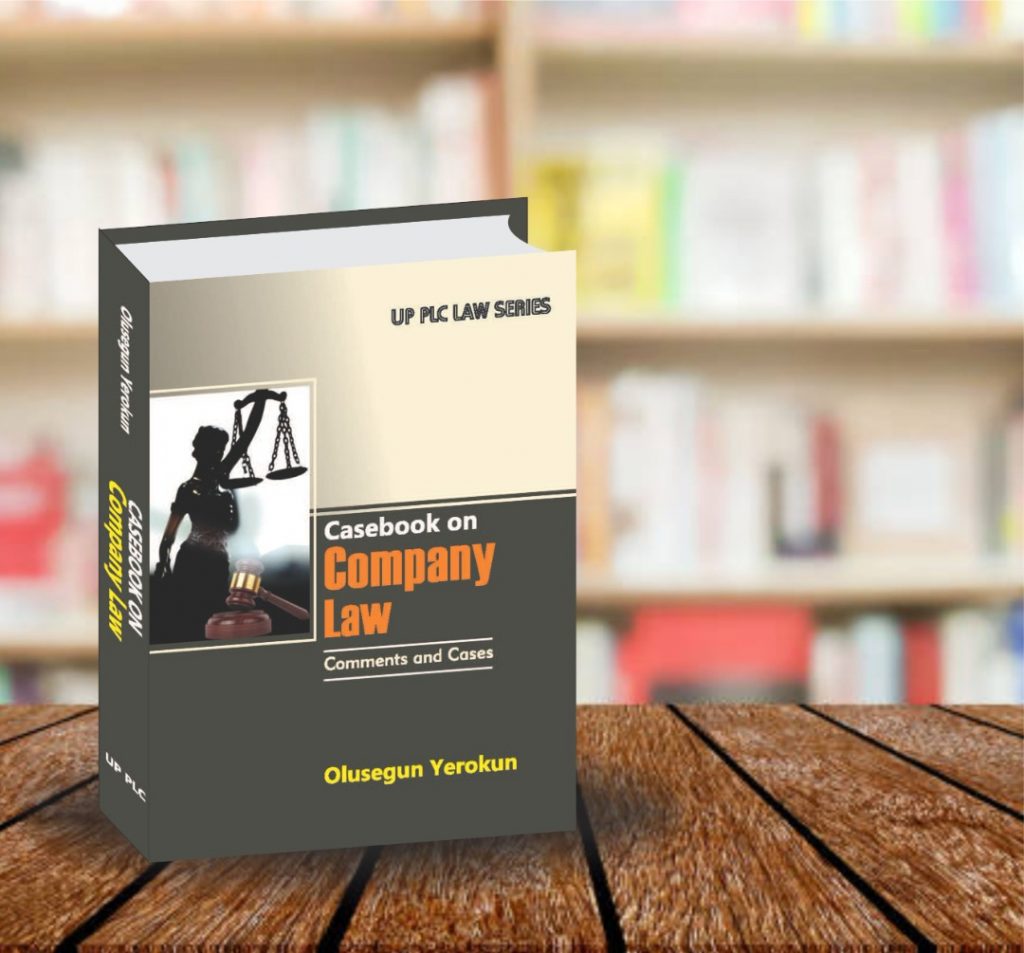
1. Casebook Company Law : Casebook on Company Law is a compilation of relevant judicial pronouncements on company law as stated in the law syllabus by the National Universities Commission (NUC) for Nigerian Universities. It gives an accurate account of the key principles on different aspects of the subject which range from the formation and registration of a company, memorandum and articles of association, shares and share capital, debentures, receivership, meetings, directors, winding up, etc.
Order here- https://legalnaija.com/product/casebook-on-company-law/
2. Company Law and Practice in Nigeria:
This book is written in response to the new legal regime. The book is therefore comprehensively written to reflect contemporary developments in corporate law, jurisprudence, regulations and practices in company law in Nigeria. In doing this, the book captures extant corporate principles and all the novelties introduced by 2020 CAMA.
Order here – https://legalnaija.com/product/company-law-and-practice-in-nigeria/
3. Commercial Law in Nigeria: Commercial Law In Nigeria: Hire – Purchase and Equipment Leasing by Felicia Monye.
Order here- https://legalnaija.com/product/commercial-law-in-nigeria/
4. Company law and practice: Company law and practice with Companies and Allied Matters Act 2020.
Order here – https://legalnaija.com/product/company-law-and-practice/
5. Employment Law: The Employment Law Handbook is written to fill a gap identified in the nature of texts on Employment and Labour Law in Nigeria. While there are many well-researched books on the general principles of Labour and Employment Law, there is a dearth of quick reference materials for Human Resource Managers and Legal Practitioners who have to grapple with taking decisions and advising on workplace related issues on a daily basis. This need is accentuated by the rapid changes in this area of the Law in recent years.
Order here – https://legalnaija.com/product/the-employment-law-handbook/
6. Tax laws in Nigeria 2022: This is a compilation of Tax Laws in Nigeria.
Order here – https://legalnaija.com/product/tax-laws-in-nigeria-2022/
7. Consumer Protection Law: https://legalnaija.com/product-category/consumer-protection-law/
8. Business law and Practice 2: Business law basically encompasses all aspects of commercial law, corporate law, law of contract, insurance law, banking law, labour law, etc. The twelve chapters of this book are designed to cover the scope of business law and give a solid understanding of the subject.
Order here – https://legalnaija.com/product/business-law-and-practice-2/
9. Casebook On Law Of Banking: Casebook On Law Of Banking by Olusegun Yerokun.
Order here – https://legalnaija.com/product/casebook-on-law-of-banking/
10. Companies and Allied Matters Act: Companies And Allied Matters Act with Amendment.
Order here – https://legalnaija.com/product/companies-and-allied-matters-act/
See other law books here https://legalnaija.com/shop
Contact details;
www.legalnaija.com
@legalnaija.com
Hello@legalnaija.com
09029755663

by Legalnaija | Sep 18, 2023 | Blawg
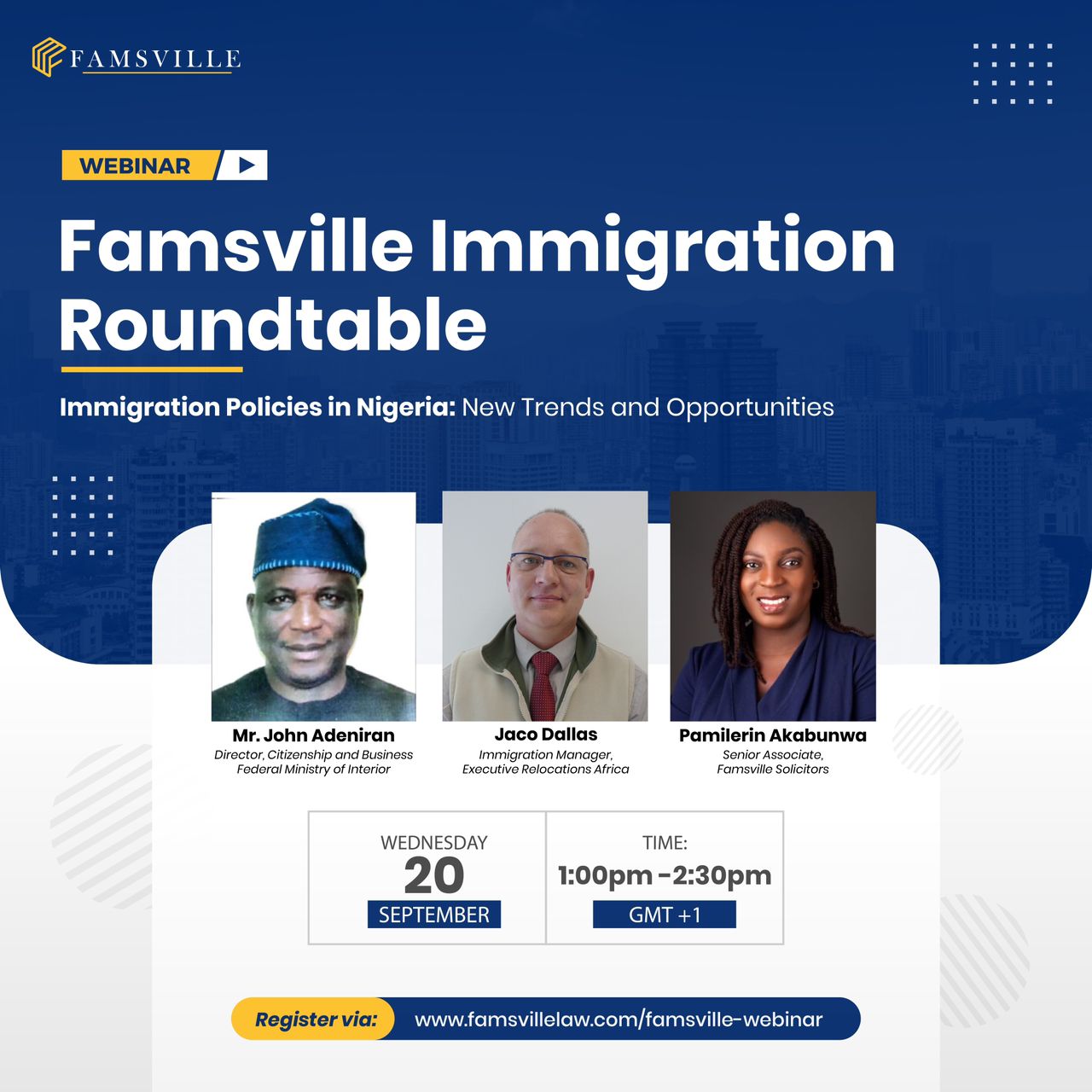
🚀 Exciting News Alert! 🚀
Prepare to embark on an eye-opening journey into the world of immigration policies in Nigeria with Famsville, a Pan-African commercial law firm.
Join us for an exclusive immigration roundtable on the topic “Immigration Policies in Nigeria: Emerging Trends and Opportunities.”
Date: Wednesday, September 20th, at 1:00 PM (GMT+1).
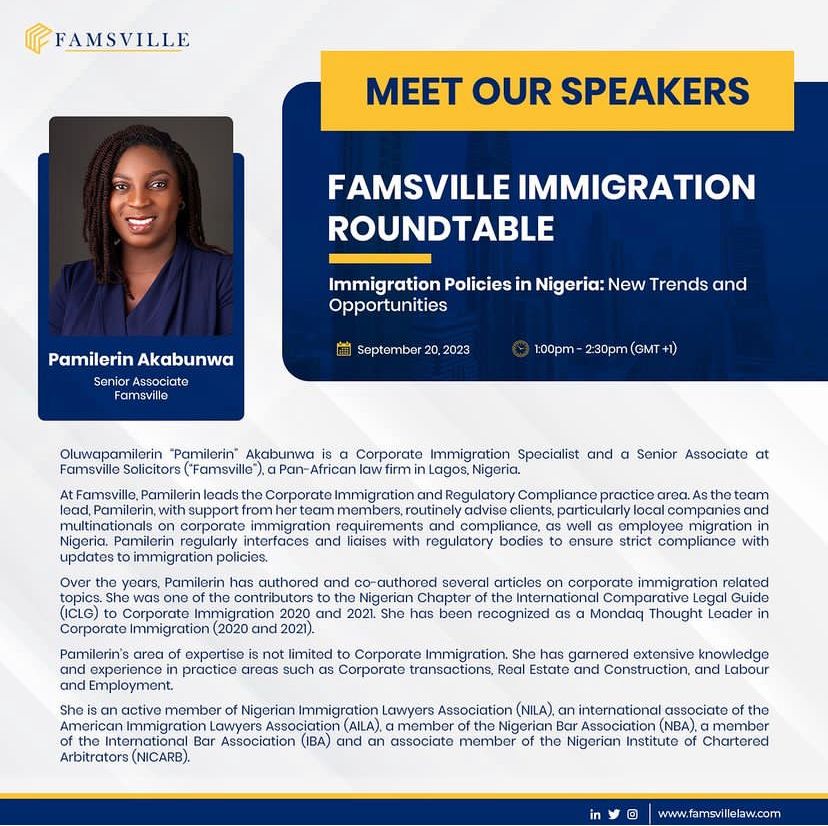
What you will learn:
➢ Visa Categories: Understand benefits and challenges of new visa classes.
➢ Legal Framework: Explore laws and regulations governing visas.
➢ Permanent Residency: Learn eligibility, requirements, and procedures.

➢ Compliance Challenges: Identify regulatory hurdles and processing times
➢ And so much more
Don’t miss out on this opportunity to expand your knowledge and seize new possibilities.
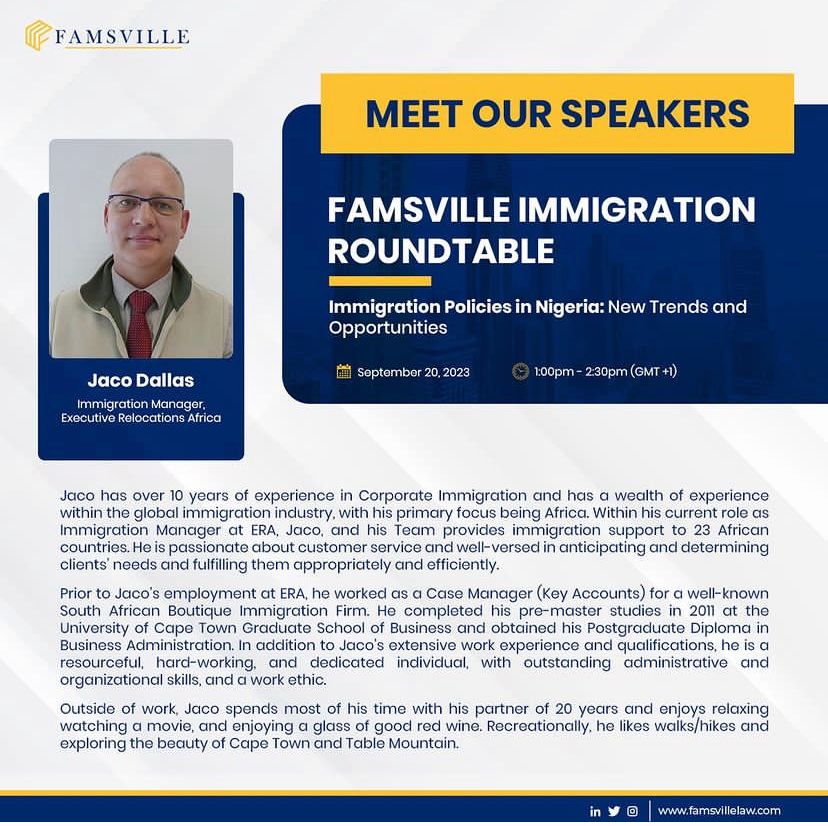
Register to secure your spot now: https://bit.ly/RegistrationLinkFamsville
#FamsvilleWebinar #NigeriaImmigration #FamsvilleWebinar #NigeriaImmigration #Famsvilleimmigrationroundtable #legalevents #immigrationconsultant