TENANCY LAW IN LAGOS STATE

TENANCY LAW IN LAGOS STATE


In Lagos State, the law that
applies to tenancy matters is the Tenancy Law of Lagos State 2011 though it
doesn’t apply to every part of Lagos, areas such as Apapa; Ikeja G.R.A; Ikoyi;
and Victoria Island are exempted from the law. Also, residential premises
operated by educational institutes for their staff and students; residential
premises provided for emergency shelters and residential premises providing
rehabilitative or therapeutic treatment are exempted from the Law as well.

The introduction of the Law by Governor
Fashola won the heart of Lagosians because it prohibited property owners from
collecting more than a year’s rent from tenants, it also prohibits the tenant
from offering and if either party are found culpable of such act they shall be
liable to 3 months imprisonment or a fine of N100,000. 00. Section
3 of the Tenancy Law provides that a tenancy agreement exist where premises are
granted by the landlord to a person for value whether or not it is – Express or
implied; Oral or written or partly oral or partly written; or For a fixed
period.
Under the Tenancy Law, tenants
are entitled to quiet and peaceful enjoyment of the premises, this includes;
privacy, freedom from unreasonable disturbance, exclusive possession of the
premises and the use of common areas for reasonable and lawful purposes. But,
tenants also have certain duties and obligations under the tenancy agreement,
which include: 
·        –
Duty to pay rent at the times and in the manner
stated.
·        –
Duty to pay all existing and future rates and
charges not payable by the landlord by law.
·        –
To keep the premises in good and tenantable
condition.
·        –
Permit the landlord’s agents to effect repairs.
·        –
Not to make alterations on the building without
express consent from the landlord.
·        –
Not to assign or sublet the property without the
consent of the landlord, and
·        –
Inform  the landlord when repairs are to be
made.
The Law allows landlords to
collect service charges but states that a separate receipt must be issued for
such payments. Tenants are however entitled to a written account of how
such funds are used. In any case where the landlord or his agent in
addition to rent requires the tenant or licensee to pay;
(a) A security deposit to cover
damage and repairs to the premises;
(b) For services and facilities
for the premises; or
(c) Service charges in flats or
units that retain common parts on the premises, 
The landlord or his agent shall
issue a separate receipt to the tenant for payments received and such tenant
shall be entitled to a written account at least every six (6) months from the
Landlord of how monies paid were disbursed.  
Where the tenant fails to adhere
to the conditions of rent, the tenancy agreement may be terminated by the
Landlord taking possession of the property. The Law also places some responsibilities
and obligations by stating that subject to any provision to the contrary in a
tenancy agreement, the landlord shall;
·        
Not disturb the tenant’s quiet and peaceable
enjoyment of the premises.
·        
Pay all rates and charges as stipulated by law.
·        
 Keep the
premises insured against loss or damage.
·        
 Not
terminate or restrict the use of a common facility or service for the use of
the premises.
·        
Not seize any item or property of the tenant or
interfere with the tenant’s access to his personal property.
·        
 Effect
repairs and maintain the external and common parts of the premises.

As for the
payment of professional services such as legal fees, it shall be the duty of
the party who engages the services of a professional in respect of the tenancy
agreement to pay the fees. Where there is a breach or non-observance of any of
the conditions or covenants in respect of the premises, the landlord shall
subject to – Any provision to the contrary in the agreement between the
parties; and The service of process in accordance with the relevant provisions
of the Law, have the right to institute proceedings for an order to re-enter
and determine the tenancy.

Where there is no stipulation as to the notice
to be given by either party to determine the tenancy, the following shall
apply-

(a) a week’s
notice for a tenant at will;
(b) one (1) months’
notice for a monthly tenant;
(c) three (3)
months’ notice for a quarterly tenant;
(d) three (3)
months’ notice for a half-yearly tenant; and
(e) six months’
notice for a yearly tenant.

In the case
of a monthly tenancy, where the tenant is in arrears of rent for six (6)
months, the tenancy shall lapse and the Court shall make an order for
possession and arrears of rent upon proof of the arrears by the landlord. In
the case of a quarterly or half-yearly tenancy, where the tenant is in arrears
of one (1) year rent, the tenancy shall lapse and the Court shall make an order
for possession and arrears of rent upon proof of the arrears by the landlord.

Adedunmade
Onibokun
@adedunmade

LEGISLATIVE MOTION ON BILATERAL AIR SERVICE AGREEMENT (BASA) BETWEEN NIGERIA AND UK

MOTION TO INVESTIGATE BILATERAL AIR SERVICE
AGREEMENT (BASA) BETWEEN NIGERIA AND THE UNITED KINGDOM AND ITS
NON-DOMESTICATION BY NIGERIAN AUTHORITIES

The House:
Notes: Bilateral Air Service Agreement (BASA) is an
agreement signed between two nations to allow international commercial air
transport services between their territories. BASA, founded on the principle of reciprocity, is
a deal that enables a country’s airlines to enjoy equal leverage, in terms of
flight operations, in countries with which their home country has an air
agreement.
Worried: During the signing of the agreement few years ago, both governments
(Nigeria and United Kingdom) agreed to assist airlines owned by

both countries
that wish to fly into each other’s airspace. Under the bilateral agreement
between United Kingdom and Nigeria, each of the two countries would have 21
frequencies for its airlines. What this means is that British airlines would
operate into Nigeria 21 times, while Nigerian airlines would also operate into
Britain 21 times.

Concerned: The underlying tenet and principle behind agreement of this magnitude
is equality of flights between and among airlines of signatory countries
without compromising safety and security standards. However, this principle of
equal partnership and stakes is being flagrantly abused by the United Kingdom.
While British Airways and Virgin Atlantic are fully exploiting the Nigerian
slots as contained in the BASA, same could not be said of their Nigerian
counterparts.

CONSTITUTION OF THE FEDERAL REPUBLIC OF NIGERIA
Resolves to;
1.     
Request
the House Committee on Aviation as well as the Committee Treaties and
Agreements investigate the BASA and how beneficial are these Bilateral Air Service
Agreements to Nigerian Airlines. 

2.     
Request
that the Ministry of Aviation, immediately forward all Bilateral Air Service
Agreements (BASA) which Nigeria entered into for domestication to the House of
Representatives in order for these treaties to have force of Law as provided in
Section 12 of the Constitution of the Federal Republic of Nigeria 1999.

           MOTION
Honourable colleagues,
I seek to present a motion to investigate thenon-domestication of the
Bilateral Air Service Agreement (BASA) between Nigeria and the United Kingdom
as its non –domestication and presentation to the National Assembly makes the
treaty not to have the force of Law in Pursuant to Section 12 of the
Constitution of the Federal Republic of Nigeria, 1999.

One of the fundamental
principles of International trade and business is economic co-operation with
agreements of different forms and shades as the basis for such interdependence.
In Air transport, air service agreements are entered into, which should be
mutually beneficial to the parties, hence the BASA.
Bilateral
Air Service Agreement (BASA) is an agreement signed between two nations to
allow international commercial air transport services between their
territories.
Under the bilateral
agreement between United Kingdom and Nigeria, each of the two countries would
have 21 frequencies for its airlines. What this means is that British airlines
would operate into Nigeria 21 times, while Nigerian airlines would also operate
into Britain 21 times.
Recent happenings in the Aviation sector seems not
to be in favour on Nigerian Airlines as deluge of complaints and displeasure
are been expressed by industry operators on the lopsided nature of this
agreement in favour of UK registered Airlines.
Fellow Lawmakers, further review of this situation
revealed that despite the noise and cries by Nigerians on the alleged lopsided
nature of this Agreement, it was revealed that this agreement was not even
domesticated and lacked the Force of Law. So, it can be convincingly deduced
that these Agreements are really not justiciable or enforceable under the Laws
of Nigeria even if the alleged defaults by the UK authorities are indeed real.

Nigeria is a signatory
to many of these treaties-be it Bilateral and Multi-Lateral agreements and
suffix to say that only a few of them have really been beneficial to the people
of Nigeria whom we always claimed to have been greatly considered before
appending our signatures on these binding documents. Also, before treaties can
have a force of Law in Pursuant to Section 12 of the Constitution of the
Federal Republic of Nigeria, 1999 they must be tabled before this Honourable House.
 

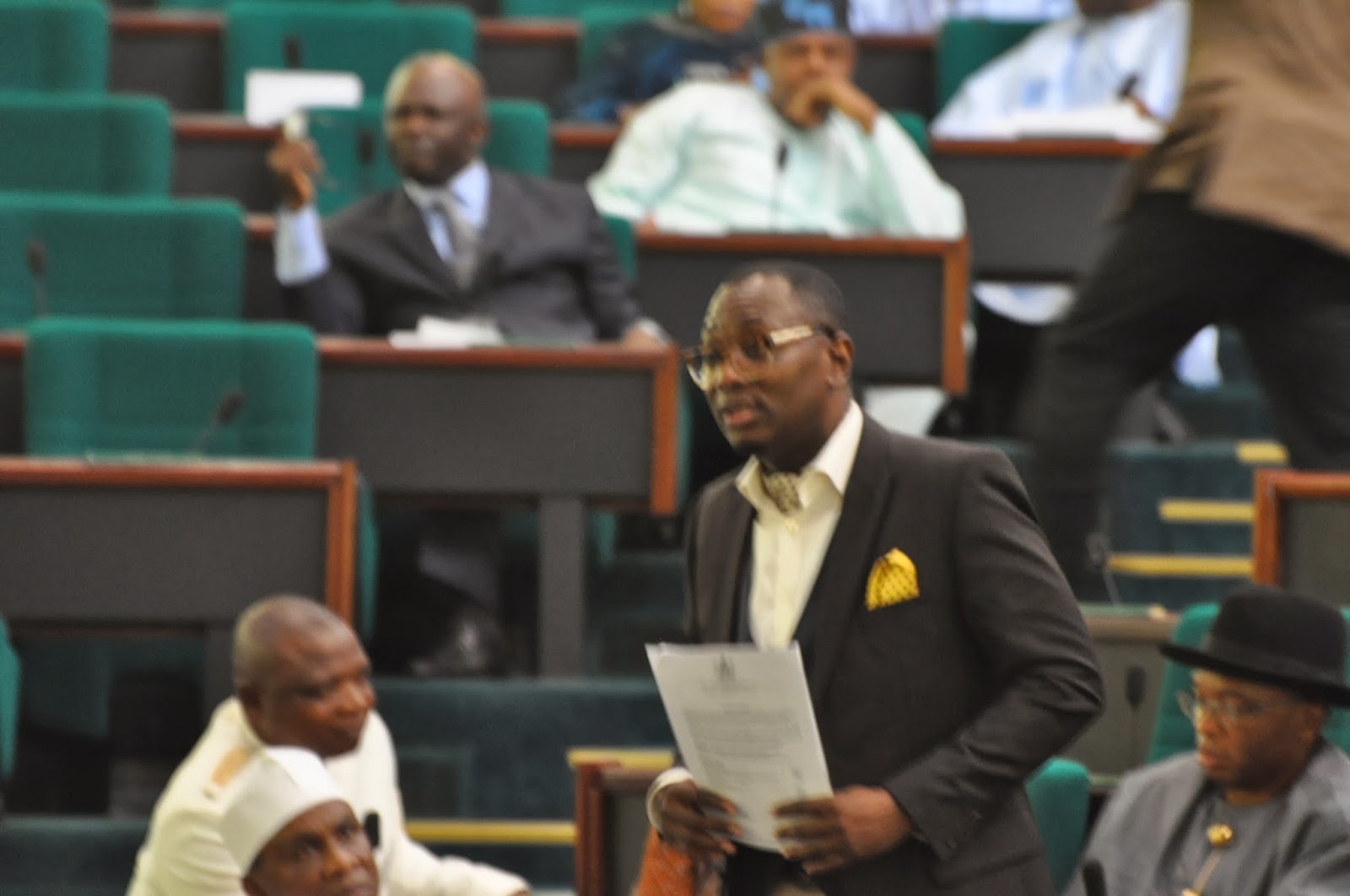
Hon. Yacoob E.A. Alebiosu 

Hon. Dayo Alebiosu is a member of the House of Representatives, representing the good people of Kosofe Federal Constituency of Lagos State and Chairman of the House Committee on Treaties and Agreements. 
INTERVIEW: HON. DAYO ALEBIOSU ON THE NATIONAL TOBACCO BILL

INTERVIEW: HON. DAYO ALEBIOSU ON THE NATIONAL TOBACCO BILL

A
new tobacco control bill sponsored by Hon Dayo Alebiosu a member of the
House of Representatives, representing Kosofe Federal Constituency has
scaled through second reading. In this interview with Michael Azorie, he
talks about what motivated him to sponsor the bill and his life as a
former smoker.


The
National Tobacco Control Bill that you sponsored scaled through the
second reading and was committed to the committees on health and
Justice, why two committees?
Well,
you know if the one sponsored by Senator Mamora had gone through with
the Presidential assent this would have been an amendment, so since it’s
not law yet, you can’t amend what is not law. The Bill sought to amend
the 2004 tobacco act with some additions to it, and we want to make sure
that since it enjoyed the support of the entire house because not a
member opposed it, we want to be sure that some of the objectives it
sought to achieve does not offend any laws here in this country. That
was why it needed to be looked at holistically from the health and
justice angle. That is why you have the bill committed to both
committees.
The motivation, what is the motivation for this tobacco bill
To
be honest with you, I will say that although I have had some health
issues and experiences in the past that I was ignorant of a few
things and on finding out it prompted my actions. I used to be a
smoker, but thank God, I didn’t get to a point where they say if I don’t
quit I will die. With the support and help of God I was able to kick
the habit. I used to drink as well; I used to drink energy drinks and
alcohol. I had some experience with energy drinks and I will not want
anybody to experience what I went through. Before that I had found
myself in the middle of health campaign, I listen to news a lot and with
the  illiteracy rate in Nigeria at 70 percent , who will look out for
them. We need to understand that as a developing nation we have ties and
treaties with other nations which is mutually benefiting and as the
chairman of the Treaties and Agreement committee, I have been able to
examine some of these treaties and say to myself that we need to do
something about it. Nigeria is a signatory to the Framework Convention
on Tobacco Control.
Also the fact
that I see most kids who smoke do so because their parents smoke and
they began at an early age. That is one of the things this bill will do,
parents can’t smoke around their children. We are also looking at those
who send their children to purchase cigarettes; it is going to become a
crime. We know the most addictive drug in the world is nicotine, that
is what makes them smoke. When you send kids to purchase nicotine, you
are saying it is okay to smoke; these are the things we seek to put out.
Apart
from that if you go driving out, you can actually buy cigarettes in
traffic. Should this be? Should the most addictive drug in the world be
sold indiscriminately without licensing which is another thing the bill
will do. It will license those who sell cigarettes. There has to be
checks and balances. The law is meant to punish those who go against it.
This is the only way we can protect our
children, as a matter of fact am not just worried about the future of tomorrow
am also worried about today, the present. We all have to die, but I
don’t want to go right now, so how do we protect the passive smoker,
those who never smoke but ended up with a tobacco related disease.  They
have a right to life but they are being killed. Do we classify that as
an act of God or murder? I will continue to repeat the use of the most
addictive drug in the world, nicotine, should we continue to have it
being sold on the streets without licensing. Tell me where in the world
that is practiced.
You
mentioned that Nigeria has an obligation to domesticate the FCTC, can
this bill serve as the domesticating instrument, and does it fulfill the
protocols in the FCTC.
Absolutely.
 It agrees with practically all the provisions of the FCTC. Also when
you append your
signature to a protocol without registering your reservations, it means
you are in agreement with all the protocol. Nigeria is in agreement
with the FCTC. We are also going beyond that to look at the peculiarity
of our country, our culture and society. When they came up with FCTC am
sure they did not consider that cigarettes are being sold on the streets
of Nigeria. There are quite a few things I see around and I ask how did
we get here. I am grateful to my colleagues for their support on this
bill, when the bill was called for hearing, not a member opposed it.
Not even members representing the tobacco growing areas….
Not one nay. And I am very grateful to the members for that as much as I will still need their support throughout this process.
Is there any difference between this bill and the
one sponsored by Senator Mamora
There
are quite a few. For instance we are introducing licensing, we are
restricting smoking in certain places, you can’t sell tobacco on the
highways, it also addresses smokeless tobacco, there is workplace
protection for speaking up against smoking.
Senator
Mamora’s bill was passed by the National Assembly but not signed into
law by the President, now that this process is on again what will you do
differently to ensure a better result this time.
Amazingly
we didn’t hear from the Executive to say this is what they were opposed
to in the bill but I hear that the Executive was working on a bill, or
so I hear, you know you hear rumours here and there. But the legislature
is such that a lot depends on the support of the members, eventually it
comes down to the ayes and the
nayes. Interestingly, we have all the ayes on our side, am hoping that
the bill will continue to get the support. There are also constitutional
provisions that allow you follow certain steps. Unfortunately, the
sponsor of the bill didn’t return to continue to push for the Executive
assent to the bill. I guess God has a reason for that because this bill
is several riders to the earlier one.
 The
constitution has provisions for what to do if the President does not
sign a bill that is he has to transmit in writing to the National
Assembly reasons he did not sign. Also, the National Assembly can choose
to veto the President on any bill. If need be, will you go for this
option
Well, I do not want
to be preemptive, because in the eventuality of that happening, it
won’t be my decision, it will be the House. You will have to lobby your
colleagues to see
reasons with you. But it is usually always the last resort, I believe
the Executive might have their reasons for what happened, now we have a
stronger bill, I wouldn’t even want to consider that at all, I believe
the Executive and the Legislature are pulling in the same directions for
the good of public health.
Won’t some people see this bill as the opposition bill since Senator Mamora is also a member of your party?
Take
a look at the tobacco statistic, an annual 6.4 million people being
affected. I am sure if they die they will not all be A C N members,
there will be PDP members too. We want to protect the under 18 children,
they are not all opposition children.  Am a father, I used to smoke; I
wouldn’t want my children to experience it likewise all the other
members of that House. Every member supported the bill, it cuts across
party
lines.
There is a
compelling argument from the tobacco industry about paying taxes and
providing jobs. Doesn’t this bill look like you are discouraging Foreign
Direct Investment
Yes I
appreciate the fact that the tobacco industry is providing less than
1,000 jobs. We thank them very much. But we have indigenous companies
like Dangote that have employed more than that. Besides, this bill is
regulatory not prohibitory. There is no other place in the world even in
the homes of the parent tobacco companies that don’t have regulations,
and they don’t have cigarettes sold in kiosks but under licensing. There
are other foreign investors in Nigeria; we need to understand that if
Nigeria isn’t seen as a huge market they wouldn’t be here. In as much
that they have a dangerous product and they want the business of
Nigerians they must be regulated. Without that
we can be sure that they can use tobacco to control our population.
Have you been contacted by the tobacco industry
No I haven’t
 When they do how will you deal with it
 
This is not the first bill I will be sponsoring, you asked me what
motivated me into doing this and I gave reasons, so I wonder what will
now kill that motivation. Amazingly, Senator Mamora is also my
constituent. It wasn’t planned it just happened, so if he could make it
through I will as well.
 
  There is a tobacco bill in the Senate……
 Correct
 Which is seeking to do exactly what your bill wants to do? Will you harmonize with the Senate or step down your bill
There
are provisions in the National Assembly, we can sit down and look at
all the bills, the strength and weaknesses, we take the strong points
and the ultimate goal is to have a strong legislation for Nigeria. I am
sure the Senate would also see the strength of this bill.

ARBITRATING FOREIGN INVESTMENT DISPUTES IN NIGERIA: PROSPECTS AND CHALLENGES

By;Dorothy Ufot SAN 
 
Nigeria’s investment laws and policies are geared towards
liberalisation, deregulation and competition. Accordingly, all sectors
of the economy are open to both foreign and domestic investment. As a
result of this favourable climate and the country’s economic and
political stability, Nigeria has become increasingly attractive to
foreign investors. However, with increased investment comes increased
potential for disputes. This update examines the infrastructure
available in Nigeria for the arbitration of investment disputes.

Bilateral investment treaties
Nigeria has entered into bilateral investment treaties (BITs) with the following countries:

  • Egypt (not yet in force);
  • Finland (not yet in force);
  • France (August 1 1991);
  • Germany (not yet in force);
  • Korea (February 1 1999);
  • the Netherlands (February 1 1994);
  • Spain (not yet in force);
  • Switzerland (April 1 2003);
  • Turkey (not yet in force); and
  • the United Kingdom (December 11 1990).

All of these BITs explicitly afford the following protection to prospective foreign investors:

  • fair and equitable treatment;
  • standard protection against expropriation, which provides that
    expropriation must be in the public interest and be accompanied by
    prompt, adequate and effective compensation. It must further take place
    under “due process of law”;
  • most favoured nation treatment;
  • full protection and security for all investments within Nigeria;
  • a standard umbrella clause under which the state undertakes to
    observe any obligation it may have entered into with regard to
    investments of foreign nationals or other contracting parties;
  • the free transfer of payments without restrictions in a freely convertible currency at the prevailing market rate; and
  • the resolution of foreign investment disputes through arbitration.

Investment arbitration
Investment arbitration is essentially statute driven. The relevant
statute governing investment arbitration in Nigeria is the Nigerian
Investment Promotion Commission Act (Cap N117, Laws of the Federation of
Nigeria 2004). This statute, which was first enacted in 1995, deals
extensively with investment promotion in Nigeria, with specific
provision for the resolution of disputes arising between an investor and
any government of the Nigerian Federation or any agencies of
government.
Section 26 of the acts provides for the resolution of investment disputes through arbitration as follows:

“1. Where a dispute arises between an
investor and any Government of the Federation in respect of an
enterprise, all efforts shall be made through mutual discussion to reach
an amicable settlement.
2. Any dispute between an investor and
any Government of the Federation in respect of an enterprise to which
this Act applies which is not amicably settled through mutual
discussions, may be submitted at the option of the aggrieved party to
arbitration as follows:-
a) in the case of a Nigerian investor,
in accordance with the rules of procedure for arbitration as specified
in the Arbitration and Conciliation Act; or
b) in the case of a foreign investor,
within the framework of any bilateral or multilateral agreement on
investment protection to which the Federal Government and the country of
which the investor is a national are parties; or
c) in accordance with any other
national or international machinery for the settlement of investment
disputes agreed on by the parties.
3. Where in respect of any dispute,
there is disagreement between the investor and the Federal Government as
to the method of dispute settlement to be adopted, the International
Centre for Settlement of Investment Dispute Rules shall apply.

All Nigerian BITs provide a right of recourse to international
arbitration. The BITs with France, Germany, Korea, the Netherlands and
the United Kingdom provide for exclusive ICSID arbitration. All other
BITs allow investors to pursue an arbitration claim through ICSID or ad hoc arbitration in accordance with the UNCITRAL rules or any other rules mutually agreed by the parties.
The Spain BIT allows for the use of the ICSID Additional Facility if a
contracting party is not an ICSID Convention country, while the Turkey
BIT makes express alternative reference to the International Chamber of
Commerce International Court of Arbitration.
As yet, no publicly available awards have been issued against Nigeria
under any of the BITs. Equally, the Nigerian courts have never been
called upon to enforce an investment treaty award against Nigeria.
However, the courts have demonstrated a pro-enforcement bias in the
sphere of commercial arbitration.
Two cases have so far been filed against Nigeria at ICSID in respect
of its investment treaties, but both were discontinued before the
conclusion of the arbitration proceedings:

  • Guadalupe Gas Products Corporation v Nigeria (ICSID) Case ARB/78/1 – discontinued on July 22 1980; and
  • Shell Nigeria Ultra Deep Limited v Federal Republic of Nigeria (ICSID) Case ARB/07/18 – discontinued on August 1 2011.

Arbitration framework
Arbitration and Conciliation Act
The legal framework for arbitration in Nigeria is set out in the
Arbitration and Conciliation Act (Cap A18, Laws of the Federation of
Nigeria, 2004). The Arbitration and Conciliation Act is modelled on the
United Nations Commission on International Trade Law (UNCITRAL) Model
Law, and applies throughout the Nigerian Federation.
ICSID Convention
Nigeria ratified the International Centre for Settlement of Investment
Disputes (ICSID) Convention as far back as August 23 1965. The ICSID
Convention has been implemented in Nigeria through the International
Centre for Settlement of Investment Disputes (Enforcement of Awards) Act
(Cap 120, Laws of the Federation of Nigeria, 2004).
The ICSID Act provides for the enforcement of ICSID awards directly
at the Nigerian Supreme Court as the court of first instance.
New York Convention
Nigeria became a signatory to the New York Convention 1958 on March 17
1970, adopting both the reciprocal and commercial reservations. The
convention came into force in June 1970.
The New York Convention has been implemented in the Arbitration and
Conciliation Act. One of the act’s stated objectives is to make the
convention applicable to any award issued in Nigeria or any contracting
state arising out of international commercial arbitration. The
convention was implemented in Nigeria without modification and its full
text is set out in the second schedule of the act.
Section 54 of the act makes the New York Convention expressly applicable to Nigeria by providing that:

where the recognition and enforcement
of any award arising out of an international commercial arbitration are
sought, the Convention on the Recognition and Enforcement of Foreign
Awards (hereinafter referred to as ‘the Convention’) set out in the
second schedule to this decree shall apply to any award made in Nigeria
or any contracting state:
a) provided that such contracting
state has reciprocal legislation recognising the enforcement of arbitral
awards made in Nigeria in accordance with the provisions of the
Convention.
b) that the Convention shall apply only to differences arising out of legal relationship which is Contractual.”

Section 51(1) of the act, on the recognition and enforcement of
awards, provides that: “an arbitral award shall, irrespective of the
country in which it is made, be recognised as binding and shall, upon
application in writing to the court, be enforced by the court.”
This provision received judicial backing from the Nigerian Court of
Appeal when the court, in upholding the recognition and enforcement of
an arbitral award issued in the United Kingdom in Tulip Nigeria Limited v Noleggioe Transport Maritime SAS ((2011) 4 NWLR (Part 1237) at p254), held as follows:

By the provision of section 51(1) of
the Arbitration and Conciliation Act, an arbitral award shall
irrespective of the country in which it is made, be recognised as
binding subject to the provisions of the Act, and shall upon application
in writing to the court, be enforced by the court.

The court further held in Tulip that “A foreign arbitral
award is now enforceable in Nigeria directly pursuant to the New York
Convention to which Nigeria is a signatory”; and that “An action shall
not be brought after the expiration of six years from the date on which
the cause of action accrued in an action to enforce an arbitral award”.
Court support for arbitration
The Nigerian courts are arbitration friendly and maintain a
pro-enforcement bias in relation to the enforcement of arbitration
agreements and arbitral awards. In Onward Enterprises LTD v MV Matrix (2010) 2 NWLR (part 1179) 530, the Court of Appeal held that:

once an arbitration clause is
retained in a contract which is valid and the dispute is within the
contemplation of the clause, the court will give regard to the contract
by enforcing the arbitration clause. It is therefore the general policy
of the court to hold parties to the bargain which they freely entered.

In the more recent case of Continental Sale Limited v R Shipping Inc
(2013) 4 NWLR (part 1343) 67, the appellant – a Nigerian party – denied
being given proper notice of the appointment of an arbitrator or of the
commencement of arbitration proceedings, despite its acknowledgment of a
notice of arbitration sent to it by email (for more details please see “Appeal court rules on serving arbitration notice by email“).
In upholding the high court decision registering the UK arbitral award
in Nigeria, preparatory to enforcement, the Court of Appeal held as
follows:

1. The spurious argument that service of notice was not in writing cannot fly.
2. Email is a form of communication
that is set down in writing. It is not oral. The fact that it is
electronic is immaterial. It is not in thin air. It can be downloaded
and is as real as a hard copy of the letter or mail in your hand.
3. Since the intention of the email
messages and the correspondence from the Respondent, the Solicitor and
the Arbitrator to the Appellant was to achieve the result of
communicating the fact that the arbitration proceedings had been
initiated at various stages of the process, there has been effective
service of the whole arbitration process on the Appellant.

Arbitration infrastructure
The following arbitration institutions operate in Nigeria:

  • the Regional Centre for International Commercial Arbitration, Lagos;
  • the Chartered Institute of Arbitrators, Nigeria Branch;
  • the Society for Construction Industry Arbitration;
  • the Maritime Arbitrators Association of Nigeria;
  • the Arbitration Commission of the ICC Nigerian National Committee; and
  • the Lagos Court of Arbitration.

The Regional Centre for International Commercial Arbitration in Lagos
shares the same pedigree as the regional centres in Cairo and Kuala
Lumpur. It is purpose built, with internationally comparable facilities
and hearing rooms. The centre is centrally located in one of Nigeria’s
prime business districts, with close proximity to the international
airport and choice hotels and restaurants.
Arbitration proceedings also frequently take place at the Hilton Hotel in Abuja, Nigeria’s administrative capital.
Nigeria also boasts the following qualified arbitration practitioners:

  • 12 chartered arbitrators;
  • 89 fellows;
  • 290 members; and
  • 1,235 associates.

It is also home to many other available personnel required for the
conduct of international arbitration, such as experienced counsel,
registrars, secretaries and recorders.
However, despite the abundant availability of resources in Africa and
the existence of major arbitrations involving African states,
particularly in the oil and gas and energy sectors, African arbitrators
and counsel are seldom appointed to participate in these proceedings.
Instead, both foreign and African parties invariably instruct foreign
counsel, who in turn appoint foreign arbitrators. When counsel are
appointed from Africa, they are appointed often only to advise on local
laws.
Challenges of arbitrating in Nigeria
The challenges of arbitrating in Nigeria include the following:

  • the risk of anti-arbitration injunctions being issued;
  • perceptions of corruption;
  • the obsolete Federal Arbitration Law; and
  • the length of time that it takes for arbitration and enforcement
    cases to reach the Supreme Court for final determination of the rights
    of the parties.

Tips for successful arbitration
Arbitration clauses should be thoroughly negotiated and properly
drafted in precise and unambiguous terms, in order to avoid intervention
by the courts. Prospective foreign investors should also appoint
knowledgeable counsel during the negotiation stage of the agreement. In
the event of a dispute arising, prospective foreign investors should
make an informed selection of arbitrators, because once these have been
appointed they cannot generally be replaced.
The arbitration proceedings should further be conducted
expeditiously, bearing in mind the limitation period for the
commencement of an enforcement action, which is six years from the date
of accrual of the cause of action in a simple contract. The Supreme
Court has ruled that this time begins to run from accrual of the cause
of action resulting in the arbitration proceedings, and not from the
date of the award. Accordingly, time is of the essence for the
commencement of enforcement proceedings.
The Supreme Court has also held that the timeframe for instituting an
action to set aside an arbitral award is 90 days from the date of the
award. However, arbitration awards are not lightly set aside. As Nigeria
is a signatory to the New York Convention, recognition and enforcement
of arbitral awards may be refused only on the grounds recognised under
the New York Convention.
Conclusion
Nigeria has signed and implemented the New York and Washington
Conventions on the recognition and enforcement of foreign arbitral
awards, has signed bilateral and multilateral investment treaties
offering full protection to foreign investors – including recourse to
international and/or investment arbitration – and has in place the
necessary personnel and infrastructure for the successful conduct of
arbitration, including arbitration-friendly courts. Despite this,
however, few international arbitrations take place in Nigeria.
With the increased potential for disputes arising from increased
foreign investment in the country, Nigeria should rightly become an
equally attractive destination for international arbitration, and now is
the time to make this happen.
There is thus an urgent need to address this issue and build capacity
for the resolution of investment disputes both within Nigeria and
across the wider region, if the continent is also to benefit from the
results of increased foreign direct investment inflow into Africa.

For further information on this topic please contact Dorothy Ufot SAN at Dorothy Ufot & Co by telephone (+234 1 463 1723) or email (dorothy.ufot@dorothyufotandco.com).

REPORT: LOCAL LANGUAGES TO PROMOTE FINANCIAL LITERACY by Peter Akindele

REPORT: LOCAL LANGUAGES TO PROMOTE FINANCIAL LITERACY by Peter Akindele

‘FINANCIAL Literacy’, according to the Organisation for Economic
Co-operation and Development, financial literacy is defined as:
“Knowledge and understanding of financial concepts, and the skills,
motivation and confidence to apply such knowledge and understanding in
order to make effective decisions across a range of financial contexts,
to improve the financial well-being of individuals and society, and to
enable participation in economic life.” With this definition, I will
explore the different methods of using local languages to promote
financial literacy in Nigeria. I believe that the main purpose of
financial literacy is to ameliorate the economy in Nigeria.

There are hundreds of local languages spoken throughout Nigeria, the
eight most widely spoken being English, Yoruba, Hausa, Igbo, Ibibio,
Kanuri, Edo and Fulfulde. Considering how Nigeria was formed of these
different tribes, there are subtle cultural differences between them.
These differences must be taken into consideration as they would reflect
on the attitudes of the people and their way of communicating. This
then poses the question: “Should we use local languages in the first
place, or use a universal language to educate the people?” This is an
interesting question as there are multiple sides to this metaphoric
coin. Although, the use of a universal language i.e. English, would mean
that educating the masses would be far simpler as there could be
seminars held in a location that is suitable for all people to attend;
the person leading the seminar would also only need to be able to speak
English in order to communicate with the entire audience.
However, this method may not necessarily work. Using a generic language
requires those who are not familiar with this language to have to learn
it and be educated in it. This is a sufficient method for young
children, provided they have suitable teachers; however it does not
cater for adults. One’s ability to learn a language diminishes as one
grows older. The technical terms that are used in such a matter are far
more difficult for a non-native speaker to have to learn.
We must
not assume that those who are educated are financially literate. There
may well be people that have fantastic jobs that are not aware of how to
maintain their income and how to save properly. Being financially
literate is not only understanding how the economy works, but also
knowing how to manage one’s own personal finance.
There is a
correlation between financial literacy and financial inclusion: those
who are financially illiterate would also be financially excluded. As of
2010, 46.3 per cent of Nigerian adults were financially excluded. This
is almost half of Nigeria’s adult population; as a result, the
percentage of financially literate adults is bound to be low. In order
to promote financial literacy, we must first address those who are
financially excluded. It is my belief that the majority of those who are
financially excluded live in the more rural parts of the country. Out
of Nigeria’s 163 million people, 49 per cent of them are living in rural
parts of the country.   
The majority of these people would be
uneducated and are either not aware of the support that a bank can
provide them with; or simply live too far away from the nearest bank.  A
way to tackle this would be to create small branches in nearby towns
and subsequently send teams to the individual villages where the
majority of the financially excluded live.
    
Using local
languages puts the people at an advantage. The topic specific words are
far simpler to comprehend in one’s own language, as it does not require
one to have already mastered the foreign language. The main goal is to
make the people financially literate; therefore using their local
languages would be the most sensible method of doing so in this
instance.
By holding seminars in rural towns and
villages, we will be able to create awareness for the inhabitants whilst
communicating with them in their own regional dialects. A new form of
education could be instated by Central Bank. As teenagers are going to
be the next generation of people who impact the economy, making them
financially literate would have a great effect. The communications
department could create a team of teachers to travel to local village
schools, where they can educate the pupils in their own language.
Bearing in mind that many students will not necessarily see the need for
financial literacy at their age, there are particular methods that
should be used, which teenagers will find relevant and engaging. Visual
presentations could be developed to give them a basic understanding of
financial education. Board games similar to the likes of Monopoly, that
teach the value of saving, could be introduced in order to provide the
children with an understanding that they could then translate into their
own financial standings when they become young adults.
The
largest part of Nigeria’s exports, aside from oil, is Nigeria’s
agricultural products. Therefore, it is essential that the farmers are
aware of how to manage their finances properly. However, many farmers
are financially excluded and are not utilising their assets properly.
The Central Bank could set up miniature farmer’s business schools that
teach farmers more agronomic methods on how to grow their crops. The
cost needed to train a farmer on how to manage their finances and how to
harvest in the most efficient manner is a mere N3000 per farmer.
Alternatively, CBN could host an outreach programme in which they have
several teams that accumulate farmers in the local areas and run
workshops and hold lectures on how to become financially literate. As
most farmers that live in the rural areas of Nigeria would not have a
grasp of the English language, the best alternative is for these teams
to be fluent in the local language of the area. The benefits of this
method are that the farmers would feel far more comfortable being able
to relate with the CBN staff in their own language; moreover, as there
would be a group of farmers from the same area, there would be a level
of understanding amongst them which would enable them to learn more
effectively. 
    
According to Africa Finance Forum, the most
financially excluded people in Africa are the women. In order to tackle
this issue, we could create workshops in the markets of more rural towns
in order to develop the financial literacy of the women. Nigeria is
primarily a cash based economy. If CBN were able to create small teams
to promote the use of debit and credit cards, this would automatically
increase financial literacy, as the people would have to know how to use
their accounts, and in turn financial inclusion. The small scale
seminars would have to be held by someone who has a strong grasp on the
native language of the area in order to ensure that all of the women
receive the valid information necessary to become more financially
literate. Giving women a sense of financial importance within our modern
society promotes their sense of financial confidence, thus including
more women along with their personal, as well as business ventures and
projects, within the financially literate sector of our nation.   
In conclusion, it is evident that there is a lack of financial literacy
amongst a large proportion of the Nigerian population. But the CBN is
in a position to create awareness of the issue to those most affected.
To do this, one must address the aforementioned parts of society in the
local language, in order to ensure that the target group feel
comfortable and do not feel that they are being oppressed by a foreign
language.  This contributes to the elimination of financial illiteracy,
and promotes a more healthy and profitable relationship between the
marginalised, and the financial sector of this nation. 

Akindele is a 16 year-old student at African Leadership Academy. He
recently won the Sylvia Trott Prize for Languages for his achievements
in foreign languages, gaining A*A*A*A in Japanese, French, Spanish and
Mandarin respectively.  He has been nominated to receive the Lord Lexden
Academic Achievement Award at the House of Lords in March 2014.
NIGERIAN ANTI – GAY LAW

NIGERIAN ANTI – GAY LAW

Recently, the Nigeria government passed the Same Sex Marriage (Prohibition) Law, a law prohibiting same sex marriage in the country which caused a lot of debates, criticism and commendation from various sectors of the country and also from the international community.  Also, persons accused of being homosexual have been investigated by the police, sometimes leading to arrests and various courts have

begun to punish homosexual behavior. The aim of this article is not to debate on the justification (or not) of the law but to inform about the provisions of this new law.

The law provides only marriages between a man and a woman shall be recognized as valid in Nigeria, thus a marriage contract or civil union between persons of the same sex is prohibited in Nigeria and therefore invalid or illegal. Also any certificate of marriage or civil union granted to members of the same sex by a foreign country shall be void and any benefits conferred by such certificate shall not be recognized or actionable in Nigeria. Religious houses and institutions are also precluded from solemnizing unions between members of the same sex. Persons who enter into same sex marriages or civil union commit an offence and are liable upon conviction to 14 years imprisonment.
Gay clubs and societies are also prohibited, so also are their activities. Any direct or indirect form of public show of same sex amorous relationships are also prohibited. A crime which is punishable upon conviction to 10 years imprisonment. Any person that aids or abets such acts as mentioned above are also liable upon conviction to 10 years imprisonment. The law also grants jurisdiction over such matters to the High Court. 
It should be noted that civil union according to the law means any arrangement between persons of the same sex to live together  as sex partners, and shall include such descriptions such as adult independent relationships, caring partnerships, civil partnerships, civil solidarity pacts, domestic partnerships, reciprocal beneficial relationships, registered partnerships, significant relationships and stable unions.
Adedunmade Onibokun 
@adedunmade
LEGAL RIGHTS OF THE NIGERIAN CHILD

LEGAL RIGHTS OF THE NIGERIAN CHILD


Best interest of a
Child to be of paramount consideration in all actions

         
 Section 1, Child’s Right Act (2003)
In Nigeria, children’s Rights are protected by law and held
sacred, not only does the law protect the child; it also stipulates punishment
for adults who take advantage of children or seek to negatively influence them.
The law seeks to prevent cruelty against children while stating the rights and
obligations of the Nigerian Child.

Prior to the 2003 Child Rights Act, Nigerian child protection
was defined by the Children and Young People’s Act (CYPA), a law relating
primarily to juvenile justice. In 2003, Nigeria adopted the Child Rights Act to
domesticate the Convention on the Rights of the Child. The United Nations
Convention on the Rights of the Child (UNCRC) is an international human rights
treaty that grants all children and young people (aged 17 and under) a
comprehensive set of rights.
In regard to legal contracts, the Act states that No child
shall enter into a contract, except as provided by the provisions of the Act
and any contract, except a contact for necessaries, entered into by a child for
repayment of money lent or for payment of goods supplied to the child, shall be
void. Other rights of the Nigerian child according to Part II of the Child’s
Right Act include:
– Right to survival and development.
– Right to name.
– Freedom of association and peaceful assembly.
– Freedom of thought, conscience and religion.
– Right to private and family life.
– Right to freedom of movement.
– Right to freedom from discrimination.
– Right to dignity of the child.
– Right to leisure, recreation and cultural activities.
– Right to health and health services.
– Right to parental care, protection and maintenance.
– Right of a child to free, compulsory and universal primary
education, etc.
– Right of a child in need of special protection measure.
– Right of the unborn child to protection against harm, etc.

The Act prohibits Child marriage as no person under the age
of 18 years is capable of contracting a valid marriage, and accordingly a marriage
so contracted is null and void and of no effect whatsoever. In addition,
parents and guardians are precluded from arranging or facilitating child
betrothals and any person who marries a child; or to whom a child is betrothed;
or who promotes the marriage of a child; or who betroths a child, commits an
offence and is liable on conviction to a fine of N500,000; or imprisonment for
a term of five years or to both such fine and imprisonment.
It is against the law to tattoo or mark the skin of a child,
any person who tattoos or makes a skin mark on a child commits an offence under
the Act and is liable on conviction to a fine not exceeding five thousand naira
or imprisonment for a term not exceeding one month or to both such fine and imprisonment. 
Exposing a child to the use or trafficking of narcotics is a
serious crime and any person found guilty is liable on conviction to
imprisonment for life. Employing a child for the facilitation of criminal acts
is also an offence under the Act and any person found guilty is liable on
conviction to imprisonment for a term of fourteen years.
It is unlawful to have sexual intercourse with a child; any
person who contravenes this provision commits an offence of rape and is liable
on conviction to imprisonment for life. Where a person is charged with an
offence under this section, it is immaterial that- the offender believed the person
to be of or above the age of eighteen years; or the sexual intercourse was with
the consent of the child.
It may be interesting to note that a child may bring an
action for damages against a person for harm or injury caused to the child will-fully,
recklessly, negligently or through neglect before, during or after the birth of
that child. Also, where the father of an unborn child dies intestate, the
unborn child is entitled, if he was conceived during the lifetime of his
father, to be considered in the distribution of the estate of the deceased
father. Where the mother of an unborn child dies intestate before the child is
delivered, the unborn child is entitled, if he survives his mother, to be
considered in the distribution of the estate of the deceased mother.
Other sections of the Act also provide for the right of the
Nigerian Child, these sections of the Act that relate to legal issues affecting
the Nigerian child include; The duty of the State to protect children and
investigate the plight of children who need special care and protection; child
labour; harmful publications that negatively influence children; adoption, custody
and guardianship of children and the Child Justice Administration system. 
Adedunmade Onibokun  
REPORT: SOLVING WORLD POVERTY THROUGH MATHEMATICS (2)

REPORT: SOLVING WORLD POVERTY THROUGH MATHEMATICS (2)

By: Peter Akindele
FROM the above facts it is clear that the United Kingdom (UK) has the revenue and already spends far more on benefits than the minimum needed to provide each person who is currently out of work with the required $1.25 a day.  With approximately 47.9 per cent of the UK population in employment and a minimum wage of £5 on average,

it would require $15,000,000,000 per year to provide $1.25 per day for the 52.1 per cent of the population who do not work.  This is far below the $330 billion that is spent each year in benefits in the UK.  Even allowing for the higher living costs in the UK the amount needed to spend in order to eradicate absolute poverty as defined by the $1.25 threshold, would not exceed the $330 billion which is already being spent.    Therefore the important step for the UK would be to redirect some of this money into systems that would help to discover the people who are living in the UK who are not benefitting from the extensive welfare system in the UK because of ignorance.  This exact method could be adapted to any developed country with a similarly high GDP PPP per capita.

   Nigeria, like other such countries with low GDP PPP per capita, on the other hand would require a number of methods to deal with absolute poverty.  Seeing as the revenue for Nigeria would not allow there to be such an extensive benefit scheme, as seen in the UK, the solution will focus on ending employment and therefore raising money for the far smaller percentage who would not be able to work.  This would be done essentially by three ways:
• The enforcement of minimum wage set at approximately 196 naira ($1.25) an hour. Although this is equal to the amount needed for a day, the minimum wage has been set for an hour such that even if a person worked only one hour a day they would have the required $1.25 per day.
• Encouraging farmers to farm to sell i.e. offering financial incentives for expansion of business.  This is a problem that affects not only Nigeria but many developing countries with good agricultural land.  Many people farm only for themselves which not only reduces the amount that the government receives in tax but most importantly it fails to realise the opportunity for employment if farmers were encouraged to expand their business. This expansion would mean that more people would be employed and less people would then live under the $1.25 threshold. Although these financial incentives would cost the government additional money, this money could be recouped by the larger percentage of people in employment who are therefore paying income tax and raising revenue for the government.  Additionally, this expansion of agriculture would lead to an increase in exported agricultural goods which would lead to further revenue for the government which could be used on a benefit system for those who could never be provided with employment.
• Furthermore corporate tax within Nigeria will be halved to 15% for companies who seek to build companies in Nigeria with Nigerian employees.  From a look at the statistics it is clear that Nigeria is not making use of its most important resource: its 162,000,000 population and this is largely due to the lack of industry in Nigeria.  If corporate tax was halved it would encourage many of the rich in Nigeria to build companies in Nigeria and therefore create employment.     In a country that is notorious for the massive divide between the wealthy and the poor, the wealth of the “super-rich” can be used in investing in Nigeria based companies that would provide mass employment.    Additionally as can be seen by the 80% graduate unemployment rate it is clear that there is a large educated workforce for these new emerging companies.     The cut in corporate tax would enable these Nigeria based companies to compete with similar products that are imported. The money lost in corporate tax initially will be recouped through the increase in income tax paid by the increase in employees. Additionally the increase in the number of businesses in Nigeria will allow for the maintaining of revenue from corporate tax as even though the government would receive half of the amount it received previously, the increase in the number of companies would help to maintain the same amount of revenue from corporate tax. The lower corporate tax would also invite companies from other countries to settle in Nigeria so that they can pay lower corporate tax.  Seeing as this would only apply to companies with Nigerian employees it would also lead to multinational companies employing Nigerians.    Furthermore, seeing as these companies would be of a large size, the 15% corporate tax would represent a relatively large stream of revenue to the government.
    By employing these three main methods, not only would it rapidly decrease unemployment but it would raise revenue, largely through the increase in income tax from all the new employees. This would allow the creation of a welfare system for those who would be unable to work such as children. The amount needed to fund this welfare system would depend on the success of these measures in increasing employment. The more successful these measures are the less would be needed for the welfare system. This welfare state however is necessary.  It is impossible to create a system in which the entire population is in employment as you will always have groups such as children, the elderly and the disabled, who will be unable to work.  This would also apply to any country which currently does not have a welfare system in place. Any serious attempt to eradicate absolute poverty would require a system for those who are not in work. Although this report acknowledges that this would require a considerable sum, it is believed that through the implementation of the above measures, such revenue can be raised.  
    In conclusion, it is evident that world poverty is a severe problem that still persists in today’s world despite the numerous advancements that have been made.  In using both the UK and Nigeria, this report has made use of two different countries with very different circumstances.  By making use of the UK, a highly developed country, and Nigeria, a country with 68 per cent of its population living in absolute poverty, the aim of the report is to show measures that could be employed to eradicate absolute poverty in any country.     The measures suggested here are designed to be highly flexible and adaptable to the situation of any country.  As mentioned above, this report believes that the best way to eradicate world poverty is to tackle it in each individual country. Any attempt to simply regularise finance on a world scale is prone to be inefficient as it would fail to make the best use of the specific advantages available in each country.  Furthermore, it would be likely to overlook some of the particular challenges facing each country. The best system therefore is a close analysis of each country with a look to maximising its potential with the primary priority of eradicating absolute poverty in each country.  
REPORT: SOLVING WORLD POVERTY THROUGH MATHEMATICS (1)

REPORT: SOLVING WORLD POVERTY THROUGH MATHEMATICS (1)

By: Peter Akindele

“The test of a civilisation is the way that it cares for its helpless members.” –  Mohandas Ghandi
IN today’s modern society, it is clear that the world has become increasingly globalised and technologically advanced.

The extent, to which it is “civilised” however, is questionable.  If Ghandi’s definition of civilisation is correct and is to be followed then the modern world is far from civilised. Today, in spite of the numerous advancements in science and technology, it was estimated in 2008 that 22.4 per cent of the 6,700,000,000 people (1,500,000,000) on this planet lived below the poverty line as defined by the World Bank.  It is therefore essential that as a global society we seek to aid the large percentage of people who are living below the poverty line. This report will seek to explore how as we can use the various advancement in today’s society, particularly in the areas of mathematics and economics, to propose a system by which we may begin to seriously tackle the issue of world poverty.

Methodology  
In order to tackle the issue of world poverty it is imperative to first define poverty on an international scale.  The World Bank as of 2005 set the international poverty line as an income of $1.25 per day per person.  This is calculated by finding the minimum amount of money needed in order to buy the basic necessities for a human being.  This is what will be used in order to define world poverty in this report and therefore the problem which I am trying to tackle.  Therefore when this report makes use of the term “absolute poverty,” it refers to those people who are living on less than $1.25 a day. 
 As suggested above, the way in which this report aims to tackle world poverty will be focused on employment.  Although it is tempting to try and tackle world poverty with mass wealth redistribution it is clear that the problem of world poverty cannot be solved by a mere handing out of money to people below the poverty line.  It is a steady income that will allow people to live above the poverty line and it is therefore clear that the best way for this to happen is to create a system whereby employment could be assured for the vast majority of the population.  This report, however, does not assume that everyone is employable with the obvious examples of children and people that are severely disabled.  This report, therefore, is focusing on how to ensure the employment of all those who are in any way employable whilst also providing for those incapable of working.
  The next step in seeking to tackle the issue of world poverty is to acknowledge the diversity in the world and the differing circumstances that each country faces in seeking to tackle the problem of poverty.  Therefore, this report will not attempt to be a “one size fits all” solution; it will, however, through the use of two case studies, aim to show how governments may go about trying to tackle poverty in their own countries.  The diversity of the different countries in the world means that the most efficient way of tackling poverty is to have governments who are aware of their unique situations to eradicate absolute poverty in their own countries.  This, however, is not to suggest that these solutions are restricted to these particular countries.  It is the aim of the report to show methods of solving poverty that with a little adjustment for each country would be able to work for any country in the world.  For the purposes of this report, Nigeria and the United Kingdom will be used for a case study.  Nigeria has been used because it is a developing country with a relatively high population, fairly low GDP and its abundance of natural resources.  The United Kingdom on the other hand is a developed country with a high GDP with a relatively low population and a lack of many natural resources and has to a large extent eradicated absolute poverty.  
Data
In order to implement the model that will be suggested in this report, it is important to have a good grasp of the current economic climate of both of the countries in question.  Although there are many methods of assessing the economic health of a country, this report will make use of Gross Domestic Product (GDP) Purchasing Power Parity (PPP).  This has advantages over other measures such as GDP, since it accounts for the differences in the cost of living for differing countries.  Furthermore, the World Bank level of $1.25 is set according to PPP and, therefore, it is important that this is the primary way with which the economic health is measured.  However, it is important to note that GDP does not measure the individual wealth but rather the sum total value of everything produced and, therefore, it must be used in conjunction with the percentage of people said to be living under the $1.25 poverty line.  Below are the GDP PPP, GDP PPP per capita, population, unemployment rate and percentage of those living below the $1.25 poverty line threshold for both the UK and Nigeria.  This will give a good picture of the current economic state of both of these countries and what would need to be changed in order to solve the issue of poverty. The following data is taken from the World Bank website:
Country Nigeria United Kingdom
As can be seen from the above figures, there is a clear difference in the amount of revenue that is produced in each of these countries.  Furthermore, the 68 per cent of people living under the $1.25 threshold is especially alarming.  This makes it an extremely useful case study for studying how to solve world poverty as it is an especially extreme case.  As such the focus will be on Nigeria on this report.  The UK has been included so that it can be seen that absolute poverty, no matter how negligible, still exists in the most developed countries and is still of concern.  The data for an exact percentage of those living under £1.25 a day in the UK is unavailable; however it can be assumed that it is very low and at the most one per cent.

– To be continued

IMPLICATIONS OF UKRAINE’S MEMBERSHIP OF THE EUROPEAN UNION

IMPLICATIONS OF UKRAINE’S MEMBERSHIP OF THE EUROPEAN UNION

Dr. Olumide K.
Obayemi*
I.          Introduction
The
Eastern Partnership signifies the western industrialized Europe’s use of
economic empowerment as a tool to infiltrate the splinter ex-communist states
of the east. Presently, the European Union (“EU”) is targeting Ukraine,
Moldova, Armenia, and Georgia.
 Sandwiched between Poland and Russia, Ukraine
is the second largest member of the old Union of soviet Socialist Republic

(“USSR”).
With the collapse of the old USSR, Ukraine has been pulled –ideologically both
ways –, i.e., towards the capitalist west and the highly conservative Russia.
On
November 21st, 2013, Victor Yanukovich, the present Ukrainian
president suspended Ukraine’s assent to the European Union (“EU”) Agreement.
This
thesis identifies the three (3) major factors that will determine whether or
not Ukraine would join the EU: (a) Ukraine’s readiness to adopt democratic
measures within its political process; (b) Ukraine’s readiness to adopt much
more competitive economic and political policies (“Rule of Law”); and (c) Ukraine’s
adoption of an open market/economy.
II.        The Dilemma.
The
soft competition between the richest western nation—Germany and Russia should
not be underrated. With the image of the big brother—Russia, looming larger than
before, there is a very steep uphill task before Kiev-based government and the
EU, as well
If
EU relaxes its rules and admits Ukraine, EU will be legitimizing half-hearted
reforms by an authoritarian government—which is both unpopular and uncooperative
at home. An antithesis of the principles that the EU stands for.
No
doubt, the full admission of the present-day Ukraine may infuriate an upheaval that
may arise from selective rules of admission and the selective application of
the Free Trade Rules
Yet,
on the other hand, a non-admission of Ukraine, will definitely rob the Western
Europe of its leverage to influence Ukraine into making more reforms and may
allow Russia to take over.
III.       Admission into the EU
On
October 21, 2013, in Luxembourg, at the meeting of the EU Foreign Ministers, it
was clear that the EU was placed in the middle of the devil of the Devil and
Deep Blue Sea concerning Ukraine. One option was to relax the rules governing
admission into the EU. Strict adherence for democratic principles, rule of law
and open market would freeze out Ukraine. On the other hand, Russia with nits
Eurasian Customs Union was waiting with open hands. To deny Ukraine admission
outright would reduce the impetus for reforms that had already began and also drive
Ukraine into further authoritarianism and overt dependence on Russia.
Below
are the issues for consideration
a.         Requirement for Democratic measures
Prior
to recent ascendance of Yanukovich, Ukraine’s former prime minister was Yulia
Tymoshenko. In 2004, the Orange revolution forced Yanukovich out of office and
enthroned Tymoshenko. Curiously, in 2010, Yanukovich was re-elected and soon
after, Tymoshenko was jailed for abuse of power and for negotiating natural gas
with Russia while in power.
Tymoshenko
remained jailed despite plea for pardon and for temporary release under
supervision for medical treatment in Germany. Cases against Tymoshenko are
frozen. She is also barred from participating in electoral process towards the
2015 elections.
Nevertheless,
towards being accepted by the west, Yanukovich has released some high profile
political detainees who were being punished via selective justice. In addition,
travel bans have been lifted against these detainees and opponents as well.
These
minute improvements n the social justice system are what the EU wants to be
developed upon rather than stultified by Ukraine’s leaning towards Russia
If
Ukraine can sustain its electoral reforms and conducts a free and fair election
in 2015, even if Yanukovich loses out of office, its admission into the EU
would be smooth
b.         Rule of Law
Earlier
on, in December 2012, the EU had accepted Ukraine conditionally upon making
necessary reforms in three (3) areas (a) Justice; (b) the electoral system; and
(c) institution reform—i.e., a demand that Ukraine separate politics, business
and organized crime from each other.
In
the western parlance, the Rule of Law entails the equality of all persons
before the law and processes. In Ukraine, demand is being made towards that the
tax service, the interior ministry and the prosecutor’s office be sanitized. Both
the criminal code and the criminal procedure rules should be reformed. The appointment
and ratification of officials into government positions must be democratized.
The
trial and prosecution of citizens and opponents must be transparent. Justice must
not only be done but must be seen to be done.
c.         Open Market.
Capitalism
is bases on laissez faire –open market, competition and lack of monopoly
and/or manipulation.
Ukraine
must sign the Deep and Comprehensive Free Trade Agreement that will create a
Free Trade Area. Ukraine must curb abuses of predatory and deprofessionalized
state that discourages entrepreneurship which in turn turns away commercially oriented
citizens.
IV.       Tempting Eurasian Customs Union
Sensing
the lure of the western world towards Ukraine, Vladimir Putin and Kremlin have
coerced Armenia to jettison the EU. Putin’s Eurasian Union is a neutralizing
factor against the EU. Formed as political bloc, the Eurasian Union aims to
provide an umbrella force for all former USSR splinter states, without
requiring major economic or political reforms as the EU does.
In
contrast to EU’s demand that Ukraine lower its tariffs, Putin’s Eurasian Union
has countered with protective measures which may include subtle economic and
political coercive measures. For instance, against Armenia, Russia threatened
to withdraw security guarantees, and, against Moldova, Russia increased the
cost of energy supply and blocked the workers influx into Russia.
V.        Conclusion
With
its attenuated political position at home, with opponents gaining grounds
against Yanukovich and with Russia breathing trade blockages and/or sanctions
against Ukraine, Ukraine would probably maintain a middle ground by refusing to
bow either to the west or east.
Yet,
the EU is more determined to get Ukraine to institute free trade and political
reforms. We must heed German Chancellor Angela Merkel:
Eastern European
countries must decide themselves on their future direction…Third parties cannot
have the right to veto.
The EU must
counter Russian pressure on Eastern Europe, be it in the form of additional
sales opportunities for products from our partner countries, which for instance
may not be exported to Russia, or in the form of assistance to diversify their
energy supply.
Perhaps
the time has come for the EU to be as proactive as it was during the 2004
orange revolution by engaging the Ukranian government and the opposition in
dialogues towards resolving the impasse.
The
EU must also provide political, financial, and institutional support as it had
given to new democracies in the past—e.g., the Marshall Plan.
The
EU must mobilize, directly and indirectly—through the IMF, the resources for
Ukraine to weather the imminent financial collapse.
Further,
the EU must shield Ukraine from likely Russian retaliation, coming through
economic sanctions, trade blockages and political intervention.
Dr. Olumide K.
Obayemi is of the Bars of the State of California and Nigeria.