Everyone who faces a conflict or crime should have access to legal support that is effective, safe, understandable, affordable and perhaps most importantly, available when it’s needed.
Hiil has made it their mission that by 2030, 150 million people will be able to prevent or resolve their most pressing justice problems.
Hiil is coming to Lagos for the Lagos Justice Innovating Conference which is the biggest conference of its scale and organised by HiiL. It brings together people at the top of their game in the legal and justice sector, in and outside of Nigeria. If you want easy access to justice for all Nigerians or you play a role in the system of justice administration or you will like to play a role in bringing innovation to the justice system, then make it a date on Friday, September 21, 2018 and join us at the Landmark Event Center, Lagos.
To register, follow the link https://www.eventbrite.co.uk/e/lagos-innovating-justice-conference-tickets-44788815553
My dear brothers, sisters & colleagues, let me start by thanking you for keeping faith with our NBA reform mission & vision particularly in these very trying verification times. I feel your verification pains & despair having experienced the agonies of the exercise personally & first hand.
I am however strengthened by your words & messages of encouragement, hope, resoluteness, steadfastness, faith & belief not just in our mission but more importantly in our ultimate success & triumph.
I am touched by the hands of friendship, fellowship & assistance that you stretch to our colleagues who are lost in the maze of verification. I am particularly moved & heartened by the calls I have received from our members offering me assistance through the verification exercise; most of the callers didn’t even know that they were talking with me, the flag bearer & symbol of our collective struggles.
From the depths of my heart, I thank you all & plead with you not to despair & or slacken in these trying moments; eternal vigilance & resilience must be & remain our watchwords. Ultimate victory, by God’s Grace, is assured if we persist & do not give up. May God bless & protect us all even as I wish us all a blessed & fulfilling week ahead.
The
Nigerian Postal Service Act, Cap N127 of 1992 has over the years, enjoyed a
revered membership among the ranks of old, tired and impractical laws in the
Nigerian Legal Regime. Enacted in 1992, the Act established the Nigerian Postal
service (NIPOST), a corporate entity with the exclusive privilege of conveying
letters from one place to another where postal communication has been
established. The Act was not the first legislation concerned with postal
services, it in fact repealed the then existing “Nigerian Postal Service
Department”.
However,
in recent times the NIPOST although still barely clinging to life, has been in
a debilitating condition, with each passing day a loss of its relevance in the courier
service industry. It is argued that a lot of factors including the rise of many
international courier service companies such as FedEx, DHL and so many others;
not forgetting the rise of many local logistics companies such as EFEX, GIG and
so many more, might have contributed to the decline of our national postal
service authority. Another factor that definitely brought this reality, was the
poor administration and archaic regulatory procedures infused in the service.
In truth, the Government absolute ownership and administration of such a
pivotal department particularly in light of changing systems of Government from
the military era to democracy was instrumental to NIPOST decline.
Thankfully,
a BILL before the Senate for an ACT to repeal Sections 43-51 of the Nigerian
Postal Service Act 1992 and the establishment of the Nigerian Postal Services
Commission, passed third reading and is well on the way to become law. On 19th,
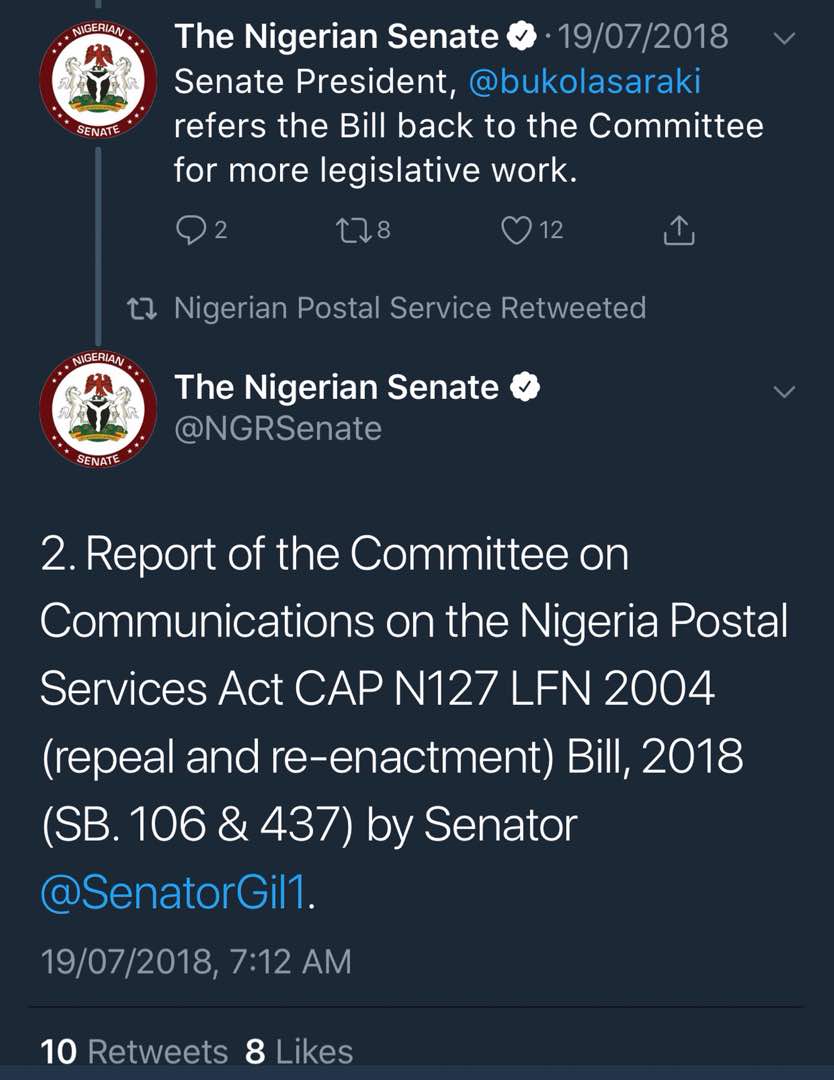
July, 2018, Nigeria Postal Services Act CAP N127 LFN 2004 (repeal and
re-enactment) Bill, 2018 (SB. 106 & 437) was read the THIRD time and
PASSED.
The
courier service sector will in no distant time witness a massive reform. From
the existing law, NIPOST which is a government owned corporation responsible
for providing postal service in the country has been acting as both operator
and regulator, a situation that has clearly impacted negatively on the growth
of the public angle of the sector. According to the Honorable Minister for
communication Abdu-Rheem Adebayo Shittu esq.
“when
the Bill is signed into law, NIPOST will concentrate on its functions as an
operator in the Nigeria’s postal system, hence the need for the reforms so that
it can make its pitch for a share of the deregulated Courier and Logistics”.
A
perusal of the bill in contrast with the
existing laws reveals some unique changes.
First,
in Section1 (One), is the establishment of the Nigerian Postal Services
Commission, this commission is otherwise, according to the bill, known as “the
Agency”, basically this Bill seeks to establish the Nigeria Postal Services
Commission which shall be responsible for regulating the Courier Service
Industry in Nigeria in order to take its supervision and control away from
NIPOST which is a player in the industry in line with the present National and
global policy of liberalization and commercialization for effective service
delivery and to bring the Courier Service Industry in Nigeria to international
standards. A laudable strike.
The
functions of the Agency include the following –
(a) regulate
the operation and business of Courier and Postal Services in Nigeria;
(b) receive
applications and grant approvals, licences and renewals to deserving and
competent persons applying to operate Courier Services in Nigeria.
(c) set
standards, guidelines and rules for the operation of Courier and other Postal
Services in Nigeria.
(d) the
Protection and promotion of interests of consumers against unfair practices
including but not limited to matters relating to unauthorized opening of sealed
articles, theft, loss, diversion of and damage to parcels.
(e) ensuring
that licensees implement and operate at all times within the purview of their
licence, terms and conditions having regard to best international practices and
indications,
(f) the
promotion of fair competition in the Courier Service industry and protection of
Courier Service Providers against anti-competitive and unfair practices.
(g) fixing
and collecting of fees in grant of licences and other regulatory services
provided by the Agency.
(h)making and
enforcement of sanctions against breaches of the provisions of this Act or Regulations
made there-under for service providers.
(J) the
formulation and management of Nigeria’s inputs into the setting of international
standards for effective Courier and Postal Services operations.
(j)
encouraging and promoting infrastructure sharing amongst licensees and
providing guidelines thereon.
(1t)
examining and resolving complaints, objections and disputes between licenced
operators, customers and any other person involved in the courier and Postal
services industry using such dispute resolution methods as the Agency may
determine from time to time including mediation and arbitration.
(I)
designing, managing and implementing universal Courier practices, strategies
and programmes in accordance with Federal Government’s general policies and
objectives. (m) advising the Minister on the formulation of the general policy
for the communication industry with emphasis on Courier service operations in
the exercise of the minister’s functions and responsibilities.
(n)implementation
of the Government’s general policies on courier services and the execution of
all such other functions and responsibilities as are given to the Agency under
this Act or incidental or related thereto.
(0) generally
advising and assisting the Courier Services industry and its Practitioners with
a view to the development of the industry and attaining the objectives of this
Act and its subsidiary legislation.
(P)
representation of Nigeria at proceedings of international organisations on
matters relating to the Courier and Postal Services industry and other matters
ancillary and connected thereto.
(q) the
Agency shall at all times carry out its functions and duties and exercise its
powers under this Act efficiently, effectively and in a nondiscriminatory and
transparent manner and in a way that is best calculated to ensure healthy
growth of Courier Service Operations in Nigeria subject to the regulatory
controls specified in this Act, and its subsidiary legislation.
Furthermore,
the Bill attempts to remove all regulatory powers whatsoever from NIPOST, as
seen in the repealed Sections 43-51 of the extant act, which gives powers to
NIPOST to grant, renew, and revoke licenses on other courier service
organizations. These powers have been bestowed solely on the Commission as
indicated in the proposed part V (sections 18-30) of the Bill.
Most
particularly, Section 18 of the Bill provides that –
(1)
Subject to the Provisions of Subsection (2) of this section, no person shall
operate Courier Services in Nigeria unless the person
(a) is registered as a company under or Pursuant to the Companies
and
Allied Matters Act; and
(b) is licensed as a Courier Services Operator under the
provisions of this
Act or any Regulation made there under
(2)
Notwithstanding subsection (1) of this section, a company wishing to operate
courier services may apply to the Agency within six months of the commencement
of this Act to be licensed under the provisions of this Act
(3) A
person not licensed under the provisions of this section shall cease to operate
Courier Services in any part of Nigeria.
In
conclusion, it must be understood that the Bill does not repeal the existing
Act. It simply broadens the spectrum that cuts through regulation of the
courier service industry. The sections repealed in the Bill are selectively
chosen to quash all existing regulatory powers of the NIPOST. The Bill cleverly
segregates Operation from Regulation. When it becomes Law, NIPOST shall become
just like the other courier service companies hustling for a robust customer
base, hence, testifying to governmental liberalization in the sector.
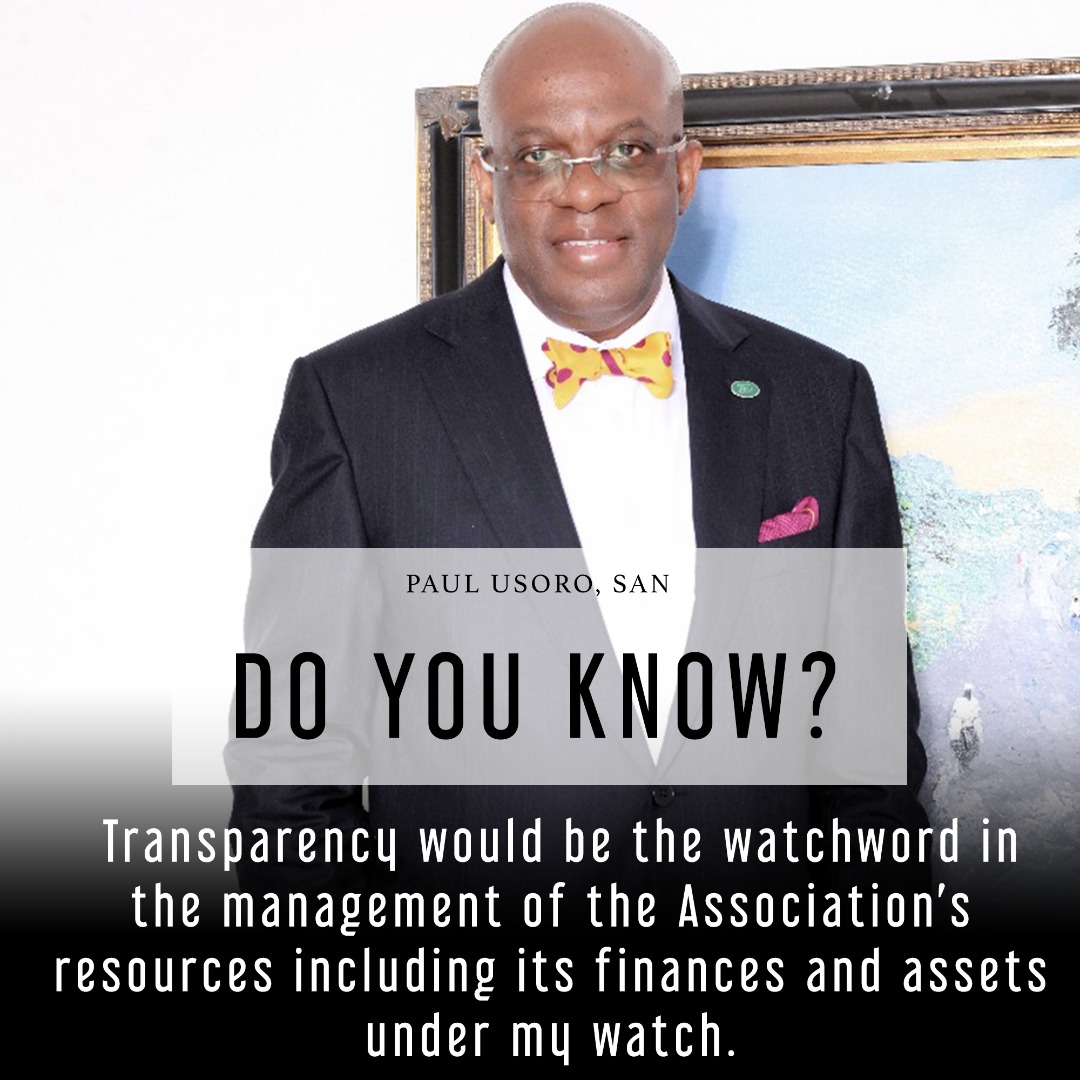
My first close encounter with Paul Usoro, SAN, left in me till this very moment, an indelible pictorial imprint reminiscent only of one of the scenes in Frederick Forsyth’s books.
It was in the Supreme Court of Nigeria, sometimes around April, 2015. As usual, the court was filled to the brim and everyone waiting eagerly for 9.O’clock for the court to start the business of the day. I was on the first seat on the third row flipping through my file when suddenly I felt a cool gentle breeze blow beside me with this flowing gown almost brushing my shoulders with this harmless gentleness.
I quickly looked up, only to see a very tall, elegant gentleman, wearing a pair of glasses on this almost infectious smile, which he shared generously with everyone that looked his way, as he gradually stepped down towards the front pew with such tenderness as if his feet sought the permission of the ground before each step was taken. I was taken by the rare mixture of aura, charisma with simplicity that this man exudes. At this time I stopped what I was doing and paid a closer attention to this angelic being.
As he stepped towards the front row almost all the lawyers in the courtroom, Senior Advocates inclusive, as if in a rehearsed uniformity rose up on their feet as they exchanged pleasantries one after another with this extraordinary Nigerian.
Few minutes later, the court began sitting. The head of the panel appealed to the Seniors in court to allow motions to be taken first before going into the hearings. Incidentally, my motion was the first on the list. Men and brethren, I almost missed my appearance because I was still lost in the imagination of what had transpired a moment before, I quickly returned to my consciousness and apologized profusely to the court.
After my motion I decided to wait and listen to this angelic being argue his case. By the time the man was done, it dawned on me that the elegance and charisma of Paul Usoro, SAN are nothing compared to his intellectual sagacity and content.
I decided to do one more thing: approach him, greet him and attempt a conversation with him because I know how inaccessible some SANs can be. When I approached Paul Usoro SAN, his humility and simplicity broke me down finally. He came close to me, bent over with his ears close to my mouth so I could whisper directly into his ears, pulled his hand around my neck and responded to all my questions. Thereafter, bade me good bye with a gentle path on my back.
Fast forward to 2018. When I heard that he was contesting for the position of NBA President, I came for one of his meetings. As I listened to him, I saw vision, sincerity, love for the Bar, determination to help lawyers, particularly the young lawyers grow a good practice, I decided to pitch my tent with him. Join me, let’s vote Paul Usoro, SAN as president of the NBA.
It is granted that election all over the world is all about interests and the forthcoming NBA election is certainly not an exception. Already there are alignments along tribal, ethnic, regional and other related lines, the most popular of these alignments being the new phenomenon of adoption. The danger of this phenomenon is that it not only shields the adopted son from unbiased and critical assessment of his leadership capital thereby leading to the enthronement of mediocrity, a cost the Bar cannot afford at this time, it also has the imminent danger of enthroning a government that thrives on patronage, settlement and compensation of a few rather than loyalty and service to the Bar, since what was needed to truly represent and serve the Bar was lacking ab initio. But here is the man that, despite all his detractors have cooked, brewed, concocted and thrown at him, they have not for once doubted his leadership capacity and competence to deliver; neither have they challenged the fact that he is visionary and that his desire to move the Bar forward is cast in stone. These qualities in him they have acknowledged, for which, by the way, I must thank them. But rather they have resorted to matters extraneous to these qualities in a desperate attempt to demarket this perfect gentlemen and strangulate his rising intimidating profile. At this juncture, gentlemen of the Bar, it becomes pertinent to ask ourselves this salient question: What exactly is our interest? What future do we seek for our beloved NBA? This is important because the future of the Bar that we seek is in our hands to create today. Would you rather vote adoption at the expense of vision, capacity and a brand new Bar? Vote Paul Usoro, SAN!!!
What are the challenges? What are their strengths? Which areas require attention and improvements? One way to start assessing the man to take the NBA to the height it should be is to take their leadership style and plans to get a general idea of how they work, the potentials they hold and the results they can deliver.
Once you have completed the check, read about the major characteristics of their dominant style.
Are these qualities helping or hindering their leadership? Once you’ve determined this, check the results and successes in their vocation, you can decide your next NBA President based on their leadership abilities. Identifying the problems of any institution is one of the leadership qualities that defines transformational leadership. Followers need to be encouraged to express their potentials by the creation of opportunities. Effective leaders offer new orientations with ample support to achieve these goals.
Paul Usoro, SAN has identified the present challenges that has crippled the profession. He has shown that these challenges are not insurmountable. He is now proffering solutions on how to deal with them. His solutions are practical, workable and achievable within the short tenure. Paul Usoro, SAN is all out to create an all-inclusive Bar.
A Bar that put you first. Would you look to someone for guidance and leadership if they did not truly care about the goals of the group? Paul Usoro, SAN has shown that he cares by his history and reputation in the profession acquired through years of commitment and experience. Vote for the man who understands the demographics of lawyers in relationship to the challenges of employment and remuneration in the legal profession.
The Lagos Justice Innovating Conference #LIJC2018 is the biggest conference of its scale and calibre, organised by HiiL. The event brings together people at the top of their game in the legal and justice sector, in and outside of Nigeria, to address how the Nigerian Justice system could be improved, and to tackle making justice more user-friendly in Nigeria, by combining data and innovations.
For speaker, media, or sponsor enquiries, contact Olufunbi Falayi at olufunbi.falayi@hiil.org and HiiL Business Development Manager connor.sattely@hiil.org.
Nigeria office of HiiL can be reached at +234 70 33 579 178 and enquiries directed to Olufunbi Falayi.
The Hague office of HiiL can be reached at +31 70 762 0700 and enquiries directed to Connor Sattely.
PROGRAMME
10:00- 10:15 — Opening remarks Sam Muller – CEO HiiL and Yemi Osinbajo – Vice Preident of Nigeria
10:15 – 10:30 — Welcome address HE Rotimi Akeredolu (SAN) – Governor of Ondo State
10:15 – 10:25 — Justice Reforms Olasupo Shasore (SAN) – Former Attorney-General for Lagos State
10:25 – 10:40 — Measuring Justice introduction Sam Muller – CEO HiiL
10:40 – 11:15 Presentation of justice findings Dr. Rodrigo Nunez, Justice Sector Advisor
11:15 – 12:00 Panel discussion on findings
Yemi Osinbajo
Rotimi Akeredolu
Olasupo Shasore M
Moderator: Sam Muller
12:00 – 1:00 Lunch
1:00 – 1:15 Justice Accelerator Introduction Connor Sattely, Business Development Manager, HiiL Justice Accelerator
1:15 – 2:00 Innovator pitches 1
Jury Members
James Peter – VP New market initiatives, Legalzoom (USA) (Jury Chairman)
“PURIFICATION” which is synonymous with the mention of the name Paul Usoro S.A.N. as a candidate for the office NBA President in this year NBA election is SIGNIFICANT in the sense that right from his days as a Law Student President in the University of Ife now Obafemi Awolowo University Ile Ife he stood for justice and purity in the process leading to the award of Law Degree when in July 1980 he wrote to the Dean of Faculty of Law University of Ife reporting leakages and malpractices in examinations administered in the Faculty particularly in the Part III class.
This led to setting up of a Panel to investigate the report In demonstration of his avowed principle of PURITY he boldly revealed the names of students and lecturers involved in the malpractices. One would wonder how an undergraduate student got this type of courage to insist on PURITY at that stage of his training He was not deterred by the clear risk of intimidation by the “LEAGUE” of lecturers who may have frustrated his quest of becoming a lawyer by reason of mentioning the names of lecturers in the faculty as persons involved in the malpractices It was Mr Usoro’s complaint that gave rise to the popular case of AKINTEMI V ONWUMECHILI 1985 1 NWLR Pt. 1 page 68 In that case the Supreme Court upheld the decision of the Investigation Panel which found merit in Mr Usoro’s complaint.
In my candid view there can’t be a better time for our Association (N.B.A.) to have an outstanding, courageous and pure person like Mr. Usoro S.A.N. as its President I urge that we ensure by our votes to have PUSAN as our President for the purification of the Bar and the administration of justice in On Nigeria.
S. Oyawole, Esq. is a member of the Jos Branch of the NBA
The
current Proclamation of President Muhammadu Buhari geared towards the Preservation of Suspicious Assets
Connected with Corruption and Other RelevantOffencesin
Nigeria has steered up a lot of debate about the President’s actions. This
article identifies key legal issues and risks associated with this Proclamation.
Introduction
Professor E.O. Okebukola and A.A Kana defined “Executive order” as a command directly given by the president to an
executive agency, class of persons or body under the executive arm of
government’’.Such a command is in
furtherance of government policy or Act of the Legislature. The executive order
may require the implementation of an action, set out parameters for carrying
out specific duties, define the scope of existing legislation or be a
subsidiary instrument.It has full force of law,
based on the authority derived from statute or the Constitution itself.
However, it is only valid where the President acts within
the boundaries of his constitutional or statutory authority. Executive Orders are
subject to judicial review; they can be challenged in whole or in part; and
they can be quashed if they lack support by statute or the Constitution.
Legal issues on Executive order 6
The provisions of the Executive Order No. 6 of 2018 on the
Preservation of Suspicious Assets Connected with Corruption and Other RelevantOffences, recently
issued by President Buhari has raised serious concerns among
different categories of stakeholders, including civil
society groups, lawyers, lawmakers, politicians and many others. Basically, the
order givesthe President the
power to freeze the assets of anyone who is being tried, investigated or
suspected of corrupt practices in this regard without recourse being first made
to a court of law and also restrains owners of such assets from carrying out
any further transaction on such assets so as not to pervert the investigative
and judicial processes. This contravenes Section 6 of the 1999 CFRN; in that, the power to
determine which assets should be subject to temporary or final confiscation is
a judicial power vested in the courts. Therefore, any preservation of assets from
corrupt practices as contemplated by the said order must be done within the
confines of the rule of law, through powers and duties conferred by already existing
statues or through the orders of courts of competent jurisdiction. On that
note, it is more expedient to make an application for an order for temporary
forfeiture or forfeiture of assets pending the determination of the case as the
court would duly examine the circumstances and available evidence.
Secondly,
the right of Presumption of innocence as captured in Section 36(5) of the 1999CFRN which is to the effect that a person accused of a criminal offence is
presumed innocent until proven guilty is also contravened. An important
question that comes to play in this regard is, “What if those whose properties are confiscated are not found guilty at
the end of the day?’’. It therefore flows that the executive order if
enforced would serve to confiscate one’s assets without a valid order or
conviction by a competent court which is ordinarily empowered to do so taking
into cognizance various constitutional safeguards.Again, this power to confiscate does not lie
with the Executive, but with the Judiciary.
Thirdly, Section
43 of the 1999 CFRN which provides for the right of a person to own
immovable property anywhere in Nigeria is also contravened. A person who is
merely suspected to be in possession of an asset which might have been proceeds
of corruption is automatically deprived his right to own and make use of his
property immediately the order is activated against him. Hence, his right is
violated in the situation where he is found to be innocent of the allegation.
Moreover,
the First Schedule of the order also reveals the names of suspects/accused
persons whose property the Executive Order purports to seize; this should be
seen as being unconstitutional as it amounts to Sub judice; which states
that once a matter is before a court, it cannot be publicized until it has been
concluded.
Interestingly,
an executive order can only be issued to enforce already existing powers,
duties and mandates under existing laws. Thus, an executive order cannot be
used by the Executive to create new powers, duties or rights or expand existing
ones beyond the mandate given by the Legislature. Moreover,
there are sufficient legislations and legal procedures that can take care of
what the Order intend to achieve. E.g., Sections
20- 34 of the Economicand Financial
Crimes Commission (EFCC) Act deals with the forfeiture of assets pending
the outcome of a court decision. Similar provisions exist in the ICPC law, Money Laundry Act, Recovery of
Public Property (Special Provisions), etc. Thus, it calls to question why
this Executive order was issued, what it has come to change or what lacuna it
has come to fill in the existing laws warranting its Proclamation.
In a democracy, the role
of the executive arm of Government is to enforce court orders/judgments handed
down based on the interpretation of existing laws. Any suggestion to the
contrary, as clearly intended by this executive order is a total aberration
from the aforementioned provisions of the constitution.
In my opinion, the
Executive Order is unconstitutional. Only a valid order of court should and
could deprive a person of his right to make use of his property.
It is essential that the
Government comes in light with the fact that, this is a democratic dispensation
and must follow due process. This Executive Order seeks to usurp the powers of
both the legislature and the courts which is contrary to the principles of
separation of powers as stated by the Supreme court in PAUL IYORPUU UNONGO
v. APER AKU (1983) 2 SCNLR
page 332 at 334 and
vest it on the executive who can use same at will, as a political instrument,
to haunt, harass and victimize perceived political opponents. This amounts to
Executive Lawlessness which directly violates both the principle of separation
of powers and the constitution itself. The Judiciary should go ahead to quash
this executive order as it is well within the lot of the judiciary in its
supervisory capacity to ensure that all arms of government keep within their
respective areas of powers, privileges and competence under the constitution as
stated by the Supreme Court in GOVERNOR
LAGOS STATE V CHIEF ODUMEGWU OJUKWU (1986) LPELR-3186(SC).
Concluding Remarks
To this end, in as much
as equity cannot suffer a wrong to be without a remedy, one who seeks equity,
must also do equity. Indeed, the fight against corruption which is hydra headed
is a noble cause. However, there can be no legislative latitude of
interpretation placed on the actions of Mr. President in respect of sections 5 and 15(5) of the 1999 CFRN as
justifications for this draconian Executive order.
Eloho Yekovie Esq.
is an Associate of Triax Solicitors, an indigenous Law Firm with offices in
Abuja and Bayelsa state. We are a niche
expertise Law firm which comprised of young, hardworking legal practitioners
who are making waves in their core areas of competence as well as in continuous
legal education and development.
It
is more than a decade since the Investments and Securities Act[i]
was enacted but the controversy surrounding the parallel jurisdiction of the
High Court of a State and the Investments and Securities Tribunal (IST) in
respect of civil matters arising from the operation and application of the ISA
appears far from settled. As a result, many legal practitioners, renowned
academics and even the courts of law have expressed different opinions on this
issue.
Perhaps
this conundrum stems from the fact that jurisdiction is the life wire of a
court and the blood that gives life to any action before a court; and
accordingly no court can adjudicate over a matter when it does not have
jurisdiction.[ii]
More so, the relevance of the State High Court and the IST to our legal system cannot
be overstated, as such necessitating a clear-cut distinction between the
jurisdiction and roles of both courts.
A
number of decisions by the superior courts seem to elect that the IST has
jurisdiction to the exclusion of all other courts in Nigeria with respect to
disputes arising from the operation of the ISA; whereas a few other decisions
of those courts are confident that the exclusive jurisdiction conferred on the
IST by the ISA cannot in anyway displace the express and far-reaching
jurisdiction conferred on the High Court of a State by the Constitution of the
Federal Republic of Nigeria, 1999.[iii]
2.JURISDICTION OF THE HIGH COURT OF
A STATE
Section
272(1) of the CFRN, 1999 (as amended) provides for the jurisdiction of the High
Court of a State and expresses that:
Subject
to the provisions of section 251 and other provisions of this Constitution, the
High Court of a State shall have jurisdiction to hear and determine any civil
proceedings in which the existence or extent of a legal right, power, duty,
liability, privilege, interest, obligation or claim is in issue or to hear and
determine any criminal proceeding involving or relating to any penalty,
forfeiture, punishment or other liability in respect of an offence committed by
any person.[iv]
The
courts have in a number of decisions qualified the jurisdiction of the High
Court of a State as “unlimited” such as in the cases of Madu v. Mbakwe[v]
and Nloga & Ors v. Bagadam & Anor.[vi]
In other decisions of the Court of Appeal and Supreme Court, this same jurisdiction
has been confirmed as only being limited by section 251 of the CFRN, 1999.
These decisions are exemplified in the cases of Society Bic S.A. & Ors v.
Charzin Industries Limited,[vii]
Ansa v. R.T.P.C.N.,[viii]
and Attorney-General, Lagos State v. Eko Hotels Limited.[ix]
Irrespective
of the trifling dissimilarities with regards to the qualification of the
jurisdiction of the High Court of a State by the superior courts, it is however
crystal clear that the Court has astronomical jurisdiction birthed from the
CFRN, 1999 with respect to civil and criminal proceedings in Nigeria.
3.JURISDICTION OF THE INVESTMENTS
AND SECURITIES TRIBUNAL (IST)
The
IST was established by section 274 of the ISA. The section reads:
There is established a body to be
known as the Investment and Securities Tribunal to exercise the jurisdiction,
powers and authority conferred on it by or under this Act.
The
jurisdiction of the IST is also expressly provided for in section 284 of the
ISA. Section 284(1) provides that:
The
Tribunal shall, to the exclusion of any other court of law or body in Nigeria,
exercise jurisdiction to hear and determine any question of law or dispute
involving; (a) a decision or determination of the Commission in the operation
and application of this Act, and in particular, relating to any dispute: (i)
between capital market operators; (ii) between capital market operators and
their clients; (iii) between an investor and a securities exchange or capital
trade point or clearing and settlement agency; (iv) between capital market
operators and self regulatory organisation. (b) the Commission and self
regulatory organization; (c) a capital market operator and the Commission; (d)
an investor and the Commission; (e) an issuer of securities and the Commission;
and (f) dispute arising from the administration, management and operating of
collective investment schemes.[x]
As
if to further cement the exclusive jurisdiction conferred on the IST, the ISA
in section 294 states that:
The
Tribunal shall have exclusive jurisdiction on matters specified in this Act.
Notwithstanding
the fact that the IST, unlike the High Court of a State, is not expressly
listed as superior court to which the judicial powers of the Federation are
vested by virtue of section 6 of the CFRN, 1999 (as amended), some judicial
authorities have stated that the Tribunal’s creation is traceable to section
6(4)(a) of the Constitution.[xi]
This position is encapsulated in the Court of Appeal decision in Wealthzone
Limited v. SEC.[xii]
4.PARALLEL JURISDICTION OF THE STATE
HIGH COURT AND THE INVESTMENTS AND SECURITIES TRIBUNAL
In
Nospetco Oil and Gas Limited v. Olurunnibe,[xiii]
the Court of Appeal in commenting on the jurisdiction of the Investments and
Securities Tribunal stated inter alia that:
There
is no doubt that to ensure speedy disposition of certain genre of cases, the
National Assembly had thought it fit to create specialist tribunal…By the
provisions of S.284(1) of the ISA, the area where the Tribunal has exclusive
jurisdiction is limited to disputes relating to powers of the Securities and
Exchange Commission vis-à-vis capital market operators and investors. S.284(1)
gives the Tribunal exclusive jurisdiction to adjudicate in disputes arising
from the administration, management and operations of a collective investment
scheme…
The
Court of Appeal in Wealthzone Limited v. SEC (supra) while remarking on the
extent of the jurisdiction of the IST vis-à-vis the Federal High Court stated
that:
The clear interpretation of the
act of the National Assembly in 1999 when it created the Investments and
Securities Tribunal as a specialist Court simply means that the exclusive
jurisdiction of the Federal High Court would no longer extend to matters
affecting the operations of the capitals and securities market, but remain
limited to matters that may arise from the provisions of BOFIA and CAMA and I
so hold.
The
aforestated dictum of the Court seems to suggest that because the National
Assembly via an Act created a specialist court with exclusive jurisdiction,
then all other courts of law including those seemingly given unlimited powers
by the CFRN, 1999 in respect of civil and criminal matters will have their
jurisdiction adjusted to conform to the ISA.
The
connotations of the decision in the Weathzone case to the extent that the IST’s
jurisdiction overrides the jurisdiction of a court created by the CFRN, 1999 in
the event that the express jurisdiction of the latter as provided for in the
Constitution conflicts with the jurisdiction of the IST as set down in the ISA
cannot be correct with due respect.
Section
1(3) of the Constitution- the grundnorm,
provides that:
If
any other law is inconsistent with the provisions of the constitution, this
constitution shall prevail, and that other law shall to the extent of the
inconsistency be void.
Therefore,
nothing that exists outside the CFRN, 1999 can purport to divest the State High
Court of its jurisdiction as expressly provide for in the Constitution.
In
fact, in deferring to the unarguable superiority of the Constitution, the ISA
in section 312(3) expressed that:
Apart
from the Constitution of the Federal Republic of Nigeria,
if the provisions of any other law, in relation to capital market matters
including the enactments specified in subsection (1) of this section, are
inconsistent with the provisions of this Act, the provisions of this Act shall
prevail and the provisions of this Act, the provisions of this Act shall
prevail and the provisions of that other law shall, to the extent of the
inconsistency, be void.[xiv]
The
court in reiterating a trite position of the law held in Stabilini v. FBR[xv]
that:
Where
the Constitution of the Federal Republic of Nigeria has vested jurisdiction in
a court of law, it cannot be lightly divested. Where it is intended to be
divested it must be done by clear, express and unambiguous words, and by a
competent amendment of the Constitution. Thus the courts do frown at any
attempt to erode or relegate the power of the court and or the supremacy of the
Constitution…[xvi]
More so, the Court of Appeal in
commenting on the jurisdiction of the High Court of the Federal Capital Territory
(which is equivalent to the High Court of a State) vis-à-vis the provisions of
the ISA that purport to limit the jurisdiction of the High Court as conferred
by the Constitution in Davandy Finance and Securities Limited & Ors v. Aki
& Ors[xvii]stated inter alia that:
The
jurisdiction of the High Court of the Federal Capital Territory Abuja is set
out in section 257(1) of the Constitution of the Federal Republic of Nigeria,
1999 (as amended). It provides as follow. “Subject to the provision of section
251 and any other provision of this Constitution and in addition to such other
jurisdiction as may be conferred upon it by law, the High Court of the Federal
Capital Territory, Abuja shall have jurisdiction to hear and determine civil
proceedings in which the existence or extent of a legal right, power, duty,
liability, privilege, interest, obligation or claim is in issue…” Thus the High
Court of the Federal Capita Territory, Abuja, is a court of unlimited
jurisdiction subject to any limitation imposed upon it by section 251 of the
Constitution or any other provision thereof… It cannot be taken away by section
284(1) of the Investments and Securities Act, 2007, which is inferior to the
Constitution of Nigeria, 1999.
Luckily
this issue was taken head-on and elaborately addressed in the case of Value Line
Securities Investment Ltd v. Anakwube[xviii]
wherein the Court of Appeal held assuredly that:
The State High Court equally has
jurisdiction to entertain any dispute covered by or arising under the
Investment and Securities Act including a dispute between a capital market
operator and its client like the dispute in the present case, by virtue of the
unlimited jurisdiction of the State High Court to hear and determine any civil
or criminal proceeding vested on it by Section 236(1) of the 1979 Constitution
of Nigeria, applicable when the cause of action arose and Section 272 of the
1999 Constitution of Nigeria, applicable when the suit was filed and up to
date.
The
Court in Anakwube’s case even went further to declare S.242 of the Investment
and Securities Act[xix]
which purported to oust the jurisdiction of the High Court of a State to
entertain matters covered by the ISA, as being void to the extent of its
inconsistency with the Constitution. The Court also held that:
As
it is, the State High Court and the Investment and Securities Tribunal have
concurrent jurisdiction to entertain cases involving disputes covered by or
arising from the Investment and Securities Act.
5.CONCLUSION
It
is true that the IST has jurisdiction to entertain all civil matters that may
arise from the operation and application of ISA but the preponderance of
authorities suggest strongly that its jurisdiction, though labelled “exclusive”
cannot in anyway divest the perceived unlimited jurisdiction of the High Court
of a State to also entertain all matters that may arise from the application of
the ISA.
Without
any doubt, both the IST and the State High Courts have equal and concurrent
jurisdiction with respect to the ISA and all the relevant portions of the ISA
that exist to divest all courts of the jurisdiction to entertain matters that
arise from the operation of the ISA cannot apply to the High Court of a State
as the latter’s jurisdiction is deeply rooted in the Constitution. It goes
without saying that where there are conflicts between the provisions of the ISA
and the Constitution, all those conflicts or inconsistencies must be resolved
against the ISA.
[i] Investments
and Securities Act, 2007 (Hereafter, ISA).
[ii] See
Dangana v. Usman (2013) 6 NWLR (Pt. 1349) 50.
[iii] Cap.
C23, Laws of the Federation of Nigeria, 2004 (Hereafter, CFRN, 1999).
[iv] See
section 257(1) CFRN, 1999 (as amended) for the equivalent provision as it
relates to the High Court of the Federal Capital Territory. See also
Mailantarki V. Tongo & Ors (2017) LPELR-42467 (SC).
[xvi] The
decisions in Ngige & Anor v. INEC & Ors (2014) LPELR-25413 (CA);
Obayuwana v. Governor, Bendel State & Anor (1982) LPELR-2160 (SC); N.U.E.E.
v. B.P.E. (2010) All FWLR (Pt.525) 201; and National Union of Electricity
Employees & Anor v. Bureau of Public Enterprises (2010) LPELR-1966 (SC)
also epitomize this axiomatic principle of law.
[xvii] (2015)
LPELR-24495 (CA) per Ekanem, J.C.A., (Pp.20-22, paras. G-A).
[xviii]
(2015) LPELR-24486 (CA) per Agim J.C.A., (Pp. 25-33, paras.A-A).
[xix] Investments
and Securities Act, No. 45, 1999. This Act was repealed by the ISA, 2007. See
section 314(1) of the ISA, 2007.