Termination Of Football Contracts: What Is “Just Cause”? (2) |

Termination Of Football Contracts: What Is “Just Cause”? (2) |

INTRODUCTION

As a sequel to the first part of this article which examined “just cause” for unilateral termination as regards clubs, this second part of the article aims to discuss “just cause” for unilateral termination of contracts by footballers. It should be noted that what would amount to just cause for football clubs are different from that of players.

It is thus important to examine circumstances that may, or may not amount to just cause for termination by players.

Outstanding Salaries.

In line with the jurisprudence of both the DRC and CAS, a club’s persistent failure to pay the salary of a contracted player for a certain period can be considered an unjustified breach of an employment contract by a club. In 2018 for instance, former Cameroonian International player, Alex Song, left his former club, Rubin Kazan, after FIFA intervened and his contract terminated due to the club’s inability to pay its players’ wages. It was stated that the player was being owed 7.9 million pounds by Rubin Kazan.
However, it is worthy to note that before a player can validly terminate his contract unilaterally, a number of things must be proven.
First, the club’s inability to fulfil its financial obligation towards the player must be established. This means that the player must prove that his wages have not been paid by the club for a period of time, which is a breach of the club’s obligation towards him. In a DRC Decision, the Chamber held that the club had neglected its financial obligation towards the player, after it was established that the club had not paid the player for over four months and two of the four instalments pertaining to the signing on fee were still unpaid (See DRC 10 June 2004, No. 64133). It must be noted that the period of time which would be regarded as ‘just cause’ matters. For instance, being owed a month’s salary does not constitute ‘just cause’. This was the reasoning of the DRC, where the Chamber decided that the non-payment of one month’s salary was not ‘just cause’ for a player to unilaterally terminate his contract. (See DRC Decision of 23rd March 2006, No. 36460.).  Also, the player must be able to specify the exact amount that is being owed by the club. The DRC in a case, decided that a player’s inability to be precise as to the exact amount, does not speak in favour of the player’s good faith (See DRC Decision of 23th February 2007, No. 27698).
It would also be considered whether or not the player accepted any postponement as regards outstanding payments. The DRC held that a player could not claim ‘just cause’, as it didn’t exist, due to the player accepting the postponement of payments, which was interpreted as consenting to delayed payments (See DRC Decision of 8th June 2007, No. 67770).
Furthermore, the player must also be able to establish that he has warned the club before terminating the contract; usually referred to as “notice of default”. This was the position of the DRC where it stated that even without being stipulated in an employment contract, this was a procedure regularly confirmed and applied by the DRC and the CAS (See DRC 10 August 2007, no. 87745).
It is also important for the player to be able to prove that he offered his services during the period of the contract.
Conclusively, two main conditions which a player must always establish according to the DRC are: that the late payment of the player’s salary is not insubstantial; and that prior to the contract termination, the player had issued the club a warning, drawing the club’s attention to its violation of its contractual obligation (See DRC 24 November 2011, No. 1111796).

Exclusion and Deregistration.

It is a general principle that having a subsisting employment contract with a club does not guarantee that a player must be fielded or train with the first team; as long as his/her salaries are being paid and the club fulfils its other obligations towards the player.  This was the decision of the DRC where the Chamber decided that as long as the player is regularly paid his salary and the club respects all other contractual obligations, a player must accept that he might not be lined up, and that not having the player fielded does not constitute a breach of the contract. It was also stated that the decision to field the player was left to the discretion of the club, which the DRC respects. (See DRC Decision of 9th May 2014, No. 05143281). In such a circumstance, the player would not have just cause for the unilateral termination of the contract.
However, if it is contained in the player’s contract that the player may only train with the first team and/or that the player would always remain in the first team regardless of his performances, a non-fulfilment of that clause by the club would amount to a breach. In that circumstance, the player would have a just cause to unilaterally terminate his/her contract. (See the DRC Decision of 8th June 2007, No. 67229).
In the DRC Decision of 13th December 2013, No. 12131045, a player was excluded from training with neither the first team nor the second team. The DRC considered it important to point out that among a player’s fundamental rights under an employment contract, is not only his right to a timely payment of his remuneration, but also his right to be given the possibility to compete with his fellow team mates in the team’s official matches. The DRC emphasized that the non-registration of a player effectively bars, in an absolute manner, the potential access of a football player to competition and, as such, violates one of his fundamental rights as a football player. It would also constitute just cause where the player is barred from the club’s activities.
Also, in the determination of just cause for a player, the DRC considers the period of time which the player was excluded by the club. The longer it is, the likelier the Chamber is to hold that there is just cause.

Sporting Just Cause

Pursuant to Article 15 of the Regulations on the Status and Transfer of Players (RSTP) 2018, a player may also unilaterally terminate his contract where, despite being an established professional, he appeared in fewer than 10% of all the official matches which his club played during a football season. The player may terminate the contract on this basis in the 15 days following the last official match of the season of the club. In such a case, sporting sanction will not be imposed on the player, though compensation may be payable to his/her club. Although the determination of an “established professional” is judged on a case-by-case basis, it has been described in the FIFA Commentary as a player who has terminated and completed his training period, and whose level of footballing skill is at least equal to or even superior to those of his teammates who appear regularly.

CONCLUSION

Having discussed above, circumstances of just cause for players based on established jurisprudence of the DRC & CAS, a player must be certain that a breach of the club is such that amounts to just cause for unilateral termination. However, it must be noted that just cause for players is not limited to those discussed above. A recent example is an incident which occurred in May 2018. The president of Sporting Lisbon (Bruno De Carvalho) heavily criticised the team’s performance against Athletico Madrid. This resulted to about 50 of the toughest ultras of the club forcing their way into the team’s training ground, who assaulted both players and staff members. The assault left the club’s top scorer for the last few seasons – Bas Dost – with a nasty head injury. Consequently, a number of the club’s key players – Rui Patricio (the club’s captain), Bruno Fernandes, William Carvalho and Gelson Martins decided to terminate their contracts and joined respective clubs of their choice.
Thus, other situations which are of an extreme nature which would not be reasonably expected of the player to put up with in the employment relationship, may nevertheless still amount to just cause for unilateral termination even though such have not been decided upon before by the DRC or CAS.
Finally, it should also be noted that parties may also define what would constitute ‘just cause’ in an employment contract. In a DRC Decision of 15th March 2013, No. 03132433, both the club and player had agreed to a clause in the contract wherein the player could terminate the contract if the club defaults in paying his salaries for three months. The player however terminated the contract after only two months of arrears, and the DRC held that there was no just cause because the parties had freely consented to three months defaults as what would constitute just cause.
Written by – Ayomide Eribake.
Source: Sportlicitors 
Termination Of Football Contracts: What Is ‘Just Cause’? (1) | Sportlicitors

Termination Of Football Contracts: What Is ‘Just Cause’? (1) | Sportlicitors

Introduction

The principle of FIFA as contained in Article 13 of the RSTP is that, generally, a football contract cannot be unilaterally terminated by any of the parties. Thus, It can only become terminated when (i) the contract expires, or (ii) when both parties mutually agree to.

Apart from the general principle above, the only exception where a party may unilaterally terminate a contract without consequences is where there is a JUST CAUSE.

What is ‘Just Cause’?

The term ‘Just cause’ refers to the exceptions or circumstances recognised under FIFA Regulations and previous Decisions, that may allow a club or player terminate the employment contract between them, without any punishment or consequence. Any unilateral termination outside of  “just cause” would attract monetary and/or sporting punishments against the defaulting party.
For example, in the DRC Decision of 2nd November 2007 No 31113, it was confirmed that a clause which permitted the club to unilaterally terminate the contract at any point in time and having to pay a compensation, is not valid. According to the DRC, such would create a disproportionate repartition of the rights of the parties to an employment agreement, to the strong detriment of the player. (See also DRC 22nd July 2004, No. 74653.)
In football, ‘just cause’ must involve a cogent reason for the termination of the contract by either party. Article 14 of the RSTP states that either party can choose to terminate a contract without any consequences where there is just cause. It is important to note that “just cause” exists for clubs, as well as Players. The first part of this article however shall be based on termination of contracts based on “just cause” by clubs.

‘Just Cause ’ by Clubs

Clubs may be allowed to unilaterally terminate the contract of their players, only where ‘just cause’ exists. The common circumstances which the issue of ‘just clause’ by clubs have arisen, will be discussed below.
a. Poor performances
In Nigeria, it is common practice that clubs unilaterally terminate players’ contracts based on poor performance; and wrongly use the word “released” in their official statements. However, based on the longstanding jurisprudence of FIFA, poor performances cannot be a just cause for the termination of a player’s contract. For example, on November 26 2004, the Dispute Resolution Chamber of FIFA decided that the clause in an employment contract which stated that the club may terminate the employment contract when the player’s performance no longer meets the club’s requirement, cannot be defined as just cause and is therefore not valid (DRC Decision 26th November 2004, No. 114534.). In that case, the parties signed an employment contract valid from 1st November 2003 until 31st October 2005. In line with Article 2.8 of the contract, the club was entitled to unilaterally terminate the contract upon a 15-day written notification of contract termination for reasons of a disciplinary nature or linked to a decline in the player’s performance which fails to meet the club’s requirements. On 1 April 2004, the player was notified in writing of the premature termination by the club of his employment contract. According to the relevant document exhibited before the DRC , the player’s contract was terminated due to a decline in the player’s performance and his inability to meet the club’s performance requirements. The DRC decided in that case that no just cause existed.

Also, in the DRC Decision of 28th July 2005 No 75975, the DRC also decided that a player’s lack of performance is no just cause for a club to unilaterally terminate an employment contract.
In summary, clubs are not allowed to terminate the contracts of their players based on poor performances. As a footballer, whether you truly have a dip in form during the season and your club eventually gets relegated, or your club makes up an accusation of “poor performance” against you; the club cannot unilaterally terminate your contract as there would be no just cause.
As a club owner or Administrator, it is advisable that the club considers finding an amicable way to agree with the player for a mutual termination of his/her contract where there is poor performance. Alternatively, the Club may offer the player to other football clubs who may be interested in his/her services.
b. Injuries
It is also important to note that a player’s contract cannot be terminated based on the circumstance that the player was injured; most especially where such injury was sustained in the course of offering his/her services to the club. In fact, it does not matter if the injury period is lengthy.

It is widely known and accepted that injures are part of the game of football. Thus, it is the duty of the club to take care of a player who gets injured while the player is under contract with the club. It would be a breach of employment if the player’s contract is terminated based on injuries. As stated by the DRC in the decision of 13th May 2005 No 55230, the DRC decided that the club’s termination of the employment contract of the player because the player was injured, does not amount to a just cause. The DRC noted that the player’s knee injury was in fact suffered in the course of the player’s service to the club, and so the club was to responsible for covering the cost of treatment as well as the costs incurred during the rehabilitation process.
c. Absence
According to the DRC, absence of a player can constitute ‘just cause’ for the termination of his contract by the club. However, the absence must be lengthy for it to be enough to constitute ‘just cause’.

Also, it would be important to establish whether or not official matches were scheduled during the player’s period of absence. In a DRC decision of 10th June 2004, the DRC noted that during the one month when the player stayed away from his employer club, no official matches were scheduled in the national league of his national football federation. Therefore, the absence of the player did not pose a serious problem to the club. In such a circumstance, rather than a termination, what a club should do is to fine or suspend the player. It is in circumstances where such an absence is lengthy or repeated so often that the club cannot be reasonably expected to put up with such behaviour, that the club can then go ahead to unilaterally terminate the contract (after having previously served a notice of absence on the player).
A recent example is the sacking by Sunderland Football Club, two of its players (Papy Djilobodji and Didier Ndong) during the course of 2018. Papy Djilobodi had indicated an interest in leaving the club, and so had an agreement with the club that he be allowed to spend the month of July on a voluntary unpaid leave. After the period elapsed and the player’s proposed transfer had broken down, the player initially refused to return to the club. It took notices of absence written by Sunderland to the player before the player eventually resumed. At that point, the player failed his fitness test and the club terminated his contract for the prolonged absence.

Conclusion

FIFA’s Regulations look to ensure that clubs and players honour the contract between them,  by prohibiting premature termination of such contracts. It is only where there exists a “just cause” that such contracts can be unilaterally terminated before their expiration.
“Just cause” for clubs as discussed above are the most common where disputes have arisen. Thus, the list above is by no means limited to those.  It should be borne in mind that other circumstances where any of the contractual parties cannot be reasonably expected to continue with the employment relationship, would likely be adjudged as “just cause” by the FIFA Dispute Resolution Chamber.
Written by: ERIBAKE AYOMIDE O.
Source: Sportlicitors 
A Short History of the Cruel and Terrible Second Regime of Muhammadu Buhari | by Ayo Sogunro

A Short History of the Cruel and Terrible Second Regime of Muhammadu Buhari | by Ayo Sogunro

The beginning of an autocracy
When Muhammadu Buhari won the 2015 presidential elections, the country was deeply divided between the All Progressives Congress (APC) and the People’s Democratic Party (PDP). As I remarked then, the results of the elections showed that Buhari was not the will of all Nigerians. Give or take a couple of million votes and PDP could have won. In his admirable inaugural speech, Buhari seemed to be aware of this division, making his now famous assertion: “I belong to everybody and I belong to nobody”. He also reached out to the country’s south-south promising to “invest heavily” in amnesty projects and extending his “hand of fellowship” to them.

But like mobile data on an open hotspot, this availability did not last long. In July 2015, when he was questioned on the Niger Delta amnesty and inclusive development, he answered: “I hope you have a copy of the election results. The constituents, for example, who gave me 97% cannot in all honesty be treated on some issues with constituencies that gave me 5%.”Across Nigeria, politically innocent hearts were broken.
But this was just the beginning of walking back promises and shifting goal posts. The APC media machinery, which had hitherto blitzed Nigerians with promises of paradise commenced a process of hurried denials. One of the first casualties of these repudiation of campaign promises was the infamous “100 Days Covenant”. Once there was nothing to measure, Buhari was able to complete his first hundred days with no targets, no goals, and no problems.
For those who had problems with “the new sheriff in town”, Buhari’s media team had a new label: “wailing wailers”. By September 2015, Femi Adesina was all over the news denouncing all critics of the government. In December 2015, Ibn Na’Allah of the APC would sponsor a bill to legislate a jail term for any person who used social media (including Whatsapp and texts) to make “an abusive statement” against government officials. Fortunately, pressure from civil society killed that attempt. Yet, these were early warning signs of coming intolerance towards Buhari’s critics.
Those who  enabled Buhari’s madness
Less critical Nigerians simply entered a phase of Buhari praise and worship. Politicians and other groups beat a path to Aso Rock to pledge loyalty and assure Buhari of their support in his new fight against corruption. The Nigerian Labour Congress, under Ayuba Waba, strayed from pressure group into partisan fan club and went to pay homage to Buhari, even demanding a death sentence for those convicted for corruption.

In this way, Nigerians gave Buhari a latitude arguably few past leaders have received. When Buhari failed to appoint a cabinet for months, Nigerians defended him. When he appointed alleged corrupt people into his cabinet, Nigerians excused this. When he failed to come up with an economic blueprint for months and then drove the economy into a recession through arbitrary fiscal and monetary policies, Nigerians justified it as a consequence of anti-corruption. “Corruption is fighting back”. When Buhari disappeared for months on medical tourism without any communication, Nigerians supported this. And when the unjustifiable surfaced, like the 2016 budget (so-called Budget of Hope) which was peppered with waste and inconsistencies, everyone was blamed except Buhari.
Nigerians slid into a habit of blaming “16 years of PDP” and Jonathan’s government, blaming Buhari’s ministers, blaming his media team, his advisers, anyone but Buhari. Buhari himself did not volunteer to take responsibility for anything. It was as if Nigeria removed PDP just so that it could excuse APC from working. Brave social critics under Jonathan would timidly criticise Buhari by first affirming their support for his regime and denying any connection with PDP. If Buhari ever believed himself to be a tin god, Nigerians affirmed this between 2016 and 2017.
A regime of sorrow, tears, and blood
And what of the grand fight against corruption? As early as 2016 it was clear, to those who wanted to see, that the government was keener on blackmailing critical or dangerous opposition than on investigating, prosecuting, and trying corrupt public officials across board. The rule of law was not observed. The capacity of federal policing, investigating and prosecuting systems was not improved. The judiciary was not strengthened. Buhari never took unprompted action against corrupt party and cabinet officials. In fact, the Buhari administration embraced former PDP stalwarts, forgiving their sins once they became APC team players. The fight against corruption was dead on arrival.

What of the fight against insecurity? For those who could see, it was clear that the president was keener on maintaining state security in the Niger Delta where oil assets were located, than on safeguarding human security across the country. The government went after the Independent People of Biafra (IPOB), the Niger Delta Avengers, and other similar groups with a passion matched only by the administration’s lukewarm attitude to other security challenges. Boko Haram continues to attack targets at will while the presidency censors information and ambiguously insists that the group has been “technically defeated” yet, as late as 2018, still requests funds to combat the terrorists. Similarly, an escalating decades-long conflict between pastoral herders and farmers over grazing routes is still troubling towns and villages in the country’s middle-belt. A recent attack by herders in November 2018 left up to 1,801 persons killed and 50,212 others displaced in Plateau state.
What of the grand plans for the economy? In May 2016, Buhari’s government raised the pump price of fuel to 145 naira per litre, outdoing the 141 naira suggested by the Jonathan era that sparked the Occupy Nigeria protests. This time, there was just a whimper of protest from a cowed civil society. The NLC tried to switch into role as a pressure group but it was too late: its call for a general strike went flat. By the end of 2016, Nigeria’s economy had gone into a recession and the country is still suffering from the effects of this. Today, the unemployment rate is at 23.1 per cent, increasing from 18.8 per cent in the third quarter of 2017. In 2018, the World Poverty Clock reported that 86.9 million Nigerians lived in extreme poverty, almost 50 per cent of a population of 180 million.
To keep the people docile, Vice President Osinbajo started public relations rounds in 2016, selling dreams of the Promised Land. On one occasion in October 2016, the vice president preached: “We are on our way out of the wilderness. We should not be like the children of Israel when he took them out of Egypt and after a few problems, became grumblers-in-chief”, likening critical Nigerians to rebellious biblical Israelites.
If the people do not constantly criticise the government, the government will start criticising the people. Buhari was good at arraying criticism against Nigerians while refusing to take criticism. He deplored the Nigerian people several times, calling us lazy, fraudulent and entitled, failing to see his own outbursts in front of a foreign press as a reckless lack of self-discipline by a supposed representative of a country. When he got a chance to represent Africa and confront Donald Trump on his “shithole countries” remark, Buhari dodged the issue.
2017 defined Buhari’s disdain for human life. His administration was racking up an increasing mountain of dead bodies. A massacre of members of the Shiite sect in 2015 by the army killed 300 people including children. A 2017 bombing by the air force of an IDP camp in Rann had left 167 people dead; a similar bombing in Numan killed 86 people. Till date, there has been no accountability for these crimes. Meanwhile, the number of dead continued to rise: in Agatu, in Southern Kaduna, in Udeni Ruwa of Nassarawa state, in Demsare, Dikajam and Taboungo areas of Adamawa state, in Buruku of Benue state, in Dori and Mesuma of Taraba state. Nigeria’s towns and villages flowed with the blood of innocents. But Buhari’s administration glibly responded that the body count was not yet as high as those under the PDP.
How to fix a terrible regime
By the end of 2017, it had become clear to admirers who had a conscience that the Buhari administration was unsustainable for the wellbeing of ordinary Nigerians. On social media, previous voters and supporters began a trend of repudiating their decision to align with the APC government. Within the political elite too, there was a perceptible shift in the power blocs. Obasanjo penned a criticism against Buhari in January 2018, officially launching the election season and a rash of elite-sanctioned defections from the APC. But rather than listen to criticism from both ordinary Nigerians and the political elite, Buhari’s government only consolidated its grip on power, favouring nepotism in the staffing of executive positions and attempting to overwhelm the judiciary, the legislature, and critical press and civil society through police intimidation and media trials.

But one day is for the owner. On Saturday, February 16, Nigerians will go to the polls to essentially cast a referendum on this government. In December 2014, at the height of the campaigns, I asked my readers whether the removal of Jonathan’s inefficiencies was worth the risk of a Buhari autocracy. At the time the answer was a toss-up for many people, including myself, who saw no good choice between either men: a dangerous position to be in. But today, only the very stupid or the very sycophantic will claim not to see the nakedness of the current emperor.
In 2015, Nigerians gave Buhari a chance to redeem his dictatorial image and a second chance to commit himself to the equality of all, social justice, and the rule of law. He blew it. Buhari does not deserve a third chance. He deserves nothing more from Nigerians.
Source: www.ayosogunro.com 
Call For Articles For Publication In The Journal Of The Section Of legal Practice

Call For Articles For Publication In The Journal Of The Section Of legal Practice

The Section on Legal
Practice Law Journal (SLPJ) is a high impact peer review publication of the
Section on Legal Practice of the Nigerian Bar Association. The Editorial
Committee calls for well researched articles interrogating topical and
contemporary legal issues or recent developments in the law.

Contributions must be
original, written in the active voice only and should not have been submitted
elsewhere for publication or presentation. The title of every article should be
concise and clear describing what the paper is about. The authors have the
responsibility to ensure that the material submitted does not infringe
copyright, plagiarise other work, is not obscene, defamatory or otherwise
litigious or unlawful.

Contributors are to use
footnotes. Names, addresses, title, telephone and e-mail addresses of
contributors should be provided at the footnote on the first page of the
article after an asterisk before any reference numbering.

Contributions should be
typed on Microsoft word, Times New Roman, font size 12, on A4 paper and not
exceeding 20 pages. Soft copies of contributions shall be forwarded to
info@nba-slp.org.ng or www.nba-slp.org on
or before the 28/03/2019. The Section on Legal Practice Nigerian Bar
Association citation and referencing style shall be adopted for citation and
referencing of contributions for publication.

Papers should be sent by
email attachment in Microsoft Word format to baderemi@nbaslp.org,  info@nba-slp.org,  clearly marked for
the attention of the Editor-in-Chief.

An abstract of not more than
150 words should also be submitted with the contribution. Miannaya Essien, SAN,
CArb.

Chairperson Section on Legal
Practice

1 Examples are provided
below as guides;

Books

Goldface-Irokalibe, I.J.(2007)
Law of Banking In Nigeria. Malthouse Press, Lagos, Nigeria.P.3

Journal

Nwabuoku, M.O.I, (2018)
Unmasking the Big Masquerade Called Ex-parte Injunction In Nigeria: Emergent
Issues and The Law. Section on Legal Practice Law Journal, Vol.4, p. 105.

Case Law

Chief Livinus Ezemegbe vs,
The Nigerian Stock Exchange & 1Or. (2009) 3 NISLR 112.

Statute

Companies and Allied Matters
Act, CAP 124, Laws of the Federation of Nigeria. Section 18.

Electronic/Web page

Denwigwe, D.C, Guide to
Fundamental Rights Enforcement in Nigeria. http://www.slp-nba.html 
Retrieved October 21, 2018.

NIGERIAN BAR
ASSOCIATION (NBA)

National Secretariat:

NBA House, Plot 1101
Mohammadu Buhari Way,

Central Business District, Abuja,
F.C.T, Nigeria
Tel: + 234 (0) 810 820 8068

The NBA, Judiciary, Rule Of Law And 20 SANs

The NBA, Judiciary, Rule Of Law And 20 SANs

The Nigerian Judiciary and
by extension the Nigerian Bar Association has always been revered and regarded
with the utmost respect. Looking back at the time when Jurists such as Justice
Kayode Eso and legal titans such as Timi – The – Law practiced in this jurisdiction,
one can say those were the good old days.

However, currently things
are not so good and the tales of woe within the Bar and Bench can be traced to
the political class, who have invaded our honourable chambers with the poisoned
wine.  Of the 3 arms of government, the Judiciary
is the most reserved as our learned justices cannot so powerfully use the media
like their counterparts in the Legislature and the Executive. Moreso, the
Judiciary is guided by a code of ethics and the rule of law, one thing we can
debate is lacking in our political class who make up the Legislature and leadership
in the executive.

Many Nigerians complain
about the slow process of justice and sometimes the inability to get justice.
This is because the Executive made up of past and present Presidents and
Governors have bastardized the process with the intention of keeping the
Judiciary under their thumb. For instance, why have State Governors blatantly
refused to ensure the financial independence of the Judiciary but have been
satisfied to allow their Chief Judges come to them with begging bowls. No
State Judiciary can buy cars for their Judges without approaching the Governor,
this is an intentional whim of politicians and the Executive to silence the
voice of the people.

President Buhari who leads
the current Federal Government is no exception as since he entered power in
2015, his government has waged a war of control over the Judiciary. A war that
began with the invasion of the homes of various Justices, a media trial and no
convictions for lack of evidence. The most recent being the illegal suspension
of the Chief Justice Of Nigeria, Hon. Justice Walter Onnoghen and the rationale
behind the unlawful suspension is exhibited in the speech of His Excellency
where he stated and I quote –

“ It is no secret that this government
is dissastified with the alarming rate in which the Supreme Court of Nigeria under
the oversight of Justice Walter Onnoghen has serially set free, persons accused
of the most dire acts of corruption, often on mere technicalities”.

From the above it can be
seen that the President wants the Chief Justice of Nigeria, not only to give
judgments that are favourable to his government but for the CJN to meddle in
the trials before his court and most importantly to ignore the provisions of
the law and due process by ensuring a conviction by all means. An act which is
in fact an abuse of power. Certainly, one must wonder if with the imposition of
the acting Chief Justice, President Buhari may have found his man.

With this background, one
must salute the 20 Senior Advocates of Nigeria, who have risen to offer
themselves as champions and titans for the rule of law. For in their joint
statement, they have stated theirs is a cause to reform the Bar and Bench by
engaging with relevant stakeholders. Most especially the Nigerian Bar
Association, the body recognized to act on all things bordering on the welfare
of lawyers.

It is believed and hoped
that though a number of the 20 SANs did not support the current NBA President
in his elections, they have put aside all resentment from the loss and are now
willing to work with the NBA President to ensure proper reforms are put in
place, as to do otherwise would be to act like the politicians who have
continued to disguise self interest as national interest and buried the Rule Of
Law under the altar of political expediency.

Furthermore, it is hoped
that they will engage the Judicial Reform Committee, most recently Chaired by
the Learned Silk, Olisa Agbakoba SAN and the Regulation of Legal Profession
Committee chaired by Tony Idigbe SAN. Most importantly, well – meaning
advocates of reforms should key into the programmes of those committees.

Lastly, we must all work
together to remove politics from our judiciary.

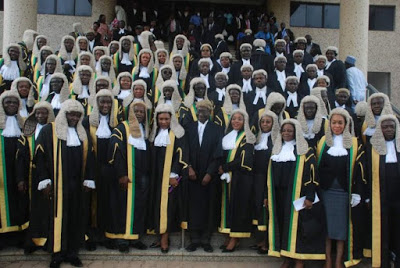
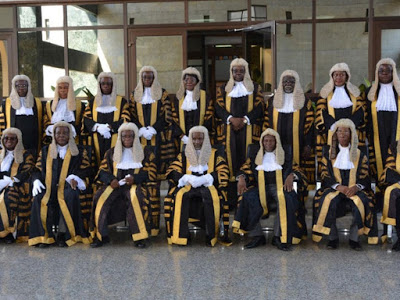
Photo – Cross Section of Senior Advocates OF Nigeria
Photo Credit – www.dnllegalandstyle.com 
@Legalnaija 

Capital Market, Corporate Structuring & Finance Training For Lawyers

Capital Market, Corporate Structuring & Finance Training For Lawyers

 
Corporate finance lawyers advise companies on all aspects of the buying and selling of whole businesses or business assets. Whether negotiating a merger agreement, acquisition, rendering a fair opinion, issuing securities or taking an IPO public, Lawyers without the basics of corporate finance are at a disadvantage. This training aims to provide corporate lawyers with the essential tools to work with financial experts and corporate clients. 

Training Overview
Theme:     Creating And Sustaining Wealth Through Legal Expertise
Modules:
  • Banking And Financial Law 
  • Capital Market Regulatory & Advisory
  • Corporate Structuring And Compliance
  • Project Finance
  • Accounting & Finance
  • Fintech Law
Members of Faculty:
  • Dr. Dapo Olanipekun SAN (Partner, Esher & Makarios)
  • Bukola Iji (Partner, S.P.A. Ajibade & Co.)
  • Davidson Oturu (Partner, AELEX)
  • Mrs. Tosin Kalegha (Senior Associate, Perchstone  & Graeys)
  • Adetutu Sanusi (Banwo & Ighodalo)
  • OACO Accounting Services (Chartered Accountants)
Training Information – 
Date – 28th and 29th of March, 2019
Venue – LCCI Conference & Exhibition Centre, Nurudeen Olowopopo
      Drive, Alausa, Ikeja, Lagos
Time :- 9am – 5pm Daily
Registration Details
Fee per delegate                               
N50,000               

Early Bird (Ends February, 28, 2019)                                  
N35,000
For contact, registration and sponsorship details, Please contact Lawlexis on 09095635314; 08055424566. 
Note that all Payment confirmation and Delegate Information should be sent to lawlexisinternational@gmail.com.
More Questions, Less Answers To The Proposed Reform | Ogaga Emoghwanre ESQ

More Questions, Less Answers To The Proposed Reform | Ogaga Emoghwanre ESQ

What are the intentions of the learned silks who orchestrated this reform? If it is not self seeking why are they not collaborating with the leadership of the NBA for a better or the said reform?

 It is crystally pellucid with due respect to the undersigned learned silks, the disposition, allegiance and position of most of the SAN’s who signed this ‘reform’  shows that they are not in support of the present leadership of the NBA. This is more of a tussle against a constituted authority,the NBA,than a reform. My opinion.
These questions are directed to the silks that signed this ‘reform’:
1.Wouldn’t it have been better for the silks to liaise with the NBA for a better reform?
2.Majority of the silks who signed the said reform move, did not support the present leadership of the NBA and they have on several occasions displayed their disgust and hate for the PU administration. Is the said reform not geared towards antagonising the NBA for personal aggrandisement?
3.Are these silks showing a good example to young lawyers in obedience to constituted authority as enshrined in the NBA bye laws?
4.Are these silks having the backing of The Body of Senior Advocates of Nigeria?
5.Under whose authority are they operating to bring about the desired reform to our justice sector system, without the backing of the NBA?
6.Will this not amount to ‘treason’ against your Association?
7.If most of the silks who undersigned, had their preferred candidate at the helm’s of NBA affairs. Would they have signed this reform? or collaborate with their candidate to build a better association?
8.Why is there more rancour, envy, bitterness and jealousy in the Inner Bar than we have at the outer Bar?
9.Did the undersign truly represent unity and One Nigeria in their composition?
10.Can the undersigned learned Silks in their translucent moment, state that this Present administration hasn’t been doing well in piloting our affairs?
11.Are lawyers from the outer Bar not knowledgeable enough to drive the said reform? Why only learned silks?
How good and how pleasant it would be, before God and man, to see the unification of all Nigerian lawyers. Most especially the learned silks.
Our strength should be In our diversity and struggle. laced with our bond of been learned and our camaraderie.
We need to shun hatred, backbiting  and pull him down syndrome. If he is down *”na wetin you gain”* .The success, prestige, good image, and potency of NBA should be the pursuit of every member thereof. 
Even if I do not like the face of the President, I am bound to cooperate with him,criticise him constructively and don’t go against the decisions of NEC *(@Bayo Akinlade, lkorodu Chairman)* for the rest of his tenure. By that I am not doing him a favour, but myself. For the glory of the association is the glory of the individuals who make up the association.
I find strong wisdom, in the words of MR. A. B MAHMUD,SAN. OON
*”We must not allow anything to distort our unity as an institution. We must come out strong and united,let us be cautious not to divide ourselves.”*
If our learned silks are sincere,without any bias or ill motive,they should join hands and forces together with this present administration for a better reform of our Association and the Judiciary.
*#kindness is the language the blind can see#*
Just passing bye,what do I know, am just a young lawyer.
Yours, in truth.
Ogaga Emoghwanre, Esq
Reform, Rebellion Or Ruin | Udems

Reform, Rebellion Or Ruin | Udems

I have read that some 20 senior lawyers want to reform the legal profession. There is nothing wrong with reform. I Iove genuine, selfless and evenhanded reforms. My problem is we must be careful so that we don’t mistake rebellion or self-serving activities or initiatives for reform. 

I have NOT seen any genuine move towards any credible reform because any attempt at reform without rule of law is doomed to derail. One Major way the Justice sector could be reformed is by the NBA setting up a Committee to that effect or by convening an all-stakeholders’ Conference to dispassionately discuss the real such issues. Reforms do not come through the back door. 
Anyone who wants reforms in the justice sector should go through the right channel and within Rule of law. The Nigerian Bar has a Leadership. Everyone ought to cooperate with the existing Leadership.  *If we NO LONGER want our current Bar Leaders, we should follow due process of law and remove and replace them.* It is allowed. But until then, we have a duty to respect our leaders. And to make disinterested suggestions and offer constructive criticisms aimed to achieve progress for the bar and Bench. Else, I remind us that One good turn deserves another. Let’s not forget that what goes round comes round.  
I am aware that NBA currently condemns and denounces  all acts and forms of corruption. *The day NBA Leadership supports any corrupt person, NBA loses my support.* Because corruption is a cankerworm. However, corruption extends beyond stealing of money or public funds. Abuse of and desecration of the Constitution and rule of law is a worse act of corruption.* Corruption can only be effectively dealt with within the ambits of rule of law, due process, evenhandedness and impartiality. 
Anything other than that is JUNGLE JUSTICE and totalitarianism which would take us back to the dark ages of Might is Right. And I assure you that NO Nigerian is safe under such a crude system. 
NBA’s current stand on CJN Onoghen’s is RIGHT in my view. NBA wants all things to be done according to laid down legal processes and procedures. The axe of justice may grind slowly, but it sure will get to its destination successfully. NBA’s position, if I get it right, is that if CJN Onoghen is found to be corrupt, there’re LEGALLY ESTABLISHED procedures for disciplining the CJN or for removing or suspending the CJN and for punishing him. If what we are now saying is that anyone accused (but not proven to be corrupt) could or should be immediately taken and LYNCHED, then let’s note that no one among us (citizens) is safe. 
I will illustrate with a brief conversation held between *William Roper* and *Sir Thomas More* as reported  in the book, *A Man for All Seasons,* by Robert Bolt:
*1⃣William Roper:* 
“So, now you give the Devil the benefit of law!”
*2⃣Sir Thomas More:*
 “Yes! What would you do? Cut a great road through the law to get after the Devil?”
*3⃣William Roper:* 
“Yes, I’d cut down every law in England to do that!”
*4⃣Sir Thomas More:*
“Oh? And when the last law was down, and the Devil turned ’round on you, where would you hide, Roper, the laws all being flat? This country is planted thick with laws, from coast to coast, Man’s laws, not God’s! And if you cut them down, and you’re just the man to do it, do you really think you could stand upright in the winds that would blow then? Yes, I’d give the Devil benefit of law, for my own safety’s sake!”
This is just to illustrate to us that society is at an end the very day you put a stop to supremacy of rule of law.  Indeed, to call for suspension of the operation of rule law, the only safeguard for a sane society, is to call for enthronement of the worst form of corruption! Any action or decision of the people, or of leaders or of anyone else, which goes contrary to rule of law is an anathema, a threat to the very foundation of society and National security and an invitation to chaos. 
The greatest and safest way to civility and progress for any society/nation is to embrace rule of law as its inviolable creed, to which both the leaders and the led are subject. A society that ignores rule of law welcomes rule by arbitrariness, the subjective predilections of people in authority. 
Rule of law is the basis for any constitutional democracy. And without the rule of law in democracy, you have chaos. We cannot build foundations of a state without rule of law. The clearest way to show what the rule of law means to us in everyday life is to recall what has happens when there is no rule of law.
Further, IS NIGERIA’S JUSTICE SECTOR SEPARATE FROM NIGERIA? It a big question we often mischievously ignore. My humble take: I agree that Nigeria’s justice sector needs reform. Yes. But Nigeria itself and its system of governance are in much more more urgent need for radical reforms. When you reform Nigeria and its style and system of governance, you’d get/have the best justice delivery system in the world. 
Our justice sector is part of a rotten society. You can’t separate one from the other. Clean up the Nation and rid it of ethnicity, tribalism, religious bigotry, oppression, political persecution and suppression of opposition, and other ills that currently bedevil and threaten Nigeria’s governance existence and, i assure you, you’d get the  type justice sector and system you want. As Paulo Coelho observed, “… everything is connected,  all the roads meet, and all rivers flow into the same sea.” 
Finally, 
*There’s no profession without bad eggs.* We see them in all professions. In the legal profession, we should continue to weed them out until we’re totally clean. Therefore, let misbehaving judges and Lawyers be PROMPTLY dealt with according to law. That’s the best reform. Let’s not label the entire Nigerian judiciary “corrupt” simply because of the conducts of some bad judges. Let’s not see all Nigerian lawyers as corrupt simply because some lawyers are found to misbehave. You don’t set an entire house on Fire because you want to catch one thief inside the house. 
That’s wrong procedure. If a lawyer or judge is found to be corrupt, let him face the law and let him be punished accordingly, to serve as a deterrent to others. The best reform is to quickly bring an alleged corrupt lawyer or judge to book, according to laid down legal procedures. We have enough laws and rules to guide us. Let’s respect our leaders . And let’s route proposed reforms in the legal profession through appropriate channels. Rule of law is paramount because justice, though due to the accuser and the society, is due the accused also.William Orville Douglas rightly stated, the function of the prosecutor under the Constitution is not to tack as many skins of victims as possible against the wall; his function is to vindicate the rights of the people as expressed in the laws and to give those accused of crime a fair trial.
Oftentimes, we hear much of people’s calling out to punish the guilty; but very few are concerned to clear the innocent (Daniel Defoe).
Lets tell ourselves the truth and stop all these shenanigans and grandstanding for selfish, partisan or sectional goals. 
I rest my case. 
I am,
UDEMS. 
Chatham House Common Futures Conversations

Chatham House Common Futures Conversations

@chathamhouse_org in partnership with Robert Bosch Stiftung is launching the Common Features Conversations (CFC) project, a digital Platform for young people in Africa and Europe to discuss the key political challenges facing youths in both continents. 
This is such an amazing intitiative, young people across both continents will have  an opportunity to exchange ideas and influence international decision-making towards improving outcomes for citizens.
The 13 countries currently involved  are:
Cote d’Ivoire
Ethiopia
Estonia
Germany
Italy
Kenya
Mozambique
Nigeria
Norway
Romania
Tunisia
UK
Zambia
You can begin to participate by taking the Common Futures Conversations: Youth Survey f vhttps://www.chathamhouse.org/common-futures-conversations-youth-survey-2019
#chathamhouse #nigeria #norway #romania #tunisia #uk #zambia #mozambique #kenya #italy #germany #estonia #governance #democracy #activecitizens #world #like #
How The Buhari Administration defiled the Nigerian Temple of Justice | Orji Agwu Uka

How The Buhari Administration defiled the Nigerian Temple of Justice | Orji Agwu Uka

It is now a week to the day since Major General Muhammadu Buhari (Rtd) the 15th Nigerian Head of State and the 6th to be democratically elected, announced the purported suspension of the Chief Justice of Nigeria (CJN), Honourable Justice Walter Nkanu Onnoghen and contemporaneously swore in the next senior Justice of the Supreme Court, Justice Ibrahim Tanko Muhammed as acting CJN. 

The President informed Nigerians that he derived imprimatur from an order of the Code of Conduct Tribunal (CCT) granted on 23rd January 2019. Predictably, the President’s actions generated an outpouring of reactions most notably from the Senate President and Speaker of the House of Representatives; the major opposition candidate and former Vice President, Atiku Abubakar; the Nigerian Bar Association; as well as the international community and in particular the European Union, the United Kingdom and the United States of America.
The aftereffects of the President’s actions continue to reverberate, the latest being the resolutions reached at the emergency meeting of the National Judicial Council (NJC) on Tuesday 29th January 2019, where the NJC issued a query to both Justices Onnoghen and Muhammed and referred a petition against the CCT Chairman, Mr Danladi Umar to the Federal Judicial Service Commission for investigation. The nation now eagerly awaits the outcome of the investigation by the NJC which is expected at the next meeting scheduled for 11th February 2019. 
In the meantime however, and consistent with any issue involving law and lawyers, diverse opinions have been, and continue to be, canvassed in favour of, and against, the actions of the President. And it is against this backdrop that the present writer contends that, whether or not the allegations against the Chief Justice of Nigeria are ultimately provided to be true, the actions of President Buhari will go down in history as the most brazen act of desecration of the temple of justice since Nigeria’s independence in 1960.
There is no doubt that President Buhari rode to power in 2015, on the back of a promise to tackle the evil of corruption that has bedevilled virtually all facets of the Nigerian society. What later emerged was that the modus operandi of the President would be to embark on this fight against corruption even if it meant sacrificing the well-established doctrines on which the Nigerian democracy is anchored to wit, the rule of law, supremacy of the constitution, separation of powers and respect for fundamental human rights. And more importantly, even in the face of demonstrable basis for the theory that the said fight is selective and not systematic.
We first saw this in August 2015, when President Buhari while addressing lawyers at the annual Conference of the Nigerian Bar Association (NBA) directed lawyers not to represent defendants who were accused of looting the treasury. For inexplicable reasons, no informed him that it is a cardinal rule of professional conduct for legal practitioners that as a general rule, they do not reject instructions; and that it is a fundamental provision in the Constitution of the Federal Republic of Nigeria 1999 (“the Constitution”), which he swore to preserve; protect; and defend, that every person charged with a criminal offence is entitled to a fair hearing; is presumed innocent until he is proved guilty; and is entitled to defend himself in person or by legal practitioners of his own choice. Three years later, the President doubled down on this by informing the same gathering that national security trumps the rule of law. This latter statement was ostensibly uttered to provide belated justification for his administration’s serial disobedience of valid and subsisting orders of courts as exemplified by the continued detention of former National Security Adviser, Ibrahim Sambo Dasuki and the Head of Nigeria’s Islamic Movement, Ibrahim Yaqoub El-Zakzaky despite repeated rulings of courts of competent jurisdiction ordering their release.
While a number of critics had concluded on the basis of clear and convincing evidence that the packaging of President Buhari as a reformed democrat in the build up to the 2015 elections was a mere sugar-coat, and some even argued that his actions are indicative of one seeking to quench a long thirst for retribution against the Nigerian judiciary against which he has harboured a decade-old, deep seated disdain, following his repeated defeats at the election petition tribunals, what no one saw coming was the extent to which he was willing to go to desecrate of the temple of justice using the instrumentality of the CCT and in particular its Chairman, Mr Danladi Umar as a willing tool. This came to a head on 25th January 2019.
Before then, Nigerians woke to the reality that all would not be well with the judiciary under President Buhari when the State Security Service, self-styled DSS, invaded the homes of some Justices of the Supreme Court and the Court of Appeal and some Judges of the Federal High Court just a month to the retirement of the immediate past CJN, Honourable Justice Mahmud Mohammed. This was followed by an unprecedented delay in the appointment of Justice Onnoghen as the CJN despite a recommendation to the President by the NJC. Both the actions of the DSS and the subsequent arraignment of some of the Judges before High Courts and the CCT sharply divided opinions, so did the delay in the appointment of the CJN. In the end, the Nigerian judiciary was badly damaged by the events, but at least the office of the CJN remained sacred and insulated from the uncertainties pervading the system. It would not remain so for long.
The CJN is the head of the Nigerian judiciary and until now the occupier of the office had a relatively secure job. By the express provisions of Section 292 of the Constitution, and as separate courts have held, the CJN and the indeed the heads of all the courts established by the Constitution may only be removed before their age of retirement by the President or the Governor of the State acting on an address by the Senate or House of Assembly of a State as the case may be, and the NJC, being the body exclusively vested with the power to exercise disciplinary control over all Judicial Officers established by the Constitution, has a vital role to play in the process. Apparently resigned to the fact that the high threshold for the lawful removal of the CJN cannot be met, the President found a veritable avenue in the CCT.
The CCT is established by the Fifth Schedule to the Constitution and conferred with the powers to determine whether a public officer has contravened the code of conduct for public officer. This raises the question whether the CCT is a court and a superior court of record at that, and whether it exercises judicial powers. A fact that often appears lost on most Nigerians is that there are fundamental differences between superior courts of record and non-superior or inferior courts and tribunals. This is not a distinction without a difference and the implication will be appreciated presently.
Section 6(1) & (2) of the Constitution provides that the judicial powers of the Federation and of the States shall be vested in the courts to which the section relates, being courts established for the Federation and for the States. Section 6(5) then states that the courts listed therein are the courts in which these judicial powers shall be vested. The courts are listed in paragraphs (a) — (k) of Section 6(5). The said Section 6(5) expressly established 9 courts listed therein in paragraphs (a) — (i) while enabling the National and State Assemblies to create other courts in accordance with Section 6(5) (j) & (k). Very importantly, Section 6(3) specifically provides that the 9 courts shall be the ONLY SUPERIOR COURTS OF RECORD in Nigeria. It is instructive to note that the CCT is not one of the courts so listed. A combined reading of the various provisions in Section 6 of the Constitution lends itself to only one plausible interpretation, other courts or tribunals established, are not superior courts of record.
Nigeria operates a judicial system which borrowed largely from English law as a result of our colonial history. Under both English and Nigerian law, superior courts of record possess a self-generating intrinsic source of power, referred to as inherent power and which is different from the general jurisdiction conferred on the various courts and tribunals by the Constitution or enabling law. Thus, Section 6(6)(a) of the Constitution provides that the judicial powers vested by the Constitution shall extend to all inherent powers and sanctions of a court of law.
One of the major incidents of being a superior court of record is that such court is entitled to determine the question of its jurisdiction. This is not the case with inferior courts and tribunals which do not possess inherent jurisdiction but which exercise the jurisdictions and powers expressly conferred by law. Once the jurisdiction of a non-superior court of record or an inferior court or tribunal is challenged, the court has no powers to take any further steps in the proceedings, even to determine its own jurisdiction. Even in the case of a superior court of record, what emerges from the corpus of Nigerian case law is that when its jurisdiction is challenged, such court also has no powers to determine any question or make any pronouncement, except to determine its own jurisdiction.
Thus on 14th January 2019, when the CCT was informed that an application had been filed challenging its jurisdiction to entertain the case against the CJN, the Tribunal, not being a superior court of record, could no longer take further steps in the proceedings. Assuming the CCT is indeed a superior court of record [it is not], it only had jurisdiction to determine its jurisdiction and nothing more. It therefore follows the entire rulings delivered by the CCT, first on 14th January 2019, and again on 22nd January 2019, and in particular the ex parte orders purportedly granted on 23rd January 2019, were all made without jurisdiction, and are in accordance with Nigerian law, null and void and of no effect whatsoever. The law on this is sufficiently trenchant and merits no rehashing.
Secondly, the ex parte orders of 23rd January 2019, were purportedly granted in the face of several orders of superior courts of record, including the Court of Appeal restraining the CCT from further proceedings in the case. Flowing from the previous point, the CCT had no powers to take any arguments unrelated to the question of whether or not it had jurisdiction to entertain the charge.
Thirdly, it is a settled principle of Nigerian procedural law that once a court has adjourned proceedings (particularly in open court), it can only resume hearing of proceedings on the next hearing note. In this case, the CCT had on the proceeding of 22nd January 2019, adjourned proceedings in the case to 28th January 2019 for hearing of the Preliminary Objection. Yet Nigerians were advised by the President that the CCT had granted ex parte orders on 23rd January 2019.
Finally on this point, it is also a settled position of Nigerian procedural law that ex parte orders are only granted in cases of extreme urgency and in cases where it is expressly provided by law or the rules of court. Ex parte orders are an exception to the general rule and are typically filed together with a motion on notice for interlocutory orders. The essence of ex parte orders is because of the fear of irreparable damage being done between the date of filing and the date of service of the motion on notice. Above all ex parte orders are not generally granted to compel the doing of an act in view of their limited lifespan, but are granted to restrain the doing of an act to prevent irreparable harm being done. In this most curious of cases the motion on notice seeking an order to compel the CJN to step aside pending his trial before the CCT had been served and the court had adjourned proceedings for hearing, yet the President paraded an ex parte order granted on 23rd January 2019, which was granted on the strength of an ex parte application dated 9th January 2019. In other words the order had been granted over two weeks after the application was filed, and long after the motion on notice had been served.
All these are determinative of the fact that the CCT had no powers to have granted any ex parte interim orders in the case never mind the one of the nature that was in fact granted. It is therefore beyond cavil that the ex parte orders purportedly granted by the CCT on 23rd January 2019 was unfaithful to both elementary logic and the foundations of Nigerian due process jurisprudence.
Another factor that appears to have been lost on many is that ex parte orders are by their nature designed to last for a very limited period of time typically 7 days. The question then is now it is more than 7 days since the ex parte order was granted, is President Buhari willing to reverse his decision to suspend the CJN and swear in an Acting CJN with similar dispatch?
Above all the CCT made the order in the face of a subsisting decision of the Court of Appeal that any misconduct attributed to a judicial officer must first be reported to, and handled by, the NJC and it is only after the NJC has pronounced against such officer that the prosecuting agencies of the FGN can proceed. Whether this much maligned decision of the Court of Appeal is right or wrong, same remains valid and binding on all courts below the Court of Appeal including the CCT and it is not open to the CCT to depart from it.
All of the above ought to have been made known to the President by his retinue of legal advisers. Indeed no other Nigerian President in history has been surrounding by such record number of Senior Advocates of Nigeria. Instead, the President who is now notorious for selecting and obeying only favourable orders of court acted with uncharacteristic swiftness in announcing the suspension on the CJN and swearing in Justice Muhammed as Acting CJN. The legality and morality of the actions of Justice Muhammed in presenting himself to be sworn has been eloquently captured in the petition of Dr Olisa Agbakoba, SAN and is the subject of ongoing investigation by the NJC. Consequently I shall say no more on that.
If only the President had stopped there, maybe his actions would not have received as much knocks as it did. The President went ahead to deliver an address that was laden with several far reaching and indeed impeach-worthy statements. After beginning his address with a reference to the yet to be commenced CCT trial of the CJN, the President curiously placed reliance on the yet to be established “suspicious transactions running into millions of dollars [traced] to the CJN’s personal accounts by the security agencies”. These suspicious transactions, the President added with magisterial authority, were all undeclared or improperly declared as required by law. This is the same President who just yesterday informed Nigerians [and rightly too] that the Governor of Kano State, Abdullahi Umar Ganduje accused of receiving kick-backs from contractors and who was caught on tape doing do, was innocent until proven guilty. The President also betrayed his inherent hypocrisy when he relied on an illegally granted order by the Chairman of the CCT who himself has been indicted of fraud and is the subject of a criminal charge instituted by the Spokesperson of the Buhari Presidential Campaign Organization, Festus Keyamo SAN on behalf of the EFCC, to suspend the CJN.
The President then decried what he termed, “the sordid spectacle of a judicial game of wits in which the Chief Justice of Nigeria and his legal team have made nonsense of the efforts of the Code of Conduct Tribunal to hear the allegation on merit and conclude the trial as quickly as possible”. The President further added insult to injury by complaining about the stalling of the trial of the CJN, helped along by lawyers who insist that the orders obtained from the various courts, whether right or wrong are technically valid, and must be obeyed till an appellate Court says otherwise. Strangely, after admitting that this is the correct position of the law, the President asked if this was the right disposition for our nation. The answer is in the question.
And any lingering doubts that the motive of the President in swiftly announcing the suspension of the CJN and replacing him Justice Muhammed was not really about the non-declaration of assets, were dispelled by the words of the President himself when he announced his government’s dissatisfaction with, “the alarming rate in which the Supreme Court under the oversight of Justice Walter Onnoghen has serially set free, persons accused of the most dire acts of corruption, often on mere technicalities, and after quite a number of them have been convicted by the trial and appellate courts”.
One only needs to refer the President to the immortal words of Obaseki JSC in the case of Ojukwu v Military Governor of Lagos State (1985) where His Lordship held that “the Nigerian Constitution is founded on the rule of law the primary meaning of which is that everything must be done according to law. It means also that government should be conducted within the frame-work of recognized rules and principles which restrict discretionary power which Coke colourfully spoke of as ‘golden and straight metwand of law as opposed to the uncertain and crooked cord of discretion”.
Implicit in President Buhari’s statement is the clear expression of his intention to substitute the institutional knowledge of the judiciary particularly the Supreme Court with his personal notion of what is “the right disposition for our nation”. If a President is allowed to remove the head of an independent and constitutionally equal arm of government because he is dissatisfied with the fact that the judiciary was releasing accused persons to walk free, what is the limit to what he or indeed future Presidents can do?
What is perhaps most shameful about this entire episode is not even the actions of the President or the ill-advice of his handlers but the various utterances from very senior lawyers who for explicable reasons have justified this desecration of the temple of justice. They say that history is written by the winner. In generations to come, our children will either read that a fearless President successfully fought corruption to a standstill in Nigeria with the help of some senior lawyers or that a when tyrannical President sought to subdue and intimidate the judicial arm of government, well-meaning Nigerians stood to be counted. I have taken sides today. I only hope I am in the right.
Orji A Uka is a Nigerian born legal practitioner