Intellectual Property Right Infringement In Nigeria: How To Stop Online Piracy | Adavize Alao

Intellectual Property Right Infringement In Nigeria: How To Stop Online Piracy | Adavize Alao

Introduction

Copyright infringement which can simply be referred to as piracy is the use of creative works belonging to creatives protected by copyright law without permission for a usage where such permission is required, thereby infringing certain exclusive rights allotted to the Intellectual property (IP) rightsholder, such as the right to reproduce, distribute, display or perform the protected work, or to make derivative works.
Online piracy in Nigeria has gained momentum with a lot of websites engaging in file sharing for users to download.  The Nigerian piracy scene does not frequently feature large file uploads of above 1GB with most users lacking the ability to afford large amounts of data bundles required for large file downloads. The piracy scene features web uploads of files ranging from 2MB – 600 MB. The most commonly pirated files are music files, movies and TV series, with a plethora of websites dedicated to providing two or three of the above-mentioned file services. 
According to the Disruptive Creative Economy Meeting  (DCEM), digital music consumption in Nigeria overtook physical consumption circa 2013 and market revenues from physical sales, which have been declining steadily year on year, are now dropping to well below $10m. Due to the mass acceptance of social media and its ability to simultaneously reach a broader audience in multiple jurisdictions, it is not uncommon for the sharing of copyrighted content on these internet intermediaries.  The ease of acceptance and speed at which social media works has made the sharing of illegitimate copyrighted content swift. 
The Nigerian Copyright Commission has made several attempts  at fighting piracy but its efforts are yet to be noticed on the internet space.
A Failure to Stop Online Piracy
The Nigerian copyright space has been left bereft of a watchdog to curtail the activities of online copyright infringers commonly known as pirates. The inaction of several regulatory bodies and private enforcement efforts has also led to the proliferation of copyrighted content. This content is therefore accessed by users who should have paid for these services and product. The effect of the lack of a combative measure to combat piracy as led several persons to believe that all IP content should be free and made available to all Nigerians. 
The Nigerian entertainment & media industry according to PWC  is currently valued at the sum of 3.7 Billion dollars, while this report focuses on the total value of the industry it does not give a direction on the blockage of these illegal activities.  It is estimated that the Nigerian creative sector loses a large sum of money to pirate groups and the emerging group of online content providers simply referred to as blogs (inclusive of dedicated music blogs and download link sharing websites).  
The piracy scene in Nigeria can best be described as an unfettered freeway with little or no rules as a lot of the platform owners do not believe they are breaching the law. They feel it is a privilege to provide Nigerians with premium quality content to gain revenues from ad serving platforms. Such platforms that upload illegal content have, therefore taken advantage of the lack of knowledge on most consumers and the failure of the relevant stakeholders to stop illegal downloads. 
A simple search on Google goes on to show that the internet intermediary famed for blocking content use allowed under the fair usage  principle  has not done much to combat the spread of illegal content over the Nigerian internet space. Web platforms such as netnaija, fztvseries amongst other websites sharing songs and albums belonging to artists continue to operate unhindered. Internet intermediaries such as Google, Bing account for 23% & 21% of visitors to netnaija and fztvseries .
While Google, Bing and other search engines are not under compulsion to stop access to these platforms, the intermediaries  may be passively liable under the provisions of Section 14(1)g of the Nigerian Copyright Act 2004 for allowing unrestricted access and acting as a conduit to copyrighted content without taking measures to stop these downloads.
A failure to stop the spread of copyrighted content would continue to lead to the loss of more revenue for IP rights holders and owners. This revenue which ought to be generated to maintain the growing Nigeria entertainment and media industry would, therefore, be lost to persons seeking to profit from adverts/crypto miners  which create a lengthy value gap  between the service providers and product users. In a time of evolving markets and new businesses. It is essential that the rate of illegal file sharing be reduced as this would improve the protection of IP rights. 
Conclusion
In tackling the scourge of online piracy which is not protective of the rights of IP owners and holders, emphasis should be placed on legal alternatives and educating internet users of the rationale that copyrighted content comes with a price. In policing the internet, the ISPs should not be mandated to become the police of the internet as doing so would be granting the 
legitimisation of private enforcement. A joint effort between regulatory bodies, copyright holders/owners, right societies, internet intermediaries and telecommunications service providers would be a very effective way of reducing online piracy in Nigeria.
In dealing with persons that seek to gain from IP theft, it is essential for regulatory and rights societies to pursue means of addressing the root causes of IP infringement. The authorities and rights owners may involve the use of the following;
a. End-user blocking and filtering (parental control) with consent, which can be regarded as a very effective mode of dealing with IP infringements.
b. Educate users on legal and illegal alternatives. This is also being propagated by Google in some parts of the world and can be utilised as an alternative to blocking injunctions. 
c. Reduce prices or utilise subscription-based services such as Boomplay, IrokoTV for premium content to convert nonpaying customers to regular paying customers. 
d. Encourage the use of Freemium  services which provide basic content for free and premium content for a price.
e. The use of Digital rights management (DRM) technologies have been specifically developed to prevent online IPR infringement . This is the generic term for a set of technologies for the identification and protection of intellectual property in digital form. It should be noted that for every trademark infringement there is a DRM tool addressing the infringement. 
f. Voluntary or legal ‘geo-blocking’ e.g. which is the blockading of certain IP Addresses which spread copyrighted content.
REFERENCES 

[1] ‘Nigeria Loses N918trillion To Piracy Annually | Sahara Reporters’ (Sahara
Reporters
, 2019)
accessed 4 July 2019.

[2] Nigerian Recorded Music Industry Report (1st edn, Disruptive Creative Economy Meeting (
2019) accessed 4
July 2019.

[3]
Internet
intermediary refers to a company that facilitates the use of
the Internet. Such companies include internet service providers
(ISPs), search engines and social media platforms.

[4] Newton Media, ‘Nigeria Reveals Plans To Tackle Online And Digital
Piracy’ (World IP Review, 2019)

accessed 4 July 2019.

[5] Entertainment And Media Outlook: 2018 – 2022 An
African Perspective
 (PWC 2018)
accessed 3 July 2019.

[6] Nigerians don’t stream they download

[7] Fair use is an
exception to an IP holders exclusive rights. It is an equitable rule of reason,
which permits the Court to avoid a rigid application of a holder’s exclusive
rights when on occasion, it would undermine the purpose of the Copyright Act

[8] Mark Butler, ‘The Trouble With Youtube’ (wow247, 2016)
accessed 4 July 2019.

[9] Thenetnaija.com Competitive Analysis,
Marketing Mix and Traffic <https://www.alexa.com/siteinfo/thenetnaija.com/> accessed 4
July 2019

[10] Search engines

[11] The Pirate Bay Website
Runs a Cryptocurrency Miner (Updated)  https://torrentfreak.com/the-pirate-bay-website-runs-a-cryptocurrency-miner-170916/

[12] A value gap is the
mismatch between the value that these intermediaries extract from music, and
the value that is returned to rightsholders or in this case pirates

[13] Accordingly, Google in
the EU and USA has launched a number of initiatives to present legitimate
alternatives to people as part of search results, including providing
advertisements on queries for movies and music to link people to legitimate
means of purchasing content or finding movie showtimes in local theaters Google
Blog – How Google Fights Piracy 2018 Report –<https://www.blog.google/documents/25/GO806_Google_FightsPiracy_eReader_final.pdf> accessed 11th November 2018

[14] Share With Care: Danish
ISP Blocks Point ‘Pirates’ to Legal Alternatives <https://torrentfreak.com/share-with-care-danish-isp-blocks-point-pirates-to-legal-alternatives-181009/>
accessed 11th November 2018

[1] A combination of the words “free” and “premium,”
freemium is a type of business model that involves offering
customers both complementary and extra-cost services.

[15] Foot Anstey LLP,
“Online infringement of IPRs” <http://www.footanstey.com/images/stories/publications/Final_PLC_Online_Infringement_Article_pdf_-_11_08_1515732764_1.pdf
> Last accessed 11th November 2018.

[16] The technology enables
IPR holders to control access to their protected materials by removing the
consumer’s control over their use of the file, and ensuring that only those
with valid permission can use it, resulting in IPR holders ensuring that they
receive payment for their investment. However, DRM has its limitations.
Therefore, IPR holders should be advised to select the most suitable form of
DRM for their IPR in order to achieve the protection required without violating
valid users’ rights to access the content. Examples include encryption and
online monitoring.
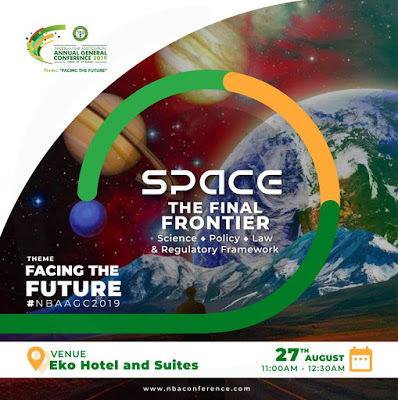
#NBAAGC2019 Session On Space Law

#NBAAGC2019 Session On Space Law

During the #NBA2019AGC, Prof Stephen Lowry from the University of Kent’s Centre for Astrophysics and Planetary Science will be the Lead Speaker at the session titled “Space, the final frontier”. 
Other topics for discussion in this session include: 

– Exploring our boundless universe of possibilities 
– International Space Law & Practice 
– Nigerian National Space Policy, and 
– Investment and Scientific possibilities in the Nigerian space industry. 
Other panelist are Dr. Gbenga Oduntan (Associate Professor of International Commercial Law, University of Kent); Motolani Fadahunsi – Banjo (Chief Legal Officer, National Space Research & Development Agency) and Temidayo Isiah Oniosun (Managing Director, Space in Africa). 
The session will be explosive and Lawyers who are fascinated with space and the solar system should look forward to an amazing session. 
Will you be there because we will.
#NBA2019AGC #Aliens #nasa #spacestation #spaceships #spacejam #nigerianlawyers 
#nbaconference2019
The Class Action that finally buried Bankers’ Order debacle in Nigeria | Olumide Babalola

The Class Action that finally buried Bankers’ Order debacle in Nigeria | Olumide Babalola

When in 2017, some of our clients’ bank accounts were severally frozen by their banks, via bankers’ orders obtained by the Nigerian Police from the Magistrates Court in Lagos pursuant to a spurious petition written by a commercial bank, our Law Firm approached the High Court of Lagos State on their behalf, challenging the constitutionality of bankers’ orders on several grounds.
In a class action with Suit No. LD/1961GCM/2017 between C. E. Osemene & 5 others (representing themselves and other bank account-holders whose accounts have been frozen by irregular and invalid bankers order in Nigeria) against Guaranty Trust Bank and 6 others, the Claimants took out an originating summons praying for:
1. A DECLARATION that a banker’s order/order freezing bank accounts cannot be validly issued pursuant to a non-existent/repealed Banker’s Order Act 1847 and/or any other irrelevant foreign law.
2. A DECLARATION that section 89 of the Evidence Act 2011 does not empower a Magistrate to issue a Banker’s order and/or order of freezing bank accounts.
3. A DECLARATION that a Magistrate lacks the powers to make banker’s order and/or order of freezing bank accounts pursuant to non-existent/repealed section 7 of the Banker’s Order Act 1847 (42 VICO11).
4. A DECLARATION that a Banker’s order and/or order of freezing bank accounts cannot be validly issued without a proceeding in court.
5. A DECLARATION that a Banker’s order and/or order of freezing bank accounts cannot be validly issued without a court proceeding with suit number and record of proceedings.
6. A DECLARATION that a Banker’s order and/or order of freezing bank accounts cannot be validly granted Ex parte to last indefinitely.
7. A DECLARATION that a Banker’s order cannot be validly granted in the absence of a formal application supported by an affidavit.
8. A PERPETUAL INJUNCTION restraining the 7th Defendant, his officers, agents and/or legal representatives from further approaching the Magistrates’ court and/or any other court for a Banker’s order without filing a Motion supported by an affidavit and suit number.
9. A PERPETUAL INJUNCTION restraining the 1st to 6th Defendants from further giving effect to a Banker’s order without first conducting an official search and obtaining a certified true copy at the registry of the court that issued the order.
10. Such other consequential Order (s) that this honourable court may deem fit to grant in the circumstance.
The matter was initially assigned to Hon. Justice W. Animahun who granted the class-action certification order but was later re-assigned to Hon. Justice K. Alogba (now Acting Chief Judge) for hearing. We served, well over, 4 hearing notices on the office of Inspector General of Police (7th Defendant) but they, unsurprisingly, did not show up throughout the matter. However, the banks responded and upon which process, the matter was eventually decided on the 24th day of May 2019 when the momentous judgment was delivered thus:
On non-existence of Bakers Order Act 1847 pursuant to which bankers’ orders are usually granted (especially by Magistrates Courts), Alogba, J. (as he then was) held thus:
“Claimants strongly contended that the Bankers’ Order Act 1847 pursuant to which the order of the Magistrates Court was made was non-existent. That may as well be correct but the proper and/or correct law is the BANKERS’ BOOKS EVIDENCE ACT 1879 CHAPTER 11. To begin with, extensive research revealed that there is no law known as Banker’s Order Act 1847. Rather, what is in the statute books is- BANKERS BOOKS EVIDENCE ACT, 1879. 
On nullity of Bankers Orders:
“So that, to begin with, the bankers’ order in issue in this case was patently issued pursuant to a non-existent law and afortiori, null and void ab initio and of no effect whatsoever. The contrary matter is the case with the so called “Bankers Order” in issue herein proceeding from a non-existent law and under a non-existent legal proceeding and ordering beyond the limits of inspecting and or taking copies of entries in the banker’s book and also not for the purpose of any existing or pending legal proceeding. It is an order which can only exist in the imaginary world of the dreamland certainly not in any existing, valid, pending “legal proceedings” stricto sensu as clearly defined in section 10 of the law (supra). For short, it is a Nullity ab-initio.”
On whether the Police can freeze accounts without legal proceedings:
“Section 4 of the Police Act does not expressly grant such power or prerogative to the police. In the course of their investigations, if the police must have recourse to and take copies of bankers’ books, they must strictly comply with section 7 of the Bankers Books Evidence Act (supra). They must institute a legal proceeding and there’s no difficulty or hindrance in so doing, for the law itself grants liberty that the order may be obtained ex parte the bank or party to be affected, the only and inescapable condition precedent is that, a legal proceeding must be instituted first and it is only under or in such existing/pending/action/application, that such an order can ensue, legally and validly so.”
On whether the courts are empowered to order freezing of bank accounts and/or arrests under the Bankers Books Evidence Act:
I must not fail to mention and indeed, emphasize the point that, in so far as bankers books are concerned and if the application be under the Bankers Books Evidence Act (supra), the court is limited to making an order for inspection and taking copies of such entries only. The law does not empower the court to order a freezing of any party’s account in whatever name called and worse still an arrest of any operator of such account by the bank (as the orders usually say on their faces) and I am sure banks will not dare do so – for it is clearly not their portion- legally speaking. Properly speaking, a court (Magistrates court in particular) ought not grant an order of arrest under the guise of section 7 of the Bankers Books Evidence Act (supra).
On the whole, the court concluded thus:
“This action succeeds in its entirety and I declare as follows:
(1) That the Bankers Order Act 1847 is a non-existent law.
(2) A bankers order cannot be granted by any court pursuant to a non-existent law to freeze or otherwise impede the running of any person’s bank account without a pending legal proceeding properly initiated by appropriate originating process and in accordance with or pursuant to a substantive legislation on the subject matter.
(3) Section 89(1) of the Evidence Act 2011 does not, on its own, empower any court to make any order to freeze bank accounts.”
The judgment of Hon. Justice Alogba (Ag. CJ) couldn’t have come at a better time than these perilous times where several people and legal entities have fallen victims of the shenanigans of the police as well as the indifferent complicity of banks at perpetually and brazenly freezing bank accounts on the strength of demonic and repressive bankers’ orders usually granted pursuant non-existent laws. 
Coming from the acting chief judge’s bosom, the judgment ushers in, a new dawn as it marks a watershed in our justice-system, while kicking out the era of employing bankers’ orders, especially without a court proceeding, and confining same to the abyss of regrettable judicial history. It is hoped that all courts take judicial notice of this oven-hot decision which ought to form the basis for a new practice direction for all Magistrates in Lagos state as far as bankers’ orders (if there is anything like that) are concerned.
Olumide Babalola is the managing partner of Olumide Babalola LP.
List Of General Interest Sessions At The NBA 2019 AGC

List Of General Interest Sessions At The NBA 2019 AGC

There are about 39 sessions scheduled to hold at the NBA
2019 AGC, for ease of reference, you may look through the following list of
General Interest Sessions to see which session you would be interested in attending

1.    
Code of Conduct Tribunal: A Clash OF Judicial
And Executive Powers

2.    
Trade in Legal Services: Current Realities
and Future Possibilities

3.    
Leveraging Technology In Justice
Administration: Issues And Challenges

4.    
Opening the Window On Lawyer Wellness And
Mental Health Concerns

5.    
Space, the Final Frontier: Science, Policy,
Law and Regulatory Framework

6.    
Rule of Law Symposium 

7.    
Judicial Protection Of Economic, Social and
Cultural Rights

8.    
Trafficking In Persons And Irregular Domestic
and Cross Border Migration

9.    
Implementing SDG 5 (Gender Equality and
Female Empowerment).

10. The
Future of The Legal Profession and The Regulation of Legal Practice and
Practitioners

For more information on sessions, speakers and other
valuable information on the NBA 2019 Annual General Conference, you can visit
the conference website at www.nbaconference.com

@Legalnaija

5 Innovations Lawyers Should Note About The 2019 NBA Annual General Conference

5 Innovations Lawyers Should Note About The 2019 NBA Annual General Conference

The Nigerian
Bar Association, NBA, Africa’s largest body of lawyers with over 100,000
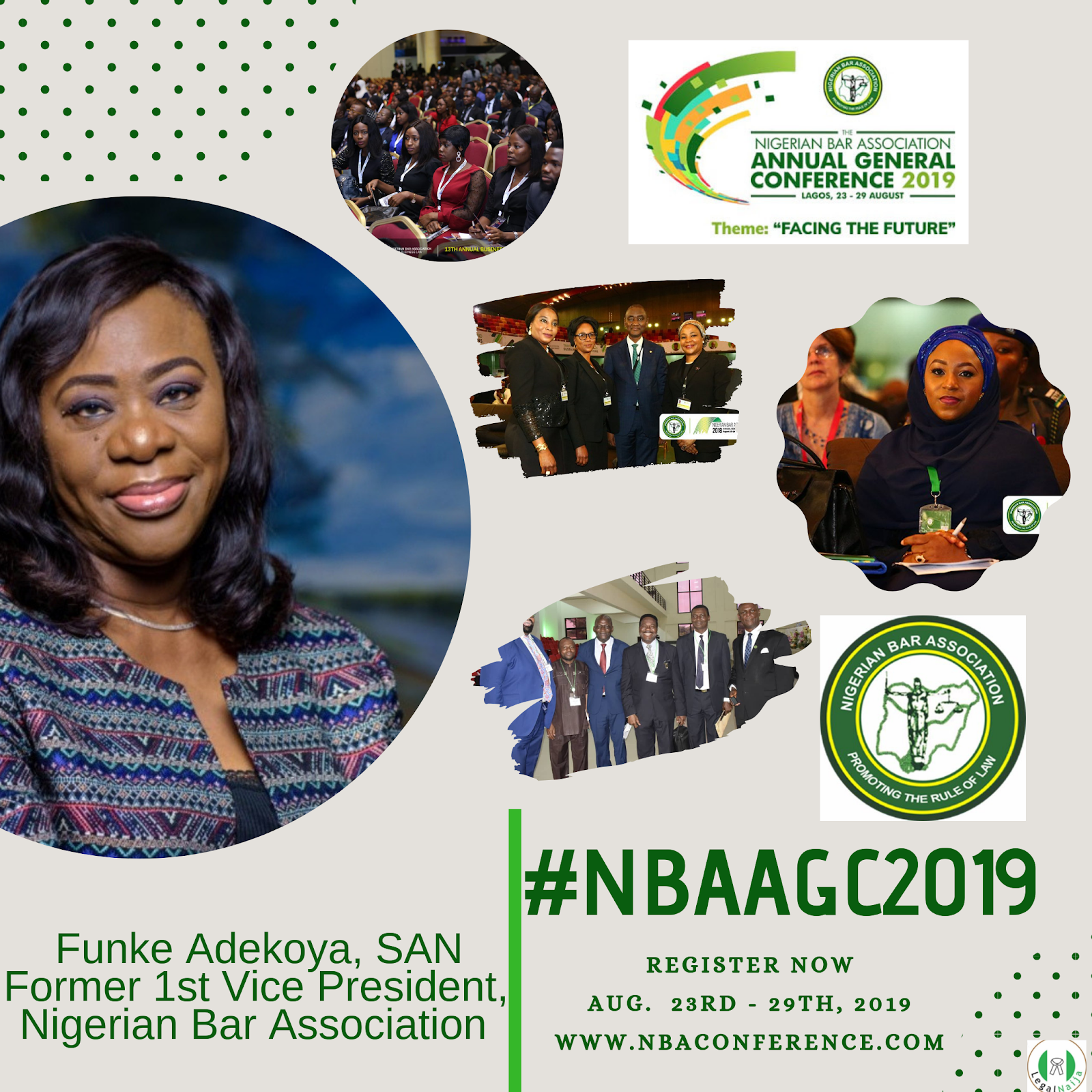
members, will be holding its 59th,Annual General Conference scheduled
to hold from August 23rd – 29th, 2019, at the Eko Hotel
& Convention Centre, Victoria Island, Lagos.

The Conference, which is one of Africa’s largest gathering of
lawyers will have the theme; FACING THE FUTURE, a theme that is most relevant
at this point in the history of our country, the Bar and Bench .
World leaders, citizens
and institutions worldwide are concerned about what the future holds. The
rapidity of innovations and change in the political, business and professional
space is perhaps more pronounced in our generation than ever before.
 Nations worry, not about the inevitability of change, but about the
capacity to predict, navigate and transform institutions to positively manage
the present and future in a way that nourishes sustainable growth in wealth
generation, freedoms, peace and security.

According to the Technical Committee for Conference Planning (TCCP). “One of the challenges facing the
legal profession today is not just the effect of globalisation and technology
but also its attendant disruption in almost every fibre of the society.
Artificial intelligence, block chain, financial technology, cloud computing and
electronic documentation are a few of the technologies that have directly
impacted and would continue to impact the manufacturing and services sector
including legal and justice sub-sectors. The legal practitioner’s task
therefore, while appreciating the inevitability of the disruption, is to
anticipate the depth of its impact and understand the need for strategic
retooling in order to explore the opportunities inherent in the disruption.”

The Conference
seeks to stir up conversation about our future as Legal Practitioners viz-a-viz
emerging global trends and local realities as well as ensure lawyers
individually discover the path to navigate the unforeseen future of legal
practice. Also the Paul Usoro, SAN led NBA administration has introduced several
dynamic innovations to this conference aimed at ensuring capacity building for lawyers
and making it the best NBA conference ever for delegates.

The List of
innovations introduced by the NBA President to ensure the coming NBA Conference
is different from the norm include –

1.      Appointing some of the best minds into the
Technical Committee for Conference Planning (TCCP)
The
Chairman of the TCCP is Gbenga Oyebode, MFR, Chairman Management Board at Aluko
& Oyebode and most certainly one of Nigeria’s most prominent lawyers. The
Co – Chairman is Olumide Akpata, Partner at Templars and also past Chair of the
Nigerian Bar Association’s Section on Business Law.  Others include the Chair persons of the NBA
Sections – Mr. Seni Adio SAN, Chairman NBA SBL; Mrs. Miannaya Essien SAN, Chairperson,
NBA SPL; Dr. Paul Annanaba, SAN, the Chairman SPIDEL and Professor Kanyinsola
Ajayi of Olaniwun Ajayi & Co.

2.     Sessions are driven by the various NBA
Specialist Committees

During
previous NBA Annual General Conferences, general interest issues drove the
sessions, however, the 59th #NBAAGC is driven by over 40 NBA
Specialist Committees including the Committees on –

         
Energy, Natural Resources & Environment

         
Intellectual Property

         
Law and Individual Rights

– Civil Litigation/ Professional Development

         
Economic Development

         
Corporate Counsel

         
International Trade Law

  Law Firm Management and Professional Development

         
Accountability and Governance  

The aim of
allowing Committees drive the sessions is to ensure that lawyers who attend the
sessions are able to learn new things and actually develop their legal skills.

3.     Structured after the IBA Conference

The NBA AGC
2019 is moduled after the IBA Conference, the International Bar Association is
the global voice of the
legal profession

and is the foremost organisation for international
legal practitioners, bar associations and law societies.
The IBA Annual Conference
serves to
advance the development of law and its role in business and society and to
learn from the experience of others.

4.      Most number
of Past NBA Presidents playing active roles

This NBA AGC 2019 will
have the most number of past NBA Presidents playing active roles at the
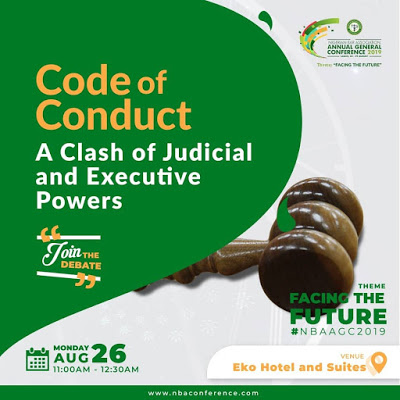
conference. Mr. J. B Daudu, SAN will chair the session on the Code of Conduct Tribunal:
A Clash of Judicial and Executive Powers; Mr. Austin Alegeh will chair the
session on Trade in Legal Services: Current Realities and Future Possibilities
and other past NBA Presidents playing active roles include Chief Bayo Ojo, SAN,
Mr. A. B Mahmud, SAN Dr. Olisa Agbakoba, SAN, Chief Wole Olanipekun, SAN and Mrs Priscilla Kuye.

5.     Introducing dynamic discussion topics

The TCCP has introduced several
dynamic and highly debated topics into the sessions scheduled to hold during
the NBA AGC including topics on social media culture; incursion of Multi –
Disciplinary firms; Brexit and African Trade; Challenges of Democracy in
Nigeria, Bullying and Sexual Harassment in the Legal Community, 10 Things No
One Knew At Law School, Space the Final Frontier, Medical Negligence and the
Rule of Law to mention a few.

About 12,000 Lawyers will
be converging at the 2019 NBA AGC and it promises to be one of the best
conferences ever.

@Legalnaija

Statement Of The NBA On The Prevention Of Justice Karatu On Performing Her Judicial Functions

Statement Of The NBA On The Prevention Of Justice Karatu On Performing Her Judicial Functions

PREVENTION OF HON. JUSTICE ELIZABETH KARATU FROM PERFORMING HER STATUTORY JUDICIAL FUNCTIONS”
The attention of the President of the Nigerian Bar Association, Paul Usoro,SAN has been drawn to a video that has gone viral online, an showing a Civil Defence official preventing a Judge of the Kebbi State High Court, Hon. Justice Elizabeth Karatu from accessing her court for the purpose of sitting to deliver some judgments reserved for that day.

The Nigerian Bar Association has launched and investigation into the incident and will revert upon conclusion of its investigation.
In the meantime, the Nigerian Bar Association reiterates the Independence of the Judiciary as a separate arm of government and urges agencies under the Executive arm to refrain from interfering or doing anything that would amount to unlawful or u constitutional interference with Judicial functions and perversion of justice.
The Nigerian Bar Association at its National Executive Committee meeting held on the 20th day of June, 2019 in Abuja had issued a communique condemning the excessive and unbridled interference by the Executive arm of government, in the affairs of the Judiciary, and demanding that the continued intimidation and harassment of Judicial officers all over the country must stop.
Nigeria is a country of laws; a constitutional democracy. The survival of democracy can only be guaranteed upon the entrenchment of rule of law and separation of powers, particularly the Independence of the Judiciary. The Executive arm of government is not superior to the Judicial arm and must not play the overlord in a democratic dispensation. The lives and official positions of Judges should not be threatened while dispensing their official functions.
The Nigerian Bar Association therefore calls upon the Inspector General of Police to investigate the unfortunate incident of preventing Hon. Justice Elizabeth Karatu from performing her lawful Judicial functions by officials of the Nigerian Security and Civil Defence Corp and to bring to book, every person found culpable in the disgraceful intrusion.
The Nigerian Bar Association also calls upon the various governmnts and public officials in Nigeria to obey the laws of the country that they have sworn to protect and preserve; and to respect the sanctity of the Independence of the Judiciary. This is necessary, if this country must move forward.

Kunle Edun 
National Publicity Secretary, Nigerian Bar Association.
NBA AGC UPDATE

NBA AGC UPDATE


The Technical Committee on Conference Planning (“TCCP”) of the Nigerian Bar Association (“NBA”) wishes to inform members of the Association and the General Public as follows:


1. As at 12 midnight on Sunday 30th June, 2019, over 8,000 delegates have so far registered for the Conference. We would like to thank these delegates who have registered and indeed everyone who has made the achievement of this significant milestone possible.


2. The TCCP however acknowledges the fact that due to network, payment and database issues, amongst others, a significant number of prospective delegates have been unable to register for the Conference within the Early Bird registration time-frame.


3. Consequently, the President of the NBA, Mr. Paul Usoro, SAN, has graciously approved the extension of the Early Bird Registration deadline to 11:59 pm on Sunday 7th July, 2019. We therefore urge members and other prospective delegates, particularly those who encountered the aforementioned issues, to promptly take advantage of this extension and register immediately for the Conference as there will be no further extension of the Early Bird period.


4. The Registration Help Desk at our Contact Centre can be reached by email: info@nbaconference.com or by telephone (Monday-Friday: 9:00 am to 9:00 pm and Saturday-Sunday: 11:00 am to 9:00 pm) on: 09031500091, 09031500092, 09031500096, 07056827698.

FIDIC CONTRACTS TRAINING COURSE

FIDIC CONTRACTS TRAINING COURSE

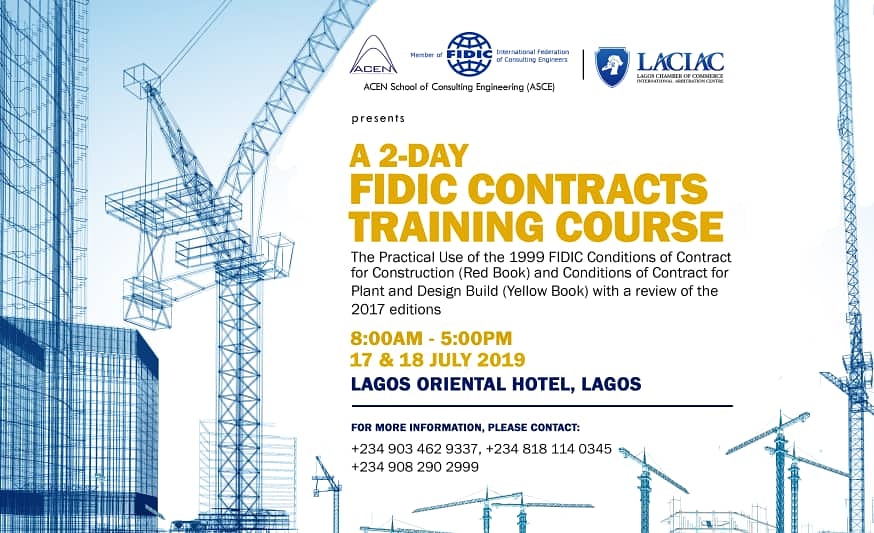
We are pleased to invite you for a two-day FIDIC Contracts Training Course on The Practical use of the 1999 FIDIC Conditions of Contract for Construction (Red Book) and Plant and Design-Build (Yellow Book) with review of 2017 updates of the Red and Yellow Books. The training is a collaborative effort of LACIAC and the Association For Consulting Engineering in Nigeria (ACEN), a FIDIC member organization. 
Date: Wednesday 17th and Thursday 18th July, 2019 
Venue: Lagos Oriental Hotel 3, Lekki Road , Victoria Island Lagos .
Time: 8:30am -5.00pm daily. 
This training will be a practical and interactive course that explains and illustrates the use of the Red and Yellow Books. Addressing topics such as: 
Contract documents

Responsibilities of main parties

management of projects

tests on completion

financial procedures

suspension and termination

risk, liability and force majeure

claims, disputes and arbitration
The training is designed for contract administrators, project managers, engineers and legal advisers in:

Oil and Gas Exploration & Production companies which engage Engineering Procurement and Construction (EPC) contractors in E&P projects;

EPC, BOT and other PPP Concession companies

Government agencies having ownership or oversight of infrastructure projects

Development Banks
It is also useful for professionals involved in construction and infrastructure projects, including architects, quantity surveyors, arbitrators, adjudicators, mediators and construction law firms. 

The facilitator will be Mr. Husni Madi a Civil Engineer, Arbitration & Adjudicator and FIDIC international accredited trainer who also functioned as a friendly reviewer of the FIDIC 2017 suite of contracts. 
We look forward to welcoming you to the training. Call +2349034629337  to register
Infusion Lawyers: Can a registered trademark be lost?

Infusion Lawyers: Can a registered trademark be lost?

Dear IP ABC

My name is Theophilus. I have a friend Oluwanifemi whose brand name Glowbal Makeovers has become quite a household name in my state, Ogun State. Oluwanifemi has customers from within and outside the state capital where her business is based. Recently, she was contacted by a competitor Marian Makeovers who wanted to purchase her brand name ‘Glowbal Makeovers’ for N1 million. Oluwanifemi turned down the offer. During negotiations, Marian Makeovers mentioned that Oluwanifemi might lose the trademark ‘Glowbal Makeovers’ anyway, thus making it a good call for her to sell the brand without delay. Now, Oluwanifemi is worried. She is wondering how true Marian Makeovers’ claim is. Can a registered trademark be lost?

Answer
Dear Theophilus
The answer is YES, Oluwanifemi may lose her registered trademark ‘Glowbal Makeovers’ but only on certain grounds, including abandonment or non-use, genericide, or deception, fraud, or misrepresentation. In the absence of these grounds, the answer is NO.
Under trademark law, a trademark owner may lose his or her registered trademark after it has been taken off the trademark register in respect of any of the goods or services for which it was registered.
 
The first and most common ground by which a trademark can be lost is abandonment or non-use.
A proprietor may lose his or her registered trademark due to abandonment or non-use.
Under section 31 of Nigeria’s Trade Marks Act, a registered trademark may be taken off the register in respect of any of the goods or services for which it is registered. This removal may be triggered by any person through an application to the Federal High Court on either of two grounds:
  1. That the trade mark was registered without any bona fide or genuine intention on the part of the applicant to use the mark in relation to goods or services for which the trade mark was registered and there has in fact been no bona fide use of the trademark in relation to those goods or services by such proprietor from inception up to one month before the date of application to remove the mark from the register; or
  2. That up to the date which is one month before the date of the application a continuous period of five years or longer elapsed during which the trademark was a registered trade mark and during which there was no bona fide use of the trade mark in relation to those goods or services by any proprietor for the time being.
Therefore, as long as Oluwanifemi’s Glowbal Makeovers is still in business, there is no way it can be removed from the register.
By the way,  non-renewal of a registered trademark is a way for one to lose his or her trademark.

What does the phrase ‘bona fide use’ of a trademark really mean?
Bona fide use’ means genuine use. This genuine use is determined by commercial standards. Use for illegitimate or undue purposes⁠—such as for example to prevent another proprietor from registering a trademark which is distinctively associated with that proprietor⁠—is not bona fide use.
This is why a registered trademark will not be removed from the register for non-use when such non-use is due to special circumstances in the trade. But if non-use is a result of any bogus, fake, or insincere intention of the proprietor, the registered trademark would be due for removal.
Since Oluwanifemi is genuinely using ‘Glowbal Makeovers’ as a trademark of her thriving makeover business, Marian Makeovers’ claim that Oluwanifemi would lose her trademark sooner or later is untenable.

A second major ground by which a trademark can be lost is when it becomes a generic mark and this happens in two ways.
If a trademark becomes generic, a court of law—upon application by any person—may decide that the trademark has lost its inherent distinctiveness or it was not distinctive in the first place.
First, a word is inherently and originally generic when the word merely describes a class of goods or services, thus rendering it ineligible for trademark protection. For example, words such as ‘sauna, ‘smartphone’, or ‘pen’ are generic terms. As far as the classes they describe are concerned, they are ineligible for trademark protection of goods or services in those classes. ‘Sauna’, ‘smartphone’, or ‘pen’ may be used to distinctively identity goods or services that do not belong to the classes they describe. Good examples of this are ‘Apple’ and ‘Orange’, distinctively known as technology companies. How does this work? Neither Apple nor Orange is in fruit business, the class their names describe.  
Second, an originally distinctive word registered as a trademark can lose its distinctiveness, thus becoming generic and consequently losing trademark protection. This happens if consumers or the members of the public begin to use the word to describe the goods or service. Common examples such generic words include Aspirin, Escalator, etc. Recently, ‘Google’ was at the brink of becoming generic. When an originally distinctive trademark loses its distinctiveness, the trademark dies. It dies because with distinctiveness lost, consumers or members of the public are no longer able to identify the source of the goods or services. Now generic, the trademark becomes a term that merely describes a class of goods or services.
Though Oluwanifemi’s ‘Glowbal Makeovers’ has become well known in the market, it does not become generic until consumers or members of the public begin to use ‘Glowbal Makeovers’ to describe the goods or services, rather than to identify it or distinguish it from other makeover goods or services. Has ‘Glowbal Makeovers’ attained this level. It doesn’t seem so.
By the way, when a trademark becomes generic, the trademark proprietor does not necessarily lose the right to his or her brand name. Rather, the proprietor loses the right to sue others for using the brand name. In other words, he or she no longer enjoy exclusivity.

A third ground by which a trademark can be lost is when there is deception, fraud, or misrepresentation


When a trademark is found to be deceptive—i.e. likely to deceive or cause confusion—it is a strong basis for removal from the trademark register.
Also, when a trademark proprietor commits fraud or misrepresents material or relevant facts to the registry at the point of applying for the registration of the trademark, the registered trademark may be removed.
Since neither deception nor fraud is the case with Glowbal Makeovers, removal of the trademark from the register is most unlikely.

Wrapping Up

Despite trademark registration, ‘Glowbal Makeover’ trademark may be lost (i) if it has not been used for a certain period of time; (ii) if it has become generic; or (iii) if it involves deception, fraud, or misrepresentation. To avoid the tragedy of losing a trademark or watching a trademark die especially after investing so much to build the brand, brand owners should ensure that they consult an IP lawyer or law firm for legal advice on steps to take. Oluwanifemi should make that call.
Best wishes
IP ABC
www.infusionlawyers.com 
TCCP Partners With Publishers Of Erudite Judgements Of The Supreme Court (EJSC) To Give Conferees Free 500 Supreme Court Judgement

TCCP Partners With Publishers Of Erudite Judgements Of The Supreme Court (EJSC) To Give Conferees Free 500 Supreme Court Judgement

As part of measures to ensure that the 2019 Annual General Conference lives up to its billing as a world-class Conference and ensure that delegates are
FACING THE FUTURE, the Technical Committee for the Conference Planning has firmed up partnership with one of Nigeria’s Law publishers, Legal Jurisprudence Ltd, the publishers of Erudite Judgments of the Supreme Court (EJSC) to give 500 soft copies of
up to date and reported Supreme court judgments FREE of charge to all confirmed delegates at the 2019 Nigerian Bar Association 2019 Annual General Conference,
WHO REGISTER FOR THE EARLY BIRD.

 Delegates would be required to bring their laptops, tablets, iPads and Android devices to the EJSC’s pavillion at the Friendship Centre located at Harbour Point, Victoria Island, Lagos.
Isaac Ogba Esq. the Editor-in-chief of EJSC (who is also the Chairman of NBA, Ota branch) and the EJSC crew would be happy to upload the 500 Supreme Court judgments into electronic devices provided by delegates that visit
its stand.
Kunle Edun

Chairman,
TCCP Media and Publicity Sub-Committee.