Enforcing Prenuptial Agreements In Nigeria | Adeniran Bukunmi

Enforcing Prenuptial Agreements In Nigeria | Adeniran Bukunmi

1.0    INTRODUCTION.
Around the world there has been a growing trend for
intending couples to enter into prenuptial agreements in order to secure their
financial interests in the event of divorce. It is believed in many quarters
that a woman can avoid great heartache 
in her oncoming marriage, if she agrees to sign a carefully considered
prenuptial agreement, that guards her right before entering into wed lock.

The
above view is likely informed by the fact that the law on the division of
property on divorce of many countries of the world is highly discretionary and
sometimes discriminatory. In most countries, the courts are often vested with
wide arbitrary powers. There are no fixed yardsticks or clear- cut criteria that
would guide the courts in the sharing of property in the event of divorce.[1]

This article discusses prenuptial agreements, its
validity under the Nigerian law, the reluctance of enforcement of prenuptial
agreements in Nigeria and How prenuptial agreements can be enforced.

2.0    WHAT ARE PRENUPS?.

Prenuptial Agreements, popularly abbreviated as prenups,
are premarital agreements made prior to formalities of marriage by couples,  setting out the terms of ownership of assets
acquired before and after marriage. Prenuptial Agreements stipulate how
finances are settled and how funds are to be distributed in the course of
marriage and more importantly, in the event of a Divorce. Commonly, it includes
provisions of Division of property and spousal support in the event of
separation and may also include forfeiture of assets as a result of divorce on
the grounds of infidelity. Not only do prenups address the financial
compensatory aspects of marriage, prenups also cover other matters like payment
of taxes, debts, living expenses, among others. Prenups are usually meant to
protect the best interests of both spouses.

Basically, prenups are contractual agreements. In Bilante
International Ltd. v. NDIC[2],
the Supreme Court held that “a binding contract must contain the basic
elements of offer, acceptance, consideration and capacity to contract or
intention to create legal relationship.” Since their terms satisfy these
requirements, the typical prenup is to all intents and purposes, a formal contract.[3]

3.0    EXAMINING THE ENFORCEABILITY/RECOGNITION OF PRENUPS IN
NIGERIA.

Prenups have existed for thousands of years in one
form or another particularly in European, Asian and Far Eastern cultures,
especially among royal families. Pre-nuptial agreements have been in existence
even before the Common law came into being. In fact, the Jewish marriage
contract known as ‘Ketubah’ dates back to at least 2, 000 years.[4]
In France, history has it that the customary pre-nuptial contract derives from
the dowry, first recorded in the ninth century. 
At common law, premarital agreements regulating financial rights and
obligations of spouses during their marriage were fully enforceable.

In Nigeria, the conceptualization of prenuptial
agreements is relatively new for reasons of cultural and religious beliefs. It
is simply not a traditional or cultural thing for Africans to divorce, hence,
the lack of need for prenups. Marriages are to last till death do the couple
part. As a result, African countries, have shunned recognition and failed to
consider enforcement of pre-nuptial agreements; the use of prenuptial
agreements has been stigmatized in Africa. All efforts are usually made to calm
turbulent marriages, however, these efforts are not always successful as
divorces and separation are still a fact of life in our society today.

Contrary to general presumptions, a prenup does not
necessarily encourage or promote divorces. A prenup lays out what would happen
if the marriage unexpectedly comes to an end. To some, by anticipating divorce,
you already have ‘one foot out the door’. Howbeit, thousands of happily married
couples with prenuptial agreements would disagree. Prenups are similar to insurance
policies; hopefully, one never needs them, but if one does, all uncertainties
would have been legally taken care of.

There is also the view that negotiating a prenup leads
to conflict even before the marriage;  starting a relationship with a contract that
sets out the particulars of what will happen upon divorce can beget a sense of
lack of trust or long term commitment. Also logical as this seems, a sincere communication
about finance before marriage, which a prenup symbolizes has proven to improve
the quality of relationships and set the foundation for good communication in
marriage.

It is imperative to state at this juncture that under
Nigerian law, Prenups are generally valid. If it were not so, The Court of Appeal
would not have indirectly pronounced on the validity of prenuptial agreements,
when it ruled in Oghoyone v Oghoyone[5].
The court of Appeal held, in this case, that the trial court was right in its
decision that the respondent had a joint interest in a property belonging to
the parties although it was not referred to in their prenuptial agreement. Agreeably,
Prenuptial agreements are recognized in the Nigerian jurisprudence.

4.0    THE IMPORTANCE OF PRENUPS: WHY PRENUPS SHOULD BE
ENFORCED.

There is a necessity for clear legal basis for prenups
in Nigeria. Unlike many jurisdictions where state laws clearly define property
rights in marriage and upon divorce, the Nigerian legal framework is vague. Currently,
there is  no law in Nigeria, which lays
out the process and procedure for how prenups should be created. The final
decision on the settlement of assets and property upon dissolution of a
marriage rests with the Judge. It is in instances of this nature that the judge
becomes the law.

As opposed to the Nigerian customary system where men
are legally allowed to marry more than one wife, under the Marriage Act (MA)
and Matrimonial Causes Act (MCA), one cannot validly contract a
subsequent marriage. Nonetheless, in instances of such marriages, a prenuptial agreement
will help protect the inheritance rights of children from the  previous marriage.

Section 72(2) of the Matrimonial Causes Act, the law states that:

the court may…make such order as the court
considers just and equitable with respect to the application for the benefit of
all or any of the   parties to, and the
children of, the marriage of the whole or part of property dealt with by   ante‐nuptial or post‐nuptial settlements on
the parties to the marriage, or either of them
”.

Pursuant to this proviso, the courts have the discretionary
power to allocate finances and  settle
property at the instance and for the benefit of the parties and the children of
such marriages. This leaves a wide room for discretion which could for example,
be often exercised to the detriment of women. There are no laid down criteria,
or yardstick that guide the exercise of this discretionary powers of the Court,
the decision of the court depends largely on the whims and caprices of the
presiding judge, who may decide to tilt in favor of one side or the other.

The case of  Nwanya
v. Nwanya[6]

and Shodipo v Shodipo[7]
brought to the fore, the level of marginalization and discrimination which Nigerian
women often have to contend with, in the sharing of marital property in
Nigeria. In Nwanya’s case, due to lack of evidence to support the claim of
 the wife that she contributed N6, 000 to
build their matrimonial home which was in her husband’s name, the court
dismissed the claim. This is not exactly astonishing as the African culture has
been roundly criticized as very ‘‘illiberal towards women’s rights’’.[8]

Arguably, the judicial attitude in Nigeria has done
injustice in many cases contrary to the intention in section 72 of the Matrimonial
Causes Act
. Thus, a prenup will address the lack of clarity of Nigerian law
on settlement of property in the event of separation or divorce. Seeing as the  court  is mandated to  take the terms of the prenuptial agreement
into consideration,  a prenuptial
agreement will better assist the court in attaining a decision that is “just and
equitable” pursuant to the foregoing section. However, such agreement must not
attempt to oust or control the jurisdiction of the court as it will be
considered contrary to public policy and probably ignored.

Agreeably, there is little or no case law or court
rules guiding prenuptial agreements in Nigeria and the only statutory criteria
is that it is fair and equitable. English law retains a strong influence
on  judicial decisions in Nigeria and it
would be good practice to conform to the criteria established in England.

In Radmacher v. Granatino[9],
the United Kingdom Supreme Court upheld a prenup which protected a woman’s £106m
fortune. The husband, a French investment banker, married a very wealthy German
national. Prior to the marriage, at the request of the wife’s family, a
prenuptial agreement was signed by both parties. The agreement provided that
each party forgo any interest or benefit from the other’s property acquired either
before or during the marriage. The husband and wife had two children but
divorced after nine years and the husband claimed ancillary relief against the
wife’s assets. The husband contended that he should not be bound by the terms
of the agreement because he was nowhere near as wealthy as the wife, and he had
not sought independent legal advice. He argued prenuptial agreements are
contrary to public policy pursuant to MacLeod v MacLeod[10].
The wife argued that there was no legislation prohibiting such agreements, and
parties should be free to agree between themselves how their assets are to be
held, that the husband having entered into the prenup, of his own free will,
should be bound by its terms. The Court ruled in favor of the wife to the
effect that if prenups are freely entered into, pursuant to all relevant
information available to both parties, and in the absence of pressure, such
agreements should be upheld, unless it would be unfair to do so.

5.0    RECOMMENDATIONS: THE WAY FORWARD.

It is hoped that the countries that are yet to accept
the enforcement of pre-nuptial agreement should be inspired by countries like,
Canada, America Australia, Netherlands, among others, which already have a long
established practice of enforcing prenuptial agreements. In view also, of the
fact that people now travel and live across borders and expect their prenuptial
agreement to be accorded legal recognition in any country of the world in which
they may wish to settle down, there is a need for a worldwide legal recognition
of prenuptial agreements. Additionally, our laws should be more forward
looking. Prenuptial agreements, contrary to popular belief, do not destroy the
romance of an oncoming marriage, rather, prenuptial agreements afford the
couples the opportunity to share their thoughts, opinions, desires, hopes and
dreams, and articulate their aspiration. A relationship based on reality is
definitely stronger than one built on illusion. Even, the former English
Parliamentarian Secretary, as far back as 1998, gave a boost to prenuptial
agreements when he conceded that there are “significant advantages” to legally
binding prenuptial contracts.[11]

6.0    CONCLUSION.

In conclusion, despite the most positive expectations,
marriages suffer setbacks with some ending in divorce; hence, the necessity for
parties to make adequate arrangements to protect themselves through prenups.
Although there are only a few or no case laws guiding prenups in Nigeria, they
are common in other jurisdictions. It is worth reiterating that prenups are
legally binding contracts between married couples. Given the spate of
separation, it is prescient for our laws to begin to take cognizance of these
agreements and encourage intending or married couples to take steps to have prenuptial
or postnuptial contracts in place. That way, the time and resources expended by
parties in contentious divorce proceedings regarding property settlement would
be minimized. All that the courts now have to do is just to enforce the terms
which the parties themselves agreed upon in the absence of fraud, duress and undue
influence or risk the manifestation of injustice.

Adeniran Bukunmi

Gani Fawehinmi Students Chambers

Faculty of Law

University of Lagos


[1] IFEMEJE:
“A Case for Global Enforceable Prenuptial Agreements”
[2] [2011]15 NWLR (Pt. 1270), 407 at 423.
[3] “Prenuptial
Agreements: Tidying Up Before Tying The Knot?” by Afolabi Elebiju & Okemute
O. Erumevba, July 2018.
[4] https://www.schulefandlawoffice.com/blog/2018/03/the-long-and-strange-history-of-prenuptial-agreements.shtml
[5] (2010) 3 NWLR (Pt. 1182) 564.
[6] [1987] 3 NWLR (Pt.62) 697.
[7] [1990] 5WRN 98.
[8] A.G. Karibi – Whyte, “Succession Rights of Women in
Nigeria Law”, Law and Family. Enugu 1994.p23.
[9] [2010] UKSC 42.
[10] [2010] 1 AC 298.
[11]
1. IFEMEJE, Op.cit. 157
Safeguarding The Human Rights Of Sexual Minorities In Africa | Adewara Adebola

Safeguarding The Human Rights Of Sexual Minorities In Africa | Adewara Adebola


To deny people their human rights is to
challenge their very humanity”
Nelson
Mandela
The human rights
of sexual minorities in Africa have occupied both the national and
international media in recent years, with more calls for their elimination than
their recognition.

This resistance against sexual minority rights is preceded
by some key events that occurred in certain African countries like the signing
into law in Uganda of the Anti-Homosexuality
Act,2014
[i]; the reports of
murder and ‘corrective rape’ against lesbians in South Africa; the ‘anti-gay marriage bill’ in Nigeria
[1]
and so much more. These events and the intense hatred and homophobia on which
they ride, compel one to consider the rhetorical question: what are human rights? Are sexual minority rights, human rights? What
does it mean to be human, and who decides who is a human worthy of rights and
who is not?

Sexual minorities
are referred to as a group whose sexual identity, orientation or practices
differ from the majority of the surrounding society (primarily used to refer to
Lesbians, Gay, Bisexuals, Transgender, Intersexual (LGBTI) persons, including gender queers)
[2].
In Africa, the most common retort in opposing homosexuality is that it is
un-African” and against
religious values. However, neither of these claims is made from a view that is
informed about what homosexuality is or to the appreciation of human dignity as
a core and universal component of international human rights and states’
obligations under the several human rights instruments they have ratified.

Almost all African
countries are parties to these instruments, which prohibit discrimination on
the basis of sex and other status and oblige state parties to ensure the equal
treatment and protection of everyone under the law
[3].
However, the stark contrast between the aspirational, lofty language of
international human rights treaties and the domestic laws for their signatories
is truly astounding. To note an example of this disparity, Nigeria signed the ICCPR, pledging that its own “laws
shall prohibit any discrimination and
guarantee to all persons equal and effective protection against discrimination
“.
But in 2014, Nigeria passed a legislation that makes it a crime for two people
of the same sex to marry, kiss, hold hands or even form associations which violates
the rights of LGBTI persons to freedom of expression, association, assembly,
privacy and family life. Even in nations like South Africa, where both
international treaties and domestic laws protect the rights of sexual
minorities, violent hate crimes and other forms of discrimination still occur
with shocking regularity.

 A
number of international treaties indirectly address this right and some UN case laws has explicitly
incorporated sexual orientation as a protected status. Article 2 and Article 26
of the ICCPR provides for the right
to equality and freedom from discrimination on any grounds such as “… race, colour, sex, language, religion,
political or other opinion, national or social origin, property, birth or other
status.
” The African Charter
also contains the rights to non-discrimination on the basis of sex, equal
protection of everyone under the law, the right of “everyone” to
respect their “integrity, dignity and inviolability”
[4].
The rights here are applicable to everybody without distinction, as the term
devoted to the bearers of these rights are “every human being” and
“every individual”. While the rights of sexual minorities, like those
of everyone else, may be limited, the limitation can only be by a rational
process in line with Article 27 (2)
and in the jurisprudence of the African Commission and the African Court. The United Human Rights Committee (HRC) in Toonen v. Australia
[5]
laid the issue to rest when it was held that sex as a ground for
non-discrimination under the ICCPR
includes sexual orientation. The position was further buttressed in the HRC’s decision in Young v. Australia
[6]
in which the HRC stated that same
sex partners have the right to receive government benefits in the same way as
heterosexual domestic partners. 

While
constitutional protections can hasten the process by which sexual minorities
realize their rights, they are not the only means available to challenge
discriminatory laws. However, with few exceptions, African courts have avoided
criticizing discriminatory practices that implicate religion, custom, family,
or sexuality even when those practices conflict with domestic laws or
international human rights treaty obligations.
In extreme instances, African states
violate the right to life of sexual minorities when they impose or allow death
penalty for homosexual conduct. For instance, in Northern Nigeria and Sudan,
where a particular version of Sharia dominates; homosexuality is punishable by death.

In conclusion, the
mere fact that the LGBTI persons constitute a “miniscule fraction” of our society cannot be a ground to deprive them
of their fundamental human rights because the criterion justifying the
bestowment of these rights is the quality of being human irrespective of one’s
sexual orientation.

adewara adebola f.

Gani
Fawehinmi Students Chambers

Faculty
of Law

University
of Lagos


[1]
Same Sex Marriage (Prohibition) Act,2014
[2]
See SB Math & SP Seshadri ‘The Invinsible ones: Sexual Minorities” (2013)
[3]
Universal Declaration of Human Rights, Article 2 & 26; The International Convenant
on Civil and Political Rights, Art. 2; the International Covenant on Economic
Socio and Cultural Rights, (ICESER) Article 2.
[4]
African Charter on Human & Peoples Rights, Articles 2,3,4 &5
[5]
Communication 488/1992; UNHR Committee (4 April 1994), UN Doc
CCPR/C/50/D/488/1992 (1994)
[6]
Communication 941/2000, UNHR Committee (12 August 2003) UN Doc
CCPR/C/78/D/941/2000 (2003)


Climate Change And Environmental Law | Okpara Cherish

Climate Change And Environmental Law | Okpara Cherish

“We
are running the most dangerous

experiment
in history right now,

which
is to find out how much carbon dioxide

 the atmosphere can handle before

there
is an environmental catastrophe.”(
ELON MUSK)

    Climate change is a change in global or
regional climate patterns, in particular a change apparent from the mid to late
20th century onwards and attributed largely to the increased levels of
atmospheric carbon dioxide produced by the use of fossil fuels. Climate change
occurs when changes in Earth’s climate system result in new weather patterns
that last for at least a few decades, and maybe for millions of years. The
climate system comprises five interacting parts, the atmosphere, hydrosphere,
cryosphere, biosphere, and lithosphere(Wikipedia).


Climate change has become one of the greatest
global challenges of our times. Climate change affects people all over the
world. Effects that scientists had predicted in the past would result from
global climate change are now occurring, such as loss of sea ice, accelerated
sea level rise and longer, more intense heat waves. Science shows that as time
goes by, it will get extremely worse. Worse impacts will be on the lives and
livelihoods of the poor and developing countries, especially small island
states. We are increasingly aware that what happens in one part of the globe
can affect another part of the globe – be it toxic pollutants from Asia, Europe
and North America contaminating the Arctic or the greenhouse gases of the
industrialised regions triggering droughts or the melting of glaciers in the
less industrialised ones.

According
to the IPCC (Intergovernmental Panel on Climate Change), human-caused global
warming is driving climate changes impacting both human and natural systems on
all continents and across the oceans. Human-caused global warming results from
the increased use of fossil fuels in transportation, manufacturing and
communications.

The
Intergovernmental Panel on Climate Change is an intergovernmental body of the
United Nations, dedicated to providing the world with an objective, scientific
view of climate change, its natural, political and economic impacts and risks,
and possible response options. 

In
Nigeria, according to findings from EcowarriorsNG (A Non Governmental Organization)
during their Climate Change Awareness Walk at Magodo; there is very little
sensitization on climate change and global warming. The very few that know just
hear of it in movies and do not educate their minds further. 


According
to a survey done by the World Health Organisation, Onitsha is rated as the
dirtiest city in Nigeria. Aba is a popular city in Nigeria known for its
commercial activities. Also, the Association of Waste Managers of Nigeria,
popularly known as Public Private Participation, says Lagos State has now
become one of the dirtiest cities in the world.

Most
of this waste gets into the drainage system, blocks them leaving waters to
flood the roads and into the ocean.Plastics pollution has a direct and deadly
effect on wildlife. Thousands of seabirds and sea turtles, seals and other
marine mammals are killed each year after ingesting plastic or getting
entangled in it.

The
2014 World Climate Change Vulnerability Index classified Nigeria as one of the
10 most climate-vulnerable countries, and Lagos as the 10th most vulnerable
city in the world. The continued heavy reliance on fossil fuel-powered
generators in Nigeria by government institutions, businesses and households for
electricity supply constitutes a major threat to the nation’s climate change
plans. The dark smoky fumes that comes out of the exhaust of some commercial buses
in Lagos is enough to keep the country in total darkness.

As of 2005, Nigeria has the highest rate of
deforestation in the world according to the Food and Agriculture Organization
of the ited Nations (FAO). Between 2000 and 2005 the country lost 55.7% of its
primary forests, and the rate of forest change increased by 31.2% to 3.12% per
annum. Forest has been cleared for logging, timber export, subsistence
agriculture and notably the collection of wood for fuel which remains
problematic in western Africa.

In
2005 12.2%, the equivalent of 11,089,000 hectares (27,400,000 acres) had been
forested in Nigeria. Between 1990 and 2000, Nigeria lost an average of 409,700
hectares of forest every year equal to an average annual deforestation rate of
2.38%. Between 1990 and 2005, in total Nigeria lost 35.7% of its forest cover,
or around 6,145,000 hectares.

   In 2015, the Nigerian Federal Executive
Council (FEC) approved the adoption of National Policy on Climate Change and
Response Strategy (NPCC-RS), as a National Document for implementing climate
activities in the country. The National Environmental Standards and Regulations
Enforcement Agency NESREA, is the major federal body responsible for protecting
Nigeria’s environment is responsible for enforcing all environmental laws,
regulations, guidelines, and standards ‘[National Environmental Standards
Regulations and Enforcement Agency (Establishment) Act 2007 (NESREAA) and the
33 Regulations made by the Minister of Environment under section 34 of the Act
This statute was created under the 1999 Constitution of the Federal Republic of
Nigeria (section 20) and repealed the Federal Environmental Protection Act 1988
].These
laws prohibit the carrying, depositing and dumping of harmful waste on land and
in territorial waters among other things.

Despite
the regulations we seemingly have in place, there is has been no major
milestone in combating climate change and global warming in Nigeria.

In
an article written by YUSUF OLAOLU on Legal Professions and Climate
Change in Nigeria;  
he stated
that:

Climate
Change, Energy and Sustainability are rapidly developing areas of law. There
has been significant activity at the national and international levels to
design and implement specific legal tools to address climate change and
renewable energy concerns. The coming years will see increased attention to a
broad range of climate and renewable energy issues at all levels of government.
Almost all business sectors and industries will be affected, including public
entities, non-profit institutions, lenders, developers, investors, landowners,
and companies in the engineering and construction, chemical, industrial and
manufacturing, transportation, and waste management sectors.

It
is time the legal profession turns its attention to the global dimensions of
this serious challenge and motivate decision-makers to bring about a
transformation of institutions and agreements to protect the lives of those who
would be worst affected by the impact of climate change. There are a number of
opportunities that exist for lawyers from the emergent regulatory and corporate
responses to climate change. Most importantly, the emerging Climate Change Bill
(the significant local legislation on Climate Change) in Nigeria and
International Treaties will generate new business opportunities and additional
regulatory risks. It is imperative for lawyers to be able to recognize and analyze
them for developmental gains
. “

There
is a scarcity of legislation dealing with climate change. Nigerians disregard topics
related to climate change and global warming. These changes have led to the
emergence of large-scale environmental hazards to human health, such as extreme
weather, ozone depletion, increased danger of wildland fires, loss of
biodiversity, stresses to food-producing systems and the global spread of
infectious diseases. In addition, climatic changes are estimated to cause over
150,000 deaths annually.

“TWENTY
FIVE YEARS AGO PEOPLE COULD HAVE BEEN EXCUSED FOR NOT KNOWING MUCH, OR DOING
MUCH ABOUT CLIMATE CHANGE. NOW YOU HAVE NO EXCUSE!!” (Desmond Tutu).

Rape In Nigeria: Should The Burden Of Proof Shift?

Rape In Nigeria: Should The Burden Of Proof Shift?

Abstract

Nigeria
is a large and populous country with a lot of beliefs and superstitions. These
beliefs are largely fuelled and sustained through religion, societal views and
a sense of morality. These factors play a role in the attitude Nigerians have
towards certain issues, criminal issues especially.

These criminal issues
elicit different responses from the different classes of individuals within the
Nigerian space, and one of such criminal issues is rape; a crime that affects
the victims both physically and psychologically as victims, who are largely
female, are stigmatised and labelled with unsavoury names and are sometimes
even accused of being at fault for their own rape and consequently victims have
been known to commit suicide to thus escape the shame they face from society.

This
stigmatisation is largely fuelled by the disproportionate and frankly
impossible elements which the prosecution must prove to be granted a conviction
against the accused. To this point, this article seeks to suggest whether this
burden of proof should shift from the complainant on to the accused; due
largely to the peculiar nature of the crime of rape compared to other crimes as
well as the burden of reporting the crime and being at the forefront of proving
that the elements of rape have been fulfilled so a conviction can be made.
BURDEN OF PROOF  As with all crimes, the
burden of proof in rape lies with the complainant/prosecution, who must show
that the accused did indeed commit the crime being alleged and that he intended
to commit the alleged act. It is not enough merely to say, that the accused
committed the alleged act however, this must be proved beyond reasonable doubt
that the accused indeed committed the alleged act. This even receives statutory
backing in the highest law of the land, the Constitution of the Federal
Republic of Nigeria1. The underlying principle behind the notion of this
stringent burden lying in the prosecution, is the point that it is better that
ten guilty men should escape than that one innocent man should suffer.2 In the
case of The State v. Danjuma3, the Supreme Court stated; 

A
cardinal principle of law is that the commission of a crime by a party must be
proved beyond reasonable doubt. The burden of proving that any person is guilty
of a crime rests on the prosecution… the burden never shifts and if on the
whole of the evidence the Court is left in a state of doubt, the prosecution
would have failed to discharge the onus of proof which the law lays down on
upon it…4  WHAT IS RAPE? According to the
Oxford Advanced Learner’s Dictionary,5 rape is defined as “to force somebody to
have sex with you when they do not want to by threatening them or using
violence.” 

1
See section 36(5) 2 Okonkwo and Naish (2012). Criminal Law in Nigeria. 2nd ed.
Ibadan: Spectrum Books Limited. p.93  3
[1997] 5 NWLR (pt. 506) 512 4 ibid 5 The 9th edition.

The
Criminal Code defines rape as:

…unlawful
carnal knowledge of a woman or girl, without her consent, or with her consent,
if the consent is obtained by force or by means of threats or intimidation of
any kind, or by fear of harm, or by means of false and fraudulent
representation as to the nature of the act, or in the case of a married woman,
by impersonating her husband…6 As stated above, rape affects its victims both
physically and psychologically and as seen from the above definitions, rape is
a vile, violent and disturbing act which is rightly punishable under the law as
a criminal act. One point that sticks out in the above definitions is the
importance of Consent.  The requirement
of consent in a rape trial is so essential that where it can be proved that
consent was absent, a conviction of rape will most likely be given while the
presence of consent will provide the accused with a strong defence and thus
weaken the case of the complainant. Thus the lack of consent is a central
factor towards establishing the offence of rape. To this effect, the accused
must not only be shown to have committed the act (of rape), but that he did so
with the intention of having sexual intercourse without the victim’s consent or
that the accused must have been recklessly indifferent as to whether the victim
was consenting or not.7 The victim is expected to show as well, in a situation
where the consent was obtained fraudulently that she was induced and relied on
the fraudulent information.

The
requirement of consent however has probably been the most difficult thing to
prove by the accuser in a rape trial. In D.P.P v. Morgan8, the House of Lords
stated that where an accused believed that the woman was consenting, he should
not be guilty of rape even though he had no reasonable grounds for his belief.
The principle of the decision reached in this case is still very relevant in
Nigeria, and it just goes to show the insensitive burden placed on the
prosecution in proving the offence of rape. This will no doubt lead to
injustice and it is perhaps no surprise, however unfortunate it may be, that
Nigeria has only ever recorded 18 rape convictions in her history.

A
case that exemplifies the injustice that may result in a rape trial is the case
of Ogabi v. The Republic9. Here, the appellant did not deny having sexual
intercourse with the victim but contended that he did so with her consent. He
was convicted by the High Court and sentenced to a term of imprisonment. Upon
appeal to the Supreme Court, the court held that the presence of injury on the
private part of the victim was not conclusive proof of absence of consent to
the sexual act and the failure of the prosecution to call material witnesses
who approximate as closely as possible to what may be described as an
eyewitness was prejudicial to the prosecution’s case. The appeal was thus
allowed! The notion that women or victims are expected to fight back while
being raped further contributes to the seemingly obtuse attitude people have
towards consent in rape. It is not

6
Section 357. See also section 282, Penal Code Act; section 258, Criminal Law of
Lagos State.  7 D.P.P. v. Morgan (1975) 2
All ER 347; R v. Olugboja 3 All ER at 433 8 Ibid  9 (1965) NMLR 364

uncommon
to hear questions being asked about the dressing of the victim at the time of
the rape, or why the victim (if a woman) would go over to a man’s house to
sleep over, suggesting she was asking for it. Probably the most infuriating of
all, is the stereotype that a woman really means yes when she says no. In other
words, consent is given indirectly and thus the victims are essentially
enablers of their own rape. Another important point that sticks out in trying
to prove rape is CORROBORATION. It is established practice, that the evidence
presented by a complainant in sexual offences must be corroborated10. In R v.
Baskerville11, corroboration was defined as; 

evidence
which implicates the accused, that is, which confirms in some material
particular not only the evidence that the crime has been committed but also
that the prisoner committed it.12 This essentially means that the victim’s
story must be supported by some external evidence connecting the accused to the
rape. However this is counterproductive as more often than not, rape occurs in
a private setting, away from the full glare of the public. As a result, the
victim would then need to rely on direct evidence such as her appearance,
medical reports or examinations immediately the offence was committed,
statement to police, etc. 

The Supreme Court in Edet Iko v. The State13, held
that the fact that the complainant said accused inserted his penis into her
vagina is not ipso facto sufficient proof of penetration in the absence of
corroborative evidence like a medical report to support the evidence of
penetration. In R v. Saidu, the victim was found sitting on the accused’s lap
who was wiping her thigh with a cloth, which was identified as belonging to the
accused. Upon examination, the cloth was found to contain human semen, which
was also found on the thigh of the girl without blood. The doctor, who examined
her could not say whether the rupture of the hymen as well as the condition of the
outer parts of the girl’s vagina was recent. Accused was thus convicted of
indecent assault instead of rape!  The
above cited cases show the attitude that judges in Nigeria have towards
corroborative evidence in rape trials. In one reported case14, the court
blatantly disregarded medical evidence that showed laceration of the hymen,
though not stating the cause, as well as the testimony of an eye witness who
stated that he found the appellant on top of the complainant. Despite the
requirement of corroboration in practice, while adducing evidence in a rape
trial, the reported cases show that more often than not, the courts would
ignore this corroborative evidences even in situations where it is clear that
the evidence supports the fact that the accused did in fact commit the alleged
act. 


CONCLUSION
AND SUGGESTIONS FOR REFORM

Though
the concept of a presumption of innocence during a criminal trial was conceived
with the idea of preventing an innocent man from being wrongly convicted for a
crime he didn’t commit, in the case of rape, especially in Nigeria, this has
only served to allow “criminals” escape punishment. This even further allows
such individuals to become repeated offenders as they escape liability

10
Ibeakanna v. Queen (1963) 2 SCNLR p.191 11 (1916-17) All ER 38 12 Ibid. at 34
per Lord Reading CJ. 13 (2001) 14 NWLR (Pt. 732) 221 at 245. See also Simon
Okoyomon v. The State (1972) 1NMLR 292 14 Na’an Upahar & Or v. The State
(2003) 6 NWLR 254-256

either
due to a failure to report the rape, the incompetence of the investigative
officers who are pit in charge of the case or even the court’s attitude towards
the victims or the evidence adduced by the prosecution during the trial. To
this effect it begs the question whether the burden of proof in a rape trial
should shift from the complainant to the accused?   

From
the above stated problems, (many of which could not be listed here by the
author) faced by the complainant in trying to get a rape conviction against the
accused, it would help if the burden shifted onto the shoulders of the
accused.      

Firstly,
shifting this burden would go a long way in allowing victims be more open
towards reporting their cases. In the present dispensation, victims are well
aware of the difficulties they face in even having their reports taken serious
by a police force who more often than not ridicule them and blame them for
enabling their own rape. Such individuals who are supposed to help gather up a
case for the prosecution would, if the accused bears the burden of proof,
probably take their jobs more serious and be more receptive towards listening
to rape reports. This will also be further helped if the police force had more
female presence, as the majority of rape victims are female, these officers
will empathise with them and be willing to investigate their claims. 

Secondly,
though newer criminal statutes such as the Violence Against Persons
(Prohibition) Act 2015 and the Criminal Law of Lagos State 2011 are more
progressive with regards to their provisions on rape and sexual offences, it is
suggested that the statutes governing rape and other sexual offences be revised
and enacted with proper regard towards the plight of victims in proving they
were raped and reference towards international best practices. These would
include a provision which shifts the burden of proof from showing that rape was
committed, to showing that rape was not committed, thus granting the victim
respite from having to go through a harrowing trial which would in the end not
favour her. 

To
end it all, it can be seen that the current prevalent system is “anti-rape” as
it does not give a favourable climate to the victim who has gone through a lot
leading up to the point of trial. It is a system that largely favours the
accused, due in part to the fact that the burden of proof lies largely with the
complainant who must prove beyond reasonable doubt that the accused did commit
the alleged act. The suggestions outlined above, together with the criticism of
the current system will go a long way to improving the entire criminal justice
system towards rape as well as granting the victims proper reliefs.  

Gani Fawehinmi Students Chambers 
Faculty of Law
University of Lagos 

Why Nigeria Isn’t Ready For A Jury System | Njoku Augusta Chinweubam

Why Nigeria Isn’t Ready For A Jury System | Njoku Augusta Chinweubam

A
nation that is still being held captive by the unrelenting grip of corruption,
and is constantly plagued by political and economic instability, has no
business pursuing a Jury system. Nigeria is one such nation. A jury is a historic
legal institution in which a group of laypersons participate in deciding cases
brought to trial.

It is a group of people randomly selected by a judicial
district who are charged with the responsibility of deciding whether, on the
facts of the case, a person is guilty of the offence for which he or she has
been charged. It flows from this definition that Nigeria, in the current state
that she is, cannot in any way achieve justice by conducting a trial using the
jury system.

The
law requires a juror to be completely unbiased and without any conflict of
interest. A conflict of interest is when a person has knowledge of the case,
such as knowing one of the people involved, that may unfairly influence their
fact-finding abilities. How possible is it that one such person can be selected
to carry out jury duty? In developed nations like the United States of America and
Canada, who like Nigeria, practice a common law legal system, that can readily
be achieved. However, unlike these nations Nigeria is a country where bribery
and corruption is the order of the day, a country where many a man can get what
he wants from whoever he wants provided he has and offers the right incentive. 


Corruption
has eaten deep into the governance and administration of Nigeria and it is easily
the major hindrance to the smooth and rapid growth and development of the nation
state. Nigeria first featured on the Corruption Perception Index (CPI) in 1996 and
has more than once been ranked as the most corrupt country in the world. What
are the odds that an unbiased Nigerian can be selected to sit in a trial as a
juror? Next to nothing. Nigeria is still in the process of learning to conduct a
free and fair election, which is one of the salient features of modern democracy,
and her progress appears to be infinitesimal or nonexistent. Over the years, after
every election, appalling stories of rigging and various malpractices at the
polls are circulated by word of mouth and the mass media. How successfully then
can any such jury selection process be conducted in Nigeria? As it is, a jury system
is likely to do more harm than good to our judiciary that is already faced with
the struggle of being and remaining independent. 

Nigeria’s
colonial history, together with her practise of the common law legal system, is
another vitiating factor. A common law legal system is characterised by the
absence of codes, an inductive method of legal reasoning, judicial precedents, to
mention a few. A jury system is not a common feature of the common law, as a
result, most common law countries do not practice it. Nigeria, by virtue of her
being a former colony of Britain, is a common law country and her legal system
is strongly entrenched in the principles of stare decisis or judicial
precedents. Stare decisis advocates for a strict adherence to the decisions
of higher courts of law by the lower courts. The Nigerian Legal System attaches
importance to courts based on their position in the judiciary hierarchy. In
other words, there is no place for a jury in the Nigerian system of
adjudication. The Nigerian 1999 Constitution (as amended) in section 6 vests
judicial powers on the courts and also describes how these courts are to be constituted.
This provision does not include a jury system. To introduce a jury system into
our stabilized court system would be to disrupt a sound legal custom and a
system of rules that have been laid down and adhered to for decades. There is
no saying how long such an adjustment would take to get used to, nor is there a
way to point out how much damage the inclusion of a jury system would do to the
effective and efficient administration of justice in Nigeria. 

Furthermore,
Nigeria is a federation characterised by diversity along ethnic, cultural and
religious lines. It suffices to point out that the Nigerian dream is a
heightened sense of nation building despite our various ethnic and religious
differences however, unfortunately, we are yet to achieve this. Many disputes
have arisen as a result of our inability to regard one another as ‘Nigerian’ and
not ‘Igbo’ or ‘Hausa’. Most of the crises in Nigeria today are the results of ethnic
or religious discrimination and it now appears that the very substance that
makes us is breaking us. Now a jury system requires a random selection of jurors
with requirements that more than half of the population is bound to be capable
of meeting. For instance, in the United States, a jury begins with a call for
jury duty. To be eligible for jury duty, one must be a legal citizen of the
U.S., be at least 18 years old, have no record of felony crime charges, be able
to speak English, and live in the jurisdiction, or area in which the jury is called,
for at least a year. Now in a multilingual and multiethnic society like Nigeria,
where tribalism, favouritsim and ethnicity is prevalent, how then can 12 people
(more or less) be selected without chaos arising from one ethnic group raising
an objection that his tribe was not represented? Or that the jurors are mostly
of a particular tribe or ethnic group? In a trial where a quarter of the jurors
are of the same ethnic group, how can the element of bias be successfully
eliminated?
What
can be inferred from the above assertions is that indeed Nigeria is not
prepared for a jury system. A jury system cannot survive in a country that is
corrupt. Many criminals and offenders will go scot free as long as they are
able to bribe one or all of the jury. The purpose of the law would therefore be
defeated. Also with how regimented the Nigerian legal system is, introducing a
jury system is bound to be a tedious, ineffective task as it would disrupt the laid
down principles and rules of our court system. In addition, to the extent that
ethnicity and tribalism continue to thrive amongst Nigerians, a jury system can
never do any good to the administration of justice in Nigeria. However, if the
issue of corruption amongst the citizens, public officials and the people in
the government can be properly addressed, if the judiciary can be statutorily expanded
to include a jury, and if tribalism can be made a thing of the past, then maybe
a jury system can be introduced into the Nigerian legal system. Until then, Nigeria
remains unprepared for a jury system.
©Njoku
Augusta Chinweubam
Gani
Fawehinmi Students Chambers
Faculty
of Law
University
of Lagos

Register For Art of Legal Advocacy And Law Firm Profitability Training For Lawyers

Register For Art of Legal Advocacy And Law Firm Profitability Training For Lawyers


Excellent
advocacy skills and a sound knowledge of the business of law are necessary
skills mandatory for every lawyer desirous of attaining career success. This
training will instruct you on the skills required to advance your legal career
and position your law firm for high profitability in today’s business eco
system. 


TRAINING OVERVIEW

Theme:
 “The Art of Legal Advocacy”

Modules:


         Litigation


         Arbitration 


         Mediation


         Forensic Documents Examination


         Legal Writing  


         Law Firm Profitability

Date:
26th and 27th September, 2019

Time:
9am – 5pm daily

Duration
of Class: 2hrs each

Venue:
Neca House, Hakeem Balogun Street, Alausa, Ikeja, Lagos 

Members of Faculty

·
        Mr. Olabode Olanipekun SAN, Partner, Wole Olanipekun
 Co.,

·
        Dr. Abiodun Osiyemi; President, Forensic Science
Academy

·
        Mr. Fola Alade ASCMA (UK); Principal Partner, Fotefa
Partners 

·
        Dr. Chinua Asuzu, Dean, The Write House; Senior
Partner, Assizes Law    

Firm

·
        Miss Busola Ajala , CEO, Strictly Law Business 

·
       Mr. Tolu Aderemi LLM (Netherlands), Partner,
Pearchstone  & Graeys       

Registration Details 

Fee
per delegate     – N60,000
 

Early
Bird (Ends September, 5, 2019) – N40,000

(1 Day Left to Register for Early
Bird)

For
registration details, please call Lawlexis on +2348055424566; +2349095635314 or
email lawlexisinternational@gmail.com 

We
look forward to welcoming you as the session promises to be impactful and help
put you well on the way to achieving your career goals. 

Thank
you.

For:
Lawlexis International 

Ade
Onibokun 

This training will instruct you on all you need to advance your legal career

This training will instruct you on all you need to advance your legal career

This training will instruct you on all you need to advance your legal career and position your firm for high profitability in today’s business eco system. 
The modules include – –
Litigation 
-Arbitration 
-Mediation
– Forensic Documents Examination 
– Legal Writing 
– Law Firm Profitability
You also get to learn from our Members of Faculty who are experts in these areas of legal practice, they include – 

·  Mr. Olabode Olanipekun SAN, Partner, Wole Olanipekun  Co.

·  Dr. Abiodun Osiyemi; President, Forensic Science Academy.

·  Mr. FolaAlade ASCMA (UK); Principal Partner, Fotefa Partners.

·  Dr. Chinua Asuzu, Dean, The Write House; Senior Partner, Assizes Law Firm.

·  Miss Busola Ajala , CEO, Strictly Law Business.

·  Mr. Tolu Aderemi LLM (Netherlands), Partner, Pearchstone & Graeys

Other details are –

Theme: “The Art of Legal Advocacy”

Date: 26th and 27th September, 2019

Time: 9am – 5pm daily

Duration of Class: 2hrs each

Venue: Neca House, Hakeem Balogun Street, Alausa, Ikeja, Lagos

Registration Details
Fee per delegate – N60,000
Early Bird (Ends September, 5, 2019) – N40,000

We look forward to welcoming you as the sessions promise to be impactful and help put you well on the way to achieving your career goals. 
For registration details, please call Lawlexis on +2348055424566; +2349095635314 or email lawlexisinternational@gmail.com or follow this link – https://paystack.com/pay/Lawlexis
#NBAAGC2019 #nbaconference #facingthefuture #NBA2019AGC #NBA2019AGC #nigerianlawyers #AOCLegal #AOCLegal #careertraining #lawyertraining
NBA Introduces Travel Policy

NBA Introduces Travel Policy


NIGERIAN
BAR ASSOCIATION
NBA
TRAVEL RETIREMENT POLICY –   APPLICABLE TO THE MACARTHUR
FOUNDATION  PROJECT AND OTHER NBA-RELATED TRAVELS
 1. Travel and
Subsistence
NBA recognizes the need for
travels in the course of executing and meeting the objectives of the MacArthur
Foundation Project and its other functions. Travel and subsistence needs may
arise for members of staff from conferences, domestic trainings and meetings.
Consequently, NBA acknowledges the need to allocate and release travel funds
for all reasonable expenses.  

1.1 Objective 
The objective of this policy
is to instill accounting and retirement discipline as well as transparency in
NBA-related travel expenses. The policy also seeks to ensure that funds
collected from the association are utilized for the purpose it was disbursed in
line with the transparent accounting policy that is being entrenched in the NBA
administration. It also bears emphasizing in specific regard to the MacArthur
Foundation ACJA project that the NBA has an obligation to properly account to
the Foundation for all expenses incurred with receipts therefor. 
 1.2 Scope
 This policy covers
NBA’s travels and meeting expenses as it relates to the MacArthur Foundation
project and for other purposes as well as reimbursements including travel
costs, accounting for travel costs, and entertainment during travels. 
 2. Policy
 2.1 General
 It is the policy of
NBA to release funds in form of advance for all its activities. In situations
where advances are obtained, members of staff while traveling on official
business must exercise sound judgment in incurring expenses as all advances
will be accounted for. Travel requests must be in writing, approved by the
President through the General Secretary’s recommendation, and shall state the
following:  
a.
Purpose of travel;  
 b.
Travel destination; 
 c.
Travel accommodations; 
 d.
Mode of Transportation; and
 e.
Travel dates and duration.
 The Internal Auditor
(or in his absence, the Accountant) shall review requests for advance and
ensure that there is sufficient cash to accommodate the expense. Alcohol or
tobacco expenses do not qualify as expense for advances or retirements. NBA’s
funds shall not be used for such expenses. 
 2.2 Travel Cost:
Transportation
Transportation shall be by
air, train, bus, taxi, or use of rental or personal vehicle. Adherence to
safety measures is paramount and always required. 
Carpooling is encouraged for
members of staff traveling to the same location.  The shortest and most
direct routes are encouraged for economy and efficiency. Timely planning and
booking of rides and air travels is encouraged to obtain the lowest priced
airfares.
 Use of the Association
or personal vehicles is acceptable when it is evident that transportation via
other means is not practical or when it is less expensive. Reimbursement to the
owner of the personal vehicle will be at the current cost per mile rate
approved by the National Executive Committee or the President personally or
through the General Secretary.
 2.3 Travel Cost:
Accommodation and Meals
 The policy allows verifiable
payment for a single room for as many nights as necessary while carrying out
official duties. Accommodation and per diem threshold shall be established and
reviewed by the Head of Administration and Finance from time to time and shall
be duly approved by the President through recommendation from the General
Secretary.  This implies that where payments seem ambiguous or outside the
expected threshold, the approver or internal/external audit can verify such
claims. Accommodations should be economical but practical. 
 NBA shall not
reimburse any staff for fines for traffic violations or private auto repair,
alcohol purchases, entertainment, or club fees.
 2.4 Accounting for
Travel Expenses
 The staff incurring
travel cost shall ensure that the President pre-approves the expense. Once
travel is completed, he or she is responsible for submitting receipts or other
documentation for all monies received and other reimbursable costs (if any).
 All staff of the NBA
(and National Officers who may have to travel in respect of MacArthur
Foundation Project) shall prepare Travel Expense Reports documenting the travel
costs including the amount, place, and purpose of the business travel. The
staff and the relevant National Officers shall submit the report no later than
seven (7) days after incurring the expense. The accountant shall review these
documents for adherence to approved limits. 
 2.5     
Supporting Documents
 The NBA requires that
receipts must be submitted for all monies received and spent. Supporting
documents should provide evidence of the amount paid for the goods bought or
services paid for. 
 A photocopy or typed
receipt shall not be acceptable as supporting document.  
Below is a list of acceptable
supporting documents for each category of expenditure:
 Expenditure Acceptable
Supporting Documents
1. 
Accommodation Hotel Invoice/Receipt.
2. 
Air Transportation (a). Airline Ticket (b). Boarding Pass (c). Proof of payment
made to the airline or booking agency  (This must tally with the flight
details)
 3. 
Local Transportation (a). Uber, Taxify and other Taxi receipt (Where
Applicable) (b). Bus ticket
4. 
Other forms of  purchase/payment   Receipt of purchase/evidence
of payment. 
 2.6 Reimbursement for
Travel Expense
 In circumstances that
an NBA Staff or National Officer is not advanced with funds for any preapproved
travel, he/she may undertake the trip with his personal funds based on and in
conformance to the provisions of this Policy provided that he shall retire the
travel expense in the manner stipulated in this Policy and be reimbursed with
such costs and expenses within 7 (seven) days of such retirement in the event
that the travel advance was not paid to him/her before the said period.
 2.7 Violation of
Travel Policy
 All NBA staff and
National Officers who may have to travel in respect of MacArthur Foundation
Project assignments are expected to comply with this travel policy. Violation
of this policy will result to disciplinary actions against the staff. National
Officers should please set the example in compliance for the staff.
 The NBA will recoup
all un-retired advance from the financial entitlement of defaulting
persons. 

Nigerian Bar Association Introduces Petty Cash Policy And Procedure

Nigerian Bar Association Introduces Petty Cash Policy And Procedure

In his to promote governance reforms of the Nigerian Bar Association,
the Paul Usoro led administration shall be present to
the NBA NEC for approval a Petty Cash Policy for the NBA.

Find details
delow –

Petty
Cash

The objectives of this
documented Petty Cash process include to;  provide funds for minor expenses 
ensure the cash is available when needed  accurately account for petty cash/
advances issued to staff

This objectives are
achieved by the various processes documented below.

1.0
Petty Cash Policy Statements

·       
An amount not more than N250,000 shall be
dedicated as float for the purpose of petty cash administration. This amount
shall be reviewed periodically by the Head-Accounts with the approval of the
NBA President.

·       
The float shall be kept by a petty cashier
for the purpose of funding. Only approved petty cash shall be disbursed.

·       
Only officers with approval limits (i.e.
head of department) shall approve petty cash requisition.

·       
The petty cash expenses will be limited to
amounts not exceeding N20,000 (twenty thousand naira) for expenses including
but not limited to:

a.
Fuel expenses

b.
Official entertainment expenses

c.
Minor purchases and expenses

d.
Minor repairs and maintenance

e.
Local transportation

f.
Other minor expenses that may be logical and relevant to operational needs.

This list of allowable
petty cash expenses shall be reviewed regularly and updated accordingly upon approval
by the NBA President.

·       
There shall be segregation of duties
between the custodian of petty cash, the officer responsible for approval of
and replenishment of petty cash. The petty cash officer shall maintain a petty
cash register for the purpose maintaining petty cash records.

  2.0
Petty Cash Requisition

·       
A requesting department/individual raises
a petty cash requisition and forwards to the petty cashier.

·       
The requisition must be approved by the
HOD of the requesting department.

·       
The petty cashier reviews the requisition
and confirms the item required is an allowable petty cash item, otherwise,
redirect requisition to procurement or other appropriate process. List of petty
cash allowable expenses are documented in the policy statements for petty cash
above and is subject to amendments upon approval by the NBA president.

·       
Subsequently, the petty cashier prepares a
petty cash voucher for approval by the Head of Accounts.

·       
On approval, the petty cashier disburses
cash and the requesting individual signs for the cash received.

·       
After incurring the expenses, the
requesting individual must ensure that the petty cash obtained is retired and
relevant support documents and balance (if any) are submitted to the petty
cashier.

·       
Support documents shall be filed
accordingly with appropriate documentation.

3.0  Petty Cash Disbursement

·       
The maximum amount payable by the petty cashier
shall be N20, 000 per expense.

·       
A duly completed and approved petty cash
request form shall be presented by the requesting officer to the petty cashier
for disbursement of petty cash.

·       
Expenses paid from a petty cash fund can
only be made for the purpose for which the fund was authorized.

·       
At every point in time, the total amount
of all receipts plus the cash on hand shall be equal to the total approved
petty cash float of N250,000.

·       
Cash count shall be performed at the end
of each day by the petty cashier and reconciled to the book balance of the cash
on hand.

 4.0 Petty Cash Retirement

·       
Petty cash advances/disbursements shall be
retired within 72hrs of completion of the transaction for which the request was
made.

·       
Retirement of petty cash shall be done
using the petty cash voucher

·       
Any unexpended petty cash shall be
accounted for on the petty cash voucher and returned to the petty cashier.

·       
Evidence of expenditure such as receipts,
tickets etc. shall be attached to the petty cash voucher or retirement form.

·       
Petty cash advances not retired within the
stipulated timelines shall be recovered from the requesting staff’s salary.

·       
Where no evidence of expenditure is
provided, the HOD of the requesting department shall sign off on the expense,
otherwise the amount of the un-receipted expense will be recovered from the
requesting staff’s salary.

5.0
Petty Cash Reimbursement / Replenishment

·       
At the end of each month or when the petty
cash balance available reaches a reorder level of N60,000, the petty cashier
shall complete the petty cash replenishment form.

·       
The amount that shall be requested for
reimbursement shall be equal to the summation of approved petty cash disbursed
during the month, bringing the total available petty cash float to the approved
monthly amount of N250,000.

·       
The request shall be submitted with
supporting documents including: a. Petty cash register b. Petty cash support
documents i.e. request forms, receipts etc.

·       
Such requests shall be reviewed by the
Head-Accounts and approved for payment by the NBA President.

·       
All cheques for replenishment of petty
cash float shall be made payable to the petty cashier.

·       
On no account shall the petty cashier have
the aggregate of cash and unpresented for reimbursement vouchers that will be
more than the float.

6.0  Physical security of petty cash

·       
Petty cash shall be placed in a safe i.e.
fire – resistant box  Access shall be granted to only authorized
personnel 

7.0  Cash counts

·       
End of month cash count – At the end of
the month, a member of staff from a different team other than finance team e.g.
Internal Audit department or Administration department, will be appointed by
the Head of Finance, shall conduct a cash-count and reconcile the cash counted
to the book balance and the cash on hand. Any issues noted during the cash
count shall be documented in a Cash count report.

·       
Surprise cash count – Management or the
internal auditor shall carry out unannounced cash counts at least once a month
or as deemed necessary. This aims at ensuring the cash on hand equals the book
balance at all times.

ADR In Criminal Litigation: An Abomination Or Necessary Evil | Nonso Nonso Anyasi

ADR In Criminal Litigation: An Abomination Or Necessary Evil | Nonso Nonso Anyasi

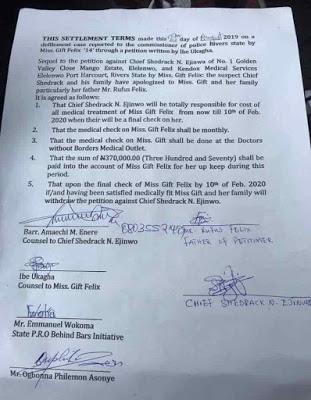
The
picture of a purported settlement agreement executed between an alleged
offender and the parents of a fourteen year old girl who was defiled has been
making the rounds on Social Media, with many lawyers and PUBLIC commentators condemning
the said settlement agreement which was presided over by Office of the
Commissioner of Police of Rivers State.

Many lawyers have opined that this
settlement agreement is alien to our criminal jurisprudence, as offences
dealing with rape, sexual harrasment and defilement of minors should be placed
outside the scope of operation of Alternate Dispute Resolution (ADR) mechanism
in order to emphasize the gravity of such offences. 
It
has become necessary to critically examine the position of the law on ADR in
criminal litigation in Nigeria. Does the law expressly prohibit “settlement” of
criminal cases? Before engaging in an exposition of the jurisprudential
principles of criminal litigation as it applies to this case, it is pertinent
to briefly state the facts of this notorious case for the ease of assimilation. 
The
father of a fourteen year old girl, upon the advice of his Counsel brought a
petition to the Office of the Commissioner of Police in Rivers State, alleging
that his daughter had been sexually defiled by a certain Chief in the
community. They sought the arrest and prosecution of the offending Chief.
Subsequently, the suspect who was accosted by the police confessed to his
complicity.  An agreement was then
reached between the accused person and the victim’s family that the accused
person and his family would apologise to the victim and her family, and also be
responsible for the medical bills of the victim. It was also agreed that the
victim would undergo monthly check up at a specified hospital for six months.
It was further agreed that upon the final check up on the sixth month, the
victim would withdraw the petition if she has been certified to be medically
fit and okay. The accused person also agreed to pay a specified sum of money as
immediate compensation to the victim’s family. The agreement was drawn up by
the legal Counsel of both parties, and executed by the parties and their
Counsel. The victim, being a minor did not sign this agreement, but it was
signed by her father. 

The
picture of this settlement agreement which was leaked on Twitter as soon as it
was executed has attracted serious opprobrium from different quarters.
Alternate Dispute Resolution (hereinafter “ADR”) is not alien to our criminal
jurisprudence. Before the introduction of colonial rule in Nigeria, disputes
were settled amicably amongst the interested parties. There was no distinct discrepancy
between civil and criminal cases in pre-colonial cases, as there was no
codified system of laws. The head of communities in most instances acted as an
umpire in settling disputes. Where offencs were committed against a member of
the community, the offender would be made to pay restitution to the victim, and
also be made to suffer moral reproach and disgrace. The principle of
restitution was however the most paramount principle behind punishment of civil
offenders in pre-colonial Nigeria. 

However,
with the advent of colonial rule, and subsequently independence, the legal
system became formalised with the introduction of the courts and prison system.
Offenders were prosecuted by the state on the behalf of the victim and the community,
and in most cases, sentenced to either jail term or compelled to pay fines to
the state. There are several principles behind the concept of punishment in
modern day criminal jurisprudence, including:

1.      Retribution: This is based on the
biblical theory of an eye for an eye, wherein offenders are made to suffer
punishment parallel to the wrong they have committed. Sentences of imprisonment,
death penalty, and corporal punishment are based on the retributive philosophy.

2.      Restitution: Here, the offender is
given the chance to make amends for his past misgivings. The offender is
punished in such a way that the society and/or the victim are compensated for
his crimes. Sentences such as community service, fines, and orders for
forfeiture of property are classic examples of the restitutive principle.

3.      Detterence: Often times, some offenders
are used as scape goats to teach a lesson to other members of the society to
desist from engaging in similar vices. This priniciple which is also known as
the utilitarian principle by Western Legal Scholars is more pronounced where
the victim has shown remorse or has already offered to make restitution for his
actions. Sentence of both imprisonment and fines on convicts is an example of
the detterence philosophy at work.

4.      Rehabilitation: This theory aims at
correcting and re-integrating offenders into the society. The offenders are
given the lessons which make them vilify their previous crimes, and are
re-integrated into the society to live crime-free lives. This principle is
mostly utilised for juvenile delinquents and first time offenders.  

The
Nigerian criminal justice system which attempts to combine all the above
principles can however be said to be largely retributive in nature. It is trite
that no person shall be punished for an offence except if such punishment is
defined and the punishment prescribed in a written law. A critical review of
the penal laws of Nigeria will reveal most criminal punishments are retributive
in nature. It places much premium on inflicting punishment and pain on the
offender than any real attempt to reform and reintegrate the offender back into
the society. From the time an offence is committed to the trial and judgment,
all our legal rules is concerned with is proving guilt according to the letters
of the law. Little or nothing is done about repairing the damage done by the
crime. Victims of crime and even the community who suffer the direct impact of
the offence are relegated to the background. 

The
resultant effect of this over-reliance on the retributive system is that the
court rooms are over-congested with too many cases and litigation is prolonged
before justice is achieved. It takes time for the guilt (or innocence) of an
accused person to be established, due to the traditional problems of shortage
of facilities associated with our juducial system. Trials at the high courts
take as long as three years before a verdict is reached. An appeal from the Court
of Appeal to the Supreme Court can span for as long as six years. Ordinarily,
an accused person remains incarcerated in custody as a guest of the state
during his trial, and may be discharged by the apex court on appeal. He would
then be made to have suffered unjustly for an offence which he is innocent. The
case of Shande v State (2005) 12 NWLR
(PT 939) 301
wherein the accused person was acquitted by the Supreme Court
after facing trial for eight years is a classic example of the tribulations
facing our retributive criminal justice system. 

The
proximate impulsion to this treatise being the recent settlement agreement to
oust the jurisdiction of the court in trying an alleged criminal offender is
the critical review of the application of ADR to criminal litigation in
Nigeria. Recently, the policy framers of the Nigerian Criminal Justice system
have begun to embrace and intigrate ADR into our criminal jurisprudence. The
Administration of Criminal Justice Act (ACJA) contains a legal framework for the
adoption of a mild form of ADR via plea bargaining in Nigeria. In the case of FRN v Igbinedion & Ors (2014)
LPELR-22760 (CA),
the Court of Appeal in defining plea bargaining adopted
the definition of the Black’s Law dictionary thus: 

“What
is a plea bargain arrangement? Bryan Garner’s Black’s Law Dictionary 8 the
Edition at pg. 1190 defines plea bargain as “A negotiated agreement between a
prosecutor and a criminal defendant whereby the defendant pleads guilty to a
lesser offence or to one of multiple charges in exchange of some concession by
the prosecutor usually a more lenient sentence or a dismissal of the other
charges.”

Plea
bargain also known as plea agreement or plea deal, although not expressly
stated to be an ADR mechanism, can be regarded as such because its form and
effects conforms to the principles and aims of ADR. It has been submitted that
plea bargaining is a case management strategy like other ADR mechanism which
brings about effective case management.[1]
In a plea bargain arrangement, the accused person agrees to plead guilty to the
some or all of the offences he is charged with, in return for a lesser
punishment. Plea bargains are mostly activated in corruption trials involving
the EFCC. It was used in the trial of ex-IGP of Police Tarfa Balogun, and the
trials of ex-Governors Lucky Igbinedion, and Diepreye Alamieyeseigha of Edo and
Bayelsa States, amongst others. The advantages of plea bargain which have been
given judicial notice by the Court of Appeal in FRN v Igbinedion (Supra) include: 

“(1) Accused can avoid the time and
cost of defending himself at trial, the risk of harsher punishment, and the
publicity the trial will involve.

(2) The prosecution saves time and
expense of a lengthy trial.

(3) Both sides are spared the
uncertainty of going to trial.

(4) The court system is saved the
burden of conducting a trial on every crime charged.”

It
must however be stated that plea bargaining can only be activated where there
is a pending charge before a competent court. In the Rivers State purported
settlement agreement under consideration, the matter was still being
investigated by the Police, who were yet to prefer a formal charge against the
accused person. Therefore, it can be submitted that this does not amount to a
plea bargain arrangement. The best legal terminology to describe this
settlement is mediation. It is clear from the facts that the agreement was
signed ssubject to the supervision of the Nigerian Police Force who were
investigating the matter. It is pertinent to note that the Police Force is
given wide powers under Section 4 of the
Police Act
which provides that: 

“The police shall be employed for the
prevention and detection of crime, the apprehension of offenders, the
preservation of law and order, the protection of life and property and the due
enforcement of all laws and regulations with which they are directly charged,
and shall perform such military duties within or outside Nigeria as may be
required of them by, or under the authority of this or any other Act.”

The
Police therefore have the primary responsibility of apprehending offenders. But
they are not saddled with the task of punishing offenders. However, they have a
general duty to maintain the peace, law and order in the society. It is the
duty of the state to prosecute and punish offenders, and not the police. Before
the state can prosecute, the police must first file a first information report
which informs the relevant state department (Ministry of Justice or Department
of Public Prosecution) of the purported commission of the offence. It is
important to note that the entire criminal system in Nigeria is based on the
exercise of discretionary powers by the parties involved. The Police Force in
submitting an information report to the Department of Public Prosecution
exercises discretionary powers. They are not bound to charge every percieved
offender to court. The Ministry of Justice or Department of Public Prosecution
(as the case may be) is also not under any obligation to prosecute all persons
who have been referred to them. The Supreme Court in the locus classicus case
of Akpa v. State (2008) 14 NWLR
(Pt.1106) 72
explained this hallowed position of the law when the Noble
Lord Nikki Tobi JSc opined thus:

The
prosecution has an unfettered discretion to prosecute person in court and
because the discretion is unfettered, court of law do not have the power to
question it
…The only jurisdiction of the court is to try accused person
presented before it for prosecution. The
prosecution is not under any regimental duty or any duty at all, to charge all
possible accused persons
“. (@ pg 18 paras A- D). 

Therefore,
it is submitted that the Police Force and the Ministry of Justice should be
exonerated from whatever legal and moral vilification that the purported
settlement agreement attracts.  

As
stated earlier, the purported settlement can be best described as the proceeds
of a mediation agreement. The Victim-Offender Mediation program is not unknown
to international jurisprudence. The Victim-Offender Mediation program is aimed
at promoting direct communication between the victim and the offender. The
victim has the opportunity to ask questions, address the mental, psychological
and emotional trauma caused by the crime and its aftermath and seek reparation.[2]
It lays more emphasis on restitution and reconciliation of crime related
offenders through one on one meeting between victims and offenders subject to
the oversight of trained mediators, rather than focusing on the retributive
system which characterises our outdated criminal litigation system. This method
is the oldest and most widely used form of ADR in criminal cases in other
jurisdiction especially when juveniles are involved.

A
proper analysis of the terms of settlement of the Rivers State Agreement
reveals that each of the clauses is geared towards the restorative or
restitutive principles of punishment. The accused person and his family were
made to undergo moral reproach by publicly apologising to the victim and her
family. The case has aleady gained sufficient notoriety, and his identity as a
potential sex offender is not in question. Furthermore, and in addition to the
moral punishment of apology, financial sanctions has also been imposed on him.
The fine which he would pay goes directly to the victim. This is unlike the
traditional penal system where fines imposed by the court are payable to the
state and becomes the property of the state. The offender has thus been
compelled to make amends to the victim by paying for her medical treatment and
also by the payment of damages. 

A
critical evaluation of the entire agreement will reveal that the mere execution
of the agreement does not immediately oust the jurisdiction of the court to
prosecute the accused offender.  In fact,
the petition submitted to the police was not withdrawn at the time of executing
the agreement. The most important clause in the agreement is term No. 5 which
provides that the victim and her family will withdraw the petition if she is
certified to be medically fit after the final medical check to be carried out
on a pre-determined date. Thus, the victim is given the freedom to pursue the
petition in the event that she has not benefitted from the proposed
restitution. The entire agreement is one which exemplifies the restorative
approach to criminal jurisprudence which places the victim at the centre of
proceedings, as opposed to the traditional retributive approach wherein the
offender is the centre of proceedings. It is only in extremely rare cases
involving theft of property that the accused person in criminal proceedings is
compelled by the courts to make restitution to the victim.[3]

It
is however understandable that the gravamen of public opprobrium against this purported
settlement agreement (and Victim-Offender Mediation) is the percieved
trivialisation of the grave offence of rape and sexual molestation. It has been
argued that such agreement operates to make the offence of rape very lucrative
and appealing to potential offenders who now know they can avoid jail term by
the simple payment of compensation to the victim. In blancing this conflict
between the need to impose retributive/detterent punishment on offenders and
the need to engage in restitutive practices, the dictum of the Court of Appeal
in the case of Okomu Oil Palm Ltd v
Okpame (2007) 3 NWLR (Pt. 1020) p.71
is most instructive thus:

After
all, it must be remembered that justice is not a one-way traffic. It is not
justice for the plaintiff alone. It is not even only a two-way traffic in the
sense that it is justice for the plaintiff and the defendant alone. I think
really justice is a three-way traffic in justice for the plaintiff who is
crying for a redress of the wrong done to him; justice for the defendant who is
crying that he should be heard and his defence considered before being ordered
to pay any sum claimed against him and also before being mulcted in cost; and
finally but very important, justice for the society at large whose social norms
and psyche are certainly going to be adversely affected if it cannot be seen by
the common but reasonable man that upon the facts as laid down, justice in the
real and true sense of that word, has been seen to have been done by the
arbiter.”
(Per Aderemi JCA). 

Hence,
has justice been done to all aggrieved parties in this case? Has justice been
done to the accused ofender who has been made to make financial restitution for
the consequences of his act? Will this deter him from committing similar act in
the future? Has justice been done to the victim who has received compensation
for the injury she suffered? Has justice been done to the victim’s family who
have received an apology and monetary compensation from the offender and his
family? Does this apology and monetary compensation diminish and overshadow the
shame of having a defiled daughter? Has justice been done to the state by this
agreement? The agreement has saved the state the resources it would otherwise
have expended in prosecuting and punishing the offender. However, will this
prevent future occurences of similar crimes in Rivers State? Will the society
learn from this event and come to the conclusion that defilement of underage
girls is unacceptable, or will they be willing to risk the venture of public apology
and payment of monetary compensation just to have a bite at the forbidden
apple? 

This
writer invites his readers to draw their own conclusions.

Nonso Anyasi is a Lagos-based Lawyer.
He tweets @Oluwanonso_Esq


[1]
Alternative
Dispute Resolution and Its Relevancy in Criminal Matters, Aduaka & Onnome,
International Journal of Business & Law Research 6(1):75-84, Jan.-Mar.,
2018

[2]
J.R. Gehm “Victim-Offender Mediation
Programs: An Exploration of Practice and Theoretical Frameworks
Western Criminology Review, Vol. 1 No http://wer.sonoma.edu/v1n1/gehm.html 

[3]
See the case of Ikpe v FRN & Anor (2018) LPELR-45567 (CA)
Written By:

Nonso
Nonso Anyasi

(@Oluwanonso_esq)