
LAWYER ASKS COURT TO SET ASIDE 2019/2020 NDDC BUDGET SUBMITTED BY BUHARI TO NATIONAL ASSEMBLY OVER NON-INAUGURATION OF GOVERNING BOARD

LAWYER ASKS COURT TO SET ASIDE 2019/2020 NDDC BUDGET SUBMITTED BY BUHARI TO NATIONAL ASSEMBLY OVER NON-INAUGURATION OF GOVERNING BOARD

Says only the Governing Board has the power to submit budget, award contracts, etc.

Challenges Inauguration of NDDC Advisory Committee without Board.

Lagos-based lawyer and human rights activist, Mr. Inibehe Effiong, has dragged President Buhari, the Attorney General of the Federation, Abubakar Malami SAN and the National Assembly before the Federal High Court in Abuja over the President’s ‘illegal’ submission of the 2019 and 2020 budget estimates of the Niger Delta Development Commission (NNDC) to the National Assembly without and in the absence of the Governing Board of the NDDC.

The case which was filed on Wednesday, 11th March, 2020 with Suit No: FHC/ABJ/CS/349/2020 also has the Minister of Niger Delta Affairs, Godswill Akpabio, the NDDC and the Ag. Managing Director and head of the Interim Management Committee of the NDDC, Prof. Kemebradikumo Daniel Pondei, as 4th, 5th and 6th Defendants, respectively.

Effiong in his Originating Summons asked the court to determine the following four questions:

“Whether by the provisions of Section 18 (1) of the Niger Delta Development Commission (Establishment etc.) Act, 2000, the President of the Federal Republic of Nigeria can validly submit estimates of expenditure and income (budget estimates) of the Niger Delta Development Commission to the National Assembly without and/or in the absence of the governing Board of the Commission.”

“Whether the 2019 and 2020 estimates of expenditure (budget estimates) of the Niger Delta Development Commission is not ultra vires, illegal, invalid, null and void having been submitted to the National Assembly by the President without and/or in the absence of the governing Board of the Niger Delta Development Commission in view of the express provisions of Section 18 (1) of the Niger Delta Development Commission (Establishment etc.), 2000.”

“Whether the Interim Management Committee appointed by the President of the Federal Republic of Nigeria to manage and supervise the affairs of the Nigeria Delta Development Commission, can legally exercise the power exclusively vested in the governing Board of the Commission, including entering into contracts and expenditure of the funds of the Commission, in view of the express provisions of Sections 8 and 14 (3) of the Niger Delta Development Commission (Establishment etc.), 2000.”

“Whether the existence and inauguration of the governing Board of the Niger Delta Development Commission is a condition precedent to the inauguration of the Niger Delta Development Advisory Committee; a body statutorily charged with the responsibility of advising the governing Board and monitoring the activities of the Commission in view of the provisions of Section 11 (2) of the Niger Delta Development Commission (Establishment, etc.) Act 2000.”

In his 40 paragraphs affidavit with 8 exhibits attached, Effiong stated that he is from the Niger Delta Region. He sated that President Buhari dissolved the extant Board of the NDDC headed by Senator Victor Ndoma-Egba in January 2019 and appointed an Interim Management Body to manage the affairs of the NDDC. He stated that Buhari in October 2019 wrote to the Senate seeking the confirmation of a new 16 member governing Board which has Dr. Pius Odubu from Edo State as chairman which was approved by the Senate.

Effiong deposed that despite the approval of the governing Board by the Senate, Buhari unilaterally suspended the inauguration of the Board and continued to retain the Interim Management Committee now head by Professor Pondei.

According to the activist, Buhari on the 26th November, 2019 submitted the 2019 and 2020 budget estimates of the NDDC to both Houses of the National Assembly without and/or in the absence of the Governing Board of the NDDC which attracted condemnation from the National Assembly, and that the Senate during its Plenary on Tuesday, 26th November, 2019 passed a resolution directing its Committee on Niger Delta Affairs not to recognize the Interim Management Committee but to relate only with the approved governing Board of the Commission when considering the budgets.

“Following the condemnation of the President’s submission of the said budget estimates without and/or in the absence of the governing Board of the NDDC by the National Assembly and the resolution of the Senate, the President by a letter dated 23rd December, 2019 formally notified the Senate of his decision to “put on hold” the governing Board appointment confirmed by the Senate “to allow the Interim Management Committee to manage the Commission pending the outcome of the Forensic Audit.” Effiong said.

According to the lawyer, in contravention of the earlier Senate resolution, the Senate Committee on Niger Delta Affairs recognized the Interim Management Committee while considering the 2019 budget of the NDDC on the 12th February, 2020 and allowed the said Interim Management Committee to defend the 2019 budget and that on Wednesday, 4th March, 2020 and Thursday, 5th March, 2020 the House of Representatives and the Senate respectively considered and passed the 2019 budget estimates of the NDDC without and/or in the absence of the governing Board of the Commission.

He also deposed that the National Assembly is currently considering the 2020 budget estimates of the NDDC without and/or in the absence of the governing Board.

Effiong also complained that on 10th March, 2020, President Buhari constituted and inaugurated the Niger Delta Development Advisory Committee at the Council Chamber, State House, Abuja, consisting of the nine Governors of the Niger Delta States and other persons appointed by the President without and/or in the absent of a governing Board for the Niger Delta Development Commission.

In his written address, the Lagos lawyer argued that the power to submit estimates of the expenditure and income of the Commission is statutorily vested in the Governing Board of the NDDC and not the president. He contended that the role of the President is that of agency; in the sense that the President merely acts as the courier of the Governing Board. The President, he argued, cannot perform his role under Section 18 (1) of the Act without and in the absence of the Governing Board. He said that a contrary interpretation will do direct violence to the spirit and letters of the NDDC Act.

Effiong further argued that “only the Governing Board of the Commission can exercise the power exclusively vested in it by the NDDC Act. There is no part of the said Act that empowers the President to put the existence of the Governing Board “on hold” and arrogate the statutory power of the Governing Board to an Interim Management Committee. The Interim Management Committee led by the 6th Defendant is an aberration and has no statutory backing”

On the inauguration of the Niger Delta Development Advisory Committee, Effiong submitted that “the existence of the Governing Board of the Commission is a condition precedent to the constitution of the Niger-Delta Development Advisory Committee. This is only logical since the advisory committee is required to advise the Governing Board. It is therefore my respectful contention that the inauguration of the Advisory Committee by the President is premature and against the due process of law and the intendment of the NDDC Act without and/or in the absence of the governing Board.” He argued.

Effiong prayed the court to declare that the President cannot validly submit the budget estimates of the NDDC to the National Assembly without and/or in the absence of the governing Board of the Commission. He therefore asked the court to set aside the 2019 and 2020 budget estimates of the NDDC submitted to the National Assembly by Buhari.

He also prayed for an order of injunction restraining the Interim Management Committee from exercising the power of the Board. Finally, he asked that the court should declare that the inauguration of the NDDC Advisory Committee was premature and against the due process of law.

Effiong told the court that “the Defendants should not be given a free hand to run the country amok without recourse to the dictates of the law. That will only lead to one result – anarchy. This Court has a sacred duty to halt descent into anarchy and uphold the rule of law. It is only by so doing that the future of Nigeria as a democratic country can be guaranteed.”

No date has been assigned for the hearing of the case.

Lawyer Profile: MFON EKONG USORO

Lawyer Profile: MFON EKONG USORO


Mfon Ekong Usoro holds an LL.M in Maritime Laws from University College London, an LLB (Hons) from the University of Buckingham, B.L (Hons) from the Nigerian Law School and a BSc (Hons) Sociology from the University of Calabar. 
She is on leave of absence as the Managing Partner of Paul Usoro & Co., a leading law firm in Nigeria. Usoro has extensive and current experience in trade in services, participation in negotiations at diplomatic meetings and achieving consensus for adoption of negotiated instruments amongst member States at the regional and continental levels.

Relevant Regional, Continental and International Experience

Usoro is the Secretary General of the Memorandum of Understanding on Port State Control for West and Central African Region (Abuja MoU) – an Inter-Governmental Organization operating under a Cooperative Agreement with the International Maritime Organization with full diplomatic status. 
The Abuja MoU comprises of 22 member States abutting the Atlantic from Mauritania to South Africa. As the Secretary General, Usoro established teams of experts from member States for the development of constitutive documents, port State Control procedures, takes the lead in negotiation and secures adoption of those documents by the member States and has successfully attained a high level of harmonization of procedures, implementation and coordination among the member States. She has held the position for over 8years.

Mfon Usoro has at various times consulted for the African Union Commission. Working with a group of experts, she was pivotal to the drafting and negotiation of the African Union Maritime Transport Charter 2009. She is periodically invited by the African Union Commission Department of Infrastructure to participate in workshops/chair meetings held in Addis Ababa, Cairo etc. 
Usoro is a member of the African Network for Women in Infrastructure (ANWIn), an African Union Commission initiative.

Mrs Usoro also consulted for UNEP [Nairobi] and UICN [Senegal] to work with two other consultants from South Africa and Togo for the revitalization of the Convention for Co-operation in the Protection and Development of the Marine and Coastal Environment of the West and Central Africa Region [Abidjan Convention].

Usoro was for several years, the sole Maritime legal consultant to the Maritime Organization for West and Central Africa (MOWCA), an inter-governmental body of countries in West and Central Africa headquartered in Cote d’ Ivoire. In that capacity produced the:

– Memorandum of Understanding on the Establishment of a Regional Integrated Coastguard Network in the West and Central Africa Region 2008. As the Chairperson of the Ad-Hoc Committee on the Establishment of the Sub-Regional Integrated Coastguard Network negotiated and developed a consensus MOU among member States for presentation to and adoption by the Ministers of Transport of the sub-regional organization.
– Draft Framework for Sub-regional Cabotage and the Memorandum of Understanding on Sub-regional Cabotage in October 2001.
Usoro was appointed in 2009 to chair the ministerial committee of the Maritime Organisation of West and Central Africa (MOWCA) regional Maritime Development Bank in 2009.

For a period spanning over a decade, Usoro regularly attends meetings of the Implementation of IMO Instrument Sub-committee of the MSC Committee of the International Maritime Organization in London and has been privileged to chair twice the IMO Workshop for Secretary General and Database Managers of Regional Port State Control regimes.

She for more than a decade has been actively involved in discussions on liberalization of legal services including attending meetings at the WTO as a member of the International Bar Association Bar Issues Commission, International Trade in Legal Services.
Relevant National Experience
Mfon Usoro is a trade law expert and represents the Nigerian Bar Association at the Nigerian Coalition of Services Industry (NCSI). Mfon was recently appointed the Chairperson of the National Consultative Forum on Trade and Trade Related Negotiations, NOTN.
She was privileged to lead the brainstorming sessions at the services industry consultation on the Nigerian Draft Schedule of Specific Commitments organized by the Nigerian Office for Trade Negotiations in February 2020. She participated as a panelist in 2 panels at the recent National AfCFTA Forum on “Effective Implementation for Industrialization and Inclusive Economic Development in Nigeria” on 5-6 December 2019 co-organized by the United Nations Economic Commission for Africa (UNECA).

At the level of the NBA and apart from representing the NBA at NCSI, Usoro was the Alternate Chairperson, NBA Liberalization of Legal Services Working Group (2012-2014) and past Chairperson, NBA Section on Business Law.

Mfon Usoro is the pioneer Director-General and Chief Executive Officer of Nigerian Maritime Administration and Safety Agency, (NIMASA) and she left the Agency in 2007. She is the chairperson of the Inter-Ministerial Committee for the Finalization of the National Transport Policy for Nigeria.


Corporate Boards
Usoro currently serves as Chairperson, Board of Directors of TIB Asset Management Limited; a Non-Executive Director (Independent), on the board of The Infrastructure Bank Plc; a Non-Executive Director (Independent), on the board of First City Monument Bank Ltd; a Non-Executive Director, on the board of Board of Geometric Power Limited.
National Honours.

Mfon Usoro was conferred with the Officier de L’Ord de Mono, a national honour of the Republic of Togo in 2002; and Chevalier de l’Ordre du Merite Maritime, a National honour of the Republic of Cote D’ Ivoire in 2015.

EMPLOYERS’ OBLIGATION TO GIVE WORK/EMPLOYMENT REFERENCES UNDER THE NIGERIA DATA PROTECTION REGULATION (NDPR) 2019 / Olumide Babalola

EMPLOYERS’ OBLIGATION TO GIVE WORK/EMPLOYMENT REFERENCES UNDER THE NIGERIA DATA PROTECTION REGULATION (NDPR) 2019 / Olumide Babalola

From time immemorial, whenever an employee moves to a new employment, it had been a standard practice for employers of labour to give employment/work reference to the prospective employers of such former employees. 

The contents of such references varied on case-by-case basis and in most cases, the employees subject matter of the references had little or no knowledge of same and consequently had no control over the transferor or the recipient of such information which may make or mar them in their career pursuit. 


With the global prominence of data protection laws and regulations came the need to now interrogate what used to be the routine practice of further processing employees’ personal data without their informed and express consent and thereby violating their rights to privacy in the process except certain other validating factors exist.


A lot has been said and written about employers’ (as data controllers and/or administrators) obligations to their staff under the Nigeria Data Protection Regulation but it must be emphasized that such duties do not end upon cessation of master/servant relationship but endures for as long as the servant’s record are retained by the master, hence accentuating the importance of making and updating employees’ data-retention policies by employers of labour. That is not however the focus of this intervention. 


Can employers lawfully send their ex-employee’s references without their informed consent?


By virtue of Article 2.2 of the NDPR, personal data can only be lawfully processed where:


a)        Data subject has given consent for specific purposes;

b)       Necessary for performance of contract;

c)        Necessary for compliance with legal obligation;

d)       Necessary to protect vital interest of data subject;

e)        Necessary to perform task in public interest


Now, we will consider all the indices of lawful processing of data to ascertain whether or not sending of references falls under any of them while bearing in mind the meaning of employee references (according to https://www.inc.com/encyclopedia/employee-references.html) thus:


“Employee references are the positive or negative comments about an employee’s job performance provided to a prospective employer. In most cases, a prospective employer will contact a person’s current or former employer to seek references as part of the process of considering that person for a new position. Prospective employers check references during the interview process in order to ensure that a candidate’s assertions about his or her job skills and work experience are accurate. In fact, obtaining references is one of the most important parts of the hiring process because it can provide valuable information that sets one candidate apart from others and facilitates a sound hiring decision.”


On Employee’s consent and necessity of processing for performance of contract


Experience has shown that the data subject is seldom or never aware of the request for his employment reference proceeding from his current employer to the former employer, hence an employee’s consent is hardly sought and/or obtained before the exchange of such pleasantries between his past and prospective employers. 


Assuming the employee’s consent is even sought and obtained, it is our modest opinion that such cannot constitute valid consent since it couldn’t have been freely given, knowing fully well that his chances of securing the new job may be dependent on favourable reference from his ex-employer, hence such consent is induced especially since the employee may not know the contents.


 The provision of article 2.3(ii)(d) of the NDPR is instructive in this respect thus:


 “Data Controller is under obligation to ensure that consent of a Data Subject has been obtained without fraud, coercion or undue influence; accordingly:

……

d) when assessing whether consent is freely given, utmost account shall be taken of whether, the performance of a contract, including the provision of a service, is conditional on consent to the processing of personal data that is not necessary (or excessive) for the performance of that contract.” (Emphasis mine)


From the foregoing provision, it is our considered opinion that: (a.) The status and bargaining power of an employer (past or present) constitutes undue influence on an employee to give consent for the processing of his personal data in order to secure another employment and (b.) Most employment offers/contracts are made subject to references from past employers which, in our humble opinion, is not necessary for the performance of the subsequent contract except in cases of crime or other vices. 


Necessary for legal obligation


A legal obligation has been defined as any obligation from time to time created by any enactment or authority. The Labour Act, Cap 198, Laws of the Federation 1990 (LA) is the principal law regulating labour relations in Nigeria but out of its 92 sections none is expressly dedicated to employer’s obligation to provide work reference or work certificate.


Sections 7, 8 and 9 of the LA expressly list matters that must be contained in an employment contract but the obligation to provide employment/work reference is conspicuously absent and thereby activating the canon of interpretation of ejusdem generis rule to dislodge any suggestion that employment reference is contemplated by the relevant sections. See Federal Republic of Nigeria v Ibori (2014) LPELR- 23214 (CA).


From the foregoing, we again, modestly conclude that, under the extant LA, an employer does not have any legal obligation to give employees reference/work certificate with or without request.


Public Interest


Employment contracts are, by their nature, private agreements with the exception of employments with statutory flavour, which are arguably public matters, since the government is the employer and wages are paid from public funds.


The Nigerian Supreme Court in Centre for Pollution Watch v. NNPC (2019) 5 NWLR (Pt. 1666) 518 @ 583, defined the term “public interest” as:


“…the general welfare of the public that warrants recognition and protection of something in which the public as a whole has a stake especially, an interest that justifies government regulation.”


Admittedly, although the public is interested in how public funds are spent, this writer modestly thinks, positing that employment reference is a matter of public interest is, drawing the principle too far, except always, such employee’s subsequent employment constitutes grave danger to the state as a whole.


From the apex court’s definition above, can one now say that a civil servant’s employment reference concerns the general welfare of the public that warrants recognition and protection simplicita? I humbly, think not!


Vital interest of the employee


Although vital interest is not specifically defined under the definition article of the NDPR, an inference can be drawn as to its meaning from article 2.12(f) thus:


“The transfer is necessary in order to protect the vital interests of the data subject or of other persons, where the data subject is physically or legally incapable of giving consent; provided, in all circumstances, that the data subject has been manifestly made to understand through clear warnings of the specific principle(s) of data protection that are likely to be violated in the event of transfer to a third country…”(Emphasis mine)


Indubitably, good references are in the interest of an employee, but the NDPR is clear that, processing such without consent can only be lawful where done in the data subject’s vital interest and it is our belief, that except of course, where the employee is bedridden and is unable to give consent but that is rarely the case where employers give references without recourse to the employees.


Flowing from the above, this writer opines that, an employer’s provision of employee’s reference to a third party without the employee’s express consent does not fall under processing in the latter’s vital interests contemplated under paragraph d of article 2.2(ii) of NDPR.


Performance of contract


Article 2.2(ii) provides that:


“Without prejudice to the principles set out in this regulation, processing shall be lawful if at least one of the following applies:

……

Processing is necessary for the performance of a contract to which the Data Subject is party or in order to take steps at the request of the Data Subject prior to entering into a contract.” (Emphasis mine)


From the clear provision above, it appears settled that, an employer is at liberty to provide employee’s work reference without the requirement of seeking further consent once such a clause is embodied in their employment contract or any other written agreement between the parties.


The problem that arises here is, where there is no such clause in the employment contract, would such processing still be lawful? This poser seems to have been answered by the National Industrial Court of Nigeria (NICN) in the case of Kelvin Nwaigwe v. Fidelity Bank Plc (unreported Suit No. NICN/LA/85/2014) where Kanyip, J. (as he then was) held that:


“I am persuaded by the force of these UK case law authorities that in appropriate cases there is an implied term in contracts of employment imposing duty on the employer to provide work reference in respect of its employee, whether former or existing. The defendant in the instant case is a Bank and hence a financial institution. This means that the defendant has an obligation to give a work reference to, or in respect of, the claimant, which work reference must be true, accurate, fair and not misleading to a future employer; and I so find and hold. In this respect, relief (c) claimed by the claimant succeeds in terms of the defendant giving a true, accurate, fair and not misleading reference of career record on demand to the claimant.” (Emphasis mine)


Although the decision above was handed down pre-NDPR days, this writer is of the considered view that, the reasoning of the court importing the implied obligation to provide work reference, remains the law in Nigeria until set aside by the appellate court.


Conclusively, as held by the NICN above, in appropriate cases, employers are at liberty to give work reference to their employees’ (past or present) prospective employers without seeking further consent on the strength of the contract of employment pursuant to article 2.2(ii)(b) of the NDPR provided always that the reference must true, accurate, fair data of the employee.

Olumide writes from Lagos, Nigeria and can be reached via olumide@olumidebabalolalp.com

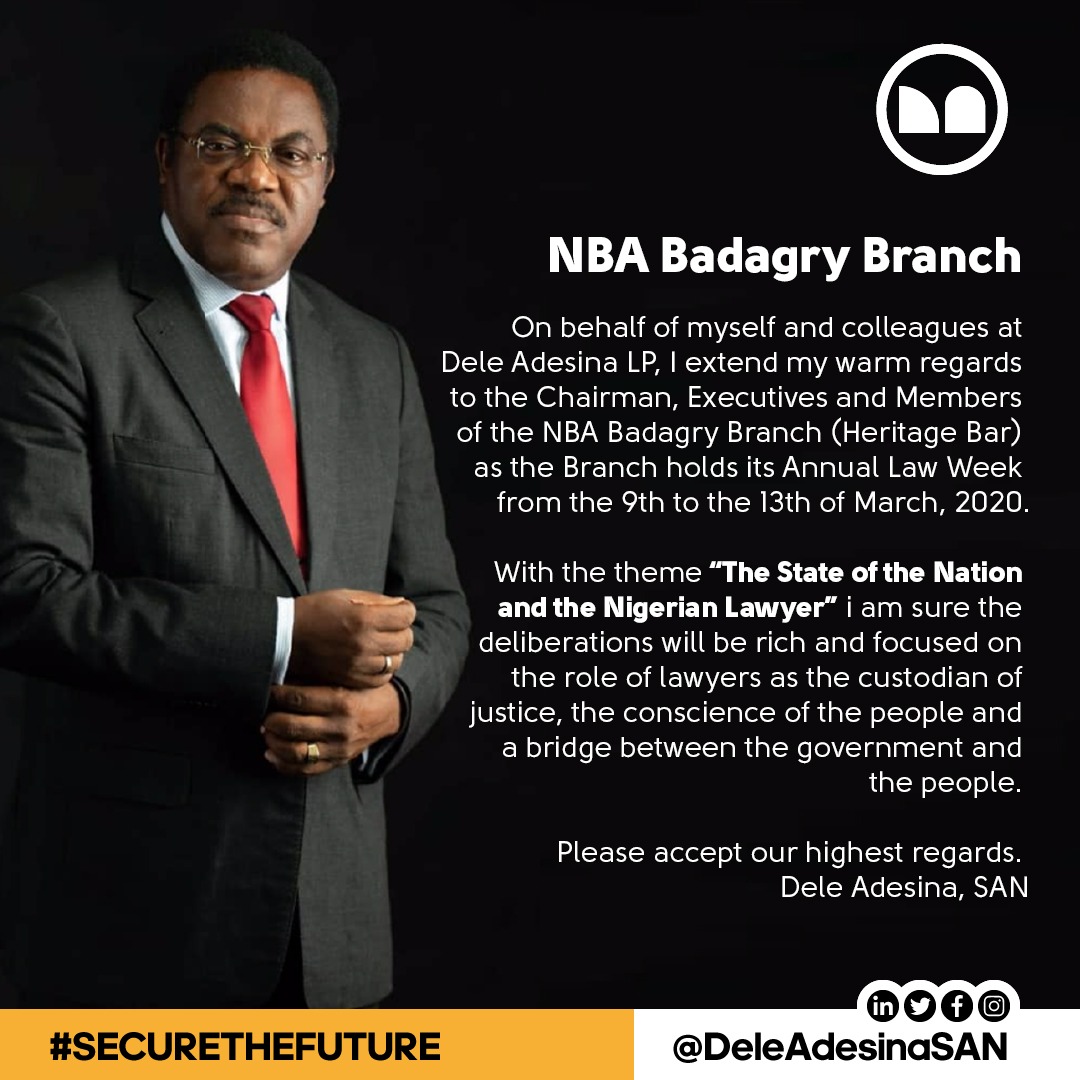
Dele Adesina SAN felicitates with NBA Badagry Branch on the occasion of its Annual Law Week

Dele Adesina SAN felicitates with NBA Badagry Branch on the occasion of its Annual Law Week

On behalf of myself and colleagues at Dele Adesina LP, I extend my warm regards to the Chairman, Executives and Members of the NBA Badagry Branch (Heritage Bar) as the Branch holds its Annual Law Week from the 9th to the 13th of March, 2020.

With the theme “The State of the Nation and the Nigerian Lawyer” i am sure the deliberations will be rich and focused on the role of lawyers as the custodian of justice, the conscience of the Nation and a bridge between the government and the people.

Please accept our highest regards.
Dele Adesina, SAN

PUSAN MILESTONES: Promoting Gender Balance in the Legal Profession

PUSAN MILESTONES: Promoting Gender Balance in the Legal Profession

The
Paul Usoro SAN led administration has recorded many wins and achievements so
far, one that stands out is the inauguration of a new leadership for the NBA
Women’s Forum and in the spirit of the International Women’s Day 2020, this
initiative leads the way in ensuring gender equality in the legal profession. 


It will be recalled that the Executive Council of the
Women Forum was recently inaugurated by the President of the Nigerian Bar
Association, Paul Usoro SAN on the 17th day of September 2019.


The purpose of the NBA Women
Forum is to give prominence to the promotion of women-Lawyers’ rights and
privileges while also bringing to the front burner gender-related issues and
ensuring that all prejudices and over-shadowy discriminatory practices against
women lawyers become a thing of the past. 

Paul
Usoro SAN in his speech during the inauguration noted that
the constitution of the Nigerian Bar Association (NBA) mandates that there
should be a women’s forum to address issues that affect women. On the issue of
sexual harassment, he had this to say, “We have just finished our Annual
General Conference (AGC) and one of the very hot sessions was the session on
bullying and sexual harassment. A lot of female lawyers spoke passionately
about their experiences and the general consensus was that the NBA must do
something about it.”


The executives of the NBA Women’s Forum have also hit the ground
running and they exhibit a line-up of successful female lawyers who have always
shown a passion for excellence and the promotion of the welfare of female lawyers.
The NBAWF held its inaugural General Council meeting on Wednesday the 30th
October 2019, at the NBA National Secretariat Abuja. It immediately set up a
Mentorship Committee which developed a mentorship programme for members. 


The programme offers free mentoring for young female lawyers
from 0-5 years at the bar. NBAWF mentoring is intended to encourage and assist
members to develop to their full potentials in all areas of career and life and
will be held at different locations in the country. For instance, it’s take off
session will be held on Tuesday, 17th March, 2020 at the NBA Port Harcourt Bar
Center, Bank road, Port Harcourt,  Rivers State.

The executive is made up of Professor Oluyemisi Bamgbose, SAN –
Chairperson, Chinyere Okorocha, Vice Chairperson, Nsidibe Aideyan, Secretary
and Hajia Safiya Balarabe as Treasurer.

To assist the Forum’s executive in an advisory capacity, a
blue-ribbon Council was also constituted by the NBA President comprising very
eminent legal practitioners. These include, Her Excellency, Anna Isiyaku, First
Lady of Taraba State, Maryam Uwais, MFR, Special Adviser to the President,
Professor Joy Ngozi Ezeilo, OON, Dean, Faculty of Law, University of Nigeria,
Nsukka, frontline arbitrator, Dorothy Ufot, SAN, frontline arbitrator, Hajia
Hadiza Magaji, Chief Registrar, Borno State Judiciary. 

Others are, Florence Fiberesima, Solicitor-General and Permanent
Secretary, Rivers, State Ministry of Justice, Dr. Foluke Dada, academician,
gender activist and NBA 2nd Vice President; and Ayotola Jagun, Chief Compliance
Officer at Oando Plc.


Dele Adesina SAN’s celebratory message on International Women’s Day

Dele Adesina SAN’s celebratory message on International Women’s Day

All members of Dele Adesina LP and I join the world in celebrating the achievements and successes of women globally. Particular in our profession, I cannot help but mention the successes of the likes of Chief Mrs. Folanke Solanke SAN, CON, Hon. Justice Aloma Mariam Mukhtar CJN Rtd, the first female Senior Advocate of Nigeria and first female Chief Justice of Nigeria respectfully.
 
After these leading women, many other female lawyers have led the way with numerous ground breaking achievements and this brief message cannot be enough to outline all. I also note the record achievements of groups such as the Federation of International Women Lawyers (FIDA), African Women Lawyers Association (AWLA) and members of the Nigerian Bar Association Women’s Forum.
 
As we all continue to raise our voices against inequality, gender stereotypes and gender oppression in every facet, I call for gender inclusion and equality at all instances. I specially commend the female members of the Nigerian Bar Association for their dynamism and their giant strides in the profession.
 
Happy International Women’s Day 2020.

Dele Adesina SAN

Dele Adesina, SAN Quotes on the Legal Profession 

Dele Adesina, SAN Quotes on the Legal Profession 

Our Profession is at a cross-road. Some others have argued that the Profession is under siege. Today, we increasingly have to contend with disobedience of Court Orders and Judgments. There is the challenge to independence of the Judiciary as an institution as well as the independence of Lawyers and Judges as professionals. The worship of money and men rather than the worship of God have also become part of the problems of the Profession. 

The general perception today is that our Judiciary is corrupt and that Lawyers and Judges are part of the Nation’s problems. Even though the conduct of some of our Members tend to justify this perception, but permit me to say that the conduct of a few Members does not and cannot justify the general condemnation of our Judicial institution and our beloved Profession.

Culled from Dele Adesina SAN’s Goodwill Message To The Young Lawyers Forum (Y.L.F) Ilorin Branch, on the occasion of their Annual Bar Dinner which held on 7th December, 2019

Assault and Detention of Mr. Temitayo Igunnu by Men of the Nigerian Army & Police – This Barbarism Must Stop

Assault and Detention of Mr. Temitayo Igunnu by Men of the Nigerian Army & Police – This Barbarism Must Stop

Just a few weeks after condemning the unlawful assault of a legal practitioner, Ibangah Goodness Esq, it is sad that we have to once again contend with yet a  case of another assault on another lawyer by officers of the very agencies mandated to protect Nigerian citizens. 
 
Information reaching me is that, in the early hours of Friday, 6th March, 2020, the side mirror of Mr. Igunnu’s car was broken by a Naval officer who was driving a commercial bus around Bonny Camp. However, rather than address the situation peacefully, the said Naval officer resorted to threats of force. During the course of the altercation, some soldiers attached to the Bonny Camp Cantonment were alleged to have intervened, but rather than ensure a peaceful resolution of the matter, they chose to constitute themselves into a mob squad and proceeded to assault Mr. Igunnu while inflicting grievous bodily injuries on him. In addition to the public brutalisation and dehumanisation of Mr. Igunnu, he was reported to have been unlawfully detained by the soldiers at the Bonny Camp Cantonment and later moved to the Bar Beach Police Station where he was detained until the intervention of the leadership of NBA Lagos Branch and other colleagues who secured his release.
 
I commend the Chairman, Executives and Members of the NBA Lagos Branch for the swift intervention and facilitation of our colleague’s release as well as the commitment of the Branch to see that justice is done. The Nigerian Bar Association must send a clear message to members of the Police and Armed Forces that the unlawful assault and oppression of Nigerian Citizens will not be condoled and most especially that an assault on a legal practitioner will cause a swift and decisive response from the Nigerian Bar Association.
 
Lastly, I call for the National Human Rights Commission to collaborate with the Nigerian Bar Association to ensure that incidents of brutality of Nigerians by members of the Armed Forces, the Nigerian Police and other security agencies are brought to an end.  However, we must ensure that the present case of brutality against Mr. Igunnu is not only investigated, but the officers involved in the dastardly act must be brought to justice. Acts of impunity and unprofessional conduct by members of the Armed Forces against lawyers must become a thing of the past. 
Dele Adesina SAN 


Dele Adesina, SAN Quotes on Leadership 

Dele Adesina, SAN Quotes on Leadership 

“Times such as this require honest, purposeful and focused leadership with relevant and verifiable experience and record of past successful services to the Profession and to the Association with the requisite character, competence and capacity to galvanize our members both leaders and followers, old and young, in order to reconstruct our profession. The time has come when we all, most particularly you the leaders of tomorrow, must resolve to produce leaders who will be driven by the passion to serve the Bar and better the standard of living of its Members. Beyond politics and politricks is the welfare and wellbeing of our Members and the survival of the Profession.”

Culled from Dele Adesina SAN’s Goodwill Message To The Young Lawyers Forum (Y.L.F) Ilorin Branch, on the occasion of their Annual Bar Dinner which held on 7th December, 2019

DELE ADESINA SAN: A dedicated Bar Man with commitment and passion.

DELE ADESINA SAN: A dedicated Bar Man with commitment and passion.

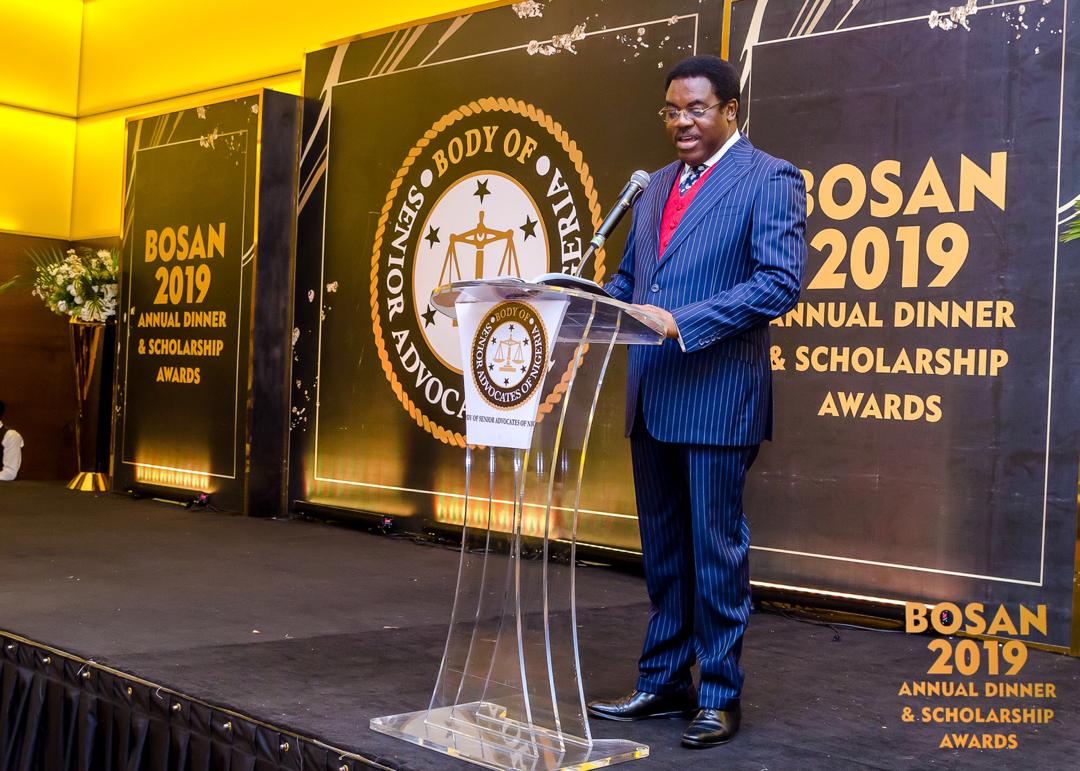
The Body of Senior Advocates of Nigeria (BOSAN) held its two in one programme, the ANNUAL BOSAN DINNER and the MAIDEN BOSAN SCHOLARSHIP AWARD on the 30th of November 2019 at Continental Hotel, Victoria Island, Lagos. While Chief Felix Fagbohungbe SAN is the Chairman of Bosan Fund Utilisation Committee, Dcn Dele Adesina SAN is the Chairman of Bosan Scholarship award Sub-Committee. 
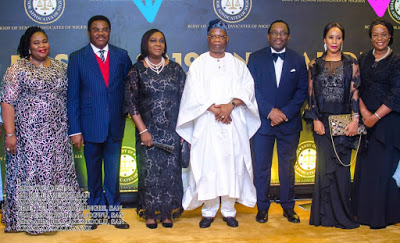
In the photograph above is Chief Felix Fagbohungbe SAN in white agbada. Next to him on his right is Hon Justice Coker of the High Court of Lagos State and Mr and Mrs Dele Adesina. On the left hand of the Chairman is Prof and Mrs Fabian Ajogwu SAN and Prof Yemisi Bamigbose SAN of University of lbadan. 
The 1st photograph is Dcn Dele Adesina SAN Chairman of the BOSAN Scholarship Sub Committee  presenting the Body of Senior Advocate of Nigeria Scholars at the well attended dinner.
The 3rd photograph above is of the other members of the Scholarship Sub Committee, Mr Lanre Onadeko SAN former Director General of the Nigerian Law School. Prof Yemisi Bamigbose SAN of University of lbadan, Prof Atsenuwa, Dean Faculty if Law, University of Lagos.  Prof Essien Essien SAN,  Vice Chancellor,  University of Uyo and Prof Fabian Ajogwu SAN together with the maiden Awardees holding their highly coveted prizes.
Each of the 5 awardees went home with the Scholarship prize of five hundred thousand ( #500,000.00) Naira