LEGAL IMPLICATIONS OF ADOPTING VIRTUAL OR REMOTE HEARINGS BY THE JUDICIARY IN NIGERIA

LEGAL IMPLICATIONS OF ADOPTING VIRTUAL OR REMOTE HEARINGS BY THE JUDICIARY IN NIGERIA

Since the announcement of the Covid-19 scourge all over the world and particularly the announcement of the index case in Lagos, Nigeria on 19 March, 2020 by Professor Akin Abayomi, Commissioner for Health in Lagos State, governments at both the Federal and State levels have adopted various strategies aimed at containing the spread including restrictions on human and vehicular movements, business, religious and social activities (except those designated ESSENTIAL) and so on.

As a consequence, people and institutions affected by these regulations of government have both adapted and devised various ways to keep up with the times. Many businesses, educational and religious organisation have since adopted the ONLINE/VIRTUAL mediums to further their objectives.
The legal industry has practically grinded to a halt in this period as the Courts at all levels have been shut to avoid human interaction which could exacerbate the increasing infection rate in the country, save for a few Courts tasked with hearing cases associated with breaches of government regulations on Covid-19 and other matters which are considered time bound or extremely important. Although, a few lawyers have made a case for legal services to be deemed ESSENTIAL so as to guarantee the rights of Nigerian citizens to access justice and fair hearing, these pleas have not been heeded.
Recently, different jurisdictions have through their Chief Justices issued Practice Directions aimed at accommodating Remote and/or Virtual Court sittings. Even the Chief Justice of Nigeria have constituted a committee to look at the suitability of adopting virtual or remote Court proceedings.
While the various effort by the heads of the various Courts must be commended as the aim is to protect the lives and wellbeing of litigants, practioners and those saddled with managing administration of justice in our country, the legality of these actions should not be overlooked.
Administration of Justice in Nigeria is governed by the Constitution of the Federal Republic of Nigeria 1999 (as amended) herein referred to as “CFRN 1999” and several other legislations including rules of Courts. For example, Secrion 36(3) of the CFRN 1999 (as amended) makes it clear that Court proceedings and the Judgment thereof must be held in public. Some have argued that virtual proceedings qualify as “proceedings held in public” in support of the adoption of virtual or remote hearings. This is however not supported by any legal authority known to Nigerian jurisprudence.
The obvious flaws in the adoption of a technology which obviate the need for physical Court Rooms and procedure clearly spelt out by our body of laws cannot be overlooked. Recently, the legal community in Nigeria received the news of the Judgment of the Supreme Court of Nigeria which set aside the conviction of a former governor of Abia State, Chief Orji Uzor Kalu on the grounds that the judge which convicted him at the trial Court had been elevated to the Court of Appeal as at the date when the trial was concluded. Although the judge did so with the fiat of the President of the Court of Appeal who in turn made same pursuant to Section 396 of the Administration of Criminal Justice Act (ACJA), the Supreme Court nullified the proceedings as the ACJA provisions cannot supersede the CFRN 1999 (as amended). This is an example of the fate that will befall any proceeding which is not in tandem with the spirit and letters of our grundnorm.
For want of time, I will not state in details the many examples of our criminal and civil proceedings that cannot be conducted via remote or virtual platforms without conflicting with existing legislations. I will rather advise that the Practice Directions being issued should be reworked and passed in the form of a Bill to the legislative arm of government at both the National and State levels for onward passage as an Act and Laws respectively.
It is worthy of reiterating here that no matter how well intended and worded these Practice Directions are packaged, they cannot supplant the CFRN 1999 (as amended) or other express or implied provisions of statutes.
Babatunde Busari, Esq.
10/5/2020
Lagos, Nigeria
Babatunde Busari is the Managing Partner and Team Lead at Babatunde Busari & Co., a firm of lawyers with focus on Commercial Law; Alternative Dispute Resolution; Civil and Criminal Litigation; Real and Intellectual Property Law; Banking Law; Oil and Gas Law; Regulatory Compliance; Family and Probate Laws. Babatunde is an ardent reader, writer and researcher.
Join the CJN, Appeal Court President and other Legal Industry Players at the Webinar organized by Wole Olanipekun & Co.

Join the CJN, Appeal Court President and other Legal Industry Players at the Webinar organized by Wole Olanipekun & Co.

The law firm of Wole Olanipekun and Co, tomorrow 11th May, 2020 will be hosting a Webinar titled “Legal and Infrastructural considerations for remote court proceedings in Nigeria” and several policy influencers in the justice sector are billed to attend including the Chief Justice of Nigeria (CJN), Justice Ibrahim Tanko Muhammad, President of the Acting Court of Appeal, Justice Monica Dongban-Mensem, and several other jurists.

Attendance of these eminent legal personalities has been confirmed by the Managing Partner of the firm, who also mentioned that several other dignitaries across Nigeria have signified their intention to attend the virtual discourse.
He said: “In view of the number of pre-registered attendees and those who have shown interest, the capacity of the Webinar has been increased from the initially anticipated 500 participants to now accommodate 1,000 participants”.
The webinar will feature five prominent and highly cerebral speakers namely: Hon. Justice Kashim Zannah, the Chief Judge of Borno State (who also chairs the Judicial Information Technology Policy Committee), Moyosore Onigbanjo, SAN (the Attorney-General of Lagos State), Prof. Taiwo Osipitan, SAN, Femi Falana, SAN and Prof. Chidi Odinkalu, former Chairman, National Human Rights Commission.
To participate, please click the link below to join the webinar:
https://us02web.zoom.us/j/85354787152?pwd=dnFhZlZLWXZ0V1JuYlRGNXRPeDdoQT09
Password: woc2020
Webinar ID: 853 5478 7152
Password: 596962
IMPACTFUL JUSTICE DELIVERY: FOCUS ON PRACTITIONERS | Dele Adesina SAN

IMPACTFUL JUSTICE DELIVERY: FOCUS ON PRACTITIONERS | Dele Adesina SAN

Justice is key in any society. No society can prosper without justice. So my plan is to draw the concentrated attention of the participants to Justice Administration in our society and the challenges militating against an effective, efficient, fulfilling and impactful justice delivery in Nigeria with particular focus on the Legal Practitioners.

As an active player, I want to state that the challenges confronting Justice Administration in Nigeria is systemic, structural and attitudinal in nature. For me however, the greatest impediment to impactful justice delivery whereby everyone involved will get value and fulfilment is an attitudinal problem. No matter how bad a system or structure may be, if the practitioners do the right thing, apply the right approach and take the right step, the effect of the inadequacy of the system and structure can be mitigated. This is why I am focusing on the practitioners.

Whether as an Advocate or a Commercial Legal Practitioner, the end that we seek for our clients is Justice, Justice, and Justice!!!

However, it is not an overstatement to say that the practitioners of the system either as Advocates, both private and commercial and Judges on the Bench erect various impediments to getting impactful justice. That is to say getting speedy justice that will fulfil the expectations of the people without delay and or procrastination as is the case in Nigeria today. It is common knowledge that cases last in some instance for as much as 10-15-20 years journeying from the High Court to the Supreme Court. Arbitration which throughout the world is known as an alternative dispute resolution is also failing to meet its target. Examples abound in Nigeria that arbitral awards are also gradually becoming a cause of action rather than resolution of a dispute between contending parties.

How about endless adjournments, frivolous applications, frivolous interlocutory appeals, frivolous petitions against opposing Counsel and even in some cases against trial Judges. All on the part of the Practitioners at the Bar. On the part of the Bench, you see negative attitude to innovations, late sittings or not sitting at all, lack of proper apprehension of the Rules and lack of the necessary will to enforce the Rules. These are some of the frustrating attitudes of the Practitioners in achieving positive justice. We have got to change this negative attitude if we want results that will be positively impactful to the users of the system. Everyone’s attitude determines his/ her altitude.

The Legal Profession is a highly regulated profession with a standard code of conduct to guide and moderate our operations. Unfortunately, it appears to me that like any other law in Nigeria, the enforcement of this standard code of conduct is less effective; hence, impunity reigns supreme. The time has come for us to begin to do things in a different way so that we can get a different result. Otherwise, the Profession will be gone before we know it.

To address these challenges mentioned above, proper attention must be focused on our disciplinary procedure in order to ensure that smart but procedurally wrong steps are made sanctionable. A Counsel who files frivolous suits must be sanctioned for failure to offer proper professional advice to clients. The same goes for Counsel who take pleasure in defending the indefensible. After all, it is a professional misconduct for a Counsel to urge a defence he does not believe in on the Court.

We have argued over and over again that interlocutory appeals be made to terminate at the Court if Appeal. For me nothing stops the total termination of interlocutory appeals so that whatever dissatisfaction against any Ruling should be taken together with the substantive judgment. Something similar to what operates in election petition cases.

Before anybody challenges any arbitral award, the challenger must be made to deposit the award into an interest yielding account. These I submit will stop many frivolous cases challenging a properly rendered award by an arbitral panel. Most of the cases are to exhaust the patience of the other party and render the award useless.

Our Judges must come back to the days of old of erudity and industry when Bench Rulings are delivered promptly in respect of contentious applications instead of the usual adjournments that we witness today on any little argument. It is said that an ignorant Judge is a calamity to the society. Of course, the Rules of procedure must be obeyed including award of costs in accordance to the Rules for any shortcoming by Counsel.

The Lawyers must hold their duties to justice as a minister in the temple of justice superior to any other duty by doing the proper thing most expeditiously.

DELE ADESINA SAN
Excerps from an interactive session with Mr. Dele Adesina SAN and members of the NBA Nigeria- KYA group on Whatsapp on 9th May, 2020. 
Covid-19: The Legality of Virtual Court Proceedings in Nigeria | Harold Benson

Covid-19: The Legality of Virtual Court Proceedings in Nigeria | Harold Benson

1.00 Introduction

1.01 The effect of the novel coronavirus has been felt in almost every sector across the world, including Nigeria, one of which is the judiciary. In a bid to curb the spread of the virus in the Nigerian judiciary, the Chief Justice of Nigeria, Hon. Dr. Justice I.T Muhammad, on March 23, 2020, directed all courts in Nigeria to suspend sittings for an initial period of two weeks at the first instance, except in matters that are urgent, essential or time-bound. After the expiration of the initial two weeks suspension of court sittings, His Lordship, Hon. Dr. Justice I.T Muhammad on 6th April, 2020, gave another directive, this time suspending court sittings sine die. His Lordship, however, noted again that courts are expected to sit particularly to dispense matters that are urgent, essential or time-bound.

1.02 Following the directive of His Lordship, the Chief Judge of Lagos State signed the “Lagos State Judiciary Remote Hearing of Cases (COVID-19 Pandemic Period) Practice Direction” (hereinafter referred to as the “Practice Direction”), which came into effect on May 4, 2020. The essence of the Practice Direction is to ensure the hearing and determination of urgent and time-bound cases through digital platforms like Zoom, Skype or any other video and audio conferencing platform approved by the Court.  Recently, the Lagos State judiciary had its first virtual sitting in line with the Practice Direction. It is expected that, other State judiciaries will adopt the Lagos model to hear cases virtually. In fact, the Borno State judiciary has also already recorded its first virtual sitting wherein a Judge delivered a judgment in a criminal matter. Another State judiciary- Ekiti State judiciary – has made arrangements to adopt virtual hearing of cases.

1.03 In addition to the above, the Attorney General and Minister of Justice of Nigeria, Abubakar Malami, SAN, and the National Judicial Council have both announced separate plans for Nigerian courts to resort to virtual proceedings during and after the covid-19 pandemic. It is therefore, a question of when, and not if, virtual court proceedings will become a norm across Nigeria.

1.04 In this paper, I will undertake a consideration of the current legal position that governs judicial proceedings in Nigeria. I will also test the constitutionality and legality of the Practice Direction with basic constitutional provisions that guarantees open and fair trials in Nigeria. At the end of this exercise, it will be argued that while virtual court proceedings serve an undeniable utilitarian value, proceeding with them without first amending the extant Nigerian Constitution and other relevant substantive laws, would be an effort in futility.

2.00 The 1999 Constitution and the Conduct of Court Proceedings in Nigeria

2.01 The Constitution of the Federal Republic of Nigeria, 1999 (as altered), hereinafter referred to as “the Constitution”, provides that court proceedings, including delivery of court decisions, shall be held in public. For emphasis, Section 36 (3) and (4) of the Constitution provide as follows:

“(3) The proceedings of a court or the proceedings of any tribunal relating to the matters mentioned in subsection (1) of this section (including the announcement of the decisions of the court or tribunal) shall be held in public.

(4) Whenever any person is charged with a criminal offence, he shall, unless the charge is withdrawn, be entitled to a fair hearing in public within a reasonable time by a court or tribunal…”

2.02 As highlighted above, the requirement for public hearing and determination of cases in Nigeria is mandatory as the operative word is “shall”. The law is settled that, where the word “shall” is used in a statute, it means a command to do or not to do a particular thing. The law therefore, leaves no room for discretion. See the case of Onochie vs. Odogwu (2006) 6 NWLR (Pt. 975) 65 at 89. It is pertinent to note that, there are two provisos to the provision of Section 36 (4) of the Constitution, but the said provisos are not relevant to the instant discourse.

3.00 Judicial Pronouncements on Public Trial

3.01 The compulsoriness of conducting court proceedings in public has been upheld in a plethora of cases. In the case of Edibo v. The State (2007) 13 NWLR (Pt. 1051) p. 306, the appellant and others were charged with culpable homicide punishable with death. Their plea was taken in the chambers of the trial Judge. At the end of trial, the appellant was found guilty of the crime for which he was charged. He appealed to the Court of Appeal and lost. On further appeal to the Supreme Court, the legal effect of the appellant’s plea which was taken in the chambers of the trial Judge was examined. In determining the appeal, the Supreme Court considered the provisions of Section 33 (1) and (3) of the 1979 Constitution, which are in pari materia with the provisions of Section 36 (1) and (3) of the 1999 Constitution (as altered). In allowing the appeal and setting aside the decisions of the Court of Appeal and the trial court, the Supreme Court held that, the taking of the appellant’s plea in the Judge’s chambers was not only irregular, but fundamentally defective. For emphasis, the Court held at page 326 paragraph H of the law report as follows:

“The proceedings of the 19th January, 1998 wherein the plea of the appellant and others were taken in the Judge’s chambers was not only irregular; it was fundamentally defective rendering the entire proceedings null and void. I hold in the circumstances that this appeal succeeds on that issue. The appeal is accordingly allowed and the judgment of the court below is set aside. The entire proceedings of the learned trial Judge including the conviction and sentence of the appellant and others tried along with him contravened the provisions of Section 33 (3) of the 1979 Constitution and same is hereby declared null and void and is set aside.”

3.02 The rationale of the Supreme Court for nullifying the decision of the trial court in the above case on the ground that, the plea of the appellant was taken in the Judge’s chambers, was that, a Judge’s chambers is not a public place which permits unrestricted ingress and egress from the general public. At page 334 of the law report, the Court per. Hon. Justice Ogbuagu, J.S.C, explained as follows:

“Let me dismiss with respect, and as completely misconceived and unacceptable to me, the submission at page 19 paragraph 6.2 of the respondent’s brief, that the Chambers of a Judge, is a public place and satisfies Section 33(3) of the 1979 Constitution (as amended) and section 36(3) of the 1999 Constitution of the Federal Republic of Nigeria. I say so because, nothing can be far from truth. If I or one may ask, can the chambers of a Judge, be described as an “open place” which is accessible to all and sundry? I think not. … I hold firmly, that a Judge’s Chambers, cannot and will never be, a public place or an “open” and unrestricted place.

By these references and arguments, can the learned counsel for the respondent, in all honesty and seriousness, maintain or insist, that he/she can walk into the Chambers of any Judge or Justice, without the consent or permission of the said Judge or Justice and unrestricted? I think not. Surely and certainly, a Judge’s Chambers, is not and cannot be equated to a hall in a public building that is used for formal meetings. As a matter of fact, a Chambers, can also be defined as or equated with a private bedroom or private room. Even in Black’s Law Dictionary, 7th Edition at page, 224, a Judge’s chambers, is defined as “the private room or office of a Judge.””

3.03 In the case of Oviasu v. Oviasu (1973) 11 SC 315, which was a case involving the hearing of a petition for dissolution of marriage in a Judge’s chambers, the Supreme Court set aside the decision of the trial court and held that, the hearing of the petition in the Judge’s chambers occasioned a fundamental irregularity as same was not conducted in public. The Court defined “public” to mean “open to everyone without discrimination. Anything, gathering or audience which is not private is public”. Similarly, in the case of Nigeria-Arab Bank Limited v. Barri Engineering Nig. Ltd. (1995) 8 NWLR (Pt. 413) 257, judgment was given in the Judge’s chambers. Relying on its decision in the Oviasu’s case, the Supreme Court set aside the decision of the trial court and held that the delivery of the judgment in the Judge’s chambers occasioned an irregularity which touched on the legality of the whole proceedings. Again, in the case of Alhaji Nuhu v. Alhaji Ogele (2003) 18 NWLR (Pt. 852) 251, the Supreme Court set aside the decision of an Upper Area Court which was delivered in chambers. The Supreme Court held that, the procedure adopted by the Upper Area Court was a fundamental breach of the Constitution which rendered the judgment delivered null and void.

4.00 Do Virtual Court Proceedings pass the legal test for proceedings held in public?

4.01 Fidelis Nwadialo in his book, Civil Procedure in Nigeria, 2nd Edition, posited at page 674 thereof that, “hearing in public entails a situation where the public is not barred… A trial is sufficiently public if members of the public may have access to where it is taking place. The actual presence of the public is, however, not necessary.” J. A Agaba on his part, stated at page 524 of his book, Practical Approach to Criminal Litigation in Nigeria, that, “the “public” here refers not only to a formal courtroom but it must be a place where there is access by the public.” In the case of Edibo v. The State (supra), Justice Ogbuagu likened “public place” to “a hall in a public building that is used for formal meetings”.

4.02 While it is arguable that, a proceeding held in a “public place” does not necessarily entail a proceeding conducted within the four walls of a courtroom, the question still remains: do virtual court proceedings pass the legal test for proceedings held in public? This question is answered in the negative. Going by the decisions of the Supreme Court in the cases of Edibo v. The State (supra), Oviasu v. Oviasu (supra), Nigeria-Arab Bank Ltd v. Barri Engineering Nig. Ltd. (supra), and Alhaji Nuhu v. Alhaji Ogele (supra), one common feature of a “public place” for the purpose of conducting legal proceedings is that, same is an open place which is accessible to everyone without hindrance of any sort. Virtual court proceedings do not have this feature.

4.03 There is no gainsaying the fact that, before virtual communication of any kind can take place, the following must be available: appropriate technology gadget (like smart phone), access to internet and registration with a virtual communication service provider. According to a February, 2020 report by Statista, only about 25% to 40% of Nigerians have a smart phone.  According to another report by We are Social and Hootsuite, published in January, 2020, only 42% of Nigerians have access to the internet. Putting the foregoing together, it is already clear that, unfettered access to virtual court proceedings in Nigeria will not be feasible to a larger percentage of the Nigerian public.

4.04 Further to the above, going by the tenor of the Lagos Practice Direction, particularly Articles 14, 15, 16, 17 and 18 thereto, virtual court proceedings will be open to the Judge, respective litigants and their counsel. I expect the Practice Directions of other States to have similar provision. This practice, if implemented, is restrictive and limiting in nature as members of the general public would not have access to the said virtual proceeding. Limiting virtual court proceedings to only the Judge, respective litigants and their counsel would defeat the spirit of Section 36 (3) and (4) of the Constitution, as any “justice” arrived thereat, would be cloistered justice. In the Nigeria-Arab Bank’s case (supra), the Court held as follows:

“Any act of secrecy, however desirable it might seem, detracts from the aura of impartiality, independence, publicity, and unqualified respect which enshrouds justice given without fear of favour. Its acceptance by the public at large, and the confidence it demands, depend on these aura being strictly adhered to.”

4.05 It has been argued that, the link to virtual court proceedings should be shared online for all and sundry to join in. The reality is that, this is not very practicable as many virtual communication platforms can only permit limited number of participants. Again, some virtual communication platforms are paid for. Therefore, assuming without conceding that a larger percentage of the Nigerian public have access to a smart phone and internet, this is still a huge obstacle to justice for a country like Nigeria where the poverty rate is 40%, and about half of her population earn a meagre USD1.92 per day.

4.06 In the case of Edibo v. The State (supra), the Court held at page 337 to 338 of the law report that, the right provided in Section 36 (3) and (4) of the Constitution is a public right for every citizen of this country. Court proceedings must therefore, be open and easily accessible to everyone and free of obstacles. The tenor of Section 36 (3) and (4) of the Constitution is sacrosanct and the right provided therein must not be seen to be hindered in any way. It does not matter if there is no miscarriage of justice at the end of the day. In the Nigeria-Arab Bank case (supra), the respondent contended that, the delivery of the judgment in the Judge’s chambers was a mere technicality which did not occasion a miscarriage of justice to the appellant. A similar argument was made by the respondent in the Edibo case. The respondents in the aforementioned cases, therefore, argued that, the decisions of the trial court ought to stand since no miscarriage of justice was occasioned to the appellants, notwithstanding that trials in both cases were not held in open court.  The Supreme Court rejected this contention by the respondents. Relying on its decision in the Nigeria-Arab Bank case, the Supreme Court in the Edibo’s case held at page 332 as follows:

“A breach of a mandatory constitutional provision is more than a mere technicality; it is fundamental. And it is no argument that there has been no miscarriage of justice.”

4.07 Further to the above, the introduction of virtual court proceedings do not agree with the spirits of other substantive laws and regulations like the Evidence Act, Oaths Act, Legal Practitioners Act (“LPA”), and the Rules of Professional Conduct, 2007 (“RPC”) which regulates inter alia, the appearance of Counsel before Courts. For instance, Rule 45 (2) of the RPC provides that, a lawyer shall not wear the Barrister’s or Senior Advocate’s robe on any occasion other than in Court. Will this Rule be relaxed during virtual court proceedings? Rule 20 of the Lagos Practice Direction already provides that, lawyers shall dress “appropriately” during virtual court proceedings. And by “appropriately, it is safe to assume “clothed in Barrister’s or Senior Advocate’s robe”. Wouldn’t the wearing of these hallowed courtroom attires in a lawyer’s office during virtual court proceedings be a violation of Rule 45 (2) of the RPC? Won’t lawyers be committing professional misconduct in this regard?

4.08 Going by all the foregoing argument, I submit that, virtual court proceedings do not pass the legal test for proceedings conducted in public.

5.00 Can Heads of Courts Constitutionally Make Practice Directions Regulating Virtual Court Proceedings?

5.01 It has been suggested that, since certain Heads of Courts in Nigeria have been constitutionally empowered to make Rules regulating the practice and procedures of their respective courts, such Heads of Courts can validly make Practice Directions for the creation and regulation of virtual court proceedings. While it is conceded that, generally, Heads of Courts have constitutional power to make rules regulating the practice and procedure of their respective courts, it is contended that, the said Heads of Court do not have constitutional powers to make Practice Directions that are either in conflict with, or tend to expand the express provisions of the Constitution. Since the provisions of Section 36 (3) and (4) of the Constitution have expressly stipulated that the proceedings of court (including the announcement of its decisions) shall be held in public, this clearly and automatically excludes any other implied forum for holding or conducting court proceedings, including a virtual forum. The law is well settled that, where there is a specific provision in a statute, all other provisions which would be implied are excluded. The foregoing principle of law is expressed in the Latin maxim, expression unius est exclusion alterius. See the case of A-G, Lagos State v. A-G, Federation (2014) 9 NWLR (Pt. 1412) 217 at 275 – 276. Therefore, Practice Directions which seek to create and regulate virtual court room proceedings will be in direct conflict with the provisions of Section 36 (3) and (4) of the Constitution. The law is settled that, Practice Directions which are in conflict with the Constitution are null and void to the extent of their inconsistency. See the case of Buhari v. INEC & Ors. (2008) 3 FWLR 4657. See also Section 1(3) of the Constitution.

5.02 Following from the above, I submit that, Practice Directions cannot be used to create or regulate virtual court proceedings.

6.00 Conclusion

6.01 While the adoption of virtual court proceedings by the Nigerian judiciary is desirable, it is pertinent that, certain extant laws, including the Nigerian Constitution, are first amended, to avoid a situation where justice is slaughtered on the altar of modern trend.

This Article is written by Harold Benson, a Commercial Litigation and Dispute Resolution Specialist.
This Article is provided for educational and informational purposes only and does not contain legal advice or create a lawyer-client relationship. The information provided should not be taken as an indicator of future legal results. Any information provided should not be acted upon without consulting a legal counsel.



Further enquiries should be made to haroldbensonthefirst@gmail.com
DELE ADESINA COMMISERATES WITH THE FAMILY OF MR. DELE SOLANKE ESQ. AND NBA IKEJA BRANCH

DELE ADESINA COMMISERATES WITH THE FAMILY OF MR. DELE SOLANKE ESQ. AND NBA IKEJA BRANCH

On behalf of my colleagues and I at Dele Adesina LP, l commiserate with the family of our deceased Colleague and the entire members of Nigerian Bar Association, Ikeja Branch on the demise of our colleague, Mr. Dele Solanke Esq. His burial takes place today, 7th of May, 2020.

Mr. Solanke had spiritedly and rigorously fought the sickness that kept him away from what he loved to do best for a couple of years. He fought a good fight of faith. He deserves a rest after the protracted struggle. Rest in perfect Peace my dear brother.

As he is buried today, may the graceful God cloth his wife, children, family members and our colleagues with His abundant grace and give us all the fortitude to bear the irreparable loss.

May the mercy and love of God avail for his soul.

Dele Adesina SAN

COVID-19 and the Nigerian Justice System: Challenges The Bench And Bar Should Expect After The Pandemic And The Way Forward

COVID-19 and the Nigerian Justice System: Challenges The Bench And Bar Should Expect After The Pandemic And The Way Forward

ABSTRACT

The outbreak of the Coronavirus
Disease- (COVID-19) has brought about unprecedented global downturn and adverse
impact on the Nigerian justice system and its activities. The pandemic had its
first show on human stage towards the end of 2019 in Wuhan which happens to be an
emerging business hub of China, this unprecedented disease outbreak is recorded
to have caused the untimely death of not less than 185,434 persons globally and
infected over seventy thousand individuals within the first fifty days of the
epidemic.[i]
This virus was reported to be a member of the β group of coronaviruses and
scientifically described as an infectious disease caused by severe
acute respiratory syndrome coronavirus 2 (SARS-CoV-2).[ii]  There is no doubt that the outbreak of
COVID-19 pandemic has  a negative effect
on the Nigerian Justice System, activities of judicial officers, legal
practitioners, law firms and the Nigerian Bar Association at large and this
paperwork seeks to consider the post Covid-19 pandemic challenges on both the B
ench and the Bar and probable solutions to remedy
the situation.


INTRODUCTION

It is common news that the Nigerian Judiciary had made swift decisions to ensure the protection of justices, judges and
staffs of courts and further undertook 
preventive measures on the spread of 
CORONA VIRUS (COVID-19) .
The Chief Justice of
Nigeria
(CJN) and the Chairman of the Nigerian
Judicial Commission, HON. DR. JUSTICE I. TANKO  MOHAMMED, CFR, JSC had earlier
direc
ted
all Heads of Courts by  circular No.
NJC/CIR/HOC/11/631 dated 23rd March, 2020 to suspend Court sittings
for an initial period of two weeks from 24th March, 2020 except for the purpose
of dispensing matters that are urgent, essential or time bound in line with the
extant laws of Federal Republic of Nigeria.[iii]  A circular was further released to that
effect on the 6th of April, 2020 , extending the suspension of Court
sittings till further notice, given the lockdown measure put in place by
Federal and some state governments to curb the spread of COVID-19.[iv]

Similarly, the Nigerian Bar Association
has also put up measures to ensure the protection and welfare of the members of
the bar, the chairman of the Nigerian bar Association Dr. Paul Usoro SAN had on
16th of April, 2020 announced the 18 (eighteen) men welfare
committee to provide strategic insight on how to provide palliatives to
indigent registered members of the Bar and also made provisions for online
payment of the Bar Practicing Fee before the statutory March 31st
deadline.

In the same light, the Lagos State Judiciary issued practice directions
to guide remote hearing of court cases in the state
to ensure that cases are heard and disposed of
urgently. The Chief Judge, Hon Justice Kazeem Alogba remarked that the practice
directions were made pursuant to Section 6 subsection 6, Section 274 of the
1999 constitution as amended, Section 87 subsection 1 of the High Court of
Lagos 2015 and other enabling legislation. The guidelines which becomes
effective from 4th of May 2020 makes reasonable provision for
preparation and conduct of remote hearings, electronic filing and service of
court processes, electronic payment of filing fees, remote hearings on Zoom,
Skype, or any other video communication approved by the court,  adoption of written addresses, and a notice
of delivery of rulings and judgments. He added that the practice direction
applies to new and urgent cases, pending cases involving urgent and time-bound
applications such as bail hearings, fundamental human rights matters, rulings,
judgments, and any other matter approved by the Chief Judge.[v]

It is noteworthy that even though the
governing authorities of the bench and bar had made applaudable attempt to
reduce the effect of the covid-19 pandemic on its members, they must also put
up measures for the post lockdown challenges as failure to do so will have
negative consequences on both members of the Bench and the Bar.


Ø
CHALLENGES

We will therefore consider some of the
post Covid-19 pandemic on the Nigerian justice system which are but not limited
to the following

·       
Backlog of Pending Cases

The Nigerian judicial system has over
time been known to have numerous pending cases before both the inferior and
superior courts of records taking cognizance of 
the inadequate number of judges in Nigerian courts, Cases today
certainly take longer time to be finalized leading to adjournment upon
adjournment before verdicts  are finally
passed unlike in cases where there are adequate number of judges to reduce the
average workload per judge.

It is glaring that despite the volume
of cases, the courts has had to proceed on an unavoidable indefinite suspension
of judicial activities since the 23rd of March, 2020 and  as a result parties in pending cases would
show up around court buildings immediately after the lockdown is over.

In consideration of the prevailing
information about the inadequate number of judicial officers in Nigerian
courts, it is an infallible proposition that cases will certainly take longer
time to be finalized and verdicts passed.[vi]

·       
Plethora
of Cases from the effect of the pandemic

The Covid-19 pandemic is
generally noted to have negative effect on all spheres of life and the court
would expect to witness a massive spring forth of cases ranging from force
majeure clauses in contracts, employment relations, inability to execute
contracts due to the lockdown, lease and tenancy disputes owing  to inability to pay rent, approvals of mergers
and acquisition owing to inability to meet up with FCCPC[vii]
thresholds by corporate bodies, declaration of solvency, winding up
proceedings, and cases of gender violence and assault during the lockdown. 


·       
Suspension of large gathering

One of the many challenging effects of
the Covid-19 pandemic on the Nigerian Bar and Bench is the continuous
restriction on large gathering and this will inevitable reduce the number of
persons in court rooms if the social distancing preventive measure is observed,
the Annual General Conference  of the
Nigerian Bar Association may not hold owing to the expected number of attendees
if Nation is still unable to defeat the pandemic before August 2020, and  essential National Judicial Council meetings
where sensitive issues with regards to the governance of the Judiciary are
discussed may also not be held as expected.


·       
Technological Deficiencies

The former chief Justice of Nigeria
(CJN) Walter Samuel Onnoghen during the previous 2017/2018 legal year of the
Supreme Court reiterated the need to ensure progressive upgrade of the
judiciary especially in areas of administration, practice directions,
independence of the judiciary and contributing significantly to the fight
against corruption. He added that

The
Rules of practice and procedure should make provision for concessionaires to
handle the service of court processes and documents. Also, the Rules of
Practice and procedure should provide for e-filing to be done either by courts
or by external management service providers,
there is a need for regular updates of courts’ websites, and there must
be computerized records in each court.”

The former CJN said entries must also
be made and posted on the website of the judiciary, where information on the
type of cases, progress made, judgments etc., can be accessed anywhere in
Nigeria, weekly, monthly or quarterly.

It is
unfortunate that this astute recommendation has still not been completely
implemented and the judiciary is continually faced with the challenge of low
Input of Computer Technology.


Ø SOLUTION

ü
In mitigating challenge of numerous
backlog of cases, it is my humbly proposition that more judicial officers
should be appointed for speedy dispensation of justice, willful delay tactics
and unethical practices by counsel  to
parties to  prolong cases and make such
cases drag through ages should be discouraged. Furthermore, there should be
statutory time for every case before the court according to its peculiarity.


ü
Heads of superior courts should review the current rules of
courts and practice directions in order to accommodate speedy administration of
justice and further enlarge the scope of the fast track procedure.


In the case of Chief John Oyegun v.
Chief Francis A. Nzeribe[viii],
the Supreme Court of Nigeria held
that the heads of every cadre of superior court shall have the power to make
Rules of that Court. It is trite law that the power to make Rules of Court at
the Supreme court, Court of Appeal, and at High Court of various states and the
FCT are vested in the Chief Justice of Nigeria, President of the Court of
Appeal and the Chief Judge of the States and FCT respectively.. The relevant
sections of the 1999 Constitution of the federal republic of Nigeria are
Sections 236, 248 and 274.

ü
Provisions for virtual
conferences, webinars,  frontloading of
evidence electronically, and electronic trials should be made in the Rules of
Courts, practice directions, Nigerian Bar Association guidelines and other
procedural laws.[ix]


With e-justice and e-meetings, case
management will be automated, forms that simplify and streamline court
proceedings will be accessible to users online, and payment of fees made
through dedicated websites to reduce corruption.


The Lagos state Judiciary made astute
attempt in line with the aforementioned recommendation however, I found some of
the provisions in the guideline issued by My Lord the Hon Chief Judge of Lagos
not to attain fundamental standards for the following reasons[x]

(1) The
preamble states the scope of cases to which the Practice Directions apply and
these includes cases which are urgent or time bound. The scope of the guideline
should be extended to all cases as we do not know when will pandemic will be
conquered and an attempt to leave out other cases except for urgent and time
bound cases will have far reaching effect on the Nigerian Judicial System.

(2) The
guideline made no provision in situations where electronically filed processes
fail to be delivered due to network error or where it was erroneously sent to a
wrong channel or platform.

(3) The
guideline in paragraph 6 and 7 made provision for electronic filing and no
provision is made for electronic signature where a person is unable to do same
physically.

(4) The
guideline made no provision for the attendance of public in proceedings before
the court in line section 36 (3) (4) of the constitution of the Federal
Republic of Nigeria.

It must be noted that there is no legal
or statutory framework for electronic trials yet and both the legislature and
Judiciary are expected  to concordly work
towards the enactment of legislation to address the aforesaid in order to avoid
multiple appeals cases before the appellate courts.

Courts and NBA branches should also
ensure compliance with Nigeria Centre for Disease Control (NCDC) measures for
prevention and control of the Covid-19 pandemic by observing physical
distancing in court rooms and in NBA National/branch meetings, provide hand
sanitizers in all court rooms and compulsory use of the face mask.

ü
It is applaudable that the Supreme
Court is moving towards complete utilization of information technology; however
there is need for all law courts and Judicial Officers in Nigeria to be ICT
compliant, provision of consistent power supply and employment of the services
of more shrewd ICT experts to assist the Judiciary and members of the bar is
also necessary.  

Information and
Communication Technology (ICT) will enhance the justice system by ensuring that
information is digitally received, controlled and passed on adequately. With
this measures put in place Processes filed in court will be finalized, ready on
demand and transfer of data and information will not be desegregated. It is
however further advised that measures must be accompanied by enhanced capacity
of personnel and investments in cyber security.

CONCLUSION

The goal of every purpose driven
society is progress which allows for unrestrained growth,
compliance
with rule of law and legal security for individuals, and even
development of its judicial system. The Covid-19 Pandemic is a threat to human
existence and particularly on the Nigerian Justice system at large and proactive
steps in mitigating its effect on both the Bench and the Bar highly required. As
patriotic citizens and ministers in the temple of Justice we are burdened with
the responsibility of ensuring compliance with the Rule of Law.


References


[i]
https://www.aljazeera.com/news/2020/01/countries-confirmed-cases-coronavirus-200125070959786.html

[v] Lagos State Judiciary remote
hearing of Cases (Covid-19 Pandemic period) Practice Directions,
https://www.channelstv.com/2020/04/28/lagos-judiciary-issues-guidelines-on-remote-court-sitting/

[vi]  https://punchng.com/judiciary-still-in-search-of-solution-to-delayed-justice/

[vii]
Federal Competition and Consumer Protection Commission

[viii] Chief John Oyegun v. Chief Francis A. . Nzeribe (2010) 1 SC
(Pt II) 1

[ix]  https://guardian.ng/features/effect-of-covid-19-pandemic-on-legal-system-is-enormous/

[x]
Lagos State Judiciary remote
hearing of Cases (Covid-19 Pandemic period) Practice Directions


Oluwatoyin Bamidele, ONI

Jurist O’toyin

onioluwatoyinbamidele@gmail.com

Four Characteristics I look for in an Associate – Dele Adesina SAN

Four Characteristics I look for in an Associate – Dele Adesina SAN

In a knowledge sharing session with members of the NBA, Ikorodu Branch, Dele Adesina SAN when asked about the characteristics he looks out for in an associate stated the following:

1.Vision  

An associate who has no dream, no goal will not matter to me even if he has a First Class at the LL.B and B.L. levels. So the first thing I watch out for in anyone is his or her vision in the Profession

The Associate must have a dream and a desire of what he or she wants to become in future. In other words, his vision must be clearly formulated and understood by him. He must be engrossed by the dream with passion. Nothing is as important in life as much as having a dream. Your dream is your goal. Unless your dream is clear to you, to pursue it would be difficult. It is worse if you have no dream. It means you are going nowhere. The scripture says that *”as far as you can see, God has given you for a possession.”* Once, his or her dream is clear, then the first hurdle is crossed.

2. Dedication 

The second characteristic is whether he or she is willing to be dedicated to that vision because I don’t want someone that would come to the Chambers today, is learning the rope of advocacy and after two or three years steps-out to take a Secretary appointment somewhere. Thereby wasting all his or her three years on the advocacy line

So the prospective Associate must be dedicated to his dream. To him nothing else must matter. Through thick and thin, he or she must hold on steadfastly to the dream. Not minding the pain because of the gain he sees ahead. He will also be ready to pay the *”price”* in order for him or her to win the *”prize”* in future.

3. Determination

The third characteristic I would watch out for is determination to succeed. Does the person siting before me have the tenacity to succeed in the Profession? Or is it somebody that will abandon the cause because of a temporary difficulty? To a determined individual, every obstacle is a stepping stone, every challenge is a hurdle to be surmounted. Every failure is only temporary. So the driving force to a determined person is the assurance of the light at the end of the tunnel and it is not difficult to know whether the person you are interviewing is a strong and determined personality.

4. Discipline 

Lastly, the fourth is Discipline. Your carrier/ vehicle that will translate your dream to accomplishment is *”DISCIPLINE”*. I won’t spend time on this. We all know what discipline in life means.

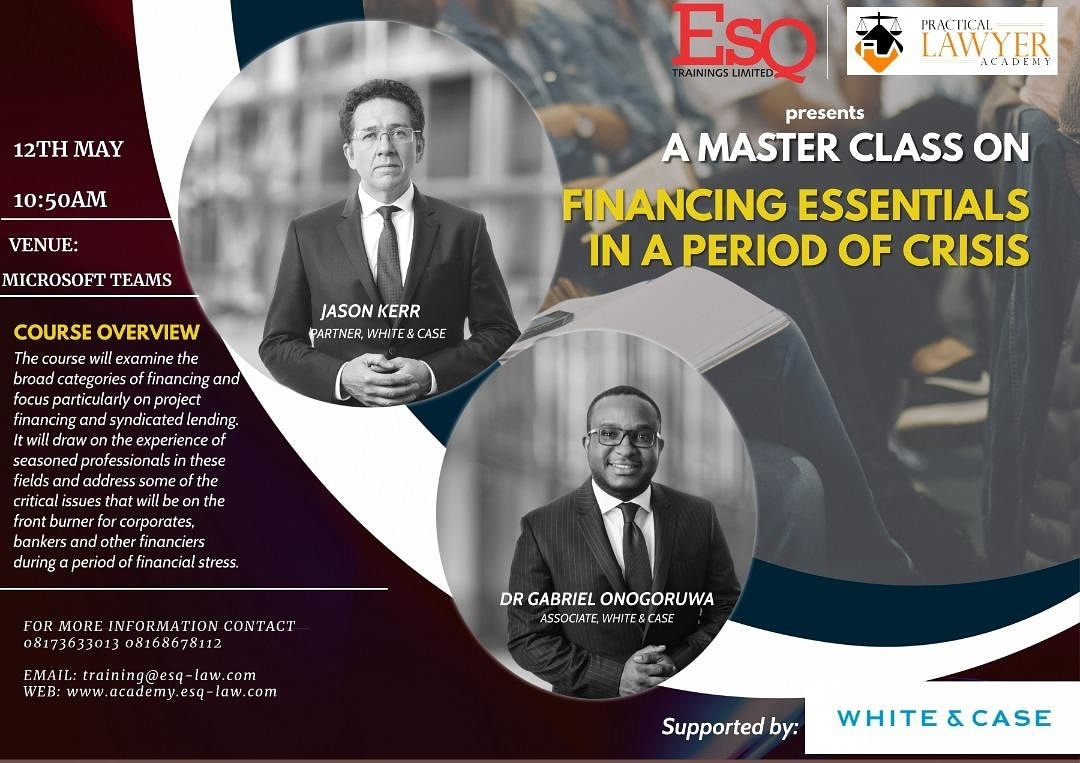
Esq presents Masters Class on Financing Essentials in a Period of Crisis

Esq presents Masters Class on Financing Essentials in a Period of Crisis

As part of our ESQ Practical Lawyer Academy Virtual Training programmes, we present to you a Masters Class on Financing Essentials in a Period of Crisis.

Course Overview
The course will examine the broad categories of financing and focus particularly on project financing and syndicated lending. It will draw on the experience of seasoned professionals in these fields and address some of the critical issues that will be on the front burner for corporate, bankers and other financiers during a period of financial stress.

The course will aim to equip participants with knowledge of:
(a) some of the fundamentals of financing, especially project financing;
(b) the life span of a project;
(c) critical flexibility and stress management provisions in typical financing documents; and
(c) proactive preparatory steps to be taken and analysis to be undertaken in periods of financial stress; and
(d) practical steps for companies / financiers involved in or considering liability management transactions.

SPEAKERS
Jason Kerr, Partner – White & Case LLP
Dr. Gabriel Onagoruwa, Associate – White & Case LLP
Date: May 12, 2020, Time: 11am
To Register: https://lnkd.in/guVqZd9q

Dele Adesina SAN Wishes Lawyers Happy Worker’s Day

Dele Adesina SAN Wishes Lawyers Happy Worker’s Day

Today, the 1st of May, 2020 marks International Worker’s Day, a day dedicated to celebrate workers and institutions the world over. It is also a day to celebrate the dignity that comes from hard work and the fruits of our labour.  
 
I celebrate all my fellow learned colleagues today, particularly those who have continued to chart a course for our nation through hardwork, diligence as well as promotion of the rule of law and democratic principles. The legal Profession has evolved over the years as a strong voice for the promotion of due process and rule of law in the country.
 
I recognize and salute the invaluable contributions of our great bar leaders both past and living, and distinguished Nigerian legal practitioners, in the struggle for a better society. Moreso, Nigerian lawyers play a leading role in our quest for a society that puts premium on selfless sacrifice and diligence in both the public and private sectors, and continues to be a worthy partner with stakeholders in Civil Society for our shared quest for greater appreciation of Nigerian workers.
 
I therefore, dedicate today to all the lawyers who have continued to use their expertise to create a better society for us all and contribute their quota in service to humanity and our great nation. On behalf of myself and colleagues at Dele Adesina LP, I wish all Nigerian lawyers  Happy Workers Day.
 
Dele Adesina SAN
ARREST AND DETENTION OF MR EMPEROR OGBONNA | Dele Adesina SAN

ARREST AND DETENTION OF MR EMPEROR OGBONNA | Dele Adesina SAN

Information has it that Mr Emperor Ogbonna, a Legal Practitioner in Aba, Abia State, was arrested sometime in March and arraigned before Magistrate Court 7, Umuahia on March 24, 2020. He was charged with an allegation of cyber-crime and terrorism in Charge No. U/144C/2020. He was said to have been remanded in custody by the Magistrate Court until he was brought before the Federal High Court, Umuahia exactly a month later on April 24, 2020.

The Federal High Court, Umuahia granted him bail on Tuesday, April 28, 2020 and according to the leaders of the Bar in Aba, the bail was subsequently perfected. Notwithstanding, the men of D.S.S. Abia State were said to have re-arrested him and put him in detention.
We call on the men of the D.S.S. in Abia State to speedily release Mr Emperor Ogbonna without any further delay in obedience to the Federal High Court Order granting him bail. Under the law and the Constitution of this country, bail is a constitutional right. And in the strong words of the same Constitution, Mr Emperor Ogbonna is innocent of the offences charged until his guilt has been established before a competent Court of Law. Furthermore, let it be stated that the Constitution of the Federal Republic of Nigeria 1999, as amended does not leave anybody in doubt as to the position of the rights of Nigerian citizens, both the conformist and the non-conformist.
In a Constitutional Democracy such as ours, the law is no respecter of persons and Orders and Judgments of Courts of competent jurisdiction must be obeyed and speedily too. We call on the Honourable Attorney-General and Commissioner for Justice of Abia State, Uche Ihediwa Esq., to bring the weight of his Office to bear on this matter and ensure that the needful is done and justice dispensed to all parties concerned.
Dele Adesina SAN