by Legalnaija | Oct 15, 2025 | Uncategorized
Introduction
Defamation remains one of the most sensitive aspects of Nigerian law, a space where personal reputation and freedom of expression constantly meet and sometimes collide. The law recognizes that while every person is entitled to protect his or her good name, society must also preserve the freedom to speak the truth, express honest opinion, and hold others accountable. It is against this background that both civil and criminal defamation have developed under Nigerian law, each with distinct purposes and procedures.
Understanding Civil and Criminal Defamation
Civil defamation arises under the common law of tort and is designed to compensate a person whose reputation has been unjustly damaged by another’s false statement. Criminal defamation, on the other hand, is a statutory offence under Sections 373–381 of the Criminal Code Act (applicable in Southern Nigeria) and Sections 391–395 of the Penal Code (applicable in Northern Nigeria). Its aim is to protect public peace and order by punishing statements capable of provoking violence or widespread hatred.
The Court of Appeal in Okotcha v. Inspector-General of Police (2019) LPELR-47848 (CA) explained that civil defamation is concerned with personal injury to reputation, while criminal defamation concerns the peace of the public. The dividing line, therefore, lies in the intention behind the publication and its likely effect on society. A publication that merely injures an individual’s reputation is civil, but one that tends to incite public disorder or hatred crosses into the criminal sphere.
In both civil and criminal defamation, the parties and the remedies sought differ fundamentally in purpose and consequence. In civil defamation, the action is a private one between the plaintiff, whose reputation has been injured, and the defendant, who made or published the defamatory statement. The remedy here is primarily compensatory damages, injunctions, or an apology to restore the injured person’s reputation. In contrast, criminal defamation is a public prosecution instituted by the State through the police or the Attorney-General against the accused person for an offence that threatens public order. The remedy in this case is punitive, involving fines or imprisonment as provided under the Criminal and Penal Codes. As the Court of Appeal held in Okotcha v. I.G.P. (Supra). The accused person here, enjoys the shade of constitutional safeguards of Presumption of innocence as guaranteed under Section 36(5) of the 1999 Constitution, and failure to establish any of the fundamental ingredients of offence alleged will occassion into failure of the charge and will lead to the discharge of the defendant.
Improper Invocation of Police Powers
It has become increasingly common to see individuals rushing to the police over issues that are clearly civil in nature, including defamation. Such practices have no basis in law. The Police Act, 2020, in Section 4, clearly defines the duties of the Nigerian Police Force as:
“The prevention and detection of crime, the apprehension of offenders, the preservation of law and order, the protection of life and property, and the due enforcement of all laws and regulations.”
Nowhere in the Act is the police empowered to intervene in purely civil disputes or to enforce personal rights. In Onagoruwa v. State (1991) 5 NWLR (Pt. 193) 593, the Court of Appeal described the police in words that still echo today:
“They are custodians of legality, not instruments of oppression. Their duty is to enforce the law, not to manufacture offences where none exist.”
When the police act outside these limits, they act ultra vires, beyond their lawful authority. Any proceeding or prosecution founded on such misuse is void. Moreover, such conduct wastes the court’s precious time and erodes public trust in both the law and its institutions. Courts have consistently warned against the abuse of their process, as seen in A.G. Anambra State v. Okeke (2002) 12 NWLR (Pt. 782) 575, where the Supreme Court cautioned that the judicial process must never be used as a tool for harassment or revenge.
Ingredients of Defamation
For civil defamation, the claimant must prove three essential elements:
- That the statement complained of is defamatory;
- That it refers to the claimant; and
- That it was published to a third party.
For criminal defamation, the prosecution must go further to prove beyond reasonable doubt that:
- The accused published defamatory matter;
- The publication referred to the complainant;
- It was false;
- It was made with intent to harm the complainant’s reputation; and
- It was not protected by any lawful defence or privilege.
These requirements underscore the seriousness with which the law views defamation, especially when it borders on criminal conduct.
Defences to Defamation
The law is not blind to the need for fairness. It recognizes that people should not be punished for speaking the truth, expressing honest opinions, or communicating in good faith. The defences available to a person accused of defamation ensure that justice does not silence legitimate expression.
Defences in Civil Defamation
- Justification (Truth)
The truth of a statement is an absolute defence. No one has the right to complain about a statement that is substantially true. In Oruwari v. Osler (2013) 5 NWLR (Pt. 1348) 535, the Court of Appeal held that “truth is a complete defence to defamation, for the law does not protect a man from the publication of that which is true about him.”
- Fair Comment on Matters of Public Interest
A person may freely express an honest opinion on a matter of public importance, provided it is based on facts that are true and expressed without malice. The Court of Appeal in Sketch Publishing Co. Ltd v. Ajagbemokeferi (1989) 1 NWLR (Pt. 100) 678 held that fair comment must be an opinion any reasonable person could hold, not a reckless assertion.
- Qualified Privilege
Certain communications made in the performance of a duty or in the protection of a legitimate interest are privileged. This defence will fail only where malice is proved. In Emeagwara v. Star Printing & Publishing Co. Ltd (2000) 14 NWLR (Pt. 688) 372, the court affirmed that a statement made in good faith, in discharge of a duty, is privileged.
- Absolute Privilege
Some occasions are so vital that the law gives complete immunity from liability, even if the words are false or malicious. Examples include statements made in judicial proceedings, legislative debates, or official acts performed in the line of duty. The case of R v. Governor of Lagos, Ex parte Roderick (1970) NMLR 204 recognized this principle.
- Innocent Dissemination
Those who unknowingly distribute defamatory material such as printers, booksellers, or internet service providers are protected where they had no reason to suspect the material was defamatory. The English case of Byrne v. Deane (1937) 1 KB 818, which has been followed in Nigerian courts, illustrates this principle.
- Apology and Retraction
Though not a full defence, an apology or retraction may mitigate the damages awarded. The Defamation Law of Lagos State (Cap. D5, Laws of Lagos State 2015) recognizes this mitigation when the apology is made promptly and sincerely.
Defences in Criminal Defamation
- Truth and Public Benefit
Under Section 375 of the Criminal Code and Section 392(2) of the Penal Code, a statement is defensible if it is true and it was for the public good that it be published. Both elements must coexist, a true statement published maliciously and without public benefit can still be criminal.
- Privileged Publications
Sections 376 of the Criminal Code and 393 of the Penal Code recognize privilege for publications made in judicial, legislative, or official proceedings, or fair and accurate reports thereof.
- Fair Comment on Public Affairs
The defence of fair comment applies where the statement represents a genuinely held opinion on a matter of public concern, made without malice. This principle was reaffirmed in Guardian Newspapers Ltd v. Ajeh (2011) 10 NWLR (Pt. 1256) 574.
- Innocent Publication
Under Section 377 of the Criminal Code, a person is not liable if they neither knew nor intended the publication to be defamatory and took reasonable care to prevent it.
- Consent of the Aggrieved Party
Where the publication was made with the consent of the person defamed, it cannot constitute an offence. This is recognized under Section 378 of the Criminal Code.
Misuse of Judicial Process and Consequences
The courts have consistently warned against the misuse of their time and process. Bringing frivolous or unfounded defamation claims, or using the police to pursue personal grudges, is viewed as a serious abuse. In Saraki v. Kotoye (1992) 9 NWLR (Pt. 264) 156, the Supreme Court defined abuse of court process as using judicial procedure for purposes it was not intended.
Such misuse can attract punitive costs, dismissal of the case, and in extreme cases, disciplinary action against the erring party or counsel. The court’s time is too valuable to be spent on matters that, as judges often say, “go to no issue.” The justice system exists to correct genuine wrongs, not to satisfy vanity or vendetta.
Conclusion
The law of defamation in Nigeria is built upon balance, the balance between protecting the dignity of individuals and upholding the freedom of expression vital to democracy. Every lawyer, journalist, and citizen must understand this delicate equilibrium.
Before rushing to court or the police over alleged defamation, one must pause and ask himself, Is this truly a matter for criminal law, or simply a civil grievance? The misuse of police powers and the abuse of court processes only weaken the integrity of our justice system.
As the courts have often reminded, the law is not a weapon for oppression but an instrument of order and fairness. Defamation law, properly understood, protects truth, honesty, and responsible expression not malice, ego, or misuse of authority.
 Amb. Ibrahim Muhammad Usman is a law graduate, advocate of intergenerational justice and equity, a passionate voice for Sustainable Development Goals, Inclusive policy and good governance, AI safety and governance in Africa, and climate justice. He can be reached via imuhammadusman66@gmail.com or 08145101965.

by Legalnaija | Sep 13, 2025 | Blawg, Uncategorized

NBA Lagos Branch Embarks on a Protest Against the Nigerian Navy’s Disregard of Court Judgment
The Nigerian Bar Association (NBA), Lagos Branch, on Friday, 12th September 2025, staged a peaceful protest against the Nigerian Navy’s unlawful signal, declaring its member, Vice Admiral Dada Olaniyi Labinjo (Rtd.), as a “deserter,” in defiance of a valid judgment of the National Industrial Court.
Led by the Branch Chairman, Mrs. Uchenna Ogunedo Akingbade, members of the Executive Committee and several lawyers converged at Marine Bridge, Apapa, where they were met with a heavy security presence of armed Police, Military personnel, DSS operatives, and Lagos State Neighbourhood Safety Corps officers.
Despite initial hostility, the lawyers stood their ground and by 11:00 a.m., marched to NNS Beecroft, Apapa, where they were received by Naval officers and later addressed by Commodore Paul Ponfa Nimmyel.

Mrs. Akingbade presented the purpose of the protest:
To condemn the Navy’s disregard of a subsisting Court judgment.
To deliver a protest letter to the Chief of Naval Staff through the Flag Officer Commanding.
However, Commodore Nimmyel refused to accept the letter on behalf of the Navy, insisting it should be delivered directly to the Chief of Naval Staff in Abuja, while suggesting dialogue before protest. In response, Mrs. Akingbade firmly countered that:

He who comes to equity must come with clean hands. You cannot call for dialogue while disobeying a Court order and persisting in unlawful actions against our member.
Present at the protest were Branch officers, including Mr. James Sonde (Vice Chairman and Chairman, Human Rights Committee), Mr. Kelechukwu Uzoka (Secretary), Mrs. Oge Mokelu (Treasurer), Mr. Oliver Omoredia (Publicity Secretary), branch members such as Mrs. Oyinkansola Badejo-Okusanya, Mrs. Chinelo Okonkwo, Mr. Shola Lamid, Mr. Victory Ilugo and prominent branch members turned out for the protest.

The NBA Lagos Branch reaffirmed its commitment to defending the Rule of Law, stressing that disobedience of Court orders by institutions poses a grave danger to Nigeria’s democracy.
by Legalnaija | Sep 6, 2025 | Uncategorized
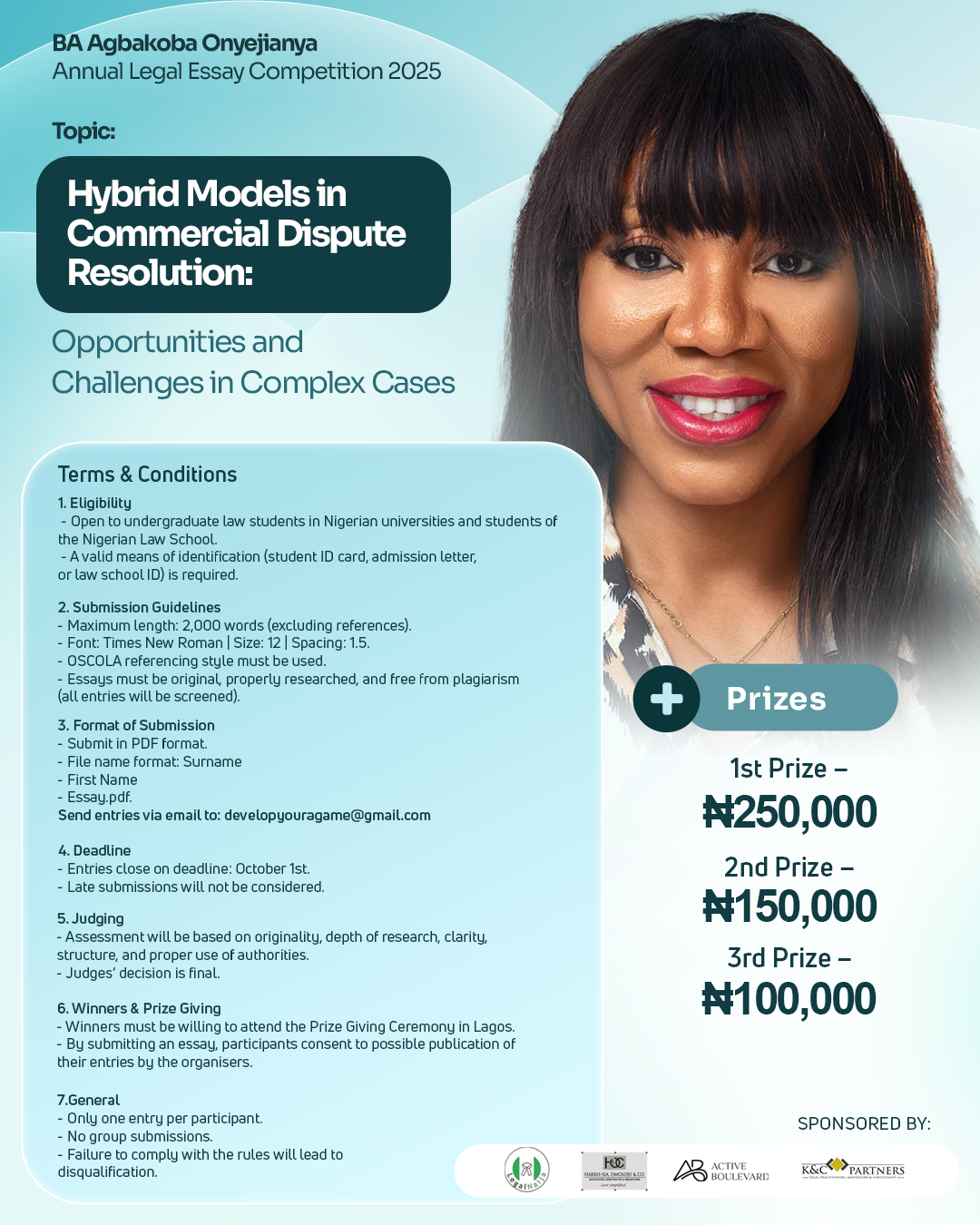
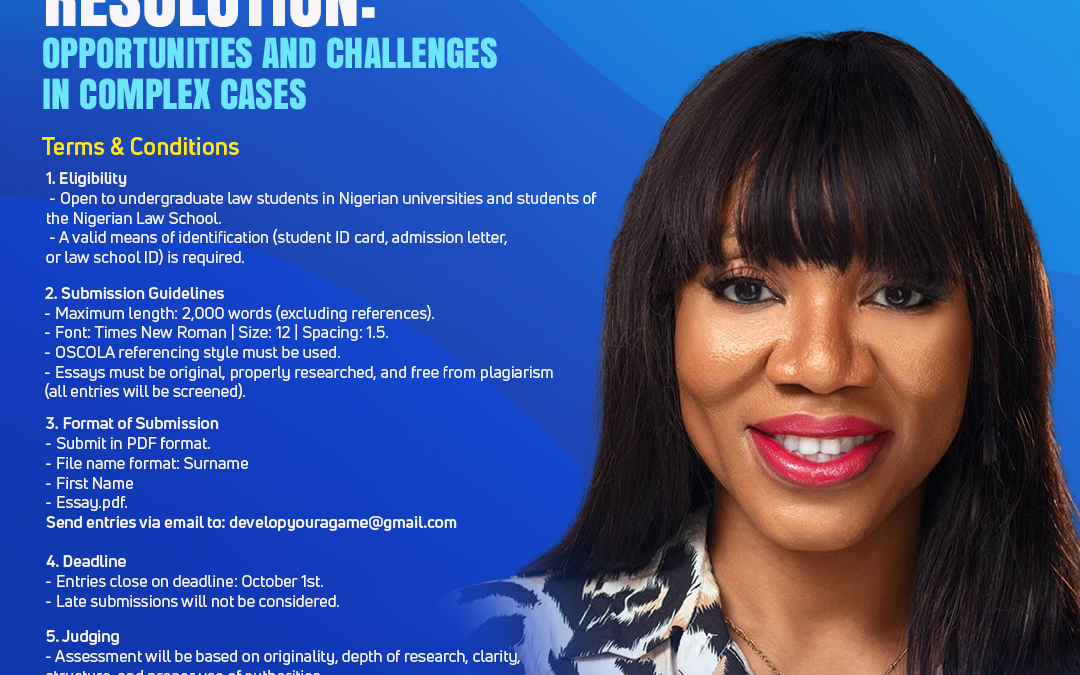
CALL FOR ENTRIES: Agbakoba Onyejiuwa Annual Legal Essay Competition 2025
Are you a Nigerian law student with a sharp mind and a passion for legal innovation? This is your moment to shine.
📌 Topic:
Hybrid Models in Commercial Dispute Resolution: Opportunities and Challenges in Complex Cases
💼 Eligibility:
Open to undergraduate law students in Nigerian universities and students of the Nigerian Law School. Valid student ID or admission letter required.
📄 Submission Guidelines:
– Max 3000 words (excluding references)
– Times New Roman | Size 12 | Spacing 1.5
– OSCOLA referencing format
– PDF format only
– Original, plagiarism-free work (plagiarism test will be conducted)
📅 Deadline:
1st October, 2025
📧 Submit to:
developyouragame@gmail.com
🏆 Prizes:
– 🥇 1st Prize – ₦250,000
– 🥈 2nd Prize – ₦150,000
– 🥉 3rd Prize – ₦100,000
📝 Winning essays may be published on CRWI, Bar & Bench, and other top legal blogs. This is more than a competition—it’s a platform to amplify your voice in the legal community.
Tag your law school crew. Let’s raise the bar. ⚖️
LegalEssayCompetition #AgbakobaOnyejiuwa2025 #Legalnaija #LawStudentsNG #CRWI #BarAndBench
by Legalnaija | Aug 24, 2025 | Uncategorized
THE NDPR TRUST MARK: A MISLEADING AND COUNTERPRODUCTIVE TOOL IN NEED OF REFORM
By Olumide Babalola
Introduction
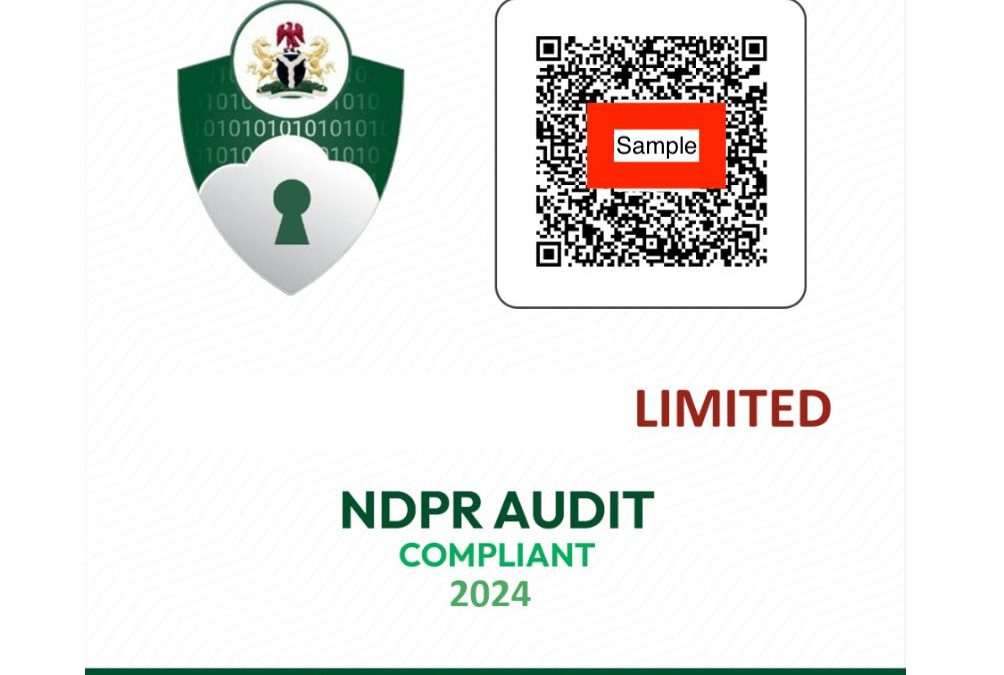
Under Nigeria’s data protection framework, certain categories of business entities are required to conduct and file annual data protection compliance audits (now formally referred to as Compliance Audit Returns (CAR) under sections 6(d) and 61(g) of the NDPA and Article 10 of the GAID). When the system was first introduced in 2019, the regulator issued confirmation emails as evidence of filing. However, upon transitioning to the Nigeria Data Protection Commission (NDPC), the practice shifted to issuing NDPR Trust Mark Certificates as proof of compliance with audit-filing obligations.
Although this innovation initially appeared professional and standardized, it quickly created misconceptions. Many organizations and even some privacy professionals, interpreted the Trust Mark as confirmation of substantive compliance, rather than a simple acknowledgment of audit filing. The result is widespread misrepresentation, with businesses brandishing the Trust Mark as proof of full compliance while neglecting their broader obligations under the law. This article examines the meaning of trust marks, why the NDPR Trust Mark (as currently issued) is misleading, and why reforms are necessary to avoid further confusion and counterproductive outcomes.
Understanding Trust Marks in Privacy and Data Protection Parlance
Globally, trust marks (also called privacy seals, certification marks, or trust seals) are visual indicators (logos, badges, or images) that signify compliance with predefined data protection or privacy standards. Typically, they are awarded by independent third parties and serve as signals of credibility to consumers, regulators, and stakeholders.
Needless to say, that the Nigerian idea of trust mark (although tweaked) was inspired by the EU GDPR’s creation of certification mechanism in Europe even though they continue to struggle with their problems of heterogeneity of the trust mark regime. In the EU, for example, the GDPR introduced certification mechanisms that serve as trust marks. These are often tied to regulated services such as electronic signatures, timestamps, and other qualified trust services, thereby enhancing confidence in digital transactions.
At their core, trust marks communicate that an organization has been evaluated and approved by a neutral third party against specific privacy or security criteria.
Why the NDPR Trust Mark is Misleading
Outdated Legal Reference: As of August 23, 2025, the Trust Mark issued by the NDPC still carries the label NDPR. Whereas the principal legislation since 2023 is the NDPA, not the NDPR. Continuing to issue certificates under the old regulatory regime only fuels legal and operational confusion especially in the light of conversations around the current status of the NDPR as extant or otherwise.
False Impression of Evaluation: Unlike global trust marks, the NDPR Trust Mark does not represent a thorough evaluation against defined privacy benchmarks. Instead, it merely confirms that an organization has filed its annual audit report. The absence of evaluation metrics, scoring frameworks, or substantive approval processes means that the Trust Mark conveys an inflated sense of compliance.
Conflicts in the Nigerian Audit Process: In Nigeria, audits are conducted by Data Protection Compliance Organisations (DPCOs), which are engaged and paid by the very companies they audit. This raises a fundamental conflict of interest: “he who pays the piper dictates the tune.” Furthermore, under Article 10 of the GAID, the obligation to conduct audits lies primarily with controllers and processors themselves. The law merely requires filing through a DPCO. Thus, the DPCO is not an independent evaluator but rather a service provider executing instructions. Without standardized scoring or evaluation metrics, the process does not amount to a true third-party certification.
Misconstrued Approval by NDPC: The most damaging misconception is the idea that the Trust Mark signifies NDPC’s approval of total compliance. In reality, audit reports are meant to highlight gaps, not certify perfection. The NDPC’s acceptance of audit filings cannot and should not be equated with substantive compliance. For instance, a company may dutifully file its audit while still failing to meet obligations around transparency, data subject rights, security safeguards, or purpose limitation. The Trust Mark, however, enables them to market themselves as “compliant,” which misleads the public and stakeholders alike.
Counterproductive Effects of the Trust Mark
The original purpose of audits was to help organizations identify and fix weaknesses in their privacy practices. Unfortunately, the Trust Mark has turned this process into a box-ticking exercise. This problem is especially acute among digital lenders and fintech companies, which often require the Trust Mark to secure licenses. Once obtained, many companies ignore the gaps identified in their audits, preferring instead to rely on the certificate as proof of compliance year after year.
The result is an illusion of compliance where organizations technically comply with the audit-filing requirement while ignoring broader obligations. Meanwhile, the NDPC’s true objective (i.e safeguarding data subjects’ rights) is undermined. In short, while the issuance of Trust Marks may inflate statistics on “compliance,” it does not reflect the reality of privacy protections in practice.
Recommendations for Reform
Replace the initial Trust Marks with Acknowledgment Notices: Instead of issuing Trust Marks upon audit filing, the NDPC should issue simple acknowledgment documents. These should confirm only that an audit has been filed, without implying broader compliance.
Introduce Remediation Timelines: Since audits reveal compliance gaps, the NDPC should require controllers to submit remediation plans with clear timelines for addressing deficiencies.
Adopt a Scoring and Evaluation Framework: True trust marks should only be awarded after substantive evaluation. The NDPC should create scoring metrics to assess compliance maturity, allowing organizations to be benchmarked and rated transparently.
Clarify the Scope of the Trust Mark: The NDPC should consistently emphasize that audit filing does not equate to substantive compliance. Public communication must reinforce this distinction.
Issue Trust Marks Post-Verification: Only after an organization has demonstrably closed the gaps identified in its audit should it be eligible for a genuine trust mark.
Conclusion
The NDPR Trust Mark, in its current form, is misleading, counterproductive, and ripe for reform. While intended as a symbol of compliance, it has instead become a shield for minimal effort and a source of confusion for stakeholders. For Nigeria’s data protection ecosystem to mature, the NDPC must realign the Trust Mark with its true purpose: a rigorous, independent certification of substantive compliance. Anything less risks perpetuating a culture of checkbox compliance while leaving the fundamental rights of data subjects unprotected.

by Legalnaija | Aug 7, 2025 | Uncategorized
Leading international law experts have called for increased integration of women in the development and implementation of clean energy transition policies and programs to achieve a just and inclusive transition agenda that leaves no one behind.
This recommendation was made at an online workshop organized by the Committee on Women, International Law, and Development of the International Law Association Nigeria (ILA Nigeria). Themed, ‘Energy for All: Bridging Gender Gaps in the Green Transition,’ the event also marked the official launch of the Journal of Sustainable Development Law and Policy special issue on ‘Gender Justice and Energy Transition in the Global South.’ The special issue, edited by the Committee Chair, Dr. Pedi Obani, and Committee member, Dr. Adenike Akinsemolu offers new theoretical and empirical insights on the intersections of gender and energy justice.
Moderated by Committee Vice Chair Barrister Titilope Akosa, the event featured leading international experts including the President of ILA Nigeria, Professor Damilola Olawuyi, SAN; the immediate past Director-General of the National Council on Climate Change Secretariat, Dr. Nkiruka Maduekwe; and the Head of the Renewable Energy Unit at First City Monument Bank (FCMB), Ms. Chinma George. The webinar also featured presentations by Dr. Opeyemi Gbadegesin, Dr. Eduardo Pereira, and Dr. Hilary Okoeguale, who authored papers for the special issue.
Committee Chair, Dr. Pedi Obani, who is also an Associate Professor of Law at the University of Bradford in welcoming participants emphasised that, “In Nigeria, as in much of the Global South, women are not only disproportionately affected by energy poverty and environmental degradation – they are also powerful agents of change driving sustainable solutions. Yet, structural and institutional barriers continue to limit their participation access to resources and decision-making power.”
In his keynote address, Professor Damilola Olawuyi, SAN, who is also an Independent Expert on the United Nations Working Group on Business and Human Rights, lamented the pervasive lack of women in leadership roles in the energy sector, which is at risk of being replicated in clean energy transition programs. Calling for the equitable distribution of the benefits and burdens of development policies, the Learned Silk stated that, ‘There is a clear and urgent need to mainstream a gender perspective in clean energy transition programs and policies.’ He identified five dimensions of justice for a gender-aware energy transition: cosmopolitan justice, procedural justice, reparative justice, social justice, and distributive justice. According to him, realizing these justice imperatives requires providing tailored opportunities for women to access the necessary financing, technologies, training and education needed for them to play active and leading roles in developing and commercializing green innovation and eco-entrepreneurial ventures. Professor Olawuyi stressed that achieving these goals demands innovative, gender-aware and equitable laws and policies.
In the second keynote, Dr. Nkiruka Maduekwe discussed the uneven impacts of the climate crisis on women and the underuse of women’s knowledge, leadership, and expertise in the energy sector. She pointed out that, ‘Despite the fact that women bear the brunt of energy poverty, we account for over 70% of off-grid energy users. We lack access to affordable energy.’ Dr. Maduekwe also noted the scarcity of women’s stories in climate-related reporting, despite their producing most wood fuel and being the primary managers of energy in households. She proposed solutions such as increasing girls’ and women’s exposure to STEM education, introducing a gender lens to legal and policy frameworks, and promoting gender-informed storytelling. She also called for public participation in Nigeria’s ongoing efforts to develop its third Nationally Determined Contribution under the Paris Agreement.
Guest speaker Ms. Chinma George highlighted gender gaps in the current transition framework, focusing on women’s experiences with energy poverty and their limited opportunities for employment and leadership in energy. She underlined FCMB’s role in addressing these issues by empowering women through access to finance – like zero-interest loans – promoting green products, improving financial literacy, and fostering public-private partnerships.
The presentations by authors of papers in the special issue reinforced discussions about the gender gaps in current transition programs across the Global South, including in Nigeria and Brazil, and proposed solutions through training policymakers on gender analysis, providing seed grants for women’s climate research, disaggregated data collection, and equitable constitutional design processes. Dr. Pedi Obani also highlighted the Committee’s ongoing projects geared at driving gender inclusion in critical sectors, such as energy, water, sanitation, and hygiene, and other areas. She called for collaboration towards building policies and systems that advance women’s rights and holistically cater to of all segments of society.
ILA Nigeria is a branch of the International Law Association, which was founded in Brussels in 1873. The Nigerian Branch of the ILA regularly hosts innovative lectures, seminars, conferences, and other capacity development programs to advance the study and understanding of international law in Nigeria. Its committees, such as the Committee on Women, International Law and Development, serve as its focal points for contributing to research, capacity development, and dialogue around key thematic areas of international law. To learn more about ILA Nigeria, its activities, and events, visit http://www.ilanigeria.org.ng

by Legalnaija | Jul 20, 2025 | Uncategorized
Franchise law is a relatively niche area of law in Nigeria. It is not as common as other areas of law in Nigeria. Franchising is a commercial aspect of law. Many law students would be familiar with the word ‘franchise’ from commercial law and contract law. Nigeria does not have a specific Franchise legislation like such countries as Brazil [Brazilian Franchise Law (Law No. 8955 of December 15, 1994)], Australia [Trade Practices (Industry Codes-Franchising)] or China [Measures for the Administration of Commercial Franchise)(2005)].[1] In this article, we shall discuss franchise law and franchise related laws in Nigeria.
What is a franchise? According to the International Franchise Association, a franchise is “the agreement or license between two legally independent parties which gives a person or a group of people (franchisee) the right to market a product or service using the trademark or trade name of another business (franchisor)”.[2] In layman terms, a franchise is a contract between two parties where one party (franchisee) agrees to market a product of another party (franchisor) in return for financial remuneration.
Franchise law on the other hand, is the law regulating the offer or sale of Franchises, business opportunities, seller-assisted marketing plans or similar relationships, or governing the relationships between franchisors and franchisees, manufactures and dealers, or grantors and distributors, including those laws that address unfair practices related to, or the non-renewal or transfer of, franchises, dealerships and distributorships.[3]What this means is that franchise law is a law that governs the relationships between a party who agrees to market/distribute a product (franchisee) on the behalf of the other (franchisor).
As was previously stated, Nigeria does not have a specific law in regards to franchising. However, just because there is no franchise specific law does not mean that franchising as a whole is not regulated in Nigeria. There are numerous laws in Nigeria that influence franchising in the country. Franchising is comprised of the following list of laws: Company Law, Intellectual Property Law, Tax Law, Labor Law, and Employment Law.[4]In scenarios where the franchisor is a foreign entity, other areas of law apply such as Immigration Law, Foreign Investment Law, Foreign Exchange Law and Money Laundering Law.
We shall now analyze the following statutes that have impacted franchising in Nigeria:
- The Trademark Act 1965 (Cap 436, Laws of the Federation of Nigeria 199). This deals with Trademarks, which is an aspect of Intellectual Property Law. As previously stated, intellectual property law is an element of franchising.
- The Patents & Design Act 1970 (Cap 344, Laws of the Federation of Nigeria 1990); This Act makes provisions for the proprietorship of Patents and Designs in Nigeria.[5] The 1970 Act is not franchise specific but has elements of franchising as a result of patents and designs.
- The Copyright Act 1988 (Cap 68, Laws of the Federation of Nigeria 1990); This piece of legislation is concerned with the ownership of copyrights in Nigeria. It is not a franchise-specific legislation but copyright is under intellectual property law which is an element of franchising. Section 3 of the Act talks about copyright by reference to country of origin. What this means is that any copyright that is published or made in Nigeria shall make reference to the country of origin of the copyright itself. Section 4A grants a company established under the laws of a country that is a party to an obligation to a treaty or other international agreement to which Nigeria is a party the right to own its copyright in Nigeria.[6]
- National Office of Technology Acquisition and Promotion (NOTAP) Act No. 70 of 1979 (Cap 268 Laws of the Federation of Nigeria 1990). This Act regulates the transfer of foreign technology to Nigeria. A franchise arrangement is regarded as involving the transfer of technology and as such is regulated by the provisions of the NOTAP Act. It should be noted that NOTAP is not the regulatory act for franchising in Nigeria. Section 4(d) and (e) of the NOTAP Act grants NOTAP the power to register franchise agreements involving franchisors. The section goes further to state that the agreement shall be registered if in the opinion of NOTAP, it involves the use of trademarks, the right to use patented inventions, the supply of technical expertise in the form of the preparation of plans, diagrams, operating manuals or any other form of technical assistance of any description whatsoever, the provision of operating staff or managerial assistance and the training of personnel etc.
- The Nigerian Investment Promotion Commission Act (Decree No. 16 of 1995). The NIPC Act is responsible for registering foreign investments in Nigeria, as well as liaising between investors and government.
- The Immigration Act 2015 (Cap. 171 Laws of the Federation of Nigeria 1990). This statute regulates the movements of persons entering or leaving Nigeria. This statute provides that any company with non-nationals must obtain a business permit in order to carry on business in Nigeria. Section 36(1) (b) of the Act states that any immigrant who wishes to conduct any business in Nigeria must obtain the consent of the Nigerian Minister of Interior in writing.[7]
- The Immigration Regulations 2017; Like the Immigration Act 2015, this act stipulates that any company with non-nationals must obtain a business permit in order to conduct any business in Nigeria. Section 4(1) of the Act asserts that for a foreign company to establish a business in Nigeria, it must first of all obtain a business permit from the Minister of Interior otherwise known as the “Minister”.[8] This is not franchise specific but it could be said that for a franchisor to set up a franchise in Nigeria it would need to obtain a business permit from the Minister of Interior.
- The Companies and Allied Matters Act 2020. This act deals with the registration and exemptions of foreign companies in Nigeria. Any foreign entity that intends to set up a business in Nigeria must incorporate a local company for that purpose. Section 78 of the Act asserts that any foreign company that intends to carry out business in Nigeria shall take all necessary steps to incorporate the company as a separate entity in Nigeria and until such act is achieved, cannot conduct business in Nigeria.[9]
Agencies that Regulate Franchising in Nigeria
In many jurisdictions, thee are special agencies that regulate franchising and implement franchise-specific laws and regulations. However, in Nigeria, there is no specific-designated franchise agency. What you have are agencies that regulate elements of franchising such as:
- The Registrar of Trademarks, Patents and Industrial Design, Federal Ministry of Commerce;
- The Nigerian Copyright Commission which is under the Ministry of Culture;
- The National Office for Technology Acquisition and Promotion;
- Nigerian Investment Promotion Commission and
- The Corporate Affairs Commission.
Conclusion
Nigeria does not have a franchise-specific legislation. However, as previously mention, many laws in Nigeria affect franchising agreements directly and indirectly. Does Nigeria need a franchise-specific legislation? Sure it does. As Nigeria seeks to attract foreign investment into its jurisdiction, there will be a need to regulate the activities of foreign companies in the country in order to protect local businesses (franchisees).
BIBLIOGRAPHY
LIST OF STATUTES
- Copyright Act (Cap. 68, Laws of the Federation of Nigeria, 1990 as amended by the Copyright Amendment Decree No. 98 of 1992 and the Copyright (Amendment) Decree 1999).
- Companies and Allied Matters Act, 2020.
- Immigration Act, 2015.
- Immigration Regulation, 2017.
- Nigerian Investment Promotions and Commissions Act,
LIST OF WEBSITES
Babatunde Denton is an associate of The City Law Associates. He was called to the Nigerian Bar in 2016 and specializes in immigration law, commercial law and intellectual property law. His contact address is Suite 3, 18 King George V Street, Onikan, Lagos. Email address is denton@citylaw.ng.
[1] http://www.nigerianfranchise.org/images/NiFA_Newsletter_03_05_14.pdf
[2] https://archive.businessday.ng/professional-services/article/franchising-law-in-nigeria/#:~:text=Nigeria%20does%20not%20have%20a%20franchise-specific%20legislation.%20In,Disclosure%20Act%20of%202006%29%20that%20have%20franchise-specific%20laws.
[3] https://www.lawinsider.com/dictionary/franchise-law
[4] https://archive.businessday.ng/professional-services/article/franchising-law-in-nigeria/#:~:text=Nigeria%20does%20not%20have%20a%20franchise-specific%20legislation.%20In,Disclosure%20Act%20of%202006%29%20that%20have%20franchise-specific%20laws.
[5] http://www.commonlii.org/ng/legis/num_act/pada195/
[6] Copyright Act (Cap. 68, Laws of the Federation of Nigeria, 1990 as amended by the Copyright Amendment Decree No. 98 of 1992 and the Copyright (Amendment) Decree 1999).
[7] Section 36 (1)(b) of The Immigration Act 2015, Laws of the Federation of Nigeria.
[8] Section 4 (1) of The Immigration Regulations, 2017
[9] Section 78 (1) of the Companies And Allied Matters Act, 2020.
by Legalnaija | Jul 3, 2025 | Blawg, Uncategorized
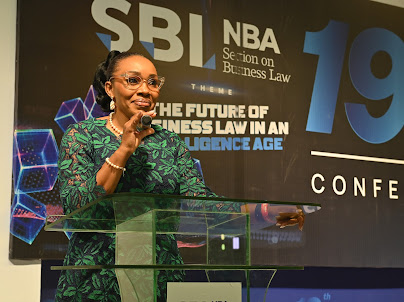
Good afternoon, distinguished guests, colleagues, friends, and partners.
I am pleased to welcome you all to the 19th Annual International Business Law Conference of the Nigerian Bar Association, Section on Business Law.
We are gathered here today not just for another conference but for what has become a defining tradition: an annual meeting of minds across industries, disciplines, borders, and generations. And it is fitting that we return to this space, Lagos, Nigeria’s commercial heart, to reflect, learn, and chart a way forward in our legal profession.
The theme of this year’s conference, “The Future of Business Law in an Intelligent Age,”could not be more timely. We are witnessing a global redefinition of how business is conducted, how information is processed, and how value is created. Artificial intelligence, data ecosystems, and predictive technologies are no longer ideas on the horizon; they arehere and now – today’s realities that we must engage with directly, as lawyers, as business leaders, as policymakers, and as players in every economic space.
This moment demands that we, as a legal community, become not just participants but shapers of the future. We cannot afford to remain observers on the sidelines of technological change. We must be architects of legal frameworks that are responsive, adaptive, and bold enough to embrace the unknown without sacrificing our principles. This means strengthening our engagement with regulators, legislators, and institutions, ensuring that the law evolves alongside innovation, not behind it.
Through plenaries, breakout sessions, fireside chats, master classes, and informal conversations, we will interrogate the intersection of law, innovation, regulation, investment, and impact. This year, we are especially honoured to have His Highness, Khalifa Muhammad Sanusi II, deliver our keynote address; his experience as a reformer and thought leader will set a powerful tone for the work ahead. Over the next 3 (three) days, we will explore how emerging technologies are transforming industries, from manufacturing and aviation to fintech, healthcare, entertainment, and education, and ask ourselves what role we must play to ensure that business law remains not only relevant but indispensable in shaping the future. This year’s programme has been carefully curated to ensure that we are leading the ongoing discussions around shaping contextually relevant, commercially sound, and socially conscious responses.
This conference is not just about the future of business law; it is about the future of business. As Africa positions itself as a hub for innovation, trade, and investment, the Nigerian legal community has a critical role to play in shaping policies, fostering trust, and driving the integrity of markets across the continent. What we discuss here will echo far beyond this hall, and the ripple effects of our ideas and actions will be felt in boardrooms, courtrooms, startups, government houses, and classrooms.
What makes this gathering truly powerful is not just the programme, it is the people. This
year, we welcome over a thousand delegates, seasoned professionals, young lawyers, regulators, senior advocates and leaders of this profession, public servants, entrepreneurs, creatives, and investors. Each of you brings your experience, perspectives, and energy. I encourage everyone connect, collaborate, contribute. To the lawyers, I say this – whether you advise multinationals, lead internal legal teams, or represent SMEs navigating change,
there is something for everyone here: insight, tools, and connections that can strengthen how you show up in your role and for your clients.
I would like to thank the President of the Nigerian Bar Association, Mazi Afam Osigwe, SAN, for his leadership of our bar, and his support for this Section. I would also like to thank the executives of the NBA who at various times alongside our President have provided support and guidance to me in my role as the chairman of this section. Let me take a moment to acknowledge and thank the phenomenal team that made this conference possible, the 2025
Conference Planning Committee under the committed leadership of Ms. Solape Peters (Chair) and Mr. Oludare Senbore (Vice chair). I also thank our sponsors and partners, whose support reflects their belief in the importance of this platform. To all our resource persons who have so graciously committed their time and expertise – you have our
gratitude. And the SBL Executive Committee and Secretariat, whose tireless behind-thescenes work has brought this vision to life – thank you. Over the past year, we have deepened our investment in capacity-building, expanded our digital footprint, and created new spaces for dialogue across sectors. The SBL continues to evolve, and I am proud of the energy, inclusiveness, and direction this leadership team has championed.
As we open this 19th edition of the NBA-SBL Conference, let us remind ourselves that we are here not just to witness change, but to influence it. Not just to talk, but to act. Not just to listen, but to lead.
I hope that by the time we leave this venue in a few days, we will do so with more than just conference bags and notebooks; we will go with new ideas, new relationships, new perspectives, and a renewed commitment to making business law work for this intelligent, ever-evolving age. On behalf of the NBA-SBL Executive Committee and the Conference Planning Committee, I welcome you all.
Thank you.
by Legalnaija | Jun 23, 2025 | Uncategorized
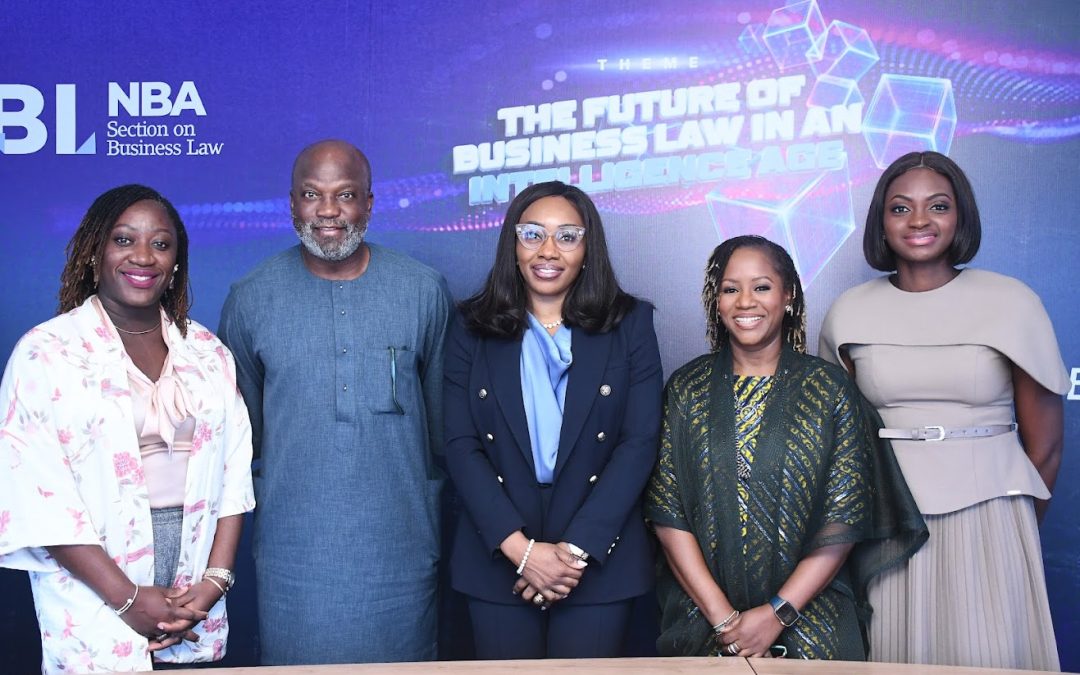
The Nigerian Bar Association – Section on Business Law (NBA-SBL) held its press conference ahead of the 19th Annual International Business Law Conference, a premier gathering of legal professionals, members of the press and business leaders. The program commenced at 11:00 AM, with Miss Rachel Olayemi serving as the anchor. After introducing herself, Miss Olayemi provided an overview of the day’s program. This was followed by the welcome address delivered by the Chairman of the NBA-SBL, who provided insight into the core objectives and significance of this year’s conference.
In her address, the Chairman emphasized that the conference was not simply a response to changing times, but a deliberate effort to lead the transformation of business law both in Nigeria and globally. She noted that in this era of digital information and artificial intelligence, the legal industry must actively engage in shaping the future. This year’s program was thoughtfully curated to reflect the “era of intelligence” in business across vital sectors of the economy.
She went on to explain that the conference would feature five plenary sessions and six breakout sessions, in addition to networking events, and would conclude with a closing party. She stated that the conference would host members of the press, policymakers, legal professionals, and industry stakeholders, underscoring its national and international importance.
Following the welcome address, Mrs. Solape Peters, a partner at DLA Piper and the Chairperson of the 19th Conference Planning Committee, shared her reflections on the purpose and expected outcomes of the event. She pointed out that technology now lies at the heart of every industry, and the business law sector must not lag behind. She highlighted the collaborative role of the Business Law Section with the National Assembly in drafting legislation that will foster a favorable environment for business operations in Nigeria.
Mrs. Peters also remarked that the Section on Business Law is renowned for organizing conferences that shape legal and regulatory discourse and directly influence how governance affects business. This year’s conference, she said, is designed to spark a mindset shift among those unfamiliar with emerging developments and to offer fresh perspectives to those already on the path of legal innovation. She also announced that two specialized masterclasses would be introduced this year.
Mrs. Peters further acknowledged the immense support of sponsors, stating that their continued partnership has been instrumental in ensuring the successful hosting of the conference year after year. She noted that the planning committee had engaged stakeholders from the regulatory, public, and private sectors, with the expectation that the discussions and outcomes of the event would help drive legal and policy reforms.
Also speaking at the opening session was Mrs. Yeside Asolo, a partner at Kayode Sofola & Associates and the Content and Program Chairperson. She provided a detailed breakdown of the conference schedule. According to her, the event would commence with a lunch on July 2nd, while the main sessions would begin on July 3rd, featuring four plenary sessions covering international trade, healthcare, and technology. The third day, would focus on sectors such as manufacturing, power, oil and gas, and aviation. The conference would conclude with a closing party, offering attendees the opportunity to unwind and network in a relaxed atmosphere.
Finally, the Chairperson of the Media Strategy Committee also addressed the audience, highlighting the media plan for the year. She stated that the media strategy is designed to:
- Showcase the value of the conference to all attendees,
- Attract professionals seeking networking and collaboration opportunities, and
- Draw global attention to the significance of the NBA-SBL conference as a leading platform for business law discourse in Africa.
The emphasis was on using strategic media engagement to amplify the impact of the conference beyond the legal community and to demonstrate the NBA-SBL’s commitment to influencing national policy, legal reforms, and business-friendly regulatory frameworks.
In conclusion, the NBA-SBL 19th Annual Business Law Conference promises to be an intellectually stimulating and strategically significant event, with a clear focus on technology, innovation, collaboration, and legal reform. With diverse participation from legal practitioners, policymakers, industry experts, and international stakeholders, the conference is set to shape the future trajectory of business law in Nigeria and beyond. The inclusion of targeted masterclasses, comprehensive plenary sessions, and structured networking opportunities underscores the Section’s commitment to providing value, relevance, and impact to the legal and business communities it serves.

by Legalnaija | Jun 17, 2025 | Uncategorized
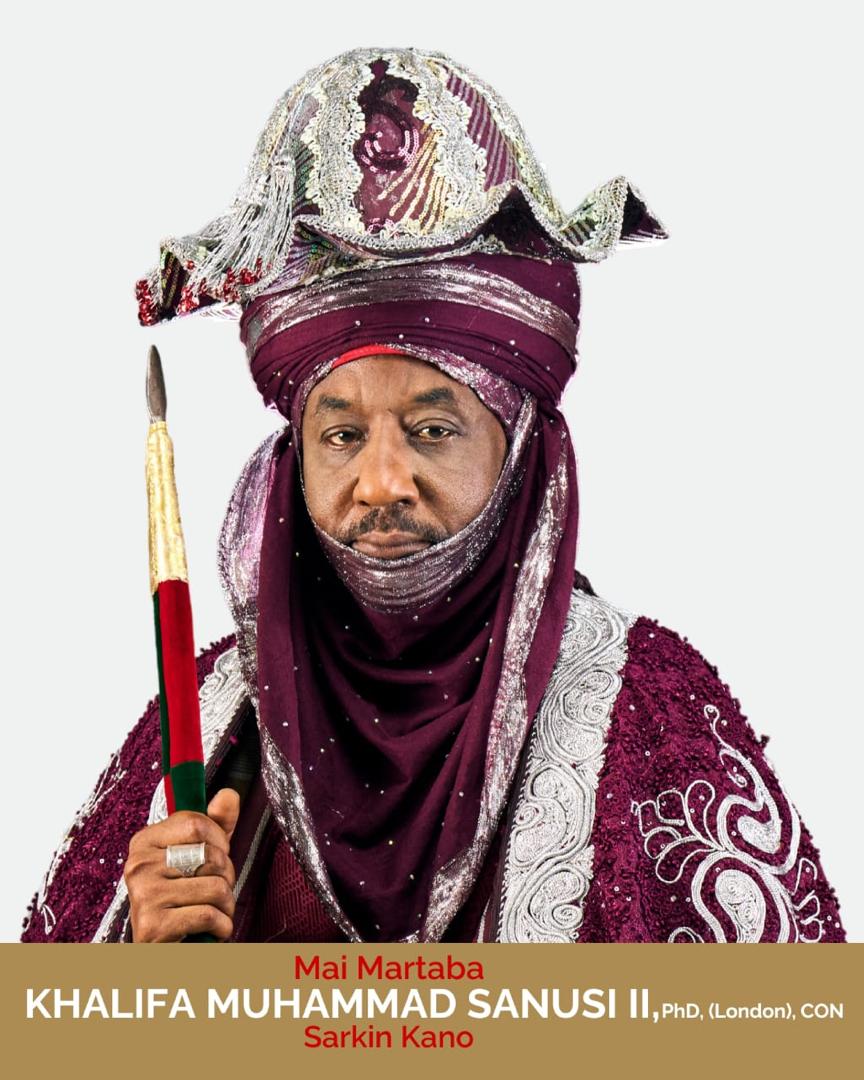
The Nigerian Bar Association Section on Business Law (NBA-SBL) is proud to announce His Royal Highness, Khalifa Muhammadu Sanusi II PhD (London) CON, as the Keynote Speaker for the 19th Annual Business Law Conference, scheduled to take place from July 2nd to 4th, 2025, at Harbour Point, Victoria Island, Lagos.
His Royal Highness. Khalifa Muhammadu Sanusi, the 14th Emir of Kano and former Governor of the Central Bank of Nigeria, is globally renowned for his bold economic reform advocacy, intellectual depth, and principled public service. His keynote address is expected to set a compelling tone for the conference, offering critical insights at the intersection of law, governance, and innovation—perfectly aligned with this year’s theme: “The Future of Business Law in an Intelligence Age.”
In addition, the conference will host an esteemed delegation of special guests whose presence underscores the growing collaboration between the legal profession, the judiciary, and the business and policy communities.
Expected at the conference are Chief Lateef Fagbemi, SAN; the Honourable Minister of the Justice and the Attorney General of the Federation, Justice Kudirat Kekere-Ekun, the Chief Judge of the Federation, Chief Judge Lagos State, Justice Kazeem Olanrewaju Alogba and the President of the Nigerian Bar Association, Mazi Afam Osigwe, SAN their presence highlight the pivotal role of technology and digital policy in shaping the future of legal practice and commerce.
Speaking on the announcement, Mrs. Ozofu Ogiemudia, Chair of the NBA-SBL, stated:
“The presence of His Royal Highness and our distinguished guests not only reflects the relevance of our theme but also affirms our shared commitment to advancing the frontiers of business law in Nigeria. This year’s conference is poised to offer powerful insights, robust discourse, and lasting impact.”
Ms. Solape Peters, Chair of the Conference Planning Committee, added:
“We’re building a conference that looks boldly into the future—one that challenges assumptions and equips legal professionals for the intelligence age. With this exceptional lineup, we’re confident that the 2025 conference will be one of our most transformative yet.”
Registration for the conference is currently still ongoing; there are limited slots for physical attendance and virtual attendance is still open. Legal practitioners, policymakers, industry leaders, and innovators are encouraged to secure their place at what promises to be a landmark event.

by Legalnaija | Jun 9, 2025 | Blawg, Book, Uncategorized
#NBALagosConference: Unlock Exclusive Savings on Legal Books – Limited Time Offer!
LegalNaija is giving you the chance to unlock incredible savings on top-tier legal books! Use the voucher code **NBALAGOS25** at checkout and enjoy **up to 20% OFF** selected items.

Offer valid from NOW until June 20, 2025—don’t wait too long!
Discover high-quality legal books at unbeatable prices.
Shop smarter, save bigger—grab your essentials today!
Visit: www.legalnaija.com/store
Contact: +234 9029755663 | hello@legalnaija.com
Offer only available on website!
#LegalNaija #NBALagosBranch #ExclusiveOffer #LegalBooks #SaveMoreSpendLess