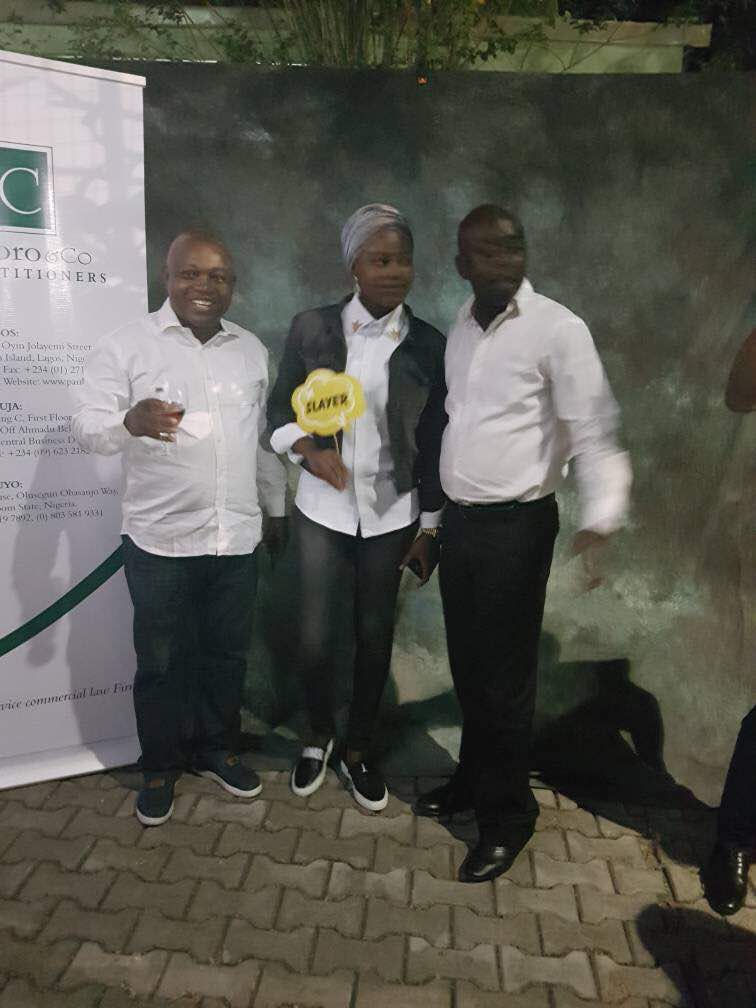
PUC Holds Annual New Year Party

PUC Holds Annual New Year Party

It was an evening of fine wining and dining as one of Nigeria’s leading legal chambers, Paul Usoro and Co., PUC, held her annual New Year Party at the Colonades Hotel, Ikoyi.

The Event was well attended by staff of PUC, who came out to have a good time and celebrate the successes of the past year and usher in the year 2018.

Paul Usoro & Co is led by Paul Usoro, SAN, one of Nigeria’s foremost communications law experts.

Represented at the event, Mr. Usoro commended the entire PUC team for their consistency and diligent efforts in ensuring that 2017 was a successful year. “Indeed, this is a gathering of deserving lawyers who have worked hard and contributed to our success in 2017. One of the highpoints of 2017 was that we were recognized as the Transport Law Firm of the year by the Global Law Experts. As I officially welcome us all to 2018, I want to encourage us to keep up the team spirit and diligence so that we can have a better year.

See photos below…..

Tv And The Law- Legal Issues With Film Making In Nigeria

Tv And The Law- Legal Issues With Film Making In Nigeria

Entertainment on TV is a great form of
“decompression”. I personally enjoy cartoons and movies produced in Hollywood,
Bollywood, and of course my very beloved Nollywood. Growing up, I vividly
remember watching Nigerian Movies like 
Violated and soap
operas like 
Checkmate and Beyond the Clouds with
family. This tradition has obviously continued, as we just saw 
The Wedding
Party, 
which by the way is hilarious, and we are currently earnestly
awaiting 
The Royal Hibiscus Hotel.

Through this, it’s impossible to miss the
fact that the Nigerian movie industry aka Nollywood has and is experiencing an
evolution from the home video outfit as we knew it, to a full blown production
apparatus. This is evident in the plot quality, script and cast. Without a doubt,
Nollywood has emerged to be a vibrant sector in the Nigerian economy. Who would
have thought?
In light of these advancements, a lot of
opportunities for improvement have consequently been revealed. As is similar
with other emerging industries, having an effective and proactive legal frame
work has been the major key to sustainability and profitability; hence the
purpose of this write up is to point out the various legal issues that may
emerge, as various stages of production in Nollywood.
For the purpose of this write up, I have
summed the stages of film production into three parts:
1)    The
Pre-Production stage:
This is the initial
stage where the idea for any production is conceptualized. This stage includes
but isn’t limited to sourcing capital, location and crew scouting, development
of set.
2)    The
Production stage:
This stage involves
the actualization of the concept – technically the first proof of concept.
3)    The
Post Production stage:
This stage involves
the marketing to the target audience, negotiation with channel partners to
enable distribution. These channel partners, might be cinemas and actual sales
outlets.
Of course, through these stages a number of
legal issues arise – I will enumerate a couple below in no particular order;
1)    Protecting the
Intellectual properties (ideas and concepts) that are to be used in the
production via Intellectual Property Laws.
2)    Developing or
acquiring a script. In the case of the latter, effectively negotiating with the
script writer about property rights.
3)    Agreement on
securing debt to fund the productions and terms on repayment and defaults.
4)    Non-disclosure
agreement to secure intellectual property that wouldn’t be featured in the
final production.
5)    Acquisition and
negotiation of right of use and access to various locations essential to the
success of the production. Example, shooting a scene in a government owned
airport.
6)  
Acquisition of required licenses from original right owners. Example, right to
use of songs, artistic works in Gallery.
It’s definitely reasonable to seek relevant
legal advice to avoiding actionable scenarios.
Below are some things to put in mind.
Contractual relationship issues:
1)    What
to do when contracting with a partner outside the country
2)    Contracts
with Actors, producers, Director, and other parties involved in the production
process
3)    Contracts
with the channel partners
4)    When
agreements are said to reached by both parties
Piracy legal issues
1)    Enforcement
of Intellectual Property Rights
2)    What
constitutes infringement of these rights.
3)    Determine
the chain of title in a film – who owns what and how they can be enforced.
Case in point Mike Tyson’s Tattoo
in Todd Philips’ The Hangover Part 2
S. Victor Whitmill, the Tattoo artist who
created a distinctive tribal tattoo for boxer Mike Tyson, sued Warner bros to
prevent the release of the sequel because his copyrighted artwork had not been
properly licensed. Though the tattoo was on Mike Tyson’s face in the original
film, in the sequel it appeared on Ed Helms Face and was on major posters
advertising the film.
Although the artist failed in his attempt
to secure an injunction stopping the release of the movie, he proceeded on a
copyright infringement suit. In rejecting the suit ,the Judge -Catherine D
Perry indicated that she believed Mr. Whitmill suit has a great chance of
success , as she confirmed that a tattoo being an artistic work can be
copyrighted. She also rejected Warner Bros defense of Fair use.
Although Tyson received the tattoo in 2003,
he also signed a document stating that the artist keeps the rights. Warner Bros
claims that their rights to use the tattoo is part of the agreement with Tyson,
but if Tyson never had those agreement in the first place it will be difficult
to claim.
The foregoing case could have been avoided
and funds put to better use by finding out what rights are needed and acquiring
the proper license from the Artist or persons you believe granting the rights
actually owns them.
Having a lawyer on retainer is definitely
worthwhile to enable a smooth sail through the various production stages.
Toju
Dottie
Senior Associate & Consultant
George Ikoli & Okagbue

Source; Linkedin 
Fashion And Law In An Emerging Economy | Toju Dottie

Fashion And Law In An Emerging Economy | Toju Dottie

Ralph Lauren once said that “Fashion
is not necessarily about labels, it’s not about brands. It’s about something
else that comes from within you”. He was basically alluding to the fact
that fashion in its tangible form – is a statement. A statement of simplicity
or explicit extravagance. These statement have been in forms
of accessories, scents, or general combination of various fabrics to
make distinctive apparels as is common in Sub Saharan Africa. On a
personal front,fashion has been a medium for projecting a bit of my personality
and current mood.

Growing up, threads, needles and sewing
machines were common fixtures of my childhood- thanks to my mother’s love/
hobby, which eventually became her “main hustle”. Looking
retrospectively, being around the entire creative process led to my lifelong
fascination with everything fashionable.
Recently, I was opportune to attend a
private viewing of a Nigerian Fashion Brand (MAZELLE) Summer Spring 2018
Collection- it’s definitely worthy of note that the fashion industry in
Nigeria, has evolved from the era of “Obioma” (road side tailor) to a
recognized industry. This evolution has definitely brought to light the need to
have a formidable regulatory body/ association to advance and advocate the
cause of the fashion Industry in Nigeria. A body, similar to The Arab Fashion
Council, British Fashion Council and The Council of Fashion designers in
America. These councils have and are continuously contributing to the longevity
of the fashion industry in their various economies.
In light of aforementioned and given the
unique situation of the Nigerian Fashion Industry- The below list ( neither
conclusive nor an exhaustive list) will help emerging fashion entrepreneurs,
fashion enthusiast and established brands understand few legal
frameworks and issues associated with a fashion establishment.
1.     Setting
up a Fashion Enterprise – This involves the incorporation of the business,
structure and funding of the business.  In developing personal names
as fashion brands, designer should be aware that there are a number
of risks that could arise- in the event the company is sold they
might lose the right to use their names in the industry. They might also
encounter hurdles in registering their personal name as a trademark.
Structure and funding of a business ( whether fashion or not) is an integral
part of any organization as it sets the foundation and the core of the
business.Case- Kylie Minogue Vs
Kylie Jenner
– Kylie Jenner filed to register the name KYLIE as a
trademark in relation to advertising services and endorsement services but was
blocked by way of an opposition application brought by  Veteran
Australian Pop Star Kylie Minogue citing possible confusion and damage to
Minogue’s Branding. According to papers filed in the US patent and
Trademark Office ( USPTO), Minogue’s legal team noted that their client a
renowned performing artist , humanitarian and breast cancer activist already
owned  KYLIE related trademarks in the US in several
industries as well websiteswww.kylie.com. However Minogue’s
team withdrew its opposition so there is a possibility they agreed to a
settlement. 
2.     Intellectual
Property Issues- This boarders on Trade mark registration, Design
protection and copyrights involved in the business. We have seen this play out
with the different litigation cases that have occurred involving brands
like Christian Louboutin, Yves Saint Laurent (YSL), Gucci and Forever 21 e.tc.
Knowing the exact type of Intellectual Property that pertains to the
business and the laws involved is fundamental in the industry to protect
the brand and enforce rights attached to it.  Case- Christian Louboutin Vs Yves Saint
Laurent(YSL)
 – Shoe Designer Christian Louboutin battled YSL in court
over ownership of his famous red soles. The litigation began when the French
house launched a collection of shoes in a range of colors , each with a
sole that matched its upper. The court held that Louboutin could not prevent
other brands from creating red shoes with red soles, but that no other brand
should create a shoe contrasting with a red sole as that was
likely to cause confusion for customers who would assume the shoe was by
Louboutin. Christian Louboutin who holds a valid US trademark is headed back to
court again to protect his trademark in the European Union; hence making sure
that European brands adhere to the guidelines.
3.     Retail-  This
deals with the final product reaching the consumers either from a storefront
or via online platforms. Ensuring PCI (payment card industry) compliance
with every transaction is key when transacting online.There is also a duty to
secure the customer’s information.
4.  
Contractual Relations- Validity and enforcement of contracts such as Employment
( Labour matters) , Sponsorship and Sales agreements, Licensing , partnerships
and franchise e.tc
5.      International
Trade- This involves expanding the business. This will also
raise several issues and engage several regulatory bodies such as
the  Standard Organization of Nigeria, The Nigerian Export and
Promotion Council and the Nigerian Custom for border control. These bodies
usually render advise and enforce Intellectual Property Rights of brand owners
against counterfeiters.
6.     Marketing-
This is one of the major factors in the fashion industry as it involves
introducing the brand to its consumers or the general public. This is
where social media platforms and fashion bloggers have created a niche for
themselves and have held the power to shape the public’s perception of the
brand. Brand owners have a right when the blogger’s narrative is not true or
slanderous of the brand. Bloggers should be aware of copyright laws on
infringement with a focus on content ownership and syndicated issues. The
blogger should also be armed with the( knowledge of) defence of Fair
Use in its application to posts especially in photography and where to get
photos.
Engaging the services of a lawyer is
absolutely important to navigate through the industry.
Disclaimer: This article is only intended
to provide general information on subject matter and does not itself
create a client /attorney relationship between the reader and the author.
Specialist legal advise should be sought about the readers specific
case.
Toju
Dottie
Senior Associate & Consultant
George Ikoli & Okagbue

Source – Linkedin 
SARS: The Necessity For A Total Structural Overhaul| Motunrayo Olaleye

SARS: The Necessity For A Total Structural Overhaul| Motunrayo Olaleye

INTRODUCTION
The Nigerian Police (NP) is the principal
law enforcement agency in Nigeria and its functions, duties and powers are
contained and regulated by the Police Act (CAP P19 Laws of the Federation of
Nigeria 2004). Additionally, Police Officers are subject to the code of conduct
for Police Officers.

The Criminal Investigation Department is
the highest criminal investigative arm of the Nigerian Police Force. The
Special Anti-Robbery Squad (commonly known as SARS) is one of the 15 units
under the Nigerian Police Criminal Investigation and Intelligence Department.
Its duties include the arrest, investigation and prosecution of suspected armed
robbers, murderers and others involved in the commission of violent
crimes. 
The NP are an organization recognized as
the custodians of security and order in society. However, in light of current
events, the SARS unit of the NP is being touted as a violent, exploitative and
oppressive system by disgruntled citizens. This article shall consider the
negative reputation of the SARS and highlight the rule of law in relation to
the powers of the NP.
NARRATIVE
The writer will present a very familiar
scenario which most Nigerians have experienced firsthand, witnessed or been
told about.  A lot of people will affirm
that this story is a familiar one.
A young man on vacation to Nigeria is
arrested while taking a leisurely stroll in the evening. He is confused as to
the reason he has been arrested but strongly believes an explanation will be
given; after all everyone is allowed to take strolls, right? He is subsequently
whisked off to an unknown police station, and after 48 hours in detention with
no communication with his family; his belief that he cannot be arrested for no
reason at all has faltered greatly. He has of course been stripped of all his
personal effects; his fancy phone inclusive. By the time a kind person manages
to contact his mother on his behalf; his belief has taken a complete turn
around and now he is certain that there is no escape from the hell hole he
exists in. This is not a place where shouting, crying or begging achieves any
results.  His mother’s joy that her only
son has been found and was not kidnapped as she previously feared is cut short;
perhaps his fate may have been better at the hands of kidnappers who merely
wanted a satisfying ransom.  This young
man was right after all; because he was killed in custody with the explanation
that he was a robbery suspect who tried to escape. Many of such people are not
alive to tell their story. They have been silenced forever; the horrors they
faced not to be discovered by anyone.
STATUS
QUO
Nigerians in their myriad of challenges
forget the past, until the present reality resurfaces buried memories. Sequel
to various continuous reported and unreported incidents of abuse, harassment,
unlawful detention, extortion and murder by officials of the Special
Anti-Robbery Squad; Nigerians are now advocating vigorously for the elimination
of SARS on social media and the campaign against SARS is trending.
A series of reports have been made in the
past few years with respect to the degrading treatment and unjust harassment
frequently meted out by SARS operative; a notable report is the one made by
Amnesty International in 2016 (https://www.amnesty.org/en/latest/news/2016/09/nigeria-special-police-squad-get-rich-torturing-detainees/)
wherein a press release accusing SARS officials of extortion, torture and
inhumane treatment was vehemently refuted by the Inspector General of the
Nigerian Police Force.
Irrespective of the admittance or refusal
of the allegations levied against officials of SARS, it is no news that the
motto of the NP; “Police is your friend” is very laughable in Nigeria. Millions
of people have been harassed and oppressed and continue to be subject to
dehumanizing and degrading treatment by police men while supposedly carrying
out their duties.
It would appear that most people while not
being completely ignorant of their rights simply do not know what to do, and
the few that are informed would understandably cower in fear or have lost the
will to fight for a seemingly hopeless cause.
The need to reiterate our basic rights
cannot be over emphasized as we continue to lend our voices as a sword till we
get the desired result.
STATISTICS
According to the PRAWA (a Non-governmental
organization aimed at promoting Security, Justice and Development in Africa) Report
on Prisons Monitoring, Investigation and Documentation of Torture Incidence in
Enugu State conducted in March 2011, The Special Anti-Robbery Squad has Police Officers
who are designated to torture crime suspects. Such Police Officers have an
unofficial designation like “OC Torture” (Officer In Charge of Torture), and
they have special skills in infringing various methods of torture on their
victims; which methods include but are not limited to prolonged detention in
police custody, gunshot wounds, severe beatings with police baton and other
dangerous objects , burning with hot objects, squeezing of testicles and
inserting objects into the penis, insertion of nails on feet, electric shock,
suspension on the tree in different positions and cutting with cutlass. (www.prawa.org)
LEGAL
PERSPECTIVE
The various forms of infringement of our
fundamental human rights in the exercise of the powers of officials of the SARS
will now be considered in tandem with the existing legal frame work that should
regulate the conduct of Police Officers.
It is relevant to note as a preamble that
Article 5 of the Universal Declaration of Human Rights and Article 7 of the
International Covenant on Civil and Political Rights provide that no one shall
be subjected to torture or to cruel, inhuman or degrading treatment or
punishment. Nigeria as a country should aim to achieve internationally
recognized standards of human rights, not only by the mere ratification of
international treaties and conventions but in the practical demonstration that
as a nation, we uphold the sanctity of life and we view human rights as
paramount.
Arrest
without warrant:

Section 24 of the Police Act provides that a Police Officer can lawfully arrest
without warrant for a felony, a misdemeanor, a simple offence or for breach of
peace. It would therefore appear that a Police Officer can arrest without
warrant at all times; as the definition of what qualifies as reasonable
suspicion remains non-specific and non-delineated.  However; Section 3(1) of the Administration
of Criminal Justice Law 2011 (ACJL) provides that the Police Officer must
inform the person arrested of the cause of the arrest. Similarly, Section 4 of
the Police Act prohibits arresting a person in lieu of a suspect; which implies
that one person cannot be arrested in place of another. Additionally, Section 3
(2) & (3) states that the person must also be informed of his right to
remain silent, the right to consult his lawyer before making any statement and
the right to free legal representation. Furthermore, by the provisions of
Section 35 (5) of the 1999 constitution a person who is arrested without
warrant must not be detained for more than 24 hours where there is a Court of
competent jurisdiction within a radius of 40kilometres or in any other case, 48
hours or for such longer period that the Court may consider to be reasonable. A
deviation from the provisions of the law on arrest entitles the victim to seek
enforcement of his fundamental rights, damages and a public apology.
Torture
and inhumane treatment:
Nigeria has ratified the International Convention on
Civil and Political Rights (ICCPR) in 1993, the Convention against Torture
(CAT) in 2001 and the Optional Protocol to the Convention against Torture
(OPCAT) in 2009. Additionally, Nigeria is a member of the African Charter on
Human and People’s rights. Irrespective of the above, the practice of torture
and ill treatment by Police Officers in general and officials of SARS particularly
remains rampant. There are countless experiences of people who have been
brutalized, ill-treated and tortured in detention. Section 34 (1) of the 1999
Constitution of the Federal Republic of Nigeria (as amended) prohibits the use
of torture and inhuman or degrading treatment, therefore a person under detention
who is beaten or threatened has the right to seek legal redress for
infringement of his right. 
Unlawful
detention
:
The right to personal liberty is guaranteed under Section 35 of the 1999
Constitution. Even though this right is not absolute; any restraint to personal
liberty must be done in accordance with a procedure permitted by law. Unlawful
detention can be defined as keeping a person in custody without any lawful
reason.  (https://dictionary.thelaw.com).
Therefore, being detained in the custody of the Nigerian Police either with or
without the power to arrest and detain may amount to unlawful detention.  It could also be interpreted to mean being
held up at a gun point with threat of being shot if you try to move. In the
same vein, a proviso to section 35 (1) of the constitution (as amended) states
that ,“a person who is charged with an offence who has been detained in
unlawful custody awaiting trial shall not continue to be kept in such detention
for a period longer than the maximum period of imprisonment prescribed for the
offence”. A contravention of the laws guiding the right to personal liberty
will therefore amount to a breach of fundamental rights.
Inducement
to give false confession
: A false confession is an admission of guilt for a
crime for which the confessor is not responsible. (en.m.wikipedia.org/wiki/false_confession).
The right to dignity of human person as contained in Section 34 of the
Constitution which prohibits torture extends to the right not to be forced by
the police to make a statement under duress. Therefore, a statement must be
given voluntarily by the person making the statement without physical coercion,
torture, promise or threats. Any such confession can be set aside in a Court of
competent jurisdiction.
Extra
Judicial killing:
An
extrajudicial killing (also known as extrajudicial execution) is the murder of
a person by governmental authorities without the sanction of any judicial
proceeding or legal process. (https://en.wikipedia.org/wiki/Extrajudicial_killing).
The relevant provision of the Constitution with respect to the right to life is
Section 33 (1) which provides that a person can only be deprived of his right
to life when he has been found guilty of a criminal offence. A person can also
be deprived of his right to life in order to effect a lawful arrest or to
prevent the escape of a person lawfully detained. Therefore; a person who has
been unlawfully detained and is killed in custody has been illegally deprived
of the right to life. Section 36 of the Constitution provides for the right to
fair hearing and Section 36(5) provides that an accused person is deemed
innocent until proven guilty in a competent court of law. Therefore, it grossly
offends the intent of the NP as custodians of the security of the citizenry to
kill an armed robber or any other person in custody. The relatives of a victim
of extra judicial killing have a right of recourse against both the police
officers responsible for the death and the Nigerian Police as an organization.
WAY
FORWARD:
It is clear that the provisions of the
Constitution with respect to human rights are grossly violated by the NP who
continually infringe on rights guaranteed under Sections 33, 34, 35, 36 and 41
of the Constitution. Furthermore, the power of the police to arrest and detain
is indisputably wide and has created the forum for abusive interpretation by
officials of SARS, the entire police force and other law enforcement agencies.
The elimination of the Special Anti-Robbery
Squad may not be the absolute solution as that may lead to a change in uniform
and not character .There is however an urgent need to contain the abuse of
power and excesses of government agencies and their personnel/officers;
inclusive but not limited to the NP in the performance of their duties.
Furthermore, it is pertinent that checks
and balances are created as well as the implementation of proper training of Police
Officers in areas such as safety, use of firearms, respect for human rights,
treatment of suspects and other related areas.
This may involve the dismissal of
unqualified, erratic or emotionally unstable police officers from the NP. 
Additionally, there is a need to introduce
a system that involves inventory and records of detainees, investigation of all
incidents of torture and extra judicial killings, supervision of all police
officers and sanction.  
Section 36 (6) of the Constitution provides
that a person who is unlawfully detained shall be entitled to compensation and
public apology. See the case of Ozide
&Ors. Vs Ewuzie &Ors. (2015) LPELR – 24482 CA
where it was held
that damages in compensation, legally and naturally follow every act of
violation of a citizen’s fundamental right.
Additionally, legal redress can be sought
by filing an action in Court for infringement of fundamental human rights. In
the case of ANOGWIE & ORS v. ODOM
& ORS (2016) LPELR-40214(CA)
, the Court held:
“It
was the need to curtail the excesses of the men and officers of law enforcement
agencies that made it necessary to strengthen the Fundamental Human Rights
(Enforcement Procedure) Rules in Nigeria, not long ago where it was held that
the Court is always prepared and will be quick to give relief against any
improper use of power or any abuse of power by any member of the Executive, the
Police or any other person…”(emphasis mine)
 Nigerians are therefore encouraged to
challenge the breach of their constitutional rights by the Police or any other
law enforcement agencies in a bid to curb extreme and unrestrained violation of
rights. 
CONCLUSION:
Accountability plays a major role. If we do
not begin to learn to take responsibility for our actions, from the petty thief
to the dubious employee, the corrupt politician or the trigger happy police
man; then the change we are all advocating for will remain chants of a
frustrated people. 
Motunrayo Olaleye
Counsel
B.A. Ayorinde & Co.,

Guidelines And Requirements For Drone Use In Nigeria | Toju Dottie

Guidelines And Requirements For Drone Use In Nigeria | Toju Dottie

I recently was
asked if there are guidelines/ licenses for operating drones for commercial
purposes in Nigeria, If yes, what are they and the requirements needed to
obtain a such license?

The Nigerian
Civil Aviation Authority (NCAA) issued a statement prohibiting the launch of
remotely piloted aircraft (known as ‘drones’) in the Nigerian airspace without
a permit from the NCAA and the Office of National Security Adviser (ONSA). The
NCAA stated that the move was part of the safety guidelines issued by the regulatory
agency to drone operators.
NCAA
guidelines and requirements
To qualify for
the issuance of certificate, applicants are expected to undergo five phases.
These are as follows, Pre-Application, Formal Application, Document Evaluation,
Demonstration & Inspection and Certification phases.
An application
for grant of a permit for aerial aviation services (PAAS) must be made in
writing to the director general of the NCAA. The application should be signed
by a person duly authorised by the applicant and submitted on or before a date
no less than six months before the expected date of use of the PAAS.
Required
Information:
The application
for the grant of a PAAS must contain the following particulars:
1.    
name and address of the applicant;
2.    
type of air services to be provided;
3.    
proposed operational base of the applicant;
4.    
details of proposed routes to be operated, where
applicable;
5.    
the number and types of proposed aircraft to be
used; and the time and frequency of the services.
6.    
The following supporting documents are required for
processing the application:
a.    
four copies of the certified true copy of the
company’s certificate of incorporation;
b.   
four copies of the certified true copy of
        
the memorandum and articles of association;
        
the particulars of the directors of the company
(Form CAC 7); and
        
the statement of share capital/return of allotment
(Form CAC 2) with minimum paid-up share capital of N20 million; at least one
member of the board of directors must be an aviation professional and the
majority shareholding must be held by Nigerian(s);
c.     
four copies of the current tax clearance
certificates of the company and each director (the originals should also be
submitted for sighting);
d.   
four copies of a detailed business plan of the
operation indicating, among other things:
e.    
the company’s vision, mission, market analysis and
strategy; and
f.      
the company’s ownership structure, personnel plan,
fleet acquisition plan, financial plan including source of finance, balance sheet,
break-even analysis, pro forma income projections (profit and
loss statements), cash flow analysis and charter rates for passengers or cargo;
and
g.   
other standard business plan requirements showing
detailed roadmap of how the applicant intends to provide efficient services;
h.   
evidence of the applicant’s solvency to undertake
the business;
i.      
duly completed application forms;
j.       
duly completed personal history statement (PHS)
forms and two passport photographs for each shareholder of the company with
more than a 5% equity shareholding (the PHS forms are to be completed at the ONSA
headquarters in Abuja); and
k.   
a N500,000 non-refundable processing fee.
Please bear in
mind that on receipt of the application, the NCAA may request additional
information from the applicant as necessary. The outcome of the technical
evaluation of the application, accompanied by an appropriate recommendation,
will be forwarded to the Air Transport Licensing Committee for consideration
and approval of issuance of a licence or otherwise as soon as the security
clearance or comment has been received from the ministry. The NCAA will refuse
to grant a licence if the applicant is not cleared by the State Security
Services’ Office. Licences not used when their three-year validity period
expires will not be renewed.
A PAAS is valid
for three years. Upon receipt of a PAAS, an annual use fee of N100,000 must be
paid to the NCAA.
Oando Reservoir
and Production Services Ltd. received the certificate having satisfied the
requirements and found competent to secure the safe operation of the Aircraft
type Lockheed Martins SN 248-255. The certificate is for flights with the
purpose of aerial work specifically Environmental Observation Monitoring and
Protection. 
In researching, I
observed from the NCAA website that there is no distinction in
guidelines between commercial use and recreational use . Possibly these guidelines
apply to recreational use of drones in Nigeria; however I have seen movie
producers and photographers make use of this equipment and I doubt that they
have gone through this rigorous hurdle to obtain a license.
DISCLAIMER:
Recourse should be made to the writer or the NCAA for further clarification
or information on the matter.
  
Toju Dottie
Senior Associate
& Consultant
George Ikoli &
Okagbue

Source : Linkedin 
Photo credit – www.dronelife.com 

Paul Usoro’s New Year Greetings

 Happy New Year to you all, my dear Colleagues. 
2018 holds great promise for us individually and collectively. I foresee an NBA that is re-dedicated to the ideals of promoting the rule of law, welfare of its members, institutional development, regulation of the legal profession and human capital development. 
I look forward to working with you towards the achievement of these objectives. Above all, I pray for Divine guidance, blessings and protection for all of us in 2018 and beyond. Paul Usoro, SAN FCIArb

Paul Usoro responds to Chidi Odinkalu

Re: “The Nigerian Bar Association: Leadership, Values and the Future”
In his recent article with the above title, Chidi Odinkalu, in continuation of his campaign against me founded ostensibly on the cash gifts that I gave to Honourable Justice James Agbadu-Fishim of the National Industrial Court (“NIC”), accuses me of professional misconduct, in the terms of the Rules of Professional Conduct for Legal Practitioners, 2007 (“RPC”). His earlier allegations of bribery against me, having been effectively debunked by the factual rebuttal that was issued by my colleagues in Paul Usoro & Co (“PUC”), Odinkalu now purports to anchor his campaign against me on Rule 34 of the RPC which stipulates that “a lawyer shall notdo anything or conduct himself in such a way, as to give theimpression, or allow the impression to be created, that his act or conduct is calculated to gain, or has the appearance of gaining special personal consideration or favor from a Judge” and claims that my gifts to Agbadu-Fishim J offend theseRules.

Odinkalu’s assertions are not borne out by the facts and are wholly incorrect. In addressing Rule 34, it is important to make the point that impressions are not, cannot and ought not to be created in vacuo; they are and always must be rooted infacts if they are not to qualify as mere gossip and street talk. It is also apropos that the relevant and surrounding facts be considered holistically and not selectively if the correct, credible and objective impression – as different from predetermined and jaundiced conclusions – must be created. Selective and prejudiced presentation of facts, which seems to be Odinkalu’s trademark, distorts and showcases an incorrectimpression  which obviously is his objective  whereas aconsideration of the facts, as a whole, bears out the contraryimpression and establishes the non-infringement of the RPC Rule 34. For a proper appreciation of my contentions, I would, in this write-up, classify my gifts to Agbadu-Fishim into two buckets – Pre- and Post PH/150 Gifts – and consider each of these in the context of Rule 34 of the RPC together with the surrounding facts thereof.
Pre-PH/150 Gifts
Pre-PH/150 Gifts refers to the N250,000.00 which I gave toAgbadu-Fishim J in August 2014, about 5 months before PUC was instructed to represent Access Bank (“the Bank”) in Suit No. NICN/PH/150 [“PH/150”], the only matter thatPUC has ever handled before His Lordship. In forming an impression on this gift, in the context of Rule 34, a number of relevant and surrounding facts, some of which are under-listed, need to and must be taken into consideration by the objective third party. First, I have never appeared as Counsel before Agbadu-Fishim J in any matter, in all my years of legalpractice. It was not until December 2014  about 5 months after my N250,000.00 gift to His Lordship – that PUC was instructed in PH/150. Given these facts and in the context of Rule 34, what “special personal consideration or favor” could I possibly have gained from His Lordship pursuant to that gift? In what circumstance can any reasonable person form the impression, given those facts, that I gave the gift to the Judge in order to gain any “special personal consideration or favor from” the Judge? None.
Second, I have consistently stated that my friendship with Agbadu-Fishim J predates his appointment to the Bench andalso that my gifts to His Lordship were at His Lordship’sinstance and based on our relationship. The N250,000.00 August 2014 gift was my contribution to His Lordship’s travel expenses for the Court’s annual vacation based on His Lordship’s request. What is so outrageous about aN250,000.00 gift to an old friend, albeit a Judge, more so,given the fact that I have never handled any matter before the Judge and PH/150 was not even in contemplation at that time?How could such a gift, in those circumstances, create animpression that it was “calculated to gain” or even “has the appearance of gaining special personal consideration or favor from” Agbadu-Fishim J? “Special personal consideration or favor” in regard to what matter or issue? No such impression, can be created in the mind of any reasonable and objectiveperson.
Third, the pattern of my professional practice before the NIC ought to be considered by any reasonable third party while forming an impression of my N250,000.00 gift, or indeed, all my gifts to Agbadu-Fishim J vis-a-vis RPC Rule 34. I have consistently asserted that I do not generally practice before the NIC and that the PUC matters that are before the NIC are all handled by my colleagues in PUC without my personal involvement or supervision. Odinkalu acknowledges thisassertion but points out that “the firm has a very activeportfolio of cases in the National Industrial Court” and that “at the time of these payments, it had about 36 cases before thecourt”. As an aside, it speaks to Odinkalu’s penchant fordistortion and dissembling that he refers to my gifts to Agbadu-Fishim J as “payments”. One pays for goods or services as different from gifts which are charitable in nature. When Odinkalu characterizes my gifts to Agbadu-Fishim as“payments”, he fails to state what service or favor I got fromHis Lordship in return. Of course, he knows that I got no favor from His Lordship but it serves his purpose of misleading the unwary to mischaracterize the gifts as “payments”.
There are however two other ancillary issues that I need to address relating to the PUC NIC case portfolio as presented by Odinkalu in his article. First, this is yet another illustrative instance of selective or elliptical supply of information by Odinkalu aimed at distorting facts and fudging the truth. The document from which Odinkalu lifted his information on the PUC NIC matters – my letter of 31 October 2016 to the EFCC together with the attached Narrative thereto  clearly statedthat PUC had 32 (not 36) pending matters before the NIC as atthe date thereof and drew the following conclusion therefrom, amongst others:
“. . . out of the 32 pending NIC matters in the Firm,Access Bank is the defendant in 25 (and represented byPUC) and only 1 is before Agbadu-Fishim J. There aresome other NIC Judges who have up to 5 or 6 of these matters before them – see attached List of NIC matters handled by PUC, both concluded and pending. As earlier stated, Mr. Usoro does not know any of these other Judges or have any relationship with them”.
If those gifts were intended or “calculated to gain” me any “special personal consideration or favor” in the context ofPUC’s “very active portfolio of cases in the NationalIndustrial Court”
– using the words of Odinkalu – would it not make eminent sense for me to dispense them across the board to all the NIC Judges handling the Firm’s matters or, at the minimum, make those gifts to and target those Judges with “5 or 6 of these matters before them”? Why would I give gifts to the NICJudge who adjudicates over only 1 (one) PUC matter insteadof targeting those Judges with “5 or 6 of these matters” if my intention, in the context of Rule 34, was to “gain special personal consideration or favor” from the Judges? And yet, as I mentioned in that letter, I do not even know those otherJudges personally nor have any relationship with
2


them. These facts should bear on the mind of any objective third party who desires to form an impression of my gifts toAgbadu-Fishim in the context of Rule 34 of the RPC. Thesefacts go to show that my gifts to Agbadu-Fishim J could not possibly have been “calculated to gain” me any “specialpersonal consideration or favor”. Why did Odinkalu suppressthese facts in his article even though he was aware of them, save for mischief?
The second ancillary issue I must address on this point is the obvious misconception by Odinkalu that 32 (or even, 36,using Odinkalu’s wrong figure) pending NIC mattersconstitute “a very active portfolio of cases” for PUC which, presumably, would command my personal attention and supervision. As at 03 November 2016 (about the time that my afore-referenced letter to the EFCC was written), PUC had 137 live appeals before the Supreme Court and various Divisions of the Court of Appeal as well as 173 pending matters before various High Courts. When these numbers areconsidered, an objective third party would comprehend that I do not and need not have visibility in regard to PUC’s NICmatters more so when the Firm has more than 35 qualified, knowledgeable, skilled and active advocates practicing under its umbrella. It would also be clear to such observer that my personal relationship with Agbadu- Fishim J has absolutely nothing to do with the PUC practice and my gifts to His Lordship do not howsoever gain me or the Firm any “specialpersonal consideration or favor” in the context of Rule 34 of the RPC.
When the totality of these facts on my personal professional practice before the NIC – recall that RPC Rule 34 talks about “special personal consideration or favor” – are thrown into the mix and contemplated by any objective third party, whyshould such an objective person form the impression that my N250,000.00 gift to Agbadu-Fishim J in August 2014 or even the aggregate of the 3 gifts, were “calculated to gain” me any “special personal consideration or favor” in the context of Rule 34? As it relates specifically to the N250,000.00 Pre-PH/150 Gift, how could any objective third party form the impression that I had infringed Rule 34 of the RPC in the circumstances that I have just outlined? What would be the basis for such impression? Where and what are the facts in support of such an impression or perception? There is no basis for and there are no facts in support of such misperception.
Post-PH/150 Gifts
Post-PH/150 Gifts refer to the N100,000.00 and N200,000.00 gifts that I gave to Agbadu- Fishim J respectively in December 2014 and March 2015 during the pendency of PH/150. In forming an impression of these gifts, in the context of Rule 34 of the RPC, the unbiased and reasonable third party, in my view, would be guided by all the preceding facts relating to the Pre-PH/150 Gift, and I therefore adopt these wholly for a consideration of these Post-PH/150 Gifts. There are at least 4 (four) additional facts which should gird the impression of any credible third party in regard to these Post-PH/150 Gifts vis-à-vis RPC Rule 34. First, since this review was undertaken in the last Quarter of 2016 (when the EFCC commenced its investigation of Agbadu-Fishim J), almost 2 years after the instructions to PUC on PH/150, I should expect any such reviewer to be interested in looking at the Records of the Court in that matter to determine whether, in the context of Rule 34 of the RPC, I actually gained, directly or indirectly (by association, for example), any “special personal consideration or favor from the Judge” in the conduct of that Suit.
As at Q4 2016 when I wrote my letters to the EFCC, PH/150had not progressed beyond being a part-heard matter andindeed was scheduled to commence de novo consequent uponAgbadu- Fishim J’s transfer from Enugu Division of the NIC.At no time had Agbadu-Fishim J made
2


any Ruling or Order in PH/150 other than routineadjournments. Absolutely nothing was done in the conduct of that matter by Agbadu-Fishim J that suggested, even remotely, the favoring of one party over the other and nobody, not even the opposing Counsel, has made any such suggestion. Even as I write, the Suit is yet to commence de novo. In what circumstance then would the objective third party form the impression howsoever that my Post-PH/150 Gifts to Agbadu-Fishim J gained or were “calculated to gain” me “special personal consideration or favor from the Judge” in the context of RPC Rule 34? And, by the way, the status of PH/150 was very well known to Odinkalu as at when he wrote his article. How come he failed to disclose these facts in his article? Obviously because they do not support or bear out his campaign against me. This is yet another instance ofdeliberate suppression of facts that do not support his campaign against me. That neither shows fidelity to scholarship nor the fidelity required of lawyers, practicing ornot.
Second, in forming an impression of the Post-PH/150 Gifts vis-à-vis RPC Rule 34, the independent third party would note that a pattern of unconditional and no-strings-attached giftingby me to Agbadu-Fishim J had been established by my Pre-PH/150 Gift of N250,000.00 and, in the absence of any contrary indication, would not believe or think that the motivations for the Post-PH/150 Gifts were any different fromthat of the preceding Gift. The Post-PH/150 Gifts were motivated by the same unconditional kindness that motivated the Pre-PH/150 Gift; they were not linked howsoever to PH/150 and the electronic communication to me from Agbadu-Fishim J which Odinkalu has read and alluded to in his article bear this out. That also explains why nothing in the Records of Proceedings of PH/150 suggests, even remotely, the favoring of one party over the other in the conduct of that matter by Agbadu-Fishim J. Much earlier, I had posited that impressions, in the context of Rule 34 of the RPC or at all, must always be rooted in facts, holistically considered and not based on selective dissembled facts. The point I make is that, in contemplating my Post-PH/150 Gifts vis-à-vis RPC Rule 34, the disinterested reader and third party needs to consider the relevant facts holistically including but not limited to thepattern that was established by my unconditional no-strings-attached Pre- PH/150 Gift and make a judgment, based on allthese facts whether that pattern was consistent all through or had changed. I am convinced that such a dispassionate third party would conclude, all the facts and circumstances considered, that the pattern remained the same and unchanged.
Third and as a corollary to the preceding facts, I would expect the disinterested third party, in forming his impression of thePost-PH/150 Gifts vis-à-vis RPC 34, to consider the modestsums involved  N300,000.00 gifted in two tranches ofN100,000.00 and N200,000.00 over a period of 4 months, between December 2014 and March 2015. Now that Odinkalu claims to have internationalized this issue, one expects that hehas been sufficiently honest and upfront to tell his presumed audience that the aggregate figure he is dissembling about (i.e. the Post-PH/150 Gifts) is a little over US$500.00. Is that theamount that Odinkalu believes would, in the context of RPCRule 34 “gain” me “special personal consideration or favor”from Agbadu-Fishim J in the conduct of PH/150? Is that how low Odinkalu thinks of our Judges? In making out his case,Odinkalu has referenced the alleged donation of N10m byPrince Arthur Eze to the former Chief Judge of Enugu State during the pendency of a matter involving Prince Eze before the former Chief Judge. Seriously, does N300,000.00 gifted in two tranches stand in the same league with N10m? In considering these matters, shouldn’t the dispassionate third party look at the quantum of the gifts and/or donations, not to mention other surrounding facts? Prince Eze, according toOdinkalu was a litigant before the former Chief Judge. Was I alitigant before Agbadu-Fishim J? Am I a litigant in any matter before the NIC? Did I make the Post-PH/150
2


Gifts to the Judge on behalf of any litigant? Does Odinkalu have any facts so suggesting? On what basis then does heplace me on the same pedestal with Prince Eze? No basiswhatsoever.
Fourth, Odinkalu ought to know that Rule 34 creates apersonal liability and responsibility for lawyers; it does not create any vicarious liability or responsibility through association. As Odinkalu himself acknowledges, I have consistently stated that I did not handle PH/150 and had no visibility of the matter prior to the EFCC enquiry in Q4 of 2016. I did not appear as Counsel in that matter and none of the Counsel who appeared announced their respective appearances as holding my brief. The other set of complementary facts is that my gifts to Agbadu-Fishim J wereentirely personal in nature and I did not share informationthereon with my colleagues in PUC. Prior to the EFCC enquiry, there was no basis for our discussing my personalrelationship with Agbadu-Fishim J apart from the fact that Ido not generally broadcast my kindness to people. There was therefore no way that my colleagues in PUC could have known of my gifts to Agbadu-Fishim J, whether pre- or post-PH/150, just as I had no knowledge of PH/150 prior to the EFCC enquiries, and therefore, no personal liability or responsibility could have attached to them or me, now or atall, in the context of Rule 34 of the RPC. Framed differently, my personal and private Post-PH/150 Gifts to Agbadu-Fishim J, at a time that I had no knowledge of PH/150, could not and cannot be misconstrued by an independent and unbiasedobserver as being calculated to “gain” me or my colleagues,directly or indirectly, any “special personal consideration or favor from the Judge” in the conduct of PH/150 or otherwise.
Again, Odinkalu disingenuously compares apples withoranges when he refers to the purported MTN case whereAgbadu-Fishim J allegedly recused himself at the instance ofthe defendant’s counsel because His Lordship had requested for financial assistance from the counsel during the pendencyof the matter and consequent upon His Lordship’sbereavement. Odinkalu should publish the full facts on the MTN matter and inform us, for example, whether there was any personal relationship between the Judex and Counsel prior to the MTN matter – similar to the relationship that I have had with Agbadu-Fishim J before his judicial appointment. Was there any instance of an unconditional no-strings-attached gift made by the MTN Counsel to the Judex, similar to my Pre-PH/150 Gift to Agbadu-Fishim J? If there were no such identical circumstances, on what basis does Odinkalu compare the MTN case with my Pre- and Post- PH/150 Gifts to Agbadu-Fishim J? In the MTN case, Odinkalu refers to the MTN Counsel as the “defendant’s counsel”. Did I at any time appear before Agbadu-Fishim J as Counsel in the PH/150 matter? These are different scenarios and, Odinkalu must know that precedents are determined and are binding only when the facts of the two matters are similar and on all fours with each other.
Conclusion
In concluding, I wish to draw attention to three residual issues.First, Odinkalu has not hidden his ambition of seeing me out of the NBA Presidential race in 2018, by hook or crook, and it is this ambition that informs his campaign against me. I can, albeit with some struggle, understand his position and motivation thereon seeing as he has his favored candidate(s) and believes that a smear campaign against me enhances the chances of those candidate(s). What I cannot understand are his gratuitous advice that I “put” my “ambitions to lead the Bar in abeyance while” I “either” clear my name or await “the outcome of the prosecution of James Agbadu-Fishim”. To Odinkalu’s knowledge, I am not under any trial and the issue of my clearing my name does not arise howsoever. More importantly, why does Odinkalu believe that the NBA votersare not sufficiently savvy and knowledgeable to make theirinformed
2


judgments based on the full facts of this matter as contained inthis write-up (as different from the dissembled and distorted untruths in Odinkalu’s published write-ups)? Why is Odinkalu so unkind to the NBA voters? Why does he have such dim view of and scant regard for their intellect?
My second concluding comment relates to Odinkalu’s consistent penchant for stoking dissension and strife between young and senior lawyers. That tension which Odinkalu stokes is not in anyone’s interest, Odinkalu inclusive, no matter his own age at the Bar. I stand for and believe in an inclusive and united Bar which has standing room for the young and the old and encourages mutual respect and knowledge-sharing for all. I know plenty of seniors who are playing their mentoring roles creditably and who are unfairly maligned and disparaged by Odinkalu’s generalizations and predilection for fiddling with facts and the truth. This is not healthy. I am hoping that, in the New Year, Odinkalu will turn a new leaf and join me in building an inclusive and united Bar. By the way, Odinkalu’s trademark lack of fidelity with truthand facts not to mention his consistent habit of tampering withfacts and figures (ranging from such seemingly minor details like changing 32 to 36 in the aggregate of PUC’s NIC matters to such grave allegations and misinformation as my purported criminal trial) neither does credit to him as a lawyer norconstitute an example worthy of emulation by young lawyers.
Finally, given his ambition of seeing me out of the NBA Presidential race in 2018, I have watched with some amusement Odinkalu’s shifting campaign against me on this issue of Agbadu-Fishim J. He started out by boldly publishing that I had bribed His Lordship and had admitted to thiscriminal conduct and was standing trial therefor. That lie wasexposed, notably by the PUC Rebuttal which, amongst others, educated Odinkalu on the constituents of “bribery” according to our statute books. Thereafter, Odinkalu struggled to find a new, albeit, weak and failed crutch in Rule 34 of the RPC. Now that I have in this write-up fulsomely addressed the Rule 34 campaign, do I expect Odinkalu to apologize to me and rest the issue? Not in the least. If his track record is anything to go by, I fully expect him to recycle his distorted facts and untruths, come up with further jaded arguments and continue to pursue his futile goal of running me out of the NBA Presidential race. Do I need to worry about these expected reprocessed attacks? No. Discerning readers, lawyers and non-lawyers alike, have seen through Odinkalu’s campaign of calumny and all that remains to be said is that a million Odinkalus cannot change God’s Will.

Hijab & Call to Bar – What the Law really says | Ahmed Adetola-Kazeem

There have been many opinions on the refusal of the Body of Benchers to call Firdaus Amasa to the Bar because of her hijab. I however noticed that most of the opinions were more of emotional outbursts rather than exposition of the provisions of the law on the subject matter. This piece will be x-raying the position of the law on the right of the female Muslims to wear the hijab on the call to bar.

WHICH BODY IS RESPONSIBLE FOR CALLING SUCCESSFUL LAW STUDENTS TO THE BAR?
S. 3(5) of the Legal Practitioners’ Act(LPA), Provides that, “There shall be a body of legal practitioners of the highest distinction in the legal profession in Nigeria to be known as “the Body of Benchers” which shall be responsible for the formal call to the Bar of persons seeking to become legal practitioners…
WHAT ARE THE REQUIREMENTS TO BE MET BEFORE A PERSON CAN BE CALLED TO THE BAR?
S. 4(1) of the LPA provides that “Subject to the provisions of this section, a person shall be entitled to be called to the Bar If, (a) he is a citizen of Nigeria; and (b) he produces a qualifying certificate to the Benchers; and (c) he satisfies the Benchers that he is of good character.
WHAT IS THE DRESSING REQUIREMENT FOR THE CALL TO BAR?
S. 16(3) of the Body of Benchers Regulations provides that: “Every student proposed and approved for call to the Bar shall, on any Call Night, be dressed in his BIBS and BARRISTER’s gown but shall not place his wig on his head until he has been called to the Bar by the Chairman”.
Did Firdaus have a bib? Yes
Did she have a barrister’s gown? Yes
Did she have her wig? Yes
Please note that the provision above did not make any provision on exposing one’s natural hair. It could be argued that there was no mention of the hijab in that section, the answer to that is there was equally no mention of trousers, suit, skirt, shirt, pants etc. The only reasonable conclusion is that the hijab is not prohibited by the regulations guiding the operations of the Body of Benchers who are saddled with calling eligible persons to the Bar.
ASSUMING THERE IS A LAW PROHIBITING THE WEARING OF THE HIJAB FOR THE CALL TO BAR, WHAT IS THE IMPLICATION OF SUCH LAW?
The Courts have held in plethora of cases that Fundamental Human Rights are not ordinary rights, they are elevated rights. They are “Special class of rights” and no person should be deprived of the enjoyment of any such rights except by the proper observance of the due process of law. The 1999 Constitution is not a mere academic model but a pragmatic living instrument that must be respected , it must not read with levity, contempt or disdain. Every of its section must be given meaning and effect by the Courts. It is at the top of all normative prescription. See Marwa &Anor v. Nyako and Ors. (2012) 6 NWLR (Pt. 1296) 199; Felix Amadi &Anor v. INEC & 2 Ors (2013) 4 NWLR (Pt. 1345)595. 
A full panel of the Court of Appeal held in the case of Abdulkareem v. LASG (2016) 15 NWLR (Pt 1535) 177 that: “the use of hijab by female Muslims constitutes an act of worship, hence the refusal to allow the appellants to wear it on their school uniform, is a clear infraction of their constitutionally guaranteed right”. The court went further to hold that section 38 of the 1999 constitution which provides that every person shall be entitled to freedom of thought, conscience, and religion, and freedom (either or in community with others, and in public or in privacy) to manifest and propagate his religion or belief in worship, teaching, practice and observance, cannot be wished away just because some other persons feel uncomfortable with it. 
Jumbo-Ofo, JCA held that every citizen is imbued with the right to practice, manifest and even propagate their religious beliefs without restrictions in any community they found themselves within the precinct of Nigeria. Such religious practice, manifestation or propagation shall not be disturbed or hindered either expressly or by the practical application of any ‘LAW’ in force in Nigeria. Such a document cannot fly at all in the face of the supremacy of the constitution.
WHAT IS THE EFFECT OF SECTION 45 ON THE RIGHTS GUARANTEED IN SECTION 38 OF THE 1999 CONSTITUTION
In The Provost Kwara State College of Education, Ilorin V. Bashirat Saliu(CA/IL/49/2009) the Court of Appeal held that: “The provision of section 45 of the Constitution is designed to save laws that are reasonably justifiable in a democratic society, notwithstanding their apparent inconsistency with any provisions in sections 37, 38, 39, 40, and 41 of the Constitution, either:
(a) In the interest of defence, public safety, public order, public morality or public health, or
(b) For the purpose protecting the rights and freedom of other persons
The laws saved by section 45 of the Constitutions are enactments made by the State Legislature. For the avoidance of doubt section 318 of the Constitution has defined “Law” as follows: “Law mean a law enacted by the House of Assembly of a State.” The Court also held in Abdulkareem v. LASG (Supra) that a law contemplated under section 45(1) must be one duly enacted to safeguard the defence of the country, public safety of its people, or public health and morality, or meant to protect the rights and freedom of other persons. Most people get it wrong by assuming that the exception is the main rule and the main rule is the exception. Ask them what is their justification, they simply tell you the right is not absolute, or the authorities have so so rules… but that’s not what the Constitution says. In conclusion the provision of S. 45 is not applicable in Firdaus’s case or in the case of any female Muslim who choose to wear the Hijab during the call to bar because there is no law enacted by the National Assembly validly curtailing such rights as guaranteed under section 38 of the constitution.
CAN THE RIGHT TO MANIFEST RELIGIOUS BELIEFS (IN THIS CASE WEARING THE HIJAB) BE WAIVED BY SIGNING AN OATH OR CONSENTING TO THE DRESSCODE?
Some commentators have argued that Firdaus waived her rights to use the hijab during the call to bar when she allegedly signed some forms on admission into the lawschool.
I doubt if that is true, but assuming it is true, the Supreme Court held in ARIOVI V. ELEMONA (1983) 1 SCNLR 1 that:
“Fundamental rights entrenched in our 1963 and 1979 Constitution are in my opinion, out of reach of the operation of the law of waiver. Our oath of office to protect and defend the constitution over all other laws ensures this…. The right to life, right to personal liberty, right to freedom of expression, thought, conscience and religion, right to lawful and peaceful assembly and association which are vital to human existence and democracy in this nation cannot in my view be waived.”
In a more recent decision the Apex Court held in A.G Ondo State V. A.G Ekiti (2001) 17 NWLR (Pt. 743) 706 @ 763 per Karibi-Whyte JSC, that:
 “ Parties cannot contract out their constitutional rights. That is clearly not permissible, and in my opinion not the subject for argument between the parties.”
It was held in Provost of Kwara College of Education V. Bashirat Saliu (Supra) that:
“The Respondents could not individually waive their fundamental rights under section 38 of the Constitution. Such right may only be lost or forfeited under the proviso to that section or by application of section 45 of the Constitution, neither of which is applicable to the 3rd Applicant’s dress code.”
WAS IT RIGHT FOR FIRDAUS TO HAVE INSISTED ON WEARING THE HIJAB DESPITE ENTREATIES MADE BY SENIOR MEMBERS OF THE BODY OF BENCHERS?
In my view, the entreaties made by the members of Body of Benchers were most unnecessary since Firdaus’s dressing did not contravene any valid law. They should have concentrated that energy in convincing themselves to call her to bar since there was no valid law preventing them from doing so. She was very right in asserting her rights and the rights of thousands of female Muslims whose right have been trampled upon unjustly and unjustifiably. Today we hail Rosa Park, Nelson Mandela and Gani Fawehinmi. What stood them out was challenging the status quo and asserting their rights when others were too timid to speak.
AHMED ADETOLA-KAZEEM
19/12/2017

Rainmaking for Associates | Yimika Adesola


Rainmaking for Associates – winning clients for your law office


Wikipedia defines rainmaking as (in business)bringing in new business and winning new accounts almost by magic, since it is often not readily apparent how this new business activity is caused. Investopedia further defines it as bringing clients, money, or respect to one’s organization solely by one’s associationEssentially, a rainmaker “makes it rain” in the colloquial sense.
As a young Associate in a Nigerian law firm, your primary role is to assist your team with servicing the legal and regulatory needs of the client. Nevertheless, you can stand out even as an Associate by going a step further and winning briefs or transactions for your firm. 

Proprietors of law firms are first, businessmen and businesswomen, so they will appreciate your efforts, no matter how little, in directly impacting the bottom line of the organization. This is of course, where winning briefs and transactions for your law office is not already a job requirement

Below are some tips to help you stand out as a young lawyer by making money for your firm.

Be visible
It’s simple really – no one can give work to a firm or person they have never heard of. Get more active; not just in the legal community, but in various industries and sectors of the economy.

If you are a technology lawyer for instance, your absence from events such as TechPlus, Social Media Week, etc. is inexcusable. Develop a presence both online and offline.

Also pay attention to your personal branding and professional image (i.e. how you, or your firm, are perceived by the professional community)and leveragewhat you do best.

Become a thought leader
Every lawyer should write. It comes with the territory, or it should. Cultivate the habit of periodically publishing well-researched and well-written articles in your area(s)of expertiseWhen starting out, you could consider co-authoring with someone more senior.

Use sites like LinkedIn or even your company website with the permission of the appropriate authorities, of course.

In this regard, it is helpful to focus on one or two practice areas or sectors and provide content that is engaging, relevant and useful to your target audience. If you do this consistently, you remain at the back of the minds of the decision-makers in various industries. That way, you or your firm will be one of the first people they contact when they need assistance along those lines.

Follow up with previous clients
It is often said that lawyers are transactional in nature. This means we finish a brief or transaction and move on to the next one, often without taking any time to look back. As a result, lawyers often work for a client on a particular piece of work while another lawyer swoops in and completes the task on another front.

For instance, assume you have just assisted a client with the incorporation of a company. There is no reason that another firm should come in to assist that client in registering trademarks in the name of that company. This is of course, provided that you (or your firm) havethe capacity to provide the service.
So, think beyond what your firm may be doing for a client presently, and anticipate your client’s future needs.

Make your existing clients happy
It follows from the above that when winning more business for your law officeyou should start with the low-hanging fruit; your existing clients

Learn to cross-sell. This means that if you currently offer dispute resolution services in respect of a company’s dispute; indicate your availability to assist with other disputes, or even with their taxation, employee or company secretarial matters.


Pay attention to the clients you already work with, and provide high-quality service. This means treating their work with confidentiality, delivering within agreed timelines, and providing regular updates on the matter. If you do this well, not only will you get more work from these clients, but you will also get referrals. 

Don’t be afraid to give freebies
It is helpful to learn even as an Associate to provide value-added services to your clientSometimes, people want a sample of what they will be getting before they commit. You do not need to dole out your legal services for free. But remember that when clients see you as someone they can call to ask one or two preliminary questions on a matter, if you provide satisfactory responses, you are more likely to get the brief than an external lawyer.

So when a potential client calls to ask some harmless initial questions, don’t be afraid to help. You can tell them enough for them to have confidence in you, but still need to come back to properly engage you.

Also, consider sending potential and existing clients regular updates on their industry and how any new regulation could impact their business. You need to demonstrate that you know your onions and understand your client’s business.

In summary, law is a business, and the people that flourish in the legal profession are not just those well versed in the law, but those who get a good grip on business considerations before it is too late. Whether the plan is to make partner or set up your own firm, you will need to learn how to win business, so start now!


Yimika Adesola is a corporate lawyer and an Associate in the Corporate/Commercial arm of Aluko & Oyebode.

She runs a career center, Legally Engaged (available at www.legallyengaged.com.ng), via which she offers direction to students and young professionals by providing them with the information they need to launch successful careers, and make better career decisions. Follow Yimika on LinkedIn here.

Senator Ashafa urges the Minister of Transportation to deliver on rail

Senator Ashafa urges the Minister of Transportation to deliver on rail


DELIVER ON CRITICAL RAIL INFRASTRUCTURE BEFORE 2019, TO EASE TRANSPORTATION FOR ALL NIGERIANS- ASHAFA TO AMAECHI

Senator Gbenga Ashafa, the Chairman of the Senate Committee on Land Transport has urged the Federal Ministry of Transport to ensure delivery of standard gauge rail lines and other vital rail infrastructure to Nigerians before 2019.
Ashafa made this call on Monday, 11th day of December,2017 while Chairing the budget Defence Session organised by the Committee in respect of Ministry of Transportation at the National Assembly. In his words “I call on the Honourable Minister to remain conscious of the fact that the 2018 appropriation cycle is the most important in the life of this administration. It is on its back that we expect most of the projects that have been commenced since 2015 to be delivered to the teeming population of Nigerians who voted the Buhari administration into government. We must therefore hit the ground running to ensure the delivery of as many critical infrastructure needed to ease the transportation of all Nigerians across the country as soon as possible.”
Further to the above, When asked by Senator Ashafa when the Lagos-to Kano Standard gauge railway project would likely be completed and delivered to Nigerians for use, Amaechi responded that initially the plan was for it to be completed by the end of 2018, but the company has stated that due to several technical works to be done it will most likely be by the first quarter of 2019.
The session also had in attendance Distinguished Senators Jeremiah Useni, John Owan Enoh, Olanrewaju Tejuoso and Osinakachukwu Ideozu who are members of the committee, while the Ministry of Transportation was ably represented by the Honourable Minister for Transportation Rt. Hon. Chibuike Rotimi Amaechi, the Permanent Secretary Alhaji Sabiu Zakari, the Managing Director of the Nigerian Railway Corporation, Engr. Fidet Okhiria amongst other key members of the ministry.
Ashafa also called for synergy between the committee and the Ministry to ensure a speedy passage of the 2018 budget, in line with the sense of urgency demonstrated by the early submission of the 2018 Budget estimates to the National Assembly by His Excellency, President Muhamadu Buhari. He stated that “that this meeting makes it the 2nd time that our Committee would meet with the Honourable Minister and his team in respect of budget defence in 2017.

 This is due to no other reason but the government’s commitment towards ensuring an early passage of the 2018 Appropriation Bill into law. What this translates to clearly is that there is a renewed sense of urgency in governance and we cannot afford to slow down this process in any way. I would therefore like to begin by imploring all parties to avoid any actions that would delay the appropriation process in any way”.

He therefore restated the committee’s determination to ensure that the estimates before them were painstakingly reviewed and also that the committee was prepared to work with the Ministry to arrive at the most realistic estimates in order to present a workable budget. 

The Minister of Transport RT. HON. Rotimi Amaechi on his part appreciated the support of the Senate Committee on Land transport for their support, understanding and cooperation and assured the committee that they shall work collectively to transform the Land Transport Sub-Sector for the benefit of all Nigerians. 

He took the committee through the 2017 budget performance of the Ministry and also though the 2018 budget proposals. He explained that priority has been placed on the completion of the ongoing Itakpe-Ajaokuta-Warri-Aladja railway project which commenced 32 years ago and the counter part funding that will be required as Federal Government contribution for the financing of the Ibadan-Kano project and the Nigerian Coastal line Lagos-Calabar project. 

He also took the committee through new projects that were inserted into the 2018 budget proposal which President Buhari has given approval to the Ministry to source for financiers. These include the new standard guage Rail line from Port-Harcourt to Maiduguri passing through Enugu, Lafis, Makurdi, Gombe with branch lines to Owerri, Onitsha, Awka, Abakaliki, Yola, Jalingo and Damaturu amongst other projects.  

With the conclusion of the budget defence, the Senate Committee on Land Transport is expected to conduct an oversight visit to the Ministry of Transport.