Strengthening Nigeria’s Democracy, True Federalism And The Freedom Of The Common Man’s Last Hope | Obaloluwa Adeleke

Strengthening Nigeria’s Democracy, True Federalism And The Freedom Of The Common Man’s Last Hope | Obaloluwa Adeleke

Government, as we have come to
know it today amongst other things exists to ensure the realisation of societal
values such as protection of rights, preservation of lives, maintaining
law and order, and providing basic human and social amenities, to name a few.
However, the government itself must be protected so as to safeguard against it
(government) destroying the values it was originally set up to protect. 


In a bid to find a working
balance for the preservation of government itself, what we have come to know
commonly today as the “Doctrine of Separation of Powers” was created alongside
other concepts as a solution to protecting government from itself while ensuring
the realisation of societal values.

The doctrine of Separation of
Powers simply means the devolution of state powers and functions among the
three independent and separate organs of government, the Executive, Legislature
and the Judiciary. The concept of Separation of Powers however has been
mixed up with other concepts like checks and balances, wherein the organs of
government perform distinct functions different from the others, thereby
preventing the concentration of unbridled power in the hands of a single branch
of government, preventively forestalling the evolution of autocratic
institutions. In emphasising the foregoing, the Court of Appeal in the case of Hon.
Abdullahi Maccido Ahmad v. Sokoto State House of Assembly & Anor (2002, 44
WRN 52) held Per Salami JCA that the doctrine of separation of powers has three
implications to wit;

1.    
The same person should not be part of more than one
of the arms or division of government;

2.    
One branch should not dominate
or control another arm. This is particularly important in the relationship
between (the) executive and the courts
; (emphasis mine)

3.    
One branch should not attempt to exercise the
function of the other.

With the advent of the Fourth
Republic, Nigeria inherited the 1999 Constitution of the Federal Republic of
Nigeria as altered (the 1999 Constitution) from the last Military Government,
which reflected, though in more subtle tones, the autocratic-style system of
government ran by the Military between the years 1983 – 1998. While the people
clamoured for and were promised a Federal system of governance in the in-coming
democratic government to be ushered in, the Constitution drafted by the
Military government fell short of the expectations of Nigerians. The
shortcomings of the Constitution would later be revealed in coming years.

There has been growing public
clamour for urgent Constitutional amendments to address several inadequacies of
the Constitution. Issues around true Federalism (proper devolution of powers
amongst the federating units), and balance of powers amongst the arms of
government particularly financial autonomy for the arms of government at the
State level topped the list of constitutional amendments sought by the people. 

As a result, the 8th National
Assembly embarked on addressing these issues. The product of this exercise led
to the passage of twenty three (23) Bills, a number of which were recently
assented to by President Buhari. Most popular of those Bills is the “Constitution
of the Federal Republic of Nigeria, 1999 (Fourth Alteration, No. 27) Act” which
effectively reduces the constitutional age for running for public offices and
has been colloquially termed “Not To Young To Run” Bill. Others include;

1.    
The Constitution of the Federal Republic of Nigeria
(4th Alteration) Act, No. 4 which amends Section 121(3) of the 1999
Constitution to allow State Legislatures, Judiciaries and Independent Electoral
Commissions draw their statutory allocations directly from the Consolidated
Revenue Fund of the Federation and no longer through that of the State; 

2.    
The Constitution of the Federal Republic of Nigeria
(4th Alteration) Act, No. 21 which amends Section 285 of the 1999 Constitution
regulating the determination of pre-election matters; and 

3.    
The Constitution of the Federal Republic of Nigeria
(4th Alteration) Act, No. 16 which provides that a person (either Vice
President or Deputy Governor) sworn in to complete the tenure of an elected
President or Governor can only be re-elected into that office for not more than
one term. This effectively resolves a highly contentious issue in Nigeria’s
politics.

Being constitutional
amendments, the Bills in line with the provisions of Sections 9(1), 9(2) and 58
of the Constitution had received the support of a minimum of two thirds
majority of the members of each of the Federal Legislative Chambers as well as
the approval of more than two thirds of all the thirty-six States in Nigeria
before presidential assent was granted.

SEPARATION OF POWERS IN NIGERIA

PART 2 of the 1999 Constitution
sets out the framework for separation of state power in Nigeria. Sections 4, 5
and 6 of the 1999 Constitution clearly devolves the Legislative, Executive and
Judicial powers of the Nigerian State on the three organs of government, that
is, the Legislature, Executive and Judiciary both at the Federal and State
levels respectively.

Nonetheless, in the independent
exercise of their individual functions, the Constitution allows for
interdependence between the different organs. This interdependence is founded
on the doctrine of checks and balances which although recognises the division
of state powers and functions among the organs of government, it does not allow
exclusive control of those powers in the arms of the organs. For example,
Section 5(4) of the Constitution does not allow the President exercise his
powers to declare war without a majority vote of the National Assembly.
Similarly, by the provisions of Sections 143 and 188 of the 1999 Constitution,
the Legislature is empowered to conduct impeachment proceedings against a
President, Vice President, Governor or Deputy Governor for gross misconduct in
the performance of the functions of his office. See ATTORNEY GENERAL OF THE
FEDERAL REPUBLIC OF NIGERIA & ORS v. ATIKU ABUBAKAR & ORS (2007) 10
NWLR (PT. 1041) 1S.C. Section 4(8) of the Constitution also subjects the
exercise of legislative powers by the Legislature to the jurisdiction of the
courts of law and judicial tribunals established by law. In elucidating the
purpose of this power of court, the court in the case of Honourable Godwin
Jideonwu & Ors v. Governor of Bendel State & Ors. (1981) 1 NCLR 4, held
inter alia that the constitution clearly sets out the powers of the three arms
of government, and if the legislature passes any law which is beyond its
competence, and which it has no jurisdiction to pass, whether or not it was
passed by all the members of the House of Assembly, any member of the House of
Assembly or an affected member of the public can challenge it in court, and
nothing prevents the court from setting it aside and declaring it ultra vires
the legislature (i.e. beyond the powers of the legislature). Also, in the case
of Attorney-General of Bendel State v. Attorney-General of the Federation and
22 Ors. (1982) 3 NCLR 1, the Supreme Court held that by virtue of Section 4(8)
of the 1979 Constitution, the courts of law in Nigeria have the power and duty
to see to it that there is no infraction of the exercise of legislative power,
whether substantive or procedural, as laid down in the Constitution. If there
is any such infraction, the courts have the power to declare any legislation
passed pursuant to it unconstitutional and void.

From the preceding discussions,
it is clear that Separation of Powers and the doctrine of checks and balances
abhors the dominance of one organ over the other organs. This was restated by
the Court of Appeal in the case of Hon. Abdullahi Maccido Ahmad v. Sokoto State
House of Assembly & Anor (Supra) where the court held that one branch of
government should not dominate or control the other arm. 

JUDICIAL AUTONOMY

It is an undeniable fact that
for the judiciary to live up to its responsibilities, it must be able to
perform its constitutional functions fairly, independently and transparently
without fear or favour from any external body, institution or arm of
government. True independence connotes an organ’s
ability to perform its
functions without any other organ holding sway or having an opportunity to
exercise undue influence over it.

By virtue of Section 81(3) of
the 1999 Constitution, the organs of government at the federal level all have
financial autonomy, hence, they are able to exercise of their constitutional
functions and powers without any external piper calling the tune. The
Constitution provides that budgetary allocation for the judiciary is paid
directly to the National Judicial Council for disbursement to heads of courts.
There is no similar provision under Section 121 of the 1999 Constitution at the
state level. Budgetary allocations for States are paid into the Consolidated
Revenue Fund of the State under the control of the Governor who then disburses
to the other organs of government. This system has however fostered a situation
of the piper calling the tune and has placed the Judiciary in very difficult
positions in times past, threatening the very fabric of Separation of
Power and checks and balances at the State level, which our democracy ‘rests
on’
. We have therefore seen State Executives wielding enormous powers to
the detriment of the other organs because they play the role of the piper
calling the tune which the Judiciary and Legislature are sometimes forced to
dance to.

In a democracy, the
independence of the judiciary is sacrosanct and cannot be compromised for any
reason whatsoever. Therefore, the Constitution of the Federal Republic of
Nigeria, 1999 (4th Alteration) Act, No. 4 which amends Section 121(3) of the
Constitution, granting financial autonomy to the State Judiciaries and which
was recently signed into law by President Buhari is crucial to the
strengthening of our democracy. The State Judiciary is now empowered to prepare
and submit before the State House of Assembly its budget for each year. Amounts
standing to the credit of the State Judiciary as budgetary allocations would
henceforth be paid directly to the Judiciary and no longer into the
Consolidated Revenue Fund of the States under the control of the State
Governors. In the same vein, the Constitutional amendment also grants financial
autonomy to the State Legislatures and State Independent Electoral Commissions.
Thus, all three organs are financially autonomous and none occupies a dominant
position. It is hoped that this amendment would further empower the organs of
government at the state levels to fully carry out their functions and exercise
their powers under the constitution to uphold the doctrine of Separation of
Power and checks and balances so as to foster a thriving democracy.

Notably, a very crucial Bill on
devolution of powers from the centre to the federating units which was
presented to the National Assembly was not passed into law as the Senate voted
against it in 2017, although the House of Representatives had resolved to
revisit it nothing new was done with it. This Bill on devolution of powers
seeks to move items on the exclusive legislative list of the Constitution to
the concurrent legislative list, thus giving more powers to States.

For the most part, this Bill is
by far the most important of all Bills considered on the floor of the National
Assembly during this Constitutional Amendment process as it would have given us
true federalism in all its glory. However, the country has taken several
positive steps in the right direction with the hope that the proper devolution
of power to the federating units would happen sooner than later. It is only
then that true federalism can begin to thrive in Nigeria.

YOU TOO CAN BE PRESIDENT.

The Constitution of the Federal
Republic of Nigeria, 1999 (Fourth Alteration, No. 27) Act, specifically amends
the provisions of Sections 65 (1)(b), 106(b), 131(b) of the 1999 Constitution
which prescribes the minimum qualifications for election into the Federal and
State Legislative houses and the office of the President. 

The amendment effectively
reduces the minimum age requirement for eligibility to contest for the office
of the President from 40 years to 35 years while that of the Federal and State
Legislative Houses has been effectively reduced from 30 years to 25 years.
However, the minimum age requirements for eligibility to contest for the office
of the Governor of a State and a seat in the Senate was retained at 35 years.

Following the passage of this
Bill into law, the participation of younger Nigerians in politics is no longer
limited to the exercise of the civic right to vote, the horizon has been
broadened. The opportunities for younger Nigerians to run for office, bring in
qualitative leadership and implement fresh ideas and policies now exist. It is
therefore left for the youths to rise to the occasion, take advantage of this
amendment, engage in the electoral process from the driver’s seat, change the
game and bring about the desired change we all yearn for.

THE GOOD-LUCK IMBROGLIO 

There’s also the Constitution
of the Federal Republic of Nigeria (4th Alteration) Act, No. 16 which provides
that a person (either Vice President or Deputy Governor) sworn in to complete
the tenure of an elected President or Governor can only be re-elected into that
office for not more than one term. This effectively resolves the highly
contentious issue that created a lot of political tension and was litigated in
the run up to the 2015 general elections. The amendment provides that in such a
situation the Vice President turned substantive President or Deputy Governor
turned substantive Governor can only run for office once. The rationale behind
this is that since the President and his predecessor in office ran on the same
electoral ticket, he is only entitled to a second electoral ticket as the
Constitution delimits the numbers of times a person can run for the Office of
the President and Vice President, Governor and Deputy Governor to two.
Furthermore, allowing such a person to run more than once would amount to him
or her been sworn into office three-times, a situation which the 1999
Constitution does not provide for.

Another key amendment towards
strengthening our democracy is the Constitution of the Federal Republic of
Nigeria (4th Alteration) Act, No. 21 which amends Section 285 of the 1999
Constitution regulating the determination of pre-election matters. Undoubtedly,
there is no strong democracy without a seamless electoral process. To this end,
this amendment is very important in ensuring seamless electoral processes by
making substantive provisions for the timely hearing and determination of
pre-election matters before the conduct of elections.

Hitherto, there has not been
any law stipulating the time frame within which an aggrieved person can
approach the court for redress on pre-election matters such as the nomination,
disqualification, substitution and party sponsorship of candidates as well as
the period within which the court ought to have finally determined the suit.
This new amendment introduces six (6) new paragraphs which provide for the
specified period of time within which a pre-election matter can be instituted
and determined by the court, as well as the institution and determination of
any appeal arising from such pre-election matter. The amendment particularly
empowers the court to suspend determination of any interlocutory applications
or preliminary objections until delivery of final judgment so as to ensure that
time is not tactically wasted and the court can resolve the suit within the
specified timeframe.

CONCLUSION

It is hoped that these new
amendments would serve as a catalyst for the much needed and desired growth and
strengthening of our democracy and its institutions, although true Federalism
is still yearned for. 

is a Partner at Awosika Adeleke Ojo 


Source: LinkedIn 

Reflections: Institutional Reforms For The Nba (2) – Paul Usoro, SAN FCIARB

Reflections: Institutional Reforms For The Nba (2) – Paul Usoro, SAN FCIARB

Governance

The required reforms in the NBA
must logically start from its apex, to wit, the governance structure at the
national level.  The current governance structure of the Association does
not have any defined role for an executive management.  Indeed, it does
not even define and/or delineate properly, if at all, the roles of the elected
part-time NBA National Officers and the administrative officials in the
National Secretariat.  As the NBA-commissioned January 2018 KPMG
Diagnostic Review of Financial Management and Reporting Process (“KPMG Report”)
states, “currently, the elected NEC officers have significant administrative
involvement in management activities such as financial control, human resources
and recruitment, and staff training . . . The elected officers, who are
part-time officers are challenged with overseeing and managing the operations
of the Secretariat while also playing crucial executive leadership roles in
their primary law practices”.


The NBA operates the Town or
Village Union leadership model similar to an Ibibio, Annang or Efik Peoples
Union where, illustratively, officers for the running of the Unions are elected
from the membership.  Those Unions with their limited membership and
activities have no need for executive management; their books and records, as
rudimentary as they usually are, are maintained by the elected part-time
officials.  The budgets and activities of those Unions are nothing
compared to the income/expenditure budgets, let alone, the activities of the
NBA.  Without a doubt, the NBA of 2018 has outgrown the 1960s Town Union
leadership model that was used in the early days of the Association when our
membership was small and our activities and budgets not as sprawling. 

According to the Association’s
website, as at date, “the NBA has a membership of over 105,406 lawyers active
in 125 Branches across the 36 States, including the Federal Capital Territory
of Nigeria.  It is organized into three Practice Sections, eleven Fora,
and two Institutes, all supported by one National Secretariat”.  That is a
far more complex Association than was envisaged when the current Town Union
leadership model was designed for the NBA.  The operational complexities
of the Association in 2018 justify the delegation of day-to-day operations and
management of the NBA by the elected part-time National Officers to an
executive management team made up of suitably qualified, skilled and
experienced full-time personnel.

The elected part-time National
Officers would not be out of job thereby. The efficient running and operation
of the NBA at the national level will still remain their responsibility – in
the same way that Boards of companies and institutions retain primary
responsibility for the efficient running and management of companies – save
that the elected part-time National Officers will delegate as much of those
day-to-day operational functions to the executive management who will report
directly to the elected National Officers and be supervised by them.  The
elected National Officers will provide the policy direction and roadmap for
running the Association.  That way, efficiency and corporate governance
would be entrenched in the operations of the Association and the elected
National Officers could still rightly claim credit for the successful
operations and management of the NBA and, conversely, own up to the failures
thereof.  The elected part-time National Officers will in turn report to
NEC (National Executive Committee) made up of the Branch officials and co-opted
NEC members, not any different from the reporting line between the Board of any
organization and its shareholders, except that, in the case of the NBA the reporting
would be done quarterly during NEC meetings.

The fourth organ of the NBA at
the national level that we should institutionalize would be the Standing
Committees.  Standing committees, unlike their ad-hoc counterparts, attend
to specific recurring issues and generally assist the elected NEC officials in
the formulation of policies relating to the Committees’ specific areas of
focus; where required and necessary and always at the instance of the elected
National Officers, the Committees may also assist in supervising the
implementation or execution of such policies, after their adoption and/or
ratification by the elected National Officers and/or the NEC.  The number
of such standing committees would traditionally depend on the exigencies of the
organization or institution, at any given time; the numbers, in any case, are
not usually static or fixed.

Illustratively, the NBA could
have a Standing Committee on Constitution Review with primary responsibility
for periodically proposing required amendments to our Constitution based on new
and prevailing trends and developments e.g. the issues in my current
Reflections.  On the governance front, the Association ought to have,
amongst others, a Finance and Audit Committee that would work with external
advisers, inter alia, to entrench internal control policies and procedures in
the Association and work with elected National Officers in ensuring absolute
adherence to these policies and procedures. By their very nature, standing
committees and their records constitute institutional memory for the
Association. In order to retain, enhance and transmit such institutional
records and also create a succession plan within the Association, the
membership of the standing committees could be staggered in a manner that
ensures that the tenure of the members overlap, and do not all expire at the
same time.

I must enter a critical caveat
here on the constitution of committees generally: given our penchant for
patronage and reward systems, we must resist the temptation to proliferate the
number of standing committees and their membership.  That would be
counter-productive and wasteful.  The elected National Officers who have
responsibility for constituting committees must, prior to the constitution of
any committee, conduct a needs-analysis and be convinced – and also be able to
convince the general membership of the Association whenever the question is
raised – that there is a need for any such committee, standing or ad-hoc, and
that the constitution of the committee’s membership is justified and prudent
and definitely not wasteful or sprawling in size.

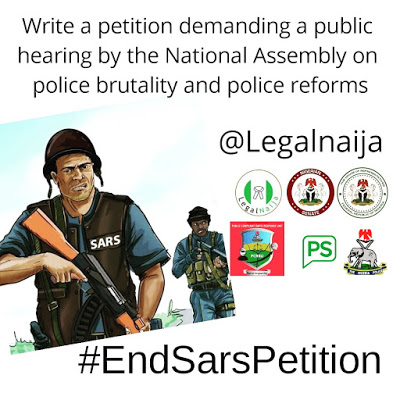
#EndSarsPetition to the National Assembly

#EndSarsPetition to the National Assembly

Have you experienced police extortion or brutality; do you know anyone who has experienced it or are you dissatisfied with the current trend and reports of police extortion/brutality by members of the police especially SARS operatives?
Then write a petition to the National Assembly requesting a public hearing on the subject matter and hopefully such public hearing will transform into police reforms.
Simply copy the template below & tag the following public officials with the hashtag  #EndSarsPetition @nassnigeria @thepublicsenate @bukolasaraki @yakubdogara @YomiShogunle @PoliceNG @PoliceNG_PCRRU @Legalnaija

PETITION TEMPLATE
Dear Sir/Ma,
Please take this as notice of my dissatisfaction with the ongoing national trends and reports of police brutality and extortion by police officers. Especially members of the SARS & FSARS police unit.
Kindly use your good office to initiate a public hearing on these allegations that would promote police reforms. 
A concerned Nigerian.
Thank you.
Name –
State –
Falz’s “This is Nigeria,” Davido’s “Mind” and the Ubiquity of Copyright Infringement in Nigeria | Lotanna Attoh

Falz’s “This is Nigeria,” Davido’s “Mind” and the Ubiquity of Copyright Infringement in Nigeria | Lotanna Attoh

By
now everyone and their mother must have heard the song “This is
Nigeria” by Nigerian rapper, Falz the bahd guy.

The
song, a take on “This is America” by his American counterpart –
Childish Gambino, has generated quite a bit of controversy in academic and
non-academic circles, thus the need for this article.

The
artistic quality of the song and video will not be discussed, you can contact
me for my thoughts on those; I will only focus on its legal issues. I will also
address that of the DMW and Davido assisted “Mind” song. Let’s begin.

The
Law

The
first thing we must realise is that every nation has its own copyright law, and
that such laws are not in isolation. What this means is that a nation’s
copyright law is (ideally) in tandem with international (intellectual property)
treaties that the nation is a signatory to.

A
number of these treaties exist, each with different provisions. But they all
have central themes, or what can be termed as core principles.

Nigeria
is a signatory to some of these treaties, the most important being the Berne
Convention of 1886. The US, the other country of interest in this article, is
also a signatory to this Convention. The provisions of this treaty (and others
as well) are meant to serve as a guide to the signatory countries in the
formulation of their own copyright laws, using the treaty provisions as the
minimum standard that should be implemented in theirs.

On
the local front, Nigeria has her own copyright law which was enacted in 1988
via a Decree (No. 47). This law has among its provisions, the core principles
stated in the Berne Convention. One of this principles is that of reciprocal
protection, which encourages a country to give works made by foreign authors or
published in foreign countries, the same protection it gives to works by its
own nationals. This principle is contained in section 5 of our Copyright Act,
and it protects such works where the country of publication is a signatory to
the same treaty that Nigeria is a signatory to.

In
the US, this same reciprocal-protection provision exists in their 1976
Copyright statute, but the crucial provision to this discourse is that
contained in section 115, which deals with “covers” and their
attendant licences. In a nutshell, this provision states that a musician who
wants to “cover” or do an interpretation of another’s song, need not
obtain permission from the original author; but if that musician’s
“cover” is intended for commercial purposes, then the musician must
pay the author of the original some royalties/percentage on each copy of the
“cover” sold. This percentage is already set by the law. No such
provision exists in our Copyright Act.

“This
is Nigeria”

The
question here (and in law, most importantly) is: what is Falz’s “This is
Nigeria”? To answer this, we must first state what it isn’t: “This is
Nigeria” is not an original song. Why? Because the music (the beat) to
which the rapper raps on is an exact copy of that which  the American
rapper, Childish Gambino, raps on in “This is America,” the original
and that which preceded “This is Nigeria.”

So,
what then is it? Under the law (US copyright law) and in music culture, it can
be only be one of 2 possible things: a cover or a parody. These 2 categories
each have their implications.

A
“cover” as we have seen is a kind of defence recognised under the US
law, and is defined as a work which does not alter the “basic melody and
character” of the original (section 115).

A
parody, meanwhile, is another defence to copyright infringement in both the US
and Nigeria’s (see the second schedule to our Copyright Act) copyright laws. On
this (parody), I will rely on the US legal jurisprudence, as ours is
unfortunately grossly lacking in this and many other areas. There, a parody has
been interpreted by the courts as a work which takes the vital elements of an
original work and uses it to either comment on that work or for comic relief.
This the court held in the Campbell v Acuff-Rose Music, Inc. case [510
US 569(1994)], which was a case involving an infringement of the song “Oh,
Pretty Woman” originally composed by Roy Orbison, by the rap group
2LiveCrew. Curiously in this case, the crew when sued claimed the defence of
parody, and not that of a cover. And the court (the Supreme Court) ultimately
upheld their parody defence, stating that their rendition of the song,
qualified as a parody.

From
these 2 concepts, I believe that “This is Nigeria” can only fall
under the “cover” category. One, because Falz’s version does not in
any way ridicule or comment on Gambino’s “This is America”; it does
the opposite of ridiculing: it comments on topical issues in the Nigerian
society, and two, in hip-hop and music culture in general, when an artiste
takes a beat (music) of another artiste and does an interpretation of it,
either using his own lyrics or that associated with the original, such a song
is termed a “cover.” In Mr Falz’s case, his “This is
Nigeria” had his own lyrics on the same music (beat) that Gambino’s
“This is America” did.

We
now know that Falz’s “This is Nigeria” is a cover (under US law and
music culture in general), what then are the implications?

As
we have seen, in the US, the implication is that royalties must be remitted to
the author of the original where the cover is for commercial purposes.

Two
questions thus emerge: (1) is Falz’s “This is Nigeria” a commercial
work? and (2) would this US cover-licence provision apply in Nigeria? To answer
the first, I will first have to answer the second.

The
US cover-licence provision (section 115) cannot apply to Nigeria. This is
because section 5 of our Act (mentioned above) provides that the protection
offered to works by foreign authors or works published in foreign countries, is
that which is offered to works by nationals. And in the Nigeria Copyright Act,
there is no such protection that provides for “covers” or their
licences, or fees for such licences. Hence, such a protection cannot be offered
to foreign works/authors, due to its non-existence.

Since
the Nigerian Copyright Act does not recognise “covers,” what then is
“This is Nigeria” under the Act?

Simply
put, “This is Nigeria” is a copyright infringement. It is an
infringement of Mr Gambino’s “This is America” song and video. This
infringement can be seen by the provisions of section 6 (2) of the Copyright
Act. Section 6 (1) provides for the rights (right of reproduction,
distribution, publication etc.) which authors of various works (literary,
musical, artistic, and film) enjoy, and subsection (2) of that section further
states:

The
doing of any of the acts referred to in subsection (1) of this section shall be
in respect of the whole or a substantial part of the work either in its
original form or in any form recognisably derived from the original

(italics mine for emphasis)

This
provision is clear enough. So then the question is if both works, “This is
Nigeria” and “This is America,” (their songs and videos) are
placed and viewed side-by-side, can “This is Nigeria” be said be to
have been “recognisably derived from the original”? No? You must
either have not seen/heard “This is America” or you are just a
die-hard fan of Mr Falz. Either way, you would be still be wrong. “This is
Nigeria” is clearly (in the music/beat, the melody, and the video) derived
from the original work – “This is America.”  This is thus the
protection that will be offered to Gambino’s “This is America” under
section 5 through the provision of section 6 (2).

On
the second question of whether “This is Nigeria” is a commercial
work, there are several layers and ways to look at it.

First,
we have stated that our Copyright Act makes no provision for a
“cover,” cover licences, or their fees; and thus “This is
Nigeria” isn’t one (under our law), and Mr Gambino will not be able to
recover from Mr Falz on that ground. But our Act provides an author of a work
the exclusive right of performing the work in public, and broadcasting or
communicating it to the public. See section 6 (1) (a) (iii) and (vii) of our
Copyright Act. And through section 5 (our reciprocal-protection section), works
by foreign authors, in this case “This is America” by Childish
Gambino, are granted these same rights. Thus, Childish Gambino has the
exclusive rights to perform his song “This is America” in public and
broadcast/communicate it to the public. And any one, other him, who performs
either the whole or a substantial part of his song “either in its
original form or in any form recognisably derived from the original”

will have infringed on this his exclusive right. It is thus in Mr Falz’s
exercise of these 2 rights granted to Mr Gambino that will determine the commercial
nature or otherwise of his “This is Nigeria.”

First,
to the best of my knowledge, Mr Falz did not put the song up for sale upon its
release, so from that it can be said that the song was not for commercial
purposes (but then, how many Nigerian artistes put their songs up for sale upon
release?)

The
real test I believe is from the performance and  broadcast/communication
of the song.

On
performance, if Mr Falz performs the song (with the music) in public at any
event he is contracted to perform, he will have infringed on Mr Gambino’s
exclusive right of public performance. And if he is paid for those
performances, then it can be rightly said that the song is indeed meant for
commercial purposes.

Also,
where radio and TV stations play the song (and Mr Falz acquiesces to such plays
by keeping mum), he and these stations will have infringed on the broadcast
rights of Mr Gambino. This too will show that the song was created for reasons
other than ‘patriotic’ ones. For Mr Falz knows that royalties will accrue to
him for plays of the song (and others) at the end of the year from the
Copyright Society of Nigeria (COSON), our performance rights organization.

Lastly,
another clear sign of the song’s commercial nature is the fact that a video was
created for it and put up on YouTube. Those familiar with the YouTube model
know that YouTube puts up adverts on your channel after your video attains a
certain number of views, and subsequently pays you for the advert(s) placed.
So, the more views you have on your videos, the more likely you are to have
adverts placed on it, and the more money you make. As I write this, “This
is Nigeria” has 5.8 million views and counting. I just wonder why YouTube
hasn’t taken it down yet….This could be because (1) Falz credits Gambino and
(2) as at when l viewed the video last, there are no adverts attached to it.

To
conclude on Mr Falz and Mr Gambino, we can succinctly summarise that:

(1) 
the works of foreign authors have copyright protection under our copyright law
(section 5)

(2) 
this protection is given to those works published in countries/by authors
residing in such countries that are signatories to the same treaty as Nigeria

(3)
the US and Nigeria are signatories to the same treaty (the Berne Convention)

(4)
“This is America” by Childish Gambino is an original work published
in America and whose author resides in America

(5)
“This is Nigeria” by Falz the bahd is not a “cover” under
the Nigerian Copyright Act

(6)
“This is Nigeria” is a work that infringes on the rights (given by
our Act) of Childish Gambino in his work – “This is America”

(7)
“This is Nigeria” may or may not be commercial work, depending on
some factors and circumstances.

I
will not be able to state here the ways in which Mr Gambino can seek redress
for this infringement as that is another topic deserving of its own article.

“Mind”

Unlike
Mr Falz’s “This is Nigeria,” the Davido and his DMW affiliated song –
Mind – is pretty much straight forward, as it does not pose the question of it
being a “cover” or not. It’s an original song. And in that
originality, lies a most blatant piece of copyright infringement you will ever
hear anywhere.

The
infringement is in the song, “Caught Up” by the American artiste,
Usher Raymond. This song was released sometime in November 2004 from Mr
Raymond’s 2004 Confessions album; and almost 14 years later, it was
resurrected to be blatantly and shamelessly copied by Davido and his
co-horts. 

The
part copied/reproduced, and now performed, distributed, broadcast and
communicated to the world is the hook/chorus in the Usher song. It goes thus:

“I’m
so caught up,

Got
me feeling, caught up,

I
don’t know what to do,

You
got me losing my cool, caught up…”

In
the Davido song, he and each one of  his DMW crew, sing those exact same
words (and in the exact same melody sung by Usher) of Mr Raymond’s “Caught
Up” chorus as the bridge leading to the main hook in their
“Mind” song. The boldness of this infringement left me embarrassed
and flabbergasted at the same time; I just couldn’t believe what I was hearing.
The gusto with which they sang it was simply incredible. But then I wasn’t too
surprised as this is Nigeria, isn’t it?

The
same section 5 (analysed above) of our Copyright Act will apply to this
instance of copyright infringement. As it involves a work published in a
country (US) and by an artiste resident in that country, which is signatory to
the same treaty (the Berne Convention) Nigeria is a signatory to. Also, the
infringement is not in doubt as it clearly violates the exclusive rights
granted to the author (Usher in this case) under section 6 of the Act.

And
unlike Falz’s “This is Nigeria,” whose commercial nature is in doubt,
that of “Mind” is not. The song was released as a single to a
forthcoming album by Davido’s DMW crew. Thus, Usher will be entitled to not
only damages for the infringement, but also whatever profits the single has
made and will make.

The
only possible defence that Davido and his DMW crew may have is that of lack of
knowledge provided for under section 16 (3) of our Act. But that defence may
not hold water in court, as I am pretty sure Davido and his crew must have
heard the Usher song when it came out 14 years ago and thus aware of its
existence, because it was a hugely successful and popular song in the US and
the world. I for one did hear it when it came out that year (and I am not that
old). And in the unlikely event that this defence should succeed, they would
still be liable to give Mr Raymond an account of profits made from the song
(see section 16 (3) of our Copyright Act.)

The
above is in the assumption that Davido didn’t seek Usher’s permission for the
use of his and the writers’ (Jason Boyd, Ryan Toby, Andre Harris and Vidal
Davis ) “Caught Up” chorus.

If
he did, then all the accolades and more go to him.

The
Opinion

In
addition to the 2 cases of infringement mentioned above, other alleged
instances of copyright infringement have occurred this year. The cases of
Simi’s “Joromi” and Tekno’s “Jogodo” come to mind. What is
worrisome and ironical is that in all these cases the alleged infringement is
being done by the artistes themselves: people who should know better and whom
the Copyright Act seeks to protect.

What
then could be the reason for this?

I am
tempted to say that ignorance of the law is the major reason for this problem,
but I refuse to believe that. Because apart from the fact that these artistes
must have some basic knowledge of copyright law, they (the A-list ones) have
professionals working with them who do know more about these laws and their
applications and implications.

If
this is the case, and I believe it is, the only reason why such cases of
infringement occurs is because the artistes decide to take the risk (especially
where the work copied is a foreign one), despite this complicit knowledge. This
decision might seem a good one in the artistes’ eyes as their only concern is
in getting that hit song (enter “Mind”), but it is a myopic,
expensive, and quite frankly, foolish decision.

It
is myopic in the sense that, unknown to the artistes, such decisions to
infringe set an example for other artistes (budding and established), and
creates a false  impression in the music industry that copyright
infringement is okay, and without consequence. This impression creates a
culture of noncompliance with copyright law, and further weakens the machinery
of the already weak copyright system. If artistes are the ones flagrantly
breaking copyright law, what hope does the system have?

This
impression is what Davido and his crew have created (if they didn’t take
permission) by using that aspect of Usher’s song in their “Mind”
song. With Falz, to be fair, he (on his Youtube channel) calls his “This
is Nigeria” a cover and also credits Childish Gambino. Still, the rate and
manner at which these cases of infringement are occurring is a cause for
concern.

Lastly,
such infringement decisions are in the long run, expensive. This is
because when (that day is coming) a person is sued for such infringement and
wins, the amount that the infringer will pay as damages, attorney fees, costs
etc. will be far outstrip the gains made from the decision taken to infringe on
that person’s right.

Artistes
should be the ones aggressively promoting and protecting copyright laws and the
system. They are the ones with the largest stake in it, and not doing so or
doing the opposite is worse than suicidal.

A 2000-plus
word article is more than enough for the wise.

I
remain a Minister in the Temple of Justice.

L.
Attoh Esq.

Photo:
Google Images

10 Questions Entertainers Must Ask Before Signing A Talent Management Contract | Hightower Solicitors

10 Questions Entertainers Must Ask Before Signing A Talent Management Contract | Hightower Solicitors

There is no gain stressing
the significant role Talent Managers, Agencies, and Management Companies, play
in the careers of talented individuals in the entertainment industry.

Every Michael Jackson,
Lionel Messi, Denzel Washington, Kenny Blaq, and other known successful
cultural icons need equally excellent supporting casts that can help chart a
progressive route to growth, profitability, and longevity. At the core of this
supporting cast is a Talent Manager.

In simple terms, Talent
Managers organize and advance the careers of talented individuals. They are
important in the scheme of things, as they are known to possess an eye for
talent and an ability to create bankable stars, which may include actors,
artists, musicians, or athletes. They are responsible for seeking job
opportunities for clients and representing your clients’ interests during the
negotiation of contracts.

In view of the above,
talents in the creative industry, entertainers, filmmakers, record producers,
and others, must seek answers to certain pertinent questions before
surrendering their careers to a talent manager.

Here are 10 questions
entertainers should ask before signing a Talent Management Contract.

1.    
HOW LONG WILL THIS RELATIONSHIP LAST?

For a new relationship, the
shorter the term, the better. Most Management Agreements come with an initial
term (one year), with an option to extend duration if both parties find the
relationship mutually beneficial. If during the initial term, all or most
expectations were met, parties can negotiate for extension. Talents must ensure
that there is clarity on the duration of a management relationship. This will
help them avoid being stuck in a lengthy unfavorable contract.

2.    
IS THERE A PROBATIONARY PERIOD?

The Talent/Manager
relationship is an intimate one. As such, parties must maintain the enthusiasm
and passion needed to make the relationship profitable. It is advisable to
agree to a trial period during which time the parties will commit to exploring
the depth of the newly established relation on a personal note, creative-wise
or with respect to business.

If at the end of the trial
period the enthusiasm has been deflated, or the expectations crushed, parties
may decide to terminate the relationship. It is advisable Talents insist on a
probationary period in their talent management contracts.

3.    
WHAT IS THE EXPERTISE OF THE MANAGER?

What a Talent expects from
his manager is largely dependent on where he is positioned as Talent in his
industry and his level of relevance and notoriety.

As there are different types
of talents with diverse areas of strength and weaknesses, same applies to
Managers. The expertise a Manager possesses is central to achieving set
objectives for the benefit of the Talent.

4.    
WILL THE MANAGER DOUBLE AS PUBLICIST?

The management contract
should give clarity as to whether the manager would go beyond the call of duty
to double as a publicist. By virtue of experience, some talent managers can
help manage relationships with the media, arranging interviews, charity events,
media parleys and public appearances. For a new talent with limited budget, it
is advisable to agree on whether the manager would serve in both capacities or
if it is clear cut that a publicist should be hired.

5.    
WHAT PERCENTAGE OF MY EARNINGS GO TO THE
MANAGER?

A standard management fee
ranges from 10% – 20%. However, the rate is open to negotiation and will depend
on the stature of the parties, and other variables. There are many channels of
revenue (tours, album sales, label advances, licensing and merchandising) from
which a manger may earn. Therefore, there must be clarity on the remuneration
of the Manager.

6.    
GEOGRAPHICAL REPRESENTATION.

Every Talent wants globally
dominance. This could cause strategic building of relationships that could help
actualize this. If Talents want representation covered in different interested
markets, it is advisable to negotiate contracts specific to such territories.
This means Talents must find managers who have knowledge and mastery of the
preferred markets, and can properly represent their interests.

This point should be given
utmost consideration when negotiating and executing a management agreement.

7.    
WHO RECEIVES PAYMENT FROM BUYERS OF
SERVICES?

Many managers do not want to
collect the money and be required to prepare and tender accounting statements
to an artiste. The artiste in turn may feel completely comfortable relying on
the manager to collect such monies. This should be agreed upon by both parties.

8.    
HOW LONG SHOULD THE MANAGER CONTINUE TO
RECEIVE COMMISSION?

It is important to agree on
when a manager stops receiving commissions after the expiration of the
management. While some may stop receiving commissions after the expiration of
contract, others might intend to continue to receive commissions on
transactions brokered during the duration of a work relationship. Parties
should make sure there is mutual understanding on this point.

9.    
IS THERE ANY PROVISION FOR A POWER OF
ATTORNEY?

An artist management
contract will often contain a provision which seeks to grant the artist manager
a power of attorney. The purpose of this is to allow the manager to sign
documents and contract on behalf of the artist, as if he or she were personally
signing the document. It is advisable for an artiste to grant only a Limited
Power of Attorney; while talents don’t want to hinder their manager’s job, they
can control how this power of attorney is wielded by adding a clause to the
contract that stipulates that for certain types of transactions, the manager
must obtain written consent before any such transactions or decisions are made.

10. HOW
WILL THE MANAGER’S EXPENSES BE COVERED?

An agreement should be
reached on how expenses will work. Talents don’t have to pay for manager’s
phone costs or office costs or business trips, or they might have to.

What are your
thoughts on the points highlighted? We want to hear your thoughts.

If you have any
questions, use the comment section, or get in touch via +2347014979879 or
hightowerlawyers@gmail.com. You will be glad you did.

PLEASE ENDEAVOR TO
SHARE THIS ARTICLE ON YOUR SOCIAL MEDIA TIMELINES. BE SOCIAL. SHARING IS
CARING!

REFLECTIONS: INSTITUTIONAL REFORMS FOR THE NBA (1) – PAUL USORO, SAN FCIArb

REFLECTIONS: INSTITUTIONAL REFORMS FOR THE NBA (1) – PAUL USORO, SAN FCIArb

Introductory

I believe that the NBA, at the national level, is in need of urgent and far-reaching reforms if it must retain its relevance not only in the larger society but even to its members.  These reforms will, at the minimum, achieve four significant and immediate goals, to wit,

(a) enhance efficiency in the operations of the Association; (b) engender confidence and trust amongst its members (or, as some would say, win back the confidence and trust of members who are disengaged); (c) transform the NBA into a sustainable institution; and (d) increase the moral equity of the NBA to enable it effectively influence required reforms in the justice subsector and remain a respected watchdog of the society.

These objectives are interlinked.  Creating an institution out of the NBA, for example, requires a much higher level of efficiency than we currently have.  In like manner, the confidence of NBA members would be greatly boosted or won back through efficient operations and institutional reforms and, in the process, the NBA would be vested with an enhanced moral authority to propagate required reforms in the justice subsector and speak out against societal ills.  To further illustrate, efficiency in operations that ensures delivery of stamps and seals to members within weeks of the payments of their respective Practice Fees and the completion of required verifications, would go a long way in heightening the confidence of NBA members in the Association.  This would contrast with the current unexplained practice of some members receiving their stamps and seals very late and sometimes close to the expiration of the validity period/year and some others not at all within the said period.
There are several ingredients and elements that work into the building of an institution and one of these is the efficiency of its operations.  There is no institution or successful organization that does not adhere to corporate governance principles, the anchors of which include transparency alongside established and defined processes and procedures and strict adherence thereto.  Embedded in the DNA of all successful organizations is the setting out of well-defined strategies/goals (usually spanning 5-10 years’ timeframes) to which the institution’s relevant stakeholders and workforce have signed up to.  Such strategic plans are communally developed by the said stakeholders and workforce and are usually documented, periodically reviewed and/or revised and faithfully implemented.  Successful institutions also have in their structures efficient succession plans that promote continuity of the Institution’s programs and strategic plans and objectives.
As you would see from the journey that we are undertaking in this series of Reflections, starting with this piece, the NBA, as currently constituted and operated, lacks these basic ingredients and characteristics of an institution.  Not having these building blocks, the NBA is unfortunately bedeviled with and by avoidable inefficiencies in its operations – the delays in delivery of stamps and seals to members and over reliance on ad-hoc committees are symptomatic of these inefficiencies – leading, in parts, to members’ dissatisfaction.  The absence of institutional efficiencies amongst others, shows in the lack of corporate governance practices in the operations and procedures of the Association, absence of published strategic plans, goals and objectives, absence of performance monitoring mechanisms and want of continuity in the implementation of the NBA’s programs consequent upon the absence of an established transition culture and plan that promotes such continuity of programs.
These deficiencies are not irremediable, in my respectful opinion. I firmly believe that they can be remedied, and the Association turned into a sustainable institution that will not only earn and retain the respect of its members but that of society at large and also have a commanding voice that cannot be ignored.  My focus in this set of Reflections, I must reiterate will be on the NBA at the national level knowing and believing as I do, that if the reforms are successfully implemented at that level, it will gradually and ultimately percolate to the branch levels.
I therefore invite you, my friends and colleagues, on this journey that will x-ray the non-exhaustive reforms that the NBA needs in order to achieve, amongst others, the four goals that I set out at the beginning of this piece, to wit, (a) the enhancement of efficiency in the operations of the Association; (b) boosting confidence and trust amongst its members; (c) transforming the NBA into a sustainable institution; and (d) increasing the moral equity of the NBA to enable it effectively influence required reforms in the justice subsector and remain a respected watchdog of the society.
Dear Creatives, protect your tradename

Dear Creatives, protect your tradename

Creatives in the fashion industry understand the importance of a brand name, ask @dolcegabbana @gbemisokeshoes or @kimonokollection. 
Other brands in various industries also need to protect their brand names, ask @wizkidayo, @mercedesbenznigeria
Or @hennessy

One other important factor is ensuring your brand name or trade name is not infringed upon and your clients can clearly identify your brand from others. 
It’s thus importance that you register your Trade name to protect your image and business. 
You can simply do this by registering your trade name or logo as a trademark. It’s done at the Federal Ministry of Trade & Commerce and a lawyer can help you with it. 
Got questions? Send a DM or comment. 
#creatives
#creativeindustrynarrative
#legalnaija 
#nigerianlaw 
#trademarks 
#IntellectualProperty
Winners emerge from the 2nd edition of the Paul Usoro Pro bono Challenge

Winners emerge from the 2nd edition of the Paul Usoro Pro bono Challenge

Following submission of entries and a rigorous screening exercise, three winners have emerged from the second edition of Paul Usoro Pro bono Challenge. Paul Usoro Challenge is an initiative of the Law Firm of Paul Usoro & Co (“PUC”), which encourages young lawyers to take on pro bono cases, as a way of rendering selfless services to the community and supporting persons who are not able to afford legal fees. 
The lucky winners were selected after entries received were evaluated by a panel of independent judges, comprising senior lawyers including a Deputy Director of the Legal Aid Council and a senior counsel in a reputable top tier Nigerian law firm. To ensure transparency, the entire process of collation was conducted and facilitated by DKK Nigeria, an independent and leading Public Relations consultancy agency in Nigeria.
According to the results, the winner of the first prize for this second edition of the Challenge is Halimat Adeniran of the Uniosun Legal Clinic. She is the team lead of Uniosun Legal Clinic, a group of young lawyers who have handled up to 35 pro bono matters within the South-Western part Nigeria. Halimat received a cash prize of N100,000 while the first runner up,  Olanipekun Nelson received the sum of N70,000 and second runner up, Tonye Clinton, received the sum of N50,000.
Speaking on the second edition of the Challenge, Paul Usoro, SAN said, “the competition was born out of an overwhelming desire to reward young Nigerian lawyers who render free and selfless legal services to their communities. Lawyers should show empathy towards the less privileged persons in the society, especially women and children, most of whom are not able to pay for legal services. It requires a lot of patience and personal sacrifice to take steps to listen, recognize, understand and/or address the complaints of persons from whom one ordinarily expects no pecuniary or other rewards”.  
In the same vein, Munirudeen Liadi, Head of Chambers at PUC stated that, “this second edition provided a wider range of opportunities for more lawyers between 1-15 years post call experience to showcase and inspire colleagues with their touching Pro Bono cases, as against the 1-10 years post call eligibility criteria adopted for the first edition. The initiative is intended to reward the selfless and sacrificial efforts of lawyers who go the extra mile to defend the defenseless, ultimately restoring confidence and respect to the rule of Law in Nigeria”.  
Commenting on the pro bono initiative, Halimat Adeniran, the first prize winner, expressed her gratitude to the organizers of the challenge for encouraging young lawyers to render professional service at no cost. “I feel happy and excited winning the challenge. It is an amazing experience for me considering that with my few years at the Bar and engagement in pro bono services, I have been able to give back to humanity. It is also very inspiring to know that Paul Usoro, SAN and the PUC team have taken it upon themselves to reward young lawyers who are engaged in pro bono services”.
She added that being the first female winner, “I feel so proud of this lofty achievement. For me, it is a firm recognition of my advocacy for the less privileged who cannot afford the services of a lawyer.  More importantly, it is a collective achievement for all young female Counsel, and in particular our female Law Students in Osun State University, College of Law Ifetedo Campus’’. She encouraged young lawyers especially the females to take up more pro bono legal services most especially on issues that concern women.
The second edition of the competition mostly featured humanitarian issues, particularly brutality to civilians by law enforcement agents, gender related issues and child abuse.
The Court of Appeal’s decision on Pre-Action Protocol Form 1 in Spog Petrochemicals Limited & Anor. v Pan Pennisula Logistics Limited

The Court of Appeal’s decision on Pre-Action Protocol Form 1 in Spog Petrochemicals Limited & Anor. v Pan Pennisula Logistics Limited


The ice-breaking Court of Appeal’s decision on Pre-action
Protocol Form 1 in Spog Petrochemicals Limited & Anor. v Pan Pennisula
Logistics Limited (2017) LPELR – 41853 (CA). 

When Hon. Justice Inumidun Akande (Rtd), an erstwhile
Chief Judge of Lagos State unveiled the extant High Court of Lagos State (Civil
procedure) Rules in 2012, a major striking feature was the introduction of the
Pre-action Protocol Form 01 as one of the documents that must necessarily
accompany a writ of summons or originating summons by virtue of Order 3 rules 2
and 8 which inexplicably omitted originating motions from the processes that
must be so accompanied. 


The arrival of Pre-action Protocol Form 01, which was
inspired by the Lord Woolf’s Reforms, unexpectedly drew diverse reactions from
legal circles in the mould of reviews, opinions, scholarly articles and
ultimately, rulings and judgements emanating predominantly from the Lagos High
Court bench until recently when the Court of Appeal sitting in Lagos had its
say on the said Form 01 in a case that shall be considered shortly.

While Dr. Muiz Banire, SAN, in a paper
titled “A consideration of
the Alternative Dispute Resolution under the Lagos State High Court (Civil
Procedure) Rules 2012
” submitted that:

“To further underscore the importance of attempts at ADR
as a condition precedent to the institution of an action, Order 3, rule
2(1)(e) and rule 8(2)(d) of the 2012 Rules make Form O1 a mandatory process
that must accompany a writ of summons and originating summons respectively.
Proof of Pre-action attempts at ADR is, therefore, condition precedent
to the institution of a suit under the 2012 Rules. By virtue of Order 5, rule
1(1) of the 2012 Rules, failure to show proof renders the action a nullity”

On the other hand, Mr. Oluwole Kehinde, in his
article titled “Pre action
Protocol and right of access to court”
submitted thus:

“One is not oblivious of the decisions of the Supreme
Court in the line of cases of Amadi v. N.N.P.C (2000) 10 NWLR (Pt. 674) 76, to
the effect that regulations of the right of access to court, like pre-action
notice, are legitimate and constitutional. However, it is respectfully
submitted that those authorities do not exactly accommodate the species of
rules relating to pre-action protocol like mandatory or compulsory mediation
under consideration. Accordingly, such cases are clearly distinguishable and
therefore inapplicable here.”


Regrettably, the High Court of Lagos State has been
inconsistent in its decisions on the effect of non – compliance with Pre-action
protocol Form 01 and issues surrounding it. One would have thought that such a
document with noble intents would not have its purport and effect enmeshed in
judicial uncertainty.

The court had in the following decisions upheld the
mandatoriness of compliance:See the ruling of Obadina, J in Suit No:
LD/506LM/2015 between Mrs. Olubukunola Osomo v. Gov. of Lagos State & 2
Ors. delivered on February 2, 2016); the ruling of Alogba, J. in Suit No
LD/192/2013 between Nitol Textiles Manufacturing Co. Nig. Ltd. v. Coastal
Services Nigeria Ltd. delivered on June 19, 2013) and the ruling of Ighile, J.
in Suit No. BD/1100LMW/15 between Dr. Lateef Seriki-Abass & Ors. v. Wasiu
Seriki-Abass & Ors (delivered on February 8, 2016).

Contrariwise, in the case of Stanbic Bank v Ehiremhen
Suit No. LD/261CMW/15
delivered by Hon. Justice J.E. Oyefeso in a case where
the Claimant did not even file any Pre-action Protocol Form 01 at all but when
the Defendant raised an objection, the learned judge held thus:

“The essence of Pre action Protocol is to ensure that
genuine efforts are made at trying to settle matters amicably before resorting
to litigation.…

Even if we were to look at the Pre action Protocol Form
01 in the sense of a type of pre-action notice, failure to even serve a
pre-action notice merely gives a defendant a right to insist on such notice
before the Claimant can approach the court. It merely puts the jurisdiction of
the court on hold pending compliance with the precondition. I have gone through
the case file. No pre-action protocol Form 01 was file….We must understand that
the rules of court are made for the convenient and orderly hearing of cases…I
am satisfied that the substantive requirements of the law have been complied
with and I so hold.”

This is no doubt, one out of the numerous decisions of
the High Court of Lagos state dismissing any objection on pre-action protocol
as leaning towards technicalities as opposed to substantial justice.

Thankfully, the Court of Appeal sitting in Lagos had been
invited by Tunde Adejuyigbe, SAN in the case of Spog Petrochemicals Limited
& Anor. v Pan Pennisula Logistics Limited (2017) LPELR – 41853 (CA)
to
interpret the effect of non-compliance with Pre-action protocol requirements.

Facts

The Respondent (Peninsula) took out a writ of summons
against the Appellant (Spog) at the High Court of Lagos State claiming $750,000
being balance of the sum of vehicles supplied to Spog by Peninsula. Upon
receipt of the originating processes, Spog filed a preliminary objection to the
suit on the grounds that:

(a)That the pre-action protocol form 01 which is an
affidavit attached to writ of summons filed by the Respondent was deposed to by
the Respondent which is not a natural person.

(b)That the Respondent failed to set out its claims and
an option for settlement in the written memorandum filed along with the
pre-action protocol Form 01.

The trial court heard the objection but dismissed same on
the 18th day of December 2015 which decision culminated in the appeal under
consideration. 

Sole issue before the Court of Appeal 

By aggregating the issues distilled by both parties, the
Court of Appeal formulated the sole issue thus:

 “Whether the High Court was right that the
Respondent’s writ of summons has substantially and sufficiently
complied with provisions of Order 3 Rule 2(1)(e)”

 Determination

In order to fully appreciate the Court of Appeal’s
decision, I will endeavour to quote their lordships extensively while driving
home the points made therein, bearing in mind the gravamen of the appeal being
an allegation surrounding incompetence of the Pre-action protocol Form 01 which
was allegedly signed by a company without stating the name of the natural
person that signed on its behalf as well as its failure to be accompanied by a
memorandum sent to the Defendant stating the claims.

On the requirement of pre-action protocol, the court
had this to say:

“The requirement of the Pre-action Protocol Form 01 is
only a statement that the other processes for the commencement of the action
have been filed in accordance with the rules of that court.”

On whether incompetence of Pre-action Protocol Form 01
vitiates the writ:
“Clearly,
the Form 01 has nothing to do with the validity or competence of writ of
summons which it is to accompany or the suit commenced thereby.”

On the effect of swearing to the Form 01 before a
Commissioner for oaths
: “The
fact that the Form was sworn to before a duly authorized Commissioner for Oath
and signed by the person who swore to the facts contained therein,
substantially complies with the requirement of the statement in the Form, the
fact of making the statement in the name of Respondent notwithstanding.”

On whether Form 01 is a condition precedent: “Form 01 is not alone a
condition precedent for the commencement of an action by writ of
summons but as stipulated in the Sub-rule to accompany the writ.”

On effect of failure to comply with the pre-action
protocol,
the court held: “In
any case, Sub-rule (2) of 3 provides for the consequence of failure to comply
with the provision of Sub-Rule (2) by saying that:

“Where a claimant fails to comply with Rule 2(1)
above, the originating process shall not be accepted for filing by the
Registry. The above provision did not say that failure to accompany a writ of
summons with any one of the processes listed in Sub-rule (1) would render an
otherwise valid writ incompetent. In unambiguous terms, the provisions
only provide that where writ was not accompanied by all the processes listed
therein, it shall not be accepted for filing by the Registry. However, once
accepted and assessed by Registry of the Court and the requisite fees paid by
the claimant and duly filed, the consequence of any non-compliance with the
provisions cannot go to affect the validity and competence of the writ.”

On the form of memorandum:“The
Rules of the High Court did not state, stipulate or prescribe any form or
manner the memorandum should be in except that it be written. Admittedly, the
purport of the said memorandum is to set out claims of a claimant against the
defendant and the discretion to settle them amicably without the need to go to
trial.”
 

In conclusion, however regrettable it may appear that the
Court of Appeal’s attention was not drawn to the provision of Order 5 Rule 1
of the
rules, it is nevertheless the writer’s humble but forceful opinion that, an
interpretation of the said provision would nevertheless have no damning effect
on the posture of the law as encapsulated by the Court of Appeal for the
following reasons:

First, the provision of Order 5 rule 1 is impliedly
subject to the provision of Order 3 rule 2, hence, it is inferior to the
express provisions of Order 3 Rule 2. See Oloruntoba-Oju v. Abdul-Raheem (2009) 13 NWLR (Pt. 1157)
83 S.C.

Second, Order 5 rule 1 is general in
its application to the entire provision of Order 3 rules 2 and 8 while Order 3
rule 2 sub-rule 2 is specific on the penalty for non-compliance. Again, it is
trite that a general provision cannot override specific provision on an issue.
See Kraus Thompson Org.
v. N.I.P.S.S (2004) 17 NWLR (Pt. 901) 44.

Third, Order 5 rule 1 provides for the effect of
non-compliance and the court of Appeal also ruled on the effect of
non-compliance, hence it is our opinion that, the court had, by implication,
interpreted the intendment of the said provision.

From the foregoing, one can safely opine that, the
decision of the Court of Appeal herein represents a demystification of the
Pre-action Protocol monster that has unwittingly snuffed lives out of
legitimate claims on the ground of experimental technicality with blatant
disregard for its purpose, not being an end to litigation but as preliminaries
of dispute resolution. Confirming the probable counter-productivity of the
procedure, Dr. Banire
, SAN
noted in his paper that:

“Also worthy of consideration is the suitability of
mandating every claimant and his legal practitioner to comply with the
requirements of Pre-action Protocol. By virtue of Order 3, Rule 2(1)(e) and
Order 3, Rule 8(2)(d), compliance with pre-action protocol is a pre-condition
to filing a writ of summons or originating summons under the Rules. This may
turn out to defeat the very essence of litigation in matters where exigency of
time requires an immediate intervention by the court.” 

Olumide Babalola
Editor at Babalola’s Law Dictionary

Olumide Babalola writes from
Lagos.
Source: LinkedIn
IP ABC—Printing a LinkedIn Mark on a Book Cover without Permission: Lawful or unlawful? | Infusion Lawyers

IP ABC—Printing a LinkedIn Mark on a Book Cover without Permission: Lawful or unlawful? | Infusion Lawyers


Question of the Week 

I am Ola Peters, a
digital-marketing expert. For over 7 years, I have been writing and speaking
about digital marketing to help both organizations and individuals succeed.
Last April, I decided to publish a book titled Connecting to Succeed: How
to Get the Best of LinkedIn
. I used a self-publishing platform, Dotpages.
To my shock, Dotpages has contacted me over a trademark-infringement letter
it received from LinkedIn. According to the letter, by printing the LinkedIn
mark on my book cover without LinkedIn’s due permission, I have allegedly
infringed on LinkedIn’s trademark. They demand I either withdraw my book from
circulation or face legal action! I’m still shocked. Is it really unlawful to
print LinkedIn mark on my book cover?

Answer 

The answer is YES; use of LinkedIn’s trademark on your book
cover without permission is unlawful.

LinkedIn mark is LinkedIn’s registered trademark. Any person who wishes to use
the mark on his or her work—such as books, film, and other materials—must first
seek and obtain LinkedIn’s permission. Without permission to use the mark, use
amounts to trademark infringement.

‘LinkedIn’ mark and other marks belong to LinkedIn Corporation.

The name ‘LinkedIn’, the LinkedIn logo, the ‘IN’ logo and ‘InMail’ are
registered trademarks or trademarks of LinkedIn Corporation. LinkedIn
Corporation’s affiliates in the United States and other countries also enjoy
rights over these trademarks.

No other person is permitted to use any of these trademarks except in
accordance with LinkedIn Corporation’s guidelines or policy.


Trademark law entitles LinkedIn Corporation to legally stop any unauthorized
use of any of its marks. LinkedIn is entitled to sue you, get damages, and even
apply for an account of profits (You will pay to LinkedIn’s account all the
profits you have made from the book so far. Absolutely!).

The illegality of printing LinkedIn mark on your book cover without
permission is not only by the working of trademark law but also LinkedIn’s policy.

Though trademark law generally entitles LinkedIn to restrict use of its
LinkedIn mark, LinkedIn Corporation reserves the right to allow any person to
use these marks in their publications or other works in accordance with its own
guidelines or policy. By having a policy that controls use of its marks, this
is what LinkedIn has done.

LinkedIn has a policy that expressly prohibits unpermitted use of its mark for
certain purposes.

For the purpose of publication in books or printed materials, LinkedIn has a
special provision that guides this.


According to LinkedIn, it “does not allow the use of its logos or the name
“LinkedIn” in the title or otherwise on the cover of books or other
publications without prior written permission of LinkedIn.”


LinkedIn requires that any person who is “interested in using the LinkedIn
name or logos in a publication” should request permission. Request for
permission can be submitted by using LinkedIn’s Request for Permission Form
(available on its brand-policy website).

Is LinkedIn’s trademark restriction the standard amongst all social media
platforms such as Facebook and Instagram?


Generally, you are prohibited from using trademarks belonging to these social
media platforms in merchandize. This means you can’t lawfully print them on any
products for commercial purposes.


Apart from the prohibition above, each social media platform has its policy and
guidelines on use of its trademark by third parties.

Facebook, for instance, does not say anything about use of its mark in books or
printed materials, but it warns that when using its ‘F’ logo, you “[d]on’t
make it the most distinctive or prominent feature of what you’re
creating”. But for use in TV and film, you must request permission.

Instagram also has guidelines for use of its logos and name. Regarding use for
print, it restricts this to print larger than A4 size. According to one of the
guidelines on Instagram’s brand-policy page, “[o]nly those planning to use
Instagram’s assets in any broadcast, radio, out-of-home advertising or print
larger than 8.5 x 11 inches (A4 size) need to request permission.

To be on the right side of the law, it is best to carefully read these
policies and guidelines.

When it comes to publications, always consider that you might have infringed on
intellectual property. Do not fail to get help when you still can. This is
vital.

To enable you make the best decision for your book or subsequent books and
avoid demanding love letters from LinkedIn’s lawyers and other lawsuits, you
may consult an IP lawyer or law firm to professionally guide you.


IP ABC wants your book to be a bestseller, not a bread winner for lawyers when
you find yourself in the box.

Best wishes
IP ABC

Follow-up questions, if any, are welcomed.

Source: Infusion Lawyers

Photo Credit – www.linkedin.com