
by Legalnaija | Sep 7, 2025 | Blawg
Is the Plea of Allocutus a Right or a Privilege in Nigerian Criminal Proceedings? | Isah Bala Garba
By way of introduction, the term allocutus is derived from the classical Latin word allocutio or alloqui, meaning ‘to address or to speak to.’ It is also referred to as allocution, meaning ‘a formal speech.’As such,allocutus or allocution is a formal statement made to the court by the defendant who has been found guilty and is about to be sentenced. This practice originated in England and was recognized by the common law as early as 1682 and Nigeria, being a common law country, also adopted the same. The Supreme Court in the case of Lucky v. State (2016) 13 NWLR (Pt. 1528) held on the meaning of allocutus as follows:‘Allocutus is a plea in mitigation of the punishment richly deserved by an accused person for the offence with which he was charged and for which he was tried and found guilty and convicted accordingly (p. 162, paras. F-G).’ This article examines the legality of allocutus in Nigeria, who makes the plea? When is it made? Must it be granted when made ? Or it can even be overlooked in the entire proceedings?
The legality of allocutus is enshrined in Section 310 of the Administration of Criminal Justice Act (ACJA), 2015, which provides : ‘Where the finding is guilty, the convict shall, where he has not previously called any witness to character, be asked whether he wishes to call any witness and, after the witness, if any, has been heard, HE SHALL BE ASKED WHETHER HE DESIRES TO MAKE ANY OR PRODUCE ANY NECESSARY EVIDENCE OR INFORMATION IN MITIGATION OF PUNISHMENT in accordance with section 311 (3) of this Act.
(2) After the defendant has made his statement, if any, in mitigation of punishment the prosecution shall, unless such evidence has already been given, produce evidence of any previous conviction of the defendant.’
Subsection (3) of Section 311 referred, state as follows:
‘(3) A court, after conviction, shall TAKE ALL NECESSARY AGGRAVATING AND MITIGATING evidence or information in respect of each convict that may guide it in deciding the nature and extent OF SENTENCE TO PASS on the convict in each particular case, even though the convicts were charged and tried together.[ Capitalization is mine for emphasis]
It’s based on the foregoing that courts do give defendants an opportunity, after exhausting all the stages of criminal trials from arraignment, examination-in-chief, cross-examination, re-examination, written addresses, conviction(finding the defendant guilty for the offense charged) before sentencing to make their plea. The prosecuting counsel also has the opportunity to rebut the plea so as not to make the plea a one-way free ticket; otherwise, accused persons might use it to escape full responsibility. That’s why the prosecution is given the opportunity to make a presentation in rebuttal of the convict’s claim, stating with evidence for example that the convict is not a first time offender, aimed at denying him having the mitigation and which after careful consideration, the courts will thereafter sentence the defendant and bring an end to the criminal trial in the courtroom.
I do not think I sound clear. Let me make myself clearer. If the court pronounced the defendant guilty, before imposing an official sentence, the court normally asks, Do you know of any reason why judgement should not be pronounced upon you? Anyways, consider this example: A young man named Abdul is charged and found guilty of the offence of Grievous bodily harm. While reading judgement, the judge will say, having carefully considered the evidence adduced before this Honourable Court by the prosecuting counsel, it is the firm and unequivocal conviction of this Honourable Court that the defendant is hereby found guilty of the offence charged. After this, the judge will state further: ‘Do you have anything to tell this Honourable Court why you shouldn’t be sentenced to prison?’ Abdul might then say, My Lord, I am very sorry for what I did. This is my first offence; I am an orphan and the breadwinner of the family, with an aged mother alongside five younger ones to take care of. I did this out of desperation but promised never to do it again. Please have mercy and consider a lighter punishment on me. This plea at this stage of trial is what is called: ‘PLEA OF ALLOCUTUS’ and If the court is convinced, the Judge may proceed to state, Having considered the defendant’s plea of allocutus and the circumstances he has presented. While his situation calls for mercy, the law must also be upheld as it is the duty of this Court to balance justice and compassion. As such, the defendant is hereby sentenced to 1 month imprisonment. Let this serve as both a warning and a lesson. I believe you will honor your promise to live a law-abiding life henceforth.
The primary objective of allocutus is to present information that will persuade a Judge to impose a more favourable and lenient sentence than the one defendant ought to be given by law.
Furthermore, there has been debate regarding whether allocutus must only be made by the convict personally or whether it can be made by a lawyer on his behalf. The Court of Appeal in considering who made allocutus In Odunayo v. State (2014) 12 NWLR (Pt. 1420) 1, held that: ‘An allocutus can be made by the convict in person or through a witness to give evidence of previous good character and good works of the convict. Where evidence of good character is given by way of allocutus, the prosecution is also at liberty to produce evidence of previous conviction(p. 25, para. F).’ In addition the supreme court held in approval of a counsel to enter a plea of allocutus for his client who has been convicted for a criminal offence prior to sentencing in the case of Lucky v. State (2016) 13 NWLR (Pt. 1528) Pp. 162-163, paras. H-C) However, the Supreme Court made a U-turn 4 years after in the case of Francis v. F.R.N.(2021) 5 NWLR (Pt. 1769) 398 where per Eko JSC lucidly held inter alia that: ‘THE CONVICT AND NOT THE DEFENCE COUNSEL, pleads his allocutus. In other words, it is for the convict himself to show cause why the prescribed sentence for the offence he was convicted of should not be passed or imposed on him. In the instant case, the allocutus given by the appellant’s counsel was contrary to Rule 20 of the Rules of Professional Conduct for Legal Practitioners, 2007 that prohibits a lawyer as a witness for the client. (Pp. 411, para. F; 412, paras. B-C) [Capitalization is mine for emphasis]
Notwithstanding the above Supreme Court’s pronouncement and which ex facie aligns more with the profession’s ethical behavior, it’s actually not observed in many Nigerian courts because Judges routinely entertain pleas by lawyers on behalf of their convicted clients without issue.
The Supreme Court (In Francis v. FRN), I believe held so to caution and make lawyers to be mindful of their professional boundaries especially during allocutus, considering how the lawyer in that case vehemently tried to overstep the required ethical boundaries such as seeking to tender evidence all in plead of allocutus which the trial court refused to accept and still went further to make it a ground of appeal as if it’s a right.
The ideal is to prepare the defendant for this exercise and let the defendant present the plea personally. The court seeks to hear the voice of the defendant, searching for genuine remorse and sincerity that flow from the heart. At all times, the lawyer should act strictly within authority conferred by the client and if lawyers must do, I normally witnessed, they start by saying: By the authority conferred on me by the Convict, my Lord, I seek to make the plea on his behalf that he is a first-time offender, he’s the breadwinner of the family etc…but not acting as a witness. However, since lawyers making Allocutus on behalf of the defendant has become normalized and accepted practice in the trial courts, I will suggest if the Supreme Court can depart from its decisions in the case of Francis v. F.R.N., as trial courts clearly prefer lawyers making the Allocutus. For example, I witnessed this a few months ago at the Federal High Court, where the Judge did not object to the lawyer who stood up to make the plea on behalf of his client. Allowing this practice has no adverse effect, and lawyers, as masters of the law representing the defendant from the beginning of the case, should be permitted to make the plea on their behalf. The position taken in the case of Lucky v. State, which allows lawyers to make the plea, should be the law. I sell this to the Learned Justices of the Supreme Court. They have a choice not to buy it. I lack the power to question their choice if they choose not to.
Flowing from the foregoing analysis it’s important to note that the plea of allocutus is not a right but a privilege given at the court’s discretion. It is not a fundamental right recognized under constitutional law. The Supreme Court in Chidi Edwin v. The State (2019) 7 NWLR (Pt. 1672) 553 held: ‘Allocutus is not a right in law, neither is it a defence. It is overstretching the constitutional law of fundamental right by attempting to interpret and classify allocutus as a fundamental right under Nigerian law of fair hearing.(p. 565, para. F)’ Also, the court further states: ‘making of allocutus is not mandatory, and its absence does not invalidate the proceedings or sentence (p. 565, paras. E-F; 572, para. D).
In, where the statute prescribes a mandatory sentence indicated by words like ‘shall’ the court ordinarily has no jurisdiction to reduce the sentence or entertain allocutus. For example, the death penalty under Section 221 of the Penal Code admits no discretion, and any sentence other than death upon conviction is a material irregularity. This was given a judicial blessing by the Apex court of the land in the case of State v. John (2013) 12 NWLR RHODES-VIVOUR JSC, held as follows: ‘Once a Judge finds an accused person guilty of culpable homicide under section 221 of the Penal Code, the only sentence he can pronounce is death. A Judge has no jurisdiction to listen to ALLOCUTUS and no discretion to reduce death sentence to a term of years once the accused person has been found guilty under section 221 of the Penal Code.(P. 364, paras. E-F)[Capitalization is mine for emphasis]’
However, where the statute uses language such as ‘is liable to,’ or most often non capital offences the court has some discretion to impose a lesser sentence or fine and may consider allocutus in exercising that discretion. Equally the Administration of Criminal Justice Law 2015 (the ‘ACJL’), a procedural law enacted to supplement the Law, section 316 specifically allows the Court to substitute an imprisonment term for a fine. The Said provision reads: ‘subject to the other provisions of this Section, where a Court has authority under any written law to impose imprisonment for any offence and has no specific authority to impose a fine for that offence, the Court may, in its discretion, impose a fine in lieu of imprisonment.’
Lastly, Before considering allocutus, the court must weigh factors like whether the convict is a first-time offender, the number and age of dependents, terminal illness, genuine remorse, time spent awaiting trial, and evidence of good character. This exercise ensures that the court’s discretion is judicially and judiciously exercised as outlined in Ubiaru v. F.R.N.(2019) LPELR-48252 (CA) Per ANDENYANGTSO, J.C.A (Pp. 31-32, paras. B-E) The trial court must not exceed prescribed statutory limits and should carefully balance justice and mercy through allocutus.
In conclusion, the plea of allocutus in Nigerian criminal proceedings is a privilege, not a right, extended at the discretion of the court and intended for mitigation of sentence rather than exoneration. The plea must be made by the convicted person personally, as the Supreme Court prohibits lawyers from pleading allocutus for their clients citing it is against the profession’s ethical behavior, though practically allowed. Also where statutes prescribed mandatory sentences, allocutus may be ineffective, but where discretion exists, it can shape a fairer outcome.
__________________________________
Isah Bala Garba is a level 300 student from Faculty of Law, Bayero University, Kano. He can be reached for comments or corrections on: LinkedIn: https://www.linkedin.com/in/isah-bala-garba-301983276 Facebook: https://www.facebook.com/isah.bala.garba
isahbalagarba05@gmail.com or on 08100129131.

by Legalnaija | Sep 6, 2025 | Uncategorized

CALL FOR ENTRIES: Agbakoba Onyejiuwa Annual Legal Essay Competition 2025
Are you a Nigerian law student with a sharp mind and a passion for legal innovation? This is your moment to shine.
📌 Topic:
Hybrid Models in Commercial Dispute Resolution: Opportunities and Challenges in Complex Cases
💼 Eligibility:
Open to undergraduate law students in Nigerian universities and students of the Nigerian Law School. Valid student ID or admission letter required.
📄 Submission Guidelines:
– Max 3000 words (excluding references)
– Times New Roman | Size 12 | Spacing 1.5
– OSCOLA referencing format
– PDF format only
– Original, plagiarism-free work (plagiarism test will be conducted)
📅 Deadline:
1st October, 2025
📧 Submit to:
developyouragame@gmail.com
🏆 Prizes:
– 🥇 1st Prize – ₦250,000
– 🥈 2nd Prize – ₦150,000
– 🥉 3rd Prize – ₦100,000
📝 Winning essays may be published on CRWI, Bar & Bench, and other top legal blogs. This is more than a competition—it’s a platform to amplify your voice in the legal community.
Tag your law school crew. Let’s raise the bar. ⚖️
LegalEssayCompetition #AgbakobaOnyejiuwa2025 #Legalnaija #LawStudentsNG #CRWI #BarAndBench

by Legalnaija | Aug 24, 2025 | Blawg
New Release: Casebook on Privacy and Data Protection in Nigeria
The discourse on privacy and data protection in Nigeria has entered a new phase with the publication of a pioneering resource: Casebook on Privacy and Data Protection in Nigeria, authored by leading privacy law scholars Olumide Babalola and Dr. Uchenna Nnawuchi.
Why This Book is Groundbreaking
This casebook is the first of its kind in Nigeria, compiling landmark judicial decisions on privacy and data protection from independence to the present day. It offers far more than a collection of cases—it provides a clear narrative of the evolution, misconceptions, and current realities of privacy jurisprudence in Nigeria.
Highlights include:
A comprehensive and authoritative reference for practitioners, academics, and policymakers.
In-depth analysis of how Nigerian courts have shaped the contours of privacy and data protection law.
A vital resource for students, scholars, and researchers interested in the development of this emerging field.
According to the authors, the book “fills a long-standing gap in Nigerian legal literature and is intended to support both scholarship and practice in a rapidly developing field of law.”
Who Should Read This Book
The Casebook on Privacy and Data Protection in Nigeria is essential reading for:
Legal practitioners seeking practical guidance from judicial precedents.
Academics and students looking for a scholarly yet accessible reference.
Policymakers, regulators, and advocates shaping Nigeria’s data protection landscape.

Now Available;
Following its successful public presentation and scholarly review, the Casebook on Privacy and Data Protection in Nigeria is now available for purchase. This is a unique opportunity to own a resource that will influence teaching, research, practice, and policymaking in one of the most critical areas of contemporary law.
Do not miss the chance to secure your copy of this groundbreaking publication.

by Legalnaija | Aug 24, 2025 | Uncategorized
THE NDPR TRUST MARK: A MISLEADING AND COUNTERPRODUCTIVE TOOL IN NEED OF REFORM
By Olumide Babalola
Introduction
Under Nigeria’s data protection framework, certain categories of business entities are required to conduct and file annual data protection compliance audits (now formally referred to as Compliance Audit Returns (CAR) under sections 6(d) and 61(g) of the NDPA and Article 10 of the GAID). When the system was first introduced in 2019, the regulator issued confirmation emails as evidence of filing. However, upon transitioning to the Nigeria Data Protection Commission (NDPC), the practice shifted to issuing NDPR Trust Mark Certificates as proof of compliance with audit-filing obligations.
Although this innovation initially appeared professional and standardized, it quickly created misconceptions. Many organizations and even some privacy professionals, interpreted the Trust Mark as confirmation of substantive compliance, rather than a simple acknowledgment of audit filing. The result is widespread misrepresentation, with businesses brandishing the Trust Mark as proof of full compliance while neglecting their broader obligations under the law. This article examines the meaning of trust marks, why the NDPR Trust Mark (as currently issued) is misleading, and why reforms are necessary to avoid further confusion and counterproductive outcomes.
Understanding Trust Marks in Privacy and Data Protection Parlance
Globally, trust marks (also called privacy seals, certification marks, or trust seals) are visual indicators (logos, badges, or images) that signify compliance with predefined data protection or privacy standards. Typically, they are awarded by independent third parties and serve as signals of credibility to consumers, regulators, and stakeholders.
Needless to say, that the Nigerian idea of trust mark (although tweaked) was inspired by the EU GDPR’s creation of certification mechanism in Europe even though they continue to struggle with their problems of heterogeneity of the trust mark regime. In the EU, for example, the GDPR introduced certification mechanisms that serve as trust marks. These are often tied to regulated services such as electronic signatures, timestamps, and other qualified trust services, thereby enhancing confidence in digital transactions.
At their core, trust marks communicate that an organization has been evaluated and approved by a neutral third party against specific privacy or security criteria.
Why the NDPR Trust Mark is Misleading
Outdated Legal Reference: As of August 23, 2025, the Trust Mark issued by the NDPC still carries the label NDPR. Whereas the principal legislation since 2023 is the NDPA, not the NDPR. Continuing to issue certificates under the old regulatory regime only fuels legal and operational confusion especially in the light of conversations around the current status of the NDPR as extant or otherwise.
False Impression of Evaluation: Unlike global trust marks, the NDPR Trust Mark does not represent a thorough evaluation against defined privacy benchmarks. Instead, it merely confirms that an organization has filed its annual audit report. The absence of evaluation metrics, scoring frameworks, or substantive approval processes means that the Trust Mark conveys an inflated sense of compliance.
Conflicts in the Nigerian Audit Process: In Nigeria, audits are conducted by Data Protection Compliance Organisations (DPCOs), which are engaged and paid by the very companies they audit. This raises a fundamental conflict of interest: “he who pays the piper dictates the tune.” Furthermore, under Article 10 of the GAID, the obligation to conduct audits lies primarily with controllers and processors themselves. The law merely requires filing through a DPCO. Thus, the DPCO is not an independent evaluator but rather a service provider executing instructions. Without standardized scoring or evaluation metrics, the process does not amount to a true third-party certification.
Misconstrued Approval by NDPC: The most damaging misconception is the idea that the Trust Mark signifies NDPC’s approval of total compliance. In reality, audit reports are meant to highlight gaps, not certify perfection. The NDPC’s acceptance of audit filings cannot and should not be equated with substantive compliance. For instance, a company may dutifully file its audit while still failing to meet obligations around transparency, data subject rights, security safeguards, or purpose limitation. The Trust Mark, however, enables them to market themselves as “compliant,” which misleads the public and stakeholders alike.
Counterproductive Effects of the Trust Mark
The original purpose of audits was to help organizations identify and fix weaknesses in their privacy practices. Unfortunately, the Trust Mark has turned this process into a box-ticking exercise. This problem is especially acute among digital lenders and fintech companies, which often require the Trust Mark to secure licenses. Once obtained, many companies ignore the gaps identified in their audits, preferring instead to rely on the certificate as proof of compliance year after year.
The result is an illusion of compliance where organizations technically comply with the audit-filing requirement while ignoring broader obligations. Meanwhile, the NDPC’s true objective (i.e safeguarding data subjects’ rights) is undermined. In short, while the issuance of Trust Marks may inflate statistics on “compliance,” it does not reflect the reality of privacy protections in practice.
Recommendations for Reform
Replace the initial Trust Marks with Acknowledgment Notices: Instead of issuing Trust Marks upon audit filing, the NDPC should issue simple acknowledgment documents. These should confirm only that an audit has been filed, without implying broader compliance.
Introduce Remediation Timelines: Since audits reveal compliance gaps, the NDPC should require controllers to submit remediation plans with clear timelines for addressing deficiencies.
Adopt a Scoring and Evaluation Framework: True trust marks should only be awarded after substantive evaluation. The NDPC should create scoring metrics to assess compliance maturity, allowing organizations to be benchmarked and rated transparently.
Clarify the Scope of the Trust Mark: The NDPC should consistently emphasize that audit filing does not equate to substantive compliance. Public communication must reinforce this distinction.
Issue Trust Marks Post-Verification: Only after an organization has demonstrably closed the gaps identified in its audit should it be eligible for a genuine trust mark.
Conclusion
The NDPR Trust Mark, in its current form, is misleading, counterproductive, and ripe for reform. While intended as a symbol of compliance, it has instead become a shield for minimal effort and a source of confusion for stakeholders. For Nigeria’s data protection ecosystem to mature, the NDPC must realign the Trust Mark with its true purpose: a rigorous, independent certification of substantive compliance. Anything less risks perpetuating a culture of checkbox compliance while leaving the fundamental rights of data subjects unprotected.

by Legalnaija | Aug 22, 2025 | Blawg
Balance business sustainability with mental wellness, Aderemi urges lawyers
The JAALS Foundation, in partnership with Mindsplace, held a Mental Wellness webinar on August 21, 2025, to mark the forthcoming birthday of Perchstone & Graeys partner Mr. Tolu Aderemi. The virtual event drew legal practitioners and other professionals from Nigeria, the United Kingdom, Zimbabwe, Morocco and beyond, and centred on reconciling firm profitability with the psychological wellbeing of those who practice law.
In opening remarks, Aderemi described the legal profession as “a demanding one,” where long hours, relentless deadlines and constant scrutiny — often seen as hallmarks of excellence — also drive anxiety, stress and other mental-health challenges. He cautioned that the sector tends to prioritise physical health and financial outcomes while overlooking mental wellness, and stressed that poor mental health in the profession results from a combination of high expectations, client pressures and sustained workload rather than any single cause.
Keynote speaker Ms. Eniola Bello, CEO of Mindsplace, appealed directly to employers, urging them to treat employee mental wellness as a core business imperative rather than an optional extra. Bello highlighted common triggers such as prolonged work hours and chronic anxiety, and argued that deliberate investment in staff wellbeing is not only humane but also essential to sustainable business growth. “A sound legal mind is essential to providing excellent legal services,” she said, urging firms to establish proactive support systems for psychological health.
Both speakers emphasised that protecting mental health and maintaining business sustainability are mutually reinforcing objectives. They argued that prioritising mental wellness reduces burnout, sustains productivity and safeguards client service standards — making it both an ethical duty and an economically prudent strategy for law firms.
Aderemi also challenged the profession to confront stigma. He called on colleagues to avoid marginalising those experiencing mental ill-health, to encourage open discussion, and to foster workplace cultures where employees feel safe to seek help. He further urged law firms to adopt supportive practices and appealed to the Nigerian Bar Association to institutionalise communal frameworks for mental wellbeing across the profession.
The webinar underlined a growing consensus within legal circles that robust, sustainable business models must incorporate deliberate measures to protect mental health — for the benefit of practitioners, firms and clients alike.
by Legalnaija | Aug 20, 2025 | Blawg

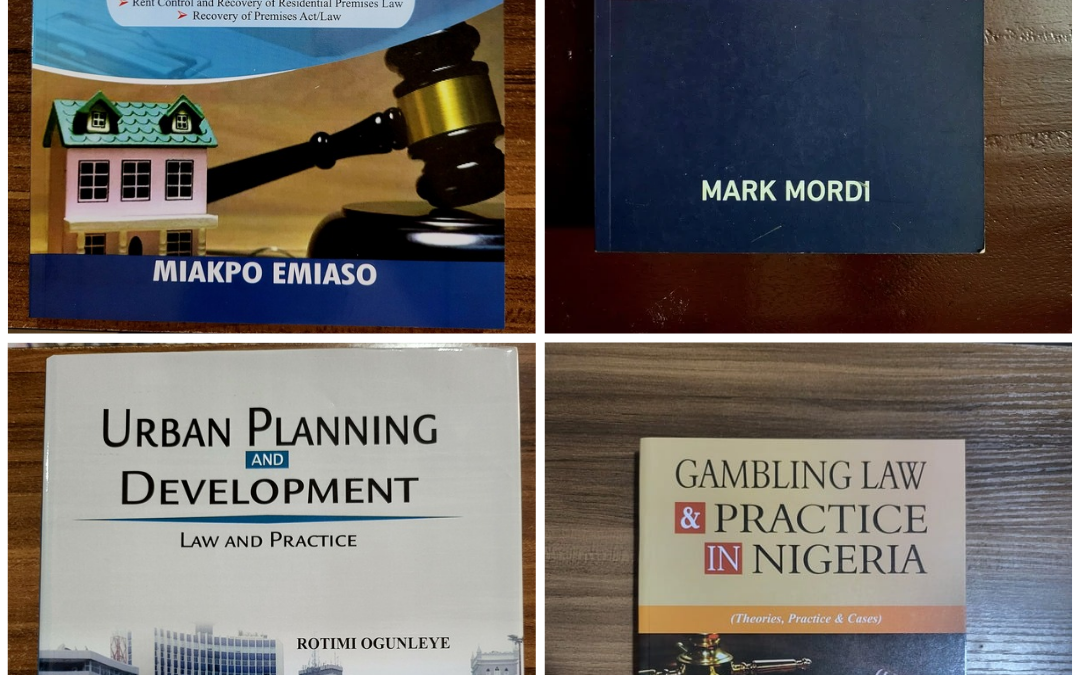
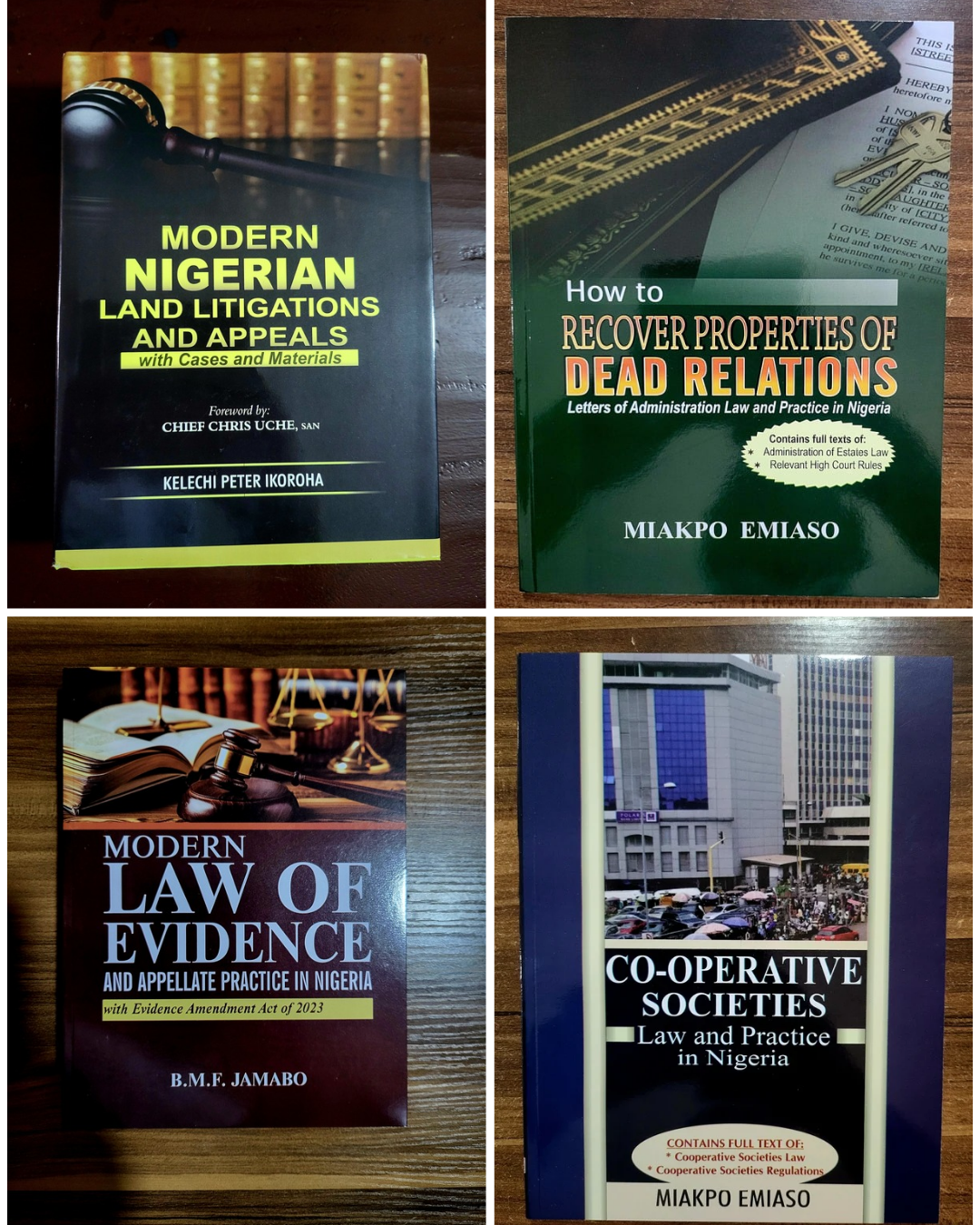
New Arrivals at the Legalnaija Bookstore: Calling All Lawyers, Law Firms & Legal Scholars
We’re thrilled to announce a fresh collection of new legal titles now available at the Legalnaija Bookstore! Whether you’re looking to sharpen your litigation skills, deepen your understanding of intellectual property, or stay updated on the latest amendments in Nigerian law—we’ve got you covered.
Featured Titles Include:
– Law and Practice of Intellectual Property and Traditional Knowledge by Nkeiruka Tasie Nwachukwu
– Modern Law of Evidence and Appellate Practice in Nigeria by B.M.F. Jamabo (with 2023 Amendment Act)
– Personal Injury Law: Principles, Practice and Procedure by Dennis Odigie
– Gambling Law & Practice by Samson Onuche
– Modern Nigerian Land Litigations and Appeals: With Cases and Materials
– Commentaries and Analysis on Nigeria’s Trade Marks Act
– Constitutional Law and Constitutionalism in Nigeria
– Landlords and Tenants Under Nigeria Laws
…and more!
Why Shop Legalnaija?
✅ Curated selection of authoritative Nigerian legal texts
✅ Perfect for law firm libraries, academic institutions, and personal study
✅ Fast delivery nationwide
✅ Trusted by thousands of legal professionals
Special Invitation
We invite lawyers, law firms, chambers, and legal departments to stock up on these essential resources. Whether you’re building your firm’s library or preparing for court, these books will elevate your legal practice.
📍 Visit www.legalnaija.com/store to place your order today.
📦 Bulk orders and firm-wide deliveries available.
For inquiries or custom orders, contact us via DM or email: hello@legalnaija.com or WhatsApp 09029755663
Let’s build smarter, stronger legal minds—one book at a time.
#Legalnaija #LawBooks #NigerianLaw #LegalPractice #LawFirmResources #LegalEducation #LawyersRead #LawLibrary #LegalScholarship #NewArrivals

by Legalnaija | Aug 18, 2025 | Blawg
MODE OF ENFORCEMENT OR SETTING ASIDE AN ARBITRAL AWARD; ORIGINATING MOTION OR A MOTION ON NOTICE? – A BRIEF COMMENTARY ON ZAMTRAC MANAGEMENT & CITY INVESTMENT LTD V. HAJIYA HALIMA BABANGIDA
Over the years, yet-to-be litigants have agreed in advance on various modes by which any disagreement that may arise from their contractual relations may be settled. Arbitration is one of these alternative dispute resolution mechanisms which allow parties to settle their differences outside of the formal courtroom, with relaxed rules and greater chances of arriving at a win-win situation. This is in clear contrast with the “winner takes all” procedure obtainable in the courtroom litigation.
The Nigerian legal system has also seen the need to encourage the use of these alternative dispute resolutions and our jurisprudence is rich with several holdings of appellate courts endorsing these alternate techniques of disputes resolution as part of concerted efforts to attain substantial justice. The reasoning behind this is not far-fetched as many of these alternative dispute resolution mechanisms are products of contract. Thus, if the parties have, at the time of entering a contract, agreed that every or a specific type of disputes that may arise in the course of their relation must be resolved by arbitration, the law ought to enforce that their desire without a second thought.
Despite these seemingly settled judicial positions however, enforcement of arbitral awards in Nigeria still poses a significant challenge. Sometimes, it begs the question whether there was any merit in first submitting to arbitration and thereafter commencing the procedure for the enforcement and recognition of an award – a process which may end up ultimately in a litigation up to the Supreme Court.
Parties who are aggrieved by an award proffer all manner of excuses, many bordering on absurdities, to call on the High Court and later the appellate courts to set aside an arbitral award published by an Arbitrator. Some of these cosmetic conspiracies were resolved in the twin appeals before the Court of Appeal in Zamtrac Management & City Investment Ltd v. Hajiya Halima Babangida (CA/ABJ/CV/226/2022 & CA/ABJ/CV/494/2022, respectively).2
BRIEF FACTS OF THE CASE LEADING TO THE APPEALS
By a Property Development Agreement, the parties agreed to mutually beneficial terms contained in the said agreement. The contract was for the development of six (6) units of five-bedroom (5) terrace structures on the Respondent’s land. The Appellant, amongst other things defaulted in meeting up with the contractually agreed duration of construction and unilaterally extended the time for delivery of the houses to the Respondent. Despite its own extension, the Appellant still failed to meet its own newly set deadlines. The Respondent therefore, by a notice, terminated the contract.
Further aggrieved by the breach of contract, the Respondent commenced an action at the High Court of the Federal Capital Territory, Abuja sitting at Kubwa, against the Appellant – the Developer. The FCT High Court, sitting in Kubwa, referred parties to arbitration, and the Appellant participated in the arbitral proceedings. Upon the conclusion of arbitral proceedings, an award was published in favour of the Respondent. Consequently, upon the publication of the award, in compliance with the rules of the lower court as well as the Arbitration Rules, the Respondent filed a motion on notice before the High Court of the FCT sitting in Kubwa, which referred the matter to arbitration, to commence recognition and enforcement of the Final Award.
The Appellant (Zamtrac) served with the application, and in response to the application for enforcement of the award, the Appellant filed a counter affidavit/written address thereto on 10th March, 2021. However, despite the pendency of these proceedings, the Appellant in the same breadth also proceeded to file an Originating Motion with a new suit number at FCT High Court, sitting in Gudu, Abuja, before another Judge purportedly seeking to set aside the award of the Arbitrator AND staying the proceedings of the High Court in Kubwa.
Expectedly, the Respondent objected to the procedure adopted by the Appellant in filing a new suit but the Appellant insisted that the procedure was appropriate.
Shop Now!
The application for enforcement and recognition of arbitral award before the FCT High Court in Kubwa therefore proceeded to hearing4 and the court delivered a considered ruling recognizing and enforcing the arbitral award against the appellant.
The Appellant’s new suit (originating motion) before the FCT High Court sitting in Gudu was also heard on its merits and eventually declared an abuse of court process in view of the pendency of the proceedings to the knowledge of the Appellant, about the existence of those proceedings.
It is against these two rulings of the FCT High Court that the Appellant appealed to the court of appeal seeking to set aside the recognition and enforcement of the award of arbitrator in CA/ABJ/226/2022 and the ruling dismissing its originating application to set aside the award in CA/ABJ/494/2022, as abuse of court process.
ARGUMENTS AT THE COURT OF APPEAL
In respect of the its new suit that was dismissed on the ground of being an abuse of court process, the Appellant argued, quite correctly, that it is trite that where a legislation has prescribed a particular means of doing a thing, that mode and no other is acceptable in law.
It further relied on the provisions of section 29 and 30 of the Arbitration and Conciliation Act, 1988 and other judicial authorities5 to submit that to enforce an arbitral award, an originating motion ought to be filed, instead of a motion on notice. It therefore urged the Court of Appeal to set aside the decision of the trial court as being flawed.
The Respondent on the other hand contended that the procedure for the enforcement and/or setting aside of an award is clear. She relied on the provisions of sections 29 and 30 of ACA as well as Order 43 Rules 1 (1) and (2) of the High Court of the Federal Capital Territory (Civil Procedure) Rules, 2018 which provides for the mode of bringing an application before the FCT High Court.
Specifically, it was argued that the rules of FCT High Court provides for manner of application for setting aside an award. Order 43 Rule 5
(1) of the Rules provides as follows:
“(1) Every motion on notice to set aside, remit or enforce an arbitral award shall state in general terms the grounds of the application and where any such motion is based on evidence by affidavit, a copy of the affidavit intended to be used shall be served with the notice of motion.”
(Underlining ours for emphasis)
Faced with these submissions, the Court of Appeal had to determine the intendment of the law makers as well as the drafters of the rules of court regarding the appropriate manner of commencing proceedings to either enforce or set aside an arbitral award; whether it is by an originating motion or by a motion on notice.
RESOLUTION OF THE COURT
The Court, in a unanimous decision delivered by H.A. BARKA, PJCA, held at pages 8-13 of the judgment as follows:
“In the resolution of this issue, it is my humble view that the area in dispute is indeed very narrow, being that the dispute flows from whether by the intendment of sections 29 and 30, of the Arbitration and Conciliation Act, an application for the enforcement of an arbitral award can only be commenced by way of an originating summons as against a motion on notice. For proper appreciation of the two sections, I reproduce the contents of the two provisions thusly…. From a holistic understanding of the cited sections of the law, it is evident that the submissions of the learned Appellant’s counsel cannot be sustained. In the recent decision of the Apex Court in A.G. bayelsa
- Odele (2025) 4 NWLR (Pt. 1982) 385, relying on its earlier decision in Nitel Ltd v. Okeke (2017) 9 NWLR (Pt.1571) 439 the fact that arbitration proceedings are sui generis was emphasized. An arbitral award is regarded as a final and conclusive judgment on all matters referred and the courts are enjoined as far as possible to uphold and enforce arbitral awards owing to the fact that it is a mode of dispute resolution voluntarily agreed by the parties. The method for the initiation of an application is governed by the rules of court, and as rightly argued by the learned counsel for the Respondent, the provisions of order 43 Rule 1 (1) and (2) of the High court of the Federal Capital Territory (Civil Procedure) Rules, 2018…. Furthermore, specifically providing for an application to set aside an Arbitral award, the manner of bringing the application to the court was stated in Order 43 Rule 5 (1) of the Rules as follows…. The learned counsel for the Appellant’s insistence that the application ought to have been made by way of an originating motion is clearly indefensible and unsustainable… I fail to see any iota of merit in this appeal, and accordingly dismiss the same.”
Her Ladyship, E. S. Nyesom-Wike, JCA, in her contribution to the lead judgment, held at page 4 thereof thus:
“For the records, Order 43 Rule 5 (1) of the High Court of the Federal capital Territory (Civil Procedure) Rules, 2018 provides that enforcement of award or application to set aside has to be by motion on notice. This method and no other, is allowed. Therefore the Appellant has relied on authorities unfavourable to it.
It should be noted that had there been no pending suit and the Respondent commenced his enforcement of the arbitral award by motion on notice, that motion on notice, whether designated as “Originating Motion” or not, remains an originating motion. Originating motion is just a motion that originates a proceeding or commences a suit. Whether the person commencing the suit adds “Originating” or not, does not make it less of an originating motion. What I am trying to say is that the word “originating” ahead of the motion on notice or even motion ex parte is only to indicate that it is an originating process and not just a mere motion. However, a motion is a motion. In the same vein, had there been no pending suit or enforcement proceeding for the award, any motion on notice to set aside the award, would be an originating motion, whether designated “motion on notice” or “originating motion”. Whatever be the case, there is no law that states that to set aside, it has to be done by a fresh action. Issue one of the Appellant, completely lacks merit.”
From the above holding of the Court of Appeal, it is without doubt that the Court has taken the view that going by the express provisions of the rules of the FCT High Court, a motion on notice is the appropriate mode of enforcement or setting aside an arbitral award. Mutandi mutantis, the trite position that where the law has prescribed a means of doing a thing, that means and no other is acceptable; applies. It is worth noting that the obiter of Nyesome-Wike JCA seeks to deepen the jurisprudence when her Ladyship stated what ought to be the position in situations that are not exactly on all fours with the instant case. The learned justice’s declaration that “a motion is a motion” though may be wrongly construed as conflicting with her previous position that the mode recognized by law to set aside an award is by a motion on notice; it is indeed illustrative of other situations when a suit may not be pending and a party wants to challenge such award. Filing a Motion on Notice, even if it is not christened “Originating Motion on Notice” will suffice.
CONCLUSION
It is therefore safe to conclude that as it relates to the making of an application for the enforcement of an arbitral award, the acceptable mode is by a motion on notice.6 Ditto, for an application to set aside an arbitral award. This, in the writer’s respectful view, is among the procedural challenges to the enforcement of arbitral awards that ought to be restricted by legislation. Otherwise, for as long as seemingly ridiculous arguments as these are allowed in relations to enforcement of arbitral award proceedings, it defeats the entire essence of the arbitration which seeks to provide a more time/cost-efficient means of resolving parties’ disputes.6 This position will apply to arbitral awards sought to be enforced/set aside in the Federal Capital Territory, Abuja Nigeria or any state that has provisions in pari materia in their respective State High Court Rules. In any case, like the appellate court had stated in this case, a motion is a motion. It is the circumstance upon which the party is filing a “motion” that will be used to determine whether it is “originating’ or not.
References
1.Abdulkabir Badmos, a legal practitioner writes from Abuja, Nigeria. He can be reached on aabadmos08@gmail.com or on X (formerly Twitter) at @MrBadmos_
2. In this piece, the writer examines some of these legal issues and the recent resolution of the court on the appropriate mode of setting aside an arbitral award.
3 Stating the specific judicial division(s) in this piece is important given that issues of abuse judicial process was the crux of Appeal No.: CA/ABJ/CV/494/2022.
4 It is worthy of note that the Appellant’s counsel failed to adopt his processes in this suit on the ground that he does not have his client’s instructions to do so. The application was therefore largely unchallenged.
5 KSUDB v. Fanz Const. Co. LTd (1990) 4 NWLR (Pt.142) 1.
6 This position will apply to arbitral awards sought to be enforced/set aside in the Federal Capital Territory, Abuja Nigeria or any state that has provisions in pari materia in their respective State High Court Rules. In any case, like the appellate court had stated in this case, a motion is a motion. It is the circumstance upon which the party is filing a “motion” that will be used to determine whether it is “originating’ or not.
 Abdulkabir A. Badmos, Esq.
Legal practitioner writes from Abuja, Nigeria. aabadmos08@gmail.com
Tweets on X (formerly Twitter) at @MrBadmos_
18th August, 2025.

by Legalnaija | Aug 9, 2025 | Blawg

Dear Barristers and Solicitors of the Federal Republic,
You’ve been drafting, defending, and decoding legalese all week. Now it’s time to drop the wig, hang the gown, and enter soft life mode. Because even the Constitution didn’t say you must suffer!
Here’s your weekend brief—no citations required:
Sleep Like NEPA Took Light and You Don’t Care
No court sittings. No “urgent” WhatsApp. Just you, your fan (or AC if God has buttered your bread), and uninterrupted sleep. If you wake up and it’s afternoon—case closed.
Chop Life—Literally
Amala and gbegiri? Jollof that slaps harder than a cross-examination? Eat like you just won a landmark case—even if all you did was survive Third Mainland traffic.
Put Your Phone on Airplane Mode (Even If You’re Not Flying)
Your inbox will be fine. That client who thinks Saturday is for legal advice? Tell them you’re observing constitutional rest.
Do Something That Has Zero Legal Relevance
Watch Nollywood. Dance to Asake. Paint something wild. The goal is joy, not billable hours.
Be a Couch SAN (Senior Advocate of Netflix)
Laugh till your belly hurts. Bonus points if you do it in your wrapper or boxers with chilled zobo in hand.
Rest no be laziness o—it’s strategy.
So this weekend, forget “Your Lordship” and embrace “Your Lounge-ship.” Monday will come, but for now, na soft life dey reign.

by Legalnaija | Aug 7, 2025 | Uncategorized
Leading international law experts have called for increased integration of women in the development and implementation of clean energy transition policies and programs to achieve a just and inclusive transition agenda that leaves no one behind.
This recommendation was made at an online workshop organized by the Committee on Women, International Law, and Development of the International Law Association Nigeria (ILA Nigeria). Themed, ‘Energy for All: Bridging Gender Gaps in the Green Transition,’ the event also marked the official launch of the Journal of Sustainable Development Law and Policy special issue on ‘Gender Justice and Energy Transition in the Global South.’ The special issue, edited by the Committee Chair, Dr. Pedi Obani, and Committee member, Dr. Adenike Akinsemolu offers new theoretical and empirical insights on the intersections of gender and energy justice.
Moderated by Committee Vice Chair Barrister Titilope Akosa, the event featured leading international experts including the President of ILA Nigeria, Professor Damilola Olawuyi, SAN; the immediate past Director-General of the National Council on Climate Change Secretariat, Dr. Nkiruka Maduekwe; and the Head of the Renewable Energy Unit at First City Monument Bank (FCMB), Ms. Chinma George. The webinar also featured presentations by Dr. Opeyemi Gbadegesin, Dr. Eduardo Pereira, and Dr. Hilary Okoeguale, who authored papers for the special issue.
Committee Chair, Dr. Pedi Obani, who is also an Associate Professor of Law at the University of Bradford in welcoming participants emphasised that, “In Nigeria, as in much of the Global South, women are not only disproportionately affected by energy poverty and environmental degradation – they are also powerful agents of change driving sustainable solutions. Yet, structural and institutional barriers continue to limit their participation access to resources and decision-making power.”
In his keynote address, Professor Damilola Olawuyi, SAN, who is also an Independent Expert on the United Nations Working Group on Business and Human Rights, lamented the pervasive lack of women in leadership roles in the energy sector, which is at risk of being replicated in clean energy transition programs. Calling for the equitable distribution of the benefits and burdens of development policies, the Learned Silk stated that, ‘There is a clear and urgent need to mainstream a gender perspective in clean energy transition programs and policies.’ He identified five dimensions of justice for a gender-aware energy transition: cosmopolitan justice, procedural justice, reparative justice, social justice, and distributive justice. According to him, realizing these justice imperatives requires providing tailored opportunities for women to access the necessary financing, technologies, training and education needed for them to play active and leading roles in developing and commercializing green innovation and eco-entrepreneurial ventures. Professor Olawuyi stressed that achieving these goals demands innovative, gender-aware and equitable laws and policies.
In the second keynote, Dr. Nkiruka Maduekwe discussed the uneven impacts of the climate crisis on women and the underuse of women’s knowledge, leadership, and expertise in the energy sector. She pointed out that, ‘Despite the fact that women bear the brunt of energy poverty, we account for over 70% of off-grid energy users. We lack access to affordable energy.’ Dr. Maduekwe also noted the scarcity of women’s stories in climate-related reporting, despite their producing most wood fuel and being the primary managers of energy in households. She proposed solutions such as increasing girls’ and women’s exposure to STEM education, introducing a gender lens to legal and policy frameworks, and promoting gender-informed storytelling. She also called for public participation in Nigeria’s ongoing efforts to develop its third Nationally Determined Contribution under the Paris Agreement.
Guest speaker Ms. Chinma George highlighted gender gaps in the current transition framework, focusing on women’s experiences with energy poverty and their limited opportunities for employment and leadership in energy. She underlined FCMB’s role in addressing these issues by empowering women through access to finance – like zero-interest loans – promoting green products, improving financial literacy, and fostering public-private partnerships.
The presentations by authors of papers in the special issue reinforced discussions about the gender gaps in current transition programs across the Global South, including in Nigeria and Brazil, and proposed solutions through training policymakers on gender analysis, providing seed grants for women’s climate research, disaggregated data collection, and equitable constitutional design processes. Dr. Pedi Obani also highlighted the Committee’s ongoing projects geared at driving gender inclusion in critical sectors, such as energy, water, sanitation, and hygiene, and other areas. She called for collaboration towards building policies and systems that advance women’s rights and holistically cater to of all segments of society.
ILA Nigeria is a branch of the International Law Association, which was founded in Brussels in 1873. The Nigerian Branch of the ILA regularly hosts innovative lectures, seminars, conferences, and other capacity development programs to advance the study and understanding of international law in Nigeria. Its committees, such as the Committee on Women, International Law and Development, serve as its focal points for contributing to research, capacity development, and dialogue around key thematic areas of international law. To learn more about ILA Nigeria, its activities, and events, visit http://www.ilanigeria.org.ng

by Legalnaija | Aug 7, 2025 | Blawg

To enhance the abilities of Chief Executive Officers and leaders of public and private institutions to effectively apply international law in boosting win-win trade, investment and development opportunities, the Nigerian Institute of Advanced Legal Studies (NIALS), in partnership with the International Law Association invites applications for its new Senior Executive Course in International Law and Sustainable Development.
This two part course will be held in Abuja and Abu Dhabi, United Arab Emirates.
Key Program Features
In-depth legal and policy instruction using primary sources and case law
Strategic capstone project and international negotiation simulations
Access to the 7th ASSELLMU Conference on Environmental Law in the Digital Age
One-on-one executive coaching and 360° leadership assessment
Distinguished guest faculty and policy practitioners
Optional financial literacy course
Alumni networking and post-program mentorship
Register here:
https://studies.ila-nigeria.org.ng/the-senior-executive-course-in-international-law-and-sustainable-development/