
by Legalnaija | May 6, 2026 | Blawg, Book
The Nigerian Lawyer’s Reading List: Essential Books for Every Area of Practice
From corporate transactions to election petitions — the titles that serious Nigerian lawyers are ordering, reading, and billing from.
What separates a good Nigerian lawyer from a great one? Beyond courtroom experience and client instincts, the great ones read — obsessively. They know the statute, the case law, and the commentary. They understand not just what the law says, but why it was written and where it is going.
At Legalnaija, one of the quietest but most impactful things we do is run the Legalnaija Bookstore, a curated library of Nigerian and international legal titles, shipped directly to lawyers across every state in the country.
Lawyers from Lagos to Abuja, Port Harcourt to Kano — the Legalnaija Bookstore has completed successful deliveries to legal practitioners nationwide. Whether you practise in a Tier 1 firm, a solo chambers, or as in-house counsel, the books your practice needs are a few clicks away.
We have done the curation work so you don’t have to. Below are our practice-area reading lists — each one assembled for the specific demands of that field of Nigerian law.
Essential Books For Lawyers In Different Areas Of Law
Essential Books for Corporate And Company Lawyers in Nigeria https://legalnaija.com/essential-books-for-corporate-and-company-lawyers-in-nigeria/
Essential Books for Litigation Lawyers in Nigeria https://legalnaija.com/essential-books-for-litigation-lawyers-in-nigeria/
Essential Books for Election Petition Lawyers in Nigeria https://legalnaija.com/essential-books-for-election-petition-lawyers-in-nigeria/
Essential Books for Tech, Digital & Fintech Lawyers in Nigeria https://legalnaija.com/essential-books-for-tech-digital-fintech-lawyers-in-nigeria/
Essential Books for Energy & Oil and Gas Lawyers in Nigeria https://legalnaija.com/essential-books-for-energy-oil-and-gas-lawyers-in-nigeria/
Essential Books for Tax Lawyers & Tax Practitioners in Nigeria https://legalnaija.com/essential-books-for-tax-lawyers-tax-practitioners-in-nigeria/
Essential Books for ADR & Arbitration Practitioners in Nigeria https://legalnaija.com/essential-books-for-adr-arbitration-practitioners-in-nigeria/
Essential Books for Financial Crimes & Compliance Lawyers in Nigeria https://legalnaija.com/essential-books-for-financial-crimes-compliance-lawyers-in-nigeria/
Each reading list is not a general catalogue — it is a practitioner’s toolkit, assembled specifically for Nigerian courts, Nigerian statutes, and the realities of legal practice on Nigerian soil. Whether you are preparing for a major arbitration under the Arbitration and Mediation Act 2023, advising on a fintech licensing matter, or building your litigation library from scratch, these lists give you a starting point that is relevant, current, and practical.
A lawyer who reads widely bills with confidence. A profession that invests in its own knowledge infrastructure closes the justice gap that still locks millions of Nigerians out of legal remedy. Both things are true — and both are why the Legalnaija Bookstore exists.
Go Deeper: The Legalnaija Bundle Offers
For lawyers ready to make a serious investment in their practice library, Legalnaija offers two curated bundles designed to give you depth, breadth, and immediate practical value — whether your focus is Corporate & Commercial Practice or Dispute Resolution. Building a strong, authoritative library is not optional. It is the foundation of billable confidence.
■ Corporate & Commercial Practitioners
Our Corporate Law Bundle gives you access to 27 essential titles carefully curated to strengthen your expertise across key areas of business and commercial law. These resources are designed to support you at every stage of practice — from young counsel to seasoned partner.
Get the Business Law Bundle here: legalnaija.com/product/business-law-bundle
■ Litigation & ADR Experts
If you live for courtroom advocacy, arbitration strategy, and the pursuit of justice, our Litigation and ADR Expert Bundle delivers 26 powerful titles tailored specifically for dispute resolution professionals — from civil litigation to arbitration under the Arbitration and Mediation Act 2023.
Order the Litigation & ADR Expert Bundle here: legalnaija.com/product/litigation-and-adr-expert-bundle
🎁 Special Offer — Enjoy 10% OFF when you use the voucher code LEGAL EXPERT at checkout.
Explore even more titles at the Lawyers’ Bookstore: www.legalnaija.com/store
For enquiries: 09029755663 · @Legalnaija
Invest in knowledge. Strengthen your practice. Lead with authority.

by Legalnaija | May 6, 2026 | Blawg, Directory

90% of Nigerians face a legal problem in their lifetime. Only 5% ever reach a lawyer
Every day, Nigerians with genuine legal needs search for qualified lawyers they can trust. The Legalnaija Directory is where that search ends — and where your next instruction begins.
Nigeria has a paradox at the heart of its legal system. On one side: millions of citizens and businesses with pressing, legitimate legal needs — disputes to resolve, contracts to review, rights to protect, deals to close. On the other: thousands of qualified, experienced lawyers whose practices are not growing as fast as their expertise deserves.
The problem is not supply. The problem is not demand. The problem is visibility — and the absence of a trusted, structured channel connecting the two.
“90% of Nigerians face a legal problem in their lifetime. Only 5% ever reach a lawyer. The gap is not shortage — it is infrastructure.”
That infrastructure is what the Legalnaija Lawyers’ Directory is built to provide. And it is already working — lawyers listed on the directory are receiving client enquiries daily, across practice areas, across states.
The Scenarios Playing Out Right Now
Scene 1 — Lagos Island, 9:43am
An MD of a mid-sized trading company just received a statutory demand. His company’s in-house counsel is on annual leave. He opens his phone and searches for a commercial lawyer who handles debt recovery. Your name does not appear. Someone else’s does.
Scene 2 — Abuja, 2:15pm
A first-generation entrepreneur is about to sign a shareholders’ agreement that has three clauses she doesn’t understand. She wants a corporate lawyer she can trust — not a referral from someone who might have a conflict. She searches online. She finds a directory. She picks the first verified profile she sees.
Scene 3 — Port Harcourt, 6:58pm
A landlord has been waiting eleven months to recover possession from a tenant in breach. His original lawyer has gone quiet. He needs someone new — experienced in property disputes, accessible, responsive. He goes online and types exactly what he needs. Someone gets that brief. It should be you.
These are not hypotheticals. These are the client conversations happening right now — every day — on the Legalnaija platform. The only question is whether your name is in the room when they start.
What Your Directory Listing Actually Does
Verified visibility
Your profile, practice areas, and credentials — searchable by clients across Nigeria who are actively looking for legal help.
Direct enquiries
Clients contact you directly through your profile. No middleman, no referral fee structures — just a warm lead arriving in your inbox.
Authority by association
Being listed on Legalnaija signals credibility. Clients come to the platform because they trust it — that trust transfers to your profile.
Nationwide reach
A client in Enugu can find you in Lagos. A business in Kano can contact you in Abuja. Geography stops being a ceiling on your practice.
Full ecosystem access
Your listing connects to Legalnaija’s ODR platform, legal templates library, and bookstore — tools that support your practice end-to-end.
Practice growth
Every listing is a long-term asset. As Legalnaija’s user base grows, so does the audience finding your profile — compounding over time.
This Is Bigger Than Your Practice
Every lawyer who lists on the Legalnaija Directory is not just growing their own client base. They are participating in something more consequential: the construction of a legal system that actually serves the country it exists within.
Access to justice is not an abstract principle. It is the SME that survives a predatory contract because it found the right legal advice in time. It is the tenant who understands her rights before the landlord changes the locks. It is the startup founder who structures equity correctly from day one rather than unwinding a costly mistake five years later.
When you are visible and accessible on a platform like Legalnaija, you are not just available to clients — you are available to Nigeria.
“A lawyer who cannot be found cannot serve. A legal system where clients cannot find lawyers is not functioning at capacity.”
Get Listed. Get Found. Get to Work.
List your practice on the Legalnaija Lawyers’ Directory →
app.legalnaija.com/signup
Access professionally drafted legal templates →
app.legalnaija.com/shop/templates
Built with Nigeria’s legal professionals, for Nigeria’s people. Your profile on the Legalnaija Directory is not just a listing. It is your practice, open for business — wherever in Nigeria your next client happens to be.
For Nigerian Legal Professionals: Your Next Client Is Already Looking. Can They Find You? app.legalnaija.com
@Legalnaija
www.legalnaija.com
by Legalnaija | May 6, 2026 | Blawg
State Control of Academic Choice and Fundamental Rights in Nigeria: A Constitutional Critique of Employability-Based Course Elimination[1]
Abstract
This article interrogates the constitutionality of the Federal Government’s policy to phase out certain university courses based on employability metrics. Contrary to arguments that such a policy falls within regulatory discretion, this paper contends that it violates fundamental human rights under Chapter IV of the Constitution of the Federal Republic of Nigeria 1999 (as amended). Specifically, it argues that the policy infringes on freedom of thought, expression, and the right to non-discrimination, while indirectly undermining the right to dignity. Drawing on judicial authorities and constitutional theory, the article establishes that state interference in academic choice constitutes an unjustifiable encroachment on intellectual autonomy in a democratic society.
1. Introduction
The Federal Government’s proposal to eliminate certain academic programmes deemed “non-employable” raises profound constitutional concerns. While framed as an economic intervention, the policy intrudes into the intellectual sphere traditionally protected in liberal democracies.
This article argues that beyond policy considerations, the proposal amounts to a constitutional infraction, particularly when examined through the lens of fundamental human rights.
2. Re-Examining the Constitutional Right to Education through Chapter IV
2.1 Beyond Chapter II: Derivative Rights Doctrine
Although the right to education is contained in Chapter II of the Constitution and is generally non-justiciable, Nigerian courts have, in certain contexts, adopted a purposive and expansive interpretation of fundamental rights.
In Attorney-General of Ondo State v Attorney-General of the Federation (2002) 9 NWLR (Pt 772) 222, the Supreme Court acknowledged that Chapter II provisions may guide interpretation of enforceable rights.
Similarly, in Fawehinmi v Abacha (2000) 6 NWLR (Pt 660) 228, the Court affirmed that constitutional provisions, and even international human rights norms, should be interpreted broadly to advance justice.
Thus, the right to education may be indirectly enforceable where it intersects with rights under Chapter IV.
2.2 Education as a Vehicle for Fundamental Rights
Education is not merely a socio-economic benefit; it is the foundation for the exercise of other rights, including:
- Freedom of expression (s 39)
- Freedom of thought (s 38)
By restricting access to certain fields of study, the state effectively limits the content and scope of intellectual development, thereby constraining these rights.
3. Freedom of Thought and Expression: The Core Violation
3.1 Intellectual Autonomy as a Constitutional Value
Freedom of thought under section 38 protects not only religious beliefs but also intellectual exploration and academic inquiry.
In Director of SSS v Olisa Agbakoba (1999) 3 NWLR (Pt 595) 314, the Supreme Court emphasised that constitutional freedoms must be interpreted expansively in a democratic society.
Academic disciplines represent structured avenues for thought. Eliminating them constitutes state-imposed intellectual limitation, which is antithetical to constitutional democracy.
3.2 Chilling Effect on Expression
The removal of courses, particularly in the humanities and social sciences, creates a chilling effect on expression.
Drawing from comparative jurisprudence such as Sweezy v New Hampshire 354 US 234 (1957), academic freedom has been recognised as a “special concern of the First Amendment.” While not binding in Nigeria, such reasoning is persuasive.
Suppressing entire fields of study indirectly suppresses:
- Research
- Debate
- Critical thought
This amounts to a structural infringement of freedom of expression.
4. Discrimination and Structural Inequality
4.1 Indirect Discrimination under Section 42
Although the policy appears neutral, its effects are not.
Students from less privileged backgrounds, who rely on public universities, are disproportionately affected. Wealthier individuals may still access such courses abroad or in private institutions.
In Uzoukwu v Ezeonu II (1991) 6 NWLR (Pt 200) 708, the Court recognised that fundamental rights must be interpreted to prevent subtle and indirect discrimination.
Thus, the policy may violate section 42 by creating class-based educational inequality.
4.2 Targeting of Non-STEM Disciplines
Empirical patterns suggest that such policies often target:
- Arts
- Humanities
- Social sciences
This raises concerns about ideological discrimination, particularly where these disciplines foster critical engagement with governance and society.
5. Human Dignity and the Right to Self-Actualisation
5.1 Expanding Section 34 (Right to Dignity)
The right to dignity under section 34 has been interpreted broadly to include respect for individual autonomy.
In Medical and Dental Practitioners Disciplinary Tribunal v Okonkwo (2001) 7 NWLR (Pt 711) 206, the Supreme Court affirmed that individuals have the right to make personal decisions affecting their lives.
Choosing a field of study is a core element of personal identity and self-actualisation. State interference in such choice undermines dignity.
5.2 Instrumentalisation of Citizens
By prioritising employability over individual preference, the state risks treating citizens as mere economic units, rather than autonomous persons.
This contradicts constitutional values rooted in dignity and freedom.
6. Limits of Section 45 Justifications
Section 45 permits restrictions on certain rights in the interest of:
- Public safety
- Public order
- Public morality
- Public health
Economic efficiency or employability is not expressly listed.
Even if “public welfare” is implied, restrictions must satisfy proportionality.
In Dokubo-Asari v Federal Republic of Nigeria (2007) 12 NWLR (Pt 1048) 320, the Supreme Court emphasised that limitations on rights must not be arbitrary or excessive.
Eliminating entire academic disciplines is arguably:
- Overbroad
- Disproportionate
- Not the least restrictive means
7. Academic Freedom and Institutional Autonomy
Although not explicitly codified, academic freedom is a recognised constitutional value.
In University of Ilorin v Oluwadare (2006) 14 NWLR (Pt 1000) 751, the Court acknowledged the importance of university autonomy in academic matters.
Centralised elimination of courses undermines:
- Institutional independence
- Curriculum diversity
- Scholarly innovation
8. Policy vs Constitution: Where the Line is Drawn
While the government has regulatory powers, such powers are not absolute.
As held in Governor of Lagos State v Ojukwu (1986) 1 NWLR (Pt 18) 621, the rule of law requires that all governmental actions conform to constitutional provisions.
Thus, policy convenience cannot override fundamental rights.
9. Conclusion
Contrary to the argument that employability-based course elimination is merely a policy choice, this article has demonstrated that it raises serious constitutional concerns.
The policy:
- Restricts intellectual freedom protected under sections 38 and 39
- Creates indirect discrimination contrary to section 42
- Undermines human dignity under section 34
- Fails the proportionality test under section 45
Accordingly, it may be argued that the policy constitutes an unconstitutional intrusion into the intellectual and personal autonomy of Nigerian citizens.
References
Legislation
- Constitution of the Federal Republic of Nigeria 1999 (as amended) ch IV, ss 34, 38, 39, 42, 45
Cases
- Attorney-General of Ondo State v Attorney-General of the Federation (2002) 9 NWLR (Pt 772) 222
- Fawehinmi v Abacha (2000) 6 NWLR (Pt 660) 228
- Director of SSS v Olisa Agbakoba (1999) 3 NWLR (Pt 595) 314
- Uzoukwu v Ezeonu II (1991) 6 NWLR (Pt 200) 708
- Medical and Dental Practitioners Disciplinary Tribunal v Okonkwo (2001) 7 NWLR (Pt 711) 206
- Dokubo-Asari v Federal Republic of Nigeria (2007) 12 NWLR (Pt 1048) 320
- University of Ilorin v Oluwadare (2006) 14 NWLR (Pt 1000) 751
- Governor of Lagos State v Ojukwu (1986) 1 NWLR (Pt 18) 621
Foreign Case (Persuasive Authority)
- Sweezy v New Hampshire 354 US 234 (1957)
Textbooks & Academic Works
- Ben Nwabueze, Constitutional Law of the Nigerian Republic (Spectrum Books)
- M T Okany, Nigerian Administrative Law (Africana First Publishers)
- HWR Wade and CF Forsyth, Administrative Law (Oxford University Press)
- Ronald Dworkin, Taking Rights Seriously (Harvard University Press)
- National Human Rights Commission, Nigeria – Fundamental Rights Framework
- UNESCO, Recommendation concerning the Status of Higher-Education Teaching Personnel
[1] Adebola V. Adeleye Esq. MBA is a corporate practice lawyer with keen interest in compliance, corporate governance M&A and risk management. He is also a certified Human Resources Manager. adeleyebola93@gmail.com 08088953829

by Legalnaija | May 6, 2026 | Blawg
THE LEGAL EFFECT OF DESTRUCTION OF A MARRIAGE CERTIFICATE ON THE DISSOLUTION OF MARRIAGE IN NIGERIA[1]
Abstract
Recently, while scrolling through my Facebook timeline, I saw the video of a newly wedded couple, still at their reception tearing their marriage certificate. What really got my attention was the caption, “No marriage certificate, No divorce.” I laughed but I was curious what inspired or prompted them to tear their marriage certificate while still celebrating their wedding ceremony.
This article examines the legal implications of tearing or burning a marriage certificate within the context of matrimonial law in Nigeria. It interrogates whether the destruction or absence of a marriage certificate affects the validity of a marriage or impedes its dissolution under the Marriage Act and the Matrimonial Causes Act. The article argues that a marriage certificate is merely evidentiary and not constitutive of marriage, and therefore its destruction has no legal consequence on marital status or dissolution proceedings. Through statutory analysis, case law, and comparative insights, the article concludes that dissolution of marriage can proceed without the production of a marriage certificate, provided that the existence of a valid marriage can be otherwise established.
1. Introduction
Marriage, as a legally recognised institution, is governed by statutory frameworks that regulate its formation and dissolution. In Nigeria, statutory marriages are primarily regulated by the Marriage Act and the Matrimonial Causes Act (MCA).¹ A recurring issue in matrimonial disputes is whether the destruction or non-availability of a marriage certificate affects the ability of parties to seek dissolution.
In practice, parties sometimes assume that tearing or burning a marriage certificate symbolically terminates the marriage. This article interrogates that assumption and addresses the central question:
Can a marriage be dissolved in the absence of a marriage certificate?
2. The Legal Nature of a Marriage Certificate
A marriage certificate serves as documentary proof that a marriage has been celebrated in accordance with statutory requirements. However, it is not the legal foundation of the marriage itself.
Under Nigerian law, the validity of a statutory marriage depends on compliance with procedural requirements such as notice, consent, and solemnisation before a registrar or licensed place of worship.² The certificate merely evidences that such formalities were complied with.
The courts recognise that:
- A marriage certificate is prima facie evidence of marriage;
- It is not the marriage per se;
- Its absence does not invalidate an otherwise valid marriage.
This distinction reflects a broader evidentiary principle: documents prove facts, but do not create them where the law prescribes substantive conditions.
3. Effect of Tearing or Burning a Marriage Certificate
The destruction of a marriage certificate has no legal effect on the subsistence of the marriage.
First, marriage is a legal status, not a physical document. Once validly contracted, it can only be dissolved through:
- A decree of dissolution by a court of competent jurisdiction;³ or
- Death of one of the parties.
Secondly, no provision of the Marriage Act or Matrimonial Causes Act recognises destruction of a certificate as a mode of dissolution.
Thus, tearing or burning a marriage certificate is:
- Legally irrelevant;
- Symbolic at best;
- Ineffective in terminating marital obligations.
4. Dissolution of Marriage Without a Certificate
4.1 Statutory Framework
Under section 15 of the Matrimonial Causes Act, a court may dissolve a marriage upon proof that it has broken down irretrievably.⁴ The statute does not require the physical production of a marriage certificate as a condition precedent.
The focus of the court is therefore:
- Whether a valid marriage exists; and
- Whether the statutory ground for dissolution has been satisfied.
4.2 Proof of Marriage Without a Certificate
Where a marriage certificate is unavailable, Nigerian courts permit proof of marriage through alternative means, including:
- Certified extracts from marriage registers;
- Oral testimony of witnesses present at the ceremony;
- Documentary evidence such as photographs or church records;
- Conduct of the parties giving rise to a presumption of marriage.
The Supreme Court in Menakaya v Menakaya emphasised the importance of proper procedure and evidentiary sufficiency in matrimonial causes, underscoring that the substance of the marital relationship, rather than mere formal documentation, is central to adjudication.⁵
Similarly, earlier authority such as Sowande v Sowande illustrates the court’s willingness to look beyond procedural defects where justice demands, particularly in matrimonial proceedings.⁶
4.3 Judicial Attitude to Documentary Absence
Courts adopt a substantive justice approach in matrimonial matters. The absence of a certificate will not defeat a claim where sufficient evidence exists to establish the marriage.
This approach aligns with the evidentiary principle that secondary evidence is admissible where primary evidence is unavailable, provided proper foundation is laid.⁷
5.1 Menakaya v Menakaya
In this case, the Supreme Court stressed procedural fairness in matrimonial proceedings and reiterated that failure to properly evaluate evidence may vitiate proceedings. While not directly on the issue of certificates, the decision is instructive in highlighting that matrimonial jurisdiction is evidence-driven rather than document-dependent.
The case reinforces the principle that:
The court’s primary concern is whether the legal requirements of marriage and its dissolution are satisfied, not whether a particular document is physically produced.
5.2 Sowande v Sowande
This case, though older, underscores the importance of procedural integrity in matrimonial litigation. It demonstrates judicial flexibility in ensuring that procedural technicalities do not override substantive justice.
5.3 On “William v William”
The case commonly cited as William v William appears in Nigerian legal discourse largely through secondary sources and comparative jurisprudence. It is generally referenced for the proposition that:
A marriage can only be dissolved by judicial decree, not by private acts or intentions of the parties.
This principle is consistent with Nigerian statutory law under the Matrimonial Causes Act.
6. Comparative Perspective
In other common law jurisdictions such as England and Wales, marriage certificates are similarly treated as evidentiary documents. The destruction of such a document does not affect marital status, as official records are maintained by the state.
Nigeria, having inherited its matrimonial legal framework from English law, follows the same doctrinal approach.
7. Conclusion
The destruction or absence of a marriage certificate does not affect:
- The validity of a marriage; or
- The ability of a court to dissolve it.
The decisive factor is the existence of a valid marriage, not the possession of documentary proof.
Accordingly:
A marriage can be dissolved even where the certificate has been lost, destroyed, or was never obtained, provided that the marriage can be established through admissible evidence.
REFERENCES
- Marriage Act, Cap M6 Laws of the Federation of Nigeria (LFN) 2004; Matrimonial Causes Act, Cap M7 LFN 2004.
- Marriage Act (n 1) ss 7–21.
- Matrimonial Causes Act (n 1) s 15.
- ibid s 15(2).
- Menakaya v Menakaya [2001] 16 NWLR (Pt 738) 203 (SC).
- Sowande v Sowande [1963] NSCC 218 (SC).
- Evidence Act 2011, ss 89–90.
[1] Adebola V. Adeleye Esq. MBA is a corporate practice lawyer with keen interest in compliance, corporate governance M&A and risk management. He is a certified Human Resources Manager. adeleyebola93@gmail.com 08088953829

by Legalnaija | May 6, 2026 | Blawg
NBA Gwagwalada Branch Election 2026: Electoral Committee Publishes Final List of Candidate
The Electoral Committee of the Nigerian Bar Association (NBA), Gwagwalada Branch, has officially released the list of cleared candidates for the forthcoming June 2026 Branch elections.
The announcement was contained in a statement jointly issued by the Chairman of the Committee, Sir Luke Enelichi, and the Secretary, Mrs. Magdalena Laya Nankwat, following the conclusion of a comprehensive screening exercise.
According to the Committee, the screening process was rigorous, thorough, and guided strictly by the provisions of the NBA Constitution and applicable electoral guidelines. At the end of the exercise, the following members emerged as duly qualified candidates for the respective offices:
Hassan Luqman Olayiwola, Esq. — Chairman
Irene Ominike Odibaba — Vice Chairman
The Committee noted that some aspirants were disqualified due to identified discrepancies in their nomination documents. Notably, a former aspirant for the office of Chairman, Mr. Nuraddin Daud Abdulsalam, was disqualified on account of inconsistencies relating to his Bar Practice Fee (BPF) receipts for 2025.
Specifically, the Committee observed that two separate receipts were presented, bearing conflicting details as to the payee branch—one indicating Abuja Branch and the other Gwagwalada Branch. In view of this inconsistency, the Committee resolved that neither receipt could be relied upon as valid proof of membership compliance with the Gwagwalada Branch.
In the wake of his disqualification, Mr. Abdulsalam and some of his supporters have reportedly expressed strong objections to the Committee’s decision, with statements suggesting that the election may be disrupted unless his candidacy is reinstated. There have also been claims—yet to be independently verified—of possible attempts to escalate the matter to the national leadership of the Association.
However, sources within the Branch, who preferred to remain anonymous, have indicated that the Electoral Committee remains resolute in its commitment to uphold due process, transparency, and the rule of law in the conduct of the election.
Further information available to the Committee also suggests that Mr. Abdulsalam does not have a record of formal registration as a member of the NBA Gwagwalada Branch.
The Electoral Committee has therefore reaffirmed its readiness to conduct a free, fair, and credible election in June 2026, urging all members of the Branch to remain calm, law-abiding, and committed to the democratic ideals of the Association.
by Legalnaija | May 4, 2026 | Blawg
In my usual juridical survey, I stumbled upon the case of *Gomez v. C. & S.S (2009) 10 NWLR (Pt. 1149) 223 (SC),* wherein a question that has troubled courts for years was put to rest. Though it prima facie looks simple, but is quite tricky in application.
When a court decides on jurisdiction, is that decision final or merely interlocutory? And more importantly, when must an appeal be filed? At first glance, you might think, “Ah, this one is straightforward”, but far from it.
This issue did not start with us. It came all the way from England, the same England that conceived, gestated, birthed, and weaned our Nigerian legal system.
Two cases. Two principles. Two completely different directions. We have *Bozson v. Altrincham Urban District Council (1903) 1 KB 547. On the other hand, Salaman v. Warner (1891) 1 QB 734.*
Now, here is where the confusion began.
Under *Bozson,* the court, *per Lord Alverstone, C.J.,* looks at the effect of the decision. So, if a court is faced with an application, usually a motion on notice; challenging its jurisdiction, and upon considering the application with the reply made thereof says: “I do not have jurisdiction; I therefore strike out the matter,”
that is the end of the case in that court. Nothing remains, and that decision is FINAL.
But if the court says: “I have jurisdiction and I shall proceed to hear the matter on the merit,”
that decision is interlocutory, because the real issues are still alive.
There is also *Salaman v. Warner.* Under Salaman, the focus is not on the effect of the decision, but on the nature of the application. *Per Fry, L.J.* opined that: whether the court says it has jurisdiction or it does not, both are interlocutory. Put differently, the order is to be classified as interlocutory in either case because it was made upon an interlocutory application.
You see the problem now?
One says look at the result.
The other says look at the process. And that was how both decisions continued their legal argy-bargy, dancing back and forth like a pendulum that refuses to settle.
Now the question is, what did Nigeria do?
Did we join the dance?
The answer is No!
Nigerian courts, in their usual wisdom, refused to entertain confusion. They picked one test and settled with it.
That test is the *Bozson test.*
This position was firmly reaffirmed in the said case of *Gomez v. C. & S.S (2009) 10 NWLR (Pt. 1149) 223 (SC),* where the Supreme Court, constituted of five panel of justices and presided over by the Law *Lord Niki Tobi, JSC, with Oguntade, JSC (of blessed memory)* delivering the lead judgment, made it clear that Nigeria prefers certainty. No room for the English style of “let’s see how it goes.” Therefore, a decision that the court has jurisdiction is interlocutory. Conversely a decision that the court does not have jurisdiction is final because there is nothing for the court to decide after holding that it does not have jurisdiction.
The court stated further that even earlier, in *Akinsanya v. U.B.A. Ltd. (1986) 4 NWLR (Pt. 35) 273, Eso, JSC* had already warned that allowing both tests to operate would only create confusion. According to him, the law should be workable and certain, not something that sends lawyers rummaging through books in search of answers.
So, yes, Nigeria chose clarity over chaos.
One may, however, ask, “But that was since 2009; what if the Court has made a U-turn?” Good question, indeed. This writer took further effort to confirm the most recent position.
In *Heritage Banking Co. Ltd. v. N.U.C. (2017) 5 NWLR (Pt. 1557) 104 (SC) and C.G.G. (Nig.) Ltd. v. Eronini (2019) 14 NWLR (Pt. 1692) 219 (SC),* the Supreme Court remained consistent on the said position.
Then came the more recent authority, according to my research: *Igoin v. Ajoko (2021) 17 NWLR (Pt. 1804) 90 (SC),* and the Supreme Court did not mince words and provided ipsissima verba as follows: “An order of court striking out or dismissing a case… for want of jurisdiction determines the rights of the parties… there is nothing left… the decision is final… It is not an interlocutory decision.”
At this point, the law is no longer shaking. It is standing firmly like the Aso Rock; let me borrow the words of my brother R.K. Rasheed, the decision stands firm:“like Kano State June/July rain fall.”
In light of the above, it can be said that the extant position of the law is this:
Where the court says: “I have no jurisdiction” and strikes out or dismisses the case, that decision is FINAL, and pursuant to section 25 of the Court of Appeal Act, the appeal must be made within 3 months (in civil cases) or 90 days (in criminal cases), as the case may be.
However, where the court says: “I have jurisdiction and I shall, in view of that, proceed with the merit of the case,” that decision is INTERLOCUTORY, and the aggrieved party must appeal within 14 days pursuant to the same section of the Act.
It can therefore be said that a decision on the issue of jurisdiction is treated as an exception to the general rule that an order that does not settle the matter in contention is interlocutory, while one that settles it is final. This is because, considering the pride of place that the issue of jurisdiction occupies in adjudication by a court, even though a decision that a court has no jurisdiction to entertain a case is not a decision on the merit with respect to the rights of the parties in the claim, it is a final decision. This is because the court is, by virtue of that fact, ipso facto devoid of the authority to further entertain the suit and cannot proceed to determine same on the merit.
While the order that says “I have jurisdiction” is interlocutory, any party aggrieved shall appeal within the 14 days.
At this point, you may want to start overthinking it:don’t. Whether it sits well with your logic or not, the court has spoken. It’s an adage in the Hausa language that: “Shari’a saɓanin hankali”: meaning; the law often runs contrary to reasoning or common sense.
As for whether England is still dancing their argy-bargy dance on this issue and refused to settle for one position like Nigeria, I honestly do not care to confirm, because I am not really a friend of foreign cases. After all, they are merely persuasive in our courts.
In sum, the extant position is that where a court declines jurisdiction and strikes out or dismisses a case, the decision is final and appeal lies within the prescribed time for final decisions. However, where the court assumes jurisdiction and proceeds to hear the matter, the ruling is interlocutory and appeal must be filed within 14 days.
In light of the above, I say no more, hoping I have made the point clear.
Thank you, for following through, my dear readers!
________________________________________________________________
Isah Bala Garba is a Level 400 student of Common and Islamic Law and a Senior Advocate of Bayero University, Kano,(SABUK).He has authored numerous legal articles and analyzed many cases in clear, plain language. He can be reached for comments or corrections via: Email: isahbalagarba05@gmail.com | Tel: 08100129131
by Legalnaija | May 4, 2026 | Blawg
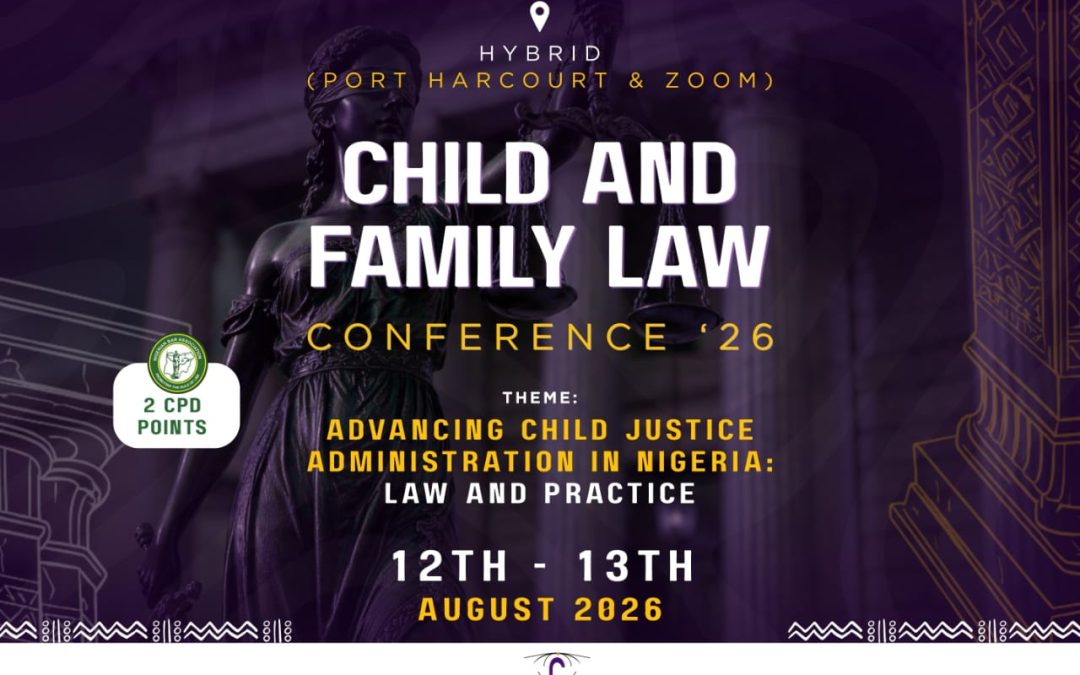
Advancing Child Justice Administration in Nigeria: What to Expect at the Child and Family Law Conference 2026
Date: August 12th-13th, 2026
Time: 10:00am daily.
Venue: Hybrid (Port Harcourt and Zoom).
NBA-ICLE: 2 CPD Points
Nigeria stands at an important moment in the development of child justice. Children make up a significant proportion of Nigeria’s population, yet the justice system still often struggles to respond to their realities in a way that is accessible, child-friendly, protective, and effective..
It is against this backdrop that Sceptre and Prima is convening the Child and Family Law Conference 2026, a high-level forum dedicated to advancing informed, practical, and rights-based approaches to child justice administration in Nigeria.
Held under the theme “Advancing Child Justice Administration in Nigeria: Law and Practice,” the conference will bring together judicial officers, legal practitioners, academics, policymakers, child protection professionals, social welfare actors, development partners, parents, and children themselves for two days of reflection, dialogue, learning, and reform-oriented engagement.
The conference programme has been carefully designed to combine thought leadership, practical insight, and lasting sector impact.
Highlights include:
– Keynote Address
– Panel Sessions on on the principles of child justice administration, the digital environment, detention reform, and adoption;
– Paper Presentations
– Launch of Books on Child Justice
– Launch of Children’s Rights and Family Law Journal
– Launch of Child Law Online Research Database
– Interactive Q and A Sessions
– Address by a Child on Access to Justice for Children
Opportunities to Participate
Register: https://sceptreandprima.com/conference/
The Child and Family Law Conference 2026 is also opening multiple pathways for participation and collaboration.
Call for Papers:
The **Journal of Children’s Rights and Family Law (CRFLJ)** invites well-researched papers for publication in its maiden edition. Scholars, practitioners, researchers, policymakers, and students are encouraged to contribute original work in child rights and family law.
Call for Authors and Book Vendors:
Authors, publishers, and booksellers with publications in child law, family law, children’s rights, and related areas are invited to showcase their books at the conference bookstore for purchase.
Call for Partners
Organisations and institutions interested in partnering with the conference are also welcome to connect with the organisers.
To learn more, register, or explore participation opportunities, visit the conference page: https://sceptreandprima.com/conference/
Certificates and 2 CPD points of the NBA-ICLE will be awarded on completion.
Email:admin@sceptreandprima.com
Phone number: 08075595575
by Legalnaija | Apr 30, 2026 | Blawg
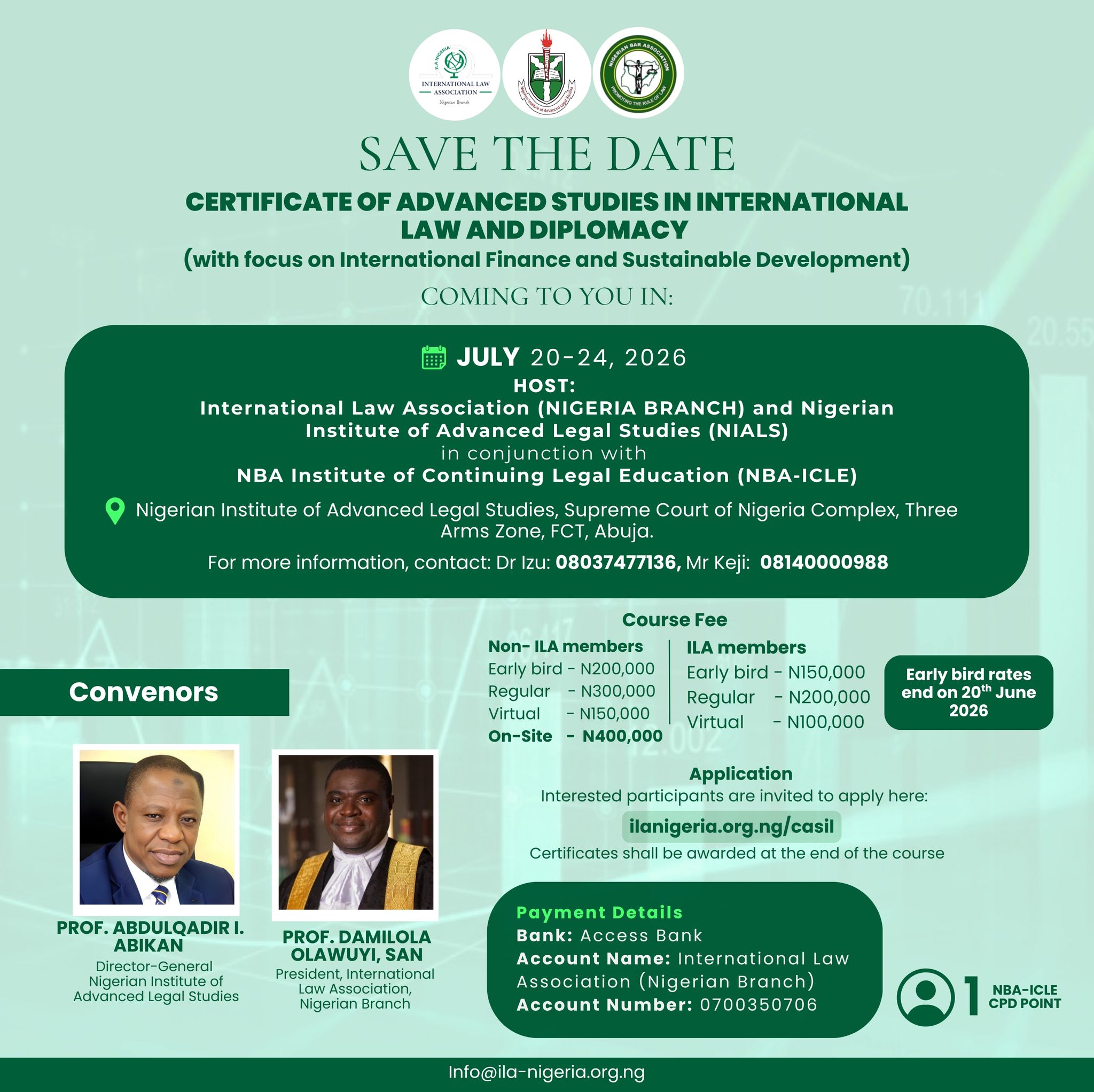
Good news! The Early Bird registration deadline for the 4th Edition of the Certificate of Advanced Studies in International Law and Diplomacy course has been extended to 20 June 2026.
If you missed the initial deadline, this is another opportunity to secure your place at a 20% discounted rate for what promises to be another landmark opportunity to elevate your career in international law and diplomacy.
From 20-24 July 2026 in Abuja, the course will bring together leading practitioners, diplomats, in-house counsel, policymakers, and industry experts from across Africa and beyond to engage on the issues shaping the practice and future of international law and diplomacy.
Now in its fourth edition, this course is organized by @Nigeria_ILA in partnership with @nialsorg. This year’s edition focuses on International Finance and Sustainable Development.
Date: July 20-24, 2026
Time: 9:00 am Daily.
Venue: Nigerian Institute of Advanced Legal Studies (NIALS), Supreme Court of Nigeria Complex, Three Arms Zone, FCT, Abuja.
Kindly register via this link: ilanigeria.org.ng/casil
Certificates and 1 CPD point of the NBA-ICLE will be awarded on completion.
Opportunities like this don’t come often—and this extension won’t last long.

by Legalnaija | Apr 30, 2026 | Blawg
Dr. Tolu Aderemi has strongly condemned the reported killing of a young Delta State indigene by a police officer, describing the incident as a grave violation of justice and human dignity, and calling for urgent institutional accountability.
The legal practitioner, who currently serves as Chairman of the NBA Lagos Branch Law Reform and Monitoring Committee and is a Partner at Perchstone & Graeys, expressed deep concern over the gruesome event said to have occurred in Effurun, Delta State. The incident, which has circulated widely in a disturbing video, allegedly involved the fatal shooting of 28-year-old Mr. Mene Ogidi under circumstances that appear both unjustifiable and contrary to established standards governing police conduct.
Dr. Aderemi noted that the deceased, by all indications, posed no immediate threat and had reportedly offered to cooperate with law enforcement by providing relevant information. He described the act as not only excessive but suggestive of conduct inconsistent with the ethical and professional obligations of police officers.
Emphasizing the need for justice, Dr. Aderemi urged the leadership of the Nigerian Bar Association (NBA) to take proactive steps in safeguarding public interest. He called for the NBA Public Interest Committee to closely monitor the disciplinary process and any ensuing prosecution of the officers involved.
He further advocated for the assignment of counsel to hold a watching brief on behalf of the Association, ensuring that the case is pursued diligently and without compromise.
According to him, such intervention is critical to reinforcing public confidence in the justice system and demonstrating the NBA’s commitment to the rule of law and protection of fundamental rights.
Dr. Aderemi concluded by stressing that incidents of this nature must not be allowed to recur, and that accountability must remain central to policing in a democratic society.
by Legalnaija | Apr 27, 2026 | Blawg
The Tolu Aderemi Initiative has successfully concluded its 12-week Alternative Dispute Resolution (ADR) Online Masterclass, capping an intensive programme designed to equip emerging professionals with practical skills and a global perspective on dispute resolution.
The Masterclass featured a distinguished lineup of facilitators who delivered sessions across negotiation, mediation, arbitration, emotional intelligence, and the growing role of technology in ADR. The closing ceremony celebrated participants’ achievements and reflected on the evolving demands of the profession.
The programme opened with Dr. Kolawole Mayomi, an accomplished arbitrator, who challenged traditional notions of negotiation by framing it as a value-driven skill applicable beyond disputes. He emphasized preparation, strategic thinking, and emotional discipline as essential tools for effective engagement.
Subsequent sessions built on this foundation. Fola Alade introduced participants to mediation and mediation advocacy, advocating for a structured approach through the Negotiation–Mediation–Arbitration–Litigation (NMAL) framework and stressing the importance of long-term career planning and a global outlook in ADR practice.
International perspectives were further explored by Aaron Ogletree, a US/Canadian attorney and expert in arbitration, who provided insights into international arbitration’s efficiency, confidentiality, and flexibility. Laura Alakija complemented this with a session on investment arbitration, offering an African perspective on investor–state disputes and the need to balance investor protections with states’ regulatory powers.
A recurring theme throughout the Masterclass was the human element in dispute resolution. In a dedicated session on emotional intelligence, Fola Alade underscored the importance of self-awareness, communication, and empathy, noting that many disputes are rooted in perception rather than purely legal issues.
The Masterclass also addressed emerging trends. Rotimi Ogunyemi, an astute tech-lawyer, led discussions on Online Dispute Resolution (ODR) and the integration of artificial intelligence, highlighting both its transformative potential and the ethical considerations of its use. He stressed that AI should serve as an assistive tool with human oversight.
Workplace dynamics and professional sustainability were examined during a panel featuring Bonyameen Babajide Lawal, Fola Alade, and Dr. Tolu Aderemi. The panel addressed conflict management in law firms, generational expectations, and the importance of fostering healthy professional environments.
Further reinforcing the programme’s practical focus, Professor Bankole Sodipo, SAN, a professor of law and Senior Advocate of Nigeria, delivered a session on ADR advocacy and career development. He encouraged participants to adopt a solution-oriented mindset, build professional visibility, and commit to continuous learning.
In the final sessions, Dr. Tolu Aderemi, the convener, highlighted the strategic importance of preliminary meetings in arbitration, describing them as critical to shaping direction and efficiency in proceedings.
Speaking at the closing ceremony, Dr. Tolu Aderemi reiterated the Initiative’s commitment to developing a new generation of ADR practitioners who are technically sound, adaptable, ethically grounded, and globally competitive.
With this cohort graduating better positioned to navigate the complexities of modern dispute resolution, especially in an era shaped by technology, cross-border transactions, and evolving professional expectations.
The Tolu Aderemi Initiative has announced TAI 2.0. The next phase will be more specialized and will have deeper intersections with AI and legal tech.
TAI continues to strengthen its role as a platform for building capacity and advancing excellence in ADR practice. For more information or sponsorship, please visit @tolu.aderemi.initiative or call Kelvin on +234703669793.