
by Legalnaija | May 17, 2023 | Uncategorized

Chukwuka Ikwuazom heads the Taxation practice and is a key member of our Litigation, Dispute Resolution and Risk Management practice at Aluko & Oyebode. Chukwuka has considerable tax advisory and adjudicatory experience. He renders ongoing tax advice to the Firm’s clients, including those in the oil and gas sector. He has also represented clients in tax litigation before several courts in Nigeria. As a Partner in our Litigation, Dispute Resolution and Risk Management practice, Chukwuka has worked closely with Babatunde Fagbohunlu as lead counsel in representing clients in numerous litigation and arbitration proceedings. Chukwuka was a key member of the team (led by Babatunde Fagbohunlu) which won a favourable award for our clients in an arbitration involving several tax disputes arising from the operation and performance of a 1993 PSC executed between the Nigerian National Petroleum Corporation and a number of IOCs.
Details of the Training:
Theme: “New Developments In Corporate Law”.
Date: 25th and 26th May, 2023
Time: 9am – 5pm daily
Modules:
– Tax Law
– Ethics and Corporate Governance
– Energy Law
– ESG And Risk Management
– Capital Markets And Securities Law
– Commercial Arbitration
Members of Faculty
– Mr. Tolu Aderemi (Partner Perchstone & Graeys)
– Mrs. Folashade Alli (Partner, Folashade Alli & Associates)
– Dr. Ayodele Oni (Partner, Bloomfiled Law Practice)
– Mr. Chukwua Ikwuazom SAN (Partner, Aluko & Oyebode)
– Miss Bukola Iji (Partner, SPA Ajibade & Co.)
– Mr. Dayo Adu (Partner, Famsville Solicitors)
Physical registration:
Fee: 70,000 Naira
Early Bird: 60,000 Naira (ends 15th May, 2023)
Venue: NECA House, Alausa, Ikeja, Lagos
Reg link: https://linktr.ee/Lawlexis
Virtual Session (ZOOM)
Early Bird: 40,000 (ends 15th May, 2023)
Regular Fee: 50,000
Registration Link: https://bit.ly/3KEW99c
Bank Transfer Details;
Name: Lawlexis International
Bank: Fidelity Bank
Acct Num: 4011176564
Registration fee covers lecture materials, and Certification. Participants also get 10 ICLE Points for participation.

by Legalnaija | May 17, 2023 | Uncategorized
“The Police is your friend.”
This phrase was intended to be reassuring and to help rebrand the Nigerian police force, but this PR bird did not just take flight. In fact, according to Vera Onana, a phrase that was intended to allay public misgivings and fears about the police only served to make it out to be a hilarious irony. Additionally, using “is” rather than “are” is a glaring grammatical mistake given that the phrase is plural.
This article does not, however, attempt to evaluate the English language proficiency of the Nigerian Police Force or critique a public relations campaign that failed to have the desired effect. Neither will this article take you on a depressing tale of the statistics on police brutality in Nigeria. This article will make better use of your time.
It is important to recognize that public perception is not homogenous and that opinions can vary significantly within and across communities. However, many Nigerians do not hold the Police in very high regard. Scratch: Many Nigerians do not hold law enforcement in very high regard, and for very good reasons too!
However, none of the very good reasons for mistrusting law enforcement is also an excuse to assault a police officer or any law enforcement officer. But if you are a celebrity or very powerful personality and you need other compelling factors to convince you why you must not, against your better judgment, assault a police or law enforcement officer other than notable and obvious reasons such as assaulting a law enforcement officer being a criminal act and it being a direct act of disrespect for their authority and the rule of law they represent, then let me quickly spell out other reasons why you should not assault or condone the assault of a police officer.
- Upholding the Rule of Law: Assaulting a police or law enforcement officer undermines the very foundation of the rule of law. The rule of law ensures that everyone is subject to and protected by the law, including both civilians and law enforcement personnel. When an officer is assaulted, it sends a message that some individuals believe they are above the law or can take justice into their own hands. This erodes trust in the legal system and can lead to a breakdown in social order.
- Protecting Public Safety: Despite their well-documented failings, police and law enforcement officers play a crucial role in ensuring public safety. They respond to emergencies, investigate crimes, and maintain order in society. Assaulting an officer not only puts their safety at risk but also hampers their ability to carry out their duties effectively. By attacking a law enforcement officer, individuals jeopardize the safety of the community they serve, as it may deter officers from taking proactive measures to prevent crime and protect citizens.
- Preserving the Integrity of the Justice System: Assaulting a police or law enforcement officer can have far-reaching implications for the integrity of the justice system. Officers are often called upon to serve as witnesses in criminal cases, and their credibility and reliability are essential to ensuring a fair trial. When an officer is assaulted, it can undermine their ability to provide accurate testimony or cooperate fully with investigations, leading to challenges in prosecuting offenders and potentially resulting in miscarriages of justice.
- Promoting Respect for Human Rights: You cannot fight for human rights for all while neglecting the rights of others. Respect for human rights, including the right to physical integrity and security, is a fundamental principle that societies strive to uphold. Police and law enforcement officers are tasked with protecting these rights and ensuring justice for all. Assaulting an officer violates their basic human rights and, by extension, undermines the principle of respecting the rights of others. Upholding the sanctity of human rights is vital for maintaining a just and equitable society.
- Fostering Trust and Collaboration: Trust between law enforcement and the community is essential for effective crime prevention and solving cases. Assaulting an officer erodes the trust and cooperation necessary for a productive relationship between law enforcement and the public. When trust is lost, individuals may be less willing to come forward with information or seek assistance from law enforcement, hindering efforts to address crime and maintain community safety.
I am not under any presumptions, and I understand that many of us are disgruntled and angry at the “system” and the agencies that serve it, particularly law enforcement agencies and agents. However, we must deconstruct the system and look beyond the veil of these agents, who are trained to carry out instructions to the latter. It’s essential to recognize that police and law enforcement officers are part of a larger system and are often tasked with carrying out instructions or policies set by higher authorities or governing bodies. It’s crucial to separate the actions of individual officers from the broader systemic issues that may exist.
Addressing grievances and seeking change in the system requires understanding the underlying structures, policies, and practices that shape law enforcement agencies. By directing attention towards systemic issues, it becomes possible to advocate for meaningful reforms that can lead to more equitable and just outcomes.
It is important to approach these efforts with a constructive mindset, acknowledging that the vast majority of law enforcement officers strive to fulfill their duties responsibly and ethically. By focusing on systemic factors and engaging in meaningful discussions and actions, it becomes possible to drive positive change while promoting a more just and accountable law enforcement system.
It’s important to note that while assaulting law enforcement officers is considered wrong, this does not mean that law enforcement is immune to criticism or that individual officers are exempt from accountability for any wrongdoing. Upholding the law and maintaining order should always be balanced with respect for human rights and the principles of justice.
So, while the Nigerian Police Force is not your friend, it is neither your enemy, and you should not assault a police or law enforcement officer—not even if you are the son of an Afrobeat legend.
Annakar, Hallelujah Tor Esq. is a lawyer based in Abuja with interests in corporate commercial law, technology and human rights.

by Legalnaija | May 12, 2023 | Training, Uncategorized

Dayo Adu is the Managing Partner at Famsville Solicitors, he advises on due diligence, Regulatory and Compliance audit, corporate and internal investigations, and general commercial law. He also renders legal advice on foreign investment in Nigeria, corporate structures for investment, investment incentives; tax breaks for foreign investors and company establishment procedures. He has advised both indigenous and international firms on general commercial laws cutting across different industries and draws from his dispute resolution background.
He is a professional negotiator and mediator (“PNM”) and also an associate member of the Chartered Institute of Arbitrators (“ACIARB”) England. He has also co-authored the Nigeria chapter for several notable international publications on Business Crimes, Labour & Employment Law, Product Liability, Corporate Immigration and Construction Law. He was a working Nigeria member of the Global Employment Institute of the International Bar Association (“IBA”) for several years.
Dayo was recently recognized by the World Bank for his contribution to “Doing Business 2016: Measuring Regulatory Quality and Efficiency”.
Join Dayo Adu at the career training session on Corporate Law holding on the 25th and 26th of May, 2023. To register follow this link buff.ly/3mQP4t5
Details of the Training:
Theme: “New Developments In Corporate Law”.
Date: 25th and 26th May, 2023
Time: 9am – 5pm daily
Modules:
– Tax Law
– Ethics and Corporate Governance
– Energy Law
– ESG And Risk Management
– Capital Markets And Securities Law
– Commercial Arbitration
Members of Faculty
– Mr. Tolu Aderemi (Partner Perchstone & Graeys)
– Mrs. Folashade Alli (Partner, Folashade Alli & Associates)
– Dr. Ayodele Oni (Partner, Bloomfiled Law Practice)
– Mr. Chukwua Ikwuazom SAN (Partner, Aluko & Oyebode)
– Miss Bukola Iji (Partner, SPA Ajibade & Co.)
– Mr. Dayo Adu (Partner, Famsville Solicitors)
Physical registration:
Fee: 70,000 Naira
Early Bird: 60,000 Naira (ends 15th May, 2023)
Venue: NECA House, Alausa, Ikeja, Lagos
Reg link: https://linktr.ee/Lawlexis
Virtual Session (ZOOM)
Early Bird: 40,000 (ends 15th May, 2023)
Regular Fee: 50,000
Registration Link: https://bit.ly/3KEW99c
Bank Transfer Details;
Name: Lawlexis International
Bank: Fidelity Bank
Acct Num: 4011176564
Registration fee covers lecture materials, and Certification. Participants also get 10 ICLE Points for participation.
Hurry and take advantage of the Workers Day Offer. Pay 25,000 Naira only when you use the voucher code: YOUNGLAWYER.
For enquiries, please contact: Lawlexis | lawlexisinternational@gmail.com | 09029755663.
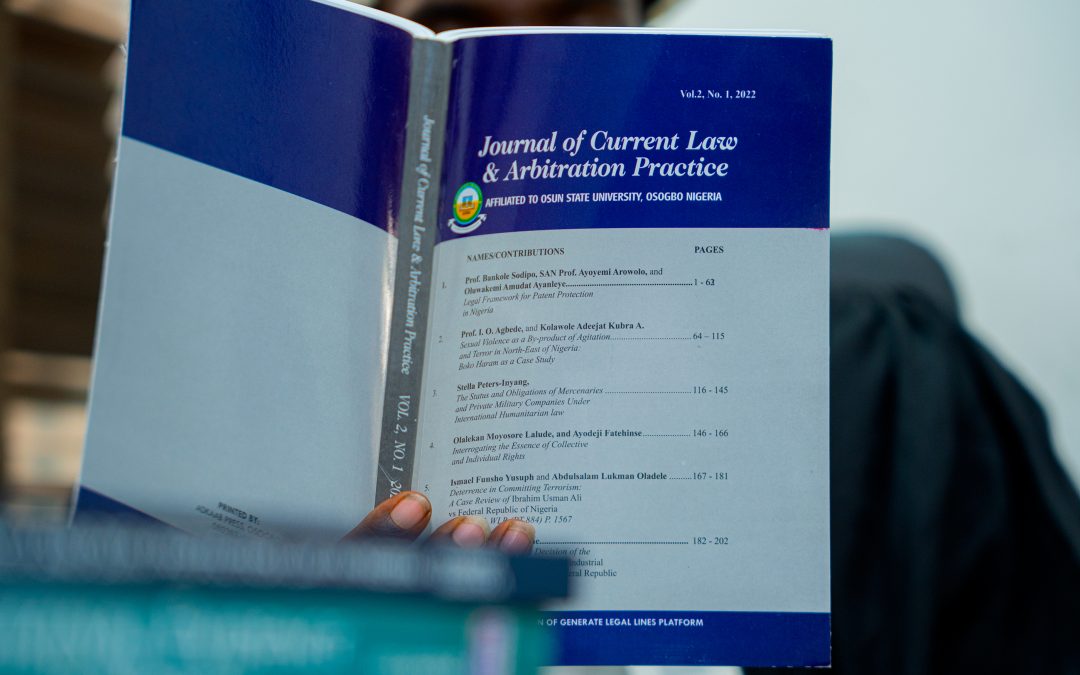
by Legalnaija | May 8, 2023 | Blawg

This journal is a triannual reportage of essays in all branches of Law and Alternative Dispute Resolution (ADR), with a particular focus on evolving areas like Medical Law, Arts & Entertainment Law, Information Technology, Energy Law and much more.
There are currently 4 volumes and you can see the topics on Vol 1 – 3 below;
Volume 1 No1 2020
- Mediation and conciliation: Traditional rulers ‘Panacea for Settling Land Disputes’ – Olufemi Ogunleye and Olusesan Oliyide.
- The Lagos State Street Trading and Illegal Markets Law: Making Norms Work– Adedotun Onibokun and N. U donmba.
- Fragility of Law and the Environment Nigeria as a Case Study – Gbadamosi, Oladele Abass
- Discourse on Legal Scholarship: The Emergence of Sociology of Law as a Discipline– Akuchie Henry A.
- Online Dispute Resolution (ODR): A Viable Solution to Speed and Efficiency Issues in ADR– Morenike, Obi-Farinde FCIArb
- Providing a Legal Framework for the Committal of the Mentally ill in Nigeria– Deborah Okemiri-Ikonne
- ODR in Africa:The Emergent Face of Dispute Resolution Post Covid 2019 – Morenike, Obi-Farinde FCIArb
- Exploring Alternative Dispute Resolution In Medical Malpractice Disputes In Nigeria – wadzi Vivian aboki, FCIrb
- Mekwunye v Imoukhuede – The Consistent Strides of Nigerian Arbitration (or, is it?) – Adebayo Adenipekun SAN, FCIArb, FCArb.
Volume 1 No2 2021
- The Effect Of Corporate Governance On The Performance Of Money Deposit Banks In Nigeria – toluwase T. Ajibade LLB,B.L,ACIArb, and Deji olanrenwaju LL.B,LLM, B.L, MSC, FCIB, FIMA, FCMR.
- Legal and Other Impacts of Foreign Investments in Nigeria since the second Republic – Olusesan Oliyide LL.M (Lagos) , Chinaka Emmanuel LL.M(BU) and Bunmi Osifeso,LL.M.(OAU).
- Getting it right between Criminal Liability and Anti- Social Behaviour – Akuchie Henry, a. b.Sc, (Hons) M.A (Houston), JD (California), LL.M (Virginia), and LL.D (South Africa).
- The imperative of establishing appellate court over Industrial Disputes in Nigeria – Festus Gboyega Oyebade B.Sc, LLB, BL, LLM (Ife). MA. Med, Mphil Law (Ife), Ph.D (Ibadan)
- Arbitration in Criminal Matters: Hoax or a possibility – Hon. Ipoola Aderemi Binuyo LL.B, ll.m, m.phil (Ife), B.L., FCIArb.
- The Companies and Allied Matters Act 2020 – Pastor ‘Niyi Odunsi
- Obafemi Awolowo University vs Inaolaji Builders Limited: A Needless Judicial Intervention– Funmi Roberts LL.M,C.Arb., FNCIArb., F.IOD
Vol.2, No.1.2022
- Bankole Sodipo, SAN, Prof.AYOYEMI Arowolo, and Oluwakemui Amudat Ayanleye – Legal Framework for Patent Protection in Nigeria.
- I.O. Agbedde and Kolawole Adeejat Kubra A. – Sexual Violence as a By-product of Agitation and Terror in the North-East of Nigeria : Boko Haram as a case study
- Stella Peters-Inyang – The Status and Obligations Of Mercenaries And Private Military Companies Under International Humanitarian Law.
- Olalekan Moyosore Lalude, and Ayodeji Fatehinse – Interrogating the Essence of Collective and Individual Rights.
- Ismael Funsho Yusuph and Abdulsalam Lukman Oladele – Deterrence in Committing Terrorism: A case Review of Ibrahim Usman Ali vs Federal Republic of Nigeria (2017) ALL WLR (PT 884) P.1567
- Francis Ohiwere Oleghe – A Critical Review of the Decision of the Decision of the High Court in Process & Industrial Developments Limited v The Federal Republic of Nigeria.
Vol.2, No 2, 2022
- Dr Effiong Esu – A Critical Appraisal Of Derivative Action Under The Companies And Allied Matters Act 2020
- Ogunleye, Olufemi Adewunmi, LL.M– Protecting Religious Minorities within Nigeria for African Traditional Religion: A challenge for international Human Right and National Laws.
- Francis ohiwere Oleghe – A Critical Analysis of Law and Justice as Instrument for Social Engineering in Nigeria.
- Gazu Gideon Nyuimbe – Reinvogorating the Ethics of Corporate Governance in the Nigerian Banking Sector
- Justice Adedotun Onibokun– Renewable Energy and the law in Nigeria
- Oluwagbemiga Atere – The Denovo effect of the Fade to periphery principle in the court of arbitration for sports . a Threat to the Right of Appeal and and its Legal Merits.
- Olufunmilola Olabode – Extending The Arbitration Agreement To Non- Signatories : A Contravention of The Consemsual Nature of Arbitration?
- Bolarinwa Levi Pius – Arbitration of Securities Disputes in Nigeria: Issues And Viable Reforms.
To order copies of the Journal, follow these links below or contact 09029755663.
- Get your copy of Vol 1 No. 1
- Get your copy of Vol 1 No. 2
- Get your copy of Vol 2 No. 1
- Get your copy of Vol 2 No 2

by Legalnaija | Apr 20, 2023 | Uncategorized
Arbitral proceedings are expressions of the will of the parties of which party autonomy is consciously guarded. The existence of an arbitration agreement is essential as it indicates the parties’ consent to settle their dispute by arbitration.
The Arbitration and Conciliation Act (ACA) gives no express definition to the term “Arbitration Agreement” but it describes the form of the agreement which is why parties must take extra precautions when executing an arbitration agreement (either as a standalone agreement or as part of another commercial agreement).
By virtue of Section 1(2) of the ACA, an Arbitration Agreement must be in writing and contained in a document signed by the parties or in an exchange of letters, telex, telegram, or other means of communication which provide a record of arbitration agreement, or in any other documents in which the existence of an arbitration agreement is alleged by one party and not denied by another.
Therefore, the way and manner an arbitration agreement/clause is drafted Is very crucial to the commercial relationship between the parties. It is pertinent to note that Arbitral Tribunals have been advised to refuse to conduct arbitration proceedings where the Arbitral clause is ambiguous.
When drafting Arbitration clauses, both the drafters and the parties are advised to state their intent in clear terms devoid of ambiguity and obscurity. To draft a valid Arbitration clause/agreement, the parties must first agree on the following fundamental terms:
- Scope of the Arbitration Agreement:
Parties must agree on the types of disputes that can be referred to arbitration under the agreement. A poorly drafted scope may deprive the tribunal of jurisdiction over all or part of the disputes. It is advisable to refer all disputes to Arbitration. Although parties are at liberty to refer only specific contract claims to arbitration, they may also expand the scope to include all disputes related to the contract, including non-contractual claims. In expressing this scope, Parties may use terms like “all disputes arising out of the contract”, “all disputes in connection or related to the contract”, or “all disputes arising under the contract”.
- Parties:
The parties to the Arbitration Agreement should be clearly stated, they should be natural persons or legal entities who are capable of entering into an agreement of this nature and against whom any award will be enforceable.
- Language of the Arbitration:
This is the language in which all submissions and evidence will be presented during the Arbitral proceedings. The parties should ascertain the language of the proceedings. The language of the arbitration also includes the words, clauses and phrases used in the agreement. This is important especially where parties are from countries with different first languages.
- Number and appointment of Arbitrators
Depending on the complexity, technicalities and the nature of the dispute, a Sole Arbitrator or an Arbitral Tribunal should be specified. Appointing a Sole Arbitrator is cost effective but where the dispute is a complex one with high commercial and reputational value, it is advisable to use a tribunal which consists of three arbitrators. When the parties opt for a tribunal, each party would each appoint an arbitrator and the 2 appointed arbitrators will then agree on a third arbitrator who should also be the chairman, where it is difficult to appoint the arbitrators, parties can agree that appointments be made by an appointing authority or body like the Nigerian Institute of Chartered Arbitrators (NICArb), LCIA etc.
- Features or qualifications of the Arbitrator(s)
One of the advantages of Arbitration over litigation is that it allows parties to determine the qualifications, characteristics, and experience that arbitrators should have before they can be qualified for appointment. This include conditions like nationality, industry/sector experience, biases or previous relationships with any of the parties etc. This is not a compulsory requirement and parties should ensure that the category of arbitrators to be appointed is not unduly narrow and unrealistic.
- Seat of the Arbitration
This refers to the procedural laws of the arbitration. it determines the rights to enforce the arbitral awards and the interim remedies available to the parties. The seat of arbitration has to do with the procedural laws while the venue of arbitration is simply the physical place where the arbitration will take place.
- Governing law of the Arbitration Agreement
This is important especially for international transactions, the law of the substantive contract may be different from the law governing the arbitration agreement.
- Choice of rules to govern the Proceedings.
When drafting an arbitration agreement, you may want to adopt the rules of an established arbitral institution, such as NICArb rules or LCIA, to govern the arbitration procedure. This enables the institution to administer the dispute (for a fee) based on its already established rules which is usually fair and impartial.
- Consolidation and joinder of Arbitral proceedings
This is common in multi-contract arrangements, where different tribunals may be appointed to deal with multiple arbitrations in relation to the same or similar set of facts. Parties should ensure that the arbitration agreements in each interrelated contract allows for consolidation of the various arbitration arising from the same or interrelated contract as non-joinder of this different arbitrations may lead to additional costs, delays, and multiple conflicting decisions.
- Multi-tiered clauses
This avails the parties the opportunity to explore various stages and types of ADR mechanism before finally exploring arbitration. Parties can attempt settlement of the disputes through other ADR mechanisms like Negotiation, Mediation or Conciliation before finally resorting to arbitration. This should be drafted with clear timelines which can be enforced with or without the active participation of any uninterested party in order not to frustrate the entire process.
Conclusion: Having discussed the various components and essential elements in a valid commercial agreement, I will share general guidelines for drafting all these components and a sample arbitration agreement will be provided in the next episode.
Oluwatoyin Bamidele Oni is a Corporate-Commercial Lawyer and a writer whose works are widely published. He has years of experience both in Arbitration, Project Finance, Infrastructure and PPP, Mergers, and Acquisition.
Oluwatoyin Bamidele Oni is a member of the Nigerian Institute of Chartered Arbitrators (NICArb), a member of the Institute of Chartered Secretaries and Administration (ICSAN), a member of Digital Rights Lawyers Initiative (DRLI), a member of The International Organisation of Management Professionals (IOMP), a member of the Intellectual Property Lawyers Association of Nigeria (IPLAN), a member of the Space Law & Arbitration Association (SLAA), and a member of Young International Council for Commercial Arbitration.

by Legalnaija | Apr 18, 2023 | Uncategorized
Introduction
With the global spread of smartphones and the accessibility to internet connections, it comes as no surprise that pharmacists are beginning to gravitate towards the use of online platform to render pharmaceutical care. The intervention of theHonourable Minister for Health in swiftly providing regulation for online pharmaceutical practice did not also come as a surprise.
What are online Pharmacies?
Online pharmacies refer to the delivery of pharmaceutical care through the instrumentality of electronic or digital platforms such as computers and smartphones to patients in circumstances where they cannot have direct access to a pharmacist or in circumstances where, although, they can access physical pharmacies but opt for the online pharmaceutical option for the convenience and privacy that comes with it.
The regulation is divided into 4 parts to wit: Registration and licensing, Inspection Monitoring and Enforcement, Operation of online Pharmacy and General provisions.
Part I- Registration and licensing
Regulation 1 empowers the Pharmacists Council of Nigeria to register internet based pharmaceutical services, same way it does traditional pharmaceutical entities.
Regulation 2,3 and 4 speaks to licencing requirements.
Regulation 3(2)prescribes that physical address of the online pharmacy must be visible online. This provision presupposes that the regulation contemplates a hybrid form of pharmaceutical practice, by which in addition to online presence, the pharmacy must have physical presence.
Regulation 9 provides that internet based pharmaceutical service must comply with the relevant laws relating to Information and Communication Technology such as the National Information Technology Development Agency Act, the Cyber Crime (Prohibition and Prevention) Act etc.
Part II-Inspection and Monitoring
Regulation 10 provides that prior to issuance of licence, the Council shall carry out inspection of the internet based pharmacyat the physical address that hosts the pharmacy.
Part III-Operation of Online Pharmacy
Regulation 12 provides that every internet based pharmaceutical service provider shall make its site user friendly and interactive for the purpose of:
- Consultancy services to patients and clients;
- Educating patients regarding the medications and disease states;
- Contacting patients regarding delays in delivering prescriptions as well as feedback and recalls; and
- Reporting adverse drug reactions and medication errors.
Regulation 14(2) prohibits the sale of dangerous drugs online.
Regulation 17 provides that internet based pharmaceutical service providers must provide a system for safe and secure delivery of medications and ensure that the right medication is mailed to the patient.
Part IV-General Provisions
Regulation 19(2) provides that the premises and sites of internet based pharmaceutical service providerswill be closed by the council where they fail to obtain the requisite licence.
Regulation 21(5) provides that a pharmacist may only register one (1)internet-based platform at any given time.
Offences and Penalties
Regulation 22(3) prescribes imprisonment for a period not less than 6 months or to fine not less than N250,000.00 or to both as penalty for contravention of the Regulation.
Conclusion
There is no gainsaying that the recognition of online pharmacy is laudable as it enhances access to pharmaceutical care. However, one of the drawbacks is the potential decrease in interaction between pharmacists and patients.
Another shortfall of this regulation is its failure to define the practicality of the operation of online pharmacies. Specifically, it fails to specify if online pharmacies registered under the regulation are designed to operate in the same configuration as telemedicine, whereby the Doctor and patient interact through video conferencing.
AUTHORS
AROME ABU
abuaromethecounsellp@gmail.com
JOHN AYOBAMI AKINWUMI
john_akinwumi@yahoo.com
For further information, please contact us at thecounsellegalpractice@gmail.com
THE COUNSEL L-P,PLOT 1014, SAMUEL ADEMULEGUN AVENUE, CENTRAL BUSINESS DISTRICT ABUJA, FCT.
http://thecounsellp.com
Twitter:
@TheCounselLP
+234 803 262 2359
+234 708 115 6539
CAVEAT: THE INFORMATION PROVIDED IN THIS ARTICLE SHOULD NOT BE TAKEN AS PROVIDING LEGAL ADVICE ON THE SUBJECT MATTER. KINDLY SEND AN EMAIL TO thecounsellegalpractice@gmail.com.IF YOU NEED FURTHER LEGAL ADVICE ON THE ISSUES DEALT WITH HEREIN
COPYRIGHT © 2023 THE COUNSEL L-P ALL RIGHTS RESERVED
by Legalnaija | Apr 7, 2023 | Law, Training
Recently, President Buhari signed the Business Facilitation (Miscellaneous Provision) Act, 2023, a legislative intervention by the Presidential Enabling Business Environment Council, PEBEC, which amends 21 business-related laws, removing bureaucratic constraints to doing business in Nigeria.
Other laws recently signed into law are the Copyright Act, 2022, and various constitutional amendments, including the creation of the NNPC Limited, all geared towards making Nigeria a progressively easier place to start and grow a business.
It is therefore important that lawyers are well equipped and informed on how these laws affect their client’s businesses and the business community at large. This is why Lawlexis has put together a stellar faculty of lawyers and business experts to deliver masterclasses on these new developments in corporate law.
Modules:
– Tax Law
– Ethics and Corporate Governance
– Energy Law
– ESG And Risk Management
– Capital Markets And Securities Law
– Commercial Arbitration
Members of Faculty
– Mr. Tolu Aderemi (Partner Perchstone & Graeys)
– Mrs. Folashade Alli (Partner, Folashade Alli & Associates)
– Dr. Ayodele Oni (Partner, Bloomfiled Law Practice)
– Mr. Chukwua Ikwuazom SAN (Partner, Aluko & Oyebode)
– Miss Bukola Iji (Partner, SPA Ajibade & Co.)
– Mr. Dayo Adu (Partner, Famsville Solicitors)
Theme: New Developments In Corporate Law
Date: 25th and 26th May, 2023
Time: 9am – 5pm daily
Venue:
- Onsite: NECA House, Alausa, Ikeja, Lagos
- Offsite: (ZOOM)
Registration Details;
Fee: 70,000 Naira
Early Bird: 60,000 Naira (ends 15th May, 2023)
Venue: NECA House, Alausa, Ikeja, Lagos
Reg Link: https://bit.ly/3KRMX1v
Virtual Session (ZOOM)
Fee: 50,000
Early Bird: 40,000 (ends 15th May, 2023)
Registration Link: https://bit.ly/3KEW99c
Bank Transfer Details;
Name: Lawlexis International
Bank: Fidelity Bank
Acct Num: 4011176564
Registration fee covers lecture materials, and certification. Plus you can get 10% discount when you use the voucher code: CORPORATELAWYER23. Persons who should attend include lawyers at all levels. For enquiries, please contact: Lawlexis – lawlexisinternational@gmail.com or 09029755663.

by Legalnaija | Apr 6, 2023 | Uncategorized
It can be generally agreed that following decades of football evolving from its 19th century origin days in Britain to the multi-million dollar empire it currently is, club football competitions now dominate the international football calendar. However, the Fédération Internationale de Football Association (FIFA) creates periodic exclusive windows for national football teams to play games via the International Window. This ensures that the relevance of international football between representative teams of national associations, which used to be the Holy Grail of football, is continually preserved.
An International Window is defined as a period of nine days starting on a Monday morning and ending on Tuesday night the following week (subject to temporary exceptions), which is reserved for national teams’ activities.[1] FIFA usually publishes the International Match Calendar for a period of between four and eight years after consultation with the relevant stakeholders. The International Match Calendar will include all International Windows available for the relevant period.
Many football fans will recall the President of the Italian football club S.S.C. Napoli, Aurelio De Laurentiis, throwing a tantrum a few months ago about no longer engaging the services of footballers who represent African nations, in view of the regular clash in calendar between the biennial African Cup of Nations (AFCON) tournament and important matches of the European Football season.[2] He reiterated his stance by threatening that he would only sign African players who agree to a clause in their contract prohibiting them from participating in the AFCON. However, what many do not know is that this was just an empty threat by the Naples executive, and any Sports Lawyer worth his/her salt would not include such clause in a football services contract. Where such clause is inserted in a contract, it would be null and void.
With international football matches returning to our screens last week for the first time since Argentina won the FIFA World Cup 2022, club football matches were halted about 2-3 days before the first round of international matches kicked off in the midweek of the week beginning on March 20, 2023. This is in line with the provisions of FIFA’s Regulations on the Status and Transfer of Players (“FSTP”), the last edition of which was published and released in October 2022.
The FSTP mandates football clubs to release their registered players to the national team of a country for which the player is eligible to play on the basis of her nationality if they are called up by the association concerned and prohibits any agreement between a player and his club to the contrary.[3] It is observed that in International Window weeks, elite club football matches are not played on Monday night as is usually done in most other weeks. This is because players must be released and start the travel to join their national team no later than Monday morning of the International Window week.[4]
It is mandatory that players be released for all International Windows listed in the International Match Calendar as well as for the final competitions of the FIFA World Cup, the FIFA Confederations Cup and each confederation’s periodic “A” grade championships.[5]
On the flip side, to also protect the interests of football clubs who in most cases pay the bulk of wages earned by players, FIFA limits the number of matches that may be played during any international window to a maximum of two matches by each national team (subject to temporary exceptions), irrespective of whether the matches are qualifying matches for an international tournament or friendlies. These matches can be scheduled any day as from Wednesday during the International Window week, provided that a minimum of two full calendar days are left between two matches (e.g. Thursday/Sunday or Saturday/Tuesday).[6]
As a further step to protecting the interests of football clubs, FIFA aims to reduce the total distance travelled by football players during the International Window. Thus, national teams are required to play the two matches within an International Window on the territory of the same confederation, with the only exception being intercontinental play-off matches. Also, if at least one of the two matches is a friendly, they can be played in two different confederations only if the distance between the venues does not exceed a total of five flight hours and two time-zones.[7]
Football clubs are not obliged to release players outside an international window or outside the final competitions included in the international match calendar. Similarly, it is not compulsory to release the same player for more than one “A” representative team final competition per year.[8]
As another means of protecting the interests of football clubs, players must also start the travel back to their club no later than the next Wednesday morning following the end of the international window, subject to temporary exception allowed by FIFA.[9] As regards this particular provision, the clubs and associations concerned may agree a longer period of release or different arrangements.[10] A player resuming duty with their clubs after an International Window must resume no later than 24 hours after the end of the period for which they had to be released, or 48 hours if the national teams’ activities took place in a different confederation to the one in which the player’s club is registered.[11]
Where a player does not resume as stated above, the Players’ Status Chamber of the Football Tribunal may, at the request of the Club:
- a) issue a fine;
- b) reduce the affected player’s period of release for the next International Window; or
- c) ban the association from calling up the player(s) for subsequent national-team activities.[12]
Given the need to protect the economic interests of football clubs in football players while ensuring that international football matches are taken seriously by clubs and players alike, FIFA’s fine balancing act of laying down precise regulations that address the interest of all parties involved is impressive.
[1] Article 1, para 4, Annexe 1, Regulations on the Status and Transfer of Players, October 2022
[2] https://www.goal.com/en-ng/news/napoli-de-laurentiis-african-players-afcon/blt0f8dc87fa7999bd3
[3] Article 1, para 1, Annexe 1, RSTP
[4] Article 1, para 7, Annexe 1, RSTP
[5] Article 1, para 2, Annexe 1, RSTP
[6] Article 1, para 4, Annexe 1, RSTP
[7] Article 1, para 5, Annexe 1, RSTP
[8] Article 1, para 6, Annexe 1, RSTP
[9] Article 1, para 7, Annexe 1, RSTP
[10] Article 1, para 8, Annexe 1, RSTP
[11] Article 1, para 9, Annexe 1, RSTP
[12] Article 1, paras 10 & 11, Annexe 1, RSTP

by Legalnaija | Mar 7, 2023 | Uncategorized

Great News For Law Firms In Nigeria
We have some amazing news.
Law firms can now register and subscribe to the Legalnaija Directory for lawyers and law firms.
Our Directory is Nigeria’s fastest growing market place for lawyers and law firms looking to establish their reputations and brands. The Directory also allows Users find your law firm through your area of expertise and location.
Take advantage of this amazing opportunity to grow your legal practice. In addition you also get free access to customizable Agreement templates, law books and materials, and a platform to showcase your legal articles, content and expertise.
Don’t loose the opportunity to make your law practice stand out from others and be more accessible to the high number of users searching the internet for legal solutions.
Follow this link to register https://app.legalnaija.com/signup, and if you need to contact support, please mail hello@legalnaija.com
Check out the Directory here https://app.legalnaija.com
@Legalnaija

by Legalnaija | Mar 6, 2023 | ADR
The mechanisms of Alternative Dispute Resolution in Nigeria’s judicial or legal system can be more relevant in reduction of courtroom congestion that has prevented expedition of natural justice, equity and fairness in our society. In the words of then Chief Justice of Nigeria, Justice Dahiru Musdapher, “the workload of the courts, noting that while 163 cases ( 78 judgements and 85 motions) were disposed of within the 2010-2011 legal year by the Supreme Court, there remained a staggering caseload of 1,149 civil appeals, 58 criminal appeals and 117 motions”. Based on this assertion, the ADR mechanisms is stirred up to expedite justice, equity and fairness in our commercial/ business sectors of the society just like other developed countries even, among some Africa countries today.
This can uplift our legal system when litigation lawyers encourage their client(s) to utilize any of these mechanisms in resolving business/ commercial disputes that might arise during or after contract rather than litigation. It is once said by the Chief Judge of River State, during the celebration of new legal year 2023 in the State that, Lawyers discourage their client(s) from using the ADR Multidoor courthouse and this has made the ADR mechanisms irrelevant today. He went further to plead with the litigation lawyers to encourage their client(s) to use the ADR system.
In ensuring the relevance of ADR mechanisms in our legal system, various Courts have encouraged all litigation lawyers to use the ADR system by making provisions in their various Courts (Civil Procedural Rules), for instance, Rule 1c of the High Court of Lagos State (Civil Procedure) Rule 2012 reiterates an “amicable resolution of disputes by use of Alternative Dispute Resolution (ADR) mechanism” and many other commercial organizations like Nigerian Communications Commission (NCC) etc and also ensure that, whenever litigation lawyers brought matters ought to be resolve through ADR, the court refer such matter(s) to the Multipurpose courtroom door or Multidoor courthouse for settlement between disputant parties which can be in form of AN AGREEMENT or AN AWARD. For example, the preamble to the High Court of Lagos State ( Civil Procedure) Rules 2012 empowers the Lagos State High Court to mandate parties in dispute to use ADR mechanisms or other dispute resolution options, to resolve their where court considers it appropriate to use such.
The ADR mechanisms will be relevant in our society, if our litigation lawyers ensure that, their client(s) have confidence in the process by accepting the outcome of the arbitral tribunal and the enforcement of agreement or award; increase the knowledge and awareness of their client(s) about the relevance of the ADR mechanisms; the creation of courts which will entertain and expedite matters from the arbitral tribunal and the quick passage of the National Alternative Dispute Resolution Regulatory Commission Bill 2011.
 Written by S. I Adeshina, ACArb
A Pleader, Arbitrator, Human Rights Activist, Socialist, Writer and Political Analyst
Authorities
Abdulsalam O. A. Alternative Dispute Resolution & Arbitration in Nigeria: law, theory and practical: Princeton Publisher 2017
Lagos State High Court (Civil Procedure) Rule 2012