by Legalnaija | Jul 30, 2018 | Uncategorized
A political party is
generally known by what it stands for, the policies it supports and the
interests it upholds. A major factor of a political party is its ideology, for
these Political ideologies shape policy debates and choices.
A political ideology is a
certain set of ethical ideals, principles or doctrines, that explains how society
should work and offers some political and cultural blueprint for a certain
social order. In a nutshell, party ideologies explain the evaluative and orientative way of
thinking of a political party.
Therefore, examining a
political party’s ideology will help shed light on the type of policies and
programmes that will be instituted by that party when it has political control.
It enables voters to decide which party and candidate to give their votes based
on the expectations from the party’s ideology.
Thus, as we approach the
Nigerian general elections in 2019, I decided to examine the ideologies of the top
2 (Two) political parties in the country; the All Progressives Congress (APC)
and the People’s Democratic Party (PDP).
On the APC Website, I discovered
their philosophy and hereby reproduced same below –
1.
Belief in, and the fear of God;
2.
Upholding the rule of law;
3.
Preserving national unity
4.
Pursuit of a joint egalitarian society;
5.
Building of strong institutions;
6.
Commitment to social justice and economic
progress; and
7.
Promoting representing and functional
participatory democracy
While on the PDP Website, what I
discovered was a Manifesto and not an express list of its ideologies as a
party. Therefore, it is safe to say that the PDP does not have an ideology or
list of principles that are center to its system of administration or
governance. However, does this make the APC better?
In the ordinary course of
examining the above paragraph, one may agree that the APC is a better party for
at least having a list of guiding principles, however, having a list on a
website is one thing and actually living according to the tenets of these guiding
principles is another litmus test a party must pass.
For instance, the APC have
stated that upholding the “rule of law” is one of their guiding principles but
the current APC led government has acted contrary to this principle as evidenced
in the case of the former National Security Adviser, Retired Colonel Sambo
Dasuki, who has been in illegal detention despite 5 (five) different court
orders directing the government and security agencies to release him on bail.
Furthermore, the
constitution guarantees every Nigerian the fundamental right to be treated
decently and free from indecent treatment or torture, however, the APC
government has failed to address the allegations of extortion, torture and
unlawful treatment of citizens by the Nigerian Police. Evidently, the guiding
principles of the APC is meant only for the objective of having a philosophy and not really one to be adhered to.
This is why it is no
surprise that politicians in Nigeria move back and forth from both parties
every election cycle because what binds the members of these parties is not
ideology but selfish and self-serving interests. For, how can one change
ideologies every 4 (Four) years.
Recently, in the Nigerian polity,
a record number of members of both political parties have jumped ship into the
other. For the party you belong to in Nigeria determines if you would
victimized by the ruling party or not. This is why as Nigerians are faced with a
choice of electing members of these parties in the coming elections, it is
important we note that we are not voting for ideals but for self-serving party
members who will do anything to attain political relevance and satisfy their
personal greed and whims.
It is therefore important for Nigerians to put politicians to task of providing and standing by their political ideologies.
Adedunmade Onibokun is a Nigerian
lawyer, Author and Social Analyst.
by Legalnaija | Jul 29, 2018 | Uncategorized
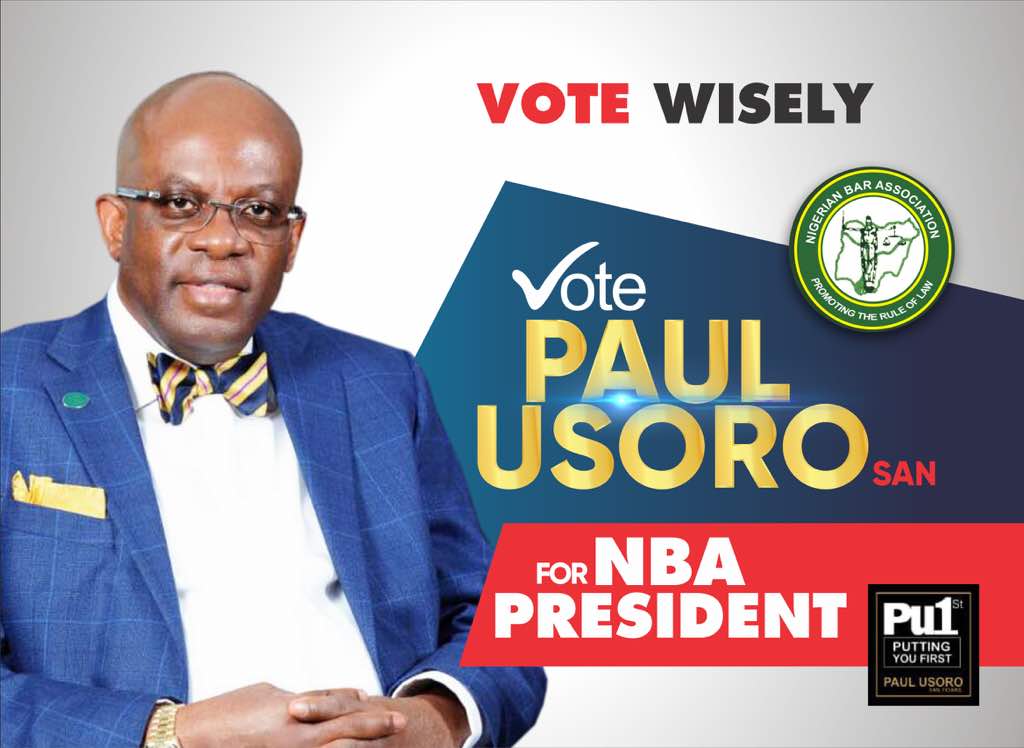
“Paul Usoro, in spite of your great and numerous achievements you have remained simple and humble. As humble as you are, you give no one cause to take you for granted. You know the law and that is the source of your confidence. You have a studious disposition and that is how a lawyer ought to be. You are honest and courageous. And that is what the times in which we live now demand. A time will never come when we shall forget you. You are a remarkable man. May the Lord remember you for the labour that you have laboured. May he remember your dedication and steadfastness. May he reward your generosity and public spirit. May the Good Lord remember your greatness of heart and your courage. Paul, because you are a man of rank and position, I take the liberty to say that in spite of all the odds we shall celebrate. Because of men and women like you, we live in hope.” — Chief Kanu Agabi, SAN ( Former Attorney General of the Federation)
by Legalnaija | Jul 27, 2018 | Uncategorized
Last
week, the Nigerian government unveiled ‘Nigeria Air’, introducing our latest
national vanity project to the world. Several commentators have raised concerns
on the transparency, economic expediency, and sustainability of the project,
but I am more troubled that the policy interests of our politicians do not
necessarily align with those of a majority of Nigerians.
It
is true that a national carrier may boost some – theoretical – national pride.
It may even serve the transport needs of upper and middle class Nigerians. But,
for the near 112 million Nigerians who live in some form of poverty, the
prestige and function of a national carrier is as meaningful as draping a
well-embroidered agbada over a starving child.
The
proliferation of this type of imitation-statehood policies inevitably
disconnects the people from the state. Consider, for example, the significant
constitutional amendments signed by President Buhari in May. There was neither
debate nor inclination to do so amongst ordinary members of Nigerian society.
Contrast this against countries where individuals have a real stake in the
state: constitutional changes generate near civil-war levels of opinion even
among the poorly educated.
The
last systematic and deliberate involvement of all Nigerians in a national
policy direction was during the creation of the MacPherson Constitution in
1951. That constitution led to independence. Since then, the Nigerian state has
deviated from popular aspirations and has been shaped by – and for – the
political elite. Yet, many well-meaning people continue to think that, without
a radical reform agenda, the Nigerian state will somehow work for the best
interests of everyone. But disempowered Nigerians are not fooled by this
fantasy. This is why, in elections, they vote for their own immediate
gratification instead of investing hope in a system that has yielded losses for
almost sixty years.
Which
brings me to the Ekiti state election.
The
arguments on vote-buying in Ekiti reflect a shocking degree of unawareness by
educated Nigerians. The range of reactions – from disgust at the idea of
selling votes to admonitions that one party had simply outmanoeuvred the other
under conventional rules of the game – ignore a worrisome fact: that a
majority of the Nigerian population are squarely and justifiably disinterested
in the Nigerian state.
Frankly,
only three categories of people across the country are still invested in the
current Nigeria: (i) the political and economic elite; (ii) the direct
dependents and beneficiaries of this elite; and (iii) the – loosely defined –
educated middle class. The interests of the elite – and those of their partisan
acolytes, sycophants, and cronies – are self-evident. These people are solely
concerned with using the political system as a territorial resource
exploitation system. To control and exploit resources, there has to be a
centralised political state.
Wedged
between the beneficiaries of our political and economic inequalities and the
disconnected and impoverished majority is the educated middle class. These
Nigerians, schooled in the ideals of statehood and citizenship, try to create
function out of dysfunction. But because they are able to negotiate with the
state from a position of privilege, they are typically invested in the
continuity of the same dysfunctional political system. It is within this
category of Nigerians that the Ekiti vote-buying debate is most pronounced.
Typically, the arguments include: blaming illiteracy (We need voter
education), blaming poverty (This happens because people are poor),
recommending practicality (Collect the money but vote your conscience),
or even blaming democracy (Not everyone should be allowed to vote).
But
these arguments, despite their sincerity, project a disregard for the autonomy
of poor, illiterate, and ordinary Nigerian citizens. These arguments tend to be
condescending in blame and paternalistic in advice; they are projected through
the perspectives and experiences of Nigerians privileged by education. The
muted assumption is that underprivileged Nigerians have an unclear
understanding of citizenship and, therefore, need guidance from their
‘betters’.
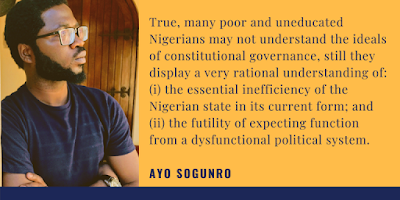
True,
many poor and uneducated Nigerians may not understand the ideals of
constitutional governance, still they display a very rational understanding of:
(i) the essential inefficiency of the Nigerian state in its current form; and
(ii) the futility of expecting function from a dysfunctional political system.
The people of Ekiti – and oppressed Nigerians in general – are wise not to
grant legitimacy to such a dysfunctional political system. In the absence of
any real participation, a game of musical chairs ensues.
The
idea that many Nigerians are disinterested in the Nigerian state is hard to
process by our educated middle class. But anyone who has consistently dealt
with the Nigerian state from a position of powerlessness quickly understands the
personal implications of dysfunction. Inequality becomes a daily systemic
experience
that cannot be dismissed simply by the promises of partisan politics.
And
so, the question is not just how to educate voters or ensure they are well-fed
before elections. The fundamental question is: how do we create a political
system that empowers, and enables the equal participation and involvement of
every individual beyond the ballot box? This question leads to ideas around
strengthening local governance, increasing democratic powers at the grassroots,
and creating publicly accountable oversight institutions. And, at this point,
we are venturing into high-level constitutional and national restructuring. But
this will be a topic for another day.

by Legalnaija | Jul 25, 2018 | Uncategorized
For every business, building your brand is not complete without protecting your brand. As entrepreneurs or business owners, you work tirelessly to grow your brand especially as profits only begin to roll in after the brand has been established, and it has become an easy choice for the target market. However, it is commonplace for business owners to overlook the importance of protecting their brands or products.
Trade or Service mark, Patent, and Design are modes of protecting your brand or product (in any market, jurisdiction or territory). Be it a Trade name (a unique mark which differentiates your goods and services from those of other businesses and competitors), a Patent (which protects your new inventions and covers how things work, what they do, how they do it, what they are made of and how they are made) or Designs (which is an appearance of a product, its shape, patterns and colours) business owners need to protect their business, brand and products. Without these protections, businesses are at risk of losing ownership of their brands, inventions or products, or experience infringement on the economic rights attached to a business product, brand name and goodwill or other inventions and creations would be unlawfully exploited. Also, customers are at risk as they are exposed to counterfeit products that pose potential harm to them.
Quite habitually, most business owners do not believe they need to take advantage of any of these legal protections until their business brand has grown to considerable size or products have a large market, however, that could be a mistake.
A notable example is the 2014 dispute between Konga Online Shopping Limited and Rocket Internet GmbH Arnt Jeschke (an international investor in electronic commerce businesses which indirectly controls Ecart Internet Services Nigeria Limited, an online retail company in competition with the Konga in Nigeria and which carries on its Nigerian business under the trade name “Jumia” and uses the domain name <jumia.com.ng>). Konga had filed a complaint with the WIPO Arbitration and Mediation Center on 30th May, 2014 contending that the disputed domain name ‘konga.sc’ is identical to trademarks in which it has rights, that Rocket has no rights or legitimate interests in the disputed domain name, and that the disputed domain name was registered and is being used in bad faith. Konga also contended that a co-founder of the Rocket had approached its CEO for a partnership deal with Konga which was refused. Since then Rocket had been registering the disputed domain name in several jurisdiction as a bargaining tool to force a partnership deal. In determining the complaint, the first issue for the Panel was the fact that the trademarks relied upon by Konga are applications only which do not appear to have proceeded to grant. The preponderant view of the panel was that until an application proceeds to grant, it does not constitute a trademark in which a complainant has rights. The Panel found that Konga had filed a Trademark application but had not completed the process, hence there was no registered trademark owned by it. Konga further relied on a common law trademark right which the Panel found to be non-existent as Konga failed to show that the name has become a distinctive identifier associated with its brand, its goods or services which it could not establish. Konga provided no evidence of sales under the trademark, media recognition, consumer surveys, advertising or similar which might show that the term “Konga” had become a distinctive identifier associated with its brand, its goods and services. The complaint was consequently denied.
In other to prevent against the problems Konga experienced as well as many others, it is advisable to contact accredited agents who are versed in the registration of Trademarks, Designs and Patents registry in Nigeria and can guide you through the process of Trademark registration from application to successful registration.
Once you have successfully registered your interest either by way of a Trademark, Patent or Design, it affords your business the protection of the law against unlawful and unlicensed use of your brand name or logo, infringement and product counterfeiting. Registering your brand or products is not a complete guarantee against infringements, however, you can enforce these rights in court by instituting an action either for passing off or infringement or as the case may warrant.
Your brand has great potential and value, so does your product. Protect them.
For more enquiries on registration of Trademarks, Designs and Patents and other related matters, our firm can be contacted via any of our channels of communication reception@aaolegal.com (+234) (0) 8102425030, 8171299068
https://www.linkedin.com/company/awosika-adeleke-ojo/ The firm of Awosika Adeleke Ojo is an accredited agent with the Trademark, Patent and Designs Registry, Nigeria.
by Legalnaija | Jul 25, 2018 | Uncategorized
The term “copyleft” was invented by the Free Software Foundation. Copyleft as a legal concept is not as popular as copyright. This is most likely as a result of the technical nature of the creative endeavours to which it mostly applies, namely software.
Copyleft has its beginnings in copyright. In relation to software, a copyright gives the author of the software an exclusive legal right to determine whether and under what rules and conditions the software can be copied, modified and distributed.
The permission given by copyright holders to copy, modify and distribute their software is called a licence. Copyleft is a form of licensing that involves the use of copyright to ensure freedom of modifying and distributing copies of a work and works derived from it, with the condition that the same rights be preserved in such derivative works. It is therefore a conditional licence. The concept of copyleft does not exist in isolation due to the fact that it requires the use of copyright to achieve its aim of safeguarding freedom.
The main aim of copyleft is to encourage invention and contribution. Copyleft however should not be confused with public domain. In public domain, copyright ownership is not claimed by the original author of the work, hence there are no restrictions placed on subsequent users of the work. Although the lack of restrictions allow for freedom of modification and redistribution, it makes it possible for subsequent users of the work in question to make modifications and release their copy as proprietary software, thus effectively stripping others of the freedom to modify and redistribute same.
On the other hand, copyleft does not mean the absence of restrictions. On the contrary, restrictions are placed for the sake of safeguarding freedom. Therefore under copyleft, the author of the work relinquishes some of the rights they have as copyright holders. Collective effort is encouraged and as such software developers are given the opportunity to actively contribute their modifications to the work without any fear of it being converted into proprietary software.
After explaining the concept of copyleft, the next thing to look at is how to copyleft a work. The process of covering a work by copyleft begins with stating that it is copyrighted. Once that is done, distribution terms are included. These terms will state that everyone has the right to use, modify and redistribute the work, including derivative works, with the condition that the distribution terms remain unaltered. Thus any person who decides to use the work in question will be legally bound to abide by the distribution terms.
The advancement in technology has made it important to be familiar with the concept of copyleft due to the effect licencing decisions can have on a software project.
A common occurrence in the software development industry is community effort. Hence it is possible to see existing code libraries built by different developers being used in brand new software. This saves developers time that would have been spent reinventing the wheel. The nature of the copyleft licence can determine the available code libraries a developer can use in their software project. Thus regard must be had to the goals, community, ideology and resources of a software project when offering legal advice to a person who is considering a copyleft licence.
Difference between Copyleft Licences and Permissive Licences
Another form of software licencing is a permissive licence. A permissive licence grants the user of the software the right to copy, modify and distribute the software. Although a permissive licence is a free licence it is not the same as a copyleft licence.
What makes it different from a copyleft licence are the usage terms. While copyleft licenses ensure that users of the software can copy, modify and distribute same so long as the same freedoms are passed on to other users, permissive licenses do not require users to transfer the same freedoms to other users. Hence users of software covered by a permissive licence are not restricted to a particular licence.
Since permissive licences do not mandate users to transfer freedoms to other users, it is possible to use code libraries that are covered by permissive licences in works that are covered by copyleft licences. This means that it is possible for a user to borrow code covered by permissive licences and include them in a work that they intend to cover by a copyleft licence. However, code covered by a copyleft licence cannot be used in work covered by a permissive licence due to the fact that a copyleft licence requires the user to pass on all the freedoms available to them to subsequent users.
Permissive licences have the effect of facilitating widespread usage of software. Users of copyleft licences, on the other hand, are more concerned about exercising some degree of control over the software project.
Commercial Usage of Copylefted Software
A question that frequently comes up when discussing the issue of copyleft is the possibility of commercial use. Those hearing about the concept of copyleft for the first time usually make the mistake of assuming that the freedom secured automatically translates to “free of charge”.
It is possible for a work covered by a copyleft license to be used commercially. It can also be bought or sold. For example, an author of software covered by a popular copyleft license called the GNU Public License can charge for the work so long as the source code is made available. Although from a strictly commercial point of view it seems counterproductive to attempt to charge for a work that can be easily shared for free, it is not impossible.
Conclusion
It can therefore be seen that copyleft is not an anti-copyright protection concept. Copyleft requires copyright to exist. Technology is growing at a fast pace and new legal issues come up along the way. The aim of this article was to give an insight into the legal concept of copyleft in order to be able to advise clients in the software industry about their rights and responsibilities under copyleft licensing.
Judy-Vallery Imasuen is a legal practitioner at the Committee for the Defence of Human Rights who has an interest in Alternative Dispute Resolution, corporate law and information technology.
by Legalnaija | Jul 25, 2018 | Uncategorized
In the wake of the forthcoming elections of the Nigerian Bar Association (NBA), the online and social media landscapes have had their share of fake stories and misinformation by troll armies or from the camp of the troll armies.
Smear campaigns and coordinated attacks are usually synonymous to election years, with the sole purpose of creating fake trends thereby spreading misinformation about a credible candidate. The online space and other platforms such as Whatsapp have had their share of “fake news” and complicated topics that are baseless. This wrong information gets spread on social media and respected news blogs and gets amplified by noble personalities in the profession.
Let’s bear in mind that misinformation and smear campaigns are age-old propaganda techniques, and common occurrences in political campaigns. The NBA as a professional body is not immune to this. Even if this is a usual practice, it should not be embraced by lawyers as a tactic to distract supporters of one candidate and hopefully lure them into their camp.
Acknowledging the fact that humans by nature are susceptible to violating the laws, hence the numerous rules and regulations (laws) put in place to guide and curb excesses. Even in the holy books (the Bible and the Quran), there are laid down guidelines by God meant to be followed strictly by man if he must make eternity.
In the guidelines of the Nigerian Bar Association (NBA) 2018 Elections of National Officers, Paragraph C (2) on disqualification from holding national office is clear on acts that lead to smear campaigns; “That he/she sponsors or is associated with sponsoring a newspaper or magazine article or any electronic or social media broadcast vilifying other candidates”. The above rightly addresses our subject of discussion on smear campaigns. But the onus rests on the ECNBA to ensure that all aspirants and their supporters are well guided so they don’t truncate their chances of making it into the executive positions of the NBA.
One thing history has shown, which I believe as far as electioneering campaigns are concerned is, no amount of smear campaigns can mar the chances of the right candidate or the people’s mandate. Barrack Obama, the former President of the USA was a victim of smear campaigns even from high profile citizens; still he made it to the White House.
Bringing it home to the NBA, in previous elections, most past presidents and even the current president, AB Mahmoud, SAN were all victims of smear campaigns. Despite the attempts made by distractors; their pedigree, intelligence and character stood them out and they came out victorious in their respective elections. Barrack Obama and AB Mahmoud, SAN were not hampered by smear campaigns because they were judged based on their leadership qualities.
In every society or organisation, leadership is very important. As we look forward to electing a new President and other executive members, be mindful that there will be distractions in many forms. Every lawyer should make conscious effort to look beyond smear campaigns and judge the presidential aspirants by their leadership qualities; experience in corporate governance, intelligence, honesty, patriotism, commitment, decision-making capabilities, accountability, creativity, Innovation, among others.
The take out for me is that those who troll misinformation and lies via online publications and social media platforms are mere distractors of the good course. My singular advice to members of the Bar is that everyone should be well guided. It is important to make the distinction between genuine information and dubious blog posts, fake social media threads and coordinated smear campaigns that spread false information targeting an individual or a group of people. Lawyers should exhibit the nobility of their profession.
Ogbonnaya Modestus

by Legalnaija | Jul 25, 2018 | Uncategorized
The advancement of ICT and its effect in providing solutions to a number of challenges cannot be over emphasised. The NBA contracting ICT companies to manage elections in recent times is the right step in the right direction.
Below are 8 facts about Chams you should definitely know;
1. Chams PLC is Nigeria’s leading provider of integrated identity management and payments transactional systems and solutions provider. Over the last three decades, Chams has evolved from computer and hardware maintenance to providing enterprise technology solutions in the identity management and transaction payments space to public and private sector institutions.
2. Chams PLC has been part of every major success story in Identity management in Nigeria since 1992 to date.
3. Deployment of Online E-voting Infrastructure for Institute of Chartered Accountants of Nigeria – 4years running.
4. ICT solution providers for CBN, INEC, PHCN, UNILAG, Nigerian Air Force, Osun State Govt., Anambra State Govt., NITDA among others.
5. Chams is the first home-grown company to be listed in Guinness Book of Records for setting up the mega ChamsCity Digital Mall and also the first computer technology company listed on the Nigerian Stock Exchange under ICT.
6. Chams PLC is the front end partner to the National Identity Management Commission (NIMC).
7. Chams pioneered Nigeria’s first payment card scheme, Valucard, with VISA, and is licensed by the Central Bank of Nigeria for Independent ATM Deployment, POS Terminal Service Provider, Mobile Payments, etc .
8. Won several awards both local and international, including the Datacard Presidential Awards, Canada, 2008 by DataCard Group Canada.
It will be recalled that on July 18, 2018; Chidi Anslem Odinkalu had written an article on Premium Times with the title – “CHAMSGATE: Understanding NBA’s Latest Election Rigging Scandal”. He was subsequently invited by the NBA President, AB Mahmoud, SAN to attend a stakeholders meeting at the NBA House in Abuja to witness CHAMS presentation, question and or defend his allegations against CHAMS but he lose the courage to appear or make a statement and like the cowardly hyena, ran away in the presence of lions.
At the stakeholders meeting, it’s instructive to note that the recommendations by Chams were considered sound, articulate and professional, leading to a unanimous adoption. Chams is a renowned ICT solution organisation; it will be a disservice to the association to lose the experience and professionalism they bring to electioneering using the e-voting system.
The truth remains that whether CHAMS OR ANY OTHER ICT provider conducts this election, it’s clear that their weak strategy of deliberate falsehood will not turn the electorate against Paul Usoro, SAN. The hundreds of thousands of intelligent lawyers that support Paul Usoro, SAN are doing so willingly and have based their loyalty on his goodwill as well as the excellent reputation he has built over time.
As the elections draw closer, are we going to support an NBA leadership that will ride on falsehoods? Are we going to live on lies without gathering concrete facts? Will respected lawyers follow campaigns of calumny and forget to take the right decision by standing with the man that will #PutYouFirst? We need to watch because the closer the day, the more the drums of deceit will beat louder.
Long Live the Nigerian Bar Association.
For more information on Chams PLC, visit https://chamsplc.com/about-us/
Alozie Ugomma
by Legalnaija | Jul 25, 2018 | Uncategorized
Conclusion
These goals and objectives can only be achieved through sustained and constant stakeholder engagement and consultations. I will operate an open-door policy and all stakeholders will continually be consulted on issues that affect and/or relate to them. It is my belief that every lawyer must have a voice in the affairs of the Association and, in particular, in matters that affect them. There will therefore be clear channels of communication that would make it easy for NBA members to reach and have access to me and Bar leaders generally.
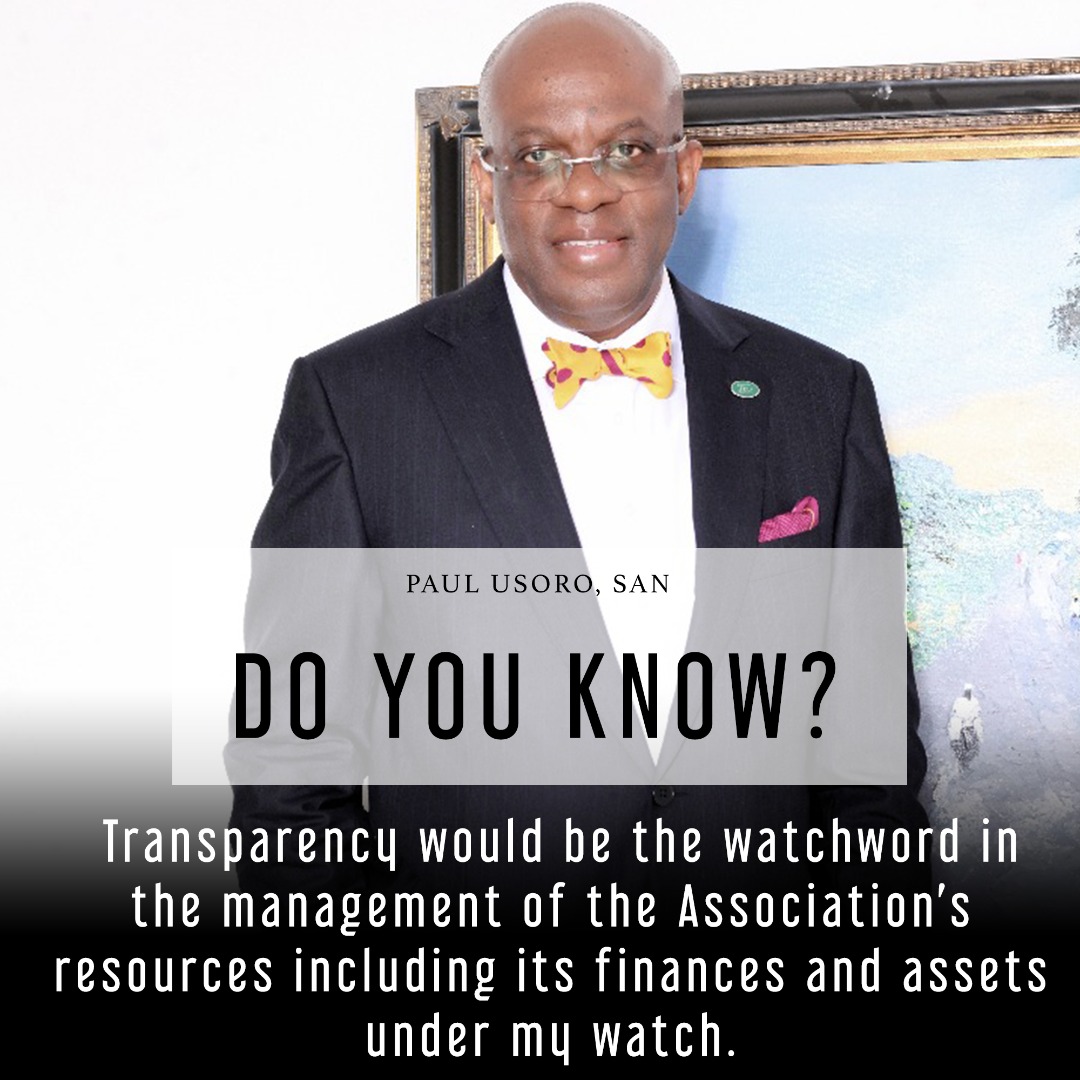
I also intend to lead by example in institutionalising transparency and accountability in the administration of the NBA. The programmes that I have articulated in this Manifesto, I must mention, are auditable constitute my pact with members of the NBA and I am willing to be judged by and held accountable therefor. I also commit to use my network of relationships in the corporate world in achieving these goals and for the benefit of the Association. It is my hope that at the end of my tenure as the NBA President, the Association would be the better for it and be the envy of other professional associations in and outside Africa.
PAUL USORO, SAN, FCIArb
29 June 2018
by Legalnaija | Jul 24, 2018 | Uncategorized
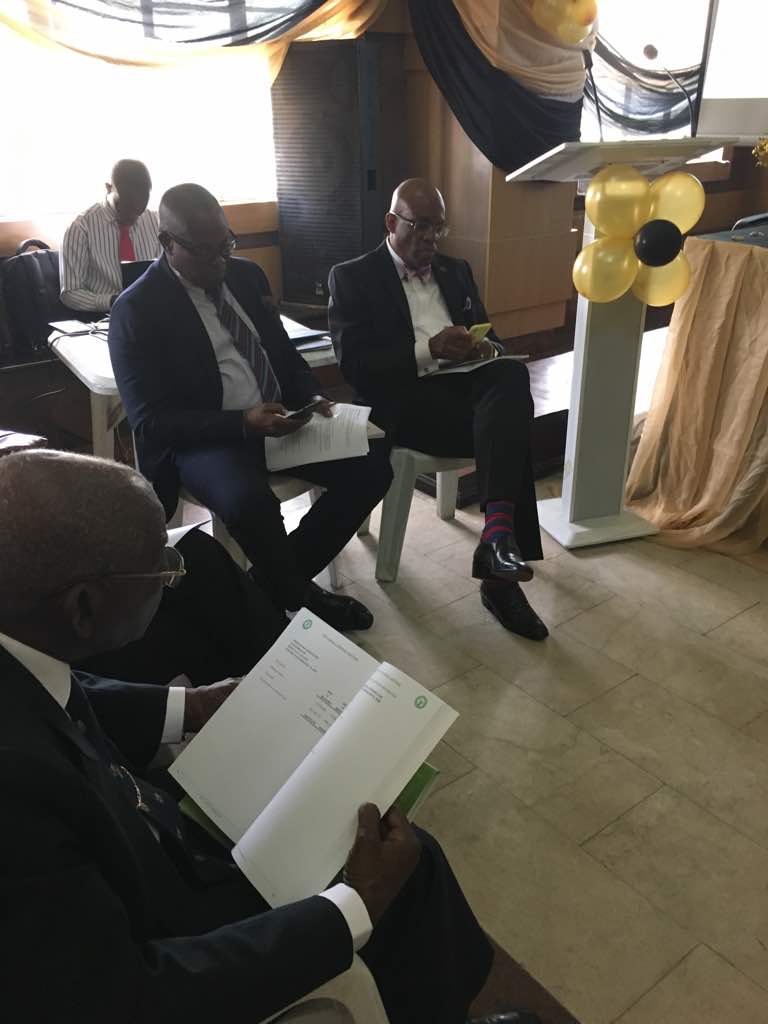
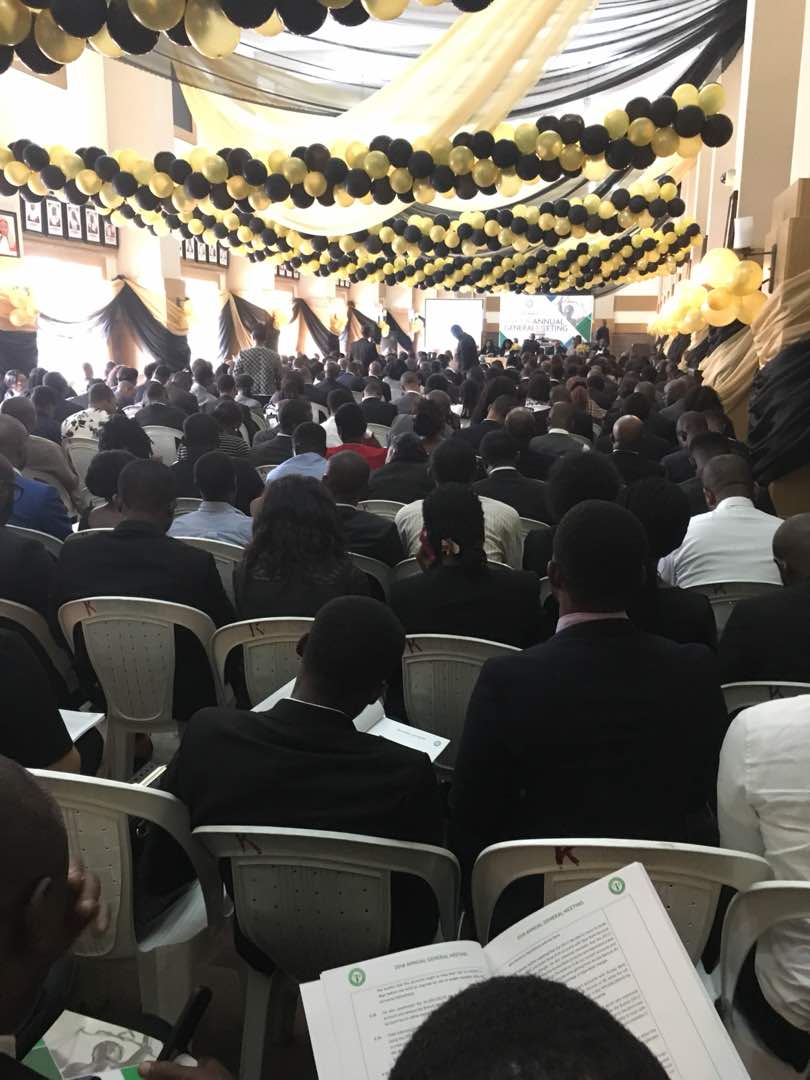
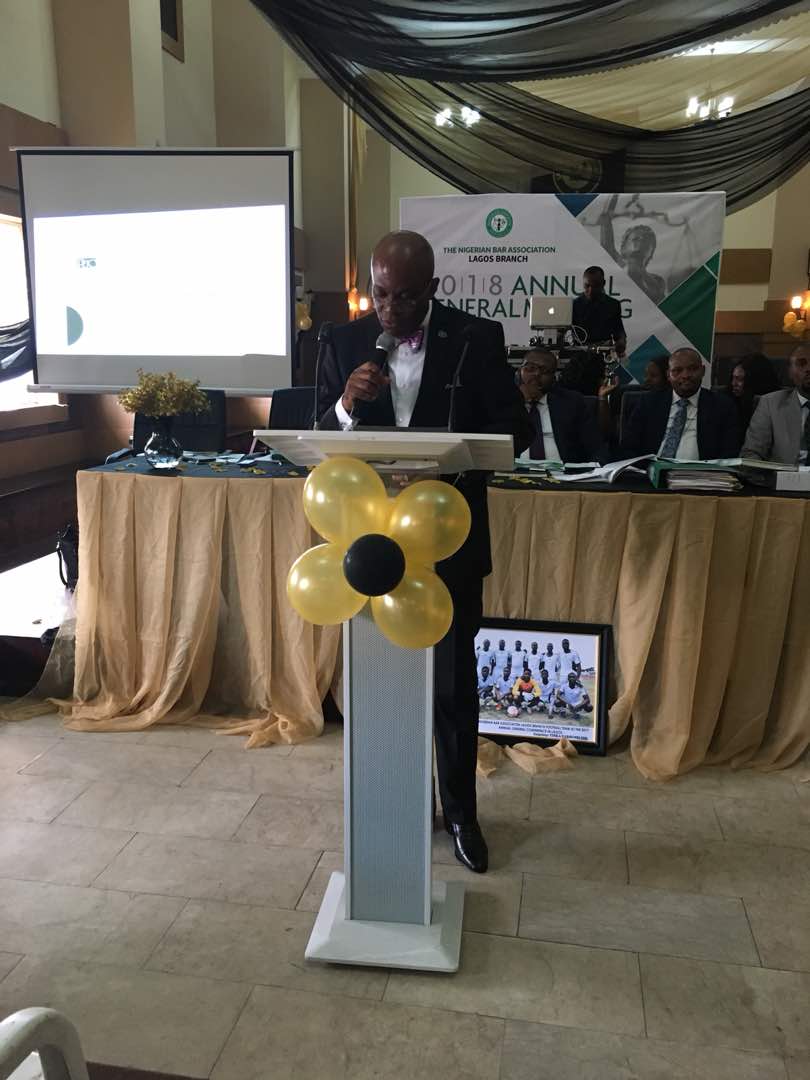
PAUL USORO SPEAKS ON THE ART OF CROSS-EXAMINATION AT THE NBA, LAGOS BRANCH AGM
At the 2018 Annual General Meeting (AGM) of the Nigerian Bar Association (NBA), Lagos Branch, which held on the 23rd of July at the Lagos State High Court, Igbosere, Learned Silk, Paul Usoro, SAN presented a paper during the Knowledge Sharing Session titled, “The Art of Cross-Examination”.
Speaking during the session, Usoro began by giving ‘The 10 Non-Exhaustive Commandments’ of Cross Examination and explained the processes involved in cross-examination using his experience on the case of the Senate President, Dr. Olubukola Saraki. “In using these commandments; you must have a strategy, you need to know the case, you must plan your cross-examination questions, you must study and know the witnesses, you must understand that friendship always works and many others”.
The Astute Litigator and Strategist went on to encourage lawyers to imbibe the act of practicing cross-examination as they can only get better by frequent practice. “Practice makes perfect. So I admonish you to always look for opportunities to cross examine and be as calm as possible during the process. Do not let any tension build up in you because that could distract you from your focus. Therefore you need to display a high level of confidence to carry on with the process”.
In conclusion, Paul Usoro showered encomium on the Executives of the NBA, Lagos Branch, led by the Chairman, Chukwuka Ikwuazom for organizing the AGM and inviting him to present a paper that speaks to his experience as a Bar man.
“I thank the executives of this prestigious branch for giving me the privilege to present this paper in our Knowledge Sharing Session on such an important topic. The session is one of the innovative ideas by the Executives who are concerned about helping lawyers in the branch to acquire and develop skills that will impact on their practice”, He said.
by Legalnaija | Jul 24, 2018 | Uncategorized
DAY 9
PUTTING YOU FIRST
PAUL USORO, SAN’S REFORM MANIFESTO FOR PRESIDENCY OF THE NBA
PROMOTION OF RULE OF LAW AND GOOD GOVERNANCE
In regard to the promotion and protection of the Rule of Law, the NBA under my leadership shall –
I. Advocate for and promote the culture of obedience to Court Orders and compliance with the principles of Rule of Law.
II. Monitor, identify and condemn cases of impunity and executive lawlessness in Nigeria and take active steps to ensure the remediation of such impunity.
III. Advocate for access to justice by facilitating pro bono and quality legal defence and representation for certifiably poor and vulnerable persons. As a corollary thereto, re-activate and upgrade the NBA Pro Bono Scheme so as to achieve the objectives for setting up the scheme.
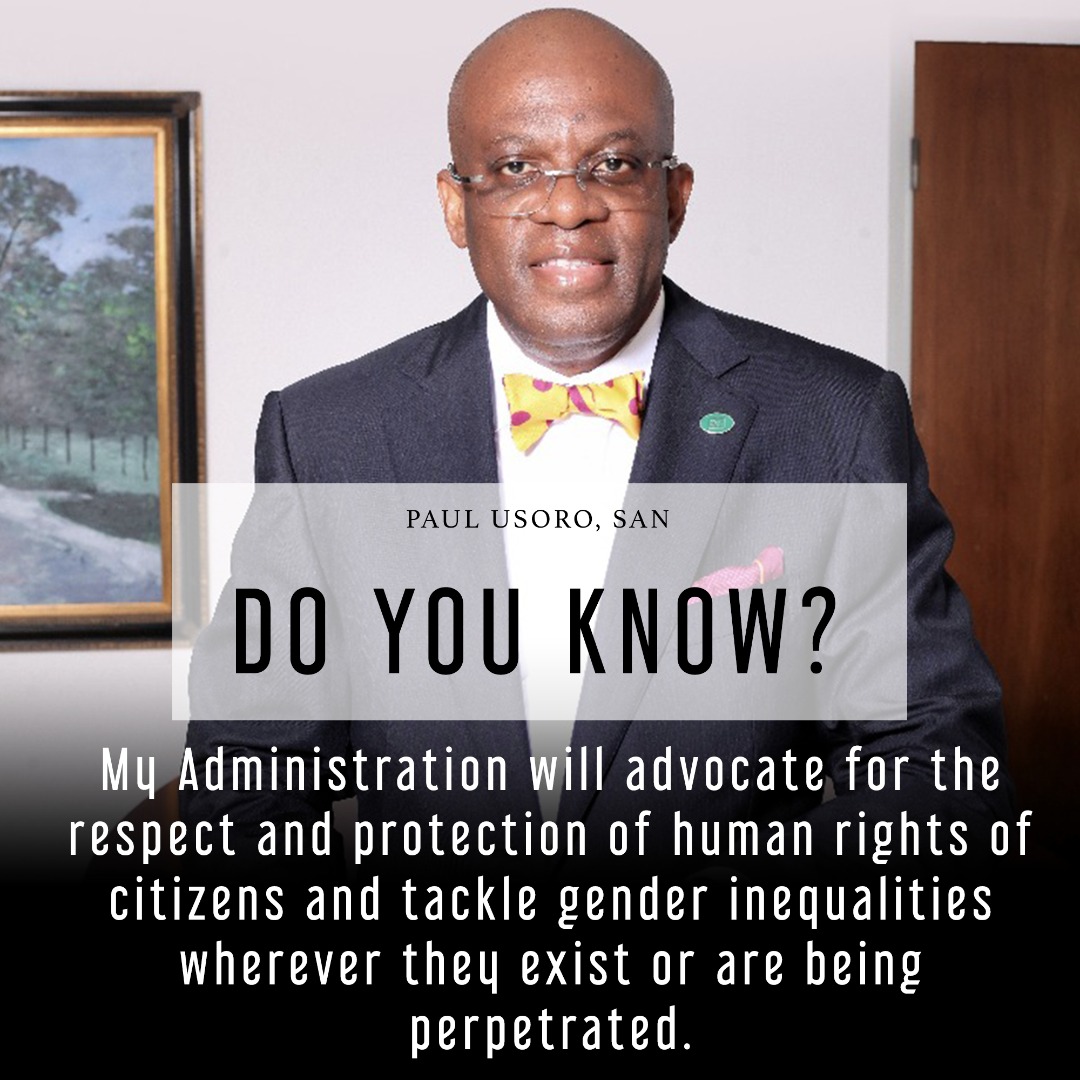
IV. Advocate for the respect and protection of human rights of citizens and tackle gender inequalities wherever they exist or are being perpetrated.
V. Develop and advocate for programmes and projects relating to prison decongestion in Nigeria.
VI. Launch an NBA Annual Human Rights Report. This would be achieved by monitoring and documenting cases of human rights complaints and violations through NBA human rights committees at NBA branches, the media, and other human rights stakeholders. This would help us determine the frequency (increase or decrease) of human rights abuses in Nigeria.
VII. Advocate for the approval of the National Action Plan for Human Rights in Nigeria by the Federal Executive Council.
VIII. Develop and enforce procedures for swift responses to national issues and in this regard, hold monthly press briefings on national issues.
IX. Institutionalize conflict resolution, gender and peace advocacy.
X. Propose comprehensive constitutional reforms with regard to the 1999 Constitution of Nigeria, as amended, especially as it relates to the Judicature.
The proposed constitutional amendments would seek to:
a. Ensure the independence of the Judiciary
b. Strengthen judicial accountability and performance
c. Reform procedure of judicial recruitment and discipline
d. Enhance access to justice and the protection of the rule of law.
e. Strengthen financial autonomy of the judiciary.
XI. Advocate for the domestication and implementation of the Administration of Criminal Justice Act, 2015 at State levels in Nigeria.
XII. Develop a much improved and comprehensive Legislative Advocacy Programme for the NBA.
XIII. Champion the reform of Justice and Accountability Institutions for better service delivery.
PAUL USORO, SAN, FCIArb