THE LEGAL EFFECT OF DESTRUCTION OF A MARRIAGE CERTIFICATE ON THE DISSOLUTION OF MARRIAGE IN NIGERIA[1]
Abstract
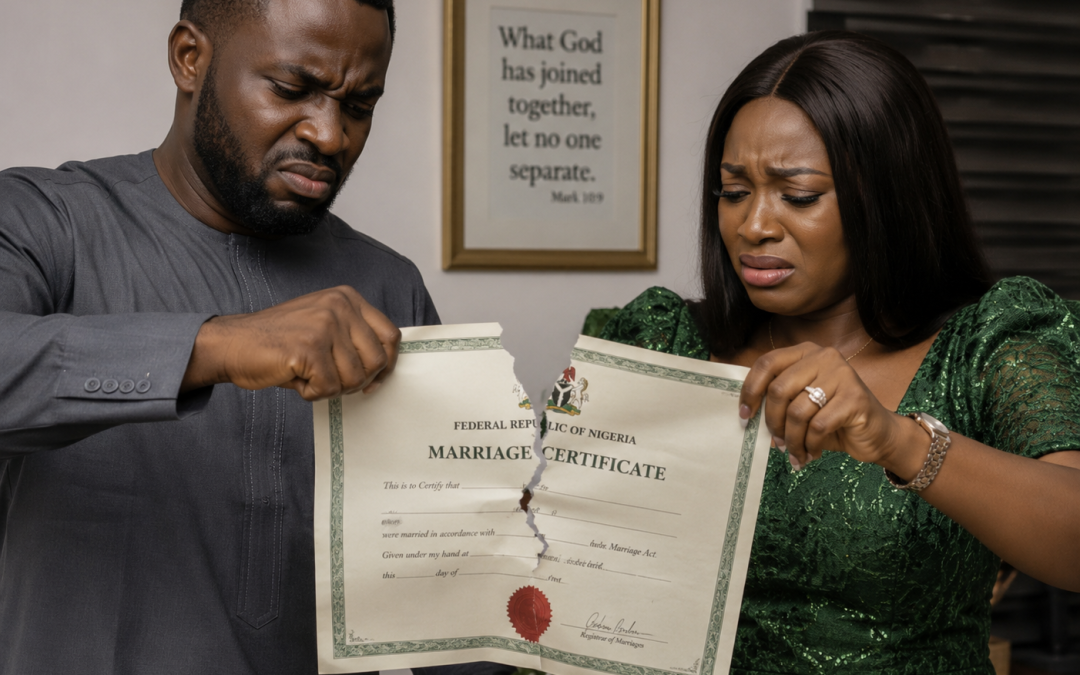
Recently, while scrolling through my Facebook timeline, I saw the video of a newly wedded couple, still at their reception tearing their marriage certificate. What really got my attention was the caption, “No marriage certificate, No divorce.” I laughed but I was curious what inspired or prompted them to tear their marriage certificate while still celebrating their wedding ceremony.
This article examines the legal implications of tearing or burning a marriage certificate within the context of matrimonial law in Nigeria. It interrogates whether the destruction or absence of a marriage certificate affects the validity of a marriage or impedes its dissolution under the Marriage Act and the Matrimonial Causes Act. The article argues that a marriage certificate is merely evidentiary and not constitutive of marriage, and therefore its destruction has no legal consequence on marital status or dissolution proceedings. Through statutory analysis, case law, and comparative insights, the article concludes that dissolution of marriage can proceed without the production of a marriage certificate, provided that the existence of a valid marriage can be otherwise established.
1. Introduction
Marriage, as a legally recognised institution, is governed by statutory frameworks that regulate its formation and dissolution. In Nigeria, statutory marriages are primarily regulated by the Marriage Act and the Matrimonial Causes Act (MCA).¹ A recurring issue in matrimonial disputes is whether the destruction or non-availability of a marriage certificate affects the ability of parties to seek dissolution.
In practice, parties sometimes assume that tearing or burning a marriage certificate symbolically terminates the marriage. This article interrogates that assumption and addresses the central question:
Can a marriage be dissolved in the absence of a marriage certificate?
2. The Legal Nature of a Marriage Certificate
A marriage certificate serves as documentary proof that a marriage has been celebrated in accordance with statutory requirements. However, it is not the legal foundation of the marriage itself.
Under Nigerian law, the validity of a statutory marriage depends on compliance with procedural requirements such as notice, consent, and solemnisation before a registrar or licensed place of worship.² The certificate merely evidences that such formalities were complied with.
The courts recognise that:
- A marriage certificate is prima facie evidence of marriage;
- It is not the marriage per se;
- Its absence does not invalidate an otherwise valid marriage.
This distinction reflects a broader evidentiary principle: documents prove facts, but do not create them where the law prescribes substantive conditions.
3. Effect of Tearing or Burning a Marriage Certificate
The destruction of a marriage certificate has no legal effect on the subsistence of the marriage.
First, marriage is a legal status, not a physical document. Once validly contracted, it can only be dissolved through:
- A decree of dissolution by a court of competent jurisdiction;³ or
- Death of one of the parties.
Secondly, no provision of the Marriage Act or Matrimonial Causes Act recognises destruction of a certificate as a mode of dissolution.
Thus, tearing or burning a marriage certificate is:
- Legally irrelevant;
- Symbolic at best;
- Ineffective in terminating marital obligations.
4. Dissolution of Marriage Without a Certificate
4.1 Statutory Framework
Under section 15 of the Matrimonial Causes Act, a court may dissolve a marriage upon proof that it has broken down irretrievably.⁴ The statute does not require the physical production of a marriage certificate as a condition precedent.
The focus of the court is therefore:
- Whether a valid marriage exists; and
- Whether the statutory ground for dissolution has been satisfied.
4.2 Proof of Marriage Without a Certificate
Where a marriage certificate is unavailable, Nigerian courts permit proof of marriage through alternative means, including:
- Certified extracts from marriage registers;
- Oral testimony of witnesses present at the ceremony;
- Documentary evidence such as photographs or church records;
- Conduct of the parties giving rise to a presumption of marriage.
The Supreme Court in Menakaya v Menakaya emphasised the importance of proper procedure and evidentiary sufficiency in matrimonial causes, underscoring that the substance of the marital relationship, rather than mere formal documentation, is central to adjudication.⁵
Similarly, earlier authority such as Sowande v Sowande illustrates the court’s willingness to look beyond procedural defects where justice demands, particularly in matrimonial proceedings.⁶
4.3 Judicial Attitude to Documentary Absence
Courts adopt a substantive justice approach in matrimonial matters. The absence of a certificate will not defeat a claim where sufficient evidence exists to establish the marriage.
This approach aligns with the evidentiary principle that secondary evidence is admissible where primary evidence is unavailable, provided proper foundation is laid.⁷
5. Case Commentary
5.1 Menakaya v Menakaya
In this case, the Supreme Court stressed procedural fairness in matrimonial proceedings and reiterated that failure to properly evaluate evidence may vitiate proceedings. While not directly on the issue of certificates, the decision is instructive in highlighting that matrimonial jurisdiction is evidence-driven rather than document-dependent.
The case reinforces the principle that:
The court’s primary concern is whether the legal requirements of marriage and its dissolution are satisfied, not whether a particular document is physically produced.
5.2 Sowande v Sowande
This case, though older, underscores the importance of procedural integrity in matrimonial litigation. It demonstrates judicial flexibility in ensuring that procedural technicalities do not override substantive justice.
5.3 On “William v William”
The case commonly cited as William v William appears in Nigerian legal discourse largely through secondary sources and comparative jurisprudence. It is generally referenced for the proposition that:
A marriage can only be dissolved by judicial decree, not by private acts or intentions of the parties.
This principle is consistent with Nigerian statutory law under the Matrimonial Causes Act.
6. Comparative Perspective
In other common law jurisdictions such as England and Wales, marriage certificates are similarly treated as evidentiary documents. The destruction of such a document does not affect marital status, as official records are maintained by the state.
Nigeria, having inherited its matrimonial legal framework from English law, follows the same doctrinal approach.
7. Conclusion
The destruction or absence of a marriage certificate does not affect:
- The validity of a marriage; or
- The ability of a court to dissolve it.
The decisive factor is the existence of a valid marriage, not the possession of documentary proof.
Accordingly:
A marriage can be dissolved even where the certificate has been lost, destroyed, or was never obtained, provided that the marriage can be established through admissible evidence.
REFERENCES
- Marriage Act, Cap M6 Laws of the Federation of Nigeria (LFN) 2004; Matrimonial Causes Act, Cap M7 LFN 2004.
- Marriage Act (n 1) ss 7–21.
- Matrimonial Causes Act (n 1) s 15.
- ibid s 15(2).
- Menakaya v Menakaya [2001] 16 NWLR (Pt 738) 203 (SC).
- Sowande v Sowande [1963] NSCC 218 (SC).
- Evidence Act 2011, ss 89–90.
[1] Adebola V. Adeleye Esq. MBA is a corporate practice lawyer with keen interest in compliance, corporate governance M&A and risk management. He is a certified Human Resources Manager. adeleyebola93@gmail.com 08088953829