
Provisions of the 2017 Compulsory Treatment And Care For Victims Of Gunshots Act

Provisions of the 2017 Compulsory Treatment And Care For Victims Of Gunshots Act

The law mandating the compulsory treatment of gunshot victims
was passed by the 8th Senate and signed into law by President Buhari
in 2017. Before the passing of the law, it was the norm for hospitals to refuse
treatment to gunshot victims and some other hospitals may eject such a victim
from its premises, despite the immediate medical attention needed to save the
life of such a gunshot victim. 


The reason why Nigerian doctors would turn their
backs on their Hippocratic oath and refuse to treat victims of gunshot wounds
was due to the incessant harassment and sometimes arrest of medical staff who
rendered such treatment by the police. It was customary for the Chief Medical
Director of such hospital to be questioned as to any links with armed robbery
syndicates or gangs.

While this police directive was being enforced, the lives of
many persons who had been victims of armed robberies and other forms of accidents
or incidents involving gun wounds would usually pass-on before any meaningful
help arrives. Such victim while bleeding would first be expected to be taken to
the police station, after which the statement’s of the persons who helped the victim
will be taken and a police officer dispatched with the victim to a nearby
hospital or a police report prepared by the police but to be handed over to the
hospital. Many Nigerians have died because of this delay and it was to prevent
the further unnecessary loss of life of other Nigerians that the Gunshot Act
was passed into law.

Section 1 (one) of the Act provides that all hospitals in
Nigeria shall accept and treat without a police clearance any person with a
gunshot wound. Section 2 (two) of further mandates all security agencies to
render the necessary assistance to gunshot victims and ensure that they are
taking promptly to an hospital for treatment. Furthermore, in the said Section,
the law provides that all victims with gunshot wounds shall be treated without
a request for initial monetary deposits and such persons shall not be victims
of any inhuman or degrading treatment. 

The hospital in Section 3 is also placed with the
responsibility of informing the nearest police station whenever a gunshot
victim is brought in and the Police are mandated to immediately investigate and
ascertain the cause of the gunshot wound. Hospitals that fail to make an
official report according to the law as described above commits an offence and
is liable upon conviction to a fine of N100,000
(One Hundred Thousand Naira) and every Doctor directly concerned will be liable
to up to 6 (six) months imprisonment and/or a fine of N100,000 (One Hundred Thousand Naira) each (Section 5). Hospitals
are also required to contact the family of the victim within 24hrs of identifying
such person (Section 10) and ensure a proper record of such treatments are kept
accordingly (Section 12).

In the past, it was the culture of the police to immediately
request the presence of a gunshot victim at the police station for further
investigation and such persons were usually taken to the station without
adequate attention paid to the wounds and the extent of their recovery. Hence,
the Act in Section 4 restricts the police form inviting a gunshot victim to the
station for investigation unless cleared by the Chief Medical Director of the
hospital.

A key provision of the Act is how it seeks to protect all
volunteers or helpers of a gunshot victim, it was usual practice for such a
person to be arrested by the police, however, the Act iin Section 8 (eight)
directs that such person be treated with respect and shall not be subjected to
unnecessary and embarrassing interrogation in their genuine attempt to save the
life of the victim.

Persons who break the law or who cause any form of emotional
or psychological damage to the victim is liable on conviction to imprisonment
for a term of 15 (fifteen) years without option of a fine. Also any person who
fails to carry out a duty as stated in this Act which leads to the death of a
person with gunshot wounds is liable to imprisonment for 5 (five) years and/or
a fine of N500,000 (Five Hundred Thousand
Naira).

Lastly, in addition to the penalties stated above, the Court
may also order that restitution be made to the victim and same may be enforced
by the victim or by the State Prosecutor. It is important that many police
officers and medical practitioners are informed of the provisions of this law
so as to ensure the protection and treatment of victims with gunshot wounds.

Legalnaija

@legalnaija

@BNLF_UK Mental Health Awareness Event Happening Next Week

@BNLF_UK Mental Health Awareness Event Happening Next Week


British Nigeria Law Forum Mental Health Awareness event sponsored by Doughty Street Chambers & supported by Yanga TV 14 May 2019, 6pm – 9pm
Speakers: Aswini Weereratne QC, Elizabeth Rimmer, CEO LawCare, Dr Shade Olajubu, MRCPsych, Edna do Rosário Martins, C.Psychol & Aji Ayorinde. Register to attend at
https://www.eventbrite.co.uk/e/british-nigeria-law-forum-event-for-mental-health-awareness-week-theme-supporting-mental-health-tickets-60061600865?aff=ebdssbdestsearch
Follow us on Twitter @BNLF_UK
Reminder Next Events and Activities
We would like to see you at the above event , register using the link.
The BNLF Committee are working on a number of activities, here are a few reminders.

  • Take part in the BNLF Survey https://www.surveymonkey.co.uk/r/MPKJFS6
  • Register your interest if you wish to attend the BNLF seminar at the Lagos Court of Arbitration on Tuesday, 25 June 2019
  • Register your interest with bln@bnlf.org.uk if you wish to join BNLF members at the Nigerian Bar Association’s Section on Business Law Conference, 26 – 28 June 2019 at Eko Hotel, Lagos
  • Register to join BNLF members at the London Legal Walk for the 10 km sponsored walk for charity.
  • BNLF Polo Shirts are currently available to purchase, please make contact if this is of interest. Do not make payment to the BNLF account for the Polo Shirts.
  • Save the date: BNLF Annual Gala Dinner is on Friday 22 November 2019. Contact us if you are interested in sponsorship/advertising at the event.
  • Our Junior Lawyers Division launched earlier this year if this is of interest contact the leads on JLD@bnlf.org.uk
  • Volunteers are needed for Pro Bono advice and assistance to the public – we are launching a BNLF Telephone Helpline.
  • You must be a paid up member of BNLF to be eligible for positions on BNLF Committees or groups. Nominations for the Elections are coming out soon.
  • You must be a paid up member of BNLF to be nominated for BNLF annual awards. Information will be coming out soon.
  • The membership year starts from January – December each year. If you are not yet a paid up member the best mode of payment is into the BNLF account with your name as a reference, then send us an email letting us know of your payment. 
Ashafa, Chairman Senate Committee on Land Transport On Adequate Rail Coaches

Ashafa, Chairman Senate Committee on Land Transport On Adequate Rail Coaches

ASHAFA ASSURES NIGERIANS OF ADDITIONAL COACHES TO EASE THE CHALLENGES BEING FACED AT THE ABUJA-KADUNA RAIL LINE.

The Chairman Senate Committee on Land Transport and Senator representing Lagos East Senatorial District, Senator Gbenga Ashafa has assured Nigerians that the Federal Government is working assiduously to provide additional coaches for the Abuja-Kaduna Rail line and also coaches to service the Lagos – Ibadan rail line upon completion.
The Senator made this known while commenting on a motion moved by Senator Ali Ndume titled “urgent need to increase the number of coaches to the Abuja-Kaduna rail line” Senator Ndume’s motion was necessitated by the challenges being faced by passengers due to shortage of coaches.
Ashafa in his comments notified the Senate that additional coaches are on its way. He said “Distinguished Colleagues by virtue of my position as the Chairman Senate Committee on Land Transport I am can confirm that the Federal Government, aware that the Ministry of Transport and the Nigeria Railway Corporation is very well aware of the situation at the Abuja-Kaduna Rail line.”

He said “As I speak with you there is presently a contract between the Federal Government and theChinese Railway Rolling stock Corporation(CRRC) Tangshan Co., Ltd to manufacture and deliver to Nigeria 64 coaches. This coaches are presently under construction. I was a part of the delegation that visited China in 2017 to inspect these coaches, and just last week I was also a part of the delegation that visited china again to see the extent of work done and to find out the reasons for the delay in completing the work.
Update: Federal Government of Nigeria V Nigerian Agip Oil Company Limited

Update: Federal Government of Nigeria V Nigerian Agip Oil Company Limited

The Federal Government of Nigeria has filed Appeals against the judgments of Justice Olateruogun J of the Federal High Court, Lagos in Suit No: FHC/L/CS/320/16 – Federal Government of Nigeria V Nigerian Agip Oil Company Limited; and Suit No: FHC/L/CS/319/16 – Federal Government Of Nigeria V Brasoil Oil Services Company Nigeria.


The Federal High Court, Lagos Judicial Division, in its judgment delivered on May 8, 2019, held that the claims of the Federal Government of Nigeria against Nigerian Agip Oil Company Limited (AGIP) and Brasoil Services Company Nigeria Limited (Brasoil) over non-declaration of crude oil exports from Nigeria to the United States of America during the period 2011 – 2013 had not been proved with sufficient evidence.

It would be recall that the Federal Government of Nigeria through its Counsel, Prof Fabian Ajogwu SAN, commenced the suits against Agip and Brasoil, amongst others, at the Federal High Court claiming that the Oil Companies had failed to fully declared crude oil shipments from Nigeria to the United States of America arising to the total of sum of USD 55,000,000.00 (Fifty-Five Million United States Dollars) and USD 54, 890,000 (Fifty-Four Million, Eight Hundred and Ninety Thousand United States Dollars) respectively during the period of 2011 to 2013.

Legal Term via Olumide Babalola Law Dictionary

Legal Term via Olumide Babalola Law Dictionary

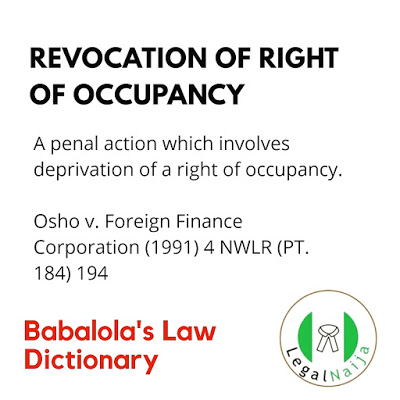
Revocation of Right Of Occupancy

A right of occupancy may be revoked by the Governor for overriding public interest.

The term ‘overriding public interest’ has been clearly defined by the law as follows:

a)  Where the holder of a statutory right of occupancy parts with the land in any manner contrary to the law or other regulatory provisions;

b)  Where the land over which statutory right of occupancy is granted is required by the State or Federal Government for public purposes;

c)  Where the land over which a statutory right of occupancy is granted is required for oil pipeline or any related purpose;

d)  Where the holder of a customary right of occupancy parts with the said land without the requisite consent;

e)  Where the land over which customary right of occupancy is granted is required by the Federal or State Government for public purpose

f)  Where the land over which customary right of occupancy is granted is required for mining purposes, oil pipeline or related purposes;

g)  Breach of any provisions or any term contained in the certificate of occupancy or any special contract made in accordance with the law in relation to the grant of the right of occupancy;

h)  Refusal to accept to pay for certificate of occupancy granted by the Governor.

Compensation would depend on the reason for revocation and may take the form of resettlement in any other place or area by way of reasonable alternative.

Learn & Share
#babalolalawdictionary #legaleducation #legalprofession #propertylaw #legalnaija

Bodily Sovereignty | Nonso Anyasi

Bodily Sovereignty | Nonso Anyasi

The legal philosopher John Locke postulated in his Two Treatises on Government that every man has a property in his own Person. The individual has the right to decide what would become of himself and what he would do, and as having a right to reap the benefits of what he did. 

This concept also known as the “Principle of Bodily Sovereignty” in legal parlance presupposes the existence of a legal right in an individual to determine what that individual does with his own body. The principle presumes the existence of both independence and autonomy in making decisions which affects one for oneself. 
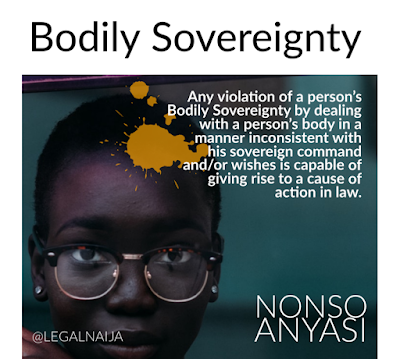
This principle of Bodily Sovereignty is applicable to all human beings irrespective of race, tribe, sex, or station in life. It is a consequential and binding bye-product of the cardinal international principle of Self-Determination as enshrined in the United Nations Charter. It is a jus cogens principle which must be respected by all persons, authorities, and governments. Therefore, any violation of a person’s Bodily Sovereignty by dealing with a person’s body in a manner inconsistent with his sovereign command and/or wishes is capable of giving rise to a cause of action in law. The criminal laws of various nations have also penalized the offence of unauthorized handling of a person’s body with harsh consequences. 
Hence, every human being, both male and female, have a right to determine what to do with and also what happens to his/her body. The females especially in the unenlightened part of Africa are largely unaware of the existence of this legal property rights in their bodies.  Many African women do indeed accept that a property exists in their bodies, but they fail to realize that they are the sole owners of this proprietary rights. Some have the erroneous misconception that they lack the will power or resources to exercise full control over their bodies and actions, and thus must subjugate themselves to the domineering authority of one who can effectively manage this property: a man. 
The law has already given the woman a moral or natural right to govern her actions and her body. It is left for the woman to enforce strict adherence to this right. The right continues till one ceases to be a person, hence, it would be foolhardy to posit that the right to bodily integrity is surrendered upon entering into a social relationship such as marriage. Marriage indeed creates an exclusive social contract wherein two persons form a union which confers right on the one on the other. However, the two parties to a marriage do not cease to be “persons”. Thus, neither of the parties to a marriage contract is expected to unilaterally surrender his/her bodily sovereignty to the other. It must be conceded that marriage creates a constructive consent for one to deal in his spouse’s body. Therefore, consent thereof can be implied where it is not expressly withheld. 
However, an express withdrawal of consent negates whatever constructive consent the marriage may have implied. It is therefore a violation of a woman’s Bodily Sovereignty for her husband to continue to handle her body in a manner inconsistent with his wife’s wishes.
There are many acts which amount to a violation of a woman’s bodily sovereignty. These include but are not limited to: touching a woman’s body in an unauthorized way, forcing a woman to touch another person against her wishes, making decisions on behalf of a woman where such responsibility was not expressly delegated, etc. In fact, any unauthorized dealing with a woman’s person is a violation of her Bodily Sovereignty. 
It therefore behooves on the Nigerian woman to avail herself of this protection afforded by the law to assert her Bodily Sovereignty from all forms of violations in whatever form it may appear.  
Nonso Anyasi 
@oluwanonso_esq
Intellectual Property and Brand Protection in the Food and Spice Industry | Infusion Lawyers

Intellectual Property and Brand Protection in the Food and Spice Industry | Infusion Lawyers

All over the world, food and spice are vital to human life. Food deliciously sustains life, provides energy, and promotes growth. And more than just adding flavour to life, spices colour and preserve food. A spice could be a bark, fruit, plant, seed, or other plant substance. Bulbs, fruit seeds, grains, rhizomes, and vegetables make up the food we eat. Though spices can serve cosmetic, medical, and religious purposes, some spices make great vegetables too. Nigeria’s food and spice industry presents huge opportunities for wealth.

Taking Competitive Advantage of Nigeria’s Food and Spice Market

Nigerians love food.

Nigeria is blessed with food and spices from the various ethnic groups in the country. With over 180 million people and growing fast, demand for food and spice in Nigeria is constantly high. This increasing demand for Nigeria’s food and spice ensures that the food and spice market is forever growing.
Food and spice companies, local and international, are taking more and more competitive advantage of the demand. Food and spice products are being produced, marketed, and distributed in both rural and urban markets. With a growing chain of wholesale distributors and suppliers, some of these food and spice products are exported to other countries, though their contributions to Nigeria’s Gross Domestic Product (GDP) have not been so delicious and spicy.
#MadeinNigeria is spurring local food and spice companies to up their game.

According to Euromonitor’s overview of the packaged food industry in Nigeria for instance, ”[t]he economic recession of 2016, due to falling government revenue from crude oil prices and an associated devaluation of the local currency, have led to a difficult environment within the packaged food environment, despite good growth.” Nigeria’s present #MadeinNigeria mantra—a campaign aimed at encouraging consumers to patronize locally made products—has opened up a door of opportunities for local companies to introduce original and fresh food and spice products for the Nigerian market. Of course, there will also be exporting opportunities.

With the above development, traditional open-markets are gradually giving way to convenience stores and supermarkets. The implication on food and spice companies is that they now need to pay even greater attention to how they package their foods and spices. Because convenient stores, grocery stores, and supermarkets will require the products they stock to be well-packaged food and spices with improved nourishments for their customers, food and spice companies must raise their game—and they are beginning to do just that!
Food and spice companies must bring value to consumers and create experience that lasts beyond taste.

In an ever-demanding consumer market, food and spice companies are realizing more than ever that their food and spice products need to be well-produced and well-packed, attracting consumers and increasing turnovers. They are also realizing that beyond getting consumers fed and spiced up, they need to produce food and spice products that bring value to consumers and create experience that lasts beyond taste.

To get ahead in today’s food and spice market, food and spice companies need strong brands, not just food and spice commodities.Branding doesn’t just start and end with logo designs and graphics for food and spice packaging, but goes beyond those. If branding is part of marketing, then marketing must begin right from the start—conceptualization or creation of the food or spice product. From what the food or spice product is made of to what it looks like; from what it is called to what it does, getting these things right ensures that you are also getting branding right. By so doing, your branded food or spice product is not only fresh and original, but also exciting for consumers who buy the product in open markets, kiosks, stores, and supermarkets.

Without strong branding for food and spice products, there is little or no value to explore, maximize, or protect.

Strong food and spice brands create great value—both commercial and intellectual assets that endear your distinctive food and spice products to your target market, wherever they are. Whether marketed and sold in Nigeria or anywhere in the world, your greatest asset is your intellectual property in the branded food or spice product.
And this is where the need for brand protection with a comprehensive intellectual-property strategy comes in. Because when you completely own your food or spice brand, buyers, distributors, suppliers, and even your competitors will respect it. Why? Because you completely and really own it. How?
How to Completely and Really Own and Protect Your Food and Spice Products

Every food and spice business—from startup to multinational—creates intellectual property. Protecting the intellectual property in the beginning ensures that your food and spice business does not lose its greatest assets to fraudulent or unhealthy infringements.

By protecting your Intellectual property in your food and spice business, you are protecting everything from the production of ingredients and creation of recipes to the labelling, marketing, exportation of the finished product. So your branded food or spice product is your intellectual property.
Below are types of intellectual property relevant to food and spice products. Any food and spice company should consider using some or all of these IP rights to increase its brand value and company worth.
Trade Secrets

Enterprises often have winning secrets. These secrets are confidential information that give them some advantage, putting them ahead of their competitors. This is why the World Intellectual Property Organisation (WIPO) defines trade secret “as any confidential business information which provides an enterprise a competitive edge which could be; commercial assets, manufacturing or industrial secrets which protects against unfair competition depending on the jurisdiction the product is”.

So it could be advertising strategies, clients and suppliers lists, consumer profiles, distribution methods, manufacturing processes, and sales methods. Food and spice companies often have one or more of this information and they keep it confidential to stay in business.
Though a trade secret does not require registration with any government agency, it must still be eligible for protection. There is no law regulating trade secrets in Nigeria. But Article 39 of the Agreement on Trade-Related Aspects of Intellectual Property Rights (TRIPS Agreement) provides a general standard:
  1. The information must be secret (i.e. it is not generally known among, or readily accessible to, circles that normally deal with the kind of information in question);
  2. It must have commercial value because it is a secret; and
  3. It must have been subject to reasonable steps by the rightful holder of the information to keep it secret (e.g., through confidentiality agreements).
So how can trade secrets be protected against unauthorized use by competitors or other unauthorized persons? It would be best to draft a nondisclosure agreement (NDA) with all the employees of the company. The NDA should be well drafted to comprehensively protect your company and charge anyone who reveals or attempts to reveal the company’s trade secret to third parties. Though Nigeria does not presently have a trade secret law or any comprehensive unfair competition law, NDAs are essentially contractual, thus enforceable. In other countries where trade secret is regarded as one of the powerful tool for economic development, there are trade secret laws. The United States’ Uniform Trade Secret Act is a good example. Nigeria needs to step up as well. But before Nigeria eventually wakes from its deep sleep, food and spice companies must be alert by using this trade-secret tool to protect their food and spice business.
Patent

Some trade secrets may not just be confidential information only but also inventions that would qualify for grant of patents. In the food sector, patents broadly cover everything from food composition to food-making process. Patent can be granted for new ingredients, new products, new packaging, new processing methods, and other novel elements. Your food and spice packaging features may provide new storage advantages that significantly delay food spoilage and the process involves an inventive activity. In an industry where brand imitation is high, you want to ensure that you protect your innovative food and spice products so you enjoy exclusive rights to your inventions.

To ensure that eligible for patent in Nigeria—similar with other countries—the food or spice product must meet the requirements listed in Nigeria’s Patents and Designs Act. Section 1(1) of the Act requires that the invention must be:

  1. new;
  2. results from an inventive activity;
  3. capable of industrial application; and
  4. constitute an improvement upon a patented invention and also new, results from inventive activity, and is capable of industrial application.

    The statutory requirements above seem daunting for food and spice businesses since patent focuses more on processes and new chemical compounds.

But if the invention in the food or spice product or process can be proved to be unique, the company may proceed to file and protect it in the country or jurisdiction it wishes to operate in or expand to.
Trademark

Trademarks can include words, logos, shapes (of the food or spice product itself or its packaging), slogans, specific colours and sounds. Think of popular but distinctive trademarks as Coca Cola, Mr Biggs, Indomie, etc.

For any food or spice company that wants to be successful, trademark is critical. Without an effective branding strategy, trademark protection will be weak, needless, or outrightly useless. This is why we briefly discussed branding in the opening part of this work.
With effective branding, your food and spice products will stand out in the market. They will be distinctive and valued. Consumers will easily recognize them. This will help you gradually achieve a competitive market for your products in a highly competitive food and spice market. And this is why at the early stage of making any new product, you need to engage your brand team to identify the unique qualities of the product and create a distinctive brand for it. It is this brand quality that will then be the basis for trademark protection. By keeping the product name and brand qualities such as colour, logos, etc distinct, obtaining trademark protection becomes easier.
In section 67 of Nigeria’s Trademark Act, trademark is essentially a mark used or proposed to be used in relation to goods to indicate a connection in the course of trade between goods and some person having the right to its use. To register a trademark in Nigeria and other countries, distinctiveness of the mark is crucial. For the purpose of determining the distinctiveness of marks, section 9 of Nigeria’s Trademark Act requires that the applicant’s mark must contain:
  1. the name of the company, individual, or firm represented in a special manner;
  2. the applicant’s signature;
  3. an invented word or invented words;
  4. a word or words having no direct reference to the character or quality of the goods and not being in accordance to its ordinary signification, a geographical name or a surname; and
  5. any other distinctive mark.
In order to maintain trademark, it must be in use for 5 years else anyone can apply for it to be revoked, including your competitors. The need to brand a business’s food and spice products is vital and cannot be overemphasized. It aids consumer recognition and goodwill, helping to grow business and increase brand value.
Copyright

Both copyright and industrial designs (discussed below) are not types of intellectual property rights that are as relevant to the food and spice industry as patents, trade secrets, and trademarks are. But copyright and industrial designs may be of some use to a food and spice company at some point.

Copyright protects literary works, granting authors exclusive right to produce, distribute, assign, license, or do other things with the work. In food and spice business, getting a list of ingredients or a specific cooking method protected under copyright may be difficult. This is because copyright only protects the expression of ideas in a fixed medium, not the ideas themselves.
So a cookbook containing recipes, for example, will be eligible for copyright protection. It is most likely that food and spice companies will benefit more from protecting their food- and spice-making processes, methods, or techniques under trade secret or patent than under copyright law.
Of course, marketing materials and publications such as banners, booklets, flyers, handbills, songs, videos, etc will all be eligible for copyright protection. Brand marketing supports brand recognition. And brand recognition needs all the brand protection it can get.
Industrial Design

Industrial design protects distinctive lines, colours, or shapes. Section 12 of Nigeria’s Patents and Designs Act defines industrial design as “any combination of lines or colours or both, and any three-dimensional form, whether it is associated with colours or not, intended by the creator to be used as a model or pattern to be multiplied by industrial process and is not intended solely to obtain technical result.”

Because industrial designs protect lines, colours, and dimensions, industrial designs can help food and spice companies distinctively package their food and spice products. This can be achieved by uniquely using or combining lines, colours, and any three-dimensional forms to design their food and spice products. There will then be protection for the products against counterfeiting and other infringing acts by both fight-dirty competitors and other counterfeiting agents.
It is not every design that is registrable under the Act. For a food- or spice-related design to qualify for protection, the design must be new and it must not be contrary to public order or morality. Thinking of what could possibly be contrary to public morality? Well, imagine a cucumber-flavoured, diary-food bottle with a cucumber shape.
As we were saying …
Determining Which Intellectual Property Apply to Your Food and Spice Business

If identifying the types of intellectual property that are relevant to the food and spice industry is not milk, determining the following can be bone:

  1. which type or types of amongst the intellectual property identified above applies (or apply) to your food and spice business;
  2. whether any of your food and spice products, food-processing, or spice-making processes is eligible for protection; and
  3. how best to go about the process of registering, managing, monitoring, and maximizing your intellectual property in the identified food and spice products, food-processing methods, or spice-making processes eligible for protection to grow and expand your food and spice business and gain market share in the industry.
To break the 3 bones above, expertise is required to avoid any mistakes.
IP registration, management, monitoring, and maximization need comprehensive strategy. A food and spice company with an eye on growth and expansion must have a strategic approach to brand protection. This ensures that brand protection positions the business for growth, and not just an end in itself.
Conclusion

When a food and spice company manages its brand protection rightly, it will significantly improve its market share.

A comprehensive intellectual-property strategy is critical to brand protection in the food and spice industry. IP protection will strengthen the brand’s value and establish the brand as a competitor to beat in the food and spice Industry. It will also support the food and spice company’s expansion, breaking new grounds both locally and internationally.
In IP protection, delay is dangerous.
Senator: senator@infusionlawyers.com.ng
Rita: rita@infusionlawyers.com.ng
Email: info@infusionlawyers.com.ng

Phone: +234(0)809 876 4066, +234(0)816 995 1792

Website: www.infusionlawyers.com.ng

Supporting Pro Bono In Nigeria #PaulUsoroChallenge

Supporting Pro Bono In Nigeria #PaulUsoroChallenge

With the high number of Nigerians living in extreme poverty, there comes a huge number of citizens who are unable to afford legal services.

This class of citizens are vulnerable to human right violations & at a disadvantage when resolving disputes. 

This is where Lawyers come in;
offering Pro Bono services is a wonderful way for lawyers to give back to the society.

Pro bono is short for the Latin phrase pro bono publico, which means “for the public good.”

The term pro bono is used primarily in the legal profession, as lawyers are bound by ethical rules to charge reasonable rates and to serve the public interest by providing free legal services to those in need. As such, the provider is thought to be imparting a benefit for the greater good, instead of working for the typical for-profit motive. 


It is safe to say that if Nigerian lawyers offered pro bono services more often, there would not be such a high rate of human right violations in the Nation.

Due to the importance of Pro Bono in our nation building efforts, the @NigBarAssoc President @PaulUsoroSAN has consistently continued to support and encourage lawyers who offer Pro Bono services.
The #PaulUsoroChallenge celebrates Lawyers who offer Pro Bono services and encourages the act of selfless service in the legal sector.

This season, Lawyers get to win up to 200,000 Naira as prize money. All you need to do is share your pro bono story. 

See flier for details, entry closes 30th April, 2019.

#PaulUsoroChallenge
#ProBonoChallenge
#NigerianLawyers https://t.co/aZWUHASAxo