Remedies available to Minority Shareholders for wrong done By the Majority/Controlling Shareholders

Remedies available to Minority Shareholders for wrong done By the Majority/Controlling Shareholders

Written
by Oluyemisi Dansu
Managing
Partner at Argyle & Clover Attorneys at Law
It is rather easy for the
rights of minority shareholders to be infringed upon however minority
shareholders are afforded some protection under the Companies and Allied
Matters Act (CAMA) to protect their rights/interests.
While it is trite in line
with the provisions of Section 299 of CAMA[1], that where a wrong has been done
in the course of a company’s affairs to the company (by the majority or the
alter ego of the company), only the company can sue to remedy the wrong. This
is commonly known as the rule in Foss .v. Harbottle. There are some exceptions
to this general principle provided for under Section 300 of CAMA. These
exceptional instances are discussed hereafter.


•Entering into any transaction which is illegal or ultra vires2:

In the case of Yalaju-Amaye
v Associated Registered Engineering Co Ltd (AREC)[2], a minority shareholder
was allowed to sue where the purported appointment of new directors by the
board was held ultra vires the board as there was no such power granted in the
articles of association.

•Purporting to do by ordinary resolution any act which by the Company’s
Articles or the CAMA is required to be done by special resolution[3]:
The law guards against the
risk of majority/controlling shareholders ratifying an act which is in itself
wrong, by a wrong procedure. For minority shareholders to effectively bring an
action under this exception, it must be clearly established that irregular and
illegitimate procedures were adopted by the majority and this requires a good
knowledge of the provisions of the company’s articles as well as the provisions
of CAMA.

•Any act or omission affecting the Minority Shareholders’ individual rights as
members of the Company:
This occurs where the
shareholders membership rights are the facts in issue, for instance where
minority shareholders are systematically denied the right to vote at general
meetings, or consistently denied the right to receive notice of general
meetings of a company. In the case of Edokpolo & Company Ltd v Sam-Edo Wire
Industries Ltd[4], a minority shareholder holding 40% of the company’s shares,
alleged collusion between the company’s Chairman and Solicitor, the result of
which was the allotment of shares to other parties out of the 40% belonging to
the minority shareholder.
The Supreme Court held
that the minority shareholder was entitled to sue in its personal capacity to
protect its personal right to the shares held by it. In the words of Aniagolu,
J.S.C; “it appears to one that this is a clear case in which a minority
shareholder should, in the interest of justice, be allowed to sue as one of the
exceptions to the rule in Foss v. Harbottle”.

•Committing fraud on either the company or the minority shareholders where the
directors fail to take appropriate action to redress the wrong done[5]:
Examples of this is where
there is expropriation of the company’s property by majority shareholders or
where majority shareholders have obtained certain unfair advantages by dealing
with the company’s property, or an attempt to release the directors’ from
liability arising from breach of the duty of good faith owed to the company. In
the case of Yalaju-Amaye v AREC[6], the minority shareholders were allowed to
sue where the directors of the company went on a withdrawal spree from the bank
account of the company, falsified minutes of meetings to cover up a
non-existence board resolution to change the signatories to the company account
on the ground that a fraud had been committed against the company. A broader
definition of fraud was given by the Supreme Court in this case as “Any act
which may amount to an infraction of fair dealing, or abuse of confidence or
unconscionable conduct, or abuse of power as between a trustee and his
shareholders in the management of a company.”
In light of the above
definition, “fraud’’ is used in a loose, wider and equitable sense thus an
abuse or misuse of power and indeed breach of duty on the part of the majority
shareholders or controlling directors opens the way for minority shareholders
to sue to correct the wrong done to the Company.
What may be imputed as
fraud on the company or on the minority shareholders varies from case to case,
and the entire circumstances surrounding a particular case would usually be
examined to determine whether or not it meets the requirements. In the case of
Omisade v Akande[7], the parties involved in the suit were both directors and
shareholders and had shares in equal proportions in the company.
In a contract entered into
between the company and a US-based airline, it was agreed that in consideration
for patronage of the flight services of the airline by Muslim pilgrims through
facilitation by the company, the airline would pay a certain amount of money as
commission to the company. Omisade alleged that Akande falsely represented to
the US-based airline, with which the company had a contract; that the company
was being wound up, in order to divert the commission due to the company to
another establishment in which Akande was the majority shareholder.
It was held that Akande
had clearly committed a breach of his fiduciary duty as a director of the
company by making false representations about the company in order to divert
profit from it, and that this amounted to a fraud on the company for which a
minority shareholder, or any other interested shareholder could bring an action
on behalf of the company.
•Where a company meeting cannot be called in time to be of practical use in
redressing a wrong done to the company or to minority shareholders[8]:
This situation may arise
where an irreversible wrong is about to be done and the facilities for
convening a proper meeting of shareholders or the board are not available, or
where urgent action is required to abate the wrong. It will be unreasonable to
wait for a formal meeting requiring notice to be convened to address the wrong
thus the law allows a shareholder in this instance to apply to court to abort
or nip the wrong in the bud.

•Where the directors are likely to derive a profit or benefit, or have profited
or benefited from their negligence or from their breach of duty[9]:
In this circumstance, a
shareholder/member[10] of the company may apply to court for redress. The
rationale behind this is that the directors are the wrongdoers and are also the
ones in charge of the day to day running of the company, it is to be expected
that they would not take any action against themselves for breach of their
duty.

•Where the interest of justice demands:
In its effort to apply
equitable principles to corporate relationship for the purpose of minority
shareholders protection, the Nigerian Supreme Court, in Edokpolor & Co Ltd
v Sam-Edo Wire Industries Ltd recognised a further exception to the rule in
Foss v Harbottle now known as the “interest of justice” exception. This
principle is to the effect that where, considering all the circumstances of a
case, it is in the interest of justice that the application of the rule in Foss
v Harbottle be suspended, the court has a duty to suspend application of the
rule even where the circumstances of the case do not fall under any of the
preceding six categories of exceptions.
Types of Action that can
be commenced by Minority Shareholders
In line with the
exceptions to the rule in Foss .v. Harbottle, there are 3 types of actions that
Minority shareholder(s) can bring:

•Personal Action
A personal action may be
commenced by a member to enforce a right due to him personally where such
rights have been abused by an act deemed to be the act of the company[11] See
Section 301 of CAMA. An example of personal action is where a shareholder commences
an action to enforce the term of a contractual obligation with the company.

1.Representative Action
A representative action is
commenced where an individual member’s right has been infringed, and the
infringement affects other members in the company, the appropriate action will
be a representative action i.e. a member will be suing the company on behalf of
himself and other aggrieved members. See Section 301 (2) of CAMA.

1.Derivative Action
A derivative action is
when minority members/shareholders bring an action in the name of the company
to correct the wrong done to a company by majority/controlling shareholders.
There are however various impediments to the minority shareholder’s ability to
enforce company’s rights as the minority shareholder(s) has to satisfy the
provision of Section 303 of CAMA, which provides that:

•“Subject to the provisions of subsection (2) of this section, an applicant may
apply to the court for leave to bring an action in the name or on behalf of a
company or to intervene in an action to which the company is a party, for the
purpose of presenting, defending or discontinuing the action on behalf of the
company.

•No action may be brought and no intervention may be made under subsection (1)
of this section unless the court is satisfied that:
 •The wrongdoers are the directors who are in
control and will not take necessary action.

1.The applicant has given reasonable notice to the directors of the company of
his intention to apply to the court under subsection (1) of this section if the
directors of the company do not bring, diligently prosecute or defend or
discontinue the action.
In light of the foregoing
provision, minority shareholders before they can validly commence a derivative
action must first apply to the Court for leave to commence the action and where
they are unable to establish factually and based on the provision of CAMA that
the conditions for a derivative action has been met, the court will refuse
leave.
[1] CAP C20 LFN 2004
[2] (1986) 3 NWLR (pt. 31)
653
[3] S. 300(b) CAMA
[4] (1989) 4 NWLR (Pt.
116) 473
[5] S 300(d) CAMA
[6] Supra
[7] (1987) 2 NWLR (pt. 55)
at 158; (1987) 18 NSCC 486
[8] S 300(e) CAMA
[9] S 300 (f) CAMA
[10] According to S. 302
CAMA, “member” includes the personal representative of a deceased member and
any person to whom shares have been transferred or transmitted by operation of
law.
[11] S. 301 CAMA

Ed’s Note: – This
article was originally posted by the author on 29th June, 2016 at https://www.linkedin.com/messaging/thread/6131850926308286467
(Last Accessed on May 6, 2016) 

Constitutional Roles  of the House of Representatives

Constitutional Roles of the House of Representatives


The House of
Representatives is the second chamber in Nigeria’s bicameral legislature, the
National Assembly. The National Assembly (NASS) is the nation’s highest
legislature, whose power to make laws is summarized in chapter one, section
four of the 1999 Nigerian Constitution. 

Sections 47-49 of the 1999
Constitution state inter alia that “There shall be a National Assembly
(NASS) for the federation which shall consist of two chambers: the Senate and
the House of Representatives”. 


The House of
Representatives is headed by the Speaker assisted by the Deputy Speaker. These
Presiding officers serve as political heads. There are three hundred and sixty
(360) members in the House of Representatives representing the 360 Federal
Constituencies the country is divided into based on population. 

The Constitution has
vested in the House of Representatives the power to make laws for the peace,
order and good governance of the Federation. 
The House of
Representatives also has broad oversight functions and is therefore empowered
to establish committees of its members to scrutinize bills and the conduct of
government institutions and officials.

The House of
Representatives is also empowered by the Constitution to legislate on
Exclusive, Concurrent and Residual lists.

Photo Credit- google.com 
Senate Constitutional Role

Senate Constitutional Role


The Constitution has
vested in the National Assembly the power to make laws for the peace, order and
good governance of the Federation. The Assembly also has broad oversight
functions and is therefore empowered to establish committees of its members to
scrutinize bills and the conduct of government institutions and officials.

The Constitution confers
exclusive powers to the Senate among them the power to scrutinize and confirm
major appointments of the executive. It is, however, specific about the
appointments to be confirmed. They are those of the Ministers, Special
Advisers, Ambassadors, top Judicial Officers heading specified levels of
courts, the Auditor-General of the Federation, and the Chairmen and Members of
the vital National Commissions.


The Senate is one of the
Chambers in Nigeria’s bicameral legislature, the National Assembly. The
National Assembly (NASS) is the nation’s highest legislature, whose power to
make laws is summarized in chapter one, section four of the 1999 Nigerian
Constitution. 

Sections 47-49 of the 1999
Constitution state inter alia that “There shall be a National Assembly
(NASS) for the federation which shall consist of two chambers: the Senate and
the House of Representatives”. 

The Senate is headed by
the President of the Senate assisted by the Deputy President of the Senate.
These Presiding officers serve as political heads. There are one hundred and
nine (109) members in the Senate corresponding to the 109 senatorial districts
in the country. Senatorial Districts are evenly distributed among the thirty
six states.  Each state has three senatorial districts while the Federal
Capital Territory (FCT), Abuja has just one senatorial district.

Photo Credit – www.dgossip247.com 
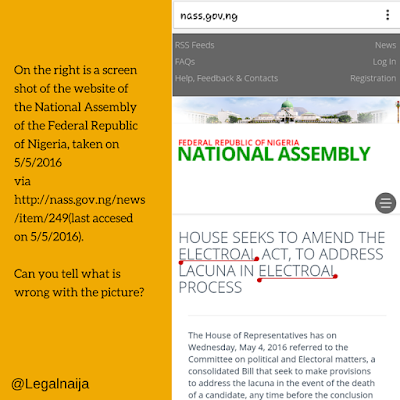
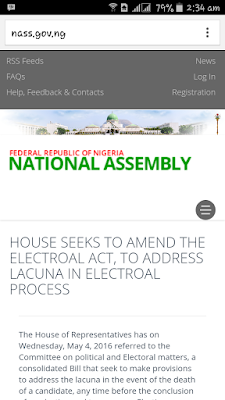
House Seeks To Amend The Electoral Act, To Address Lacuna In Electoral Process

House Seeks To Amend The Electoral Act, To Address Lacuna In Electoral Process

The House of
Representatives has on Wednesday, May 4, 2016 referred to the Committee on
political and Electoral matters, a consolidated Bill that seek to make
provisions to address the lacuna in the event of the death of a candidate, any
time before the conclusion of an election and to empower Election Tribunals and
Courts to declare Candidates who score the second highest votes as winners of
the elections. Other issues which the Bill seeks to address include to ensure
that all political parties are gender sensitive and to eliminate all forms of
discrimination.
A co-sponsor of the Bill,
Hon. Femi Gbajabiamila, while leading the debate on the general principles of
the Bill stated that a key component of the Bill also wants to accommodate the
use of Card Reader in the Electoral Laws as well as to increase the amount of
money permitted as maximum election expenses to be incurred by Candidates
standing for elections. In addition, nullification of elections by Tribunals or
Court should be put in the right perspective, he said. Other sponsors of the
Bill, Hon. Karimi Sunday, Edward Gyang Pwajok, Uzoma Nkem-Abonta, Olatoye
Temitope Sugar and Raphael Nnanna Igbokwe took turns to adumbrate on the
desirability or otherwise of the Bill as they appealed to the Members of the
parliament to support their argument and prevent the recent electoral impasse
in Kogi Sate Governorship election from happening elsewhere.
However, the Minority
Leader, Hon. Leo Ogor had a different view regarding the use of Card Reader, he
informed that the Card Reader was almost declared illegal in a recent ruling by
the Supreme Court. He opined that the Card Reader inadvertently shuts out
several eligible voters from performing their franchise, calling it a violation
of the fundamental Human Rights of the people; he however suggested that the
system of electronic voting be captured in the Electoral Act. 

In a related development,
the representatives passed for second reading a Bill which seeks to alter the
3rd schedule of the Constitution of the Federal Republic of Nigeria, 1999 to
provide for Electronic Voting and other related matters, standing in the name
of Hon. Edward Gyang Pwajok.
Meanwhile, the House
resumed the 
senatorial debate on Diversification of the Economy: real sector
development during the plenary session where it played host to the Hon.
Minister of Agriculture, Chief Audu Ogbe who delivered his brief where he
advised that the way out of the current economic quagmire is to ride the lane
of self-sufficiency and to focus on export goods like cocoa and palm oil. “We
must begin to grow our own foods and wage an economic war against importation
of excessive goods”, he emphasized.

He informed that the
Ministry of Agriculture is doing well in rice and beans production, reviving
the cocoa industry, establishing a new market for bananas and conducting
nationwide survey on fertilizer. 
Chief Ogbe stated that the
Ministry is tackling the issues of competition, importation and inability to
access finance through policy direction, however, solicited support of the
parliament if the challenges are to be surmounted. He further stressed that
factors such as high and inaccessible financial interest rate for farmers,
youth restiveness, land revenue and problems of Extension Services need to be
addressed. “Nigeria has the highest ratio of extension workers to the tune of
1:10 in Africa”, he stated.
Responding to questions
from the lawmakers, the Minister said that the way forward includes having a
functioning Local Government system that will perhaps boost local production in
the grassroots, and interest rate for agriculture should not be higher than 5%.
He strongly advised against re-opening of the grazing routes across the
country, citing waste of effort as reason if the routes would not lead to grasslands
but farms. 
Credit – www.nass.gov.ng http://nass.gov.ng/news/item/249
ENTER YOUR NOMINATIONS: 40 Leading Nigerian Lawyers Under 40

ENTER YOUR NOMINATIONS: 40 Leading Nigerian Lawyers Under 40


ESQ Nigerian Legal Awards,
an annual event which celebrates excellent and professional contribution of
lawyers to the growth of Nigerian economy, will be hosting the maiden annual Nigerian
Rising Stars – 40 Leading Nigerian Lawyers Under 40 who will shape the future
of the legal profession in Nigeria
 – on 6th October 2016, at the Muson
Centre, Onikan, Lagos Island, Lagos. This award will honour young lawyers, from
law firms, in-house legal departments, government and from the diaspora, who
are the rising stars of the legal profession in Nigeria.


This award is set to
encourage and recognize distinguished 40 Nigerian lawyers under the age of 40, who
will shape the future of the legal profession in Nigeria
. The award is
dedicated to honouring young leaders who have distinguished themselves and are
clearly setting new standards in the practice of law either in Nigeria or in
the various jurisdictions where they practice or work.

We are therefore inviting
nominations from companies, law firms and the general public of outstanding
young Nigerians who are lawyers or business executives with legal background
who are younger than or are ataining the age of 40 in 2016 for inclusion in
our  – Top 40 Under 40 Nigerian Lawyers who will shape the
future of Legal Practice in Nigeria.
 Only 40 Nigerian Lawyers that
exemplify distinction and quality service delivery will be selected for
inclusion in this roll of honours. Qualified nominees should demonstrate
superior leadership, reputation, influence, stature and profile as a Nigerian
Lawyer.

Eligibility for Nigerian
Rising Stars – Leading Lawyers Under 40 who will shape the future of the legal
profession in Nigeria:

Selected winners will be
considered on the basis of the criteria below:

  • Must be a Nigerian and below 40 years
    as at 1st January 2016 and at least 7 years of experience as a lawyer
  • Reputation among peers, the judiciary
    and the public
  • Achievements, settlements and verdicts
    as a lawyer
  • Nominations from leading lawyers,
    peers and employer
  • Leadership and membership in the
    Nigerian Bar, International Bar or any other professional lawyer
    organizations
  • Rankings and ratings by leading
    international evaluation organizations
Each of our
distinguished Top 40 under 40 members strives to
encompass the knowledge, skill, experience and success held by only
the best Nigerian lawyers.

 It is our
mission to promote a unique and professional networking opportunity
for young lawyers, while developing progressive ideas. The winners
will include in-house lawyers as well as lawyers working in private practice
and in Government. We invite law firm partners, General Counsel of Companies,
heads of legal teams at the various governmental departments and Ministries of
Justice, senior lawyers from the diaspora, International Law Firms and the
general public to please nominate young lawyers from their various offices or
that they have worked with for inclusion in this roll of honour.

We invite you to nominate
other lawyers from your firms, in-house and government with whom you have
worked. Nomination should conform with the form below.

For details, please email awards@esqlaw.net, lere.fashola@esqlaw.net
or call Lere on 08035269055 or James 08039696286

NIGERIAN RISING STARS –
NOMINATION FORM
PART A
All fields in this section
are mandatory
NOMINEE
Name:
________________________________
Name of firm/organization:
__________________________
Job title: _______________________________
Phone number:
_________________
email:
 ___________________________

PART B
All fields in this section
are mandatory
REFEREES (please,
provide at least two, both of whom must be either a client of your
firm/organization or your employer (current or former)
Name: (1)
__________________, (2) ______________________, (3) ____________________
Firm/Organization:
  (1) __________________, (2) ______________________, (3)
____________________
Job title: (1)
__________________, (2) _____________________, (3) ___________________
Phone number: (1)
______________, (2) _____________, (3) ________________
email: (1)
______________________, (2) ______________________, (3) _________________

PART C
All marked fields are
mandatory
Nominee Information:
Optional Information:
Nomination Criteria:
Deals, Cases and/or Files –
He/she has an outstanding track record of success relative to others in his/her
field and at a notably high level of complexity. Please provide examples: (2000
characters limit)
2000 characters left.
 * Recognized
Leader
 – Provide examples of his/her community involvement and
leadership in pro bono work and/or his/her involvement in professional or other
organizations:(850 characters limit) 850 characters left.
 * Contribution
to Success
 – He/she has demonstrated their value to the firm,
department or company by pro-activity in client service, excellent client
development and/or other ways, as evidenced by:(850 characters limit)
850 characters left.
 * Business
Acumen
 – He/she has demonstrated his/her ability to focus on the
central legal needs/issues within the context of his/her business or client’s
business and the larger relevant competitive realities, as evidenced by:(1750
characters limit)
1750 characters left.
 * Adaptable
to Change
 – He/she is highly flexible and responsive to change. Often
he/she anticipates, initiates and leads change efforts. He/she is planning and
visioning for lawyering of the future as evidenced by:(850 characters limit)
850 characters left.
 * Education,
Awards and Affiliations of Note
 – Please, provide highlights: (850
characters limit)
850 characters left.
 * Team
Player
 – He/she is highly skilled at synchronizing the efforts and
work of multiple players and generous in sharing the most interesting work.
He/she recognizes his/her colleagues for successful results and is respectful
and civil in all dealings. Please provide example(s):
2000 characters left.

  * – Any
words or other materials beyond this nomination form will not be distributed to
Advisory Board members –

Effect of Corporate Bullying on Organizational Performance by SEYI BABATUNDE ACIPM HRPL

Effect of Corporate Bullying on Organizational Performance by SEYI BABATUNDE ACIPM HRPL

The centrality of what
large and small organizations aim to achieve aside profiteering may also be to
constantly aspire to satisfy stakeholders’ interest. However, in
actualizing this aim, most often than not depend on the human effort either
from the owner of an enterprise or from the staff of the enterprise. Bullying
and corporate harassment as a deleterious issue in the corporate world has not
been given much attention, the reason could be because there are fewer
literatures on it or because the victims of a bullying circumstances usually
don’t speak up for the obvious economic reasons.

 This piece which relies on ancillary data and
personal experience wishes to address the fundamental hindrance why most
organization could be in business for years yet without significant progress in
terms of profitability and healthiness. The theme of this piece also spins on
understanding the human side of every business in order to proffer solutions to
what the author termed as corporate bullying.

Bullying in its basic
usage is synonymous to words like Intimidation, mistreatment, oppression,
victimization, Harassment, oppression, hounding, harrying. While a Bully may
also mean the same as a tormentor, persecutor, oppressor, tyrant, intimidator
and aggressor.
According to Harvard
Business Review 2011, workplace bully is defined commonly as individual or
group who use aggressive or unreasonable tactics against co-workers or
subordinates persistently. As seemingly unpleasant the word bully may sound, it
is unfortunate those words are personified in many organizations. According a
recent research by Lagos Business School (Nigeria) the more unfriendly
the organizational (work-family) culture is, the more the employees think of
changing jobs.
 This and others may be the cause for high attrition
rate. However, the reason why people bully should also be explained as
elucidated below:

WHY PEOPLE BULLY

  • Personality Clash: In
    Africa, it is often said that one of the reasons why none of the human
    fingers is equal is because nature wants to remind us that no human being
    is the same in orientation and in personality. The finger prints security
    checks also tells this story better. With this background, it is on record
    that bosses tend to bully staff who they think they cannot work with as a
    result of incompatibility of personality colorations.

  •  Deadlines: Deadlines
    are usually cash lines. Clients see exceptionality in paying more to
    organizations who meet deadlines. Aside repeated buying, referrals are
    usually key for organizations who are able to meet deadlines. More often
    than not, supervisors or owners of the business get too emotional on
    subordinates for not meeting targets and set deadlines. From research,
    some organization award punishment for not meeting up to deadlines. Such
    punishment could range from monetary surcharges, forfeiture of day offs
    and other fringe benefits. Although, this piece doesn’t plan to address
    punishment implications for offences, however, there should be a prior
    acknowledgement from parties to employment on how to deal with ineffective
    work operations as against arbitrariness of disciplinary operations. This
    is what company manual and employee hand book should address. 

Aggressions transfer: The
world is said to be a war zone, hence for organization being a unit in the
world, the impact is clear. No soldier would be in the battle field
smiling all day, no no no! Not even in Hollywood or Nollywood movies. It’s
usually a battle field, and this relates to organizations; battling
between making more profit this year or losing out into bankruptcy, battle
of getting more customers or your competitors have them, it’s a battle of
lowering your cost to attain sustainability and   battling of
adherence to corporate governance issues in the face of economic upheaval. 


 More often its only leaders and owners of companies that share some of
these battles alone. Unlike a troop in the army where team work is
actually team work. For instance a battalion that losses a war can all
perish together in war front.
 However in corporate organization this isn’t
so. Workers leaves and move on if the business fails, hence leaving the
owner of the business to bear the bruises all alone. This is a typical
sorry case and as such the enterprise owners is on his/her own. With of
the understanding of this irony, the corporate leader seeks to result to
being emotional whenever subordinates aren’t pulling enough strings in
achieving corporate objectives. 

A story was told of a Lady Business owner
named Bimbo who was suffering from husband battering especially during the
weekend, it was told that this lady usually have an emotional crack down
on every of her male staff on every other Monday /Tuesday during the
operations meetings. Asides this, some unit heads having been verbally
assaulted by her also transfer similar verbalized bully on their
subordinates and so goes down the line. Aggression transfer creates a
tyrannical organization and it has ruined goodwill of organizations.

  •  State of the business in
    not too distant time ago in Nigeria, I once worked with an Executive
    Director in a group of firms majoring in Food and Quick Restaurant
    Business. She was so furious about an HOD not been able to track
    operational lapses from his subordinate. She dragged the HOD to the HR
    office and instructed the HR to issue him a query. In the process of this
    instruction, she made such comment as this: this Company is going
    down day by day, and we must all go down with it is since we don’t want to
    do the right thing.
     That’s shocking isn’t it? The effect of this
    statement was obvious, within 6 weeks of that statement, both the HOD and
    even the HRM resigned from that organization.  Now that’s the effect
    of bully!
THE EFFECT OF CORPORATE
BULLY
From experience, actions
and inactions of corporate actors has over whelming effect on the corporate
existence of an enterprise. Bullying being an adverse action and
inaction within corporate organizations has the following ripple effect to the
existence of an organization. Below points sums up few of such effects.

  • Lowers Staff morals: Performance
    of any organization would depend on the state of mind of the actors of the
    organization. You cannot have a highly disgruntled workforce in your
    organization and expect the best from them. Never, because people aren’t
    wood after all. They have emotions and the blood that runs through their
    vain often tell them whether the organization is favorable or not. More
    often than not when you verbally deal with staff, they transfer such to
    your customers. If you have ever heard a customer complain about the
    service of a company bitterly, and that such customer had to result to
    making such complain viral on the internet? Then I bet you to check out
    the ways supervisors or managers of that company interact with their
    staff, and you will see hostilities from top down.

  • High Attrition rate:
    These talks about the rate of labour turn over in an organization. One of
    the basic signs you notice in a bully prone organization is that top
    managers leaves almost without notice. A good sign of a bullous
    organization job seekers should watch out for any time is companies
    recruiting regularly for top management position may not be a good place
    to work. Such companies only turn the HR department recruitment partner as
    against being a strategic partner in business.

  • Talent forbidden zones: With
    the advent of the social media, there is no more hiding place for any
    hostile organization. Have you recently recruited someone and concluded
    with pay package as well as other terms of employment, only for him/her to
    resume, then you hear him call to say; I am sorry I am no
    longer interested
    ! Yes it happens a lot right? Lol,   Believe
    it or not out of every 5 situation like this, 2 of them has to do with
    reputation issues on the side of the organization. We now have social
    generations of workers who are ready to go the whole route of making
    background check on the organization who is poaching them. They contact
    your former staff to enquire how it is like to working for you.
I
once worked in an organization with open cubicle style of office arrangement.
The Executive Director which happens to be the daughter of the CEO one day
openly described the Procurement Manager as an inefficient dummy who
cannot track simple supplies. But right there in my front was a job
candidate
 who has just accepted to work with us and he was to pick up
his letter the next week and then resume as Facility Coordinator. But guess
what? He never showed up. A call by the recruitment guy revealed that he can’t
work with such owner of the business who assault staff with words. Now how HR
guys will interpret this experience to the owner of the business often becomes
a major headache.
  • Bad PR: Managing
    organizational reputation could be a demanding job, and contracting this
    to Perception Managers also doesn’t come cheap. But what is more demanding
    is when the owner of a business directly or indirectly damages the
    business image. According to Tomas Chamorro–Premuzic,
    a Professor of business psychology at the University College London; in
    his article; The Dark Side of Executive Narcissism: How CEOs Destroy
    Companies’ Reputation and Employee Morale; he stated that organizations
    led by arrogant, self-centered, and entitled CEOs tended to perform worse,
    and their CEOs were significantly more likely to be convicted for
    corporate fraud (e.g., fake financial reports, rigged accounts, insider
    trading, etc.) with this, the action and inaction of CEOs on the image of
    the organization cannot be over emphasized.
REMEDY
Fortunately a lot of huge
problems require simple solutions.


  • USE MORE WORK AS PUNISHMENT FOR LAZY
    LEOPARDS
Douglas Mc Gregor’s X and
Y theory also sells even in this generation. To Gregor there are 2 types of
workers in an organization, the X workers who is typically a lazy worker and a
Y worker who is by a nature a workaholic. The strategy here is to  
give more work to those lazy leopards and monitor performance and attitudes
while you endeavor to understand the aspirations of the Y employee to motivate
him/her.

  • DEMYSTIFY YOUR PROCESS
Processes, Policies,
organizations’ SOPs and daunting bureaucratic procedures could be a
discouraging factor for worker’s performance. Some staff sees some policies as
a signal to get them out of the game. It is advised that organization steam
down rigidity on some processes for corporate gains. The essence of these
policies should be addressed.
  • OPEN DOOR POLICY
Many are organizations
preaches this but they fail to get the practice right. It is important that the
Management would always make themselves approachable. Get along with staff and
make some intimate comment when they celebrate special occasions to show you
how value even their personal life. Open your office door wide so that people
can approach and talk to you. The idea here is not that management should
pamper staff but that management should listen to staff for the sake of the
business. With this you will get maximum value and Return on human capital
investment.


  • DON’T BE EMOTIONAL:
There is need to act
professionally irrespective of the situation. Emotional intelligence seems to
be a song for the employees alone, but frankly speaking, we all need it
irrespective of the level of our economic status. Try to read people and
yourself then put them in the perspective of the environment so that you can
get result and performance from people.


  • GET SOCIAL:
This generation is a social
generation. Hence, to draw from the monetary and non-monetary proceeds from any
organization’s economic activities, the organization must have an healthy
environment for individual talents to manifest. The epochal Elton Mayo
experiment as carried out in Hawthorne in the United States of America reveals
that the social structures and its impact on the workplace can affect job
performance, hence corporate success. There is need to publicly celebrate
staff, know their birthdays, anniversaries and like their comments on social
medias. Although Mayo’s experiment on the impact of social structures on
workers was conducted several decades before the advent of the social media, it
is important to understand the social needs and background of each of our staff
for us to get the best from.
SUMMARY AND CONCLUSION
From the fore going, It
can be inferred that bullying occur then there is weak leadership.  Hence
bulling has been identified as inimical to the progress of any organization. We
have been able to establish that Manager or owner of the business may also act
deliberately to the disadvantage of their organizations due to certain
situations such as Clash of personality, deadlines on projects and the state of
the business among others seems to bring out the devil within.

The effect of this, is
alarming aside having to do with public relational issues, organizations tends
to lose top talent on a sporadic basis. To curb this, we advise solutions which
include; demystification of policies and processes, practical open poor
policy,   the use work as punishment, getting social at work and
understand the concept of emotional intelligence among others.

For
Training on mastering HR related issues for organizational effectiveness kindly
mail info@HRLeverageAfrica.com or call +2348032288650

Yours
Sincerely,

SEYI
BABATUNDE

Ed’s Notes: This article
was initially published by the author on 3rd May, 2016, via 
https://www.linkedin.com/pulse/effect-corporate-bullying-organizational-performance-acipm-hrpl?trk=hp-feed-article-title-ppl-follow (Last visited on 4th May, 2016)