Forward Recommendations On The National Automotive Policy – Senator Olugbenga Ashafa

Forward Recommendations On The National Automotive Policy – Senator Olugbenga Ashafa


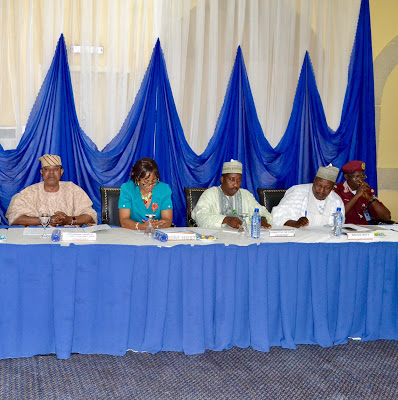
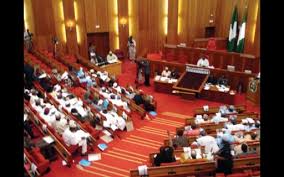
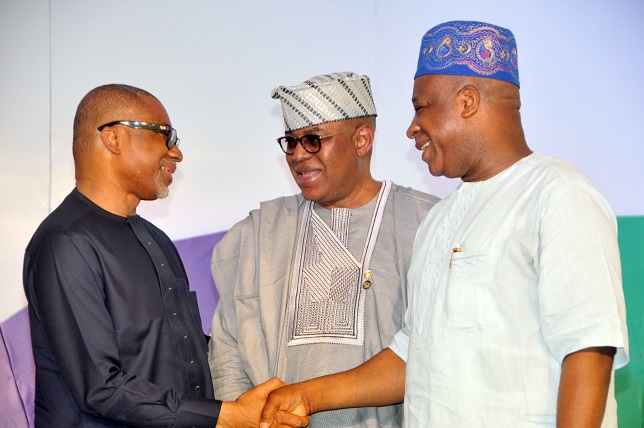
Senator Gbenga Ashafa, Chairman Senate Committee on Land Transport

Senator Olugbenga Ashafa, the Senate
Committee Chairman on Land Transport on Tuesday 4thOctober, 2016 at
the 2 day National Workshop for Chief Executives of Mass Transit Organisations
on the Nigeria Automotive Policy, urged the organisers to break away from the
culture of hoarding communiqués generated from such forums.

While delivering his good will
message, the Senator commended the Nigerian Institute for Transport Technology
and the National Automotive and Design Development Council for putting together
the all too important National Workshop.
Speaking further, the Senator
Representing Lagos East stated that “the functionality of our National
Automotive policy side by side our Mass Transit System is very important to our
economy hence; this workshop is timely as it directly affects the pressing
challenge that we face as a country today, which is the challenge of our
economy.”
  

Ashafa identified the important
issues that the Workshop needed to interrogate to include “how to ensure that
the National Automotive Policy remains a viable document on one hand and how to
ensure that the local manufacturing sector remains attractive to the investor
(both local and foreign).”
  
The Senator concluded by calling on
the organisers of the workshop to ensure that any recommendations requiring the
action of the Senate Committee on Land Transport, should be forwarded to the
committee without hesitation. In his own words, “I have observed a critical
missing link in how we make use of our body of knowledge after the brilliant
ventilation of ideas at such a forum as this. We have the habit of keeping the
resolutions to ourselves without forwarding same to relevant arms of government
for execution. Even when we do, we do not follow through to ensure that each
arm takes responsibility of his part of the job. I therefore urge that if at
the end of this workshop, you come up with any recommendations which you
believe the Senate Committee on Land Transport should push in form of a
legislation or a legislative agenda, kindly forward same to us.”


One Step Closer to Creation of State Police

One Step Closer to Creation of State Police


Sometime ago, I wrote
about why we needed to establish State Police in Nigeria and empower local security agencies
here.
The advantages will be of course immense including employment for the teeming
youths, safer neighbourhoods and superior policing infrastructure. My voice is
definitely not the first and won’t be the last in support of this initiative
and I am glad we are moving one step closer as a nation to achieving this goal.

At the House of
Representative on the 27th of September, 2016, the Bill which seeks
to alter the 1999 Constitution of the Federation, to provide for the
establishment of State Police and to ensure effective community policing in
Nigeria, standing in the name of Hon. Awoleye Abiodun Dada passed through its
second reading and was accordingly referred to the Ad hoc Committee on
Constitutional review for further legislative action.
Section 214 of the 1999 Constitution,
provides that there shall be a police force for Nigeria, which shall be called
the Nigeria Police and, subject to the provisions of this section no other
police force shall be established for the Federation or any part thereof. In
order therefore to establish State Police in Nigeria, this provision of the Constitution
must be amended. It is hoped that the Bill becomes law in the shortest possible
time. 
The Nigerian Police is
regulated by the Police Act, Cap.P19, Laws of the Federation of Nigeria, 2004.
Section 10 of that Act provides that for public safety and public order The
President may give to the Inspector-General such directions with respect to the
maintaining and security of public safety and public order as he may consider
necessary, and the Inspector-General shall comply with those directions or
cause them to be complied with.
I believe the amendment
when passed will further lead to the State House of Assemblies passing their
respective Police Laws establishing the police in each state and enumerating
their duties, powers and administration. Most likely, the law will also empower
State Governors in regard to the security of their states as also provided for
in Section 10 of the Police Act. Also, the Police Act may be further amended to
properly outline the respective legal jurisdiction of the Federal and State
Police.
Adedunmade Onibokun
@adedunmade

Photo Credit – www.punch.com
Nigerian Senate Considers Report Of Ad-Hoc Committee On The State Of The Economy & Passes Five Motions

Nigerian Senate Considers Report Of Ad-Hoc Committee On The State Of The Economy & Passes Five Motions


The Senate on Tuesday,
September 27, 2016 commenced consideration of the Report of its Ad-hoc
Committee on the State of the Economy. The Report presented before the Chamber
for consideration has seventeen recommendations. The recommendations were
extensively deliberated upon by  Senators and at the end most of them were
adopted by the Chamber.

According to the report,
the Senate of the Federal Republic of Nigeria conducted a two-day intense and
wide ranging debate on the state of the Nigerian economy. It observed that the
negative GDP growth of 0.36% and 2.6% in the first and second quarters of 2016
technically plunged the national economy into recession. This contraction was
largely due to the fall in oil revenues and further exacerbated by the
vandalism of the nation’s oil assets in the Niger Delta region as well as the
country’s plummeting foreign exchange reserve from more than $60 billion in
2007 to $24 billion currently.
Major highlights of the
report is the decision of the Upper Legislative Chamber, urging President
Muhammadu Buhari not to sell the country’s national assets, and the suggestion
to raise a team of experts that would engage the youth of the Niger Delta for
amicable resolution of the crisis in the region. The report also summoned the
Chief Financial Reporting Officer of the federation to brief the Chamber.
Similarly, five Motions
were also debated and passed by the Senate, they include:
1) Inconclusive Elections,
sponsored by the Deputy Senate President, Ike Ekweremadu (Enugu West) and the
Senate Leader, Muhammed Ali Ndume (Borno South). The Motion sailed through with
three prayers below:
A) Call on the President
of the Federal Republic of Nigeria to immediately nominate suitably qualified
persons to fill the vacant positions at INEC in line with the constitution to
enhance the capacity of the Institution to conduct conclusive elections.
B) Call on INEC to
immediately conclude all pending re-run elections in the country.
C) Constitute an Ad-hoc
Committee to hold a public hearing to review the performance of the INEC
 in the last one year with a view to ascertain the factors that may have
caused the perceived decline of the electoral system.
2) Unscrupulous violation
of Foreign Exchange (Monitoring and Miscellaneous) Act, sponsored by Sen. Dino
Melaye (Kogi West). The Motion noted with serious concern the repatriation of
$13.92 billion illegally out of Nigeria by the Mobile Telecommunication Limited
(MTN) through its bankers between 2006 and 2016. The Motion scaled through with
single resolution below:
A) Mandate the Committee
on Banking, Insurance and other Financial Institutions to carry out a holistic
investigation into the matter and report back to the Senate.
3) Earth Tremor and the
preparedness of Nigeria to deal with the intending consequences, sponsored by
Sen. Danjuma La’ah (Kaduna South). The law-maker noted that the Earth tremor
that occurred in Kwoi and its environs in Jaba Local Government Area of Kaduna
State on Sunday, through Monday September 11 and 12, 2016 as well as the
increasing Earth tremors occurrence in Nigeria in recent time, there is the
likelihood of witnessing Earth Quake in the near future. The Motion was passed
with three prayers below:
A) Urge the government at
all levels to take the Earth Tremor warnings in parts of the country serious
and begin to take proactive measures to educate the populace on what to expect
and how to react when it occurs.
B) Urge the National
Emergency Management Agency (NEMA) and the Security Agencies to move in
immediately through public enlightenment and drills to prepare the people
against any eventuality as the resources required at this stage would be
minimal.
C) Mandate the Committee
on Environment and Solid Minerals to undertake tour of affected communities and
report back to the Senate.
4) The need to ascertain
the Degree of Local Content in Nigerian Oil and Gas industry, sponsored by Sen.
Gershom Bassey (Cross River South). He stated that the Senate is aware that the
National Committee on Local Content Development (NCLCD) discovered that the
local participation in the upstream sector of the oil and gas industry in
Nigeria was less than 5% meaning that 95% of the yearly expenditure of about $8
billion left the country. The Motion also sailed through with two resolutions
below:
A) Mandate the Senate
Committee on Petroleum Upstream and Gas to conduct a public hearing to
investigate the implementation of local content with a view to determine the
degree of compliance with the Nigerian Oil and Gas Industry Content Development
Act (NOGIC) by the industry operators.
B) Mandate the Senate
Committee on Petroleum Upstream and Gas to investigate the utilization of the
Nigeria Content Development Fund.
5) Looming crisis in the
Nigerian Aviation Industry, sponsored by Sen. Samuel Anyanwu (Imo East). The
Law-maker noted with concern that the looming crisis in the Aviation sector
portends grave danger to air safety and operations. He added that the sector
has been gasping for survival over some years now but worsen by the current
economic recession. The Motion was passed with two prayers below:
A) Mandate the Committee
on Aviation and the Ministry of Aviation to liaise with the Nigerian Civil
Aviation Authority (NCAA) to urgently look into the problems faced by the
airlines in order to fashion out possible solutions to the problem and avert
latent danger inherent in the crisis.
B) Mandate the Federal
Ministry of Transport to urgently commence the rehabilitation of major highways
and the rail system to serve as a viable and safe alternative to air travels.
 
Ed’s Note – This article was originally published here
Ashafa Says Senate Is Ready For 2017 Budget

Ashafa Says Senate Is Ready For 2017 Budget

The senator representing Lagos East at the
8th Session of the National Assembly, Senator Olugbenga Ashafa, on Thursday
29th September, 2016 highlighted some of the efforts of the National Assembly
to assist the economy and also encourage more local content in the Nigerian
economy. He also seized the opportunity to join his voice to the call by the
Senate President on the executive to transmit the 2017 budget estimates to the
National Assembly in good time.

He made this call at the fourth day of the
Made in Nigeria Summit which took place at the Eko Atlantic City with the theme
“Pathways to building the main economy: Legislative agenda for the main
economy.”
While analyzing the contribution of the
Senate towards encouraging local participation in the economy, the senator
stated ”The fundamental role of the National Assembly in the area of the
economy remains providing the requisite legislative support for both the
executive and indeed the Nigerian populace to thrive in their areas of
business.”

He stated further “The 8th
Session of the National Assembly is very well aware of the task ahead of it in
this period of economic challenge and we are alive to this responsibility. I
will give you some instances: one is the amendment of The Public Procurement
Act which has effectively reduced
the time it takes government to process the award of contracts. Also, that law
is to make it compulsory for government to patronize locally produced goods.
The
Senator also spoke about the passage of the Nigerian Railway bILL 2016
which was spearheaded by the Senate Committee
on Land Transport of which he is the chairman and expressed his optimism on how
the new law will help open up the Rail sector to private sector participation.”
In concluding, the Senator stated that the
National Assembly is ready to receive the 2017 budget, calling on the Executive
to send the budget estimates for the year 2017 to the National Assembly in good
time to afford the National Assembly the opportunity of carrying out a thorough
examination and timely passage of the document. “I agree that the National
Assembly can do more to encourage local content in the economy, however I think
it is important to state that since it takes the National Assembly averagely
about Four months to scrutinize the budget, we in the National Assembly are
ready to start work on the 2017 budget. If we receive the budget estimates
early, it gives us the opportunity of carrying out a thorough examination and
timely passage of the document.”
Freedom of Expression and the Blogger under Nigerian Law – Timothy Tion

Freedom of Expression and the Blogger under Nigerian Law – Timothy Tion


The recent arrest of Abubakar Sidiqu; a blogger, by operatives
of the Economic and financial Crimes Commission (EFCC) supposedly because of a
post which is critical of the EFCC Chairman has brought to the fore once again
the issue of freedom of expression and defamation especially on the Internet. 

The 1999 Constitution of
the Federal Republic of Nigeria (as amended) under section 39(1) provides for
freedom of expression. But under section 39(3) the right to freedom of
expression could be restricted by a law reasonably justifiable in a democratic
society, for the purpose of preventing the disclosure of information received
in confidence or for the purpose of maintaining the authority and independence
of the courts and also section 45(1) which provides that nothing in section 39
shall invalidate any law that is reasonably justifiable in a democratic
society, in the interest of defence, public safety, public order, public
morality or public health; or for the purpose of protecting the rights and
freedom of other persons.
Therefore the test to
determine whether a law which limits freedom of expression is constitutional or
otherwise is whether the law is:
(a) reasonably
justifiable in a democratic society;
(b) for the purpose
of preventing the disclosure of information received in confidence;
(c) for the purpose
of maintaining the authority and independence of the courts;
(d) in the interest
of defence;
(e) in the interest
public safety;
(f) in the interest
public order;
(g) in the interest
public morality;
 (h) in the interest public health; or
 (i) for the purpose of protecting the
rights and freedom of other persons.
The question that follows
therefrom is whether the following laws which tend to limit freedom of
expression meet or do not meet the constitutional criteria for a law limiting
the freedom of expression as provided in section 39(3) and 45(1) above
mentioned. The laws are as follows:
Section 24 of Cybercrime (Prohibition, Prevention, Etc.) Act, 2015 which
provides that:           
“Any person who
knowingly or intentionally sends a message or other matter by means of computer
systems or network that – 
(a) is grossly
offensive, pornographic or of an indecent, obscene or menacing character or
causes any such message or matter to be so sent; or 
(b) he knows to be
false, for the purpose of causing annoyance, inconvenience danger, obstruction,
insult, injury, criminal intimidation, enmity, hatred, ill will or needless
anxiety to another or causes such a message to be sent: commits an offence
under this Act…
(2)Any person who
knowingly or intentionally transmits or causes the transmission of any
communication through a computer system or network –
(a)to bully,
threaten or harass another person, where such communication places another
person in fear of death, violence or bodily harm or to another person;
 (b)containing
any threat to kidnap any person or any threat to harm the person of another,
any demand or request for a ransom for the release of any kidnapped person, to
extort from any person, firm, association or corporation, any money or other
thing of value; or 
(c)containing any
threat to harm the property or reputation of the addressee or of another or the
reputation of a deceased person or any threat to accuse the addressee or any
other person of a crime, to extort from any person, firm, association, or
corporation, any money or other thing of value: commits an offence under this
Act…”
Section 391(1) of the
Penal Code for Northern Nigeria which provides as follows:
“whoever by words
spoken or reproduced by mechanical means or intended to be read or by signs or by
visible representations makes or publishes any imputation concerning a person,
intending to harm or knowing or having reason to believe that such imputation
will harm the reputation of such person is said, save in the cases hereinafter
excepted, to defame that person.”
Section 391(2) provides
for instances which are an exception to sub-section 1 above.
Section 393(1):
“Whoever,
save as hereinafter expected, by words either spoken or reproduced by
mechanical means or intended to be read or by signs or by visible
representations makes or publishes any false statement of fact, intending to
harm or knowing or having reason to believe that such false statement of fact
will harm the reputation of any person or class of persons or of the Government
authority in the Northern Region shall be punished with imprisonment. 
(2) It is not an
offence under this section to make or publish in good faith a false statement
of fact which the accused had reasonable grounds for believing to be
substantially true and proof that he had such reasonable grounds shall lie on
the accused.” 
Section 394:
“Whoever prints or engraves any matter or
prepares or causes to be prepared any record for the purpose of mechanical
reproduction of any matter, knowing or having good reason to believe that such
matter is defamatory of any person shall be punished with imprisonment for a
term which may extend to two years or with fine or with both.”
Section 395:
“Whoever
sells or offers for sale any printed or engraved substance containing
defamatory matter or any record prepared for the purpose of the mechanical
reproduction of defamatory matter, knowing that such substance or record
contains such matter, shall be punished with imprisonment for a term which may
extend to two years or with fine or with both.”
The Criminal Code for Southern Nigeria also criminalises
defamation. See sections 373 to 381 of the Criminal Code. See also chapter 7 of
the Criminal Code which deals with sedition and the importation of seditious or
undesirable publications. Chapter 7 contains offences such as publication of
false news with intent to cause fear and alarm to the public. Section 59(1)
provides that any person who publishes or reproduces any statement, rumour or
report which is likely to cause fear and alarm to the public or to disturb
the public peace, knowing or having reason to believe that such statement,
rumour or report is false is guilty of a misdemeanour and liable on
conviction to imprisonment for three years.
Furthermore Section
60  provides that any person  who,  without such
justification  or excuse as would be sufficient in the case of the
defamation of a private person, publishes anything intended to be read,
or any  sign  or  visible  representation,
 tending  to  expose  to hatred or contempt  in
 the estimation  of  the  people  of  any
 foreign  State  any  person exercising
sovereign authority over that State is guilty of a misdemeanour, and is
liable to imprisonment for two years. 
As can be read from above
provisions, apart from section 24 of the Cybercrimes Act 2015, sections 391 and
393 of the Penal Code and sections 59 and 373 of the Criminal Code could be
used to clamp down on a blogger or any person who posts contents considered to
be defamatory or constitutes injurious falsehood under the Penal Code.
In 2012 Abbas Faggo was arrested and charged to court under section
393 of the Penal Code for the alleged Facebook publication, which the
Attorney-General and Commissioner for Justice, Mr. Almustapha Suleiman
described as “injurious falsehood and defamation to Yuguda’s (Bauchi State
Governor) administration.”
 
Abbas
Faggo
was alleged to have posted comments on his Facebook
account about monumental corruption in the state
. He was alleged to have specifically
commented on the funding of the wedding ceremony of the eldest son of Governor
Isah Yuguda, Idris Yuguda, ostensibly with public funds.
In spite of the above many
commentators while often condemning the provisions of section 24 of the
Cybercrimes Act, 2015 as been unconstitutional often ignore the fact that even
before the Cybercrimes Act, 2015 there was and there are still other laws which
restrict the freedom of expression and they could be used to clamp down on
bloggers and social media users who post content which the government considers
to be critical of it.
The Supreme Court of India
in May, 2016 in the case of Subramanian Swamy v. Union of India held that
section 499 of the Indian Penal Code (IPC) which criminalizes defamation is
constitutional and not a breach of freedom of expression. Section 499 of the
IPC is the same and contains the exact wording as 391(1) of the Penal Code.
In that case the
petitioners, Subramanian Swamy and Rahul Gandhi, argued that sections 499 and
500 of the IPC dealing with criminal defamation have an “inhibitive
effect” on freedom of speech and expression, particularly political speech. The
two leaders, who have been charged with criminal defamation under section 499
and 500 of the IPC for their political speeches contended that the colonial law
enacted in the 19th century has become “unreasonable and arbitrary” in
independent India and was continuing without debate or a test on its
constitutionality.
The stand of the
petitioners that defamation be treated as a “civil wrong” was opposed by
the Government which advocated retaining sections 499 and 500 in the IPC,
saying that criminal defamation works as deterrent against growing tendency to
defame people through social media. While describing the penal provisions
as “deterrent”, the government had defended their retention on the
grounds that while in other countries, defamation cases are decided very fast,
in India it takes years even decades before they reach conclusion.
In another Indian case of Shreya Singhal and Ors. vs Union of India the
Supreme Court of India was called upon to decide on the constitutionality of
section 66A of the amended Information Technology Act of 2000 (which is
similar; though not in exact words, but in effect or substance with portions of
section 24 of the Cybercrimes Act). Section 66A defines the punishment for
sending “offensive” messages through a computer or any other communication
device like a mobile phone or a tablet. A conviction can fetch a maximum of
three years in jail and a fine. The section
specifically provides that:
Any person who sends, by means of a computer resource or a
communication device, —
(a)           
any information that is grossly
offensive or has menacing character; or
(b)           
any information which he knows
to be false, but for the purpose of causing annoyance, inconvenience, danger,
obstruction, insult, injury, criminal intimidation, enmity, hatred or ill will,
persistently by making use of such computer resource or a communication device,
(c)   any electronic mail or electronic mail message for the purpose of
causing annoyance or inconvenience or to deceive or to mislead the addressee or
recipient about the origin of such messages,
shall be punishable with
imprisonment for a term which may extend to three years and with fine.
In the case under
reference two women were arrested by the Mumbai
police in 2012 for comments on they posted on Facebook. The arrested women were
released later on and the criminal cases against them dropped yet their arrests
attracted widespread public condemnation. It was felt that the police had
misused its power by invoking Section 66A inter alia contending that it
violates the freedom of speech and expression.
The
Supreme Court of India in declaring section 66A unconstitutional held that that
the terms:
“annoying,
offensive, inconvenience, danger, obstruction, insult, injury, criminal
intimidation, enmity, hatred or ill-will” used in the section were vague
and indefinite… If judicially trained minds can come to diametrically opposite
conclusions on the same set of facts it is obvious that expressions such as
“grossly offensive” or   “menacing”   are  
so   vague   that   there  
is   no   manageable standard by which a person can be said
to have committed an offence or not to have committed an offence.  Quite
obviously, a prospective offender of Section 66A and the authorities who are
to   enforce   Section   66A  
have   absolutely   no   manageable
standard   by   which   to  
book   a   person   for  
an   offence   under Section 66A. This being the case,
having regard also to the two English   precedents  
cited   by   the   learned 
Additional   Solicitor General, it is clear that Section 66A is
unconstitutionally vague”.
The court
further held that:
“Governments
may come and Governments may go but Section 66A goes on forever. An assurance
from the present Government even if carried out faithfully would not bind any
successor Government. It must, therefore, be held that Section 66A must be
judged on its own merits without any reference to how well it may be administered,”
the bench observed while striking down the law. “…We, therefore, hold
that the section is unconstitutional also on the ground that it takes within
its sweep protected speech and speech that is innocent in nature and is liable
therefore to be used in such a way as to have a chilling effect on free speech
and would, therefore, have to be struck down on the ground of
over-breadth.”
 
Whereas the offence of
criminal defamation has been held to be constitutional in India and section 66A
which is similar to portions of section 24 of the Cybercrimes Act 2015, has
been held to be unconstitutional also in India, it would be interesting to see
how the Nigerian courts would decide on the constitutionality of sections
391(1), 393 of the Penal Code, sections 59 and 
373
and of the Criminal Code and section 24 of
the Cybercrimes Act, 2015 earlier stated if their constitutionality is
challenged. The decision in the India cases may be highly persuasive to a
Nigerian court deciding on the constitutionality of the Nigerian laws above
mentioned.
The
United Nations Special Rapporteur on freedom of expression, David Kaye on the 3rd
May 2016 in a speech
to commemorate the World Press Freedom Day, said:
“Some governments
target journalists, bloggers, political dissidents, activists and human rights
defenders as ‘extremists’ or ‘terrorists’, criminalizing and detaining them,
using legal systems to counter broad and unclear offences. The harm is felt not
only by journalists but also by their audiences, the public that deserves the
right to know and to access information of public interest. Freedom of
expression plays a critical role in promoting equality and in combating
intolerance, and the role the media, the Internet and other digital
technologies play in keeping society informed is essential.”
It is hereby recommended
that social media activists, human rights advocate and civil liberties
organizations should avail themselves of the option of public interest
litigation provided under the Fundamental  Rights  (Enforcement 
Procedure)  Rules  2009  which has  drastically 
increased  the potentiality of the public interest litigation as peoples’
tool against abuse of powers in  governance, to challenge the
constitutionality of Nigerian laws especially those that have been highlighted
in this article, which restrict or limit the freedom of expression guaranteed
by the Constitution.

Timothy Tion attended the Benue State University, Makurdi
and Nigeria Law School where he obtained an LL.B and BL respectively. He has an
avid interest in the intersection of law, information and communications
technology or techno-legal issues. He also blogs via Naija Cyber Lawyer 

Ed’s Note – This article was originally published here
Taking steps frustrates Arbitration in Nigeria –  kayode Omosehin Esq.

Taking steps frustrates Arbitration in Nigeria – kayode Omosehin Esq.


Preliminary View
Arbitration is an old
dispute resolution mechanism. Some authors have traced its adoption to the
reign of King Solomon in the Bible. It is recorded that the dispute between the
two women over the living son was resolved by Kind Solomon in a manner consistent
with arbitral proceedings. Modern arbitration has proved useful in many
respects in commercial and industrial dispute settlement. Arbitration is partly
regulated by law (in terms of form and procedure), it is however largely based
on agreement by parties.

Arbitration agreement
simply implies that parties shall resolve any dispute arising from their
agreement by an arbitral panel and be bound by the decision from resolution.
When parties freely enter into an arbitration agreement, either of the parties
cannot resolve a dispute by resorting to a regular court. Where a party sues in
court, the other party can object to the suit and pray that the judicial
proceedings be stayed (i.e. put on hold) and urge the court to refer the
dispute to arbitration in accordance with the agreement of both parties.
However, agreement on
arbitration, like other private arrangements, may suffer failure from
unenforceability in some circumstances. Such circumstances are only called into
question when the court has to determine the defendant’s objection to the suit
or application for stay of judicial proceedings in order to enable parties
settle their dispute by arbitration in accordance with their agreement. One of
such circumstances is when the defendant “takes a step” in the judicial
proceedings rather than objecting or before objecting to the suit. In the said
circumstance, the defendant would be deemed to have taken steps and as such has
waived his right to insist on the arbitration agreement. The court would not
recognize the agreement that dispute be resolved by arbitration. What
constitutes these “steps” has however not been a subject of a settled law in
the Nigeria.
It would appear that the
decision of a court on the question of what amounts to taking steps will turn
of the peculiarities of the facts of each case. The determining factor is
whether the step taken is so clear as to amount to a total waiver or
abandonment of the right to insist on arbitration agreement. The foregoing will
ultimately turn on the following:
  • (a) the nature of the process (if any)
    filed by the defendant or any other act or conduct undertaken by the
    defendant before raising the objection on ground of arbitration agreement
    and/or applying for a stay of proceedings; and
  • (b)  the inconsistency of any
    such step taken with the application for stay of proceedings to such
    extent as to make the court to conclude that the right to apply for stay
    of proceedings ought to be deemed to have been waived.
  •  
There is an uncertainty in
the state of the law. The misfortune created by uncertainty in the state of the
law appears to have stemmed from the blanket pronouncement of Fatai-Williams
JSC in the case of Obembe v. Wemabod Estates to the effect that “A
party who makes any application whatsoever to the court, even though it be
merely for application for extension of time, takes a step in the proceedings”
A review of the line of
subsequent cases would provide insights into the misunderstanding of the facts
and decision in the Obembe’s case leading to the pronouncement made by
Fatayi-Williams CJN.
The First Step Taken
The checkered history of
the concept of taking steps before making an application for stay of
proceedings in Nigerian courts began with the case of Obi Obembe v. Wemabod
Estates Ltd. (1977) All NLR 130
. If there was any earlier Nigerian case on
the point, it was neither referred to nor considered in the Obembe case. 
In the Obembe case,
the appellant sued the respondent in the High Court of Lagos State for wrongful
termination of appointment as a consulting engineer claiming balance of fees
and reimbursable expenses for engineering work done in respect of a building
project for the respondent. The disagreement arose from their differences in
the quantity of steel recommended by the appellant for the project. The amount
claimed was based partly on the scale of fees laid down in a booklet published
by the Association of Consulting Engineers in London (Exhibit 3).
The respondent defended
the suit and did not file any motion for stay of proceedings even though clause
17 in part 11 of Exhibit 3 contained reference to arbitration in case of
dispute. In the judgment of the High Court, the appellant’s case was dismissed
on the ground that the appellant did not prove his case as he did not lead any
evidence or put in any document to support his case. However, the judge went
further to observe that even if the appellant succeeded in proving the amount
claimed, he (the judge) would have been unable to enter judgment in his favour
in view of clause 17 in part 11 of Exhibit 3.
On appeal to the Supreme
Court, it was held that the lower court was in error to have made the
observation. It is in the judgment of the Supreme Court that Fatayi-Williams
CJN made the general statement that has generated the confusion in the state of
the law regarding what constitutes steps before making application for stay of
proceedings pending arbitration. His lordship said at page 141 that:
“In order to get a stay, a
party to submission must have taken NO step in the proceedings. A party who
makes any application whatsoever to the court, even though it be merely for
application for extension of time, takes a step in the proceedings. Delivery of
a statement of defence is also a step in the proceedings.”

(Emphasis mine)
It is consoling, at least
for the purpose of permitting a distinction between the Obembe case and
other cases, that the Supreme Court itself stated the peculiarities of the Obembe’s
case
to indicate the limited usefulness that the statement of Fatayi-Williams
CJN can serve in determining what constitutes steps in a proceedings when the
court observed at page 141 that:
“No stay was asked for the
defendants/respondents after they were served with the writ of summons. On the
contrary, they accepted service of the statement of claim, filed their own
statement of defence, testified in their defence, and took part in the
proceedings.”
Other Steps Taken So Far
It is important to review
few of the cases in which the courts have had opportunity to determine what
constitute steps in a judicial proceedings to defeat the right of a defendant
to insist that the dispute in a judicial proceedings be referred to
arbitration.
1.    
K.S.U.D.B. v. Fanz Construction Ltd
(1990) 4 NWLR (Pt. 142) 1.
On the day this case came
up in Court, the defendant’s counsel applied to Court for an order of pleadings
and the Court ordered pleadings to be filed, giving plaintiff twenty-one (21)
days and defendant forty (40) days as requested by counsel. The Plaintiff filed
a statement of claim accordingly. Thereafter the defendant applied for stay of
proceedings. The application was rightly refused.
1.    
Fawehinmi Construction Co. Ltd. v. O.
A. U [1998] 6 NWLR (Pt. 553) 171.
In 1998, the Supreme Court
had a golden opportunity to lay down the rule and correct the palpable error
that may arise from the wholesale adoption of the blanket judicial statement of
Fatayi-Williams CJN in the Obembe case. The opportunity arose in Fawehinmi
Construction Co. Ltd. v. O. A. U.
But rather than overruling itself, the
Supreme Court towed the easier path of distinguishing the Obembe case
from the Fawehinmi case and held that the Obembe case has no
application to the case before it, thus, living the state of the law hazy and
susceptible to erratic interpretations of the sweeping statement of
Fatayi-Williams CJN in Obembe case.
In the Fawehinmi
case, the appellant (as plaintiff) took out a writ of summons against the
respondent (as defendant) claiming damages for breach of contract and wrongful detention
of its plants and machinery. On the same day the writ of summons was filed, the
appellant also filed a motion for mandatory injunction compelling the release
of its plants and machinery which motion was fixed for hearing on 3rd June
1987. On 25th May 1987, the respondent filed a motion for stay of proceedings
pending reference to arbitration in accordance with Clause 35 of the contract
between the parties. The motion for stay of proceedings was argued and was
later dismissed. Thereafter, the Court adjourned for hearing of the substantive
suit.
The appellant filed a
Statement of Claim and served same on the respondent. The respondent did not
file any Statement of Defence but rather it raised the issue that the suit was
not properly before the Court on ground that Section 46 of the University of
Ife Edict on pre-action notice was not complied with. The High Court overruled
the objection holding that the respondent had waived his right by taking steps
in the proceedings. The respondent’s appeal to the Court of Appeal was upheld
and the appellant’s suit was struck out by the Court of Appeal. The appellant’s
appeal to the Supreme Court was refused. 
It is noteworthy that,
though the defendant in this suit went beyond arbitration agreement by invoking
statutory provision in order to make the suit incompetent, the Supreme Court
nonetheless held that the trial court ought to have upheld the objection to the
suit on ground that the plaintiff did not comply with the arbitration clause in
their contract.
On what amounts to “taking
a step in a proceeding
”, the Supreme Court held at pages 183 – 184 as
follows:
“Now by appearing before
the trial in a court to raise preliminary issue of clause on arbitration to be
resorted to first before the trial in a court of law, could the defendant be
said to have waived its right? When parties enter into agreement and there is
an arbitration clause whereby the parties must first go for arbitration before
trial in Court it is natural for the defendant in a case where the other party
has filed a suit to ask for stay of proceedings pending arbitration. That does
not amount to submission to trial. In the case where such application is
refused the next step is to invoke a statutory right where it exists if that
right will make the suit incompetent. In the present case, s. 46(1) of the
Edict, (supra) was invoked by the defendant and the learned trial judge held it
was too late and that the defendant had waived its right. The right under
s.46(1) is very wide. Waiver is not all that simple, appearance by way of
demurrer is not enough to amount to waiver. When party has a right whether by
way of agreement or under statute he can exercise it at the earliest time and
can equally waive it if the statutory right is not absolute and mandatory. The
waiver must be clear and unambiguous like allowing all evidence to be taken or
even decision given before challenging the hearing. It will then be shown that
the party, deliberately refused to take advantage of the right when it availed
him. Such failure to take advantage of a right must be so clear that there will
be no other reasonable presumption than that the right is let go. The
preliminary skirmishes in this case at the trial Court could not by any
imagination be presumed to be a waiver. The defendant had not filed his
statement of defence and service of the statement of claim on it is certainly
not a waiver by it. Had it filed a statement of defence but with indication
that the preliminary objection will be raised that the suit was not properly before
the Court, it would not (sic) have been a waiver. This would have distinguished
the dictum in Kano State Urban Development Board v. Fanz Construction Ltd.
(1990) 4 NWLR (Pt. 142) 1. It is therefore clear, that the defendant had not
taken any step in having the case heard by the trial Court and had not waived
its right under s.46(1) of the Edict. Obembe v. Wemabod Estates Ltd. (1977) 5
SC 115, 131-2 has no application in this case. There is no evidence of waiver
in this case.”
Of particular interest is
the dictum of the Court of Appeal in the above case quoted with approval by
Ogundare JSC (in the concurring judgment) at page 187 of the report. It was
held as follows:
“It is not enough to say
that the appellant entered an unconditional appearance and therefore he has
waived his (sic) right to complain about jurisdiction. The decision in Muni v.
Worsfold (supra) which was followed in the case of U.B.A. Trustees Ltd. v.
Nigergrob Ceramic Ltd. (sura) has determined that entering an appearance, even
unconditional, does not constitute a waiver of the right to object. It is
therefore not enough to say that the appellant having entered unconditional
appearance cannot raise the objection on the decision of the court. For it is
clear from the record that as soon as the appellant entered appearance, the
first step taken by its counsel was to protest against the jurisdiction of the
court by seeking a stay of its proceedings with a view to referring the case to
arbitration as set out in the agreement between the parties. The only step
taken after appearance therefore by the appellant was to protest against the
court hearing the case. If any step could be said to have been taken. (sic) it
is only in protestation.”
3. Confidence Insurance
Ltd. v. Trustees of O.S.C.E. (1999) 2 NWLR (Pt. 591) 373 
In this case, upon the
commencement of the suit and service of the originating process, parties
exchanged pleadings. In its statement of defence, the appellant averred that
the respondent’s action was premature as the respondents did not exhaust
arbitration as agreed in the trust deed before resorting to litigation.
Judgment was entered against the appellant and he appealed against the refusal
to stay proceedings. The appeal was dismissed with the following dictum at page
388 paragraphs A-D as follows:
“While certain acts done
by a party may or may not constitute steps in the proceedings,
nevertheless some acts will surely be construed to mean “taking steps in the
proceedings.” For example, exchange of correspondence between parties or their
counsel after entering appearance or efforts made out of court to settle the
matter in controversy between the parties or moving the court to seek a
party’s desire that the matter be placed before arbitration panel cannot
ordinarily amount to taking other steps in this proceedings as to defeat a
party’s right to rely on the arbitration provision.”
4. M. V. Lupex v. N. O.
C. (2003) 15 NWLR (Pt. 844) 469
The next case to be
considered is the case of M. V. Lupex v. N. O. C. The dispute in this
case arose between the parties in respect of a charter-party agreement which
contained a clause that disputes should be resolved by arbitration. The
Respondent sued the Appellant at the Federal High Court claiming damages for
breach of the charter-party and thereafter obtained an order ex parte
for the arrest of the chartered vessel (M.V. LUPEX) which at the time had
berthed at the port of Warri. On becoming aware of the ex parte order,
the Appellant filed a motion on notice for the following orders:
1.    
An order setting aside the order for the
arrest of the vessel, alternatively;
2.    
An order for the release of the arrested
vessel unconditionally or upon such terms as the Court may direct;
3.    
An order for stay of proceedings in the
suit sine die.
The Federal High Court
held that it had jurisdiction and refused the Appellant’s prayer to stay
proceedings. Also, the Court released the vessel on monetary condition. The
Appellant appealed to the Court of Appeal. The Court of Appeal dismissed the
appeal. The Appellant further appealed to the Supreme Court. The Supreme Court
allowed the appeal and granted stay of proceedings sine die to enable
parties resort to arbitration.
Mohammed JSC held at pages
488-489:
“Taking into consideration
all what I have considered above in this judgment, it is crystal clear that the
trial High Court could only have acted judicially and judiciously if it
exercised its discretion by ordering a stay of proceedings in the case at hand.
It is abundantly clear that the trial court had acted on wrong principles of
law and that it misapprehended the facts of this case when it refused to grant
the appellant’s application for stay of proceedings of the action filed before
it by the respondent. The court below is therefore in error to affirm the
decision of the trial Federal High Court in refusing to grant a stay of
proceedings.”
5. Enyelike v. Ogoloma
(2008) 14 NWLR (Pt. 1107) 247
In Enyelike v. Ogoloma,
the dispute arose between the parties from a lease agreement which contained an
arbitration clause. The Respondent sued the Appellant on 14th March 2000 before
the High Court of Rivers State contrary to the arbitration agreement. On 22nd
February 2000, the Appellant filed a Notice of preliminary objection seeking to
dismiss the suit. Thereafter the Appellant filed a conditional appearance out
of time and a motion for extension of time to file and serve his statement of
defence and counterclaim dated 12th February 2001. The Appellant pleaded the
arbitration agreement in his statement of defence and counterclaim.
The High Court of Rivers
State held (quoted at page 254 of the report) as follows:
“As can be seen in all the
authorities to above, there is something that a party to an arbitration cannot
do……he must not have taken any tangible step in the proceedings or as section 5
of the Arbitration Law, cap 10 put it, “taking any other steps”. In this
instant matter, the defendant/applicant not only entered a conditional
appearance out of time, after filing a motion for to enter appearance out of
time, but filed a motion on notice for an extension of time within which he can
file and serve his statement of defence and counterclaim dated 12/2/2001, and
this motion dismissing (sic) the suit for lack of jurisdiction. All these constitute
an act of “taking any other steps”
committed by the defendant/applicant and
having done so, he cannot be heard to raise the issue of non-compliance with
the arbitration clause.”
(Emphasis mine)
The Court of Appeal, Port
Harcourt agreed and held at pages 257-258 as follows:
“By virtue of the
provisions of subsection (1) of section 5 of the Arbitration and Conciliation
Act (supra), either the appellant or the respondents have the right to, at any
time after entering an appearance but before filing any pleadings (including
statement of defence) or taking any other steps (e.g. filing of motions etc),
apply to the court to stay proceedings. In the instant case, it’s rather
obvious that the appellant having already deemed it fit or expedient to file
(i) a statement of defence (ii) a counter claim to the respondents’ suit, it
was rather most inappropriate, to say the least for him to file the notice of
preliminary objection in question seeking that the suit be dismissed
.”

(Emphasis mine)
6. Onward Enterprises
Ltd. v. MV Matrix & Ors (2010) 2 NWLR (Pt. 1179) 530
This is another case in
which the Court of Appeal did not follow the hardship in Obembe case
though distinguished the earlier case from the present one. The appellant (as
plaintiff) sued the respondent claiming damages for breach of contract of
affreightment and obtained an ex parte order on 2nd July 2002 for the
arrest and detention of the respondent’s vessel (M.V. Matrix). On 15th July
2002, the respondent filed two applications. While the first application was
for release of the vessel, the second application sought to shift the vessel to
anchorage pending the hearing of the application for release. The appellant
consented to the release of the vessel on 26th July 2002. On 11th July 2003,
the respondent filed a motion for stay of proceedings pending reference to
arbitration in London. The Court granted the motion for stay of proceedings.
The Court of Appeal at
page 551 took a step to state certain steps which can be regarded as waiver of
the right to insist on arbitration agreement wherein Mshelia JCA held as
follows:
“In the instant case,
respondents entered conditional appearance and filed two motions on notice
before the application for stay. One sought the release of the vessel, while
the second sought an order to shift the vessel to anchorage. The application
for stay of proceedings was the third application filed by the respondents. For
the appellant, the application to shift the vessel in particular amounts to a
step taken in the proceedings. It is evident from the record that the
respondents did not file any statement of defence nor applied for extension of
time to file any statement of defence. I agree with the submission of
respondents’ counsel that neither the application for the release of the vessel
nor the application to shift the vessel to anchorage pending the determination
of the application to release her from arrest constitute steps taken within the
contemplation of section 5 (1) of the Arbitration and Conciliation Act. It is
only acts done in furtherance of the prosecution of the defence that could be
said to amount to steps taken in the proceedings.”
7. Nissan (Nig.) Ltd. v.
Yaganathan & Anor (2010) 4 NWLR (Pt. 1183) 135. 
The dispute in this case
arose from a contract in restraint of trade between the 1st Respondent and the
Appellant (his former employer). The contract contained arbitration clause. The
Appellant sued the 1st Respondent at the High Court of Lagos State for taking
up a new employment with the 2nd Respondent. On being served with the writ of
summons and other court process, the Respondents filed a notice of preliminary
objection seeking orders:
1.    
To strike out the suit against the 2nd
Respondent for non-disclosure of a reasonable cause of action and for being
improperly joined in the suit;
2.    
To strike out the suit for being
incompetent and non-compliant with the arbitration agreement; and
3.    
For such further orders as the Court may
make in the circumstances.
The High Court granted
prayers (i) and (ii). Also, the Court stayed further proceedings in the suit
which was not one of the prayers in the notice of preliminary objection. At the
Court of Appeal, Lagos, one of the issues was whether the High Court was right
to grant a relief not claimed. The Court of Appeal allowed the appeal in part,
holding at pages 156-157 as follows:
“From decided authorities,
it is clear that the application to refer the matter to arbitration would
succeed if the application is made at any time after the applicant enters
appearance but before filing pleadings or taking any other steps in the
proceedings. In this case, the respondents entered conditional appearance on
15th January 2007 and the next day, 16th January 2007 filed a preliminary
objection seeking order of the court striking out the suit for non-compliance
with the arbitration clause. It ought to have been not for striking out the
suit, but for stay of proceedings to enable the parties go to arbitration. …………
The order granting a stay of proceedings pending resolution of their disputes
by arbitration as agreed between the parties is correct notwithstanding that
the respondents asked that the suit be struck ou
t.”
8. Williams vs Williams
& 3 Ors. (2013) 3 CLRN 114
.
The Appellant petitioned
for the winding up of the 4th Respondent on the grounds of alleged commission
of sundry illegalities by the 1st and 2nd Respondents, the alter ego of the 4th
Respondent; and the oppressive and discriminatory conduct of members of the 4th
Respondent in relation to the running of the affairs of the 4th Respondent.
Pursuant to section 5 of
the ACA, the 1st and 2nd Respondents filed a motion for stay of proceedings
pending arbitration as agreed by parties. Before the motion was heard, counsel
to the 1st and 2nd Respondents did the following:
(a) orally applied to the
court for an adjournment;
(b) gave an undertaking in
respect of a pending motion on notice in the substantive suit; and
(c) prayed the trial court
not to grant the prayers of interim injunction in the terms sought by the
Appellant.
The Appellant contended
that the 1st and 2nd respondents took steps in the substantive suit in view of
the above. The foregoing contention notwithstanding, the court upheld the 1st
and 2nd Respondents’ motion and stayed its proceedings in the matter pending
arbitration. The court further directed the Appellant to commence arbitral
proceedings pursuant to the parties’ written agreement. Dissatisfied with the
ruling of the trial court, the Appellant appealed to the Court of Appeal where
the Appellant, relying on the Obembe’s case, forcefully contended that the 1st
and 2nd Respondents had taken a step in the proceedings. Accordingly, the
Appellant submitted that the 1st and 2nd Respondents had lost their right to
ask for a stay of proceedings pending arbitration. The Appeal was refused.
9. S. A. & Ind. Co.
Ltd. v. Ministry of Finance Incorp (2014) 10 NWLR (Pt.1416) 515.
The dispute in this case
arose from a contract for supply of fertilizer between the 1st Appellant and
Kano Government (represented by the 2nd Respondent). The contract contained
arbitration clause. The Respondents sued the Appellants at the High Court of
Kano State for balance due under the agreement and for damages. Upon being
served with the originating process, the appellants filed their respective memorandum
of conditional appearance under protest. Thereafter, without delivering
pleadings, the appellants filed a motion for stay of proceedings pending
arbitration (though the third appellant filed a motion to strike out the
suit). 
The High Court refused the
application for stay of proceedings. The Court of Appeal overruled the lower
court and granted stay of the proceedings. Nothing is said about taking step as
it was not in issue. However, the Court adopted the views expressed in Confidence
Insurance Ltd. v. The Trustees of Ondo State College of Education Staff Pension
(1999) 2 NWLR (Pt. 591) 373 at 386-387 paragraphs C-G
where Achike, JCA as
follows:
“It is perfectly clear to
me that mere entering an appearance by the appellant, be it conditional or
unconditional appearance, is not controlling nor relevant to the party’s right
to rely on the arbitration clause inserted in the parties’ agreement. On the
contrary, it is in fact what happens after a party has entered an appearance
that matters in determining whether or not such a party can still take
advantage of the aforesaid arbitration clause.”
Making a Case against Obembe
v. Wemabod
In the determination of
the application to stay judicial proceedings in order that parties may go to
arbitration, the relevant question the court should consider is whether the
party applying for stay is “guilty” of doing something in the judicial
proceedings which negates his application for stay of judicial proceedings so
as to constitute waiver of his right to insist on arbitration. If the question
is answered in the affirmative, the application for stay of judicial
proceedings should be refused. Otherwise, stay should be granted. 
However, the determination
of whether the particular step taken qualifies for waiver is not a simple
straight-forward task particularly in the face of Obembe case. Although,
as already indicated in the list of cases considered above, the courts have
done well in some cases by distinguishing the peculiarities in the Obembe case
from the one being decided to avoid the application of the sweeping statement
of Fatayi-Williams CJN that “A party who makes any application whatsoever to
the court, even though it be merely for application for extension of time,
takes a step in the proceedings”
. The Obembe case still appears to
be a law to which a lazy recourse can be easily had where there is no judicial
willingness to distinguish the facts of the case being decided from those in Obembe
case to avoid the application of the far-reaching statement of
Fatayi-Williams CJN.
With due respect, the Obembe
case is not a useful authority for any issue bordering on whether a party
has taken steps that constitutes waiver. Also, the popular statement of
Fatayi-Williams CJN is not a statement of the law, rather it is a statement
made in error as it arose from the Supreme Court’s determination of a ground of
appeal complaining against an observation made in passing by the trial
judge. The trial judge observed that “Had I been in a position on the facts
to find any of the plaintiff’s claims proved I would have been unable to enter
judgment in his favour in view of the Arbitration Clauses 17 of Exh. 3 at page
37 which parties had agreed would govern their contract.”
The foregoing
observation of the trial judge, in my respectful view, is an obiter dictum
as it did not form the basis of his dismissal of the plaintiff/appellant’s
case. 
The law is trite that it
is only against the ratio decidendi in a judgment and not an obiter
dictum
that an appeal (if any) can be lodged. The Supreme Court in A.I.C.
LTD V. NNPC (2005) 22 NSCQLR 903, at 925 (2005) 5 SC (PT. 11) 60
defined ratio
decidendi
and obiter dicta as follows: “The ratio decidendi
of a case represents the reasoning or principle or ground upon which a case is
decided. Obiter simply means in passing, incidental, cursory. Obiter dicta
reflects, inter alia, the opinions of the Judge, which do not embody the
resolution of the Court.”
The ground and issue
formulated by the appellant in the Obembe case in respect of the
observation made by the trial judge ought to have been struck out by the
Supreme Court for being incompetent. Failure to strike out the ground and the
issue led to the popular statement by Fatayi-Williams CJN that “A party who
makes any application whatsoever to the court, even though it be merely for
application for extension of time, takes a step in the proceedings”
. In CHAMI
V. UBA PLC. (2010) 6 NWLR (PT. 1191) 474 at 493 PARAGRAPHS E- F
, the
Supreme Court made the point so clear that grounds of appeal must attack the ratio,
when it held thus: “It is settled law that issues for determination
must be distilled from Grounds of Appeal which Ground(s) must attack the ratio
decidendi of the judgment not anything said by the way, or obiter dicta or be
formulated in vacuo, as issue 5 in the instant case.”
It is therefore my
humble view that the statement of Fatayi-Williams CJN was made per incuriam
which ought to be overruled or jettisoned by subsequent courts. It must be
noted however that even though the Supreme Court can depart from or overrule
the Obembe case, the Court of Appeal and all other inferior courts are
bound by it.
Generally speaking the
Supreme Court may depart from or overrule its previous decision under certain
circumstances and in accordance with laid down principles of law, such as where
it is shown or demonstrated that the earlier decision is either erroneous in
law, or given per incuriam or that it has become an instrument of
injustice etc, see Veepes Industries Ltd vs Cocoa Industries Ltd (2008) ALL
FWLR (Pt.425) 1667 at 1687; Bakare v. NRC (2007) ALL FWLR (Pt.391) 1663.
In
addition to the above, where the decision complained of hinders the proper
development of the law (e.g. the law of arbitration) in which a broad issue of
public policy was involved, the Supreme Court may depart from such a decision.
It is therefore my humble submission that the decision in Obembe case
should be overruled by another panel of the Supreme Court for being a major
impediment to the development of arbitration law in Nigeria.
The Way the Law should Go
It is clear from the
totality of cases considered that if the arbitration law must develop and be
seen to be developing in Nigeria, the court should be more inclined to granting
stay of arbitration than refusing it. The steps that a defendant is alleged to
have taken in a judicial proceeding to defeat his right to arbitration must be
so clear and positive as to constitute a waiver of his right to insist on the
resolution of the dispute by arbitration. The following steps have been
highlighted, though not exhaustive, on what a defendant can do to frustrate his
right to go to arbitration, namely:
1.    
filing an affidavit in opposition to
summons or motion for summary judgment, or
2.    
filing and/or service of a statement
defence, or
3.    
filing an interpleader summons, or
4.    
filing of a counterclaim, or
5.    
filing an application for leave to serve
interrogatories, or
6.    
filing an application for stay of
proceedings pending the giving of security or costs
7.    
filing an application for extension of time
to file and/or serve a statement of defence
8.    
filing an application for an order for
discovery
9.    
filing an application for an order for
further and better particulars,
10.                       
filing a motion to commence a third party
proceeding
This Thing Called Tax; Another Commercial Jargon? – Omotayo Akorede

This Thing Called Tax; Another Commercial Jargon? – Omotayo Akorede


Recently, there have been a lot of news
about tax avoidance and new legislations to this effect. Apart from the now
‘cliched’ decision of the
EU Competition Commission’s decision against Apple for its tax policies in Ireland, earlier
this week, Donald Trump the United States Republican presidential candidate
announced
that he will reduce the US corporate tax to 15% to boost the US economy if
elected into power. Of course, this is seen by many as the usual politician’s
rhetoric.
Skeptics have
argued that such a figure is unrealistic and will do nothing more than increase
the national debt. 

Is it that Simple?
However, for many people, including law
students and lawyers, these news makes very little sense. Systems of taxation
vary among governments, making it difficult for people to understand and which has
been described as a Gordian knot that is very difficult to untie. In simple
terms, tax is an amount of money paid to the government, on profits for sales,
procuring or for using goods and services. These charges are usually calculated
on different rates, depending on the government or type of tax. 
There are generally different type of
tax. Corporate Taxes are based on how much profits a company, for instance
Apple, earns. Income Taxes are based on how much a person earns (Salaries and
Wages). Sales Taxes are based on how much a person/entity buys (Valued added
Tax). Stamp duties are also another type of tax paid when an official document
are approved (e.g when changing the Title of a house). There are also more
specialized tax such as inheritance or estate tax, property tax etc. 
But this is not as simple as that. Many
countries charge Taxes at different rates for companies, residents and
non-residents. Corporate tax for instance in
US is 30 percent, UK 20%, Ireland 12.5% and some other countries, called Tax
havens,
have as low  as 0% (Cayman Island
for instance).
The
significance of these rates cannot be over-emphasized.
George Osborne, the UK Chancellor, has recently announced that he is ready to slash corporation
tax to less than 15% in an effort to woo businesses deterred from investing in
a post-Brexit Britain as part of his new five-point plan to galvanise the
economy, to make it super-competitive should the UK finally leave the EU.
To what
effect?
The
government uses the money it gets from taxes to pay for things. For example,
taxes are used to pay for people who work for the government, such as the 
military & police,
provide services such as 
education & health
care, and to maintain or build things like roads,
and for big projects such as the
Hinkley
Point C nuclear power plant in the UK.
It is against this backdrop that most
criticisms against Apple has flared up. About 90% of Apple’s foreign profits
are earned by the Irish subsidiaries which are highly profitable because they
hold rights to Apple’s IP.
But these Irish
entities paid little tax because they were no tax resident anywhere – a
structure, called transfer pricing, which allows companies to transfer the
returns from sales of products from one country, e.g China, Namibia etc. to a
single country, in this case Ireland, with a relatively low corporate tax rate.
However, the
Commission argues that this dubious
profit-allocation deal allowed most of their profits to a “head-office” which
existed only on paper and was tax resident in no country – allowing apple to
shrink its tax rate in Europe to well below 1% (0.005%).
Apple, which has
denied these allegations, and some other
US companies such as Starbucks and Fiat, have been able to
operate this system successfully because the US tax system operates a deferred
tax system, whereby companies could defer the payment of its tax on profits to
a convenient time in the future and which allows these companies to play around
with the money and expand on its investments.
Is there a way
forward?
Overall, there have
been recent clamp-downs on ‘tax avoidance’ and on parties that provide these
sort of tax advice. In the UK,
the HMRC has recently issued a consultation to clamp down on
accountancy firms, tax planners and law firms that provide advice on how to
avoid tax. Under the plans, enablers could have to pay a fine of up to 100% of
the tax the scheme’s underpaid.
In Indian, following the passage of a new goods-and-services tax (GST) in its upper house in August 3rd, the tax system
is undergoing a systematic reform but with a lot of uncertainties. Before the
passage of this Bill, businesses, particularly car sales, were subject to six
different levies at various rates, depending on the length of the vehicle,
engine size and ground clearance – which is now to be replaced with a single
GST rate to be applied to all goods and services. However, the rate of the GST
is still unknown, and there is still uncertainty as to when the Bill will come
into effect.
Indeed, the uneven and complex nature
of tax systems all over the world makes it easy for companies to manipulate and
difficult for regulators to ‘legally’ clamp down on such practices. Despite
calls for a uniform tax rate in the EU, there is little evidence that this will
become a reality. Others have argued that rather than tax profits that
Companies declare, the government should place taxes on the Sales made in each
country, wherever it is declared. This will have the resulting effect of
ensuring taxes are effectively paid, and that they go back to the proper
authorities and customers. The general implication of this, especially as it
relates to VAT and general accounting book-keeping principles, sums up the
complexity of this thing called Tax.

Written by

Omotayo Akorede Samuel
Final year law Student at Bangor
University.
The Concept Of Plea Bargain As A Veritable Tool For Justice Or Corruption – Adebayo Oluwaseyi Olayiwola

The Concept Of Plea Bargain As A Veritable Tool For Justice Or Corruption – Adebayo Oluwaseyi Olayiwola


The Concept Of Plea Bargain As A
Veritable Tool For Justice Or Corruption Under The Nigerian Criminal Justice
System
Introduction
The concept of Plea bargain has its origin in the
United States of America as part of their belief that society is dynamic, so
the law needs to keep up with it. The practice came about as a potent weapon in
their criminal law jurisprudence. 

Plea bargain was first used in the United States
of America in the year 1973 when her Vice President, Spiro Agnew, was made to
resign on the accounts of fraud, but was later convicted of his refusal to pay
taxes. However, in the 1960s the Scholars had begun to shed light on plea
bargain but the concept was endorsed by US Supreme Court and upheld the
process in the 1970 case of
BRADY v. UNITED STATES 394 US 742, 90 S.C.T. 1463, 25 L.Ed., 2d 747 (1970).

The concept was given credence in the case of PERKINS v. COURT OF APPEALS 738 S.W. 2d 276, 282 (Tex Crim. App. 1978)
where certain number of safeguards into the bargaining process was laid down
and the court held that:
i.                  
The promise of a prosecutor made during
plea negotiations must be kept.
ii.               
To be valid, a guilty plea had to be made
voluntary and with full knowledge of its implications.
The concept of plea bargaining in the recent times was
introduced vide The Criminal Law (Amendment) Act, 2005 in Chapter XXIA of Code
of Criminal Procedure.
In order to have a concrete insight of the said topic,
it is pertinent to define certain keywords as embedded in the topic; such words
as “Corruption”, “Criminal”, “Justice”, “Criminal Justice” etc.
What
is corruption?
It has been defined
as: depravity, perversion, or taint; an impairment of integrity virtue, or
moral principle; especially the impairment of public official’s duties by
bribery. 
Who
then is a criminal?
Simply put, a criminal is one who has committed a
criminal offense.
What
is justice?
Justice has been defined as “the fair and proper
administration of laws. 
Meaning
of Plea bargain:
The concept of Plea bargain in Criminal cases refers to
pre-trial negotiations between the defendant through his/her Counsel and the
prosecution during which the accused agrees to plead guilty in exchange for
lesser punishment. Also, a plea bargain/plea agreement is an agreement in
criminal cases whereby the prosecutor offers the defendant the opportunity to
plead guilty, usually to a lesser charge or to the original criminal charge
with a recommendation of a lighter punishment than the maximum sentence.
Plea bargain has also been referred to as a deal offer
by a prosecutor as an incentive for a defendant to plead guilty. It is also
referred to as a negotiated agreement between a prosecutor and a criminal
defendant whereby the defendant pleads guilty to a lesser offence or to one of
the multiple charges in exchange for some concession by the prosecutor, usually
a more lenient sentence or a dismissal of the other charges.
Types
of Plea bargain
Plea bargaining though relatively novel to Nigerian
Criminal Justice System is already being practiced in other countries across
the globe for a long period of time. In fact, this concept is a norm in the
United State of America as stated above whereby 75% of the Criminal cases get
decided on plea bargaining. Hence, the types of plea bargaining is as follows:
CHARGE
BARGAIN
: under this type, the accused has the option of
pleading guilty to a lesser charge or to only some of the charges filed against
him. For instance, a defendant charged with burglary may be offered the
privilege to plead guilty to “attempted burglary”; or a defendant charged with
assault and molestation; may be offered the opportunity to plead guilty to just
the molestation charge.
SENTENCE
BARGAIN
: this occurs when a defendant is told in advance what
his sentence will be if he pleads guilty. For instance, if a defendant is
facing serious charges and is afraid of being convicted with maximum sentence,
he may plead guilty and be punished with an acceptable sentence which limits the
severe punishment accrued to the defendant.
According to Lord Justice Denning M.R in one of his
dictums where he said and I quote: “Justice is rooted in confidence, and the
confidence is destroyed when a right thinking person walks away thinking the
Judge is biased in the case
”. 
Also, the legal maxim “Fiat Justitia Ruat Coleum” meaning let justice be done even if
heaven will fall”
In line with the aforesaid, it is highly fundamental to
ask this question: why bargaining with an accused defendant and not allowing the law to
take its full course (simplicita) on anyone who is alleged and found guilty of
embezzling, stealing or looting public funds which belongs to all the citizens
(innocent tax payers) of the nation? 
Conversely, it is quite shocking and alarming that the
concept promotes bargain with an accused defendant all in the name of ensuring
that both parties do not loss out at the end of the day. At this juncture, it
is ideal to critically examine the aims and objectives of this concept to wit;
a country like Nigeria where most public office holders loot and embezzle
public funds with full guts and confidence at the detriment of the masses
without considering their plights and havoc such heinous act bring on them. 
Not only this, the concept (plea bargain) which
promotes bargain between the prosecutor and the defendant (accused) whereby an
agreement is reached and the defendant plead guilty to some of the offences
charged with before trial and enjoys lesser sentence. This kind of arrangement
is of no doubt berated our criminal justice system and judicial system, knowing
well that the judiciary is being referred as to “the last hope of a common man”
and it is highly imperative for the judiciary to dispense the carrot and stick
of justice without any fear, favoritism or partiality. Going by this concept,
this cannot be obtained under our criminal justice system due to the fact that
its preempt true justice on one hand and limits the Court (Judges) on the other
hand from implementing the full measures of law as provided for in our various
Criminal Statutes against any erring criminal and such it is nothing but a
mockery of our criminal justice system and a clog in the wheel of progress of
the judiciary in dispensing true justice. 
According to the words of Prof. G.S. Pande, in his article Criminal Justice; these
were some of the observations and suggestions, he opined and they go thus:
“Punishment for an offence must be
according to the gravity of the offence, personality of the offender, the
nature of his guilt and other relevant circumstances. It need not be
retributive alone. Reform and rehabilitation of the criminal, wherever feasible
without unduly endangering the social life, is necessary, but for offences
which pose a real treat to the normal life in the society and which are of
cruel nature, detriment punishment must be awarded. If punishment is
inadequate, there is every likelihood of repetition.”
Typical illustrations to buttress this assertion are
not far fetched, but I shall mention just a few. Precisely, December 18th,
2008, the Federal High Court sitting in Enugu delivered a judgment in the case
involving former Governor of Edo State in person of Lucky Igbinedion where he
was charged for looting N4.4 billion
public funds belonging to the State, acquiring of palatial houses and
properties for himself within and outside the country at the detriment of the
people of Edo State who ought to be the beneficiaries of the funds. While
delivering his judgment, Justice Abdul
Tafari
only fined the former Governor a paltry sum of N3.5million out of
the said huge amount embezzled with no option of jail time for egregious crime
of plundering the Edo State treasury for solid eight years in office. The
concept (plea-bargain) was also used during the case of the former Inspector
General of Police (IGP), Chief Tafa Balogun who was convicted for just six
month and has his properties confiscated after he pleaded to bargain. 
Also, in the case of F.G.N v. Alamieyeseigha
involving the Ex-Governor of Bayelsa State where he was charged for looting the
fund belonging to the State; the concept of plea bargaining was adopted and
delivering his judgment; Justice
Mohammed Shuaibu
of the Federal High Court in Lagos State order as follows:
That
in respect of the properties in the Charge Sheet (Information Sheet), they are
hereby forfeited to the Complainant (Federal Republic of Nigeria). The proceeds
after sale would be forfeited to Bayelsa State couple with six months
imprisonment.
This is of no doubt ridiculous and far
below the crime committed by the accused person and no wonder Mr.Babafemi the
former spokesman of the Economic and Financial Crimes Commission (EFCC) told
Nigerians at the behest of his boss Mrs. Farida Wazari ( now former
Commission’s Chairman) in the wake of Chief Cletus Ibeto’s arrest that: 
“Also, the chairman of the commission
(as she then was), Mrs. Farida  Wazari,
expressed opposition to plea bargain strategy being used by the anti-corruption
agency, saying it was wrong and unhelpful in the crusade against corruption in
Nigeria”
.
But it was scandalous that after the judgment that was
handed down on the former Edo State Governor, Lucky Igbinedion on December 18,
2008 by Justice Abdul Tafari at the Enugu Federal High Court to hear the same
Mr. Babafemi in a press statement saying that the outcome of the exercise at
the court in Enugu fall short of the Commission’s (EFCC) expectation. He said
and I quote: 
“It is believed that the essence of a
plea bargain is not only for suspects to forfeit the proceeds of crime but that
such should go with a sentence which will serve as deterrence.” “In view of
this development, the Chairman of the EFCC (as she then was), Mrs. Farida
Wazari has instructed the commission’s Counsel to file an appeal against the
verdict immediately.” “The Commission will rather go the long way of
prosecution than to settle for a plea bargain verdict that has no bite or will
not serve any deterrence purpose.”
The above statements definitely are not the words of
the writer of this article but that of the then spokesman of EFCC and they
revealed the lacuna attached to the concept of plea bargain and its shaky
foundation which may not be able to combat corruption under our criminal
justice system in Nigeria as a nation.
It is therefore imperative to ask how far the
Commission has lived up to the above assertion or statement…I humbly want the
readers of this piece to supply the necessary response whether in the negative
or positive i.e. whether the Commission can be given pass mark or not. 
Another criminal case where the concept was adopted was
that of the former MD/CEO of the just acquired Oceanic Bank Plc in person of
Mrs. Cecelia Ibru who was charged for money laundering, embezzlement and
financial recklessness and after she pleaded guilty to bargaining arrangement. Justice Dan Abutu sitting at the
Federal High Court in Lagos State only sentenced her to a jail term of 18
months, six months on each of the three count charges to run concurrently for
illegally acquiring cash and assets worth N191
billion.
It is crystal clear that all the aforesaid are pointing
to just one fact and this I like to couch inform of a question: can
there be said to be true and genuine justice with the use of the concept of
plea bargaining in our Nigerian Criminal Justice if truly we are sincere about
warding off corruption and promoting justice in our country
? In my humble view, it is a “Res
Ipsa Loquitor”
meaning “the fact speaks for itself”.
It is my humble opinion as the write of this piece that
the concept (plea bargain) cannot be used to get rid of corruption in our
country nor could it promotes true criminal justice either. It amounts to a
mere mockery of our criminal justice system and pose a big threat to the
country’s effort in combating corruption (if truly there is any such ambition). 
Recommendation
If truly Nigeria as a country is sincere and ready to
fight corruption and promote justice, the issue of plea bargaining concept
introduced into our criminal justice system needs to be reviewed. The
government particularly the legislative arm must look into the law critically
and carryout thorough evaluation of the merits and demerits of the concept to
our criminal justice system and proffer necessary solution by passing into law
cogent amendment of the concept or total abolition of it. The judiciary which
is tagged the last hope of the common man needs also to be watchful and be
cautious in delivering judgment in respect of the concept; in order not to keep
bringing its standard to dispute. 
Our court(s) or judiciary is meant to stand for true
justice and need not be swayed away by the concept “plea bargain” but the
courts should ensure that sound and effective judgment devoid of fear,
favoritism and partiality is dispensed at all times.
This writer is therefore, of the opinion that the
concept of plea bargaining needs to be given clinical evaluation and total
overhauling if Nigeria as a nation is truly committed to fighting corruption
and promoting justice on all facets.
Conclusively, I will like to end this piece with the
words of Honourable Justice Morki (JSC)
in the case of ALTIMATE INVESTMENT LTD v. CASTLE & CUBICLE LTD (2000), ALL FWLR
(Pt. 117) at pages 151-
152 where he said and I quote:
“…It is important to mention that this
is a time when the Nigerian nation is fighting the difficult battle against
corruption in all its ramifications. All hands should be on deck to eliminate
or eradicate this social ill. Corruption or corrupt practices, if not checked,
threaten the peace, order and good government”.
AUTHORITIES
Altimate Investment Ltd v, Castle & Cubicle Ltd
(2000), All FWLR (Pt. 117) at pages 151-152.
Black’s Law Dictionary, Seventh Edition. Pg.348, 380,
869 & 1173
Brady v. United States. 397 US 742, 90 S.C.T. 1463,
25L, Ed, 20 747 (1970)
Economic and Financial Crime Commission Act, 2004 (As
amended)
F.G.N v. Alamieyeseigha. The punch Law Report, Friday
July 27 2007 P.4
National Institute of Law Enforcement and Criminal
Justice, Plea Bargaining in the United States (Washington DC U.S. Government
Printing Office, 1978)
Perkins v. Court of Appeal 738 S.W. 20 276 (Tex Crim.
App. 1987).
  
Adebayo
Oluwaseyi Olayiwola 
(N.D Bus. Admin. & Mgt. FEDPOLY Ede; LL.B O.A.U; B.L  

Photo Credit – Here 

Risk of Doing Business in Nigeria; Depth of Local Knowledge is Key – Prince-Alex Iwu

Risk of Doing Business in Nigeria; Depth of Local Knowledge is Key – Prince-Alex Iwu


Sometime in 2014, massive development began
in one of the choice locations in Nigeria, Falomo Ikoyi. The developers were
building a grand shopping mall in the very heart of Lagos, and they did not
seem to be sparing any expense. Shortly after May 2015, work ground to an
abrupt halt; what had happened?

Nigeria currently sits pretty as the 20th
largest economy in the world going by purchasing power parity index, at least.
It is projected by PWC to be the 9th largest economy in 2050 a few billion
dollars behind Japan and Russia in 7th & 8th respectively. Even as the
engines of growth slowdown into a recession caused largely by a cocktail of
policy and political misdirections, trade in Nigeria in the 2nd quarter of 2016
grew by as much as 49%. Nigeria is a place to do business, because there are
over 180 Million potentials for success.
Both foreign investors and local businesses
doing business in Nigeria require a depth of local knowledge about the policy,
economic and political environment. Secondly, local knowledge must be valuable
by translating into viable business relations that help businesses achieve
goals, such as dealing with trigger-happy regulators or revenue officers.
I read over the past week a post by the
founder of Hitv, explaining the sad circumstances surrounding the unfortunate
collapse of the free to air satellite tv company. Of all the issues that led to
the collapse of Hitv, none was more striking as “the delay in obtaining the
loan needed to pay for the English Premiership TV rights” which came a day
after the rights had been sold, effectively killing the company. More on this
later.
I read somewhere that China is a compliance
rainforest, so also is Nigeria. Entering into a country fills businesses with a
lot of concern about the local partner to engage. The risks of getting it wrong
can be devastating, as we found from the Unaoil scandal. But there is no way of understating the
importance of local partners who understand the terrain. Even for local
businesses, the difference between a failed business venture and a successful
one usually turns on the knowledge of the terrain. One recent case supremely
illustrates this point.
Sometime in 2014, massive development began
in one of the choice locations in Nigeria, Falomo Ikoyi. The developers were
building a grand shopping mall in the very heart of Lagos, and they did not
seem to be sparing any expense. Vibrations from the foundation work
reverberated some hundred feet away in buildings close-by and a billboard just
outside displayed a picture of the state-of the art edifice. Shortly after May
2015, work ground to an abrupt halt; what had happened? There was a new
Sherriff in town, who had different ideas. 2015 was an election year, there was
going to be a new Governor and the guys who were spending millions on the
property might have saved all the investors the loss of the huge funds sunk
into the project if they had the presence of mind to consider all the
possibilities. A sound risk assessment should have involved an analysis of the
following:
1.     political
risks of commencing such huge project a year into 2015 elections which had been
tagged as the most hotly contested in Nigeria in many decades
2.     an analysis
of the consequences of victory by each contestant
3.     the
ramifications should the opposition party win 
In other countries this might be
unnecessary; government is a continuum, therefore a change of government should
have little or no bearing on already concluded contracts, and in any case there
must be available remedies in the event of infringement of an investor’s rights
(and indeed in Nigeria there are “remedies”). But the reality is that it is not
always a simple matter in Nigeria. A robust country-entry risk assessment must
consider all the preceding possibilities to avoid getting an investor in and
leaving them stranded in the courts.
This point is also further illustrated by
another interesting instance from Lagos. During the 2015 elections, one of the
campaign promises of one of the gubernatorial aspirants was that his
administration would discontinue a 30-year concession of the Lekki-Epe
expressway to a company known as Lekki Concession Company (LCC). LCC had
been awarded a 30year concession to manage and collect toll on the road in
order to recoup the (somewhat unbelievable) N50 billion it allegedly spent on
the “expansion” (emphasis on expansion) of the 29km road. LCC is clearly a
special purpose vehicle by a band of investors who had invested in the project.
Imagine the panic and concern among shareholders of the investor companies when
they learnt of the campaign promise of a major aspirant to discontinue the
concession. A sound risk officer would have identified the threat long before
it came mainstream, and suggested ways of managing the risks to minimise the
LCC’s exposure. In the LCC case, I learnt that certain steps were taken which
satisfied the investors, although fortunately, the favourable candidate won. 
On the second point, a local partner must
go beyond reeling out country-entry requirements and post incorporation
obligations. Such a partner must be proactive. Hitv effectively went
underground because a loan came 24 hours late. Imagine a scenario where someone
in Hitv had a network of contacts that they leveraged to ensure all the bank’s
internal processes were seen to timelously? Perhaps we might have still had
Hitv around giving DStv a reason to be customer-friendly. In my experiences,
with respect to regulators, a business can be shut down with the attendant loss
of revenue because a local partner either did not know how to or whom to
engage.
As I write, a government project that has
arguably gulped billions in funds is lying abandoned in Illubirin, Lagos
because there is a new administration in power. Imagine if some banks
bankrolled such massive project? In Rivers State, the new administration has
abandoned a mono-rail project that gulped billions of state funds. Had
investors’ funds been involved what would have been their remedy?
A local partner must not just know the law
and the processes, he must know the terrain, understand how it works and where
to go to get things done. As with everything in business, great care must be
taken to select an ethical local partner to avoid a Unaoil type scandal.

Prince-Alex Iwu is an associate at Aelex Legal Practitioners & Arbitrators


Ed’s Note – This article was originally published
here.
Photo Credit – here