Compensation for injury in the Workplace

Compensation for injury in the Workplace


The Black’s Law
Dictionary, 9th Edition at page 320, defines compensation as:
1. Remuneration and other benefits received
in return for services rendered…..
2.
Payment of damages or any other act
that a court orders to be done by a person who has caused injury to another
.”
(Emphasis
mine)
It is common for workers
to suffer injury or incur liabilities during the course of employment. This is
more common with employees whose employment require them to work with delicate
and complex medium and heavy duty machinery, such as workers on an oil rig, a
manufacturing company, a laundry service or even a restaurant.

However, though the
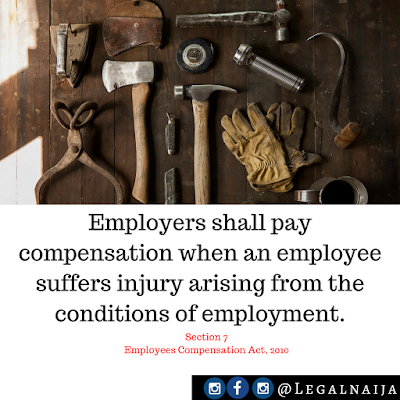
Employees Compensation Act, 2010, provides that employers must pay compensation
when an employee suffers injury arising from the conditions of employment. It
is common to see these compensations delayed, frustrated and sometimes never
paid. Several employees who suffered injury during the course of their
employment have been forced to approach the Courts of law to mandate the
unwilling employers to pay up. However, giving the slow pace of the law courts,
which is a situation being speedily addressed by the National Industrial Court,
most victims still tend to feel abandoned, stressed, angry and sometimes
powerless in their situations.
The Employees Compensation
Act, 2010, repealed the Workman’s Compensation Act, 2004, and seeks to provide
an open and fair system of guaranteed and adequate compensation for all
employees both in the public and private sector. However, the Act does not
apply to members of the Armed Forces as stated in Section 3 of the Act.
The Act provides in
Section 7, that –
“(1).
Any employee, whether or not in a work place, who suffers any disabling injury
arising out of or in the course of employment shall be entitled to payment of
compensation in accordance with Part IV of the Act.  
 It must be noted that it is not compulsory for
the worker to be at the point of duty when the injury occurred, as the Act
provides other instances when the employee will be liable to compensation for
injury suffered. The Act further provides in Subsection (2) that – 
“An
employee is entitled to payment of compensation with respect to any accident
sustained while on the way between the place of work and

a)          
The
employee’s principal or secondary residence,
b)          
The
place where the employee usually takes his meals, or
c)          
The
place where he usually receives remuneration provided that the employer has
prior notification of such place. “ 
If the injury is as severe
as to cause any disability to the employee from earning full remuneration at
the work place, Subsection (3) provides that the compensation shall be payable
pursuant to the Act from the first working day following the day of the injury,
except that only a health care benefit shall be payable on the day of the
injury. When the injury is caused by an accident which arose from the
employment, it would be presumed that the injury happened in the course of the employment.
In C & C Const. Co. Ltd. v. Okhai (2003) 18 NWLR (Pt.851)79, the
respondent while on duty which involved the servicing of the appellants’ crane
sustained grievous injuries arising out of the 2nd appellants failure as switch
operator to use due care thereby causing the crane to become agitated and resulting
in a drum of the crane to rollover violently over the respondent’s left foot,
crushing that leg below the knee. For this he was under great pain and suffering
for which he was hospitalized and this eventually led to the amputation of that
leg. The employee was awarded damages for loss of earning capacity, future loss
and damages for pain and suffering.
 Usually, the employer is responsible for
ensuring that the workplace is not dangerous and that tools, machinery and
other equipment used by the employees are suitable for the task and safe. It is
also the duty of the employer to ensure that the methods used to undertake the
work, the system of supervision and general organization add up to a safe
system of work. It should however be noted that the employer’s duty is only to
take reasonable care and not protect the employee at all cost[i].
 
Adedunmade Onibokun Esq,
Adedunmade is the Principal
Partner of Adedunmade Onibokun & Co., a corporate commercial law firm
located in Lagos, Nigeria. He also publishes the Legalnaija blog, an
online platform dedicated to educating Nigerians on their legal rights and
obligations. He can be reached via
dunmadeo@yahoo.com


[i] Gwyneth
Pitt (2007). Employment Law. 6th ed. London : Sweet & Maxwell. 410.
“THE CNN EFFECT” If it Bleeds it Leads. Does media coverage make violent conflict more likely?

“THE CNN EFFECT” If it Bleeds it Leads. Does media coverage make violent conflict more likely?


The saturation of media in
virtually all areas of contemporary life and its effects on society has been
widely discussed by many academic scholars. At the same time, since the end of
the Cold War in 1989, intra-state conflicts in which the Great Powers have been
openly involved have also become significant. Connecting these developments,
the media has been seen as not merely observers, but participants in these
post-Cold Wars. 

Accordingly, serious
questions have been raised about the role of the media in these violent
conflicts. For instance, does the media coverage make violent conflict more
likely? Is it used to facilitate Liberal War and sell violence as just, ethical
and ultimately peaceful? Is the “CNN effect” real? This Article will discuss
the role of media coverage and the CNN effect with regard to violent conflict.
The CNN Effect
In 1991 after the Gulf
War, Iraqi Kurds staged an insurgency against Saddam Hussein. The Western
powers which defeated Saddam Hussein did not wish to intervene in Iraq.
However, relentless coverage by CNN deliberately evoked sympathy with the Kurds
and increased public pressure for the Western powers to ‘do something’.
Eventually, the western powers did intervene in Northern Iraq to protect the
Kurds and a no-fly zone was established. This gave rise to commentary about the
“CNN effect”.
 Hence, it is safe to
say that the CNN effect refers to the impact that global media coverage on
humanitarian crises has on public opinion in the West, which in turn forces the
western Government to act where they otherwise would not.  This so called
effect was also said to operate again with regard to ‘humanitarian
interventions’ in Somalia, Bosnia, Kosovo and Rwanda in the 1990’s.
Notably, the “CNN Effect”
is directly opposed to the elite- centred Propaganda Model because it asserts that
democratic pressure from below, spurred on by independence of global media, can
change the policies of Western governments to a more humane foreign policy.
The Exaggeration of
the CNN Effect
Upon closer examination,
the CNN effect is greatly exaggerated by many commentators, both positively and
negatively. It is not that the media coverage does not have any effect at all
on the public opinion and government policy in western democracies, but rather
its presumed effect with regard to changing or even formulating government
policy is overstated.
Factually, what most
analysts have found is that when western governments have a clear, well
communicated policy, no amount of public pressure will sway the executives and
the military panel. Conversely, where there is a weak or unclear policy, then a
window is open for actors to influence government policy as it is being made,
debated or reformulated. An academic writer, Jakobsen has identified another
crucial factor which can determine whether public pressure will affect
government policy towards intervention, options for minimal or no casualties
and a clear identified exit points.
This goes a long way in
explaining the liberal humanitarian interventions of the 1990s. After the Cold
War, foreign policies among western powers were in a state of flux. Without the
Soviet Union as the enemy, and with the explosion of violent conflicts in the
wake of the Soviet Union’s demise, Western powers were not clear as to how and
why, or even whether they should intervene. 
Now when they eventually
intervene, they do so in such a way as to minimize their own casualties, and in
the event that such casualties occur as in Somalia, they quickly withdraw their
steps. These liberal wars of choice almost by their nature stirred a debate and
opened the door for the ‘CNN effect’. Indeed it is notable that the debate
about the CNN effect was at its height during the Clinton presidency and the
Blair premiership. It is worth mentioning that, under President Barack Obama’s
presidency, there appears to be similar quandaries with regard to military
intervention in the Middle East since the outbreak of the Arab Spring. 
In conclusion, I am of the
view that the media’s role in violent conflict is complex. It cannot be thought
of in a unitary way. There are important differences between local and
international media and now Western global media conglomerates as opposed to
non-western media. While the media can influence situations profoundly, the
media is also influenced by many actors. In such a complex world, the
multifaceted, dynamic complexity of the media’s relationship to violent
conflicts should not come as a surprise.

By: Jacinta Obinugwu 

Ed’s Note – This article was originally published here.
Interview: Chika Ugonwa, Immigration lawyer talks about law practice and finding her niche by Anne Mmeje

Interview: Chika Ugonwa, Immigration lawyer talks about law practice and finding her niche by Anne Mmeje


Anne Mmeje interviewed Chika Ugonwa, a young entrepreneurial
Nigerian Lawyer who practices Immigration Law in Nigeria. Chika talks about her
work, human trafficking in Nigeria, and the Gender Equality Bill that failed to
pass at the National Assembly. Chika’s vision includes establishing a law firm
that will serve as a one stop shop for everything Travelling/Immigration
inquiry and assistance in Nigeria; having a bilateral relation with immigration
firms all over the world, Embassies and High Commissions; and building a strong
brand on the foundation of Trust and Integrity.


Please tell
our readers a little bit about you.
I am a Nigerian Lawyer, a Graduate Manager, and an
Immigration Consultant.  In the past I worked with Abubakar Mustapha &
Co. (Kaduna) and Threshold Barrister & Solicitors (Lagos). Presently, I am
running my own firm in partnership with Reality Education Ltd (Port Harcourt),
Rexcue Barrister and Solicitors (Lagos), and New Dimension Konsult (kaduna).
Okay, now
that sounds interesting. You are affiliated with three law firms. What’s the
arrangement like and how did that come to be?
I
started my Immigration Law practice in Lagos with Threshold Immigration Consult
which is a subsidiary of Threshold Barristers & Solicitors. As you know,
Immigration practice is built on trust and in the course of the attorney-client
relationship, one gets access to clients’ sensitive private and financial
information. So when I moved to Abuja, a lot of my Lagos clients still
sought me. My efforts to get them to work with other lawyers failed. That was
where the partnership idea came from. I continued to work with my clients in
Lagos while I was in Abuja. When that proved successful, I realized that I
could successfully serve clients in all thirty-six states from my base in Abuja.
For
my clients who are in Lagos, for example, they consult me through the phone or
email. Then I do their work and send the finished work to my colleague Rexcue
Barrister and Solicitors Lagos (he practices Immigration Law too) who goes over
them with the clients and guides them to sign the documents.
Congratulations
on your achievements so far. Has law practice been what you expected? Many
people go into law school with noble intentions. Did the reality of law
practice match your earlier expectations of what to expect from the practice of
Law? 
I don’t know
about ‘many people.’ For me, I did not really go into the law program with
great expectations or any expectations. The decision to study law was
suggested by someone I could never say No to. In secondary school I was good in
social sciences and art, my parents wanted me to be an accountant; my
grandfather wanted Law. I chose Law. In University then my major goal was not
to fail my grandfather, my parents who were paying for my education, and
myself. (In my family, my siblings and I are a bit competitive). Long story
short: I did not have ‘earlier expectations.’ But having practiced for a while,
I realize that we (Nigerian Lawyers) need to do more. The fate of this country
to a large extent lies with the legal profession and so it suffices to say we
are to a large extent part of the problem of the country. We need strict ethics
and conduct regulations and compliance.
What has
been your greatest challenge practicing law in Nigeria?
Law practice is a very broad concept. The challenges a lawyer
encounters are unique to his/her area of practice. I practice mostly
Immigration and Maritime Law (More of Immigration).  I can write a book on
the challenges for each but for this interview I will only mention one
challenge in Maritime practice which is ‘stagnancy.’
My former firm (Threshold barristers & Solicitors) had
over 30 cases on different maritime matters. Apart from one of the matters that
I got a default Judgement on, others ended up in settlement before I got the
chance to taste my skills in trial. In court one day while I was moving yet
another motion for discontinuance and adoption of parties’ terms of settlement,
the Judge said (jokingly) that in his 20 years in the bench he was yet to
deliver a final Judgement on a Maritime case.
In Maritime, litigation is instituted just to get the shippers/and
or the insurance company to settle. Hence in rare cases where the matter goes
all the way to trial, there are hardly sufficient judicial precedents to rely
on.

You mentioned earlier that you serve
clients in all thirty-six states.
Yes. Thanks to Nigeria legal system and Judicial procedure, a
lawyer in Nigeria can practice in any part of Nigeria. My Job takes me around
the Country (and I hope someday beyond). We attend to clients at any location
within Nigeria. When clients can take care of my travelling expenses, I fly to
their cities to see them and we have our business at my colleagues’ offices.
Are you
surprised at how little or much your clients know about Immigration law?
Not at all; Immigration law practice is still a grey area of
practice. I was fortunate to stumble into it myself. Its sounds alien when I
discuss it with my colleagues. Apart from a few firms in Lagos I am not sure
there are firms in other jurisdiction who engage in it. Imagine how many
countries there are. Through this job, I have learned a lot and I am still
learning.
What does
an Immigration lawyer do?
I am sure not a lot of people know that travelling across border
is actually a right not a privilege
. Let me not
bore your readers with sections of UN Treaties and African Charters on Human
right and other citations that uphold these rights.
In summary; A country cannot close its borders from entry to
citizens of other territories. There are exceptions though.
I run an Immigration Consultancy Firm. We attend to Immigration
issues bothering on;
Permanent migrants i.e spouses, children,
parents etc. who seeks to join families overseas across border or regularize
foreigners already in the country. Temporary Migrants
which includes International Students, Work permits (eg Canada Federal
Skill migrant scheme, for professional migrants) etc
. My firm is also an International Education facilitator. We
work with schools in Europe, United States, Canada, Australia, Malaysia etc.
Then we have our cluster clientele: the short time Visitors. Tourist, family
visitors, Medicals Visitors etc.
It is quite an interesting job. You will be amazed at the volume
of immigration cases there are out there.
In addition to the above, we also organize trainings and
seminars. News are often reported about mangled dead bodies found in
international flights tyre compartments, like the story here: www.nairaland.com/432392/desperate-man-sneaks-into-delta, 
http://old.nationaldailyng.com/news/crime/5988-arik-dead-body-uk-authorities-may-join-investigation. Some lose their
lives at Sahara Desert or at sea. all in desperate attempt to illegally migrate
in quest for greener pasture. In the later instance. loved ones are saddled
with the agony of not knowing for sure what happened to their wards. Pain they
will be forced to endure to their graves. Those who promote this inhuman
practices for profit will never inform their clients on the risks involved.
 Through these seminars we educate the youth on the dangers of illegal
migration.  We also create awareness on Human trafficking. We hope to
attract the government and multi-national companies and concerned individuals
to get involved and sponsor some of these programs.
We also offer
professional advisory services. This is very important, especially since
countries keep reviewing their immigration rules and regulations to protect their
borders against economic migrants and terrorists. Before anyone thinks of
traveling, it is important to seek professional guidance.
We give
packaging assistance; a lot of immigration process / application is done online
and not many people know their way around the internet nor have the patience to
be bothered with it, and the question may be a bit technical, so we do the
actually application for clients who retain us to do so.
We also
represent clients on appeals (via paper litigation) for clients who have
been wrongfully refused. We prepare ground of appeal, witness statement(s) etc.
Further,
we offer International Investors legal assistance through our partnership with
other law firms abroad. We can help a client secure an investment abroad, or a
foreigner secure investments here (Nigeria).

What is the
most fulfilling case you have handled?
As a rule, I do not take on any case I am not passionate about. It
is my passion that propels me to give my best. In my immigration practice however,
one particular case comes to mind though. Client was a 17-year old boy. He lost
his mother at a young age. His mother was never married to the father. He was
raised by his maternal grandmother who also later became deceased. His father
was a Nigerian / Belgian permanently resident in Belgium and he wanted our
client to join him. There were a lot of documentary challenges. Initially it
looked like a hopeless case. Our young client, without assistance (other than
professional fee his father paid to the firm), did all his best to assemble
necessary documentation. He made several trips from Edo (where he is based) to
Lagos (our firm). The package took about 6 months to tidy up and another 6
months in the embassy. I was gearing up for appeals when the documents came out
and his application was granted. It was not the hardest case but the case was
fulfilling for me because in the course of packaging Jesse’s application I got
to learn of his life story. He had had a difficult life and I felt that he
deserved a break. I was very happy he got his visa. He is doing very well in
Belgium now.
I share
your joy. I do find too that the cases we tend to love the most are not the
ones we made most money from but the ones we helped our clients get
life-changing resolutions. Given your diverse practice, have you noticed any
dissimilarity between Immigration Law and other areas of law practice?
Yes. In two major ways.
First, one of the most popular Principle in criminal law, for
example, is that a person is ‘innocent until proven guilty’. In
Immigration law the reverse is the case. In Immigration Law, it is an
applicant’s duty to prove that his/her purpose is genuine before his/her
request is granted. In other words, you are considered an Economic Migrant
(especially if you are applying from an undeveloped country to a developed
country) until evidence proves otherwise.
Second, Immigration law is not guided by Precedence.  Even
where two clients have the same immigration challenges, solutions are rarely
the same. Every application is unique to the applicant’s personal and economic
circumstances.
Lagos
State government recently uploaded the State Laws on the internet but requires
people to make a certain payment before accessing them. What is your take on
this? Shouldn’t people know, say the Criminal Code, without having to buy them,
in order not to break the law.
I have always been of the opinion that basic laws (criminal law
and fundamental human right) should be introduced as subjects is senior
secondary schools and that such laws be also made available to the masses
especially since ignorance of the law is not a defence. Take this yahoo yahoo
thing for example, a lot of youths who engage in it do it for the fun of it as
much as for the money. They are ignorant of the fact that they are committing a
felony and the penalty it attracts. But the Government as usual is focused on
generating revenue at the expense of the masses’ welfare.
The National
Assembly did not pass the Gender Equality Bill that was presented before it
earlier this year. What effect do you think passing this law would have had on
women’s right?
I have not read the bill though but I do not think it will
have any substantive effect on women’s right. I am not aware of any law that is
specifically discriminatory against women. The constitution provided for
Fundamental HUMAN rights. The Criminal Code did not segregate crimes or
penalties on gender. I am indifferent to the bill just like am indifferent to
the bill on domestic violence (when the criminal code has amply provided laws
against physical and non-physical violence). I am indifferent to these laws and
bills focusing on women simply because I think they amount to proliferation of
laws.  If we women are serious about our rights, we should stop expecting
special treatment. It is you constitutionally giving right to challenge any law
or practice that you feel is discriminatory towards you on basis of your gender.
Any woman who seeks to challenge such laws or practice will have my support pro
bono.
 So if someone wants to apply for visitors’
visa to U.S. are you able to do that? 
Yes.
Like I said the bulk of our clients falls in the Visitors (short time travelers)
category. We also serve clients who wish to travel to Canada, Australia, Europe
etc.
Where can people get
information and resources about Maritime Laws and Immigration Laws in Nigeria?
There
are plethora of books and legislations on Maritime: NIMASA ACT 2007,
Sabotage Act etc. For Immigration law, it is the Immigration rules and
regulation of the country a client is seeking entry to that we rely on. 
You do a little bit
of Maritime law. What is the relationship between depreciation of the naira and
importation?
The
naira depreciation is as a result of Nigeria’s heavy reliance on importation. Nigeria
imports almost everything because we are consumers. If importation reduces the
Naira will appreciate. 
What are your other
interests, besides Law?
I
write poems. I am also considering venturing into agriculture and my long term
goal is to run a farm and get to finally call myself a farmer. Nothing says
humanity than farming. I am doing some background research on animal farming
and my area of interest is fishing and poultry.
I enjoyed this
interview and I learned quite a lot. I believe some readers will be thrilled by
the legal knowledge you have so generously given away freely
. How may people
contact you if they have further questions?
Our
official website will be launched soon. In the interim I can be contacted Via
Phone +234 8129375453, and/or email: measchika@yahoo.com.
Thank you very much
for granting this interview, Chika.
You are most welcome, Anne, and thanks
again for having me.
Anne Mmeje is a lawyer and a freelance writer. To see more of her works,
visit annemmeje.com. To contact her email
annemmeje@yahoo.com.
Ivie Omoregie: The Importance of Contracts;Especially When Dealing with Friends

Ivie Omoregie: The Importance of Contracts;Especially When Dealing with Friends


The importance of
contracts
Over the years, in my
professional capacity, as well as in my personal life, I have seen extremely
ugly disputes erupt amongst people who would have once referred to themselves
as close friends or family; all because they attempted to do business or engage
in a project together which subsequently went pear shaped. I often tell people
even if you are going into business with your mum, make sure you sign
something setting out, in clear terms, exactly what is expected from each party
’.

The importance of formally
documenting proposed business obligations cannot be over stated. Some people
believe it might be insulting to the other party if seemingly out of nowhere
they bring a document for that party to review and sign; but I always stress
that prevention is better than cure, and in most instances, to actually save a
friendship one has to be objective and follow due process.  If you were
doing business with a stranger, you would certainly mandate that the two of you
sign something to show each-others clear intentions…. So why should this change
because you are dealing with your “best friend”.
The Principals Behind
Legally Binding Contracts
The foundations of legally
binding contracts are premised on intention, an offer, acceptance of that offer
and valid consideration. Each party to a contract acquires rights and duties
relative to the rights and duties of the other parties.
Key elements for the
formation of a legal contract include: –
a.      Intention
– all parties must have intended to create relations by entering into the
contract;
b.     Offer
– there must be a valid, definite and clearly stated offer to do something;
c.      Acceptance
– this must be unequivocal and unconditional, and must be in accordance with
the terms of the initial offer; and
d.     Consideration
– this may be in any form accepted by both parties, aside from a monetary
consideration, it can also take the form of physical objects, promised actions,
services, absence from future actions and the list goes on.
The general position of
legal authorities is that any contract is legally binding and enforceable where
the parties to the contract, at the time of entering into the contract, had the
intention to be bound to the terms of the contract. All courts around the world
appreciate that the sole objective of a legal contract is to define the
agreement that the parties have consented to enter into, thus fixing their
rights, duties and obligations in-line with what has been clearly set out in
the contract. There is no legal body empowered to enforce the terms of a
contract which does not exist.
Capacity to Contract
In saying this, I must
stress that there are instances where a party to a contract may be deemed as
lacking the capacity to enter into the contract, thus the contract regarded as
unenforceable where some laws which relate to that nature of person are not
duly complied with.
These persons include: –
a.      An
Illiterate – this is generally a person who cannot read or write in the
language in which the contract has been executed;
b.     An
Infant – this is persons under the age of 21 (with an exception being
contracts for the sale of goods)
c.      A
Lunatic or Person of Unsound Mind – however
in these instances, a contract entered into with a lunatic at lucid intervals
is valid (here the test for determining whether someone is a lunatic is not
quite clear under Nigerian law, as we often see “many are mad but few are
raving
”)
d.     A
Drunkard – again the test for differentiating a drunkard from someone
who likes to drink often is somewhat grey, however where it can be proved that
the drunkard was sober at the time of entering into the contract then the
contract would be binding.
Parties to a contract are
bound by the terms of that contract, even in instances where the terms are more
favorable to of the parties; as long as the contract is not the result of
duress, undue influence or fraud, it is not the duty of the courts to determine
the business viability of the contract terms.
Key Clauses
I must empathize that the
contract does not have to perfectly drafted to be binding, although advise from
a professional would always be a best case scenario, in the event that this is
not possible, parties may simply google the applicable template and adapt to
suit their needs, or write out some pivotal points on a sheet of paper and
sign. 
The following are some
vital clauses I would advised to be included in every contract: –
1.       Commencement
Date – this is the date upon which the contract will be deemed as validly
existing;
2.      Parties
– here you list the names and addresses of the parties to the contract, where
any of the parties is a company, one may also include the company registration
number, and the country in which the company was registered;
3.      Recital
– this is a clause which details briefly the facts surrounding the transaction,
and may be narrative or introductory by nature. For example, in a contract for
the sale of goods it would be narrative and would tend to specifically state how
the seller came about possession of the goods;
4.      Consideration
clause – as titled, this clause details the consideration for the transaction;
5.      Receipt
clause – here the party receiving the consideration accepts receipt of same, or
where the consideration is not of a tangible nature confirms acceptance of
whatever consideration has been proposed;
6.     Capacity
– this clause confirms the party’s capacity to enter into the contract;
7.      Termination
clause – this usually details what constitutes a significant breach or several
events which could lead to termination if not rectified within a specified
period of time;
8.     Choice
of law clause – this clause details which laws will govern the contract, there
must be a rational reason for the choice of law specified, as the laws of
different jurisdictions may affect the parties differently;
9.     Alternative
dispute resolution clause – this clause creates an obligation for the parties
to submit their dispute to any of the alternative dispute resolution options.
It may also detail a course of actions both parties need to take in order to
rectify any possible discrepancies; and
10.   Signature
– parties should bear in mind the signatory requirements of a company.
Conclusion
The truth is, there are
several multi billion naira industries, which have been successfully operating
in Nigeria over several decades, established by a simple gentleman’s handshake.
Many people believe that in an attempt to be over diligent one can end up over
complicating the matter and set the foundation for distrust; akin to getting a
prenup before entering into a marriage. 
Many people, especially in
the Nigerian jurisdiction, because of the difficulties experienced or the
tedious nature of the litigation procedure, believe that most contracts are not
worth the paper they are written on. They believe that in most instances when
one or more of the parties involved purposely and disrespectfully rescinds on
their contractual obligations, little to nothing can be done to immediately
rectify the situation. The truth is the Nigerian court system is over
saturated, with final judgment often taking several years from the date of the
initial application. However, where the dispute is amongst related parties, any
mutual friend may intervene and give their objective interpretation of the
terms of the contract.

Ivie is a commercial lawyer, with experience and keen
interest in projects and transactions work within the Sub Saharan African region.
She is called to practice in England and Wales and Nigeria.
Ed’s Note – This article was originally published here

Powers of National Security Agencies in Nigeria

Powers of National Security Agencies in Nigeria


According to Wikipedia, National security is a concept that a government, along with
its parliaments, should protect the state and its citizens against all kind of
national” crises through a variety of power projections, such
as political power, diplomacy, economic power, military might, and so on.

Nigeria like every other
nation has Security Agencies in addition to the Police and the Armed Forces.
For instance the United States of America has the Federal Bureau of
Investigations (FBI), the Department of Homeland Security and the Central
Intelligence Agency (CIA). The United Kingdom also has MI6. Likewise Nigeria
has its own agencies with similar duties as the agencies stated above.  
 These agencies are provided for in the
National Security Agency Act. The Act is An Act to
disband the Nigeria Security Organization and to create three security
agencies, charging each with the conduct of the relevant aspect of the national
security, and other related matters
.
The Act states that
– 
There
shall, for the effective conduct of national security, be established the
following National Security Agencies –
       (a)       the Defence Intelligence Agency;
       (b)       the National Intelligence Agency; and
      
(c)        the State Security Service (SSS).
The respective agencies
also have their duties outlined. Section 2(1) of the Act provides that the
Defence Intelligence Agency shall be charged with responsibility for-
 (a)  the
prevention and detection of crime of a military nature against the security of
Nigeria;
  (b)the
protection and preservation of all military classified matters concerning the
security of Nigeria, both within and outside Nigeria;
 (c) such other responsibilities
affecting defence intelligence of a military nature, both within and outside
Nigeria, as the President, or the Chief of Defence Staff, as the case may be,
may deem necessary.
  Subsection 2 of the
Act provides for the duties of the National Intelligence Agency and states that
it shall be charged with responsibility for-
  (a) the general maintenance of the security of
Nigeria outside Nigeria, concerning matters that are not related to military
issues; and
    (b)such other responsibilities
affecting national intelligence outside Nigeria as the National Defence
Councilor the President, as the case may be, may deem necessary.
 Furthermore Subsection 3
provides for the State Security Service and provides that, The State Security
Service shall be charged with responsibility for-
(a) the prevention and detection within
Nigeria of any crime against the internal security of Nigeria;
 (b) the protection and preservation
of all non-military classified matters concerning the internal security of
Nigeria; and
 (c)such other responsibilities
affecting internal security within Nigeria as the National Assembly or the
President, as the case may be, may deem necessary.
 The National Intelligence
Agency is Nigeria’s version of the Central Intelligence Agency, while the State
Secret Service (SSS) is Nigeria’s version of the FBI.  The Act States in Section 4, that the powers
of these agencies shall have effect regardless of any law to the contrary. It
should be noted that the exception to this provision will be the Constitution
of the Federal Republic of Nigeria.  However,
the Supreme Court noted in Dokubo -Asari
v. F.R.N. (2007) ALL FWLR (Pt. 375) 558 at 585; Paras B – E & F – H (SC)
,
that “where national security is threatened or there is the real likelihood of
it being threatened, human rights or the individual right of those responsible
take second place. Human rights or individual rights must be suspended until
the national security can be protected or well taken care of”. 
This rule of law is not
new as the court further posits that, “the corporate existence of Nigeria as a
united, harmonous, indivisible and and indissoluble sovereign nation, is
certainly greater than any citizen’s liberty or right. Once the security of
this nation is in jeopardy and it survives in pieces rather than in peace, the
individual’s liberty or right may not even exist”.
 The Act also makes provision for 2 advisory
councils namely The National Defence Council and The National Security Council,
while also providing for their duties and functions. 
 The above mentioned
agencies are established by the Act to promote and protect the National
Security of Nigeria. 
Adedunmade Onibokun Esq.
@adedunmade 
dunmadeo@yahoo.com 
Photo credit – Premiumtimesng.com 
Who will speak for the judiciary – Dunmade Onibokun

Who will speak for the judiciary – Dunmade Onibokun


Who will speak for the judiciary – Dunmade Onibokun
First they came for the Socialists, and I did not speak
out—
Because I was not a Socialist.
Then they came for the Trade Unionists, and I did not
speak out—

Because I was not a Trade Unionist.
Then they came for the Jews, and I did not speak out—
Because I was not a Jew.
Then they came for me—and there was no one left to
speak for me.

 
by Martin Niemöller

In
the past 24hours, the homes of various judicial officers across the country have
been besieged by officers of the Department of State Services (DSS), based on
allegations bothering on corruption. According to the Punch Newspaper, operatives
of the Department of State Service between late Friday night and the early
hours of Saturday simultaneously invaded the houses of two Justices of the
Supreme Court as well as two judges of the Federal High Court, including the
home of a judge in Rivers State.
The
commando style with which these actions were taken by the DSS is quite worrisome,
especially in a country that is called a democracy where everyone is entitled
to their fundamental human rights of freedom, equity and justice.    
This
scenario reminds me of the poem by Martin
Niemöller,
where he described the penalty for keeping quiet in the face of
tyranny. When the DSS and the Police trampled on the rights of Nigerians, the
courts did not save them. When political opponents of the present government
administration were arrested and not given a fair trial, the courts held their
hands back. Now that they have come for the judiciary, who will speak out on
their behalf? Certainly not the common Nigerian, who has no belief in the
Nigerian legal system. 
Corruption
must be expunged from our system, we all agree but we must not in that guise
invite tyranny, disregard for the rule of law and dictatorship to take its
place. It is sad that we have become a country where official authority comes
before the rights of every Nigerian and the rule of law is being breached by
the very people put in place to safeguard them. 
The
Executive places itself as the leader of the various tiers of government,
forgetting that the doctrine of separation of powers still hold true till this
day. If as a people, we do not brace ourselves against the direct breach of our
legal rights by security agencies and raise our voices against the unlawful
acts of State agencies, we may as well put guns to our heads and pull the
trigger, for it means one day, the DSS will unlawfully lay siege at your house
and no one will be there to help.
Dunmade
Onibokun
@dunmadeo/Twitter

Photo Credit – www.timeforequality.org
Commendation to Nigerian Police on tattoos

Commendation to Nigerian Police on tattoos


I just stumbled on an article on the Linda Ikeji Blog about a lady
who was assaulted by the Police for having a tattoo. It’s so amazing the work
our Nigerian Policemen are doing. 

The sheer amount of intelligence
gathering and psychology that results in the identification of criminals by
their body art is one that should be shared with every police force in the
world.
For those who don’t know, a tattoo is a
permanent design drawn on a person’s skin. It is a popular form of self –
expression for many and also recognised by many tribes and cultures around the
world.
Never mind that the person is law
abiding, or is a respectable member of the society, as long as you have a
tattoo in the eyes of the Nigerian Police, you must be a criminal or prostitute
as the case may be. This level of professionalism in policing is unprecedented
and definitely unique to our police force. A reason why we always continue to
adore the police, our friends.
As the chief security agent of the
State, the agency with the mandate to protect the rights of the Nigerian
Citizen, uphold the rule of law and ensure our safety, arresting well-meaning
Nigerians just because they have tattoos is very commendable.
This exemplary work by the Police can
be found online, such as the case of Jerry
Guobadia
and that of Jackie Awah.
You must agree with the Police that people with tattoos are a big problem to
the Nigerian Society, even though they may be musicians, performers, artists,
doctors or even bankers, the police should arrest them and prosecute them.
The police must have noted that the
high rate of   people with tattoos in Nigeria is directly proportional to
the high crime rate in the community. Hence the need to take down everyone with
a tattoo. Having a tattoo can also cause a severe breach of the peace, riot,
looting or even murder the Police must believe.
Even the Constitution that has a
provision for the fundamental right of every Nigeria not to be subject to
degrading treatment cannot fault this incredible work of the police. Neither
can Section 8 of the Administration of Criminal Justice Act that provides that
suspects should not be subject to any form of cruel treatment be of any use
here.
Fellow Nigerians, we definitely have to
wake up and fight to protect our rights as a people, especially from those who
seek to spit on them such as our friends. Fundamental Human Right proceedings
commending the police for a job well done is a good way to start.
This is a
blog post by Adedunmade Onibokun. Adedunmade is a lawyer and blogger. He
practices in Lagos and publishes the law blog www.legalnaija.com. You can reach
Adedunmade on dunmadeo@yahoo.com
Ed’s Note – This article was originally published here.
Opinion: On Sambo Dasuki and the ruling of the ECOWAS Court by Raymond Nkannebe

Opinion: On Sambo Dasuki and the ruling of the ECOWAS Court by Raymond Nkannebe


The
considered ruling yesterday 4th October, of a three man panel of the Ecowas
court led by Justice Friday Nwoke that terminated in an order of immediate
release of the estranged former National Security Adviser, Sambo Dasuki who has
been in custody of the DSS since last year, and cost against the Nigerian state
in the sum of 15 million naira is a welcome development. Nigerian security
operatives on no reason should be allowed in any guise to overshot the runway
of the law ostensibly to fortify the security of the nation.

The
right to Freedom of Liberty save in the exceptional cases must always remain
guaranteed. While some may argue that the circumstances bringing Dasuki within
this maze of legality falls within those exception encapsulated in section 35
of the constitution and as such should earn him a continuous detention at the
DSS, we beg to disagree and anchor our disagreement on a plethora of decided
cases by the supreme and appellate courts of this clime to wit :Abacha v state,
Bamaiyi v state, Fawehinmi v state Ani v state to name but a few. Where the
learned justices of both courts reechoed the attitude of the courts in
admitting to bail a person accused of an offence grave as they may be, to the
effect that where the accused would not prejudice the investigation of the
police; commit another offence or abscond from the jurisdiction of the courts
during the pendency of the trial; then bail becomes a right. 

It
is our submission that poor Dasuki has fulfilled or at one point or the other
undertaken to fulfill these conditions, yet his twin rights of Freedom of
Movement and liberty as enshrined in sections 38 and 35 of the constitution respectively,
remain breached by security agencies. 
More
so, one of the “exceptional circumstances” in the language of the
ACJA 2015 to be admitted to bail as provided in section 161(2)b is,
“extraordinary delay in the investigation, arraignment and prosecution for
a period exceeding one year”. It is common knowledge that Sambo Dasuki has
remained in custody beyond this window of the law. Therefore, it is safe to
conclude that our security operatives have breached both the judicial and
statutory requirements of the law in their desperation to secure conviction of
the former Security Chief. 
It
is lugubriously pitiable that whereas the role of the police in any democracy
is to prosecute accused persons, the police have taken to persecution and a
man-eat-man approach to justice. This judicial rascality and professional
indiscretion must stop. 
It
is on the sands of the fore going therefore, that the judgment of the Ecowas
court as a regional court of competent jurisdiction becomes instructive and
hence should be hailed. While many lawyers have argued that the judgment of the
court is at best persuasive and it’s sanctions prone to abuse by member
nations, it remains to be seen how the Buhari administration who rode to power
on the wings of democracy and Rule of Law and who therewith, told a beleaguered
nation at his inaugural address that he would uphold the rule of law and all
conventions to which Nigeria is a signatory to, would react to this particular
ruling of the court. 
Let
us conclude by paraphrasing the irrepressible late Justice Chukwudifu Akunne
Oputa in one of his legal sound bites. The prosecution in its pivotal role of
helping the courts come to the justice of a case must always remember that
their role is to prosecute and not persecute. A spectacle where the Law is
triumphant and justice prostrate therefore, must remain a sorry, and I dare
say, gory spectacle. For the law in the final analysis is but a hand maid of
justice.
The
writer, a lawyer and public affairs commentator wrote in from kano. He can be
reached via Raymondnkannebe@gmail. Twitter : @RayNkah 

Photo Credit 1 – Naij.com 
Photocredit 2 – punchng.com