Senator Ashafa calls for Legislative Support on Rails

Senator Ashafa calls for Legislative Support on Rails


The Senator representing Lagos East
Senatorial District in the National Assembly, Senator Gbenga Ashafa on Tuesday,
16th May 2017 vehemently urged his colleagues to ensure that
the National Assembly passes the loan request from executive arm with which to
fund the Lagos to Kano and Calabar to Lagos Standard Gauge Rail Projects.

The Senator made the call while
contributing to a motion sponsored by Senator Eyinnaya Abaribe (Abia South) on
the “Outright Omission of the Eastern Corridor Rail line in the request for
approval of Federal Government 2016 to 2018 External Borrowing Plan.
You would recall that on the 26th of
April 2017, the Federal Government laid before the National Assembly a request
seeking an approval for a loan of $5,851 Billion from China Exim Bank to
execute the Modernisation of Lagos to Kano, Kano to Kaduna, Lagos to Ibadan and
Lagos to Calabar rail segment.
Senator Abaribe had observed with dismay
that the segments for which the Federal Government sought the loans covered
only a section of the country while the South Eastern to North Eastern parts of
the rail line had been completely excluded. The senator therefore urged the
Senate to Suspend consideration of the loan request of any guise until the
correction of this apparent oversight of the eastern parts of the country and
invite the Minister of Transport to appear and explain the reason for the
oversight of the east.
While contributing to the motion, Ashafa
who is also the Chairman of the Senate Committee on Land Transport stated his
support for all the Geo Political Zones to benefit from the Governments Rail
Infrastructure programs. Speaking further, the Senator however urged his
colleagues not to throw away the baby with the bathwater by suspending the
consideration of the loan request on the grounds canvassed in the motion. He
stated that the Lagos to Kano and Calabar to Lagos Standard Gauge Projects
would cut across the entire country with all Geo Political Zones including the
South East benefitting immensely from the project.
Ashafa stated that “for instance, the
Calabar to Lagos Coastal Rail would pass through: Obudu Cattle
Ranch-Calabar-Uyo-Aba-PH- Yenagoa-Otuoke-Yenagoa-Ughelli-Sapele-Benin-Agbor-Asaba-Onitsha-Benin-Ijebu
Ode- Ore-Sagamu-Lagos Seaports; and the Lagos-Kano:
Lagos-Ibadan-Ilorin-Minna-Kaduna-Kano.” Hence it can be seen that the project
touches at least Two Major States in the South East being Anambra (Onitsha) and
Abia State (Aba) respectively.
On his part, Senate President Dr. Abubakar
Bukola Saraki stated that the leadership of the National Assembly had already
met with the Presidency on the issue and that they had received assurances that
all parts of the country would benefit from the standard gauge rail
modernisation project of the Federal Government.

In conclusion, Senator Abaribe withdrew the
first prayer of the motion urging the Senate to suspend consideration of the
loan request until the correction of the oversight of the eastern parts of the
country. While the Second prayer on the motion paper seeking to invite the
Minister of Transport to appear before the relevant committee of the senate in
order to clear the air was passed.
Mini Grids; Does the new regulation depict a bright future for Nigeria | Okezi Okah-Avae

Mini Grids; Does the new regulation depict a bright future for Nigeria | Okezi Okah-Avae

Introduction
The
Federal Government of Nigeria (“FG”) has long since declared its
intention to solve the country’s perennial electricity problem. However, the
conclusion of the first phase of the privatization of the power sector in
November 2013 has not exactly led to the uninterrupted supply of power once
promised to the populace. Between 50-55% of approximately 180 million Nigerians
do not have access to grid electricity, while the 45-50% of Nigerians who are actually
connected to the grid especially in urban locations, are largely in darkness. Furthermore,
not only are these Nigerians enduring crazy, unrealistic bills but also have no
choice other than to spend excessive amounts on electricity generation sets.


Nigeria
would require more than 160,000MW to achieve its desired electricity generation
capacity. The FG estimates that by the year 2020, the country’s generation
capacity would be in excess of 40GW (40,000MW), and the energy mix will
constitute 69% thermal generation; 17% hydro; 10% coal; and about 4% of
renewable.

The on-grid
challenge
On-grid
generation refers to a system of power generation evacuated through the
national grid to off-takers which may be the Nigerian Bulk Electricity Trading
Company Plc (“NBET”) who through vesting contracts supplies the power to
the power distribution companies (“Discos”); or directly to Eligible
Customers, as may be declared by the Minister of Power, Works and Housing,
Babatunde Fashola.

However
due to certain challenges highlighted below, Nigeria has witnessed an alarming
rate of frequent collapse of the power grid. It is gathered that the most
recent system collapse was due to frequency constraints on the grid. Figures by
the Transmission Company of Nigeria showed that power generation dropped
significantly from 3,222.5 MW on April 26, 2017 to 113.6 MW on April 27, 2017.
This, according to industry sources, is despite the increased gas supply to the
power plants following the ‘stability’ in the Niger Delta region.

Further,
it was reported in early April 20
17 that there was a prior collapse of the
national power grid on April 9, 2017 resulting in the drop in generation from
3,069.5MW to just 108.7MW. However, this moved up marginally to 240MW the next
day. Heavy rainfall at three transmission stations is ascribed to have led to
load reduction which prompted high frequency in the system, subsequently
triggering the collapse of the electricity grid.

Most
of the power consumed by Nigerians is actually on-grid power which the Discos supply
to these consumers. In addition to the above stated reasons for the collapse of
the power grid, on-grid power generation has had other (and notable)
constraints, some of which are identified below:

   a)   
Unavailability of Gas: About 85% of installed generation capacity is
thermal. Despite Nigeria’s large gas reserves, production has been
significantly low. Gas constraints is said to reduce the power generation
capacity by 1,995MW, and reasons for this include uneconomical gas prices; gas
pipeline vandalism; insufficient gas infrastructure; and uncertainty in
regulation and fiscal policy for gas, amongst others.
    b)   
Inadequate Transmission Infrastructure:
Out of a total installed capacity of 12,522MW, the
existing transmission system is only capable of delivering about 5,300MW. A
major reason for this is Nigeria’s current weak transmission infrastructure
which is mostly radial. This means that it’s a single path of transmission with
a power source at one end. Thus any fault in the path could potentially lead to
a collapse of the transmission network. The Transmission Company of Nigeria
plans to upgrade the transmission system to a capacity of 11,000MW by 2020
(subject to adequate funding and completion of projects planned for
implementation); however, the transmission infrastructure in its current state is
unable to accommodate the estimated increase in generation by 2020.

c. Liquidity Issues: Since
the privatization of the power sector in November 2013, the Nigerian Electricity
Supply Industry has faced with liquidity issues resulting from non-cost reflective
tariffs. The Discos have found it difficult collecting sufficient revenue to
pay their power bills which should sustain the rest of the value chain that
includes the Gencos, gas suppliers and service providers. This has led to a cash
crunch in the market and a clear disincentive to investment in additional
generation or capital expenditure for the Discos.

d. Nigerian Integrated Power Project (NIPP)
Privatisation
: The privatization process of NIPP plants should have had
the capacity to add close to 4,775MW to the grid. Unfortunately, issues such as
non-availability of gas; non-completion of some of the NIPP plants; and
inadequate gas and transmission infrastructure had hampered this development. Furthermore,
the current liquidity issues, and the lack of government credit enhancements in
the present circumstances, have not given potential investors the confidence to
invest in the acquisition of the assets. Access to funds from Nigerian Banks is
limited, and the alternative is international funding which would be subject to
more scrutiny by international banks.
Given
the above, it is imperative that whilst the issues are being resolved, we
should look at viable solutions for increasing generation that would hopefully
be somewhat isolated from some of the issues raised above.

Mini-Grid Solutions
In
recent years, Nigeria has been at the forefront of promoting a cleaner and more
modern energy in Africa. The regulatory space around solar power investments in
Nigeria has also seen some transformation, which has served as an incentive for
the recent growth in both off grid and on grid solar power developments. However,
there is still so much to achieve in this space but the willingness of the FG
and policy makers to further develop the space is evident and noted.

It
should be noted that off-grid technological solutions mainly mini-grids that
can power communities without access to electricity (unserved), as well as
provide reliable power supply to under-served urban centers, metropolis and
housing are being blocked by regulations that seem to place them and the
Nigerian consumers, at the mercies of Discos.

According
to the Nigerian Electricity Regulatory Commission (“NERC”), power
distribution firms, otherwise known as Discos, will soon begin the development
of mini-grids to augment electricity supply to households, businesses and
institutions in the country.

A
mini-grid is any electricity supply system with its own power generation
capacity, supplying electricity to more than one customer and which can operate
in isolation from or be connected to a distribution licensee’s network.
Within
the regulations, the term mini-grid is used for any isolated or interconnected
mini-grid generating between zero kilowatt and one megawatt of generation
capacity.
In accordance
with its power to make regulations, the NERC is currently working on a new
mini-grid regulation with the main objective of accelerating electrification in
areas without existing distribution network (also known as unserved areas) and
areas with an existing but poorly electrified or non-functional distribution
grid (also known as underserved areas) by attracting participation of private
sector, communities and non-governmental organizations in achieving nationwide
electrification. It is imperative to point out that the NERC intends to use the
draft Mini Grid Regulation to attract investments into mini-grids without
hampering the operational successes of the Discos. After a comprehensive review
of the draft Mini Grid Regulation, the question of whether the proposed
regulation shall work for investors’ spring to the mind of the writer of this
article. 

The Mini Grid
Regulations & Some of its Technical Issues
The
proposed regulation will provide massive investment opportunities for current
and potential mini grid power providers, solar power companies in particular,
as Nigeria has a serious resource advantage in that area. According to industry
experts, the regulation shall sought to minimize major risks associated with
mini-grid investments such as sudden tariff changes and stranded mini-grid
operator investments due to extension of main grid.
Engr.
Chinedum Ukabiala, the Deputy General Manager at NERC and the Head of Renewable
Research and Development (RRD), suggested that the strategic gains of the Mini
Grids Regulation to market players are that there is the opportunity to start a
small business in electricity generation and distribution and then expand to
bigger utility companies with the expected benefits of improved revenues and
returns. He believes that it is easier and simpler to start a small business
than large scale businesses in the electricity industry and this is more so
when the regulation will be light-handed.

Late
2015, NERC invited inputs from the general public whilst preparing the first
draft of the Mini Grid Regulation. Subsequently, NERC issued a statement which
said “The regulation seeks to minimize
major risks associated with Mini-Grid investments such as: (1) Sudden tariff
changes, as tariffs would have been agreed in advance by the relevant parties;
and (2) Stranded Mini-Grid operator investments due to extension of main grid
(into mini grid geographical locations). In such cases, a fair compensation
mechanism would be applied for Mini-Grid operators that choose to exit
.” 

It
is expected that the Mini Grid Regulations should aid in the improvement of the
state of power access in rural Nigeria while simultaneously providing an
opportunity to deploy more renewables such as solar instead of fossil-sourced
power. Additionally, the possibility of having these mini grid projects
completed in record time, relative to delays in main grid expansion also
provides an opportunity for rapid power-induced economic
development/industrialization in rural areas. Licensing burdens would
predictably also be reduced drastically or completely removed. Further, a
flexible tariff structure that is not over-regulated but would guarantee
returns on investment would be implemented. The Mini Grid provides a policy
also make recommendations to the Federal Government of Nigeria for specific
incentives and, especially, for Solar. It will remove exclusivity to the
geographical area of the (current) distribution companies.

The
manufacturing sector in Nigeria, which has long suffered due to lack of steady
power supply from the grid, should be a key benefactor of this Regulation.
Already many manufacturing hubs and organizations in Nigeria have been reliant
in one way or another on a certain form of mini grids, for example a shared
power plant and/or on-premise captive sources. However, the economics of
procuring power from these sources cannot be as advantageous as commercial and
third-party controlled distributed sources, where power providers will benefit
from the economies of scale in supplying several consumers, as well as the
improved efficiencies of hybrid mini grid systems (such as Solar/Diesel
hybrids). These and several other incentives will be cascaded to the connected
mini grid consumers. Thus as the regulation for mini grid owners/power
suppliers become better, consumers in turn receive more reliable and affordable
power.

In
spite of this and several other already completed reforms in the solar space in
Nigeria, there seems to be calls for more to be done, especially when one
compares Nigeria with some other solar markets in Africa. For example, while
the importation of solar panels enjoys free import tariff in Nigeria, to bring
in other components such as batteries used in setting up a solar power plant is
subject to an unfair tariff and Value Added Tax (VAT). Kenya is a good example
where the Energy Regulatory Commission (ERC) has zero-rated the import duty and
removed Value Added Tax (VAT) on renewable energy equipment and accessories
including solar.

The
Mini-Grid Regulation would drive new and improved investments in energy supply
solutions to rural communities in Nigeria. Apart from achieving deployment of
renewable energy sources, this regulation would help cut deficit in power
supplies in rural communities. At the time of writing this article, the new
regulation is still undergoing public consultation.

According
to the regulation, a mini-grid developer who intends to distribute power larger
than 100kW from the isolated mini-grid is required to apply for a mandatory
permit through NERC. However, if the generation capacity of the power station
installed is larger than 1MW, the plant is not a mini-grid under the proposed
regulation and other regulations apply. In order to encourage mini-grid
development in Nigeria, it is imperative that cost-reflective retail tariffs
should be utilized which is the intention of the regulation. It is the aim of
the tariffs to be higher than current electricity distribution company’s retail
tariffs.

Private
sector funding will play a key role in closing power supply gaps in the country
and this will not come unless the private investors are sure of favorable
return on their investment. NERC intends that the regulation takes measures to
de-risk investment in power supply infrastructure to attract necessary
financing.
The NERC‘s strategy is to use regulatory instruments to
promote not only the conventional sources but also all options for
sustainability including: energy efficiency, renewable energy, clean coal
technology, rural electrification, mini grid and distributed generation.

However, in spite of NERC’s intentions to put in a
regulatory framework to attract renewable energy based power and promote
sustainable energy economic growth, the proposed mini-grid regulation puts
mini-grid operators at the mercies of Discos, while ignoring and denying the
Nigerian customers the choice to access reliable power supply. For instance, Section
7(1)(b) of the Regulation requires that there must be confirmation of the
Disco’s expansion plans which have to be approved by NERC to ensure that the
mini-grid activities will not interfere with the expansion plans into the
designated Unserved Area of the Disco before a permit to construct an isolated
mini-grid can be granted.
There is need to clarify that the
mini-grid developer does not need to seek the confirmation of the distribution
licensee’s expansion plan; rather, they have to simply obtain the approval of
NERC. The Regulation should clarify the frequency and protocol for the
Distribution Licensees to submit their expansion plans to the NERC. This writer
further recommends that the Regulation should clarify the frequency and
protocol with which the Distribution Licenses are required to submit their expansion
plans to NERC as it is assumed that the Regulation assumes that Discos would
submit their expansion plans on their own volition. The Regulation does not ensure
that the Distribution Licensee has the resources to back up its expansion plan
and does not deprive a community their inalienable right to power supply that
could have been met by a mini-grid developer. Alternatively, the Regulation
should stipulate stringent penalties for a Distribution Licensee that does not
deliver on its published expansion plans.

Furthermore, according to Section 7(1) (c) of the
Regulation, the applicant must obtain a written consent of the Disco of the
intended area where the operational period of the mini-grid developer within
the five year expansion plans of the Disco.

It is the opinion of the
writer of this article that according to both Sections 7(1) (b) and (c), in
order for the end user (either underserved or unserved) to have access to
reliable electricity, via the mini-grid, they must not only have a written
consent from Discs approving this, but they must also have access to the five
(5) year expansion plans of the Discos, which must have been approved by NERC.

The writer envisages some
likely problems which may arise a direct result of the foregoing. Firstly, what
exactly are the expansion plans of the Discos? In a situation where the Discos
have come up with these plans, it would be helpful if these plans have already
been delivered to NERC for its approval. Further, if indeed the expansion plans
are with NERC, then why is NERC not making their plans public and taking full
responsibility for its implementation, so that the Nigerian public can know when
they can realistically expect access to steady electricity?

In addition, one wonders
what would happen if the Discos are unable to execute their plans after five
years having denied Nigerians access to electricity as well as the intended
investments by the mini-grid operator; as the new regulation neglected to
provide any sanction or penalty for such failure. It should be recalled that the
disclosure of the expansion plans of the Discos was a part of the criteria
during the handover of the Discos to the successor companies. However, till
date Nigerians are yet to see the plans.

It is suggested that Section
7(1) c should clarify that a written consent from the Distribution Licensee is
only necessary if a mini-grid developer chooses to develop in a location that
is already part of the published expansion plans of a Distribution Licensee. In
addition, where a mini-grid developer needs to seek the consent of a
Distribution Licensee, the regulation should make it clear that the latter has
to respond to the consent request within 30 days. The mini-grid developer may
assume consent in the event that the consent is not received within the
stipulated period.

Further to Section 7(1) (d) of the proposed regulation
electricity consumers in underserved areas cannot independently chose to set-up
their own isolated mini-grids. For example, an estate would not be able to
decide on its own to seek isolated mini-grids for supply of electricity in
place of an incapacitated Disco due to the fact that the estate is in an
unserved area (i.e. off-grid).

According to Section 7(1)
(g) of the Regulation, Mini-Grid developers are expected to ensure that “all
necessary land for construction and installation of all assets has been
acquired and all necessary permits have been granted to the Mini-Grid
Developer”. This provision assumes that the investor would have acquired all
the land and assets prior to securing the approvals. Although it is
understandable for NERC to insist on screening out investors who may not have
the prerequisite technical and financial capacities, it is important that it
does not douse the interest of potential investors. It is advisable for NERC to
balance the need to select credible investors with realistic demands from
investors. A number of the investors may need to first secure the approvals to
unlock the resources required to acquire the land and other assets. Many of the
financial investors may not wish to expend significant resources if there is a
risk that the approvals may not be obtained. NERC should issue the approval
once the investor is able to demonstrate their financial and technical
capabilities. For instance, in lieu of full payment for the land, NERC may
accept evidence of an option on the land and assets. The Regulation should
require investors to show that they have acquired land rights.
Section 17 (1) provides for
compliance to all existing environmental laws by Mini-Grid Operators. The Regulation
does not state explicitly if an Environmental Impact Assessment (EIA) is
necessary for all scales of mini-grid operations especially considering the
cost of these studies. It is the opinion of the writer of this article that to
safeguard against environmental hazards (such as improper solar battery
disposal), there should be a requirement for Mini-Grid developers to register
with the Federal Ministry of Environment. Furthermore, the FG should stipulate
and enforce the product standards for the various components used in the mini-grids
(batteries, panels, wires, etc.) and enforce a disposal programme that
safeguards the environment.

Pursuant to Section 10(2)
of the Regulation NERC is required to issue a permit pursuant to Section 7 or
Section 8 or approve a Tripartite Contract pursuant to Section 9 to an
applicant within a maximum period of 30 days from the date of receipt of
complete documentation. This Regulation fails to provide for any stipulations
(or penalties) to ensure NERC meets the 30-day timeline. It is recommended that
should a response not be received from NERC within the prescribed 30 day
period, the integrated mini-grid developer should deem the tripartite contract
approved.

Regarding inspection of
accounts, Section 13(7) and Section 13(8) of the Regulation pertains to the inspection
of accounts for the purpose of adjustment of tariffs and ascertaining
depreciated value as request by Mini-Grid Operator and inspection of accounts
for the purpose of adjustment of tariffs and ascertaining depreciated value as
requested by the Community. Both sections suffer from lack of clarity as to how
the amount referred to in Section 13(7) shall be computed and as to how NERC
shall pay the Community a fee in the event of the Community requesting to
inspect the accounts. It is suggested that the requisite clarity should be
provided in the aforementioned sections to eliminate any future disputes or
misunderstanding amongst stakeholders.

Another attempt at prevention
of dispute can be found in Section 20 (2) which pertains to determination of Tariffs
and Other Usage Charges. Here the Regulation stipulates that interconnected
mini-grid operators shall pay the Distribution Licensee a usage charge that
shall be agreed upon between both parties and NERC. However, where the
Interconnected Mini-Grid Operator and the Distribution Licensee are unable to
agree on the usage charges, the methodology described in Annex 8 shall be
applied as a guideline. The next logical question is whether Annex 8 provides
clarity on the methodology for calculating usage charges for interconnected
min-grids or if such could lead to disputes? The Regulation should be more
explicit (preferably with a formula) on how the usage charges should be
determined. Lack of clarity may likely result in disputes. Furthermore, Annex 8
should provide clarity on how disputes should be resolved in a cost and time
efficient manner.

Although the opportunity for mini-grids to come to
fruition is commendable, it is important that NERC provides policies, laws and
regulations that would protect and improve the lives of Nigerian citizens.
There should be avenue for increased competition and innovation to achieve
this. There should provisions in the proposed regulation that would compel the
Discos to disclose publically their five (5) years expansion plans, as well as
review the mini-grid regulation to reflect the interest of the Nigerian electricity
consumer at the core. This is can only be guaranteed when the Nigerian energy
consumers are availed the opportunity of choice.

It is encouraging to note that the Regulation already
seeks to minimize major risks associated with mini-grid investments such as
sudden tariff changes and stranded mini-grid operator investments due to
extension of the main grid to cover the mini-grid area. This basically permits
a fair compensation mechanism that may be applied for mini-grid operators that
choose to exit at any time.

The 2016 Mini-Grid
Regulation adds to the growing list of draft and approved policies and plans
for the renewable energy market in Nigeria. The increased activities in the
off-grid renewable energy market (signaled by the increase in policy documents)
are encouraging; however, investors need clarity on the approved policies and
plans for the sector. There is need for an integrated and comprehensive
national electrification plan that harmonizes the various plans. The national
electrification plan should consider the various regions viable for mini-grids.
It should delineate the areas that are best served by on-grid distributors.
Several factors should be considered in creating this plan including cost
effectiveness, natural resource availability, and the infrastructure capacities
of the Discos. Furthermore, the plan should integrate the various resource
plans that have been developed by Discos, government and development agencies
in the power sector. The resource should be public and easily accessible.

Conclusion
The Draft 2016 Mini-Grid
Regulation lays the groundwork to the emerging frontier in Nigeria’s
electricity supply industry. Given the current state of grid power in Nigeria,
an alternative is needed to provide electricity to the over 100 million
Nigerians who do not have access to grid power. Mini grids have revolutionised
other smaller countries in Africa, Asia, and South America and there are
promises and lessons to be learned from those experiences.
At the time of writing this article, NERC has
reiterated its
optimism that the draft Mini Grid Regulation
will become law in the first quarter of 2017. Stakeholders’ views have been
taken and deliberated upon. It is the wish of the writer of this article that
NERC may consider the recommendations made here in to achieve the progress and
development of Nigeria’s power sector.


OKEZI OKAH-AVAE 

Okezi is an Energy
& Natural Resources, Senior Associate at Bloomfield Law Practice

 Photo Credit – www.youtube.com 

Lawyer Profile – Babatunde Fagbohunlu, SAN

Lawyer Profile – Babatunde Fagbohunlu, SAN


Tunde Fagbohunlu SAN is a Partner and
heads of Litigation, Arbitration and ADR Practice Group. Tunde joined the
firm of Aluko & Oyebode (Barristers & Solicitors) in 1993. 

He specializes in commercial litigation and
has litigated on extensive range of issues, including that pertaining to oil
and gas, maritime, intellectual property, telecommunications, taxation, finance
and banking, contracts, receiverships and insolvency, commercial law
transactions and general litigation both at trial and appellate levels. 
Tunde has represented various clients
including oil companies, telecommunication companies and banks both in
litigation and arbitration proceedings. He renders legal advice on a wide range
of commercial transactions.
He regularly represents Nigerian as well as
foreign and multinational clients in ad hoc arbitrations and arbitrations
administered by arbitral institutions such as the International Court of
Arbitration of the ICC. 
Tunde was a member of the national
committee on the Reform and Harmonization of Arbitration/ADR Laws in Nigeria.
In Chambers Global 2013 legal rankings he
was described as “hard-working and thorough”respected by
peers for his litigation skills, and is also increasingly involved in
arbitration.
Tunde’s expertise has also been recognised
in publications such as Who’s Who Legal Nigeria 2010 and 2012. Where he was
described as a “fantastic litigator” and (2012), he was noted for his
“craftsmanship” in constructing legal arguments when representing international
entities in arbitration proceedings. 
Tunde obtained a Bachelor’s degree in law
(LLB honors) from the University of Ife, Ile Ife, Nigeria, and an LLM from the
University of Lagos, Nigeria, in 1987 and 1991 respectively. He is a barrister
and solicitor of the Supreme Court of Nigeria (admitted 1988).
In December 2008, Tunde was conferred with
the rank of Senior Advocate of Nigeria (SAN) by the Nigerian Legal
Practitioners Privileges Committee. A Nigerian equivalent of the Queen’s
Counsel.
Tunde participated in the International
Arbitration Seminar: Transnational Arbitration Issues in Emerging Markets
(jointly organized by Aluko & Oyebode and Clyde & Co) Lagos, Nigeria
(February 2011). He was also a speaker at the ICC, UK Annual Arbitration 
Practitioners’ Symposium, London, England (July 2010).
Education
·        
1991
– University of Lagos, LLM
·        
1988
– Nigerian Law School, BL
·        
1987
– University of Ife, LLB

Provision of the Constitution on Acting President | Adedunmade Onibokun

Provision of the Constitution on Acting President | Adedunmade Onibokun


Muhammadu Buhari,
President of the Federal Republic of Nigeria on the 5
th of May,
2017, transmitted a letter to the Senate President, Dr. Bukola Saraki informing
the National Assembly of a Medical follow – up trip to the United Kingdom. In
the said letter, the President further stated that the Vice – President, Prof.
Yemi Osibajo will coordinate the affairs of government while His Excellency is
away.

In
the above mentioned letter, the President stated –
“In compliance with
Section 145 (1) of the 1999 Constitution
(as amended), I wish to inform the distinguished Senate that I will be away for
a scheduled medical follow-up with my doctors in London. The length of my stay
will be determined by the doctor’s advice. ‘‘While I am away, the
Vice-President will coordinate the activities of the government. Please accept,
the distinguished Senate President, the assurances of my highest
consideration.”
This has resulted into debates on many
forums about use of the word “coordinate” by the President and questions have
been asked if the President erred in this regard. This post seeks to enlighten
Nigerians on the provisions of the Constitution as it relates to the above
mentioned scenario.
Many commentators have stated that the transmission
of power to the Vice-President is not clear while other conspiracy theorists
had also began to spin stories of tight grips on power. The Nigerian Senate was
also not left out of the debate as deliberations were made on the floor of the Chamber.
It is important to point out that the
relevant provision of the law is Section
145
of the Nigerian Constitution. It provides thus –
“Whenever
the President transmits to the President of the Senate and the Speaker of the
House of Representatives a written declaration that he is proceeding on
vacation or that he is otherwise unable to discharge the functions of his
office, until he transmits to them a written declaration to the contrary such
functions shall be discharged by the Vice – President as Acting President”.
The above section of the Constitution if
given its literal meaning is clear. It can also be seen from the words of the
law, that it is not mandatory for the President to name the Vice- President as
Acting – President. It is clear that once the President writes to the National
Assembly of his unavailability, the role of Acting President automatically
falls on the Vice – President. Even though the name of the Vice – President is
not specifically mentioned in the letter.
From the above, it is clear that the
President erred in no way and even went further than the letter of the law to
name the Vice-President as the person whom will coordinate the affairs of
government. Which according to the law is just a mere formality.
Adedunmade Onibokun, Esq.  
Principal
Partner
Adedunmade Onibokun & Co.

Photo Credit – www.wikipedia.com 
Police Bail is free or so they say | Adedunmade Onibokun

Police Bail is free or so they say | Adedunmade Onibokun


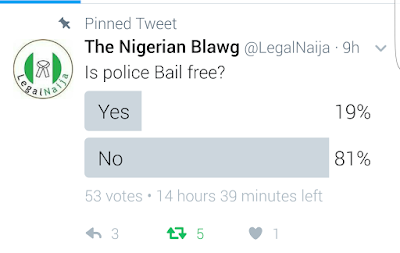
It has been made known time and time again,
that Police bail is free. The words “bail is free” have been recited by
officers of the Nigerian Police on several occasions, so –
 

1.     Why is bail still
collected in Nigerian police stations?
2.     What is the money
collected as bail used for?
On the 2nd of May, 2017, The
Punch Newspapers, broke a story about a 50 year old photographer who died
shortly after being released on bail. The said newspaper article is available here.
The photographer allegedly died as a result of torture in the hands of the
police but that allegation is being investigated and not the purpose of this
article. In this post, I will like to bring to the fore other elements of the
story.
According to the news report by The Punch
Newspaper, Mr. Kola Adeyeye, a photographer had been arrested alongside 4(four)
others. At the time of his arrest, no criminal allegation was made against him
and all he happened to be doing was drinking herbal concoctions at a local spot
where it was sold. Mr. Adeyeye was then taken to a Courtyard, where the head of
the Special Anti-Robbery Squad (SARS) team who made the arrest interviewed
them. The Head of the SARS team cleared them of any wrong doing but ordered
that they pay for bail before they could be released from detention. It was
learnt that while others paid between N25,000
and N40,000 and were set free, Mr.
Adeyeye was remanded because he could not raise the bail sum and was reportedly
kept in detention for 7 (seven) days until his pastor came to bail him with N3,500. N2000
was paid while the deceased’s phone was seized until he came back to pay the
remaining N1,500. Mr. Adeyeye then died
on the motorcycle that was taking him home.
From the above report, I have raised the
following questions that need to be determined;
a.     If bail is free,
how come the head of a Special Anti – Robbery Team could demand for it?
b.    If bail is free,
how come Mr. Adeyeye was not released from detention unconditionally even after
he was cleared of any wrongful act?
c.      If bail is free,
what happened to the monies paid by the other people arrested alongside Mr.
Adeyeye?
d.    If bail is free,
does it mean the Head of the Special Anti – Robbery Squad is himself a robber?
e.     If bail is free,
can the leadership of the Nigerian Police force admit to not knowing that bail
money is still collected in police stations across the country?
f.       If bail is free,
does it mean police officers who demand for bail are part of criminal racketeering
enterprise within the Nigerian police?
I will leave the questions to be answered
by the Inspector – General of Police or Mr. Yomi Shogunle, Assistant Commissioner
of Police, Public Complaints Rapid Response Unit, he can be reached via his
twitter handle @yomishogunle.
However, because bail is free, I will
recommend that if any police officer demands bail from you, please make a
complaint by contacting the Police Complaints Unit via 08057000001 or via the website
npf.gov.ng/complaint/ . Don’t forget,
just the way bail is free in Nigerian police stations, the police is also your
friend.
Adedunmade Onibokun, Esq.

Photo Credit – www.nigeriapolicewatch.com 
Joint Operating Agreements | Onyeka Obidi

Joint Operating Agreements | Onyeka Obidi


(10 years ago *gasp*, I wrote this essay –
which may or may not be terrible – on JOAs back in Aberdeen. Back then, I was
chomping at the bits to be done with my Masters and working in the oil field.
Alas… anyway, I was trawling through essays written back then, way back then
and I came across this one. I chuckled to myself as I read through it, and then
I decided to put it up and see what the public might make of it. Without
tweaking a word or editing – so forgive all typos and structural problems – here’s
my short essay on JOAs)
J

Oil exploration, no matter how rewarding it
is on the chance of said exploration being successful, is fraught with
extremely high risks, costs and liabilities. In order for oil companies,
especially international oil companies to go about exploring, developing and
producing hydrocarbon reserves, it is crucial and more advantageous for said
companies to pool their resources together thereby minimizing the risks, high
costs and liabilities that go hand in hand with petroleum exploration as well
as realizing maximum rewards. This is especially crucial due to the fact that
these companies will be based in different countries all over the world thus
increasing said risks and liabilities.


There are different ways via which oil
companies could form a joint venture through which this could be achieved and
the most common of these ventures is the Joint Operating Agreement.[1] This
agreement is viewed as being very beneficial to international oil companies due
to various reasons and the aim of this essay is to describe the key features of
this arrangement as well as highlight its advantages as opposed to other
agreements or types of joint ventures. This will be achieved by stating what a
Joint Operating Agreement is and then describing its key traits and benefits
ergo, explaining why international oil companies prefer to enter into such
arrangements.

A Joint Operating Agreement[2] is
a contractual agreement between two or more parties establishing and setting
out the terms of a joint venture between them under which petroleum
exploration, development and production operations will be conducted.[3] It
is the common means by which businesses come together as a joint venture in
their search for and production of oil and gas both within the United Kingdom
Continental Shelf and internationally. This agreement is regarded as very
important and necessary especially with reference to international oil
companies as the oil and gas industry is a high-risk, high-cost enterprise with
a heavy frontloading of costs.[4]
The JOA is known for its remarkable
features which distinguishes it from other forms of joint ventures. Firstly,
the JOA is not a legal entity. This agreement is purely contractual without the
involvement of any legal entity[5] as
the parties to the contract decide among themselves the manner in which their
joint objectives will be achieved.[6] As
stated by J. Ellison and E. Kling[7], ‘there
exists neither a single body of the United Kingdom law nor a distinct legal
entity dedicated to the formation and operation of joint ventures, neither is
there a dedicated body of law.’ This therefore means that the parties engaged
in this agreement can, in their discretion, agree on how issues like funding,
management etc. can be tackled, amongst other things.

Secondly, the co-venturers have no
authority to bind one another[8] i.e.
an operator or manager is interposed between the parties of the agreement and
the operation itself hence leaving them with no authority to bind one another
as agents.[9] Also,
the co-venturers attempt to create several liabilities.[10] This
is in the sense that there is a lack of mutual liability between the parties as
each co-venturer will be liable for his own acts and omissions in the course of
the arrangement.

Again, co-venturers take the fruits of the
venture separately and in kind[11] i.e.
each party has the right to take its share of petroleum in kind and dispense of
it separately in its own business. This is regarded as a very important feature
as it distinguishes the JOA from other forms of joint venture particularly
legal and/or corporate partnership. This shall be tackled further-on in the
essay.

These are but a few of the key features
which the JOA possesses, and this includes that of co-venturers having the
power to hold their assets in common. Regardless of how beneficial they may
seem, one cannot help but wonder why international oil companies choose to
enter into these agreements as opposed to the other ways via which a joint
venture could be established. This is due to the fact that these other
arrangements also achieve the same purpose of uniting different parties from
all over the world in their common goal of making profit yet reducing risks and
costs. An example of these forms of joint venture is the joint venture company.
This is an arrangement set up for the purpose of said joint venture as well as
acting as the company’s shareholder. It is regarded as the most popular legal
structure for joint ventures and is viewed as a separate legal personality from
the shareholders. This inevitably exposes the company to the financial and
commercial risks involved in the joint venture thereby protecting them from
losses, were the joint venture to fail[12].

Another form of a joint venture is the
partnership joint venture. Under the Partnership Act 1980[13], a
partnership is defined as ‘the relation which subsists between persons carrying
on a business in common with a view of profit.’ According to Kling and Ellison,
the establishment of a partnership gives rise to a vehicle that can be used for
the creation and operation of a jointly owned business.[14] In
this instance, theoretically[15],
a partnership offers the parties an independent identity i.e. the firm operates
under a name that is different from its partners and ‘may open a separate bank
account, may sue or be sued in its own name and may not appear to be affected
by the comings and goings of partners’[16]. This
form of joint venture is described by some[17] as
‘the most suitable form to use in instances where the parties wish to establish
a collaborative structure without the administrative formalities and the
accounting transparency of a corporate vehicle.’

As indicated above, there are different
ways via which international oil companies can go about the oil exploration,
development and producing business, however these companies have a preference
for joint operating agreements regardless of how suitable the other agreements
may seem. This is as a result of a large number of reasons. Firstly, unlike
other types of joint ventures, the JOA structure offers total tax transparency[18]. This
is due to the fact that there is an absence of a joint entity thus the parties
to the contract are able to deal with the tax on their own profit in accordance
with their own circumstances, as well as plan his/her own tax affairs
individually without interference from another party. According to Styles[19], ‘the
unincorporated joint venture has been favoured by the oil industry over other
possible models such as legal partnership or incorporation because of the tax
advantages it provides…which is possible under the JOA’. This is in sharp
contrast with the partnership venture.

Further, international oil companies,
particularly those holding smaller interests will benefit more from a JOA as
this arrangement possesses the unique ‘pass mark trait’. The pass mark is the
‘percentage interest share of votes which must be obtained before the Operating
Committee may make a binding decision[20].’ The
importance of this trait lies in the fact that parties with large interests
inadvertently hold the dominant position if a low pass mark is given and this
leads to those possessing lesser interests to lose out on the making of
important decisions during negotiation. Thus, the pass mark is hardly ever less
than 50 percent as it will inevitably lead to a large interest holder being
dominant. 70 percent is suggested as a common level[21],
although the outcome of agreeing on the exact pass mark depends on the degree
of trust the parties have in each other as well as their contractual strengths[22]. This
lays in sharp contrast to the corporate partnership whereby unanimity is of the
essence in all major decisions. There can be no negotiations between parties as
to a majority of votes. Rather, there has to be a unanimous agreement and this
could lead to time-wasting in decision making as parties might reach a
stalemate if a unanimous vote is not achieved as quickly and efficiently as
possible. As for the joint venture companies, especially under the United Kingdom
legislation, ‘the holder of a 75 percent interest can ensure the passing of a
special resolution…and anyone holding more than 50 percent will be able to
pass ordinary resolutions.’[23] This
suggests that a large interest holder could invariably possess the power to
make ordinary or even ‘special’ resolutions regardless of whether other parties
agree with his decision or not.

Again, the JOA has the advantage of its
formation being relatively easy as well as its mode of operation being informal[24]. With
regards to the former, there is a lack of an independent vehicle or body of law
prescribing formalities that need to be observed thus these arrangements can be
set in place economically and without any unnecessary fuss. This is in contrast
to the formation of a joint venture company as its formation is dictated by the
Companies Act 1985 thus rendering it more complex, time consuming and lastly,
costly. Regarding the latter, the mode of operation in a contractual joint
venture is relatively flexible as there is no joint venture vehicle in which
the parties have an equity interest unlike the joint venture companies and
partnership which are legal entities thus the dictates of the aforementioned
Act require a ‘more formal administrative framework especially in respect of
board meetings, general meetings or directors’ duties.’[25]
Another reason international oil companies
choose to enter into a JOA is due to the distinctive clauses the arrangement is
party to i.e. the sole risk and non-consent clause. With reference to the
former, if one fails to obtain the pass-mark, one could still go ahead with his
decision. As incompatible as this may seem to the idea of a joint venture, it
can be seen as a form of giving every member a chance regardless of whether a
pass mark is obtained or not. This is also evident in the latter (non-consent),
whereby the members who do not intend to participate in a decision agreed upon
by the majority does not do so. This gives everyone a chance to engage in their
own dealings and an opportunity buy themselves back into the engagements they
opted out of regardless of how large the premium could be.

With regards to ways in which joint
ventures could be terminated, JOAs are easier to terminate as they are
prescribed solely by contract and typically address a specific business project
hence they can end the arrangement if decided upon together or once the project
is over. This is unlike other forms of joint ventures like a partnership whereby
statutory rules have to observed before termination can take place e.g. the
Insolvency Act 1986 regarding liquidation and the Partnership Act 1980 on
issues of dissolution[26].

The biggest bone of contention lies within
the thin line between a partnership joint venture and the JOA. Members of the
JOA are adamant about their agreement not being mistaken for a partnership.
This is due to a number of reasons: tax benefits shall be lost if the agreement
is mistaken for a partnership, and minimisation of liability amongst the
parties to a JOA unlike those in a partnership. Again, under the JOA, each
party has the right to take and dispose of separately its share of the
petroleum gained. This clearly emphasises that the common enterprise of the
joint venture is limited to the exploration and production of the oil and gas
which the parties hold in common[27]. This
is different from a partnership whereby there is joint disposal of the product
for mutual profit. This is also similar to profit-making by the parties in a
partnership. As stated in the aforementioned Act[28], a
partnership constitutes of the sharing of profit by its parties and the mode of
taking separate profits in the JOA might be regarded as not being so
indistinguishable from the way profit is shared in a partnership. Although it
has been expressly stated that ‘it is not the purpose or intention of this
Agreement to create, nor shall the same be construed as creating,
any…partnership’,[29] the
courts are of the opinion that regardless of the express denial of any
formation of a partnership by the JOA, ‘if a partnership exists…no concealment
of name, nor verbal equivalent for the ordinary phrases of profit or loss…will
prevent the substance from and reality of the transaction being adjudged to be
a partnership.’[30] This
has led to the argument by G Lewis[31] that
a JOA ‘does not involve the sharing of gross returns,’ however ‘each
participant is entitled to and bound to take in kind its share of the crude or
the gas which is produced’ as well as being able to ‘sell its share for its own
account’. Hence, ‘these arrangements do not amount to a sharing of profits
which the Partnership Act definition requires and in effect the participants
share the expenses of the production, but sell the products separately.’
From all that has been stated above, one
sees that a JOA is extremely vital to ‘such powerful players as international
oil companies’ regardless of the slight confusion that could arise due to
arguments as to whether it is viewed as a partnership or not. The courts are
even deemed to be fairly reluctant to argue against what has been expressly
stated in a contract except if blatantly disregarded. Although other joint
ventures are important in their own ways, the JOA trumps them all as it covers
virtually all bases that international oil companies might view tentatively.
Therefore, it is not surprising in the least for one to be of the opinion that international
oil companies choose to enter into these arrangements.
[1] Also
known as a Contractual Joint Venture
[2] Hereby
referred to as a JOA
[3] T
Winsor and S Tyne, Taylor and Winsor on Joint Operating Agreements (1992), p
xix
[4] Styles
[5] Stephen
Sayer ‘Negotiating and Structuring International Joint Venture Agreements’ Vol
5 of the Dundee University CPML web journal:
http://www.dundee.ac.uk/cepmlp/journal
[6] J
Ellison and E Kling, Joint Ventures in Europe (1997) p 315
[7] supra
[8] G M
D Bean, ‘Fiduciary Obligations and Joint Ventures: the collaborative fiduciary
relationship,’ (1995) p 8
[9] J D
Merrals, “Mining & Petroleum Joint Ventures in Australia: Some basic
concepts,” (1998) p 909
[10] Ibid
G M D Bean
[11] Ibid
J D Merrals
[12] Ibid
Stephen Sayer ‘Negotiating and Structuring International Joint Venture
Agreements’
[13] Section
1
[14] Ibid Ellison
& Kling pg 329
[15] theoretical
because in practice the law does not regard its members as being independent in
English law and even if it was recognised the members themselves are still
party to unlimited liability.
[16] Ibid
Ellison & Kling
[17] Ibid
Stephen Sayer ‘Negotiating and Structuring International Joint Venture
Agreements’
[18] Ibid
Ellison and Kling p 317
[19] Styles
[20] Styles
[21] supra
[22] supra
[23] Dundee
[24] Ibid
Ellison and Kling pp 315-16
[25] supra
[26] Ellison and Kling p 317
[27] Stephen Sayer ‘Negotiating and Structuring
International Joint Venture Agreements’
[28] Partnership Act 1980 Section 1
[29] UKOOA 20th Round Draft Joint JOA, cl
21.2.1
[30] Adam v Newbigging (1888) 13 App Cas 308 at
315
[31] G Lewis, Comment: the Joint Operating
Agreement: Partnership or Not? (1986) 4 JENRL 80-84

Onyeka Obidi
Legal Counsel & Writer
Ed’s Note – This article was first published here
Photo Credit –
1. www.oilandgaslawdigest.com
2.  www.vancourier.com 
Critiquing the Provisions of the Lagos Anti-Land Grabbing Law – Prince Ikechukwu Nwafuru

Critiquing the Provisions of the Lagos Anti-Land Grabbing Law – Prince Ikechukwu Nwafuru


Proem
This article aims to
critique  the Lagos State Properties Protection Law, 2016 (“Anti-Land
Grabbing Law
” or “the Law”) for the purpose of  appraising the
likely efficacy of the legislation in tackling the menace of land grabbing and
identifying any potential shortfalls  that might hamper the effective implementation
of the Law and the actualization of the goals set for the Law.


Before going into the meat
of the piece, it is pertinent to state the importance of investor-friendly
business environment which has been identified as a sine qua non for
economic growth and development in any country. Therefore, it behooves every
government to improve its business operating environment and ease of doing
business in order to attract both local and foreign investors. The strategic
position occupied by the State of Lagos[1], Nigeria’s largest business and commercial city,
accounts for its choice as a relevant study location for business practices,
processes and regulations such as urban planning laws, land registry laws,
environmental laws, state laws, and local government taxes in the World Bank
Ease of Doing Business Survey which incidentally makes use as part of its key
indicators, acquisition and registering of properties. Unfortunately Nigeria as
a country has continued to be relegated to the bottom of the table in the World
Bank’s Ease of Doing Business Report[2] due to factors which include those discussed in
this work.

In a bid to address the
challenges affecting the business operating environment, particularly those
relating to the acquisition and ownership of landed properties, the Lagos State
Governor, Akinwunmi Ambode prior to the 2015 Governorship Election, made it one
of his campaign promises, the creation of more investor-friendly business
environment by improving the ease of doing business in the State. One of the
ways he proposed to actualize this was by flushing out land-grabbers and
outlawing their nefarious activities in the State. That promise, which could
have passed as “election campaign rhetoric”, was however, recently fulfilled
with the signing into law on 15 August 2016 of the Anti-Land Grabbing Law by
the Governor.
The menace of land
grabbing itself has always been with us as a country but the problem seems to
be more pronounced in Lagos as a result of its afore-noted strategic economic
position and the crucial need for land in the aquatic State. Land has often being
jocularly referred to as the “oil” of Lagos. Notwithstanding, the perennial
problem of land grabbing, the political will to legislate against it only
manifested with the enactment of the Anti-Land Grabbing Law of 2016. To be fair
to the previous administrations in Lagos, the Anti-Land Grabbing Law, contrary
to the widely held belief, is not the first legislative attempt to deal with
the issue of land grabbing. The Criminal Law of Lagos State, 2011 has
several provisions that are geared towards addressing some of the challenges
faced in land transactions and ownership such as forcible entry to land,
fraudulent alteration of title documents at the Land Registry[3] and other nefarious activities by land grabbers[4]. The 2016 Law, however, may well be described as the
most specific and most decisive so far.

Provisions of LPPL
The Anti-Land Grabbing Law
is by all means a short legislation. Therefore, a section by section
consideration of the provisions will be done in this work, in no particular
order, in order to aid proper understanding of the Law. In terms of structure,
the Law contains 15 sections with some of the sections having sub-sections
except sections 1, 5, 6, 7, 12, 13, 14 and 15. The language of the Law is
simple devoid of the antiquated diction often seen in most of our legislations
particularly those inherited from our colonial past. The dictional deviation is
commendable and reflects the modern approach to legislative drafting.

Definition/Interpretation
Section
Section 1 of the Law is
the interpretation section and has six defined terms, viz: “agent”,
access”, “construction activities”, “encroachment” “landed
property
” and “State”. For reasons that will be shown later, three
of these definitions will be considered in this work and they are reproduced as
follows:

Agent” is defined
to mean “a person who acts or purports to act on behalf of any party to a real
property transaction, whether in respect of a sale, lease, license, mortgage or
other dealings or disposal of, or relating to the property including any person
engaged for the purpose of forceful takeover of a landed property”

Encroachment”
means entry into another’s property without right or permission; trespass,
violation, intrusion and usurpation:”

Landed property
on the other hand means “a property, a parcel of land, an improvement on land,
a building, any land ancillary to a building, a site comprising of any
building(s) with any land ancillary to it”

One common trend with the
definitions is the use of the word “means” which suggests an intention to
restrict the meaning of the defined terms as against the word “include” which
when employed in interpretation section suggests a wider meaning. For instance,
the definition of “constructive activities” in the Law preceded with the word
“include” and this could also explain the draftsman’s intention to enlarge the
meaning of “constructive activities”.

As can be gleaned from the
afore-referenced definition of “agent”, it extends to a person engaged
for the purpose of forceful takeover of a landed property. The question is, can
an “agent” charged with any offence under the Law invoke as a defence,
the principle of agent of a disclosed principal? It is submitted that such
defence will not avail the agent as this principle only applies in civil cases.
Similarly, the concept of vicarious liability has no place in our criminal
jurisprudence, as the offender whether he acted as an agent or otherwise will
be personally liable for the crime committed either alone or together with the
principal depending on what the proof of evidence discloses. However, where the
facts and available evidence disclose the offence of conspiracy or aiding and abetting,
the conspirators whether acting as the agent or principal will be jointly
liable. The likelihood of charging together the offender and the principal is
very high given the definition of “agent” which as noted above extends to “any
person engaged for the purpose of forceful takeover of a landed property
”.
It is therefore very unlikely that the agent will be charged alone in such
scenario discussed above.

Another point worth
mentioning under this sub-head is the inconsistency in the use of the terms “land”,
“property” and “landed property” which refer to the same thing i.e. interest in
land. As one would observe, they are used interchangeably in the Law. One would
have expected consistency in the use of those terms to avoid confusion.
Nonetheless, the definition of landed property is wide enough to guide the
Court and in any case, land in law, includes anything affixed to land and
improvements thereon.[5]
Substantive Provisions
Sections 2, 3, 4, 5, 6, 7,
8, 9, 10 and 11 of the law create various offences. Some of the
offence-creating sections however, do not provide for punishments for the
respective offences created therein and the effect of this legislative lapse
will be considered later in this work.

Forceful Take-over
of Landed Property
Section 2(1) prohibits the
use of force or self-help to take over any landed property or to engage in any
act inconsistent with the proprietary right of the owner. The use of the
disjunctive “or” means that the offence under subsection 1 of section 2 can be
committed in two alternative ways, viz: (1) “use of force or
self-help to take over any landed property” or (2) “use of force or self-help
to engage in any act inconsistent with the proprietary right of the owner”. The
Law does not define “self-help” or “force” and recourse will be made to an
external aid in construing these words. It is safe to assume that self-help
includes using any measure not prescribed or permitted by the law to take over
any landed property, often referred to in local parlance as taking the law into
one’s own hand.

A property owner can be
found criminally liable under the first limb of the subsection if he employs
force or self-help to eject a trespasser on his property. As can be deduced
from the letters of the Law, a property owner is required to follow due process
in ejecting a trespasser or enforcing his right in any property and it is not a
defence to the offence under section 2(1) of the Law that the property belongs
to the offender. It remains to be seen whether the defence of bona fide claim
of right under section 23 of the Criminal Law of Lagos will avail a property
owner caught by this subsection.

Section 2(2) gives a
three-month window period to any person or persons who use force to take over
any landed property before the commencement of the Law, to vacate the property.
Failure to vacate the property and remaining in possession of the said property
three months after the commencement of the law will expose the defaulter to an
offence under the sub-section. By calculation, three months after the
commencement date of 15 August 2016 (i.e. the day the Governor gave his assent)
would have lapsed on or about 14 November 2016.[6] It has been argued that the provision of section
2(2) appears to convey a retroactive effect given that the actus reus of
the offence, which is the “use of force to take over a landed property”
predates the Law.[7] However, this impression can be doused since the
law does not seek to punish the offender for what has been done in the past but
makes the continuous infraction of “remaining or being in unlawful possession
of another’s property”, the sole physical element of the offence. It was
further argued that the way to make the provision of section 2(2) clearer is to
delete the seemingly retroactive aspect from the text of the subsection and
make the act of “remaining or being in unlawful possession of another property”
the sole element of the offence.[8]
I cannot agree more with
the above view except to add that even in the absence of such suggested
amendment, the provision as it is, is still capable of curbing the mischief
which it sets out to cure. It will be preposterous for an offender who has been
in unlawful possession of another’s property after the expiration of the three
months grace period to be heard arguing that he entered into possession prior
to the commencement of the Law. Thus, aside the civil remedy available to the
property owner which can be defeated by laches and acquiescence if not enforced
within a reasonable time, a liberal interpretation of this provision will
clearly reveal the legislative intention which is to forestall an act of being
in unlawful possession of another’s property. The emphasis, as noted by Okanga[9], should be on “remaining in possession” which by its
nature and in my view is a positive act. Viewed differently, remaining in
possession in such circumstance could also amount to encroachment and the
offender can be charged under section 4 of the Law for being an encroacher
provided there is a prior demand for him to leave the property and it is of no
moment that he entered into possession prior to the commencement of the
Anti-Land Grabbing Law.

What is not clear under
section 2(2) is whether a property owner who uses force to retake possession of
his own property and so remains in possession three months thereafter can be
criminally liable. One would have expected the draftsman to include in section
2(2), a similar provision as found in section 3(2) of the Law to the effect
that a person’s right to possession or occupation of a property shall not
constitute lawful authority for the use of force to retake any property. In my
view, a property owner can be found criminally liable under section 2(2) as
there is nothing in the Law to suggest otherwise. The mischief that is sought
to be prevented under section 2 generally is the use of force to take over any
property, whether by the owner, or owner’s agent or by a trespasser. It is not
therefore a defence that the offender has a right to possession or occupation
of the property as the Law expects such owner to follow due process of law in
recovering or retaking possession.

An offender under the
provisions of section 2(1) and (2) is, on conviction, liable to ten (10) years
imprisonment.

Threat or Use of
Violence to secure Entry into Landed Property
Section 3(1) of the Law
criminalizes the use or threat of violence for the purpose of securing entry
into any landed property either for oneself or for another, without lawful
authority. As already noted earlier in this work, a person’s right to possession
or occupation of any property shall not constitute lawful authority or a
defence for the purpose of this section. As can be seen from subsection 3
thereof, the offence is committed whether or not the violence is directed
against the person or against the property provided the violence is intended to
secure entry for the purpose of acquiring possession of the property or for any
other purpose. Section 3(4) creates two categories of punishments – thus, while
section 3(4)(a) provides for ten (10) years imprisonment for an offence of
forceful entry, section 3(4)(b) provides for four (4) years imprisonment for
any person who (i) makes forceful entry with fire arms, offensive weapons, or
any obnoxious or chemical materials (ii) is in company of any person so armed
or (iii) wounds or uses violence on any person. It follows that the cumulative
punishment for an offence under section 3(1) is 14 years depending on whether
such offender makes use of fire arms, offensive weapons, or chemicals as
provided under the sub-section.

It has been argued that
the provisions of the Anti-Land Grabbing Law is not applicable to tenancy
relationship[10], perhaps (though not so expressly stated), in view of
the provisions of section 44 of Tenancy Law of Lagos State, 2011 which
prohibits forceful ejection and re-possession and further provides for a
punishment of a fine not exceeding Two Hundred and Fifty Thousand Naira
(N250,000:00) or a maximum of six (6) months imprisonment for an offender.

My view on this is
different as there is nothing in the Anti-Land Grabbing Law that precludes its
application to landlord/tenant relationship. A landlord or a lessor who
threatens or uses violence or force or self-help to eject a tenant or lessee
from his property can be held criminally liable under section 3 of the Law. Of
course, the facts of each case will determine whether to charge under the
Anti-Land Grabbing Law or under the Tenancy Law. To further drive home the
point, the afore-quoted definition of “agent” under section 1 of the Anti-Land
Grabbing Law is wide enough to include the agent of a landlord. In fact, the
words “lease” and “license” were both mentioned in that definition and tenancy
includes lease. Similarly, section 47 of the Tenancy Law defines “tenancy” as
“holding of interest in land or property by a tenant under a tenancy agreement”
and goes further to define tenancy agreement as “an agreement whether written
or oral, express or implied between a landlord and a tenant regarding possession
of premises and use of common areas and includes leases and
sub-leases
.”

Therefore, it can be
argued that the provisions of the Anti-Land Grabbing Law on use of force,
self-help or violence to retake possession complement the Tenancy Law provision
and the prosecutor will readily resort to the former given the more severe
punishment provided therein as against the 6 months imprisonment or paltry fine
of 250,000,000 provided in the latter.

Illegal occupation
of Landed Property (Encroachment)
Section 4 criminalizes any
encroachment on peoples’ properties and provides for fine not exceeding N5
million or 5 year imprisonment or both, against any such encroachment. A
condition precedent for the activation of the offence is a demand by the owner
or his agent that the encroacher leaves the property and it is only when the
encroacher fails to leave after such demand that an offence is committed.
Okanga in his afore-referenced article has queried the absence of timeline
within which the encroacher shall vacate the property after being asked to
leave and opined that there exists a vacuum in this regard. In my view, the
demand period should be reasonable depending on the circumstances of each case.
For instance, if the property is developed, the timeline will be longer to
enable the encroacher remove his belongings from the property. Another lacuna
in the Law is the failure to provide for the form the demand will take – will
an oral demand suffice? It is safer to put the demand in writing as it will be
easier to prove a written demand coupled with the fact that such written demand
will ordinarily state the timeline within which the encroacher shall vacate the
property.

Section 4(2) seems to have
expanded the definition of “landed property” by providing that “a reference to
property includes reference to an access to the property, whether or not such
access itself constitutes property within the meaning of this Law”.
Incidentally, the Law only defines “landed property” and not “property”. In the
writer’s view, such extended definition is not necessary given that the right
of way is often appurtenant to proprietary right and the extent of such right
is a question of fact. The section also goes further to provide that any
person who enters into occupation of any property by virtue of any title
derived from an encroacher or license or right given by an encroacher shall
himself be treated as an encroacher.

Encroachment with
Weapon
Section 7 addresses
encroachment with firearms or dangerous/offensive weapons and provides for punishable
of ten (10) years imprisonment. What constitutes “firearms” or
“dangerous/offensive weapons” will be left to the court to decide, relying on
external aids, as the Law provides no guide.

Use of Agent for
Forceful Take-over of Landed Property
Section 5 complements the
provisions of section 3 on the use of force by prohibiting the placing of land
agent on any land or landed property for the purpose of forceful takeover of
the said land. On the surface, it will appear that no punishment is provided
for the offence created under section 5 of the Law. Were this to be the case,
it would mean that no person can be convicted for the said offence based on the
legal principle to the effect  that no person shall be convicted of a
criminal offence unless that offence is defined and the penalty is prescribed
in a written law. This principle which is in section 36(12) of the Constitution
of the Federal Republic of Nigeria, 1999 (as amended) was applied in the case
of Aoko v. Fabgemi (1961) 1 All NLR 400. However, a closer
look at Section 3(4)(a) will reveal that the punishment provided therein will
cover the offence created under section 5 of the Law. Section 3(4)(a) of the
Law provides that “any person who commits the offence of forceful entry under
the provisions of this Law” shall on conviction be liable to
ten (10) years imprisonment. What follows is that the offence of forceful
takeover by whatever means is punishable under section 3(4)(a) of the Law.
Similarly, where the offender is armed or is in company of a person who is
armed, section 3(4) (b) will apply as well. Thus, section 3(4) is a
one-size-fits all punishment provisions for the offence of forceful entry under
the Law.

Illegal Use of Law
Enforcement Agent/Vigilante Group to enforce Judgment
Another offence-creating
provision that is silent on punishment-provision is section 6 of the Law which
prohibits the illegal use of law enforcement agent, vigilante group, ethnic,
cultural/traditional militia to execute the Judgment of a Court under. The
reason for omitting the punishment provision by the lawmakers is not clear;
neither is it clear what consequence will flow if someone commits the offence
under the said provision. It is submitted that there is no legal consequence
for committing the offence under section 6 of the Law in view of the express
provision of section 36(12) of the Constitution. However, flowing from the
preceding analysis in respect of section 5 of the Law, and given that illegal
use of Law Enforcement Agent or Vigilante Group will sometimes (but not always)
entail the use of force, it can be argued that an offence under Section may be
punishable under section 3(4) of the Law provided that the illegal use of law
enforcement agent or vigilante group involves “force” in a bid to enforce the
Judgment and take over the landed property. Other than this arguable, limited
and possible application of section 3(4) to the offence created under section 6
of the Law, it is doubtful if any punishment will be imposed on any person
found liable for illegal use of law enforcement agent or vigilante group to
enforce Judgment.

Sale of Property
without Authority
Section 8 of the Law
provides three categories of offences in relation to sale of landed property.
First, under section 8(1)(a) of the Law, any person who “offers for sale” any
property knowing that he has no lawful title to the property or the authority
to offer for sale is criminally liable on conviction to a fine of N500,000.00
or six months imprisonment or both. All that is required to ground this offence
is to “offer for sale” and it is not a defense that the actual sale was not
consummated. Knowledge plays a very important role under this category as the
person selling or offering for sale must know that he has no lawful title at
the material time. It is submitted that where the seller establishes that he
has a bonafide claim or honest belief that the land belongs to him, such claim
or belief is capable of vitiating the requisite mens rea necessary
to ground conviction provided there is evidence to support such claim.

The second category of
offence is provided under section 8(1)(b) & (c) of the Law which is
targeted at the actual sale. Thus, a person who “sells” a property knowing that
he has no lawful title to the property or that the property has been previously
sold by him or his privies or without the lawful authority of the owner sells a
property entrusted to him is criminally liable on conviction to a fine not
exceeding 100% of the value of the property or to imprisonment for five years
or both and the property shall revert to the lawful owner. By providing that
“the property shall revert to the lawful owner”, the Law seems not to have
taken into consideration, a situation where it will be impossible to so do,
such as where an innocent purchaser without knowledge of the defect in title
has made substantial improvement on the property. Even in our civil
jurisprudence, a court will not order specific performance of a contract for
sale of land where a third party had acquired the subject matter of the contract.
Specific performance will, in such circumstances, be defeated by the concept of
impossibility of performance.[11] Thus, section 8(1)(b)(c) did not consider the
impossibility of reverting the property to the lawful owner in such
circumstance as noted above and to further demonstrate the injustice that will
arise from strict application of the subsection, no remedy is provided for the
innocent third party who may have invested heavily in improving such property.
The purchaser no doubt has his remedy in civil court against the seller who
sold to him without lawful authority.
The third category of
offence under section 8 which incidentally carries the heaviest punishment
under the Law is at section 8(2)& (3). Under these subsections, it is an
offence (i) to sell or cause to be sold, a family land or property without the
consent of the family head and other accredited family members (ii) to sell
Government land or property without the consent of the authority of the State,
(iii) to sell or offer for sale any land that has been previously sold without
a Court Judgment repudiating the initial sale. Any person or persons convicted
for any of the offences under this category shall be liable to twenty-one (21)
years imprisonment. Again, as noted by Okanga, the subsequent seller of the
property must be aware of the previous sale at the time he was attempting to
make the subsequent sale as it would be absurd for the law to sanction a vendor
who genuinely sells his own property. I agree with this view as it further supports
my earlier position that a bonafide claim of right can vitiate the requisite
mental element required to ground conviction under the section. Even though
knowledge of previous sale is not specifically mentioned in this category 3
offence, the severity of punishment is such that the prosecutor will be
required to prove beyond reasonable doubt that the seller knew or ought to know
that the land has been previously sold.

Professional
Misconduct
Section 9 targets
professionals such as lawyers and estate agents who engage in professional
misconducts in respect of land transactions. The professional misconducts
prohibited under section 9(1) and (2) of the Law are: (1) facilitating
contractual agreement between land owning family and any other party in contravention
of the Law or any other law; and (2) execution of Court Judgment without
following due process as provided in the Sheriff and Civil Processes Act or any
other law. Going by the provision of section 9(3), contravention of the
provisions of section 9(1) by a professional
constitutes an offence of aiding and abetting the commission of such offence.
This is a laudable provision as it will curtail professional malfeasances often
seen in land transactions. Clearly, the offence created under section 9(1) is
aiding and abetting. Thus, a professional who facilitates contractual agreement
between parties knowing that such contract will contravene any provision of the
Law or any other Law is liable to face the punishment provided for that
offence. Illustration will aid a better understanding if this provision. If Mr
A who is a lawyer facilitate or prepares an Agreement for a sale of land by Mr
B to Mr C, and such sale is contrary to say section 8 of the Anti-Land Grabbing
Law, Mr A commits the offence of aiding and abetting the offence created under
section 8 thereof and will be liable for the punishment provided under the said
section 8 of the Law. The above illustration is not exhaustive of possible
scenario where a professional can be found criminally liable for aiding and
abetting under the Law or any other law. However, there is a lacuna in section
9(3) in view of the fact that the offence of aiding and abetting is only
restricted to facilitating contractual agreement under section 9(1) without
more. It does not extend to the offence of executing Judgment without following
due process under section 9(2) of the Law. Thus, it remains to be seen what
offence, a professional will be charged with if he is suspected of aiding and
abetting illegal use of law enforcement agent or vigilante group to enforce
Court Judgment under section 6, as there is no specific punishment for the
offence created under the said section 6 as already noted above. It is
suggested that the Law be amended to address these obvious shortfalls.

Section 9(4) of the Law
provides that any professional found guilty “under the provisions of the Law”
shall be reported to the relevant professional body for misconduct and
necessary action. A holistic consideration of the provisions of section 9 will
reveal that the only offence created under the said section is the offence of
“aiding and abetting”.

False and Frivolous
Petitions
In other to minimize
incidents of false and frivolous petitions, section 10 specifically prohibits
writing of frivolous and unwarranted petitions to any Law Enforcement Agency
knowing the content to be false. The Section further makes it a statutory
requirement for a petitioner to accompany with his petition a sworn declaration
in form of Affidavit. Surprisingly, no punishment is provided for the offence
of writing false and frivolous petition under the section. However, the only
consolation in the midst of this legislative lapse is that such a petition
writer will be exposed to perjury[12] since the petition as a matter of law must be
accompanied by a sworn affidavit. Thus, the fear of perjury alone is enough
deterrent to false and frivolous petitions.

Illegal Demand for
Fees
Another laudable provision
in the Law is section 11 which addresses the recurrent issue of illegal demand
for fees and all sorts of levies by the “Omonile”. It prohibits any person from
demanding either personally or through an agent any fee or levy in respect of
construction activities on any property or from disrupting construction work.
There is however, a proviso in section 11 to the effect that the section shall
not prohibit land owning families under the authorization of family head to
demand customary fee for possession from buyers or ratification fees pursuant to
Court Judgment. What qualifies as customary fee for possession or ratification
fees is left to conjecture as no clue or definition of these vague terms are
provided under the Law. It is submitted that a lot of illegal demands and
extortions can still be made under the guise of “customary fee for possession”
as all that is required is to have the support of family head to legitimize
such extortion. The only good news is that a person who has paid such customary
fee to the family head cannot be subjected to subsequent demands or extortions
by the Omonile as often seen in most parts of the State
especially where a construction work is about to be commenced. It is advisable
that the person making the payment insists on having a receipt to serve as a
proof of such payment in the event of subsequent demand by any other group
under whatever guise.

An offender under section
11 is liable to a fine not exceeding N1 million or two years imprisonment or
both.

Other provisions
The Law establishes a Task
Force under section 12 without specifically providing for its duties except the
general power to enforce the Law. It is also not clear whether the Task Force
can sue or be sued. It is submitted that even in the absence of such express
provision, the Task Force can be sued for any act done under the Law in view of
its power under section 13 to arrest offenders. The power of arrest under the
Law can also be exercised by any other Law Enforcement Agency or Unit in the
State.

Section 14 provides that
Special Offences Court or any other Court shall have jurisdiction to try
offenders under this Law. Lastly, section 15 is the citation and commencement
section.

Conclusion
In the preceding
paragraphs, I have critically considered the provisions of the Law and the
target menace of land grabbing, which manifests in many forms such as forceful
takeover and possession of landed properties, encroachment, illegal sale and
resale of land, illegal use of Law Enforcement Agents and Vigilante Groups to
enforce Judgments, misconducts by professionals in land transactions, writing
of frivolous and false petitions, unlawful demands by Omonile,
touting, amongst other ills which have become the nightmare of stakeholders
involved in land transactions. Like in most legislations, few lacunae have also
been identified, particularly the failure to provide punishments for some of
the offences created in the Law, which failure, as earlier noted, has the
effect of hampering the effective implementation of the Law, particularly the
affected provisions. Notwithstanding the few identified lapses, the Law is
nonetheless laudable and will go a long way in curbing land grabbing in the
State. I have also made reference to some provisions of the Criminal Law of
Lagos State, 2011 which I believe will complement the provisions of the
Anti-Land Grabbing Law, in checkmating the incidents of land grabbing in the
State. To achieve this and more, there is a need for the necessary will power
and mechanism to ensure proper implementation and enforcement of the law as the
objectives of the Law can only be achieved when its provisions are implemented
to the letter and without fear or favour. It is hoped that this think piece
will guide the lawmakers in possible future amendment as well as provide the
needed insight for other States that might want to enact a similar legislation.
[1] Lagos is reportedly the 5th largest economy in
Africa.
[2] For more on the Ease of doing business, see this
writer on “Suspension of FRCN Codes of Corporate Governance: Lessons Learnt”,https://www.linkedin.com/pulse/suspension-frcn-codes-corporate-governance-lessons-learnt-nwafuru –
published 12 December 2016,  the article discussed in some details,
Nigeria’s current position in World Bank Ease of Doing Business Report..
[3] See for instance, sections 52 and 53 of the
Criminal Law of Lagos State, 2011 which respectively provide for the offences
of forcible entry into land in actual and peaceable possession of another and
illegal possession of land without a claim of right in a manner likely to cause
a breach of the peace. The offences under sections 52 and 53 are punishable
with 2 years imprisonment. Similarly, section 56 of the Criminal Law also
prohibits threat to break or damage a residential house and offenders risk one
year imprisonment or 3 years imprisonment if the offence is committed in the
night. See also the offences of concealment of register of title and deed of
assignment evidencing title to land at sections 286 and 288 of the Criminal Law
of Lagos 2011 respectively.
[4] Section 324 of the Criminal Law of Lagos,
2011 which specifically targets the activities of Land speculators and
professional misconduct of real estate lawyers provides as follows “Any
person who, being a seller or mortgagor of any property or being the solicitor
of agent of any such seller or mortgagor, with intent to induce the purchaser
or mortgagee to accept the title offered or produced to him, and with intent to
defraud – (1) conceals from the purchaser or mortgagee any instrument to the
title, or any encumbrance; or (2) falsifies any false pedigree on which the
title depends or may depend; or (3) makes any false statement as to the title
offered or conceals any fact material to it, is guilty of a felony and is
liable to imprisonment for seven years.”
[5] The principle is quic quid plantatur solo
solo cedit
 – meaning whatever is affixed to the land becomes in
contemplation of law as part of it. What this implies is that once a party is
adjudged to be the rightful owner of the land in dispute, such land together
with what is on it automatically becomes his.
[6] In Akeredolu v. Akinremi (1985) 2 NWLR
(Pt.10) 787
, the Supreme Court held that computation of months or years
is done in days.
[7] See Okanga Okanga “Understanding the Lagos State
Properties Protection Law, 2016”https://www.linkedin.com/pulse/understanding-lagos-state-properties-protection-law-2016-okanga –
accessed on 07 January 2017.
[8]Ibid
[9] Ibid
[10] Ibid
[11]Oshafunmi & Anor v. Adepoju & Anor(2014)
LPELR-23073(CA)
[12] Perjury carries the punishment of 7 years
imprisonment under the Criminal Law of Lagos, 2011. Writing of frivolous
petition may also give rise to any of the offences under sections 94 – 96 of
the Criminal Law, 2011 which relate to making false accusation and false
statements.

Prince Ikechukwu Nwafuru
Associate at Paul Usoro & Co

Ed’s Note – This article was fist published here


Photo Credit – www.akinwunmiambode.com 
Bail Conditions for Nnamdi Kanu- Just or Unfair? | Gbenga  Odugbemi

Bail Conditions for Nnamdi Kanu- Just or Unfair? | Gbenga Odugbemi

There has been dense discussions on the trial and especially, the bail conditions of the leader of the Indigenous People of Biafra – Nnamdi Kanu – recently at the Federal High Court sitting in Abuja. It’s quite unruly for lawyers or specialists in law, especially specialists in criminal law to conclude that the Federal High Court’s ruling and bail conditions are too severe. At most, the bail conditions is a confluence of acceptable conditions and some which are unacceptable – because they touch on constitutional provisions in Chapter 4 of the Nigerian Constitution. 

The bail conditions as deductible from the court’s ruling are that: 
1. Mr. Kanu must not hold rallies.
2. He must not grant interviews.
3. He must not be in a crowd of more than 10 people.
4. He must provide three sureties in the sum of N100 million each.
5. One of the sureties must be a senior highly placed person of Igbo extraction, such as a senator. 
6. The second surety must be a highly respected Jewish leader
7. The third surety must be a highly respected person who owns landed property and is resident in Abuja FCT.
8. He must not leave Nigeria till his trial commencement on July 11 and 12, 2017 as he must deposit his Nigerian and British passport with the court.
9. He must provide the court with reports on the progress of his health and treatment on a monthly basis.
The condition is a mixture of acceptable tenets and those unacceptable as mentioned above. The first 3 conditions are clearly unacceptable. They are not stringent, rather, they are illegal and unconstitutional. The accused is still a suspect under the fair hearing doctrine enshrined in section 36 of the constitution, thus, whereas some rights are taken away from convicts, the accused is yet to be a convict. So, it baffles me and I am sure it does baffle other legal minds why the court descended so low and violate clear constitutional provisions. A condition restricting the accused from granting interviews to no one and disallowing him from holding rallies contravenes section 39 on freedom of speech, and freedom of association in section 40. The condition that the said accused can only be in a crowd of no more than 10 people also offends the right to freedom of association. The court clearly erred in submitting these first 3 conditions. It is quite appalling. The consequence, and what the court is trying to say is that, in some situations, even when you’ve not been convicted of any offense, your freedom of speech and to association could be taken away. This type of ruling puts us few step backward in the legal development journey. This is because, since this ruling was made by the Federal High Court, it would become a precedent for lower courts in future hearings. It’s a bad precedent. 
However, aside from the first 3 conditions which are absurd, and clearly illegal and unconstitutional. Agitators and unwary legal minds must be cautious of the remaining conditions, as they are prudent. The fourth condition requires that the accused supply three sureties, in the sum of N100 Million each. Candidly, maybe the amount is excessive, but this requirement is conventional in criminal law practice – that a person seeking bail brings sureties, so, argument contesting this condition I believe should address the amount attached to it, not the condition itself. Even, as regards the amount, the amount does not seem totally outrageous, it might seem excessive, but the accused definitely has such sureties on deck. For example, the Governor of Ekiti State, and the former Minister of Aviation were at the ruling to show solidarity with the accused, they could stand as sureties for the accused. These people are worth more that USD100 Million. 
The qualifications of the sureties have been a subject of controversy as well, with many saying the requirement that the first surety be a senator is outrageous. Of course, from the understanding that we only have Senators of the Federal Republic of Nigeria and not Biafra, most Senators would be reluctant to be a part of what could ‘disintegrate’ Nigeria, as most Nigerians qualify Kanu’s efforts. However, this line of argument is not entirely flawless. What the court said was that the first surety should be a senior highly placed person of Igbo extraction, followed by “such as a Senator” – ‘such’ as used signifies an ‘example-given’ (e.g.). It thus means using the ejusdem generis rule of interpretation, an Obi, Ebube Dike, Ikemba, Uba zuo oke, Eze, or anyone considered ‘highly placed’ in Igbo tradition would suffice. In essence, the court does not require that the first Surety be a senator as most people are saying – that would be absurd going by the reason explained above. The court is aware of the unlucky circumstance requiring a senator strictly would imply. 
The qualification of the second surety that the accused present a Jewish leader also might seem as highly sophisticated, and too stern. However, a closer look into the nitty-gritty of the case and prior depositions of the accused shows that this condition is also reasonable. The accused had previously conferred with the court that he is NOT a Christian or Moslem, but that he practices Judaism. The question thus is not “can the court ask the accused to present a Jewish leader as surety as a bail condition?”, the question is “can the court require that the accused present a spiritual leader as a surety as a condition for bail?’. If we answer the latter question in the affirmative, which I believe is quite conventional in Nigeria – i.e. that courts often require that an accused seeking bail bring his spiritual leader as surety – then, asking the accused to bring a spiritual leader from his belief is only habitual, not arbitrary. Perhaps, if the accused had chosen from the two main religions – Islam or Christianity – when asked about his religion/faith in court, most likely, the court would have asked the accused to present a Pastor or an Imam cleric. The accused exercised his right to freedom of religion in section 38 of the constitution, and that is alright. He is, therefore, the author of his own predicament if finding a Jewish leader is difficult in the Nigerian setting. Still, it must be clear, that this condition is quite fair.
I believe the qualification of the third surety – owning a landed property in Abuja FCT – the jurisdiction of the trial court is not a cause of debate, as this is almost a norm in bail hearings in Nigeria. The same goes for restricting the movement of the accused pending trial. Thus seizing the passports of the accused is only standard, since the idea of bail is to allow the accused leave prison premises, but to come back on the set trial date. Allowing the accused hold on to his passport can put these considerations into extreme jeopardy. For example, the accused is also a British citizen, if he manages to travel to the UK during the bail subsistence, it might be difficult to extradite him back to Nigeria. 
Although the above scenario is doubtful, especially since the UK government is a partisan in this case. The Nnamdi Kanu’s case has been the only case where the British government has refused to help her citizen in extreme turmoil, despite the fact that the accused has been held in prison without a proper trial since 14th October 2015. The British government has refused to offer her help to the accused because according to the Parliament under the Secretary of State for Foreign and Commonwealth Affairs – James Duddridge in 2015 – the accused has not asked for the British government’s help. When do citizens have to ask the government for her help in obvious danger?, the British government has chosen to hide behind this effigy, whereas its mind state is to support Nigeria as a country – since Nigeria is her product, and naturally, no one wants what she created to get destroyed or become disintegrated. The Biafra agitation is thus inept to the British government, letting Nnamdi Kanu rot in prison is a sacrifice the British government is not scared of making. Thus efforts are being given to the Nigerian government to conquer Biafra subliminally, this is directly apparent also especially when one considers the British government role in the Nigerian Civil War when Biafra forcefully intended to break away from Nigeria. 
Lastly, the condition that the accused supply the court with updates on his health condition and treatment is only normal since according to the court, the accused is being considered and granted bail, mainly because of his health condition which is deteriorating. The court itself admits the Nigerian prison is bereft of such expertise, workmanship, and instruments needed in taking care of the accused. The grant of bail on this basis is laudable since only the living can stand trial. The requirement of care update is therefore also reasonable, the court wants to be sure that the accused is not utilizing the time given to him to take care of himself for other purposes such as the one that led to his arrest and arraignment. 
In conclusion, Biafra agitators and her legal minds should not consciously blind themselves to well-established principles in criminal law practice in Nigeria, especially when it comes to bail hearings, just because the concerned accused is their leader. Truthfully, some of the bail conditions are unreasonable, but the majority of them are also reasonable, only if one examine the rationale behind them closely. Also, although bail conditions might be fact-specific, thereby affirming the ‘subtle’ strange conditions of the accused’s bail; still, bail conditions that directly interfere with constitutional provisions cannot be substantiated in law. This explains why the first 3 bail conditions cannot stand, but the remaining definitely will stand, even on appeal.
Gbenga Odugbemi
4/25/2017.