Special Invitation to Young Lawyers Forum (YLF) NBA Party

Special Invitation to Young Lawyers Forum (YLF) NBA Party


All attendees of
@nbaconferenceng are specially invited to the Biggest Party at the NBA
Conference hosted by The Ikeja Branch of NBA Young Lawyers Forum (YLF) in
collaboration with other YLF Branches in Lagos State. 


Date: Tuesday, 22nd August,2017

Time: 7pm till you are tired

Venue: Farmcity, opposite Dominos, Admiralty road, Lekki Peninsula, Lekki. 


Dress Code – White 

NB: Attendance is FREE but strictly by
reservations. All Guests and The Chairman of each YLF Branch nationwide should
please contact: Grace: 08062465746 or Musa: +234 802 532 5113 to make
reservations.
Its a night for celebrity special appearances,  music, dance, drinks and
food. Special appearances include Flip Tyce ( Ace Music producer and artiste.
producer of Jenifa’s dairy soundtrack, P-Square chop my money, Yemi
Alade-KISSING e.t .c); Award winning commedians-MC Triple U and MC Ukwa. Chief
Host: Charles Ajiboye,Esq.(Chairman,NBA-YLF Ikeja) @ajiboyecharles

Ain’t no party like a lawyers party cos a
lawyers party always rocks

Lawyer’s Advice On Why Employer Must Give Reason For Termination Of Employment | Kayode Omosehin

Lawyer’s Advice On Why Employer Must Give Reason For Termination Of Employment | Kayode Omosehin

Why Employer must give reason for
termination of employment

From a review of 257 employment cases
decided by Nigeria courts, 17 by Canadian courts and 81 by the English courts,
I have observed that the relationship between an employer and a worker neither
starts nor end with equal bargaining power notwithstanding that it is created
and determined by mutual agreement. The employer will always have an advantage
over the employee. One of the most apparent instances of such inequality of
positions is (or what used to be) the employer’s power to hire and fire a
worker for good, bad or no reason at all. This was so for many in years in
simple employment contract. However, the law is constantly changing to ensure a
greater level of protection for the workers.


Termination without reason is unlawful
Times have changed in labour relations. The
employer’s power to hire and fire for bad or no reason is no more without
financial consequence to the employer. For an employer to validly terminate a
contract of employment, the employer is required to do so for a reason, and of
course, a good reason. An employer is also required to state the reason in the
letter of termination of employment. This requirement holds in all employment
cases, whether the employment enjoys statutory protection or is that of a
master-servant kind.

Under the Nigerian labour law, every
employment contract can now only be terminated with cause –and a good cause. An
employment which is terminated without any stated reason is presumed to have
been terminated without good cause, and, therefore, unlawful. For instance, in
a decided case, the court held that a termination of employment was wrong as it
was not done with any reason. The letter of termination of the employment was
reviewed. It contained nothing on the reason for the termination of the
employment except “your services are no longer required”. The court
held that “services no longer required” is not a valid ground
for termination.

Reason for termination must be proved by
credible evidence
Where an employment is terminated for a
reason, the law imposes a duty on the employer to justify any reason given for
the termination. Usually, if the reason stated in the letter of termination is
disputed by the worker, the employer must then prove to the Court during trial
that, indeed, the worker was justifiably disengaged. What amounts to credible
evidence depends on the facts of each case, the law of evidence and other
procedural laws as well as the judicial discretion of the presiding judge all
of which involve intricate and complex balancing. For instance, in between
one Nwako and the First City Monument Bank Plc¸ the
Claimant, a branch manager of the defendant bank, was dismissed for releasing
ATL (Authority To Load) to a customer of the bank without any cash lodgment,
thereby causing the bank a loss to the tune of N24,806,550.41. In justifying
the reason for the Claimant’s dismissal, the bank tendered during trial, and
the Court was satisfied with, the relevant Credit Appraisal Memorandum, the
offer letter of credit facility and the provisions of Credit Guidelines and
Sanctionable Offences Policy of the bank which the Claimant ought to comply
with before releasing the ATL as well as evidence of the Claimant’s failure to
comply with them.

Reason for termination must comply with
international labour best practices
The National Industrial Courts in Nigeria
are now required by law to take cognizance of international best practices in
labour relations when deciding matters on employment disputes. This implies
that a decision of an employer to terminate a worker’s service must be reviewed
by a judge against international best standards in labour practice around the
world. Interestingly, this legal requirement once again restates the need for
lawyers and judges (as well as employers) in Nigeria to be abreast of any
developments in labour laws of other countries of the world. Where a reason
stated for disengaging a worker is bad or inconsistent with any labour law,
convention, treaty or international best practices, the employer will be liable
for wrongful termination. It is however unclear and, therefore, arguable
if Nigerian court will accept as international best practice a singular event
or precedent which has not enjoyed consistent judicial restatement in the
international jurisdiction. In any event, it is advised that corporate bodies
should keep proper records of all disciplinary decisions against a worker in
the event that it later becomes necessary for the employer to justify the
reason for termination of the worker’s service.

Good reason must be stated in the letter of
termination
An employer is no longer allowed to fire a
worker without stating the reason why the worker is being fired. The letter of
termination of employment must state the reason for the employer’s decision to
end the worker’s service –and the stated reason must be a good reason.

The list of reasons for which an employer
may disengage a worker is a fairly long, perhaps an endless one. It is
difficult to determine what reason will suffice for every employment
relationship. Nigeria courts usually determine reasons for termination of
employment on a case by case basis, being guided by the terms of the employment
contracts (particularly the details of the employee hand book or employer’s
disciplinary procedure), industry practice, international best practice and the
facts of each case.

From my review of 257 employment cases
decided by Nigerian courts, the following reasons, not arranged in any
sequence, have been accepted as good reasons to disengage a worker, namely:

1. Commission of a crime such as
falsifying records, forgery, bribery, stealing, corruption, money laundering,
homosexuality, cybercrime, threat to life, manslaughter, murder, terrorism etc.
Even though the Constitution presumes every accused person to be innocent, the
Supreme Court of Nigeria has held that such presumption does not preclude an
employer from enforcing its disciplinary procedure against a worker who has
been alleged of a crime notwithstanding that the worker is yet to be tried,
convicted or even if he/she has been acquitted of the crime;

2. Misconduct such as insubordination,
office gossip, taking too much time off work, consuming alcohol or
intoxication at work, disrespect to senior staff or management of an
organization, violating company’s policy (or any misconduct as may be defined
by the employment contract). If a conduct is not defined as misconduct in the
contract of employment or a crime according to law, it is unlikely that the
employer would be allowed to fire a worker on that basis;

3. Gross misconduct such as revealing
employer’s trade secrets or other confidential information to third party,
operating a parallel business with the employer, disrupting other workers,
damaging company’s property, using company’s property for personal business (or
other gross misconduct as defined by the employment contract);

4. Dereliction of duty;

5. Poor performance from incompetence,
poor quality of work, low or lack of productivity;

6. Non-performance;

7. Attendance issues such as chronic
tardiness or staying away from work without official leave or acceptable
excuse;

8. Unethical conduct touching on
sexual, drug, alcoholic, smoking or other related activities in prohibited
forms. Any or all the foregoing may be the same as or different from unlawful
conduct, misconduct or gross misconduct listed out above;

9. Unlawful conduct such as physical
violence, threats or discriminatory practices against other employees. Any or
all of the foregoing may be the same as or different from unethical conduct,
misconduct or gross misconduct listed out above;

10. Any other reason stated in a
contract of employment.

Exemplary Damages is the remedy for
terminating employment without cause or for bad cause.

Generally, a worker who is aggrieved
by an unlawful termination of a simple contract of employment can only apply to
the Court for damages, not reinstatement. Damages is a monetary compensation
that is awarded by the National Industrial Court for wrongful termination of
employment. No worker can be reinstated by a Court to a job from which he or
she has been disengaged, however bad the procedure for termination, unless the
employment is regulated by some statutory procedures.

An unlawfully disengaged worker, if
successful in an action against the employer, may be awarded the amount
representing his salary for the agreed length of notice for termination and, in
some cases, exemplary damages, in addition to any outstanding or terminal
benefits due to him or her. Nigerian Court usually does not award general
damages in employment litigation except exemplary damages. Exemplary damages
may be awarded, as the court deems fit, to a worker whenever the
employer’s conduct is sufficiently outrageous to merit punishment such as where
the company was malicious, fraudulent, cruel, insolent to the worker or acted
in flagrant disregard of the law or an acceptable international best practice,
in dealing with the worker. It should be noted that in awarding exemplary
damages, the Court would be satisfied to award the amount claimed (or a lesser
sum in deserving circumstances) upon proof that the employer did not give any
reason or comply with the law or an international best practice in terminating
a worker’s contract of employment.

Associate at Udo Udoma & Belo-Osagie

Ed’s Note – This article was first published here

How Pharmacisits Can Lead Charge Against Drug Abuse| Senator Ashafa

How Pharmacisits Can Lead Charge Against Drug Abuse| Senator Ashafa

It
is no news that Drug Abuse in quite rampant in Nigeria, this is mad epossible because
most of drugs being abused are readily available over the counter to any
willing buyer. Hence, the call by the S
enator representing Lagos
East, Senator Gbenga Ashafa on the Association of Community Pharmacist’s, to
lead the charge in the fight against the abuse of over the counter and
prescription pills.


 Ashafa who made the
call as the chairman of the 2017 Edition of the Lagos Chapter of the
Associations Day, was represented by Dr. Rotimi Adesanya a family
Physician and Head of Senator Gbenga Ashafa’s Medical Outreach Team.

At the event which was
themed “National development: The role of pharmaceutical sector” with a sub
theme Building a healthy nation: role of community pharmacists”, the Senator
commended the role of community pharmacists as first responders in the
community health value chain.

While decrying the rise in
the abuse of prescription medications and over the counter pills, which he
described as dangers to National Development, the Senator stated that “
At this juncture, I must state that the increased rate
of drug abuse, particularly in the dispensation of over the counter medication has
become very alarming and a threat to National Development. Drugs like, codeine,
tramadol etc have been used as stimulants and narcotics by a large number of
our youth. 

“To this end, I sponsored a motion on the floor
of the senate a 
Motion on Nigerians involvement in illicit
Global Drug Trade and increase in Domestic Abuse by Nigerian Youths and a bill
for the amendment of the Nigerian Drug Law Enforcement Agency Act. These
legislative interventions seek to ensure that we overcome drug abuse in Nigeria.”

He concluded by charging the pharmacists not to sell
drugs capable of being abused indiscriminately, stating that “I therefore seize
this opportunity to reiterate my call that community pharmacists’ should lead
the charge in ensuring that prescription medication are only sold upon
presentation of the Doctor’s prescription. While every other over the counter
medication that have been commonly abused, should only be sold when the need is
justified.”

Wills And Letters Of Administration | Adeolu Adesuyi

Wills And Letters Of Administration | Adeolu Adesuyi


Many Nigerians have a misconceived
impression about making Wills. When asked if he/she has a will, their ready
response is usually “do you wish me dead, why do I need a will?”.
Such statements are actually proof of ignorance, as preparing a will does not
in any way add or remove a day from anyone’s life.

Others however have many questions about
wills and their validity usually because they may currently be beneficiaries in
a will or are contesting the provisions of a will in court. This article aims
to shed more light on Wills in general.
A WILL simply helps a person to determine
what happens to his properties after his death; it also helps him to give any
instructions he may wish to be carried out if he is no longer alive.
In preparing a will, a testator (person
making his will) must have capacity to do so, meaning he must be of legal age
(above 18yrs) and have mental capacity (he must be of sound mind). Furthermore,
for a will to be valid it must be;
1. In writing. (either typed or hand
written)
2. Signed by the testator, and
3. The signature of the testator must be
acknowledged by at least 2 witnesses (please note, it is advised that a
beneficiary to a will must not act as a witness to the will).
In probate courts today, there are many
parties in legal battles contesting the provisions of a will, the court is
likely to set aside a will if there is conclusive proof that the testator did
not have the mental capacity to understand what he was doing at the time the
will was made or if the testator was unduly influenced to dispose of his
properties as he did in the will.
  A person who dies without
making a will is described as a person who died intestate, in such situations,
certain members of the family shall apply to the probate registry of
the High Court to be granted letters of administration of the deceased’s
estate.
Upon the grant of Probate or Letters of
Administration, the executors or administrators, as the case may be are legally
and formally empowered to deal with or distribute the properties of the
deceased among the beneficiaries.

Solicitor/Counsel at Adeolu Adesuyi &
Co.

Ed’s Note – This article was first
published here
Property Agents get in here

Property Agents get in here

With over 1,400,000 views so far and over
3,000 views daily from professionals all over Nigeria, the Legalnaija Blawg is
the ultimate place to  
advertise your properties for rent or sale.

Cost is only 3000 Naira per advert. 
Call 09095635314 or mail legalnaija@gmail.com for details

HURRY YOUR CLIENT READS OUR BLAWG 
When You Discover You’re Not the Father | Ivie Omoregie

When You Discover You’re Not the Father | Ivie Omoregie


A few months ago I watched a heart
wrenching video of an Igbo man who discovered his only son was not actually his
biological child. After 32 years of being a wonderful and loving father and
relocating the boy’s destiny to England, the boy’s mother calls them to drop
the bombshell. Recently, we have been seeing a lot of news about paternity
testing in Nigeria. There have been many funny memes about it, but anyone who
has actually faced this in reality will tell you that it is not a laughing
matter.

This just made me wonder; a lot of the time
when a woman gives birth in Nigeria she tends to be married, and the father of
the child is presumed to be the woman’s husband. In almost all instances where
a woman tells a man that he is the father of her child, she would be offended
if he asked for a paternity test. However, after talking to several friends about
the topic, one comment that was reoccurring was, “Ivie you cannot even begin
to understand how many men in Nigeria are raising children that are not
biologically theirs. Many of them continue with the marriage because of image,
but tend to start misbehaving uncontrollably
”.
This article talks about paternity fraud
and the legal implications in Nigeria and abroad for same.
Paternity Fraud
Paternity fraud is where a woman leads a
man to believe he is the legitimate and biological father of a child. This may
be either by misidentification, where the woman is wrong in her own belief as
to who the child’s father is; or may be outright fraud, where the mother knows
categorically that the man is not the child’s biological father, but for
reasons best known to her, continually tells him “You Are The Father…”.
In 2015 a survey conducted by Durex
revealed that Nigerian women are amongst the most unfaithful in the world; the
DNA department of the Lagos University Teaching Hospital has estimated that
approximately 30% of Nigerian men are not the biological fathers of their
children. However, many others believe paternity fraud is even more prevalent
than this. Some argue that in most cases women know who the biological father
of their children are and that misidentifications are rare.
The Legal Implications – Abroad
In other jurisdictions, paternity fraud is
a very serious issue. As you can imagine, with the gravity of child maintenance
in these countries, such a mistake often turns out to be a very expensive
mistake. In this case, the authorities have the right to use the affidavit of
paternity or birth certificate, both signed by the father, as proof of
paternity in child maintenance cases.
The laws relating to child maintenance vary
from region to region; however, what resonates is that the best interests of
the child are of the utmost importance. Thus, where there have been confirmed
cases of paternity fraud, the courts have the onus of determining whether
payments should continue, or whether the father may cease continuation of
payments.
It has not been unheard of, for a man to be
mandated to continue child maintenance payments for a child who has been
revealed as being unrelated to the man where maintaining the status quo has
been deemed as being in the best interest of the child.
Implications Of Paternity Fraud
Depending on jurisdiction, women involved
in paternity fraud are often guilty of a criminal offence, however many courts
are unwilling to convict on grounds of paternity fraud. This is because, the
best interests of the child are of paramount concern.
Where the mother is able to prove that the
matter is a genuine misidentification, as opposed to outright fraud, then this
may successfully mitigate any possible liability she may have; or rather, the
presiding judges willingness to extend the full ambits of the law against her.
In most instances, the only recourse a man
would have is a monetary claim against the woman for all the monies exhausted
on that child, however the likelyhood of her having the capacity to repay
monies, expanded over the course of several years in one lump sum, are slim to
none. Where the child is a teenager, damages awarded in such an instance could
run into the millions.
The Legal Implications – Nigeria
Unfortunately there seems to be no case
history in a court of record for paternity fraud in Nigeria. As stated above,
it is something that is definitely happening in our society. Regrettably, due
to our culture of keeping things in house, in most instances parental/community
intervention and church counselling, are the primary means of conflict
resolution.
The most one might possibly hear is that,
Tunde and Yinka are no longer together, and that Tunde doesn’t even take care
or see his “daughters” again.
Some believe that another reason for sweeping
things under the carpet is that in most instances there is no court
intervention, where a man has a child through extra-marital affairs or out of
wedlock. Fathers simply know that they have an obligation to cater for their
children, and so tend do so. Thus why would there be court intervention in this
case?
Conclusion
Unfortunately in Nigeria we have not gotten
to the stage where any man has actually sued a woman for paternity fraud.
However, just like spousal support for men, any man who establishes that he has
been wrongly maintaining a child who is not his biological child, has a claim
against the mother of said child – in the form of monetary damages. How the
Nigerian courts might decide to handle the matter is an entirely different
matter.
Any man who believes that a child is not
his biological child should seek a DNA test immediately. I believe, for the
well-being of the child, it is something that really should be highlighted and
rectified as soon as possible. Every man has the right to be able to forge
solid relationships with their biological children and every child has the
right to know their biological fathers.
Many men sign a child’s birth certificate
without “doing the needful” and I believe this is where the problem lies.
Mandatory paternity tests at the time of birth will significantly solve the
issue of paternity fraud.
In Nigeria we are very far from such an
order being likely to be implemented. If all else fails, I would advise women
to simply pray that the child is a splitting image of the identified father,
thus avoiding unnecessary questioning.

Energy & Finance, Associate at Templars

This article was first published here
You Don’t Always Have to ‘Drag’ People to Court | Ivie Omoregie

You Don’t Always Have to ‘Drag’ People to Court | Ivie Omoregie

I loved litigation; it was
something I found very interesting. It was akin to story telling, yet each
story always had a different dimension; no two matters were ever the same.

I soon saw the light
however, and irritation caused me to drop my wig and gown. I don’t even know
where they are now.


Anyone who has ever been
involved with litigation in Nigeria can testify to the fact that it tends to be
long and tedious. Imagine having to prepare for trial over the entire Salah
weekend and going into the office daily, only to get to court on Monday morning
and be met by frustrating news – that the judge has postponed hearing by three
months because he cannot sit in a court where the air conditioner is not
working.

That is only one example
of the many reasons I decided to leave litigation for my stronger, more
resilient learned colleagues and focus on other aspects of law. The process
(especially in Nigeria) is tiring for all parties involved.
Not every dispute requires
legal action. Alternative Dispute Resolution (ADR) which I will be discussing
in this piece also exists. It is a must-read for anyone either contemplating or
already involved in a contentious matter.

What is ADR?
ADR is a collective term
used for the various methods and procedures through which parties to a dispute
may resolve their issue without letting it result in long and tedious court
action.
The traditional forms of
ADR are: –
1. Arbitration
2. Mediation
3. Negotiation
4. Conciliation.

With the evolution of ADR
in Nigeria, we have seen it take the forefront in different forms. In many instances
where court action has been taken, trial judges enquire what steps parties have
taken to amicably settle a dispute and tend to make various orders. An example
of such is adjourning the case, to enable parties time negotiate a settlement,
either directly or by engaging a third party.

Most contracts today
contain ADR clauses, thus mandating that parties explore ADR before court
action. However, even where the contract has omitted this clause, we often see
judges advising parties to explore an amicable resolution of the matter.
Interestingly, ADR is currently being applied in matters such as divorce
proceedings and chieftaincy title disputes.

Why ADR?
In Nigeria, quite a number
of matters escalate unnecessarily to superior courts; it is not uncommon for a
party with ‘no defense’ to a claim to use a a delay tactic such as time
wasting, aka their ‘right of appeal. This results in applications being made
for a relief at a superior court at every whim in a bid to frustrate the other
party and weaken morale.

The following are some of
the reasons anyone who is involved in litigation of any kind, might want to
explore ADR: –


The legal fees are considerably less than conventional litigation

ADR is faster than court action

Confidentiality can be managed perfectly

Parties are more likely to achieve a better resolution of their issues

Lack of a ridged structure means parties are allowed to control the direction
of the proceedings

Where there is a third party involved, parties are given an option to choose
who will settle their dispute.

I have seen matters go on
for decades due to one technicality or the other, with no resolution in sight.
Where there is a third party overseeing ADR proceedings, time wasting becomes
difficult and consent judgement is reached without delay.

What Is Consent Judgment?
Consent judgment is one
that the parties involved have agreed to. Here, parties to a dispute consent to
a settlement between the parties. This agreement is then lodged with the court
for the judge to sign and adopt as the final decision of the court.

Consent judgment is the
ultimate aim of ADR; both parties are able to negotiate the outcome they want,
and due to the fact that it is done out of the courtroom, parties successfully
avoid the usual limitations of Nigeria’s legal system.

Setting Aside Consent
Judgment
A consent judgment has an
extremely binding effect; it is an established principle in law that they may
only be set-aside in instances of fraud or misrepresentation. Interestingly, a
unilateral mistake by either of the parties is not a valid ground for the
consent judgment to be set aside.

However, where there is a
twist of events (such as breach of warranty) that completely disproves the
original agreement upon which the dispute giving rise to the consent judgement
occurs, the consent judgement can be successfully invalidated. For
instance, party B might have agreed to repay a contractual debt owed to party
A, but later discovered that party A has done something that would have caused
the contractual agreement to be rescinded. Party B will no longer have any
contractual relationship with Party A, thus he will not be bound by the terms
agreed to in the consent judgement, which is repayment of the contractual debt.

The unfortunate reality we
face in Nigeria is that the courts are congested with an unbelievable backlog
of cases. The administration of justice in Nigeria is being adversely affected
by the unnecessary and frequent delays in court proceedings. This has been
caused by many factors. Aside from cases where rulings on technicalities are
being escalated to the Supreme Court, we also have unnecessary adjournments
that add to the excessive delays.

I personally believe ADR
is the way out of the litigation web if one finds themselves there. I am firmly
against court action in instances where there is no criminal element to the
claim. In most cases litigation is simply not worth the stress and it makes
most contracts not even worth the paper they have been written on.
Energy & Finance,
Associate at Templars

This article was first published here

Calculating Compensation for Suspension of Employee| Kayode Omosehin, Esq.

Calculating Compensation for Suspension of Employee| Kayode Omosehin, Esq.


1.    
Suspension of employees in a nutshell
An employer’s power to
suspend a worker at any time, during probation or after confirmation, is
without a doubt, whether or not it is expressly stated in an employment
contract. No court of law will deny an employer of this inherent power, if
utilized properly. Suspension is a powerful tool to an end and not an end in
itself. Suspension puts an employment relationship in limbo as the worker lives
in anticipation of either being recalled or laid off. A worker cannot seek
another employment in the course of suspension until the suspension is
converted to termination of employment or dismissal. It is therefore important
for a company to investigate a suspended worker, make its findings and
communicate its decision to the worker. A suspended worker needs to know
whether his service is still required by his employer or has been (technically)
terminated!


A striking difference
between suspension and termination of service or dismissal is that suspension
is neither terminal nor requires any procedure like dismissal and termination
of employment which are both terminal and usually follow an agreed procedure to
end a working relationship. Suspension is a prelude to termination/dismissal
but not all suspensions result in dismissal or termination of employment.
Suspension does not bar the affected worker from his normal employment
benefits. Unless a company’s disciplinary procedures have been conducted and
the worker has been indicted to his/her knowledge, he stands entitled to his
wages and other relevant benefits.

Notwithstanding the
impression that Nigerian labour law leans more in favour of the workers, our
law recognizes the power of an employer to suspend workers pending
investigation of allegations. It is extremely difficult, except in few special
cases recognized by law, for a suspended employee to rush to court and succeed
on a claim based on his suspension. There are many clear judicial
pronouncements to the effect that a worker will be jumping the gun by rushing
to court based on suspension from employment without waiting for the conclusion
of any investigation by the employer. For instance, there are reported cases
against First City Monument Bank Plc and First Bank
Plc
, in which the courts denied the workers’ claims for compensation on the
ground that the workers were rightly suspended (and subsequently dismissed) for
gross misconduct. Also, the Court in Shell Petroleum Dev. Co. v. Lawson
Track 
(citation available) held that suspension of employee pending
investigation is an acceptable labour practice even if the employee is
suspended without fair hearing.

2. Suspension without
salary
As already pointed out,
suspension does not imply an end to an employment relationship unless it has
proceeded for such length of period that it evinces an intention to impliedly
terminate the service of a worker. So, naturally, unless otherwise stated in an
employment contract, the law implies that a suspended worker should be entitled
to all the benefits which he/she would have enjoyed if the service had not been
suspended. In other words, unless an employee is indicted under an agreed
disciplinary procedure which provides for loss of benefits, all employment
benefits ought to be paid as at when due during suspension or, cumulatively,
upon the end of suspension.
In all relevant employment
cases, there are always questions to be answered by an employer who suspends a
worker without pay if the contract of service does not provide for suspension
without salary. In most cases, the question is always resolved in favour of the
affected worker. Even in cases in which the employment contract provided for
power to suspend without pay, such as the one filed against Jemmtek
Resources Limited
, though this case has its own peculiar twists, the issue
was nevertheless resolved in favour of the suspended employee notwithstanding
the company’s allegation that the worker had taken up an employment in another
company during the period of his suspension. Also, the Court of Appeal held in Olafimihan
v. Nova Lay-Tech Nig. Ltd. 
(citation available) that suspension of a
worker without pay with a restriction on the worker from entering the premises
of the company was a clear intention of the company to dispense with the
services of the worker and, as such, the worker must be paid all his
entitlements.

The onus will always be on
the company to prove its power to suspend its workers without pay and that the
investigation was concluded (indicting the affected worker) to justify its
defence against any employment litigation. The issue of proof is a matter of
evidence at trial in which the letter of employment, terms and conditions of
service or employee’s handbook and disciplinary procedures must all be
presented to the court for scrutiny and must be unambiguous as to their
contents, as any ambiguity will be resolved in favour of the employee.

3. Indefinite suspension
of worker
Indefinite suspension of
an employee appears to be a common feature in some organizations, especially in
matters bordering on allegations of crime against a worker. Whilst suspension
is a veritable tool for effective investigation of any allegation, its length
and other ramifications can result in either gain or loss to the company unless
the management proceeds with proper guidance of employment law advice. There is
a mix of two complex propositions that usually confront a judge in any labour
case that is founded on an indefinite suspension of worker.

The first approach is to
treat the employment as having been constructively terminated by the employer.
This would be consistent with judicial precedent. Popular judicial decisions
are to the effect that an indefinite suspension is a constructive or implied
(though unlawful) dismissal. That is to say, where an employee is suspended
indefinitely without recall or eventual letter of termination, the employee’s
service is deemed to have been constructively or impliedly terminated, though
wrongfully. It is however not clear and, therefore, arguable on the facts of
each employment dispute what length of suspension will be regarded as
sufficient to evince an intention of the employer to dispense with the worker’s
service. This point is more appreciated if one considers the difficulty an
indefinitely suspended worker faces in determining when to initiate a
compensation claim against the employer during the period of suspension without
jumping the gun.

The other approach is to
treat the employment relationship as subsisting to ensure a greater
compensation for the employee. In this respect, the court deems the worker to
still be in the service of the employer in order to entitle him/her to the
salaries for the period of suspension. This option would meet the justice of
the case of an employee who has fought a long litigation battle to redress
his/her grievance, especially where the length of period between the suspension
and conclusion of litigation results in fairly huge compensation from the award
of all salaries in arrears to the worker. It appears that there is no express
provision of law for this approach except to subsume it in the provision of
section 254C(1)(h) of the Constitution which grants the National Industrial
Courts powers to apply and interpret international best labour practices in any
employment litigation brought before them. The courts have held that an indefinite
suspension of worker is inconsistent with international best labour practices.

It is instructive to note
that Justice F. I. Kola-Olalere of the National Industrial Court held in a case
decided on 16th October 2014 that an employee who was suspended without salary
for a long period (more than three (3) years in that particular case) would be
deemed to still be in the service of his employer till the date of judgement
and, therefore, entitled to his monthly salaries from the date of suspension
(13th June 2011) till the date of judgement (16th October 2014). In other
words, the Court held that the indefinite suspension of the worker for more
than three years without pay meant that the termination of his employment was
with effect from the date of judgement. The Court took the foregoing position
notwithstanding the provision of clause 15 of the staff handbook of the
defendant company which permitted the company to suspend workers with or
without pay. As already stated above, the decision may appear to be at variance
with popular judicial decisions of superior courts on the point but it is one
that is consistent with the spirit and letters of the provision of section
254C(1)(h) of the Constitution. In any event, it is my view that such option is
not available to a judge in an employment litigation in which the worker has
not specifically pleaded and prayed for a declaratory order that his employment
contract subsists in the face of an indefinite suspension.

4. Calculation of the
entitlement of a worker who has been indefinitely suspended
Lawyers and judges, of
course, do some mathematics in a labour case whenever it is necessary. Unless
the facts of a case involve complex accounting principles, employment lawyers
are at liberty to establish during trial, by simple mathematical calculation of
figures in frontloaded witness statement on oath, pay slips and other
admissible documents, the total amount payable to a successful employee in
labour litigation. In few special cases, the help of an accountant is useful as
an expert witness to guide the court and the parties and, when necessary, the
onus to call an accountant as an expert witness or obtain and tender an
accountant’s opinion, lies on the party who will suffer in the absence of such
accounting evidence.

Now, let us do some
mathematics on compensation, as the court does in most employment cases, in
which an indefinitely suspended worker is successful, to arrive at what the
worker would be entitled to as damages. Suffice to say that if the matter is
resolved in favour of the company, it will be accordingly dismissed (sometimes
with costs against the worker) for lacking in merit.

(a)  Claim for
salaries in arrears
In order to found a claim
for salaries in arrears, the worker must specifically seek a declaratory relief
that his employment still subsists with the employer. Notwithstanding the power
of the court under section 254C(1)(h) of the Constitution, a court will not
grant a relief that is not sought by the claimant. In addition, the worker must
plead and prove his/her monthly salary by credible evidence. Additionally,
there must be factual pleadings and proof of the last payment by the employer
and the number of months or years which are outstanding. All applicable
deductions based on any staff loan, law or any prior agreement must be
considered by a court in arriving at what is due to the worker.

For instance, in the
decision by Justice Kola-Olalere, mentioned above, the worker’s pay slip for
the month of March 2011 was tendered and admitted in evidence showing the
worker’s total earning was N280,511.20. His total deduction was N59,127.24,
while his net pay was stated as N221,383.96. The facts of the case showed that
the employee was suspended by a letter dated 13th June 2011 till the date of
judgement, 16th October 2014, which equals to forty (40) months and three (3)
days in all! Now to translate the foregoing to monetary figure, the Court
multiplied the worker’s net pay, N221,383.96, by 40 months to arrive at
N8,855,358.40. For the extra three (3) days in October, the net pay
(N221,383.96) was divided by 31 days in the month of October, the result of
which (approximately N7,141.42) was multiplied by 3 to arrive at N21,424.25 as
the salary for the three (3) days. Consequently, the worker was awarded
N8,876,782.65 (i.e. the result of N8,855,358.40 plus N21,424.25) as his salary
arrears for the period of suspension! That was a huge but avoidable consequence
to the company, a growing company as at 2014!

(b)  Pension
contributions
Pension contribution is
one of the applicable deductions an employer makes from the earnings of a
worker to be credited, in addition to its own statutory contribution, to the
pension fund account of its workers. In Essang v. Akwa Ibom State
Government & Ors
[1] (2015) 55 N.L.L.R. (Pt. 186) 93,
the National Industrial Court held that the Pension Reform Act 2004 (as amended
in 2014) does not regulate the employment relationship of an employer and
employee but only establishes the contributory pension scheme for employees in
public and private sectors. The jurisdiction of the National Industrial Court
on pension is limited to adjudging what is due and payable as pension
contributions in favour of a worker. An employee is entitled to judgement on
all outstanding contributions from the employer. However, even in the absence
of any express pronouncement in a judgement for a worker, the employer is at
liberty, without any additional liability, to remit the contributions to the
pension fund administrator of the worker in compliance with the law. Documents
showing the company’s remittal of the worker’s pension contributions are
admissible at trial to disprove a claim for pension benefit. A worker cannot
seek an order of the court to compel the employer to pay to him all his
outstanding pension contributions which are due from the employer, as this will
be contrary to the provisions of the Pension Reform Act.

(c)   Terminal
benefit, gratuity or severance package
Terminal benefit, gratuity
or severance package is a common feature contract of service in Nigeria. The
contract of employment must specifically provide for these benefits before a
claim can be founded on any of them. Any of these benefits is grantable if it
is provided in the employment contract and specifically prayed, pleaded and
proved in an employment litigation.

(d)  Annual
leave, maternity, transport, telephone and other allowances
The award of an allowance
will depend on the facts and evidence in each case. Annual leave is a right
guaranteed by law and, as such, will be due to worker in any employment.
However, leave allowance must be contained in an employment contract before it
can be claimed. In most employment contracts, leave allowance is payable to an
employee who has worked for a year as part of his/her annual package. Although
annual leave or maternity leave is a right derived from law, it is nonetheless
arguable whether an annual or maternity leave allowance is grantable to an
indefinitely suspended worker even if the contract provides for allowance but
without any express exclusion of staff on suspension. Transport or telephone
allowance appears to be payable to working staff as part of working expenses.
Transport or telephone allowance will not be appropriate in a judgement for an
indefinitely suspended worker unless otherwise proven by evidence. It is my
view that an employment contract must clearly provide for an allowance before a
claim can be founded on same.

(e)  Claim for
unlawful interference with the worker’s employment
Suspension is, no doubt,
an interference in a worker’s service, particularly if it denies him/her the
opportunity to make earnings, exercise his/her professionalism and grow in
his/her career. Whether suspension is a justifiable or unjustifiable
interference in a worker’s employment is a question of facts or mixed question
of facts and law. In my view, it is plausible for an employee to contend that
his/her suspension has negatively affected his/her chance of promotion and
career growth, particularly if his/her previous performance appraisals have
been favourable. Of course, I am aware of a decided case of an indefinitely
suspended worker whose claim for an alternative relief of N50,000,000 as
damages for unlawful interference with his employment was refused because the
court had awarded to him all his salaries in arrears. It is however not clear
whether the court would have granted a relief for exemplary damages to the
worker (if specifically prayed, as compared to seeking it as an alternative
relief) if same had been sought on the basis that his suspension interfered
with his employment and impaired his chance of promotion or career growth. In
my opinion, having strongly condemned the act of the employer in suspending the
worker indefinitely, the court, in that case, might have been inclined to grant
exemplary damages to punish the company on the ground of either being
sufficiently outrageous to merit punishment or being in flagrant disregard of
the parties’ contract and the law on best international labour practice.

(f)    Cost
of litigation
Cost of litigation is not
a straightforward relief that can be sought and granted, as a matter of course,
to a worker who is successful in an employment dispute. Generally, the
courts have held that it is unethical to attempt to pass on the burden of
counsel’s fees to the opposing party. However, there are provisions of the
National Industrial Act and the Rules of the Court that grant discretion to the
judge to award costs in employment litigation. Nevertheless, cost of action is
one which, if ever recoverable, lies in special damages which must be
specifically pleaded, strictly proven by cogent and compelling evidence and, of
course, prayed as a distinct relief. So, if supported by pleadings and
evidence, costs of litigation are grantable relief at the discretion of the
court.

(g)   Pre-judgement
and post-judgement interests
The National Industrial
Court appears not to have power to grant pre-judgement interest in accordance
with the provision of Order 47 Rule 7 of the 2017 Rules of the Court except
post-judgement interest. Order 47 Rule 7 of the 2017 Rules of the
Court permits the court to order interest a rate not less than 10% per annum
upon any judgement sum. What is clear is that 10% is the minimum rate a worker
can claim as interest on a judgement sum whilst the maximum is at the
discretion of the judge which, from experience, is usually not exceeding 20%
per annum.

5. Conclusion
From the above, it goes
without saying that suspension of a worker, however simplistic it appears given
that it has no procedure to follow, deserves to be taken seriously,
nevertheless, particularly if one considers the possible sum of the monetary
awards that are grantable against a company in favour of a worker under the
sub-headings above, namely: (a) arrears of salaries, (b) pension contributions,
(c) terminal, gratuity or severance package, (d) annual leave, maternity leave,
transportation, telephone and other allowances, (e) unlawful interference in the
worker’s employment, (f) cost of litigation, and (g) interest on judgement sum.

Therefore, suspension
should be followed by immediate investigation. Investigation should be thorough
and concluded timely, one way or the other. Report should always result from
all investigations, informing the affected worker as to whether he is indicted
or not indicted, and may contain recommendations for improvements to all the
parties concerned. After the report, the company should take a definite
position with regard to a suspended worker. All of these should be well
documented. None of these should be done by persons in the company who do not
have a thorough understanding of the company’s disciplinary procedures and the
guidance of legal advice.

 Associate at Udo Udoma & Belo-Osagie
[1] Delivered
Obaseki-Osaghae J. NIC, Calabar, 1st December 2014. 

Ed’s Note – This article was first published here

Photo Credit – www.federalcompensation.com 

VAIDS and the need for effective tax administration in Nigeria | Olajide Olutuyi

VAIDS and the need for effective tax administration in Nigeria | Olajide Olutuyi

As
part of efforts to improve non-oil revenue amid a global outlook of low oil
prices, Nigeria’s Acting President, Yemi Osinbajo, recently signed an Executive
Order (EO) on the Voluntary Asset and Income Declaration Scheme (VAIDS). The
main objective of the scheme – which commenced on July 1, 2017 and will last
for a period of nine months – is to help expand the country’s tax base.


Other
objectives of the scheme, as announced by the Minister of Finance, Kemi Adeosun,
include increasing tax-to-GDP ratio from 6% to 18% by 2020, and improving
compliance with existing tax laws. VAIDS is also expected to curb the use of
tax havens, discourage tax evasion, and tackle illicit financial flows. With
the introduction of VAIDS, the government hopes to encourage voluntary
disclosure of previously undisclosed assets and income and the payment of
outstanding tax liabilities.

In
one of its reports on Voluntary Disclosure Programmes, the Organization for
Economic Co-operation and Development (OECD) describes VDPs as “opportunities
offered by tax administrations to allow previously non-compliant taxpayers to
correct their tax affairs under specified terms. When drafted carefully,
voluntary disclosure programmes benefit everyone involved – taxpayers making
the disclosure, compliant taxpayers, and governments.” The Nigerian VAIDS is
being implemented by the Federal Inland Revenue Service (FIRS) in collaboration
with all 36 State Internal Revenue Services (IRS) and the FCT IRS.

While
signing the EO on the scheme, Osinbajo said it had become imperative for the
government to do something about the low level of tax compliance, adding that,
“When people pay taxes, they pay more attention to what government is doing.
There’s a greater level of political and social consciousness. Taxes are not
only about boosting government revenues. When people pay taxes, they hold the
government to account more.” He is right. In developed countries, citizens pay
their fair share of taxes and they have a say in the way their representatives
in government manage government funds.

Considering
Nigeria’s low tax-to-GDP ratio, and the fact that out of a taxable class of
about 69 million people, only 14 million are currently in the tax net, the
implementation of VAIDS could go a long way in increasing non-oil revenue.
Despite having a non-oil sector that accounts for up to 93% of Nigeria’s GDP,
government’s non-oil revenue in 2016 was N2.99 trillion (or 2.9% of GDP).
Suffice to say, though, that there was a decline in non-oil collection from the
N3.08 trillion recorded in 2015. Nevertheless, this does not alter the main
gist, which is the dismal performance of the non-oil sector in terms of
generating revenue for the government.

Permanent
and temporary disclosure schemes
Voluntary
disclosures regarding tax matters are not new in tax administration. Indeed,
VDPs are widely used in developed countries, helping to enhance the
effectiveness of their tax administration. Voluntary disclosure programmes can
generally be grouped into two categories, namely permanent or temporary
programmes. The Nigerian VAIDS is considered a temporary programme.

The
Canadian Voluntary Disclosures Program is a permanent programme. It gives
individuals and companies a second chance to change a tax return that was
previously filed or to file a return that should have been filed. To be
eligible, it must be voluntary. Should an individual or company be contacted by
the Canada Revenue Agency before making the disclosure, it won’t be considered
voluntary.

South
Africa also operates a permanent VDP as part of its tax administration.
However, a temporary VDP was introduced last year. Called the Special Voluntary
Disclosure Programme (SVDP), it is similar to Nigeria’s VAIDS. The SVDP window
period is between October 1, 2016 and August 31, 2017. It is meant for
individuals and companies who have not, in the past, disclosed tax and exchange
control defaults in relation to offshore assets.

In
developed countries, there are benefits associated with voluntary disclosure,
including reduced penalties and an allowance to negotiate for protection
against criminal prosecution – in serious cases of default.

In
the case of VAIDS, some benefits to individuals and companies were also listed
during the rollout, such as: immunity from prosecution for tax offences;
immunity from tax audit; waiver of interest; and waiver of penalties. However,
for there to be institutionalization of voluntary disclosure in Nigeria’s tax
administration, there needs to be an enactment of a permanent VDP law by the
National Assembly. The South African Revenue Service Voluntary Disclosure
Programme (VDP), which came into effect on October 1, 2012, is administered
under the Tax Administration Act, 2011.
VDPs
have been found to rake in significant funds for governments. Canada’s VDP
raked in $1.3 billion in the 2014-2015 fiscal year, out of which about $780
million came from offshore disclosures. Similarly, the United States Offshore
Voluntary Disclosure Program (OVDP) has raked in about $10 billion in taxes,
interest and penalties since 2009. In Nigeria’s case, the VAIDS has a tax
revenue target of $1 billion.

Revamping
tax administration
For
VAIDS or a future VDP law to be very successful, an efficient and effective tax
administration has to be in place. The country’s current tax administration is
bogged down with several issues, ranging from lack of accurate data, duplicity
of taxes and crude collection systems. These issues will need to be dealt with.

In
his book, The Wealth of Nations, published in 1776, Scottish economist, Adam
Smith, outlined the four principles or canons of a tax system: 1) “The subjects
of every state ought to contribute towards the support of the government, as
nearly as possible, in proportion to their respective abilities; that is, in
proportion to the revenue which they respectively enjoy under the protection of
the state.” 2) “The tax which each individual is bound to pay ought to be
certain, and not arbitrary. The time of payment, the manner of payment, the
quantity to be paid, ought all to be clear and plain to the contributor, and to
every other person.” 3) “Every tax ought to be levied at the time, or in the
manner, in which it is most likely to be convenient for the contributor to pay
it.” 4) “Every tax ought to be so contrived as both to take out and to keep out
of the pockets of the people as little as possible over and above what it
brings into the public treasury of the state.”

Modern-day
economists have re-stated the above four canons as: equality (everybody ought
to pay the same rate or percentage of his income as tax); certainty (there
should be no ambiguity about the time, manner and quantity of payment);
convenience (the sum, time and manner of payment of taxes should not be
burdensome to the taxpayer); and efficiency (taxes should be as simple as
possible and collection costs minimised). Much of these principles are lacking
in Nigeria’s tax administration.

The
FIRS and the Ministry of Finance would need to work hard to revamp the
country’s tax administration. Although Executive Chairman of the FIRS,
Babatunde Fowler, has expressed optimism that the agency and the government
will meet their revenue target for VAIDS, the tax agency will need to do more
than a temporary disclosure programme to boost tax revenue in the country. It
should also look at how a permanent VDP can be embedded in the tax
administration.

But
the much bigger task is putting in place policies to engender sustainable
inclusive economic growth, increase access to funding for small businesses and
revitalize the private sector. Tax revenue plays a key role in building the
economy. However, the economy has to be supported to grow and diversify. And
the economic diversification agenda of the government is hinged on boosting
non-oil revenue, of which tax revenue is a huge part of.  

While
VAIDS remains a temporary programme, the tax agency must also ensure punitive
measures for tax defaulters are clearly stated. Otherwise, VAIDS will soon join
the pool of several government programmes that were rolled out with pomp and
pageantry but never achieved their objectives.

In
designing an effective tax system, the FIRS and the Finance Ministry must bear
in mind the power of taxation, as James Madison, America’s fourth President
opined: “The power of taxing people and their property is essential to the very
existence of government.”
Senior Financial Analyst at Scouts Canada
@jideolutuyi
This article was first published here

Difference between Letter of Dismissal & Letter of Termination | Adedunmade Onibokun

Difference between Letter of Dismissal & Letter of Termination | Adedunmade Onibokun

It
is important to note that an employment relationship cannot be forced upon
either an unwilling employer or employee. Therefore, an employer has a right to
hire and fire, likewise an employee has the right to resign from an employment.

Many a times, the words “dismissal” and “termination”
are used interchangeably when referring to an employee whose employment has
seized.  This may be appropriate in general
discussions, however, under the law, a dismissal and a termination of
employment have completely different interpretations and consequences. A letter
of resignation represents an employee’s desire to quit a job; however, the
effects of a letter of dismissal from an employer are quite different from
those of a letter of termination.  
The Oxford Dictionary describes the word “dismiss”
to mean to send away from one’s presence or employment, it also describes it as
meaning to “reject”. Likewise, a letter of dismissal is a rejection of the
employee by the employer, such rejection which is usually for a reason.  
The first difference between a dismissal
and a termination is that a dismissal is usually punitive in nature while a
termination is simply bringing an employment contract to an end. This implies that
while an employer may well under the law terminate an employment, choosing to
rather dismiss an employee seeks to punish that employee for an act of
misconduct. This was illustrated in Eigbe V Nigeria Union Of Teachers
(2007)
LPELR-8310(CA)
where the court held that
“It is now well settled that in statutory
employment, as well as in private employment, the employer can dismiss an
employee where the accusations against such employee is of gross misconduct
involving dishonesty bordering on criminality, and in such a case, it is not
necessary, nor is it required under Section 36 (1) of the 1999 Constitution
that employee must be tried in a court of law.”
Another difference between a dismissal and
a termination is that, under a termination, the employee is liable to receive a
gratuity and other terminal benefits, however, an employee who has been
dismissed may not be liable to receive any such benefits. This is further
stated in Union Bank Of Nigeria Plc v. Soares
(2012)
LPELR-8018(CA)
, where the court held that –
“There is a clear distinction between termination of a
contract of employment and a dismissal. Termination gives the parties the right
to determine the contract at any time by giving the prescribed period of
notice. Dismissal on the other hand, is a disciplinary measure which carries no
benefits.”
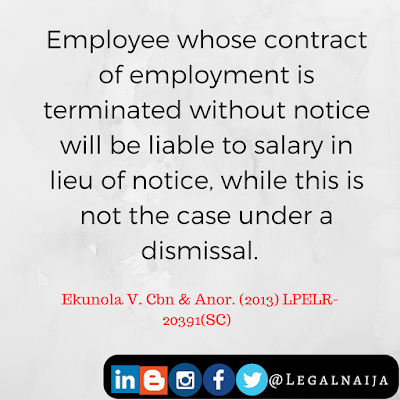
A third difference between a dismissal and
a termination is that, an employee whose contract of employment is terminated
without notice will be liable to collect a salary in lieu of notice, while this
is not the case under a dismissal. This was aptly put by the Supreme Court in Ekunola
V. Cbn & Anor.
(2013)
LPELR-20391(SC)
where the court deliberated whether an employee dismissed on the ground of allegation of gross
misconduct is entitled to notice or salary in lieu of notice, it was held that  –
 “Where his dismissal is founded on the
allegation of gross misconduct the appellant is not entitled to any notice or
salary in lieu of notice …………. And it would be wrong in law to make any awards
to him in these regards.”
The above is a guide to help when
considering, the legal implications of a letter of dismissal and a letter of
termination.
Adedunmade Onibokun
@adedunmade