Gender Equality In The Nigerian Police? | Zeniath Abiri

Gender Equality In The Nigerian Police? | Zeniath Abiri

Gender discrimination is
prejudice or discrimination based on a person’s gender in circumstances where
the gender difference is irrelevant to a person’s rights, abilities or
performance. Though it may affect any gender, women and girls are the most
commonly affected. The right to freedom from discrimination on the basis of
gender, race, ethnicity, etc, is protected by Section 42 of the Nigerian
Constitution as well as by many international instruments, which Nigeria has
ratified and enacted into law.

However, some of the laws
enacted in Nigeria, contain provisions which to encourage and perpetuate
discrimination against the female gender. The discriminatory provisions in the
Police Act and Regulations Cap P19, L.F.N, 2004 (the Act), shall be the focus
of this discourse.

The discriminatory
provisions are mainly contained in Regulations 118 – 126 of the said Act. Those
Regulations deal primarily, with the enlistment and duties of female police officers.

1.     Qualification
for Enlistment:

Regulation 118 of the Act,
provides for the criteria to be met by a female, seeking enlistment into the
Nigerian Police Force (hereafter referred to as NPF). By paragraph (g) thereof,
such a woman must be UNMARRIED. 

2. Duties of Female
Officers:

By Regulation 121 of the
Act, the following shall be the duties of female members of the NPF;

 (a) investigation
of sexual offences against women and children; 

 (b) recording of
statements from female witnesses and female accused persons and from children;

 (c) attendance
when women or children are being interviewed by male police officers;

(d) the searching,
escorting and guarding of women prisoners in police stations, and the escorting
of women prisoners to or from police stations;  

(e) school crossing
duties;

(f) crowd control,
where women and children are present in any numbers. 

An extension of the above is
found in Regulation 122 of the Act, which provides;

“Women police officers
recruited to the General Duties Branch of the Force may, in order to RELIEVE
MALE POLICE OFFICERS from these duties, be employed in any of the following
office duties, namely- 

(a) clerical
duties;  

(b) telephone duties;

(c) office orderly
duties.” 

These duties are far too
mundane for any police officer and seem to suggest that the female police
officer is incapable of carrying out the more technical aspects of police work.

3.     Permission
to Marry
:

It is interesting to note
that by Regulation 124 of the Act, a female police officer needs to apply in
writing, for PERMISSION to marry, from the Commissioner of Police, of the state
police command, where she is serving. The written application must state the
name, address, and occupation of the person she intends to marry.

That section further
provides that permission will be granted for the marriage if the intended
husband is of good character and the WOMAN POLICE OFFICER HAS SERVED IN THE
FORCE, FOR A PERIOD OF NOT LESS THAN THREE YEARS.

The latter part of that
section implies that a female police officer in Nigeria, will not be allowed to
marry, any time less than 3 years after joining the NPF. This is besides the
rather appalling fact that she must apply for and obtain permission before she
can be allowed to marry.

4. Pregnancy of unmarried
women police
:

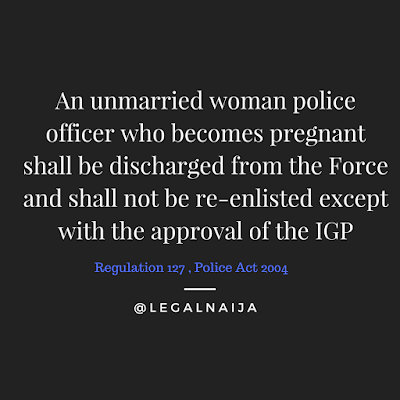
By Regulation 127 of the
Act, an unmarried woman police officer who becomes pregnant shall be discharged
from the Force and shall not be re-enlisted except with the approval of the
Inspector-General of the NPF. 

It is interesting that these
are only applicable to women, in the Nigeria Police Force. A comparison of
these provisions with those contained in Section 72 (2) of the Act (the
subsection dealing with the enlistment of male police officers, into the NPF),
will show no such restrictions exists with respect to male police officers.
What if a male police officer impregnates a girl, out of wedlock? What is the point
of placing such ridiculous conditions on women? Why are the male and female
officer subject to different rules?

While many will agree that
these provisions are discriminatory, subsection 3 to Section 42 of the Nigerian
Constitution, which arguably permits discrimination on this ground. Section 42
(3) of the Constitution is now reproduced for clarity:

“Nothing in subsection (1)
of this section shall invalidate any law by reason only that the law imposes
restrictions with respect to the APPOINTMENT of any person to any office under
the State or as a member of the armed forces of the Federation or member of the
Nigeria Police Forces or to an office in the service of a body, corporate
established directly by any law in force in Nigeria.”

It suffices to say, that the
provisions of Section 42(3) of the Constitution, deals with the appointment,
while the aforementioned discriminatory provisions of the Act, extends to
serving female police officers.

The above provisions of the
Police Regulations sharply contrast the provisions of Articles 2, 3 and 18(3)
of the African Charter on Human and People’s Rights (ratified and enacted by
Nigeria, in accordance with Section 12 of the Constitution and subsequently
referred to, as the African Charter), where the right to freedom from
discrimination is guaranteed. After a combined reading of those Articles,
 it is my opinion that the provisions of Section 42(3) of the Constitution
have now been overridden. The provisions of the said Articles are reproduced
hereunder;

“Article 2.

Every individual shall be
entitled to the enjoyment of the rights and freedoms recognized and guaranteed
in the present Charter without distinction of any kind such as race, ethnic
group, colour, sex, language, religion, political or any other opinion,
national and social origin, fortune, birth or other status.

Article 3.

 l. Every individual
shall be equal before the law.

2. Every individual shall be
entitled to equal protection of the law.

Article 18(3).

The State shall ensure the
elimination of every discrimination against women and also ensure the
protection of the rights of the woman and the child as stipulated in
international declarations and conventions. “

It is interesting to note
that these offending provisions in the Police Regulations which were enacted in
1968, at a time when the societal attitude to women in the workplace was very
different from what it is today, still remain on our statute books. This is
more so as there is no rational justification for the imposition of these
discriminatory provisions, since they do not in any manner promote the
efficiency or discipline of the female police officer and today, women occupy
very senior roles in the Police and have shown themselves to be just as competent
and as disciplined as their male counterparts. An example is the rise of Farida
Waziri, through various notable ranks in the NFP, up till Assistant Inspector
General of the NFP.  The move to expunge these regulations is thus, long
overdue.

Relying on the provisions of
the African Charter, and the principles of equity, good conscience, a move can
be made for the discriminatory provisions of the Police Act and Regulations, to
be expunged. It is my hope that the needful is done, in the nearest future.


 Zeniath Abiri
Managing Partner 
Abiri & Mustafa Legal Practitioners 
Source – www.linkedin.com
OPINION – NIgerians And The 419 Of “Development” | by Ayo Sogunro

Sometime in January this year I was in my
hometown Abeokuta. I was interested in seeing how governance had fared and a
close friend had driven me around the town, showing me the modernisations. New
flyovers decked major intersections, revamped roads gleamed under the sunlight,
and pedestrian bridges brimmed everywhere. It was an impressive makeover.

I
asked my host if Abeokuta residents were satisfied with these improvements. He
replied no. He explained that the state’s health sector was dilapidated. Government
paid little attention to equipping the state hospitals and improving the
primary healthcare system. Healthcare projects still relied heavily on donor
funding. Similarly, the public school system was not exactly a joy to behold.
Human capacity in the civil service remained underdeveloped. Small and medium
scale enterprises creaked under aggressive fees, levies, and taxes.

I had just completed a research stint in
Mauritius, also spending time at their human rights commission studying the
country’s socioeconomic welfare system. Mauritius provides free universal
healthcare and education, free public transportation for students and senior
citizens, unemployment and welfare benefits, and even ‘social aid’ for families
of detainees. Yet, the country’s infrastructural investment has only just
started increasing to improve investment opportunities and tourism. Still,
Mauritius is reasonably more developed than Nigeria.

It
is frustrating that, whether deliberately or ignorantly, Nigerian politicians
conflate infrastructural investments with development. Lagos State, for
example, carried out the mass displacement of Otodo-Gbame residents to
literally pave way for an estate. But international law, binding on Nigeria
under the African Charter
and the core human rights treaties, defines the principles of development. For
instance, in the Endorois Case against
Kenya, the African Commission noted that the right to development requires the
state to ensure that its policies and projects are equitable,
non-discriminatory, participatory, accountable, and transparent, ‘with equity
and choice as important, over-arching themes’. Development has to be focused on
nurturing the people, not just fashioning the state.

Unfortunately,
Nigerian citizens are often misled by the simulated notion of development. Our
governments copy and paste infrastructure, mirroring developed countries, but ignore
the systemic socioeconomic empowerment of the people. We have roads and bridges
without comfortable mass transportation systems, hospitals and schools without
quality equipment and staff, and inaccessible government-funded estates while
majority live under horrible conditions. Ultimately, these investment in
‘things’ put us in debt, transfer our resources to external investors and
contractors, displace communities, are abandoned by new administrations, lack
long-term maintenance and deteriorate, or simply have their funds looted.

And
the majority of Nigerians remain disempowered.

Investing
in human capacity and welfare before building cities should be intuitive logic
for all of us. It is worrisome that it took a Bill Gates to make this a
national conversation (and we have already switched to our favourite hobby:
arguing over contestants in politics, sports and reality television). But while
Gates may have spoken specifically on Buhari’s economic policies, the message
cuts across all of Nigeria’s political history and applies at all levels of
government. Nigeria has to adopt a human rights approach to public expenditure
and investment if it is to cease being a dysfunctional country. This requires
that the allocation of economic resources should answer the question: how does
this expenditure protect, promote and fulfil the rights of the citizens? In
other words, public money should be used only in ways that enhance human
dignity and human rights for all members of society.

For
example, we should buy arms only to demonstrably protect the right to life of
the citizens and not merely to enhance state power or prestige. Similarly,
roads and bridges are not important in themselves, but only to the extent that
they fulfil the right to development of the people. A construction project that
displaces people or creates more hardship in the construction process violates
the right to development.

The
Nigerian Constitution, problematic as it is, also recognises socioeconomic
welfare as the basis of development. It does not mandate the government to
build megacities. Instead, it directs government to provide ‘adequate medical
and health facilities for all persons’, ‘equal pay for equal work without
discrimination’, ‘public assistance in deserving cases or other conditions of
need’, ‘eradicate illiteracy’ and similar objectives. 

True, unlike Mauritius where many of these
objectives have been realised, Nigeria has a very large population and
geography. However, this point only takes us again to the issue of
restructuring. Human development is best attained within relatively small
political units. We cannot continue with Nigeria’s highly unwieldy centralised
structure. We will need to devolve governance and return land – and the control
and use of its resources – to organic communities under an evolved local system
of government if we are to truly develop our people.

But
these reforms will disempower our current political class.

For
now, our politicians are more interested in encouraging photographable projects
with high contractual value, scamming us with ersatz development. As a friend
tweeted a few days ago:

‘When our senators speak at the NASS, they
speak from a place of sentiments and hysterics, quote the Bible, Qur’an and
stray far away empirical facts. They do not care about the citizens and they’ll
never care. We the citizens are out of cards to play.’

She
is very right.

 Originally published here in my new monthly column for The
Guardian
.

Source – Ayosogunro.com

Women must have a place in a more inclusive NBA

Women must have a place in a more inclusive NBA


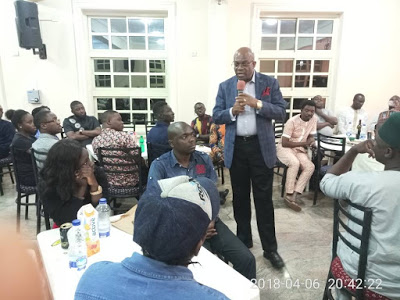
NBA Presidential candidate
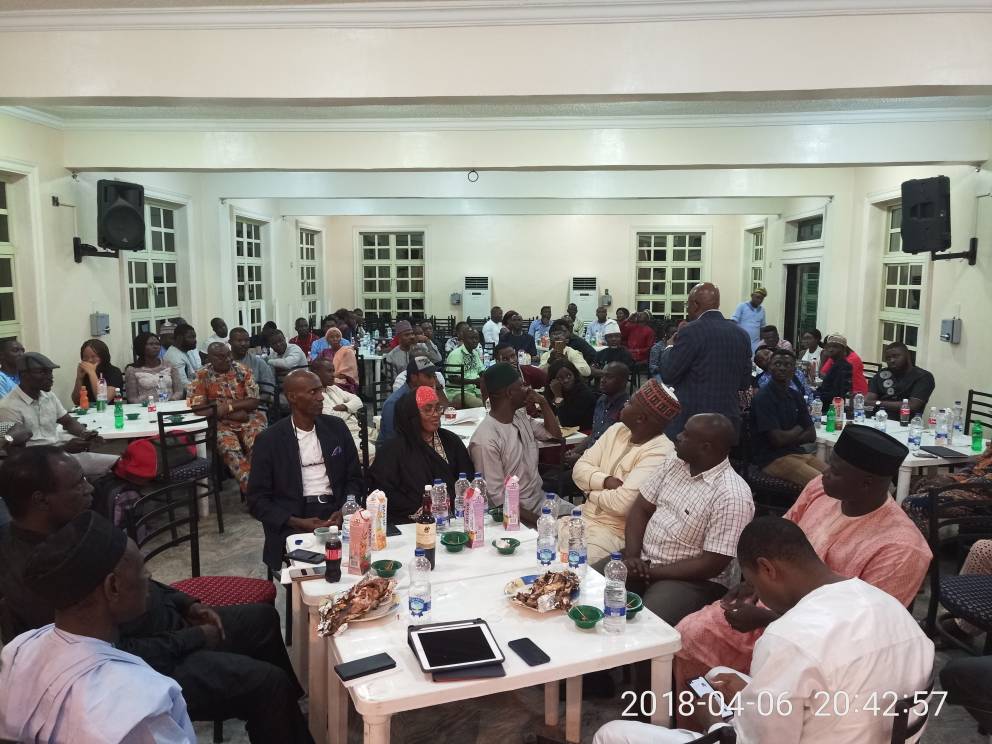
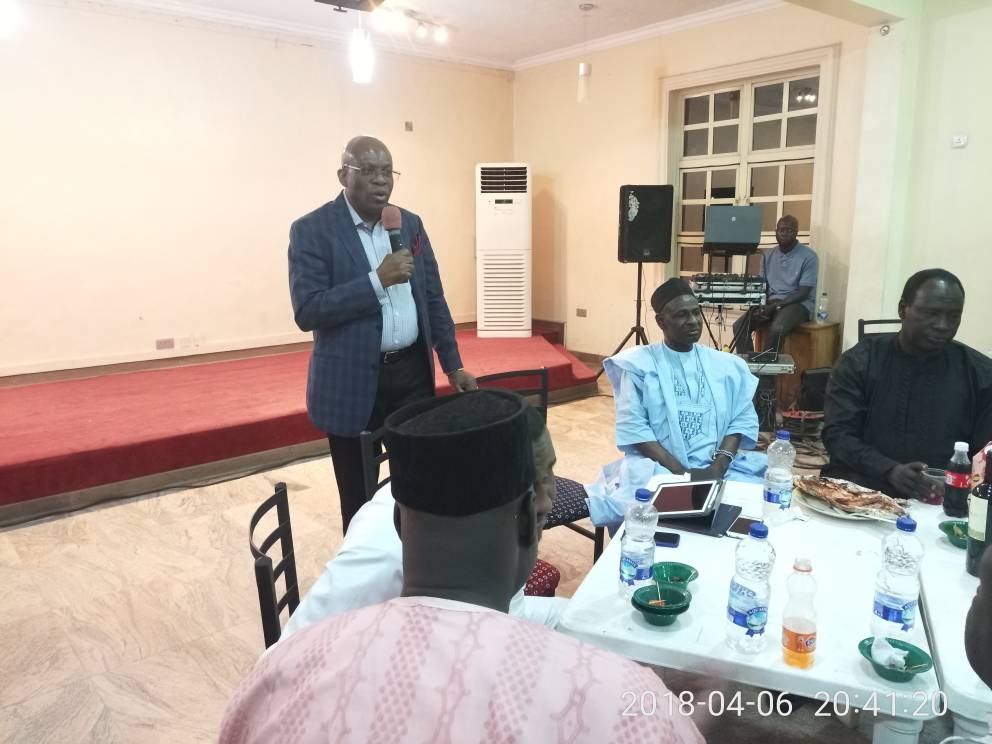
Mr. Paul Usoro, SAN, FCIArb is meeting with Lawyers in Ibadan. While speaking
at the meeting; he stated his desire for a more complete NBA where women have
more active roles.

The meeting is well attended
with the likes of Mallam Hussain Sani Garun-Gabbas, SAN (Hon. Attorney General
and Commissioner of Justice, Jigawa State), Alh. Tajudeen Oladoja (Life
Bencher), Francis Ekwere (Immediate Past 1st Vice President of NBA),  Mallam Ibrahim Aliyu (Immediate Past 2nd Vice
President of NBA), Mr. Bukar Waziri 
(Immediate Past Publicity Secretary of NBA) and others.

Well over 16 current NBA
Chairmen along with notable NBA officials are present at this memorable
meeting.
Support for Paul Usoro is
overwhelming as more people throw their weights behind him, such examples are
highlighted below:

“We believe in Paul
Usoro, SAN and his capacity to move the bar forward. Mr. Usoro, SAN is the only
candidate that has the capacity to lift the bar”
– Mallam Hussain Sani Garun –
Gabbas, SAN (Attorney General of Jigawa State)

“We are here because we
consider this project personal. We came with 16 current NBA Chairmen, 6 current
NBA Secretaries and 6 Past NBA Chairmen and Secretaries. We are here to show
that the North is firmly in support of Mr. Paul Usoro, SAN”
Aminu Gadanya

Querying The Constitutionality Of Section 300 (3) Of The ACJL Of Delta State | Oliver Omoredia

Querying The Constitutionality Of Section 300 (3) Of The ACJL Of Delta State | Oliver Omoredia

The
Administration of Criminal Justice Act (ACJA) was signed into law by former president
Goodluck Jonathan in 2015 and has since its enactment revolutionized the
administration of criminal justice in the country. The provisions of the Act
have been largely re-enacted in the Administration of Criminal Justice Law of
Delta State 2017.  This write-up
considers the provision of Section 300 (3) of the Administration of Criminal
Justice Law of Delta State and argues its sustainability in the light of constitutional
provisions on the state’s legislative competence to enact same.

THE CONSITUTION AND LEGISLATIVE
COMPETENCE

Generally,
the Constitution of the Federal Republic
of Nigeria 1999 (As amended)
clearly sets out matters upon which federal
and state legislative arms exercise competence. Section 4(1)(3) & (7) of the Constitution provides:

“4. (1) The legislative
powers of the Federal Republic of Nigeria shall be vested in a National
Assembly for the Federation, which shall consist of a Senate and a House of
Representatives…

 (3) The
power of the National Assembly to make laws
for the peace, order and
good government of the Federation with respect to any matter included in the Exclusive Legislative List shall, save
as otherwise provided in this Constitution, be to the exclusion of the Houses
of Assembly of States

(7) The House of Assembly of a State shall
have power to make laws for the peace, order and good government of the State
or any part thereof with respect to the following matters, that is to say
:

(a) any matter not included in the
Exclusive Legislative List
set out in Part I of the Second Schedule to
this Constitution.”

By
the combined provisions of Section 4 (3)
and (7)
, all matters in the Exclusive
Legislative List set-out in the Second Schedule to the Constitution are
exclusively under the federal legislative competence of the National Assembly and
cannot be legislated upon by any State House of Assembly. The Supreme Court
gave judicial impetus to this reasoning when it considered the “exclusivity”
the exclusive legislative list in A-G OF
FEDERATION v. A-G OF LAGOS STATE (2013) LPELR-20974(SC)
and stated that:

“…apart from the
National Assembly, no other legislative assembly whether of state or Local
Government (if any) can legally and effectively legislate on any matter listed
under the Exclusive Legislative List.” See also
Attorney-General, Plateau State v.
Goyol (2007) NWLR (Pt. 1059) 57 at 92, paras. D – G (CA)

The
issue was also thoroughly considered by the Supreme Court in the popular case
of A-G Abia State v. A-G. Federation
(2006) 16 NWLR (Pt. 1005)
where the apex court per Tobi, JSC concluded that:

“There are
two Legislative lists in the 1999 Constitution. These are the Exclusive
Legislative List and Concurrent Legislative List. The Exclusive Legislative
List of Part 1 Schedule 2 to the Constitution contains 68 items. By Section
4(2) only the National Assembly can exercise legislative powers on the 68 items…While the House of Assembly of a State is
prohibited from exercising legislative functions on matters in the Exclusive
Legislative List”

UNDER THE CONSTITUTION ONLY THE NATIONAL
ASSEMBLY CAN LEGISLATE ON EVIDENCE

The
Exclusive Legislative List in the Second Schedule to the 1999 Constitution
contains 68 items amongst which “Evidence” is item 23. Evidence by our
constitution is a matter only the National Assembly can legislate upon and the
National Assembly did so when it enacted the Evidence Act 2011 Cap E14 laws of the Federation of Nigeria which
according to its explanatory memoranda has application to all judicial
proceedings in or before courts in Nigeria.

Interestingly
however, in the “re-enacting” the provisions of the ACJA, some states have
attempted a subtle enactment on “other matters” including evidence. This is the
precarious position of Section 300 (3) of the ACJL of Delta State.

One
must note that Section 1 (3) of the constitution
makes the constitution supreme and stipulates that any law inconsistent with
the constitution must to the extent of its inconsistency be null and void. See. Towoju v. Gov. Kwara State (2006) ALL
FWLR (Pt. 321) 1365 at 1389 (CA).
Therefore, whenever a State House of
Assembly legislates on any matter outside its legislative competence the act is
ultra vires and any law proceeding from it shall be deemed inconsistent with
the constitution, null and void to the extent to which it is inconsistent.

SECTION 300(3) OF THE ACJL OF DELTA
STATE IS A MATTER OF EVIDENCE AND CANNOT BE LEGISLATED BY A STATE HOUSE OF
ASSEMBLY

As
a preliminary point, it is incisive to note that the provisions of Section
300(3) of the ACJL of Delta State is not similarly contained under the ACJA
2015 which the law sought to replicate. The inclusion of Section 300(3) in the
Delta State Law was therefore an independent act by the State’s House of
Assembly to address the issue of delayed trial occasioned by the conducting of
a trial-within-trial when a confessional statement is objected to on the ground
of involuntariness. The Assembly in undertaking this noble cause however ended
up enacting a provision which clearly over-reached the State’s legislative
limits under the constitution by conspicuously legislating upon evidence. The
said Section 300(3) provides that:

“In the course of any criminal trial, where the
admissibility of any confessional statement is objected to by a defendant on
the ground of involuntariness, the Court shall note the objection and the
ground for the objection thereon and make a decision in its judgement at the
end of the trial without conducting a trial within trial”.

The
provision clearly touches on evidence in judicial proceedings which, according
to item 23 of the Exclusive Legislative List, is a matter exclusively within
the legislative competence of the National Assembly. This is particularly so as
Section 29(2) of the Evidence Act 2011
already makes provision on the exact issue and states the duty of the trial
judge when an Accused person challenges the voluntariness of a confessional
statement thus:

“(2) If, in any
proceedings where the prosecution proposes to give in evidence a confession
made by a defendant, it is represented to the court that the confession was or
may have been obtained –

 a. by oppression of the person who made it; or

b. in consequence
of anything said or done which was likely, in the circumstances existing at the
time, to render unreliable any confession which might be made by him in such
consequence, the court shall not
allow the confession to be given in evidence against him except in so far as
the prosecution
proves to the court beyond reasonable doubt that the
confession (notwithstanding that it may be true) was not obtained in a manner
contrary to the provisions of this section
.

Apparently,
Section 29 of the Evidence Act and
Section 300(3) of the Delta State ACJL
stipulate different positions on the court’s duty when a Defendant objects to a
confessional statement as involuntary. There cannot be two provisions on the
same issue of “evidence” which conflict each other, particularly since the
later was enacted by the State House of Assembly obviously lacking vires to so
enact. The provision of Section 300(3) cannot be saved by any thought of argument
that is a mere “domestication” of the ACJA on the issue since same provision is
not in Section 300 of the ACJA. In effect, Section 300 (3) of the ACJL of Delta
State is ultra vires the legislative powers of the Delta State House of Assembly,
inconsistent with the constitution and to the extent of its inconsistency is
null and void.

IN CONCLUSION

The
curious position under Section 300 (3) of the ACJL of Delta State is one which
can be carefully avoided in ACJLs of respective States. While the
administration of crime is a concurrent matter which both federal and state
legislature can legislate over, evidence is a matter exclusively within the
legislative territory of the National Assembly. State Houses of Assembly must
therefore note that they cannot attempt to amend the Evidence Act by the
provisions of their respective State ACJLs. What can be done however is
regulate proceedings in court which do not deal with evidence in itself but
procedures in criminal proceedings. The ACJL of Lagos State is recommended as
veritable guide on how to carefully carry out this difficult legislative task in
other to avoid provisions which may be too quickly declared null and void.

Oliver Omoredia Esq.

Associate Obiagwu & Obiagwu LLP

08100193573, oliveromoredia@yahoo.com

Looters List And The Subjudice Rule: The Need To Caution Comments | Oliver Omoredia

Looters List And The Subjudice Rule: The Need To Caution Comments | Oliver Omoredia


The
President Muhammadu Buhari (APC)-led Federal Government on Friday published the names of persons who
under the Goodluck Jonathan (PDP)-led administration had allegedly looted the
treasury of the country. The list which contained six names of high-profile
members of the Peoples Democractic Party (PDP) was published in response to the
taunting the Federal Government by the PDP that it makes true allegations of “looting”
by publishing the names of persons it claims have looted.

While
some have criticized the list for containing only six names despite the high
premium the Buhari-led administration claims to be placing on corruption,
others have criticized the list for containing no names of members of the
present APC administration. The PDP has in response debunked the allegations
and named its own “list of looters” containing names of high profile members of
the APC. This write-up, while trying as best as possible to avoid the politics
of the issue, considers the list published by the federal government and
advises on the need for caution in commentaries on matters pending before the
courts.

It
is an elementary point that under law and our constitution, a person charged
with a criminal offence is presumed innocent until his guilt is proven. This is
the essential theme of our criminal prosecution enshrined in Section 36(5) of the Constitution of the
Federal Republic of Nigeria 1999 (As Amended)
. It is therefore only a
competent court that can pronounce the guilt of a person accused of an offence,
and the courts in so doing must be allowed to reach a just conclusion
independent of public sentiments from the court of public opinion.

Our
criminal procedural laws, as imported from England, seem to slightly permit “suspects”
or names of persons alleged to have committed offences to be published and the
fact of the allegation may be subject to “fair comment” before the person is
charged to court. Indeed, in DANIEL v.
FRN (2013) LPELR-22148(CA)
, the court disagreed that extensive media
publication before the trial of a case infringed on a Defendants right to fair
hearing and a fair trial. However, when the matter becomes pending before the
courts, continued commentary on the culpability or otherwise of a party in the
case offends the subjudice rule and may, under some circumstances, be contempt
of the proceedings of the court.

Looting
of the national treasury is a serious criminal offence which cannot be
established conclusively save by a court of law. When a matter has proceeded to
and is before the courts, parties must refrain from commentary on the matter.
In the UK case of R v. Socialist Worker
(1975) QB 637
, the attempts at publication of names of accused when the
courts had warned against same earned the publisher terms of imprisonment or
contempt.

In
Nigeria, while the publication of “alleged looters” may not particularly offend
our laws or  be complete grounds for
action in defamation, the publication of names of those who have been charged
to court, including statement of how much they allegedly stole, is no doubt an
act which impedes the duty of the court in independently reaching a conclusion  on the guilt of a person whose case pends
before it and whose guilt is yet to be determined. There is therefore a serious
need for caution, particularly as more comments may continue to generate on the
said list. Such persons as Olisa Metuh and the former National Security Adviser
who are already before competent courts should not have been published on a
list that indirectly confirms them as “looters” when the court is yet
exercising jurisdiction to determine the issue.

Indeed,
this action by the Federal Government could greatly prejudice the right of the
named persons to justice and was exactly what the Chief Justice of Nigeria, Walter Onnoghen, cautioned against in his
press briefing on 11th of January this year when he said, and I
quote:  

 The
CJN wishes to remind the public that it is Contempt of Court for anyone to
discuss any matter pending in any Court of Law in the country. The punishment
for Contempt may include a term of imprisonment
,”.

 “In
respect of criminal proceedings, it is forbidden for parties, their counsel or
newspaper commentators to freely offer opinions in respect of matters pending
in court, including any situation where a conviction has been entered but the
convict’s appeal is pending at the appellate court.

‘We must not allow ‘trial by newspaper’ or ‘trial by
television or trial by any medium other than the courts of law.’ I think that
anything in the nature of prejudgment of a case or of specific issues in it is
objectionable not only because of its possible effect on that particular case
but, also, because of its side effects which may be far reaching.

“Responsible ‘mass media’ will do their best to be
fair, but there will also be ill-informed, slapdash or prejudiced attempts to
influence the public.

“If people are led to think that it is easy to find
the truth, disrespect for the processes of the law could follow and, if mass
media are allowed to judge, unpopular people and unpopular causes will fare
very badly.

“Most cases of prejudging of issues fall within the
existing authorities on contempt. I do not think that the freedom of the press
would suffer, and I think that the law would be clearer and easier to apply in
practice if it is made a general rule that it is not permissible to prejudge
issues in pending cases.”
See. http://sunnewsonline.com/cjn-warns-against-comments-on-pending-court-cases/

The
CJN’s admonition is clear and incisive of this issue. The Federal Government is
no doubt a party in all criminal trials it has initiated in courts against some
named in the “alleged looters list” and the publication of the list has no
effect other than to taking the cases already pending before courts to the
court of public opinion. Even though one may say it was the opposition who “asked
for it”, there is need for caution to intervene to avoid further and more full-blown
commentaries on the issue.

IN CONCLUSION

It
is the duty of the Government and all in society to preserve the machinery for
the determination of rights and the preservation of justice: the courts. Judges
do not possess adjudicatory authority because they are muscular men of
strength, rather possess this authority because the society abides by their
direction and respect their determination of rights and obligations. The rule
against subjudice acts or comments seeks to preserve this authority and if the
other arms of government who should aid in ensuring the respect for the judiciary
continue to recklessly engage in acts that derogate from its respect, the role
of judiciary in ensuring of justice may become an illusionary concept and the
rule of law; a theory we only read in law books. The Federal Government must
therefore exercise caution and restraint in leading discuss on matters already
under the adjudicatory authority of its own courts.

Oliver
Omoredia Esq.

Associate
Obiagwu & Obiagwu LLP

08100193573,
oliveromoredia@yahoo.com

Gender Parity: The Paul Usoro Example

Gender Parity: The Paul Usoro Example

In the black continent, where the intellectual prowess of women is yet to be fully acknowledged and accepted as a tool for societal development, only a few members of the male gender openly encourage and support females in the face of hostilities associated with gender imbalance in the society. Paul Usoro, SAN, a distinguished gentleman and one of Nigeria’s finest Lawyers, is one of such supportive males.
Paul Usoro is a Senior Advocate of Nigeria, an ICT Law Expert who is not just recognized as an outstanding brain from which most legal minds are to tap from, he is a figure who represents a true manifestation of the modern day advocacy of gender equality. This is as a result of his massive contributions to the development of the legal profession on both sides of the divide.
Last October, the learned silk justified the thoughts of observers when he donated the sum of one million naira to the Rivers State branch of the African Women Lawyers Association during its first anniversary. According to him, there are dividends when women are empowered and occupy positions of authority; women have the potentials to drive positive societal changes if only they are given the ample opportunity. 
Giving equal opportunity to women didn’t just happen upon him. In his firm, they hold principal roles. Asides his wife, Mfon who is a Managing Partner, Adetola Bucknor joined Paul Usoro & Co. in 2008 as a Junior Associate, fresh off National Youth Service Corp. In 2014, she became an Associate Partner in the firm. Again, this development is another demonstration of Usoro’s gender parity agenda. For Adetola, the success of the journey can be attributed to the opportunity Usoro provided.
“It’s easy for people to say I’ve done well for myself to be able to rise through the ranks here at PUC but in truth, credit must be given to the man with the vision that we all key into as employees. My position as an Associate Partner today is down to Mr Usoro’s belief in my capacity and importantly, his strong agenda for equal opportunity for men and women.”
For Usoro, there is no better way of showing it than being an example of it. Like Maya Angelou once said: How important it is for us to recognize and celebrate our heroes and she -roes.
“It’s important for us individually and collectively to harness the good in people, encourage them, particularly when they’re good at what they do. Leadership should be based on merit and not on gender or the notion of patriarchy as evident in our society today. We must practice what we preach and that’s why we’re an equal opportunity employer at PUC and we hold that very dear,” he said.
Usoro is not only a preacher of women participation in governance, he is as well a contributor to sporting activities amongst male and female lawyers alike: as for nine years and counting, he has been sponsoring male and female lawyers to the IBA yearly which is a fall-out of the Mfon Usoro Tennis cup, nicknamed the largest sporting event among lawyers. LTTO is a Table Tennis tournament open to lawyers from within and outside Lagos. Travel and accommodation cost for out-of-town lawyers are underwritten by PUC. The 9th edition of this tournament was held in October 2017. 
Indeed, Usoro has proven himself an excellent figure; an icon of gender parity. His strives over the years have never been one sided, they have been all embracing and all admiring. 
For many who do not know him, Paul Usoro is a telecommunication giant, known for his exceptional drafting and advocacy skills and his philanthropic records throughout Nigeria.
Police Cannot Suo Moto Declare Person Wanted

Police Cannot Suo Moto Declare Person Wanted

By virtue of the provisions of the law,
only a court can compel the appearance of a suspect. 
Section 113 of the
Administration of Criminal Justice Act 2015 states that –

“ A court may issue a
summons or warrant as provided in the Act to compel the appearance before it of
a suspect accused of having committed an offence in any place, whether within or
outside Nigeria, triable in a state or in the FCT”.

The Act does not in anyway
empower the police to declare a person wanted without a warrant for that
persons arrest issued a court of competent jurisdiction. 

Learn & Share
@Legalnaija 

Tips For Foreign Companies Investing in Nigeria

Tips For Foreign Companies Investing in Nigeria

–  Foreign companies intending to
carry on business in Nigeria should note the following- 

1. Foreign
companies must be registered as corporate entities in Nigeria with the
Corporate Affairs Commission 

2. Penalty for
foreign companies who fail to comply with the directive above shall be guilty
of an offence and liable to conviction to a fine and every officer or agent of
the company who permits the default shall also be liable to a fine.

3. Foreign
companies may apply to the President for exemption via the Secretary to the
Govt of the Federation.

4. Exemptions are
granted on the basis that the company was invited to Nigeria by the Federal
Govt or International Organization to carry out a specific project.

5. Such exempted
company shall have the status of an unregistered company. 

Adedunmade Onibokun and Co.,

Forensic Document Examination at the 2018 Career Training For Lawyers

Forensic Document Examination at the 2018 Career Training For Lawyers


As a lawyer, training in Forensic Document Examination will aid you in preparing expert opinions on the authenticity of documents from Wills, Agreements, Cheques, Signatures and many more. 


REGISTER NOW 
Early Bird Registration for the 2018 Career Training For Lawyers ends in 2 days. Register  on or before the 31st of March, 2018 to earn a 5,000 Naira discount. 
Training modules include – •  Sports Law •  Mediation •  Entertainment Law •  Finance for Lawyers •  Forensic Document Examination; and •  Intellectual Property Law


Training Information –
Date – 26th and 27th April, 2018
Venue – LCCI Conference & Exhibition Centre, Nurudeen Olowopopo Drive, Alausa, Ikeja, Lagos
Time :- 9am – 5pm Daily 

Registration Details
Fee per delegate:
N25,000 – Early Bird (Ends 31st March, 2018)
N30,000 – Regular 

Account Details –
Lawlexis International Limited
Fidelity Bank
4011176564 

Note that all Payment confirmation and Delegate Information should be sent to lawlexisinternational@gmail.com. For contact and sponsorship details, Call Lawlexis on  09095635314; 08055424566