by Legalnaija | Apr 13, 2020 | Uncategorized
In
2020, who would have thought that the world would be faced with such a global
threat that is not a nuclear war instigated by North Korea, or an Alien
Invasion but an invincible biological threat where we now seem to cherish the
comfort of staying indoors, government and employers advising their employees
to work from home, Mums yelling at their kids to go outside and get a life are
now being encouraged to stay indoors not to risk contracting the deadly Virus.
It is no surprise that this Disease (COVID-19), has disrupted various
commercial and operational activities, interrupted Supply chains, and made
contractual obligations impossible to perform as many countries have been
forced to impose restrictions on movements, international and domestic flights,
shutdown of workplaces, sporting events, industries, ports, markets, and public
places generally which tend to pull a large crowd of people.
As
a result of these recent developments, it has become impossible for many
business owners, companies and relevant stakeholders to perform their
contractual obligations in a Contract which then introduces the application of
Force Majeure clauses in a contract or the Common Law principle of Frustration
of Contract to help mitigate or excuse delay or non-performance of the
contract.
This article will discuss the applicability of Force Majeure and Frustration, their
effects on Contracts amidst the outbreak of COVID-19, how to invoke or enforce
them and suggestions on the application of Force Majeure and Frustration on
Contracts in the future.
Force Majeure:
This is a Clause included during the
drafting of a contract to state that a party shall not be liable for the failure
of or any delay in performing his own obligations in the contract so far as the
failure or delay is as a result of an event beyond the reasonable control of a party
and could not reasonably have been foreseen or provided against. However, such failure to perform will not be
excused for failure or delay resulting from only general economic conditions or
other general market effects such as an increase in the cost of delivery as a
result of the event.[1]
The
purpose of this clause is to protect parties from events that are outside the
normal risks associated with the business, and to put the parties on notice of
events that may excuse or suspend performance.
It is important to point out that the
distinguishing factor between Force Majeure and Frustration is that the act
which seeks to delay or cause either party not to perform their contractual
obligations must be specified in the Force Majeure Clause in the contract while
the parties only need to meet the necessary tests for frustration to apply.
This Clause is often
interpreted narrowly, and the party invoking the force majeure clause to excuse
performance must prove the event in question falls within the scope of the
clause. For example, Act of God, War, Riot. However, in the instant circumstance,
parties may have failed to include a term that will sufficiently cover the
recent outbreak of COVID-19 but where parties include general terms such as
Disease, Epidemic, pandemic, or Government action which the COVID-19 or events
arising from COVID-19 may fall under, would enable parties to invoke the Force
Majeure Clause to excuse the delay or non-performance of their contractual
obligations in order to avoid a breach of the contract[2]
There are certain factors the Courts take into consideration
when interpreting or determining if the Force Majeure Clause is properly
invoked by a party and these are;
·
Does the Force Majeure
Clause capture the event the party seeks to invoke
·
Was the event unforeseeable at the time of
entering the contract,
·
Whether the risk of
non-performance could be mitigated?
·
Whether the event has
rendered performance impossible, or merely expensive?
The Force Majeure Clause also provides for some remedies
which could be specific to the listed events in the clause. Such as the party
is excused from liability or damages, an extension of time within which to
perform his contractual obligations, or termination of the contract where the
purpose of the contract can no longer be achieved.[3]
Frustration:
The doctrine of frustration can be traced back to the English
common Law as a principle which will generally come into effect and apply to a
contract that has been made impossible for parties to perform their obligations
in the contract. This means that a contract’s performance will be rendered
impossible because of some intervening or supervening event after the contract
has been made.
Under the English
common law, frustration will result in the contract being terminated so that
the parties are excused from further performance or any liability. A party
faced with an external occurrence or event that may make its performance under
a contract impractical, onerous or even impossible might seek to rely on the
principle that the contract has been frustrated. This principle was laid out in
the Locus Classicus case of Taylor V Cadwell where the Court held
that “when an opera house, which was rented for holding concerts was
destroyed by fire, the contract was frustrated. This was because the very thing
on which the contract depended on ceased to exist or if a certain thing
happened. Thus it was held that for the doctrine of frustration it must be so
that the nature of contract is such that it would not operate if a thing ceased
to exist.” It is also important to
note that frustration will not apply where the non-performance of a party’s
obligations is as a result of his own decision or negligence.[4]
The Courts would have to consider the following factors in
determining if the doctrine of frustration will apply;
·
That the event in
question must be unforeseen,
·
It must have occurred
without the fault of either party to the contract and
·
It must either make
the contract’s performance impossible or
·
It must destroy the
fundamental purpose of the contract.
The distinguishing factor between the Application of
Frustration in a Contract and the Force Majeure Clause is that where a contract
fails to integrate a Force Majeure Clause, the doctrine of frustration would
apply to the non-performance of the contract upon meeting the necessary tests
listed above. The reason being that frustration applies in case of events which
happen after the contract is made and for which neither any party is
responsible nor can they prevent it from happening.
The application of the
doctrine of frustration has the effect of terminating the contract and
relieving both parties from their contractual obligations. In such circumstances, Section 8(2) of the
Law Reform (Contracts) Law of Lagos State, provides that all sums paid to a
party in accordance with the contract shall be recoverable by the person who
made the payment. However, Section 8(3) of the same law states that if
the party to whom the payment was made has incurred expenses for the
performance of the contract before the frustrating event occurred, the court
may, if it considers it just to do so, allow the retention of the portion of
the sums paid to him or her that have been so expended.[5]
Further to the above, section
120 of the Federal Competition and Consumer Protection Act provides for the
protection of consumers who may find themselves on the defaulting side of a consumer
contract and gives them the right to “cancel
any advance booking, reservation or order for any goods and services, subject
to a reasonable charge for cancellation of the order or the reservation by the
supplier or service provider.”
For example, before the outbreak of COVID -19, it is normal for parties
to have booked or made a reservation for travel tickets with domestic and
international Airlines but due to the sudden outbreak, parties will be forced
to change their plans to either travel at an earlier date or decide not to make
use of such flight reservations again. The Competition and Consumer Protection
Act would then give the consumer the right to cancel such advance booking,
reservation or order for any goods and services. Airlines also have the right
to charge a reasonable fee for the cancellation of the reservation or services,
but recent reports and outcry by consumers on social media have stated that the
domestic airlines have refused and/or failed to adhere to the provisions of the
Federal Competition and Consumer Protection Act.
How
to Invoke a Force
Majeure Clause
and/or Frustration in a contract
In light of the
outbreak of the COVID-19, a party can take the following steps to invoke the
Force majeure Clause:
1. Check whether the Force Majeure clause in the contract
provides for the Outbreak and other events which came about as a result of
such. The FM clause might have not specifically mentioned the Corona Virus
Disease but might fall under one of the general terms usually inserted in force
Majeure clauses such as “Disease”, “Pandemic”, “epidemic” or “Government
Action.”
2.
The party would also
consider whether the risk of his non-performance could have been mitigated. The
party seeking to invoke the FM clause is under an obligation to have taken
reasonable steps to mitigate the foreseeable risks of its non-performance.
3.
Lastly, the party
would have to show that his contractual obligations or performance have been
impossible to execute as a result of the Outbreak. For example, where an
Industrial company has a contractual target to produce a certain amount of
Chairs to be delivered on a particular date, but due to the Government
restrictions and shutdown as a means of preventing the widespread of the
disease, the workers are required to stay at their respective homes for a
certain or indefinite period will make it impossible for the party to meet up
with the delivery date.
In
the event where a claim of Force Majeure will not apply, the next consideration
is whether any of the following established
grounds to founding a successful claim of frustration apply:
·
Temporary
unavailability – where a person or object that
is essential for performance of the contract is temporarily unavailable.
·
Method
of performance impossible – this will usually occur where
there has been a ban or restriction of movement e.g., a contract for Courier
services by Air where a travel restrictions is in place as is the current case
in the world where Airlines have been grounded pending the passing of the
outbreak. However, a contract will not be frustrated where performance is
possible by a different method, and the difference between the two methods of
performance is not sufficiently fundamental.
·
Failure
of a specific source – this occurs where a contract to
import goods from a particular country is now subject to a travel ban and/or
restriction. E.g. the restrictions on importation of Masks and other protective
gears from China due to conspiracy theories of such masks being contaminated.[6]
The application of Force Majeure and Frustration on
Contracts in the future.
In high and positive
spirit of a pro Covid-19 era, there are certain actions parties to a contract are
advised to take into consideration in order to best protect their interests in
the event of a severe outbreak or event which is likely to render the
performance of contractual obligations impossible.
The parties are to;
1.
Check the definition
and scope of the force majeure Clause and whether the event in question falls
within such scope;
2.
Check the contract’s
notice requirements and whether they have been or may be triggered
3.
Write to your counterparty and require
(i) evidence of the circumstances it relies on, (ii) a full explanation of why
its performance is now physically/legally impossible, (iii) evidence of steps
it is taking to mitigate and (iv) regular updates as to its efforts to resume performance.
4.
Check the governing
law provisions and impact that such law will have on interpreting the contract
5.
Check whether
mitigation steps or alternative means of performance can reasonably be taken in
respect of the contract
6.
Consider the potential
consequences of a breach and/or default of the contract
7.
Can consider entering
into a written variation to the Contract or seek Alternative Dispute resolution
mechanisms.
In essence, Force
Majeure clauses are inserted in a Contract to protect parties and help parties lessen
or avoid their contractual obligations in the event of a phenomenon which is
out of the control of both parties. Where this Force Majeure Clause is not
inserted in a Contract, then the general Common Law Principle of Frustration
will apply upon meeting certain criteria and alleviate both parties from their
contractual obligations. The outbreak of COVID-19 is an unexpected event that
hit the whole world and has put a hinge on so many contracts, and business
operations. Parties are advised to negotiate and look for amicable ways to fulfil
or remedy their own contractual obligations as it will be counter-productive
for parties to play the blame game which could possibly ruin business
relationships.

by Legalnaija | Apr 9, 2020 | Uncategorized
While sitting with some friends and fellow colleagues a couple of days ago, I broached the subject of the upcoming NBA 2020 elections and almost everyone in the group waived the topic aside, all of them disinterested. I tried one more time to stimulate their interests by naming some of the candidates vying for the office of the NBA President but this brings forth an entirely different result, a feeling of resentment and apathy for the NBA, an association they believe has done little or nothing to help their respective practices.
These are lawyers who manage their own firms and are partners in some of the top tier firms in the country, they work very hard and according to them cannot state how the NBA has helped boost their careers or promote their practice. In a nutshell, they cannot state what the NBA has done for them.
“What has the NBA done about expanding the frontiers of practice in real terms;
“How have they prevented the encroachment on the jobs of lawyers;
“What have they done to rectify the poor salaries earned by many junior lawyers;
“How have they protected the human rights of lawyers, many of whom have been assaulted severally by the police;
“What has the NBA done asides holding conferences where all they do is talk and issue statements that have no effect whatsoever; and
“How have they upheld the Rule of Law, remember Onnoghen, how come the NBA could not prevent such shameful exploitation of the Rule of Law;
All at once, they drilled me with questions. It is obvious that many lawyers feel this way and a large number of practitioners have stayed away from the NBA totally save for paying their practicing fees and branch dues. However, unperturbed by their non – challant attitude, I felt the need to engage them a little further and state my case.
Gentlemen, I begin, I understand how you feel but if some of our best minds in the profession choose to ignore the growth and promotion of our collective welfare through the Nigerian Bar Association, little wonder many of us are not as satisfied with the current position of things. All this however can change if we ensure we get the right kind of leadership that can continue to build on the achievements of the past administrations and help us to promote the welfare of lawyers and help secure the future of the profession.
Most sincerely, I appreciate that the Paul Usoro administration may not be perfect but it has never failed to challenge any attack on the Rule of Law, nor to secure the obedience to the fundamental rights provided for lawyers and everyone else according to the Constitution. Could the PUSAN administration have done things better, most definitely, however perfection is not a destination but a journey and by voting the right person for the job, going forward we may be able to build on the foundations laid by the current and past administrations.
“So who is the right leader you may ask?”
Over the past few weeks many have postulated a formula for determining who the next NBA President should be. While many have postulated that it should be the man with the biggest law firm, others have said it should be the lawyer who pays his lawyers the highest. All these in my opinion are the wrong factors to consider. I recall during the last election that ushered in Paul Usoro SAN, there was debate about how much he pays his lawyers compared to other candidates and how his firm, Paul Usoro and Co., was bigger.
My question for this class of lawyers is that in the past two years, has the amount Paul Usoro SAN pays his lawyers or the size of his firm increased your salary in any way? Has it resulted into a minimum wage for lawyers? Or has it brought briefs to your firm? I am sure the answer is no. This means most definitely that all these should have no bearing on who leads the NBA as its President.
There are other things I will like to consider such as track record, long term contribution to the Bar, leadership qualities and a thorough understanding of how the Nigerian Bar Association works. I have evaluated the candidacy of the top 3 candidates vying for the office of the President of the NBA and while I agree that all 3 of them are very successful lawyers, only one of them meets all my under listed requirements. I in no way claim that others are bad for the job, I only recommend that we choose not only the best man for the job but the right man as well. That man is Dele Adesina SAN and I will tell you why.
The Deacon as Mr. Dele Adesina SAN is fondly called by lawyers all over the nation has a track record of long term contribution to the Bar, leadership qualities and a thorough understanding of how the Nigerian Bar Association works. I will now pick my reasons one after the other.
Track Record
The Deacon has held a number of offices in the NBA, he was the Chairman of NBA Ikeja Branch during the military era and was instrumental to many of the victories won against the Military regime. As Femi Falana SAN put it, there was no time I called Dele that the NBA needed to make a statement or put it to the military regime of the day that he ever refused.
The Deacon was also the General Secretary of the NBA between 2002 – 2004 under the leadership of Chief Wole Olanipekun SAN, where he was instrumental to many of the wins of that administration. Dele Adesina SAN is also a Life Member of the Distinguished Body Of Benchers, the highest regulatory body of the Legal Profession, a member of the Governing Council, Lagos State Multi-Door Court, High Court Of Justice, Lagos State, Life Member of The National Executive Committee Nigerian Bar Association and was the Chairman, NBA Electoral Committee in the 2008 NBA National Elections just to mention a few.
Long Term Contribution
During his time as the General Secretary of the NBA, the Deacon was instrumental to a number of innovations now experienced within the NBA, including providing life insurance cover for lawyers, introducing the various Sections of the NBA and also being the only lawyer who was successful in moving a motion for a minimum salary for lawyers at the NBA NEC, among other things.
Understanding of the NBA
Recently, former Chairman of the Nigerian Bar Association (NBA) Section on Public interest and Development Law (SPIDEL) Chief J.K Gadzama SAN, described Mr. Dele Adesina SAN as unbeatable in terms of his leadership capacity at the Bar. Furthermore, D.D. Dodo SAN stated that Mr. Adesina’s track record and respect for the tradition of the Bar makes Dele Adesina the best candidate to provide leadership for the association at the moment.
Another highly respected and respectable member of the Association Prof Fabian Ajogwu SAN, the Chairman of the Body of Senior Advocates of Nigeria ‘s Annual Lecture Committee spoke of Dele Adesina SAN who is also the Chairman of the Scholarship Committee of the Body of Senior Advocate of Nigeria as a thorough professional with a well known passion for the Bar and the Profession. The learned Professor said further that the views and position of Dele Adesina SAN on Rule of Law and how to advance the cause of justice administration in this country is well known.
Moreso, in an exclusive interview with DNL Legal and Style published on the 11th of December, 2019, when the Deacon was asked about his past activities in the NBA, he had this to say, “I have been active in the affairs of NBA since 1986. Between 1987 and 1989 I was one of the ardent followers of Alao Aka-Bashorun. We elected him President of the Bar in 1987. In 1990 or thereabout, I became the Secretary of Ikeja branch and in 1998 I was elected the Chairman of the branch. Since that 1990, I have remained at the National Executive Council of the NBA till today.”
I am sure Titans of the profession such as J.K Gadzama and D.D Dodo SAN must know what they are talking about when they refer to Mr. Dele Adesina SAN as the best and right person to lead the Bar at this time. Most importantly, I agree with them totally.
It is time to secure the future of the Bar and with Dele Adesina SAN will secure the future of the Bar.

by Legalnaija | Apr 9, 2020 | Uncategorized
ABSTRACT
As part of measures put in place to
contain the spread of the ongoing pandemic COVID-19, the Nigerian government
has ordered the total shutdown of all businesses and organizations excluding
those providing essential services for a period of two weeks in states such as
Lagos, Ogun and also the Federal Capital Territory. Although the government, in recognition of the
financial hardship this lockdown is likely to cause has put in place steps such
as the injection of one trillion naira into the economy, reduction in the price
of petrol, and supply of foodstuffs etc.
all to be a form of relief to its citizens, it does not mitigate the
hitch in the operations of private businesses and its attendant financial
detriment. One of the sectors
particularly affected is the legal sector especially following the directive of
the Chief Justice of the Supreme Court, Ibrahim Tanko Muhammad, to suspend all
court hearings till further notice. Lawyers might be rendered incapable of
attending to their clients, but not if they embrace Information Technology
(IT). This work aims to expose the concept
of IT and mention a few of the ways in which it could be beneficial to the 21st
century lawyer.
INTRODUCTION
“Information
technology” was coined in 1958 by Harold J. Leavitt and Thomas L. Whisler in a
Harvard Business Review article because the new technology did not have an
established name and comprised several parts.[1] Even though, at that time the potentials of this technology was yet to be
understood, there was however no doubt in the minds of the authors that it
wielded a life-changing ability.[2] A cursory glance might misbelieve
IT to be one with computer science,
however they differ in scope. For while computer science deals with the
effective programming of computer hardware and software which in turn births
subfields such as artificial intelligence (the programming of robots to act
like humans), information technology is the application of technology to
diverse sectors of the society.[3] It is described by Roger
Carter to be ‘the use of technology to aid the capture, storage, retrieval,
analysis, and communication of information whether in the form of data, text,
image or voice.’[4] IT is in fact the collection of
equipment that aid the organization and analysis of data.[5] It thus encompasses such
things as televisions, smartphones, computers, printers and other computer
peripherals. What is essential is that such device must be able to manipulate
data.
Over
the years, the significant impact of IT has become undeniable. IT has become an
integral part of our lives that rarely, do we have to do anything manually
anymore. For instance, it has aided the media sector in the transmitting and
broadcasting of programs. We have access to news across the globe 24hours each day and this
wouldn’t have been feasible were it not for IT.[6] The invention of railways, aircrafts, and automobiles were
largely promoted by IT and this has facilitated the transporting of people from
even very remote places to any destination in the world, no matter the
distance. Health care has also benefited by the discovery, improvement of
vaccines and equipment to combat even the deadliest of ailments. The banking system could not be so automated
and tightly secured if IT did not lend its services. What more of the business sector which can
now manage data with ease, interact cordially with customer and even monitor
returns. How about the legal sector?
LAW AND INFORMATION TECHNOLOGY
The
relationship between IT and law may seem obscure since the nature of IT is “fast, schematic
and futuristic” while that of lawyers
are “cautious, verbose and old-fashioned.”[7] But it must be remembered that law entails the processing of
information. It is thus intertwined with
information. In fact, they’re both inseparable,
they’re Siamese twins.[8] As such, IT should play the important role
of managing and organizing such
information to ensure availability and easy access. Fortunately, there has been
a collaboration between these two disciplines. An earliest example of this development can be
traced to the transition from handwritten scrolls to typewritten documents via
a typewriter. This has also progressed
now into the drafting of legal documents with software such as Microsoft Word
and its printing with a printer.
Legal research took on an electronic face when
in the United States (US), the computer assisted legal research (CALR) promoted
the development of websites such as Westlaw and Lexis which stores several
judicial decisions, articles that in order to aid lawyers, jurists, professors
and law student in carrying out quality research.[9] This move has been adopted
in other jurisdictions, including Nigeria where here is the existence of
websites such as LawPavillion and Legalpedia providing a similar service. Electronic
casebooks have also been introduced by the storage of large volume of cases on
a CD-ROM. Individually, Law firms have also utilized the internet by creating
blogs where they write articles, commentaries etc. all to educate their
clients. In fact firms like Aluko&Oyebode and Banwo& Ighodalo, issue a newsletter
monthly to educate the public.[10] Law firms have also created on their official websites, online form by which their actual and
potential clients can reach out to them, in order to eliminate the barrier of
distance or time constraints.
Videoconferencing
has also been applied effectively to bridge the problem of physical barrier and
it has been found quite suitable for arbitration proceedings. In addition to
this, many Online Dispute Resolution (ODR) platforms, simply put online form of
Alternative Dispute Resolution (ADR) abound for the effective and efficient
resolution of disputes. Social media applications such as Linkedln, Facebook,
Whatsapp etc. and email also help lawyers network and share files even in a
court sitting. The legal education is not entirely left out as now there exists
in the Nigerian Law Schools an e-handbook to make studying easier for students.
With
the presence of all of these, it might sound absurd to still pick it as a
subject for discussion, however an investigation into how often IT is embraced
by lawyers reveals that lawyers pose
somewhat resistant IT. Why? I’m not too sure but it might be because law
as we all know is conservative and as such lawyers are encouraged to be sober
members of the society. Perhaps this explains the preference for the old ways
and reluctance to accept new trends. For instance, it is reported that back in the mid-2000s, law firms opposed the
idea of an email,[11] and even now that you
could believe that every lawyer owns a smartphone, the American Bar Association (ABA), reports
that 98% of them do not use these phones to its full potential; usage for them does
not extend beyond calls, texts and emails.[12] There are even stories flying round about
lawyers accusing colleagues patronizing e-libraries of lacking comprehensive
understanding of the law. To the former, the presence of a printed material is
an essential. Removal of that and there just isn’t commendable research.
WHY A LAWYER SHOULD EMBRACE IT IN
WORKPLACE
With
the present situation, ranging from closure of law firms to suspension of
court-sittings, IT is one medium by which a lawyer can continue to offer her
services. Here are a few reasons why IT should be embraced by every lawyer:
1. Flexible
working time: rather than complain about how
exhausting, monotonous and boring a 9-5 job can be, IT affords a lawyer the
opportunity to work from everywhere, including their homes on days they cannot
be at the firm. This would even aid to reduce traffic on the roads and make
movement easier for lawyers who must appear in court.
2. Efficient
and Speedy Research:
there is a whole lot of information on the internet that can be
harnessed by the lawyer as he carries out his research. What’s even better is
that there is no geographical boundary to the availability of this information
and as such utilization of them produces a quality, time, energy and money
saving research. In addition to this,
lawyers can create a blog or website where they can upload their
well-researched opinions as this would also earn recognition.
3. Client
Satisfaction: when a lawyer can provide up-to-date
information, maintain contact with clients and speedily execute tasks, it is
only natural that clients would be pleased and of course a strong client-base
would pull in more clients. IT applications such as Zoom can be used to hold
meetings with clients in order to avoid the difficulty that cones with
scheduling a physical meeting.
4.
An extra skill:
In the midst of the intense competition out there amongst lawyers, the “infotech conscious” lawyer definitely has an edge over the “infotech
unconscious” lawyer.[13] Russ Abney agrees with this by saying that : these technologies are a must for
litigators. Whichever on the go solution you choose; you will have an edge over
opponents who still lug their paper files into court[14]
5. Networking:
no man is an island of knowledge, and as such no lawyer can have every
information at his/her disposal. There is always something to learn from a
colleague or senor at the bar. You never
can tell, you might require a file urgently someday in court and then you would
wish you had your fellow’s email address so you can easily text him for
this. Most importantly, lawyers we occupy
a very prestigious position in the society, and so should be there for one
another
6. IT
provides so many mediums through which a lawyer can store thousands of files,
move them around conveniently and even access them. They include laptops, flash
drives. Hard disks, CD-ROMs and even Cloud.
7. Intellectual
property lawyers can easily monitor the works of their clients in cyberspace
and be informed of any infringement at once.
CONCLUSION
As Paliwala puts it, ‘…The
development of the global legal practice means that lawyers need to be globally
aware in ways which are beyond the limits of traditional law libraries and
books.’[15] As new areas of law
continue to spring up, it necessitates a shift from the old ways in order to
provide solution to the new issues that
arise in these areas. Only an informed lawyer can do this and IT offers a whole
lot of information. Therefore, lawyers cannot continue to deny the relevance of
IT especially where they live in a society propelled by technology. The
yardstick for determining a well completed legal education and also a successful
lawyer lies in how well he/she has been able to apply his legal education in
addressing individual/societal problems. Lawyers must now take the pains of
understanding IT and applying it lest they find themselves incompetent in face
of situations such as the present closure of businesses.
*Assunpta
is a student of the Faculty of Law, University of Lagos.
[1]
Harold J. Leavitt and Thomas L. Whisler, ‘Management in the 1980’s’, Harvard Business Review, November, 1958,
https://hbr.org/1958/11/management-in-the-1980s
(accessed 1st April 2020).
[4]
CARTER, R., Students Guide to Information
Technology, London: Heinemann Newner, 1990, pp. 2-3. Cited in Nwachukwu Chukwuma E., Application of information technology to
legal practice: perspectives, problems and prospects www.academia.edu.
(accessed 6th April 2020)
[7] Arno
R. Lodder, Anja Oskamp, (eds.), Information Technology & Lawyers research.vu.ni
[8] Com.
Ibrahim Babayidi Maikasuwa, ‘ICT and legal profession in Nigeria-an impact
analysis’ Nigerian Law Claz blog, 24th
June 2017,
https://nigerianlawclaz.blogspot.com/2017/06/ict-and-legal-profession-in-nigeria.html?m=1
[10] accessible
at their websites
[13] Bernard ’Femi Jemilohun, ‘The
information communications technology revolution: Imperatives for the 21st
century Nigerian lawyer’ www.academia,edu. (accessed 6th
April 2020)
[14] Russ Abney ‘Take Your Data With
You’ Texas Bar Journal Vol. 68 No 3 p.200 cited in Bernard ’Femi Jemilohun, ‘The
information communications technology revolution: Imperatives for the 21st
century Nigerian lawyer’ www.academia,edu. (accessed 6th
April 2020)
[15] A
Paliwala: ‘Learning in Cyberspace’ The Journal of Information, Law and
Technology (JILT) cited in Bernard ’Femi Jemilohun, ‘The information
communications technology revolution: Imperatives for the 21st
century Nigerian lawyer’ www.academia,edu. (accessed 6th
April 2020)

by Legalnaija | Apr 8, 2020 | Uncategorized
In 2019, china recorded the outbreak of coronavirus also known as covid-19, and countries all over the world has had their fair share of the spread of the disease. The World Health Organization has declared that the Covid-19 is pandemic and countries in a way of ensuring safety are closing their borders, restricting travel, locking down cities and banning gatherings.
Countries have recorded low economic growth due to the spread of the virus and the maritime industry is not left behind from the negative impact ranging from dry-bulk market to the tanker and from ship repair business especially in china.
The maritime Industry is timely in nature i.e all activities must be done within a particular time and failure to do this will incur cost and demmurrage against the hirer or chatterer and the wide spread of the covid-19 has delayed the activities and in a time charter, the delay is usually borne by the charterer in the absence of any contrary term. In a way to salvage the risk borne by the charterer, there are some terms that may be introduced in to the time charter, and the essence is to allow a charterer not to pay hire if delay is caused to the operation of the ship. One of the clauses is termed ‘Off Hire Clause’. Off-hire clause is the clause that is included in a time charter that entitles a hirer to stop paying hire when there is delay in the operation of the ship.
Off hire clause can fall into two categories, i) Net loss of time ii) Period.
The net loss of time is the clause that states that in the event of of loss of time from the deficiency of men, breakdown of the hull or machinery, or cargo drydocking for the purpose of examination or painting of bottom or any other cause that prevent the full working of the vessel, the payment of hire will cease for the time lost. while the ‘Period’ clause is wider, it provides that the hirer will cease the payment of hire until the ship is ready and in an efficient state to resume her business.
It should be noted that the types of off hire clause provide for when there is breakdown of the ship and when the ship is not efficient to resume business. Using the literally interpretation, this off hire clause do not provide for where there is economic restriction on the vessel as in recent outbreak of the covid-19 virus. however, when one can establish that the full working of the vessel has been prevented it is necessary to examine whether it falls under the the causes discussed above or ‘Any other Cause’ but interpreting this phrase, one has to examine that the ‘Any Other Cause’ will be relevant if it is a cause that can be attached to the specific causes mentioned in the off- hire clause.
The big question is, does Economic and Political reasons trigger the off- hire clause? Yes, it does, as long as the restrictions prevent the ship from carrying out her duties.
CONCLUSION
It is very important to conduct due diligence on a time charter before approving and appending signatures in order to exhaust all the remedies available as to prevent excess payment of hire.
Pelumi Ajekiigbe is a graduate of University of Ibadan and Nigerian Law School where she bagged a First Class.
She is an associate in Olawoyin & Olawoyin, where she is currently observing her National Youth Service Corps programme. She has interest in Maritime and Aviation Law.

by Legalnaija | Apr 6, 2020 | Uncategorized
1. 0 INTRODUCTION
In the period of 20 years, China has taken
the World through a gruesome path, twice. After being criticized for
a slow response to SARS, China is once again facing global scrutiny for its
handling of the new ‘Coronavirus’. China repeated the obstruction
of information that worsened the SARS crisis 18 years earlier. In
that case, China tried to cover up the SARS epidemic, which led WHO member states to adopt the new
International Health Regulations in 2005. In both cases, China and the world
would have been spared thousands of unnecessary deaths had China acted
forthrightly and in accordance with its legal obligations.
The events to date has shaken confidence in the Chinese Communist Party at home and
abroad. China’s initial response to the crisis was less than impressive. The
Wuhan government was secretive and self-serving. The Chinese state made
evidently intentional misrepresentations to its people concerning the outbreak.
Reports showed that the Chinese Government silenced doctors who raised the
alarm of the virus, minimizing the danger to the public even as they were
bewildered and overwhelmed. State media also suppressed information about the
virus. Although authorities closed the Wuhan “wet market”, the epicenter of the
contagion, they did not take further steps to stop the wildlife trade, where
scientists traced the virus to.
The Covid-19 pandemic has affected all systems. Financial
markets have shuddered and have been pulled into all kinds of uncharted
territories, commodity prices have fallen, especially oil prices. According to
the International Monetary Fund, the global economy is now in a recession. Schools
have been closed globally, religious and social gatherings have been
restricted. There is now this new trend of ‘Working from home’. Summarily, the
whole world is in a lockdown, mildly say- a compulsory holiday.
This article addresses the possible arguments that International
law imposes an obligation on China to make reparation for COVID-19-related
harms or say damages.
2.0 CHINA’S OBLIGATION UNDER INTERNATIONAL LAW
The scale of the damage, Worldwide, has
prompted arguments of whether or not, China bears international legal
responsibility for the pandemic and should compensate countries harmed by the
outbreak.
China is one of the 194 states, party to the
2005 International Health Regulations, which is legally binding. China has a
duty to rapidly gather information about and contribute to a common
understanding of what may constitute a public health emergency with potential
international implications. The legally binding International Health
Regulations were adopted by the World Health Assembly in 1969, to control six
infectious diseases: cholera, plague, yellow fever, smallpox, relapsing fever,
and typhus. The 2005 revision added smallpox, poliomyelitis due to wild-type
poliovirus, SARS, and cases of human influenza caused by a new subtype, set
forth in the second annex.[1] Annex 2 of the IHR
provides for: “Any event of potential
international public health concern, including those of unknown causes or
sources and those involving other events or diseases than those listed”.
Obviously, Covid-19 falls under this category.
States are expected to provide expedited, timely, accurate, and sufficiently detailed information to
the World Health Organization about the
potential public health emergencies identified in the second annex in order to
galvanize efforts to prevent pandemics, according to Article 6 of the IHR.
Article 7 also provides that “any unexpected
or unusual public health event within a country’s territory, irrespective of origin or
source”, should be reported to the WHO. The body (WHO) also has a mandate in Article 10 to seek
verification from states with respect to unofficial reports of pathogenic
microorganisms. States are required to provide timely and transparent
information as requested within 24 hours, and to participate in collaborative
assessments of the risks presented. Yet China rejected repeated offers of
epidemic investigation assistance from WHO in late January (and the U.S.
Centers for Disease Control and Prevention in early February), without
explanation. The Washington Post concluded in a story on February 26 2020 that
China was not sending the details that WHO officials and other experts expected
and needed.
3.0 CHINA’S LEGAL RESPONSIBILITY
It can be seen that China had violated international law on
infectious diseases and, under the International
legal principles of state responsibility, has an obligation to make full
reparation for the harm done. None of the treaties addressing the international
spread of infectious diseases dating back to the nineteenth century have rules
requiring payment of compensation for damage in other countries associated with
violations of treaty rules. The leading contemporary treaty, the International Health Regulations
(2005) (IHR), has no provisions on this issue. This situation is
not unusual. Most treaties do not address whether the violation of their rules
creates an obligation to compensate those states parties adversely affected by
harms caused by the violation.[2]
A state violating international law has “an
obligation to make full reparation for the injury caused by the internationally
wrong act”, under Customary
international law on state responsibility. This customary rule has played no discernable role in
disease outbreaks over the long history of international health cooperation,
even when states have argued that countries violated applicable treaties.
States have not seriously pursued compensation against countries accused of
breaching treaty obligations to report disease events or refrain from imposing
trade or travel measures that have no scientific basis.
States have not been keen
to use ‘customary law on state responsibility in the infectious disease context’
because of how political and epidemiological considerations align. Fulfilling
treaty obligations to report disease outbreaks involves challenging scientific
and public health questions and difficult political calculations. Pathogenic
threats with the potential for cross-border spread can appear in any country.
For example, although the origin of the devastating influenza pandemic of 1918-19 remains unclear, the
United States is on the list of potential countries of origin. The H1N1 virus
that caused an influenza pandemic in 2009 was first detected in the United
States. This reality creates a shared interest among states not to litigate
disease notification issues. Likewise, a state experiencing an outbreak will
complain about irrational trade or travel measures, other countries impose.
However, next year, that same state might want to implement similar measures
when another nation suffers an outbreak, which reveals reciprocal interests
among states not to seek reparations for violating treaty rules on trade and
travel measures.[3]
States understand that, tomorrow, the shoe could be on the other foot, which
creates a collective incentive among countries to avoid being legalistic about
reporting obligations.
Article 56 of the IHR
(2005) requires an injured state to first explore negotiation or any other
peaceful means of their choice including good offices, mediation, or
conciliation, to settle any dispute involving treaty interpretation and
application. Failing that, the parties may refer the dispute to the WHO
director general or parties to the dispute may agree to compulsory arbitration
in which the arbitral award shall be binding.
Under
the principles of state responsibility, States have the obligation to make
reparation for the damage caused by their wrongful act. Thus, China may be
liable to pay reparations over its failure to promptly notify the WHO about the
outbreak. Reparations involve restitution, and where that is no longer
possible, the offending state pays compensation “for loss sustained which would
not be covered by restitution in kind or payment in place of it” (Chorzow
Factory,1927). Such assessment of damages may also come with an award of
satisfaction, or a formal apology and an assurance that its unlawful conduct
will not be repeated (LaGrand Case, 2001).[4]
However,
countries have never used the dispute settlement provisions in infectious
disease treaties from the nineteenth century through today — an indication that
states have no interest in legal remedies in this area.
4.0
CONCLUSION
Under the principles of
state responsibility, separating what damage is attributable to China’s delayed
reporting and what harms arose because other governments botched their
responses to COVID-19 would be difficult. Such causation issues also help
explain why states have, historically, not pursued reparations for damage
associated with alleged violations of treaties on infectious diseases.
Many countries now struggling with COVID-19
had time to prepare for the pathogen’s transboundary spread after China
reported its outbreak under the IHR.
At
the moment, no state party has alleged that China violated its IHR notification
obligations but two class actions have been filed against China for
“damages suffered as the result of the coronavirus pandemic” before
the U.S. District Court in Florida and Texas, shocking the Chinese legal community.
There
have been clamours that China should be held responsible this time, for the
Covid-19 pandemic so as to protect the future.
[1] https://warontherocks.com/2020/03/china-is-legally-responsible-for-covid-19-damage-and-claims-could-be-in-the-trillions/(accessed
30 March 2020)
[2] https://www.justsecurity.org/69394/covid-19-and-international-law-must-china-compensate-countries-for-the-damage-international-health-regulations/
(accessed 30 March 2020)
[4] https://opinion.inquirer.net/128226/china-international-law-and-covid-19#ixzz6IPMcilCd/
(accessed 31 March 2020)

by Legalnaija | Apr 3, 2020 | Uncategorized
It is no longer news that on the wake of the Coronavirus pandemic, the Federal Government of Nigeria and various State Governments put in place some drastic measures to prevent the spread of the life-threatening scourge. The danger posed to humanity and Nigerian citizens inclusive, by the ravaging pandemic has been taken very seriously by governments all over the world. For this purpose, the President of the Federal Republic of Nigeria announced a total lockdown of Lagos, Abuja and Ogun States in the national broadcast of March 29, 2020. Other State Governments have followed suit through the announcement of various restrictions and stay-at-home Orders by Executive Orders and/or regulations pursuant to their powers under the relevant enabling Quarantine Act.
The concern of this write-up is the manner of enforcement of such Executive Orders, restrictions and regulations by the law enforcement agencies and men of the Nigerian Army which has brought with it Police brutalisation, dehumanization and outright death of the citizens. The Tribune of today published the story of someone that was killed in Ogunnu, a suburb of Warri in Delta State, while driving for refusing to stop when he was reportedly flagged down by the security personnel. These various acts of brutalisation and dehumanization of citizens must be condemned in its entirety. It is an extra-judicial killing, it is illegal and absolutely unconstitutional.
It needs to be emphasised that the very reason for the announcement of these stay-at-home Orders and other restrictions on movements is essentially to save lives. Hence, the phrase: stay-at-home to stay safe. If the objective of a policy is to save lives, it is therefore totally illogical and inherently contradictory to kill in order to enforce safety measures. Indeed the point must be made for the umpteenth time that it is the business of the regular Police to enforce and maintain law and Order in the society as distinct from the Armed Forces whose duty is to protect the nation against external aggression and internal insurrection. The objective of the measures will be defeated if human lives are wasted, treated with disdain and their Human Rights violated with reckless abandon.
We saw a good example of how to enforce law and Order by the reported arraignment and conviction of twelve (12) persons for violating the provisions of Ekiti State Coronavirus Prevention of Infection Regulations 2020. The violators were tried and fined by the Chief Magistrate Court of Ekiti State. We advise everyone involved in the enforcement of these Orders in the different States of the Federation to take que from this example by arresting the violators and arraigning them before the appropriate Court for trial and sanction if found guilty. To do otherwise is to resort to self-help which is a product of executive lawlessness, an anathema and abomination in a constitutional democracy such as ours.
I call on the civil populace to see the reason behind the restrictions and other safety measures and directives to put up with the momentary inconvenience in order to experience the long term gain for ourselves, our families, the Nation and in the interest of public health and public safety. May I also say that any further act of brutalisation, dehumanization and unprofessional conduct on the part of the law enforcement agencies should be reported to the nearest Nigerian Bar Association Branch or directly to the Inspector-General of Police for necessary actions. With regards to the Armed Forces, report should be directed to the Defence Headquarters by sending text or WhatsApp messages through the telephone numbers provided by the Headquarters of the Nigerian Army.
Let us join hands together in unity of purpose to fight the Coronavirus war and live after the guaranteed victory.
Dated April 3, 2020.
Dele Adesina SAN
by Legalnaija | Mar 31, 2020 | Uncategorized
The Corona-Virus
Disease (COVID- 19), famous for its widespread, has killed tens of thousands of
people across the globe and has raisedan indispensable question in the minds of
many; whether the Chinese government can be held liable in Negligence, whether the
pandemic is an ‘act of God’. In the legal community, an act of God is a concept
that allows a party exemption from instances of strict liability and negligence.
This article is concerned primarily with the debate, whether the corona-virus
pandemic is an act of God or an act of man.
An event,
occurrence or accident that cannot be prevented by ordinary human foresight,
normally by an operation of natural forces free from human intervention, like
flood or earthquake is an ‘Act of God’. James LJ in Nugent V Smith[1]
described it as “any accident due to natural causes directly and exclusively
without human intervention and that could not have been prevented by any amount
of foresight and pains and care reasonably to have been expected”.The
determining factor for an act of God is that it “proceeds from the
forces of nature alone, to the entire exclusion of human agency.”[2]
The courts have
expanded this concept by including similar defences such as force
majeure and peril of the sea to the mix. The courts have also
expanded on the no-fault concept and used the term ‘inevitable accident’ to
describe certain accidents, whether or not caused by an act of God, where all
reasonable precautions had been taken and the accident occurred anyway. An
inevitable accident, unlike an act of God, can start with human action or
originate with a natural force.[3]
On December 31,
2019, the World Health Organisation(WHO) heard the first reports of a previously-unknown
virus behind a number of pneumonia cases in Wuhan, a city in Eastern China with
a population of over 11 million.[4]What
started as an epidemic mainly limited to China has now become a truly global
pandemic with cases globally surpassing 669,310 and deaths, at least 30,982
people.[5]
Not only is the virus a major concern from a public health perspective,
businesses are seeing disruptions which are only likely to increase in the
coming weeks and months.
It is apparent
that the disease originated from a Wuhan seafood market where wild animals,
including marmots, birds, rabbits, bats and snakes, are traded illegally.
Coronaviruses, constituting the subfamily
Orthocoronavirinae, are known to jump from animals to humans, so
it is thought that the first people infected with the disease, a group
primarily made up of stallholders from the seafood market, contracted it from
contact with animals.
The hunt for the
animal source of Covid-19 is still unknown, although there are some strong
contenders. A team of virologists at the Wuhan Institute for Virology released
a detailed paper showing that the new coronaviruses’ genetic makeup is 96%
identical to that of a coronavirus found in bats, while an as-yet unpublished
study argues that genetic sequences of coronavirus in pangolins are 99% similar
to the human virus. Some early cases of Covid-19, however, appear to have
inflicted people with no link to the Wuhan market at all, suggesting that the
initial route of human infection may pre-date the market cases. Although the Wuhan
market was shut down for inspection and cleaning on January 1, 2020, it appears
that Covid-19 had already spread beyond the market itself.
United States President
Donald Trump has repeatedly referred to it as the “Chinese virus”. Many of his
critics insist the term is racist. U.S. Sen. Kelly Loeffler, opines that the
crisis should not be politicized by assigning blame, but our focus should be on
pulling together in the common fight against a global disease that makes no
distinction between people and recognizes no borders. However, many still argue
that the virus is a failure of governance, not a blind force of nature
independent of human agency, caused in part by incompetent, malicious, and
corrupt politicians. To ignore the political dimension of the coronavirus
pandemic is an excellent way to ensure its recurrence, and that to prevent a
recurrence, we have to hold accountable the politicians responsible for its
global transmission and uncontrolled spread, with all its terrible consequences
to populations and economies around the world.[6]
As one of the
194 states party to the legally binding 2005 International Health
Regulations, China has a duty to rapidly gather information about and
contribute to a common understanding of what may constitute a public health
emergency with potential international implications. The legally binding
International Health Regulations were adopted by the World Health Assembly in
1969, to control six infectious diseases: cholera, plague, yellow fever, smallpox,
relapsing fever, and typhus. The 2005 revision added smallpox, poliomyelitis
due to wild-type poliovirus, SARS, and cases of human influenza caused by a new
subtype, set forth in the second annex.
Article 6 of the International Health Regulations requires states to provide expedited,
timely, accurate, and sufficiently detailed information to WHO about the
potential public health emergencies identified in the second annex in order to stir
efforts to prevent pandemics. States are required to provide timely and
transparent information as requested and to participate in collaborative
assessments of the risks presented. Yet China rejected repeated offers of
epidemic investigation assistance[7]
from WHO in late January, as well as the U.S. Centres for Disease Control
and Prevention in early February, without explanation.[8]This
answers the question whether reasonable care was taken by China to prevent the
horrific consequences the disease posed. China’s failure to expeditiously and
transparently share information with WHO in accordance with the International
Health Regulations[9]
constitutes an early and subsequently extended breach of its legal obligations.
An
epidemiological model at the University of Southampton found that had China
acted responsibly just one, two, or three weeks more quickly, the number
affected by the virus would have been cut by 66 percent, 86 percent, and 95
percent, respectively.[10]
By its failure to adhere to its legal commitments to the International Health
Regulations, the Chinese Communist Party has let loose a global contagion, with
mounting material consequences.[11]
Other than the
fact that the act of God defence is still not relied on very often, likely
because of the difficulty of proving that human elements played no role in causing
an injury, China’s initial lackadaisical attitude, malfeasance and breach of an
international obligation is certainly the cause of the cost of the coronavirus
disease. Thereby making it improbable that the defence will excuse the Chinese
government. Hence, China bears legal responsibility for its internationally
wrongful acts.[12]
Under Article
31 of the Articles of State Responsibility, states are required to make
full reparations for the injury caused by their internationally wrongful acts.
Injuries include damages, whether material or moral. Injured states are
entitled to full reparation “in the form of restitution in kind, compensation,
satisfaction and assurances and guarantees of non-repetition”.[13]
Restitution in kind means that the injured state is entitled to be placed in
the same position as existed before the wrongful acts were committed.[14]
To the extent that restitution is not made, injured states are entitled to
compensation[15], and
satisfaction, in terms of an apology and internal discipline and even criminal
prosecution of officials in China who committed malfeasance.[16]As
the world continues to suffer the costs of China’s breach of its legal duties,
it remains to be seen whether the injured states can be made whole.
Perhaps, China
did not intentionally create a global pandemic. However, the increasing
incidents of sickness and death as well as the economic cost of the pandemic
cannot be overlooked. The world has paid and is still paying for China’s
carelessness.
Written by:
Oluwabukunmi
Adeniran.
[2]Rice v. Or. Short Line R.R. Co., 198 P. 161, 164 (Idaho 1921).
[3]Lawrence R DeMarcay, Michael Harowski,
“Planning ahead to use act of God as legal defence.”. Published: July 8, 2015. Accessed
March 30, 2020.
[4]Matt Reynolds, “What is coronavirus and
what happens now it is a pandemic?”. Published: March 27, 2020. Accessed
March 29, 2020.
[5]CNBC, “Coronavirus live updates: Cases
globally surpass 660,000, Spain sees highest daily jump in deaths”. Published:
March 28, 2020. Accessed March 29, 2020.
[6]Paul D. Miller, “Yes, Blame China for
the Virus.”. Published: March 25, 2020. Accessed March 29, 2020.
[7] New York Times: By Donald G. McNeil Jr. and Zolan
Kanno-Youngs, “C.D.C. and W.H.O. Offers to Help China Have Been Ignored for
Weeks”. Published: February 7, 2020. Accessed March 30, 2020.
[10]Shengjie Lai, Nick W Ruktanonchai,
Liangcai Zhou, Olivia Prosper, Wei Luo,Jessica R Floyd,
AmyWesolowski, Mauricio Santillana, Chi Zhang, XiangjunDu,
Hongjie Yu, and Andrew J Tatem, “Effect of non-pharmaceutical
interventions for containing the COVID-19outbreak in China.”. Published: March
3, 2020. Accessed March 30, 2020.
[11]James Kraska, “China is legally
responsible for Covid-19 damage and claims could be in the trillions.”.
Published: March 23, 2020. Accessed March 30, 2020.
[12] Article 28 of the International Health Regulations.
by Legalnaija | Mar 31, 2020 | Uncategorized
As the world battles the Corona-Virus
Disease (Covid-19), emergency legislations are being enacted globally.[1]
Some governments have invoked the provisions of relevant legislations to
declare a state of emergency, to enable them legally enforce total shutdown of cities,
provide relief packages, and fast track the mass production of health
equipment.[2]
Alongside the unified effort by the Nigerian federal government, governors have
been on the front line of combating the disease, as a couple of them have
issued directives and regulations to enforce the shutdown of their respective
states.
Section 305 of the 1999 constitution and the Quarantine
Act[3]
serve as the legal authority for the President to take extraordinary measures
during public health crises, as we are currently experiencing. While Section
305 of the 1999 constitution empowers the president to declare a public
emergency, restricting right to personal liberty, movement and property; the Quarantine
Act on the other hand, gives the president and the country’s health authorities,
broad powers to deal with public health crises by issuing declarations and
orders.
As already stated above, the Quarantine
Act is the primary legislation governing the suppression and prevention of
deadly infectious disease in Nigeria. The Act intends to provide for and
regulate the imposition of quarantine, and to make other provisions for
preventing the introduction and spread of dangerous infectious diseases in Nigeria.
The Act provides that “dangerous infectious disease” means cholera, plague,
yellow fever, smallpox and typhus. The Act further states that the president
may by notice, declare any disease of an infectious or contagious nature to be
a dangerous infectious disease within the meaning of the Act.[4]
Till date, this authority has been used just once in the past, to categorize Sleeping
sickness as a dangerous infectious disease.[5]
As the author writes, the president is yet to declare, by notice, Covid-19, to
be a dangerous infectious disease.
The Act also provides that the
President may by notice declare any place, whether within or outside Nigeria,
to be an infected local area.[6]
Section 4 further provides that the President may make regulations which among
other things:
·
prescribe
the steps to be taken within Nigeria, upon any place, whether within or outside
Nigeria, being declared to be an infected local area.
·
prevent
the spread of any dangerous infectious disease, from any place within Nigeria,
whether an infected local area or not, to any other place within Nigeria.
·
prevent
the transmission of any dangerous infectious disease, from Nigeria or from any
place within Nigeria, whether an infected local area or not, to any place
outside Nigeria
·
prescribe
the duties of such officers as may be charged with carrying out such
regulations.
It must be noted that the Quarantine
(Ships) Regulations remains the only set of regulations that has been issued
pursuant to this provision at the national level.[7]
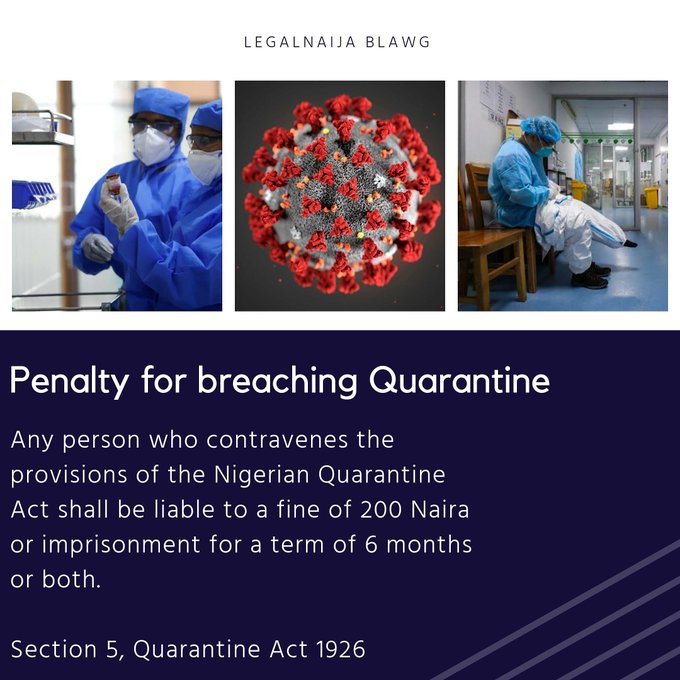
Section 5 of the Act stipulates a 6
month jail term or a fine of 200 Naira for contravening any of the regulations
made under the act. The President; and within each state, the Governor, may provide
sanitary stations, buildings and equipment and appoint any sanitary anchorages,
as he may think necessary.[8]
The magistrate courts have jurisdiction to commence and determine proceedings
for imposing any fine or imprisonment or for recovering any expense incurred or
charged by the Government in carrying out the provisions of the Act.[9]
Section 8 of the Act provides that where
the President is yet to declare, by notice, a disease to be a dangerous infectious
disease or is yet to declare, by notice, any place to be an infected area or is
yet to issue regulations as provided for in Section 4 of the Act, the State
governors are accorded the same powers as the President.
The Kaduna state government on Thursday 26th
of March invoked the provisions of Section 2, 3 and 8 of the Act, declaring
Kaduna State a public health area, declaring Covid-19 a dangerous infectious
disease and restricting movement from midnight.[10]
Similarly, on Friday 27th of
March, the Lagos state government issued the Lagos State Infectious Disease
(Emergency Prevention) Regulations 2020.[11]
These regulations, among other things, imposed a shutdown of the state,
declared Covid-19 a dangerous infectious disease, and declared Lagos State an
infected local area.[12]
The Quarantine Act however has two
subsidiary legislations namely:
1.
Declaration
of Dangerous Infectious Disease: Sleeping Sickness was declared to be a
dangerous disease within the meaning of the Act.
2.
Quarantine
(Ships) Regulations:
These regulations provide that the port
health officer is authorized to inspect any ship, already in the port or on
arrival at the port.[13]
In any instance where the master of a ship has sent to the health authority, a
notification of infectious disease on board, or he (the health officer) has
reasonable grounds to believe that there is on board, a case or a suspected
case of an infectious disease, the port health officer is authorized to inspect
on arrival, any of such ship.[14]
The regulations also provide that a
ship that has voyaged in a foreign port shall complete a Maritime Declaration
of Health Form which shall be countersigned by the ships’ surgeon, if it has
one.[15]
When before a ship arrives a Nigerian port, and a person is suspected to be
suffering from or is showing symptoms of an infectious disease, the master is
obligated to send a radio message before arrival, either directly or to the
Port Health Authority. When a person onboard a ship is suffering from an
infectious disease or tuberculosis, or has been exposed to an infectious
disease, the port health officer, upon
request by the master of a ship or on his own volition, is authorized to take
measures, including detaining the infected person or ordering his belongings to
be disinfected.
It should be noted that there is a Bill
for an Act to Establish the Nigerian Public Health (Quarantine, Isolation and
Emergency Health Matters Procedure) Act also known as Public Health Bill 2013
in the Senate.[16] This
Bill seeks to replace the Quarantine Act 1926, but is however yet to scale the
committee stage.
In conclusion, it must be stated that
the federal government is yet to lead by example in implementing the provisions
of the Quarantine Act 1926, as Nigerian is confronted by a deadly health
crisis. In his national address on Sunday 29th of March 2020, the
President made no recourse to the provisions of the Act in combating the
current national health crisis; rather he unconstitutionally imposed a 14-day
lock down on Lagos, Ogun and Abuja. This move, though out of necessity, begs to
question the relevance of the Quarantine Act 1926, in the current realities of
the Nigerian state.
@Legalnaija
[13]
Par. 3(1) Quarantine (Ships) Regulation
[15]
Par, 10 Quarantine (Ship) Regulation
[16] Available
on the Nigerian Senate website at http://www.nassnig.org/nass/legislation.php?id=1316