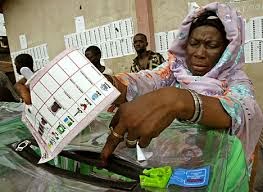

PENALTY FOR IMPROPER USE OF VOTER’S CARDS

PENALTY FOR IMPROPER USE OF VOTER’S CARDS

Editor’s note: This is the second post in a series informing
the public on Electoral offences, you can find the first post here – Punishment
for buying and selling voter’s cards
The recent Presidential primaries of the APC and PDP caused
some excitement over the last couple of days. Elections are coming closer by
the day and political parties are ensuring they present their best candidate
before the electorate in 2015. Many Nigerians are also gearing up for the elections
as most conversations now centre on the coming elections or the roles being
played by any of the many protagonists and antagonists in the political movies playing in Nigeria now. As we all
get closer to 2015, its quite important that we all protect out votes and
ensure that we report any electoral criminality that we may observe or suspect. 

An example of such criminality is the improper use of Voter’s
cards as provided for in  Section 120 of the Electoral Act 2010 which provides that –
Any person who –

  • being entitled to a Voter’s card, gives it to some other
    person for use at an election other than an officer and acting in the course of
    his duty under the act;
  • not being an officer acting in the course of his duty under
    the Act, receives any voters card in the name of some other person or persons
    for use at an election uses it fraudulently;
  •  without lawful excuse has in his possession more than one Voter’s
    card; or 
  •  buys, sells, procures or deals, with a voters card otherwise
    than as provided in the Act: commits an offence and is liable on conviction to
    a maximum fine of N1,000,000 (One million naira) ir imprisonment for 12 months
    or both.  

From the abovce provisons of the law, it is obvious anyone
caught commiting such criminality will have some explaining to do and possibly
some jail term to serve or fine to pay, thus it’s important no one participates
in such acts. Please share this article with as many people as you can to
discourage electoral offences. 
Adedunmade Onibokun, Esq
@adedunmade

CREATING AN INVESTMENT CULTURE: NO RIGHT TIME TO INVEST  By Ahmed O Banu

CREATING AN INVESTMENT CULTURE: NO RIGHT TIME TO INVEST By Ahmed O Banu

“A stitch in time
saves nine” said a tailor down the road.
I am very sure a lot
of us would have wondered “How does a stitch save nine? Why nine?”.For
people like me who didn’t grow up loving English (weird), the phrase
wouldn’t have been given a lot of thought. However, I actually gave it a
thought today and thanks to “Google”our reliable companion, I can
authoritatively tell what it means. Simply put, it means “why don’t you do
what you have to do now and stop procrastinating
”. Okay, English teachers,
review my script and tell me how close I got.
How does this relate
to investing? Hmmmmm…Wait for it.

The humble years I’ve
spent diving into the world of finance, swallowing every bit of knowledge I can
chew as spinach to succeed in what I now love so much, has taught me that one’s
ability to accumulate substantial wealth – the end result of consistently
making meaningful investment returns – depends on one’s ability and willingness
to take on risk. As the father of modern portfolio theory; Harry Markowitz,
said “the higher the risk the higher the return”. Hence, the very
aggressive risk takers will definitely become wealthier than their fellow peers
at a future date over a certain time horizon, all else being equal.
An individual’s
ability and willingness to take on risk is dependent on a lot of personal and
economic variables which includes but is not limited to; source of wealth,
measure of wealth, stage of life etc. I’d like that we concentrate on just
these three variables and see how it is that a lot of us might end up not
attaining the level of wealth we desire.
Let’s not dwell on
sources of wealth because it’s as clear as it can be. Our ability and
willingness to take risk and become as wealthy as we desire depends on our
source of wealth; be it the 9-5 guy working in an Oil company; the investment
banker who works 24/7 or the easy going entrepreneur looking forward to the
next day to make a profit. Howwealthy we can be depends on the amount of money
we earn. Therefore, we can definitely say a man that has three sources of
income is wealthier than the other with just one. However, the flipside to
investing is that, it’s not the quantity of wealth that
determines one’s ability and willingness to take risk but the way and manner we
perceive our wealth. This is in the sense that one might earn a lot but still
feel or actually be broke.
Let’s put this into
perspective, Mr A has three sources of income and earns a total some of NGN
1,000,000 monthly but spends NGN 800,000 out of it before the next month’s
receipt date while Mr B earns NGN 400,000 monthly and spends NGN 100,000 only.
Without a reasonable doubt, Mr A is the baller, the guy we all want to be like (I
definitelywant to be like him, who wouldn’t). Based on sources of wealth being
our factor to defining one’s ability and willingness to take risk, Mr A is just
the guy we looking for. But do a simple math; on a monthly, Mr B has NGN
100,000 more to invest and make himself wealthier than Mr A at future date over
a certain time horizon. So who is the baller now?
J
The question then is;
who would you rather be? Mr A; who lives for the moment (YOLO) and forgets what
the future holds or Mr B; who lives moderately and creates the avenue to become
wealthier in the future. Why don’t we act now by increasing our ability and
willingness to take risks and subsequently increase our propensity to become
wealthier? It’s never too late – the time is always right to do the right thing.
Don’t procrastinate.

By
Ahmed O.  Banu.

THE DUTIES YOU OWE YOUR EMPLOYER

THE DUTIES YOU OWE YOUR EMPLOYER

Credits – hse.gov.uk
I know how good it feels to get that bank alert or collect that
cheque that contains the sum of your monthly salary and/or other entitlements
such as bonuses etc. Do you also remember the feeling when it was delayed for
about a day or two, must have been horrible especially if you had bills to pay waiting
at your front door. An employer owes a duty to pay the wages of his employees
and provide a good environment for them to work but what duties are owed to
your Boss as an employer, here is the list –

  • To offer personal service ;
  • To be ready and willing to work;
  • Not to willfully disrupt the employer’s undertaking, i.e. to
    corporate with the employer;
  • To obey reasonable or lawful orders;
  • To give exclusive service, i.e. to work only for the employer in
    the employer’s time;
  • To account for profits received;
  • To respect the employer’s trade secret;
  • To take reasonable care of the employer’s property and to exercise
    reasonable care and skill in the employer’s service;
  • Duty of Fidelity;
  • Duty of care and skill;
Look forward to the next blog on the duties of employers.
Adedunmade Onibokun, Esq
@adedunmade
SPONSORED POST: NEXT365™ INTERACTION l

SPONSORED POST: NEXT365™ INTERACTION l

EVERY 365 DAYS, THERE ARE QUESTIONS TO ASK AND THOUGHTS TO EMBRACE. IT’S ALL ABOUT HOW THE YEAR AHEAD OF YOU CAN COUNT IN LINE WITH THE CONTENTS OF OUR HIGHEST CALLINGS.
The IDEA: Another year is dawning, what will we do DIFFERENTLY? What if you are told that an environment exist where you can have a CLEAR PEEP into 2015 through PRESCIENCE, in a way that gives you KNOWLEDGE, UNDERSTANDING, POWER and CONTROL over the CONTENTS of the EVENTS in it? How much will you pay to access that environment? Well, you will have to answer that question right away, because the environment do exist and it’s your turn to decide for or against it. It’s called PRESCIENCE—the fact of KNOWING something in ADVANCE as FOREKNOWLEDGE. Whether it’s your birthday and you have a whole new year ahead of you, or it’s your wedding anniversary and you have another year ahead or it’s simply December—the end of the year—or January—the beginning of a new year and your are getting ready for another 365DAYS, the COMMON DENOMINATOR to all these different scenarios is the TRUTH that there are THOUGHTS to SUSTAIN, BELIEFS to AUDIT, new GOALS to engineer and PLANS to EXECUTE.

The SOLUTION: The NEXT365™ INTERACTION is about what will or might happen 2015 and who you must be in it. It will help you with the mentality and intelligence to sit and to run all through 2015 and create winning experiences consistently through the year at the very centre of friction and heat and chaos. It will deliver guidance, counsel, direction, encouragement and focus.
The AUDIENCE: The NEXT365™ INTERACTION is for VISIONARY INDIVIDUALS focused on GREAT PERFROMANCE and HIGH-LEVEL RESOURCEFULNESS and RESULTS in 2015 within a Third-World Environment:
EXPERIENCE: It takes just 5hrs on-location to kick-start your ascent to the next level in 2015! It’s a black tie event.
EVENT POINT: The LUSH and SERENITY of Protea, Ikoyi, Lagos and will add all the ambiance value. Black Carpet starts at 5pm. 19th December 2014 at Port Harcourt, Rivers State and 20th December in Lagos.
EXCHANGE: Apart from a compelling, USABLE, TRANSFERABLE, AND REWARDABLE KNOWLEDGE experience, you will take away, the video of the event (shipped to you at no extra cost), you will receive our best-selling 4-pack audio selling in four countries: NEXT365 Audio work and a FREE DOWNLOAD of our “This is Wisdom Video Series”.
ALL THESE AND MANY MORE FOR JUST FIFTY THOUSAND NAIRA (N50,000) ONLY. PAYABLE INTO ACCOUNT NAME: THE OLAKUNLE SORIYAN COMPANY. 0054285748. DIAMOND BANK.
The NEXT365™ INTERACTION is your NEXT LEVEL… PLUG IN.  
For more details on event please call PATRICK on 08128118885 or OLANIYAN on 08128118883. 
Thank you!

OFFENCES & PENALTY ON PUBLIC HEALTH IN NIGERIA

OFFENCES & PENALTY ON PUBLIC HEALTH IN NIGERIA

The public health of a society or community
is very important to the general welfare of everyone in that society or community.
A good example that depicts the importance was the recent Ebola outbreak in
certain African countries, if you followed the news and updates from neighboring
countries who were worst hit by the virus, you must have observed their
respective governments instituting policies and measures to control the
breakout such as issuing directives that certain areas be quarantined and
placing curfews to prevent movement and spread of the virus. Such instances show
how important governments work hard to ensure the health of its citizenry is
protected and you will always find an abundance of laws which aim to punish and
prevent exposing the public to health hazards, for instance the Nigerian
Criminal Code Act. 

Section 243 of the Act provides that –

  • Any person who sells, as food or drink, or
    has in his possession with intent to sell it as food or drink, any article which
    has been rendered or has become noxious, or is in a state unfit for food and
    drink, knowing or having reason to believe that the same is noxious as food or
    drink, or is in a state unfit for food or drink is guilty of a misdemeanor, and
    is liable to imprisonment for one year. Examples of these are merchants who
    sell expired drugs and food items.    
  • Any
    person who adulterates any article of food or drink, so as to make such article
    noxious as food or drink, intending to sell such articles as food or drink is
    guilty of a misdemeanor, and is liable to imprisonment for one year.
     
  • Also, anyone who with intention to sell or
    provide for public consumption any carcass of any animal which has died of any
    disease is guilty of a misdemeanor and is liable to imprisonment for one year
    (Section 244). 
  • Furthermore, anyone who corrupts or fouls water from any spring,
    stream or river which renders it less fit for the purpose for which it is
    ordinarily used is guilty of a misdemeanor, and is liable to imprisonment for
    six months (Section 245). 
  • It is also a misdemeanor to bury a corpse in a house
    without the consent of the President or Governor and such person is liable to
    imprisonment for 6 months.
It should be noted that anyone who vitiates
the atmosphere so as to make it noxious to the health of persons in general or
spreads any infectious disease dangerous to life is guilty of a misdemeanor and
liable to 6 months in prison.
Adedunmade Onibokun
@adedunmade
     
PENALTY FOR BUYING AND SELLING VOTERS’ CARDS

PENALTY FOR BUYING AND SELLING VOTERS’ CARDS

Credits – google
General elections are fast
approaching and political parties are concluding their primaries to elect those
who would be their flag bearers in the coming 2015 National elections. As we
enter into the last lap of selecting our government representatives, it is
important that we do not sell our votes, rather it is imperative that we choose
the best man or woman for the job. Also of utmost importance is that we all
observe proper discipline in election matters. This post is a first in a series
informing you about electoral offences as provided for in the Electoral Act
(2010), particularly the offences of buying or selling of voter’s cards.

Section 23 of the Electoral act
provides that; Any person who –
  • Is in unlawful possession
    of any voters’ card whether issued in the name of any voter or not;
  • Sells or attempts to sell
    or offers to sell any voter’s card whether issued in the name of any voter or
    not; or
  •  Buys or offers to buy any
    voters’ card whether on his own behalf or on behalf of any other person,
    commits an offence and shall be liable, on conviction, to a fine not exceeding
    N500,000.00 or imprisonment not exceeding two years or both.
Credits – google
By virtue of the above provisions,
anyone caught with the illegal possession of voters’ cards will be prosecuted
and if found guilty may end up behind bars or having to pay a hefty fine. Manipulating
the voter registration process is also an offence.
Section 24 further provides that;
Any person who –   
  • Knowingly makes a false
    declaration in his voters’ registration form.
     
  • Fails to provide
    information in their possession after demand under the act;
     
  • Signs a voter’s
    registration form in the name of another person;
     
  • Makes multiple
    registration; or
  • Procures a fictitious
    registration

Commits an offence and is liable on
conviction to a fine not exceeding N100,000 or imprisonment not exceeding one
year or both. Obviously there is jail time involved for anyone found guilty for
any of the acts mentioned above. Persons who also by duress or threats hinder
others from registering as a voter is liable on conviction, to a fine not
exceeding N500,000 or imprisonment not exceeding two years. 
Kindly share this post with others to
ensure that many people are deterred from carrying out any of the above
offences and if you discover anyone doing same, please report immediately to
the nearest police station. 
Adedunmade Onibokun, Esq
@adedunmade/ twitter
THE CHALLENGES CONFRONTING WOMEN IN LEGAL PRACTICE

THE CHALLENGES CONFRONTING WOMEN IN LEGAL PRACTICE

(Being
the Paper Delivered by Mrs. FunmiFalana at the Young Lawyers’ Forum, NBA (IKEJA
CHAPTER) Annual General Seminar on Thursday, November 13, 2014.
It is my pleasure to be
invited to discuss this topic as it has become amatter of great concern to some
of us in active legal practice. I will therefore want to start by looking at how
Nigerian women have fared in the legal profession. We will look at where we are
coming from, where we are today and of course, where we should be.
Gender discrimination is
commonly observed in various profession and has also remained the barrier that
prevent a large number of women from taking up prestigious and high ranking jobs
in the work force, and the legal profession is not an exception. Women are
marginalized in political appointments and various decision making department
of the society because of the customs and traditional practices which have
continued to put Nigerian women at disadvantaged positions and the belief that
women are generally not suitable for the high post.

In terms of those entering
the legal profession and those currently in the legal profession and women in
other professions, like teaching, nursing etc one may find the number encouraging.
There seems to be an increasing symmetry between the number of women in the
legal profession and the number of women in the society at large. But
considering the number of women in active legal practice the number is
considered unattractive as one goes higher up the career ladder, one discovers
the number decreases further!
For example, how many women
in practice are partners in law firms? How many women are Senior Advocates of
Nigeria? Perhaps one will say women have continued to run away from the active
practice of law because of the peculiar challenges women face in practice.
The
History of Women in the Practice of Law
Many times we hear people
say “There
are no women at the bar”
This common slogan arouse from the age long
discrimination against women in legal practice. Uptill 1913, in Britain women
were incapable of being lawyers due to their sex as they were not regarded as
“person” under Solicitors Act 1843.
However, in 1913, the
advocates of women rights, filed a Case in Court Bebb v. the Law Society (1914) 1CH 286 seeking a declaration that Bebbwas
a “person” within the meaning of the Solicitors Act 1843 and the Amendment Acts
and therefore was entitled to be admitted to the law society. However, the
court dismissed the case and ruled that a woman was not eligible to practice as
a solicitor of the supreme court because that right was given under the statute
to a “person” and that word referred only to men! (Very Sad)

It was at the end of 1920s
which marked the beginning of the emancipation of women, that the judgment was
overturned by the Privy Council in Edwards v. A.G. of Canada (1930) AC
124 a landmark decision that heralded the entrance of women into the legal
profession.

In 1935 just about a decade and half after this remarkable judgment Nigeria
produced its first female lawyer! (Late Stella Jane Thomas).Nigeria also had Justice
ModupeOladunniEbo (Nee) Akingbehin, appointed as the first female High Court
Judge in Lagos State in 1969. Things however began to pick up in the 1980s with
the appointment of the first female Senior Advocate of Nigeria, Chief (Mrs.)
FolakeSolanke.
In 2009 Honourable Justice
Aloma Mariam Mukhtar (CJN) was appointed the first female justice into the
Supreme Court. Incidentally, Mrs. Aloma Mariam Mukhtar is also the first female
lawyer from the northern part of Nigeria. She further made history when she was
appointed the first Chief Justice of the Federal Republic of Nigeria. She truly
broke down all barriers and swept the door wide open for the likes of
Honourable Justice OlufunlolaOyeladeAdeleke, rtd, JSC;Honourable Justice Mary
Peter Odili JSC;Honourable Justice ClaraOgunbiyi, JSC and our own Honourable
Justice OlatokunboKekereEkun JSC who was appointed from the Lagos State
judiciary.
Moving to the appellate
court, women have also not done badly, the present President of the Court of
Appeal, HonourableZainabBukachukwu JCA was appointed recently. Others in line
are Honourable Justice AminaAugie who presides in Lagos division of the Court
of Appeal, Honourable Justice P.A Gaduje who presides inEkiti Division, Ado
Ekiti, Honourable Justice MorenikejiOgunwuniyi of the Benin Division,
Honourable Justice OyebisiOmoleye, Makurdi Division, HonourableModupeFasanmi,
Port Harcourt Division, Honourable Justice Dupe Komolafe-Wilson JCA. Etc.
Women, no doubt, are making
waves in the appellate courts. The recent elevation to the appellate court of
some female judges is indeed very commendable. Quiet a number of Chief Judges
of the States in the country are women, for example, Justice
OlufunmilayoAtilade of Lagos State, Justice BolajokoAdeniji(Oyo State), Justice
IdongesitIsua (AkwaIbom), Justice FatiAbubakar (Niger) Justice NnennaOtiti
(Abia) Justice OyebolaOjo (Osun) Justice TokunboOlapade (Ogun) and Justice Kate
Abiri (Bayelsa). Women are not doing badly at all on the bench!
This remarkable trend is
not reflected in private legal practice. The private practice is still
dominated by men. There is need to stem up the decline in female representation
in private legal practice in Nigeria. The women forum was inaugurated by the
NBA in 2006 to provide equal opportunity for the advancement of women in the
legal practice.
Gender diversity and gender
sensitivity must be consciously promoted by the Nigerian Bar Association in
positions and appointments to give women the needed encouragement especially in
private legal practice. Women should be allowed to play prominent roles in the
association.
Challenges
Facing Women in Legal Practice
Perhaps one of the reasons
for lack of many women in the private legal practice is undoubtedly the fact
that professional women still have the primary responsibility of both housekeeping
and child care. Despite the changing patterns of the work force it is still the
case that women routinely perform a higher proportion of household chores and
spend more time looking after children. The traditional role of a woman as a
child bearer, house keeper and a cook for the husband, children and larger
family puts her at a great disadvantage in taking her proper position at work
life.
The desire to strike a
balance therefore between working and family life is a big challenge. Sadly,
child rearing and housekeeping are just part of the many challenges confronting
women in practice. Practically speaking, most of the time, in times of appointment,women
are marginalized and discriminated against.Issues of state of origin and state
of marriage are often plots to marginalize and discriminate against women even
in the judiciary. Most of the time the women has the misfortune of being pushed
into the shadow of her husband and so she needs to work extra harder than her
male contemporaries to extricate herself from the shadow, the case of Justice
Jumbo Offor readily comes into memory here!
For you to get noticed as a
woman you need to work twice as hard as your male counterpart would need to do.But
unfortunately some women are lazy and unwilling to play by the rules of hard
work to get to the top especially in legal practice. Diligent, hard work,
integrity and determination are all very essential in the journey to the top!
The
wrong perception about women lawyers
People usually have a wrong
notion about women; they see them as not being strong enough and tender heart.
It is common knowledge that clients most of the time prefer male lawyers to
handle their cases including female clients for that matter. This does not
translate to mean that male lawyers are more brilliant, vocal and articulate
than their female colleagues but just on the premise of general perception. More
regrettable is the fact that some senior lawyers are often reluctant to recruit
female lawyers. They prefer male lawyers who may not even be as brilliant as
the female ones. It is a man’s world!
Strategies
to Success:
Here below are some suggested strategies
that can assist you in your journey to the top in legal practice.

  • Mentoring
    is indeed desirable and it provides practical training, encouragement and role
    modeling for the young lawyers:
  • Do
    not sit passively waiting to be noticed, map out a blue print for your own
    success. Opportunity may not just drop on your lap, you need to look out for
    opportunities. Study the life of successful lawyers and learn from them. Be
    proactive in seeking out opportunities for training. Work on high profile
    assignments, projects and service and committees. Those who have made it
    succeeded because they persevered. Justice Kekere- Ekun started as a
    Magistrate, the outgoing CJN started from the lower bench as well.
  • Stay Visible

Seek
out increasing responsibilities, take up difficult challenges and risk,
participate in NBA / FIDA and be noticed.
  • Apply Problem Solving
    Skills to Work Place
Use
as a learning experience. Do not label every roadblock as one resulting from
gender discrimination.
  • Prepare for obstacle from
    friends if you are fast tracked or hard working

While
being fast tracked is desirable, many of your colleagues or seniors may become
envious of your advancement, stand for promotion of the rule of law and justice
at all times.
  • Pick Your battles carefully   When you need to face a battle, be convinced it is
    worthwhile.
  • Make
    sure your expectations are realistic. Do not be over ambitious, learn to rise
    through the ranks.
  • Aim
    for outstanding performance, therefore you need to be more productive in terms
    of output and be prepared to work two times more than your colleagues.
  • Align
    yourself with the right people in the legal profession. No room for laziness.
  • Seek
    feedback on assignments / projects from your seniors via e-mail. etc.
  • Seek
    out opportunity for training and continuing education
  • Do
    not live in other peoples shadow.
Conclusion
These challenges
highlighted above are just few of the obstacles keeping women away from the top
in legal practice, however, women must be determined to break the glass ceiling
and take their proper places at the top.
REGISTRATION OF FOREIGN JUDGMENT IN NIGERIA   by Bolarinwa Awujoola.

REGISTRATION OF FOREIGN JUDGMENT IN NIGERIA by Bolarinwa Awujoola.

1.0       
As of today, the applicable law on the registration of foreign
judgments in Nigeria is the Reciprocal
Enforcement of Judgments Ordinance, Cap. 175, Laws of the Federation of
Nigeria, 1958 (REJO).
See Witt &
Busch Limited v. Dale Power Systems Plc (2007) 17 NWLR (Pt. 1062) 1.
By
extension, the Reciprocal Enforcement of
Judgments Rules, Cap. 175
Laws of
the Federation of Nigeria,
1958 (REJ
Rules)
is also applicable. It becomes pertinent to highlight the relevant
portions of the REJO and REJ Rules.

2.0       
Section 3
(1) of REJO provides thus:
“Where a judgment has been obtained in the
High Court in England or Ireland or in the court or session in Scotland, the
judgment creditor may apply to a High Court at any time within 12 months after
the date of the judgment or such longer period as may be allowed by the court
to have the judgment registered in the court….”
3.0       
Section 3
(2)
of the REJO provides thus:
No judgment
shall be ordered to be registered under this Ordinance if –
(a)              
the original
court acted without jurisdiction; or
(b)              
the judgment
debtor, being a person who was neither resident within the jurisdiction of the
original court, did not voluntarily appear or otherwise submit or agree to
submit to the jurisdiction of that court; or
(c)               
the judgment
debtor, being the defendant in the proceedings, was not duly served with the
process of the original court, and did not appear, notwithstanding that he was
ordinarily resident or was carrying on business within the jurisdiction of that
court or agreed to submit to the jurisdiction of that court; or
(d)              
the judgment
was obtained by fraud; or
(e)              
the judgment
debtor satisfies the registering court either that an appeal is pending or that
he is entitled and intends to appeal against the judgment; or
(f)                
the judgment
was in respect of a cause of action which for reasons of public policy or for
some other similar reason could not have been entertained by the registering
court. 
4.0       
Rule 12 of the REJ Rules also provides that:
The judgment debtor may at any time
within the time limited by the order giving leave to register after service on
him of the notice of registration of the judgment apply by petition to a Judge
to set aside the registration or to suspend execution on the judgment and the
Judge on such application if satisfied that the case comes within one of the
cases in which under section 3(2) of the Ordinance no judgment can be ordered
to be registered or that it is not just or convenient that the judgment be
enforced in Nigeria or for other sufficient reasons may order that the
registration be set aside or execution on the judgment suspended either
unconditionally or on such terms as he thinks fit and either altogether or
until such time as he shall direct; provided that the Judge may allow the
application to be made at any time after the expiration of the time mentioned.”
5.0       
Thus, by Section 3 (1)
of REJO, a judgment creditor (the
Applicant) may apply to a High Court in Nigeria, within 12 months of the judgment, for leave to register a foreign
judgment. When the Applicant is unable to register same within the allowable 12 months period, the Applicant may
apply to the court for extension of time to register. By a combined reading of Section 3 (2) of REJO and Rule 12 of the REJ Rules, upon service of the notice
of registration or the order granting leave to register the foreign judgment on
the judgment debtor (the Respondent), the Respondent may, within the time given
in the order, apply to the Court, vide a Petition, for the setting aside of the
registration or the order granting leave to the Applicant to register the said
judgment or for the suspension of execution of the judgment if the foreign
judgment falls within any of the circumstances highlighted in Section 3 (2) of REJO and Rule 12 of the REJ Rules.
6.0       
Whilst the provisions of the law appear substantially to be self-explanatory,
some of the said provisions are however shrouded in controversy. An example is
the nebulous provision of Section 3 (2)
(f)
of REJO. This provision will certainly warrant the posing of certain rhetorical
questions like; what will amount to a ‘cause
of action which for reasons of public policy or for some other similar reason
could not have been entertained by the registering court?’;
in Rule 12 of the REJ Rules, what ‘is not just or convenient?’ and what are ‘other sufficient reasons?’
7.0       
Since the REJO and the REJ Rules referred to above do not define “public policy”, “other
similar reasons”, “what is just and convenient” and “other sufficient reasons”,
the reasonable inference that can be made from the said open-ended provisions
is that the registering court has wide discretionary powers to set-aside and/or
refuse the registration of a foreign judgment depending on its interpretation
and/or definition of the above provisions. We hope someday soon, the Supreme
Court will make definite and definitive pronouncements on the application
and/or interpretation of Section 3(2)
of REJO and Rule 12 of the REJ Rules.
8.0       
For now, one can safely conclude that the facts and circumstance
of each case will determine the application and/or interpretation of the
provisions of Section 3 (2) of REJO and Rule 12 of the REJ Rules.
By Bolarinwa Awujoola.
PROFILE: FIDELIS ODITA QC SAN

PROFILE: FIDELIS ODITA QC SAN

Fidelis Oditah, is a Queen’s Counsel, a Senior
Advocate of Nigeria and a Professor of Law at Oxford University. Fidelis
practises as a QC at 3/4 South Square, London and at ODITAH, Legal
Practitioners & Arbitrators, in Lagos, Nigeria.  His extensive
practice area has included Company Law, Capital Markets, Corporate Finance,
Asset-based financing, Projects, Financial Services, Banking and Commercial
Arbitration. This first class scholar and an alumnus of the Universities of
Lagos and Oxford, United Kingdom, has an extensive legal practice in Nigeria
and UK. In England, he specialises in chancery and commercial work, with
emphasis on insolvency and restructuring work. He has acted and/or advised on
virtually all major corporate insolvencies in the UK in the last two decades.

In Nigeria, his practice encompasses energy,
projects, corporate and general commercial law. He has advised and acted for
the Federal Government of Nigeria in a number of the most significant energy
and power matters, and for many large and medium sized companies. He has extensive commercial arbitration practice as counsel and also sits
frequently as an arbitrator in a broad range of commercial disputes. He began his legal career at Oxford
University, England in 1989 where he taught corporate finance, corporate
insolvency, company law, contracts and trusts for many years before going into
full time commercial practice.
Born in Nigeria on 27 March, 1964, the son of a
Head Teacher, Fidelis graduated at the age of 20 from the University of Lagos
with a first-class law degree and scooped 12 of the 13 prize awards. The
following year he graduated with the highest first-class honours awarded by the
Nigerian Law School in 1985. Between 1985 and 1986 he undertook his National
Youth Service Scheme at the Nigerian Law School where he engaged as a lecturer
until August 1986. In September of he came to study at Magdalen College, Oxford
University with the benefit of a Commonwealth Scholarship. At Oxford, Fidelis
obtained a Bachelor of Civil Law in 1987 and a Doctor of Philosophy of Law in
1989, completing his thesis in just two years.
He was called to the Bar (Lincoln’s Inn) in July
1992, did pupillage from January to December 1993 and took silk in April 2003,
at the age of 39 and after a mere 10 years at the Bar of England and Wales. In
2004 he became a Senior Advocate of Nigeria (SAN). He also served as a consultant to the United
Nations Commission on International Trade Law from 1995 until 1999 and he is
President of the African Users Council of The London Court of International
Arbitration (LCIA), a member of court (governing council) of the LCIA, a member
of the Board of Trustees of Foundation for International Arbitration Advocacy
(FIAA).

He is the author of many books and learned articles in periodical journals, but
his best known publication is probably Legal Aspects of Receivables Financing,
published in 1991, a leading text in its field, which is an expanded version of
his doctoral thesis. He was also the founding editor of Company, Financial and
Insolvency Law Review. He is a member of the Editorial Board of Insolvency
Lawyer, a member of the Chancery and Commercial Bar Associations and was a
member of the Financial Law Panel Working Group on E-Commerce between 1999 and
2002.
Fidelis was a Fellow and Tutor in Law at Merton
College, Oxford and Travers Smith Braithwaite Lecturer in Corporate Finance Law
at Oxford from 1989 until 1997.  He resigned in order to practise
full-time at the Bar.  However, he remains a visiting professor at the
Oxford University Faculty of Law. Chambers 2002-2003 edition described
him as having a “huge brain” and that “what he doesn’t know is probably not
worth knowing”. 
In an article in Nigerian Village Square,
published in 2006, author Eugene Uzum looked back to Fidelis’ graduation day at
the University of Lagos and described him as a “softly-spoken and unassuming
encyclopedia of law, jokingly referred to as Fidelism.” 
Fidelis is married with children.