“Uncle, Stop Touching” “Sorry Madam, Sorry | Chika Maduakolam

“Uncle, Stop Touching” “Sorry Madam, Sorry | Chika Maduakolam

For some of us not in the know, there is a hot-cake scandal of a big Hollywood exec who has been alleged to have assaulted and harassed several women in Hollywood. Following the allegations, the #MeToo movement on social media is to enable other women around the world identify if they have been victims of sexual assault and harassment. In brief, the purpose of this movement is to stand against sexual assault and harassment, saying enough is enough.

As per my usual style, permit me to find an avenue to share my thoughts and unburden my jobless overworked legal mind:
What has a scandal from all the way in America got to do with us? Quite a lot! I muse over the fact that if Nigerian women; and it may surprise a few of us, men too, should share our #MeToo stories, we would actually shut down Twitter and any other social media outlet that exists. 
This is not saying that it only happens in Nigeria but I am Nigerian so this piece is fashioned to the environment I know. To return to my train of thought: I believe what catches my attention is not even the stories of blatant assault and harassment suffered by countless people, but actually the accepted standards of sexual misconduct within Nigeria which has drawn its weave within our society to the point where we are numb to various displays of this egregious acts daily.
Case in point: Boy and Girl are on the dancefloor, one or the other gets into the rhythm of the music and starts to close the ‘gap’ between both bodies. Before we say “Yeba” , one person lays their hand on another person’s waist suggestively and the dance takes another turn. 
Now, the person who is being touched tries to put some distance between the bodies, not appreciating the familiarity, the other person terms it as “shakara” and starts to apply more pressure to getting his or her way (with the erroneous thought that “yanga” will end after some persistence). If the offended now shows their offence, they are termed as overreacting. Bringing it home, when everyone is chilling and mingling, how often do we digress into sexual innuendos and then guys start touching you suggestively but mind you, as a “joke”. 
After all, we are not overly sensitive people!  And I could recount countless stories of some friends who go in for a business meeting and the potential client thinks it is okay to move from his seat to the seat right beside her and start stroking her, telling her “why are you being so serious?” and then when she wants to leave, he says “ahn ahn, someone cannot play with you again? It’s like you don’t want this account from me ooo”. What strikes me as funny is even as people recount these stories, we on the listening end laugh it off and say “all these men sef”.
We are desensitized to the gravity of what happens to us daily. Imagine my surprise when Nigerians reacted to a certain incident that occurred when the last Big Brother Nigeria aired. My surprise came from the fact that we could actually recognize what sexual assault looks like because to be honest, the alleged action is one that occurs on a regular and we shrug it off as a guy making a move on a girl he likes “Naija-style”. 
I will be the first to admit that even when a friend brought it to my attention, my first response was “Why are Nigerians attacking the guy, but guys do that” and I will apologize because it shows that even I am part of the problem!
To cut my long story short, I know some of us think that we have become on overly sensitive generation, following in the “western” footsteps but I would like to think that the principle of the lesser of two evils  applies here. I would rather be sensitive than condone inappropriate conversation, banter, touch or any other form of assault or harassment on my person. It is time to wake up because if we continue to permit our desensitization, very soon, even incidences like rape lose their shock factor and become commonplace (if it already hasn’t gotten there, but tale for another day!)
This is a decision that the court of public opinion has to take because our present laws in Nigeria (The Criminal Code, Penal Code and VAPPA) are limited in the protection they offer us. But the change starts with us first before we call for the attention of the lawmakers.
Disclaimer: I love the song “Yeba” so I use it as an illustration. I am in no way discussing the merits of the song.
My Adventure into Communications Law  – Paul Usoro SAN

My Adventure into Communications Law – Paul Usoro SAN

Before the GSM revolution in Nigeria, communication was a huge nightmare. The age-old cable telephone system in the country was as inefficient as it was costly.  Except for those at the topmost stratum of the society, possession of a telephone line was largely a luxury.  And it almost cost a fortune to get hooked up to the national trunk.  

However, the Federal Government took a bold step to break the monopoly of NITEL, which was in control of the industry. And so, the GSM came and the private network providers changed the face of things in the blink of an eye. Thanks to the great innovation, possession of a telephone has ceased to be a symbol status. Everybody is now communicating without tears. Today, Nigeria is one of the fastest growing telecom markets in the world. The tele-density too has grown beyond imagination.
But one strange thing about this phenomenal innovation is that relatively little is known about the behind-the-scene actors who midwifed the process of auction of the sales of the licenses of operation to the various network providers.  One of those unsung heroes of that revolution is Mr. Paul Usoro, a Senior Advocate of Nigeria (SAN).  He took an adventure into advocacy on communication matters when the field was relatively unknown.  Right from the outset of the negotiation of the deal, he provided the required legal advice for the liberalization of the sub-sector.
Today, Usoro, who is widely acknowledged as Nigeria’s father of communication law, remains a reference point in this specialized area of legal practice.  Listen to his story:
“I think much of my life has simply been structured by God.  He gave me the presence of mind to seize the moment.  I set up my practice in 1985.  Before then, when I finished my youth corps, I had joined a firm in Kaduna during which time I met a gentleman who happened to be a permanent secretary in the Federal Ministry of Communication.  And we got to be very close and became more of family even till today. When I decided to set up my law practice, I mentioned it to him and he encouraged me.  He said it would be a success because the people I was working for thought very highly on me.
That was how I set up my law practice.  Coincidentally, it was the time the Federal Government was setting up NITEL, excising it from the P & T. And he was responsible for the process.  Because of the confidence he had in me, he listed me as one of the external pioneer soliciting counsel to NITEL. That was how I became NITEL’s counsel. Of course, being a NITEL counsel doesn’t necessarily translate you to an advocate in communications matters.  But gradually, I became interested in core communication. At a point, I literally became a counsel of choice for NITEL. During the initial negotiation with regards to P & T on interconnect, it came naturally and they said, ‘Paul, you will be the one to do it.’  That was novel; it was a new thing.  Again, when it got to the level of having to negotiate SAT 3, International cable, somebody needed to represent NITEL and they said, ‘Paul, you have to negotiate with the consortium.’ Gradually, it became natural for them to give me core communication assignments.  To equip myself with the skill needed to confront the challenge, I went for conferences and researched to understand the language of communication. With that, I understood the intricacies of communications as far as the laws relating to it areconcerned.  And then, of course, some other significant developments came up later. When the Nigerian Communications Commission (NCC) was reorganized, they also started using me for their specialized needs.  To an extent, this area of specialization is a small industry. So, everybody knows each other and individual competences.”
By the time Ernest Ndukwe came in and decision was taken to do the GSM auction, he took me as their legal adviser.  It was exciting and groundbreaking. As I applied myself in NITEL, I also started applying myself here too, doing groundbreaking work and setting the standard. I began to produce some publications which served as agenda setting for the industry. I actually had to prepare the documents needed by the commission to work with the National Assembly. I give thanks to the Almighty God for opening the door for me.”
Interestingly, when Paul got admission to read English at the University of Ife (now Obafemi Awolowo University) in 1977, little did it occur to him that providence has a different plan.  But for peer influence, he probably would have ended up in class as aPioneering a new field of knowledge could not have come easy.  In any human endeavor, there is always this initial challenge of doing-it-alone. But he never allowed himself to be distracted.  He saw a bright future in the profession and went all out to acquire the much needed tool, especially the semantics. Recalling how he managed to overcome the initial challenges, Usoro recounts: “In terms of global context of practice, there were initial challenges. At that initial stage, you really could not have had the opportunity of mega-million naira paying assignments.  Even if there were, they were not as frequent. 
Therefore, if I had focused only on that, perhaps I wouldn’t have been able to pay salaries or maintain myself.  So, what I did was to focus on developing those skills I knew I needed for the profession. At the same time, I did not forget my primary role as a lawyer. So, I still went to court to do my advocacy as an advocate to those who believed very strongly in my advocacy.
“In the same vein, there were also some who believed that I am a specialist in communication related matters only.  In fact by the time I became a Senior Advocate of Nigeria (SAN), there were some people who were skeptical as to whether or not I go to court.  On the other hand, some who knew me within the communication industry saw me as an advocate in the communication field. In other words, doing only core communication couldn’t have been sufficient to sustain me at the very initial stage.
“The second challenge I had was to build myself and develop the necessary skills.  And as I used to tell people, one of the things you have to do if you are going to be specialist in communication is to have good mastery of the language.  You must speak the language; you must understand the linkages. If you do not understand, it will be very difficult for you to apply the law. For example, if you don’t understand the intricacies of the structure of lending, it will be difficult for you to prepare an agreement of lending document that would protect the parties you represent. You must understand the structure and how they want to do it. 
The same thing applies to communications; if you do not understand what needs to be understood and how to achieve it, it will be difficult for you to apply the law very well.  In this regard, I must pay tribute to my friends in NITEL.  I usually would go to some of them and ask them to lecture me on technical issues and the language as well.  And they would spend time to break it down for me. I actually used to ask for materials to read so that I could understand those technical language aspects.”
For the simple fact that Usoro was part of the process that gave birth to the successful operation of the GSM in Nigeria, at the snap of a finger he can narrate, blow-by-blow, how the hitherto dormant telecommunication industry was nurtured to become a competitive player in the ever-growing global market.  He saw it all and understands the intricacies of the deals that culminated in the opening up of the once-constricted industry.
Why was the operation fee paid to roll-out so expensive?  His answer: “It is a very simple thing.  You have a scare resource and you want to dispose of that scare resource. The fairest way you can dispose it off is to have people to bid so that each individual pays according to his appetite.  
That is the equivalent of putting your money where your mouth is.  The logic is this: You want it so badly; then let’s see how much you can pay in the process. Those who don’t have the deep pocket to be able to pay will gradually fall out; until it gets to a stage where only those who can afford it and really want it as much pay for it. That is one aspect of it. If the person values it that high, definitely, he would want to do something to be able to actualize it. He is not going to allow it to go fallow because he needs a return of his investment.

An English teacher or a lecturer at the tertiary level, depending on how far his luck could carry him.  But unconsciously, he strayed into the law programme.  This was how he came about that: “I believe I strayed into the profession.  I had an admission to read English at the University of Ife in 1977. There were two of my friends – Dipo Kalejaiye, now in the U.S., and the late Anthony Opop – studying English with me. By the time we finished the first year, Dipo said we should change to law.
“I knew he had an idea of what he wanted to do with law. And I also reasoned that it might be very interesting to go in for studying law than reading basically English. That was how I strayed into law. Then, they used to look into students’ result at the end of the session to decide those who can change courses.  When they looked into my result, I was one of the few students admitted into the law programme.”
The fairer way to do all this is to throw it open and set a minimum price.  Then, you start bidding from that base price. That way, those who are gambling will fall off.”

Nigeria’s experience is a peculiar one. Unlike most countries which had earlier embraced the new technology, Nigerians have had to pay through their nose for the epileptic service provided by the various networks. Drop calls, inter-connectivity problem and outright rip-off are still issues customers grapple with.  Usoro believes that with time, all these problems will be a thing of the past. His words: “What we have at present in Nigeria is much of voice telephony. Data hasn’t been developed as much as it ought to be.  The speed is not also as well as developed as it ought to be and even with regards to the voice, the quality still needs to be enhanced. The customer needs to have his money’s worth. Even the structure as well as convergence of all the technologies has not been fully developed. It is not a day’s journey so there are some things that need to be developed as far as the industry is concerned.”

Usoro however notes that one of the things that have been responsible for the growth in the communication industry is the stability of the regulatory agency, which is statutory. The credit still goes to Usoro, who practically single-handedly prepared the bill that was eventually passed into law by the National Assembly.

Usoro is an indigene of Ikot-Ekpene in Akwa-Ibom State and is married to Mfon, his childhood sweetheart, who is  the star maritime lawyer of Paul Usoro & Co. They are richly blessed with children.

Culled from the book For the Love of Their Nation: Lawyers as Agents of Change in Nigeria by Mustapha Ogunsakin
Nigerian Senator calls for State of Emergency in Educational Sector

Nigerian Senator calls for State of Emergency in Educational Sector

ASHAFA JOINS CONCERNED NIGERIANS TO CALL FOR STATE
OF EMERGENCY IN EDUCATION SECTOR
Just a day after the President hosted the Federal
Executive Council to the Presidential Summit on Education organized by the
Honourable Minister of Education Alhaji Adamu Adamu, where the President
decried the rot being experienced in the Nigerian Educational Sector,
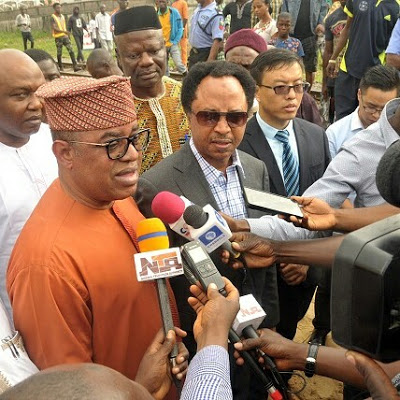
Distinguished Senator Gbenga Ashafa representing Lagos East Senatorial District
has also joined other concerned Nigerians calling for  a State Emergency
to be declared in the Education Sector.

The Distinguished Senator made this call at the
Convergence Summit held at the NAF Conference Centre Abuja on Tuesday, 14th November,
2017. 
Distinguished Senator Gbenga Ashafa while giving
his remarks said, “I am happy that the Hon. Minister is present at this event
because he is very vital in achieving the theme of this event, which is “Driving
a new public education initiative for Nigeria.”
 It goes without saying
that the state of public education in Nigeria is very poor and crying for help.
From the primary to the tertiary institutions, public education in Nigeria is
failing…”
The Distinguished Senator went on further to
provide some statistics to buttress his point. He said “Ladies and
Gentlemen, permit me to draw some inferences quickly. According to the Central
Intelligence Agency’s world fact book, the literacy level in Nigeria is just
about 59%, this is not too far from the UNESCO’s submission that about 65
Million Nigerians are illiterate. It is also important to note that by 2050,
Nigeria would be the third most populous country in the world. Beyond the ratio
of population to literacy, is also the issue of quality of education being
received. In Kaduna State recently, a competence test conducted for all
teachers in the state revealed that 75% of the teachers failed. Never mind that
this test was based on curriculum for Primary Four”
While acknowledging the effort of the President
Buhari led administration through the Minister of Education in the Education
sector by revamping the curricular, Senator Ashafa noted that if this dangerous
trend continues at this rate Nigeria would be looking at a very huge population
of illiterates/under literates by year 2050
He therefore called on the Minister of Education to
declare a state of Emergency in the Nigeria Education Sector. He was quoted to
say as follows “I join other well meaning Nigerians to call on the
Honourable Minister to declare a State of Emergency in the Nigerian Education
Sector. The effect of this might not be popular at first, however this is the
bold, proper and conscientious thing to do. We must do right by the judgment of
posterity and the future of our common wealth”.
He canvassed for the need for Nigeria to adopt
contemporary training, teaching methods and instruments being used in the more
developed countries to educate the minds of their people. To adopt an
experimental approach to teaching and learning as this will allow the students
learn better and the teachers impart knowledge more easily.
The event which has as its theme “Driving a new
Public Education Initiative in Nigeria
” was organized for the purpose of
identifying the challenges in the education sector and proffering ideas and
solutions that could revamp the Nigeria education sector.
Today In @ngrsenate Plenary

Today In @ngrsenate Plenary

*PROCEEDINGS OF THE NIGERIAN SENATE OF TUESDAY, 14th NOVEMBER, 2017.*

Welcome to a new Legislative Day in the Senate of the Federal Republic of Nigeria. Deputy Senate President, Ike Ekweremadu took the official prayer and led the Senate into today’s proceedings at 11:01am.

*EXECUTIVE SESSION*
The Senate moved into its Executive Session at 11:04am.
The Senate in its Executive Session deliberated on the workings of the Senate and the National Assembly as a whole and also discussed the suspension of Senator Ali Ndume. He is recalled without prejudice and billed to resume on Wednesday, 15th November, 2017 after 90 legislative days suspension.
The Senate Plenary resumed from its executive session at 11:19am
*APPROVAL OF VOTES AND PROCEEDINGS*
Senator Dino Melaye moved for the approval of the votes and proceedings of Thursday, 9th November, Senator Danjuma Lar seconded.
*ANNOUNCEMENT*
The Deputy Senate President, Ike Ekweremadu welcomed people who are present in the gallery to observe plenary.
*PETITIONS*
Senator Ovie Omo-Agege laid a petition on behalf of members of his constituency on a breach of the public trust with the brazen and illegal conversion of the land of the Uvwie people purportedly acquired for public purposes into private property y some unscrupulous soldiers through the instrumentality of the Nigerian Army Properties Limited.
Senator Gershom Bassey laid a petition from a member of his constituency.
The petitions were referred to the Committee on Ethics, Petitions and Privileges.
*POINT OF ORDER*
Senate Leader, Ahmed Lawan cites Order 42 seeking the permission of the Senate to present a motion tomorrow (Wednesday, 15th November 2017) on the fire outbreak in Nguru market, Yobe State in his constituency which gutted stores with goods worth hundreds of thousands of Naira.
*PRESENTATION AND CONSIDERATION OF A REPORT*
1. Report of the Committee on Local and Foreign Debts
Issuance of US$2.5 billion to Finance the 2017 Appropriation Act and US$3.0 billion to refinance domestic debts by Senator Shehu Sani.
– That the Senate do receive and consider the Report of the Committee on Local and Foreign Debts on the Issuance of US$2.5 billion to finance the 2017 Appropriation Act and US$3.0 billion to refinance domestic debts.
Senator John Enoh seconded that the Report be *LAID* while Senator David Umaru seconded that the report be *PRESENTED*.
The Report is *LAID*.
Senator Yusuf A. Yusuf cautions the Senate on piling foreign debt. 
Senator Gbenga Ashafa said what the loans are meant for will spread across the Geo-Political zones. 
He said, ”We’re working to ensure Nigerians get dividends of democracy & return Nigeria to a construction giant.”
Senator Mohammed Hassan raised an observation on the title and said it should read ”bond issuance”, he also speaks on the recommendations of the US$2.5 billion bond.
Senator Ahmed Lawan said, “The Executive have complied with laws that governs seeking of loans, these are infrastructure projects that will  have positive impact on the  economy.”
The Deputy Senate President, Ike Ekweremadu thanked his colleagues on their contributions and said the Senate will continue to partner with the Federal Governmnt towards making sure that the 2017 Appropriation Act is achieved.
*MOTIONS*
1. Urgent need to investigate allegations of unremitted Stamp Duty Revenue running into trillions of naira.
Sponsor: Senator John Owan Enoh (Cross River Central).
Senator Suleiman Hunkuyi seconded the motion. 
*The Senate accordingly resolves to:*
i. Commend the tenacity and fortitude of the School of Banking Honours for bringing the issue of unremitted Stamp Duties Revenue 
To public notice, and for insisting on probity of the Nigerian Inter-Bank Settlement System; and
ii. Mandate Committees on Finance and Banking, Insurance and other Financial Institutions to investigate allegations of unremitted Stamp duties Revenue in the last five years, and to report its findings, observations and recommendation to the senate not later than eight weeks from the date of this resolution.
2. The Need for fair and equitable distribution of federal health facilities in all six geo-political zones of the country in response to several demands.
Sponsor: Senator Matthew Urhoghide (Edo South)
Senator Aliyu Sabi lent his voice to the motion by adding that the senate needs to look at truly disadvantaged areas as regards federal health facilities. 
He said, “Our people deserve adequate health facilities provided for them in the rural areas.”
The Deputy Senate President, Ike Ekweremadu thanked everyone who contributed to the debate, he said the senate must ensure the implementation and defend the constitution at all time, he also said, ”It is our duty to ensure even distribution of health facilities  across the Geo-Political zones.”
Deputy Senate President, Ike Ekweremadu said uncompleted and abandoned health sectors scattered all around the country should be taken over by state government to avoid wasting funds building new ones.
*The Senate accordingly resolves to:*
i. Mandate the Senate joint Committees on Health (Secondary and Tertiary) and Primary Healthcare and Communicable Diseases to catalogue all existing Health facilities reflecting their locations, size, nature of services rendered, years of construction, present condition and other challenges to form part of the health sector information bank to date; and 
ii. Refer all requests or demands by legislators and other stakeholders for the citing of federal health facilities, where they do not already exist, to this joint committee with the intent and purposes of correcting the imbalance in the distribution of federal health facilities across local government areas, states and or geo-political zones.
iii. Mandate the Joint Committee in the tiers of government to work out staff structure in the hospitals.
*CONSIDERATION OF A REPORT*
1. Report of the Committee on Niger Delta
Niger Delta Development Commission (NDDC) Act 2000 (Amendment) Bill, 2017 (SB. 544) by Senator Peter Nwaoboshi.
-That the Senate do consider the Report of the Committer on Niger Delta on the Niger Delta Development Commission (NDDC) Act 2000 (Amendment) Bill, 2017 (SB. 544).
*COMMITTEE OF THE WHOLE*
The senate now dissolves into the Committee of the whole for the clause by clause consideration of the Niger Delta Development Commission (NDDC) Act 2000 (Amendment) Bill, 2017 (SB. 544).
The Senate reverts to Plenary to report progress.
The Deputy Senate President, Ike Ekweremadu thanks the committee for a prompt presentation and says the constitution empowers us to oversight the MDAs on matters like this.
The Niger Delta Development Commission (NDDC) Act 2000 (Amendment) Bill, 2017 (SB. 544) is read the *THIRD TIME* and *PASSED*.
*ADJOURNMENT*
The Leader of the Senate moved that other items on the Order paper be stood down to another Legislative day. The Minority Leader seconded.
Plenary is adjourned to Wednesday , 15th November, 2017.
#GavelBangs.
*Signed*
Digital Communications Department,
Office of the President of the Senate,
Federal Republic of Nigeria.
Behold The Next Generation Of The Nigerian Bar

Behold The Next Generation Of The Nigerian Bar

Growing up, we were always told that we were the Leaders of Tomorrow. Well, fast forward to today. Welcome to the tomorrow that we looked forward to yesterday.


It’s a critical period of our lives. A time where just one decision can make or unmake you. Today we are finally the “future leaders” that the world eagerly expected. 

And what kind of leaders are we turning out to be? “Future leaders who are not ready to take the bull by the horn”, some may say. “Rather than prove their mettle through the noble profession of the Law, they would rather engage in get-rich-quick schemes”, others will add.
Enter the #PaulUsoroChallenge.

The #PaulUsoroChallenge was much more than about the prize money. It wasn’t just about taking advantage of the social media for the sake of it. This was an opportunity for young, inspired, forward thinking members of the Nigerian bar to spark a movement and change the narrative in Nigeria’s legal space. 

Indeed, the challenge did a lot to counter the suggestion that young lawyers in Nigeria are not ready to take their place in the scheme of things. The campaign has put a lie to assertions that young lawyers only live for themselves. Today we see a new breed of lawyers stepping up in readiness to take over the mantle of leadership.

On the flip side, the campaign turned out to be a visual “CV” of sorts. It showcased the talent, drive and selflessness of our young breed of lawyers. They say a “picture says a thousand words”. Well, a video says far more than a picture can possibly say. And that was exactly what the video clips from those lawyers who participated in the challenge did. It brought to light the hitherto unknown selfless acts of some of our finest young lawyers. No more are they unsung heroes courtesy of the challenge.
Well done to all those who participated in challenge. Beyond the challenge, keep doing what you do!

I urge us all as young Nigerian lawyers to remain resolute and continue to position ourselves as problem solvers in our society rather than money-chasing young lawyers. That is the one true way to remain relevant in the world today and earn the respect we deserve.

Kudos to Paul Usoro and his team for being a shining light in the dark.  God bless Nigeria.
Understanding Copyright Protection In Nigeria (PART 1) | Davidson Oturu MCIArb

Understanding Copyright Protection In Nigeria (PART 1) | Davidson Oturu MCIArb

Introduction
Copyright is a form of intellectual
property. It has been defined by Black’s Law Dictionary, 9th Edition as a right
granted to the author or originator of certain literary or artistic
productions, whereby the creator is invested, for a limited period, with the
sole and exclusive privilege of multiplying copies of the literary or artistic
works and publishing or selling them.

The Copyright
Act Chapter C28 Laws of the Federation of Nigeria 2004 (Copyright Act), 
does
not define the word “works”. However, Section 1 (1) of the Copyright
Act provides that the following shall be eligible for protection:

                    a)   Literary
works
                    b)   Musical
works
                    c)    Artistic
works
                   d)   Cinematographic
films
                    e)    Sound
recordings
                    f)     broadcasts
Any work that is created which does not
fall under the foregoing categorisation cannot vest copyright in its creator.
Furthermore, it is not sufficient to have created a work; such work will only
be eligible for legal protection if:
“(a) Sufficient effort has been
expended on making the work to give it an original character;
(b) The work has been fixed in any
definite medium of expression now known or later to be developed, from which it
can be perceived, reproduced or otherwise communicated either directly or with
the aid of any machine or device.”
It can be gleaned from the above statutory
provision that the moment a literary, musical or artistic work has been fixed
in a definitive form and effort has been expended on the work to give it an
original character, it qualifies as a work eligible for protection.
Originality within this context does not
connote inventiveness or novelty. It simply denotes that the work was not
copied or plagiarised. It is therefore pertinent to note that copyright does
not protect ideas and copyright is acquired by expending skills on a work and
not by invention.
Copyright does not need to be
registered to enjoy protection
Unlike other forms of intellectual property
like patents, designs and trademarks, a work that is eligible for copyright
does not need to be registered in order for it to enjoy legal protection. An
eligible work enjoys protection as soon as it is created and fixed in a
definite medium.
However, the Nigerian Copyright Commission
(NCC) provides owners of copyrights the option to deposit a copy of their works
with the NCC and receive a certificate which serves as notification of the
existence of the work to the general public. Section 34 (2 (3) of the Copyright
Act states that the NCC is also required to maintain an effective data
bank on authors and their works.
Duration of copyright
Literary, musical or artistic works
 Copyright in literary, musical or
artistic works other than photographs lasts until seventy (70) years following
the death of the author. In cases where the work is owned by a government or a
body corporate, the copyright in the literary, musical or artistic work will
expire seventy (70) years after the work was first published.
Films, photographs and sound
recordings
Copyright in films and photographs lasts 50
years after the year the work was first published. Copyright in sound
recordings also lasts 50 years after the recording was first published.
Under part 2 of these series, we will
examine in depth the nature of works that are eligible for protection, how a
work can be protected and the remedies available to the owner of a work when
his copyright is being infringed.
Davidson Oturu MCIArb
Partner, Intellectual property and brand
protection
ǼLEX

Source – Linkedin 
Video: Adedunmade Onibokun on how young lawyers can excel in Nigeria

Video: Adedunmade Onibokun on how young lawyers can excel in Nigeria

As part of activities at the on-going Legal Marathon Summit 2017, @lms2017_ organised by the Liberation Chambers and held at the prestigous Oduduwa Hall, of the Obafemi Awolowo University.

Adedunmade Onibokun (@adedunmade), Founder @Legalnaija, delivered a speech on “How Young Lawyers Can excel in Nigeria’s Political & Economic Climate.

It was an amazing event and every young Lawyer should watch and learn.

Safeguards against Breach of the Lawyer’s Duty of Confidentiality | M. Dugeri

Safeguards against Breach of the Lawyer’s Duty of Confidentiality | M. Dugeri

It is commonly understood by lawyers that they are under a duty to protect confidential information relating to their relationship with clients. The law imposes on lawyers a strict obligation to safeguard client’s confidential information.  

Section 19 (1) of the Rules of Professional Conduct for Legal Practitioners 2007 (“the Rules”) is explicit that “all oral or written communications made by a client to his lawyer in the normal course of professional employment are privileged”. Sub-section (2) goes on to provide that a lawyer shall not knowingly:
a. reveal a confidence or secret of his client; 
b. use a confidence or secret of his client to the disadvantage of the client; or
c. Use a confidence or secret of his client for the advantage of himself or of a third person unless the client consents after full disclosure.
It is to be noted that, like all rules of law, there are also exceptions to this rule. For instance, disclosure is permissible when required by law or a court order, or with the client’s consent. See section 19 (3) of the Rules. 
The lawyer’s duty of confidentiality has broad application. It continues after the representation ends and applies to information received about prospective clients as well. The duty not only forbids revealing information, but also proscribes a lawyer’s use of confidential information about a client to the disadvantage of that client. With regard to former or prospective clients, a lawyer may not use confidential information to the disadvantage of a former or prospective client unless that information has become “generally known.”
Generally, both the duty of confidentiality and the lawyer-client privilege encourage clients to trust their lawyers. The lawyer-client privilege, especially, encourages clients to tell his or her lawyers everything, though the duty of confidentiality does this as well. With complete information, lawyers can provide the best and most appropriate advice.
Notwithstanding its importance, few lawyers and law firms have put in place safeguards against the breach of this fundamental duty. It is often taken for granted by most lawyers and law firms that this duty would enforce itself, which is hardly the case.
As a lawyer or law firm, it is necessary to do a self-appraisal of the systems you have in place for managing clients’ confidential information and consider how you might improve them to create greater confidence from your clients and insulate yourself against potential liability for breach of the duty of confidentiality. 
The following are some pointers to remember about client confidentiality:
1. Don’t discuss business outside the office.
2. Never discuss one client’s business with another client.
3. Beware of water cooler conversations. Can your chatter with the client at court premises be overheard by other clients or lawyers? 
4. Don’t talk to the press about your client’s business. Decline to answer if a reporter or blogger calls to ask if your firm is representing a particular person. Decisions about what to say to the press should be made by the client.
5. Remember the law is a profession, not merely a business. Clients pay good money for help with their problems. They deserve respect for their privacy.
6. Be especially cautious in office sharing arrangements. Beware “gossip” with employees of other firms. Keep case files segregated.
7. Remember that your duty of confidentiality continues even after the case is closed. It also continues after you leave the law firm.
8. Be wary when non-staff members want to use your office for ‘short meetings’ or ‘quick research’. Make sure no client files or documents are lying about carelessly or visible.
9. Never release information to callers such as a client’s accountant or business associates or partners without authorization.
10. Be careful when disposing of confidential papers, including rough drafts or duplicates. Use shredders or other secure disposal methods for sensitive materials
.
11. Never forget that the attorney-client relationship is built on mutual trust and confidence. Clients come to you expecting a form of sanctuary. You must honour that.
12. Put in place secured means of storage of clients’ files and communication with clients.
The law office is an exciting place. The lawyers and support staff are privy to information others don’t have. You learn interesting things about prominent people. Resist the temptation to share this information with outsiders, including friends and family. The duties of client confidentiality are broad. It is not limited to merely what the clients tell you. It also precludes unauthorized discussions of case strategy or evidence.
Loose lips sink ships – and might well lead to ethical and malpractice problems. Every member of a law firm, from senior partner to the litigation clerk, is under a strict obligation to protect the privacy and secrets of clients. Rule 19 (4) provides that:
“A lawyer shall exercise reasonable care to prevent his employees, associates and others whose services are utilized by him from disclosing or using confidences or secrets of a client, but a lawyer may reveal the information allowed by sub-rule (3) through his employee.”
A good idea is for firms to require all employees to sign confidentiality forms, which are placed in their personnel files. A blank copy of the form should be included in the office manual. It should be very clear to every member of staff that disclosure of a client confidence is a serious offence punishable with termination/dismissal. Breach of client’s confidentiality may prove very costly to the lawyer’s business and reputable, and leave him open to liability from the client and other third parties. It is better to be safe than sorry.
By Michael Dugeri
Commercial Lawyer at Austen-Peters & Co.
Event: Should I stay or should I go – Building a successful practice: UK or Nigeria?

Event: Should I stay or should I go – Building a successful practice: UK or Nigeria?

 
The British Nigeria Law Forum and Stephenson Harwood LLP invites you to a seminar: 
“Should I stay or should I go – Building a successful practice: UK or Nigeria?”

Venue: Stephenson Harwood LLP, 1 Finsbury Circus, London EC2M 7SH
Date: Thursday, 30 November 2017
Time: 18.00 – 21:30
To attend click on the link:
https://www.eventbrite.co.uk/e/the-british-nigeria-law-forum-and-stephenson-harwood-llp-invite-you-to-a-seminar-should-i-stay-or-tickets-39427398410?aff=es2
Speakers
Chair: Prof Oba Nsugbe QC, SAN, Pump Court Chambers
Carolann Edwards – Global Director of Learning & Organisational Development, Norton Rose Fulbright
AB Mahmoud – President, Nigerian Bar Association
Kamal Shah – Partner, Stephenson Harwood LLP
Jide Adesokan – Associate, Stephenson Harwood LLP
Ben Uduje – Partner, Charles Anthony LLP (Nigeria) and Barrister, 42 Bedford Row
Topics discussed will include:
How to build a successful practice and reach your potential in the UK or Nigeria
Comparing and contrasting the experience of lawyers in both jurisdictions
Advantages and disadvantages of practice in UK or Nigeria
Tips for success and career progression.
Programme:
18:00 Arrival & Registration
18:30 Seminar begins
Panel Discussion followed by Q & A
20:00 Seminar concludes
Drinks & Canapes served, networking
21:30 Event ends
British Nigeria Law Forum established in 2001 is a vibrant professional organisation made up of British and Nigerian Lawyers and Students. The objectives include career development, promoting and protecting members’ interests, creating business and educational opportunities, engaging with key stakeholders.
Stephenson Harwood LLP is a law firm with over 1000 people worldwide, including more than 150 partners with headquarters in London, with 10 offices across Asia, Europe and the Middle East.
For enquiries on how to join BNLF/Advertise/Sponsor contact: info@bnlf.org.uk or Rebecca Okoria (07506 991 579)