
Artist Performance Contracts And The Accolades Nigerian Artists Deserve | Joshua Olorunmaiye

Artist Performance Contracts And The Accolades Nigerian Artists Deserve | Joshua Olorunmaiye


If you caught up with my previous
article related to this subject matter; MUSIC
CONTRACTS AND THE ACCOLADES NIGERIAN ARTISTS DESERVE,
you would remember
the point noted that there is no perfect music contract that caters, once and
for all, for every single situation. This is so because there are several types
of contracts an artist may make during the long haul of a music career. What is
crucial therefore, is that you understand the content within each specific
music contract; the rights and obligations that they create between parties.

On this article, I am using an Artist
Performance Contract as a template for some of the insights to what you should
arm yourself with as an artist. As you may know, an Artist Performance Contract
is the contract which contains agreements regarding your performance at a gig.

In the meantime, do budding artists in
Nigeria ever sign these contracts or they just receive a call to perform at a
venue and turn up ready to blow out the mics?

Let’s go:

1.    
BASICS: Your contract should clearly define
the location, date, time, amount of compensation for your performance and have
a signature from you and your host.

2.    
PERFORMANCE: Precisely define the expectations of
the performance. What does your host expect and what do you expect? How many
breaks? How long should the minimum performance be?

3.    
PAYMENT: How will you be paid? Is it a fixed
amount, or a percentage of ticket/merchandise sales? When will the you be paid?
What is the method of payment? Would it be in lump sum or in instalments?

4.     RIGHTS: Who has the commercial rights to the recording,
reproduction, transmission and photography of your performance?

5.     COST: If the gig is out of town, you need to be certain of who
will cover the cost of incidentals such as meals, transportation and lodging.

6.     PRODUCTION: How and who handles issues such as
DJs, sound engineering, instrumentals, needs to be stated. Does your host
handle them or leave you to provide them?

7.     FRUSTRATION:
‘
Acts
of God’ are often mentioned to protect everyone involved. This includes weather
and/or illnesses. Acts of God is a legal term for occurrences that are beyond
the control of man and which would effectively cause the performance to be
impossible or delayed.

8.     TERMINATION: How will a cancellation of the
performance be handled? Will there be a penalty and to what extent?
Cancellation policies need to be clearly defined in your contract.

9.     COPYRIGHTS: You may consider adding a clause on
royalties and licenses to your performance contract especially if the work is
copyrighted. This would bring you economic gains as any part of your
performance is monetized.

10. RESTRICTIONS: Some specific requirements or restrictions
due to religion or social norms within the location regarding dressing,
language, smoking, drinking etc., would need to be inexplicably stated to avoid
running legal problems.

11. AGENTS: If there is an agent involved, their
terms need to be included as well in relation to the kind of compensation they
would receive or any obligations that they would have.

12. INSURANCE: Terms relating to insurance and
security should be provided to cater for possible injuries or mishaps that may
occur in relation to your performance.

In all, as an artist, it behoves on
you, upon your invitation to a gig, to request that a formal contract be signed
between you and your host. This goes a long way in ensuring that both parties
are saved from unnecessary anger in the event that things go wrong.

Finally, make sure to have your lawyer
review all documents in relation to your art before you sign same.

I hope you enjoyed this. Kindly share
to others. Cheers!

*Joshua
Olorunmaiye Esq is a legal practitioner based in Lagos. He is on Twitter as
@joshomaiye. You may contact him via email joshomaiye@gmail.com


Issue For Determination | Kema Ufelle-Smith

Issue For Determination | Kema Ufelle-Smith

Good morning Mr. Tobi, kindly accept my most
sincere apologies for being unable to secure the eventual satisfaction of your
creditor’s pecuniary liabilities towards you. It was indeed a jostle for which intricate
and extensive-cum-holistic research was expended, and for which no small degree
of persuasive legal gymnastics and histrionics were employed towards assuaging
the heart of His Lordship in your favour.

You know my problem with you, Barrister Segun? You try to
make your points with an unnecessary wide choice of words, and at the end of
the day, I never understand what you are saying. I always require the help of
an interpreter whenever you draft an agreement for me, and in this case, I
still don’t know if you are telling me that you won or lost my case.

Oh well, Mr. Tobi, your inability to
comprehend these rudimentary elucidations, is no fault of mine. Your worrisome
lack of comprehension, despite my spirited attempts at descending to your
level, is a matter to be settled between you and your English teachers. On my
part, it would be tantamount to being sucked into the vortex of incompetence to
cascade to such depths as to communicate on a banal and pedestrian level. Such asinine
communication is reserved for peasants, and must never be heard among the ranks
of the learned. Do you not know that the hallmark of an educated mind is its
ability to unearth the hidden meanings and nuances in an obscure speech?

Sometimes I wonder if you actually mean some of the
things you say. Since when has communication turned into a fine art, which will
require deeper interpretations? Isn’t communication simply for the purpose of
conveying a simple message to another person anymore? You insult me and call me
pedestrian because I use simple words, but what you don’t know is that it takes
an intelligent mind to speak with simplicity. Not only is your intelligence
revealed in your simplicity of language, but so also is your wisdom. This is
because it takes a wise man to use words that will be understood by the greater
number of people. Of what use will it be to speak without being understood? It
is like taking a bath without the intention of being clean, or telling a joke
without planning to be funny.

Again, I will pardon your ignorance on issues
of this stripe. Your brazen disregard for the elevated art of fine conversation
is self-evident, and I wish to continue this conversation no further.

No way, Barrister Segun! You cannot start a fire and then
run away. I have ignored you all this while, but we must get to the root of
this thing today. Just last week, I asked you to draft an agreement for me. It
was a simple agreement I reached with my business partner, but we wanted to make
it binding. When we asked you to put it into writing, we couldn’t even tell
what it was that we were signing anymore – we just had to rely on the trust we
had for you. Why will you write something for my own benefit, and then I cannot
understand its content? I mean, it only makes sense that I understand the
agreement that I am signing, doesn’t it?

You seem to have a lot of time on your hands
today, Mr. Tobi. Unfortunately, I have higher-ranking ordeals and herculean
tasks that require my timeous intervention. However, whilst I resist the
temptation to ignore your retorts, which, by the way, are strikingly similar to
those of an intellectually-vacuous man, I will make it poignantly clear that a
learned and lettered man is of a rare ilk. His is an elevated vocation, and his
frock is sewn by a different fabric. He has a solemn obligation to the law, and
nowhere in such an obligation is he bound to ensure the comprehension of his
clients. His sworn duty is to protect the law, and in what better way can the law
be preserved but in its strict, obscurantist and non-pedestrian form? If you
seek a conversation for the sake of leisure, there is an abundance of
motor-park simpletons waiting to indulge you, but my time, Mr. Tobi, is valuable.

You seem to throw insults quite freely, Barrister Segun.
All I wanted was a fair explanation on why your words are always so complex,
and not an afternoon shower of abuses. It seems that when you are backed into a
corner, you resort to verbal attacks. You say your duty is to protect the law,
but I am the one paying for the service. If it is the law you are serving, then
why isn’t the law paying you to draft the agreement? The service culture is
obviously lacking in your trade, and the earlier you treat me like I matter,
the better for your continued survival. When you defend me, I reserve the right
to understand in an intelligible form, how I am being defended, and I wonder
why this is so hard for you to understand.

You speak as though you have never been at the
mercy of a doctor. When he pens down his prescriptions, do you understand his
handwriting? No. Yet I am the hapless victim of your ill-considered
vituperations. I have had enough of this conversation. And if this was done in
a bid to avoid paying me my legal fees, then you must be joking. Do you not
know that a legal practitioner unwittingly subscribes to an unwritten vow to
preserve the mystique and inherent legalese of legal communication?

Perhaps this is true.
However, Barr. Segun, have you considered that the use of simple language may
actually promote efficiency and speed in legal drafting?

(Raucous
laughter
) Efficiency and speed, you say? What would an intellectual
Lilliputian like yourself know about legal drafting? Ordinarily, I would not
have dignified such puerile rantings with a response, but I consider it my duty
to educate simpletons such as yourself. Do you not know that the law is a
complex linguistic leviathan which requires arduous study to master? Surely,
even you must know that many words and phrases employed in legislations and
agreements have judicially-defined meanings, which would be lost in the miasma
of simplistic transliterations? For instance, do you know what it means to
‘execute’ a thing in law?

Of course! It means to
kill it.

There you go! A first-rate simpleton you are,
my dear friend. To execute simply means to sign a document. I have had enough
of this insipid and inane conversation. Off I go to attend to more pressing
engagements. You will do well to remit my fees into the bank account I have
already furnished as soon as is practicable and without undue delay.

My dear reader, please judge between Barrister Segun and I.
Do you think lawyers should tone down on their complex use of language, or should
it be retained for the preservation of the customs of the profession?

Kema
is a business lawyer, Founding Partner of Capitalfield Attorneys, and member of
the World Economic Forum.

Kema.ufellesmith@gmail.com

Paul Usoro SAN delivers a powerful lecture at the Kano State NBA Branch 2018 Law Week

Paul Usoro SAN delivers a powerful lecture at the Kano State NBA Branch 2018 Law Week

The Learned Silk is in the city of Kano for the NBA Law week, where he delivered a lecture on the topic “Good Governance, Corruption and Economic Development: Nigeria’s Experience and the Journey So Far”.
The law week promises to be exciting with key insights to be delivered from the 5th – 9th of May, 2018.
Excerpts of Paul Usoro’s lecture can be viewed below:

“Traditionally, the Bar Law Week gives us opportunity to examine topical issues as far as Nigeria is concerned, and it is quite interesting that this time, the Kano Bar decided to pick a very interesting topic – Good Governance, Corruption and Economic Development: Nigeria’s Experience and the Journey so Far.
 It is also interesting that the theme of this Law Week is actually geared “Towards Improving the Quality of Justice Delivery in Nigeria.
One of the significant ingredients for good governance is quality justice delivery. Without quality justice delivery, it is impossible for us to talk about good governance.
Essentially, good governance relates to political and institutional processes, and outcomes that are deemed necessary to achieve the goals of development.
The true test of good governance is the degree to which it delivers on the promise of human, civil, cultural, economic, political and social rights.
Good Governance, according to the United Nations Commission on Human Rights is the process by which public institutions conduct public affairs, manage public resources and guarantee the realization of human rights in a manner essentially free of abuse and corruption, and with due regard to the rule of law.
This definition indeed, incorporates justice delivery and the rule of law as features of good governance.
There are four (4) pillars that determine good governance according to the International Development Association. These four pillars are:
• Accountability
• Transparency
• Rule of Law
• Participation of the Citizenry
Transparency of decision making, particularly in budget, regulatory and procurement processes, is critical to effectiveness of resource use and the reduction of corruption and waste.
There must be a fair, predictable and stable legal framework which helps businesses and individuals to assess economic opportunities and act on them without fear of arbitrary interference or expropriation.
Good governance requires that civil society has the opportunity to participate during the formulation of development strategies.
Good leadership sets the tone for the standard of good governance. Without having good leadership, it will be difficult for us to have good governance.
When there is transparency in government, the private sector which is acknowledged as the engine room for economic development will have confidence in the economy and will want to invest.
Investment can only go to a place where there is good governance. Good governance is a precondition for economic development, which essentially means that the wellbeing and quality of life of the citizenry is dependent on good governance.
Good governance creates a viable economy with a knock-on result being economic development. The indexes for determining this economic development in a country are:
• Ease of doing business and predictability of economic policies – If you have good governance, the ease of doing business will be enhanced.
• Increased local investments as well as FDIs
• Job creation and opportunities;
• Assured security of lives and properties;
• A satisfied, patriotic and tax compliant citizenry.
Corruption is a bane to economic development. Monetary corruption is very bad, but corruption goes beyond financial corruption, which includes embezzlement, bribery etc. Corruption is common in all countries, irrespective of their stages of development.
The Black’s Law Dictionary, 8th Edition, defines corruption in two aspects:
– Depravity, perversion, or taint; an impairment of integrity, virtue, or moral principle; especially, the impairment of a public official’s duties by bribery.
– The act of doing something with an intent to give some advantage inconsistent with official duty and the rights of others; a fiduciary’s or official’s use of a station or office to procure some benefit either personally or for someone else, contrary to the rights of others.
Other forms of corruption that affect economic development occur when:
– Law-making processes are subverted and there is no transparency.
– Marks and grades are given in exchange for sex or some other forms of inducements or extortions or they are simply awarded on grounds other than merit
– Employment, appointments and contract awards and procurements are made, not on merit but based on some other opaque and corrupt considerations
– Approvals are given based on corrupt considerations
– Independence of the judiciary and independence of judges is tampered with and taken away by overbearing executive interference
– Electoral processes are tempered with
*A corrupt system produces a weak institution.
*As lawyers, we must be able to speak against corruption even when there is executive intimidation, interference and harassment. We must ensure that the bench is not corrupt.
Government must consciously acknowledge that good leadership is critical to good governance, and must ensure that good leadership is entrenched in Nigeria. It must also make relentless efforts to curb corruption.
Our Leaders must lead by example by respecting the basic principles of good governance – accountability, transparency, rule of law, citizenry participation in policies of government, restoration of due process and respect for laid down rules. It is important that the institutions that fight corruption must be strengthened. Fighting corruption in a way that erodes the rule of law is also corruption on its own. It is difficult to fight corruption with corruption. There must be a proper system to fight corruption”
How To Recover Small Debt Claims In Lagos State | Adedunmade Onibokun

How To Recover Small Debt Claims In Lagos State | Adedunmade Onibokun

A friend once wanted to recover
the sum of N35,000 (Thirty – Five Thousand
Naira) which had been erroneously deposited into a wrong bank account. Due to
the inability to locate the account owner, my friend was informed by the bank that
only via a court order could the payment be reversed, hence leading to my
friend calling me for help. Would you believe it cost over N5,000 (Five Thousand Naira) to institute a court proceeding at the
Magistrate Court and effect service on the Defendants? Leaving my friend with N30,000 (Thirty Thousand Naira) as the
value of the sum sort to be recovered.

Sometimes, the value of the sum
sort to be recovered could be much higher, for instance N500,000 (Five Hundred Thousand); N3,000,000
(Three Million Naira) or N5,000,000
(Five Million Naira). No matter the amount, a creditor will usually be required
to pay legal fees, most especially if a lawyer is instructed or one proceeds to
court as an option to recover the debt owed.  More often than not, creditors find the legal
and other fees paid to recover a debt as too high. Also, the long period of
time associated with court proceedings further discourages such creditors and
many usually choose to petition the police as an option of recovering the sum. Though
the police do not have the jurisdiction to act as debt recovery agents except
the petition also includes allegations of fraud or deceit.

This high cost of litigation
suffered by creditors especially those seeking to recover small sums, instigated
a cry for a small claims court with a mandate to address the issues of high
cost of litigating small claims and abridge also time of litigation. Thankfully,
the Lagos State Judiciary has established such a court with the introduction of
the MAGISTRATES’ COURTS LAW PRACTICE
DIRECTIONS ON SMALL CLAIMS 2018
by Hon. Mr. Justice Opeyemi O. Oke, Chief
Judge of Lagos State on 24th April, 2018. The objective of the small claims procedure is to provide
easy access to an informal, inexpensive and speedy resolution of simple debt
recovery disputes in the Magistrates’ Courts.

The Small Claims Practice
Direction is novel in that it provides in Article 12 (2) that the entire period
of proceedings from filing till judgment shall not exceed sixty (60) days) and
for matters to come under this provisions it must have the following elements
as stated in Article 2 –  

(a)     The Claimant or one of the Claimants resides
or carries on business in   Lagos State;

(b)     The
Defendant or one of the Defendants resides or carries on business in Lagos
State;

(c)      The cause of action arose wholly or in part in Lagos State.

(d)     The claim is for a liquidated monetary
demand in a sum not exceeding N5,000,000
(Five Million Naira), excluding interest and costs.

(e)     The Claimant has served on the Defendant, a
LETTER OF DEMAND.

The Practice Direction also recognizes
in Article 10 that Parties may represent themselves at the proceedings in the
Small Claims Court. Partnerships and Registered Companies can be represented by
either a Partner, Company Secretary or any other Principal Officer of the
Partnership or Company.

This is good news for
businesses and persons in Lagos seeking to recover sums below N5, 000, 000 (Five Million Naira) at the Magistrate
Court as it reduces the cost of litigation and abridges the time spent in
court. To institute a proceeding for debt recovery according to the Small
Claims Practice Direction, one may a fill the Small Claims Complaint Form and
file same at the Magistrate Court. For further information on how to take
advantage of the new practice direction in recovering your debt, you may
consult a lawyer or visit the Registry of the Magistrate Court.


Adedunmade Onibokun

Principal Partner

 Photo Credit – www.thenigerianlawyer.com 

   

Lagos State Small Claims Court

Lagos State Small Claims Court


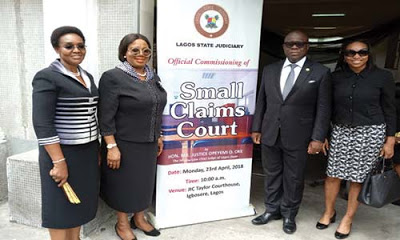
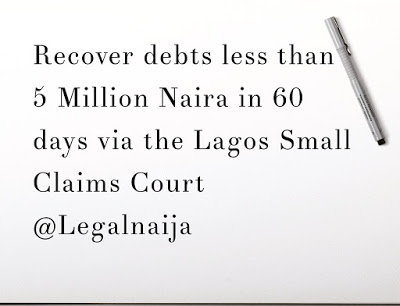
The purpose of the Small Claims Court  commissioned by the Honourable Chief Judge of Lagos State on Monday, 23rd April, 2018 is to provide easy access to an informal, inexpensive and speedy resolution of debt recovery disputes in the Magistrate Courts, of claims not exceeding the sum of N5,000,000 (Five Million Naira). The entire period of proceedings from filing of the claim till judgment is not to exceed 60 days.


#lagoslaws 
#debtrecovery 

#smalldebts
IP ABC: – Does a Patent give you complete protection | Infusion Lawyers

IP ABC: – Does a Patent give you complete protection | Infusion Lawyers


Question of the Week –

We are DigiMid, a digital media company in
Nigeria. We have just developed a new product that will enable people watch
videos at nights with their eyes closed so they don’t strain their eyes. The
product is a wearable electronic lens. Because it is new, we want to apply for
patent in Nigeria. But the issue we have is the risk of having a third party
make the same product by reverse engineering or other means. Before investing
in patent application, we want to know what a grant of patent really gives us.
Is it adequate protection? If not, what should we do to get complete
protection?

Answer 

WOW, a wearable electronic lens that enables
people watch videos with their eyes closed! Amazing stuff!


Now to your question, you want to know what a grant of patent in Nigeria gives
DigiMid and if this will be adequate.


A patent gives DigiMid a monopoly over the invention for a period of 20 years.
This protection is generally adequate.

What kind of monopoly? you might ask.


The Patents and Designs Act governs patents in Nigeria. Under the Act, a patent
can either be a product or a process. An inventor who is granted a patent is
called a patentee. A patent gives the patentee a monopoly by conferring on the
patentee right to stop any other person from doing two major acts:-

If the patent is granted in respect of a
product, the patentee has the right to stop any other person from making,
importing, selling, using, or even stocking the product for the purpose of
selling or using it;

If the patent is granted in respect of a
process, the patentee has the right to stop any other person from doing two
things:

(i) applying the process; or

(ii) making, importing, selling, using, or
stocking for the purpose of selling or using a product that was obtained from
applying the process.

In DigiMedia’s case, your wearable electronic
lens is a product. As a patentee, you will therefore enjoy the right to stop
any other person from doing any of the acts in paragraph one above.


Now to your second question, will patent be an adequate protection for your
invention?


Generally, yes. With the exclusive rights granted to a patentee, you have
meaningful protection for your invention.


But note that DigiMid’s rights as a patentee in respect of its
watch-videos-with-eyes-closed lens only applies to acts done for commercial or
industrial purposes. This means you can’t stop an unauthorized person from
making the invention if it is not for commercial or industrial, or both.

There are a number of reasons a patentee may not enjoy adequate protection.

One of these reasons is the way with which many inventors fail to protect their
inventions right from day one. How?


In DigiMedia’s case, the 3 points below show how:

If DigiMid’s patent application is not
well prepared for adequate protection, you may not have adequate protection.
 In your patent
application, your claim or claims determine the scope of protection you will
enjoy after patent is granted. This is why the scope of protection a patent
confers is determined by 2 things: (i) the terms of the claims; and (ii) the
description (with any plans and drawings). To prepare a patent application that
protects you adequately, consult a patent agent or attorney;

If DigiMid already sold the
watch-videos-with-eyes-closed lens in Nigeria, DigiMid no longer has any rights
against unauthorized makers, importers, sellers, or users.
This is so because
by selling the product before patenting it, you have exposed the invention to
the public. Under section 1(2) of the Patents and Designs Act, an invention is
new as far as it does not form part of the state of the art. State of the art
is everything concerning the field of knowledge to which your invention relates
which has been made available to the public before the date of filing your
patent application. So avoid selling your inventive product or process before
getting a patent. If you must make your invention available to the public for
some reasons, there is a safe procedure to do so under the Act; and

If DigiMedia exposed the
invention in a local or unofficial exhibition, getting adequate protection or
any protection at all is difficult.
 Making your invention available to the
public before patenting it affects protection (and even eligibility of the
invention for patent). Under the Act, there are 3 ways an invention is made
available to the public: (i) by description (oral or written); (ii) by use, or
(iii) by any other way. ‘Any other way’ is quite broad so it’s best that you
avoid any disclosure to the public in any way. The only public place that is
excluded is any official or officially recognized international exhibition. So
you don’t compromise your proprietary interest, avoid disclosing details of
your invention at both local and unofficial exhibitions.


What should DigiMid do to get complete protection?

First, be aware that even for real or movable property, there is no such thing
as complete protection. A patent being an intangible property, protection is
even less assured. This is why there are always risks of infringement. One way
of minimizing these risks is by ensuring that your patent application contains
specific claims, not general claims.


Second, since your invention is new—and excitingly so—consider getting patents
internationally as well. You may start by focusing on the countries you wish to
export your product to. For this purpose, there is a procedure that allows an
already registered patent in a country to be given priority when applying for
patent for the same product or process in another country. Nigeria’s Patents
and Designs Act recognizes this procedure.

Lastly, apart from patent, you may also consider trademarking the name of the
product you have invented. Should any person successfully get away with
unauthorized sale, import, or use of any invention as yours, you will be able
to use your distinctive mark to compete, making it easier for your customers to
distinguish your inventive product from others.

To explore all your options, we advise you contact an IP lawyer or law firm for
professional assistance and guidance.


Best wishes

IP ABC

Photo Credit – Static World 

Duale, Ovia & Alex-Adedipe Set to Organize Inaugural Business Series on Telecommunications, Media And Technology

Duale, Ovia & Alex-Adedipe Set to Organize Inaugural Business Series on Telecommunications, Media And Technology

Top Nigerian Law Firm of
Duale, Ovia & Alex-Adedipe (DOA)
is organizing its inaugural Business Breakfast Series on May 8, 2018 at The Wheatbaker
Hotel, Ikoyi, Lagos, Nigeria.

The theme of the Session is “Investment in Nigeria’s Telecommunication,
Media and Technology Market (TMT)
”. According to the Managing Partner of
the Firm, Adeniyi Duale, this year’s Session would focus on the burning issues
in the Financial Technology (Fintech)
space with an opportunity to discuss and review new developments from a global
perspective.

Furthermore, Adeniyi has
stated the session will provide a unique opportunity for Fintech companies to
meet with potential investors to dialogue and listen to various private equity
firms on what forms the basis of their investment criteria in start-ups and
companies seeking growth capital.

The Session will serve as an
elevated medium to share ideas and skills, grow and network while deliberating
on ways to build and identify opportunities that allows Investors or Venture Capitalists
invest in the budding Fintech sector.

The Firm will be partnering
with Terragon Group, Bluechip Technologies Limited and Blue Point Global Resource
Limited for the event. The event is also expected to attract a distinguished
faculty of knowledgeable panelist and resource persons from within and outside
Nigeria.

The Firm has been recognized
in the Telecommunication, Media and Technology sector as well as in the Real
Estate and Construction space having won awards at the Legal Blitz Limited’s
annual ESQ Nigeria Legal Awards 2017.

DOA is a bespoke full-service commercial
law firm in Nigeria providing a wide range of expert legal services to a highly
diversified client base both local and international operating in various
sectors of the economy.

The Firm is noted to have specialist
skills in areas including but not limited to Telecommunication, Media and
Technology, Banking and Finance, Company Secretarial, Capital Market, Energy
and Natural Resources, Litigation and Dispute Resolution, Taxation, Real Estate
and Construction.

According
to the Firm’s Managing Partner “As a Firm, we effect our distinct understanding
and knowledge of the Nigerian market to advise our clients on legal issues. We
also understand the challenge and complexity of doing business in Nigeria,
hence clients have continually relied on our intricate and artful knowledge of
the law and economic realities of Nigeria in providing bespoke legal services
that achieve their respective corporate and business objectives”.

To register for the event click here

Map: View
Directions 
here

When Lawyers Bury the Wig and Gown 1: Big Brother and the LPA | Lotanna Attoh

When Lawyers Bury the Wig and Gown 1: Big Brother and the LPA | Lotanna Attoh


Two
weeks ago, the Big Brother Nigeria reality TV show ended, and one youth (who
may or may not be lazy, depending on how you look at it) has emerged N25
million naira richer. Also newsworthy, but maybe not as much as the Big Brother
finale: the 113 plus Chibok girls still in captivity along with Leah Sharibu;
the Benue people still being killed; Lai Mohammed still being Lai Mohammed;
Senator Dino Melaye doing Jackie Chan-like stunts; thugs casually visiting the
National Assembly; and oh yes, Buhari still remains our president.

Yes,
all those take second place to Big Brother; such is the power of mindless
reality TV shows. Personally, I have never understood what the fascination is
with the Big Brother show, and I never will.

Now
you might be wondering what the correlation is between the topic above and Big
Brother? Well to those who were regular viewers of the show and are lawyers,
such might be obvious; but to others like myself who couldn’t be bothered about
it, but were forced to receive updates and information on it thanks to social
media and the show’s numerous fans, that link might not be so obvious. The link
between the two is none other its ex housemate, Cynthia Nwadiora aka Cee-C. Still
not clear? A little background then.

Cynthia
Nwadiora aka Cee-C is, presumably, a lawyer. That is all the background you
need.

This
article aims to look at the propriety or otherwise of conduct of persons who
are presumably practising lawyers, in relation to the relevant sections of the
Legal Practitioners Act . Our case study on this discourse will be Cee-C.


“Facts”

We
will be working on a set of presumptions. This is solely because of the fact
that I don’t personally know Cee-C, and thus I cannot factually speak about
anything concerning her; inference and presumptions will only be made here.

Our
chief presumption and the foundation of this discourse is that the now ex
Big-Brother housemate is a lawyer. I say presumption because I don’t know for a
fact that she is one, but all the information from social media and news outlet
claim that she is learned. Till it is rebutted, Cynthia Nwadiora aka Cee-C is a
lawyer.

Our
next step now is the question: when was she called to the Nigerian Bar?

Her
year of call will help in achieving the goal of this article: an earlier year
of call will bring about a different analysis from a later one. So, for the
sake of this article, we will presume, again, that she was called sometime
before she entered for the Big Brother reality show. Let’s say some 4 years
before; so, 2014 would be  her year of
call, hypothetically.

Next
is the crucial question: what was Cee-C doing in the ‘4 years’ since she was called
to the Nigerian Bar? Was she a practising lawyer, or was she engaged in some
other  profession? Again, we must presume
here. Let us go with the former supposition, i.e., that she was a practising
lawyer. Let us also presume that she was practising up to the moment before she
got into the Big Brother house.
Now
that we have all our ‘facts’ in place, let us take stock:
–
Cee-C is a lawyer

–
Cee-C was called to the Bar in 2014

–
Cee-C was a practising lawyer before getting in the Big Brother House
Now
let’s look at the law in relation to this topic.

The Law

The
relevant law to this discourse is the Legal Practitioners (LPA) (Amendment) Act
1994, with specificity to its section 12 (2).

Section
12 (2) states that:

“Where
a person whose name is on the roll is judged by the Disciplinary Committee to
be guilty of misconduct not amounting
to infamous conduct, which in the opinion of the Disciplinary Committee is
incompatible with the status of a legal practitioner,
the Disciplinary
Committee may, if it thinks fit give such direction as is authorised by
paragraph (c) (II) or (III) of subsection (1) of this section…”

I
have highlighted the relevant portion of that section to our discussion.

To
my unlearned friends, the above section is simply saying that where the
disciplinary body of our profession finds any lawyer to be guilty of conduct
which they judge to be unbecoming of a legal practitioner, such a lawyer will
be punished either by being suspended from practising law for a period of time,
or by being admonished by the body [section 12 (1)]. Pretty straightforward
right? Alas, like with all things law, it isn’t so, and there are
complications.

To
understand these complications, one must first of all understand the true
meaning of the section. And to do this, reference must be made to subsection
(1) (a) of the same section 12. Section 12 (1) (a) states:

“Where a person who is a member of the legal
profession is judged by the Disciplinary Committee to be guilty of infamous
conduct in any professional respect…”

The
phrase “… infamous conduct in any professional respect” simply
means conduct rendered in a professional capacity, which is at variance with
the rules and norms of the profession; it seeks to ensure that lawyers act
uprightly while rendering their professional services. In the case of NBA v
Alabi
(2006) 14 NWLR (Pt. 1000) 841, the Disciplinary Committee defined the
phrase to mean “infamous conduct in any professional respect is an act or
omission which in the opinion of the Legal Practitioners Disciplinary Committee
is such that will bring the legal profession into disrespect.” In that
case, the lawyer in question failed to remit to his client money given to him
for the client. In another case, Chike v LPDC (2005) 15 NWLR (Pt. 1026)
1, the lawyer misappropriated money given to him for his client. Such was held
to be an infamous conduct in a professional respect. In several other cases,
the Committee ruled against lawyers who acted unscrupulously in their
professional dealings.

Now
that we know that section 12 (1) (a) has to do with the lawyers’s conduct  in their professional capacity, we turn back
to section 12 (2). This section is the direct opposite of section 12 (1) (a).
This is so because its provisions make no reference to conduct in a
“professional respect,” rather the conduct which it seeks to prohibit
is that which “is incompatible with the status of a legal
practitioner.” What would then amount to such conduct? Unfortunately, the
Act does not specify; it leaves that question unanswered and open to one’s
discretion, and there lies the problem. Our case law is also rather lean in
this respect, as most of the disciplinary cases have bordered on conduct in a
professional respect (I found none which touched on conduct incompatible the
status of a legal practitioner.) Despite the dearth of materials on this issue,
I will refer to the textbook, Law In Practice in Nigeria (Professional
Ethics and Skills)
2nd Edition by A. Obi Okoye, for a better understanding
of such conduct as stated under section 12 (2). In pages 384 and 385  under the heading “Conduct not amounting
to infamous conduct, but which is incompatible with the status of a legal
practitioner,” the author lists out certain types of behaviour, that in
his opinion may be held to be conduct incompatible with the status of a legal
practitioner. He mentions: “the use of obscene language by a legal
practitioner in public, habitual drunkenness, fighting in public, seduction of
a client or his wife.”

We
now know the law and its problem; we can now proceed to the last part of this
article.

Cee-C

Recall
our earlier presumptions on Cee-C (stated above) under the heading
“facts,” that she is lawyer and she was a practising one up until she
entered the Big Brother house? Good.

I’m
sure you can now see my destination with all this, but before we arrive there,
let us indulge ourselves in one more presumption. For the sake of this
discourse, let us presume that Cee-C’s conduct in the Big Brother house was terrible
and full of shocking behaviour. In any case, the updates and reports on social
media during the show showed that this was the case. Still, as I didn’t watch
the show, I cannot confirm that.

With
this last presumption and taking into consideration others mentioned, the
question then is: can section 12 (2) of the Legal Practitioners (Amendment) Act
1994 be invoked against Cynthia Nwadiora aka Cee-C?

Can
her conduct in the house be sufficient 
grounds for the Disciplinary Committee to try her, and if found guilty
suspend her from practising law or admonish her? Can Cee -C’s conduct in the
house be held to be conduct which is ‘incompatible with the status of a legal
practitioner?”

Unfortunately,
I don’t have the answers to those questions. So, I will leave them to you and
the LPDC to ponder on.

Needless
to say, it is obvious that section 12 (2) and other sections of the Legal
Practitioners Act need to be reviewed and amended. There is currently a bill before
the National Assembly seeking to replace the existing Act, but I don’t know if
it contains an amendment to that section.

To my
learned friend Cee-C: Not all of us were made to suffer adjournments and the
like… I applaud your hustling spirit. You know what you want, keep chasing
it!
I remain a Minister in the Temple of Justice.

L. Attoh Esq. [2018] All rights reserved.
Photo:
thenationonlineng.net

Sensitizing People About Their Rights – Whose Responsibility Is It? | Judy-Vallery Imasuen

Sensitizing People About Their Rights – Whose Responsibility Is It? | Judy-Vallery Imasuen


A
sight that is so common among Nigerians is that of not knowing what their
rights are. The idea of “fundamental rights” has been so romanticized by the
populace that it is common to hear citizens vaguely bring almost any matter
under it. Therefore it is possible to hear a person who has been denied their
salary or is facing an eviction say that “their fundamental right has been or
is being breached.”

Due
to lack of sensitization, people are unable to distinguish between a
fundamental right, as provided for in Chapter 4 of the Constitution of the
Federal Republic of Nigeria 1999 (as amended)
, and other rights that are
safeguarded by the law and contracts. They do not categorize rights the way it
is done in the legal sector. Most times the general perception is one of
recognizing that there is a problem that needs sorting out.

What
this shows is that Nigerians are not adequately sensitized about what the law
is and how it affects them. Some do not seem to appreciate the importance of
contractual terms and conditions stated in letters addressed to them. They do
not see the importance of seeking clarification on terms they do not understand
before signing documents until it is too late.

They
are not aware of the existence of institutions that can help them. In addition
to this, their distrust in the efficiency of institutions such as the police
force is preventing them from getting the help they need. With this, the
unfortunate cycle of injustice continues everyday.

While
there are some people who are aware that their rights are being breached or are
about to be breached, they do not know the correct institution to go to in
order to have their issues addressed.

For
example, in Lagos State there exists the Domestic
and Sexual Violence Response Team
established with the aim of
eradicating sexual and gender-based violence. It is common for domestic
violence victims to run to a human rights organization first instead of
immediately reporting the matter to the Domestic and Sexual Violence Response
Team.

Although
domestic violence may lead to a violation of one’s fundamental right to life
and right to dignity of human person as provided for in Sections 33 and 34
of the Constitution of the Federal Republic of Nigeria 1999 (as amended)

respectively, an organization such as the Domestic and Sexual Violence Response
Team would be better able to handle such matters effectively.

Various
rights groups have sprung up to address the problems of the masses and render
assistance to them whenever they can. However, what the people do not realize
is that some of their problems could be easily addressed by filing a complaint
at the nearest police station without having to tolerate the injustice done to
them.

The
question then is, who is responsible for sensitizing the people? Sensitization
campaigns are not the responsibility of only a few. It is the responsibility of
all stakeholders who are dedicated to seeing that justice is done, such as
lawyers and rights groups. This is because they are in a position that enables
them to know about the law and explain it using simple terms.

Now
that we have been able to establish who bears the responsibility of sensitizing
the masses about their rights, the next question is how best could we carry out
sensitization campaigns? A good way of tackling this would be to follow the
practices of copywriters in the marketing sector.

In
simple terms, a copywriter writes advertisements that encourage people to take
a particular action such as purchasing an item or signing up to a course.
Before a copywriter writes an advert, they take time to analyze their target
audience to determine where they can be found, their habits, interests and common
problems or “pain points”. They know what medium their audience reacts to best.
Taking this medium into consideration, they craft relatable words that capture
the attention of their audience and achieve their primary aim of selling.

A
similar technique can also be employed in the legal sector to facilitate an
effective sensitization campaign by bringing the law to the masses using media
that they can easily relate with. 

For
a sensitization campaign to be effective, it has to take into consideration the
people it is meant for. The campaign has to be able to convey information using
a medium and language that can be easily consumed. This could take the form of
social media posts and pictures that portray the main point.

An
example of this can be seen in how Venezuela Inteligente, a digital rights
organization, used
social media to promote participation in legislative elections
. Mass
BlackBerry Messenger messages were sent out to encourage the youth to
participate in legislative elections.

If
sensitization campaigns are properly conducted, more people would know that
they can seek help to address their problems and hence would be better equipped
to fight for their rights.


Judy-Vallery
Imasuen

Legal
Practitioner at the Committee for the Defence of Human Rights (CDHR)