
by Legalnaija | Dec 9, 2024 | Blawg

EVENINGS OF UNENDING FUN AS NBA IBADAN CELEBRATES 70TH ANNIVERSARY
As part of the 70th Anniversary celebration of the Nigerian Bar Association, Ibadan Bar, the Planning Committee has lined up an exciting array of social events to honour the branch’s rich history and bring members together to unwind and have fun.
These activities promise fun, relaxation and unforgettable moments.

• The Jersey Party
It’s going to be an evening after the Aare Afe Babalola/NBA Ibadan Football Competition Final where members of the Bar and football fans will come together to have fun in an exciting setting. Get your Jersey ready and join us on Saturday. 14th December, 2024 for a party like no other at the Aare Afe Babalola Bar Centre, Opp. Old NTC, Iyaganku Road, Ibadan.

• Movie Night
Bringing the SCREEN to the BAR! Relax with colleagues and enjoy a cinematic experience as we celebrate 70 years of excellence in style on Sunday 15th December 2024 at the Aare Afe Babalola Bar Centre, Opp. Old NTC, Iyaganku Road, Ibadan

• Variety Night
A vibrant evening of unlimited fun with good live band music, dancing, lots of drinks and food. it’s going to be an evening to celebrate creativity and community at the Aare Afe Babalola Bar Centre, Opp. Old NTC, Iyaganku Road, Ibadan on Monday, 16th December, 2024

• Karaoke/Games Night
An evening of music, laughter and friendly competition! Come sing your heart out on stage or showcase your gaming skills with trivia and board games on Tuesday 17th December, 2024 at the Aare Afe Babalola Bar Centre, Opp. Old NTC, Iyaganku Road, Ibadan
• 70th Anniversary Dinner and Award Night
A grand night of elegance and honour featuring the investiture of Dr. Wale Babalakin SAN as Patron and the presentation of Awards of Excellence to deserving members. Let’s dine on Wednesday 18th December, 2024 while the Dinner speech is being delivered by Aare Olumuyiwa Akinboro, SAN, Past General Secretary of NBA and a life Bencher. This event will be chaired by Alhaji Ahmed Raji, SAN, Principal Partner, Ahmed Raji & Co.
These activities are designed to celebrate our shared legacy, strengthen bonds and create memories that will last a lifetime. Mark your calendars and join the NBA Ibadan as we celebrate 70 incredible years.
We can’t wait to see you there!
Kindly pre-register for the event via https://nbaibadan.org.ng/70thanniversaryregistration/ and do not forget to purchase your dinner ticket via https://nbaibadan.org.ng/dinner-ticket/
For more enquiries, kindly contact 70thanniversary@nbaibadan.org.ng

by Legalnaija | Dec 6, 2024 | Blawg
(Being Part 2 the text of a speech delivered at the 17th SPA Ajibade & Co.’s Annual Business Luncheon held on the 5th day of December 2024 in Lagos, Nigeria)
The Way Forward: Recommendations
The 2024 e-elections have come and gone but like its predecessors, vestiges of allegations of electoral malpractices continue to linger, especially in the light of the documented pushbacks from the electoral umpire. For future elections i.e the ones conducted on digital platforms, the NBA ought to sincerely consider the following suggestions:
- Proactive information on voters’ personal data
One of the data subjects’ rights guaranteed by the NDPA is the right to be informed on the processing of personal data. Since the ECNBA acknowledges that some “critical” personal information are fed to the e-voting platforms towards the elections, the NBA as controllers ought to proactively provide full, lucid, comprehensive and understandable information to the voters on the entire life cycle of their personal data for the electoral process i.e from collection to migration to the e-voting platforms and post-election use (if any). For clarity, the ECNBA must provide information on the data flow of the entire electoral cycle. For example, when you register to vote, where is the data recorded, after voting where are the votes’ digital receipts stored? etc. The NDPA expressly requires information on recipients of personal data, in this case, the e-voting platform, the period of retention, the sub-recipients from the e-voting platform and most importantly the rights of users.
- Adopt a multi-level approach towards curbing Identity theft and double-voting
It is rather too simplistic for the ECNBA to conclude that inaccurate voter records is not its “issue.” The duty to ensure the accuracy and update of personal data is a shared responsibility between the controller (ECNBA) in the context of elections and the voters. Interestingly, the NDPA puts this responsibility squarely at the NBA/ECNBA’s doorstep to ensure the accuracy of personal data and keep it up to date. The NBA does not have to wait till the election period before cleaning up the members’ personal data since the obligation to ensure accuracy and updated records is a recurrent duty. The NBA has an existing database of members which has members’ emails and telephone numbers, which can be used as a benchmark for the voters list to flag inconsistencies ahead of time.
- Votes cast are the personal data of contestants accessible by DSAR
The complainants’ request for the election transaction is to compare the number of votes cast in their favour with the results recorded for them in order to establish their allegations of manipulations and other electoral malpractices. In elections, votes cast in favour of a candidate represent the electorates’ endorsement and expression of their preference for the candidate concerned. These votes double as electorates’ and contestants’ personal data. Both the GDPR and NDPA define personal data identically as information relating to an individual directly or indirectly identifiable. From whatever prism one looks at it, election results, e-ballots and voting transactions relate to the candidates since they give clear information on the votes allegedly won and lost, hence they constitute the candidates’ personal data within the context of election outcomes. Admittedly, there are no direct authorities supporting this novel argument however, election computation and results could be likened to examination marking and grading on which a court decision exists. In Peter Nowak v Data Protection Commissioner,[1]a trainee accountant who failed an open book professional examination made a data subject access request for all his personal data held by the examination body. The body obliged the request but refused to share his examination scripts on the grounds that they did not contain personal data but when the matter went to the Court of Justice of the European Union (CJEU), the court found that:
“First, the content of those answers reflects the extent of the candidate’s knowledge and competence in a given field and, in some cases, his intellect, thought processes, and judgment. In the case of a handwritten script, the answers contain, in addition, information as to his handwriting. Second, the purpose of collecting those answers is to evaluate the candidate’s professional abilities and his suitability to practice the profession concerned. Last, the use of that information, one consequence of that use being the candidate’s success or failure at the examination concerned, is liable to have an effect on his or her rights and interests, in that it may determine or influence, for example, the chance of entering the profession aspired to or of obtaining the post sought.”
Relating the finding above to the complainants’ request, like examination results, the election transactions reflect the performances of the candidates in the election, and their suitability as decided by the electorate with consequences on their rights and interests in the leadership of the NBA. The totality of these considerations leads to an aggregate of election transactions as information relating either directly or indirectly to the candidates (the complainants) – the falls under the expansive definition of personal data. This position finds support in the European decision of Patrick Breyer v Germany[2] where the court acknowledges that information relating to a data subject may not contain all the identifiers, but an aggregate of other information makes such information qualify as personal data. In the complainants’ case, any vote cast in their favour directly relates to them while the other votes arguably indirectly relate to them as well. In any case, all the votes form part of the election transactions and they holistically relate to the complainants, in terms of the electorate’s endorsement or disapproval.
Having settled the nature of votes as contestants’ personal data as well, then such transactions are accessible by exercising data subjects’ access request. As part of the rights guaranteed by the NDPA, data subjects can request copies of their personal data in a controller’s possession.[3] Relying on this provision, the complainants are within their rights to demand copies of the election transactions and the ECNBA is duty-bound under the NDPA to oblige without incurring any liability.
- Masking/protecting other international users’ data
Part of the ECNBA’s reluctance to grant access is the apprehension of exposing other international service users’ personal data in the process. First, if this excuse was given by Election Buddy, then it is an indictment on them since elections on their platform are meant to be uniquely protected and encrypted. So access to the servers used for a particular election transaction does not necessarily expose data used in other election transactions not associated with the one concerned. Secondly, to circumvent privacy breaches, other users’ personal data can be masked or redacted while granting access to the relevant election transaction. In Michael J. Durant v Financial Services Authority[4] a bank customer made requests to his bank seeking disclosure of personal data held by it, both electronically and in manual files. The FSA provided him with some copies of documents relating to him but some of the documents were redacted so as not to disclose the names of others, but he wanted more files. When the matter got to the English Court of Appeal, the court notes the need for redaction and when consent will be dispensed with as follows:
“It is important to note that section 7(4) leaves the data controller with a choice of whether to seek consent; it does not oblige him to do so before deciding whether to disclose the personal data sought or, by redaction, to disclose only part of it.”
Under relevant data protection laws, access can validly be granted to servers where a legal basis exists. In this case, the controllers can validly rely on legitimate interest to grant access for elections audit thereby dispensing with the requirement for voters’ consent. For the Nigerian lawyers, the bases of legal obligation and legitimate interest are grounded in the NBA’s Constitution. The second schedule, Part 2, paragraph 8(c) of the Constitution of the Nigerian Bar Association, 2021 provides for electoral transparency thus:
“The ECNBA shall display openness and transparency in all its activities and in its relationship with all members, particularly the candidates for the election, and shall ensure the following: …Establish a system that allows interested parties to access, in a timely manner, all critical information, documents, and databases used in an election process, or used in the normal operation of the election administration.”
This provision was inserted in the Constitution to protect the rights of the complainants as a derogation from voters privacy recognised under section 45 of the Nigerian Constitution which subjugates certain fundamental rights at the expense of laws made for public order and protecting others’ rights. In interpreting how Section 45 of the Constitution relates to rules made by associations, the Supreme Court in Mbanefo v Molokwu ruled that:
“Section 45 provides that nothing in Section 40 of the 1999 Constitution shall invalidate any law that is reasonably justifiable in a democratic society, in the interest of defence, public safety, public Order, public morality or public health etc … This may be an appropriate stage to state loud and clear that
the interpretation of “law” as prescribed under section 45 of the Constitution cannot be restricted only to the statutes of parliament. It would include rules and regulations guiding communities which them in maintenance of peace and tranquillity. This will minimize those anti-social behaviours which spill over to the outside specific boundaries creating a breakdown of law and order thereby overloading the security agencies beyond their tour of duty.”[5]
From the foregoing decision, section 45 trumps any privacy arguments that may be used to shield electoral inaccuracies and malpractices in this circumstance.
- Choice of service provider and access to terms of engagement
As part of the recruitment process for an e-voting service provider, the preferred vendor’s privacy practices must be reviewed to ensure compliance with Nigerian data protection legislation. The service level agreement must be accessible to contestants to pre-inform them of their data subjects’ rights especially access to election transactions, and the rectification of inaccurate or misleading election records/results which are all guaranteed by the Nigeria Data Protection Act 2023.[6]
- Opening the black box and auditable elections
The adoption of e-voting in the NBA elections must turn out a better option than the erstwhile paper-based system in terms of transparency, security and accountability. The crux of the complainants’ post-election umbrage is the umpire’s refusal to allow them to audit the elections through the voting platforms. The ECNBA’s letter discloses that the conduct of what appears to be a self-audit which falls short of the complainants’ request, and what is more, Election Buddy favours election audits thus:
“It doesn’t matter if your organization is a small homeowners association electing officers in an intimate election or if you’re tallying votes for a large-scale industry association—you want to be sure the process is uncorrupted and fair. If the integrity of your elections comes into question, this is when election audits take place. Election audits occur when there is suspicion or evidence of discrepancies or inaccuracies in the voting process. These audits aren’t just reserved for elections involving the government. They can be applied to industries and organizations. Auditing your election can instil voter confidence and ensure your organization follows all proper procedures… While online voting is generally secure and accurate, audits are just as necessary for digital voting as physical ballot submissions. Both methods can work together to ensure accurate results… Currently, manually reviewing and recounting through an objective third party is the best way to audit elections and ensure an accurate vote count.”[7]
The NDPA requires personal data (election results in this case) to be accurate, not misleading and in the event of inaccuracy, it must be corrected and updated to reflect current reality.[8] This accuracy can only be ensured after a proper audit exercise has been conducted on the election. On the essentiality of audits, it has been advised that:
“Appropriate audits can be used to enable trust in the accuracy of election outcomes even if the integrity of software, hardware, personnel, or other aspects of the system on which an election is run were to be questioned.”[9]
In similar terms, Mello-Stark and Lamagna rightly argue that:
“In order for an election system to be trusted, it needs to be verifiable. Methods must exist to check that the votes are cast as intended by the voters. There must be strong evidence that the machines function as they are supposed to function. Voters should feel confident that the election is conducted fairly and accurately.”[10]
Driving further their advocacy for e-voting audits, the authors suggest, the following types of audits: receipts audits, tally audits and system self-checking audits using various methods.[11] In a much recent research paper, Khlaponin et al confirmed the necessity and option of ‘building a system of secret Internet voting, in which a full-fledged audit is available to all voters and their proxies. A full-fledged audit should be understood as such an audit, in which everything that may be in doubt is checked.’[12]
From the foregoing intervention, conducting audits on e-voting systems is not only necessary but essential for the integrity, transparency, and trustworthiness of electoral processes. Audits serve as a crucial mechanism to verify the accuracy of votes, ensure compliance with legal and regulatory standards, and identify any irregularities or security risks. Moreover, the credibility of NBA elections hinges on its members’ confidence in the electoral process. Regular audits can help to reassure stakeholders—including voters, political parties, and regulatory bodies—that the e-voting system operates as intended, free from manipulation or technical failures. By systematically assessing the security, functionality, and overall accuracy of these systems, audits can enhance accountability and contribute to a more robust democratic process.
Conclusion
The 2024 Nigerian Bar Association’s elections together with its post-election controversies provide a valuable case study for the practical and academic assessment of the intersection of data protection and e-voting systems. As technology continues to transform electoral processes across the World, the importance of safeguarding personal data, ensuring voter privacy and ascertaining the accuracy and credibility of voting platforms has never been more pronounced. This retrospective analysis highlights the pre- and post election intrigues, emphasizing the need for robust data protection measures including the respect for voters/candidates’ rights.
Effective data protection in e-voting systems is not merely a regulatory requirement but a cornerstone of public trust in the electoral process. The lessons learned from the 2024 elections underscore the necessity for continuous improvement in the security and transparency of e-voting systems. Moving forward, it is imperative that future elections incorporate best practices in data protection, including regular audits, stakeholder engagement, and adherence to established standards. As we advance into an increasingly digital future, the commitment to protecting voter data will play a pivotal role in fostering confidence and ensuring that bar elections remain fair, transparent, and secure.
Olumide Babalola
(PhD Researcher, University of Portsmouth; Member, Author, Privacy and Data Protection Law in Nigeria; Co-Author, Annotated Nigeria Data Protection Act 2023; Co-Founder, The Privacy Academy)
References
[1] C-434/16 delivered by the Court of Justice of the European Union on the 20th day of December 2017.
[2] Application no. 50001/12: Patrick Breyer v Germany delivered by the European Court of Human Rights on the 20th day of January 2020.
[3] NDPA, section 34(1)(a) –(b).
[4] Michael John Durant v Financial Services Authority [2003] EWCA Civ 1746. Delivered in 2003 by the UK Court of Appeal.
[5] Mbanefo v Molokwu (2014) LPELR-22257(SC).
[6] See section 34 of the NDPA.
[7] electionbuddyadmin, ‘Do Elections Get Audited?’ (ElectionBuddy, 24 May 2023) <https://electionbuddy.com/blog/2023/05/24/do-elections-get-audited/> accessed 5 October 2024.
[8] NDPA, section 24(1)(e) and 34(1)(c).
[9] National Academies of Sciences, Engineering, and Medicine ‘Securing the Vote: Protecting American Democracy’ at NAP.Edu <https://nap.nationalacademies.org/read/25120/chapter/7> accessed 5 October 2024.
[10] Suzanne Mello-Stark and Edmund A Lamagna, ‘The Need for Audit-Capable E-Voting Systems’, 2017 31st International Conference on Advanced Information Networking and Applications Workshops (WAINA) (2017) <https://ieeexplore.ieee.org/document/7929736/?arnumber=7929736> accessed 8 October 2024.
[11] ibid.
[12] Yuriy Khlaponin, Volodymyr Vyshniakov and Oleg Komarnytskyi, ‘Proof of the Possibility for a Public Audit of a Secret Internet Voting System’ (19 January 2023) <https://papers.ssrn.com/abstract=4330966> accessed 8 October 2024.

by Legalnaija | Dec 6, 2024 | Blawg
(Being the text of a speech delivered at the 17th SPA Ajibade & Co.’s Annual Business Luncheon held on the 5th day of December 2024 in Lagos, Nigeria)
Preliminaries
By a letter dated 30th September 2024 and signed by Dr. Babatunde Ajibade, SAN, I was graciously invited by S.P.A Ajibade & Co., one of the oldest law firms in Nigeria, to deliver the keynote address at their Annual Business Luncheon – an event that has, over the years, become a platform for the discourse of burning socio-political legal issues. Hence, I am grateful to the learned Silk and his team for this invitation for two reasons: First, the topic revolves around data protection – a concept that has driven my law practice, revved up my passion and enjoyed my undivided attention for the better part of the last decade. Secondly, the topic also provides us with another opportunity to critically look at our noble profession in light of the issues militating against rancour-free transitions and associational succession plans.
Introduction
Three (3) years after the International Bar Association (IBA) African Regional Forum’s release of a Data Protection/Privacy Guide for Lawyers in Africa, the Nigerian Bar Association (NBA) is increasingly giving data protection its desired attention. Interestingly, speaking on the document, Mr Ajibade, SAN is quoted to have observed thus:
“Data protection is of great importance to us all. There are many related rights for individuals, including the right to access, rectification and erasure, all of which must be safeguarded by individuals who have a firm understanding of their legal and moral obligation to ensure the necessity of protection. I am delighted that the IBA African Regional Forum is at the forefront of an initiative to provide guidance to lawyers and bar associations on the new data protection regimes across the continent and the importance of protecting personal data and privacy for individuals and business.”
See Data Protection And Privacy Laws Guide Released For The Legal Profession By The IBA African Regional Forum.
In the last four years, with every opportunity provided, I have consistently spoken about the NBA’s need to take data protection seriously starting with the publication of a privacy policy on the Association’s website and this yielded some fruits recently. (For a few of my previous advocacies on this issue, read them here and here). As further indicators of this new consciousness of the bar towards data protection, the Nigerian Bar Association (NBA) through the Section on Law issued two privacy and data protection-centric documents titled ‘Privacy Guidance for Lawyers in Nigeria’ and NBA Cybersecurity Guidelines.
Following the release of the Nigeria Data Protection Regulation (NDPR) in 2019 and the passage of the Nigeria Data Protection Act in 2023, it has become more important than ever for the Nigerian bar to actively engage with both the technical and regulatory frameworks that govern privacy and data protection in their practices, most importantly in electing the bar leaders.
During a telephone call with Dr Ajibade, SAN on the objectives and essentials of this occasion, it became crystal clear that the theme was inspired by the post-2024 bar election disputes which have somewhat become a biennial expectation especially since the introduction of the e-voting system in 2016. For ease of readership, this paper is structured into five parts. The first part introduces the purpose and focus of this academic but practicable intervention. The second part is a typical overview of privacy and data protection concerns over e-voting systems. Since the 2024 NBA election is the crux of the paper, the third part analyses the privacy and data protection issues addressed by the Electoral Committee of the NBA (ECNBA) in their documented response to the contestants after the elections. The fourth part offers some practical recommendations for future NBA elections from a privacy and data protection perspective. The fifth part concludes with the arguments made in the paper.
Privacy and data protection concerns in e-voting systems
Electronic voting or e-voting has been interchangeably referenced as ‘remote voting’ ‘online voting’ ‘Internet voting’ ‘i-voting’ or ‘cyber voting.’ Irrespective of the preferred term, e-voting has been defined as follows:
- the election or voting system that relies on ‘some electronic technology for their correct functionality’[i]
- ‘the use of electronic systems and technologies in elections to cast and count votes’[ii]
- a ‘systems that allow the eligible voter to cast their votes via a computer normally connected to the internet or intranet from anywhere like home or office.’[iii] and
- ‘a system of voting where the voters cast their votes from a remote Internet-enabled computer or another access device.’[iv]
Expectedly, e-voting like other activities migrated to digital platforms, is faced with some privacy and data protection concerns briefly discussed below:
Under the Nigerian Constitution, the right to privacy, among other interests, embodies the freedom to vote for the candidate of one’s choice and the autonomy to keep such decisions private, especially in secret balloting. Theoretically, the interests protected by privacy include
- intrusion upon an individual’s seclusion or solitude
- the appropriation of a person’s name or likeness
- publicity which places a person in a false light; and
- public disclosure of private facts about the plaintiff
For elections, the unjustified disclosure of a person’s vote or electoral choices intrudes into the person’s seclusion or solitude. In Nwali v EBSIEC, the Court of Appeal idenetified the nexus between elections and the right to privacy thus:
“… the privacy of his choice of that candidate and the privacy of his voting for that candidate constitute part of his “privacy” as a citizen. The appellant was entitled to the privacy of his decision to vote for a particular candidate, his choice of that candidate and his casting his vote for that candidate. Therefore requiring or compelling him to vote openly in the public watch and knowledge by queuing in front of the poster carrying the portrait of the candidate he has decided to vote for intrudes into, interferes with, and invades the privacy of his said decision, choice and voting, completely removing that privacy, therefore amounting to a clear violation of his fundamental right to the privacy of a citizen guaranteed him and protected by Section 37 of the 1999 Constitution.”[v]
Visit www.legalnaija.com/store
In the context of elections, privacy ensures the confidentiality of the identity of the voters (voter anonymity) vis a vis the choices made or votes cast. Voter anonymity also known as ‘voter privacy’ is an assurance given to voters that their electoral choices during and after the elections remain private and undisclosed without authorization. While anonymity is mostly seamless in paper-based elections where the electorate physically visits the polling booths to get accredited to cast their votes into the boxes. Afterwards, the ballot papers are procedurally separated from the identity of the voters. The only identifiers are fingerprints which are not immediately attributable to any individuals except they go through some forensic process revealing the identities. However, in an e-voting system, it is practically impossible to digitally separate voters from their respective votes. This continues to be a source of concern!
Apart from privacy, which is contextually distinguishable from data protection, e-voting systems also generally raise some data protection concerns as follows:
- Obtaining informed consent
Under most data protection laws across the world, consent is one of the legal bases for the processing of personal data. Where personal data is processed based on consent, the subjects of such processing must understand the intricacies of the activities to which they voluntarily and explicitly agree. In electronic voting systems, seeking and obtaining informed and explicit consent is not only a legal requirement but also crucial for maintaining the integrity of the democratic process.
Since e-voting systems constitute an unusual way of casting ballots, voters’ consent to use their personal data in unconventional ways must be validly sought and obtained. Statutorily, voters, like other data subjects, must also have the option to withdraw consent, although, in the case of electronic voting, this is almost impossible, once a vote is cast, as it is practically irreversible to ensure election integrity. Ultimately, the voting system must balance the need for free, informed consent within the technical constraints of vote finality.
- Confidentiality and integrity threats
One of the principles of data protection is – integrity and confidentiality. For e-voting, the principle mandates the electoral umpire to ensure the protection of voters’ personal data by ensuring that voter identities and their choices remain private and secure from unauthorised access, manipulation, alteration or destruction. The principle demands that the votes cast are accurately captured, recorded, transmitted, and counted correctly, without alterations or manipulations. In e-voting systems, the breach of data integrity invariably leads to manipulation of election results, casting doubt on the legitimacy of the outcomes. Since the principle of confidentiality and integrity forms the spine of safe and trustworthy e-voting systems, they are potentially under attack by cybercriminal activities, hence the necessity for robust security mechanisms.
Visit www.legalnaija.com/store
- Cross-border data transfers
From the definition or description, e-voting systems are digital, hence they are hosted on the Internet and often rely on cloud storage services, data processing centres, and other IT infrastructures that are usually spread across multiple countries. This decentralization of infrastructure introduces the challenge of cross-border data transfers, where voter data flows across national boundaries for storage, processing, or backup. While this globalized infrastructure can increase the efficiency and scalability of e-voting systems, it also introduces legal, privacy, and security risks. These cross-border data flows raise the issues of data sovereignty, adequacy of level of protection, jurisdictional complexities, third-party vendor compliance and associated risks, data security threats, and foreign interference. etc.
Storage limitation is a principle of data processing requiring personal data to be stored within a certain time limit – as long as it is necessary for the initial purpose of collection or otherwise processing. Data retention focuses on the period during which personal data is stored and the processes by which it is deleted or anonymized after it is no longer needed. In e-voting, the length of time voter data is retained can have significant privacy implications i.e increased vulnerability to misuse, compromise and other ills. E-voting systems often store personal information (such as voter IDs and login details) to verify election results or for audit purposes. Retaining this data for unregulated periods creates vulnerabilities, especially in the event of a cyberattack or unauthorized access. While it is important to ensure the integrity of the election, retaining detailed voting records could expose sensitive information, such as how individuals voted, undermining voter privacy.
Various categories of personal data are processed by the e-voting systems, hence the (joint)controllers of the e-voting systems ought to proactively provide information to the users on the functionality of the platforms especially as it relates to the use, purpose(s), transmission, security and retention of the personal data collected. E-voting systems are complex and not easily understandable by the general public or even election administrators. This creates a “black box” problem where voters, candidates and observers cannot easily see how their votes are processed. Transparency is breached when the vulnerabilities of voting platforms are downplayed or not fully disclosed to the public. When security vulnerabilities are kept secret or poorly communicated, voters cannot be sure that their votes are safe from manipulation.
Privacy and data protection challenges in NBA e-voting
The NBA adopted e-voting for its general elections for the first time in 2016 under the leadership of Augustine Alegeh, SAN. The outcome of the election was reportedly challenged because many eligible lawyers were allegedly disenfranchised owing to some functional irregularities. Since 2016 till date, the successive outcomes of the electronic elections conducted by the NBA have been challenged on similar grounds including the repeated requests for post-election audit exercise.
The outcome of the 2024 NBA elections added a twist. The election was conducted on Election Buddy Inc. – a Canadian platform that describes itself as “online voting software ensures your electronic voting is accurate and secure.” After the elections and declaration of results, the 1st and 2nd runners-up (the complainants) called for an audit of the elections on the grounds of double voting, identity theft, and manipulation of votes, but that was not the twist. In a 28-paged robust response to the letters written by the complainant, NBA’s electoral body – the Electoral Committee of the Nigerian Bar Association (ECNBA) or (the Umpire), declined the request for an audit with reasons – chief of which are the enforcement of privacy and data protection rights of voters and other non-NBA users of the e-voting platform. In this part, I briefly analyse some of the issues bordering on privacy and data protection as decipherable from ECNBA’s letter dated 25th July 2024 titled ‘Re: Request for Access to Critical Information Regarding The 2024 NBA National Elections.’ (See the letter here.
- Access to servers and application logs
The ECNBA denied the complainants ‘access to server and application log files used during the election period’ because it is contrary to the GDPR, NDPA/NDPR and ‘Election Buddy Inc provides its services to tons of organizations and nations globally using the same servers and application files, hence giving one user access clearly compromises the entire credibility of their servers carrying other users’ data.’ Curiously, the umpire’s letter does not contain any specific provision of the referenced laws that would be violated if the complainants are granted access to the servers and application logs but the starting point is a confirmation of the nature of personal data borne by the servers and application logs on one hand and the use of such information on the other hand. Are they personal data, anonymised or pseudonymised data?.
From a data protection perspective, this is part of the information that should have been proactively provided to the users of Election Buddy’s e-voting systems and the members of the NBA before personal data are migrated to the platforms for electioneering purposes. Under the GDPR and NDPA alike, at the point of collection of personal data, data controllers (Election Buddy[vi] and ECNBA) are duty-bound to provide certain information about the nature of the data collected, its use and entire governance.
While the GDPR does not expressly state how this obligation is to be fulfilled, its Nigerian counterpart specifically provides for the use of a privacy policy to convey this set of information. On Election Buddy’s website, their privacy policy interestingly states that they use personal data for “Investigating and protecting against fraudulent, harmful, unauthorized, or illegal activity.” The complainants have alleged identity theft, double voting, electoral manipulation etc. All these point towards illegality – and they have called for an investigation in the mould of an audit, hence the ECNBA and Election Buddy have valid and lawful grounds to grant access to servers and application logs to unravel the alleged illegalities (if any).
Situating this within the relevant provisions of the GDPR, data protection rights and controllers’ obligations are restricted for the investigation and detection of crime[vii] and ‘the prevention, investigation, detection and prosecution of breaches of ethics for regulated professions.’ The legal profession is a highly regulated one, hence any allegation of manipulation of its general elections is worth investigating. Under the NDPA, certain data protection rules and obligations are not applicable to the processing of data necessary for the establishment of legal claims whether in court or out of court.
Legitimate interest is one of the lawful grounds on which controllers can rely to process personal data. The lawful basis allows organizations to process personal data without needing explicit consent from the data subjects where the former has a compelling reason or “legitimate interest” to do so, provided that it does not adversely prejudice the data subjects’ rights and freedoms. Legitimate interest is not defined under the NDPR, however the GDPR gives a little bit of clarity on the concept. This legal basis concerns the processing of data for the purpose of interests legitimately pursued a ‘controller or by a third party, except where such interests are overridden by the interests or fundamental rights and freedoms of the data subject which require protection of personal data, in particular where the data subject is a child.’ According to Ferretti, “The legitimate interest of data controllers or that of third parties is known as the “balance of interest” clause…Therefore, the legitimate interest clause is considered the criterion upon which the majority of personal data processing takes place, at times the default position, especially for commercial transactions. Under this condition, the processing must be necessary for the purpose, which must be a legitimate interest of the controller or a third party to whom the data is disclosed, provided that such legitimate interests do not impinge upon the fundamental rights and freedoms of individuals.[viii]
Section 25(2) of the NDPA requires an assessment to be conducted where legitimate interest is to be relied on. Hence, the three-part test ought to be applied by asking the salient questions:
(a) Purpose test – is there a reasonably expected legitimate purpose behind the processing?
(b) Necessity test – is the processing necessary and compatible with that purpose? and
(c) Balancing test – is the legitimate interest overridden by the individual’s interests, rights or freedoms.?
For the impugned elections, the complainants have only demanded access to the server and application logs pertaining to NBA elections. Considering the weighty allegations, both ECNBA, Election Buddy and the complainants (as third parties) have legitimate interests in preventing electoral fraud by establishing credibility and accuracy of the election results by granting access to the information required for this proof – the purpose. Secondly, this is reasonably necessary to build voter trust, ensure transparency in the succession procedure of the association and to prevent the subversion of Nigerian lawyers’ choice of their leaders – the necessity. In other words, the voters expect their votes to count, hence an audit establishing such accuracy is reasonably expected. In balancing the competing interests, the duty of the Association towards holding credible elections and entrenching the rule of law overrides an individual’s right to privacy on one hand and it is the expectation and hope of every member of the NBA that the election results reflect the true wishes of the electorate, hence they are not averse to election audits confirming the accuracy of such results.
- Consent of voters to the sharing of election transactions
In response to allegations of identity theft leading to double voting, the umpire requests the complainants to seek and obtain the consent of their supporters that alleged identity theft so the umpire ‘can also unveil their said privately cast votes for transparency in our investigation.’ Again, while answering a request for voting transactions, the umpire responds that the provision of such information is a violation of voter privacy except the complainants provide ‘consent letters of the voters’ concerned. These answers have repeatedly elevated ‘consent’ above all other legal bases and statutorily allowed derogations. From a privacy or data protection perspective, the umpire is not required to rely on voters’ consent before processing their data to defend the integrity and accuracy of the elections it conducts. This much is confirmed in Election Buddy’s privacy policy thus:
“For operational and legal purposes, we may share your personal information with certain entities as outlined below:… Authorities and others: Law enforcement, government authorities, and private parties, as we believe in good faith to be necessary or appropriate for the compliance and protection purposes described above.”
As argued earlier, relying on legitimate interest and public interest, the ECNBA can validly disclose the voting transactions to the complainants without voters’ consent as contemplated by the relevant data protection legislation.
References
[i] J Paul Gibson and others, ‘A Review of E-Voting: The Past, Present and Future’ (2016) 71 Annals of Telecommunications 279.
[ii] Ghizlane Ikrissi and Tomader Mazri, ‘Electronic Voting: Review and Challenges’ in Mohamed Ben Ahmed and others (eds), Innovations in Smart Cities Applications Volume 7 (Springer Nature Switzerland 2024).
[iii] Mahdi Alhaji Musa and Farouk Muhammad Aliyu, ‘Design of Electronic Voting Systems for Reducing Election Process’ (2013) 2.
[iv] Piret Ehin, ‘Internet Voting in Estonia 2005–2019: Evidence from Eleven Elections’ (2022) 39 Government Information Quarterly 101718.
[v] Hon. Peter Nwali v. Ebonyi State Independent Electoral Commission (2014) LPELR–23682(CA).
[vi] In their privacy policy accessible at: https://electionbuddy.com/privacy-policy, Election Buddy admits that there are instances where they act as controllers with respect to voters’ information.
[vii] GDPR, article 23(1)(d).
[viii] Federico Ferretti, ‘Data Protection and the Legitimate Interest of Data Controllers: Much Ado about Nothing or the Winter of Rights?’ (2014) 51 Common Market Law Review <https://kluwerlawonline.com/api/Product/CitationPDFURL?file=Journals\COLA\COLA2014063.pdf> accessed 19 June 2023.
Olumide Babalola
(PhD Researcher, University of Portsmouth; Member, Author, Privacy and Data Protection Law in Nigeria; Co-Author, Annotated Nigeria Data Protection Act 2023; Co-Founder, The Privacy Academy)
by Legalnaija | Dec 4, 2024 | Blawg
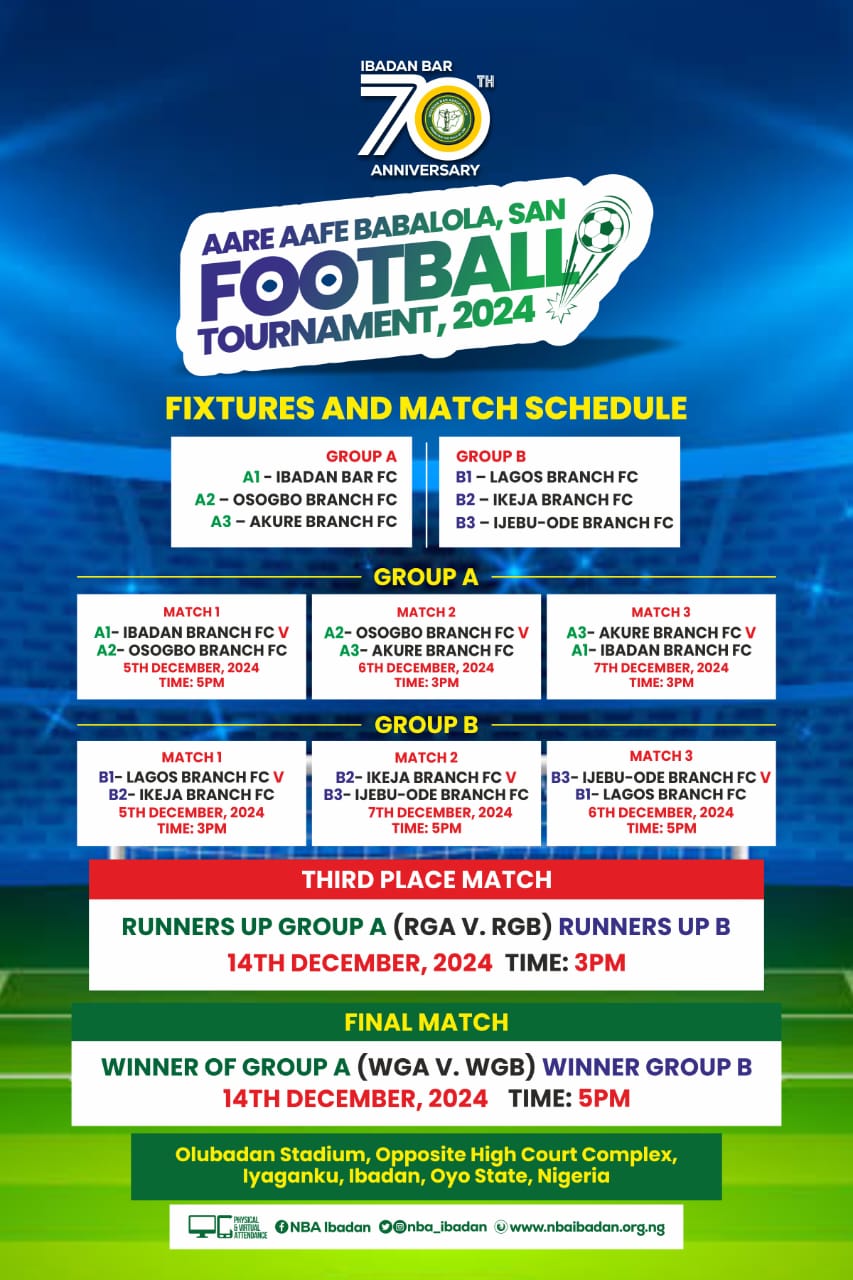
Anticipate and experience the thrill and celebration of the 70th Anniversary of the Nigerian Bar Association, Ibadan Branch with the unfolding of the AARE AFE BABALOLA (SAN)/NBA IBADAN Football Competition, 2024. The Competition is set to begin on 5th of December, 2024 and the final match will be played on 14th of December, 2024.
The Football tournament this year will feature the Ibadan Branch Football Team, (the defending champion of the NBA National Football Competition) alongside the football teams from Osogbo Branch, Akure Branch, Lagos Branch, Ikeja Branch and Ijebu-Ode Branch.
See below for the Fixtures and Match Schedule
FIXTURES
Group A
A1 (Ibadan Bar FC)
A2 (Osogbo Branch FC), A3 (Akure Branch FC)
Group B
B1 (Lagos Branch FC)
B2 (Ikeja Branch FC)
B3 (Ijebu-Ode Branch FC)
MATCH SCHEDULE
MATCH 1 (Day 1) 5th December, 2024
1. GROUP B @3pm – B1 ( Lagos Branch FC) versus B 2 (Ikeja Branch FC)
2. GROUP A @5pm – A1 (Ibadan Bar FC) versus A2 (Osogbo Branch FC)
MATCH 2 (Day 2) 6th December, 2024
1. GROUP A @3pm – B2 (Ikeja Branch FC) versus B3 (Ijebu-Ode Branch FC)
2. GROUP B @5pm – B2 (Ikeja Branch FC) bersus B3 (Ijebu-Ode Branch FC)
MATCH 3 (Day 3) 7th December, 2024
1. GROUP A @3pm – A3 (Akure Branzh FC) versus A1 (Ibadan Bar FC)
2. GROUP B @5pm – B3 (Ijebu-Ode Branch FC) versus B1 ( Lagos Branch FC)
THIRD PLACE MATCH: 14TH DECEMBER 2024
RUNNERS UP GROUP A (RGA V. RGB) RUNNERS UP B
TIME: – 3PM
FINAL MATCH: 14TH DECEMBER, 2024
WINNER OF GROUP A (WGA V. WGB) WINNER GROUP B
TIME: – 5PM
VENUE FOR ALL THE MATCHES: – OLUBADAN STADIUM, OPPOSITE HIGH COURT COMPLEX, IYAGANKU, IBADAN, OYO STATE, NIGERIA
Kindly pre-register for the 70th Anniversary Celebration via https://nbaibadan.org.ng/70thanniversaryregistration/ and do not forget to purchase your dinner ticket via https://nbaibadan.org.ng/dinner-ticket/
For more enquiries, kindly contact 70thanniversary@nbaibadan.org.ng
by Legalnaija | Dec 2, 2024 | Uncategorized
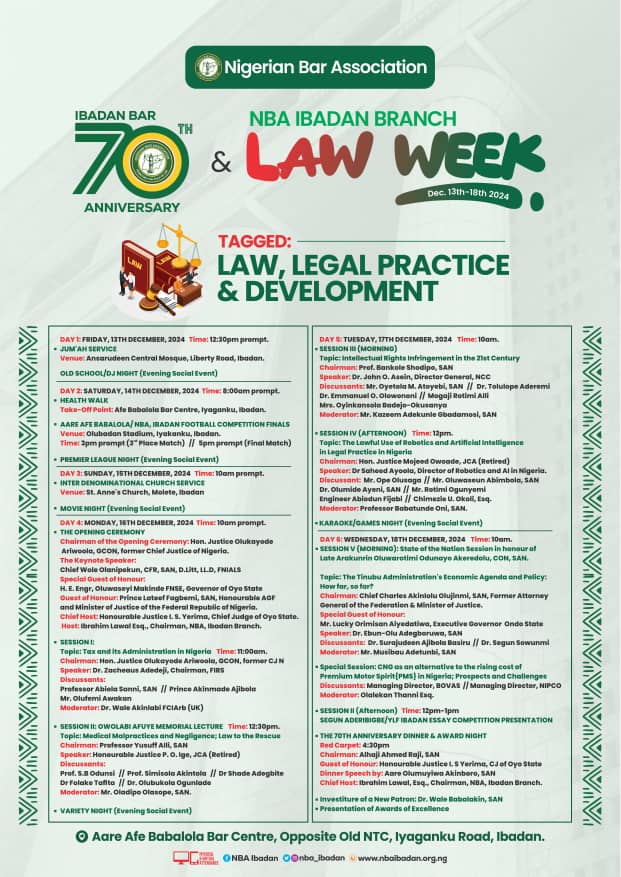
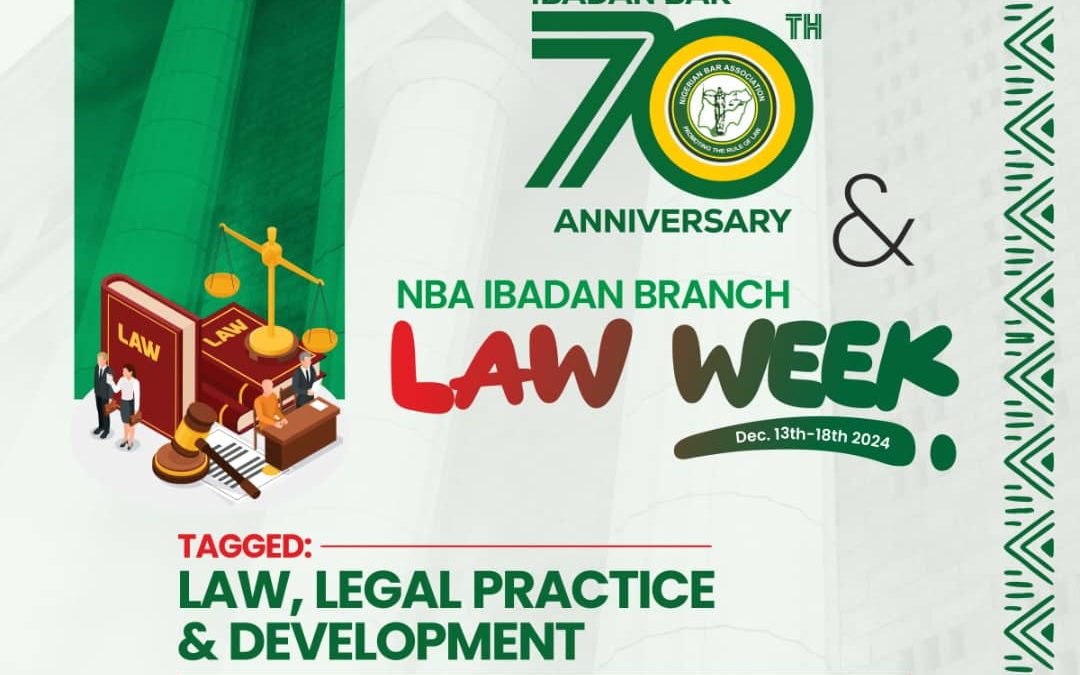
The Nigerian Bar Association (NBA) Ibadan Branch will proudly mark her momentous milestone in grand style with events starting from 13th December, 2024 to 18th December, 2024. It’s the 70th Anniversary of the Premier Bar and to celebrate this legacy, the Anniversary Planning Committee ably-led by Asiwaju Adebayo Mutalabi Ojo, SAN has planned an exciting week of activities, blending intellectually stimulating events with vibrant social engagements.
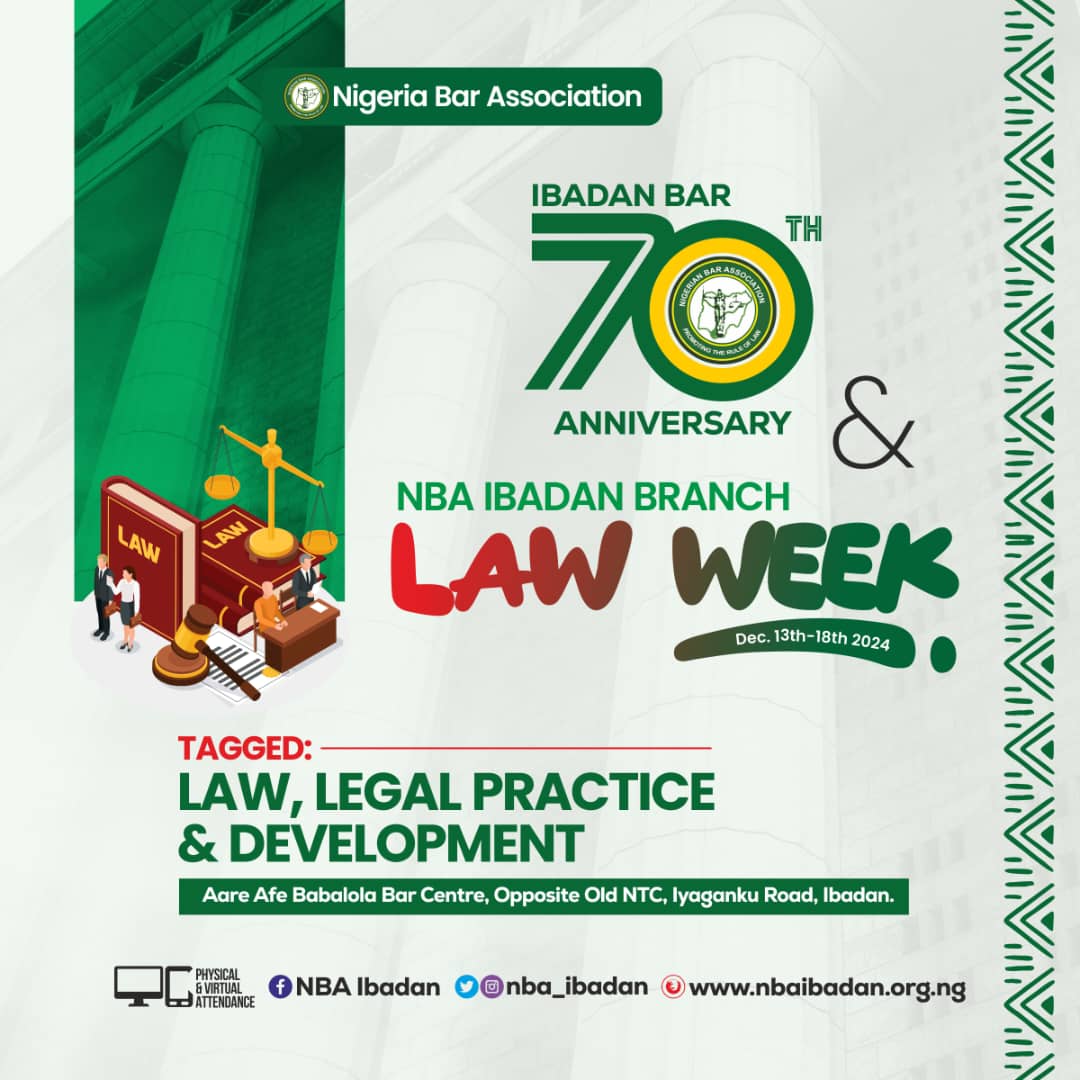
With a lineup of carefully curated programs, the celebration promises to be engaging, enriching and memorable. Below is a sneak peek at the schedule of events to look forward to as the Ibadan Bar celebrates seven decades:
DAY 1: FRIDAY, 13TH DECEMBER, 2024:
• JUM’AH SERVICE
Venue: Ansarudeen Central Mosque, Liberty Road, Ibadan.
Time: 12:30pm prompt.
• OLD SCHOOL/DJ NIGHT (Evening Social Event)
Venue: Aare Afe Babalola Bar Centre, Iyakanku, Ibadan.
DAY 2: SATURDAY, 14TH DECEMBER, 2024
• HEALTH WALK
Take-Off Point: Afe Babalola Bar Centre, Iyaganku, Ibadan.
Time: 8:00am prompt.
• AARE AFE BABALOLA/ NBA, IBADAN FOOTBALL COMPETITION FINALS
Venue: Olubadan Stadium, Iyakanku, Ibadan.
Time: 3pm prompt (3rd Place Match)
5pm prompt (Final Match)
• PREMIER LEAGUE NIGHT (Evening Social Event)
Venue: Aare Afe Babalola Bar Centre, Iyakanku, Ibadan.
DAY 3: SUNDAY, 15TH DECEMBER, 2024
• INTER DENOMINATIONAL CHURCH SERVICE
Venue: St. Anne’s Church, Molete, Ibadan
Time: 10am prompt.
• MOVIE NIGHT (Evening Social Event)
Venue: Aare Afe Babalola Bar Centre, Iyakanku, Ibadan.
DAY 4: MONDAY, 16TH DECEMBER. 2024
• THE OPENING CEREMONY
Venue: Aare Afe Babalola Bar Centre, Iyaganku, Ibadan, Oyo State
Time: 10am prompt.
Chairman of the Opening Ceremony: Hon. Justice Olukayode Ariwoola, GCON, former Chief Justice of Nigeria.
The Keynote Speaker: Mr. Babatunde Raji Fashola, SAN, Former Governor of Lagos State.
Special Guest of Honour: His Excellency, Engr, Oluwaseyi Makinde FNSE, Governor of Oyo State
Guest of Honour: Prince Lateef Fagbemi, SAN, Honourable Attorney General of the Federation and Minister of Justice of the Federal Republic of Nigeria.
Host: Ibrahim Lawal, Esq., Chairman, NBA, Ibadan Branch.
Chief Host: Honourable Justice I.S Yerima, Chief Judge of Oyo State.
• PLENARY SESSION I:
Topic: Tax and its Administration in Nigeria
Time: 11:00 am.
Chairman: Hon. Justice Olukayode Ariwoola, GCON, former Chief Justice of Nigeria.
Speaker: Dr Zacheaus Adedeji, Chairman, Federal Inland Revenue Services
Discussants:
1. Professor Abiola Sanni, SAN, Dean, Faculty of Law, University of Lagos,
2. Prince Akinmade Ajibola, Chairman, Tax Appeal Tribunal, South Western Zone
3. Mr. Olufemi Awakan, Executive Chairman, Oyo State Board of Internal Revenue.
Moderator: Dr. Wale Akinlabi FCIArb (UK)
• SESSION II: OWOLABI AFUYE MEMORIAL LECTURE
Topic: Medical Malpractices and Negligence; Law to the Rescue
Time: 12:30pm.
Chairman: Professor Yusuff Alli, SAN, Principal Partner, Ghalib Chambers, Ilorin, Kwara State
Speaker: Honourable Justice P.O Ige, JCA (Retired)
Discussants:
1. Prof. S.B Odunsi, Faculty of Law, OAU, Ile Ife
2. Prof. Simisola Akintola, Former Dean, Faculty of Law, University of Ibadan.
3. Dr Shade Adegbite, Associate Professor, Faculty of Law, University of Lagos.
4. Dr Folake Tafita, University of Ibadan and a Registered Nurse
5. Dr. Olubukola Ogunlade, Head of Legal, University College Hospital, Ibadan.
Moderator: Mr. Oladipo Olasope, SAN.
• VARIETY NIGHT (Evening Social Event)
Venue: Aare Afe Babalola Bar Centre, Iyakanku, Ibadan.
DAY 5: TUESDAY, 17TH DECEMBER, 2024
• SESSION III (MORNING)
Topic: Intellectual Rights Infringement in the 21st Century
Time: 10am.
Chairman: Prof. Bankole Shodipo, SAN
Speaker: Dr. John O. Asein, Director General, Nigerian Copyright Commission.
Discussants:
1. Mr. Oyetola M. Atoyebi, SAN, Managing Partner, Omaplex Law Firm
2. Dr. Emmanuel O. Olowononi, Senior Lecturer Nigerian Law School, Abuja and a sports law Expert.
3. Mogaji Rotimi Alli, Chairman, Ibadan Football Council and a Member of Oyo State Football Association.
4. Dr. Tolulope Aderemi, Entertainment Law Attorney.
5. Mrs. Oyinkansola Badejo-Okunsanya, Managing Partner, Africa Law Practice NG & Co.
Moderator: Mr. Kazeem Adekunle Gbadamosi, SAN
• SESSION IV (AFTERNOON)
Topic: The Lawful Use of Robotics and Artificial Intelligence in Legal Practice in Nigeria
Time: 12pm.
Chairman: Hon. Justice Mojeed Owoade, JCA (Retired)
Speaker: Dr Saheed Ayoola, Director of Robotics and Artificial Intelligence in Nigeria.
Discussant :
1. Mr. Ope Olusaga, Managing Director, Law Pavilion Business Solutions Ltd.
2. Mr. Oluwaseun Abimbola, SAN, Managing Partner, Prime Solicitors
3. Dr. Olumide Ayeni, SAN
4. Mr. Rotimi Ogunyemi, Technology Law Attorney, Lagos.
5. Engineer Abiodun Fijabi, Principal Consultant, Lord Princely Associates Limited, Abeokuta, Ogun State.
6. Chimezie U. Okoli, Esq., Faculty of Law, University of Ibadan.
Moderator: Professor Babatunde Oni, SAN.
• KARAOKE/GAMES NIGHT (Evening Social Event)
Venue: Aare Afe Babalola Bar Centre, Iyakanku, Ibadan.
DAY 6: WEDNESDAY, 18TH DECEMBER, 2024
• SESSION V (MORNING): State of the Nation Session in honour of Late Arakunrin Oluwarotimi Odunayo Akeredolu, CON, SAN, distinguished Patron, Past Chairman of the Branch, Past President of NBA and former Governor of Ondo State
Topic: The Tinubu Administration’s Economic Agenda and Policy: How far, so far?
Time: 10am.
Chairman: Chief Charles Akinlolu Olujinmi, SAN, Former Attorney General of the Federation & Minister of Justice.
Special Guest of Honour: Mr. Lucky Orimisan Aiyedatiwa, The Executive Governor of Ondo State
: Speaker: Dr Ebun-Olu Adegboruwa, SAN
Discussants:
1. Dr. Surajudeen Ajibola Basiru, National Secretary, APC
2. Dr. Segun Sowunmi, PDP Chieftain and Public Affairs Analyst The Tinubu Administration’s Economic Agenda and Policy: How far, so far?
Moderator: Mr. Musibau Adetunbi, SAN
• SPECIAL SESSION: CNG as an alternative to the rising cost of Premium Motor Spirit{PMS} in Nigeria; prospects and challenges
Discussants:
Managing Director, BOVAS
Managing Director, NIPCO
Moderator: Olalekan Thanni, Esq.
• SESSION II (AFTERNOON): SEGUN ADERIBIGBE/YLF IBADAN ESSAY COMPETITION PRESENTATION
Time: 12pm-1pm
Chairman: Mr. Oluwaseun Abimbola, SAN, Managing Partner, Prime Solicitors
Topic: A Review of Community Service As Corrective Regimen For Convicted Internet Fraudsters
Coordinator: Timileyin Olayiwola, Esq., Chairman, Young Lawyers’ Forum, Ibadan Branch.
Moderator: Tomiwa Fadeyi, Esq., Chairman, Academic Board, YLF, Ibadan Branch.
• THE 70TH ANNIVERSARY DINNER & AWARD NIGHT
Red Carpet: 4:30pm
Venue: Aare Afe Babalola Bar Centre, Iyaganku, Ibadan.
Chairman: Alhaji Ahmed Raji, SAN, Principal Partner, Ahmed Raji & Co
Guest of Honour: Honourable Justice I. S Yerima, Chief Judge of Oyo State
Dinner Speech by: Aare Olumuyiwa Akinboro, SAN, Past General Secretary of NBA and a life Bencher.
Chief Host: Ibrahim Lawal, Esq., Chairman, NBA, Ibadan Branch.
Investiture of a New Patron:
Dr. Wale Babalakin, SAN to be inducted as a new patron of NBA, Ibadan Branch
Presentation of Award of Excellence to the following deserving members of Ibadan Bar.
1. Hon. Justice L. A Ganiyu , Justice of Court of Appeal
2. Hon. Justice Olukayode A. Adeniyi , Justice of Court of Appeal (Former Chairman, NBA, Ibadan Branch).
3. Hon. Justice Oyebola Oyewumi, Justice of Court of Appeal
4. Hon. Justice R.O Ayoola, Justice of Court of Appeal.
5. Hon. Justice, T.M Abdulganiyu, President, Customary Court of Appeal, Oyo State.
6. Hon. Justice Oluwatosin Popoola, a Judge of High Court of Lagos State.
7. Hon. Justice M.O Folorunsho , a Judge of High Court of Kwara State.
8. Mr. Akinyemi Olujinmi, SAN
9. Mr. Yusuff Tunji Ogunrinde, SAN
From thought-provoking lectures featuring reputable discussants to lively social gatherings designed to foster relationships, the 70th Anniversary will offer something for everyone. Kindly pre-register for the event via https://nbaibadan.org.ng/70thanniversaryregistration/ and do not forget to purchase your dinner ticket via https://nbaibadan.org.ng/dinner-ticket/
For more enquires, kindly contact 70thanniversary@nbaibadan.org.ng.
by Legalnaija | Nov 30, 2024 | Blawg
In today’s fast-paced world, accessing quality legal services can often be a daunting task for both individuals and businesses. This is where business directories for lawyers come into play, serving as an essential bridge between those in need of legal expertise and the professionals who can provide it.
Connecting Clients to Legal Experts
Business directories for lawyers are specialized platforms that list legal professionals and firms, categorized by their areas of expertise. These directories offer a centralized, easily navigable resource that allows users to search for lawyers based on specific criteria such as location, specialization, and ratings. By providing detailed profiles and contact information, these directories make it easier for potential clients to find and connect with the right legal expert.
Enhancing Access to Justice
One of the most significant benefits of these directories is their role in improving access to justice. By simplifying the process of finding legal representation, they help ensure that individuals and businesses can obtain the legal support they need promptly. This is particularly crucial in situations where time is of the essence, such as in cases of legal disputes or urgent legal advice.
Moreover, these directories often include ratings and reviews from previous clients, offering insights into the quality of service provided by listed lawyers. This transparency empowers users to make informed decisions, enhancing their confidence in the legal system and encouraging the pursuit of justice.
Promoting Legal Awareness
Beyond connecting clients to lawyers, business directories also play a vital role in promoting legal awareness. Many directories offer educational resources such as articles, FAQs, and legal tips that help users understand their legal rights and obligations. This added layer of information can be invaluable in demystifying legal processes and making them more accessible to the general public.
Legalnaija: Leading the Charge
Legalnaija is a prime example of a business directory that is actively bridging the gap between legal professionals and those in need of legal services in Nigeria. With a comprehensive directory that lists lawyers across various fields of practice, Legalnaija provides a user-friendly platform for individuals and businesses to find and connect with the right legal experts. Legalnaija’s directory is designed to be intuitive and easy to navigate, featuring detailed profiles, and contact information. This ensures that users can quickly identify suitable legal professionals and make well-informed choices. Furthermore, Legalnaija’s commitment to legal education through its blog and resources section helps promote legal literacy and awareness among its users.
In conclusion, business directories for lawyers are transforming the way legal services are accessed, making it easier for individuals and businesses to find the right legal support. By enhancing access to justice and promoting legal awareness, these directories play a pivotal role in fostering a more informed and empowered society. Legalnaija stands at the forefront of this movement, providing an invaluable resource for those seeking legal expertise in Nigeria. Visit the Legalnaija Directory.

by Legalnaija | Nov 30, 2024 | Blawg
Divorce is an inherently painful and emotional process, often complicated by the disclosure of deeply personal and sometimes embarrassing private information. However, in Nigerian divorce cases, the disclosure of sensitive personal details often goes beyond what is necessary for the fair adjudication of the matter, damaging the dignity and privacy of the individuals involved, and by extension, their families. This practice, which is often done under the guise of pleadings, not only harms those directly involved in the case but also perpetuates social stigmas and exacerbates the already high rate of divorce-related trauma in Nigerian society.
As members of the legal profession, Nigerian lawyers have a profound ethical responsibility to balance the pursuit of justice with respect for privacy, decency, and human dignity. Unfortunately, in many cases, sensitive information that is irrelevant to the resolution of a divorce is unnecessarily disclosed, causing significant harm to the parties (and their dependants) involved. This article seeks to examine this growing concern and calls for a conscientious effort from Nigerian lawyers to prevent the socially destructive consequences of such practices.
Statutory marriages, like every other contractual relationship may/can end as amicably as reasonable without vendetta, mudslinging, intimidation or character-assassination. Happily, the Matrimonial Causes Act provides for instances where marriages can be dissolved by the courts without apportioning blames to either party. i.e where both parties have lived apart for a period of two or three years. Hence, parties to a divorce petition do not necessarily need to divulge gory details of their disagreement especially since court papers are public documents that can be accessed by innumerable number of persons.
The Legal and Ethical Obligations of Lawyers
Nigerian lawyers are bound by the ethical guidelines of their profession, which emphasize the duty to protect the confidentiality and dignity of their clients. The Rules of Professional Conduct for Legal Practitioners in Nigeria clearly outline that lawyers must avoid unnecessary disclosure of confidential information and must act in a manner that protects the integrity of the judicial process.
The challenge, however, arises when lawyers prioritize winning cases over protecting the well-being of their clients. Some practitioners may be inclined to use personal information strategically to gain an advantage in a case, without considering the long-term consequences for their clients. In such instances, the interests of the lawyer may conflict with the ethical duties to their clients and society. A lawyer ought to advise clients against the use of personal or embarrassing details about the client’s private and family life as ammunition for scoring a point in court. Such actions undermine the trust and confidentiality inherent in the lawyer-client relationship, erode public confidence in the legal system, and, most importantly, contribute to the broader social stigma surrounding divorce.
Privacy concerns
I recently read a divorce case where the petitioner was vindictive enough to disclose the HIV-status of his spouse even when that was not the fact relied on for the divorce. Admittedly, Nigeria’s privacy jurisprudence has not developed to the extent of reprimanding and redressing such unnecessary privacy invasion in court proceedings, there however exists foreign authorities for such claims. In L.L. v. France (Application no. 7508/02) a woman filed divorce petition and, in a bid, to win sole custody of the child of the marriage, she fraudulently obtained the husband’s medical record showing he was an alcoholic. When the husband challenged the tendering and use of his medical records as an unjustifiable invasion of his privacy, the European Court of Human Rights held that
“In reality, it was only on an alternative and secondary basis that the domestic courts used the disputed medical document in justifying their decisions, and it thus appears that they could have declared it inadmissible and still reached the same conclusion. In other words, the impugned interference with the applicant’s right to respect for his private life, in view of the fundamental importance of the protection of personal data, was not proportionate to the aim pursued and was therefore not “necessary in a democratic society for the protection of the rights and freedoms of others”
The court ultimately determined that while the disclosure of the applicant’s medical record during the proceedings was in accordance with established procedural law and aimed at protecting the wife’s rights and freedoms, it was ultimately unjustified. This was because the medical records were not essential to the case and did not play a decisive role in the proceedings. Where a party divulge private facts that are unnecessary to the issues in a case, a privacy suit can lie against such a party and section 45 of the Constitution may not offer any defence except such disclosure is required, necessary or backed by law.
Data protection dictates
Court proceedings are not immune or exempted from data protection obligations. Section 3(2)(e) of the Nigeria Data Protection Act 2023 (NDPA) only exempts processions that are necessary to establish legal claims. The test of necessity of a certain processing activity is found in proportionality and reasonableness. The Nigeria Data Protection Commission clarifies that, the necessity of processing of personal data must be determined from the risks and availability alternatives to such processing. (see page 27 of the General Application and Implementation Directive of the NDPA). For divorce cases, parties should ensure that the facts disclosed or evidence used do not portend unusual privacy risks to the other parties especially where there are alternatives to the disclosure of such private facts.
Conclusion
Divorce is a painful process that should not be compounded by unnecessary public humiliation. Nigerian lawyers are in a unique position to play a crucial role in reducing the harm caused by embarrassing disclosures in divorce cases. By adhering to ethical standards, advocating for privacy, and considering the long-term consequences of their actions, Nigerian lawyers can contribute to a legal system that is fair, compassionate, and just. This is a passionate appeal to all Nigerian lawyers to uphold the principles of privacy and dignity, both in the courtroom and in society, and to protect the individuals they represent from the socially destructive consequences of unnecessary disclosure of private facts. It is time for the legal profession to lead the way in creating a society where personal privacy is respected, and individuals are not further victimized by a legal process that is supposed to serve them.
by Legalnaija | Nov 29, 2024 | Blawg
Annual Conference of the Nigerian Institute of Chartered Arbitrators: A Summary of Day One
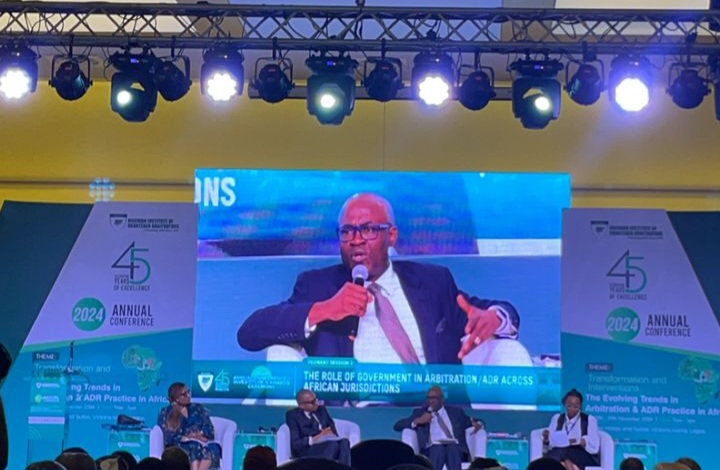
The Annual Conference of the Nigerian Institute of Chartered Arbitrators(28th and 29th of November) at the prestigious Eko Signature Hotel, Lagos. Themed “Transformation and Intervention: The Evolving Trends in Arbitration & ADR Practice in Africa,” the conference brought together leading practitioners, academics, policymakers, and stakeholders to discuss the dynamic developments shaping Arbitration and Alternative Dispute Resolution (ADR) across Africa.
Opening Ceremony
The first day began with opening remarks by Professor Yusuf Olaolu Ali, Chairman of the Planning Committee, followed by the address of the Institute’s Chairman, Professor Fabian Ajogwu, SAN, FCIArb. Both speakers emphasized the importance of fostering innovation and collaboration to advance arbitration practices across Africa.
The highlight of the opening session was the Keynote Address, delivered on behalf of Professor Benedict Oramah, which provided a comprehensive appraisal of the conference theme. The address emphasized the need for governments to take a proactive role in nurturing the growth of Arbitration in Africa, aligning legal frameworks, and creating enabling environments to attract global confidence in the region’s ADR capabilities.
Plenary Session 1
This session featured a distinguished panel of experts: Professor Emilia Onyema, Dr. Wale Babalakin, SAN, and Dr. Enga Kameni, moderated by Mrs. Funke Aboyade, SAN, FCIArb.
The panel explored the current state of Arbitration and ADR in Africa, noting significant progress in legislative reforms, the establishment of arbitration centres, and the increasing recognition of arbitration as a viable dispute resolution mechanism. However, they also highlighted persistent challenges, including issues of accessibility, political interference, and the enforcement of awards. The discussion underscored the need for continuous capacity-building and regional collaboration to address these obstacles effectively.
Plenary Session 2
This session brought together a panel of arbitrators and judges, including Folashade Alli, SAN, C.Arb, Honourable Justice Ayokunle Faaji, FCIArb, and Anne Ekongolo, moderated by Chukuma Ezeala, FCIArb.
The discourse revolved around the critical role of governments in shaping Arbitration and ADR landscapes in Africa. The panelists observed that while many African governments have supported arbitration through legislative and judicial reforms, challenges such as political interference and inconsistent enforcement of awards persist. A key recommendation was to encourage more judges to adopt arbitration practices and award costs against parties that intentionally frustrate proceedings.
The session concluded with unanimous agreement that sustained government support and commitment are essential for the long-term growth and credibility of Arbitration and ADR in Africa.
Plenary Session 3
The third plenary session, moderated by Edith Onwuchekwa, FCArb, featured contributions from Hon. Prof. Kariuki Muigua, Ph.D., OGW, FCIArb, Ch.Arb, Guled Yusuf, Funke Adekoya, SAN, C.Arb, and Hon. Justice Ayotunde Phillips, FCArb.
The discussion centered on the importance of adherence to international best practices and due process as non-negotiable elements for Africa’s readiness to thrive in global Arbitration and ADR. The panelists stressed the need for capacity-building initiatives, legal transparency, and compliance with international standards to enhance Africa’s reputation as a hub for resolving complex disputes.
the day programme concluded with two concurrent breakout sessions addressing specific sectors and emerging trends:
Breakout Session 1 addressed “Arbitration/ADR in the African Extractive Industry: Lessons Learnt and Way Forward” This session explored the role of Arbitration and ADR in resolving disputes in the mining, oil, and gas sectors. Panelists discussed the complex nature of disputes in the extractive industry and how Arbitration can provide more flexible and efficient solutions compared to traditional litigation. While Breakout Session 2 addressed “Emerging Trends in Arbitration/ADR: Insolvency, Tax-Related Matters, Banking/Finance, and SMEs” This session focused on the evolving challenges in resolving disputes in finance, taxation, and insolvency, emphasizing the growing relevance of Arbitration and ADR in addressing the needs of SMEs and other stakeholders in these sectors.
The event was formally closed by a closing remark given by Mrs. Shola Oshodi-John, FCArb, the Registrar and CEO of the Institute, who commended participants for their contributions and reiterated the importance of fostering dialogue and innovation in Arbitration and ADR practice across Africa. She also urged delegates to participate in the cocktail session by interacting with other delegates and speakers present.

by Legalnaija | Nov 29, 2024 | Blawg
Introduction
Artists, songwriters, producers and other stakeholders in the music and entertainment industries must comprehend the nuances of master and publishing rights. Each of these two separate but related rights governs distinct elements of a musical composition each with its own sources of income and legal ramifications.
Understanding Master and Publishing Rights
In the context of sound recordings master rights refer to the ownership of a master recording. These are frequently owned by the organization that provides funding for the recording, which could be the artist if it was self-funded or a record label. How the recording is used, distributed and reproduced in the media is up to the owner of the masters rights. Synchronization licensing or sync licenses for the use of recordings in movies or advertisements for instance is covered by master rights.
Important Legal Aspects of Masters Rights.
Under copyright legislation master rights serve as the cornerstone for the protection, commercialization and distribution of sound recordings. These rights comprise the established legal precedents pertaining to ownership duration licensing terms and the laws regulating their application and implementation.
- Ownership of Master Rights
i) Artist Ownership
Frequently, independent musicians keep their master rights which allows them to control how the recording is used and receive full payment.
Control over Creativity and Finances.
Independent artists don’t require any permission from third party organizations to license their recordings for use on streaming services and sync partnerships along with other uses. By maintaining the master rights, they are better able to control the terms of use pricing and distribution methods for their songs.
The Difficulties Faced By Independent Artists:
While the master rights ownership is admittedly a more freeing and artistically inclined experience, it also means that the artist will have to be ready to cover the bills that come with production, marketing and distribution. Independent artists just starting out will most likely not have access to the resources and finances readily available in record labels, possibly restricting their capacity to succeed financially and gain market share.
- ii) Label Ownership
Artists often enter into contracts with record labels that include the acquisition of master rights. Some labels consider this to be an important part of the negotiation process and will not take no for an answer. The labels contribute to the cost of professional production marketing initiatives, distribution networks and recording sessions while the artists transfer ownership of their master recordings to the label either permanently or temporarily in return.
Revenue Sharing:
Artists are usually paid royalties on the earnings earned from the master recordings. Although the percentage varies depending on the contract many artists get between 10 and 20 percent of net profits. Labels maintain control of the majority stake which they defend as payment for their investment. Certain contracts contain clauses that let artists reclaim their master rights after a predetermined period of time or after fulfilling specific requirements.
- Duration of Master Rights.
The term of protection for master rights differs by the local jurisdiction, although it is usually for several decades.
International Standards (the Berne Convention):
The Berne Convention, which unifies copyright regulations among participant countries, establishes a 50-year period of protection for sound recordings starting from the date of publication. This time frame is extended by many nations such as the European Union to 70 years following the release of the recording or the death of the inventor.
Copyright laws in the United States:
For 85 years following publication or 120 years following invention whichever comes first, sound recordings made in the United States after February 15, 1972 are protected. Depending on state legislation and federal changes older recordings may be subject to different standards.
Understanding Publishing Rights
Conversely, the underlying composition—the melody arrangement and lyrics—is covered by publishing rights. Typically publishers and songwriters own these rights. They have authority over the works’ public performances, distribution and reproduction. Publishing rights are involved when a composition is licensed for covers or movie adaptations.
- Split ownership of publishing rights.
A music publisher and the songwriter or songwriters often share publishing rights which leads to a division of duties and royalties.
Songwriters’ Ownership:
Due to their role in the creation of the composition (melody and lyrics), songwriters are still entitled to publishing rights. This share could be anywhere between fifty percent and the majority of the rights depending on the terms of the contract. Ownership is divided equally among many songwriters who work together and this needs to be recorded in a split sheet to prevent disputes.
Earnings:
Songwriters are compensated with royalties for their synchronization, performance and mechanical rights. The role of the publisher may also give them administrative control over the licensing of their compositions.
Music Publishers’ Role in Ownership
Publishers manage the market, promotion and profit from the composition in return for a share of the rights. Among their duties are licensing the composition, obtaining synchronization and cover opportunities and collecting royalties.
Standard splits:
Songwriters and publishers typically share publication rights 50/50 but this is not always the case. Self-publishing independent songwriters keep all rights but they are also in charge of all marketing and administrative duties. In foreign markets the composer may be represented by sub-publishers who will keep a share of the publisher’s profits while permitting local licensing and royalties to be collected.
Examples of Legal Cases.
There have been notable court cases pertaining to publishing rights most of which have involved ownership transfers, license conditions and royalties.
Music Mills Inc. v. Snyder in 1985.
The Supreme Court considered a publisher’s right to retain a share of earnings from derivative works produced after the songwriter terminated the initial transfer of rights. The idea that the original creator maintains complete ownership of any rights that are terminated was upheld by the Court’s ruling in favor of the songwriter.
Williams v. Gaye (2018): A Case of Blurred Lines.
A lawsuit was filed against Robin Thicke and Pharrell Williams for allegedly violating Marvin Gaye’s song Gotta Give It Up. The court found that there had been a violation of Gayes publishing rights and granted significant damages.
Conclusion
Intellectual property in the music industry is complicated as demonstrated by the relationship between master and publication rights. Participants need to be well-informed about these rights and their legal basis in order to optimize profits and reduce disputes. In order to guarantee fair and sustained business growth as the digital music economy develops these challenges must be addressed by robust legal frameworks and open processes.
Eniola Sultan Olatunji is a final-year law student of the University of Ibadan, and an aspiring corporate lawyer with a focus on Entertainment, Data Privacy, and Commercial Law. A talented writer, Eniola looks forward to working with top companies in the nearest future.
Sources
- Bolero Music: “Master vs Publishing Rights in Music IP” https://www.boleromusic.com/blog/master-vs-publishing-rights-music-ip
- Releese Help Center: “What is the difference between master rights and publishing rights? https://support.releese.io/hc/en-us/articles/23100485505947-What-is-the-difference-between-master-rights-and-publishing-rights
- Icon Collective: “How Music Royalties Work in the Music Industry” https://www.iconcollective.edu/how-music-royalties-work
- Case law: Mills Music, Inc. v. Snyder (1985), Grand Upright Music, Ltd. v. Warner Bros. Records Inc. (1991) https://en.wikipedia.org/wiki/Grand_Upright_Music,_Ltd._v._Warner_Bros._Records_Inc
- U.S. Copyright Office – Circular 56A: Copyright in Sound Recordings https://www.copyright.gov/circs/circ56a.pdf
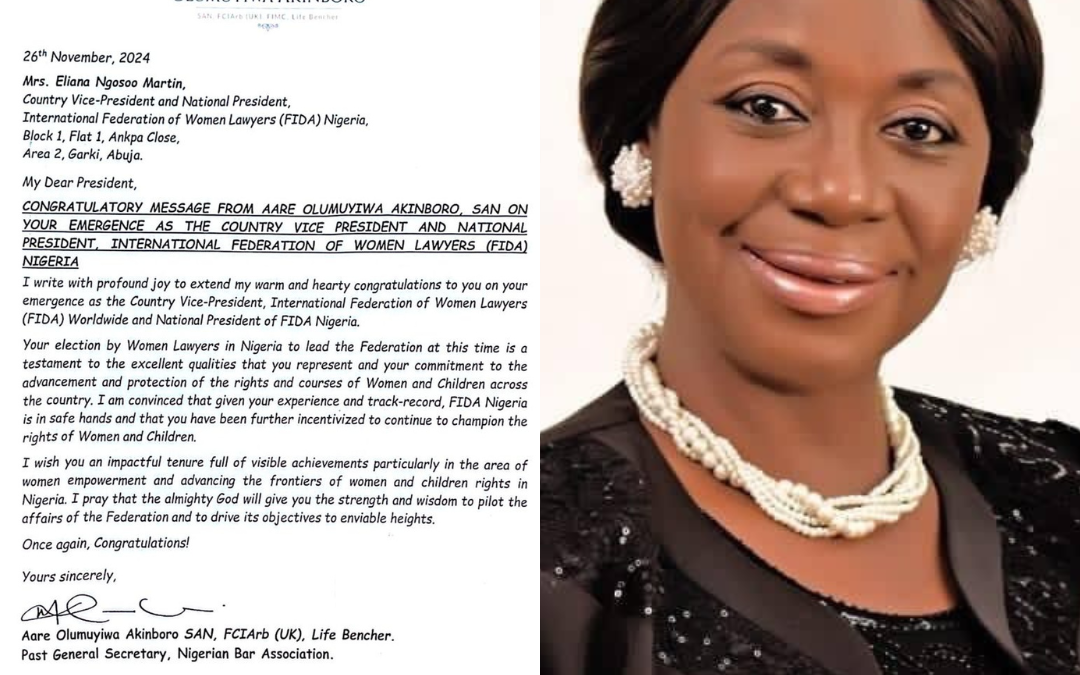
by Legalnaija | Nov 28, 2024 | Blawg
CONGRATULATORY MESSAGE FROM AARE OLUMUYIWA AKINBORO, SAN ON YOUR EMERGENCE AS THE COUNTRY VICE PRESIDENT AND NATIONAL PRESIDENT, INTERNATIONAL FEDERATION OF WOMEN LAWYERS (FIDA) NIGERIA
I write with profound joy to extend my warm and hearty congratulations to you on your emergence as the Country Vice-President, International Federation of Women Lawyers (FIDA) Worldwide and National President of FIDA Nigeria.
Your election by Women Lawyers in Nigeria to lead the Federation at this time is a testament to the excellent qualities that you represent and your commitment to the advancement and protection of the rights and courses of Women and Children across the country. I am convinced that given your experience and track-record, FIDA Nigeria is in safe hands and that you have been further incentivized to continue to champion the rights of Women and Children.
I wish you an impactful tenure full of visible achievements particularly in the area of women empowerment and advancing the frontiers of women and children rights in Nigeria. I pray that the almighty God will give you the strength and wisdom to pilot the affairs of the Federation and to drive its objectives to enviable heights.
Once again, Congratulations!
Aare Olumuyiwa Akinboro SAN, FCIArb (UK), Life Bencher.
Past General Secretary, Nigerian Bar Association.