Chatham House Common Futures Conversations

Chatham House Common Futures Conversations

@chathamhouse_org in partnership with Robert Bosch Stiftung is launching the Common Features Conversations (CFC) project, a digital Platform for young people in Africa and Europe to discuss the key political challenges facing youths in both continents. 
This is such an amazing intitiative, young people across both continents will have  an opportunity to exchange ideas and influence international decision-making towards improving outcomes for citizens.
The 13 countries currently involved  are:
Cote d’Ivoire
Ethiopia
Estonia
Germany
Italy
Kenya
Mozambique
Nigeria
Norway
Romania
Tunisia
UK
Zambia
You can begin to participate by taking the Common Futures Conversations: Youth Survey f vhttps://www.chathamhouse.org/common-futures-conversations-youth-survey-2019
#chathamhouse #nigeria #norway #romania #tunisia #uk #zambia #mozambique #kenya #italy #germany #estonia #governance #democracy #activecitizens #world #like #
How The Buhari Administration defiled the Nigerian Temple of Justice | Orji Agwu Uka

How The Buhari Administration defiled the Nigerian Temple of Justice | Orji Agwu Uka

It is now a week to the day since Major General Muhammadu Buhari (Rtd) the 15th Nigerian Head of State and the 6th to be democratically elected, announced the purported suspension of the Chief Justice of Nigeria (CJN), Honourable Justice Walter Nkanu Onnoghen and contemporaneously swore in the next senior Justice of the Supreme Court, Justice Ibrahim Tanko Muhammed as acting CJN. 

The President informed Nigerians that he derived imprimatur from an order of the Code of Conduct Tribunal (CCT) granted on 23rd January 2019. Predictably, the President’s actions generated an outpouring of reactions most notably from the Senate President and Speaker of the House of Representatives; the major opposition candidate and former Vice President, Atiku Abubakar; the Nigerian Bar Association; as well as the international community and in particular the European Union, the United Kingdom and the United States of America.
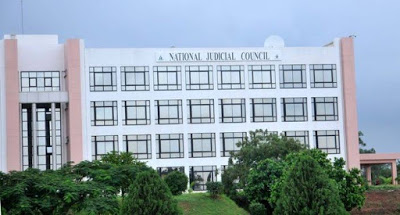
The aftereffects of the President’s actions continue to reverberate, the latest being the resolutions reached at the emergency meeting of the National Judicial Council (NJC) on Tuesday 29th January 2019, where the NJC issued a query to both Justices Onnoghen and Muhammed and referred a petition against the CCT Chairman, Mr Danladi Umar to the Federal Judicial Service Commission for investigation. The nation now eagerly awaits the outcome of the investigation by the NJC which is expected at the next meeting scheduled for 11th February 2019. 
In the meantime however, and consistent with any issue involving law and lawyers, diverse opinions have been, and continue to be, canvassed in favour of, and against, the actions of the President. And it is against this backdrop that the present writer contends that, whether or not the allegations against the Chief Justice of Nigeria are ultimately provided to be true, the actions of President Buhari will go down in history as the most brazen act of desecration of the temple of justice since Nigeria’s independence in 1960.
There is no doubt that President Buhari rode to power in 2015, on the back of a promise to tackle the evil of corruption that has bedevilled virtually all facets of the Nigerian society. What later emerged was that the modus operandi of the President would be to embark on this fight against corruption even if it meant sacrificing the well-established doctrines on which the Nigerian democracy is anchored to wit, the rule of law, supremacy of the constitution, separation of powers and respect for fundamental human rights. And more importantly, even in the face of demonstrable basis for the theory that the said fight is selective and not systematic.
We first saw this in August 2015, when President Buhari while addressing lawyers at the annual Conference of the Nigerian Bar Association (NBA) directed lawyers not to represent defendants who were accused of looting the treasury. For inexplicable reasons, no informed him that it is a cardinal rule of professional conduct for legal practitioners that as a general rule, they do not reject instructions; and that it is a fundamental provision in the Constitution of the Federal Republic of Nigeria 1999 (“the Constitution”), which he swore to preserve; protect; and defend, that every person charged with a criminal offence is entitled to a fair hearing; is presumed innocent until he is proved guilty; and is entitled to defend himself in person or by legal practitioners of his own choice. Three years later, the President doubled down on this by informing the same gathering that national security trumps the rule of law. This latter statement was ostensibly uttered to provide belated justification for his administration’s serial disobedience of valid and subsisting orders of courts as exemplified by the continued detention of former National Security Adviser, Ibrahim Sambo Dasuki and the Head of Nigeria’s Islamic Movement, Ibrahim Yaqoub El-Zakzaky despite repeated rulings of courts of competent jurisdiction ordering their release.
While a number of critics had concluded on the basis of clear and convincing evidence that the packaging of President Buhari as a reformed democrat in the build up to the 2015 elections was a mere sugar-coat, and some even argued that his actions are indicative of one seeking to quench a long thirst for retribution against the Nigerian judiciary against which he has harboured a decade-old, deep seated disdain, following his repeated defeats at the election petition tribunals, what no one saw coming was the extent to which he was willing to go to desecrate of the temple of justice using the instrumentality of the CCT and in particular its Chairman, Mr Danladi Umar as a willing tool. This came to a head on 25th January 2019.
Before then, Nigerians woke to the reality that all would not be well with the judiciary under President Buhari when the State Security Service, self-styled DSS, invaded the homes of some Justices of the Supreme Court and the Court of Appeal and some Judges of the Federal High Court just a month to the retirement of the immediate past CJN, Honourable Justice Mahmud Mohammed. This was followed by an unprecedented delay in the appointment of Justice Onnoghen as the CJN despite a recommendation to the President by the NJC. Both the actions of the DSS and the subsequent arraignment of some of the Judges before High Courts and the CCT sharply divided opinions, so did the delay in the appointment of the CJN. In the end, the Nigerian judiciary was badly damaged by the events, but at least the office of the CJN remained sacred and insulated from the uncertainties pervading the system. It would not remain so for long.
The CJN is the head of the Nigerian judiciary and until now the occupier of the office had a relatively secure job. By the express provisions of Section 292 of the Constitution, and as separate courts have held, the CJN and the indeed the heads of all the courts established by the Constitution may only be removed before their age of retirement by the President or the Governor of the State acting on an address by the Senate or House of Assembly of a State as the case may be, and the NJC, being the body exclusively vested with the power to exercise disciplinary control over all Judicial Officers established by the Constitution, has a vital role to play in the process. Apparently resigned to the fact that the high threshold for the lawful removal of the CJN cannot be met, the President found a veritable avenue in the CCT.
The CCT is established by the Fifth Schedule to the Constitution and conferred with the powers to determine whether a public officer has contravened the code of conduct for public officer. This raises the question whether the CCT is a court and a superior court of record at that, and whether it exercises judicial powers. A fact that often appears lost on most Nigerians is that there are fundamental differences between superior courts of record and non-superior or inferior courts and tribunals. This is not a distinction without a difference and the implication will be appreciated presently.
Section 6(1) & (2) of the Constitution provides that the judicial powers of the Federation and of the States shall be vested in the courts to which the section relates, being courts established for the Federation and for the States. Section 6(5) then states that the courts listed therein are the courts in which these judicial powers shall be vested. The courts are listed in paragraphs (a) — (k) of Section 6(5). The said Section 6(5) expressly established 9 courts listed therein in paragraphs (a) — (i) while enabling the National and State Assemblies to create other courts in accordance with Section 6(5) (j) & (k). Very importantly, Section 6(3) specifically provides that the 9 courts shall be the ONLY SUPERIOR COURTS OF RECORD in Nigeria. It is instructive to note that the CCT is not one of the courts so listed. A combined reading of the various provisions in Section 6 of the Constitution lends itself to only one plausible interpretation, other courts or tribunals established, are not superior courts of record.
Nigeria operates a judicial system which borrowed largely from English law as a result of our colonial history. Under both English and Nigerian law, superior courts of record possess a self-generating intrinsic source of power, referred to as inherent power and which is different from the general jurisdiction conferred on the various courts and tribunals by the Constitution or enabling law. Thus, Section 6(6)(a) of the Constitution provides that the judicial powers vested by the Constitution shall extend to all inherent powers and sanctions of a court of law.
One of the major incidents of being a superior court of record is that such court is entitled to determine the question of its jurisdiction. This is not the case with inferior courts and tribunals which do not possess inherent jurisdiction but which exercise the jurisdictions and powers expressly conferred by law. Once the jurisdiction of a non-superior court of record or an inferior court or tribunal is challenged, the court has no powers to take any further steps in the proceedings, even to determine its own jurisdiction. Even in the case of a superior court of record, what emerges from the corpus of Nigerian case law is that when its jurisdiction is challenged, such court also has no powers to determine any question or make any pronouncement, except to determine its own jurisdiction.
Thus on 14th January 2019, when the CCT was informed that an application had been filed challenging its jurisdiction to entertain the case against the CJN, the Tribunal, not being a superior court of record, could no longer take further steps in the proceedings. Assuming the CCT is indeed a superior court of record [it is not], it only had jurisdiction to determine its jurisdiction and nothing more. It therefore follows the entire rulings delivered by the CCT, first on 14th January 2019, and again on 22nd January 2019, and in particular the ex parte orders purportedly granted on 23rd January 2019, were all made without jurisdiction, and are in accordance with Nigerian law, null and void and of no effect whatsoever. The law on this is sufficiently trenchant and merits no rehashing.
Secondly, the ex parte orders of 23rd January 2019, were purportedly granted in the face of several orders of superior courts of record, including the Court of Appeal restraining the CCT from further proceedings in the case. Flowing from the previous point, the CCT had no powers to take any arguments unrelated to the question of whether or not it had jurisdiction to entertain the charge.
Thirdly, it is a settled principle of Nigerian procedural law that once a court has adjourned proceedings (particularly in open court), it can only resume hearing of proceedings on the next hearing note. In this case, the CCT had on the proceeding of 22nd January 2019, adjourned proceedings in the case to 28th January 2019 for hearing of the Preliminary Objection. Yet Nigerians were advised by the President that the CCT had granted ex parte orders on 23rd January 2019.
Finally on this point, it is also a settled position of Nigerian procedural law that ex parte orders are only granted in cases of extreme urgency and in cases where it is expressly provided by law or the rules of court. Ex parte orders are an exception to the general rule and are typically filed together with a motion on notice for interlocutory orders. The essence of ex parte orders is because of the fear of irreparable damage being done between the date of filing and the date of service of the motion on notice. Above all ex parte orders are not generally granted to compel the doing of an act in view of their limited lifespan, but are granted to restrain the doing of an act to prevent irreparable harm being done. In this most curious of cases the motion on notice seeking an order to compel the CJN to step aside pending his trial before the CCT had been served and the court had adjourned proceedings for hearing, yet the President paraded an ex parte order granted on 23rd January 2019, which was granted on the strength of an ex parte application dated 9th January 2019. In other words the order had been granted over two weeks after the application was filed, and long after the motion on notice had been served.
All these are determinative of the fact that the CCT had no powers to have granted any ex parte interim orders in the case never mind the one of the nature that was in fact granted. It is therefore beyond cavil that the ex parte orders purportedly granted by the CCT on 23rd January 2019 was unfaithful to both elementary logic and the foundations of Nigerian due process jurisprudence.
Another factor that appears to have been lost on many is that ex parte orders are by their nature designed to last for a very limited period of time typically 7 days. The question then is now it is more than 7 days since the ex parte order was granted, is President Buhari willing to reverse his decision to suspend the CJN and swear in an Acting CJN with similar dispatch?
Above all the CCT made the order in the face of a subsisting decision of the Court of Appeal that any misconduct attributed to a judicial officer must first be reported to, and handled by, the NJC and it is only after the NJC has pronounced against such officer that the prosecuting agencies of the FGN can proceed. Whether this much maligned decision of the Court of Appeal is right or wrong, same remains valid and binding on all courts below the Court of Appeal including the CCT and it is not open to the CCT to depart from it.
All of the above ought to have been made known to the President by his retinue of legal advisers. Indeed no other Nigerian President in history has been surrounding by such record number of Senior Advocates of Nigeria. Instead, the President who is now notorious for selecting and obeying only favourable orders of court acted with uncharacteristic swiftness in announcing the suspension on the CJN and swearing in Justice Muhammed as Acting CJN. The legality and morality of the actions of Justice Muhammed in presenting himself to be sworn has been eloquently captured in the petition of Dr Olisa Agbakoba, SAN and is the subject of ongoing investigation by the NJC. Consequently I shall say no more on that.
If only the President had stopped there, maybe his actions would not have received as much knocks as it did. The President went ahead to deliver an address that was laden with several far reaching and indeed impeach-worthy statements. After beginning his address with a reference to the yet to be commenced CCT trial of the CJN, the President curiously placed reliance on the yet to be established “suspicious transactions running into millions of dollars [traced] to the CJN’s personal accounts by the security agencies”. These suspicious transactions, the President added with magisterial authority, were all undeclared or improperly declared as required by law. This is the same President who just yesterday informed Nigerians [and rightly too] that the Governor of Kano State, Abdullahi Umar Ganduje accused of receiving kick-backs from contractors and who was caught on tape doing do, was innocent until proven guilty. The President also betrayed his inherent hypocrisy when he relied on an illegally granted order by the Chairman of the CCT who himself has been indicted of fraud and is the subject of a criminal charge instituted by the Spokesperson of the Buhari Presidential Campaign Organization, Festus Keyamo SAN on behalf of the EFCC, to suspend the CJN.
The President then decried what he termed, “the sordid spectacle of a judicial game of wits in which the Chief Justice of Nigeria and his legal team have made nonsense of the efforts of the Code of Conduct Tribunal to hear the allegation on merit and conclude the trial as quickly as possible”. The President further added insult to injury by complaining about the stalling of the trial of the CJN, helped along by lawyers who insist that the orders obtained from the various courts, whether right or wrong are technically valid, and must be obeyed till an appellate Court says otherwise. Strangely, after admitting that this is the correct position of the law, the President asked if this was the right disposition for our nation. The answer is in the question.
And any lingering doubts that the motive of the President in swiftly announcing the suspension of the CJN and replacing him Justice Muhammed was not really about the non-declaration of assets, were dispelled by the words of the President himself when he announced his government’s dissatisfaction with, “the alarming rate in which the Supreme Court under the oversight of Justice Walter Onnoghen has serially set free, persons accused of the most dire acts of corruption, often on mere technicalities, and after quite a number of them have been convicted by the trial and appellate courts”.
One only needs to refer the President to the immortal words of Obaseki JSC in the case of Ojukwu v Military Governor of Lagos State (1985) where His Lordship held that “the Nigerian Constitution is founded on the rule of law the primary meaning of which is that everything must be done according to law. It means also that government should be conducted within the frame-work of recognized rules and principles which restrict discretionary power which Coke colourfully spoke of as ‘golden and straight metwand of law as opposed to the uncertain and crooked cord of discretion”.
Implicit in President Buhari’s statement is the clear expression of his intention to substitute the institutional knowledge of the judiciary particularly the Supreme Court with his personal notion of what is “the right disposition for our nation”. If a President is allowed to remove the head of an independent and constitutionally equal arm of government because he is dissatisfied with the fact that the judiciary was releasing accused persons to walk free, what is the limit to what he or indeed future Presidents can do?
What is perhaps most shameful about this entire episode is not even the actions of the President or the ill-advice of his handlers but the various utterances from very senior lawyers who for explicable reasons have justified this desecration of the temple of justice. They say that history is written by the winner. In generations to come, our children will either read that a fearless President successfully fought corruption to a standstill in Nigeria with the help of some senior lawyers or that a when tyrannical President sought to subdue and intimidate the judicial arm of government, well-meaning Nigerians stood to be counted. I have taken sides today. I only hope I am in the right.
Orji A Uka is a Nigerian born legal practitioner
Our President Has surpassed Himself In The Subversion Of Justice | Prof Ben Nawbueze

Our President Has surpassed Himself In The Subversion Of Justice | Prof Ben Nawbueze

Long Title
BY HIS STATEMENT WHILE SUSPENDING THE CHIEF JUSTICE OF NIGERIA FROM OFFICE, OUR PRESIDENT HAS SURPASSED HIMSELF IN THE SUBVERSION OF THE CONSTITUTION
by
Professor Ben Nwabueze

​President Buhari’s suspension of the Chief Justice of Nigeria (CJN) from office is, in itself, a most condemnable subversion of the Constitution, but his statement while announcing it to the public makes the action so absurdly subversive. Hear what he said:
“A short while ago, I was served with an Order of the Code of Conduct Tribunal issued on Wednesday 23rd January, 2019 directing the suspension of the Chief Justice of Nigeria, Honourable Justice Walter Nkanu Samuel Onnoghen from office pending final determination of the cases against him at the Code of Conduct Tribunal and several other fora relating to his alleged breach of the Code of Conduct for Public Officers.
It is against this background that I have received the Order of the Code of Conduct Tribunal directing me to suspend the Chief Justice pending final determination of the cases against him.
It also explains why I am not only complying immediately but with some degree of relief for the battered sensibilities of ordinary Nigerians whose patience must have become severely overtaxed by these anomalies.
In line with this administration’s avowed respect for the Rule of Law, I have wholeheartedly obeyed the Order of the Code of Conduct Tribunal dated 23rd January 2019.”
​The “Administration’s avowed respect for the Rule of Law” and for obedience of court orders sound like a deliberate perversion of truth, as witness Dasuki’s continued detention four years after a court of law ordered his release on bail, and same as Ibrahim Yaquob El Zakzaky two years after he was granted bail.
​The President’s statement raises several questions, the most crucial of which is as to whether the CCT has the power to order or direct the President to suspend the CJN. Second, whether the President, incarnating the Nigerian state, and as guardian of its Constitution, is bound to carry out the order, even when he knows, as he ought to know, that he has no power to suspend the CJN. Third, do the circumstances in which the order of the CCT was obtained not suggest a pre-meditated plan to subvert the Constitution?
​With respect to the first question above, the suspension is manifestly subversive of paragraph 18 of the Fifth Schedule to the Constitution (1999), which provides as follows:
“18.​(1)​Where the Code of Conduct Tribunal finds a public officer guilty of contravention of any of the provisions of this Code it shall impose upon that officer any of the punishments specified under sub-paragraph
 (2) of this paragraph and such other punishment as may be prescribed by the National Assembly.
​(2)​The punishment which the Code of Conduct Tribunal may impose shall include any of the following –
(a)​vacation of office or seat in any legislative house, as the case may be.
(b)​disqualification from membership of a legislative house and from the holding of any public office for a period not exceeding ten years; and
(c)​seizure and forfeiture to the State of any property acquired in abuse or corruption of office.
​(4)​Where the Code of Conduct Tribunal gives a decision as to whether or not a person is guilty of a contravention of any of the provisions of this Code an appeal shall lie as of right from such decision or from any punishment imposed on such person to the Court of Appeal at the instance of any party to the proceedings.
It is clear from paragraph 18 that:
(a) only the CCT itself can order vacation of or suspension from office; the President is not empowered to do so, and cannot be ordered or directed by the CCT to do so;
(b) more importantly, the CCT cannot make an order vacating an office or suspending a person from office until the trial before it is completed and the accused person is found “guilty of contravention of any of the provisions of this Code”; the trial in this case is only just commencing;
(c) the right of appeal to the Court of Appeal conferred by paragraph 18(4) of the Fifth Schedule is from a decision of the CCT finding the accused person guilty of contravention of the Code, not from the action of the President suspending the accused person from office even when the action (suspension) is on the direction of the CCT; the denial of that right is a violation of the Constitution.
In conclusion, the CCT acted ultra vires the Constitution in making the order directing the President to suspend the CJN from office. The suspension is unconstitutional, null and void.
​The second question raised above, though not as crucial, is remarkable for its great intricacy. The impression created by his statement is that the President is trying to hide under the cover of the principle that an order of court directing him to do something imposes upon him a duty to carry out the order, notwithstanding that he does not have the power to do the thing in question, and that we are thereby precluded from enquiring as to whether or not he in fact has the necessary power.
​The ex parte order the President obtained from the CCT directing him to suspend the CJN from office does not, and cannot, erase the fact that he lacks the power to do that. The New Webster Dictionary of the English Language defines “suspend” to mean “to remove temporarily from an office, to cause to cease for a time from operation or effect”. The CJN is both the head of the judiciary, in which role he exercises largely administrative functions, as well as a justice of the Supreme Court; his removal (or suspension) from office as CJN can only be effected by the President with the support of two-thirds majority of the Senate, while his removal as an ordinary justice of the Supreme Court is by the President on the recommendation of the National Judicial Council (NJC) – section 292 Constitution 1999. The suspension (removal) of the CJN from office by the President does not comply with the two requirements of section 292 of the Constitution and is therefore null and void, notwithstanding that it is ordered by the CCT.
​The President had followed the suspension of the CJN with the appointment of the most senior justice of the Supreme Court as Acting CJN. The validity of the acting appointment depends on whether there is a vacancy in the office. Without a vacancy, no one can validly be appointed to the office in an acting capacity. Be that as it may, an acting appointment must comply either with any special constitutional provisions relating thereto or, if there is none, then, with the general provisions governing the appointment of a CJN. These require the appointment to be made by the President on the recommendation of the NJC subject to confirmation by the Senate: section 231(1). The 1999 Constitution has no special provision relating to the appointment of a CJN in acting capacity. The general provisions in section 231(1) therefore apply. The circumstances surrounding the suspension of Onnoghen and the hurried swearing-in of Mohammed as Acting CJN suggest that section 231(1) is not complied with in the swearing-in of the latter. The acting appointment is therefore null and void.
​In this connection, section 231(4) of the 1999 Constitution differs significantly from section 211(4) of the 1979 Constitution, which reads:  
“(4)​If the office of Chief Justice of Nigeria is vacant, or if the person holding the office is for any reason unable to perform the functions of the office, then until a person has been appointed to and has assumed the functions of that office, or until the person holding the office has resumed those functions, the functions shall be performed by a person to be designated from time to time in that behalf by the President, acting in his discretion, from among the Justices of the Supreme Court.
Section 231(4) of the 1999 Constitution is certainly a significant advance in our democratic evolution. What the President has done by the suspension of the CJN in his discretion without recourse to the Senate (or the NJC) is to take us back to the era of personal rule, which is the form of rule to which his career as a military commander has accustomed him. Personal rule and dictatorship is anathema to Nigerians. We want nothing more of that obnoxious system of rule.
After the Federal High Court (FHC) has ordered a stay of proceedings in the prosecution against the CJN and adjourned the case until a named date, the President, being the alter ego of the Federal Republic of Nigeria (FRN), the named complainant, went behind the scene and surreptitiously got the CCT, the supposed impartial arbiter, to order the suspension of the CJN, the other party in the case. This is subversion unchained and running wild to devour the defendant in the suit, and to stifle the system of constitutional restraints on power. By this action the President has lost all his integrity and fitness to govern, and should not remain in office.
The ex parte order issued by the CCT, on which the President relied as authority for suspending the CJN, calls in question the integrity of its chairman, Justice Danladi Umar, as well as his impartiality as arbiter in the matter. Allegation of corruption has been levelled against Justice Umar in the Sunday Vanguard of 15th November, 2015. The newspaper report discloses an investigation by the Economic and Financial Crimes Commission (EFCC) of a N10 million corruption allegation against Umar as chairman of the CCT and the former Deputy Controller-General of Customs, Rasheed Taiwo, N1.8 million of which had reportedly been paid by Taiwo and collected on Umar’s behalf by his personal assistant, Gambo Abdullahi. The newspaper report also disclosed that the two other members of the CCT, Robert Odu and Agwage Atedze, feeling so embarrassed by the allegation, had refused to sit with Umar, and that in a joint letter to  former President Goodluck Jonathan, dated April 4, 2014, the two members had said as follows:
“May we with respect draw His Excellency’s attention to the allegation of N10 million bribe made against Justice Danladi Yakubu Umar, current chairman of Code of Conduct Tribunal, Abuja, which is being investigated by the EFCC.
“We, the two members of the CCT and the entire staff, are embarrassed and saddened by this allegation because a tribunal set up to check corruption should not be accused of being corrupt. This would not be in keeping with the transformation agenda of the administration.
“We are mindful of the fact that the Federal Government has zero tolerance policy for corruption, and this is the reason for the establishment of the CCT as one of the agencies to fight corruption in all its ramifications.
“It is our prayer therefore that this allegation will be looked into so that the tribunal can start sitting in the interest of litigants and their counsel.”
​The Sunday Vanguard of November 15, 2015 further reported that, based on findings of its investigations on the matter, the EFCC raised a two-count charge against Umar and his PA, Gambo Abdullahi, but for reasons unknown, the Commission later dropped Umar’s name from the charge sheet and took only his PA to court, which left Umar to continue functioning as CCT Chairman and to preside over Saraki’s case, sitting with one other member, Agwadza Atedze, who earlier signed a letter declining to continue sitting with Umar. In the course of the trial of Gambo Abdullahi before the CCT presided over by the same Justice Umar as chairman, the Court of Appeal made an order in March 2018 banning him (Justice Umar) from participating further in the case.
​The same Sunday Vanguard issue again reported that, based on the report and findings of the EFCC investigations, the former Attorney-General of the Federation (AGF), Mohammed Adoke SAN, wrote on May 7, 2015 to former President Goodluck Jonathan, as follows:
“I am of the humble opinion that the current state of affairs in which the CCT is unable to sit while the institution is increasingly diminished by a pall of suspicion, should not be allowed to fester as it will expose the institution to public ridicule and undermine this administration’s effort to combat corruption.
“IN the light of the foregoing therefore, Your Excellency may wish to initiate the necessary steps for the removal of the CCT chairman from office.”
​It is surprising that in spite of all this, Justice Umar is still in office as chairman of the CCT, which suggests that he is being kept there as part of a pre-planned subversive design aimed at manipulating the 2019 presidential election.
This sad episode in our history would not be completely resolved by the resignation of Justice Onnoghen, as is being suggested in some quarters, unless the President, as the person who brought this whole mess upon us, also resigns. The Attorney-General of the Federation (AGF), Abubakar Malami (SAN), and Justice Danladi Umar must also resign.
Professor Ben Nwabueze 
Lagos,
31st January, 2019

Power Of Court To Convict Based On A Confession

Power Of Court To Convict Based On A Confession

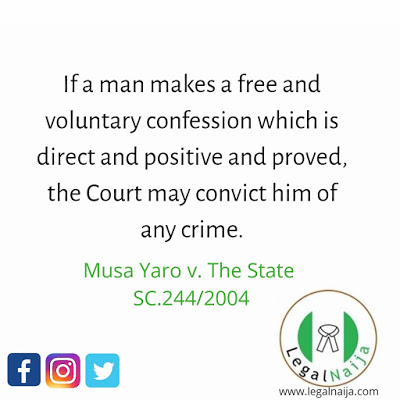
Mr X was arrested for stealing by the police, on arrival at the station he made a voluntary confession and described how he and his friends had committed the crime. 

Under Nigerian criminal law, Mr. X can be convicted of the crime of stealing solely on the strength of his confession. .
If the confession was however involuntary and Mr. X was coerced to make it, what do you think will be the case? .
Share your comments below 
#criminallaw #law #nigerianlawyer #barrister #nigerianblawg #legaleducation #legalnaija
NBA Thanks Lawyers For Standing Firm For The Rule Of Law

NBA Thanks Lawyers For Standing Firm For The Rule Of Law

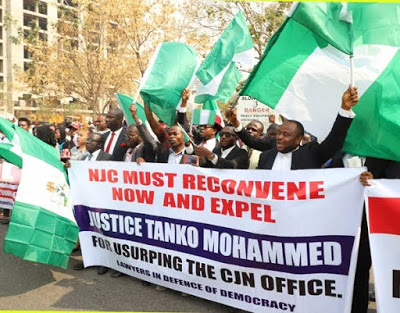
*NBA PRESIDENT EXPRESSES GRATITUDE TO ALL LAWYERS WHO STOOD FIRM ON DUE PROCESS* 
The President of the Nigerian Bar Association, Paul Usoro, SAN and the National officers gladly convey their gratitude to members for the huge support and solidarity in observing the two day boycott of courts. The boycott recorded a huge success. 

The NBA shall continue to ensure that the tenets of the rule of law and due process are upheld by the Federal Government of Nigeria. The NBA shall also continue to stand firm in PROMOTING THE RULE OF LAW.
Further information shall be communicated to members in the coming days. 
Thank you. 
 *Kunle Edun* 
National Publicity Secretary, NBA.
Photo Credit- Vanguard.com 
2nd Edition Of Babalola’s Law Dictionary Quiz Competition Is Here

2nd Edition Of Babalola’s Law Dictionary Quiz Competition Is Here

2ND EDITION OF BABALOLA’S LAW DICTIONARY QUIZ COMPETITION TO HOLD ON THE 7TH DAY OF JUNE 2019 IN LAGOS
Like the first edition which held at the Onikan Youth Centre, Lagos on the 1st day of June 2018, the 2nd edition of Babalola’s Law Dictionary Quiz Competition for Young Lawyers promises to be equally keenly contested.

The competition, which is for young lawyers between 0-5 years post call will have 10 finalist contest for varying prizes ranging from 1st prize of N250, 000 (Two Hundred and Fifty Thousand Naira) cash with electronic law report, the second prize of N150, 000 (One Hundred and Fifty Thousand Naira) and third prize of N100, 000 (One Hundred Thousand Naira) respectively and other consolation prizes.
Entry into the competition is now open to all eligible Lawyers (0-5years post call) by logging on to www.bldcompetition.com.
The qualifying rounds will be held in Lagos in March 2019.
The grande finale will be held in Lagos on the 7th day of June 2019 and the event is proudly sponsored by: Probitas Partner LLP, – Perchstone & Graeys, Hybrid Consult, – Law Pavilion Electronic Law Report, – FWLR, – Esher & Makarios, Esq. Magazine, – www.nigerianlawyer.com, – www.dnllawandstyle.com, – www.baristerng.com, – and Olumide Babalola LP.
Entry opens from 1st January 2019 to 28th February 2019 while the Grande finale holds in Lagos on the 7th day of June 2019 in Lagos.
Exclusive: NJC Saves The Day; Gives Justices Onnoghen & Tanko Muhammad 7 Days To Respond To Petition

Exclusive: NJC Saves The Day; Gives Justices Onnoghen & Tanko Muhammad 7 Days To Respond To Petition

The National Judicial Council has weighed in on the controversy that has engulfed the Nigerian Judiciary since the unlawful suspension of the Chief Justice Of Nigeria  by President Muhamadu Buhari without due process.
After the emergency meeting of the NJC held on Tuesday, 29th January, 2019, the NJC reached the following resolutions – 
1. That  Hon. Justices Walter Onnoghen, GCON and Tanko Muhammad, CFR respond to petitions written against them within 7 days. 
2. That the petition written against CCT Chairman, Danladi Yakubu Umar be forwarded to the Federal Judicial Service Commission (FJSC)
3. That the NJC would reconvene on 11th February,2019
This is a victory for Nigerians, members of the Nigerian Bar Association and members of civil society who protested on what was dubbed a coup against the Judiciary by the Federal Government led by President Buhari. 
It should be noted that if the NJC allows the unlawful suspension of Justice Onnoghen to stay, then every Governor in Nigeria  will believe they have the powers to remove the Chief Judges of their states without the recommendations of the CJN.

The NJC is the only constitutional body recognised as having the powers to discipline members of the Judiciary and their intervention in the chaos caused by the President’s order is timely in restoring the rule of law and the doctrine of separation of powers.

@Legalnaija 

#NigeriaDecides2019: Political Decisions and Its Economic Effects | B.K. Saka, Esq.

#NigeriaDecides2019: Political Decisions and Its Economic Effects | B.K. Saka, Esq.

The
Independent National Electoral Commission on January 9, 2018 released the
official timetable and calendar of exercises for the anticipated general elections
which is down to less than a month. As a major aspect of arrangements for the polls,
INEC has registered an aggregate of 91 political parties and through its
Continuous Voter Registration which was suspended on August 31, 2018, had been
able to register 84,004,084 (Eighty-Four Million, Four Thousand, and Eighty-Four)
eligible voters.

According
to Reuters, Nigeria’s economy will grow more slowly this year than previously
forecasted, this is due to investors hold off before elections this year, the
average investor is a capitalist he is concerned about the profitability of the
market he is trading in, the indicators have not shown positivity as such he
holds off. Investigators and financial experts’ conjectures demonstrated a
middle of 2.1 percent development for Nigeria, quickening to 3.0 percent one
year from now, a noteworthy downsize from the past survey taken three months
back, which demonstrated Africa’s biggest economy growing 2.6 percent this year
after a dreary 0.8 percent in 2017. The upcoming elections and its trademark of
related high-wire political issues would affect business and investment alerts
with respect to economic stakeholders. Business and venture decisions are definitely
subject to the aftermaths of the forth coming elections.

Despite
the fact that President Buhari, to some degree, won the 2015 race on the
strength of his anti-corruption promises, corruption is still endemic in
Nigerian public life and it appears that it is only members of the opposition
parties that are being prosecuted. Nigeria has one of the biggest youth
populaces on the planet, with at any rate half of its evaluated 180 million-in
number populace younger than 30. This could be a gigantic advantage for the
nation yet the current financial conditions where this advantage is harnessed,
the reverse is sadly the case, as a very large percentage of these young
persons are unemployed and the economic environment makes its unrealistic for
them to thrive.

Amidst
these negatives, we expect the continuous recuperation in oil generation to
make ready for robust medium-term prospects, helped by enhanced transparency in
the energy sector and others. Likewise, the bounce back in the economy would be
coordinated by enhancements in the fiscal balance, as the spending shortfall is
anticipated to ease from 3.6% of the GDP in 2017 to 3.2% in 2018. An enhanced
business atmosphere and speculators’ certainty have been the aftereffects of
the upward development in Nigeria’s ease of doing business ranking. 
A huge
enhancement in credit to the private sector will drive individual investment development
and thusly affect business and buyer utilization emphatically. The standpoint
of the naira past 2018 stays empowering regardless of fears that the raw
petroleum supply excess may bring costs down in 2019. Having directed its month
to month Forex request by 65% in 2017, a further significant decline is normal
in 2019 as Nigeria’s biggest Forex use the importation of refined oil-based
goods is probably going to be taken out when the Dangote refinery goes ahead
stream.

As
2019 races move closer, stock trade dives by 19.77%. The year 2018 was not all
that glowing for the Nigerian Stock Exchange as its significant markers
devalued by 19.77 percent because of vulnerabilities encompassing the expected
general decisions. The News Agency of Nigeria reports that the NSE which was
named the third best performing stock trade on the planet in 2017 with more
than 43 percent degree of profitability performed horridly in 2018. Specialists
said the market, which began the primary quarter on a positive note, plunged
because of the withdrawal of assets by remote portfolio financial investors who
were concerned over the pending elections.

Given
all these Negatives, one way out of a conceivable reaction on the economy is
that Politicians and their cronies need to receive down to business systems
that would ensure quiet battles and balance out the country to guarantee a
practical market bounce back. Besides, it should be perceived that uncertainty
and social issue are disincentives to speculation. Government should meet
people’s high expectations of handling, with all earnestness, the lamentable
advancements so as to re-establish investors’ certainty. 

The polity must be
quiet. Politicians should be upstanding and play by the standard by following
fair treatment to guarantee a serene environment in front of the decisions. Politicians
require not overheat the polity. The political class needs to understand the
nexus between political decisions/indecisions and economics. It will be
ridiculous to win an election, then spend years convincing investors to come (or
comeback) to invest in the country. To have a prosperous 4-year ahead, our
leaders have to take strict business decisions that will make Nigeria a hive
for investors and magnates.


Basit Kolapo Saka, Esq.
Associate, Ayanlaja, Adesanya & Co
Kolapo is a legal practitioner at the
prestigious Ayanlaja, Adesanya & CO, Situate in ILupeju, Lagos. He has keen
interest in Business and Corporate Law, Commercial arbitration and Fintech. He
also writes and advises business start ups and SMEs.

k_basyt@yahoo.com,
@_Kolamposi

Crypto-Currency Anarchy – A Comparative Overview | Michael Jonathan Numa

Crypto-Currency Anarchy – A Comparative Overview | Michael Jonathan Numa

Over the last 7years, crypto-currencies
have evolved tremendously and has increasingly established itself as a payment
system globally. Today, crypto-currencies are a Multibillion-dollar venture
with dual potential as both an investment and an electronic medium of exchange.
Increasingly, mainstream retailers are announcing plans to accept bit-coins.
Bit-coin ATMs are growing in prominence; the first bit-coin debit cards were
launched by an Hong Kong domiciled company called Xapo in the year 2014 and the
first Bit-coin derivative transactions have been executed on a US-regulated
exchange. Yet, there remain numerous risks and challenges associated with
crypto-currencies. In addition to experiencing significant volatility in
exchange rate and susceptibility to attacks from illicit users and
cybercriminals; the crypto-currency marketplace remains largely unregulated.
Governments around the globe are taking widely divergent actions- or taking no
action at all- to define and regulate crypto-currencies. This article is an
attempt to provide some context for the crypto currency landscape, including
regulatory and law enforcement developments.

WHAT ARE CRYPTO-CURRENCIES?

Crypto-currencies are decentralized
peer-to-peer payment systems that are digital representations of value and can
be transferred, stored and traded electronically. At their core, they are
distinct from other digital payments (e.g PayPal, Facebook Credits, airline and
hotel miles) because they provide intermediate party. They do not have legal
tender status; they operate with no central authority or banks, and their issue
is carried out collectively by a distributed network. While the transaction
between buyer and seller is direct, the identities of the parties are encrypted
and therefore no personal information is transferred. However, crypto-currency
transactions such as bit-coin transactions are not fully anonymous. A
transaction record of every bit-coin and every bit-coin user’s encrypted
identity is recorded on a public ledger. As a result, it is most appropriate to
characterize bit-coin and many other crypto-currencies as pseudonymous as
opposed to being anonymous. This pseudonymity, combined with its efficient and
decentralized nature, makes it appealing to both consumers and criminals alike.

Today, there are several hundred (if not
thousands) of crypto-currencies in existence with a current market
capitalization as at April 2018 of over $200bn. The bit-coin system is the most
prominent and perhaps most dominant crypto-currency. Other mineable crypto-currencies
with sizeable market capitalization include ButsharesX, Peercoin and Dogecoin.

While these descriptions provide a helpful
understanding of what crypto-currency is, they do clarify the role of
crypto-currencies in the modern financial system. Are they a commodity, a
currency? Policy makers and regulators are still trying to answer these
questions. The department of Treasury’s Financial Crimes Enforcement Network
(FinCen) has defined crypto-currency as a medium of exchange that operates like
currency in some environments, but does not have all the attributes of real
currency, does not have legal tender status in any jurisdiction.

In its recent ruling, the Internal Revenue
Service (IRS) held that crypto-currency would be treated as property, not
currency, for tax purposes. And a Former Acting Commissioner of the Commodity
Futures Trading Commission (CFTC) stated his belief in May 2013, that bit-coins
would be likely to be considered a commodity under the Commodity Exchange Act.

In March 2018, the Bank of England’s Head of
Finance Stability Board Mr. Mark Carney while in agreement with the U.S.
Securities and Exchange Commission (SEC) to classify crypto-currencies as
securities subject to laws governing how they are issued and traded stated inter
alia thus “For many reasons the crypto assets in your digital wallets are
unlikely to be the future of money, but that is not meant to dismiss them.
Their core technology is already having an impact. Bringing crypto-assets into
the regulatory tent could potentially catalyze innovations to serve the public
better”.

 Carney posited that the crypto
ecosystem should be held to the same standards as the rest of financial system,
which will bring great privileges, but also greater responsibility.

LEGAL AND REGULATORY FRAMEWORKS OF
CRYPTOCURRENCY

Crypto-currency and wokings of its
respective platforms have all the semblance of a Ponzi scheme, this similarity
will be treated
anon. Owing
to the fact that Crypto-currencies transcend traditional Sovereign jurisdictions,
financial regulators globally, have diverse opinions and approaches on the
phenomenon, and are struggling to agree on market standards, amid fears of
crypto-currency bubble.

In December, 2013, the Chinese Central Bank
and four other regulatory bodies jointly issued the Notice on Precautions
against the Risks of Bit-coins (the Joint Chinese Notice). In an Echo of the
IRS ruling, the Joint Chinese Notice defined Bitcoin as a virtual commodity and
found that it was not a currency, and therefore should not be circulated and
used in the Market as such. Banks and payment institutions in China may not
deal in bit-coin but the Central Bank clarified that it was not prohibiting
trading in crypto-currencies, however, it is apparent that the Chinese investor
interest in Bit-coin has been tempered. In September, 2017 the Chinese
government quickly moved to ban Initial Coin Offering (ICO), viewing them as
illegal means of financing. It also launched an investigation into 60 local
platforms dedicated to managing them; South Korea Followed suit, introducing an
ICO ban later that month. It is however an entirely different story in many
other developed economies with strong legal frameworks, including Australia,
Canada, the European Union, Hong Kong, Singapore, the United Kingdom and the
United States. Regulators in these jurisdictions are now looking to treat a
coin that functions like a security in a similar way as it would be under their
existing domestic securities laws. Japan, an early adopter of ICOs, has
more than ten regulated bit-coin exchanges, controlling a large chunk of global
market. A key topic in various jurisdictions is to try to put ICOs under the
umbrella of the Local Securities laws, but there is no best practice yet
globally. Recent survey has revealed that ICOs are looking to avoid being
defined as a security, so trying to regulate them seems to conflict with the
purpose of ICOs and Crypto-currencies. Such inconsistency is breeding
uncertainty among marketers.

In the United States, the SEC has taken actions
in two forms: various enforcement actions and the issue of investor advisory
notices. Recent actions indicate that even in the absence of new regulations
specifically addressing crypto-currency, the SEC has significant existing
authorities to regulate a wide range of matters involving bit-coin. The first
SEC enforcement action relating to crypto-currency occurred in July 2013, when
the SEC charged Trendon Shavers of Texas with defrauding investors in
Bit-coin-denominated Ponzi scheme. Shavers, the founder and the operator of
Bit-coin savings and trust, offered and sold bit-coin-denominated investments
online, raising at least 700,000 Bit-coins in what was allegedly a Ponzi
Scheme. In September, 2014, a US Federal Judge found that the SEC established that
the Company was a Ponzi Scheme, and ordered Bit-coin Savings and Trust and
Shavers to Pay a combined $40.7m. In so finding, the court held that the
Bit-coin investments at issue qualified as investment contracts and securities
under the Securities Act of 1933, as amended, and the Exchange Act of 1934, as
amended. The finding that Bit-coins are properly treated as securities is
likely to have broad implications in the future. In conjunction with the civil
enforcement action, SEC issued an investor alert at the same time, warning
investors of the dangers of Ponzi schemes and other potential scams using
crypto-currencies. In the alert, SEC expressed its concern that heightened use
of crypto currencies may entice fraudsters to lure investors into Ponzi and other
schemes in which these currencies are used to facilitate fraudulent or simply
fabricated investments or transactions.

Numerous other measures have been taken
including suspension of companies using mobile platforms to facilitate bit-coin
trading. However, the New York department of financial Services (NYDFS)
has adopted one of the most aggressive stances when it comes to
crypto-currencies, and it became the first state in the US to propose a robust
regulatory framework for crypto-currencies. In 2014 the NYDFS requested
proposals from firms to set up regulated exchanges from crypto-currencies all
in a bid to strengthen oversight including robust standards for consumer
protection, cyber security and anti-money laundering compliance.

In 2014, the Canadian Parliament adopted an
amendment to its proceeds of crime (Money Laundering) and Terrorist Financing
Act that will treat crypto-currency as Money service businesses for the
purposes of the Canadian Anti-money laundering law. As a result, companies
dealing in Crypto-currencies will be required to register with the Financial
Transactions and Reports Analysis Centre of Canada, implement compliance
programmes, maintain records, report suspicious or terrorist-related property
transactions and determine if any of the customers are politically exposed
persons.

In Nigeria, there is no clear legal or
regulatory framework (to the best of the writer’s knowledge) with respect of
crypto-currency. Although during the MMM saga the MPC issued a statements
warning members of the public not to be vulnerable to Money-doubling Ponzi
Schemes which are unapproved and unregulated by the CBN, this includes the
numerous Bit-coin related investments which are fast emerging in Nigeria
promoted by some Nigerian based platforms and some foreigners
alike.  In a whole, there is a consensus across the various
jurisdictions that crypto-currencies are susceptible to all manner of crimes
because Bit-coin transactions can be very difficult to trace, and often cross
multiple legal jurisdictions, it is hard for law enforcement to track or seize
criminal profits. The FBI has published its concerns about Bit-coin,
particularly the lack of regulation for offshore services that may be used by
criminals as a safe haven for criminal conduct. Albeit, so the attraction
to the numerous investing public is not diminishing, this perhaps increases the
conundrum associated to the subject matter. click this link to
access more of our articles via our website for free

Partner @ Karina Tunyan & Company

Source: LinkedIn 
Photo Credit – www.medium.com