False Advertisement and Vulnerable Persons in Nigeria (1) |Akpan, Emaediong Ofonime

False Advertisement and Vulnerable Persons in Nigeria (1) |Akpan, Emaediong Ofonime


False advertisement[ii]
is any advertising or promotion that misrepresents the nature, characteristics,
qualities or geographic origin of goods, services or commercial
activities.  An advert that is false
contains false statement of fact about the advertiser’s product or another
person’s goods, services, or commercial activity. Such advert deceives and has
the potential to deceive a substantial portion of its targeted audience. The
deception in the advert is also likely to influence the purchasing decisions of
its audience. False adverts contain statements that either results in or is
likely to result in injury to the consumer.


          The most heavily weighed factor is the
advertisement’s potential to injure a customer.[iii] The
European Economic Community Draft Directive (ECC) Article 2 defines ‘misleading
advertising’ as any advertising which is entirely or partially false or which,
having regard to its total effect including its presentation , misleads  or is likely to  misleads persons reached, unless it could not
be reasonably foreseen that these persons would be reached thereby’ The ECC
Draft Directives are replicated in the Nigerian Food Products (Advertisement)
Regulations[iv]
whereas the regulation does not expressly define false or misleading
advertisements most of its regulations prohibit misleading adverts. Regulation
4 explains the nature of advertisements and exempts misleading adverts from its
scope. Regulation 12 prohibits vague and misleading statements or half-truths,
Regulation 13 and 14 disallows the use of false data in comparative
advertisements, Regulation 15 prohibits the use of false names that are
suggestive of nutritional properties. These regulations form the bulk of
consumer protection from false and misleading adverts in Nigeria.

         
Whilst it is generally regarded as
self-evident that the consumer can be deceived, misled or tempted by
promotional methods into agreements he would not otherwise have made.[v]
This is equally true whether the promotion is in the form of general
advertisements, ‘sales patter’ or the labeling and packaging of goods
themselves. It is an ethical problem which the courts have recognised in Valentine v. Chrestensen[vi]  and Virginia
Pharmacy[vii]
wherein it stated that consumers have a strong interest in the free flow of
lawful and accurate commercial information (advertisements) and so ought to be
protected from advertisements that can mislead consumers and injure
competitors. In the financial sector the consumer is susceptible to the notion
that it is comparatively easy to acquire goods and services on credit terms or
to negotiate a loan, a notion that is frequently given by extensive advertising
and persuasive salesmen. Secondly, the individual is less likely to be informed
as to the true cost of the credit to him or even the most suitable form of
credit provision for his particular requirements. Finally he might be
pressurised by the canvassing salesmen into entering into transactions which sober
reflections or subsequent events might lead him to regret making. The Consumer
Credit Act[viii]
tightened the reins on the restrictions imposed by the Money Lenders Act which
regulated the advertisements by Money Lenders. Such advertisements were to
contain only basic information, personal solicitations were not allowed. The
recent Ponzi schemes scam made use of door-door advertisements offering huge
financial returns whilst unsuspecting and vulnerable consumers were lured in to
the scheme. While it might be difficult to ascertain financial decisions made
as a result of advertising and pressure, there is a need for the law to concern
itself with these difficulties and protect vulnerable consumers. The problem of
misleading advertisements gets worse by the day though it is illegal in its
most blatant forms, deceptive advertising can occur in subtle ways that are
difficult to establish as outright deception. The courts in Concentrated Foods Ltd. V. Champ[ix]  stated that the test for misleading adverts
lies in the understanding of the ordinary man. It follows therefore that if an
ordinary consumer is likely to be misled then such advertisements are false.
Consumer deception as a result of misleading advertisements and strategies to
counteract it are important issues in today’s marketplace.[x] The court
noted the foregoing in Central Hudson Gas
and Electricity Corp. v. Public Service Commission[xi]

when it stated that advertisements must not be misleading or concern unlawful
activities.

          Surrogate advertisement is one of those
less researched areas. Here a company advertises a non-existent product which
is likely to create a need associated with the brand name, the consumer
memorises this, evaluates and eventually goes on to make purchases based on
brand. In the case of United Breweries
Ltd v. Mumbai Grabak Panchayat[xii]

the court held that the defendant United Breweries advertised an alcoholic
drink as if it were soda(soft drink), the court found that the acts of United
Breweries constituted surrogate advert. It further held that the actions of the
defendant (surrogate liquor advertisement) was aimed at misleading and
encouraging the younger generation to consume alcohol. It follows that
consumers associated the brand name with soda but upon purchase it turned out
to be alcohol which most of the young consumers purchased. The Nigerian Food
Products (Advertisement) Regulations[xiii]
prohibits surrogate liquor advertisements; it prohibits expressly the ambiguous
inference to the tonic properties of a product whereas such product contains
alcohol or caffeine.

          The Sale of Goods Act is also aimed at
protecting consumers from false advertisement.[xiv] Where
goods are sold by sample or description the law stipulates that the bulk of the
goods should fit such description or sample. However, this is not always the
case in some contracts for sale of goods where the sample or description, is
relayed to the consumer over the internet, the Act provides the consumer
redress where the manufacturer is in breach. The Act does not envisage
e-commerce as such it accounts for the lack of redress by the consumer
especially because such contracts involve cross-border issues. In the light of
this Ukpong states that the Act does not conform to the provisions of the
United Commercial Code leaving consumer almost without a remedy.[x
v]  

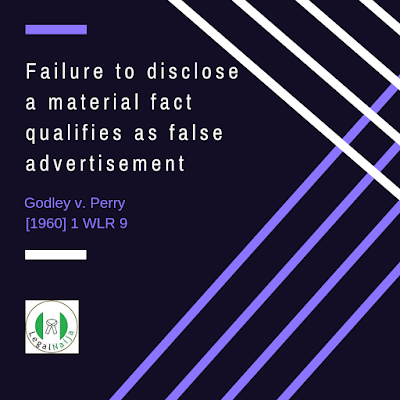
In Godley
v. Perry[xvi]
the courts stated that failure to disclose a material fact qualifies as
false advertisement. Going by this premise, advertisements by telecommunication
firms advertising caller tunes withholding the material fact that such
subscription will be automatically renewed at the end of the month except the
consumer opts out amounts to false advertising. The impact of this on consumers
who are oblivious to such re-occurring surcharges can be best imagined. Asides
paying for a service they may no longer need they might still lack the basic
information to opt out of such service, these telecoms firms gain at the
expense of vulnerable uninformed consumers who cannot make rational choices.
Determining what constitutes insufficient disclosure American Home Products Corp v. Johnson and Johnson. Johnson whilst advertising its product left out a few side
effects of its own. The court held Johnson to be in breach of the Lanham Act
because of the potential health risks it posed to consumers and the fact that
it did not fully disclose the side effects of its products to the general
public. In Broomfield v. Craft Brew
Alliance, Inc.[xvii]

 Kona Beers were being advertised in a
manner to suggest that the beers were produced in Hawaii when in fact they were
produced in Oregon. The Kona brands bore names and images that evoked a sense
of Hawaii origin. The beer’s outer packaging showed the map of Hawaii and the
location of the Kona brewery, and encouraged consumers to visit their brewery
and pubs whenever they were in Hawaii. In delivering its decision against
Broomfield, the court said that the disclaimer on the bottle was not visible
enough to a consumer as such it constituted false advertising. On the shelves
of various stores abound goods that mislead the consumer as to its origin. The
vulnerable Nigerian consumer is largely unaware of the criminalisation of adverts
such as this and so he may be unaware of the fact that he can approach the
Consumer Protection Council to address the issues. 

Akpan, Emaediong Ofonime is currently undergoing
postgraduate studies at the University of Uyo and majors in Consumer
Protection. She can be reached at akpanemaediongofonime@gmail.com


[ii]    Lanham Act, 15 U.S.C.A. § 1125(a)).”
[iii]   West’s Encyclopedia of American Law, 2nd
ed.
[iv]    1994 NO.15. S.I 13 of 1996.
[v]     Mickleburgh (n.8).
[vi]    316 U.S 52 1942.
[vii]   425 U.S 748.
[viii]  UK 1974.
[ix]  
(1994) K.B 342.
[x]     Girimaji
(n.303).
[xi]    447 U.S at 557.
[xii]   (2007) CPJ 102 NC. https://indiankanoon.org accessed 27th
December 2017.
[xiii]  1994 NO.15. S.I 13 of 1996. Regulation 17.
[xiv]            Sale
of Goods Act 1893 sec 13 and 12
[xv] I Ukpong, ‘An Appraisal of the
Sale of Goods Act’ (2018) Law Seminar Paper Series, University of Uyo
[xvi]  [1960] 1 WLR 9.
[xvii] No.17-cv-o1027-BLF
2017. www.alcoholadvisor.com.

Proliferation of Arms – Insecurity to Lives and Property | Paul Usoro SAN

Proliferation of Arms – Insecurity to Lives and Property | Paul Usoro SAN


Dear Sir/Ma,

1. Barely a week ago,
precisely on Sunday, 04 November 2018, hoodlums rained bullet shots at the car
of the past Chairman of Auchi Branch of the Nigerian Bar Association (“NBA”),
Mr. A A Atemoagbo, along Auchi-Benin Road, near Ehor, in Edo State, in an
attempt to halt him.  Mr. Atemoagbo survived the attack, albeit with
injuries and greatly traumatized, but not so, his wife, Joan, who was killed by
the assassins’ bullets.  Mr. Atemoagbo was returning from a Convention of
the Jehovah’s Witnesses that held in Benin and, in his Honda CRV car were his
wife, their young child and one other passenger.  Mr. Atemoagbo’s car was
indeed stopped by the hoodlums and he was kidnapped and only released days
later after the payment of the specified ransom amount.

2. This very unfortunate and
depressing incident which, sadly, is not isolated, highlights two critical
issues, both related to security of lives and property in our land. 
First, how come criminals find it so easy to acquire firearms and ammunition in
our country?  What happened to the enforcement of the law prohibiting
unlicensed possession of firearms?  How come we’ve not heard of any
crackdown by the security agencies on illegal ownership and/or possession of
firearms or isn’t it obvious that there’s unbridled ownership and possession of
guns by all shades of criminals, giving rise to the runaway insecurity to lives
and property in Nigeria?  How come governments, at the different levels,
are not carrying out consistent and concerted campaigns against illegal
ownership and possession of firearms? Why is there no concerted effort at
stemming this unseemly situation?  

3. It needs be mentioned
that the proliferation of firearms and ammunition in Nigeria gives the
impression that governments and their security agencies are very complacent in
their approach to these security and safety challenges.  What would it
take to wake up governments at all levels and the security agencies to their
respective responsibilities in this regard?  Perhaps, Joan Atemoagbo
would’ve been alive and with us today if governments and their security
agencies had taken their respective responsibilities seriously and cracked down
on proliferation of arms and ammunitions.  It’s not too late to start that
crackdown now and we urge the various governments to do so before another life is
lost.

4. Second and on a related
note, we understand that the location where the Atemoagbos were attacked, along
Benin-Auchi Road, close to Ehor, in Edo State, is notorious for such criminal
and deadly attacks.  Indeed, we understand that an Edo State Local
Government Chairman was attacked and killed at that same spot in 2017. 
Mr. Atemoagbo also tells us that, while in captivity, he noticed that the
kidnappers’ business was truly booming.  Indeed, as he was entering his
captivity, some others were being released from the den upon the payment of the
demanded ransom and he was replacing them.  As he was also being released,
after payment of the ransom amount, some other victims were replacing and
taking his place. 

5. How come such organized
criminal rings and gangs operate brazenly without hindrance and with such
freedom and effrontery? What happened to the intelligence capabilities of our
security agencies?  Have the criminals developed strategies and operating
modus that are seemingly superior to those of our intelligence and security
agencies, thereby making the criminals invincible and, perhaps,
untouchable?  

6. We deeply mourn the
untimely death of Joan Atemoagbo and condole with the Atemoagbos and indeed,
the executive and members of our Auchi Branch.  We sincerely hope and pray
that the gruesome murder of this innocent woman who was returning from a place
of worship, would not go unpunished.  We pray that Joan’s death pricks the
conscience of our various governments and their law enforcement and security
agencies sufficient to galvanize them into actions that would secure lives and
property in the land.  In particular, we call on the security agencies to
bring to book the murderers of Joan Atemoagbo while also rounding up and
bringing to justice the criminal gang(s) of kidnappers and murderers that
operate along the Benin-Auchi Road.

Paul Usoro, SAN

President    

IP Protection For Artists

IP Protection For Artists

Dear Artist👩‍🎨 After putting so much effort into your beautiful piece of art, it is essential that you protect your masterpiece by ensuring you register for copyright protection.

Copyright law protects the creative expression of Ideas. Any creative work that has been fixed in a tangible medium of expression, such as paper, software, or film, and that can be reproduced or otherwise communicated exactly is automatically protected by copyright law. Examples include art, songs, movies and writings. The digital world is boundless and to protect a copyright, an artist may have to use digital watermarks on their creations and put up a copyright notice on the web page where your work is displayed.

Do you have any questions on how to register for a copyright? Send us a mail.

#copyright #art #intellectualproperty #paintings #photography #artist #artistsofinstagram #creatives #artwork #artlovers #artx #artxlagos2018 #nigerianlawyers #artlawyer #nigerianart #royalvisitnigeria
How To Catch A Judgment Debtor

How To Catch A Judgment Debtor

When a court gives monetary judgment in favour of a creditor, an avenue to ensure the money is recovered is through the process of a garnishee proceedings. 
This is a judicial process whereby a judgment creditor can recover such debt owed to the judgment debtor. For instance, if Mr. A gets a judgment against Mr. B, Mr. A can ask the court to help collect Mr B’s money from Mr C (a bank) who in turn owes Mr. B money. 
Usually Mr C in this scenario can be Mr B’s bankers. If you ask any further questions on this topic, kindly send a DM or mail. 
#law #legal #corporatelaw #garnishee #commerciallaw #blog #blawg #nigerianlawyer #lagoslawyer #nigerianblawg #debt #debtrecovery
IP ABC—Does a database enjoy copyright protection in Nigeria?

IP ABC—Does a database enjoy copyright protection in Nigeria?

Question 

My name is Yakubu Jang, an investment advisor and consultant in
Nigeria. I publish a monthly investment e-newsletter The Yaks Investment.
The Yaks Investment publishes up-to-date information on incentives in
Nigeria available to investors. Apart from that, what our subscribers find most
valuable about the newsletter is access to our comprehensive and up-to-date
database of Agrotech & Fintech Businesses and Venture Capitalists in
Nigeria. This database is accessible through a URL link which directs readers
to the page where the database is electronically stored. In over 3 years, this
database has greatly made The Yaks Investment newsletter become well
known amongst both local and international private-equity investors with an eye
on the Nigerian market.

Recently, a new e-newsletter The Ark Investment published by Ark
Investments Nigeria Limited, a Lagos-based investment advisory company, was
launched. Apart from the confusingly similar name it has with The Yak’s
Investment,
the new newsletter has also been practically “copying and
pasting” our comprehensive and up-to-date Database of Agrotech & Fintech
Businesses and Venture Capitalists in Nigeria in their ‘The Ark’s List of
Agrotech & Fintech Startups and Venture Capitalists in Nigeria.’

I am unhappy with The Ark Investment’s act as it infringes on my copyright in
the database. As the maker of the database, I invested so much resources into
collecting information from various sources and systematically arranging them
in a way readers and users would find invaluable. But when I instructed my
lawyers Bitrus Adamu & Co to write The Ark Investment about this
infringement, the company claimed that they have not infringed on my copyright.
Under Nigeria’s copyright law, does a database not enjoy copyright protection?

Answer

Though
the Nigerian Copyright Act does not provide for copyright protection of a
database, a database may be protected as a compilation or directory as long as
sufficient effort is expended on it to give it an original character. This
copyright protection extends only to the compilation itself, and not to the
underlying data, facts, or materials in the database. Copyright protection is
irrespective of quality.

What qualifies The Yak’s
Investment’s
Database
of Agrotech & Fintech Businesses and Venture Capitalists in Nigeria
as a protectable work under the
Nigerian Copyright Act?


Under copyright law, databases are protected under the concept known as
compilation copyright. Compilation copyrights protect the collection and
assembling of data, facts, or other materials. While some countries or
international treaties specifically recognize compilation copyright and the
extent of protection it enjoys, the Nigerian Copyright Act does not contain
provisions for compilation copyright. Also, ‘database’ is neither defined nor
referred to in the Act. But in the interpretation section of the Act, section
39 defines a literary work as including, among other works, “encyclopaedias,
dictionaries, directories
and anthologies” and other
works similar thereto
. According to the Oxford Dictionary, a
‘directory’ is “a book or website listing individuals or organizations
alphabetically or thematically with details such as names, addresses, and
telephone numbers”. Directories are a kind of compilation. Therefore, by virtue
of section 1(1)(a) of the Nigerian Copyright Act, a database which functions as
a directory is a literary work eligible for copyright protection.

So the general provisions of section 1(1)(b) and section 39 may be interpreted
as protecting a database as long as the data, facts, or materials collected and
arranged as a compilation serve the purpose of a directory or purposes similar
thereto. Section 1(1)(b) makes literary works eligible for copyright
protection.


The Yak’s Investment’s comprehensive and up-to-date ‘Database of Agrotech &
Fintech Businesses and Venture Capitalists in Nigeria’ is a list compiled by
Yakubu Jang and electronically available to subscribers as a database. This
database is a directory
of agrotech and fintech businesses and venture capitalists to enable
subscribers have access to their names, addresses, and other contact details.
Being a directory, it falls under literary works, thus eligible for protection
under the Act.


Under copyright law,
underlying data is not protected. This is why copyright in the database does
not prevent any person from extracting the unprotected data from it.

A database has been defined as a collection of independent works, data, or
other materials arranged in a systematic or methodical way and individually
accessible by electronic or other means.


A database of unprotectable works such as facts is protected only as a
compilation.

If The Ark Investment has only extracted information from the database such as
names, addresses, and contact details of the agrotech and fintech businesses
featured in the original Database
of Agrotech & Fintech Businesses and Venture Capitalists in Nigeria
,
this would not be a violation of copyright law. But The Ark Investment would be
violating copyright if it copied the entire database, as long as the database
meets the statutory requirement of originality.


Since what The Ark
Investment has practically done is copy the entire database, this amounts to
copyright infringement, subject to section 1(2)(a) and (b) of the Act.

A mere collection of data, facts, or materials does not enjoy copyright
protection except there is originality.


Section 1(2) requires that (a) sufficient effort has been expended on making
the work to give it an original character and (b) the work has been fixed in
any definite medium of expression now known or later to be developed, from
which it can be perceived, reproduced, or otherwise communicated either
directly or with the aid of any machine or device. Since the database is
electronically stored and accessible on webpage, this is adequate.

Because a database is a collection and assembly of preexisting data, facts, or
materials, how the maker selects and arranges these to create an original work
is what determines whether it enjoys copyright protection. Sufficient effort
must have been expended on the collection and assembly of pre-existing data,
facts, and materials facts; the selection, or arrangement of those materials;
and the creation of the database as an original work of authorship.

How about The Ark
Investment’s act of publishing a similar investment newsletter?

Any person has the right to publish a newsletter, whether a similar newsletter
exists or not.

One of the fundamental concepts of copyright law is that copyright does not
protect ideas, information, or facts but instead protects the form in which
those ideas, information, or facts are expressed. This is known as the idea-expression
dichotomy, which means that copyright will not be infringed when works based on
the same ideas are independently created, provided the way in which those ideas
have been expressed is not copied.

Therefore, Yakubu Jang has no copyright in the idea for an investment
newsletter.

What about title and
straplines of the newsletter, including articles on investments?

Names and titles cannot be accorded copyright when they are not substantial
enough to attract copyright in themselves.


Titles and names can be protected as trademarks. If trademarked, you may sue
The Ark Investment for trademark infringement, since The Ark Investment
newsletter sounds confusingly similar to The
Yak Investment.
If The
Yak Investment
has not been trademarked, you may institute an
action for passing off since The Yak Investment enjoys goodwill and reputation
in Nigeria’s investment market. You must however prove that The Yak Investment
really enjoys goodwill and reputation and that The Ark Investment is unduly
benefiting from this goodwill by illegally coming up with a confusingly similar
newsletter, The Ark
Investment
newsletter. Therefore, the title of the newsletter will
not attract copyright protection. Also, any strap lines such as ‘Invest wisely
with Yaks’ or ‘Your most reliable investment newsletter’, etc will be regarded
as too trivial or little in terms of creative effort to attract copyright. But
the logo, if any, of The
Yaks Investment
newsletter may attract copyright protection as an
artistic work.


Apart from the database, analysis and explanations on investment opportunities
published as articles in the newsletter would attract copyright protection as
long as they are original. You or the authors of these articles would have no
doubt exercised a sufficient degree of skill, applied knowledge, or used
judgment in forming opinions by evaluating and comparing the different
investments opportunities in the Nigerian market. Subject to originality, such
articles are protected by copyright.


Therefore, if The Ark Investment also copied any substantial part of these
articles without authorization, this amounts to copyright infringement.


Consult an IP lawyer or law firm to help you determine all the legal options
available to you.

Best wishes

IP
ABC

Create Your Future Workshop Friday Giveaway

Create Your Future Workshop Friday Giveaway

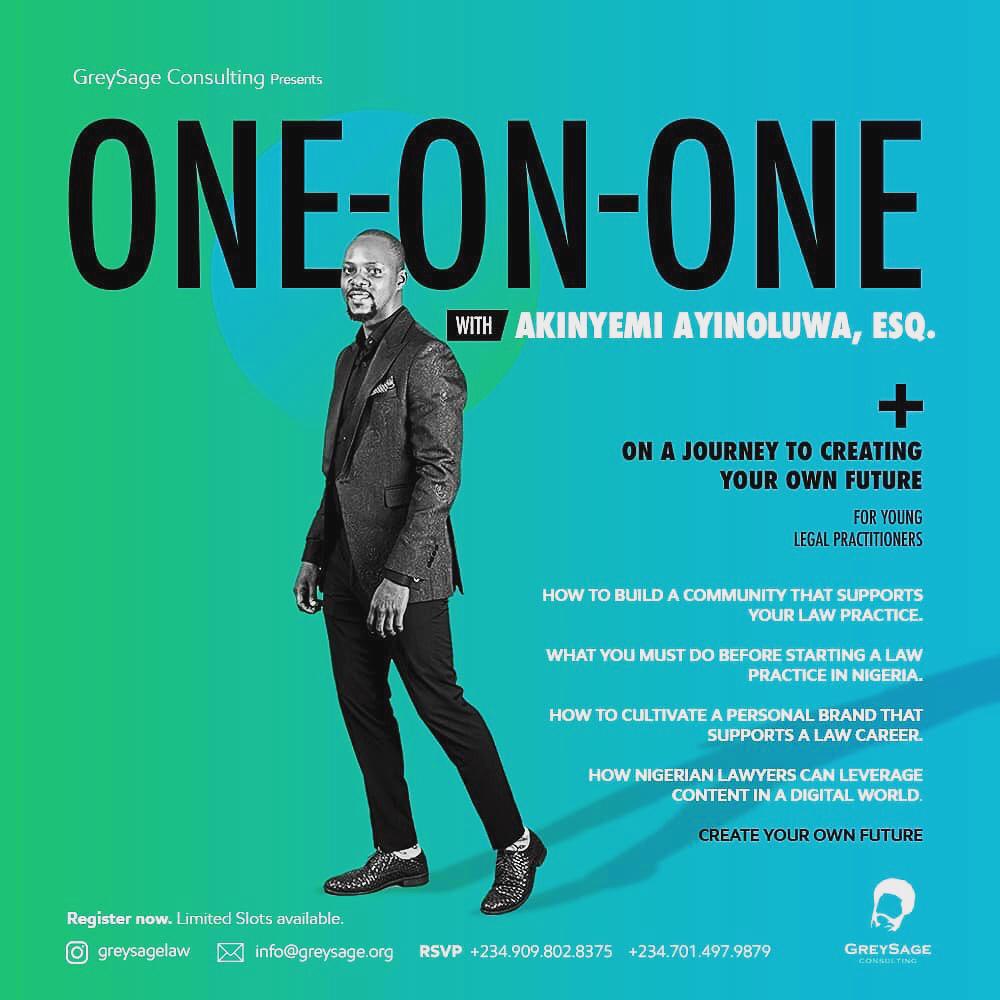
We are giving 5 young lawyers the opportunity to attend the CREATE YOUR FUTURE WORKSHOP organized by GreySage Consulting. 
Each young lawyer will learn –
1. How to build a Community that supports your law practice;
2. What you must do before starting a practice in Nigeria;
3. How to cultivate a Personal Brand that supports your career and;
4. How Nigerian lawyers can leverage content in a digital world.

To be one of the 5 lucky winners –

A) You must be following @Legalnaija on Facebook; Twitter & Instagram
B) You must show a commitment to attend the event; and
C) post a comment telling us why you deserve to be one of the 5 lucky young lawyers. The comments with the highest likes win 

Don’t miss this opportunity to grow your legal career👌🤗👍
Study UK Exhibition, Lagos – December 2018

Study UK Exhibition, Lagos – December 2018

                         
Are
you considering an international education? Are you thinking of getting an MBA,
undergraduate or postgraduate international degree?

Do
you live in Nigeria’s Southwest region? Yes?


Join
us in November 2018 as the British Council in Nigeria invites you to the second
edition of the Study UK Exhibition.

The
details for this November/December batch of exhibitions are as follows:

1. Uyo – 27 November 2018 at Ibom Hotel and Golf Resort (formerly Le Meridien
Hotel). 9.00am to 4.00pm


2. Abuja – 29 November 2018 at Sheraton Abuja Hotel, 9.00am to 6.00pm


3. Lagos – 01 December 2018 at The Zone Tech Park, Gbagada Expressway, beside
UPS office, Gbagada, Lagos, 9.00am to 6.00pm


The UK is a top study destination with world-class institutions. Three of the
top ten universities in the world is UK institutions. The UK is also home to
many high-quality further education colleges and boarding schools. Whatever
your level of study, the UK offers you a multicultural learning environment
with rich traditions and beautiful cities and countrysides.

Prepare
for a great future by joining representatives of UK institutions in Lagos
this December. Get first-hand guidance and information about courses, fees and
scholarships.

To
register log on to the British
Council NG
. 

Advertisers Liability in Nigeria and the Eco-Contort Principle | Akpan, Emaediong Ofonime

Advertisers Liability in Nigeria and the Eco-Contort Principle | Akpan, Emaediong Ofonime

1.0     Introduction

The first victim of advertisement suffered the lack of redress solely
because the liability regime in existence was heavily laden with the caveat ‘buyer beware.’ This caveat reads
thus; ‘….but the fruit of the tree which is in the midst of the garden…….God
has said you shall not eat it, neither shall you touch it …’
[ii]  This caveat may be said to have
allowed the advertiser act with reckless abandon, transferring in whole, the
liability of his actions on the consumer’s inability to adhere to warnings. It
leaves out the question of the consumer’s ability to understand such warning
and re-enforces the advertiser as king who has usurped the powers of the
consumer.

Another bone of contention has been largely predicated on the nature of
relationship between the advertiser and the consumer who has been injured. It
must be mentioned at this point that the business relationship that resulted in
Eve being harmed was without any consideration or contractual relations, and
centuries after such liability regime has continued to work hardship for
consumers especially the vulnerable. The liability of an advertiser has been
the also been the bone of contention from time immemorial. It is evident in the
brief argument that ensued between Adam and Eve on the one part, and God on the
other after they had consumed the product advertised to them. While Adam placed
the liability on Eve (the retailer or distributor); Eve if probably asked would
have placed the liability on the Serpent (the advertiser) and the Serpent would
have placed the liability on God (the producer).
[iii] This argument is vital because it determines, the duty of care, the
demarcating lines for proving negligence and the right to claim redress.

Nigeria is yet to have an articulated body of laws termed ‘Advertiser’s
Liability Law’ or an aspect of its advertising law that deals solely on the
liability of the advertiser.
[iv] For the protection of consumers, there is a reliance on the rules of
liability under the laws of contract, tort and also under criminal powers of
some regulatory frameworks. Most of the parameters for situating liability have
been developed extensively on goods as opposed to services.[v]

2.0     The Liability Regime in
Nigeria

The liability for defective products is borne by the producer or such a
person that holds out himself as a producer. These include persons who mark or
name appears on the product, the importer or distributor and so forth.[vi]
This implies that the manufacturer of products and sometimes the person in the
distribution chain owe a duty of care to the consumer of that product. This
position was enunciated in Donoghue v
Stevenson[vii]

where the House of Lords held that the defendants who were manufacturers of
drinks, owed a duty of care to the plaintiff, who became sick after drinking a
bottle of the manufacturer‘s ginger beer, bought for her by a friend at a
restaurant and which contained the decomposed remains of a snail.

Product liability[viii]
is a tort which imposes liability on manufacturers and sellers of products that
are manufactured or sold in defective condition. A product is defective if it
is unreasonably dangerous to the user. Liability is tied to physical or
emotional injury to the ultimate consumer as was held in Constance Ngonadi vs Nigerian Bottling Co. Ltd.[ix]
The consumer is saddled with proving that a manufacturer was negligent.[x]
The privity of contract has created a lot of hardship for the assignment of
liability in the case of advertisements. However it is workable for goods since
it is hinged on consideration;[xi]
hence it defines the scope for persons who can hold the producer liable for
defective goods.[xii]
The loopholes in the privity of contract were addressed by the exceptions of
negligence and duty of care. The current test for a duty of care can be found
in the judgment of Caparo Industries Plc
vs Dickman.
[xiii]
Lord Oliver‘s speech in the above case sets the test for a duty of care thus;

(a) The harm which occurred must be a reasonable foreseeable result of
the defendant‘s conduct;

(b) A sufficient relationship of proximity or neighbourhood exists
between the alleged wrongdoer and the person who has suffered damage;

(c) It is fair, just and reasonable to impose liability.

3.0     The Monstrosities in
Evolving a Service Liability Regime for Advertisers

While the last limb of the test on reasonable and just need to impose
liability may be appropriately applied to the advertising sector it may be
difficult or almost impossible to establish the existence of a sufficient
relationship of proximity and neighbourhood since advertisements are simply an
invitation to treat and not in itself sufficient to import a contractual
relationship. It is also difficult to place the advertiser or manufacturer
within a water tight compartment to establish mens rea. This is because the manufacturer in defence may state
that such advertisements were outsourced to an advertising agency who was
supposed to act as a professional. Conversely the advertiser may state that the
advertisements were subject to final verification by the manufacturer hence
they acted solely on his instructions as an employee as opposed to a contract
for service. While jurisdictions like China place liability on the advertisers
giving them the responsibility of verifying the contents and claims of
advertisements which they put out or consumers. In the light of the foregoing
it has become necessary to examine the Eco-Contort Principle as a possible
liability principle for advertisements with a few modifications.[xiv]
The eco-contort principle is a combination of economic or business
consideration, privity of contract and the neighbourhood principle within the
precinct of tortious liability. This presupposes an amalgamation of other
liability regime to ensure that consumer redress is not sacrificed on the altar
of a tight compartment of strict rules. However, the eco-contort liability
principle still makes consideration a paramount factor thereby almost leaving
the consumer who has not acted upon the advertisement to mature into a
contractual relation without a basis for his claims. This will continue to
allow the advertiser the leeway to continue with reckless abandon the
exploitation of the vulnerable consumer.

In Tamara Egbedi v. (Our Daily
Manna ) The Registered Trustees of the Chapel of Liberty[xv]

the plaintiff,  Ms Egebedi a lawyer
approached the court to enforce the payment of damages she incurred in acting
on an advertisement for a religious crusade by the defendants popularly known
as Our Daily Manna which she attended
and sustained injuries. Candide Johnson in delivering the judgement stated that
the defendants put themselves forward as spiritual shepherds and hence owed a
duty of care to the public whom they had invited through advertisements to
their spiritual crusade. If this be the case that a plaintiff who offered no
consideration towards an advertisement then it follws that the vulnerable
consumer who only views an advertisement can also bring a claim against the
proprietors of such advertisement. This is favourable to the vulnerable
consumer as it will no longer allow the advertiser avoid liability on the basis
of a non-existent contractual relationship.

4.0     Conclusion/Recommendation

          If the eco-contort
liability principle is expanded to accommodate the court’s decision in Tamara Egbedi v. (Our Daily Manna ) The
Registered Trustees of the Chapel of Liberty[xvi]

it will offer some amount of protection to the vulnerable consumer who has not
furnished any consideration towards the maturity of any advertisements
into  a contractual relationship but is
nevertheless affected by the mere viewing of such advertisements. It may also
open a floodgate of law suits thereby stifling economic activities but it will
offer vulnerable consumers the much needed protection and afford regulatory
agencies the necessary parameters for achieving a balance.

END NOTES


[i] Akpan, Emaediong Ofonime is
currently undergoing postgraduate studies at the University of Uyo and majors
in Consumer Protection. She can be reached at akpanemaediongofonime@gmail.com.
[ii] King James, Easy Reading  Version :The Holy
Bible
, Genesis Chapter 3: 1 King James Version  G.E.M Publishing,   2001 p. 2-5. Eve the first woman according
to Christian theological history was made out of man and both lived in the
Garden of Eden.
[iv] A model example is Advertising Law of
the People’s Republic of China 2015
[v] E Ekanem ‘No Longer at Ease: The
Contract-Based Liability Posture of the Nigerian Law Toward Consumers of
Hospitality Services’ (2015) Journal of
Humanities and Social Science. Pp.10-19.
[vi] Malemi, E., Law of Tort,
Princetown Publishing Company, Lagos, 1st ed. p. 267
[vii] (1932) AC. 562 at 599
[viii] The tort protects the consumer
from unfair trade practices by manufacturers and other key players in the chain
of distribution who put in the market potentially dangerous and shoddy consumer
products, unwholesome and adulterated food, fake and substandard food and fake
drugs.
[ix] (1985) 1 NWLR pt.4 p.739 – where
the Plaintiff/Appellant sustained severe injuries from a brand of Kerosene
refrigerator, which was sold to her by the defendant/Respondent.
[x] I Omadane Edegbo ‘An Assessment Of
Consumer Rights In Nigeria: A Case Study of The Sachet Water Industry’
Masters’  Dissertation Ahmadu Bello
University,
[xi] Dunlop Pneumatic Tyre Co. Ltd vs
Selfridge Ltd.  (1915) AC 487 at 853
[xii] Sagay, I., (2000).Nigerian Law of
Contract, Spectrum Law Series, Ibadan p. 489
[xiii] (1990) 2 AC 605
[xiv] E E Ekanem ‘No Longer at Ease:
The  Contract-Based Liability Posture of
the Nigerian Law Towards Consumers of Hospitality Services ’ (2015) Journal of Humanities and Social Sciences
20(9)pp10-19.
Retrieved from www.iosjournals.org.Aceessed
1/1/2018.
[xv] Suit no: LD/359/2011. Retrieved
from www.thenigerialawyer.com
Accessed 1/6/2018.
[xvi] Suit no: LD/359/2011. Retrieved from
www.thenigerialawyer.com
Accessed 1/6/2018.


Akpan, Emaediong Ofonime
Emaediong Akpan is a postgraduate student passionate
about consumer protection. Her interests also spans grey areas of Law including
but not limited to IVF and cybercrime