
The Effect of COVID-19 in the Maritime Industry: Invoking the ‘OFF HIRE CLAUSE’ in a Time Charter | Pelumi Ajekiigbe


1. 0 INTRODUCTION
In the period of 20 years, China has taken
the World through a gruesome path, twice. After being criticized for
a slow response to SARS, China is once again facing global scrutiny for its
handling of the new ‘Coronavirus’. China repeated the obstruction
of information that worsened the SARS crisis 18 years earlier. In
that case, China tried to cover up the SARS epidemic, which led WHO member states to adopt the new
International Health Regulations in 2005. In both cases, China and the world
would have been spared thousands of unnecessary deaths had China acted
forthrightly and in accordance with its legal obligations.
The events to date has shaken confidence in the Chinese Communist Party at home and
abroad. China’s initial response to the crisis was less than impressive. The
Wuhan government was secretive and self-serving. The Chinese state made
evidently intentional misrepresentations to its people concerning the outbreak.
Reports showed that the Chinese Government silenced doctors who raised the
alarm of the virus, minimizing the danger to the public even as they were
bewildered and overwhelmed. State media also suppressed information about the
virus. Although authorities closed the Wuhan “wet market”, the epicenter of the
contagion, they did not take further steps to stop the wildlife trade, where
scientists traced the virus to.
The Covid-19 pandemic has affected all systems. Financial
markets have shuddered and have been pulled into all kinds of uncharted
territories, commodity prices have fallen, especially oil prices. According to
the International Monetary Fund, the global economy is now in a recession. Schools
have been closed globally, religious and social gatherings have been
restricted. There is now this new trend of ‘Working from home’. Summarily, the
whole world is in a lockdown, mildly say- a compulsory holiday.
This article addresses the possible arguments that International
law imposes an obligation on China to make reparation for COVID-19-related
harms or say damages.
2.0 CHINA’S OBLIGATION UNDER INTERNATIONAL LAW
The scale of the damage, Worldwide, has
prompted arguments of whether or not, China bears international legal
responsibility for the pandemic and should compensate countries harmed by the
outbreak.
China is one of the 194 states, party to the
2005 International Health Regulations, which is legally binding. China has a
duty to rapidly gather information about and contribute to a common
understanding of what may constitute a public health emergency with potential
international implications. The legally binding International Health
Regulations were adopted by the World Health Assembly in 1969, to control six
infectious diseases: cholera, plague, yellow fever, smallpox, relapsing fever,
and typhus. The 2005 revision added smallpox, poliomyelitis due to wild-type
poliovirus, SARS, and cases of human influenza caused by a new subtype, set
forth in the second annex.[1] Annex 2 of the IHR
provides for: “Any event of potential
international public health concern, including those of unknown causes or
sources and those involving other events or diseases than those listed”.
Obviously, Covid-19 falls under this category.
States are expected to provide expedited, timely, accurate, and sufficiently detailed information to
the World Health Organization about the
potential public health emergencies identified in the second annex in order to
galvanize efforts to prevent pandemics, according to Article 6 of the IHR.
Article 7 also provides that “any unexpected
or unusual public health event within a country’s territory, irrespective of origin or
source”, should be reported to the WHO. The body (WHO) also has a mandate in Article 10 to seek
verification from states with respect to unofficial reports of pathogenic
microorganisms. States are required to provide timely and transparent
information as requested within 24 hours, and to participate in collaborative
assessments of the risks presented. Yet China rejected repeated offers of
epidemic investigation assistance from WHO in late January (and the U.S.
Centers for Disease Control and Prevention in early February), without
explanation. The Washington Post concluded in a story on February 26 2020 that
China was not sending the details that WHO officials and other experts expected
and needed.
3.0 CHINA’S LEGAL RESPONSIBILITY
It can be seen that China had violated international law on
infectious diseases and, under the International
legal principles of state responsibility, has an obligation to make full
reparation for the harm done. None of the treaties addressing the international
spread of infectious diseases dating back to the nineteenth century have rules
requiring payment of compensation for damage in other countries associated with
violations of treaty rules. The leading contemporary treaty, the International Health Regulations
(2005) (IHR), has no provisions on this issue. This situation is
not unusual. Most treaties do not address whether the violation of their rules
creates an obligation to compensate those states parties adversely affected by
harms caused by the violation.[2]
A state violating international law has “an
obligation to make full reparation for the injury caused by the internationally
wrong act”, under Customary
international law on state responsibility. This customary rule has played no discernable role in
disease outbreaks over the long history of international health cooperation,
even when states have argued that countries violated applicable treaties.
States have not seriously pursued compensation against countries accused of
breaching treaty obligations to report disease events or refrain from imposing
trade or travel measures that have no scientific basis.
States have not been keen
to use ‘customary law on state responsibility in the infectious disease context’
because of how political and epidemiological considerations align. Fulfilling
treaty obligations to report disease outbreaks involves challenging scientific
and public health questions and difficult political calculations. Pathogenic
threats with the potential for cross-border spread can appear in any country.
For example, although the origin of the devastating influenza pandemic of 1918-19 remains unclear, the
United States is on the list of potential countries of origin. The H1N1 virus
that caused an influenza pandemic in 2009 was first detected in the United
States. This reality creates a shared interest among states not to litigate
disease notification issues. Likewise, a state experiencing an outbreak will
complain about irrational trade or travel measures, other countries impose.
However, next year, that same state might want to implement similar measures
when another nation suffers an outbreak, which reveals reciprocal interests
among states not to seek reparations for violating treaty rules on trade and
travel measures.[3]
States understand that, tomorrow, the shoe could be on the other foot, which
creates a collective incentive among countries to avoid being legalistic about
reporting obligations.
Article 56 of the IHR
(2005) requires an injured state to first explore negotiation or any other
peaceful means of their choice including good offices, mediation, or
conciliation, to settle any dispute involving treaty interpretation and
application. Failing that, the parties may refer the dispute to the WHO
director general or parties to the dispute may agree to compulsory arbitration
in which the arbitral award shall be binding.
Under
the principles of state responsibility, States have the obligation to make
reparation for the damage caused by their wrongful act. Thus, China may be
liable to pay reparations over its failure to promptly notify the WHO about the
outbreak. Reparations involve restitution, and where that is no longer
possible, the offending state pays compensation “for loss sustained which would
not be covered by restitution in kind or payment in place of it” (Chorzow
Factory,1927). Such assessment of damages may also come with an award of
satisfaction, or a formal apology and an assurance that its unlawful conduct
will not be repeated (LaGrand Case, 2001).[4]
However,
countries have never used the dispute settlement provisions in infectious
disease treaties from the nineteenth century through today — an indication that
states have no interest in legal remedies in this area.
4.0
CONCLUSION
Under the principles of
state responsibility, separating what damage is attributable to China’s delayed
reporting and what harms arose because other governments botched their
responses to COVID-19 would be difficult. Such causation issues also help
explain why states have, historically, not pursued reparations for damage
associated with alleged violations of treaties on infectious diseases.
Many countries now struggling with COVID-19
had time to prepare for the pathogen’s transboundary spread after China
reported its outbreak under the IHR.
At
the moment, no state party has alleged that China violated its IHR notification
obligations but two class actions have been filed against China for
“damages suffered as the result of the coronavirus pandemic” before
the U.S. District Court in Florida and Texas, shocking the Chinese legal community.
There
have been clamours that China should be held responsible this time, for the
Covid-19 pandemic so as to protect the future.
[1] https://warontherocks.com/2020/03/china-is-legally-responsible-for-covid-19-damage-and-claims-could-be-in-the-trillions/(accessed
30 March 2020)
[2] https://www.justsecurity.org/69394/covid-19-and-international-law-must-china-compensate-countries-for-the-damage-international-health-regulations/
(accessed 30 March 2020)
[3] Ibid. 1
[4] https://opinion.inquirer.net/128226/china-international-law-and-covid-19#ixzz6IPMcilCd/
(accessed 31 March 2020)

The essence of this write-up is not to criticise the Federal Government of Nigeria, but to urge the Government to do the needful by ensuring the health sector is properly funded. The era of the Government at all levels paying lip service to the health sector, in terms of adequate funding, going forward should be gone with the wind. Clearly, the world was/is largely unprepared for the outbreak of this plague-like virus, as even first-world countries, with well-funded health sectors are battling tooth and nail to checkmate the spread of the virus. This fact should serve as a wake-up call to Nigeria, whose successive leaders have over the years under funded the health sector.
While surfing the internet for information relating to disease prevention, I was jolted by the heart wrenching caption of This Day Newspaper of 5th March, 2020 which stated: “FG Budgets 8 Naira for Disease Prevention of Each Nigerian in 2020”. I must say that the said newspaper article is a must-read for all Nigerians to appreciate the extent of the retrogression of the Nigerian health sector. Our health sector is still in the wilderness, going round in circles with no hope in sight of reaching Canaan land anytime soon. The article revealed that only a paltry sum of N1, 673, 486, 127 was allocated to the Nigeria Centre for Disease Control (NCDC), the country’s national public health institute (established in 2011), essentially saddled with the responsibility of epidemic preparedness, detection and response to infectious disease outbreaks and public health emergencies for over 200 million Nigerians. Unfortunately, a visit to the website of the NCDC would reveal that the above mentioned budgeted sum will be expended on preventing and managing Lassa fever, Ebola, Coronavirus (COVID-19) Yellow fever, Cholera, Meningitis, Measles etc; running, funding and maintenance of the six Departments (four of which are technical Departments) created by the NCDC namely the: Surveillance and Epidemiology Department, Public Health Laboratory Services Department, Health Emergency Preparedness and Response Department, Prevention Programmes and Knowledge Management Department, Administration and Human Resources Department and the Finance and Accounts Department. In order to appreciate the dire straits, foisted upon the Nigerian health sector by meagre funding over the years, I would proceed to quote copiously, portions of the pungent This Day Newspaper article earlier referred to which served as a catalyst to my writing this article. The said article stated in part as follows:
“…NCDC’s counterpart in the United States, the Centre for Disease Control (CDC) will spend $6.594 billion on epidemic preparedness this year, which is about N2.34 trillion, an amount that exceeds Nigeria’s entire Federal Ministry of Health allocation for five years. This means, if the CDC budget is spread across the population, the centre will spend at least 20 dollars (N7, 200) on epidemic preparedness for every American resident, while Nigeria, a country which prides itself as the giant of Africa and the economic hub of the black continent, will spend eight naira on same disease prevention and management in a full year per citizen…. The health sector generally has had one of the lowest budget allocations in the country, even far lower than sectors relatively not as crucial as the health sector. This is despite the pledge made by the country in April 2001 during the ‘Abuja Declaration’ where it, along with other heads of state under the African Union platform, declared to increase health budget allocation to 15 per cent of the entire national budget every year. Since the Declaration, the highest health allocation for Nigeria was in 2012 where 5.95 per cent was allotted to the sector. In 2014, it allocated N216.40 billion to healthcare, representing 4.4 per cent. In 2015, it was N237 billion, which represents 5.5 per cent of the entire budget, same with 2016 (4.23 per cent), 2017 (4.16 per cent), 2018 at 340.5 billion (3.9 per cent), and 2019 at N315.6 billion (4.1 per cent)…the Nigerian government, again in 2020, followed the same trend with only 4.14 per cent of the entire budget allocated to the health sector, amounting to N427 billion; an allocation less than 25 per cent of what CDC alone will spend on epidemic preparedness. But the World Health Organisation (WHO) says for Nigeria to be seen to have prioritised healthcare, it must at least spend a minimum of N6, 908 per Nigerian in a year, which when multiplied by 200 million people will amount to N1.38 trillion, which is around 12 per cent of Nigeria’s entire budget for 2020… For instance, Rwanda reportedly devoted 18 per cent of its total 2016 budget to healthcare. Botswana budgeted 17.8 per cent to health; Malawi, 17.1 per cent, Zambia, 16.4 per cent and Burkina Faso, 15.8 per cent. But Nigeria still lags behind in this regard, which has had direct consequences on the funding capacity of the Health Ministry and its affiliated agencies and parastatals, thereby making the fight against poor healthcare very unrealistic.”
The above quoted portions of the article perfectly reflect the unfortunate doldrums that the Nigerian health sector is enmeshed in due to lack of proper funding. There is no gainsaying the fact that there is no use crying over spilt milk. It is time for the Government to seize the bull by the horn by adequately funding the health sector in tandem with global best practices. The outbreak of the deadly pandemic Coronavirus has shown that we cannot always resort to medical tourism to meet our medical needs. It is apparently clear that the Government must go back to the drawing board to re-strategize and chart a way forward, in order to revive our comatose health sector. To my mind, the only way forward is for the Government to prioritize and adequately fund the health sector. Fortunately, the Federal Government of Nigeria can resort to its 359-page blue-print National Action on Health Security (2018-2022), which is a “comprehensive multi-sectoral plan that integrates multiple work plans including REDISSE, NCDC Strategy Plan, AMR Action Plan, and immunizations plans, addressing the major gaps identified by the Joint External Evaluation (2017) and Performance of Veterinary Services (2010) assessments, and prioritizing them by national strategies and risks. As such, the NAPHS is an “overarching” plan and can be used to create linkages and monitor progress of major health security initiatives.”
Flowing from the above, can the Federal Government religiously, diligently and steadfastly implement the NAPHS, in order to ensure the Nigerian health sector is revamped, revitalised and repositioned to meet the health needs of all Nigerians? Most humbly and with all due respect, I must state that Nigeria is a country, whereby successive Governments have expended so much funds in drawing up plans, without the will to implement them. In this wise, I must plead that in relation to the health sector (and in fact all sectors), it can no longer be business as usual, bearing in mind the words of the 34th President of the United States of America, Dwight D. Eisenhower ” In preparing for battle I have always found that plans are useless, but planning is indispensable.”

The concern of this write-up is the manner of enforcement of such Executive Orders, restrictions and regulations by the law enforcement agencies and men of the Nigerian Army which has brought with it Police brutalisation, dehumanization and outright death of the citizens. The Tribune of today published the story of someone that was killed in Ogunnu, a suburb of Warri in Delta State, while driving for refusing to stop when he was reportedly flagged down by the security personnel. These various acts of brutalisation and dehumanization of citizens must be condemned in its entirety. It is an extra-judicial killing, it is illegal and absolutely unconstitutional.
It needs to be emphasised that the very reason for the announcement of these stay-at-home Orders and other restrictions on movements is essentially to save lives. Hence, the phrase: stay-at-home to stay safe. If the objective of a policy is to save lives, it is therefore totally illogical and inherently contradictory to kill in order to enforce safety measures. Indeed the point must be made for the umpteenth time that it is the business of the regular Police to enforce and maintain law and Order in the society as distinct from the Armed Forces whose duty is to protect the nation against external aggression and internal insurrection. The objective of the measures will be defeated if human lives are wasted, treated with disdain and their Human Rights violated with reckless abandon.
We saw a good example of how to enforce law and Order by the reported arraignment and conviction of twelve (12) persons for violating the provisions of Ekiti State Coronavirus Prevention of Infection Regulations 2020. The violators were tried and fined by the Chief Magistrate Court of Ekiti State. We advise everyone involved in the enforcement of these Orders in the different States of the Federation to take que from this example by arresting the violators and arraigning them before the appropriate Court for trial and sanction if found guilty. To do otherwise is to resort to self-help which is a product of executive lawlessness, an anathema and abomination in a constitutional democracy such as ours.
I call on the civil populace to see the reason behind the restrictions and other safety measures and directives to put up with the momentary inconvenience in order to experience the long term gain for ourselves, our families, the Nation and in the interest of public health and public safety. May I also say that any further act of brutalisation, dehumanization and unprofessional conduct on the part of the law enforcement agencies should be reported to the nearest Nigerian Bar Association Branch or directly to the Inspector-General of Police for necessary actions. With regards to the Armed Forces, report should be directed to the Defence Headquarters by sending text or WhatsApp messages through the telephone numbers provided by the Headquarters of the Nigerian Army.
Let us join hands together in unity of purpose to fight the Coronavirus war and live after the guaranteed victory.
Dated April 3, 2020.
Dele Adesina SAN

*Main Topics:*
1. Professional Development
2. Managing Practice in a Coronavirus Environment; and
3. Understanding Mentoring
Sub-Topics as time will permit are Self Development, Advocacy Skills, Dealing with Sexual Harassment in the Workplace, Work-life Balance, Choice of Life Partner.
Link to connect: Here

The Corona-Virus
Disease (COVID- 19), famous for its widespread, has killed tens of thousands of
people across the globe and has raisedan indispensable question in the minds of
many; whether the Chinese government can be held liable in Negligence, whether the
pandemic is an ‘act of God’. In the legal community, an act of God is a concept
that allows a party exemption from instances of strict liability and negligence.
This article is concerned primarily with the debate, whether the corona-virus
pandemic is an act of God or an act of man.
An event,
occurrence or accident that cannot be prevented by ordinary human foresight,
normally by an operation of natural forces free from human intervention, like
flood or earthquake is an ‘Act of God’. James LJ in Nugent V Smith[1]
described it as “any accident due to natural causes directly and exclusively
without human intervention and that could not have been prevented by any amount
of foresight and pains and care reasonably to have been expected”.The
determining factor for an act of God is that it “proceeds from the
forces of nature alone, to the entire exclusion of human agency.”[2]
The courts have
expanded this concept by including similar defences such as force
majeure and peril of the sea to the mix. The courts have also
expanded on the no-fault concept and used the term ‘inevitable accident’ to
describe certain accidents, whether or not caused by an act of God, where all
reasonable precautions had been taken and the accident occurred anyway. An
inevitable accident, unlike an act of God, can start with human action or
originate with a natural force.[3]
On December 31,
2019, the World Health Organisation(WHO) heard the first reports of a previously-unknown
virus behind a number of pneumonia cases in Wuhan, a city in Eastern China with
a population of over 11 million.[4]What
started as an epidemic mainly limited to China has now become a truly global
pandemic with cases globally surpassing 669,310 and deaths, at least 30,982
people.[5]
Not only is the virus a major concern from a public health perspective,
businesses are seeing disruptions which are only likely to increase in the
coming weeks and months.
It is apparent
that the disease originated from a Wuhan seafood market where wild animals,
including marmots, birds, rabbits, bats and snakes, are traded illegally.
Coronaviruses, constituting the subfamily
Orthocoronavirinae, are known to jump from animals to humans, so
it is thought that the first people infected with the disease, a group
primarily made up of stallholders from the seafood market, contracted it from
contact with animals.
The hunt for the
animal source of Covid-19 is still unknown, although there are some strong
contenders. A team of virologists at the Wuhan Institute for Virology released
a detailed paper showing that the new coronaviruses’ genetic makeup is 96%
identical to that of a coronavirus found in bats, while an as-yet unpublished
study argues that genetic sequences of coronavirus in pangolins are 99% similar
to the human virus. Some early cases of Covid-19, however, appear to have
inflicted people with no link to the Wuhan market at all, suggesting that the
initial route of human infection may pre-date the market cases. Although the Wuhan
market was shut down for inspection and cleaning on January 1, 2020, it appears
that Covid-19 had already spread beyond the market itself.
United States President
Donald Trump has repeatedly referred to it as the “Chinese virus”. Many of his
critics insist the term is racist. U.S. Sen. Kelly Loeffler, opines that the
crisis should not be politicized by assigning blame, but our focus should be on
pulling together in the common fight against a global disease that makes no
distinction between people and recognizes no borders. However, many still argue
that the virus is a failure of governance, not a blind force of nature
independent of human agency, caused in part by incompetent, malicious, and
corrupt politicians. To ignore the political dimension of the coronavirus
pandemic is an excellent way to ensure its recurrence, and that to prevent a
recurrence, we have to hold accountable the politicians responsible for its
global transmission and uncontrolled spread, with all its terrible consequences
to populations and economies around the world.[6]
As one of the
194 states party to the legally binding 2005 International Health
Regulations, China has a duty to rapidly gather information about and
contribute to a common understanding of what may constitute a public health
emergency with potential international implications. The legally binding
International Health Regulations were adopted by the World Health Assembly in
1969, to control six infectious diseases: cholera, plague, yellow fever, smallpox,
relapsing fever, and typhus. The 2005 revision added smallpox, poliomyelitis
due to wild-type poliovirus, SARS, and cases of human influenza caused by a new
subtype, set forth in the second annex.
Article 6 of the International Health Regulations requires states to provide expedited,
timely, accurate, and sufficiently detailed information to WHO about the
potential public health emergencies identified in the second annex in order to stir
efforts to prevent pandemics. States are required to provide timely and
transparent information as requested and to participate in collaborative
assessments of the risks presented. Yet China rejected repeated offers of
epidemic investigation assistance[7]
from WHO in late January, as well as the U.S. Centres for Disease Control
and Prevention in early February, without explanation.[8]This
answers the question whether reasonable care was taken by China to prevent the
horrific consequences the disease posed. China’s failure to expeditiously and
transparently share information with WHO in accordance with the International
Health Regulations[9]
constitutes an early and subsequently extended breach of its legal obligations.
An
epidemiological model at the University of Southampton found that had China
acted responsibly just one, two, or three weeks more quickly, the number
affected by the virus would have been cut by 66 percent, 86 percent, and 95
percent, respectively.[10]
By its failure to adhere to its legal commitments to the International Health
Regulations, the Chinese Communist Party has let loose a global contagion, with
mounting material consequences.[11]
Other than the
fact that the act of God defence is still not relied on very often, likely
because of the difficulty of proving that human elements played no role in causing
an injury, China’s initial lackadaisical attitude, malfeasance and breach of an
international obligation is certainly the cause of the cost of the coronavirus
disease. Thereby making it improbable that the defence will excuse the Chinese
government. Hence, China bears legal responsibility for its internationally
wrongful acts.[12]
Under Article
31 of the Articles of State Responsibility, states are required to make
full reparations for the injury caused by their internationally wrongful acts.
Injuries include damages, whether material or moral. Injured states are
entitled to full reparation “in the form of restitution in kind, compensation,
satisfaction and assurances and guarantees of non-repetition”.[13]
Restitution in kind means that the injured state is entitled to be placed in
the same position as existed before the wrongful acts were committed.[14]
To the extent that restitution is not made, injured states are entitled to
compensation[15], and
satisfaction, in terms of an apology and internal discipline and even criminal
prosecution of officials in China who committed malfeasance.[16]As
the world continues to suffer the costs of China’s breach of its legal duties,
it remains to be seen whether the injured states can be made whole.
Perhaps, China
did not intentionally create a global pandemic. However, the increasing
incidents of sickness and death as well as the economic cost of the pandemic
cannot be overlooked. The world has paid and is still paying for China’s
carelessness.
Written by:
Oluwabukunmi
Adeniran.
[1] (1876) 1 CPD 428.
[2]Rice v. Or. Short Line R.R. Co., 198 P. 161, 164 (Idaho 1921).
[3]Lawrence R DeMarcay, Michael Harowski,
“Planning ahead to use act of God as legal defence.”. Published: July 8, 2015. Accessed
March 30, 2020.
[4]Matt Reynolds, “What is coronavirus and
what happens now it is a pandemic?”. Published: March 27, 2020. Accessed
March 29, 2020.
[5]CNBC, “Coronavirus live updates: Cases
globally surpass 660,000, Spain sees highest daily jump in deaths”. Published:
March 28, 2020. Accessed March 29, 2020.
[6]Paul D. Miller, “Yes, Blame China for
the Virus.”. Published: March 25, 2020. Accessed March 29, 2020.
[7] New York Times: By Donald G. McNeil Jr. and Zolan
Kanno-Youngs, “C.D.C. and W.H.O. Offers to Help China Have Been Ignored for
Weeks”. Published: February 7, 2020. Accessed March 30, 2020.
[8]James Kraska, “China is legally responsible for Covid-19 damage and claims could
be in the trillions.”. Published: March 23, 2020. Accessed March 30, 2020.
[9] Article 14.
[10]Shengjie Lai, Nick W Ruktanonchai,
Liangcai Zhou, Olivia Prosper, Wei Luo,Jessica R Floyd,
AmyWesolowski, Mauricio Santillana, Chi Zhang, XiangjunDu,
Hongjie Yu, and Andrew J Tatem, “Effect of non-pharmaceutical
interventions for containing the COVID-19outbreak in China.”. Published: March
3, 2020. Accessed March 30, 2020.
[11]James Kraska, “China is legally
responsible for Covid-19 damage and claims could be in the trillions.”.
Published: March 23, 2020. Accessed March 30, 2020.
[12] Article 28 of the International Health Regulations.
[13] Article 34.
[14] Article 35.
[15] Article 36.
[16] Article 37.

As the world battles the Corona-Virus
Disease (Covid-19), emergency legislations are being enacted globally.[1]
Some governments have invoked the provisions of relevant legislations to
declare a state of emergency, to enable them legally enforce total shutdown of cities,
provide relief packages, and fast track the mass production of health
equipment.[2]
Alongside the unified effort by the Nigerian federal government, governors have
been on the front line of combating the disease, as a couple of them have
issued directives and regulations to enforce the shutdown of their respective
states.
Section 305 of the 1999 constitution and the Quarantine
Act[3]
serve as the legal authority for the President to take extraordinary measures
during public health crises, as we are currently experiencing. While Section
305 of the 1999 constitution empowers the president to declare a public
emergency, restricting right to personal liberty, movement and property; the Quarantine
Act on the other hand, gives the president and the country’s health authorities,
broad powers to deal with public health crises by issuing declarations and
orders.
As already stated above, the Quarantine
Act is the primary legislation governing the suppression and prevention of
deadly infectious disease in Nigeria. The Act intends to provide for and
regulate the imposition of quarantine, and to make other provisions for
preventing the introduction and spread of dangerous infectious diseases in Nigeria.
The Act provides that “dangerous infectious disease” means cholera, plague,
yellow fever, smallpox and typhus. The Act further states that the president
may by notice, declare any disease of an infectious or contagious nature to be
a dangerous infectious disease within the meaning of the Act.[4]
Till date, this authority has been used just once in the past, to categorize Sleeping
sickness as a dangerous infectious disease.[5]
As the author writes, the president is yet to declare, by notice, Covid-19, to
be a dangerous infectious disease.
The Act also provides that the
President may by notice declare any place, whether within or outside Nigeria,
to be an infected local area.[6]
Section 4 further provides that the President may make regulations which among
other things:
·
prescribe
the steps to be taken within Nigeria, upon any place, whether within or outside
Nigeria, being declared to be an infected local area.
·
prevent
the spread of any dangerous infectious disease, from any place within Nigeria,
whether an infected local area or not, to any other place within Nigeria.
·
prevent
the transmission of any dangerous infectious disease, from Nigeria or from any
place within Nigeria, whether an infected local area or not, to any place
outside Nigeria
·
prescribe
the duties of such officers as may be charged with carrying out such
regulations.
It must be noted that the Quarantine
(Ships) Regulations remains the only set of regulations that has been issued
pursuant to this provision at the national level.[7]
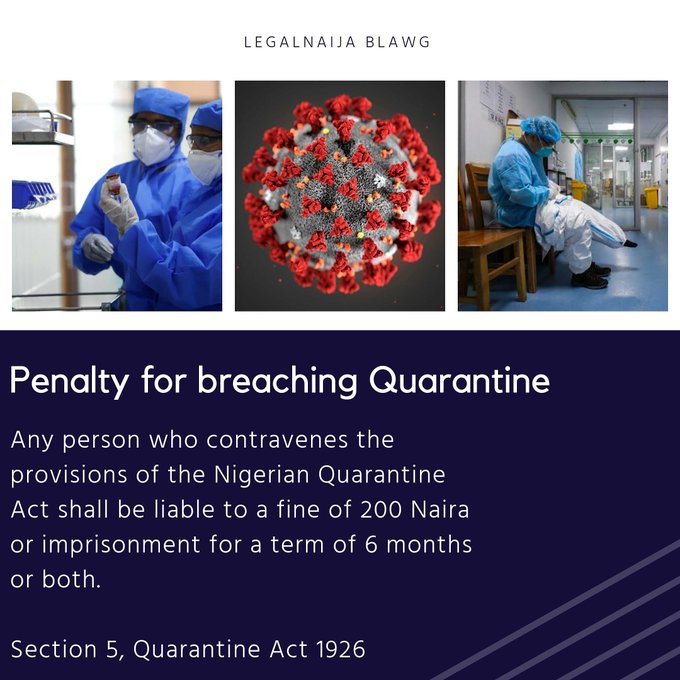
Section 5 of the Act stipulates a 6
month jail term or a fine of 200 Naira for contravening any of the regulations
made under the act. The President; and within each state, the Governor, may provide
sanitary stations, buildings and equipment and appoint any sanitary anchorages,
as he may think necessary.[8]
The magistrate courts have jurisdiction to commence and determine proceedings
for imposing any fine or imprisonment or for recovering any expense incurred or
charged by the Government in carrying out the provisions of the Act.[9]
Section 8 of the Act provides that where
the President is yet to declare, by notice, a disease to be a dangerous infectious
disease or is yet to declare, by notice, any place to be an infected area or is
yet to issue regulations as provided for in Section 4 of the Act, the State
governors are accorded the same powers as the President.
The Kaduna state government on Thursday 26th
of March invoked the provisions of Section 2, 3 and 8 of the Act, declaring
Kaduna State a public health area, declaring Covid-19 a dangerous infectious
disease and restricting movement from midnight.[10]
Similarly, on Friday 27th of
March, the Lagos state government issued the Lagos State Infectious Disease
(Emergency Prevention) Regulations 2020.[11]
These regulations, among other things, imposed a shutdown of the state,
declared Covid-19 a dangerous infectious disease, and declared Lagos State an
infected local area.[12]
The Quarantine Act however has two
subsidiary legislations namely:
1.
Declaration
of Dangerous Infectious Disease: Sleeping Sickness was declared to be a
dangerous disease within the meaning of the Act.
2.
Quarantine
(Ships) Regulations:
These regulations provide that the port
health officer is authorized to inspect any ship, already in the port or on
arrival at the port.[13]
In any instance where the master of a ship has sent to the health authority, a
notification of infectious disease on board, or he (the health officer) has
reasonable grounds to believe that there is on board, a case or a suspected
case of an infectious disease, the port health officer is authorized to inspect
on arrival, any of such ship.[14]
The regulations also provide that a
ship that has voyaged in a foreign port shall complete a Maritime Declaration
of Health Form which shall be countersigned by the ships’ surgeon, if it has
one.[15]
When before a ship arrives a Nigerian port, and a person is suspected to be
suffering from or is showing symptoms of an infectious disease, the master is
obligated to send a radio message before arrival, either directly or to the
Port Health Authority. When a person onboard a ship is suffering from an
infectious disease or tuberculosis, or has been exposed to an infectious
disease, the port health officer, upon
request by the master of a ship or on his own volition, is authorized to take
measures, including detaining the infected person or ordering his belongings to
be disinfected.
It should be noted that there is a Bill
for an Act to Establish the Nigerian Public Health (Quarantine, Isolation and
Emergency Health Matters Procedure) Act also known as Public Health Bill 2013
in the Senate.[16] This
Bill seeks to replace the Quarantine Act 1926, but is however yet to scale the
committee stage.
In conclusion, it must be stated that
the federal government is yet to lead by example in implementing the provisions
of the Quarantine Act 1926, as Nigerian is confronted by a deadly health
crisis. In his national address on Sunday 29th of March 2020, the
President made no recourse to the provisions of the Act in combating the
current national health crisis; rather he unconstitutionally imposed a 14-day
lock down on Lagos, Ogun and Abuja. This move, though out of necessity, begs to
question the relevance of the Quarantine Act 1926, in the current realities of
the Nigerian state.
@Legalnaija
[1]
The Covid-19 Emergency Response Act Receives Royal assent, https://www.canada.ca/en/departments-finance/news/2020/03/the-covid-19-emergency-response-act-receives-royal-assent0.html
[2]
Countries like The US, Italy, France, and Spain, among others, have declared
state of national emergency.
[3]
Quarantine Act of 1926, 14 Laws of the Federation of Nigeria Cap. Q2 (rev. ed.
2004) http://www.placng.org/new//laws/Q2.pdf
[4]
Section 4, Quarantine Act 1926
[5]
Nigeria: Legal Responses to Health Emergencies, https://www.loc.gov/law/help/health-emergencies/nigeria.php#_ftn33
[6]
Section 3, Quarantine Act 1926
[7] Nigeria:
Legal Responses to Health Emergencies, https://www.loc.gov/law/help/health-emergencies/nigeria.php#_ftn33
[8] Section
6, Quarantine Act 1926
[9] Ibid Section. 7
[10]
Covid-19: Kaduna Govt Invokes quarantine Act, And State Public Health Law,
Imposes Curfew Throughout The State, https://thenigerialawyer.com/covid-19-kaduna-govt-invokes-quarantine-act
[11]
Available online at http://www.lawyard.ng/lagos-state-government-infectious-diseases-emergency-prevention-regulations-2020/infectious-disease-regulations-2020-pdf-pdf-pdf-pdf-pdf/
[13]
Par. 3(1) Quarantine (Ships) Regulation
[14] Ibid
[15]
Par, 10 Quarantine (Ship) Regulation
[16] Available
on the Nigerian Senate website at http://www.nassnig.org/nass/legislation.php?id=1316

We can invest the time by drafting those outstanding briefs and pleadings, vetting of documents, reading our law reports, researching into specific areas of legal interest and of course audio and video calls and conferencing with clients to render both curative and preventive legal advice and opinions.
Recognising that health is wealth, exercising the body is also of paramount interest. We must remain active so as to prevent weight gain and strengthen our immune system as this will make us less susceptible to infections including that of the Corona Virus. We must continue to take the necessary precautions to prevent the spread of the virus and flatten the curve. It is my confident belief that the earth will reject Coronavirus in all its entirety because the earth is given by God to the children of men. Surely the end of the virus is coming soon. Our expectations shall not be cut-off.
I urge you to stay alive as we will all rise from this challenge stronger, healthier and with a determined mind to continue to serve the interest of our clients, our nation and justice in general.
My warm greetings to you and your family.
Thank you.
Dele Adesina SAN
#securethefuture
#nigerianlawyers