5 Points To Note On Constructive Dismissal Arising From Involuntary Registration | Kayode Omosehin

5 Points To Note On Constructive Dismissal Arising From Involuntary Registration | Kayode Omosehin


1.  What is the meaning of Constructive Dismissal?

In order to discourage hostile work environment, common law sides with an employee who has been subjected to a forced or compulsory resignation, especially where it is clear that the employer has pressured the employee into involuntary resignation without any reasonable ground.

Whenever a resignation is not voluntary, the #law views it as a kind of unlawful #termination known as constructive dismissal or constructive discharge. In C.B.N. v. Aribo (2018) 4 NWLR (Pt. 1608) 130, the Supreme Court held as follows:

“A forced or compulsory resignation by an employee amounts to constructive dismissal ……. In this case, the respondent did not voluntarily resign. His employer (the bank) advised him to resign after the 1st appellant revoked the bank’s licence to conduct foreign exchange and fined it for illegal foreign exchange transaction. In the circumstance, the respondent’s resignation amounted to a constructive dismissal.” (P. 172, paras. C-E)

 Constructive dismissal is a type of disengagement which arises from the involuntariness of the employee’s decision to leave an employment, which entitles the employee to sue the employer after exiting the employment. According Hon. Justice Kanyip in Balonwu v. Voluntary Service Overseas (VSO) International“constructive dismissal/discharge once proved evinces a poor and unfair labour practice on the part of the employer”.


2.   When Can Constructive Dismissal Arise?

 From notable judicial decisions, constructive dismissal may arise in two circumstances resulting in involuntary resignation:

 1.    When an employee resigns on the advice or request of the employer; or

2.    When an employee is forced by the employer to resign.

 Management’s advice to an employee to resign must be proved by credible evidence and this can be established through the email or memo or report of a panel. For instance, in Mrs. Vivien Folayemi Asana v. First Bank of Nigeria Ltd, the judgment of which was delivered on 9th October 2018, the National Industrial Court held thus:

 “By Exhibit C5/D3 (i.e. Claimant’s letter of resignation and Exit Form), the claimant stated thus: “Further to the request that I should resign, by Management of First Bank of Nigeria Ltd. I hereby tender my letter of resignation”. (words in parenthesis supplied for clarification).

 A worker may be forced into #resignation where the employer’s action or action is #discriminatory, oppressive, humiliating or intolerable and the #employee has no choice but to resign. In Mr. David A. Fadipe v. Cedarcrest Hospitals Limited, the Court held that constructive dismissal means the attempt by an employer to have the employee resign, rather than outright firing the employee.

 For instance, while relying on the case of Miss Ebere Ukoji v. Standard Alliance Life Assurance Co. Ltd [2014] 47 NLLR (Pt. 154) 531 NIC, my lord Justice Kanyip, President of the National Industrial Court, in the Balonwu v. Voluntary Service Overseas (VSO) International, held as follows:

 “From Miss Ebere Ukoji v. Standard Alliance Life Assurance Co. Ltd, the employer need not have asked the employee to resign. The behaviour of the employer is sufficient once it is intolerable or heinous that the employee has no choice but to resign. The employer must have created such working conditions or so changed the terms of employment that the employee has little or no choice but to resign. It must be noted though that the claimant’s case in the instant case is not that the employer changed the terms of employment. Where the employer makes life extremely difficult for the employee, to attempt to have the employee resign, that will amount to constructive dismissal.

 Below is a list of unbearable behaviours or circumstances which the courts have held to justify an employee to resign and make a claim for constructive dismissal on the ground of involuntary resignation:

 –      Actual or repudiatory breach of employment contract such as employer’s unilateral reduction of salary, demotion, non-payment of salaries;

 –      Victimization, witch-haunt, vendetta, retaliation, targeting the victim for whistleblowing or filing a complaint or grievance procedure against a colleague or superior;

 –      Discrimination on ground of sex, age, religion, ethnicity or nationality, disability, etc;

 –      Gender harassment, for example telling female colleague that “this is a boys club” or a male colleague that “why do you like ladies’ job?”

 –      Racial harassment in form of racial slurs, insults, jokes, disgust, degrading comments and intolerance of difference or other form of racial harassment;

 –      Personal harassment such as inappropriate comments, offensive jokes, personal humiliation, critical remarks, ostracizing behavious, intimidation tactics, or any other behavior that creates intimidating and offensive work environment for the victim.

 –      Physical or verbal harassment or workplace violence (such as physical attack or destroying something to intimidate the victim) or threat of violence (such as shaking fists at the victim’s face);

 –      Power or psychological harassment in form of excessive or impossible targets above employee’s ability or resources, demeaning demands far below the employee’s designation, intrusion of personal life such as unreasonable tracking or monitoring of personal device, belittling acts, discrediting or challenging everything the victim says or does, cyberbullying the victim,

 –      Third party harassment, which involves someone from outside of the organization, usually vendor, supplier, customer or client of the company who is friends with a colleague or boss (i.e. the perpetrator).

 Anyone one of the above (happening alone) or a collection of some of the above circumstances are enough to justify immediate resignation and a claim for constructive dismissal by the victim.

 Whatever an employee finds unbearable or intolerable, the employee is required to show that the behaviour of the employer is so intolerable or heinous that the employee has no choice but to resign. The employer must have created such working conditions or so changed the terms of employment that the employee has little or no choice but to resign.

 While relying on the case of Miss Ebere Ukoji v. Standard Alliance Life Assurance Co. Ltd [2014] 47 NLLR (Pt. 154) 531 NIC, my lord Justice Kanyip, President of the National Industrial Court, in the Balonwu v. Voluntary Service Overseas (VSO) International, held as follows:

 “From Miss Ebere Ukoji v. Standard Alliance Life Assurance Co. Ltd, the employer need not have asked the employee to resign. The behaviour of the employer is sufficient once it is intolerable or heinous that the employee has no choice but to resign. The employer must have created such working conditions or so changed the terms of employment that the employee has little or no choice but to resign. It must be noted though that the claimant’s case in the instant case is not that the employer changed the terms of employment. Where the employer makes life extremely difficult for the employee, to attempt to have the employee resign, that will amount to constructive dismissal. The employee may resign over a single serious incident or over a pattern of incidents. But generally, the employee must have resigned soon after the incident?”


3.   How Does an Employee Prove Force, Coercion or Involuntariness of a Resignation?

 It is sometimes difficult to prove that an employee has been forced to resign. Circumstantial evidence may help but it is better to have direct evidence. For instance, where there is an email or memo or a report of investigation from the management requesting, advising or directing an employee to resign, the job of proving involuntariness will become easy. It is important for all employees to keep proper record of email communication, especially on disciplinary process.

 Sometimes, also, employees may assist the court in setting out in their respective resignation letters, the background facts that are relevant to their decision to resign. For instance, in Mr. Charles Ughele v. Access Bank Plc, the judgment of the National Industrial Court, which was delivered on 10th February 2017, the National Industrial Court held thus:

 “The claimant did not leave anyone in doubt that he resigned involuntarily. Exhibit C4 (same as Exhibit D4) is the Exit Form. Against the reasons for exit, the claimant ticked “redundancy” under “involuntary”; and under question 1 at page 2, to the question, “What are your primary reason(s) for leaving?”, the claimant answered, “Management decision to create room for new people to work with new GM”.

 It is important for the employee to have clear and credible evidence to show the employer’s request, advice or directive to the employee to resign or some other unpleasant actions of the management which, indeed, forced the employee to resign.


 4.   When Must the Employee Resign? What happens if resignation is delayed?

 In order to successfully make a claim for constructive dismissal, the victim must have resigned immediately or within a reasonable time after experiencing the unpleasant incident. Delay in putting a resignation letter may amount to acquiescence and, consequently, destroy the chance of claiming for constructive dismissal.

 The case of Western Excavations v. Sharp [1978] 1 All ER 713 points to the fact that there must be a repudiatory breach (actual or anticipatory) on the part of the employer, which must be sufficiently serious to justify the employee resigning; the employee must resign in response to the breach; and the employee must not delay too long in acting on the breach.

 Also, in Joseph Okafor v. Nigerian Aviation Handling Company Plcthe judgment of which was delivered on 25th April 2018, National Industrial Court held thus:

 “…to be able to succeed in a claim for constructive dismissal, the claimant must show that he resigned soon after the incident(s) he is complaining about.”

 According to Justice Kanyip, President of the National Industrial Court, in the Balonwu v. Voluntary Service Overseas (VSO) International:

 The employee may resign over a single serious incident or over a pattern of incidents. But generally, the employee must have resigned soon after the incident?”

 It is difficult to set a definite timeline for all cases, as every case will be determined on its merits. If an employee resigns within a reasonable time after becoming a victim of unbearable and unpleasant circumstance, the court will grant his or her claim for constructive dismissal.

 For instance, in the Balonwu’s case, the employee (a #Country Director of the Voluntary Service Overseas (VSO) International) resigned 3 days after the unbearable event she complained about and the #Court held that the 3-day period wasn’t too long to defeat her claim for constructive dismissal. Specifically, the Court held as follows:

 “The point in these cases is that for a claim for consecutive dismissal/discharge (for that is what the claimant’s case actually is in the instant suit) to succeed, the claimant must have resigned so soon after the employer’s act. The defendant argues that the 3 days in between the date of Exhibit C5/D3 and when it was received is too long a period for the claimant’s claim for forceful resignation (constructive dismissal/discharge) to be hinged on. Is this the case? I do not think so. Three days is not too long a period in this regard especially as the defendant made no attempt before now to dispute the fact that the claimant alleged that she was requested by the defendant to resign her employment. The defendant was until now silent on that fact. I accordingly believe the claimant that she was requested by the defendant to resign her employment…I accordingly hold that the claimant has made out a case for constructive dismissal/discharge. Relief (1) accordingly succeeds and so is hereby granted….…”

 A good example of delayed resignation can be found in Suit No. NICN/LA/291/2016 Joseph Okafor v. Nigerian Aviation Handling Co. Ltd. (delivered by Justice B.B. Kanyip in Lagos on 25th April 2018) as follows:

 “……..the claimant’s resignation took effect from 31st December 2015. I agree with the defendant that the acts for which the claimant complains and hence makes a case for constructive dismissal were acts that occurred between 2009 and 2014. This means that it took a year for the claimant to resign because of the said acts. This is tantamount to waiver or condonation by the claimant. It cannot even be that the claimant showed that he resigned soon after the incident(s) he is complaining about as Miss Ebere Ukoji v. Standard Alliance Life Assurance Co. Ltd (supra) enjoins. As it is, therefore, the claimant has failed to prove his case. The case fails and is hereby dismissed.”


5.    What is the Remedy for Constructive Dismissal?

Once constructive dismissal is proved, general #damages become awardable. The amount to be awarded will be based on the facts of each case. Even in the case of B.E.D.C. Plc. V. Eseluka (2015) 2 NWLR (Pt. 1444) 411 where the plaintiff did claim wrongful dismissal but lack of notice of dismissal, the Court of Appeal found that the plaintiff was constructively dismissed and held at page 439 as follows:

 “As I have imputed legal notice of the respondent’s dismissal by end of April 2000, then the respondent was only entitled to his salary from the date he was interdicted on half pay till end of April 2000 when he received constructive notice of his dismissal. That is the discretionary resolution that accords with the law, equity and common sense. I hereby order that the respondent be paid his full salaries and allowances due to him from 22nd October 1996 when he was put on half pay till April 2000.”

 In Mrs. Vivien Folayemi Asana v. First Bank of Nigeria Ltd, delivered on 9th October 2018, Honourable Justice B. B. Kanyip, PhD of the National Industrial Court awarded N2,000,000 (Two Million Naira) as damages for constructive dismissal, which was deducted from the claimant’s outstanding staff loan.

 In three cases, Mr. Charles Ughele v. Access Bank Plc delivered on 10th February 2017, Mr. David A. Fadipe v. Cedarcrest Hospitals Limited delivered on 8th July 2020 and Ms. Lucia Balonwu v. Voluntary Service Overseas (VSO) International delivered on 22nd July 2020, Hon. Justice B.B. Kanyip awarded the sum of N1 Million only as general damages for the constructive dismissal of the claimant in each of those cases.

 It should be noted that the old judicial authorities which decided that the measure for damages for unlawful dismissal is the amount representing the length of notice the employee would have be entitled to are all inapplicable since the advent of the Third Alteration of the 1999 Constitution.



Exciting Things You Should Know About The NBAAGC2020

Exciting Things You Should Know About The NBAAGC2020

The upcoming NBA Annual
General Conference is just weeks away and there are a few exciting things you should
know about the Conference. The first is that this is the 60th
Anniversary of the Annual General Conference and it’s the NBA’s 1st
Virtual Conference.

Also registration for the
conference is absolutely free and the registration process is quite easy. You
simply log on to www.conference.nigerianbar.org.ng
and hit the registration button.

Upcoming sessions include Executive
Order and Democratic Governance
and Security
and Extra – Ordinary Killings in Nigeria
.

Two other things you should
know is you can look forward to stimulating sessions and dynamic engagement. We
are looking forward to an exciting Annual Conference and are glad you are going
to be part of it.


@Legalnaija

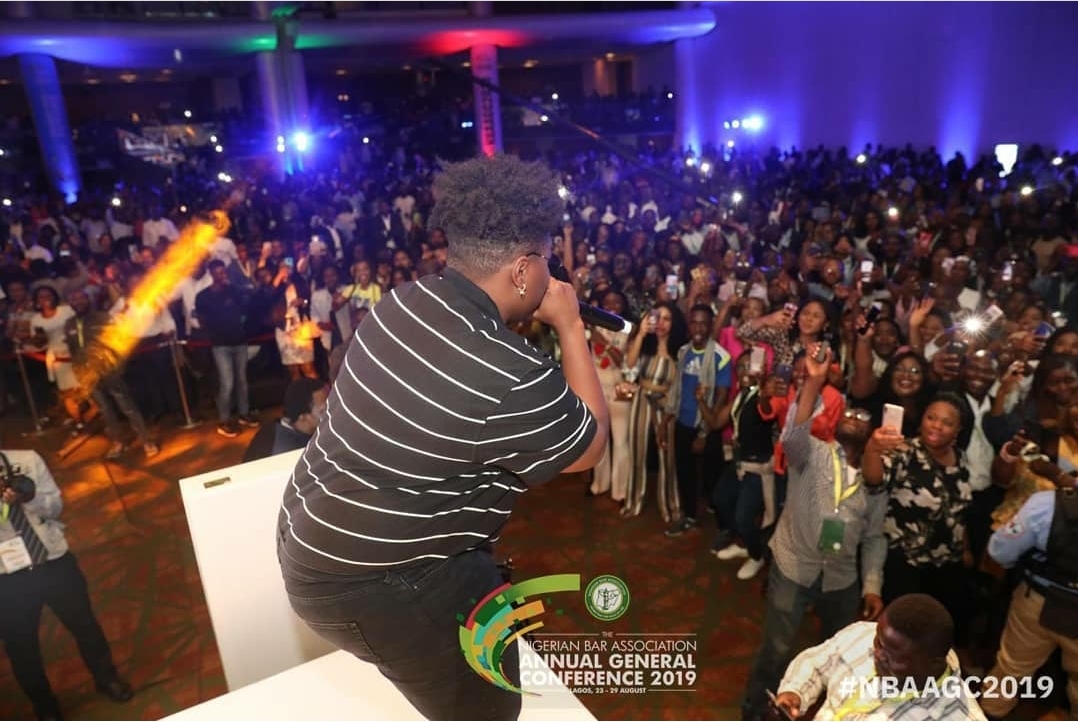
NBAAGC2020: Sights From The NBAAGC 2019

NBAAGC2020: Sights From The NBAAGC 2019

As Lawyers are gearing for
the 60th Annual General Conference of the NBA and the very first
virtual conference, let’s go back memory lane to the 2019 Annual General Conference
which still fills us with excitement from just thinking about it.


The 2019 AGC was one of a
kind and has the NBA President Mr. Paul Usoro SAN promised, it raised the bar
for subsequent conferences. For one it was amazing to have the President of the
International Bar Association, Mr. Horacio Bernardes Neto in attendance.


The AGC featured over 40 amazing
technical and show case sessions and introduced several innovative ideas. The
musical “Fela and The Kalakuta Queens” also had lawyers in awe.

Also the party had
superstars like Teni the Entertainer and Wande Coal thrill the audience. No
doubt the NBAAGC2020 is going to be more amazing and we welcome lawyers to
register via this link www.conference.nigerianbar.org.ng


You can also watch one of the NBAAGC2019 sessions below: 


Dele Adesina Rallied The Bar To Fight Against Principalities – Prof. Ilochi Okafor SAN, FCIArb

Dele Adesina Rallied The Bar To Fight Against Principalities – Prof. Ilochi Okafor SAN, FCIArb

In the hours of our greatest crisis the very dark days following the gruesome murders of our brother sister and child Late B. C. Igwe Chairman NBA Onitsha Branch his pregnant wife our learned colleague and unborn child the NEC under the leadership of Wole and Dele Adesina in great courage rallied the entire Bar in unprecedented unity to fight for redress and support the Igwe family.
The fight was against principalities and powers wickedness and evil in the high places. 
The endowments established have funded the education of the children of our murdered colleagues. We are obliged in all decency to vote for Dele Adesina. Remember the wise saying of the fowl. VOTE DESAN

Prof. Ilochi Okafor SAN, FCI. Arb.

Dele Adesina SAN Condemns Killing Of Haro Gandu and Kidnap Of His Wife And Son

Dele Adesina SAN Condemns Killing Of Haro Gandu and Kidnap Of His Wife And Son

The very sad news of the murder of Haro Gandu was brought to my attention in the early hours of this morning. I learnt that his residence was invaded on Sunday night by persons suspected to be bandits.

These unrepentant men of the underworld shot Haro Gandu to death and abducted his wife and son. This is most tragic and worrisome. While sympathising with the Gandu family over the gruesome murder of our colleague, I call on the State and Federal Governments to step up security and ensure the killers of Haro Gandu are brought to justice. The State and Federal security agencies must collaborate effectively to ensure speedy and safe release of our deceased colleague’s wife and son.

This is another killing and abduction too many. Government must rise up to its responsibility of protecting the lives and security of the citizens. Just about a week ago, I read about the wanton killings in some parts of Kaduna State. These gruesome killings must stop.
We need peace in our land and it is my prayer that peace shall return to every troubled part of our country.

My heartfelt condolences to the Gandu family, his colleagues and friends, NBA Kaduna Branch, Ministry of Justice Kaduna State and the Government and people of Kaduna State over these mindless killings.

Haro Gandu was until his death a Deputy Director in the Kaduna State Ministry of Justice and an elder brother to one of the very vibrant young lawyers and my good friend, Fumen Gandu. May the good Lord bless his soul and grant him eternal rest.

Dele Adesina SAN, FCIArb

Dele Adesina Can Restore The NBA To Its Glory Days| Maurice Oru Ebam Esq

Dele Adesina Can Restore The NBA To Its Glory Days| Maurice Oru Ebam Esq

I know that I know  compared to all other presidential candidates (all due respect to my  seniors) in the forth coming NBA  General Elections DEACON DELE ADESINA (SAN) DASAN is the best candidate based on my persuasion beyond conviction.

We must change our mentality as lawyers and members of the biggest Bar in Africa for over the years the NBA has committed blunders becoming toothless bull dogs.

The NBA must take up its rightful place with boldness, confidence and uprightness.
Deacon Dele Adesina SAN (DASAN) is the only candidate with  antecedents in the Bar that can restore the NBA to its glory days with innovations.

Many lawyers are even unaware that the now celebrated ‘SBL’ of the NBA is the brainchild of Deacon Dele Adesina SAN (DASAN).

Iron sharpens iron for Deacon Dele Adesina SAN (DASAN) conducts helped determine my courage as my association determines my acceleration.

Maurice Oru Ebam Esq
NBA Abuja Unity Bar.

3 Things to Consider When Acquiring Art | Adedunmade Onibokun

3 Things to Consider When Acquiring Art | Adedunmade Onibokun

There are various reasons
why people buy art, it could be for investment, for some because they are
collectors, while for others because they are art enthusiasts and sometimes
even for emotional reasons, for instance when the buyer is drawn to what is
depicted by the artist on canvass.  Some
of the most expensive paintings ever sold include Leonardo da Vinci’s Salvator
Mundi, which sold for $450.3 million at Christie’s on November 15, 2017, and Pablo
Picasso, Les Femmes d’Alger (“Version O”), which sold for $179.4 million also
at Christie’s on May 11, 2015[i].

With the price for some paintings
running into millions of naira or even dollars, one can deduce that buying art
is serious business and with such investments going into paintings, it is
important for patrons and those who seek to acquire art to note the following 3
legal points;
1.     
Due
Diligence
When buying art, due diligence
should be the watch word of every patron, for instance, due diligence helps to
ensure that you are buying from the right person and that the painting is
authentic. This would include tracing the provenance as far back as one can. Due
diligence will also ensure that the documentation for the paintings are not
falsified and that the paintings are not stolen or even war artifacts. A
classic example are the Benin Bronzes, some of Africa’s greatest treasures, which
were looted decades ago.
Some paintings could also
have been stolen from museums or collectors in various parts of the world and
depending on the position of the law and facts in any legal jurisdiction in
question, a purchaser of such art may lose the title to the painting or even be
prosecuted for obtaining stolen property. Due diligence can also help determine
if the painting is fake.
2.      Title
The second thing buyers of
art should consider is Title. i.e. does the seller or the seller’s principal
have the right to sell the item. A classic example is when the art work belongs
to the family but an unscrupulous member of that family goes ahead to sell the
item without the consent of other members of the family. Also, the title to the
property may be vested in some other party like a museum or the item may even
be the subject of several encumbrances. It is important to note that possession
does not necessary mean ownership. For instance, the fact that the painting is
in my possession does not necessarily make me the owner of the item.
3.      Have a written contract
Executing a contract of sale
is also important when acquiring art. Having such a contract helps the buyer
secure a reasonable amount of confidence in the sale. For instance, such
contract may provide that the buyer will be indemnified in the case a 3rd
party comes with valid title to the painting or if the art is discovered to be
different from what was represented at the point of sale. Such contracts may
also include a confidentiality if parties decide that certain parts of the
agreement remain confidential e.g. the price or even their names. A contract of
sale may also help show proof of provenance upon resale by the collector.
Finally, it is important for
art buyers to use the services of professionals when acquiring art so as to
prevent any losses that may arise from a bad sale. There are however times when
a party may not have the time to carry out detailed due diligence or even have
the time to inspect the title of the seller, for instance when the buyer is an
art fair for instance. It is however important that buyer takes reasonable steps
to ensure the authenticity and title of the item.   

Adedunmade
Onibokun

Adedunmade
is the Team Lead at Adedunmade Onibokun & Co. and practices in Lagos,
Nigeria. He may be reached via email on Dunmadeo@yahoo.com


[i]
Invaluable . (2019). 31 of the Most Expensive Paintings Ever Sold at
Auction.
 Available:
https://www.invaluable.com/blog/most-expensive-painting/. Last accessed 27th
July, 2020 .

Do Not Sell Your Votes For A Plate Of Porridge Like Esau Did | Seye Thompson

Do Not Sell Your Votes For A Plate Of Porridge Like Esau Did | Seye Thompson

‘I don’t believe in superstars
Organic food and foreign cars
I don’t believe the price of gold
The certainty of growing old
That right is right and left is wrong
That north and south can’t get along
That east is east and west is west
And being first is always best’

Do you know this song? Don Williams sang it years ago and for me, the song makes me look inwards when making decisions

Look at the reality of things. Can your candidate actually do all these things he has promised to do if elected? Does he even have the history of defending lawyers in the face of harassment? Amaka, think very well.

For my colleagues at Ilorin, Ikire, Abakaliki, Jalingo, etc (once you ain’t in Lagos or Abuja, you fall in this category. Don’t argue), how would your candidate help your legal practice with his policies?? You are jumping up and shouting for a candidate with jumbo sized multinational deals in his pocket and who probably you heard for the first time because of the elections yet you seem to have forgotten that your address on ‘no case submission’ is due by Monday. No be everybody dey do oil and gas or commercial transaction o. Think o.

Your candidate has laid claims to playing active roles in the NBA-SBL. Is it the NBA-SBL that requires annual subscription for membership and subscriptions for committee memberships? Is the NBA-SBL that you ain’t a member of? How is this different from the free seminars we see in the papers but which require registration fees? Idowu, why are you doing like this now? Be careful when a barefooted man offers u shoes.

Can your elitist client really identify with you? Yes, you. Are you not the one who struggles from Ikorodu to Igbosere everyday? Yes, your candidate pays juniors very well but then how is that commensurate with the rigours of waking up 4am everyday just for you to make it to work by 8am. Remember, all that glitters is not gold.

That your candidate has not been endorsed by any group or branch should get you worried. Is he a lone ranger? Is he that bad? My sister, wake up.

Do not sell your votes for a plate of porridge like Esau did. You owe the bar a duty to elect an experienced and cultured  President. You owe the bar a duty to ensure that it maintains its ideals and goals. We need a repositioning and not an overhaul. Nobody is more suited to achieve this than a candidate who has served as General secretary and who understands the terrain. Two years is too short to experiment.

Cast your vote for Dele Adesina SAN and join him in his quest at making our bar successful.

I am Adeboye Oluwaseye Thompson and I write from the Ilorin branch of the NBA

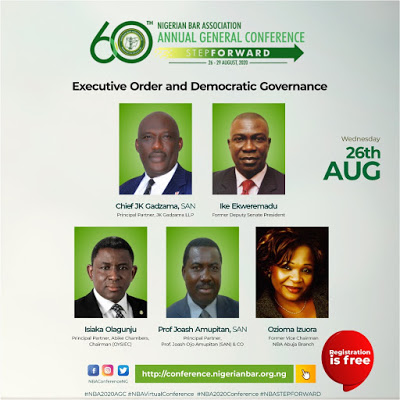
NBAAGC Session on Executive Order And Democratic Governance

NBAAGC Session on Executive Order And Democratic Governance

On May 20, 2020, President Buhari signed Executive Order No. 10 which guaranteed financial autonomy of
state legislature and judiciary. This Order was warmly welcomed by many as the
issue of financial autonomy has hampered the development of both arms of
government within the States.


In addition to this
Order, President Buhari has also signed other Orders including; Executive Order
No.1, on the Promotion of Transparency and Efficiency in the Business
Environment; Executive Order No.2, on the Promotion of local content in public
procurement by the Federal Government;
Executive Order No.3,
for the Timely Submission of annual budgetary estimates by all statutory and
non-statutory agencies, including companies owned by the Federal Government; Executive
Order No.4, on the Voluntary Assets and Income Declaration Scheme (VAIDS), to
increase the level of Tax awareness and compliance, widen the tax net, and
reduce incidence of tax evasion in the country; Executive Order No.5, to
improve local content in public procurement with Science, Engineering and Technology
components; and  Executive Order No.6, on
the Preservation of Suspicious Assets connected with corruption and other
relevant offences. This order sought to fight corruption by curtailing certain
liberties and fundamental rights of Nigerians.

These Executive Orders
however, raise one question, “does it in any way erode on the powers of the
National Assembly to make laws?” or put in another way, “does the Executive
carry exercise law making powers via these Orders?”. Indeed, democracy cannot
flourish in the dearth of clear and precise separation of powers and an
operative system of checks and balances. This topic will be subject to debate
at the upcoming NBA Annual General Conference scheduled to hold in August,
2020, and lawyers are urged to participate actively in the session.
@Legalnaija 


The Need To Understand The Constitutional, Political And Policy Contexts Of Executive Powers

The Need To Understand The Constitutional, Political And Policy Contexts Of Executive Powers

Man’s increasing thirst
for power since the dawn of time is the premise for which Separation of Powers
and a system of Checks and Balances is ingrained in the roots of democratic
governance. If power corrupts, then absolute power corrupts absolutely. According
to Charles de Montesquieu, “
when the legislative and executive powers are
united in the same person, or in the same body of magistrates, there can be no
liberty
”. The essence of Democracy, the Rule of Law and the security of
Human rights is to give man a good life and liberty against arbitrary or
unrestrained exercise of power. If powers are not definitely shared, the path
to tyranny is not far-off.

The concept of
separation of powers stands frontward in the interaction of the three branches
of government; the executive, the legislature, and the judiciary. The Nigerian
constitution captures the doctrine of separation of powers to prevent one arm
of government, specifically the executive, from becoming excessively powerful,
enough to destroy the system. Under the 1999 Constitution of the Federal
Republic of Nigeria, federal legislative power is vested in the National
Assembly, while executive power is vested in the President and the judiciary with
the power to interpret laws, by virtue of Sections 4, 5 and 6 respectively.

In performing his
executive functions, the President may issue orders to agents and agencies of
the executive branch in respect of a project or programme. These orders may set
out government policies, issue directives or command action relating to
functions of the executive arm. An order issued by the President becomes rather
controversial when it purports to make law
(1). There is no express
mention of executive orders in the constitution, howbeit, executive orders are
an offspring of constitutional development, especially, in the history of the
development of presidential power in the United States
 (2). It is usually
following the presidential instinct to ‘execute and maintain’ the provisions of
the constitution
(3).

The President’s power
to issue executive orders raises the problem of lack of clarity in separation
of powers. If executive orders have the force of law, it goes without saying
that Presidents have the power to make laws by issuing executive orders.
However, there is a counterbalance considering that this power is also
controlled and checked by the Judiciary. Executive orders are advantageous
because they are required to fill in the gaps in legislations creating
executive agencies.
A good instance of such
executive order would be Executive Order 5, issued by the President relating
chiefly to promotion of Nigerian content in public procurement of goods and
services. The use of executive orders is also necessary in occasions of
regulatory contradiction and uncertainty in Nigeria
(4).


Like legislative
statutes, executive orders are subject to judicial review and may be overturned
if the order lacks support by statute or the Constitution, if the order demands
an action that will be illegal, or if the order contravenes one or more doctrines
of democracy. A critical case on Presidential executive orders is Attorney General
of Abia State & ORS V. Attorney General of the Federation [2003] 4 NWLR (PT
809)124. In this case, the Supreme Court considered the validity of the
promulgation of the Revenue Allocation (Federal Account, Etc) (Modification)
Order (Statutory Instrument No. 9 of 2002). Belgore, JSC held that the promulgation
order was indeed constitutional and valid seeing as the then President of the
Federal Republic of Nigeria, Chief Olusegun Obasanjo, acted pursuant to Section
315 of the 1999 Constitution. Courts, however, do not readily invalidate
executive orders and the legislature cannot impose a general prohibition on the
use of executive orders, as noted by the Supreme Court in Attorney General of
the Federation v Abubakar [2007] 10 NWLR (Pt 1041)1 (1).

Like drugs, the
authority granted to the President to make an executive order can be misused. Truly,
an executive order issued by the president, with a goal to ‘execute and
maintain’ the terms of the constitution, can engender the adherence to
democratic principles, consequently advancing the practice of democracy. Nonetheless,
if misused, an executive order can set a nation on the path to tyranny.


Since the return to
democracy in 1999, each successive government in Nigeria has signed a number of
executive orders, President Muhammadu Buhari’s government inclusive. Commonly,
the news of the signing of a new executive order is greeted with either public
outcry at worst or with mass apathy at best (5). Some of the orders
issued by President Muhammadu Buhari’s government include:


Executive Order No.1,
on the Promotion of Transparency and Efficiency in the Business Environment. The
mischief of this order is to facilitate the ease of doing business in Nigeria
through the promotion of transparency and efficiency in the business
environment (6).


Executive Order No.2,
on the Promotion of local content in public procurement by the Federal Government.
This order’s mischief is to grant preference to local manufacturers of goods
and service providers in their procurement of goods and services.


Executive Order No.3,
for the Timely Submission of annual budgetary estimates by all statutory and
non-statutory agencies, including companies owned by the Federal Government. This
order addresses the delay in the passage and assent of National Budget
occasioned by the late preparation and transmission of budget estimates by Ministries,
Agencies and Departments (MDAs), with the 2016 and 2017 budgets as befitting
reference points.


Executive Order No.4,
on the Voluntary Assets and Income Declaration Scheme (VAIDS), to increase the
level of Tax awareness and compliance, widen the tax net, and reduce incidence
of tax evasion in the country. Also, to offer amnesty until March 31, 2018 (later
extended to 30 June, 2018) to tax payers (individuals and corporate bodies) who
have defaulted in their obligations in the past.

Executive Order No.5,
to improve local content in public procurement with Science, Engineering and Technology
components. The executive order is expected to promote the application of
science, technology and innovation towards achieving the nation’s development
goals across all sectors of the economy (7).


Executive Order No.6,
on the Preservation of Suspicious Assets connected with corruption and other
relevant offences. This order sought to fight corruption by curtailing certain
liberties and fundamental rights of Nigerians (8).
The order prevents persons guilty of corruption from continuously holding and
controlling asset acquired from proceeds of corruption.


Executive Order No.10,
which merely affirms the financial autonomy already donated to State
Legislature, Judiciary, and by the Constitution, strengthens them as
institutions, and makes them truly independent from the suffocating grip of
State Governors. This ensures transparency, accountability and responsibility
in government; broadens and deepens the democratic space; and signposts the
much-desired restructuring and power devolution (8)


These executive
orders do not escape criticisms. Particularly, President Buhari’s Executive
Order No.6 raised controversies as to its constitutionality and validity seeing
as it invalidates the rights to property guaranteed in Sections 43 and 44 of
the 1999 Nigerian Constitution. According to the President, the order aims to
“restrict dealings in suspicious assets subject to investigation or inquiry
bordering on corruption in order to preserve such assets from dissipation and
to deprive alleged criminals of the proceeds of their illicit activities which
can otherwise be employed to allure, pervert and/or intimidate the
investigative and judicial processes” (9).


Indeed, democracy
cannot flourish in the dearth of clear and precise separation of powers and an
operative system of checks and balances (10).
This is a challenge for the legal profession and the Judiciary to understand
the constitutional, political and policy contexts of the exercise of executive
power in order to prevent the executive arm from exceeding its power limits,
safeguard human rights and liberties, and save the democratic society that is
Nigeria.


Adeniran
Oluwabukunmi.


References

1. Okebukola and Kana. Executive Orders in Nigeria as
Valid Legislative Instruments and Administrative Tools.

2.
Historical Development of Separation of Powers. LawTeacher. 2019.

3.
Sam, Amadi. Executive order 10 of 2020 is dangerous to constitutional democracy.
2020.

4.
—. Executive Order and presidential power in the Nigerian constitutional
democracy. TheGuardian. 2018.

5.
Jonathan, Ekpo. A Critique Of The Companies Income Tax (Road Infrastructure
Development And Refurbishment Investment Tax Credit Scheme) Order 2018.

6.
Ladan, M.T. Presidential Executive Orders 1-6 Of May 2017 to July 2018 as
Enforceable Legislative Instruments In Nigeria [As At July 6, 2018]. 2018.

7.
Law, Bloomfield. Nigeria: President Muhammadu Buhari Signs Executive Order To
Improve Local Contents In Science, Engineering & Technology Procurement.
2018.

8.
Nigeria: Is President Buhari’s Executive Order 10 Constitutional? AllAfrica.
2020.

9.
Dayo, Adu and Ridwan, Oloyede. President of Nigeria Signs Executive Order 6
of 2018 on the Preservation of Assets Connected With Serious Corruption and
Other Relevant Offences. 2018.

10.
Simon, Rogo. Nigeria: Executive Order 10 Will Deepen Democracy. 2020.

 Photo Credit – www.saynigeria.com