
Provisions of the Lagos State Properties Protection Law  2016

Provisions of the Lagos State Properties Protection Law 2016

Though not restricted to
the commercial city of Nigeria, Land grabbing has always been a big issue in Lagos
state. Property investors were not protected under the law and were being taking
advantage of by the popularly called “Omo Onile”, meaning in loose terms “Children
of the land” and their sponsors, or privileged individuals who used force,
threats and sometimes violence to unscrupulously take possession of land or
property belonging to other persons. It is common to see or hear of a crowd of
young men gather at the sites of undergoing private construction demanding for
unaccountable levies and fines. 

To say, these unlawful actions
have plagued the real estate industry in Lagos and other parts of Nigeria, is
to put it mildly. Sometimes, law enforcement agencies are also powerless to aid
or act in certain situations. The property divisions of the law courts are
filled with claims bothering on forceful and unlawful possession of land or
property and have been in court for quite some time. 
Lagosians can however smile
and be relieved, as Governor Ambode on the 15th of August, 2016,
signed into law, the LAW PROHIBITING FORCEFUL ENTRY AND ILLEGAL OCCUPATION OF
LANDED PROPERTIES IN THE LAGOS STATE. This new Law protects the proprietary
rights of Land and Property owners in Lagos State and also criminalizes actions
of forceful and unlawful entry or occupation of premises. 
The law states in Section
2(1), that – 
“ As from the commencement
of the law, no one shall use force or self-help to take over any landed
property or engage in any act inconsistent with the proprietary right of the
owner in the State. 
Furthermore, subsection
2(two) states that persons who have used force to take over the properties of others
and still do so after 3 months from the date of commencement of the law commit
an offence. Anyone who commits such offence is liable to ten (10) years
imprisonment. 
Also, anyone without
lawful authority who applies threats or violence to secure entry into any
landed property for personal use commits an offence. Regardless of if the entry
is lawful, it does not give a right to use threats or violence and anyone who
commits the offence shall be liable to 10 (ten) years imprisonment.
Furthermore, by virtue of
section 3(4), anyone who uses fire arms or offensive weapons or is in any way
armed or wounds anyone while committing the act of forced entry is liable to 4(four)
years imprisonment. 
Persons in illegal
occupation of premises who also fail to leave the property commit an offence
and are liable to a fine of N5,000,000
(Five Million Naira) and/or up to five (5) years imprisonment. By virtue of
Section 7, any encroacher who keeps fire arms or dangerous/offensive weapons on
the premises shall be liable to 10 (ten) years imprisonment. 
Any encroacher who tries
to sell the property knowing he has no lawful authority to do so commits a
crime and is liable to a fine of N500,000
(Five Hundred Thousand Naira) and/or Six (6) months imprisonment. If the person
is successful in selling the property, he shall be liable to a fine not
exceeding 100% the value of the property and/or 5(five)years imprisonment as
provided in section 8. 
It was always common for
purported family agents to unlawfully sell family property without the consent
of the head of the family. However, by virtue of the law, anyone who sells
family property without the authority of the family head or sells government
land without the authority of the relevant government authority shall be liable
to 21 (Twenty – One) years imprisonment. 
Due to the fact that many
property/estate agents and sometimes, lawyers, have been known to aid the sale
and unlawful encroachment of private property. Section 9, prohibits
professionals from aiding in conduct that constitute an offence under the law
and such professionals shall be reported to the relevant bodies for misconduct
and appropriate actions. 
A popular provision of the
Law is the section that prohibits that harassment of property owners by the omo
onile groups and other hoodlums. Section 10, states that persons who act as
agents and demand a fee in regard to construction on properties shall be
committing an offence and liable to a fine of 1(One) million naira and/or 2 (two)
years imprisonment. 
The Law also establishes a
task force to enforce the law and grants jurisdiction to the Special Offences
Court and other courts. 
In other to prevent
private persons from taking laws into their hands, no law enforcement agent,
vigilante group, ethnic, cultural or traditional militia shall have the right
to enforce the law except in terms with the Sheriffs and Civil Process Act.   
The enactment of this law
brings succor to all lawful property owners in Lagos State and is highly
welcome.
Dunmade Onibokun

Principal Partner
Adedunmade Onibokun &
Co.
+2349095635314
Dunmade’s legal practice
focuses on corporate and commercial law, regulatory compliance, due diligence,
corporate advice and commercial transactions. 
He is the Principal partner of Adedunmade Onibokun & Co. a law firm
based in Lagos, Nigeria. Dunmade is also a blogger and publishes the Legalnaija
Blawg via www.legalnaija.com

Photo credit – www.Nigerianelitesforum.com

RBN Bloggers – How to draft an Affidavit though you aren’t a lawyer

RBN Bloggers – How to draft an Affidavit though you aren’t a lawyer


Many people don’t like
lawyers simply because it appears they argue too much, others don’t like them
because they have encountered the ones who charge a lot. A client once told me
“I swallowed all the Paracetamol I could find when I saw your bill.”
All I could do was laugh. Knowing what I had charged, I knew I had undercharged
him just because I wanted him to retain my services and there he was still
insinuating I had overcharged. Like him, many people have the fear that lawyers
overcharge even when they don’t. And yet it’s not so easy to get by without a
lawyer on your side because there will always be a need for one.

However, there are a few
things you might be able to do on your own (if you are smart) that ordinarily
ought to be done by a lawyer. One of them is drafting an affidavit and getting
a police report for your missing or stolen item.
Just Before I tell you how
to go about it, first let me give you a layman definition of an affidavit.
An affidavit is simply a
document of facts made under oath. It is meant to stand as  your court
approved oral evidence. So while making an affidavit you are only expected to
state facts that you know to be true. Usually you don’t have to say what others
told you, just state what you know, so let’s assume you have just misplaced
your latest phone or your purse which had your ID card, ATM card and other
documents, and you rushed to the nearest police station to lay a complaint and
the police officer has asked you to bring an affidavit, here is what you should
do:
1.    
Find Out Which Court Is Nearest To
You:

All affidavits for stolen or missing items ought to be done at the court
nearest to where the incident happened. In law it is called jurisdiction I.e.
The court must have power over the matter brought before it. For instance, if
your phone was stolen in Ikeja Lagos state, the appropriate police station will
be Area F while the appropriate court to stamp your affidavit will be at the
Ikeja High Court or Ikeja Magistrate Court. You are not expected to go outside
the court nearest to you. (Or rather the court within your jurisdiction)
2.    
Get A Laptop:
Sit in front of a laptop and open Microsoft Word or any other word processor.
3.    
Type The Heading:
your heading should be in three lines and in the name of the court you will be
going. Here is how affidavits are headed:

First line:                  
                     
          In the Lagos High Court

Second line:                  
                     
   In The Ikeja Judicial Division

Third Line:                  
                     
                Holden At
Ikeja

Make sure the heading is bold, centralised and underlined.

4.    
The Subheading:
The subheading is a one line heading which states the purpose of the affidavit.
Examples are Affidavit of Loss of Original Certificate , Affidavit
of Loss of Phone
etc.

The sub-heading should be directly above the main content of the affidavit and
should also be bold, centralised and underlined.
5.    
The Introduction:
The introduction is where you tell the reader about yourself. It usually
contains basic (but static) details about yourself and here is the format.

I, John Doe, a Christian, male, Adult,
Doctor of No. 19 rbnbloggers street, Ikeja, Lagos, do make oath and state as
follows
:
The introduction should
contain all those facts so that anyone reading knows a little about you.
6.    
Statements of Facts: This is where you
start saying all the things that led to your making the affidavit. It should be
in sequential order and should be in numbered paragraphs starting from
“1.” Each paragraph should carry a single idea and you can have as
many paragraphs as you want but only necessary facts are needed. You should
begin each paragraph with “that”. See example below:
7.                                        
  1.
That on the 15th August 2016 I embarked on a journey to work on a BRT bus at
Ojota Bus Park
2.
That while on the journey, I had in my possession my brand new iPhone Six which
had my 080644456d Mtn sim card installed in it.
3.
That around 2 O’clock in the afternoon, two men carrying firearms approached me
along with other passengers on the bus and demanded our personal belongings.
4.
That my iPhone along with several sums of money amounting to Eight Hundred
Naira was obtained from me.
5.
That since then, I have no knowledge of the whereabout of neither the phone nor
the MTN sim card.
6.
The last Paragraph: The last paragraph comes after you have stated all the
facts and you feel its time to close the affidavit. The paragraph is simply a
static line that affirms your sincerity. This is how it is drafted:
7.
That I make this affidavit in good faith conscientiously believing same to be
true and in accordance with the oath Law of Lagos State.
8.    
The
signature:

After the paragraph above, it’s time to indicate where you will append your
signature. This should be on the right-hand side below the statements. Draw a
line that is big enough to contain your signature and under the line type the
word: Deponent. Do not sign the signature after you print it. You are
meant to sign it at the registry in the presence of the commissioner for oaths.
9.    
State
The Registry:

the next thing to do is to go down one step below and type the following words
on the extreme left-hand side of the document in this exact manner:

SWORN TO on this …….day of ……., 20….
at
the Ikeja High Court Registry.
10.                       
The
Commissioner for oaths:

Now its time to draft the commissioner for oaths section. You should go down
now and type the following in capital letters:        
                     
                     
              BEFORE ME:

Leave some space for signature and draw a line for the signature. Under the
line type the following words in capital letters:

—————————————————-

       COMMISSIONER FOR OATHS.

11. Print Out: Before you hit the print button,
go over your draft again and make sure you have eliminated all typographical
and spelling errors. Make sure you have also edited the draft to look like it
was done by a professional lawyer. Once you are satisfied, print out three
copies and run to the court, and ask for the court registry.
You will be asked to pay a
token amount which is not up to N500 (as at the time of publishing this post.)
12.   The last step: After you have paid, a
receipt will be issued to you and you will be asked to see the Commissioner for
Oaths. He or she will ask you to sign the documents. Append your signature at
the deponent’s space, then he/she will fill in the date and stamp the documents
and hand them back to you.
Disclaimer:
The opinions expressed in this article should not be taken as a substitute
for legal advice. For all questions and suggestions relating to Law you can
chat with us on our Whatsapp line: 09054551883
or send us an email at law@rbnbloggers.net
Ed’s Note – This article was originally
posted here.
Ivie Omoregie: So You Want to Stand As a Guarantor For LeBoo?

Ivie Omoregie: So You Want to Stand As a Guarantor For LeBoo?


Just
the other morning a friend of mine called messsscccrreeeaammmiinnggg;
she said a certain Nigerian bank had deducted N7m from her account. It was a
Saturday morning, so there was no way to contact the bank to ask them for the
exact details of the transaction. She said her account manager’s number was not
going through and that when she checked online she could not see specific
details for the deduction…just a series of transaction codes.

After
calming her down, I asked her to be patient and wait till Monday to get
clarifications. There was actually nothing that could be done before then, so
she had no choice but to relax and sleep. (I can just visualise her in church
the following morning…hehe)
When
she called the bank on Monday, she was given the biggest reality check of her
entire life. Apparently 2 years prior this time, her ex-fiancé had wanted to
expand his business and needed a loan from the bank. He didn’t have any assets
to secure the loan, and had asked her to stand as his guarantor. She has a
flourishing interior design business, and also receives a considerable amount
as rental income from property she inherited from her grandfather. Her boo was
her world and they were about to be married and start a life together. She was
doing well, so accepted to be his guarantor. In all honestly I think she
desperately wanted to personify the perfect “wifey” and so couldn’t say no.
He
kept on stressing that it was just a hypothetical situation and that the
chances of him defaulting were slim. She told herself she knew him inside out
and would be able to police his obligations under the loan agreement. The way
she saw it “at least he wasn’t being a waste man with no ambition. He had big
dreams of growing his business and was not asking her to ‘lend’ him money”.
As
you can imagine, when the relationship scattered because his ex-girlfriend had
just given birth to his first child, “policing his loan obligations” were not
at the forefront of her mind. In all honesty, she had completely and utterly
forgotten about that random document she signed over 2 years ago.

The question now was…how does she get her money back?
Let’s start with the Guarantee Agreement
A Guarantee Agreement is defined as a written undertaking made by one party
(the “Guarantor”)
to a second party (usually the “Creditor”),
consenting to be responsible if a third party (usually the “Principal Debtor”)
fails to perform a certain duty, i.e. payment of a debt.
Halsbury’s
Laws of England defines a Guarantee Agreement to mean an accessory contract by
which the Guarantor undertakes to be answerable to the Creditor for the debt,
default or miscarriage of a Principal Debtor; the primary liability to the
third party must exist or be contemplated before the creation of the Guarantee
Agreement.
I
must stress that in considering the adequacy of a Guarantee Agreement, what is
of importance is the financial position of the Guarantor and not the financial
inadequacy of the Principal Debtor.
The Creditor
This
is the person to whom obligations of the Principal Debtor and the Guarantor are
owed. In the event that the Principal Debtor defaults on his/her obligation to
pay the principal loan, then the Creditor may recover the amount outstanding
from the Guarantor.
The Principal Debtor
This
is the person primarily liable to the Creditor for the obligation guaranteed.
The Principal Debtor is not a party to the Guarantor’s contract with the
Creditor, even though the Guarantor’s contract stems from the dealings of the
Principal Debtor. Thus we often see instances where the Creditor has deemed the
Principal Debtor as incapable of settling the debt and thus focuses all efforts
on retrieving the outstanding monies owed, plus interest, from the Guarantor
(i.e. they no longer bother with the Principal Debtor and “hound” only the
Guarantor).
The Liability of the Guarantor
The
Guarantor’s liability is a secondary obligation that is only triggered upon
default by the Principal Debtor. A Guarantor cannot be held liable for more
than he/she has undertaken to guarantee; in addition, the liability of a
Guarantor cannot exceed that which is owed by the Principal Debtor.
The Guarantor’s Rights on Demand for Payment
The
manner in which the Creditor is able to make a demand against the Guarantee
Agreement is usually dependant on the terms of that agreement as well as the
terms of the agreement between the Principal Debtor and the Creditor.
Generally, the Creditor is only required to issue a demand notice to the
Guarantor upon a default by the Principal Debtor, the Creditor may thereafter
commence legal action for recovery if the Guarantor does not comply with the
terms of the demand notice.
Unless
the Guarantee Agreement itself provides otherwise, generally:
• There must be a clear case of default on the part of the Principal Debtor
before the Creditor can pursue the Guarantor;
• All remedy periods relating to the event of default should have expired with
the default in question not having been remedied;
• The Creditor must not have impliedly or expressly waived the default in
question.
However,
I must stress that the terms of individual Guarantee Agreements are governed on
a case by case basis; we are now seeing instances where as a prerequisite,
Creditors are demanding that the Guarantor issues blank cheques, said cheques
to be presented by the Creditor at the point of default by the Principal Debtor,
without the obligation requiring the Creditor to give the Guarantor prior
notice.
The Guarantor’s Rights After the Settlement of Debt
A
Guarantor has a right to the recovery of money improperly paid to a Creditor,
this would entail money which could have been paid under a mistake of fact as
to the Principal Debtor’s obligations.
The
Guarantor may also be indemnified by the Principal Debtor for the total amount
paid in settlement of the debt, plus interest. However, in reality a Principal
Debtor who was unable to repay its Creditor is unlikely to be able to repay the
Guarantor.
Determination of a Guarantee
I
must stress that unless the agreement to which the Guarantee was given had been
terminated in accordance with the terms of that agreement, whilst the Creditor
is being owed an obligation by the Principal Debtor, the Guarantors obligation
to the Creditor will continue to subsist.
Furthermore,
unless the Guarantee Agreement provides to the contrary, the Guarantee will be
determined if the Principal Debtors obligation is changed without the
Guarantor’s consent.
Conclusion
My friend was able to confirm that the reason why the bank was able to simply
deduct the money from her account was because she had issued an undated cheque
at the time of signing her Guarantee Agreement. It was simply filled in
and presented as final settlement for the debt.
Luckily
for my friend, under the terms of her agreement, the bank was supposed to give
her several demand notices at the point of default to enable her mitigate the situation
with hopes of getting the Principal Debtor to pay the debt being owed to the
Creditor.
The
bank had failed to do this, thus were forced (after stern warnings from my
friend’s lawyer, who happens to be a no-nonsense highly rated Senior Advocate
of Nigeria and who also happens to be my friend’s father) to reverse the
transaction and follow due process.
The
concept of guarantor is something which is now a part and parcel of modern day
banking, yet what intrigues me is the fact that many people do not seem to
appreciate the full implication of standing as someone’s guarantor. Maybe this
stems from the fact that it is to a large extent a worst case scenario.
Ivie Omoregie 

Ivie is a commercial lawyer,
with experience and keen interest in projects and transactions work within the
Sub Saharan African region. She is called to practice in England and Wales and
Nigeria. Her core practice areas: include – all aspects Corporate Commercial;
Corporate Governance, Risk and Compliance; Financial services and Banking;
Infrastructure and Projects; Venture Capital, Private Equity and Alternative
Investment (including Fund Formation and Administration) ; Public Procurement;
Natural Resources; Telecoms, Technology and Media; Agribusiness; Manufacturing
and Construction.

Ed’ s Note – This article was
originally published here
Busayo Adedeji – A Review of the Cybercrimes Act

Busayo Adedeji – A Review of the Cybercrimes Act


·        
Introduction
The
cybercrime act was signed into law on the 15th of May, by President
Goodluck Jonathan before leaving office. 
The objectives of the act are to provide an effective and unified legal
regulatory and institutional framework for the prohibition, prevention,
detection, prosecution and punishment of cybercrime in Nigeria; ensure the
protection of critical national information infrastructure and promote cyber
security and computer systems and networks electronic communications, data and
computer programs intellectual property and privacy rights.

Some salient provisions of
the act include:
·       Designation of certain computer
systems or networks’ as Critical National Information Infrastructure.
The act provides that “The President may on the recommendation of
the National Security Adviser, by Order published in the Federal Gazette,
designate certain computer systems, and/or networks, whether physical or
virtual, and/or the computer programs, computer data and/or traffic data vital
to this country that the incapacity or destruction of or interference with such
system and assets would have a debilitating impact on security, national or
economic security, national public health and safety, or any combination of those
matters as constituting Critical National Information Infrastructure.”[i]
Further
to the above power vested in the president, he may make orders for the
preservation, storage etc of the critical national information infrastructure and
offenses against infrastructure are punishable by imprisonment for as long as
10 to 15 years.
·        
Registration of Cybercafés
The
act provides that from the commencement of the act all operators of cybercafé
shall register as a business concern with Computer Professionals’ Registration
Council in addition to a business name registration with the Corporate Affairs
Commission. Cybercafés shall maintain a register of users through a sign-in
register. This register shall be available to law enforcement personnel
whenever needed.[ii]
The
act does not however prescribe any penalty for cybercafé operators that do not
comply with the above provision. It however prescribes an imprisonment of 3
years or fine of one million naira (or both) for any person who perpetrates
electronic fraud or online fraud in cybercafé. 
In the event of proven connivance on the part of the owners of the cybercafés,
such owners shall be liable to imprisonment for 3 years or a fine of 2 million
naira. The burden of proving such connivance shall be on the prosecutor.
·        
Intercepting electronic messages,
emails and electronic money transfers
The
act provides that any person who unlawfully destroys or aborts any electronic
mails or processes through which money and or valuable information is being
conveyed is guilty of an offence and is liable to imprisonment for 7 years in
the first instance and upon second conviction shall be liable to 14 years’
imprisonment.[iii]
  • Computer
    Related Forgery
A person
who knowingly accesses any computer or network and inputs, alters,
deletes
or suppresses any data resulting in inauthentic data with the intention that
such inauthentic data will be considered or acted upon as if it were authentic
or genuine, regardless of whether or not such data is directly readable or
intelligible, commits an offence and is liable on conviction to imprisonment
for a term of not less than 3 years or to a fine of not less than 7,000,000.00
or both.[iv]
  • Electronic
    Signatures
The act provides that electronic
signature in respect of purchases of goods, and any other   
transactions
shall be binding. Whenever the authenticity or otherwise of such signatures is
in question, the burden of proof, that the signature does not belong to the
purported originator of such electronic signatures shall be on the contender.
Any person who with the intent to defraud and or misrepresent, forges through
electronic devices another person’s signature or company mandate commits an
offence and shall be liable on conviction to imprisonment for a term of not
more than 7 years or a fine of not more than N10,000,000.00 or to both
fine and imprisonment.
The
following contractual transactions or declarations are however excluded and may
not be by electronic signature[v]:
  • Creation
    and execution of wills, codicils and or other testamentary documents;
  • Death
    certificate;
  • Birth
    certificate;
  • Matters
    of family law such as marriage, divorce, adoption and other related issues;
  • Isuance
    of court orders, notices, official court documents such as affidavit,
    pleadings, motions and other related judicial documents and instruments;
  • Any
    cancellation or termination of utility services;
  • Any
    instrument required to accompany any transportation or handling of dangerous
    materials either solid or liquid in nature; and
  • Any
    document ordering withdrawal of drugs, chemicals and any other material either
    on the ground that such items are fake, dangerous to the people or the
    environment or expired by any authority empowered to issue orders for
    withdrawal of such items.
·        
Cyber Terrorism
Any person that accesses or causes to be accessed any
computer or computer system or network for purposes of terrorism, commits an
offence and is liable on conviction to life imprisonment.
The act
further stipulates that for the purpose of the provision as stated above,
“terrorism” shall have the same meaning under the Terrorism (Prevention) Act,
2011, as amended.
·        
Identity
theft and impersonation
The act provides that any person who is engaged in the
services of any financial institution, and as a result of his special knowledge
commits identity theft of its employer, staff, service providers and
consultants with the intent to defraud is guilty of an offence and upon
conviction shall be sentenced to 7 years imprisonment or N5, 000,000.00
fine or both.
The
act further provides that any person who fraudulently or dishonestly makes use
of the electronic signature, password or any other unique identification
feature of any other person; fraudulently impersonates another entity or
person, living or dead, with intent to –
(a) gain advantage for himself or another
person;
(b)  obtain any property or an interest in
any property;
(c)  
cause
disadvantage to the entity or person being impersonated or another person; or
avoid arrest or prosecution or to obstruct, pervert or defeat the course of
justice commits an offence and shall be liable on conviction to imprisonment
for a term of not more than 5 years or a fine of not more than N7,
000,000.00 or to both such fine and imprisonment.
·        
Manipulation of ATM/POS terminals
Any person who manipulates an ATM machine or Point of
Sales terminals with the intention to defraud shall be guilty of an offence and
upon conviction sentenced to Five Years imprisonment or N5, 000,000.00
fine or both. Furthermore any employee of a financial institution found to have
connived with another person or group of persons to perpetrate fraud using an
ATM of Point of sales device, shall be guilty of an offence and upon conviction
sentenced to Seven Years imprisonment without an option of fine.[vi]
·    
Electronic card related fraud
For card related offenses the act stipulates a jail term
of up 5 years and a fine of up to 7 million for offenses ranging from purchase
or sale of card of another, dealing in cards etc. In the case of financial
institutions, there is a fine of 10 million for any in institution that makes
available, lends, donates, or sells any list or portion of a list of
cardholders and their addresses and account numbers to any person without the
prior written permission of the cardholder(s).[vii]
·        
Duty of financial institutions
Financial
institutions are required to verify the identity of their customers; as such
they are to request documents that bare their names, address and other relevant
information before issuance of ATM cards, credit cards, debit cards and other
related electronic devices. They are to apply the principle of know your
customer in documentation of customers preceding execution of customers
electronic transfer, payment, debit and issuance orders.
Any official or organization, who fails to obtain proper
identity of customers before executing customer electronic instructions in
whatever way, commits an offence and shall be liable on conviction to a fine of
N5, 000,000.00. It further provides that any financial institution that
makes an unauthorized debit on a customer’s account shall upon written
notification by the customer, provide clear legal authorization for such debit
to the customer or reverse such debit within 72 hours. Any financial
institution that fails to reverse such debit within 72 hours shall be guilty of
an offence and liable on conviction to restitution of the debit and a fine of N
5, 000,000.00.
·        
Administration and Enforcement
The
office of the National Security Adviser shall be the coordinating body for
all
security
and enforcement agencies under this Act and shall provide support to all
relevant security, intelligence, law enforcement agencies and military
services to prevent and combat cybercrimes in Nigeria
·        
Arrest, search, seizure and
prosecution
The
act provides that a law enforcement officer may apply ex-parte to a
Judge in chambers for the issuance of a warrant for the purpose of obtaining
electronic evidence in related crime investigation. The judge in turn may issue
a warrant authorizing a law enforcement officer to enter and search any
premises or place if within those premises, place or conveyance –
(i)  an offence under the act is being
committed; or
(ii)  there is evidence of the commission of
an offence under the act; or
(iii)  there is an urgent need to prevent the
commission of an offence under the act.
The
judge may also make orders relating to search of persons, computer systems or
networks, vehicles etc.[viii]
·        
Jurisdiction
The federal High Court in any location
in Nigeria, regardless of where the offence is committed has exclusive
jurisdiction to try offenses committed under the act.
·        
Conclusion
Overall, the Cybercrime Act (2015) is
a boost for the Nigerian legal system as offences that are captured in the act
were in hitherto not provided for in any of our laws. This new act is in my
opinion a welcome development as it attempts to safe guard national security,
corporations and individuals alike.

Busayo Adedeji


Busayo advises clients on
corporate immigration issues, advising clients on employment and labour law
issues, ensuring that clients are in line with regulatory compliance rules,
civil litigation etc


Twitter:
@thestreetloya


[i]
Section 3(1) Cybercrime Act
[ii]
Section 7(1) Cybercrime Act
[iii]Section
9 Cybercrime Act

[iv]
Section 13 Cybercrime Act

[v]
Section 17(2) Cybercrime Act
[vi]
Section 30 Cybercrime Act
[vii]
Section 33, 34 & 35
[viii]
Section 45
Penalty for Cyberstalking in Nigeria

Penalty for Cyberstalking in Nigeria


The Cybercrimes (Prohibition,
Prevention, Etc) Act, 2015 provides for an effective, unified and comprehensive
legal, regulatory and institutional framework for the prohibition, prevention,
detection, prosecution and punishment of cybercrimes in Nigeria. The act also
ensures the protection of critical national information infrastructure, and
promotes cybersecurity and the protection of computer systems and networks,
electronic communications, data and computer programs, intellectual property and
privacy rights.

As Nigeria’s online community
grows daily with the springing of thousands of blogs every week, the
Cybercrimes Act is a piece of legislation that should get the attention of
bloggers and online information marketers. One of the offences prohibited under
the Act is “Cyberstalking” which can be found under Section 24 of the Act. It
provides that –
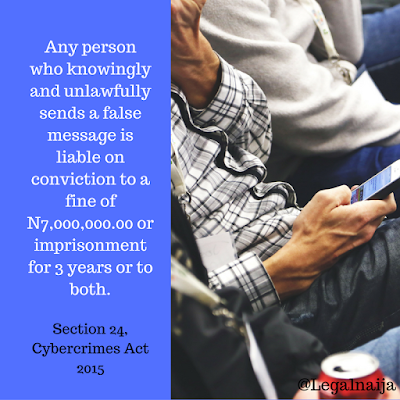
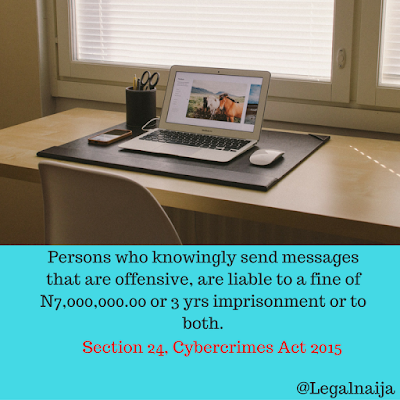
(1)Any person who knowingly or
intentionally sends a message or other matter by means of computer systems or
network that -­
(a)      
is grossly offensive,
pornographic or of an indecent, obscene or menacing character or causes any
such message or matter to be so sent; or
(b)      
he knows to be false, for the
purpose of causing annoyance, inconvenience danger, obstruction, insult, injury,
criminal intimidation, enmity, hatred, ill will or needless anxiety to another
or causes such a message to be sent commits an offence under this Act and shall
be liable on conviction to a fine of not more than N7,000,000.00 or imprisonment for a term of not more than 3 years
or to both such fine and imprisonment.
By virtue of the above
provisions, it seems a number of people are guilty of this offence. Many
bloggers and online users are guilty of sending messages and articles over the
internet which can be considered to come under the purview of Section 24(1). 
The act
further states in Subsection 2 that –
Any person who intentionally
transmits any communication through a computer system to bully, threaten or
harass another person, where such communication places another person in fear
of death, violence or bodily harm or to another person; commits an offence
under the Act and shall be liable on conviction to a term of 10 years and/or a
minimum fine of N25,000,000.00.
The
penalty mentioned above also goes to persons found liable of transmitting
communications which – contain any threat
to kidnap any person or any threat to harm another person, any demand or
request for a ransom for the release of any kidnapped person, to extort from
any person, firm, association or corporation, any money or other thing of
value;
Furthermore,
if the transmission contains any threat to harm the property or reputation of another
or the reputation of a deceased person or any threat to accuse another person
of a crime, or to extort from any person, firm, association, or corporation,
any money or other thing of value: such person commits an offence and shall be
liable on conviction to imprisonment for a term of 5 years and/or a minimum fine
of N15,000,000.00.
It should be noted that the
courts have the power to make an order protecting the victim of a Cyberstalker and
the Act empowers all law enforcement, security and intelligence agencies to
develop requisite institutional capacity for the effective implementation of
the provisions of the Cybercrimes Act. 
It is important that every
active online user is familiar with the provisions of the Cybercrimes Act to
ensure they do not run fowl of its provisions. 
Dunmade Onibokun 
Principal Partner 
Adedunmade Onibokun & Co. 
www.adedunmadeonibokun.com  
2348055424566
dunmadeo@yahoo.com
Abimbola Balogun – Position Of Commissioned Photographers under The Nigerian Copyright Law

Abimbola Balogun – Position Of Commissioned Photographers under The Nigerian Copyright Law


So I somehow walked into
an argument with a friend of mine the other day of which the true and current
position on the topic has been on my mind for a few days now. I really Don’t
remember how that happened but the issue sent me into a frenzy as I really hate
to loose arguments. Here is how I got myself into the argument.  So I just
finally got my wedding album from my fantastic photographer and I was really
impressed with the turnout as I was frankly scared that it would not look as
dreamy as I had pictured in my mind (brides and their outlandish fantasy ideas
right) so I didn’t waste any time to whip out my new priced possession albums
for my guests to view on one fine Thursday evening. 

To my greatest pleasure,
my guests were as impressed as I was when I first saw the albums. As they
flipped through the pages of the albums many different topics ensued from each
picture. From how hilarious a particular picture turned out; to how the
photographer’s skills were beautifully displayed when she captured “emotions”.
All small talk was warm and very welcome to massage my growing ego until one of
my guests said and I quote “do you know that the photographer owns the
copyright on your pictures?” basically she could do what she pleases with my
pictures. I thought that idea was ridiculous and I did not hesitate to mouth
out that fact. I knew that we had moved from small talk to big business. The
room was instantly heated up in arguments and legal talk on what does or should
apply. I against guest and my husband trying to be diplomatic by trying to see
the sense in both views. Of course myself and guests did not budge on our own
lawyerly opinions on the issue.
 My Guest opined that
when a photographer takes shots, he/she as the author of that image has the
copyright on the pictures over and above any other. This is regardless of if
the pictures have been paid for. I thought this idea was weird and ridiculous.
How can I pay for someone to do a job and the person still can hold on to
rights of my own personal images that I paid to be taken?
 The night ended
quite pleasantly; warm hugs and kisses goodnight, but silently I knew this
argument was definitely not over.
I tried to forget about
the argument for a couple of days, but as I said I really hate to loose
arguments. So I went on my own literal photobomb expedition.
While on my research I
stumbled on the American copyright article which agreed 100% with my guest’s
position[1]. The author states that Under U.S. copyright law, the original
owner of a created work is exclusively the creator, unless it’s a ‘work for
hire’. The author therein stated that in the wedding scenario, a photographer
is hardly ever ‘for hire,’ Even though married couples spend thousands for a
photographer to cast their most memorable moments in just the right light, they
may never actually own the results and also, the fact that the photographer
hands you a cd, hard copy, or soft copy of pictures taken of you does not mean
he has handed you the rights to those pictures. Hmmm interesting I thought to
myself, but still confused; plus, that one is the Americana situation; so back
to Nigerian scenario to find something that makes more legal sense to me or at
least someone or something that could explain this crazy phenomenon to me.
It also occurred to me
that I have come across this topic a number of times in the past but I lazily
brushed aside the thought of researching the crux of the matter. For instance,
the 2face and Annie Idibia suit of 2013, where the an un-commissioned and
uninvited photographer took wedding photos of 2face and his bride[2]. Secondly;
a client of mine who also happens to be in the entertainment industry had
complained to me about his photographer who had uploaded pictures recently
taken on social media as publicity for his photography career. This was done
without any recourse to my client and even before he had seen the said
pictures. And oh thirdly, back to my wedding album, one of my photographer’s
crew members had uploaded some very nice shots of the wedding for publicity on
her Instagram page (Of course I immediately demanded that he takes down the
shots before I blink my eyes). These are only a few incidents out of the
thousands that occur on a daily basis in the new era of the growing photography
sector.
So now to answer this
lingering question of where the copyright stands with commissioned/hired/paid
photographers in Nigeria, I have cast away the spirit of laziness and
procrastination and buried my face first to the copyright act itself, my
findings made me smile in 8 different ways. inside smile, outside smile, evil
smile, happy smile, confused smile, wide smile, one sided smile, haahahaaa I
told u so smile. (yes, 8 different types of smiles).
(1)Copyright
conferred by sections 2 and 3 of this Act, shall vest initially in the author.
(2) Notwithstanding
subsection (6) of section 10 of this Act where a work-
  • is commissioned by a person who is not
    the author’s employer under a contract of service or apprenticeship; or
  • not having been so commissioned, is
    made in the course of the author’s employment,
the copyright shall
belong in the first instance to the author, unless otherwise stipulated in
writing under contract.
(3) Where a
literary, artistic or musical work is made by the author in the course of his
employment by the proprietor of a newspaper, magazine or similar periodical
under a contract of service or apprenticeship as is so made for the purpose of
publication in a newspaper, magazine or similar periodical, the said proprietor
shall, in the absence of ]any agreement to the contrary, be the first owner of
copyright in the work in so far as the copyright relates to the publication of
the work in any newspaper, magazine or similar periodical,; or to the
reproduction of the work for the purpose of its been so published; but in all
other respects, the author shall be the first owner of the copyright in the
work.
(4) In the
case of a cinematograph film or sound recording, the author shall be obliged to
conclude, prior to the making of the work, contracts in writing with all those
whose works are to be used in the making of the work.
Now here’s were the
confused smile and happy smile came in. I had to read this provision about 10
times to get the gist. (legislative drafters right). So here’s how I see this
provision:
In Nigeria the
photographer owns the copyright to pictures he has taken as a general rule.
However, the following situations are exceptions to this rule.
1.    
CONTRACT OF APPRENTICESHIP:
where a photograph is taken under an apprenticeship relationship, the rights of
the photograph belongs to the trainer or master.
2.    
CONTRACT OF EMPLOYMENT WITH A
NEWSPAPER MAGAZINE OR SIMILAR PERIODICAL:
in this case
section 10(3) of the copyright act stipulates that the rights to such works
belong to the proprietor in the absence of any contrary agreement in so far as
publication is concerned.
3.  CONTRACT OF EMPLOYMENT:
reference to section 10 (1)(2)(a) (which I had to read really
slowly, and aloud several times).
And here is where I had my fifty shades
of smiles; “… commissioned by a person who is not the author’s employer
under a contract of service or apprenticeship; or… the copyright shall belong
in the first instance to the author, unless otherwise stipulated in writing
under contract.”
Where a photographer is an employee of a company
instructed to take the photos or is an employee whose duties include or require
photography, the photographer will be acting on behalf of his employer, and as
such the copyright in photographs taken by the employee in the normal course of
business will belong to the employer. In simpler words, a work done by a
commissioned person or employee belongs to the employer or
commissioner[3].
4.    
ASSIGNMENT: A
photographer may assign his copyright by written agreement. This will supersede
the provisions of the law. If there is a written contract or an agreement
signed by the photographer assigning copyright to another party, then the
rights will be deemed to belong to the assignee.
5.    
GOVERNMENT COMMISSIONING: Section 4.(1) Copyright
shall be conferred by this section on every work, which is eligible for
copyright and is made by or under the direction or control of the Government, a
State authority or prescribed international body. Such rights are conferred on
the Government on behalf of the Federal Republic of Nigeria.
6.    
LAPSE OF TIME.
The 1st schedule to the copyright act provides that an author of a photograph
can exercise exclusive rights on his photo for a period of 50 years after the
end of the year in which the work was first published., after which he looses
the exclusive right on the said work.
7.    
CONTRACT FOR SERVICE:
where I have commissioned the services of the photographer, I am the employer
of the photographer’s services under a service agreement, the rights on my
photographs and album belongs to me. And yes I had to ponder on the issue of
the; “Of or For Service”. I found the key word to be
“Commission” as contained in Section 10 of the Copyright Act; my
interpretation is that once someone has paid for the service of the
photographer under a contract of any nature, without an agreement stating that
the right will belong to the photographer, such rights will be vested in the
commissioning party. Therefore, whether you employ the photographer under a
contract of service or employ the services of the photographer for a specific
purpose, this law will apply[4].
Nigerian case law further
buttressed this point in the case of Joseph Ikhuoria v. Campaign Services
Ltd and Anor[5]
, the court noted that when a person commissions the
taking of a photograph or the painting or drawing of a portrait or undertakes
an engraving and pays or agrees to pay for it in money’s worth and the work is
made in pursuance of that commission, the person who so commissioned the work
is entitled to any copyright in it as an original work. See also Kolade
Oshinowo v John Holt Group Co [1986] FHCR 308
.
On this same point in my
research journey, I also found a very interesting post online which I totally
align myself with. It said in summary that although when the photos are taken,
the photographer owns the copyright to the photos. The writer further made a
distinction between license and other rights. He stated that the licence
represents the leave to reprint (i.e., use the photos for personal use, such as
on Christmas cards or in a wedding photo book), for which the photographer may
charge an extra fee. This is so for the sole reason that the photographer will
lose out on the money that you would have paid for the prints. All other rights
are purchased off the photographer upon the payment of the fees. The
photographer however is free to charge an extra and separate fee for the
release of all the rights as mentioned in a contract[6]. But to me, I know I
will only agree to a payment of extra charges if the photographer is Madame TY
Bello!
As regards the 2face and
Annie Idibia matter mentioned above, I think this is an issue of facts which
will be discussed another day where the issues for determination will be
whether or not a photographer can claim copyright on an unauthorised or
illegally acquired photograph, or the copyright for paparazzi, I’ll find a
catchy name (Watch out for part 2).
Therefore, ladies and
gentlemen, it is with great pleasure that I state that in my firm opinion that,
my husband and I own our beautiful wedding photos, album, and all rights
connected thereto. As I said, I hate to lose an argument.
[3]http://www.academia.edu/4673044/Who_Owns_Copyright_under_the_Nigerian_Copyright_Act;
viewed 13th July 2016. Who Owns Copyright under the Nigerian Copyright Act; by
Meshack Okezi
[5] F.H.C.R. 308 1986, http://news.nlipw.com/?p=19254
viewed 11th August 2012,
Impact of the World Trade
Organisation TRIPS Agreement on the Intellectual Property Law of Nigeria; by
Temitope Oredola Oloko; http://repository.up.ac.za/dspace/bitstream/handle/2263/53216/Oloko_Impact_2015.pdf?sequence=1&isAllowed=y;
viewed 11th August 2013
[6]http://apracticalwedding.com/2015/09/wedding-photography-contract/;
by steven Portland; viewed 11th august 2016.

Ed’s Note – This article
was originally posted here
Photo Credit – www.guardian.ng
Evicting tenants through self-help

Evicting tenants through self-help


A client once complained
to me about a belligerent tenant who despite owing arrears of rent had refused
to vacate the premises. My Client wanted to let the premises to someone else
who was ready to pay and asked how he could get the tenant out in two months.
This is rather an
unfortunate situation landlords sometimes find themselves in. My Client
required funds for his business and these funds were being held over by the unyielding
tenant, which was very frustrating for him. One cannot blame tenants who also
are in this position because such disputes usually arise from the financial
incapacity of the tenant or from dispute with the landlord over rights and
obligations of the parties.

Sadly for my client, I informed
him that his tenant being a yearly tenant could not be evicted in 3 months except
he left on his own accord as it was mandatory that the tenant be served a 6 months’
Notice before the process of eviction could begin. 
My client also wanted to
know when exactly he could serve the Quit Notice as the tenants term was to
expire in seven months. According to the law in this regard, a Notice to Quit
must end not sooner than at midnight on the day preceding the anniversary of
the tenancy as stated by the Supreme Court in Nig. Joint Agency LtdV. Arrow Eva
& Gen. Trans. Co. Ltd (1970) NSCC 273
. Therefore, if the yearly
tenancy term began on the 5th of February, 2015, the Notice to Quit
must expire no sooner than 4th of February, 2016.
Many impatient landlords
sometimes result to self-help in these situations. Some by executing physical
ejection of the tenant by forcefully removing the tenant’s belongings from the
premises or by frustrating the tenant via cutting off water supply to the
tenant’s apartment and also via some extreme measures like removing the roof of
the building and exposing the tenant to the elements of nature. 
All landlords must note
that these sorts of actions are extremely frowned upon by the law. This is
further illustrated by the Supreme Court’s pronouncement in Prof.
Ajibajo Akinkugbe V. Ewulum Holdings Nigeria Limited & Anor (2008) 4 SCNJ
404
Even where a tenancy has
come to an end, the landlord is not entitled to go out into the premises and
physically throw out the tenant but must give the statutory notice required to
the person in possession. The laws of all civilized nations have always frowned
at self –help. The law forbids it. Elochin (Nig) Ltd V. Mbadiwe (1986) 1 NSCC
42
Where the landlord brushes
aside the necessity to obtain an order of court of law for possession and
jettisons the rule of law, enters the premises and takes possession, he has
invaded and committed an infraction of the rights of the tenant and renders
himself liable in trespass. 
It is therefore advised
that should a landlord be in such situation, it is wise to retain the services
of a lawyer in ejecting the tenant. Also negotiating and mediating as a means
of settling tenancy disputes should be explored and encouraged.  
Dunmade Onibokun Esq.
Principal Partner
Adedunmade Onibokun &
Co.
+2349095635314
Dunmade’s legal practice
focuses on corporate and commercial law, regulatory compliance, due diligence,
corporate advice and commercial transactions. 
He is the Principal partner of Adedunmade Onibokun & Co. a law firm
based in Lagos, Nigeria. Dunmade is also a blogger and publishes the Legalnaija
Blawg via www.legalnaija.com
Profile – Chief J. K Gadzama SAN

Profile – Chief J. K Gadzama SAN


Called to the Nigerian Bar
in 1986 and enrolled at the Supreme Court of Nigeria the same year, Chief J-K
Gadzama was appointed Notary Public in June 1996 and elevated to the worthy
rank of a Senior Advocate of Nigeria (SAN) in 1998. His professional experience
spans a vast area of adjectival/procedural and substantive law. A worthy
professional par excellence, he has been external Solicitor to several
Merchant, Commercial, Development and Industrial Banks; adviser to major
multinational corporations and indigenous companies and organizations and
network of individuals in Nigeria. He was the lead Counsel to the Independent
National Electoral Commission (INEC), and also was the Chief Legal Counsel to
Peoples Democratic Party (PDP).

He is registered with the
Securities & Exchange Commission (SEC), Abuja as a Capital Market
Consultant and was a partner in the legal consortium of Legal Advisory
Partnership (LAP), comprising foreign and indigenous lawyers charged with the
responsibility of providing legal services to the Bureau of Public Enterprises
(BPE) Abuja, from April 2004 to July 2007. Aside this very important
assignment, he is a Legal Consultant to Bureau of Public Enterprises (BPE), the
Secretariat of the National Council on Privatization (NCP), chaired by the Vice
President of the Federal Republic of Nigeria.
Chief J-K Gadzama has been
recognized in the international scene, as his expert opinion on the nature of
damages recoverable under Nigerian Law, was recently in 2015 sought in
Toulouse, France before The Tribunal De Grande Instance De Toulouse. He has
been recognized by Intercontinental Finance Magazine (ICFM) in 2015 as one of
the 500 best lawyers in the world. He is also featured on Who’s Who Legal as an
Arbitration Expert. He was recently appointed Liquidator to wind up the Power
Holding Company of Nigeria ( PHCN) PLC and also provide Legal Advisory Services
for the winding up proceedings.
Due to his Anti-corruption
posture, he was appointed the Chairman, Legal Team of Economic and Financial
Crimes Commission (EFCC) and he was also Chairman, National Working Group on
the Rome Statute constituted by the office of the Honourable Attorney General
of the Federation.
Until recently, Chief
Gadzama was a Federal Commissioner/Board Member with the Infrastructure
Concession Regulatory Commission of Nigeria (ICRC), Board Member, Diamond
Pension Fund Custodian and Board Member, University of Benin Governing Council.
Ed”s Note – Culled from www.gadzama.com 
What you should know before signing a contract (Part 2)

What you should know before signing a contract (Part 2)


This is the 2nd
post in a series of articles on contract. The first article defined contracts
while this post will be examining the terms and contents of contracts
Terms of contracts can be
described as the rights and obligations of parties under the contract. For
instance, under a tenancy agreement, a term of the contract is for the tenant
to pay rent, another term is for the landlord to deliver the premises in
tenable condition. 

A term of contract may be
express. i.e. written out expressly in the contract while others may be
implied. i.e. it can be read into a contract though it is not expressly written
out in the contract. For instance under a contract to supply frozen chicken, it
is usually an express term to state the number of cartons of chicken the buyer
requires, however it may be implied into the contract that the seller must
deliver them in good condition, probably in a cooling van in other to keep them
in good condition and not with the cartons dripping with murky defrosted water
and chicken pieces falling out of the cartons. 
No matter what the
contract is for, either a contract to merge companies, buy a property, a
recording contract or a contract of employment. Understanding what terms are express
and those that can be implied into a contract is essential for all parties. As everyone
must know and understand their respective duties and obligations under the contract.
Failure to do this may result in conflict later on, if a party is seeking to
enforce a perceived right under the contract but the other party claims being
not obligated for that right. This may help save you and/or your company from
unwarranted liability. 
With regard to liability,
it is also important to identify if the alleged obligation is an actual term of
the contract or a mere representation. Also,  if it can be implied into the contract. 
The fact that parties must
fully understand the terms of their contract is further expressed by the
Nigerian Supreme Court in Best (Nigeria) Limited v. Blackwood Hodge
(Nigeria) Limited & 2 Ors (2011) 1 -2 SC (Pt I) 55
, where the court
held that –
“A
contract ought to be strictly construed in the light of the essential and material
terms agreed by parties. The court should not allow a party to dribble the
other party”.  
It is recommended that
before you sign an agreement, you evaluate if the terms constitute a valid
contract and all parties are clear of their respective duties and obligations
under the contract. Also, do not hesitate to seek counsel from a legal
practitioner if you need to.
Dunmade Onibokun Esq.
Principal
Partner
Adedunmade
Onibokun & Co.
+2349095635314
Dunmade’s legal practice
focuses on corporate and commercial law, regulatory compliance, due diligence,
corporate advice and commercial transactions. 
He is the Principal partner of Adedunmade Onibokun & Co. Dunmade is
also a blogger and publishes the Legalnaija Blawg via www.legalnaija.com