by Legalnaija | May 29, 2025 | Blawg
In today’s digital age, a strong online presence is no longer optional—it’s essential. Whether you’re a solo practitioner or part of a larger firm, leveraging social media can help you establish credibility, reach potential clients, and engage with the legal community. Here are some key strategies to make the most of your social media platforms:
- Choose the Right Platforms
Not all social media channels are created equal. LinkedIn remains a top choice for lawyers, offering networking opportunities and a space for professional thought leadership. Twitter (X) is great for sharing quick legal insights, while Instagram and TikTok can be useful for showcasing firm culture and providing accessible legal tips. Facebook can also be beneficial for engagement with local communities.
- Share Valuable Content
Consistency and quality matter. Post content that educates, informs, and engages your audience—such as:
- Legal insights on trending topics
- Case studies and success stories (while maintaining confidentiality)
- Industry news and updates
- Behind-the-scenes firm culture and team highlights
- Client testimonials
- Engage and Interact
Social media is not just about broadcasting messages—it’s about building relationships. Respond to comments, engage in discussions, and participate in relevant legal conversations to establish credibility and trust.
- Leverage Video and Visuals
Short videos explaining legal concepts in simple terms can make your content more digestible and shareable. Infographics that summarize complex ideas can also be powerful tools for engagement.
- Be Ethical and Professional
Lawyers must navigate ethical considerations when posting online. Always adhere to client confidentiality rules, avoid giving personalized legal advice publicly, and ensure compliance with legal marketing regulations.
- Monitor Analytics and Adjust Strategies
Use analytics tools provided by platforms to track engagement, reach, and conversions. Understanding what works allows you to refine your strategy and maximize impact.
- Promote Your Legal Services with Online Directories
Beyond social media, listing your practice in reputable legal directories can significantly enhance visibility. Legalnaija Lawyers Directory offers a fantastic opportunity to showcase your expertise, connect with potential clients, and strengthen your online presence.
The internet has revolutionized legal practice, enabling lawyers to expand their reach beyond geographical limitations. Whether through social media or legal directories, leveraging digital tools ensures you remain visible, accessible, and influential in your field. Don’t miss out—embrace the digital transformation today!

by Legalnaija | May 16, 2025 | Blawg
Why Nigerian Lawyers Must Be Visible Online
In today’s digital age, people turn to the internet for solutions to almost everything—including legal issues. According to Google Trends, hundreds of people in Nigeria search online daily for lawyers to help them navigate legal challenges. Whether it’s contract disputes, property transactions, or corporate legal matters, potential clients are actively looking for legal professionals who can provide guidance and representation.
The Importance of Online Visibility for Lawyers
When someone needs legal assistance, their first instinct is to search online. If a lawyer or law firm isn’t visible in those searches, they risk losing potential clients to competitors who have established a strong digital presence. Being accessible online is no longer optional—it’s a necessity for legal professionals who want to grow their practice and connect with clients efficiently.
For Nigerian lawyers looking to expand their client base, Legalnaija Directory is the ultimate solution. It provides a centralized platform where individuals and businesses can easily find qualified legal professionals based on their expertise and location. Here’s why Legalnaija Directory is a game-changer:
Increased Visibility – Lawyers listed on the platform appear in relevant searches, making it easier for clients to find them.
Targeted Client Reach – Connect with people actively seeking legal services in Nigeria.
Credibility & Trust – A professional profile on Legalnaija enhances a lawyer’s reputation and credibility.
Seamless Client Engagement – Potential clients can contact lawyers directly through the platform, streamlining the consultation process.
Don’t Miss Out on Potential Clients
If you’re a lawyer in Nigeria, now is the time to take control of your online presence. Clients are searching for legal help every day—make sure they find you when they need it most. Join Legalnaija Directory today and position yourself as a go-to legal expert in your field!
Ready to grow your practice? Get listed on Legalnaija Directory and start connecting with clients effortlessly. Log into the Lawyers Directory🚀

by Legalnaija | May 15, 2025 | Blawg, Directory
Are you looking to expand your reach, connect with potential clients, and strengthen your professional brand? The Legalnaija directory is your gateway to visibility, credibility, and growth in Nigeria’s legal industry.
Here’s why forward-thinking lawyers like you are renewing their subscription:
- Be Easily Discovered – Clients, businesses, and fellow professionals rely on Legalnaija to find the right lawyer. Stay visible to those who need your expertise!
- Gain Access to Legal Insights – Stay ahead with up-to-date legal resources, case law, and industry trends that keep you informed and competitive.
- Expand Your Client Base – Legalnaija connects lawyers to individuals and businesses seeking legal services, giving you a direct path to new clients.
- Boost Your Professional Branding – Your listing reinforces your credibility, positioning you as a trusted legal expert in Nigeria.
- Engage with the Legal Community – Network with peers, participate in discussions, and explore collaboration opportunities with fellow lawyers.
Don’t let your practice go unnoticed! Stay ahead by renewing your subscription today and keep unlocking the benefits of Legalnaija – the trusted directory for Nigeria’s legal professionals.
Visit Legalnaija now to subscribe and renew your subscription.
by Legalnaija | May 14, 2025 | Blawg
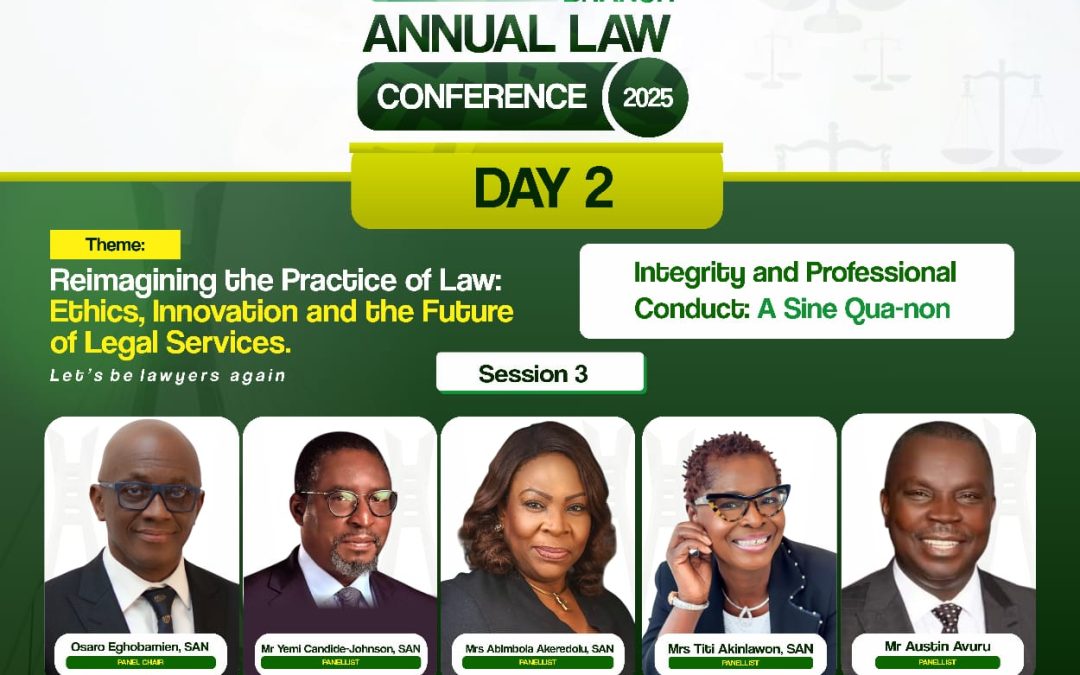
The legal landscape is constantly evolving, and staying ahead requires insightful discourse and collaboration. The *NBA Lagos Branch Annual Law Conference 2025* is set to be an extraordinary meeting of minds, bringing together some of Nigeria’s finest legal practitioners and thought leaders for an engaging and transformative experience.
A Stellar Lineup of Legal Titans
This year’s conference boasts an impressive panel featuring *distinguished personalities* who have left indelible marks on the legal profession and beyond:
– Osaro Eghobamien, SAN – Managing Partner, Perchstone & Graeys LP
– Yemi Candide-Johnson, SAN – Senior Partner, Strachan Partners; Convener, Justice Reform Project
– Mrs. Abimbola Akeredolu, SAN – Partner, Banwo & Ighodalo; Former Attorney General & Commissioner for Justice, Ogun State
– Mrs. Titi Akinlawon, SAN – Principal Partner, Akinlawon & Ajomo
– Mr. Austin Avuru – CEO, Seplat Petroleum Development Company
Dates and Venue
Taking place from *14th to 20th June 2025* at the prestigious *Muson Center, Onikan, Lagos*, this event promises to be a week-long immersion into cutting-edge legal insights, innovative discussions, and valuable networking opportunities.
Why You Should Attend
Beyond the intellectually stimulating sessions, this conference offers attendees a chance to engage with industry experts, debate pressing legal issues, and forge meaningful connections with colleagues and mentors alike. Whether you’re a seasoned practitioner or an emerging legal mind, the NBA Lagos Law Conference 2025 is *where the future of law will be shaped*.
Register Now!
Don’t miss out—secure your spot today:
– *Members* – Register here https://nbalagos.gigo360.com/event/2025-nba-lagos-law-week/
– *Non-members* – Register here https://nbalagos.gigo360.com/event/2025-nba-lagos-law-week-non-members/
Let’s celebrate the art of advocacy and the future of the legal profession. *See you there!*

by Legalnaija | May 9, 2025 | Blawg

Yesterday, Reno Omokri made a post on his Facebook page stating how AI is rapidly taking over the lawyer’s job. He averred that AI is being used to make laws and give judgments in some parts of the world. Of course, no one is disputing that AI is a developing innovation and is here to stay, but Reno is overhyping the whole thing, which, as far as reality is concerned, is a mirage.
A Legal Practitioner, as defined under section (24) of the Legal Practitioners Act (2004), is a person entitled in accordance with the provisions of the Act to practice as a barrister and solicitor of the Supreme Court. For someone to be qualified to practice as a legal practitioner, section 2(1) of the Act provides that such a person must have his name on the Roll; otherwise, he cannot engage in any form of legal practice in Nigeria. To have one’s name on the Roll, section 7 of the Act prescribes that such a person must have been called to the Bar by the Body of Benchers and must produce a certificate of his call to the Bar to the Supreme Court Registrar. And for you to be called to the Bar, you must have had your LL.B Degree and BL certificate. The question now is: does AI have an LL.B. and BL certificate? Because Section 8(2) of the LPA also provides for a lawyer as the only person having the right of audience in all courts in Nigeria to represent clients; any other person cannot. That’s to say, an AI can’t go and move a motion or bail application in court without spending five years at the university pursuing an LL.B degree and another one year for BL at the Law School. Section 22(1)(b) of the Legal Practitioner Act specifically mentions some documents that are meant for lawyers to sign and not any other person, for example, instruments relating to immovable property.
Furthermore, Mr. Reno, you should note that the law is settled that it is only a legal practitioner that can prepare and sign court processes. Therefore, the signing of a court process by a person whose name is not on the Roll will render such a process incompetent. This has been given judicial blessing in the case of Adeneye v. Yaro (2013) 3 NWLR.
Let’s assume AI even prepared the brief you’re taking to court. Who will then sign it for it to be valid? An ‘AI Robert’? Of course not. It must be signed by a lawyer, or else your smart opposing counsel will cite the case of Okafor v. Nweke (2007) 10 NWLR to get rid of your worthless paper for lacking a lawyer’s signature. Court processes can be said to have been properly signed, Mr. Reno, if they fulfill the following, as per, Supreme Court:
- ‘The signature of Counsel, which may be in any form;
- The name of Counsel clearly written as indication of authorship of the signature;
- The name of the person(s) Counsel represents; and
- Name and address of the law firm under which Counsel practices as legal practitioner or solicitor/advocate of the Supreme Court of Nigeria.’
Any breach of the above is fundamental and will make the process suffer the fate of every incompetent brief, which is ‘striking out’. On this, I place reliance on the Supreme Court decision of SLB Consortium v. NNPC (2011) 9 NWLR.

www.legalnaija.com/store
In addition, AI can’t replace the analytical skills, legal advocacy skills and deep thinking needed by lawyers. AI cannot build trust nor have the emotional intelligence to guide a client through the toughest moments of their lives, which is a skill required during client interviews. Practicing law requires human intelligence and emotion; after all, your clients are human too. Adaptability, cunning psychological techniques, as well as appealing to emotion, especially during cross-examination, are very sacrosanct, and AI doesn’t have all this.
Furthermore, you assert that ‘AI is being used to give judgment’. Do you think such judgment will be just and reasonable? Does AI have a sense of discernment? Let me briefly narrate an enriching court session I witnessed this week at the National Industrial Court, Kano Division. Monday was slated for the adoption of the final written addresses. The learned counsel filed a reply on point of law, and during the adoption, the counsel to the plaintiff, who’s a senior advocate, vehemently argued that National Industrial Court Rules don’t recognize any reply on point of law in a written address. Everyone in the court and the Learned Judge were in awe, but without citing any case nor section, My Lord asked the learned silk a simple question: ‘Learned silk, confirm to this Honourable Court that you have never filed a reply on point of law before [since you started practicing]?’ Learned silk replied with a coping smile on his face that he’s always a plaintiff, so he has never. Everyone burst out laughing, and the Judge said: ‘When I see you in court for adoption of final written address, I know you’re up to something, because you can allow your junior counsel to come a do the adoption, in anyway, learned silk, there is no way I can deny him a reply on point of law as it will go down to issue of fair hearing.’ And that was how the objection was overruled.
Please, if I may ask, can an AI Judge make the above erudite discernment? Don’t you think you think it will be swayed with the argument of the learned silk that National Industrial Court rules don’t allow reply on point of law, and which the NIC rule is actually silent about, and thereby deny the innocent learned counsel the opportunity to be heard?
Based on the foregoing, I end with the saying of my Senior Learning Colleague A.A. Abdulrauf: ‘As long as law remains a discipline, it cannot be approached just because one can speak English. AI will never replace lawyers; it will just be a tool to ease lawyers’ work.’ AI isn’t here to replace legal practitioners’ work but rather to change how they work. It is a tool to be used in legal research; even in that, it must be used consciously, as AI only knows the general principles of law but not its intricacies. It can also be used for drafting some legal instruments that have a generally acceptable sample across the globe or a region, but not for draftings to be taken to court. On this, I submit that, AI won’t eliminate the need for lawyers but will transform their roles. It can automate routine tasks, which will help lawyers spend more time on the human aspects of the role, such as client relationships and advocacy. I say no more!
Isah Bala Garba is a level 300 student from Faculty of Law, Bayero University, Kano. He can be reached for comments or corrections on: LinkedIn: https://www.linkedin.com/in/isah-bala-garba-301983276 isahbalagarba05@gmail.com or on 08100129131.
by Legalnaija | May 8, 2025 | Blawg
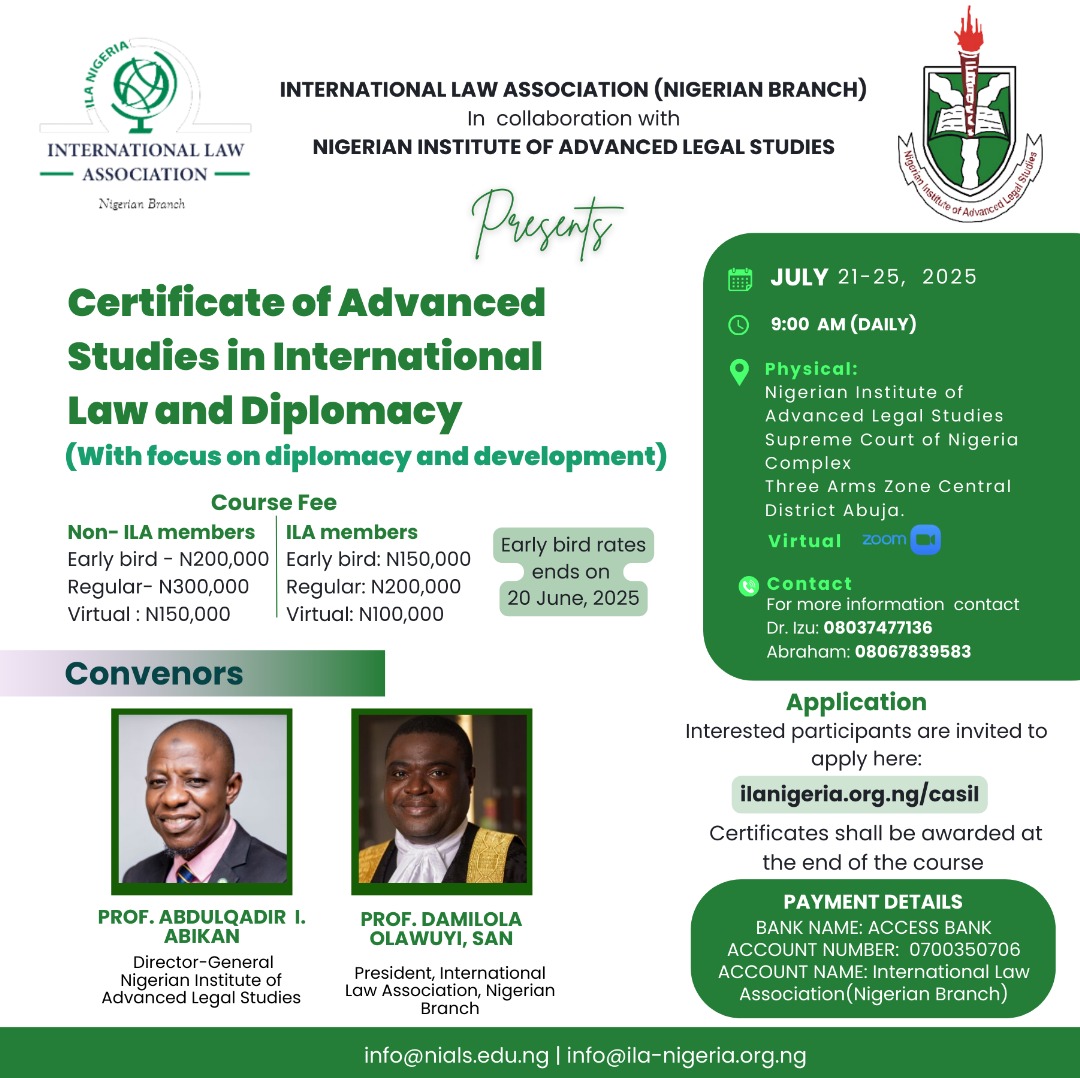
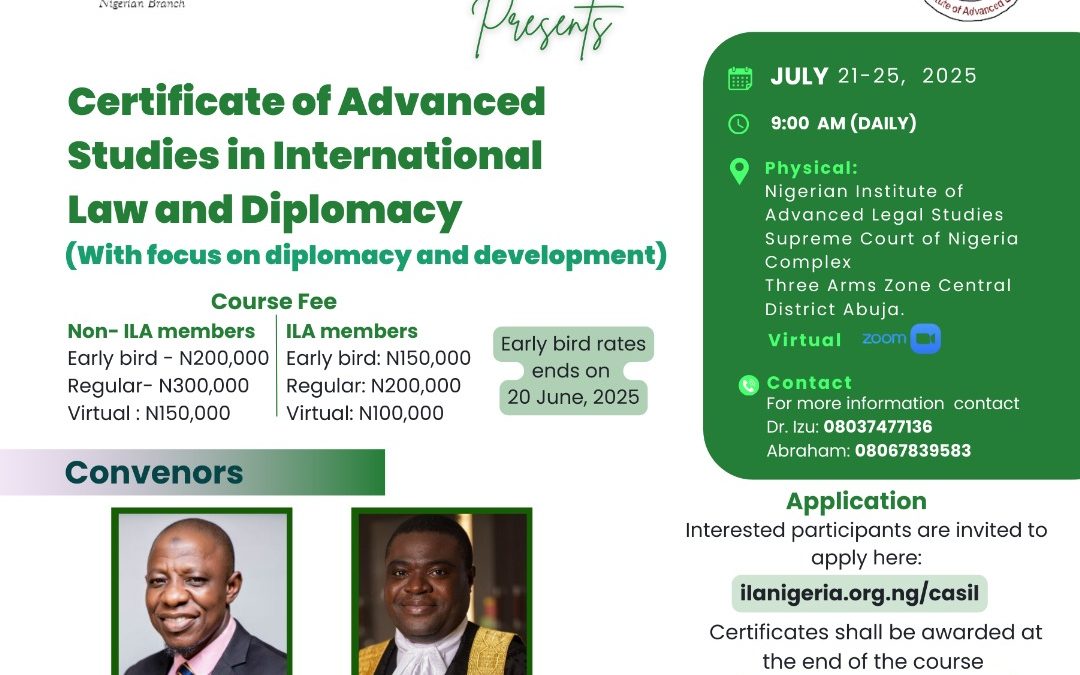
The Certificate of Advanced Studies in International Law and Diplomacy is back in 2025!
Date: July 21-25, 2025
Venue: Supreme Court of Nigeria, Abuja
Early Bird deadline: June 20, 2025
Building on the success of the previous editions, the @nigeria_ila, in partnership with @nialsorg invites you to register for the 2025 Certificate of Advanced Studies in International Law and Diplomacy.
The course exposes participants to the specialised knowledge and skillsets required in the practice of international law and diplomacy. The course provides an in-depth examination of the core sources and principles of international law, the practical challenges that limit their effective design and implementation, especially in the context of developing economies, as well as the innovative approaches and skillsets required to negotiate win-win international instruments in an increasingly globalized world.
The course will hold at the Supreme Court of Nigeria, Abuja from July 21-25, 2025.
Early Bird rates end on 20 June, 2025
Register here to elevate your career and benefit from the early bird rates: https://ilanigeria.org.ng/casil
by Legalnaija | May 5, 2025 | Blawg
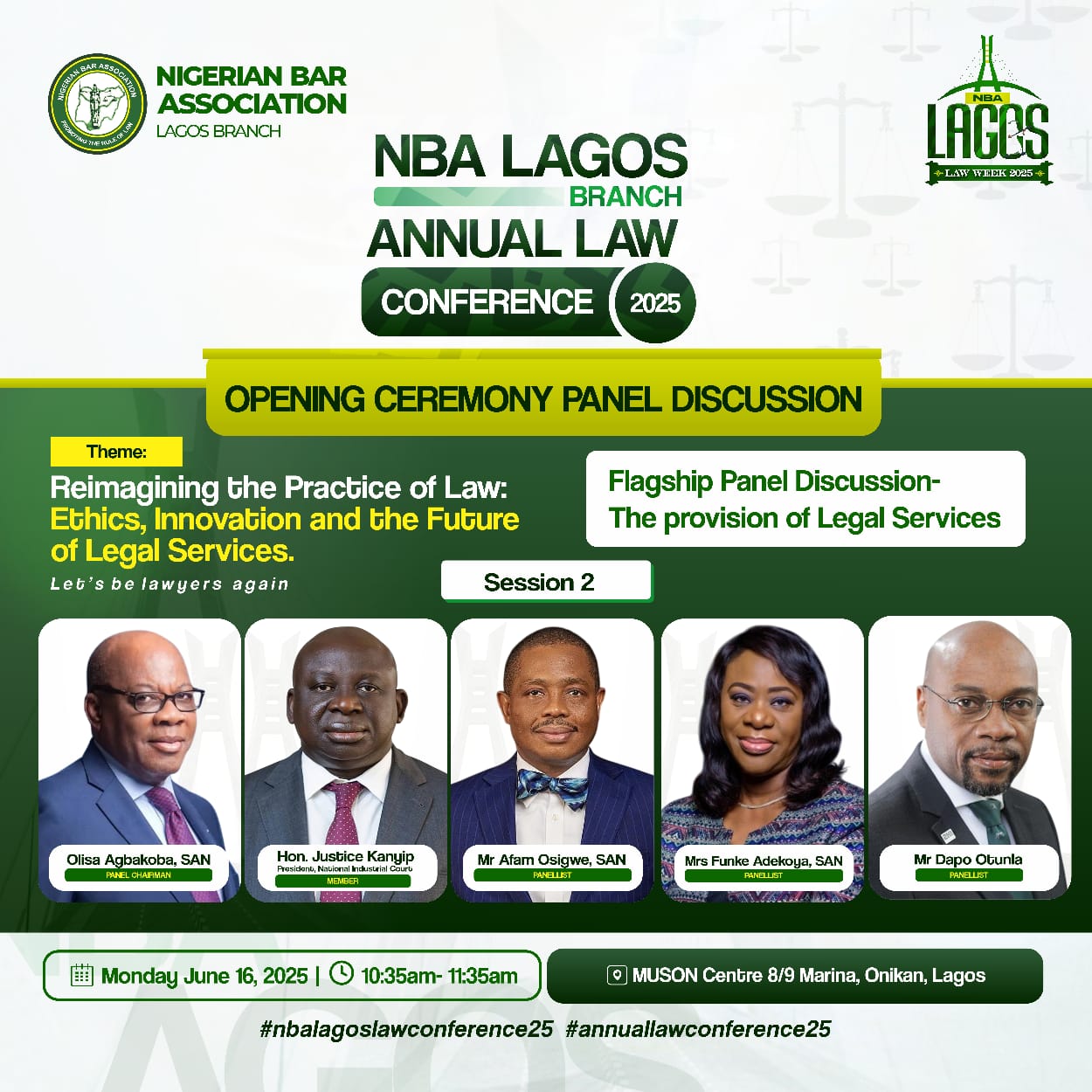
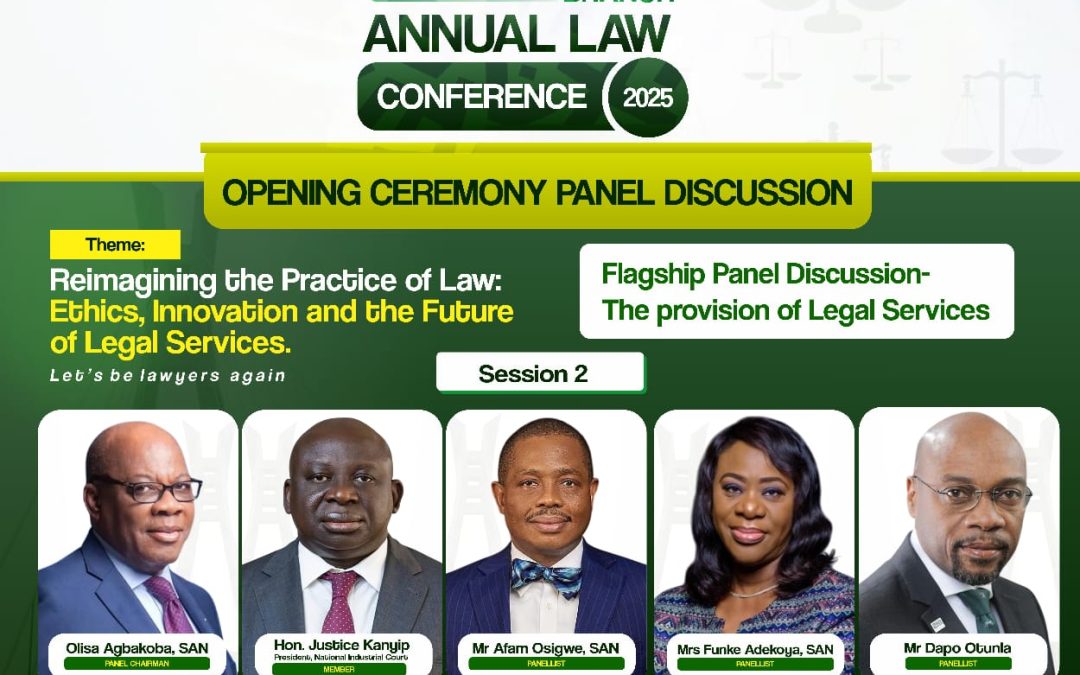
How else would you want to spend Monday, June 16th, 2025, if not at the panel discussion kicking off the NBA Lagos Branch Annual Law Conference 2025?
This year, we’re bringing you an exceptional lineup of speakers:
– Mr. Olisa Agbakoba, SAN
– Hon. Justice Benedict Kanyip
– Mr. Afam Osigwe, SAN
– Mrs. Funke Adekoya, SAN
– Mr. Dapo Otunla
Theme: Ethics, Innovation, and the Future of Legal Services. Let’s be Lawyers again.”
Be part of the **biggest gathering of any NBA Branch** by securing your spot today!
For Branch members:
[Register here](https://nbalagos.gigo360.com/event/2025-nba-lagos-law-weeknon-membl
For non-members:** [Register here](https://nbalagos.gigo360.com/event/2025-nba-lagos-law-week-non-members/)
Early Bird registration closes on Monday, May 19th, 2025.** Don’t miss out!
#nbalagoslawconference25 #annuallawconference25
by Legalnaija | May 2, 2025 | Blawg
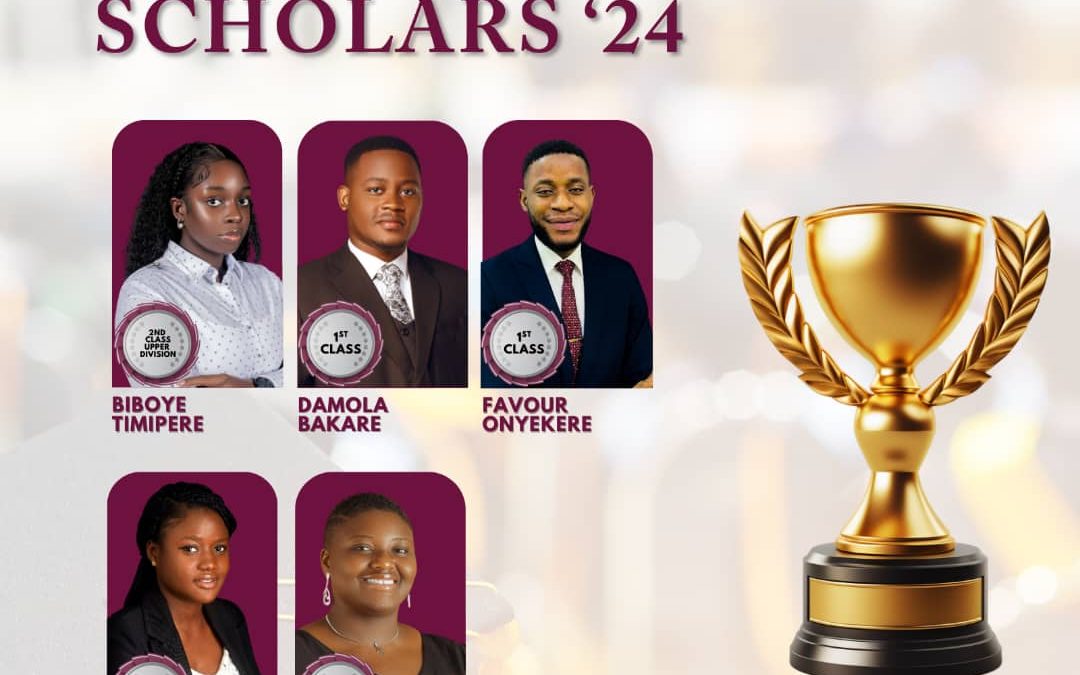
Beneficiaries of the Davidson Oturu Mentorship and Sponsorship Programme have achieved remarkable success in the recently released Nigerian Law School Bar Finals results.
Among the outstanding scholars — Biboye Timipere, Kabir Damola Bakare, Favour D. Onyekere, Janet M. Adio, and Joy Abogu — four earned First-Class honours, while one graduated with a Second-Class Upper division. Their achievements underscore both their individual dedication and the impact of the programme, which was established to provide mentorship, financial support, and career guidance to promising law students.
In addition to their academic excellence, the graduates are already seeking ways to give back to their communities, reflecting the programme’s broader mission of fostering leadership, social responsibility, and professional excellence among young legal practitioners.
Founder of the programme, Davidson Oturu, expressed pride in the scholars’ accomplishments, describing their success as a testament to the value of investing in the next generation of leaders in the legal profession.
The Davidson Oturu Mentorship and Sponsorship Programme continues to mentor and support talented students and young professionals through regular check-ins, structured mentorship initiatives, and professional development opportunities, helping to build a strong pipeline of future legal leaders.
by Legalnaija | Apr 26, 2025 | Blawg
NBA Legal Education Committee calls for increased investment in legal education
The Legal Education Committee of the Nigerian Bar Association (NBA) has called for increased funding for legal education in Nigeria in order to enhance the development of practice-ready lawyers that can contribute meaningfully to the social and economic development of the nation.
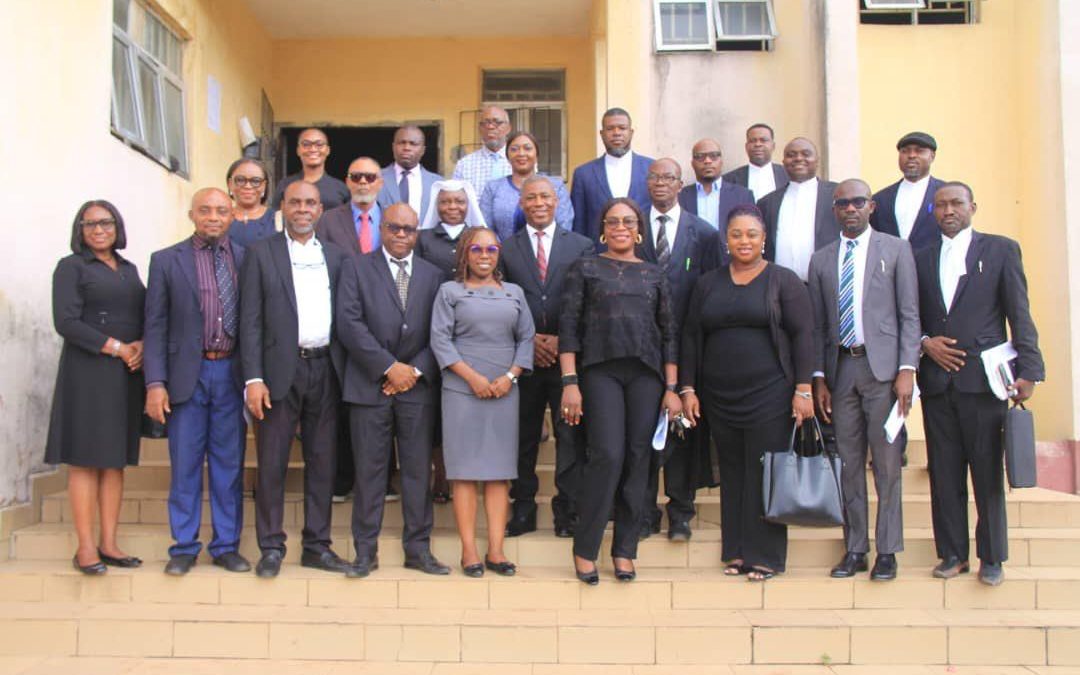
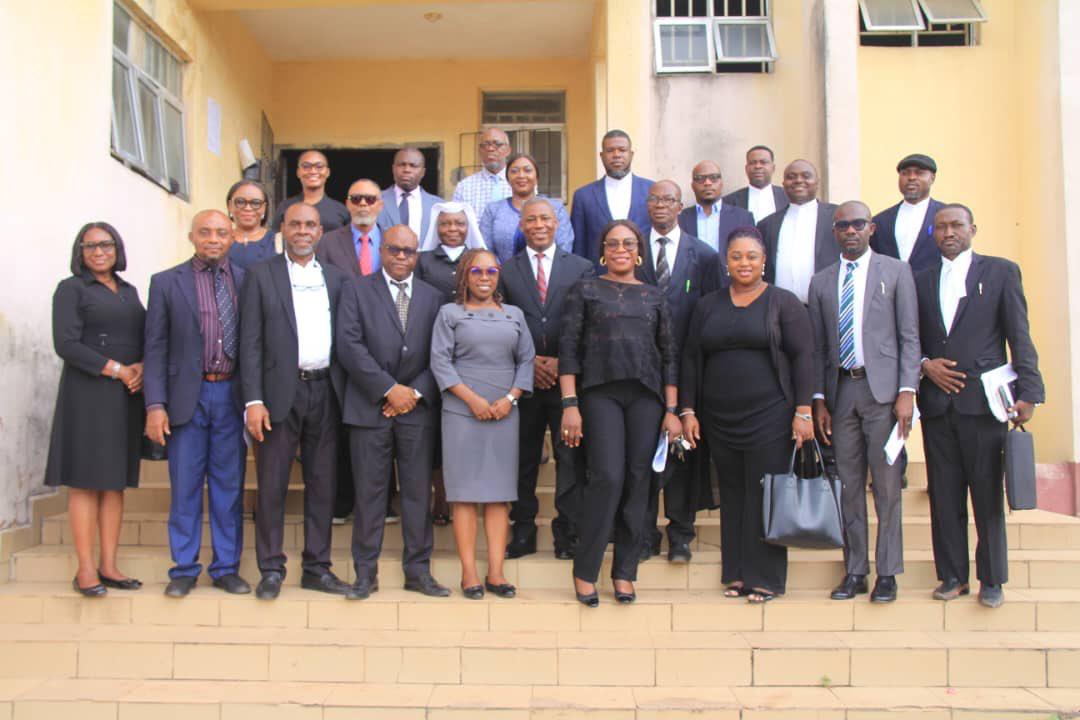
These recommendations were made at the inaugural Regional Townhall Workshop on Legal Education held at the Imo State University, Owerri (IMSU). Recall that as part of the NBA’s efforts to enhance legal education and practice in Nigeria, NBA President, Mazi Afam Osigwe, SAN inaugurated the Legal Education Committee (NBA-LEC) under the leadership of Professor Damilola Sunday Olawuyi, SAN, Deputy Vice Chancellor at Afe Babalola University, Ado Ekiti (ABUAD), with the mandate to promote and advance functional legal education in Nigeria, especially through training sessions and conferences on modern teaching approaches.
In exercise of this mandate, the NBA-LEC introduced the Regional Townhall Workshop on Legal Education Series with the maiden edition held in South East region at Imo State University, Owerri. The workshop recorded a huge turn out of about more than 300 attendees. Key stakeholders including the host of the event, the Vice Chancellor of IMSU, Prof. Uchefula Ugonna Chukwumaeze, SAN, Chairman of the NBA-LEC Regional Townhall Workshop Series, Prof. Chimezie Kingsley Okorie SAN, law teachers and students across universities in the Southeast attended. Four institutions delivered presentations on the state of legal education in Nigeria: Abia State University, Chukwuemeka Odumegwu Ojukwu University, Imo State University, and Enugu State University of Science and Technology.
While welcoming delegates to the Workshop, Chairman of the NBA-LEC, Professor Damilola Olawuyi, SAN highlighted the growing demand to review legal education in Nigeria to meet global standards. He emphasized the need to revise the curriculum and leverage technology to enhance legal education, ultimately transforming it into a more effective law practice that can compete globally. According to him ‘There is also an urgent need to increase investment in learning infrastructure across our law faculties if we are to actively deploy technology-based teaching methods. Only few law faculties have functional ICT centres, modern teaching equipments, digital tools and libraries needed to instil contemporary entrepreneurial, technology and project management skills in law students. Government or the NBA alone cannot provide all the tools. We all can do something about this by giving back to our law faculties.’ the Learned Silk concluded.
The Vice Chancellor of IMSU, Prof. Chukwumaeze, SAN emphasised the need for all stakeholders in Nigeria’s justice sector, including the NBA to support legal education by providing educational materials. The Chairman of the Townhall Sub committee Prof. Okorie SAN also stressed the need for the NBA to be a bridge between the legal education and other relevant authorities in ensuring a strengthened legal education in terms of collaboration.
The ensuing roundtable discussions featured presentations by law teachers on the achievements so far and existing challenges that pose a threat to law teachers and students in law faculties. The reports expressed concern on the falling standard of law practice in Nigeria and the ethical standard depreciation, this was attributed to various challenges faced by law faculties, affecting the quality of legal education and the overall development of legal the profession. They sought increased collaboration with justice sector stakeholders to alleviate these challenges and improve existing standards.Various challenges were highlighted by the institutions, including infrastructure deficit, poor remuneration of law teachers, excessive workload of law teachers, limited access to legal information and underfunding of law faculties, especially lack of funding to attend international and domestic conferences. Despite challenges, some faculties showcased good infrastructure and upgraded law libraries from analogue to digital, especially contributions from lawyers and alumni.
While discussing the way forward, the Workshop commended the NBA leadership for providing the innovative platform to reflect on the way forward and called for the swift implementation of the NBA Legal Education Endowment Fund which could go a long way in mobilizing financial support for infrastructure and technology upgrade. While calling on law firms, companies and other stakeholders to contribute to the Fund, the Workshop also called for more joint research projects between NBA and law faculties, as well as tailored research programs and subsidized conferences for academic lawyers, as a way of incorporating theoretical and practical law aspects in the profession.

by Legalnaija | Apr 22, 2025 | Blawg
The skincare industry in Nigeria has expanded significantly, and many consumers rely on vendors’ recommendations when purchasing skincare products. Some vendors act as informal skincare consultants and, therefore, they recommend products based on customers’ needs or desires confidently. However, when these recommendations do not work as recommended or lead to skin damage, the customers often blame the vendors. This article examines the vendors’ liability briefly in such a situation.
Under Section 14(1) of the Sale of Goods Act, where a buyer makes known to the seller the particular purpose for which a product is required and relies on the seller’s skill, knowledge or judgment, there is an implied condition that the goods shall be reasonably fit for such purpose. For instance, if a vendor recommends a product for acne treatment and it causes severe irritation, the vendor shall be liable for breaching this implied condition of fitness for purpose.
The Court of Appeal in Afrab Chem Ltd. v. Owoduenyi held that a seller may be liable if a product does not serve its intended purpose as communicated to the buyer. Additionally, Section 131 of the Federal Competition and Consumer Protection Act 2018 provides that goods sold to consumers must meet their intended purposes, good quality, usable, durable and free from defects.
Section 14(2) of the Sale of Goods Act states that goods sold must be of merchantable quality. In other words, the goods should be safe, effective, and free from any defect or encumbrance. Therefore, if a vendor sells a face cream or body lotion that is expired or contaminated, this could constitute a breach of this implied warranty. Consequently, a consumer can maintain an action and seek redress against the vendor for selling a product that is not fit for the stated purpose or unmerchantable.
But it is essential for consumers to note that where a product is sold under a patent or trade name, example ABC body lotion, the vendor will not be held liable if the consumer did not get what he likes or if it leads to damage. The pretty safe assumption of the law is that when you’re buying a product under its patent or trade name you’re aware of what you’re buying and, as such, you shall bear the consequences of your choice. In Bristol Tramways & Carriage Co Ltd v. Fiat Motors Ltd, the court held thus: “if a man orders, in express terms, an article known by a patent or trade name under that name, and he gets it, he cannot complain that it does not answer some specific purpose for which he wanted it, even though he told the vendor before he ordered the purpose for which he required it.”
Apart from contractual obligations, skincare vendors in Nigeria can be liable under the law of torts, particularly for negligence and misrepresentation. In celebrated case of Donoghue v. Stevenson, the House of Lords established the principle that sellers owe a duty of care to consumers. The authority of Okwejiminor v. Gbakeji reaffirmed that manufacturers and sellers can be held liable for negligence when their product causes harm to consumers. But to establish negligence in such a situation, the consumers must prove the following ingredients:
- Duty of Care: The vendor owed a duty to provide a safe and appropriate product.
- Breach of Duty: The vendor failed to exercise reasonable care in recommending the product.
- Causation: The breach caused the consumer harm (example, skin damage).
- Damage: The consumer suffered actual loss or injury.
Misrepresentation occurs when a skincare vendor makes false, misleading, or exaggerated claims about a particular product. Example: If a vendor falsely claims that a product is “100% natural” or it has a “lighting or whitening effect” but it turns out to be otherwise or contains harmful chemicals, this could amount to misrepresentation and, as such, consumers may have a right to sue for damages. Similarly, Section 132(2) of The Federal Competition and Consumer Protection Act makes it categorically clear that a consumer can return the goods he/she found to be unusable or not fit for its intended purpose within three months. The vendors are also mandated to either repair or replace the goods or refund the price paid by the consumer for the goods.
In conclusion, the liability of the skincare vendors in Nigeria depends on contractual obligations, tortious liability and consumer protection law. The consumers enjoy protection of the law against the vendors where products sold are not fit for the intended purpose or where they are not of merchantable quality. Similarly, where the vendors misrepresent products or sell them in violation of the provisions of the Federal Competition and Consumer Protection Act, they shall be held liable for any damage caused by their act. Therefore, the skincare vendors ought to be cautious and ensure that their recommendations are accurate and that products meet the fitness for purpose and merchantability requirements. However, where products are sold under their patent or trade names, the vendors shall not be held liable for anything.
Written by Musbahu Yahaya Rabiu, a graduate of the Faculty of Law, Bayero University Kano, and a bar aspirant. He can be reached for corrections or constructive criticism at 08107882404 or musbahuyahayarabiu@gmail.com
References
Statutes:
Sale of Goods Act
The Federal Competition and Consumer Protection Act
Judicial Authorities:
Afrab Chem Ltd. v. Owoduenyi (2014) LPELR-23613 (CA)
Bristol Tramways & Carriage Co Ltd v. Fiat Motors Ltd (1910)
Donoghue v. Stevenson [1932] AC 562
Okwejiminor v. Gbakeji (2008) 5 NWLR (Pt. 1079) 172