Templars Celebrates Year – End With Fun – Filled All White Party

Templars Celebrates Year – End With Fun – Filled All White Party

Templars – one of the leading commercial law firms in Nigeria held its annual End of Year Party last Friday and members of the Firm were filled with gratitude for a very busy yet exciting and eventful year. It was thus a time to celebrate, make merry and reflect on the many big wins recorded by the Firm in 2019.

Speaking at the event, the Managing Partner, Mr. Oghogho Akpata, thanked the staff for their hard work and commitment to maintaining the Firm’s leading position in the Nigerian Legal space.

Mr. Akpata noted that amongst the many big wins recorded by the Firm this year was the elevation of one of its Partners – Mr. Godwin Omoaka to the coveted rank of Senior Advocate of Nigeria after another Partner, Mr. Adewale Atake who also took Silk in 2018. He stated that this back-to-back recognition by the Legal Practitioners Privileges Committee was an affirmation of the Firms top tier status in the field of Dispute Resolution.

In his comments, Senior Partner and Head of the Corporate Commercial Practice Group, Mr. Olumide Akpata congratulated members of the Firm for a very successful year. He noted that Templars’ commitment to knowledge development, capacity building and specialization has made it one of the most formidable legal teams in Nigeria and the go-to Law Firm for complex matters and transactions. He also affirmed that as the Firm marches into the 25th year of its existence it will remain committed to the continued development and strengthening of the Practice and it’s members stating that “we have built an institution and we must ensure that it will stand the test of time.”

The high point of the event was the presentation of Long Service Awards to members of the Firm.
NBA BENIN HOLDS ANNUAL BAR DINNER…. HONOURS OBASEKI, AKPATA, OTHERS.

NBA BENIN HOLDS ANNUAL BAR DINNER…. HONOURS OBASEKI, AKPATA, OTHERS.


Yesterday, 19 December 2019, the Benin Branch of the Nigerian Bar Association (NBA) held its Annual Bar Dinner at the iconic Uyi Grand International Event Centre with over 500 Lawyers in attendance.
This year’s event with theme *”Human and Infrastructure Development; the role of the law”* was very well organized and attracted various high-profile guests from within and outside the State.


The event which was chaired by
the Chief Justice of Edo State, Honourable Justice Esther Edigin also had the Governor of Edo State, His Excellency Godwin Obaseki,  as the Special Guest of Honour.
Other guests at the event include the Attorney-General of Edo State, Prof. Yinka Omorogbe, Professor Violet Aigbokhaevbo of the University of Benin, who was the Guest Speaker,  Chief of Staff to the Governor of Edo State Mr. Taiwo Akerele, Music maestro Sir Victor Uwaifo as well as  Judges and Magistrates from the Edo State Judiciary and Senior Advocates of Nigeria.

The high point of the event was the presentation of Awards to deserving individuals including H.E. Governor Godwin Obaseki who was recognized for his stellar performance as Governor of Edo State and Mr. Olumide Akpata, Senior Partner at Templars and immediate past Chairman of the NBA Section on Business Law in recognition of his constant support for the NBA Benin Branch including his donation of an ICT Centre to the Branch in 2018.

Other awardees include, Mr. Parry Osayande a retired Deputy inspector General of Police and Honourable Justice Constance Momoh a former Chief Judge of Edo State and one-time Chairman of the Code of Conduct Tribunal.


The Chairman of Branch, Prince Collins Ogiegbaen, congratulated all the Awardees and urged them to continue to contribute their respective quotas to the development our society at large.
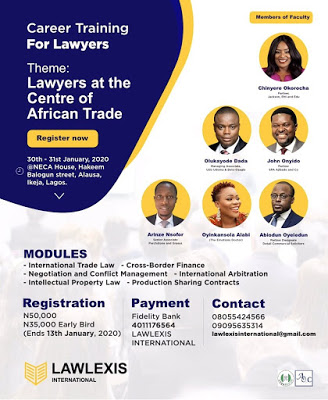
10 Reasons You Should Register For the International Trade and Conflict Management Training for Lawyers

10 Reasons You Should Register For the International Trade and Conflict Management Training for Lawyers

1.      The AfCFTA has officially become the largest free trade
agreement since the World Trade Organisation (WTO) agreement in 1995, with
about 1.3 billion Africans and a combined GDP of over $3.4 billion.

2. To contribute to its
success lawyers need to improve their knowledge of and competence in
trade and business law and be proactive in advising clients.”

3.      The theme is “LAWYERS AT THE CENTRE OF AFRICAN
TRADE” where the modules will be focused on improving the capacity of
Nigerian lawyers in handling international trade transactions.

4.      The Members of Faculty have been carefully selected to
ensure participants learn from the very best in the areas of law. Most
certainly our members of faculty will bring to bear their expertise and
experience which will benefit participants immensely.  

5.      The Modules focus on equipping Lawyers with the necessary
skills and competence required in handling cross – border transactions.

6.      Participants will learn the international regime for
registering intellectual property rights.

7.      Conflict Management includes the ability to negotiate and
resolve disputes timely and professionally while maintaining the business
relationship of parties.

8.      Participants will be equipped with the skills and competence
in participating in and handling International Arbitrations.

9.      The registration fee is little compared to the immense value
that participants stand to gain at the training.

10. Participants will be equipped with the necessary skill
required to advance their legal careers and position their firms for huge
profits.

Details of the Training include –

·       
Theme:  Lawyers
at the center of African Trade

·       
Modules:


Negotiation
& Conflict Management 

        
International
Arbitration 

        
Cross
Border Finance 

        
International
Trade Law

        
Production Sharing Contracts

        
Intellectual
Property Law

·       
Date:
30th and 31st of January, 2020 

·       
Time:
9am – 5pm daily

·       
Venue:
Neca House, Hakeem Balogun Street, Alausa, Ikeja, Lagos

·       
Audience:
Lawyers

·       
Aims
& Objectives: To train lawyers on how they may take advantage of the
opportunities presented by the African Continental Free Trade Agreement.

Registration Details

Fee
per delegate     N50,000                                                                   

Early
Bird (Ends January 7, 2020) – N35,000

Account Details

Lawlexis
International Limited

Fidelity
Bank

4011176564

Note that all payment confirmation and
delegate information should be sent to lawlexisinternational@gmail.com.
For contact and sponsorship details, Please contact Lawlexis on 09095635314;
08055424566 or email lawlexisinternational@gmail.com
 

Racism In Sports – The Way Forward | Oluwatobiloba Adesemowo

Racism In Sports – The Way Forward | Oluwatobiloba Adesemowo

Racism in English parlance can be defined
to be “prejudice, discrimination or antagonism directed against someone of a
different race based on the belief that one’s own race is superior.
Historically, those who openly professed or practiced racism held  that members of low status jobs and that
members of the dominant race should have exclusive access to political power,
economic resources, high status jobs and unrestricted civil rights
[1]Acts of racism includes physical
violence, daily insults and frequent acts and verbal expressions of contempt and
disrespect.

This
problem of racism can be referred to as “the transformation of race
prejudice through the exercise of power against a racial group defined as
inferior, by individuals and institutions with the intentional or unintentional
support of the entire culture.” Racism teaches nothing of value and can
only breed a hatred or desire to succeed by overcoming the portrayer of the
racist action in those it affects. Either way, those who pervade these racist
attitudes will be faced with some sort of negative effect.[2] Racism has been an issue
which has been in the sports industry right from collegiate sports which can be
seen as the origin of racism in sports.

One
of the trending news which hit the sports world in the past weeks is that of
the Bulgarian Football President Mr. Brorislav Mihayylov who resigned as president
of the Bulgarian football union because of the racism witnessed at the Euro
2020 qualifier against England. It was reported that the government of Bulgaria
had pressured him to resign as the act of racisim was not accepted. Infact the
Sports Minister did say that the government would suspend its relationship with
the Bulgarian Football Union until the MrBrorislavMihayylov leaves. This act by
Bulgarian government can be said to be too extreme but really very commendable
and encouraging as it shows their stance against the menace of racism in
football.


People
argue that sport is a model of racial equality, which facilitates the
integration of blacks intonsociety, provides an avenue for upward mobility for
blacks, and lacks the segregation and discriminatory problems of society as a
whole.[3]Sports organizations such
as Federation Internationale de Football Association (FIFA), The English
Football Association, Kick it out.org and the Bulgarian Football Union have
also taken a stand against racism which is very commendable. Mr. Giovani
Infantino stated during his speech at the last concluded “The Best” ceremony
stated that everyone should fight against the act of racism. We can also
observe from the Barclays Premier League games the the phrase “no room for
racism” The fight has been encouraging however more efforts needs to be put in
place to fight the disgusting acts. We have also seen football clubs boldly
come out and opin against racism for example Chelsea football club after the
racist abuse hurled at Raheem Sterling during one of the Barclays Premier
League matches had publicly rebuked the fans involved and held on its position
against racism. We have also seen top sports atheletes boldly step up to fight
the problem of racism. One name that comes to mind in this regard is Colin Rand
Kaepernick who won the heart of many for knelling duringthe national anthem of
the USA as a protest against racism in the United States.
We have also had players such as Dani Alves, Patrice
Evra who are victims of racism. In as much as the fight is on and the awareness
is on, there is hope that this menace will be dealt with and every atheletewon’t
be judged by his or her colour of skin.

While
we commend the various bodies and personnel who are fighting this menace, some
posit that the issue of racism is more of an ethical issue which should be
dealt with from an ethical point of view as various ethical theories are been
analyzed. Well, we would see how that helps in the sports industry. The writer
is of the opinion that the world is a global village and accepting each other
is the best mode of survival especially when it relates to sports which is
referred to as the only bond of unity in the world. 

Oluwatobiloba Adesemowo

Tobi is a tax and sports lawyer. He is currently a
management strategist at Lagos Tigers Football Club. He is also a tax associate
at SIAO partners. During his leisure, he loves to research on sports and tax
related issues.”


[1]www.britannica.com/topic/racism
last accessed on the 28thOct., 2019 

[2]Paul
M. Anderson; Racism in Sports: A question of ethics, Marquette Sports Law
Review, Vol. 6 Issue 2 Spring Article 9

[3]
Ibid.

Good Governance in The Sports Industry | Oluwatobiloba Adesemowo

Good Governance in The Sports Industry | Oluwatobiloba Adesemowo

Bad
governance has been a major setback which has affected major corporations and
organizations from accomplishing their potential hence reducing their
effectiveness and efficiency; unfortunately sports organizations and companies
are not left out of this setback. In order to curb this setback of bad
governance among corporations, various committees have been set up to provide
workable solutions. Among these committees was the Cadbury Committee which was
set up in the year 1992 and played major role in the development of corporate
governance although the efforts of other committees cannot be shelved. In the
Cadbury Committee’s Report, corporate governance was defined “as a system in
which companies are directed and controlled.”


It
is worthy of note that the united nations made a very important move in 2014
during the 69th regular session of the United Nations General
Assembly in New York when it recognized the independence and autonomy of
sports. In the words of the International Olympic Committee (IOC)President
Thomas Bach; “sport is truly the only area of human existence which has
achieved universal law, but to apply this universal law worldwide, sport has to
enjoy responsible autonomy. Politics must respect this sporting autonomy.”[1]
Due to this autonomy, it will be pertinent to regulate the administration and
governance of sport organizations since majority of them will not be subject to
national or locals laws in order to be free from governmental influence.

In many parts of the
world, sports bodies are to a large extent autonomous from government in the
way they organize themselves and their sport rules. One of the causes of
governance failures in sport may be the slow evolution of what were primarily
voluntary institutions founded in the 19th century into professionalized bodies
and regulatory systems adequate to govern the modern, commercial world of sport
of today. However, it is not the only explanation: many entirely voluntary
sports bodies have governed well, and there are plenty of professional
organizations where widespread abuses have taken place. However, as the IOC and
representatives of governments have acknowledged several times the right to
autonomy has to be earned: when governance is perceived to be poor, external
intervention by governments, law enforcement agencies and others becomes more
likely.[2]
There
have been scandals since the earliest days of sport but sports governance first
attracted serious scrutiny as a discrete topic in the 1990s after work by
academics, investigative journalists and campaigning organizations such as Play the Game.[3]
There have been corruption charges against various sport leaders although some
of them have their charges dropped while some are still under investigations.
Currently, we have the FIFA General Secretary FatmaSamoura is currently in
Egypt at the headquarters of the confederation of African football trying to
ensure stability in the continent’s football governing body. While some
commentators are not in support of this move by FIFA, other commentators opine
that it’s a good one to ensure that CAF adopts good governance, a major need
for its progress.

Some sports organizations
such as FIFA, UCI and IAAF have made significant changes to their constitutions
in recent times, introducing term limits and involving more independent people
in aspects of decision-making. However, the pace of progress across the sports
sector as a whole is slow, The Association of Summer Olympic International
Federations (ASOIF) subsequently developed a
governance assessment tool for International Federations. There are now
several different theories of governance. In recent years the specific topic of
sports governance has attracted a fair amount of interest from academics and
institutions. A number of principles of good governance have been produced,
such as the IOC’s Basic Universal Principles of Good Governance of
the Olympic and Sports Movement

(2008), the EU’s Principles of good governance in sport (2013), and the Universal
Standards
of the Sport Integrity
Global Alliance. 
 The
EU’s Expert Group on Good Governance has defined the principles of good governance in sport in the following terms: “The framework and culture within which a sports
body sets policy, delivers its strategic objectives, engages with stakeholders,
monitors performance, evaluates and manages risk and reports to its
constituents on its activities and progress including the delivery of
effective, sustainable and proportionate sports policy and regulation.”

In addition to the various
good governance codes which have been published, governments and regulatory
bodies in many countries have put in place standards of governance for sports
organizations. For example, UK Sport and Sport England produced a Code for Sports Governance. Tracey Crouch MP
had stated that
“It is vital that our domestic
sports bodies and organizations uphold the very highest standards of governance
and lead the world in this area. We want to ensure that they operate efficiently
and successfully while being transparent and representative of society. We have
been clear that we will expect them to adhere to the new Code for Sports
Governance if they are to receive public funding in the future.”[4]Working
with partners in eight European countries, Play the Game created a benchmarking
tool for assessing governance in national sports federations, resulting in a report published in November 2018. A
new initiative which started in 2017 called the International Partnership Against Corruption in
Sport
(IPACS) brings together stakeholders including the
Organisation for Economic Co-operation and Development (OECD), the IOC, a
number of national governments, the Council of Europe and the United Nations
Office on Drugs and Crime (UNODC). Taskforces are addressing the issues of
corruption in procurement, integrity in the selection of hosts for major sports
events, and compliance with good governance principles.[5]

It
is very evident that sports governance emanating from good corporate governance
is taking a great force among sports organization in the sports industry which
cannot be over emphasized. Organizations have started developing codes of
sports governance with promotion of the principles of sports governance and
violators of these principles are being brought to book. It will be interesting
to see how menaces such as corruption, bribery and lack of integrity is being
flush out through the development and promotion of good sports governance. 

Oluwatobiloba Adesemowo
“Tobi is a tax and sports lawyer. He is currently a
management strategist at Lagos Tigers Football Club. He is also a tax associate
at SIAO partners. During his leisure, he loves to research on sports and tax
related issues.”

Photo Credit – www.uslegal.com


[2]www.itrustsports.com/goodsportsgovernance last accessed on the 2nd
Nov.2019
[3] Ibid
[4]www.uksport.gov.uk/resources/governance-code last accessed on the 2nd
Nov. 2019
[5] Ibid

Introduction To Sports Law In Africa

Introduction To Sports Law In Africa

The
Sports Industry is fast becoming a growing industry which accommodates various
professional from all works of life. It is very pertinent to note that due to
the growing nature, it has become paramount to find a medium to regulate the
activities within the sector. Owing to this fact, legal professionals within
the industry have developed the legal framework that pertains to sports and the
developing issues that evolve from the sector.


The
immense development of sports around the world cannot be over emphasized; talk
more of its impact in the progress of a nation.Football,
for example is the  first team sport in Spain by number of
practitioners, has become an important phenomenon that involves cultural,
social, economic and even political factors. Although it sounds like a cliché,
football is much more than two teams of eleven people running after a ball.[1]Sports has been recognized
as the only event which bring together all personalities; whether Black, Asian,
White or Australoid.

Historically,
sports was generally seen as a past time that didn’t require serious
formalization and regulation. For instance, when the ancient Olympic Games
started, there were limited rules and regulations binding the athletes and the
organizers. In the past few decades however, we have seen sporting activities
and tournaments become much more complex. These days there are events like the
World Cup and Olympic Games, African Cup of Nations (AFCON), sporting
federations like FédérationInternationale de Football Association (FIFA),
Confederation of African Football (CAF) and the American National Basket Ball
Association (NBA), players and agents all involved in complex web of
organizing, hosting and playing of games and tournaments. These days players
sign contracts, teams have relationships with the governing federations and the
governing federations have connections with the governments of each country.
These complexities have led to the growth and emergence of sports law and
practice[2]around the world without excluding
Africa.

A
distinct Forbes list just for highest paid athletes evidences the rising
popularity of the sports industry in the past few decades. The history of
sports extends as far back as the existence of people as purposive and
competitive. It simultaneously portrays as how the beliefs of the society have
changed and what changes have been brought in the rules and regulations. The
most eminent legal scholars have always unanimously held that law is essential
for a society because it serves as norms of thecode of conduct. It keeps the
community running. Without law, there would be a state of chaos where only the
fittest will survive. Similarly, even though law and sports often get
considered as “separate realms”; sports laws form the backbone of the
sports industry regulating the myriad of interlinking legal issues ranging from
anti-doping, gambling,andmatch-fixing to the choice of legal structure for
sporting organizations. Sports without the governance of a body of law can be
comparable to a football match without a referee; havoc.  These laws have
an unusually well-developed pattern of globalized regulation and overlap
substantially with multitude areas of other distinct laws.[3]

One
of the major sports that emerged in Africa and has stood the test of time is
Football which has been evidenced in the great African players who have also
made their marks not just in Africa but in Europe. Amongst them are Austin
Okocha, KanuNwankwo, Samuel Etto, Didier Drogba, Rasheed Yekini et al.

The
development in African football has over the years been astonishing and rather
controversial. For the sports lawyer and other interested parties, this is a
remarkable opportunity to examine and critically analyze further the perennial
battle between state regulation and self-regulation. It is a well-established
fact that FIFA and CAF regulations prohibits attempts to seek remedies before
national courts in matters which is of purely sporting nature and by pursuing
this one risks violating specific FIFA regulations. The general position is
that national courts are usually reluctant to interfere with cases of a
sporting nature as the sports associations are private bodies as opposed to
public bodies. Courts cannot intervene in matters conducted by private
associations, however when a matter is presented in court against a private
association the courts will nevertheless go ahead with the hearing of the
matter.[4]


Oluwatobiloba Adesemowo

“Tobi is a tax and sports lawyer. He is currently a
management strategist at Lagos Tigers Football Club. He is also a tax associate
at SIAO partners. During his leisure, he loves to research on sports and tax
related issues.”

Picture Credit – www.legaldesire.com

Dispute Resolution In The Sports Industry. Part 1 | Oluwatobiloba Adesemowo

Dispute Resolution In The Sports Industry. Part 1 | Oluwatobiloba Adesemowo

It
is often said that as long as relationship is being established, dispute is
inevitable. For as long as we interact with each other as humans in our daily
routine, there is every likelihood to have disagreements, different opinions
and ideas which could bring about dispute; however, the beauty is ensuring that
disputes are resolved amicably. To facilitate a fast and easy means of settling
dispute especially in the sports industry, it has been encouraged that the
Alternative Dispute Resolution mechanisms should be adopted.  


There
are various types of disputes that can emanate from the sports industry because
of the large size of the industry and based on the area of specialization of
the athletes or personnel. These disputes include but not limited to sports
commercial disputes, on-field of play disputes, contractual disputes and
organizational/ institutional disputes. It is no doubt that the Alternative
dispute resolution (ADR) is utilized to resolve a variety of sports-related
dispute which could come in various forms as mentioned earlier.

ADR
provides parties with fair, independent, and impartial forums to resolve
disputes. The most common forms of ADR proceedings are mediation and
arbitration. An increasing number of sports organizations are including mediation
and arbitration as the primary means for resolving disputes that arise on the
field of play as well as commercial business matters.[1]ADR
can provide quick, private, and fair dispute resolution among sports atheletes
and sports organization which has been made evident in various circumstances
using the Court of Arbitration for sports as an example.

ADR
is a flexible, time and cost efficient mechanism that helps parties in sports
disputes to come to practical and satisfactory solutions. Parties benefit from
having a neutral forum for resolving an international dispute through a single
procedure. ADR can be set up in a way that facilitates efficient enforcement of
the outcome. It is interesting to note that other independent bodies asides the
CAS has found it important to create a platform to help sports athletes resolve
disputes amicably.

 One of such bodies is the World Intellectual
Property Organization which is based in Geneva Switzerland with various ADR
options in particular arbitration and mediation for the resolution of
international commercial disputes between private parties. WIPO’s ADR services
for specific sectors include dispute resolution advice and case administration
services to help resolve disputes in the field of sports.[2]

While
the efforts of the WIPO is very much appreciated, we shall subsequently be
looking at the jurisdiction the CAS and examine the need for a sports tribunal
to help facilitate ADR mechanisms.

Oluwatobiloba Adesemowo

“Tobi is a tax and sports
lawyer. He is currently a management strategist at Lagos Tigers Football Club.
He is also a tax associate at SIAO partners. During his leisure, he loves to
research on sports and tax related issues.”


[1]
American Arbitration Association journal on using adr to resolve collegiate,
professional, and sports-business dispute

[2]www.wipo.int/resolving-disputes-in-sports
last accessed on 23rd Nov.2019

Register for the International Trade Law and Conflict Management Training for Lawyers

Register for the International Trade Law and Conflict Management Training for Lawyers

Register for the “International Trade Law & Conflict Management” Training for Lawyers-

Details –

· Theme:  “Lawyers at the center of African Trade”

· Modules:
– Negotiation & Conflict Management
– International Arbitration
– Cross Border Finance
– International Trade Law
–  Production Sharing Contracts
– Intellectual Property Law

· Date: 30th and 31st of January, 2020

·Time: 9am – 5pm daily

·Venue: Neca House, Hakeem Balogun Street, Alausa, Ikeja, Lagos.

·Audience: Lawyers

Registration Details
Fee per delegate     – N50,000                                                         
Early Bird (Ends January 7, 2020) – N35,000

For registration, Please contact Lawlexis on 09095635314; 08055424566 Or send a mail to lawlexisinternational@gmail.com

Some Key Policy Issues in Nigeria’s Sustainable Energy Challenges and Environmental Sustainability | Michael Dugeri

Some Key Policy Issues in Nigeria’s Sustainable Energy Challenges and Environmental Sustainability | Michael Dugeri

Nigeria, like other nations, has long
recognised the potentials of renewable energy in the promotion of environmental
sustainability. However, unlike countries such as China, Brazil and Germany,
Nigeria’s huge renewable energy potentials have not been fully utilised. This
is due to a number of factors, such as Nigeria’s overdependence on the crude
oil revenue, lack of an overarching legal framework that articulates a
comprehensive strategy for promotion of renewable energy and political will to
drive enforcement and implementation of extant policies on renewables. One of
the overarching objectives of Nigeria’s National Energy Policy is to guarantee
adequate, reliable and sustainable supply of energy at appropriate costs and in
an environmentally friendly manner, to the various sectors of the economy, for
national development.

However, a review of Nigeria’s legal and institutional
framework on renewal energy development shows that the approach is not well
focused on the ideals of environmental sustainability, as the emphasis seem to
be more on energy access and sufficiency than on environmental sustainability.
The many regulatory institutions that exist in both the power sector and the
environment sometimes have overlapping mandates and responsibilities, resulting
in disagreements between agencies over jurisdictional boundaries.

Environmental sustainability forms
one of the pillars of sustainability development, the others being social
sustainability and economic sustainability. It is an aspect of the development
process which emphasises the harnessing of natural and social resources with
major considerations for continuity and the future. Renewable energy sources
such as biomass, geothermal, hydropower, solar and wind, energy sources are by
their nature infinite and environmentally friendly when compared to
conventional energy sources such as coal, oil and natural gas. There is,
therefore, a global shift to support the promotion of renewable energy.
Investment in renewable electricity would be desirable for increasing energy
security, mitigating climate change and promoting economic development.
However, Nigeria’s energy sector is dominated by oil and gas consumption. Most
investments in the sector are currently in oil and gas generating plants. Owing
to prolonged investments and economies of scale, the cost of generation of
electricity from oil and gas is lower than that of renewable energy installations.
Apart from hydropower, renewable energy sources hardly feature as part of
Nigeria’s energy mix. 

In many ways, Nigeria has
demonstrated awareness of the need to promote sustainable development. However,
while the post-1988 environmental law development period in Nigeria placed the
environment at the center of sustainable development objectives of the country,
it did not translate actual protection of the environment. Our environmental
protection laws are not strictly enforced because the Nigerian economy relies
heavily on fossil fuel, and serious environmental protection measures and/or
enforcement would affect revenue from crude oil production and transactions. It
then appears then that what Nigeria need is a way to balance its energy
interests with environmental concerns, hence the importance of a legal and
institutional framework for promoting renewable energy.

Nigeria is endowed with huge energy
resources, yet it perennially suffers energy poverty. Moreover, the reliance on
fossil fuel to meet Nigeria’s energy need has been attended with many problems
such as physical deterioration of energy transmission and distribution
facilities, inadequate metering system, increase in the incidence of power
theft through illegal connections, manpower constraints and inadequate support
facilities, high cost of electricity production, inadequate basic industries to
service the power sector, poor billing systems, poor settlements of bills by
consumers, inadequate generation capacity, deforestation, desertification,
erosion and a host of other environmental problems. There is also the problem
of energy access for the vast populated of Nigeria that reside in the rural
areas. Adoption of renewable energy sources as alternatives to fossil fuel will
greatly assist in addressing many of these challenges. Renewable energy is
cheap because its resources are naturally replenished, evenly distributed and
readily available, renewable at a reasonable rate, environmental-friendly,
divisible into small units, and flexibly transmittable.

Nigeria is a signatory to the Kyoto
Protocol and also has in place a National Policy on Climate
Change and Response Strategy (2011) for implementing climate change
activities in the country. The Kyoto
Protocol
 is the international treaty which extends the 1992 United
Nations Framework Convention on Climate Change (UNFCCC) that commits state
parties to reduce greenhouse gas emissions, based on the scientific
consensus that, firstly, global warming is occurring and secondly, it
is extremely likely that human-made CO2
emissions have predominantly caused it. The Kyoto Protocol was adopted in
Kyoto, Japan, on 11 December 1997 and entered into force on 16 February 2005.
The National Policy on Climate Change and Response Strategy is a framework
for tackling environmental challenges occasioned by global changes in climate.
It is expected that this Policy will enhance Nigeria’s abilities to meet her
obligations towards reduction of emission of noxious substances in the
environment. The policy envisages a shift away from fossil fuel or
coal-generated energy towards renewables as the resources to meet the local
growing energy demand using clean technologies. Given Nigeria’s status as a
fossil-fuel dependent economy with a large climate sensitive agricultural
sector, the development of a climate change policy and response strategy is
critical; as climate change portends a serious threat to poverty eradication
and sustainable development in general. One of the key pillars of Nigeria’s Vision
20:2020 is investment in low carbon fuels and renewable energy. There are
however, the challenges of effective implementation of the policy. The impacts
of climate change in Nigeria require the widest cooperation and participation
in an effective and appropriate national response comprising mitigation and
adaptation measures that are efficient, concrete and targeted.

Since crude oil earnings have
continued to contribute the largest share of government revenue, and since
fossil fuel dominates the Nigerian energy mix, it has been a challenge for
Nigeria to reduce carbon emission from energy activities, and this has
continued to be detrimental to the environment. However, a careful balance of
renewable and non-renewable energy sources in Nigeria’s energy mix will not
necessarily result in a drop in revenue, if global best practices are followed
in the design and implementation of the required policy, legal and
institutional framework. The actual design of renewable energy support
mechanisms is more important for effective and efficient support than the mere
choice of support schemes a jurisdiction employs. Support systems for renewable
energy can be investment or generation focused, wherein the regulation may be
price-based or/and quantity-based.

The issue of deciding which policies
for renewable energy development to choose cannot be answered in a general way.
There is not one perfect support scheme that could be recommended for all
countries. The choice depends upon different factors such as: the current market
stage of the technologies, the budget available or the means of finance, the
anticipated renewable energy targets, as well as the desirability and
feasibility of the technology mix, with regard to the natural conditions in the
respective country. A country’s choice of support system depends on its
objectives and peculiar conditions. The support systems can be actualised
through policy objectives and legal instruments. Policy framework for renewable
energy can be direct or indirect, optional or mandatory. Lessons from other
jurisdictions show that technology-specific support mechanisms have been the
most effective and efficient, and that production-based support mechanisms are
better for the development of renewable energy projects than investment-based support.

Nigeria needs a support scheme which
is both effective and efficient. This is what the 2015 Regulations on Feed-In
Tariff for Renewable Energy Sourced Electricity in Nigeria aim to achieve.  Feed-in tariffs have become the policy
instrument of choice for so many diverse economies around the world because
feed-in tariffs are empirically proven to promote the fastest expansion of
renewable electric power, at the lowest cost. They also do so more simply,
transparently and democratically than other schemes. Unlike other mechanisms,
such as tax credits or research and development subsidies, feed-in tariffs need
cost governments nothing, being usually funded through costs spread among all
electric utility customers, as part of their regular bill. They are
performance-based, only paying for the actual output of renewable electricity,
not just given out as a grant for purchasing the equipment. Feed-in tariffs
work so well because they are simple and inclusive, allowing all players to
invest. They are more transparent than other schemes, have lower administration
costs, and when designed properly (and supported by appropriate planning laws)
can get deployment moving very quickly. Generally, feed-in tariffs also
accelerate the cost reduction of renewable energy technologies, making them
cost-competitive with conventional energy sources at a much faster pace. At
that point, no more support will be necessary. The question of how long support
is necessary also depends on the ambition of the country in question. Although
they can be used to meet a minimal target, they can also be applied
aggressively to redirect money flows in a significant way towards creating a
domestic renewable energy industry large enough to compete in the global
market.

Using the law to
integrate renewable energy into the Nigerian power sector will promote energy
security and access, a clean environment and economic development.
In order to effectively harness the
potentials afforded by renewable energy, Nigeria needs to have a robust legal
regime that promotes and regulates the development and utilization of renewable
energy. With an abundance of natural gas in the country and with the potential
of this form of fossil fuel serving as a transition fuel, the policy and
regulatory framework must carefully balance Nigeria’s need for economic
development vis-à-vis preservation of its environmental resources.

Michael Dugeri

mikedugeri@gmail.com

Photos From The NBA-SBL Employment, Labour and Industrial Relations Committee Annual Seminar

Photos From The NBA-SBL Employment, Labour and Industrial Relations Committee Annual Seminar

Templars’ Partner and immediate past Chairman of the NBA-SBL, Olumide Akpata speaking at the NBA-SBL Employment, Labour and Industrial Relations Committee annual seminar held today Wednesday, December 18, 2019 at the Oriental Hotel, Victoria Island, Lagos. 
The theme, “Realties of Today’s World of Work” is informed by the current realities and in the today’s world of work. 
The seminar interrogated these issues extensively with the help of a very rich faculty of experts comprising seasoned legal practitioners, in house lawyers, human resource management experts and Justices of the National Industrial Court. They shared insight on the theme and took on very hard questions from participants.
For this year’s seminar the committee also created a special Question and Answer session with judges of the National Industrial Court.