
Intellectual Property Issues in Fintech – Oluwafunmilayo Mayowa

Intellectual Property Issues in Fintech – Oluwafunmilayo Mayowa

Introduction

Over the last three years, there
has been a rapid rise in the number of Financial Technology (“Fintech”)
companies in Nigeria. Within the last three years the number of Fintech
companies in Nigeria has grown to over 60.[2] The growth in recent years is mainly
due to the introduction of modern and convenient payment services which is a
much-needed improvement to customer experience in the digital space.

From transaction payments to
lending, to insurance, virtual currencies and Blockchain, Fintech services are
redefining the way businesses and consumers carry out routine transactions. The
increasing adoption of these trends is positioning Nigeria as an attractive
market worldwide.[3] The industry has also experienced a
rise in its Investment opportunities, for example, Paystack and Piggybank.ng,
(two prominent Fintech companies in Nigeria) recently received both foreign and
local investments worth over $9 million.[4]

There are various intellectual
property (IP) rights associated with Fintech and like every other business it
is essential that Fintech companies adopt appropriate IP strategies to protect
their core innovations. Having a good IP portfolio does not only assist in
protecting technical innovations, it also helps to boost the image and value of
the company which in turn plays a critical role in attracting investors.[5] Some of the various IP aspects of
Fintech companies are briefly discussed below:

  • Patent

A Patent is an exclusive monopoly
granted by a country to an inventor for his or her ingenuity/invention for a
limited period of time usually 20 years.[6] Patents are considered to be one of
the core assets of technology related companies because it enables the company
to exploit the patented invention exclusively within the stipulated time before
releasing to the public domain and it precludes another person(s) from
exploiting the invention without the inventor’s consent or authorization.

Fintech companies often utilize
patent rights to protect the core of their inventions. It can be used to
protect devices such as ATM,[7] POS,[8] MPOS,[9] tokens, etc. as well as the
inventive steps or methods involved in the invention as well as the computer
programmes that drive these innovations.[10]

One of the major benefits of
patenting one’s invention is that it helps to create market monopoly over that
invention thereby providing the company the avenue to build its brand, attract
customer confidence in the product and simultaneously increases the income and
profit margins of the company. It also helps to boost a company’s profile,
making it more attractive to investors.

In Nigeria, for an invention to
be patentable it must be new or an improvement on an existing invention;
consist of an inventive step; must be capable of industrial application and
must not be specifically excluded under the law.[11] To obtain a patent, an application
will be submitted to the registrar of the patent registry together with the
prescribed fee. Upon careful examination of the application, if the registrar
is satisfied that the statutory requirements are met, the patent over that
invention will be granted. Once granted, the patent holder can enforce its
rights against infringers.[12]

  • Copyright

Typically, computer programs and
software are categorized and protected under copyright law.[13] Software such as computer codes,
mobile banking applications, audio and visual guides, application programming
interface structures etc., are some of the copyright assets of FinTech
companies. Copyright over these computer programs subsists automatically the
moment they are created and require no form of registration before it is
enforceable. However, owners of copyright may take further steps to lodge their
copyright with the Nigerian Copyright Commission (NCC) under its
Notification/Depository scheme.[14] This serves the purpose of bringing
the existence of the work to the notice of the NCC and it also serves as proof
of ownership in court when there are competing interests.

Furthermore, in order to better
protect the copyright over their works, Fintech companies are advised to
inculcate the practice of placing digital locks on copies of their works to
provide additional security. Circumvention of digital locks is an offence in
some jurisdictions and may provide relief against unauthorized parties.[15] The Nigerian Draft Copyright Bill
2015 also prohibits circumvention of technological protection measures
protecting a work and entitles the aggrieved owner to reliefs such as damages,
injunction and accounts for profit. The companies should take more caution in
drafting the provisions of its contracts with developers especially when
incorporating third-party copyright, as this may affect the ownership of the
technology and freedom to operate.[16]

  • Trademark

The word mark, logos, domain
names, icons etc., which forms the brand of a business should be registered and
protected as trademarks because a good brand helps to distinguish a Fintech
company from its competitors. Registration of the trademark of a company
enables the company to successfully bring an infringement action against its
competitors for passing off or for damaging or diluting the goodwill and
reputation of the company.[17]

  • Trade Secrets

Trade secrets are confidential
business information that have economic or commercial value. Confidential
backend server processes, algorithms, business methods, ideas, client details,
code and secret recipes are some examples of trade secrets of a Fintech
company. It is pertinent that a company takes reasonable and deliberate actions
to protect its trade secrets especially those which gives it economic advantage
over competitors.

Unlike other IP assets, trade
secrets can offer perpetual protection so long as the secrecy is preserved,
because the value of a trade secret is in its secrecy, and once it is revealed
to the public or independently discovered by competitors, the right is lost.

A Fintech company can protect its
trade secrets by entering into Non-Disclosure Agreements (NDAs) with potential
clients, contractors or investors before providing them with any confidential
information. It can also have confidentiality, exclusivity, non-competition /
non-solicitation and intellectual property clauses in the agreements with its
employees. Likewise, the company can implement an enforceable data security
policy which will among other things restrict access to vital business
information to a need-to-know basis.

  • Industrial Designs

Industrial designs refer to the
physical/aesthetic outlook of a product offered by a company. The designs on
electronic cards, computer or machine interfaces are also protectable IP assets
of the Fintech companies. Industrial Designs may also contribute to the
distinctiveness of the brand.

Conclusion

Intellectual property forms the
bulk of the value of any business and is recognized as the most important asset
of a business.[18] It is the foundation for the market
dominance and continuing profitability of leading corporations.[19] Fintech
companies that desire to expand and increase income, market visibility,
clientele and investment portfolio must endeavor to manage and protect their IP
portfolio as a form of business strategy because IP increases the
competitiveness of a company and in turn affords it both economic and social
advantages over its competitors.

The licensing and assignment for
these IP rights to third parties will also provide a significant and valuable
income stream. With the constant rise in M&A transactions in the Fintech
space, having a strong IP portfolio increases the value of a firm when it is
being evaluated during a potential merger or acquisition.[20] Therefore, in addition to the
protection accorded to the tangible assets and technical financial services of
fintech, adequate attention must equally be directed towards protecting the
intellectual property assets of the company. A company can adopt either one or
a combination of the above-mentioned forms of IP protection for its business.

For further information on this
article and area of law, please contact

Oluwafunmilayo Mayowa at:
S. P. A. Ajibade & Co., Lagos by telephone

(+234 1 +234.810.952.8293
or  234.12703009;
14605091; 14605092
)

[1]      Oluwafunmilayo
Mayowa, NYSC Intern, SPA Ajibade & Co., Lagos, Nigeria.

[2]      
Medici, “56 Fintech Companies in Nigeria Enabling Inclusive Growth” available
at: https://gomedici.com/56-fintech-companies-nigeria-extending-access-to-financial-products-for-inclusive-growth accessed
2nd November 2019.

[3]       Boye
Ademola, “Fintech in Nigeria” available at: https://assets.kpmg/content/dam/kpmg/ng/pdf/ng-fintech-in-nigeria-understanding-the-value-proposition.pdf accessed
29th October 2019.

[4] Emmanuel Benson, “Fintech
companies to watch out for in 2019
” available at: https://nairametrics.com/2019/01/22/fintech-companies-to-watch-for-in-2019/ 
accessed 4th November 2019.

[5]       Finance
Monthly, “Intellectual Property: How to Protect Your Fintech Innovation” available
at

[6]       See
section 7(1) Patents and Designs Act (PDA) 1970 cap P2 LFN 2004.

[7]     Yetunde Okojie and
Oluwasolape Owoyemi, “How do I Register an Invention in Nigeria? Substantive
and Procedural Requirements for Registration of an Invention
” available
at: http://www.spaajibade.com/resources/wp-content/uploads/2019/01/How-do-I-Register-an-Invention-in-Nigeria-by-Yetunde-Okojie-and-Oluwasolape-Owoyemi.pdf accessed
21st November, 2019.

[8]     Ibid

[9]     Ibid

[10]     The Canadian
Federal Court of Appeal in Amazon.com, Inc. v. Canada (Attorney General) 2011
FCA 328, held that Amazon.com “one-click” buy interface feature is patentable.

[11]     Section 1 PDA
Supra.

[12]   Yetunde Okojie and Oluwasolape
Owoyemi, supra.

[13]     Section 51
Copyright Act Cap C10 LFN 2004.

[14]   Federal Ministry of
Communications AND Digital Economy, “NCC unveils E-Registration Platform to
Check

e-registration-platform-to-check-piracy.html
accessed 21st November 2019.

[15]      Financier
Worldwide Magazine
 “Intellectual property strategy for FinTech” available
at:

[16]     Ibid.

[17]    John Onyido, “Understanding
Trademarks”, Presentation to the IP LAW CLUB Obafemi Awolowo University
”

2018, available at:  http://www.spaajibade.com/resources/wp-content/uploads/2018/09/
Understanding – Trademarks
IP-Club-Presentation-Obafemi-Awolowo-University-updated.pdf,
accessed 21st November 2019.

[18]     Nexsen Pruet, “Intellectual
property is 80% of the value of a business
” available
at:    https://www.lexology.com/library/detail.aspx?g=6f7dd161-e101-4809-9cb6-af37b853aae8 accessed
27th October 2019.

[19]     WIPO, “The
value of Intellectual Property, Intangible Assets and Goodwill”
 available
at: https://www.wipo.int/sme/en/documents/value_ip_intangible_assets_fulltext.html accessed
27th October 2019.

[20] Yetunde Okojie, “Importance of
IP Due Diligence in Mergers and Acquisition”
 available at: http://www.spaajibade.com/resources/wp-content/uploads/2018/09/THE-IMPORTANCE-OF-IP-DUE-DILIGENCE-IN-MERGERS-AND-ACQUISITION-ARTICLE-Okojie.pdf accessed
20th November 2019.

Names of Counsel that should appear in judgement of court; highlighting the Court of Appeal’s decision in Elias v Ecobank Nigeria Plc (2017) 2 NWLR (Pt. 1549) 175

Names of Counsel that should appear in judgement of court; highlighting the Court of Appeal’s decision in Elias v Ecobank Nigeria Plc (2017) 2 NWLR (Pt. 1549) 175

Ordinarily,
the concerned part of the decision of Lagos division of the Court of Appeal in
Elias v Ecobank (supra) ought not be of immense interest to practicing lawyers
but for the requirement of a certain number of Court of Appeal judgments in an
application for the prestigious rank of Senior Advocate of Nigeria, which might
have prompted the learned senior lawyer to make such an audacious application
as would be seen later hereunder.

As
it is my style, I will once again, lead my audience into the facts of the case
under this spotlight for the necessary appreciation of the court’s ratio as to
the names that ought to appear in judgment of courts.

As
borne by the judgment, during the pendency of Appeal Number: CA/L/873/2013, Dr.
Charles Mekwunye’s clients (the appellants) demolished the property subject
matter of the suit and when delivering the judgment, although the name of the
counsel who adopted the appellants’ brief was not reflected in the end of the
judgment and in the judgment itself,
Obaseki – Adejumo JCA
held thus:

“In his brief of
argument, appellants’ counsel was silent on the contemptuous conduct of the
appellants by demolition of the property. It is the duty of counsel to exhibit
high level decorum and candour and fairness to the court and to other lawyers …
counsel appearing before any court owes a bounden duty to be diligent, treat,
the court with respect, honesty and mutual courtesy…”

Dissatisfied
with the omission of their counsel’s name in the judgment and the
uncomplimentary remark of the presiding Justice, the appellants filed an
application at the same court, for an order “reviewing and/or varying and/or
annulling part of the judgement” to show that Mr. E. Nwonu holding the brief of
Dr. Charles Mekwunye was in court and adopted the appellants’ brief and to
“delete the said remarks made by Obaseki – Adejumo, JCA against their counsel
to show that Dr. Charles Mekwunye appeared for them when judgement was
delivered.

In
ruling on the application, Augie, JCA (now JSC) held thus:

“Now
the applicants are urging us to review and/or vary and/or annul part of the judgment
to reflect three things… The third which is to vary the judgement to show that
the said Dr. Charles Mekwunye was in court when the judgment was delivered, is
out of the question because, as the respondent said, it is the names of
counsel who argued the appeal itself that are listed in the judgment, not the
name of counsel who merely appeared on the date of judgment
…..so the Constitution
recognizes that delivery of a judgment is a different process entirely from the
writing of the judgment, wherein the names of counsel who adopted the briefs of
argument at the appeal are listed.” (Emphasis mine)

From
the foregoing decision which, to my knowledge, is yet to be set aside by the
Supreme Court, the prevalent practice in judgment writing which lists the name
of counsel present at judgment delivery at the expense of counsel who conducted
the case or adopted the final address, ought to be relegated to the background
on the strength of this 2016 but extant position of the Court of Appeal.

I
however hope this decision doesn’t open a floodgate of applications for the
correction of judgments and rulings which have omitted the names of counsel who
argued the briefs or adopted the final addresses at the respective courts.

Olumide Babalola writes from
Lagos State.  

Justice Reforms: Dele Adesina SAN Calls for Federalization of the Judiciary

Justice Reforms: Dele Adesina SAN Calls for Federalization of the Judiciary

The commissioning of the Court of Appeal Divisions in Asaba, Delta State on Monday, February 3rd; Awka, Anambra State on Wednesday, February 5th; Kano State on Monday, February 10th and Yobe State, by the Presiding Justice of the Court of Appeal, Honourable Justice Zainab Adamu Bulkachuwa, has brought into focus Mr. Dele Adesina SAN’s proposal for the federalization of the Nation’s Judiciary. This proposal posted on his social media handles on Tuesday, 3rd of February, 2020 was made on 11th of June 2018 while presenting a keynote address at the Nigerian Bar Association (NBA), Benin Branch Law Week on the theme – THE ROLE OF LAW IN ECONOMIC DEVELOPMENT AND NATIONAL SECURITY.

In the said presentation, Mr Adesina SAN proposed “the total federalisation of our Judicial System.” According to him, “if the federating States can have their own Executives and Legislatures, the States are entitled to have a full complement of the State Judiciary to be made up of the High Court, the Court of Appeal and the Supreme Court of the State to take charge of all matters that are on the Concurrent and Residual Legislative Lists while only matters of exclusive nature and on the Exclusive Legislative List shall go through the Federal High Courts, the Federal Court of Appeal and terminate at the Federal Supreme Court.”

Mr Adesina SAN also in the same presentation reemphasised the need to terminate interlocutory appeals at the level of the Court of Appeal. He is not done yet. He also made a strong case for the amendment of the Arbitration and Conciliation Act Cap. A18 Laws of Federation of Nigeria 2004, to make it legally obligatory for any party where a dispute has been referred to and settled by a competent arbitral panel leading to an arbitral award for obedience of the terms of the award; for example, depositing the award into an interest yielding account as a precondition for any application to set-aside or appeal. It is his contention that this will also go a long way to reduce frivolous applications and appeals inundating the High Courts and Appellate Courts.

The statement of the Chief Justice of Nigeria, Honourable Justice Tanko Muhammad that the Supreme Court “is daily inundated and suffocated with cases of different types” buttress the position that Mr Adesina SAN made at the Nigerian Bar Association (NBA), Benin Branch Law Week in 2018.

Mr. Adesina SAN further stated that “It is common knowledge that there are thousands of matters before the various Divisions of the Court of Appeal and the Supreme Court and clearing the backlog of these cases will take almost 5 years, not to mention the pressure mounted by the daily filing of more appeals before these superior courts.”

Mr Adesina SAN believes that stakeholders in the administration of justice, members of the Nigerian Bar Association and all Nigerians should begin to engage on promoting discuss of the total federalization of our Court system and creating State Court of Appeals and Supreme Courts for the State. According to him, “the judiciary as an institution is indispensable. The task of re-building the institution is a great one. The responsibility is enormous, and the duty is very imperative.”

On the commissioning of the Court of Appeal Divisions in Asaba, Delta State, Awka, Anambra State, Kano State and the other one to be commissioned soon in Yobe State, Mr Adesina SAN congratulated the President of the Court of Appeal, Honourable Justice Zainab Adamu Bulkachuwa, the Justices of the Court of Appeal, the entire Judiciary of the Federal Republic of Nigeria, the President of Nigerian Bar Association, Mr. Paul Usoro SAN, all the Branch Chairmen and members of the Bar in the four States for this giant and historic feat at proactively addressing one of the fundamental challenges of delay and congestion facing our Courts. No doubt, the commissioning and the inauguration of the additional four Divisions of the Court of Appeal will bring justice closer to the people.

Chairman Egbe Amofin ni Eko backs Dele Adesina’s Adoption

Chairman Egbe Amofin ni Eko backs Dele Adesina’s Adoption

I have received several calls and messages asking me to refute or clarify the information related to the Adoption of Dcn Dele Adesina,SAN by Egbe Amofin Oodua.

For the avoidance of doubt, both Messrs Ajibade,SAN & Adesina,SAN were in attendance at Egbe Amofin ni Eko meeting yesterday.

It is an indisputable fact that Egbe Amofin Oodua did adopt Deacon Dele Adesina SAN as its candidate for OPNBA 2020.

It is also indisputable that *Egbe Amofin ni Eko is an affiliate of Egbe Amofin Oodua* . Recall that we hosted Egbe Amofin Oodua meeting in February 2019 here in Lagos.

It is therefore correct that Egbe Amofin ni Eko stands by, and is indeed bound by the decision reached on December 14, 2019 in ibadan.

It is correct that I did pronounce that any departure from that decision could only be discussed at Egbe Amofin Oodua meeting and not at Egbé Amofin ni Eko.

I am aware that another meeting of Egbé Amofin Oodua comes up on February 22 at ibadan and I encourage our members to attend.

Finally I remind our members that irrespective of our personal preferences, Article 10 of the Constitution of Egbe Amofin ni Eko enjoins us to prioritize the groups interest in our quest for NBA offices.

I thank you for your time.

*Otunba Martin Ogunleye*
Chairman

Legal Rights: Formal Apology From A Policer Officer Who Slapped A Lawyer

Legal Rights: Formal Apology From A Policer Officer Who Slapped A Lawyer

Attached is an apology letter from a Police officer who slapped a lawyer in Asaba. The lawyer is Samson Chinedozi Okehielem, a Sapele based lawyer who had a matter before Hon. Justice F.N. Azinge at High Court No. 4 Asaba.

During the court’s sitting on the 13th day of January, 2020 a convoy of the Commissioner of Police removed the barricade on the road including the  signboard ‘COURT IN SESSION’. The Court usually put the barricade because of the noise from vehicles plying that road. There are two other alternative routes within that same area but the CP’s convoy felt they were above the law.

During the commotion the Court had to rise and lawyers came out to caution the CP’s convoy that they should not remove the barricade and advised to take the alternative routes. One of the police officers, Sgt. Galadima Nwayama of the ‘A’ Division Police Station, Asaba (who was in the convoy) confronted our colleague and slapped him. Eventually the convoy passed and still returned again passing same route.

Immediately i got wind of it, i reached out to our colleague. He subsequently filed an action to enforce his fundamental rights against the said Sgt. and the Police authorities.

The Police authorities through the Command’s Legal Department reached out to me and requested for out of court settlement. Our colleague discussed with the Police legal team. He stated that he would forego reimbursenent of the legal expenses incurred. I proof read the terms and advised that the NBA President,  the branch Chairman and my Lord, F.N. Azinge should be copied.

Kunle Edun
National Publicity Secretary, NBA

Who owns Copyright in an AI Invention? – Oluwafunmilayo Mayowa

Who owns Copyright in an AI Invention? – Oluwafunmilayo Mayowa

Introduction
Copyright confers on the creator of a work of authorship an exclusive right to use and control the use of a protected material. Works eligible for copyright protection include: literary works such as novels, poems, plays, reference works, newspaper articles; computer programs, software, databases; films, musical compositions, and choreography; artistic works such as paintings, drawings, photographs, and sculpture; architecture; and advertisements, maps, and technical drawings.[2]

The Artificial intelligence (“AI’’) system is gradually becoming a global phenomenon with increasing significance and relevance in almost every facet of human society/activity. Copyright protects the software programmes which make up the “building blocks” of the AI system.[3] With the growth in the current trends coupled with continuous research and development of the AI systems, machines and Al computer programmes are predicted to become the major creators and inventors of the future.[4] This raises a very important question; who would own the works produced by these computers?
Copyright Over AI Inventions
The term “Artificial Intelligence” which was first coined in 1956 by John McCarthy is defined by the English Oxford Living Dictionary as “the theory and development of computer system, able to perform tasks normally requiring human intelligence, such as visual perception, speech recognition, decision making and translation between languages”. In simple terms, it is “the capability of a machine to imitate intelligent human behaviour”.[5]
Al is now largely being employed in the creation of copyrightable work worldwide and it is used as a tool to enhance human creativity. These machines and software applications also possess creative abilities like human and can create artistic designs,[6] literary works, and news articles and even compose/generate music.[7] In fact, some of these computers participate in competitions with humans; a short novel written by a Japanese computer program in 2016 reached the second round of a national literary prize.[8] This awesome ability is as a result of built-in algorithms giving them the capabilities to learn from data inputs and as a result, evolve and make decisions. These decisions may either be instructed or independently made by the computer programme. This development of intelligent machines, however, comes with attendant legal challenges.
Traditionally, the authorship or ownership of copyrightable works which are computer-generated was not in doubt. The popular belief is that since a computer is a man-made invention, it is deemed as a tool in the hand of a human creator, consequently authorship of the resultant work would belong to the human creator. The current impact of Al is starting to disrupt this seemingly rigid traditional presumption.[9]
The question of who should own the copyright of an Al creative work is still largely unanswered. There are divergent views on the point. The current position of copyright legislations worldwide is that human authorship is an indispensable requirement for copyright protection. Most copyright jurisdictions across the world only recognise natural persons and registered corporations as authors who are entitled to appropriate both economic and moral rights over the created work. In England, the Copyright Design and Patent Act makes provision for computer-generated works.[10] It provides that the author of a computer-generated work is the person by whom the arrangements for the creation of the work were undertaken. The Act grants the author 50 years protection but does not include moral rights.[11] In New Zealand, copyrights on works made by machines, belong to “whoever has undertaken the necessary provisions for the creation of the work.”[12] In other words, copyright in such work will not be conferred on the machine/Al but on the  person who created the machine. This same position holds true in the USA and Spain.
In Nigeria, copyright is conferred only on a qualified person i.e. an individual who is a citizen of or who is domiciled in Nigeria or an incorporated entity registered under Nigerian law.[13] Although the Nigerian Copyright Act makes no reference to computer-generated works, it can be deduced from the Act that only humans are capable of owning copyright over a work. Therefore, where a work is created by a machine in Nigeria, the copyright in that work will be conferred on the human inventor or programmer.
In addition to the above, the popular belief is that the ability of an Al to “independently” create copyrightable content is limited, in the sense that the invention by an Al more often than not, originates from the initial instructions or data feed to the Al by the human being, i.e., the Al makes inventions based on the instructions programmed by the human being in the form of algorithms on which the Al operates.[14] There is always a human input in the creativity process, no matter how minute, and although such human agent may not contribute to the actual creative or expressive form, he or she often predicts the end-result of the activity. Therefore, since the creative process of Al works are usually initiated by a human, it suffices to say that the copyright in the work should belong to the human creator. Furthermore, one of the major incentives for investments in the research and development of Al is the acquisition of proprietary rights in the eventual outputs of the Al.
The position of the law that only humans can own copyright was strongly affirmed by the US Court of Appeal in the notorious “Monkey Selfie” case. In that case, a UK Wildlife photographer, David Slater had in July 2011, visited a wildlife park in Indonesia to take unique pictures of some rare macaque monkeys. At some point, he intentionally left his camera on a tripod for the monkeys to explore as they seemed curious. One of the monkeys named Naruto, took the camera and snapped “selfies” of itself.[15] David Slater then went on to print and publish several copies of the pictures. An animal rights group, People for the Ethical Treatment of Animals (PETA) sued Slater in 2015 on behalf of Naruto for copyright infringement.[16] The Ninth Circuit Court of Appeals upholding the judgment of the lower Court dismissed the appeal by PETA and held that copyright protection cannot be granted to animals, being a non-human entity. This case clearly reinforces the general rule that non-human entities such as Al and other machines, are not entitled to copyright protection.
There are, nonetheless, some dissenting opinions to the above position. For example, Simon Colton, the creator of “The Painting Fool”, an AI which paints excellently well believes that artificial intelligence should be accorded authorship over the creations it makes. According to him, “If artificial intelligence is not the material owner of the fruit of its work, then it will never be more than a tool, a means of production, that software is taken seriously as a creative entity is the ultimate goal of computer creativity”.[17] Agitations are also sprouting at different levels on the need to revisit the global intellectual property law regime in view of the need to attribute copyright or other IPRs to the rightful inventor or creator – the AI! An international team led by a professor Ryan Abbott of the University of Surrey United Kingdom filed patent applications in the US, UK and the European Patent Office naming the AI system as the sole inventor. According to him, the Al had created the unique designs without any human contribution.[18]
It is also worthy of note that in January 20, 2015, the European Union formed a committee on legal issues related to the evolution of robotics and artificial intelligence. The committee proposed some Civil Law rules which was intended to guarantee the legal status of robots, which are granted the status of “electronic persons”. The proposal stated that “the most sophisticated autonomous robots could receive the status of an electronic person, with specific rights and obligations, including to amend damages they cause”.[19]
Conclusion
The impact and continuous relevance of Al in medicine, art, music, sports etc, is no longer deniable, even in Nigeria. Recently, Globacom announced its plans to launch Artificial Intelligences in its telecoms services in Nigeria.[20] The company reportedly remarked that “the AI platform would engage customers directly and assist them to get information on pressing issues.” The Glo AI platform, which will be the first of its kind in the local telecoms sector, will enable conversation in English and Pidgin through voice & text.[21]
In the nearest future, it might become extremely important to amend existing IP legal regimes in order to provide for computer-generated works and Al operation, both in Nigeria and internationally. The Law needs to clearly identify the rights, if any, attributable to the Al for its inventions. Alternatively, a computer or Al related IP legislation may be enacted to deal with the intricacies associated with authorship of Al and computer-generated works, among others.
However, as rightly pointed out elsewhere, the legislators in drafting the recommended laws should be careful not to include provisions that will stifle or destroy human creativity.[22] If the copyright legislation is amended to grant absolute copyright protection to Al and invariably personhood, this might affect human creativity. The growing sophistication and complexities involved in the Al system means that the works created by the Al could also become more sophisticated and improved compared to those made by a human being. Al inventions are already being considered as superior compared to that of humans. For example, Google recently reported that its Al created its own Al which is considered more superior than those made by humans.[23] This might end up creating a market monopoly for Al works, thereby reducing incentives for creativity by humans.
There is also the issue of liability for copyright infringement. The legislators should also make clear provisions stipulating who would be liable for copyright infringement; both civil and criminal, committed by an Al independently or in conjunction with a human being, and appropriate means of enforcement.
For further information on this article and area of law, please contact Olufunmilayo Mayowa at: S. P. A. Ajibade & Co., Lagos by telephone (+234 1 472 9890), fax (+234 1 4605092), mobile (+234.810.952.8293) or email (omayowa@spaajibade.com).

www.spaajibade.com
1]      Oluwafunmilayo Mayowa, NYSC Intern, SPA Ajibade & Co., Lagos, Nigeria.

[2]     WIPO, “Copyright” available at https://www.wipo.int/copyright/en/ accessed 28th October 2019. This list is inexhaustive and varies depending on the copyright law of each country. In Nigeria, section 1 of the Copyright Act 1988 Cap C28 Laws of the Federation of Nigeria 2004 outlines the categories of works eligible for copyright protection.

[3]     Ibid.

[4]     Ademola Adeyanju, “The Role of Intellectual Property in Artificial Intelligence” available at http://www.mondaq.com/Nigeria/x/794610/Patent/The+Role+Of+Intellectual+Property+In+Artificial+Intelligence accessed 3rd December 2019.

[5]     Merriam Webster online Dictionary “Artificial Intelligence” https://www.merriam-webster.com/dictionary/artificial%20intelligence accessed 13th December 2019.

[6]      A group of researchers in the Netherlands in 2016 revealed a portrait called  The “Next Rembrandt”, a new

artwork created by a computer that had analysed thousands of works by the 17th-century Dutch artist Rembrandt Harmenszoon van Rijn.

[7]     Andres Guadamuz, ‘Artificial Intelligence and Copyright’, World Intellectual Property Organization [WIPO] Magazine (October 2017), available at accessed 17th August 2019.

[8]     Ibid.

[9]     Anjana Viswanath, “Intellectual Property and Artificial Intelligence” available on http://www.mondaq.com/india/x/852186/Patent/INTELLECTUAL+PROPERTY+AND+ARTIFICIAL accessed 11th December 2019.

[10]    Section 9(3) of the Copyright Design and Patent Act 1988 UK.

[11]    Ibid.

[12]    Section 5(2)(a) of the Copyright Act 1994 New Zealand.

[13]    Section 2(1) Copyright Act 1988 supra.

[14]    Maria Diaz “Artificial Intelligence and Copyright” available at https://www.lexology.com/library/detail.aspx?g=ab3340fa-57e5-4145-afe9-110b088c9e36 accessed 12th December 2019.

[15]    Andres Guadamuz, “Can the Monkey-selfie case teach us anything about Copyright Law?” https://www.wipo.int/wipo_magazine/en/2018/01/article_0007.html accessed on 6th December 2019.

[16]    Naruto v. Slater, No. 16-15469 (9th Cir. 2018).

[17]    Ibid.

[18]      Laura Butler “World first patent applications filed for inventions generated solely by artificial intelligence” https://www.surrey.ac.uk/news/world-first-patent-applications-filed-inventions-generated-solely-artificial-intelligence accessed 2nd December 2019.

[19]      Maria Diaz, “Artificial intelligence and copyright”

https://www.lexology.com/library/detail.aspx?g=ab3340fa-57e5-4145-afe9-110b088c9e36 accessed 30th October 2019.

[20]    Glo set to deploy Nigeria’s 1st Artificial Intelligence in telecoms, https://www.gloworld.com/ng/latest-news/glo-set-to-deploy-nigerias-1st-artificial-intelligence-in-telecoms/ accessed 27th November 2019.

[21]    Ibid.

[22]    Ademola Adeyanju, “Role of Intellectual property in Artificial Intelligence” supra.

[23]      Kavita Iyer, “Google’s AI Creates Its Own AI That Is Superior than the Ones Made by Humans”

https://www.techworm.net/2017/12/googles-ai-creates-ai-superior-ones-made-humans.html accessed 5th December 2019.


Commissioning  of the Court of Appeal, Kano Division, Kano State: Another Giant Step for the Nigerian Judiciary – Dele Adesina SAN 

Commissioning  of the Court of Appeal, Kano Division, Kano State: Another Giant Step for the Nigerian Judiciary – Dele Adesina SAN 


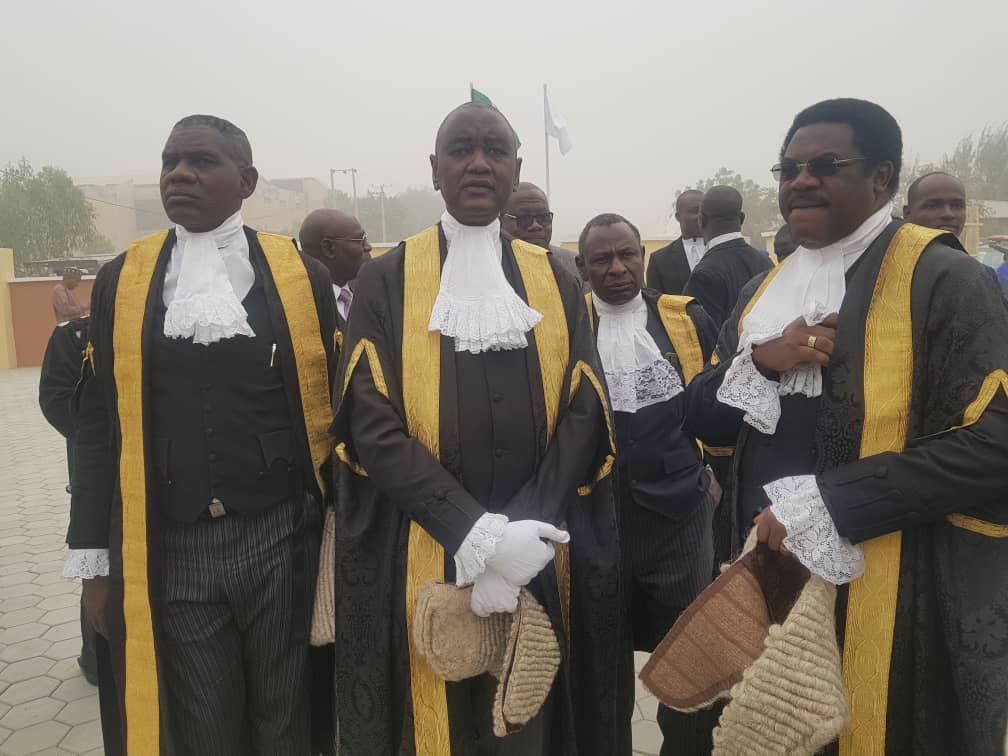
The commissioning of the new Court of Appeal Complex for the Court of Appeal, Kano Division, Kano State right after the commissioning of the Calabar and Awka Divisions is another great step in reinvigorating the Nigerian Judiciary. 


I commend my Lord, the President of the Court of Appeal, Honourable Justice Zainab Adamu Bulkachuwa and I congratulate the Justices of the Court of Appeal, the entire Judiciary of the Federal Republic of Nigeria, the President of Nigerian Bar Association, Mr. Paul Usoro SAN, all the Branch Chairmen and members of the  Branches of the Nigerian Bar Association in Kano and Jigawa States and the Governments and people of Kano and Jigawa States, on the commissioning of the Court of Appeal Complex of the Court of Appeal, Kano Division, Kano State, today, Monday 10th of February, 2020.

This commissioning hereby increases the Divisions of the Court of Appeal to nineteen (19). Like I stated earlier with regards to similar commissionings this will not only aid the swift dispensation of justice and address the high number of appeals before my noble Lords at the Court of Appeal but it will restore the hope of the average Nigerian and bring justice closer to the people.

DELE ADESINA SAN, FCI. Arb
Dele Adesina Congratulates Hon. Justice O.A. Olayinka on her Retirement from the Bench

Dele Adesina Congratulates Hon. Justice O.A. Olayinka on her Retirement from the Bench


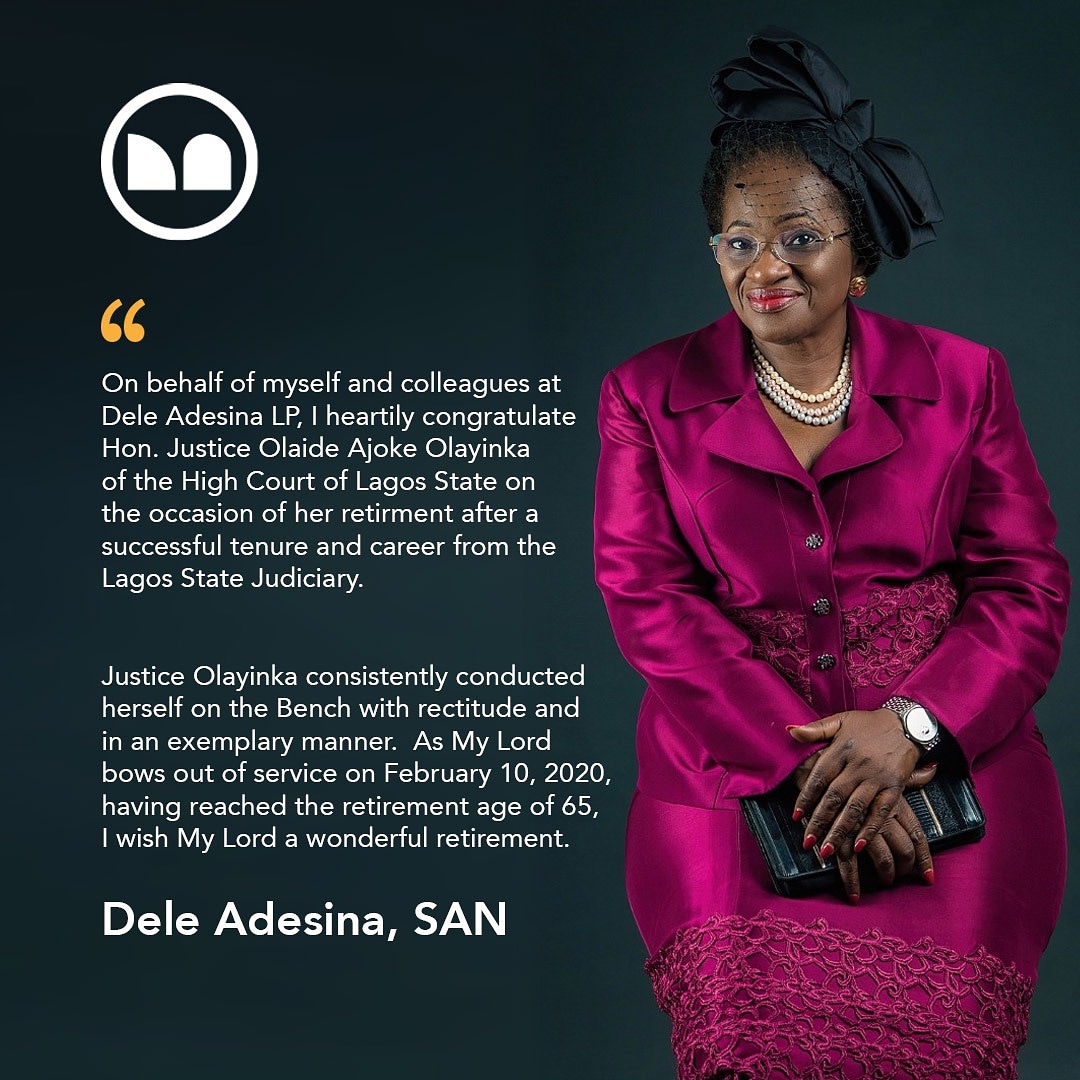
On behalf of myself and colleagues at Dele Adesina LP, I heartily congratulate Hon. Justice Olaide Ajoke Olayinka of the High Court of Lagos State on the occasion of her retirment after a success tenure and career from the Lagos State Judiciary.

Justice Olayinka consistently conducted herself on the Bench with rectitude and in an exemplary manner. As My Lord bows out of service on February 10, 2020, having reached the retirement age of 65, I wish My Lord a wonderful retirement.

Dele Adesina, SAN 

The Court of Appeal clears the air on the difference between class actions and representative actions | Olumide Babalola

The Court of Appeal clears the air on the difference between class actions and representative actions | Olumide Babalola

Christmas
came quite early for me as the Court of Appeal delivered a landmark judgment in
my appeal against Apple Inc. clarifying the difference between class actions
and representative actions. It was a journey of three years which began on the
5th day of September 2016 when I filed a class action against the
makers of iPhone (Apple Inc.) over their defective iPhone 6 which was universally
plagued with the touch-screen disease.

The
suit was certified as a class action by Hon. Justice D. T. Okuwobi after which
the certification order was advertised in national dailies and the originating
processes subsequently served on the American company at their office in California,
USA.

The Defendant was represented
by the first female maritime lawyer to take silk, Mrs. Funke Agbor, SAN of the
Firm of Adepetun Caxton Martins, Agbor & Segun who filed an objection to
the competence of my suit on the ground of non-fulfilment of condition
precedent under the now repealed Consumer Protection Council Act, LFN 2004. 

My Lord, Okuwobi, J. agreed
with the learned silk, upheld her objection and consequently struck out the
suit. The court specifically held that:

“It is a fact that
every iPhone user has a separate contract of sale when the purchase was made. The
Claimant did not at any time negotiate as an agent of all iPhone users in
Nigeria when the phones were purchased. A contractual relationship is founded
on the basis of privity. There is no evidence of assignment of the contractual
rights of       other members of the class
or that an enforceable trust has been created in his favour. There are also no
statutory exception, it is therefore my considered view that the breach of
warranty sought in    this action is not
proper in a class action.”
(Emphasis mine) 

The
emphasized part of the above holding formed the plint of Ground 1 of my notice
of appeal. The appeal was heard in October and judgement delivered on the 6th
day of December, 2019 as follows:

On
the meaning of class action
, My Lord, J.Y. Tukur, JCA who read
the leading judgement held at page 15 thus:

“As a first port of
call, it is very expedient to draw a distinction between class actions and
representative actions. According to Black’s Law Dictionary, Eighth Edition,
page 267, defines a class of actions as:

“A lawsuit in which the
court authorizes a single person or a small group of people to represent the
interests of a larger group, specifically a lawsuit in which the convenience
either of the public or of the interested parties requires that the case be
settled through litigation by or against only a part of the group of similarly
situated persons and in which a person whose interests are or may be affected
does not have an opportunity to protect his or her interests by appearing
personally or through a personally selected representative, or through a person
specially appointed to act as a trustee or guardian.”

On
the peculiarity of class action
, the court held at
page 16 that:

“In a class action, the
class must be so large that individual suits would be impracticable. There must
be legal or factual questions common to the class. The claims or defences of
the representative parties must adequately protect the interests of the class.”

On
the distinction between class action and representative action
,
the court held at page 17 that:

“(1)In my view, class
action is restricted to interpretation of written instruments, statutes,
administration of estates, property subject to trust, customary, family or
communal property, whereas a representative action on the other hand, may be
brought on any cause of action.

(2)A class action
requires appointment by the judge whereas a representative action does not
require leave of court.

(3)In a class action,
notice of appointment is required, whereas notice of representation is not
required in a representative action.

(4)Class members may
not be identifiable and ascertainable in a class of action, but interested
persons are ascertainable in a representative action.

(5)No doubt, I am aware
that in class actions, members are only to have interest whereas in
representative actions, members must have same interest. See: Order 13, Rule 12
and Order 13, Rule 13 of the High Court of Lagos State Civil Procedure Rules,
2012.”

Conclusively on the
issue, the court summed it up as follows:

There is no gainsaying the
fact that a judge is empowered to appoint one or more persons to represent a
person or class or members of the class in instances where a judge is satisfied
that a person, the class or some members of the class interested cannot be
ascertained, the person, the class or some members of the class interested,
cannot be found, the person, class and the members thereof cannot be
ascertained and be found…Thus, the lower court, in my view, went on a frolic of
its own in its position that there must be assignments of contracts of members
represented or that, an enforcement trust must be created in a class action. Accordingly,
issue 1 is resolved in favour of the Appellant and against the Respondent.”

Although, I lost the
appeal on the ground relating to non-fulfilment of condition precedent (which
ought to be tested at the Supreme Court) the silver-lining in this decision for
me, is the comprehensive consideration given to class action procedure which has
been repeatedly, in different fora, been confused with the representative
actions.

On the whole, I am
grateful to the learned Justices of the Court of Appeal for pronouncing extensively
on this procedural phenomenon which remains underutilized in our courts even
till this day.

Olumide
is
the Managing Partner of Olumide Babalola LP and he writes from Lagos, Nigeria.